Unaware Black Man Was Their $1B Deal Partner — CEO’s Wife Poured Wine on Him in Front of 200 Guests
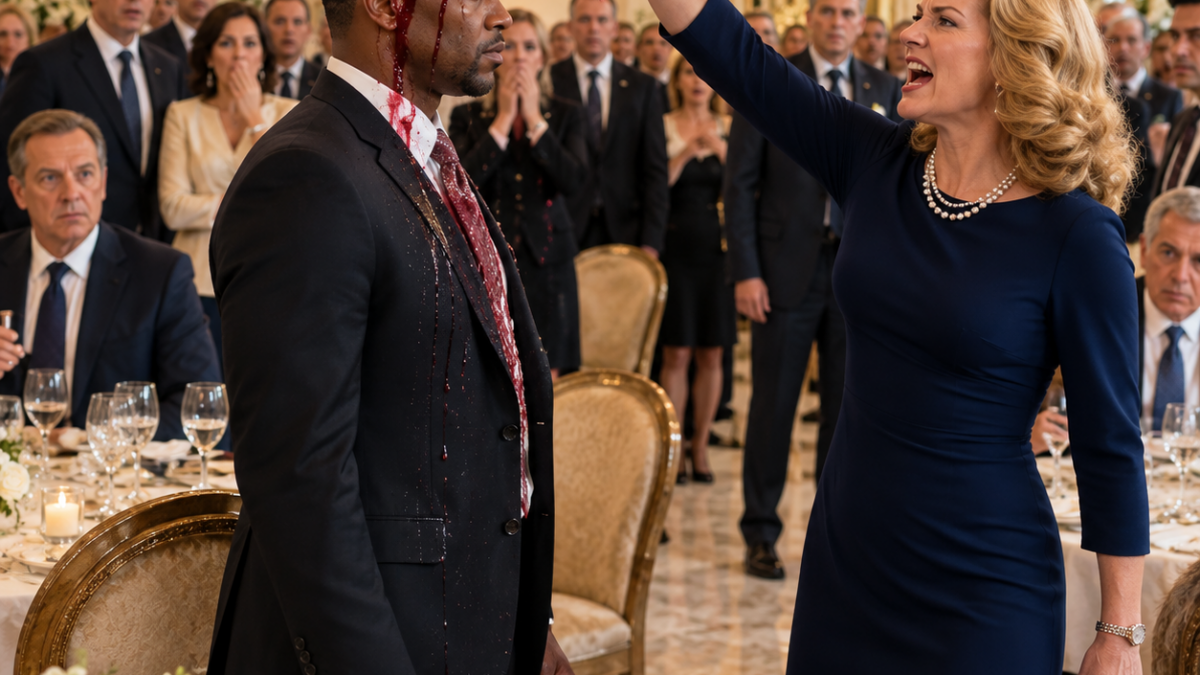
Unaware Black Man Was Their $1B Deal Partner — CEO’s Wife Poured Wine on Him in Front of 200 Guests.
Margo Sullivan looked at me and saw a Black man she believed did not belong in her ballroom.
She poured red wine down my white shirt in front of two hundred guests, certain she had just thrown out a nobody in a cheap suit.
Ten minutes later, her husband learned I was the billion-dollar deal partner he had been begging to meet, and by morning, the empire they built was already falling apart.
My name is Byron Palmer.
I grew up in Southeast Baltimore, in the part of the city tourists never visited and investors only mentioned when they wanted tax credits. The streets were narrow. The corner stores had bulletproof glass. Sirens were common enough that children learned to sleep through them. Men disappeared into prison, drugs, debt, or bad luck with a frequency that made absence feel ordinary.
My mother, Dorothy Palmer, refused to let ordinary swallow me.
She worked nights in a hospital laundry room and weekends at a grocery store. Her hands were always dry from detergent. Her feet always hurt. Her voice always had one more lesson in it, even when her body was so tired she could barely stand at the stove.
When I came home angry because a teacher had suggested I was “not college material,” my mother did not storm the school. She did not call anyone names. She simply sat me at the kitchen table, put a library card in front of me, and said, “The only person who gets to decide what you become is you.”
That sentence built me.
Not all at once.
Nothing worth building happens all at once.
I worked through high school. I earned scholarships. I slept four hours a night in college and told myself tired was temporary. I read finance books in laundromats, wrote investment models in library basements, and learned early that rooms full of powerful people often confuse volume with intelligence.
After graduation, I did not chase Wall Street.
I went home.
I rented a small office above a barbershop in Baltimore and started Meridian Capital Holdings with one desk, one used laptop, three clients, and a coffee machine that worked only when it felt respected.
Twenty years later, Meridian Capital was valued at $3.2 billion.
People liked to call me self-made.
I never liked that phrase.
Nobody is self-made.
My mother made me.
Every tired teacher who stayed after class made me.
Every client who trusted me with a small account before I had a reputation made me.
Every insult I swallowed and turned into discipline made me.
But I was private.
Very private.
No flashy cars.
No social media.
No entourage unless absolutely necessary.
No magazine covers if I could avoid them.
A few old press photos existed online, but they were outdated and grainy. Most people in finance knew my name long before they knew my face.
That privacy gave me a strange advantage.
People revealed themselves around me.
They assumed silence meant weakness.
They assumed a simple suit meant a small bank account.
They assumed a Black man standing alone in a wealthy room must be staff, security, or lost.
I never corrected assumptions too quickly.
Assumptions were useful.
They showed me who people were before money taught them to behave.
That was why I decided to attend the Sullivan Industries investment conference alone.
Sullivan Industries was dying.
Not publicly.
Not yet.
But the numbers did not lie.
PART2:
Debt had strangled them. Leadership had grown arrogant. Their old clients were leaving. Their cash flow was collapsing. Banks were circling. Suppliers were nervous. Their board was quietly panicking while their public relations team kept issuing statements about “strategic repositioning.”
Meridian Capital had spent six months negotiating a rescue package.
The deal was simple in structure and enormous in consequence.
Meridian would acquire 60% of Sullivan Industries for $1 billion.
The money would save the company.
It would protect thousands of jobs.
It would keep creditors calm.
It would buy Sullivan Industries one last chance to become something other than a family name sliding toward bankruptcy.
I had never met Leonard Sullivan in person.
He had never met me either.
Negotiations had gone through lawyers, bankers, and encrypted calls. Leonard knew Meridian. He knew my reputation. He knew I was the man behind the money.
But he had never looked me in the eye.
Before I signed a billion-dollar check, I wanted to see the Sullivans when they did not know they were being watched.
So I went alone.
No assistant.
No security team.
No Meridian name badge.
No private car.
Just a dark suit, a white shirt, and an invitation under a name most guests would not recognize until it was too late.
The Sullivan Industries annual investment conference was held at the Kensington Hotel in Washington, D.C., a place built to make powerful people feel even more certain of themselves.
The ballroom was all crystal, marble, white tablecloths, polished silver, and fresh lilies arranged so perfectly they looked nervous. A string quartet played near the far wall. Champagne moved through the room on trays. Men in tailored suits stood in clusters, laughing softly over numbers that could ruin entire towns. Women in expensive dresses leaned close to one another, speaking in low voices that carried more judgment than volume.
There were senators.
Hedge fund partners.
PART3:
Corporate executives.
Old-money families.
Board members.
Reporters who pretended not to be listening.
Two hundred people, maybe more.
Almost every face in that ballroom was white.
I stepped inside at 11:15 and paused just long enough to understand the room.
No one greeted me.
No one checked my invitation.
No one asked my name.
Several people looked at me and then looked past me, their eyes sliding away with practiced ease.
To them, I was not a guest.
I was an interruption in the wrong suit.
I moved toward the VIP reception area and stood near a table with place cards arranged in alphabetical order. Somewhere in that hotel, Leonard Sullivan was probably fighting with banks, praying I would sign the deal that kept his company breathing.
Across the ballroom, his wife saw me.
Margo Sullivan.
I knew her from photographs.
Washington society pages loved her.
Charity boards, gala committees, museum fundraisers, hospital benefits. Margo Sullivan had built a reputation on appearing generous in public rooms while standing beside larger checks written by other people.
She had silver-blonde hair, pearls at her throat, and the kind of smile that never wasted itself on anyone without status.
I watched her eyes lock onto me.
She did not check the guest list.
She did not ask a staff member.
She did not consider, even for one second, that I might be the most important person in the room.
She saw a Black man standing alone near the VIP section.
That was enough.
Margo set down her champagne glass and crossed the ballroom with the confidence of someone who expected floors, doors, and people to make way for her.
They did.
She stopped in front of me.
Close enough that I could smell her perfume.
Sharp.
Floral.
Expensive.
Suffocating.
“Excuse me,” she said.
Her voice was loud enough for nearby guests to hear.
“This area is reserved for our VIP guests.”
I looked at her calmly.
“I’m an invited guest.”
Her mouth curved into a smile that had nothing to do with kindness.
“You?”
“Yes.”
“I personally approved every name on that list,” she said. “And I can promise you there is no one like you on it.”
There it was.
No one like you.
Not no one with your name.
Not no one matching your invitation.
No one like you.
A woman nearby set down her glass.
A man in a gray suit suddenly became fascinated by his phone.
No one spoke.
“I’m on the list,” I said.
“Do not argue with me.”
“I’m not arguing. I’m telling you a fact.”
Her eyes hardened.
“This is a private event. For professionals. For people of a certain caliber.”
She paused on caliber.
Let it land.
Let the room hear it.
Let me understand where she had placed me.
I had spent twenty years in boardrooms with men who smiled while doubting me. I had seen banks question my numbers after praising weaker models from white competitors. I had watched receptionists assume I was a courier until someone important whispered my title. I knew the flavor of what stood in front of me.
This was not confusion.
This was recognition of a kind.
Margo recognized my race before my humanity.
“I have every right to be here,” I said.
Her nostrils flared.
“Rights?”
Her voice rose.
A waiter slowed nearby, tray shaking slightly in his hands.
Margo stepped closer.
“You don’t walk into a room like this dressed like that and talk to me about rights.”
The ballroom quieted.
Not completely.
Rooms like that are trained not to show discomfort too openly.
But conversations thinned.
Forks slowed.
Eyes shifted.
People were listening.
No one was intervening.
I looked around once.
A senator’s wife watched from a table near the stage.
A hedge fund partner stared at his shoes.
A retired diplomat lifted his water glass and pretended to sip.
Two hundred powerful people surrounded us, and not one of them found a voice.
That silence told me more than Margo’s words.
“I understand this is your event,” I said. “But I’m not leaving.”
Her face changed.
It was not surprise.
It was rage.
Not explosive yet.
Worse.
Controlled.
The kind that belongs to someone who has spent a lifetime being obeyed and cannot process refusal from a person she considers beneath her.
“You are not leaving?”
“No.”
“A Black man in a bargain suit is standing in my VIP section refusing to leave.”
A gasp came from somewhere behind me.
Small.
Quickly swallowed.
Margo turned slightly, addressing the nearby guests like they were her jury.
“Can you believe this? I asked him politely to leave. I explained the situation, and he just stands here.”
Nobody answered.
Of course they did not.
Cowardice wears formalwear too.
“You know what your problem is?” Margo said, turning back to me.
“I doubt you do.”
Her smile vanished.
“People like you always think rules don’t apply to you.”
“People like me.”
“Yes. People like you.”
The waiter was still near us, pretending to adjust a table setting. He was young, maybe twenty-five, Black, thin, careful. His eyes flicked toward mine for half a second and away again.
He had learned the room too.
He knew when a person could speak and when a person had to survive.
Margo jabbed a manicured finger toward my chest, stopping just short of touching me.
“The rule right now is that you do not belong here.”
“That is your opinion,” I said. “Not a fact.”
The calmness in my voice made her angrier than shouting would have.
Her jaw tightened.
“I am the host. My opinion is the fact in this room.”
“No,” I said. “It is only your opinion said loudly.”
The string quartet had gone quiet.
I noticed that then.
The cellist’s bow hovered above the strings.
Margo’s face flushed red beneath the pearls.
For a moment, I thought she might slap me.
Instead, she turned sharply and walked away.
Her heels struck the marble like small cracks of thunder.
The room exhaled.
People shifted.
Someone whispered.
A few guests glanced at me and then away again, relieved they could pretend the moment had passed.
It had not passed.
Not for me.
Not for Margo.
Not for Sullivan Industries.
The young waiter came near me again, holding an empty tray like a shield.
“Sir,” he whispered without looking directly at me. “You should go. She won’t stop.”
I studied him.
His hands were trembling.
Not from weakness.
From experience.
“What’s your name?” I asked quietly.
“Malik.”
“Thank you, Malik.”
He swallowed.
“I’m sorry.”
“You didn’t do it.”
“No,” he said. “But I didn’t stop it either.”
I looked at the silent ballroom.
“You weren’t the only one.”
He moved away, pain on his face.
Across the room, Margo stood near the bar.
She was not done.
I could see that immediately.
She picked up a glass of red wine.
Not champagne.
Red wine.
Dark, almost black under the chandelier light.
She held it loosely, swirling it once, her eyes fixed on me.
I felt something settle inside me.
Not fear.
Not even anger.
Clarity.
Some moments arrive carrying their own witness.
You understand, while they are happening, that life is dividing itself into before and after.
Margo walked back toward me.
The ballroom felt the storm before it broke.
Conversations died.
Heads turned.
The waiter Malik froze near the service corridor.
Margo stopped two feet away.
Her eyes were open now.
No mask.
No society smile.
No charity-board polish.
Just contempt.
“Move out of my event,” she said, using words uglier than that, words meant to reduce me to my skin and nothing else.
I held her gaze.
“I am an invited guest. I am not leaving.”
Something snapped.
She lifted the wine glass and poured it down the front of my white shirt.
Not splashed.
Not spilled.
Poured.
Deliberately.
The cold wine struck my chest and bloomed through the fabric like a wound. It ran down my shirt, soaked through to my skin, dripped onto my belt, and fell in red drops onto the polished marble floor.
The room held its breath.
I could smell it.
Sharp.
Acidic.
Expensive.
The stain spread across my shirt while two hundred people watched.
Margo lowered the empty glass and spoke loudly enough for every table to hear.
“This is how I deal with people who don’t know their place.”
She said more than that.
Crueler words.
Racial words.
Words that revealed exactly what had been sitting behind her pearls the entire time.
Phones began to rise.
One.
Then another.
Then another.
Tiny red recording lights blinked awake across the ballroom.
Margo either did not notice or did not care.
I looked down at my shirt.
I felt the cold wine against my skin.
My pulse spiked once.
Then leveled.
Twenty years of negotiations had taught me many things. One of them was this: the person who loses control first loses the room.
Margo thought she owned the room.
She had just handed it to me.
I reached into my breast pocket and removed a white handkerchief.
Slowly, I wiped my shirt once.
Then again.
The handkerchief turned red at the center.
I folded it carefully and placed it on the nearest table.
Then I looked directly into Margo Sullivan’s eyes.
“I hope you remember this moment.”
My voice was quiet.
In that silence, everyone heard it.
Margo smiled coldly.
“Oh, I will. The moment I threw you out of my gala.”
“No,” I said. “The moment you destroyed it.”
For the first time, something uncertain flickered in her eyes.
She buried it quickly.
“Security,” she called.
Two men in dark suits appeared near the service entrance.
Hotel security.
Professional.
Careful.
Already uncomfortable.
Margo pointed at me as if I were something spilled.
“This man is not a guest. He walked in off the street, harassed me, and disrupted my event. Remove him immediately.”
The taller guard looked at my wine-soaked shirt.
Then at Margo.
Then at me.
“Sir,” he said quietly, “I need you to come with us.”
He did not believe her.
I saw it.
He knew something was wrong.
But he was still going to obey her.
That is how rooms like that work.
Power tells the lie.
People afraid of losing paychecks carry it.
“I understand,” I said.
I did not pull out my invitation.
I did not give my name.
I did not say Meridian.
Not yet.
There are moments when revealing the truth too early lets guilty people rearrange themselves.
I wanted the room exactly as it was.
Honest.
Cowardly.
Recorded.
The guards flanked me.
One on each side.
They walked me through the center of the ballroom beneath chandeliers and silence.
Every table watched.
No one stood.
No one said, “Stop.”
No one said, “This is wrong.”
The walk felt long enough to age a man.
I passed senators, executives, donors, board members, lawyers, people who made speeches about equality at luncheons and wrote checks to foundations with diversity in their names.
They watched a Black man in a wine-stained shirt being escorted out after a racist humiliation, and every one of them discovered something urgent to do with their eyes.
Near the kitchen entrance, Malik stood with his tray pressed to his chest.
His lips moved.
I could barely make out the words.
I’m sorry.
I did not look back at Margo.
She did not deserve that much of me.
At the same moment I reached the ballroom doors, Senator Richard Coleman entered from the lobby.
I knew Coleman.
Not closely, but well enough.
He had spoken at a Meridian community investment event the year before. He understood money, politics, and the power of being seen shaking the right hand at the right time.
He stopped when he saw me.
His face changed from practiced public warmth to genuine recognition.
“Byron Palmer?”
The name cut through the ballroom like a bell.
The guards stopped.
I stopped.
Every head turned.
Senator Coleman walked toward me with his hand extended.
“Mr. Palmer,” he said loudly, warmly, clearly. “It’s good to see you again.”
He shook my hand firmly.
Then he looked at the wine stain and frowned.
But he did not ask the question yet.
He gave the room the information first.
“I was just telling the Senate Finance Committee about the work Meridian Capital is doing. Three-point-two billion in assets and you still show up without an entourage. That’s why I’ve always respected you.”
The words landed one by one.
Meridian Capital.
Three-point-two billion.
Byron Palmer.
Recognition spread through the ballroom like a shockwave.
Whispers.
Gasps.
The scrape of a chair.
Someone said, “Oh my God.”
The guards stepped away from me as if they had been burned.
Margo stood fifteen feet away, one hand still curled as though it held the empty wine glass.
Her face drained of color.
Her mouth opened.
No sound came out.
Behind her, the conference room doors opened.
Leonard Sullivan stepped back into the ballroom with his phone in his hand and exhaustion on his face. He had clearly just finished a brutal call. His tie was loosened. His forehead shone with sweat.
He saw Senator Coleman first.
Then me.
Then my wine-stained shirt.
Then the guards.
Then Margo.
And in one terrible second, every piece connected.
His wife had poured wine on his billion-dollar lifeline.
His wife had publicly humiliated the man whose signature stood between Sullivan Industries and collapse.
His wife had done it in front of two hundred witnesses and recording phones.
Leonard’s hand tightened around his phone.
He looked at Margo with the expression of a man watching his house burn and recognizing the person holding the match.
I turned to Senator Coleman.
“Always good to see you, Senator.”
My voice was calm.
Then I took out my phone.
I called Elliot Simmons, my general counsel.
He answered immediately.
“Byron?”
“Pull the Sullivan deal,” I said. “All of it. Every dollar. Effective immediately.”
I did not explain.
Elliot did not ask.
That was why he was my lawyer.
“Understood,” he said.
I ended the call and walked out of the ballroom.
This time, no one tried to stop me.
The doors closed behind me with a soft click.
That sound ended Sullivan Industries.
The next morning, Meridian Capital issued a one-line press release at 6:00 a.m.
Meridian Capital Holdings has terminated all acquisition discussions with Sullivan Industries effective immediately, citing irreconcilable differences in corporate values.
Twenty-three words.
That was all it took.
By the time markets opened, Sullivan Industries stock was already falling. Investors did not need the full story. They only needed to know the billion-dollar rescue had vanished.
By noon, the stock had dropped more than twenty percent.
By close, it was down over thirty.
Trading halted twice.
Leonard Sullivan called my office four times.
Each time, my receptionist took his name and told him I was unavailable.
The fifth time, she said, “Mr. Palmer has no further business with Sullivan Industries.”
Then she hung up.
He called Elliot.
Elliot let him speak for forty-five seconds.
Then he said, “The deal is dead, Mr. Sullivan. There is nothing to discuss.”
That was the business consequence.
The public consequence arrived faster.
The first video hit the internet three hours after the conference.
It was shaky, filmed from under a table, but the audio was clear enough.
Margo’s voice.
The wine.
The silence.
By midnight, millions had seen it.
The second video showed security escorting me out.
The third showed Senator Coleman recognizing me, saying my name, and detonating the truth in front of the entire ballroom.
The internet did what the internet does.
It replayed the worst moment of Margo Sullivan’s life until her name became shorthand for everything she thought she could hide behind money.
But I was not interested in memes.
I was interested in precedent.
Six weeks later, my legal team filed suit.
Racial discrimination.
Intentional infliction of emotional distress.
Defamation.
There were videos.
Witness statements.
Security testimony.
Clear audio.
No ambiguity.
Margo’s attorneys tried to call it a misunderstanding.
They said she was overwhelmed.
They said she was protecting the event.
They said my attire had contributed to confusion.
That last argument made the courtroom go cold.
Elliot Simmons stood during cross-examination and played the video.
On a large screen.
Audio clear.
Margo pouring wine.
Margo using racial language.
Margo ordering my removal.
Then Elliot paused the frame at the exact moment her hand tipped the glass.
“Mrs. Sullivan,” he said, “was race part of your misunderstanding?”
Her mouth opened.
Nothing came out.
He played the second clip.
“Was that also a misunderstanding?”
Silence.
The jury deliberated for four hours.
They found Margo Sullivan liable on all counts.
Fifteen million dollars.
Five million compensatory.
Ten million punitive.
Reporters liked the number.
I cared more about the record.
When a morning show asked why I sued, I told the truth.
“Fifteen million dollars does not change my life,” I said. “But consequence changes culture. The next person who has wine poured on them, the next person called names because of their skin, the next person humiliated in a room full of silent people may not have a billion-dollar company behind them. I wanted proof that this has weight.”
That clip went everywhere.
But the part that mattered most to me did not happen in a studio.
It happened two months later in a community center in Southeast Washington.
No chandeliers.
No string quartet.
No marble.
Just folding chairs, fluorescent lights, and sixty people sitting close together because the room was too small for what we were announcing.
The Palmer Foundation.
A $10 million seed capital fund for Black entrepreneurs in underserved communities.
First city: Washington, D.C.
Second: Baltimore.
My hometown.
People expected me to talk about Margo.
I did not.
I talked about my mother.
I told them about Dorothy Palmer, who worked two jobs and still walked me to the library every Saturday. I told them how she sat in the parking lot doing crossword puzzles while I read for hours because she believed books were doors and did not care how long it took me to open them.
I told them about the day I came home crying after a teacher told me I would never amount to anything.
I told them what my mother said.
The only person who gets to decide what you become is you.
The room went quiet.
Not like the Kensington Ballroom.
Not guilty quiet.
Human quiet.
The kind that happens when truth enters gently and everyone makes room.
Then someone in the back began to clap.
Soon the whole room stood.
That applause felt nothing like victory.
It felt like responsibility.
Meanwhile, the Sullivan name continued collapsing.
The bank recalled a $200 million loan.
Sullivan Industries froze payroll.
Clients withdrew contracts.
Board members resigned.
Leonard was removed as CEO.
Within weeks, the company filed for bankruptcy protection.
The business his father had built, the company Leonard had inherited and expanded, became a case number in federal court.
Leonard moved out of the Sullivan home not long after.
According to someone who knew them, he said one sentence before leaving.
“You didn’t just ruin my company, Margo. You ruined everything.”
She had no answer.
That may have been the first honest silence of her life.
People called what happened revenge.
They were wrong.
Revenge would have been personal.
Consequence is structural.
Revenge wants someone to suffer.
Consequence says actions have weight, and that weight does not disappear because you are rich, connected, white, polished, protected, or used to being obeyed.
Margo Sullivan looked at me and saw nothing.
She did not ask my name.
She did not check her list.
She did not wonder why I was there.
She saw my skin and made her decision.
That decision cost her husband his company, his career, and his marriage.
It cost her reputation.
It cost her money.
It cost her access to rooms she once believed belonged to her by birthright.
And it gave me the platform to build something she never could.
Something real.
I have been asked many times why I did not announce myself sooner.
Why I did not pull out a business card.
Why I let her keep going.
The answer is simple.
A person does not become racist because they fail to recognize a billionaire.
They reveal racism when they think there is no consequence.
Margo treated me that way because she thought I had no power.
The room stayed silent because they thought defending me might cost them something.
That was the real stain in the ballroom.
Not the wine.
The silence.
Red wine washes out poorly, but it can wash out.
Cowardice leaves a deeper mark.
Years from now, people may forget Sullivan Industries.
They may forget the stock price, the bankruptcy filing, the legal language, and the size of the verdict.
But I hope they remember one thing.
The measure of a person’s character is not how they treat someone once they know that person is important.
It is how they treat someone before they know.
Margo Sullivan looked at a Black man in a simple suit and saw someone she could humiliate.
She was wrong.
But more than that, she showed the world exactly why people like her should never be trusted with power.
As for me, I still wear simple suits.
I still show up without an entourage when I want to know the truth.
I still listen more than I speak.
Because quiet reveals things.
It revealed Margo Sullivan.
It revealed two hundred silent guests.
It revealed a young waiter named Malik, who later received a Meridian scholarship to finish business school because guilt should not be the only thing he carried from that room.
And it revealed what my mother taught me long before money ever found my name.
No one else gets to decide what I amount to.
Not a teacher.
Not a boardroom.
Not a ballroom full of cowards.
Not a woman with a glass of red wine and hatred dressed as etiquette.
Only me.








