Two Shelter Cats Were Adopted Into Separate Homes—Then Both Stopped Eating Until Their Families Realized Who They Were Missing
PART3:
Normally she stayed at the opposite side.
Maya noticed but thought little of it.
Then Milo stopped crying.
She looked.
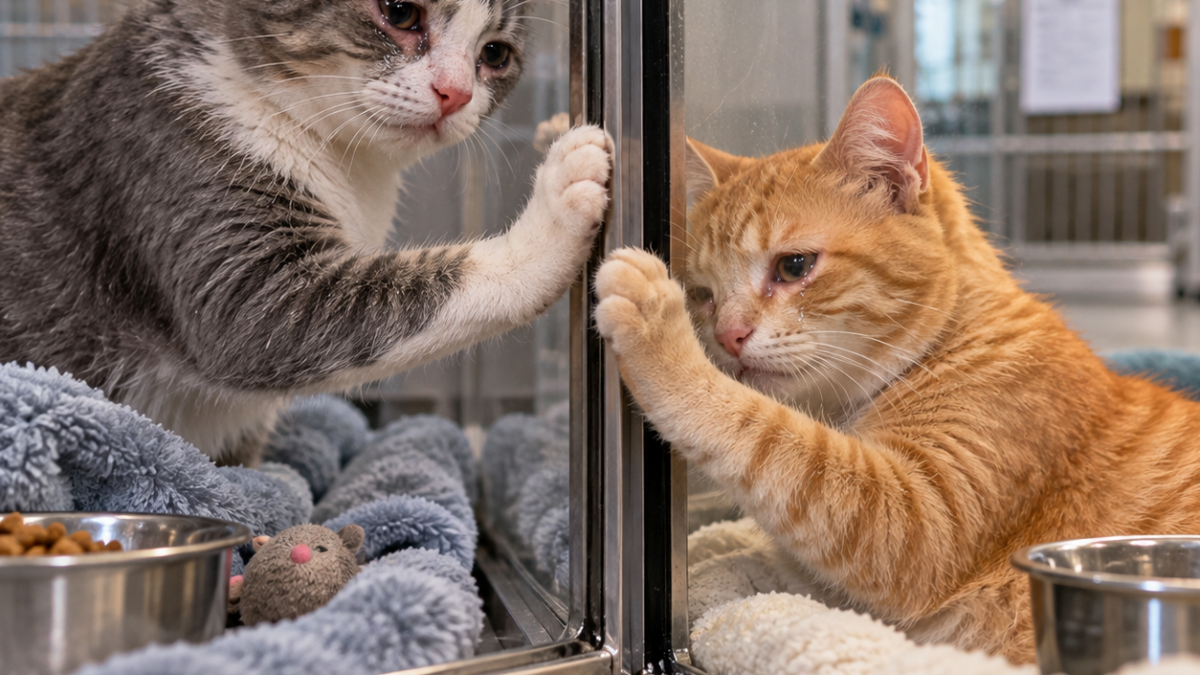
His orange body had pressed against his side of the divider.
Juniper’s gray body rested against hers.
They could not see each other.
A solid panel separated them.
But they could hear.
Smell.
Feel movement through the wall.
Maya smiled.
“Well.”
The next morning, Juniper ate almost her entire breakfast.
Maya noticed that too.
Coincidence.
Probably.
That afternoon, volunteers rotated cats into the social room.
Milo went first.
He investigated everything.
Window.
Toy basket.
Chair.
Water dish.
Then screamed at the door.
Maya let Juniper in.
Juniper froze.
Milo froze too.
They stared at each other.
Maya expected hissing.
Maybe defensive posturing.
Instead Milo walked toward Juniper.
Slowly.
He stopped three feet away.
Juniper sniffed.
Milo sat.
Juniper approached.
Nose to nose.
Nothing dramatic.
No instant cuddle.
Milo turned away.
Walked toward the window.
Juniper followed.
Fifteen minutes later, they sat beside each other.
By the end of the hour, Juniper was grooming the top of Milo’s head.
Maya wrote:
POSITIVE SOCIAL SESSION WITH MILO. JUNIPER SIGNIFICANTLY MORE ACTIVE.
The next day they went together again.
Then the next.
Within a week, shelter staff stopped pretending the arrangement was temporary.
If the social room was free, Juniper and Milo went together.
They ate side by side.
Milo learned not to scream at dinner because Juniper would stare at him with what Maya called “deep maternal disappointment.”
Juniper began playing.
That shocked everybody.
A feather wand she had ignored for three weeks suddenly became interesting if Milo chased it first.
Milo would leap.
Juniper would watch.
Then pounce.
He taught her chaos.
She taught him restraint.
Sort of.
Milo climbed shelves.
Juniper watched from below.
When he knocked something over, she walked away as if denying association.
At nap time, the pattern reversed.
Juniper chose the spot.
Milo curled around her.
Always touching.
A paw.
A shoulder.
Tail against tail.
Something.
When strangers entered, Milo usually approached first.
Juniper stayed back.
If someone moved too quickly toward her, Milo returned.
Sat near her.
Not defending.
Not aggressive.
Simply there.
Maya began calling them:
“The married couple.”
Another volunteer preferred:
“The old couple.”
They were three and two.
Nobody cared.
They had routines.
Morning breakfast.
Grooming.
Window.
Nap.
Afternoon play.
Dinner.
Then Juniper washing Milo’s ears while he behaved as though this service had been contractually guaranteed.
People began noticing them during adoption visits.
Unfortunately, they rarely wanted both.
A family would point.
“The gray one is beautiful.”
Maya would say:
“She’s very close with Milo.”
Another visitor:
“We already have an orange cat, so maybe just Juniper.”
Or:
“We want Milo. He’s outgoing.”
“What about the gray one?”
“Our lease only allows one.”
The rescue discussed formally labeling them bonded.
That term mattered.
A bonded pair would be adopted only together.
But rescues also have to be careful.
Two cats can enjoy each other without being psychologically dependent.
Labeling every friendship a bonded pair can make adoption significantly harder.
Some pairs wait months longer.
Sometimes years.
So the staff evaluated.
Did they panic when temporarily separated?
Not severely.
Would Juniper eat without Milo?
Usually.
Would Milo play without Juniper?
Yes.
Were they affectionate with humans independently?
Increasingly.
The consensus was:
Strongly attached.
Preferred placement together.
But not mandatory.
Maya wrote:
IDEALLY ADOPT TOGETHER IF POSSIBLE.
That sentence would later haunt her.
Four months after Juniper arrived, Emily Carter walked into the shelter.
Thirty-four.
Elementary-school teacher.
Recently moved into a small townhouse.
No other pets.
She wanted a quiet adult cat.
Maya immediately thought of Juniper.
Emily sat in the social room.
Juniper stayed near the wall.
Milo climbed directly into Emily’s tote bag.
She laughed.
“I think this one is trying to steal my wallet.”
“That’s Milo.”
“He’s friendly.”
“He is a criminal.”
Juniper approached after ten minutes.
Emily held out one hand.
Juniper sniffed.
Then pressed her forehead against it.
Emily’s face softened.
“Oh.”
Maya saw it.
The moment.
Shelter workers learn to recognize it.
Emily spent nearly an hour with both cats.
But her townhouse lease allowed one animal.
“I wish.”
She said it twice.
“I really do.”
Maya explained their relationship.
“They’re very close.”
“Bonded?”
“Not officially.”
“What does that mean?”
“We would prefer them together.”
“But Juniper can be adopted separately?”
“Yes.”
Maya hesitated.
“We believe so.”
Emily looked at Juniper.
The gray cat was now sitting in her lap.
Milo slept against her ankle.
“What happens to Milo?”
“He stays here until adopted.”
“Will Juniper be okay?”
Maya answered honestly.
“We expect an adjustment period.”
“But yes?”
“We believe she can adapt.”
Juniper was adopted the following Saturday.
Milo watched her carrier leave the social room.
He cried.
Maya felt awful.
Then he ate dinner that night.
Played the next morning.
Slept in Juniper’s usual bed.
That reassured everyone.
See?
He missed her.
Of course.
But adaptation.
That was what shelters existed to help animals do.
Two days later, Milo met Daniel and Priya Shah.
Young married couple.
No children.
Both worked partly from home.
They wanted a friendly adult cat.
Milo climbed onto Daniel’s shoulders within fifteen minutes.
Decision made.
When Maya explained Juniper, Priya asked:
“Was she adopted?”
“Yes.”
“That’s good.”
“It is.”
Maya told herself that too.
Three days after Juniper left, Milo went home.
The shelter staff celebrated.
Two successful adoptions in one week.
Exactly the outcome everyone was supposed to want.
Empty kennels meant space for other cats.
Juniper had a quiet home.
Milo had two attentive people.
Everything looked right.
For about forty-eight hours.
Emily sent an update first.
Juniper is hiding a lot, but I expected that. She ate a little last night.
Maya replied:
Very normal. Give her space and routine. Please keep us posted.
Day three:
Juniper came out.
Explored.
Used the litter box.
Ate half her breakfast.
Good.
Day four:
She began sitting near the front door.
Emily thought maybe she liked the light.
That night Juniper slept on the doormat.
Not on Emily’s bed.
Not on the couch.
Door.
Day five:
Juniper cried at two in the morning.
Emily woke.
Found her pacing between the front door and living-room window.
“Hey.”
Juniper looked at her.
Meowed.
Emily picked her up.
Juniper tolerated it briefly.
Then jumped down.
Returned to the door.
Emily texted Maya the next morning.
Is this still normal adjustment?
Maya answered:
Possibly. Is she eating?
Less.
How much less?
Maybe half.
That raised concern.
Maya suggested warming wet food.
Quiet location.
Feliway diffuser.
Veterinary check if appetite continued dropping.
Across town, something similar was happening.
Milo entered Daniel and Priya’s home loudly.
As expected.
He inspected every room.
Yelled at the refrigerator.
Slept on their bed the first night.
They thought:
Easy cat.
Then he stopped sleeping there.
Second night, he sat in the hallway.
Third night, he cried.
Not his usual demanding meow.
Different.
Longer.
Repeated.
Priya walked around the apartment carrying him.
“What do you need?”
Food?
Ignored.
Water?
Fine.
Litter?
Clean.
Toy?
No.
He walked to a closet door.
Cried.
They opened it.
Nothing.
He walked to the bedroom.
Cried.
Front door.
Cried.
Day four, Milo ate half his meal.
Day five, less.
Daniel emailed the shelter.
Quick question: Did Milo have a favorite food there? He seems stressed and appetite is dropping.
Maya read the message.
Then Juniper’s update.
Something uncomfortable moved through her.
She opened the adoption records.
Juniper:
Front door.
Night crying.
Appetite decreased.
Milo:
Night crying.
Appetite decreased.
She went into the cat room.
Looked at the two empty kennels.
Side by side.
“Oh.”
Her coworker Lena glanced over.
“What?”
“I think we made a mistake.”
They contacted both adopters.
Separately.
Asked detailed questions.
Juniper was medically evaluated first.
Nothing obvious.
Temperature normal.
No infection.
No dental pain.
No gastrointestinal symptoms.
Basic bloodwork unremarkable.
The veterinarian asked Emily:
“Any major change immediately before this?”
“Adoption.”
“Other animals?”
“No.”
“Was she housed with anyone?”
Emily remembered.
“Milo.”
Across town, Milo’s exam produced nearly the same result.
Healthy.
Stressed.
Weight slightly down.
Priya asked the veterinarian:
“Can cats get depressed?”
The veterinarian answered carefully.
“They can experience stress-related behavioral and appetite changes.”
“Because he misses another cat?”
“Absolutely possible.”
Priya called the shelter from the parking lot.
“I think he misses Juniper.”
At almost the exact same time, Emily left Maya a voicemail.
“I know this sounds ridiculous, but I think Juniper is waiting for Milo.”
Maya sat at the desk listening.
Then looked at Lena.
“Both.”
“What?”
“They both called.”
Same morning.
Same conclusion.
Nobody celebrated being right.
They had separated them.
Not cruelly.
Not carelessly.
They made a reasonable adoption judgment based on what they had observed.
And it had been wrong.
Maya called Emily first.
“I want to try something.”
“What?”
“Would you be willing to bring Juniper back here temporarily?”
Emily’s voice changed.
“Are you taking her away?”
“No.”
“Absolutely not.”
“No.”
Maya slowed down.
“We’re not revoking anything.”
“Okay.”
“We want to see how she responds to Milo.”
Silence.
“Milo?”
“Yes.”
“Is something wrong with him?”
Maya hesitated.
“He’s having similar issues.”
Emily whispered:
“Oh.”
Then:
“When?”
“Tomorrow if possible.”
Daniel and Priya agreed immediately.
The next afternoon, Juniper arrived first.
She hated the carrier.
Emily set it in the old social room.
Opened it.
Juniper stayed inside.
Maya sat nearby.
“You remember this place?”
Juniper did not answer.
Obviously.
But her body was tense.
The shelter smelled familiar.
Cats.
Disinfectant.
Food.
Voices.
Emily knelt.
“I’m right here.”
Ten minutes later, Daniel and Priya arrived carrying Milo.
He was crying before they entered the room.
The sound reached Juniper through the door.
Everything changed.
Her head snapped up.
Ears forward.
Body lifted.
Milo cried again.
Juniper stepped out of her carrier.
Fast.
Faster than Emily had seen her move since adoption.
Maya opened the interior door.
Daniel placed Milo’s carrier on the opposite side.
He screamed.
“MRRAOW.”
Juniper answered.
One sharp meow.
Priya covered her mouth.
“Oh my God.”
Maya opened Milo’s carrier.
He came out immediately.
Stopped.
Saw Juniper.
For half a second, neither moved.
Then Milo ran.
Juniper ran too.
They met in the center of the room.
Nose.
Face.
Shoulder.
Milo pressed his entire head beneath Juniper’s chin.
Juniper began grooming him.
Fast.
Forehead.
Ear.
Cheek.
Milo purred loudly enough that Emily could hear from across the room.
Priya started crying.
Daniel looked away and wiped his face.
Emily sat on the floor.
Juniper did something she had not done all week.
She lay down.
Fully.
Relaxed.
Milo curled against her.
Within three minutes they were touching from shoulder to hip.
Within ten, Milo ate.
Maya had placed a small dish nearby as a test.
He walked over.
Ate almost the entire portion.
Juniper followed.
Ate too.
No coaxing.
No warmed food.
No medication.
No feeding tricks.
Maya leaned against the wall.
“I’m sorry.”
Emily looked at her.
“For what?”
“We should have known.”
Priya shook her head.
“How?”
“We saw how close they were.”
“But you couldn’t know this.”
Maya did not feel absolved.
Shelter work teaches you that doing your best does not prevent mistakes.
Good intentions can still produce pain.
The responsibility is not to become perfect.
It is to correct what you can once you understand.
The four humans sat in the room while Juniper and Milo slept together.
Then came the difficult conversation.
They could not simply send each cat back to separate homes.
Not after this.
Maya said it first.
“I think we need to consider them bonded.”
Nobody disagreed.
The problem:
Which home?
Emily’s lease allowed one animal.
Daniel and Priya’s allowed two.
That seemed obvious.
Except Emily loved Juniper.
Five days had been enough.
She had already bought a cat tree.
Changed her morning routine.
Learned Juniper liked the right side of the couch.
She had spent nights sitting beside her on the floor.
Taking Juniper away would hurt.
Priya knew.
She looked at Emily.
“You should have her.”
Emily shook her head.
“Your place allows both.”
“We can ask the landlord to add Milo—”
“No.”
Priya stopped.
Emily stroked Juniper’s back.
“She needs him more than she needs my townhouse.”
Her voice broke.
Juniper looked up.
Emily smiled through tears.
“That’s rude, by the way.”
Everyone laughed softly.
Daniel said:
“What if we help you move?”
“What?”
“If your lease is the only problem.”
Emily stared.
“I’m not moving because of a cat I’ve had five days.”
Pause.
Then:
“Two cats.”
Maya smiled.
They explored every option.
Landlord exception.
Pet deposit.
Lease amendment.
Emily called.
The property manager was polite but firm.
One pet maximum.
No exception.
Daniel and Priya could take both immediately.
Emily sat in her car afterward and cried for twenty minutes.
Not because someone was taking Juniper from her.
Because doing the right thing sometimes still hurts.
She called Maya.
“They should go with Daniel and Priya.”
“You’re sure?”
“No.”
Honest.
Then:
“But yes.”
Maya closed her eyes.
“I’m sorry.”
“Stop apologizing.”
“I keep feeling like—”
“Maya.”
“Yes?”
“You reunited them.”
That mattered.
Juniper returned temporarily to the shelter while paperwork was adjusted.
Emily visited every day.
Daniel and Priya prepared their home for two cats.
Second litter box.
Then Maya corrected them.
“Three.”
Daniel stared.
“Three?”
“General recommendation. Number of cats plus one.”
“That feels like propaganda from the litter industry.”
Maya laughed.
“Three.”
They bought three.
Two feeding stations.
Extra bed.
More vertical spaces.
The following Saturday, Juniper and Milo left together.
One large hard-sided carrier was technically available.
Maya recommended separate carriers for transport.
They placed them side by side in the back seat.
Milo cried once.
Juniper answered.
Then both settled.
Emily came to say goodbye.
She knelt beside Juniper’s carrier.
The gray cat pressed her nose toward the bars.
Emily pushed one finger through.
“I love you.”
She laughed at herself.
“Five days and I’m saying that.”
Juniper rubbed her face against the finger.
Emily cried again.
Priya hugged her.
“Come visit.”
“Don’t say that unless you mean it.”
“I mean it.”
She did.
Juniper entered Daniel and Priya’s home differently the second time.
No hiding near the front door.
She walked out.
Milo came out beside her.
They explored as a pair.
Kitchen.
Living room.
Hall.
Bedroom.
Milo showed her the window.
Juniper showed him one of the cardboard scratchers he had apparently ignored for a week.
Then they ate.
Together.
That night, Daniel woke at three.
Not to crying.
Silence.
He went into the living room.
Juniper and Milo were asleep on the couch.
Milo’s head across Juniper’s back.
He took a photograph.
Sent it to the shelter group chat.
Maya saw it at 6:12 the next morning.
She sat at her kitchen table staring.
Then cried.
Her husband walked in.
“What happened?”
“They’re sleeping.”
He looked at the photo.
“That’s good?”
“Yes.”
“Then why are you crying?”
“I work at an animal shelter.”
He nodded.
Fair.
Within three days, both cats’ appetites returned completely.
Milo resumed his normal commitment to behaving as though every meal might be his last.
Juniper stopped waiting at the front door.
She began sleeping on the Shahs’ bed.
Milo slept there too.
Usually directly on Daniel’s legs.
Juniper chose Priya.
Which was fair.
Emily visited the following weekend.
She worried Juniper would not remember her.
Again, humans project.
Juniper approached.
Sniffed.
Rubbed against her leg.
Emily sat.
Juniper climbed into her lap.
Milo climbed onto the chair arm.
Priya brought tea.
Emily stayed three hours.
That became the arrangement.
Not ownership.
Friendship.
Emily eventually called herself:
“Aunt Emily.”
Daniel mocked her.
Then bought a Christmas stocking with AUNT EMILY’S FAVORITES embroidered across it for treats.
One adoption had failed.
Something better grew from the correction.
But the shelter changed too.
Maya reviewed every note.
Every observation.
Every photograph.
Juniper sleeping against the divider.
Milo eating better after social sessions.
Juniper becoming active when Milo appeared.
Milo returning whenever Juniper became frightened.
All the evidence had been there.
Just not dramatic enough.
That bothered her.
At the next staff meeting, she said:
“We need a better bonded-pair assessment.”
The shelter director agreed.
They developed a more structured process.
Temporary overnight separation when appropriate.
Behavior observation.
Eating.
Vocalization.
Rest patterns.
Stress signs.
Not to prevent every mistake.
Impossible.
But to notice attachment before adoption.
Juniper and Milo became the first example in the training document.
Not as:
LOOK WHAT WE DID WRONG.
More:
BEHAVIOR THAT MAY INDICATE STRONG INTERDEPENDENCE.
The language mattered.
Animals are not fairy tales.
Not every pair that cuddles must stay together forever.
Not every separation causes harm.
But some relationships become part of how an animal regulates safety.
Remove the relationship and you do not simply remove companionship.
You remove the familiar thing that tells the nervous system:
You are not alone here.
That appeared to be Juniper and Milo.
The shelter had given them food.
Beds.
Veterinary care.
Warmth.
But they had given each other something the shelter could not manufacture.
Certainty.
Milo knew Juniper.
Juniper knew Milo.
In a place where doors opened without warning, humans changed shifts, animals came and went, smells changed daily, and nothing belonged to them permanently, they belonged to each other.
Daniel began noticing their private routines.
At exactly 6:30 every morning, Milo walked to Juniper.
Touched noses.
Then went to the kitchen.
Juniper followed.
If Milo woke from a loud sound, he looked for Juniper before anything else.
If Juniper entered a new room, Milo walked through first.
When visitors arrived, Juniper stayed behind him.
When the vacuum appeared, both abandoned every claim of dignity and hid beneath the bed together.
Priya bought two beds.
They used one.
She bought a larger one.
They slept beside it on the floor.
Cats.
Six months after the reunion, Juniper got sick.
Nothing major.
Stomach infection.
Vomiting.
Loss of appetite.
Veterinary visit.
Milo paced the entire time she was gone.
Daniel tried distracting him.
Toy.
No.
Treat.
Ate it, then resumed pacing.
Window.
No.
He sat near the front door.
The moment Juniper returned, Milo inspected her from nose to tail.
She smelled like veterinarian.
He recoiled.
Hissed.
Everyone stared.
Priya said:
“Really?”
Milo hissed again.
Juniper slapped him.
Normal relationship restored.
By evening, they were asleep together.
A year after adoption, Franklin County Rescue held a fundraising event.
Daniel and Priya brought photographs.
Not the cats.
Too stressful.
A poster featured Juniper and Milo:
ADOPT BONDED PAIRS TOGETHER.
Emily attended.
Maya found her near the display.
“You okay?”
Emily smiled.
“Yeah.”
“Still miss her?”
“Yes.”
That surprised Maya.
Even after a year.
Emily continued:
“But missing someone doesn’t mean you should have kept them.”
Maya looked at her.
“That’s annoyingly healthy.”
“Therapy.”
“Ah.”
Emily laughed.
She had adopted another cat six months earlier.
An eight-year-old tortoiseshell named Margaret.
Margaret hated everybody.
Including Emily.
For twelve days.
Then decided Emily was acceptable.
Margaret slept alone.
Preferred being the only cat.
Perfect.
Emily showed a photograph.
Maya smiled.
“You found your cat.”
“I think Juniper was my cat for five days.”
“And Margaret?”
“My cat for the next fifteen years, apparently.”
Good answer.
Life did not arrange itself around one correct relationship.
Juniper could love Emily.
Milo.
Priya.
Daniel.
Different kinds of connection.
The reunion did not mean nobody else mattered.
It meant one connection mattered enough that losing it had consequences.
Years passed.
Milo became enormous.
Not obese.
The veterinarian made that distinction repeatedly because Daniel was sensitive about it.
“Large-framed.”
Priya called him.
“Fat.”
Emily called him.
Milo did not care.
Juniper stayed small.
Gray face became lighter around the muzzle.
They still slept together.
At seven, Milo developed asthma.
Managed.
At eight, Juniper developed mild arthritis.
Heating pad.
Joint support.
Low steps.
The first cold winter after her diagnosis, Daniel found Milo sleeping with his body wrapped around Juniper more tightly than usual.
Maybe warmth.
Maybe coincidence.
Maybe care.
Humans always want to know which.
Sometimes behavior is enough.
The shelter received updates every adoption anniversary.
Photo.
Two cats.
Together.
Year one:
Window.
Year two:
Christmas tree.
Year three:
One bed.
Year four:
Both inside the same cardboard box despite a second identical box beside it.
Year five:
Juniper sleeping across Milo’s back.
Maya printed every one.
She kept them inside a folder labeled:
J + M.
One new volunteer asked:
“Who are they?”
Maya told the story.
The volunteer said:
“That’s so romantic.”
Maya smiled.
“It’s also a lesson in paperwork.”
Not as poetic.
More useful.
At ten, Juniper’s kidneys began declining.
Early-stage disease.
Diet.
Fluids later.
Medication.
Milo grew more attached.
Or maybe humans simply noticed more because they were afraid.
Priya called Emily.
“You should come.”
“Is she dying?”
“No.”
“Then why did you say it like that?”
“I’m sorry.”
Emily came anyway.
Juniper sat in her lap.
Older.
Lighter.
Still the same eyes.
Milo squeezed beside them.
Emily stroked both.
“You two caused a ridiculous amount of trouble.”
Milo purred.
Juniper slept.
Kidney disease progressed slowly.
Two more years.
Good ones.
Juniper could no longer jump onto the bed easily.
Daniel built steps.
Milo used them too despite being perfectly capable of jumping.
Solidarity or laziness.
Probably laziness.
When Juniper’s appetite declined, Milo often ate beside her.
That helped.
They moved food bowls closer.
Sometimes Priya hand-fed Juniper while Milo sat touching her side.
The vet warned:
“At some point, her needs may exceed what we can comfortably manage.”
Priya knew.
She had promised herself years earlier never to turn love into endless intervention.
Good days.
Comfort.
Dignity.
Then one morning Juniper did not get up for breakfast.
Milo waited.
He walked to her.
Touched noses.
Juniper lifted her head.
Barely.
Priya knew.
The vet came to the house.
Daniel called Emily.
She arrived before noon.
Maya came too.
Not as shelter worker.
As someone who had loved Juniper first in that room.
They sat together.
Juniper on her favorite blanket.
Milo beside her.
The vet gave the first injection.
Juniper relaxed.
Milo sniffed her face.
Stayed.
Nobody removed him.
Nobody knew how much he understood.
But they had learned enough years earlier not to assume separation was automatically kinder.
Juniper died with Milo’s paw touching hers.
Emily cried.
Priya cried.
Daniel cried.
Maya cried hardest.
“I’m sorry.”
Priya looked at her.
“For what?”
“The first time.”
Eleven years later and Maya still carried it.
Priya shook her head.
“You brought them back together.”
“But we separated them.”
“And then you listened.”
Maya looked at Milo.
He was still beside Juniper.
Priya said:
“That has to count too.”
It did.
After Juniper was taken away, everyone worried about Milo.
Of course.
His entire adult life had contained her.
Daniel and Priya prepared for appetite loss.
Night crying.
Searching.
Everything they had seen the first time.
Milo searched.
For two days.
Room to room.
Front door.
Juniper’s heating pad.
Her bed.
He cried once at night.
Priya sat with him.
He ate.
Not enthusiastically.
But ate.
Emily visited daily that first week.
Maya checked in.
The veterinarian monitored him.
Something important had changed since the shelter.
The first separation had taken Juniper away while Milo was also losing every familiar part of his environment.
Shelter.
Smells.
Staff.
Routine.
Home.
Everything.
Now, Juniper was gone.
But home remained.
Daniel.
Priya.
His bed.
His food.
His windows.
Emily.
Familiarity surrounded the hole.
Grief still existed.
But he was not being uprooted along with it.
Milo slowly adjusted.
He began sleeping between Daniel and Priya.
Then took over Juniper’s heating pad.
Nobody objected.
Three months later, Priya worried because he had started sleeping alone.
Daniel said:
“Maybe he’s okay.”
She cried at that.
Because okay felt almost like betrayal.
It wasn’t.
Being okay after loss does not mean love was small.
Milo lived another three years.
Very spoiled.
Very loud.
Still large-framed.
Emily visited.
Maya sometimes did.
He became affectionate with almost everyone.
At fourteen, cancer arrived.
Fast.
The family had less time than they expected.
On his final day, Daniel placed the old photograph beside him.
Juniper and Milo at the shelter.
Gray and orange.
Touching.
Milo obviously did not understand photographs.
Humans need objects for memory.
Priya stroked his head.
“Go find your girl.”
Then laughed through tears.
“I know.”
“We don’t know how any of that works.”
Daniel said:
“He doesn’t care about your theology.”
Milo purred.
He died at home too.
Afterward, Priya sent one final photo to Franklin County Rescue.
Not of Milo’s final day.
Not illness.
The first adoption-year picture.
Both cats in the window.
Sunlight.
Side by side.
Her message:
Thank you for correcting the mistake.
Maya stared at that sentence.
Not:
Thank you for never making one.
Correcting.
There was grace in that.
Shelters make thousands of decisions with incomplete information.
So do adopters.
So do veterinarians.
So do families.
The goal cannot be never getting anything wrong.
The goal has to include noticing when reality tells you something different.
Juniper and Milo told everyone.
Not with language.
Appetite.
Sleep.
Pacing.
Doors.
Crying.
Then reunion.
Eating.
Rest.
Touch.
Their bodies answered the question before humans did.
Years after both cats were gone, Franklin County Rescue still used their story during orientation.
Maya eventually became shelter director.
On the wall of her office hung a photograph.
Two cats in a sunlit window.
New volunteers often asked about them.
She would say:
“That’s Juniper and Milo.”
“They were adopted together?”
“Eventually.”
Then she told them.
Not as guilt.
As instruction.
“Watch what the animal does when the other one leaves.”
“Watch eating.”
“Watch sleeping.”
“Watch recovery.”
“Friendship and dependency are not exactly the same thing.”
“And never assume two animals aren’t family simply because they didn’t arrive with the same last name.”
One volunteer laughed.
“Cats don’t have last names.”
“Exactly.”
Maya looked at the photograph.
“They make their own paperwork.”
The shelter eventually redesigned several cat rooms.
More shared spaces.
Better bonded-pair housing.
Adoption cards became clearer.
BONDED — MUST GO TOGETHER.
STRONGLY ATTACHED — PREFERENCE FOR JOINT PLACEMENT.
SOCIAL — CAN LIVE WITH OTHER CATS.
People understood the difference better.
Fewer ambiguous decisions.
Still not perfect.
Nothing involving living creatures is.
But better.
That was Juniper and Milo’s legacy there.
Not that every pair must remain together.
That connection itself is part of welfare.
Food.
Water.
Shelter.
Medical care.
Safety.
All essential.
But for some animals, safety has a face.
A smell.
A body sleeping beside them.
A familiar paw touching their shoulder when the room changes.
For Juniper, safety was orange.
Loud.
Too big for most boxes.
For Milo, safety was gray.
Quiet.
Small enough to disappear behind him.
They did not arrive together.
They were not siblings.
No shared mother.
No shared kittenhood anyone knew about.
They met in a shelter because somebody happened to place two kennels beside each other.
That was all.
One frightened cat pressed against one side of a wall.
Another pressed against the other.
Then the crying stopped.
Sometimes family begins with something that small.
Years later, Emily kept one photograph too.
Juniper in her lap during the five days they lived together.
People occasionally asked:
“Do you regret adopting her?”
“No.”
“Even though you gave her up?”
“I didn’t give her up.”
“How do you see it?”
Emily thought.
“I helped her get home.”
That was the right answer.
Daniel and Priya were the permanent home.
But Milo was the home Juniper had already chosen.
The humans simply had to build walls around it.
That was why the first two adoptions failed.
Not because Emily was a bad home.
She was wonderful.
Not because Daniel and Priya were bad for Milo.
They adored him.
But people initially tried giving each cat half a home.
Nice rooms.
Food.
Beds.
Love.
Everything except the one living piece each cat kept searching for.
Once that piece returned, the rest could work.
If you had walked into Franklin County Rescue during those early months, you might have thought Juniper and Milo were simply two cats who liked sleeping together.
Shelters see that every day.
But watch longer.
Milo eats.
Juniper eats.
Juniper relaxes.
Milo stops crying.
Stranger approaches.
Milo checks Juniper.
Door opens.
Juniper checks Milo.
Sleep.
Touch.
Wake.
Touch again.
Repetition becomes language if you pay attention long enough.
That was what everyone eventually learned.
Juniper and Milo had been speaking clearly.
Humans were simply slow.
The good part was that eventually, they listened.
Two separate adoption contracts became one home.
Two food bowls became a shared morning routine.
Two frightened shelter cats became something nobody had planned for.
Family.
And for more than a decade after the day people accidentally separated them, Juniper and Milo never had to wonder where the other one had gone.
Every morning:
There.
Every night:
There.
Every strange sound.
Every veterinarian trip.
Every thunderstorm.
Every new visitor.
Every ordinary afternoon in the window.
There.
Until age finally accomplished what adoption paperwork once had.
And even then, when Juniper left first, Milo remained surrounded by the people the two of them had learned to trust together.
That may be the best ending any bonded animal can receive.
Not never losing anyone.
Nothing living can promise that.
But never being carelessly separated from the one you love simply because humans failed to understand what you mean to each other.
Juniper and Milo were lucky.
People made a mistake.
Then paid attention.
Both cats stopped eating.
Both changed.
Both waited.
Both told the truth in the only ways they had.
And when the door finally opened and they saw each other again, there was no dramatic human speech that could have explained it better.
Milo ran.
Juniper ran.
Orange met gray in the middle of the room.
One head disappeared beneath the other’s chin.
Juniper began grooming him.
Milo started purring.
Then, after days of pacing, waiting, crying, and refusing meals, both cats lay down.
Together.
And finally slept.








