Two Kids Knocked on Our Biker Clubhouse at 12:17 A.M.—What the Boy Whispered Made Every Rider Stand Up
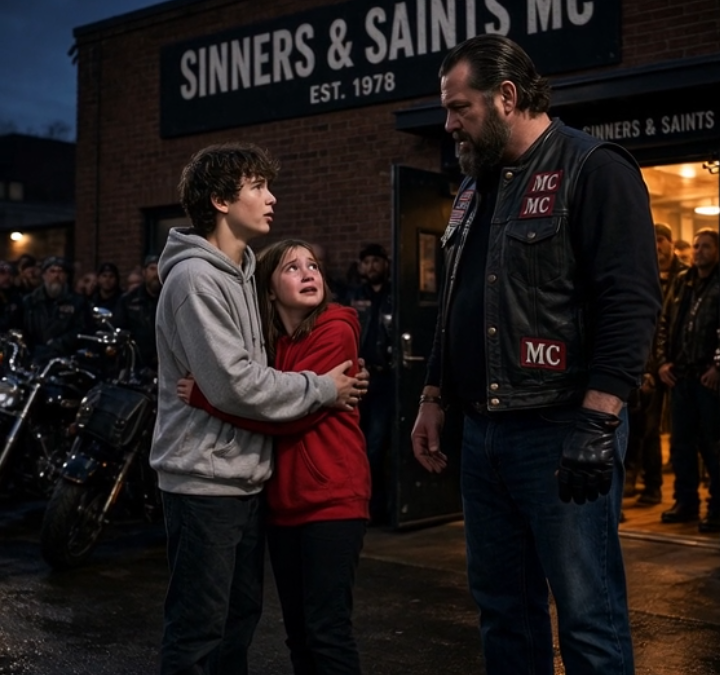
PART2:
A tear ran down one sleeve where the fabric had caught on something.
His lower lip was split.
He was carrying a little girl.
She looked ten.
Maybe younger because fear has a way of making children fold themselves small.
Her arms were locked around his neck.
She wore jeans, sneakers without socks, and a puffy jacket too thin for the weather.
A paperback book was crushed between her chest and his.
I could see the title only because she was holding it so tightly.
The Secret Garden.
Neither child said anything at first.
The boy looked past my shoulder.
Motorcycles.
Leather vests.
Travis.
Earl.
The fluorescent lights.
Then back at me.
“I’m not here to cause trouble.”
His voice trembled.
His eyes did not.
“I just need her safe tonight.”
The little girl tightened her arms around him.
“We’ll leave when the sun comes up. I swear.”
I opened the door wider.
Cold air rolled inside.
“What’s your name?”
“Noah.”
He shifted the girl higher in his arms.
“This is Lily.”
“How old are you?”
“Sixteen.”
“And Lily?”
“Ten.”
At the sound of her name, Lily moved slightly.
Her sleeve pulled back.
There were pale purple marks around her wrist.
Finger-shaped.
Every part of me went still.
Earl saw them too.
“Where are your parents?” he asked.
Noah swallowed.
“Our mom died two years ago.”
“What about your dad?”
“Gone before Lily can remember him.”
He hesitated.
“We live with our stepdad.”
Travis crossed his arms.
“And where is he?”
Noah looked down at Lily.
Then at me.
“Probably looking for us.”
The rain seemed louder.
I stepped aside.
“You’re coming in.”
Noah did not move.
I could see him calculating.
Three adult men.
One locked building.
No obvious exit except the door behind him.
His sister in his arms.
I remembered being seventeen.
I remembered thinking the difference between courage and stupidity was whether you had any other choice.
“You can leave the door unlocked if that makes you feel better,” I told him.
He looked surprised.
“You’re not prisoners.”
That was enough.
He carried Lily inside.
I closed the door behind them.
Did not lock it.
Lily’s eyes moved slowly across the room.
A row of motorcycles along the wall.
Tool chests.
Club photographs.
Old road signs.
Helmets.
Leather.
Tattooed arms.
A rusted gas-station sign Earl had stolen legally from a demolition site but still insisted on describing as “liberated.”
I wondered what she had been told about places like ours.
Probably the same things everyone else had been told.
Bad men.
Dangerous men.
Men children should avoid.
Travis looked almost offended when he realized Lily was afraid of him.
Then, without saying anything, he disappeared into the kitchenette.
Noah remained standing.
“You can put her down,” I said.
“She hurt her ankle.”
Lily immediately whispered:
“I’m okay.”
It was the first thing we heard from her.
Children who say they are okay too quickly are rarely okay.
Earl brought over one of our folding cots.
“Sit.”
Noah started to refuse.
His legs almost made the decision for him.
He lowered Lily carefully onto the cot.
She did not release his hoodie until he sat beside her.
Travis returned holding a mug.
“Hot chocolate.”
Lily looked at him.
He cleared his throat.
“It’s too sweet for me anyway.”
That was nonsense.
Travis consumed enough sugar to keep an elementary school awake for a month.
Lily accepted the mug.
Both hands around it.
“Thank you.”
Barely audible.
Travis nodded once and immediately found something across the room that required intense visual study.
I pulled a chair over.
“Noah.”
He looked at me.
“Tell me what happened.”
His jaw tightened.
“We just need tonight.”
“I heard you.”
“Then we leave.”
“And go where?”
Silence.
“Family?”
“No.”
“Friend?”
“No.”
“Shelter?”
He shook his head.
“You called one?”
“No phone.”
I leaned back.
“When did you eat?”
“That doesn’t matter.”
“It matters here.”
His eyes sharpened.
“You going to call the cops?”
Eventually.
But I did not say that yet.
Instead I asked:
“When did you eat?”
Noah looked embarrassed.
“School lunch.”
“It’s after midnight.”
“I know what time it is.”
Travis was already moving toward the refrigerator.
Earl glanced at me.
I nodded.
Ten minutes later, Noah had a plate with eggs, toast, and whatever leftover potatoes Travis could heat without poisoning anyone.
Lily had half a grilled cheese.
She ate slowly.
Noah ate like someone who had trained himself not to look hungry.
I waited.
People talk more easily when they stop believing every question is a trap.
Eventually Lily fell asleep against Noah’s side.
Only then did he speak.
“Our mom’s name was Sarah.”
I said nothing.
“She married Raymond when Lily was five.”
“Raymond what?”
Noah looked at me.
“Cutter.”
Earl stopped wiping the same wrench.
I knew the name.
Not well.
Enough.
Raymond Cutter ran a small commercial roofing business south of Dayton.
Played golf with people who liked their charity events photographed.
Sponsored a youth baseball team.
His company logo was on two church vans.
I also knew he drank.
Knew he had a temper.
And I knew he occasionally spent time with men connected to the Black Thorn Crew, a motorcycle outfit from outside Montgomery County that had never liked the River Reign Riders.
Not because of anything dramatic.
Territory.
Pride.
Old insults.
The stupid things men turn into tradition because nobody remembers who started them.
“How long?” I asked.
Noah knew what I meant.
“A while.”
“Define a while.”
“After Mom died, it got worse.”
“What got worse?”
Noah looked at Lily.
“Everything.”
He took a breath.
“First he yelled. Then he’d throw stuff. Then it was me.”
His voice remained flat.
“Then her.”
My hands tightened beneath the table.
“Who else knows?”
“School.”
“They know he hits you?”
“No.”
“You never told them?”
Noah gave me a look that made me feel stupid for asking.
“He told us if anybody came asking questions, he’d say I was violent.”
“You’re sixteen.”
“He already told people I am.”
That answered more than Noah realized.
“He says I’m angry because Mom died. That I’m dangerous. He has pictures.”
“Of what?”
“Doors I broke.”
“Did you?”
“Yes.”
“Why?”
Noah looked at Lily again.
“Because he locked her in rooms.”
The space heater clicked off.
The clubhouse became very quiet.
I asked:
“What happened tonight?”
Noah swallowed.
“Lily dropped a glass.”
His right hand closed into a fist.
“Raymond grabbed her.”
Lily moved in her sleep.
Noah lowered his voice.
“He wouldn’t let go.”
The bruises.
“I hit him.”
“Where?”
“Face.”
“Then?”
“He came after me.”
Noah touched his split lip.
“I got Lily out through the laundry-room door.”
“How did you get here?”
“Bus.”
“At midnight?”
“Last westbound route. Got off early.”
“How did you know this place?”
For the first time, Noah almost smiled.
“Everyone knows this place.”
That was not necessarily comforting.
“My friend Dylan’s dad brought his bike here once.”
He looked around.
“He said you guys were rough, but you didn’t mess with kids.”
Earl stared at the floor.
Travis muttered something I could not hear.
Then Noah said the sentence I still remember word for word.
“He said if I ever had nowhere else to go, find a place where men have rules.”
I looked at him.
“What does that mean?”
“He said dangerous men with rules are sometimes safer than respectable men without them.”
Nobody spoke.
I had heard plenty of compliments about our club.
Most involved bikes.
Charity rides.
Standing by a brother.
Nobody had ever said anything like that.
Noah leaned forward.
“Please.”
There it was.
The thing underneath all his toughness.
A child.
“I don’t care what happens to me.”
“That’s a stupid thing to say.”
He blinked.
“You’re sixteen,” I said. “You still count.”
His eyes dropped.
“Just don’t send her back.”
I waited until he looked at me again.
“I’m not sending either of you anywhere tonight.”
His shoulders shifted.
Barely.
But enough.
“Thank you.”
“I didn’t say we’re hiding you.”
The relief disappeared.
“I have to make calls.”
“No.”
“Noah.”
“You don’t understand.”
“I understand more than you think.”
“If cops take us—”
“I’m not calling random patrol officers and tossing you into whatever happens.”
He stared.
“I know people.”
That was true.
A club that had been around twenty-three years collected relationships.
Veterans.
Mechanics.
Lawyers.
Paramedics.
Deputies.
Firefighters.
Social workers.
People who understood that leather did not automatically mean criminal and a clean polo shirt did not automatically mean safe.
“You stay here tonight.”
Noah’s jaw worked.
“Tomorrow we make this official.”
“What if they make her go back?”
I did not lie.
“I don’t know.”
Fear returned.
“But I know this.”
I leaned closer.
“We don’t solve that by running forever.”
Noah looked exhausted.
“You’ve already done the hardest part.”
“What?”
“You got her through a door.”
He looked down at Lily.
His eyes filled.
He rubbed them quickly.
“I almost didn’t.”
“But you did.”
Around 2:30, exhaustion finally beat adrenaline.
Noah fell asleep sitting beside Lily.
His head tipped forward.
His hand remained around hers.
Travis stood near the workbench watching them.
“This doesn’t end in the morning.”
“No.”
“We keeping them?”
I looked at him.
“That is not how children work.”
“You know what I mean.”
Earl walked over.
“Cutter’s going to look.”
“I know.”
“And when he finds out where they are…”
“I know.”
Travis’s face hardened.
“I’m just saying—”
“No.”
“I didn’t say anything.”
“You were about to.”
He crossed his arms.
“What if Black Thorn gets involved?”
“Then they get to decide whether they want to be stupid.”
“And if they do?”
I looked toward the sleeping children.
“Then we make sure our response doesn’t make their lives worse.”
Travis hated that answer.
Young men often do.
Anger feels efficient.
Restraint feels weak until you understand how much strength it requires.
At 6:40, I called Detective Lena Ortiz.
Lena had ridden behind her father on motorcycles when she was little and had known our club long enough to understand that when I said I needed discretion, I meant it.
She arrived out of uniform.
No marked car.
With her came a child-services investigator named Caroline Meyers.
Noah woke the second the front door opened.
He stood before his eyes were fully focused.
Lily woke because he did.
I moved between them and the newcomers.
“Noah.”
He looked at me.
“I told you I’d make calls.”
His face went white.
“You said—”
“I said you weren’t going back tonight.”
He grabbed Lily’s hand.
“We’re leaving.”
Caroline stopped immediately.
“Noah, nobody is taking you to Raymond Cutter.”
The boy froze.
“Not today,” she continued. “Not while allegations are investigated.”
He did not trust her.
He looked at me.
That hurt more than I expected.
Not because he doubted me.
Because he was asking me whether adults had become dangerous again.
I nodded.
“You can talk.”
The interview lasted almost three hours.
We gave them the back office.
Nobody from the club entered.
Lena took photographs only with consent.
Caroline called emergency placement.
The problem was Noah.
At sixteen, he could not simply remain as Lily’s legal guardian.
The system wanted to place them separately because there was no immediate foster home equipped for both ages.
When Caroline said that, Noah stood.
“No.”
Lily immediately grabbed his sleeve.
“Noah—”
“We stay together.”
Caroline remained calm.
“I understand.”
“No, you don’t.”
“You’re right.”
That stopped him.
“I don’t know what it feels like to be you.”
She pulled a chair closer.
“But I do know separating you right now may cause more harm.”
Noah stared.
“So what?”
“So give me time.”
That was when Earl spoke from the doorway.
“Use us.”
Caroline looked over.
Earl shrugged.
“We have people.”
He was right.
By nine thirty, half the River Reign Riders knew enough to start calling.
A member named Dennis and his wife had been licensed foster parents years earlier.
Another rider’s sister worked with kinship-placement programs.
Our club attorney knew a family-law judge.
None of those connections meant rules could be ignored.
They meant we knew how to find the right doors.
By afternoon, Noah and Lily were placed together in an emergency foster home twenty minutes from the clubhouse.
Noah hated leaving.
Lily hugged Travis.
That almost killed him.
She hugged Earl.
Then she stood in front of me.
“Will we see you again?”
“Yes.”
I did not hesitate.
She looked at Noah.
He nodded.
Lily whispered:
“Okay.”
Three days later, somebody threw a brick through our clubhouse window.
It landed beside the pool table.
No one was hurt.
A note was rubber-banded around it.
SEND THEM BACK.
Travis picked up the note.
His face changed.
“Give me ten minutes.”
“No.”
“Marcus.”
“No.”
“They come to our house—”
“And do what?”
“We know who.”
“No, we suspect.”
“We know.”
“Then say the name.”
“Cutter.”
“Did you see him throw it?”
“No.”
“Did you see Black Thorn?”
“No.”
Travis kicked a chair.
“So we eat this?”
“We document it.”
“That’s it?”
“We photograph the brick. Photograph the window. Pull the camera footage. Call Lena.”
Travis laughed bitterly.
“This is why people think we’ve gone soft.”
Earl spoke from the corner.
“No.”
Travis looked at him.
“This is why Marcus is president and you’re not.”
Travis stared at him.
Earl continued wiping glass from the table.
“If we ride over there angry, what happens?”
“They learn.”
“What?”
“That we don’t—”
“No.”
Earl shook his head.
“They learn how to tell a judge we’re violent bikers hiding two children.”
Travis stopped.
Earl pointed at the note.
“That brick wasn’t sent to hurt us.”
He looked at me.
“It was sent to make us behave exactly how they need us to.”
That was why Earl had survived sixty-one years.
He understood traps.
We gave everything to Lena.
Security footage showed a dark SUV slowing outside.
Plate obscured.
Not enough.
Then Noah called.
He had heard about the window.
“Is Lily safe?” I asked first.
“Yes.”
“You?”
“Yes.”
“Then don’t worry about the clubhouse.”
“I’m sorry.”
“For what?”
“They did it because of us.”
“No.”
“Marcus—”
“Listen to me.”
Silence.
“People do not get to make you responsible for what they choose to do.”
He said nothing.
“That is something adults like Raymond teach kids because it protects the adult.”
Noah breathed slowly.
“You understand?”
“I think so.”
“You didn’t throw the brick.”
“No.”
“Then you didn’t break my window.”
A pause.
“Travis says whoever did it has terrible aim anyway.”
Noah laughed.
First time I had heard it.
It sounded younger than sixteen.
The investigation into Raymond Cutter widened.
Not because we threatened anyone.
Because Noah and Lily had survived long enough to talk.
School records showed unexplained absences.
A pediatric clinic had documented wrist injuries the previous year explained as “playground accidents.”
A neighbor recalled Lily sitting outside in winter without a coat after an argument.
A former employee of Cutter Roofing told investigators Raymond sometimes paid workers in cash off the books.
That opened another door.
Financial investigators found tax irregularities.
Then fraudulent invoices.
Then a business account connected to equipment reported stolen from another county.
The rival-club connection proved mostly noise.
A few Black Thorn members knew Raymond.
One had done roofing work for him.
Another drank with him.
But when law enforcement attention increased, they wanted no part of the situation.
Men can pretend loyalty means everything until subpoenas arrive.
Raymond’s public image began coming apart not with an explosion, but with paper.
Records.
Statements.
Dates.
Photographs.
Bank transfers.
Messages.
The kinds of facts anger cannot punch away.
Noah and Lily started visiting our clubhouse every Saturday afternoon.
Legally approved.
Supervised at first.
Then less formally as everyone involved became comfortable.
Lily liked Earl best.
He pretended to dislike this.
She sat beside him while he rebuilt carburetors and asked approximately four hundred questions per hour.
“What’s that?”
“Gasket.”
“What does it do?”
“Seals.”
“What happens if it doesn’t?”
“Leaks.”
“Then what?”
“Problems.”
“What kind?”
Earl would stare at me.
“You created this.”
I had done nothing.
Travis was worse.
One Saturday Lily arrived with her hair half-falling from a braid.
Caroline had been called into work early and the foster father admitted he had no idea what he was doing.
Travis said:
“How hard can braiding be?”
Earl looked at him.
“Do not challenge the universe.”
Twenty minutes later, Lily looked like she had survived a windstorm inside a washing machine.
She examined herself in the mirror.
Then looked at Travis.
He winced.
“I can fix it.”
“No.”
“I almost had it.”
“You made four braids.”
“More is better.”
She laughed.
Really laughed.
We all stopped.
The room changed.
Not because laughter was unusual.
Because it was hers.
Noah heard it from across the garage.
His head lifted.
He watched his sister laughing while Travis tried to untangle his own fingers from a hair tie.
Something in Noah’s face loosened.
That was when I realized how long he had been living for only one purpose.
Protect Lily.
He did not know who he was without danger.
That became the next problem.
He started working at a hardware store after school.
Not because anyone asked.
Because he could not tolerate feeling dependent.
He saved almost everything.
When I offered to teach him motorcycle repair, he refused twice.
The third time I simply put a wrench in his hand.
“Loosen that.”
He did.
“Congratulations.”
“For what?”
“You’re learning.”
Within six months, Noah could change oil, adjust chains, replace brake pads, and diagnose several basic problems by sound.
He liked electrical work best.
“It makes sense,” he told me.
“How?”
“Either the current gets there or it doesn’t.”
I smiled.
“Life disappointing you?”
He looked at me.
“Life should have wiring diagrams.”
“Agreed.”
Lily went back to school.
For the first few weeks she sat near classroom doors.
Then near windows.
Then eventually wherever she wanted.
Her teacher told Caroline she had begun drawing again.
Motorcycles mostly.
But every motorcycle had flowers in the spokes.
Some had giant purple flowers bigger than the wheels.
One drawing showed five bikers standing around two children.
Above it Lily had written:
THE NIGHT PEOPLE.
I asked what that meant.
“You were awake when we needed you.”
I kept that drawing.
Not on the clubhouse wall.
In my office.
Raymond Cutter was arrested seven months after the knock.
The charges were broader than Noah expected.
Abuse allegations.
Fraud.
Tax violations.
Possession of stolen commercial equipment.
Witness intimidation connected to the brick and later messages.
He accepted a plea rather than risk trial on everything.
Noah attended only one hearing.
Lily attended none.
That was their choice.
Afterward, Noah sat on the courthouse steps beside me.
“You disappointed?” I asked.
He frowned.
“Why?”
“You thought it would feel different?”
He considered that.
“Yeah.”
“How?”
“I thought I’d feel like we won.”
“And?”
“I just feel tired.”
I nodded.
“Sounds normal.”
“You ever want to hurt somebody who hurt someone you care about?”
I looked at him.
“Of course.”
“What do you do?”
“Depends.”
“That’s not an answer.”
“Most days, I remember that wanting something doesn’t mean doing it improves anything.”
He stared across the courthouse lawn.
“I still hate him.”
“You’re allowed.”
“Does it go away?”
“I don’t know.”
“You’re terrible at advice.”
“That is why nobody pays me.”
He smiled faintly.
Then asked:
“Do you hate people?”
“Specific people or as a concept?”
That got another smile.
“Seriously.”
I thought about it.
“I think hate gets heavy if you carry it too long.”
“What do you carry instead?”
I looked toward the courthouse doors.
“Standards.”
He raised an eyebrow.
“You decide what kind of man you are regardless of what kind of man he was.”
Noah was quiet.
“You make that sound easy.”
“It isn’t.”
Years passed.
Noah turned eighteen.
Then nineteen.
He graduated high school.
Not top of his class.
Not valedictorian.
He had missed too much school and carried too much before anybody noticed.
But he graduated.
That mattered more.
The scholarship came from several places.
Local businesses.
Members of our club.
Teachers.
A veteran riders’ organization.
Even people who had once complained about motorcycles outside our clubhouse contributed.
Noah decided to study electrical engineering at Wright State.
When he told me, I said:
“Wiring diagrams.”
He laughed.
“Exactly.”
The high school auditorium was full the night of the scholarship ceremony.
I stood in the back.
Club habit.
We like walls behind us.
Lily sat in the front row.
Fifteen years old now.
Confident enough to wear a bright blue jacket.
Hair braided correctly.
Travis had eventually learned.
Mostly.
Noah walked onto the stage.
Tall.
Lean.
The split lip from that night existed only in memory.
He accepted the scholarship.
Shook hands.
Then the principal unexpectedly handed him the microphone.
“You want to say anything?”
Noah looked toward the audience.
I saw the old version of him flicker for half a second.
Sixteen.
Wet hoodie.
Sister in his arms.
Calculating exits.
Then it disappeared.
He looked at Lily.
Then toward the back.
Found me.
“I wasn’t planning to speak.”
People laughed.
He waited.
“When I was sixteen, I thought being strong meant being able to take a hit without showing it.”
The room quieted.
“I thought my job was to protect my sister by myself.”
Lily’s eyes filled.
“I thought asking for help meant I failed.”
Noah paused.
“Then one night, I knocked on a door.”
My chest tightened.
“I picked the door because I had heard the men inside were dangerous.”
Several people turned toward me.
Noah smiled slightly.
“I figured dangerous men might understand dangerous problems.”
Soft laughter.
“But I learned something.”
He looked directly at our table of River Reign Riders.
“The safest people I ever met were the ones who could have fought and chose not to because fighting would have made things worse for us.”
Travis looked down.
Earl, now retired from riding long distances, removed his glasses.
Noah continued.
“They didn’t rescue us by being tougher than Raymond.”
His voice strengthened.
“They rescued us by staying.”
“Court dates.”
“School meetings.”
“Therapy appointments.”
“Saturday afternoons.”
“Bad hair braids.”
Lily laughed through tears.
“Homework.”
“Phone calls.”
“Showing up.”
He looked toward me.
“They taught me that protection isn’t one big moment.”
“It’s a thousand small ones.”
The auditorium stood when he finished.
I did not.
Not immediately.
I was too busy trying not to embarrass myself in public.
Lily graduated three years later.
She wanted to become a school counselor.
When I asked why, she gave me the most Lily answer possible.
“Because quiet kids are loud if you know what to listen for.”
The River Reign Riders changed too.
Not into saints.
We still argued.
Still rode too fast occasionally.
Still made inappropriate jokes.
Still possessed more opinions than wisdom.
But something about that night became part of club culture.
We created an emergency fund.
Not flashy.
No giant charity branding.
It paid for motel rooms, emergency groceries, bus tickets, school supplies, and sometimes legal consultation for families in crisis.
We worked with professionals.
Always.
That was important.
We were bikers.
Not social workers.
Not judges.
Not police.
Learning the difference between helping and taking control was one of the most valuable things those kids taught us.
On the tenth anniversary of the night Noah and Lily knocked on our door, we held a small dinner at the clubhouse.
No ceremony.
No reporters.
Just food.
Music.
Old stories.
Travis had become vice president.
Earl complained about his knees.
Noah was twenty-six and working for an engineering firm outside Cincinnati.
Lily was twenty.
Studying psychology.
At some point, I noticed her standing near the steel door.
Same door.
Older paint now.
New security camera.
Same heavy frame.
She ran her hand over it.
I walked over.
“You okay?”
She nodded.
“I remember it being bigger.”
“You were smaller.”
“Noah carried me.”
“I remember.”
She smiled.
“I pretended my ankle hurt more than it did.”
“Why?”
“I was scared to walk in.”
That surprised me.
“You were afraid of us?”
She laughed.
“Marcus, look at you.”
“Fair.”
She touched the steel.
“I remember hearing the door shut.”
I waited.
“I thought we had made a mistake.”
My chest tightened.
“Then Travis gave me hot chocolate.”
“Worst hot chocolate in Ohio.”
“It was good.”
“You were traumatized.”
She smiled.
Then became serious.
“I think that was the first night after Mom died when Noah slept before I did.”
I looked toward him across the room.
He was arguing with Travis about some electrical problem.
“He trusted us?”
“No.”
She shook her head.
“He was just too tired to stay awake.”
That sounded more accurate.
“But I remember watching him.”
Her voice softened.
“I remember thinking… if he can sleep here, maybe I can too.”
For a few seconds we said nothing.
Then Lily looked up at me.
“Do you remember what time we knocked?”
“12:17.”
Her eyes widened.
“You remember?”
“I remember everything about that night.”
She smiled.
“I do too.”
I looked around the clubhouse.
Motorcycles.
Photographs.
Old patches.
People growing older together.
Noah laughing.
Travis getting louder.
Earl pretending not to listen.
The place looked almost exactly as it had years ago.
But nothing was the same.
I used to think leadership was about knowing when to fight.
For a long time, most of us did.
Maybe because fighting is visible.
People see fists.
Hear engines.
Remember confrontations.
Nobody notices restraint.
Nobody writes songs about the phone call you make instead of the punch you throw.
Or the appointment you show up for.
Or the paperwork you complete.
Or the child you sit beside without demanding she explain why she is afraid.
But those were the things that saved Noah and Lily.
Not revenge.
Not intimidation.
Not making Raymond more frightened than he had made them.
We won by refusing to become useful evidence for his lies.
We won by letting the truth stay louder than our reputation.
Mostly, we won by opening a door and not closing it again when helping became inconvenient.
Late that night, after everyone had gone, I stood alone in the garage.
The clock over the refrigerator read 12:14.
Three minutes later, I found myself looking toward the steel entrance.
12:17.
No knock came.
Of course it didn’t.
But I could still hear the old one in my head.
Three hard strikes.
A sixteen-year-old boy holding a little girl.
“We’ll leave at sunrise.”
They did leave that morning.
Technically.
But some people enter your life through a door and never really leave again.
I walked over and touched the lock.
For years, people in Dayton had looked at that building and seen a biker clubhouse.
Noise.
Leather.
Trouble.
Maybe some of that judgment was deserved.
We were not perfect men.
Noah never needed us to be.
He needed somebody awake.
Somebody willing to listen before deciding what kind of kid he was.
Somebody willing to believe that respectability could hide cruelty and roughness could hide mercy.
Somebody willing to open the door.
That was all.
One door.
One decision.
12:17 a.m.
And two frightened kids who taught a room full of grown men that the strongest thing we would ever do was not chase anyone down a dark road.
It was stand still between two children and the place they were terrified to return to—and refuse to move.








