Two Days After My 78-Year-Old Neighbor Died, Her Cat Appeared on My Porch With a Note in Her Handwriting—Then at Midnight, I Found the Voice Recorder Hidden Beneath His Towel.
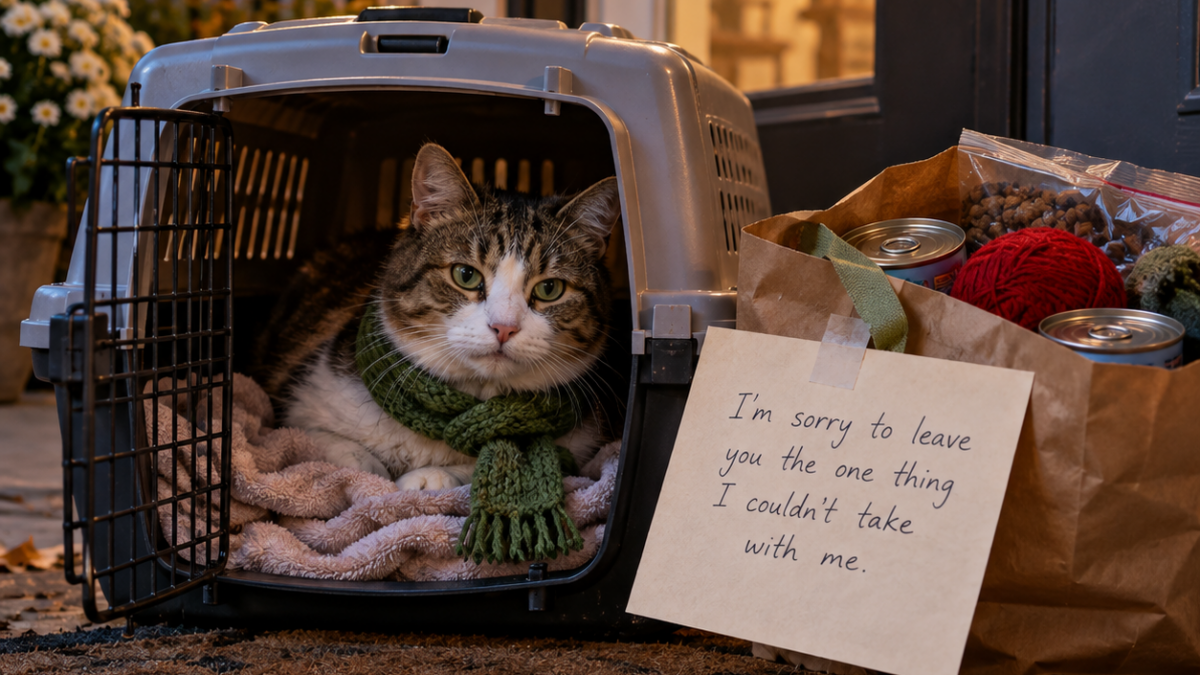
PART3:
My cats lined up at the end of the hallway as if I had brought home a live grenade.
Poca stayed in the carrier.
I opened the door.
He did not move.
I placed water nearby.
Food.
A folded blanket.
Nothing.
“You’re safe,” I told him.
He stared past me toward the front door.
That afternoon I called the county shelter.
The woman who answered sounded tired but kind.
She told me they had space.
I could bring him the next morning.
I thanked her.
Then I stood in the kitchen and stared at the fourth bowl I had temporarily placed beside the other three.
Four cats made no sense.
Money was tight.
My oldest cat, Winston, needed medication twice a day.
Penny hated unfamiliar animals and had already spent an hour growling beneath the dining table.
Milo had begun stalking Poca’s carrier like an assassin with attention deficit disorder.
I did not need another responsibility.
I repeated that sentence until it sounded almost reasonable.
That night, Poca finally came out.
He ignored the food.
He walked directly to the front door.
He sat.
Every time headlights moved across the curtains, his ears lifted.
Every time a car door slammed somewhere outside, he stood.
At 10:17, he scratched once.
At 10:46, twice.
Near midnight, I sat behind him.
“She isn’t coming,” I whispered.
His tail moved against the floor.
I started crying.
Not because of the cat.
Not entirely.
Because suddenly I remembered every time Evelyn had asked whether I wanted coffee.
Every time she had said, “No hurry,” while I hurried anyway.
Every time she had asked about my cats when what she probably wanted was someone to ask about her.
Poca turned his head.
Then returned his attention to the door.
I do not know how long I sat there.
At some point I heard scratching from the grocery bag.
Poca had moved toward it.
He pawed at the faded towel inside.
I reached beneath it.
My fingers touched plastic.
It was a small voice recorder.
The kind people use for reminders.
There were several recordings stored on it.
The first was dated four days before Evelyn died.
My hand shook when I pressed play.
Static.
A cough.
Then Evelyn.
“Poca.”
The cat froze.
His head lifted.
Evelyn’s voice filled my kitchen.
“If I don’t come home one day, don’t think I left you because I wanted to.”
I covered my mouth.
Poca walked toward the recorder.
“You may have to go next door,” she continued. “Rachel says she has too many cats, but she leaves food outside when she thinks nobody is watching.”
I actually laughed through my tears.
She knew.
Every freezing night, I left food beside a small insulated box near the garage for strays.
I had never told her.
Apparently I had never needed to.
“She complains,” Evelyn whispered, “but she has a soft center she protects like it owes her money.”
There was another cough.
Then her voice became quiet.
“Don’t be afraid, little boy.”
Poca sniffed the recorder.
“Love sometimes just changes addresses.”
I stopped the recording.
I cried so hard I had to put my forehead against my knees.
Poca stood several feet away.
Then, for the first time since entering my house, he approached me voluntarily.
He pressed his nose against my knee.
That was all.
A tiny movement.
But something changed.
The next morning, I placed his carrier near the front door.
I told myself I was still taking him to the shelter.
Poca walked into it without resisting.
That hurt more than if he had fought.
He curled around Evelyn’s green scarf.
He lowered his head.
He looked like an animal who had learned that people put you in boxes when your opinion stopped mattering.
I reached for the carrier door.
Then I remembered Evelyn.
The only door that opened.
I removed the carrier door instead.
I carried the fourth bowl into the kitchen.
Poca stayed.
Three weeks later, someone knocked on my door at ten in the morning.
When I opened it, I saw an empty carrier.
Then the woman holding it.
She was probably in her mid-forties.
Dark hair pulled back carelessly.
Black coat.
Jeans.
No makeup.
Her face had that exhausted grayness people get when grief and sleep deprivation have spent too much time sharing the same body.
But her eyes stopped me.
Evelyn’s eyes.
Not the gentle version I knew.
These were swollen and red.
“My name is Mara Bennett,” she said. “Evelyn Mercer was my mother.”
I stared at her.
In eight years, Evelyn had never mentioned a daughter.
“I’m sorry,” I said.
Mara nodded once.
“I was told a neighbor had her cat.”
Behind me, Poca appeared at the end of the hallway.
He saw Mara.
Then he saw the carrier.
He disappeared.
Mara’s hand tightened around the handle.
“I’m here to take him.”
There are moments when your body makes a decision before your mind catches up.
Mine moved slightly into the doorway.
Blocking her.
Mara noticed.
“He belonged to my mother.”
“She left him with me.”
“Did she put that in writing?”
“Yes.”
Mara swallowed.
“Then I’d like to see it.”
I let her inside.
She placed the carrier beside the door.
Inside it was a new blanket, a ceramic food bowl, and a stuffed mouse that still had the price tag attached.
She had come prepared.
My cats watched from strategic locations.
Mara remained standing.
Then she saw the chair near my living room window.
It was an old wooden chair with faded floral upholstery.
A week after Evelyn’s funeral, two men clearing her house had carried it onto my porch.
There had been a paper sign taped to it.
FOR THE NEIGHBOR.
Nothing else.
Poca slept there most afternoons.
Mara walked toward it.
“That was hers.”
“Yes.”
Her fingers touched the armrest.
“I did spelling homework in this chair.”
Her voice had changed.
For three seconds, she sounded twelve.
Then the armor returned.
“Why do you have it?”
“It was left for me.”
Mara laughed without humor.
“Of course it was.”
That was when I realized this was not really about a cat.
Not entirely.
I brought Evelyn’s note from the kitchen.
Mara read it.
Once.
Twice.
Then she turned it over.
I had written something on the back the night I decided to keep Poca.
“Poca’s next home: the house next door. He still misses you. I do too.”
Mara stared at my handwriting.
“You wrote this?”
“Yes.”
“Why?”
“I wanted her to know he was safe.”
“She’s dead.”
“I know.”
Mara folded the paper carefully.
“My mother had a strange talent.”
“What?”
“She could make people feel chosen.”
The accusation landed between us.
“She trusted me,” I said.
“She knew you for eight years.”
“Yes.”
“She knew me for forty-six.”
Silence.
Under the dining table, Poca shifted.
Mara crouched.
“Poca?”
Nothing.
She took a small bag of treats from her coat.
The same brand Evelyn used.
She shook them.
Poca’s ears appeared.
Then his face.
He stared at Mara.
Mara extended her hand.
For one hopeful second, he moved toward her.
He sniffed.
Then backed away so quickly his shoulder hit a chair leg.
He ran into the kitchen.
Mara stood.
“He’s afraid of the carrier,” I said.
“Maybe.”
“You haven’t been around him much?”
Her jaw tightened.
“My mother told me about him.”
“When?”
“Before we stopped speaking.”
There it was.
The missing six years.
“How long?”
“Almost six years.”
I could not hide my reaction.
Mara saw it.
“You think I abandoned her.”
“I didn’t say that.”
“You didn’t have to.”
She walked toward the window.
Evelyn’s house stood across the lawn.
“I called,” Mara said.
I remained quiet.
“She didn’t answer.”
Mara folded her arms.
“I sent birthday cards. Christmas cards. Letters.”
“Did she get them?”
“I assumed so.”
Something about the way she said it caught my attention.
“Assumed?”
“I mailed them here.”
Mara looked at Evelyn’s house.
“I drove down three years ago. She wouldn’t open the door.”
“That doesn’t sound like Evelyn.”
Mara turned.
“Which Evelyn?”
I immediately regretted it.
“The one who asked about your cats? The sweet neighbor? The lonely widow who made scarves?”
Her voice trembled.
“She was that person, Rachel.”
I had not told her my name.
Then I remembered the note.
“But she was also my mother.”
The word mother sounded heavy in her mouth.
“What happened?”
“That’s private.”
“You’re asking me to hand you Poca.”
“I’m asking you to return my mother’s property.”
“He isn’t property.”
“I know that.”
“Do you?”
Her expression hardened.
“You have no idea what I know.”
Neither did I.
Not yet.
Mara picked up the carrier.
“I’ll be back tomorrow.”
“For what?”
“For Poca.”
“No.”
She stared at me.
“No?”
“Not tomorrow.”
“You don’t get to decide that.”
“Neither do you.”
“My mother’s estate passes to me.”
“She left him here.”
“One sentence is not a will.”
“She wrote my name on the note.”
Pain crossed Mara’s face so quickly I almost missed it.
“She could write your name.”
I said nothing.
“She could leave you a message.”
Her voice dropped.
“But she couldn’t call me.”
She opened the door.
Then stopped.
Her eyes had landed on the recorder sitting near the coffee maker.
“Did she mention me?”
I froze.
Mara looked at me.
“On that.”
I had only listened to the first file.
There were others.
I had been afraid to hear them.
“No,” I said.
It was not exactly a lie.
But it was not honest either.
Mara nodded.
“I’ll be back at ten.”
She left.
Poca stayed hidden for almost an hour.
That night, I sat at the kitchen table with the recorder.
The house was quiet.
Poca was in Evelyn’s chair.
I replayed the first message.
“Love sometimes just changes addresses.”
Then the recording stopped.
I almost turned the machine off.
Instead I pressed the arrow.
The second file began.
Breathing.
A machine humming somewhere.
Then Evelyn said one word.
“Mara.”
I dropped the recorder.
It struck the table.
Poca jumped.
The recording continued.
“I don’t know if you’ll ever hear this.”
Her voice was weaker.
“I suppose that is partly my fault.”
I reached toward the stop button.
This was private.
It was not mine.
But Mara had asked.
Evelyn continued.
“I told myself you would call when you were ready.”
A pause.
“Then you did.”
Another pause.
“And I didn’t answer.”
I sat perfectly still.
“Because by then I had spent so many years pretending I was the one waiting that I could no longer admit you were waiting too.”
Evelyn coughed.
Poca climbed into the chair beside me.
“I was stubborn before you were born. You only inherited enough of it to survive me.”
The smallest laugh.
Then breathing.
“I know why you wanted me to leave the house after I fell.”
My chest tightened.
“You were frightened.”
Another cough.
“I heard control when you were trying to say concern.”
Silence.
“And you heard rejection when I was trying to say I was afraid.”
I closed my eyes.
“I should have opened the door when you came.”
Evelyn’s voice cracked.
“I watched you from the upstairs window.”
The machine humming in the background became suddenly unbearable.
“You stood on the porch for twenty-three minutes.”
I covered my mouth.
“I counted.”
A long silence.
“I wanted you to knock again.”
Her breathing trembled.
“But you had already knocked six times.”
Poca pressed one paw against my leg.
“A mother should not make her child beg at a closed door just to prove she still wants to come inside.”
I began crying.
Evelyn did too.
I could hear it.
Quietly.
The way older people sometimes cry when they do not want anyone to know.
Then she spoke again.
“About Poca.”
He lifted his head.
“He should stay next door if Rachel will have him.”
I looked at him.
“She has three cats and too many worries, but she makes room before she admits she has room.”
A weak laugh.
“Kindness is inconvenient. She hasn’t learned that yet.”
I wiped my face.
“Mara, do not take him because you think grief has to leave you with a burden.”
Poca began kneading my pants.
“And do not leave him because you think I chose Rachel instead of you.”
Evelyn’s voice grew unexpectedly firm.
“I chose the house where he already went when I was too weak to open a can.”
I stopped breathing.
Poca had been coming to my house before Evelyn died.
I remembered seeing him near the garage.
I thought he was hunting.
Maybe he had been hungry.
“He knows that door,” Evelyn said. “He knows those cats. He knows her voice.”
Then came another pause.
“But you need to know something.”
A cough.
“Leaving him next door does not mean I loved you less.”
She inhaled carefully.
“It means I finally understood that love is not proven by holding on to the last thing someone touched.”
My throat tightened.
“It is proven by asking where that living thing will feel safe.”
Silence.
Then three words.
“Mara, I’m sorry.”
I closed my eyes.
“I should have said it while you could decide whether you wanted to forgive me.”
Her voice broke.
“Now I have made forgiveness into another thing I left on someone else’s porch.”
The recording ended.
I sat there for a long time.
Then I noticed something I had missed.
There were four more files.
The third was only seventeen seconds.
Evelyn breathing.
A chair moving.
A woman’s voice in the background.
Not Mara.
“Evelyn, who are you talking to?”
The recording clicked off.
I frowned.
I played it again.
The voice was familiar.
I had heard it before.
But I could not place it.
The fourth file began with Evelyn whispering.
“I don’t like when she takes my mail.”
My skin prickled.
“She says she’s helping.”
Pause.
“I forget things.”
Another pause.
“But I don’t forget everything.”
The recording ended.
I stared at the machine.
The woman who found Evelyn after she collapsed had been named Darla King.
I had seen Darla around the neighborhood for months.
Mid-fifties.
Blond hair.
Always perfectly arranged.
Bright smile.
She called herself a “senior companion.”
She drove Evelyn to medical appointments.
Picked up groceries.
Helped with bills.
Sometimes she sat on Evelyn’s porch drinking coffee.
I had thought she was family.
Once, when I asked, Evelyn said, “Darla helps because Mara won’t.”
I had accepted that sentence without question.
Now I wondered who had taught Evelyn to say it.
At ten the next morning, Mara returned.
She carried a folder.
I opened the door before she knocked.
“There’s another recording.”
Her face changed.
“You listened?”
“Yes.”
“After I asked?”
“Yes.”
“You told me there wasn’t one.”
“I hadn’t listened yet.”
“But you knew there were other files.”
“Yes.”
Mara stepped backward.
“You should have called me.”
“I know.”
“When were you going to?”
“I don’t know.”
“That isn’t good enough.”
“No.”
For once, I did not defend myself.
Mara saw the recorder.
“What did she say?”
“You need to hear it.”
“Did she say she wanted Poca here?”
“Yes.”
Her face hardened.
“Of course.”
“She also said your name.”
Mara stopped.
Everything angry disappeared.
“She did?”
“Yes.”
“What did she say?”
I held out the recorder.
Her hand trembled.
“I don’t know if I can.”
“You don’t have to listen here.”
“And let you keep another thing from me?”
“That isn’t what I meant.”
“Everything here feels like it belongs to you now.”
I had no answer.
Mara sat in Evelyn’s chair.
For one irrational second, I resented it.
Then I hated myself.
That chair had held Mara while she learned to spell.
It had belonged to her mother decades before it sat in my living room.
Mara pressed play.
Evelyn said her name.
Mara closed her eyes.
She did not move when Evelyn admitted watching her from the upstairs window.
But a tear slipped down her cheek.
When Evelyn said, “A mother should not make her child beg at a closed door,” Mara bent forward.
Her hand pressed against her stomach.
Poca appeared in the hallway.
When Evelyn said she wanted him to stay with me, Mara’s face went rigid.
Then came the sentence.
“Do not leave him because you think I chose Rachel instead of you.”
Mara looked at me.
I looked down.
When Evelyn apologized, Mara made no sound.
The tears simply continued.
The recording ended.
For almost a minute, neither of us spoke.
Then Mara whispered, “She always did that.”
“What?”
“Waited until nobody could answer.”
Poca approached.
Mara extended her hand.
She did not call him.
Did not shake treats.
She waited.
Poca sniffed her fingers.
Then walked past her to the windowsill.
Mara lowered her hand.
“She makes me sound unreasonable.”
“I didn’t hear that.”
“She said I wanted her to leave.”
“Because she was falling.”
“That was the fourth fall.”
I looked at her.
Mara stared through the window.
“She left the stove on twice. She got lost coming home from a grocery store she had used for twenty years. She took her blood-pressure medication twice one morning.”
I had known none of this.
“I found an apartment five minutes from my house,” Mara continued. “Ground floor. Pets allowed. Little patio. Same church denomination three blocks away.”
“She refused?”
“She accused me of trying to steal her house.”
Mara laughed bitterly.
“I was trying to keep her alive.”
I remembered all the times Evelyn had stood too long in her doorway.
The stories she repeated.
The questions she asked twice.
I had thought she was lonely.
Maybe sometimes she had been frightened.
Maybe I had mistaken confusion for conversation.
“Why did you stop calling?”
“I didn’t.”
Mara looked at me.
“Not at first.”
She opened the folder.
Inside were copies of phone records.
Dozens of calls.
“I called almost every week for eighteen months after our worst fight.”
Many lasted less than ten seconds.
Some showed no connection.
“I sent letters.”
She took out postal receipts.
“Certified sometimes.”
“What happened to them?”
“That’s what I’d like to know.”
I remembered Evelyn’s recording.
I don’t like when she takes my mail.
“Who is Darla King?”
Mara went still.
“Why?”
“Evelyn mentioned someone taking her mail.”
“On the recorder?”
“Yes.”
Mara stood.
“Play it.”
I did.
When Darla’s voice came through the speaker, Mara’s entire expression changed.
“You know her.”
“I hired her.”
“What?”
“Three years ago.”
Mara’s face drained of color.
“I found her through a senior-care referral group. Mom wouldn’t move, so I tried another solution. I paid Darla to come three mornings a week.”
“You paid her?”
“For six months.”
“But Darla was still coming here this year.”
“I stopped paying her almost two and a half years ago.”
I stared at her.
“Why?”
“Because I discovered my mother had given her access to a checking account.”
The room seemed suddenly smaller.
“How much?”
“I never knew.”
Mara stood.
“My mother refused to discuss it. Told me Darla was the only person who actually cared about her.”
Something cold moved through me.
“When was the last time you saw Darla?”
Mara asked.
“The week Evelyn died.”
Her face tightened.
“She found her.”
“Yes.”
Mara walked toward the door.
“Where are you going?”
“To my mother’s house.”
I followed.
Poca tried to follow too.
I shut my door before he could escape.
Evelyn’s house smelled different without her.
Closed air.
Dust.
Lavender powder.
Mara unlocked the front door using a key from her folder.
The kitchen looked almost untouched.
A mug sat beside the sink.
A sweater hung from a chair.
A half-finished crossword puzzle rested on the table.
Mara opened drawers.
I searched near the desk.
We found bills.
Medical statements.
Coupons.
Receipts.
Then, in a kitchen drawer, cans of cat food marked with letters.
M.
T.
W.
T.
F.
Days.
Some were unopened.
Mara held one.
“She was marking whether she fed him.”
My stomach turned.
Poca had been coming to my garage because Evelyn had forgotten.
“I should have noticed.”
Mara shook her head.
“You were her neighbor.”
“I was ten steps away.”
“And I was six hours away.”
Neither answer made either of us feel better.
We searched for almost two hours.
Then Mara called my name from the bedroom.
Inside the closet was a wooden box.
MARA was written across the top.
Mara sat on the floor.
She opened it.
Birthday cards.
Christmas cards.
At least twenty.
None mailed.
Some sealed.
Some unfinished.
Mara opened one.
Her mouth trembled.
Another.
Then another.
“What do they say?”
“She asks if I still make Dad’s soup.”
Another card.
“She says she saw a picture of me with short hair.”
Another.
“She says she almost called.”
At the bottom was one card without an envelope.
Mara read it twice.
Then handed it to me.
Evelyn had written:
“I wanted you to apologize first because I was hurt. But I was the mother. I should have understood that being older did not make me more right. It only gave me more time to say something.”
The sentence stopped there.
Mara took the card back.
“She wrote all these.”
“Yes.”
“And mailed none of them.”
“No.”
“Why?”
“I don’t know.”
“So she could be afraid, but I got blamed for being angry?”
“I’m not blaming you.”
“You did yesterday.”
She was right.
“I’m sorry.”
Mara stacked the cards.
“I don’t need you to hate her.”
“I don’t.”
“I don’t want anyone to hate her.”
Her voice cracked.
“I just need one person to admit she had choices.”
“She did.”
“And sometimes she chose wrong.”
“Yes.”
Mara stared at me.
That answer seemed to matter.
Then we heard the front door.
“Evelyn?”
A woman’s voice.
Mara stood.
Darla King walked into the bedroom.
She stopped when she saw us.
The smile came first.
Then confusion.
Then something much sharper.
“Mara.”
“You remember me.”
“Of course.”
Darla recovered quickly.
“I didn’t know you were coming today.”
“It was my mother’s house.”
“Of course.”
Darla looked at me.
“Rachel, sweetheart, I’m glad someone’s helping.”
Sweetheart.
I had never noticed how condescending she could make the word sound.
Mara lifted the wooden box.
“Did you know about these?”
“No.”
“The letters?”
“No.”
“My mother said you handled her mail.”
Darla sighed.
“She became confused near the end.”
“Did you throw away my letters?”
“Absolutely not.”
“Did you open them?”
“No.”
“Did you tell her I stopped calling?”
“I told her what she already knew.”
Mara’s eyes narrowed.
“What did she know?”
“That you weren’t here.”
Cruelty rarely announces itself with shouting.
Sometimes it smiles.
Sometimes it uses a soft voice.
Darla folded her arms.
“Your mother needed someone.”
“I hired you to be someone.”
“And then you stopped paying me.”
“Because I discovered she was giving you money.”
“Gifts.”
“How much?”
“That is none of your business.”
“It came from my mother’s account.”
“It was her money.”
“Then you won’t mind showing me the records.”
Darla’s smile disappeared.
“You have always been exactly what Evelyn said you were.”
Mara became still.
“What did she say?”
“Controlling.”
I watched Mara absorb it.
“Cold.”
Darla continued.
“More interested in that house than in your mother.”
“That’s enough,” I said.
Darla turned toward me.
“You barely knew her.”
I almost laughed.
Yesterday Mara had accused me of knowing only one version of Evelyn.
Now Darla was using the opposite accusation.
“She trusted me,” Darla said.
“Then why did she record herself saying you took her mail?”
Darla’s face changed.
Only slightly.
But enough.
“What?”
Mara looked at me.
I took the recorder from my pocket.
Darla stared at it.
“That woman was confused.”
“She remembered your voice.”
“I helped her.”
“You were still helping two years after Mara stopped paying you?”
“She asked me to.”
“Without telling her daughter?”
“Her daughter abandoned her.”
Mara flinched.
Darla saw it.
And smiled.
That was the moment I stopped giving her the benefit of the doubt.
“You enjoyed that,” I said.
“What?”
“You enjoyed hurting her.”
Darla looked offended.
Mara stepped closer.
“How much money did my mother give you?”
Darla grabbed her purse.
“I don’t have to stay here and be interrogated.”
“You’re right.”
Mara took out her phone.
“I’ll ask the police to do it.”
Darla laughed.
“Over gifts from a competent adult?”
“Let them decide.”
The laugh stopped.
Darla walked past us.
At the front door she turned.
“Your mother died thinking you didn’t care.”
Mara’s face collapsed for half a second.
Then she straightened.
“Maybe.”
Darla looked satisfied.
“But if you helped her believe that,” Mara said, “you’d better pray the money was worth it.”
Darla left.
The investigation began with a bank statement.
Mara obtained access as executor.
We sat at my dining table three days later with two years of records spread between us.
Withdrawals.
Transfers.
Checks.
Small at first.
Two hundred dollars.
Three hundred.
Then eight hundred.
Then fifteen hundred.
A check for $4,700.
Another for $6,200.
Payments to a company called Golden Companion Services.
Mara searched the state business database.
The company had been dissolved eighteen months earlier.
Darla continued accepting checks under its name.
Then we found something worse.
Three ATM withdrawals made during the week Evelyn was hospitalized after a fall.
Mara called the bank.
Evelyn could not have made them.
The security department opened a fraud investigation.
Police came.
They listened to the recordings.
They photographed the checks.
They took statements.
I told them what I had seen.
Mara told them everything.
The following week, two other families contacted police.
Then a third.
Darla had worked for all of them.
One elderly man had lost nearly $18,000.
A widow with early dementia had signed over jewelry.
Another family had discovered unexplained credit-card charges but had been too embarrassed to report them.
Darla had not merely found lonely elderly people.
She had found people whose families were complicated.
Estranged children.
Busy children.
Children living far away.
She entered the cracks.
Then she widened them.
She told parents their children wanted their money.
Told children their parents refused help.
She volunteered to control mail.
Phone calls.
Appointments.
She made herself necessary.
And once she became necessary, she became expensive.
The most painful discovery came from Evelyn’s landline records.
Mara had called far more often than Evelyn ever knew.
On at least seventeen occasions, the calls lasted between one and four seconds.
Someone had answered.
Then disconnected.
Darla had been scheduled at the house during twelve of those calls.
Mara stared at the records.
“She answered.”
“Maybe.”
“She answered my mother’s phone and hung up.”
“We can’t prove every one.”
“I know.”
She pressed both hands to her face.
“All those years.”
I sat beside her.
“She still made choices, Mara.”
“I know.”
“Darla didn’t create everything.”
“I know.”
“Your mother still refused to open that door.”
“I know.”
Her voice broke.
“That almost makes it worse.”
Because there was no clean villain capable of carrying all the blame.
Darla had manipulated.
Evelyn had been proud.
Mara had become exhausted.
I had been inattentive.
Grief did not offer us the comfort of innocence.
A month later, the police arrested Darla.
They did it outside a probate sale at Evelyn’s house.
By then half the neighborhood had heard what was happening.
Some people still defended her.
“She cared for Evelyn.”
“She drove her everywhere.”
“She was always helpful.”
That was the problem with predators who choose vulnerable people carefully.
They learn to look like helpers.
Darla arrived at the sale despite being told not to.
She marched across the lawn and pointed at Mara.
“You abandoned your mother, and now you’re trying to destroy the only person who stayed!”
Neighbors turned.
Mara went pale.
I saw the old shame rising inside her.
Darla continued.
“You were too busy for six years, but now there’s money involved—”
“Stop.”
Mara’s voice was quiet.
Darla laughed.
“You know it’s true.”
Mara looked around at the neighbors.
Then at her mother’s house.
Then back at Darla.
“I did leave.”
The lawn became silent.
“I stopped answering some calls because every conversation was hurting both of us.”
Darla smiled.
Mara continued.
“I said things I regret.”
The smile faded.
“My mother said things she regretted too.”
Mara’s eyes filled.
“And while we were both too stubborn and hurt to repair it, you used the distance between us to make money.”
Darla shook her head.
“You can’t prove that.”
A police cruiser turned onto the street.
Darla looked toward it.
Mara did not.
“You were right about one thing,” she said. “I can never get those years back.”
Two officers stepped out.
“But neither can you.”
Darla was arrested in front of Evelyn’s bluebird.
She screamed.
She called Mara ungrateful.
Cold.
Vindictive.
She told everyone Evelyn had loved her more than her own daughter.
Mara did not respond.
When they put Darla into the cruiser, she finally looked at me.
“I thought this would feel better.”
“It doesn’t?”
“No.”
Justice and healing are not the same thing.
Sometimes justice simply stops someone from creating another wound.
Darla eventually pleaded guilty to financial exploitation, fraud, and theft involving multiple elderly clients.
Some money was recovered.
Most was not.
Mara used part of what returned from Evelyn’s account to create a small fund through the county shelter for senior pets whose owners died or entered long-term care.
She named it the Open Door Fund.
She did not put Evelyn’s name on it.
When I asked why, she said, “Because this part is about what she taught me, not about pretending she was perfect.”
Poca remained with me.
That decision was not immediate.
Mara still took him for one night.
She needed to know.
I let her.
Watching him leave in that carrier nearly broke me.
At ten that night, she called.
“He won’t eat.”
“He sometimes waits.”
“He’s sitting at the door.”
My chest tightened.
“What is he doing?”
“Looking at me. Looking at the door.”
“He used to do that here.”
“For my mother?”
“Yes.”
Silence.
Then Mara whispered, “Now he’s doing it for you.”
I drove to the cottage where she was staying.
Mara opened the door.
Poca saw me.
He ran.
He slammed against my legs so hard he nearly fell.
I knelt.
He climbed halfway into my lap.
Behind him, Mara stood holding the stuffed mouse she had bought.
There are victories that make you feel ashamed to have won.
That was one.
“I understand,” Mara said.
“Mara—”
“Don’t make it kinder.”
She sat on the couch.
“He wants to go home.”
The word home hurt her.
I carried Poca to the couch.
He pressed against me.
“I wanted him to remember me,” Mara said.
“He might.”
“I wanted him to smell Mom on me.”
Her voice cracked.
“I wanted one living thing that belonged to her to look at me and somehow say I still belonged to her too.”
I had no answer big enough.
She wiped her cheeks.
“I thought taking care of him would let me become the daughter who finally showed up.”
“You did show up.”
“After she died.”
“You came before.”
“She didn’t open the door.”
“That was her choice.”
Mara stared at Poca.
“People say that like choices happen in clean rooms.”
She shook her head.
“She was scared. I was angry. We both waited for the other person to move.”
Her voice softened.
“Then time moved instead.”
Poca reached one paw across my wrist.
Mara watched.
“Take him home.”
I breathed again.
“But send me pictures.”
“As many as you want.”
“Every Sunday.”
“Every Sunday.”
We spent the next week clearing Evelyn’s house.
Neighbors came.
Each brought a different Evelyn.
The woman who delivered soup when someone was sick.
The woman who fought over a fence.
The woman who watched children for free.
The woman who accused one of those children of destroying flowers.
Funny.
Suspicious.
Generous.
Proud.
Tender.
Difficult.
Human.
No single story owned her.
Poca wandered between my house and Evelyn’s while we worked.
In Evelyn’s bedroom, he climbed onto the bare mattress and lay where her pillow had been.
Mara sat beside him.
“She used to sleep beside me during storms.”
I leaned against the doorway.
“She told me thunder was furniture being moved upstairs.”
“That sounds like her.”
Mara smiled.
“It does.”
Poca moved closer.
For the first time, he allowed Mara to lift him.
She held him against her chest.
He remained still.
Then he purred.
Mara closed her eyes.
She cried without making a sound.
Neither of us turned the moment into an argument about ownership.
It was simply a moment.
For once, that was enough.
Near the end of summer, Evelyn’s house sold.
A young couple moved in with a baby and an old gray dog.
Poca despised the dog immediately.
For two weeks he sat in my window staring at the new family as if they had committed a personal betrayal simply by existing in Evelyn’s rooms.
Then one evening their baby began crying on the porch.
Poca crossed the yard.
He sat several feet from the stroller.
The baby stopped crying.
After that, he visited sometimes.
Never inside.
Just the porch.
Then he came home.
Mara visited in winter.
She brought a crooked green scarf she had knitted herself.
One end was twice as wide as the other.
Several stitches were missing.
“It looks like a rope with a fever,” I said.
She laughed so hard she had to sit down.
“That is exactly what Mom said about the first thing I knitted.”
She put the scarf around Poca.
He tolerated it for twelve seconds.
Then sat on it.
We laughed.
It was the first winter in which mentioning Evelyn did not always end in tears.
Mara used the cracked blue cup her mother had always used.
I used an ordinary mug.
For the first time, that felt right.
We began talking every Sunday too.
Not only sending pictures.
Talking.
Sometimes ten minutes.
Sometimes an hour.
She told me about her father.
Daniel.
He had died when Mara was twenty-eight.
Cancer.
Before that, he had spent years trying to stand between two women who loved each other and fought because they were more alike than either admitted.
“He wanted a cat,” Mara told me once.
“Your dad?”
“He wanted one when I was little. Mom said no.”
I laughed.
“Why?”
“She claimed cats looked judgmental.”
“Evelyn owned a cat.”
“Exactly.”
Mara smiled.
“Dad always said if he got one, he’d name him Poca.”
I stared at her.
“Your mother found Poca decades after your father died.”
“I know.”
“She remembered the name.”
“Yes.”
Mara looked at him sleeping beneath the table.
“That was her way.”
“Of what?”
“Saying things without saying them.”
The cat’s name.
The unsent cards.
The chair.
The scarf.
The recordings.
Evelyn had spent years leaving messages in objects because saying the words directly frightened her.
Sometimes those messages were beautiful.
Sometimes they were not enough.
That spring, Mara canceled two Sunday calls.
The first time she said work was busy.
The second time she said she had the flu.
On the third Sunday, she answered from what sounded like a hospital room.
I heard the electronic beeping before she spoke.
“What happened?”
“Nothing dramatic.”
“Mara.”
She sighed.
“I’ve been meaning to tell you.”
Cold moved through me.
She had breast cancer.
Not new.
She had first been diagnosed almost four years earlier.
Before Evelyn died.
Before the carrier.
Before the recordings.
She had undergone surgery and chemotherapy.
The cancer had returned.
It was metastatic now.
I sat down.
“You knew when you came for Poca.”
“Yes.”
“How long?”
“The doctors couldn’t tell me.”
“Why didn’t you tell your mother?”
The silence answered before she did.
“We weren’t speaking.”
“Mara.”
“I tried.”
Her voice cracked.
“I wrote it in one of the letters.”
I closed my eyes.
One of the letters Darla may have taken.
“One of the certified ones?”
“Yes.”
“Did Evelyn know?”
“I don’t know.”
We searched the wooden box.
The letter was not there.
The postal receipt showed delivery.
Mara had written to her mother:
I don’t want us to keep doing this. I’m sick, Mom. I’m scared. I don’t know what happens next, and I don’t want to die with us still fighting.
Evelyn never answered.
Mara had assumed silence was the answer.
Maybe Evelyn never received it.
We would never know.
That uncertainty nearly destroyed her more than certainty might have.
Darla claimed through her attorney that she remembered no such letter.
Police found no copy.
There would be no justice for that particular wound.
Only doubt.
I drove six hours to see Mara the following weekend.
Poca came with me.
He complained during the first forty minutes and then slept.
Mara lived in a modest townhouse outside Richmond.
Her living room was neat.
Too neat.
The kind of neatness illness creates when people start reducing life into things that someone else will eventually have to sort.
Poca walked into her house cautiously.
Mara sat on the floor.
She was thinner.
Her hair had started falling out again.
She wore a soft gray cap.
Poca approached.
Sniffed.
Then rubbed against her knee.
Mara laughed.
“Oh, now you like me.”
He climbed into her lap.
I looked away because watching her cry felt private.
She buried her face against his green scarf.
“My mother touched this.”
“Yes.”
“She made the first one.”
“Yes.”
Mara held him.
“I’m so tired of people I love turning into objects.”
That sentence stayed with me.
During the next eight months, we became something I had never expected.
Family would be too simple a word.
Friend sounded too small.
I became the person Mara called after appointments.
She became the person who reminded me to stop working at seven.
When she felt well enough, she visited.
When she did not, I drove to her.
Sometimes with Poca.
Sometimes without him because traveling stressed him.
Mara never complained.
She began recording messages.
Not because she expected to die immediately.
Because Evelyn had taught her what happened when people waited.
She recorded one for an old college friend.
One for her ex-husband.
One for me.
I refused to listen.
“You are not dead.”
“I know.”
“Then say whatever it is to my face.”
She smiled.
“Look at you learning.”
“What?”
“To make people stay another minute.”
The cancer spread to her liver.
Then bone.
Her doctors changed treatments.
Some helped temporarily.
None changed the ending.
One October morning, almost two years after Poca first appeared on my porch, Mara called.
“Can you bring me to the house?”
“What house?”
She did not answer.
I knew.
Evelyn’s.
The young couple living there remembered Mara.
When I explained, they welcomed us.
Mara was walking with a cane by then.
The baby who had once stopped crying for Poca was now a toddler.
The gray dog had died that summer.
The young father opened the door.
“Take all the time you need.”
Mara stood in her mother’s former living room.
Everything was different.
New paint.
New couch.
Family photographs that belonged to another life.
She smiled.
“It’s smaller.”
“You said that before.”
“I was right.”
We walked upstairs.
The room that had been Evelyn’s bedroom was now a nursery.
Mara stood in the doorway.
A small mobile turned above a crib.
She did not enter.
“I thought this would hurt.”
“Does it?”
“Yes.”
She smiled.
“But not the way I expected.”
Outside, we sat on the porch.
Poca rested beside her.
Mara removed something from her bag.
The original green scarf.
She had kept it inside Evelyn’s wooden box.
“I want him to have this back.”
“You sure?”
“Yes.”
I tied it loosely around Poca’s neck.
Mara touched the fabric.
“My mother should have called me.”
“Yes.”
“I should have knocked a seventh time.”
“Maybe.”
She looked at me.
It was the first time neither of us tried to erase the other person’s guilt.
Then she said, “I forgive her.”
I waited.
Mara stared at the front door.
“I hate that she can’t hear me.”
My eyes filled.
“I know.”
“That’s the cruel part.”
She pressed her lips together.
“People talk about forgiveness like it frees you.”
“Doesn’t it?”
“Some.”
She wiped a tear away.
“But I wanted her face.”
“What?”
“I wanted to see her face when I said it.”
Her voice broke.
“I wanted her to know I understood.”
I took her hand.
Mara began crying.
Not like she had when she first heard the recording.
This was different.
There was no anger left to hold her upright.
“I forgive you, Mom,” she whispered toward the closed door.
“I forgive you.”
The young family was inside.
A child laughed behind the window.
Somewhere down the street, a lawn mower started.
The world refused to become quiet for her.
“I’m sorry too.”
Mara squeezed my hand.
“I should’ve knocked again.”
Poca climbed into her lap.
She laughed through her tears.
“Of course.”
He curled against her.
For almost an hour, we sat there.
Nobody hurried.
Nobody said they had work.
Nobody said maybe tomorrow.
Mara entered hospice three months later.
Her townhouse had become difficult.
She chose a small residential hospice closer to me.
Six hours became twenty minutes.
By then she weighed almost nothing.
Her face still looked like Evelyn’s.
Especially around the eyes.
I brought Poca whenever the nurses allowed it.
The first time, he climbed onto the bed and immediately tried to eat the tubing from her oxygen machine.
Mara laughed until coughing stole the sound.
“Still impossible.”
“He takes after your family.”
“Unfortunately.”
One Sunday afternoon, Mara asked everyone else to leave.
I sat beside her.
Poca slept between us.
“Rachel?”
“Yeah?”
“You know the worst part?”
“What?”
“I understand her now.”
“Your mom?”
“She was afraid to leave that house because leaving meant admitting the life she had with Dad was over.”
Mara looked toward the window.
“I used to think she chose the building over me.”
Her hand rested on Poca.
“But maybe she chose the version of herself that still existed there.”
I said nothing.
“I’m scared too.”
“Of dying?”
“Yes.”
She swallowed.
“But mostly of becoming something people talk about in the past tense.”
I held her hand.
“I’m going to talk about you constantly.”
She smiled weakly.
“That sounds exhausting.”
“I’ll make it annoying.”
“Good.”
She closed her eyes.
A few minutes passed.
“Rachel?”
“I’m here.”
“Open the recorder.”
I knew exactly which recorder.
Evelyn’s.
Mara had asked me to bring it weeks earlier.
She wanted to hear the second message one more time.
I pressed play.
“Mara.”
Her eyes opened.
Evelyn’s voice filled the room.
“I don’t know if you’ll ever hear this.”
Mara listened.
When her mother said, “I should have opened the door,” Mara whispered, “Yes.”
When Evelyn said she had counted twenty-three minutes, Mara smiled through tears.
When Evelyn apologized, Mara pressed her fingers against her lips.
The recording ended.
Mara looked at me.
“Again.”
I played it again.
Then again.
On the fourth time, she stopped me halfway through.
“I’m ready.”
“For what?”
“My message.”
She pointed toward her phone.
There was a recording app open.
She pressed record.
For several seconds she said nothing.
Then:
“Mom.”
Her voice trembled.
“I don’t know if there is anywhere for words to go after someone dies.”
She looked at me.
I nodded.
She continued.
“But you taught me what happens when we wait too long, so I’m saying this anyway.”
Poca lifted his head.
“I forgive you.”
Mara breathed slowly.
“And I hope, wherever love goes when the body can’t carry it anymore, you know I never stopped being your daughter.”
She began crying.
“I was angry because I loved you.”
Her lips shook.
“I stayed away because loving you hurt.”
A pause.
“I came back too late.”
Another.
“But I came back.”
Poca placed his paw on her arm.
Mara smiled at him.
“And your impossible cat is safe.”
She looked toward me.
“So is Rachel.”
I tried to laugh.
It came out broken.
Mara continued.
“I’m scared, Mom.”
Her voice became small.
“I wish you were here.”
That was the sentence that destroyed me.
Not the apology.
Not the forgiveness.
Not the years they had lost.
A forty-eight-year-old woman dying in a hospice bed, asking for her mother.
“I wish you were here.”
Mara cried.
“So if there is any part of you left somewhere…”
She took a breath.
“…please open the door.”
She stopped the recording.
Neither of us spoke.
That evening, Mara slept with Poca curled against her ribs.
At some point after midnight, I woke in the chair.
The nurse had entered quietly.
She touched my shoulder.
Mara’s breathing had changed.
I moved closer.
Poca raised his head.
Mara’s eyes opened.
Barely.
“Rachel?”
“I’m here.”
“Poca?”
“Right here.”
Her fingers moved.
I placed Poca’s paw beneath them.
She smiled.
Then whispered something I could not hear.
I leaned closer.
“What?”
She tried again.
“Don’t…”
Her breath caught.
“Don’t close…”
I started crying.
“The door?”
The smallest nod.
“I won’t.”
Her fingers relaxed.
I do not know whether people can feel the exact moment someone leaves.
Maybe we only imagine we can because the alternative—that a life can stop without the room acknowledging it—feels impossible.
But something changed.
The room became too large.
The silence became physical.
Poca stood.
He sniffed Mara’s hand.
Then her face.
Then the pillow.
He waited.
The nurse checked her pulse.
I already knew.
Mara Bennett died at 1:17 in the morning.
The exact same time I had first heard Evelyn’s voice on the recorder.
Poca did not cry.
He did what he had done after Evelyn died.
He walked to the hospice room door.
And sat.
I broke.
Completely.
I sat on the floor beside him and wrapped my arms around myself because there was no one left in that room who could tell me what to do with grief.
Poca stared at the door.
Every time a nurse passed, his ears lifted.
Every time footsteps approached, he stood.
He waited for Mara.
Just as he had waited for Evelyn.
I finally understood something I wish I never had to learn.
Animals do not understand our explanations.
They understand presence.
Then absence.
That is all.
Someone is there.
Then they are not.
And no story we tell can make that fair.
I carried Poca home before sunrise.
His fourth bowl was still beside the others.
Evelyn’s chair stood near the window.
I placed him down.
He walked through the house.
Kitchen.
Hallway.
Front door.
Then back to the chair.
He jumped up.
Circled twice.
Lay down.
For the next six Sundays, he sat beside the front door around the time Mara usually called.
Every Sunday.
The first week I thought it was coincidence.
The second week hurt.
By the fourth, I started sitting beside him.
We waited together.
No phone call came.
On the seventh Sunday, I finally listened to the recording Mara had made for me.
Her voice filled the kitchen.
“Rachel, if you’re hearing this because I’m gone, I need you to do something I was terrible at.”
I closed my eyes.
“Stay.”
A weak laugh.
“Not everywhere. Not for everyone. That would be impossible.”
Poca walked into the kitchen.
“But when somebody keeps talking after the conversation should have ended, ask yourself why.”
My throat closed.
“When someone says they’re fine too quickly, stay another minute.”
Poca sat beside me.
“When someone knocks, and you love them, don’t make them prove it seven times.”
I covered my mouth.
“And when you’re angry, say what is underneath the anger before time turns it into silence.”
Mara paused.
“I spent years believing my mother chose everyone else over me.”
Her breathing was audible.
“She didn’t.”
“She was afraid.”
“So was I.”
“And sometimes two frightened people can love each other so much that neither knows how to cross the room.”
I began crying.
“Take care of Poca.”
He looked toward the recorder.
“Take care of yourself.”
Another pause.
“And please stop feeling guilty about being busy when Evelyn was alive.”
I shook my head.
“Mara…”
“You didn’t know.”
Her recorded voice answered me.
“You know now.”
Silence.
“That has to count for something.”
Then:
“Open the door, Rachel.”
The recording ended.
I kept sitting there.
A few months later, Mara’s attorney contacted me.
She had changed her will.
The wooden box of Evelyn’s letters came to me temporarily with instructions that they eventually be donated to the local memory-care education center along with copies of the recordings.
The original green scarf stayed with Poca.
The cracked blue cup stayed with me.
The remaining money from Mara’s estate went mostly to cancer charities and the Open Door Fund.
But she left me one envelope.
Inside was a photograph.
Mara at about eight years old.
Evelyn was sitting in the old floral chair.
Daniel stood behind them.
Mara sat on her mother’s lap.
Both were laughing.
On the back, in Mara’s handwriting, were six words.
“We were happy too. Remember that.”
That sentence mattered.
Because pain is greedy.
It wants to rewrite everything that came before it.
It wants six terrible years to erase forty years of birthdays, thunderstorms, spelling homework, Christmas mornings, burned dinners, hospital visits, jokes, arguments, forgiveness attempted and forgiveness delayed.
Mara refused to let anger become the only surviving version of her mother.
She also refused to pretend love erased the harm.
Both mattered.
Poca grew older.
His face became rounder.
He stopped jumping onto high counters.
The uneven scarf Mara knitted remained in a drawer because he hated wearing it.
The green scarf Evelyn made stayed folded over the arm of her chair.
Some evenings, Poca slept with his face pressed against it.
Three years after Mara died, he became sick.
Kidney disease.
At first, medication helped.
Then fluids.
Special food.
More medication.
I learned the rituals people learn when they know love has entered its final stage.
Measure.
Watch.
Hope.
Pretend.
Repeat.
One January morning, snow covered the yard between my house and Evelyn’s old home.
Poca did not eat.
He walked to the front door.
I opened it.
He stepped onto the porch.
Slowly.
The family next door had changed again.
The baby who once stopped crying for him was old enough for school.
The young father saw us through the window.
He waved.
Poca looked across the lawn.
Toward the house where Evelyn had once carried him inside her coat.
He stood there for almost a minute.
Then turned around.
He came back inside.
He walked to Evelyn’s chair.
I lifted him because he could no longer jump.
He curled against the green scarf.
That afternoon, the veterinarian came to the house.
I had promised Poca years earlier, without saying the words aloud, that when his time came I would not put him into a carrier again if I could avoid it.
No more boxes.
No more strange doors.
No more waiting for someone to explain.
The veterinarian sat on the floor.
I sat beside the chair.
Poca’s head rested in my lap.
I played Evelyn’s recording.
“Poca.”
His ear moved.
“If I don’t come home one day, don’t think I left you because I wanted to.”
I stroked his face.
“You may have to go next door…”
My tears fell onto his fur.
Then Evelyn said the line that had changed all of us.
“Don’t be afraid, little boy. Love sometimes just changes addresses.”
Poca exhaled.
The veterinarian gave me time.
I played Mara’s recording next.
“Open the door, Rachel.”
Poca’s breathing slowed.
I pressed my forehead against his.
“You can go.”
Those words felt like betrayal.
“I’ll be okay.”
A lie.
“I promise.”
Another lie.
But maybe love sometimes requires lying kindly to the dying.
I held him.
He did not fight.
He did not cry.
His body simply became heavier.
Then still.
The house went silent.
For the first time in years, there were only three bowls in my kitchen.
I could not remove the fourth for eleven days.
On the twelfth morning, I washed it.
Dried it.
Placed it in the cabinet.
Then I sat in Evelyn’s chair.
The green scarf lay across my knees.
Outside, the neighborhood continued.
Cars passed.
A delivery truck stopped.
Children shouted somewhere down the block.
Life has terrible manners around grief.
It keeps moving.
That afternoon, someone knocked.
I almost ignored it.
Old habits.
Then I heard a second knock.
I opened the door.
The woman from two houses down stood there.
Her husband had died six months earlier.
I knew that.
I had sent a card.
We had exchanged polite sentences near the mailbox.
Nothing more.
She held a small plate covered with foil.
“I made too much cake,” she said.
We both knew that was not why she had come.
“Oh.”
She looked embarrassed.
“I thought maybe you’d want some.”
I nearly said I was working.
I had an unfinished project open on my computer.
An email waiting.
Laundry in the machine.
Three cats expecting dinner.
Something always feels urgent.
Then I saw the way she stayed in the doorway after the conversation should have ended.
And I remembered Evelyn.
I remembered Mara.
I remembered six unanswered knocks.
Twenty unsent cards.
A daughter whispering into a recorder because her mother had died before she could forgive her.
A cat waiting beside two different doors for women who would never come through them again.
I stepped aside.
“Would you like coffee?”
The woman looked surprised.
Then relieved.
“I’d love some.”
She entered.
I did not look at the clock.
We sat in Evelyn’s chair and the chair beside it.
She talked about her husband.
At first, ordinary things.
His terrible driving.
The way he snored.
The coffee mug he refused to throw away.
Then harder things.
The hospital.
The last night.
The guilt.
The words she wished she had said.
I listened.
Really listened.
When the coffee cooled, I did not stand.
When she apologized for talking too much, I told her she wasn’t.
When she finally left, almost two hours had passed.
I closed the door gently.
Then I looked at the empty space beneath the kitchen counter where Poca’s bowl had been.
For years, I believed I had rescued Evelyn’s cat.
I was wrong.
Poca rescued what the rest of us kept abandoning.
Attention.
Patience.
Truth.
The courage to return after anger.
The humility to admit love does not make us innocent.
Evelyn loved Mara.
She still wounded her.
Mara loved Evelyn.
She still stayed away.
I loved them both.
I still failed to notice things while there was time to change them.
Darla was punished for what she stole.
But no court could return the telephone calls she interrupted.
No sentence could put those letters back into Evelyn’s hands.
No recovered money could give Mara one final afternoon with her mother.
Justice could stop the thief.
It could not repair time.
That was the tragedy none of us escaped.
Years later, I still have the photograph Mara left me.
I still have the recordings.
I still have the cracked blue cup.
The floral chair has been repaired twice.
Sometimes one of my cats sleeps in it.
Sometimes nobody does.
And every January, on the week Poca died, I take Evelyn’s green scarf from the drawer and lay it across the armrest.
Not because I believe objects can bring people back.
They cannot.
I learned that lesson too well.
I do it because memory needs somewhere to sit.
Some evenings, when the house is quiet, I think about that first morning.
A carrier on my porch.
A frightened cat.
A grocery bag.
A note.
“I’m sorry to leave you the one thing I couldn’t take with me.”
For years I thought Evelyn meant Poca.
Now I am not sure.
Maybe the thing she could not take with her was unfinished love.
Maybe she left that too.
With me.
With Mara.
With a cat who crossed the lawn whenever one house became too lonely.
We spend so much of our lives believing there will be another knock.
Another phone call.
Another Sunday.
Another chance to say I’m sorry.
Another chance to say I forgive you.
Another chance to admit I was scared.
Another chance to ask someone to stay.
Sometimes there is.
Sometimes there isn’t.
Mara learned that from Evelyn.
I learned it from Mara.
And Poca, in the simple way animals understand the world, had known it all along.
A closed door is only a closed door until someone decides to open it.
But eventually there comes a day when no one is standing on the other side anymore.
That is the part people forget.
That is why, whenever someone I love knocks now, I try not to count how many times they should have tried before.
I just open the door.
Because Evelyn waited for Mara to knock seven times.
Mara only managed six.
And neither woman ever got the seventh.








