Two Days After I Married Him, My New Husband Took My 15-Year-Old Blind Cat to a Shelter Without Telling Me—Then I Came Home and Found His Bed Empty.
PART3:
Mark looked frustrated, as if my terror was interrupting the part where he explained why this had actually been reasonable.
“He was keeping me awake.”
I stared at him.
“He cries at night, Linda. He scratches the rug. There’s cat hair everywhere. He walks into things. I didn’t realize how hard it would be living with an elderly animal.”
Some of that was not new.
Mark and I had talked about Walter before we got married.
We had talked about the meowing at night.
The hair.
The litter box.
The fact that Walter sometimes woke disoriented and needed me to call his name.
We had discussed moving his bed out of the bedroom.
We had discussed a white noise machine.
We had discussed keeping certain doors open so Walter would not panic if he bumped into them.
What we had never discussed was getting rid of him.
“You should have talked to me.”
“We did talk.”
“Not about this.”
“At some point,” Mark said, and his voice changed in a way I would remember for the rest of my life, “we have to start building our life together.”
Our life.
The words hit harder than I expected.
Apparently, making room for our new life meant removing pieces of my old one.
Pieces with fur.
Pieces with failing kidneys and cloudy eyes.
Pieces that had stayed beside me long before Mark ever walked into my house.
“Which shelter?”
He looked away.
“Mark.”
“I don’t remember the exact name.”
A coldness moved through me.
“You don’t remember?”
“I was upset.”
“You were upset?”
“I knew this would be difficult.”
“No,” I said. “You knew I would say no.”
He did not answer.
That was when I stopped thinking about my marriage.
All I could think about was Walter.
I grabbed my keys.
Mark stepped toward me.
“Linda, wait.”
I did not.
I drove away so fast I nearly backed into the mailbox.
I started calling shelters from the car.
The first did not have him.
Neither did the second.
At the third, I repeated the description with my voice shaking so hard the woman asked me to slow down.
“Gray male cat. Sixteen years old. Almost completely blind. Answers to Walter. He might be scared. He might not eat. He—”
“We don’t have him, ma’am.”
By the fourth call, my throat hurt.
By the fifth, I was sitting in a diner parking lot with a coffee I had bought and never opened because my hands would not stop trembling.
“Gray male cat,” I told the woman who answered. “Older. Almost blind. He may have been brought in this morning by a man named Mark.”
There was a pause.
A pause can save you or destroy you.
“We did have an older gray cat brought in this morning.”
I stood so fast inside my parked car that my head hit the roof.
“Is he blind?”
“Almost completely, yes.”
“I’m coming.”
The shelter sat behind a chain pharmacy on a road I had driven past a hundred times and never noticed. The building was low and beige, with a green sign and a row of cracked planters by the door. Someone had painted paw prints along the sidewalk.
I hated those paw prints before I even went inside.
A young woman behind the desk asked my name.
When I said Walter’s, her expression changed.
Not dramatically.
Just enough.
She took me down a hallway that smelled of disinfectant and wet towels.
The cats were in a room at the back.
Some came to the fronts of their kennels when we entered. One orange cat meowed loudly. A black kitten batted at a toy. A white cat watched us like a judge.
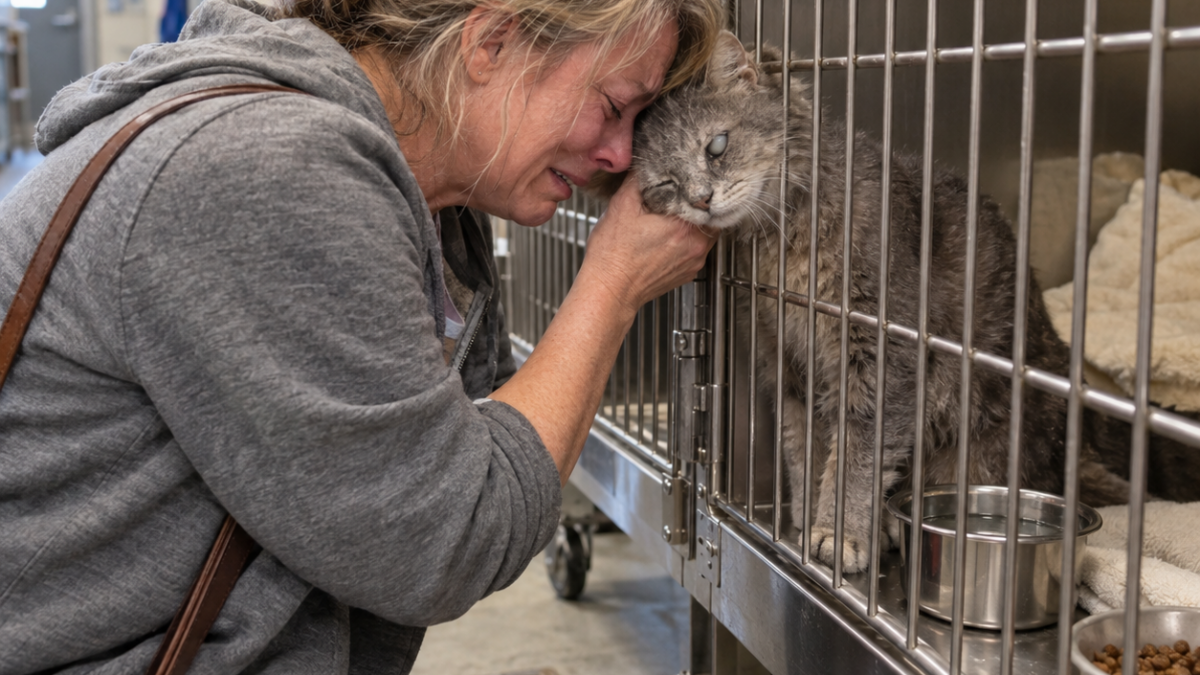
Then I saw Walter.
For one second, I almost did not recognize him.
He was pressed against the back wall of the kennel.
Low.
Tight.
His cloudy eyes were open but fixed on nothing.
There was a bowl of food in front of him that he had not touched.
His blue blanket was gone.
My old Walter, who navigated my house like a little gray ghost, who complained at 4:30 in the morning if breakfast was late, who could find the warm patch of sunlight near the back door with the confidence of a king, had been reduced to a trembling shape in a metal cage.
I crouched.
I did not reach for him.
I just said his name.
“Walter.”
His head lifted.
“It’s me. I’m here.”
For a few seconds, he stayed still.
Then he stood.
One careful step.
Then another.
His paw felt forward.
His whiskers brushed the side of the kennel.
He moved toward my voice, slow and uncertain, building a map one inch at a time.
When he reached the front, he pressed his forehead against my hand through the bars.
That was it.
I sat right down on the shelter floor and cried.
Not the kind of crying where you wipe your eyes and apologize.
The kind where your body understands before your mind does that something sacred has been violated.
The young woman opened the cage and helped me gather him.
Walter did not fight.
He tucked himself into my arms as though he had been holding his breath since morning.
At the counter, they gave me forms to reclaim him.
I signed everything.
Then the woman hesitated.
“Your husband said you had agreed.”
I looked up.
“What?”
“He said you were at work and that you both decided it was best.”
The pen froze in my hand.
“He said that?”
Her face tightened with regret.
“Yes.”
I did not have room inside me to process it.
Not then.
Walter was in a carrier by my feet.
He needed home.
That was all.
When we got back, Mark was still there.
The two plates were still on the table.
The food had gone cold.
He stood when I entered.
Walter was in his carrier by my feet.
Mark’s eyes moved to him first.
Then to me.
“I’m sorry.”
I believed him.
That surprised me.
I believed that he felt sorry.
I believed that he hated the look on my face.
I believed that some part of him wished he could rewind the day and become a different man before breakfast.
But that did not fix it.
“I just wanted us to have a fresh start,” he said.
I looked at him for a long time.
“Who gets to decide what I have to lose so we can have that fresh start?”
He did not answer.
I told him there had been a dozen things we could have tried.
Walter did not have to sleep in our bedroom.
We could have changed how we used the rooms.
We could have asked the vet for advice.
We could have admitted that living together was harder than we expected.
We could even have decided, with pain and honesty, that maybe marriage had come too late for two people with too much history to merge cleanly.
Any of those things could have been discussed.
But Mark had not discussed anything.
He had made the decision for me.
He had taken my old blind cat to a shelter and told strangers I agreed.
I removed my wedding ring.
It made a small sound when I set it on the kitchen table.
A tiny sound.
Almost nothing.
But Mark flinched like it had shattered glass.
“I can’t live with someone who takes something I love and removes it from my life without asking me.”
His mouth opened.
Closed.
For once, he did not explain.
The next day, Mark went back to his old apartment.
Some people thought I was being too harsh.
Two days of marriage.
Was I really ending it over a cat?
But it was never only about a cat.
A few weeks later, I moved Walter’s chair while vacuuming and forgot to put it back.
That evening, he walked to its usual spot.
Stopped.
Reached one paw forward, searching for the chair leg.
There was nothing there.
The sight of it nearly split me open.
I got up and moved the chair back.
Walter touched the wood with his nose, turned around twice, and curled up like he always had.
I stood there looking at him.
An old blind animal does not ask for much.
He needs the bowl where he expects the bowl to be.
The chair where he expects the chair to be.
The voice he trusts to tell him he is safe.
He needs to believe his whole world will not suddenly disappear because someone else decided it was inconvenient.
I think people need that too.
For three months, Mark and I did not see each other.
Life became quiet.
At first, I thought the quiet would crush me.
It didn’t.
That was one of the hardest truths to admit.
I missed him.
But I did not miss the tension.
There is a difference.
I missed the way Mark hummed while making coffee. I missed having someone ask if I needed anything from the store. I missed his hand resting on my shoulder while we watched television. I missed hearing another person move around upstairs.
But I did not miss watching his face every time Walter meowed.
I did not miss apologizing because my elderly cat had forgotten where he was at two in the morning.
I did not miss noticing every gray hair on Mark’s black sweater before he could complain about it.
I did not miss feeling like my home had to shrink so my marriage could fit inside it.
Some people thought leaving Mark meant I had never loved him.
I had.
I did.
Maybe part of me still does.
Love is not always the question.
Sometimes trust is.
And once someone takes something important from you without permission, you start noticing every place where permission matters.
Which drawer gets emptied.
Whose furniture stays.
Where Christmas is spent.
Who decides whether the old chair is ugly.
Who decides whether the cat is inconvenient.
Who decides what pieces of a life are allowed to come into the new one.
At fifty-seven, I did not want a fresh start that required pretending nothing existed before Mark arrived.
I had lived most of a life.
So had he.
That should have been the point.
We were not twenty-two-year-olds moving into an empty apartment with a mattress on the floor.
We came with histories.
Children.
Habits.
Furniture.
Grief.
Photographs.
Medication bottles.
Old friends.
Old arguments.
Old pets.
Old scars nobody else could see.
You do not marry someone our age and get a blank page.
You marry the whole book.
Three months after I took off my ring, Mark appeared at my front door with Walter’s blue blanket folded over his arm.
I had not given it to him.
For one terrible second, I thought he had been inside my house again.
Walter was asleep in his chair behind me.
I stood in the doorway and did not move.
“Where did you get that?”
Mark looked down at the blanket.
“It was in my car.”
Then I remembered.
The morning he took Walter to the shelter, he must have put the blanket in the back seat with him.
The shelter never returned it.
Mark had forgotten about it.
Or maybe he hadn’t.
“I washed it,” he said.
I almost laughed.
Not because anything was funny.
Because washing Walter’s blanket was exactly the sort of thing Mark used to believe counted as fixing a problem.
Clean the blanket.
Make dinner.
Say sorry.
Move on.
I did not take it at first.
Mark stood on the porch holding it with both hands.
He looked older than he had three months earlier.
Not dramatically.
Just tired.
“I’m not here to ask you to take me back,” he said.
“That’s good.”
He nodded.
“I know.”
There was an awkward silence.
Then Walter woke.
I heard the soft tap of his claws behind me.
Slow.
Careful.
He came down the hallway following my voice the way he always had.
When he reached me, he stopped beside my ankle.
Mark looked at him.
Walter did not react.
Maybe he recognized Mark’s voice.
Maybe he didn’t.
I still don’t know.
Mark crouched slightly.
“Hey, Walter.”
Walter turned his head toward the sound.
That was all.
No hiss.
No running.
No dramatic moment.
Just an old cat trying to understand where a voice was coming from.
Mark’s face changed.
He stood again.
“I brought his blanket back.”
I finally took it.
“Thank you.”
He looked relieved that I had said even those two words.
Then he handed me an envelope.
“I wrote something. You don’t have to read it.”
My name was written on the front in his small, careful handwriting.
“I’m not asking you to answer,” he said.
“Okay.”
He nodded once.
Then left.
I closed the door.
Walter followed me into the living room.
I put the blue blanket on the floor.
He walked toward it slowly.
His front paw touched the edge.
He sniffed.
Then climbed onto it and lay down.
Just like that.
Three months gone.
One sniff.
Home again.
I sat in the chair across from him with Mark’s envelope in my lap.
I did not open it for four days.
That surprised people later.
My daughter, Emily, said she would have opened it immediately.
My friend Carol said she would have thrown it away without reading it.
Everybody always knows exactly what they would do when it is not their envelope.
I put it in the drawer beside the kitchen phone.
Every time I opened the drawer for a pen, I saw it.
Every time I saw it, I closed the drawer again.
On the fourth night, I opened Mark’s letter.
It was six pages long.
The first line said:
Linda, I keep trying to explain what I did, and every explanation makes it worse.
That got my attention.
He did not say he panicked.
He did not blame Walter.
He did not blame lack of sleep.
He did not blame me for not taking his concerns seriously enough.
He wrote that the morning he took Walter away, he honestly believed he was solving something.
That sentence made me angry.
The next one made me stop.
He wrote:
I thought being your husband gave me more authority in your life than it actually did.
I read that sentence three times.
Mark said he had confused being included in my decisions with being allowed to make them.
He said that when we married, he thought of my house as our house immediately. That had sounded romantic in his head. But what he really meant, he wrote, was that he started treating things that had been mine for years as things he now had equal right to remove.
Including Walter.
Especially Walter.
He wrote that the moment he understood what he had done was not when I took off my ring.
It was earlier.
At the shelter.
Apparently, when Mark handed Walter to the woman at the front desk, Walter refused to come out of his carrier.
Mark reached in to move him.
Walter backed into the corner.
Not aggressive.
Just afraid.
The shelter worker asked Mark how long he had owned the cat.
Mark said, “Fifteen years.”
The woman looked at him.
Then he corrected himself.
“My wife has.”
The worker asked why his wife was not there.
Mark wrote that he lied.
He told her I was at work and we had made the decision together.
I stopped reading.
I put the letter down.
That was worse than I knew.
Not because of the lie itself.
Because some part of him already knew.
You do not lie about something you believe is completely right.
You lie because you know the truth changes how it looks.
The next morning, I called Emily.
She lived in Wisconsin with her husband and two kids.
She answered while driving home from work.
“You read it?”
“How did you know?”
“Because you only call me at seven-fifteen in the morning when you have either read something upsetting or decided your furnace is making a weird noise.”
I almost smiled.
“I read part of it.”
“And?”
“He lied to the shelter.”
Emily was quiet.
“He told them we agreed.”
“Oh.”
That one word told me she understood.
“I’m sorry, Mom.”
“I don’t know why this bothers me more than what I already knew.”
“Because now you know he knew.”
Exactly.
That was it.
Emily had been angry with Mark from the beginning.
Angrier than I expected.
She had liked him before all of this.
For almost four years, she had included him in birthdays and video calls. Her children had sometimes called him Grandpa Mark, even though nobody asked them to. After Walter disappeared, Emily stopped answering his messages.
But then she said something I did not expect.
“Are you going to finish the letter?”
“I don’t know.”
“You probably should.”
“Why?”
“Not for him.”
I waited.
“For you.”
I did not answer.
Emily sighed.
“Mom, I am not telling you to forgive him.”
“I know.”
“And I am definitely not telling you to take him back.”
“I know.”
“But if you stop halfway, you’re going to spend the next six months wondering what is on page four.”
She knew me too well.
That evening, I finished it.
The last pages were different.
Mark wrote that he had stayed with his brother for two weeks before finding another apartment. The first night there, he could not sleep.
Not because of a cat.
Because there wasn’t one.
He had gotten used to hearing Walter move through the hallway.
That irritated me too.
Then came the part I did not know what to do with.
Mark had started helping at a small neighborhood foster group on Saturday mornings.
Not the place where he had taken Walter.
Another one.
They mostly worked with older animals whose owners had died, moved into assisted living, or could no longer care for them.
He specifically wrote:
I know this does not undo anything. I am not telling you so you will think I am a good person now.
That sentence bothered me because I believed it.
He said his first job was cleaning litter boxes.
The next week, someone asked him to sit beside an old white cat named Daisy because she cried whenever she was left alone.
He sat beside her kennel for forty minutes.
She never let him touch her.
He went back the following Saturday.
And the Saturday after that.
Eventually, Daisy climbed into his lap.
Mark wrote:
I kept thinking about Walter in that shelter. I do not think I will ever stop thinking about it.
I folded the letter.
Then I cried.
Not because I wanted him back.
That would have been easier.
I cried because people are complicated.
It would have been much simpler if Mark had been cruel.
If he had hated Walter.
If he had laughed when I was upset.
If he had told me I was ridiculous.
If he had refused to apologize.
Then I could have placed him neatly in my mind.
Bad man.
Bad decision.
Finished.
But Mark was not a monster.
He was a man I loved who made a choice so selfish and so serious that I no longer trusted him inside my life.
Both of those things could exist at the same time.
That is uncomfortable.
People dislike uncomfortable truths.
They like teams.
Mark was wrong, so everything about Mark must have been wrong.
Or Linda ended a marriage after two days, so Linda must have overreacted.
Nobody wanted the middle.
But the middle is where most real life happens.
Two weeks after I read the letter, Carol came over for coffee.
Carol and I worked together years ago. She was sixty-one and had opinions about everything. Usually, I liked that about her.
She sat at my kitchen table while Walter slept on the blue blanket nearby.
“Did you answer him?”
“No.”
“Good.”
I poured more coffee.
Carol shook her head.
“A man does that once, he’ll do something like it again.”
“Maybe.”
“No maybe.”
I looked at her.
She leaned forward.
“Linda, do you know what scares me? Women our age spend years building a life, and then somebody comes along and expects us to rearrange everything because we’re afraid to be alone.”
I understood what she meant.
But something about the way she said it bothered me.
“I wasn’t afraid to be alone when I married Mark.”
Carol paused.
“I know.”
“I married him because I loved him.”
“I know that too.”
“And leaving him doesn’t mean I need to turn every good thing we had into a lie.”
Carol looked down at her cup.
She understood.
Maybe better than I expected.
After a while, she said, “You’re thinking about talking to him.”
“I’m thinking about answering the letter.”
“That’s not the same thing?”
“No.”
She gave me a look.
I almost laughed.
“Maybe it is.”
Carol reached across the table and touched my hand.
“Just remember why you left.”
“I do.”
I looked at Walter.
“I remember every day.”
That afternoon, I wrote Mark a message.
Not a letter.
Three sentences.
I read what you wrote.
Thank you for returning Walter’s blanket.
I’m willing to have coffee with you once, but I am not discussing getting back together.
Mark answered twenty minutes later.
Understood.
We met at a little coffee shop on the west side of town.
Neutral place.
Public.
Nothing dramatic.
I arrived first.
Mark came in wearing the brown jacket he always wore in fall.
He saw me and stopped for half a second.
That hurt more than I expected.
We had spent four years walking toward each other without thinking.
Now even crossing a coffee shop seemed to require permission.
He sat.
“Hi.”
“Hi.”
We ordered.
Then we talked about nothing for five minutes.
Emily’s children.
His brother’s new truck.
A neighbor who had cut down a tree.
Two people who had been married for forty-eight hours discussing landscaping.
Finally, Mark put both hands around his coffee.
“I’m sorry I lied to the shelter.”
I looked at him.
“I didn’t know that part.”
“I know.”
“Why didn’t you tell me?”
“Because I was ashamed.”
“That’s not a good reason.”
“No.”
That was one thing Mark had stopped doing.
Arguing with every accusation.
Before, if I told him something hurt me, he explained what he meant.
Now he seemed to understand that what he meant was not always the important part.
“I need to ask you something,” I said.
“Okay.”
“If I hadn’t found Walter, what would you have done?”
Mark looked at the table.
He took a long time.
That told me he was not going to give me the answer he thought I wanted.
“I don’t know.”
I appreciated that.
I hated it.
But I appreciated it.
“Would you have gone back?”
“I want to say yes.”
“But?”
“But I don’t know who I was that morning.”
That sentence stayed with me.
Who I was that morning.
We like to think character is permanent.
Maybe most of it is.
But there are moments when we become smaller versions of ourselves.
Impatient.
Afraid.
Proud.
Tired.
Possessive.
Certain.
And certainty can be dangerous when it belongs to the wrong person.
Mark looked at me.
“I kept telling myself you would be upset for a few days and then things would settle down.”
“You thought I would forgive you.”
“Yes.”
“You thought I would have no choice.”
He flinched.
Then nodded.
“Yes.”
There it was.
The ugliest truth.
Not that he thought I would agree.
He thought I would adjust.
There is a difference.
I sat back.
For a minute, neither of us spoke.
Then Mark said, “I’m not asking you to forgive me.”
“You are.”
He looked surprised.
“You might not be saying it. But every apology asks for something.”
He thought about that.
“Maybe.”
“I don’t know what forgiveness is supposed to look like here.”
“Neither do I.”
That was the first honest conversation we had after the wedding.
We stayed another hour.
When we stood to leave, Mark asked about Walter.
“He’s okay.”
“Still sleeping in the chair?”
“Mostly.”
Mark smiled.
“Still yelling at five in the morning?”
“Four-thirty now.”
He laughed quietly.
So did I.
Then we walked outside.
Mark stopped beside my car.
“Can I ask one more thing?”
“Depends.”
“If Walter ever needs anything…”
I knew where he was going.
“No.”
“I just meant—”
“I know what you meant.”
“I could help.”
“No.”
Mark nodded.
I could see that answer hurt him.
But it mattered to me.
Walter had been something Mark tried to remove.
I could not let him become something Mark used to prove he had changed.
That was not Walter’s job.
And it was not mine to provide Mark with a redemption story.
We said goodbye.
I drove home.
Walter was asleep.
Of course he was.
He had missed the entire emotional crisis.
He woke when I opened a can of food.
Life continued.
For the next four months, Mark and I exchanged occasional messages.
Nothing romantic.
Nothing daily.
Sometimes weeks passed.
Then he would send a picture of Daisy, the old white cat from the foster group.
Eventually, Daisy was adopted by a retired teacher.
Mark told me he cried in the parking lot.
I believed him.
I did not confuse that with trust.
That distinction became important.
People kept asking whether I would “give him another chance.”
I started hating that phrase.
Another chance at what?
Being married?
Being my friend?
Being forgiven?
Being allowed to apologize?
Being allowed to change?
Those were not the same thing.
A person can deserve the chance to become better without being entitled to return to the place where they caused harm.
I wish more people understood that.
Then, in January, Walter stopped eating breakfast.
At first, I was not worried.
Old cats have strange days.
He ate a little that evening.
The next morning, he walked to his bowl, sniffed it, and turned away.
I called the veterinarian.
Walter had gone to the same small clinic for years. Dr. Reeves had gray hair and the calm voice of someone who understood that frightened people only hear half of what is said to them.
She examined him.
Blood work.
Weight.
Heart.
Kidneys.
The usual things.
Then she sat across from me in the little room.
“Linda,” she said, “he’s lost more weight than I like.”
My stomach dropped.
Walter sat in his carrier with the door open, his face pointed toward my voice.
“What does that mean?”
“It means we should look closer.”
Tests followed.
Nothing dramatic.
No emergency.
Just the slow reality of an old body becoming older.
His kidneys were not working as well as they used to.
There were medications we could try.
Different food.
Fluids.
Monitoring.
Maybe months.
Maybe longer.
Maybe not.
Dr. Reeves explained everything carefully.
Then she said something that scared me more than the numbers.
“From here on, I want you to think about quality of life, not just length of life.”
I knew what she meant.
I did not want to know.
I took Walter home with three small containers and a printed schedule.
For weeks, I became ridiculous about it.
I wrote down every meal.
Every drink.
Every litter box visit.
Every medication.
Every time he walked across the room.
Every time he climbed into his chair.
Every good day felt like proof we were winning.
Every bad day felt like a threat.
Emily called every night.
“How is he?”
“He ate half his dinner.”
“That’s good.”
“He slept all afternoon.”
“He’s sixteen.”
“I know.”
But knowing something and accepting it are not the same.
One Saturday morning, Walter missed the chair.
He tried to climb up, misjudged the distance, and slid back onto the rug.
He was not hurt.
I picked him up.
He settled against my chest.
Walter had never been a cat who liked being carried.
That day, he did not protest.
I sat with him for almost an hour.
That scared me.
A week later, Mark sent a message about Daisy’s new owner.
I stared at my phone.
Then, without thinking too much, I wrote:
Walter isn’t doing very well.
The three dots appeared immediately.
Disappeared.
Appeared again.
Finally:
I’m sorry.
Nothing else.
No questions.
No request to visit.
No offer of money.
No advice.
I was grateful.
That evening, I called him.
He answered on the first ring.
“Linda?”
“Hi.”
“Hi.”
I could hear he was somewhere quiet.
“I wanted to tell you before you heard from someone else.”
“Okay.”
“His kidneys are failing.”
Mark was silent.
Then I heard him exhale.
“How bad?”
“I don’t know.”
That was the truth.
We talked for ten minutes.
Mostly about Walter.
At the end, Mark said, “I know I don’t have any right to ask this.”
I waited.
“If there is ever a time you think it would be okay for me to see him…”
I closed my eyes.
There it was.
The question I had known might come.
“No,” I said.
Mark did not speak.
“I’m sorry.”
“You don’t have to apologize.”
“I’m not trying to punish you.”
“I know.”
And I think he did know.
The problem was that I did not know why I was saying no.
Was it for Walter?
Or me?
Walter was not afraid of Mark.
He had never acted afraid of him after coming home.
If Mark entered the house, Walter would probably know his voice.
Maybe even his smell.
The person carrying the fear was me.
I ended the call.
Then I sat on the kitchen floor beside Walter’s water bowl and cried.
Two days later, Emily called.
I told her Mark had asked to see Walter.
“What did you say?”
“No.”
Emily was quiet.
“You think I was wrong.”
“I didn’t say that.”
“You got quiet.”
“I’m trying to decide whether I’m allowed to have an opinion.”
“You always have an opinion.”
“That is true.”
I almost smiled.
Then Emily said, “Mom, do you think Mark loved Walter?”
“No.”
“You don’t?”
I thought about it.
“Not the way I do.”
“That isn’t what I asked.”
“Emily.”
“I’m serious.”
“What difference does it make?”
“Maybe none.”
I waited.
She continued carefully.
“I hated what he did. I still hate it. But if Walter is getting near the end…”
“Don’t.”
“Okay.”
“No. Say it.”
She sighed.
“If Walter is getting near the end, are you going to be okay later if Mark never got to see him again?”
“That’s Mark’s problem.”
“Maybe.”
I knew that tone.
She was being careful.
Too careful.
“What aren’t you saying?”
Emily waited.
Then she said, “I think you’re protecting the version of yourself who had to drive around calling shelters.”
That hurt because it was true.
“She deserves protecting.”
“Yes,” Emily said immediately. “She does.”
Then she added, “But she isn’t the only version of you anymore.”
I did not answer.
My daughter had become annoyingly wise sometime around forty.
“She was terrified,” Emily said. “And she made a good decision. She protected Walter. She protected herself.”
I looked across the room.
Walter was sleeping.
“But maybe you don’t have to keep making every future decision from that exact moment.”
I was angry after we hung up.
Not at Emily.
At the question.
I did not want a question.
I wanted rules.
Mark did something unforgivable.
Therefore Mark never enters the house again.
Simple.
Safe.
Clean.
But life kept refusing to be clean.
Three days later, Dr. Reeves changed Walter’s medication.
He improved.
He started eating more.
He yelled at me one morning because breakfast was nine minutes late.
I laughed so hard I scared him.
For almost two months, he had more good days than bad.
Spring came.
Walter began sleeping in a patch of sunlight near the back door.
I put the blue blanket there.
One Saturday afternoon, I received a call from the foster group Mark had mentioned.
At first, I thought something had happened to him.
A woman named Joyce introduced herself and said Mark had listed me as an emergency contact when he started volunteering.
“I’m sorry,” I said. “We’re separated.”
“Oh.”
An uncomfortable silence.
Then Joyce apologized.
I told her it was fine.
Before we hung up, she said, “For what it’s worth, he’s very good with the difficult old ones.”
I almost laughed at the wording.
“The animals?”
“Yes.”
“Okay.”
She must have heard something in my voice because she laughed too.
Then she became serious.
“He sits with the ones nobody wants to sit with.”
I thanked her.
After the call, I stood by the sink looking out at the yard.
People can change.
That sentence sounds hopeful.
It can also be terrifying.
Because if people can change, anger loses the simple shape it used to have.
It does not mean trust automatically comes back.
It does not mean consequences disappear.
It does not mean the person who changed gets rewarded.
But it means you may have to look at them and admit they are not frozen forever inside the worst thing they ever did.
That is harder than hatred.
At least it was for me.
I called Mark.
“Do you want to see Walter?”
He did not answer right away.
“Yes.”
“One visit.”
“Yes.”
“I’m going to be here.”
“Of course.”
“And this is not about us.”
“I know.”
He came the next afternoon.
Walter was on his blue blanket.
Mark entered quietly.
He had been in that house hundreds of times.
But he stood inside the front door like a guest.
Maybe that was what he was now.
“Where is he?”
“Living room.”
Mark took off his shoes.
I noticed.
Walter heard us.
His head lifted.
Mark stopped six feet away.
“Hey, old man.”
Walter’s ears moved.
Mark sat on the floor.
He did not reach out.
He just talked.
About nothing.
The way I did.
“You’ve gotten skinny.”
Walter listened.
“I guess you’re still running this place.”
Walter stood.
Slowly, he walked toward Mark.
I held my breath.
One step.
Then another.
He stopped near Mark’s knee.
Mark placed one hand flat on the floor.
Walter sniffed it.
Then rubbed his face once against Mark’s fingers.
Mark started crying.
Silently.
No performance.
He turned his face away from me.
Walter, apparently satisfied that everyone in the room was being sufficiently emotional, walked past him toward the kitchen.
Mark laughed through tears.
“Still rude.”
“He wants water.”
“I know.”
Those two words landed strangely.
I know.
For years, Mark had known Walter too.
That was another truth I had tried not to think about.
He knew Walter liked the faucet dripping.
He knew Walter hated the vacuum.
He knew Walter sat outside the bathroom door and complained if I showered too long.
He knew which treats Walter liked.
He knew how Walter scratched the rug before lying down.
He knew.
And he had still taken him away.
That contradiction would always exist.
But so would this one:
He had returned.
He had learned.
He had changed some things.
Both could be true.
Mark stayed twenty minutes.
At the door, he said, “Thank you.”
I nodded.
Then he left.
I expected regret.
I did not feel it.
I expected to feel as if I had betrayed myself.
I did not.
Instead, I felt something I had not felt in months.
Relief.
Not because Mark was forgiven.
Because I had made the decision myself.
That mattered more than I realized.
He had asked.
I had said no.
Later, I changed my answer.
Nobody pressured me.
Nobody decided for me.
Maybe that was what I had needed all along.
Not control.
Choice.
Walter had a very good summer.
He turned sixteen.
Emily came down with her family for his birthday.
Yes, we gave a cat a birthday party.
No, I am not embarrassed.
My grandson made a paper crown.
Walter hated it.
The crown stayed on his head for approximately four seconds.
We took a blurry picture.
It is still one of my favorite photographs.
Mark did not come.
I did not invite him.
He sent a small bag of Walter’s favorite treats through Emily.
No note.
Walter ate three.
That fall, things changed quickly.
He stopped using the chair.
Then he stopped walking to the bedroom at night.
I put a small bed beside mine instead.
His world became smaller.
Bedroom.
Hallway.
Kitchen.
Living room.
Then mostly living room.
I moved his water closer.
Then his food.
Then the litter box.
Every time I moved something, I remembered what I had once said about Walter knowing the map of my house.
Now I was changing the map.
But this time, I was changing it for him.
Not against him.
There is a difference between making a world smaller because someone is inconvenient and making it smaller so they can still move through it safely.
I learned that too.
One Thursday morning, Walter did not get up when I made coffee.
I sat beside him.
He was awake.
He heard me.
His tail moved once.
I knew.
Not because anyone told me.
Because when you love something for sixteen years, sometimes you know when the world has shifted.
I called Dr. Reeves.
She came to the house that afternoon.
I had asked weeks earlier whether that would be possible when the time came.
She said yes.
Emily drove down.
She arrived just before three.
We sat on the living room floor.
Walter lay on his blue blanket.
Dr. Reeves examined him gently.
Then she looked at me.
“He’s tired, Linda.”
I nodded.
That sentence broke me more than anything medical could have.
He’s tired.
Walter had spent sixteen years finding me in rooms.
Waiting in hallways.
Listening for my key.
Learning a house after losing most of his sight.
He was tired.
Dr. Reeves gave me time.
As much as I needed.
That was when my phone buzzed.
Mark.
Emily saw the name.
I stared at it.
The message said:
Thinking about you both today. No need to answer.
I showed Emily.
She did not say anything.
Then I asked the question.
“Should I call him?”
Emily looked surprised.
“That’s up to you.”
“I know.”
And this time, those words did not frustrate me.
I knew.
It was up to me.
I called.
Mark answered.
“Linda?”
“It’s today.”
Silence.
Then, softly, “Okay.”
“He’s here at home.”
“Okay.”
“I don’t know if—”
My voice broke.
Mark waited.
I tried again.
“If you want to say goodbye, you can come.”
“I can be there in twenty minutes.”
“No.”
He stopped.
I looked at Walter.
“Not in person.”
Another silence.
Then Mark understood.
“Can you put the phone by him?”
“Yes.”
I turned on the speaker.
I placed the phone near Walter’s blanket.
Mark’s voice filled the room.
“Hey, Walter.”
Walter’s ear moved.
Emily covered her mouth.
Mark laughed once, but it came out broken.
“You still know me, huh?”
Walter stayed still.
Mark talked for maybe two minutes.
He apologized.
Not dramatically.
Not to me.
To Walter.
“I’m sorry I scared you.”
I closed my eyes.
“I’m sorry I took you away from home.”
Walter’s paw shifted.
Mark kept going.
“You didn’t do anything wrong, old man.”
That sentence nearly finished me.
Then he said, “Take care of Linda for another few minutes, okay?”
I started crying.
Emily did too.
Mark’s voice shook.
“And then you can rest.”
When the call ended, I sat beside Walter with my hand against his back.
Not holding him.
Just touching him.
He could hear me.
That mattered.
I told him the same thing I had told him hundreds of times before he jumped into his chair.
“You’re okay, buddy.”
His breathing stayed slow.
“You’re okay.”
Dr. Reeves waited.
Then Walter died at home on the blue blanket.
Quietly.
With my hand beside him.
I will not pretend it was beautiful.
Losing something you love is not beautiful.
But it was peaceful.
And it was his home.
That mattered to me more than I can explain.
For days afterward, I kept hearing him.
Not really.
I knew that.
But I would wake at 4:30 because some part of my brain expected his breakfast complaint.
I would look toward the hallway and expect to see him.
I stepped around his water bowl twice after I had already put it away.
The house felt wrong.
Not empty exactly.
Off balance.
The chair was still there.
The blue blanket was still there.
I left it untouched for almost a month.
People told me I should get another cat.
People mean well when they say things like that.
I was not ready.
Maybe someday.
Not then.
Walter was not an available position that needed filling.
He was Walter.
About a week after he died, Mark came by.
He had asked first.
That detail mattered.
He stood on the porch with a wooden box about the size of a book.
“What is that?”
He handed it to me.
Inside was a small wooden plaque.
Nothing fancy.
No photograph.
No long poem.
Just one carved line.
HE KNEW WHERE HOME WAS.
I stared at it.
Mark looked nervous.
“I asked someone from the foster group to make it.”
I ran my fingers over the letters.
“It’s beautiful.”
“I thought you might hate it.”
“I don’t.”
We sat on the porch.
For almost an hour.
We talked about Walter.
Good stories.
Stupid stories.
The time he climbed into Mark’s open suitcase and peed on three shirts.
The time he disappeared during Thanksgiving and we found him asleep inside a closet on clean towels.
The way he yelled at empty corners because he apparently believed something important was happening there.
We laughed.
Then the conversation became quiet.
Mark looked at his hands.
“Do you forgive me?”
There it was.
After all those months.
The question everybody else had asked before he did.
I looked at him.
“I don’t know.”
He nodded.
I expected disappointment.
Instead he said, “That’s fair.”
“No.”
He looked at me.
“I think that’s the wrong answer.”
“What is?”
“I said I don’t know.”
“Okay.”
I took a breath.
“I think I do forgive you.”
His eyes filled.
I raised my hand.
“But.”
He waited.
“I am not coming back.”
The tears stayed in his eyes.
He nodded.
“I know.”
“I need you to understand those are two different decisions.”
“I do.”
“Forgiving what happened doesn’t make me trust you the way I did before.”
“I know.”
“It doesn’t make us married again.”
“I know.”
“It doesn’t mean what you did became okay.”
“I know.”
Then Mark said something I still think about.
“I used to think forgiveness meant getting something back.”
I waited.
“Now I think maybe sometimes it just means the other person stops carrying you like a weight.”
I looked at him.
“That’s probably closer.”
We sat quietly.
Then Mark smiled sadly.
“So this is it?”
I thought about the question.
“No.”
He looked surprised.
“This is just what this is.”
That was the truth.
Mark did not become my husband again.
But he did not disappear from my life either.
For some people, that will make no sense.
Carol thought I was making a mistake.
Emily understood.
My sister said she would never speak to him again if she were me.
A neighbor said marriage vows should have meant I worked harder to repair things.
Another friend said allowing Mark back in any form showed weakness.
Everybody had a rule.
I stopped collecting rules.
Mark and I became something I still do not have a good word for.
Not a couple.
Not exactly friends at first.
Two people who had loved each other.
Two people who had hurt each other in different ways.
Two people who knew things about each other nobody else knew.
Sometimes we had coffee.
Sometimes three months passed without contact.
He continued volunteering with older animals.
I eventually donated Walter’s unopened food and medications to the foster group.
Mark did not pick them up.
Joyce did.
I appreciated that.
One year after Walter died, Joyce called me.
They had an old cat named Franklin.
Seventeen.
Half deaf.
Arthritis.
His owner had gone into long-term care.
Franklin had been in foster care for four months.
Nobody wanted him because everyone wanted a younger animal.
Joyce was not pressuring me.
She made that very clear.
She only said Mark had once mentioned that I understood old cats.
I was annoyed with him for saying that.
Then I asked to see Franklin.
I told myself I was only looking.
Everybody knows how that story ends.
Franklin came home with me the following Tuesday.
He had a crooked tail.
Three teeth.
And absolutely no gratitude.
For the first week, he lived beneath the guest bed.
I put food nearby.
I sat on the floor and read books aloud.
Slowly, he came out.
One evening, I was sitting in the living room when Franklin walked toward Walter’s old chair.
I froze.
The chair had never moved.
Franklin sniffed one leg.
Then climbed up.
He turned around three times.
And went to sleep.
I cried.
Of course I did.
But the crying felt different.
I did not feel as though Walter had been replaced.
I felt as though Walter had made room.
A month later, Mark came by for coffee.
Franklin was in the chair.
Mark saw him and smiled.
“So that’s him.”
“That’s him.”
Franklin opened one eye.
Mark walked closer.
Then stopped.
He looked at me.
“Can I?”
Two words.
Such a small thing.
Can I?
I nodded.
Mark held out his hand.
Franklin sniffed it.
Then turned his head away as if Mark had personally disappointed him.
I laughed.
Mark did too.
And in that moment, I understood something I wish I had understood years earlier.
Respect is often made of tiny questions.
Can I move this?
Can I invite them?
Can I help?
Can I come in?
Can I touch him?
Can we talk about this?
Can we change this?
Can I?
Those two words leave room for another person to exist.
That was what had been missing the morning Mark took Walter away.
There had been no question.
Only a decision.
People still ask whether I regret ending my marriage after two days.
Sometimes they ask carefully.
Sometimes not.
My answer is no.
I do not regret leaving.
I also do not regret forgiving Mark.
Those statements are not opposites.
I used to think a strong person was someone who knew exactly where the line was and never moved it.
Now I think strength can also mean understanding why the line exists.
Some lines protect you.
Some punish people forever.
Some do both.
You have to know the difference.
I had to learn another difference too.
A second chance does not always mean a second marriage.
Sometimes the second chance is simply the chance to do better the next time you stand at someone’s door.
The chance to ask instead of assume.
To listen instead of decide.
To accept that sorry may not restore what was lost.
To change even if nobody rewards you for changing.
Mark never got the marriage back.
I think that matters.
Consequences matter.
But so does what people do after the consequence.
He could have spent the rest of his life telling everyone I chose a cat over my husband.
Instead, when someone from our old circle once said exactly that, Mark corrected him.
Emily heard about it later.
Mark apparently said, “No. She left because I made a decision about her life that wasn’t mine to make.”
That may be the closest thing to proof of change I ever received.
He did not make himself the victim.
He did not make me the hero either.
He just told the truth.
Franklin has been with me almost two years now.
He sleeps more than any living creature should be capable of sleeping.
He hates chicken.
Loves tuna.
Yells at closed doors.
Unlike Walter, he can see perfectly well.
He simply chooses to walk into furniture.
The little wooden plaque Mark gave me still sits on the shelf beside Walter’s photograph.
HE KNEW WHERE HOME WAS.
Sometimes I look at it when Franklin is asleep in Walter’s chair.
I think about the woman I was that Thursday afternoon.
Standing in the hallway.
Calling Walter’s name.
Realizing the man I had just married had removed something from my life because he thought marriage gave him permission.
I still feel protective of her.
Emily was right about that.
I probably always will.
But I am protective of another woman now too.
The one who drove to the shelter.
The one who brought Walter home.
The one who took off her ring.
The one who later answered a letter.
The one who said no.
The one who eventually said yes to one visit.
The one who let a man apologize without giving him his old position back.
The one who sat beside an old cat on his last day and told him he was okay.
The one who learned forgiveness is not surrender.
And boundaries are not revenge.
The one who brought home another old cat even though she knew exactly how that story would eventually end.
Because love ending someday does not mean love was a mistake.
That may be the biggest thing Walter taught me.
At fifty-seven, I thought starting over meant choosing between being alone and giving parts of myself away.
I was wrong.
Starting over can be quieter than that.
It can look like keeping the chair where you want it.
Calling your daughter on Sunday.
Making one cup of coffee instead of two.
Letting somebody apologize without promising them anything.
Bringing home an animal everyone else thinks is too old.
Opening the door only when you decide to.
And sometimes opening it again.
Not because you forgot what happened.
Because you remember who gets to choose now.
Me.
A few weeks ago, Mark stopped by.
Franklin was asleep.
We sat at the kitchen table.
The same table where Mark had once made dinner while I drove around Grand Rapids trying to find Walter.
I still think about that sometimes.
Two plates had been sitting there that night.
Mark believed we would eat.
Talk.
Forgive.
Continue.
Life did not continue the way either of us expected.
Maybe that was necessary.
Mark finished his coffee.
Then stood.
“I should get going.”
I walked him to the door.
Before leaving, he looked toward the living room.
Franklin was still in the old chair.
“Take care of him,” Mark said.
“I will.”
Then he looked at me.
“And yourself.”
“I do.”
He smiled.
“I know.”
After he left, I locked the door.
Not because I was afraid.
Because it was evening, and I always lock the door.
Franklin woke.
He stretched.
Then he walked toward me and complained loudly because dinner was apparently three minutes late.
I filled his bowl.
He ate.
Then wandered back into the living room and climbed into Walter’s chair.
I sat across from him.
The house was quiet.
But not empty.
I looked at Walter’s picture.
Then at Franklin.
Then at the front door Mark had just walked through after asking permission to come inside.
Life had not gone back to what it was.
Thank God.
It had become something else.
Something more careful.
More honest.
Less certain.
Maybe that is what home really is.
Not a place where nothing painful ever happens.
Not a place where nobody makes mistakes.
Not even a place where everyone gets to stay.
Maybe home is the place where your life is treated like it belongs to you.
Where the things you love are not removed because someone else finds them inconvenient.
Where apologies do not come with demands.
Where forgiveness does not erase consequences.
Where people ask before they move the chair.
Walter spent his last years barely able to see.
But he always knew when I entered the room.
He knew my footsteps.
My voice.
The sound of my keys.
The shape of the hallway.
The place where his chair belonged.
And on his last day, he knew exactly where he was.
Home.
For a long time, I thought the lesson was that nobody should ever be allowed to take that away from you.
I still believe that.
But now I think there was another lesson too.
When somebody finally understands what they took from you, you are allowed to forgive them.
You are allowed not to.
You are allowed to let them back into part of your life.
You are allowed to keep the door closed.
You are allowed to change your mind.
What you are not required to do is surrender the choice.
Some people will always believe I should have saved my marriage.
Others will believe I should never have spoken to Mark again.
Maybe both groups are certain.
I’m not.
And strangely, I am comfortable with that now.
Because certainty was never what I needed.
I needed my life to belong to me.
Walter taught me that without saying a word.
He could barely see where he was going.
But somehow, he saw that more clearly than the rest of us.








