Two Bonded Cats Were Separated After Adoption—11 Days Later, One Was Returned and Ran Straight to Kennel 9 to Press Her Forehead Against the Cat She’d Lost
PART3:
The two cats were pressed so tightly together that their bodies overlapped.
Gray female on top slightly.
White female curled underneath.
Neither tried to get away.
Mark folded his arms.
“Told you.”
“How’d you find them?”
“Property owner was clearing debris.”
He wiped sweat from his forehead.
“Lifted a piece of roofing and thought he found one dead cat.”
My stomach tightened.
“Then?”
“One head came up.”
He paused.
“Then another.”
That image stayed with me.
A collapsed shed.
Heat.
Rotten boards.
Two cats surviving underneath.
Pressed so close a grown man mistook them for one body.
They were approximately four years old.
No chips.
No collars.
No nearby owner located.
We had no history.
No names.
Nothing.
Procedure required separate initial examination.
So we placed them in neighboring intake cages.
That lasted less than one hour.
The gray cat flattened herself against the divider.
Not hiding.
Not pacing.
Just pressed her entire body against the metal panel separating them.
The white cat reacted differently.
She paced.
Back.
Forward.
Back.
Forward.
And made a sound.
I have heard thousands of cat vocalizations.
Fear.
Pain.
Anger.
Heat cycles.
Confusion.
Demand.
This was different.
Low.
Drawn out.
Repeated.
Not the sharp screaming of a terrified animal.
Not quite a howl.
It sounded like calling.
That is the best word I have.
Calling.
The gray cat stopped eating.
The white cat never started.
We moved their food closer to the divider.
Nothing.
I crouched beside the white cat.
“Hey.”
She barely looked at me.
Then pressed her face toward the wall.
“Your friend’s right there.”
Another long call.
Dr. Patel completed their basic health checks.
No contagious illness that required isolation from each other.
Minor dehydration.
Fleas.
Small abrasions.
Otherwise surprisingly healthy.
I asked:
“Can we put them together?”
He looked at both untouched bowls.
“Yes.”
We opened the connecting access between two larger cages.
The white cat moved first.
Straight through.
The gray cat stood.
They touched noses.
Then the gray one began washing the white one’s face.
Immediately.
Forehead.
Ear.
Cheek.
Slow strokes.
The white cat closed her eyes.
Lay down.
Placed her head across the gray cat’s back.
Less than ten minutes later, both were eating from the same plate.
Dr. Patel watched.
“Well.”
I looked at him.
“That subtle enough?”
“Extremely.”
We officially listed them as bonded.
Names came two days later.
Shelter naming is strange.
Sometimes serious.
Sometimes ridiculous.
One volunteer was watching Stranger Things during lunch.
The gray cat became Eleven.
The white cat became Ghost, even though technically Ghost was not a Stranger Things reference and three people argued about it.
Nobody cared enough to change it.
Names stuck.
Eleven.
Gray coat with white paws.
White chest.
Amber-green eyes.
Slightly bolder.
Ghost.
Entirely white.
Pale green eyes.
Longer legs.
Quieter around people but more vocal when Eleven disappeared from sight.
They did everything together.
Eat.
Sleep.
Groom.
Use the litter box within minutes of each other.
Walk to the front of the kennel when visitors arrived.
Then retreat together if voices became too loud.
At night, they slept so tightly intertwined that sometimes volunteers checking the room had to count tails to make sure both were there.
Their adoption profile began:
ELEVEN & GHOST — BONDED PAIR
Must be adopted together.
We meant it.
For five weeks, nobody took them.
Plenty of interest.
Very little follow-through.
A college student loved Ghost.
Landlord allowed one cat.
A retired couple wanted Eleven.
Already had two cats at home and did not want four.
A young family spent twenty minutes with both.
Kids adored them.
Father asked:
“What happens if we separate them?”
I said:
“We don’t recommend it.”
“Would they die?”
“No.”
That answer bothered me afterward.
Because people hear “won’t die” as “will be fine.”
I continued:
“But they become significantly distressed when separated even briefly.”
He nodded.
Then:
“We really only wanted one.”
They adopted a kitten two cages down.
I watched Eleven groom Ghost after they left.
Shelter work makes you irrational sometimes.
You start resenting happy adoptions because the wrong animal got chosen.
Then you remember:
The kitten needed a home too.
There is no villain in every disappointment.
Five weeks.
Then August 19.
A family came in specifically looking for an adult cat.
Mother named Diane.
Her husband Paul.
Their daughter Sophie, nine years old.
They lived thirty minutes away in a rental townhouse.
Quiet.
No other pets.
Sophie sat on the floor of our meet-and-greet room.
Eleven approached first.
Rubbed her ankle.
Ghost watched from behind a chair.
Ten minutes later Ghost came out.
Sophie smiled.
“They’re sisters?”
“We don’t know biologically.”
“But they act like it.”
“Yes.”
The family stayed almost an hour.
I started feeling hopeful.
Then Diane said:
“We can only adopt one.”
My stomach dropped.
“Our landlord only approved one cat.”
I explained the bond.
Not casually.
Carefully.
How they had responded to separate intake cages.
How neither ate until reunited.
How they slept.
How Ghost called when Eleven left the room.
Paul listened.
Diane looked disappointed.
Sophie looked at both cats.
“Can we ask the landlord?”
Diane said:
“We already did.”
Apparently the lease was firm.
One animal.
Sophie’s eyes filled.
She pointed at Eleven.
“If we have to choose…”
I interrupted gently.
“I really don’t recommend choosing between them.”
Diane looked at me.
“We understand.”
Then:
“But you’ve had them five weeks.”
True.
“They need homes.”
Also true.
“If we take one, isn’t that better than both staying here?”
That question went directly into the conflict shelter workers live with every day.
Ideal versus available.
Perfect placement versus placement.
Kennel stress versus separation stress.
We discussed it with management.
Another staff member argued against separation completely.
One argued that Eleven appeared slightly more independent and might adapt.
Ghost had shown stronger separation vocalization.
I hated that reasoning even as I understood it.
We called the shelter veterinarian.
He said:
“If you split them, make sure the adopter understands there’s a real possibility it fails.”
Diane understood.
She seemed responsible.
Compassionate.
Willing to return Eleven if severe distress developed.
We documented everything.
I still felt wrong.
When I signed the adoption paperwork, my pen hesitated.
Sophie noticed.
“You don’t want us to take her.”
Children are brutal observers.
“I want Eleven to have a good home.”
“We’ll love her.”
“I believe you.”
That was true.
I looked toward Ghost.
She sat behind the kennel door.
Watching.
I added:
“She may miss Ghost more than we expect.”
Sophie went to the cage.
Placed two fingers through the safe opening.
“I’m sorry.”
Ghost sniffed.
Eleven was placed in the carrier.
At the door, she began vocalizing.
Not loud.
Searching.
Ghost answered from the cat room.
One long call.
Eleven froze inside the carrier.
Diane looked at me.
“That’s Ghost?”
“Yes.”
Sophie started crying.
Paul looked uncomfortable.
“We can still stop.”
I wanted to say yes.
Instead, because I had already helped approve the adoption, I said:
“You can take her home and monitor closely.”
That sentence followed me for eleven days.
The moment the front door closed behind Eleven, Ghost walked to the kennel bars.
Sat.
Faced the hallway.
Did not move.
Dinner came.
Untouched.
I told myself:
Adjustment.
By morning, still untouched.
We tried wet food.
Tuna water.
Warm chicken.
High-value treats.
Ghost turned her head away.
She did not hide.
That made it worse.
A hiding cat looks frightened.
Ghost looked like she was waiting.
Every sound at the corridor entrance brought her head up.
Then down again.
Day two.
Minimal water.
No meaningful food.
Dr. Patel started supportive care.
Appetite stimulant.
Fluids.
Exam.
Nothing medically obvious.
“What do you think?”
He looked toward cage #9.
“Stress.”
“Separation?”
“Most likely.”
I called Diane.
“How is Eleven?”
Silence.
My stomach tightened.
“Not good.”
“What’s happening?”
“She hasn’t eaten.”
I closed my eyes.
“How long?”
“Since we brought her home.”
“Nothing?”
“A few licks.”
“Where is she?”
“By the front door.”
“What do you mean?”
“She sits there.”
“All day?”
“Almost.”
Diane sounded exhausted.
“She doesn’t explore.”
“Doesn’t play.”
“We bought toys.”
“A heated bed.”
“Different foods.”
“She just sits facing the door.”
My chest hurt.
“Bring her back.”
There was a pause.
“We have a vet appointment tomorrow.”
“Good.”
“But if they say she’s healthy…”
“Bring her back.”
Diane whispered:
“You think it’s Ghost.”
“Yes.”
I did not soften it.
“I think they’re both doing the same thing.”
That night Ghost finally ate two teaspoons of food after medication.
We celebrated like idiots.
Then she returned to the bars.
Day three.
Same.
Day four.
Ghost’s coat began looking dull.
Cats stop grooming properly when they feel badly.
Her white fur, normally clean, looked slightly clumped near the shoulders.
She lost weight.
We weighed daily.
At home Eleven did too.
Diane sent photographs.
Eleven sitting beside a beige front door.
Morning.
Evening.
Night.
Same position.
One photo had a new plush bed beside her.
Unused.
Another showed a plate of expensive prescription food.
Untouched.
Sophie sat beside Eleven sometimes.
The cat allowed petting.
But kept facing the door.
Diane wrote:
She’s not afraid of us. She just seems like she’s waiting for permission to leave.
That sentence broke me.
On day five, I sat outside Ghost’s kennel after closing.
“You know she isn’t coming through there tonight.”
Ghost stared down the hallway.
“You need to eat.”
Nothing.
I slid my fingers near the bars.
She came closer.
Not for me.
Just closer to the door.
I had spent twelve years telling adopters not to assign human motives too confidently to animals.
Now every part of me wanted to say:
She misses her.
That was the simplest explanation.
Maybe scientifically it was disruption of attachment.
Loss of social buffering.
Stress response.
Environmental change.
Absence of familiar scent.
All of those words may have been more precise.
None felt more true.
She missed her.
Day six.
Diane’s veterinarian found no physical reason for Eleven’s refusal to eat.
Weight loss becoming concerning.
Anti-nausea medication.
Appetite stimulant.
No meaningful improvement.
Day seven.
I called again.
“Please bring her back.”
Diane sounded like she had been crying.
“Sophie thinks we failed her.”
“You didn’t.”
“We wanted to give her a home.”
“I know.”
“We did everything.”
“I know.”
“Why doesn’t she want us?”
That question hurt.
“This isn’t about not wanting you.”
“How do you know?”
“Because animals can form attachments that exist before us.”
I looked at Ghost.
“We don’t become more important just because we adopted them.”
Silence.
Then:
“My landlord still won’t approve two.”
“I understand.”
“If we bring Eleven back, Sophie will be devastated.”
“I know.”
Diane inhaled.
“I need another day.”
I wanted to push.
I didn’t.
The vet was monitoring Eleven.
They were trying.
This family was not careless.
They were hurting too.
Day eight.
Ghost accepted syringe-assisted nutrition.
Day nine.
Eleven lost over a pound—more than half a kilogram from her starting weight.
Dangerous in a cat.
Especially with prolonged food refusal.
Risk of hepatic lipidosis.
Her veterinarian became more urgent.
Day ten.
Diane called.
“We’re coming tomorrow.”
I exhaled.
“Okay.”
“She ate one bite tonight.”
“Good.”
“Then went back to the door.”
“I’ll be here.”
Sophie came on the phone.
“Rachel?”
“Hi, sweetheart.”
“Is Ghost mad?”
“No.”
“Does she hate us?”
“No.”
“Does Eleven?”
“No.”
“Then why can’t she be happy here?”
I took a long time.
“Sometimes love for one place doesn’t erase love for someone who was there before.”
She was quiet.
Then:
“Eleven wants her sister.”
“I think so.”
“Does Ghost want her?”
I looked directly at cage #9.
“Yes.”
The next morning was day eleven.
I arrived early.
Ghost looked terrible.
Not dying.
But depleted.
Thin.
Eyes half closed.
She had received fluids.
Medication.
Nutrition.
Her body was being kept safe while her behavior remained withdrawn.
At 10:12, the shelter front door opened.
Diane came in carrying a soft-sided cat carrier.
Sophie held one side.
Paul walked behind them.
Diane’s face looked ashamed.
That bothered me immediately.
“You don’t need to apologize.”
“She looks awful.”
“Who?”
“Eleven.”
Then I heard movement inside the carrier.
I opened the top carefully.
Gray face.
White paws.
Eleven looked up at me.
Thinner.
But alert.
The moment she smelled the building, she stood.
Not slowly.
Instantly.
Her nose worked.
Head turned toward the hallway.
Diane said:
“She knows.”
I lifted Eleven out.
I intended to carry her.
She twisted.
Not aggressively.
Urgently.
“Okay.”
I lowered her to the floor.
She ran.
I had never seen her run like that.
Down the cat corridor.
Past cage three.
Five.
Seven.
Stopped at nine.
Ghost was lying inside.
For half a second, nothing happened.
Eleven walked to the bars.
Lowered her head.
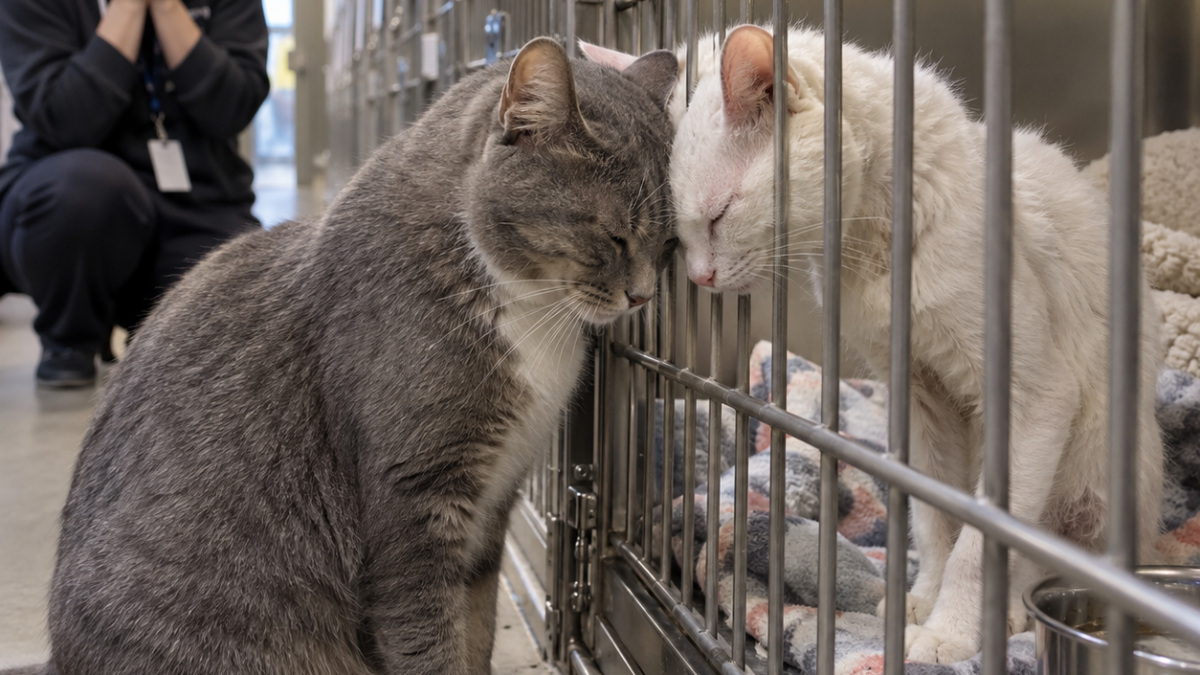
Pressed her forehead against the metal.
Ghost’s eyes opened.
Slowly.
Her head lifted.
She stood with visible effort.
One step.
Then another.
She reached the cage front.
Placed her forehead against Eleven’s through the bars.
Metal between them.
Fur touching where the gap allowed.
Forehead to forehead.
Then both closed their eyes.
Nobody spoke.
Diane started crying first.
Sophie next.
I was already there.
A kennel technician named Luis stopped at the end of the hallway carrying laundry.
He lowered the basket without making a sound.
Dr. Patel came around the corner.
Stopped.
We all watched.
One minute.
Five.
Ten.
They did not move.
Eleven’s breathing slowed.
Ghost’s body loosened.
At some point Eleven sat.
Ghost sat inside.
Still touching.
Twenty minutes.
I know because Luis looked at the clock when it started and again when Ghost finally moved.
She turned.
Walked toward her food dish.
Sniffed.
Ate.
Three bites.
Then more.
I covered my mouth.
Eleven remained outside the cage.
Ghost ate perhaps two tablespoons.
The most she had voluntarily eaten since separation.
Diane whispered:
“Oh my God.”
Sophie looked at her mother.
“We have to take Ghost.”
Diane closed her eyes.
“Our landlord—”
“We have to.”
Paul had said almost nothing.
Now he spoke.
“I’ll call him.”
He walked outside.
I opened cage #9.
Eleven went in.
No hesitation.
Ghost stopped eating long enough to groom Eleven’s face.
Same as the day we first reunited them after intake separation.
Forehead.
Ear.
Cheek.
Eleven closed her eyes.
Then they ate from the same bowl.
That was when I realized how much guilt I had been carrying.
I had approved the separation.
Not alone.
Not carelessly.
But I had helped.
Because I wanted one cat to get a home.
Because five weeks felt long.
Because I told myself maybe they would adapt.
Watching them eat side by side, I knew the gamble had cost both animals eleven days of distress.
I promised myself something then.
Never again would I describe a bonded pair as:
“They prefer to stay together.”
Not if the evidence showed more.
Preference is choosing one blanket over another.
This was regulation.
Safety.
Attachment.
Their bodies worked differently together.
Paul came back twenty minutes later.
“Landlord says no.”
Sophie’s face fell.
Then Paul added:
“So we’re moving.”
Diane stared.
“What?”
“I’m serious.”
“You cannot move because of a cat.”
“Two cats.”
“Paul.”
“Our lease is up in six weeks.”
That detail had not come up before.
“We’ve been talking about moving anyway.”
Diane stared.
“And what do we do for six weeks?”
Paul held up his phone.
“My sister.”
She owned a duplex.
Allowed pets.
Vacant downstairs unit.
“Temporary.”
Sophie screamed.
Not words.
Just sound.
Then hugged her father.
Diane started crying harder.
“This is insane.”
Paul looked through the kennel bars.
Ghost was washing Eleven’s head.
“Yeah.”
Then:
“I think separating them was more insane.”
We did not let both cats leave that day.
They needed medical stabilization.
Eleven had lost dangerous weight.
Ghost too.
Dr. Patel wanted at least several days of monitored feeding.
Diane understood.
The family visited every day.
Both cats improved faster than I expected.
Eleven ate the first afternoon.
Ghost continued eating.
Grooming resumed.
They slept tangled together.
Day two, both used the litter box normally.
Day three, Ghost played with a feather wand for the first time since Eleven left.
Day four, Eleven climbed onto Sophie’s lap during visitation.
Ghost climbed partly onto Eleven.
Sophie sat very still.
“I’m trapped.”
“Yes.”
“Can somebody bring me water?”
“No.”
She looked offended.
“Bonded cat rules.”
She giggled.
The landlord situation changed unexpectedly.
Paul sent the landlord the photograph.
The reunion photo.
One of our volunteers had taken it from several feet away.
Two foreheads pressed through the bars.
Eyes closed.
No dramatic lighting.
No staging.
Just two cats.
Paul also sent veterinary letters explaining the health consequences that occurred after separation.
The landlord called him.
Not sentimental.
Practical man.
Asked about deposits.
Damage.
Vaccinations.
Litter management.
Then approved a second cat with an additional pet deposit.
Paul told us:
“I think the photo did what I couldn’t.”
Diane said:
“He pretends it didn’t.”
I said:
“Let him.”
The next day, they came back.
This time for both.
I changed the adoption paperwork.
ELEVEN — ADOPTED
GHOST — ADOPTED
Same household.
Same day.
We used one large carrier.
The moment both were inside, Ghost curled around Eleven.
Sophie crouched in front.
“You’re both coming.”
Ghost blinked.
Eleven rubbed against her.
Diane hugged me before leaving.
“I’m sorry we separated them.”
“So am I.”
She looked surprised.
“You warned us.”
“Not enough.”
“You couldn’t know.”
“No.”
But I could learn.
That was the important part.
Their first update arrived that evening.
Photo.
Two cats underneath a dining table.
Pressed together.
Caption:
They ate dinner. Both bowls.
The next morning:
Slept all night.
Then:
Ghost followed Eleven into the bathroom and yelled because the door closed for four seconds.
Normal.
A week later:
Eleven and Ghost on a couch.
Sophie between them.
Well, technically Sophie underneath them.
One cat on her stomach.
One near her legs.
Caption:
I have lost access to my child.
A month later, both cats had regained their weight.
Coats brighter.
Eyes clear.
Diane brought them for follow-up.
Ghost refused to remain in the exam carrier if Eleven was taken out first.
So we examined them within view of each other.
Dr. Patel said:
“Lesson learned.”
“Yes.”
They were medically healthy.
Emotionally?
Better.
Much better.
Over the next year, the family sent photographs regularly.
The pattern never changed.
Sleeping:
Together.
Eating:
Side by side.
Window:
Together.
Sophie doing homework:
Both on the table despite rules.
If Eleven entered another room, Ghost followed.
Usually under thirty seconds.
Diane timed it once.
Seven seconds.
Then posted:
Separation anxiety or just extremely committed supervision?
I answered:
Yes.
One photo became my favorite.
Winter.
Snow outside.
Eleven curled into Ghost so tightly their heads overlapped.
Sophie wrote beneath it:
One cat with two bodies.
That line came from something she told her teacher.
Her class had been asked to describe their pets.
Sophie apparently said:
“We have two cats, but really it’s one cat with two bodies.”
Her teacher emailed Diane because she thought it was adorable.
Diane forwarded it to me.
I cried.
Again.
Shelter work makes you cry at absurdly small emails.
The reunion photo stayed with us.
We printed it.
Framed it.
Hung it near the cat adoption area.
Underneath, I wrote:
THIS IS WHAT BONDED MEANS.
Management thought that sounded too blunt.
So we changed it.
The final plaque read:
This is what a bonded pair can look like.
This is why some animals must be adopted together.
Sometimes home is not a place. Sometimes home is the one waiting beside you.
People noticed the photograph.
Asked questions.
That became useful.
Instead of staff saying:
“These two must go together,”
we could explain.
Attachment.
Behavior.
History.
Signs of distress.
Why separation can create real health risks in some animals.
And importantly:
Not every pair sharing a cage is bonded.
Some simply tolerate one another.
Some enjoy company but can adapt separately.
Others depend deeply on each other.
We got better at distinguishing.
Behavioral observation.
Short supervised separations.
Eating patterns.
Resting behavior.
Response to absence.
Reunion behavior.
The language became more precise.
“Bonded” stopped being a cute label.
It became a placement decision supported by evidence.
Eleven and Ghost changed that.
They also changed me.
I had spent twelve years thinking I understood cat attachment.
Cats had a reputation for independence.
People liked saying they were less needy than dogs.
I hated that word already.
Need is not weakness.
Cats can form profound social bonds.
With humans.
Other cats.
Dogs.
Places.
Routines.
The expression may be different.
That does not make it shallow.
Eleven and Ghost did not scream theatrically when separated.
That might have been easier for us.
They stopped.
Stopped eating.
Stopped exploring.
Stopped grooming properly.
Stopped engaging.
Their grief looked like stillness.
And humans are bad at noticing stillness.
We notice destruction.
Noise.
Aggression.
We notice a cat tearing curtains.
Not necessarily the cat sitting beside a door for eleven days.
That became the part of their story I told most often.
Diane once described Eleven’s behavior at home in detail.
The first night, after they brought her in, she explored maybe three feet from the carrier.
Then returned to the front door.
Sat.
Sophie brought a toy.
No reaction.
Food.
Nothing.
At midnight, Diane woke.
Eleven was still there.
At three in the morning, same.
At seven, same.
Every time someone opened the door, Eleven stood.
Looked outside.
Not trying to escape wildly.
Searching.
Then sat down.
For eleven days.
Imagine that.
New family.
Soft beds.
Warm house.
Toys.
Affection.
Everything shelters tell ourselves an animal is waiting for.
And Eleven did not want any of it without Ghost.
Not because the family failed.
Because the most important part of her existing world had not come with her.
Ghost did the same from the other side.
Shelter cage.
Door.
Hallway.
Waiting.
Two animals in two locations.
Facing exits.
Both apparently expecting the missing one to appear.
That symmetry still gets me.
I sometimes wonder what would have happened if the family had waited longer.
Would Eleven eventually have adapted?
Possibly.
Would Ghost?
Maybe.
Animals can survive loss.
Humans do too.
But survival was not the question.
We had the power to restore the relationship.
Why force them to learn to live without it?
That changed how I thought about adoption generally.
People sometimes approach rescue with the idea that any home is automatically better than the shelter.
Usually, yes.
But home is not only walls.
Food.
A couch.
Home includes relationships.
Smells.
Routine.
Companionship.
Safety cues.
Take an animal from a shelter and you may improve ninety percent of its environment while removing the ten percent that mattered most.
Placement has to consider both.
That lesson became policy.
Bonded animals received a red marker on records.
No separation without behavioral review.
If a housing restriction allowed one pet only, we offered to speak directly with landlords.
Sometimes it worked.
Sometimes not.
We partnered with a local rescue fund to cover additional pet deposits for bonded pairs when that was the only barrier.
One anonymous donor specifically gave money after reading Eleven and Ghost’s story.
Memo line:
KEEP THEM TOGETHER.
I taped a copy over my desk.
Six months later, a bonded pair of twelve-year-old brothers arrived after their owner died.
Both black cats.
One diabetic.
Nobody wanted two seniors.
The old version of our shelter might have eventually considered separate placement.
We did not.
They waited seven weeks.
Then a widow adopted both.
Deposit paid by the bonded-pair fund.
She sent us a photograph of them asleep in her recliner.
I printed it.
Put it beside Eleven and Ghost.
Impact spreads.
That is one of the reasons stories matter.
Not because every emotional story needs to go viral.
Because sometimes one visible failure changes the next decision.
We failed Eleven and Ghost when we separated them.
There.
I can say it now.
We did not abuse them.
Did not act maliciously.
We discussed.
Documented.
Warned.
Had reasons.
Still failed.
Intentions do not erase outcomes.
The important thing is what happened next.
We admitted it.
Changed the policy.
Helped the family repair the situation.
Learned.
Shelter professionals are under tremendous pressure to appear certain.
Animals cannot explain themselves in language.
So people expect us to know.
We do not always know.
Good animal welfare work includes humility.
Observe.
Make a decision.
Watch the outcome.
Adjust.
Eleven taught us quickly.
Ghost taught us too.
Their bodies provided the data.
By their second year with the family, Sophie had become an unofficial ambassador for bonded pairs.
Her school held a supply drive for our shelter.
She made posters.
One had the reunion picture.
Underneath she wrote in marker:
DON’T BREAK UP BEST FRIENDS.
Technically oversimplified.
Emotionally effective.
They collected food.
Blankets.
Litter.
Over six hundred dollars.
Sophie came in to deliver everything.
She was eleven by then.
Taller.
Still serious about animals.
“Can I see cage nine?”
That question caught me.
It no longer belonged to Ghost.
We had used it after retiring the reunion photo display period.
A young tabby was inside.
He rubbed against the bars.
Sophie looked.
“That was Ghost’s?”
“Yes.”
“She looks bigger than this cage in my memory.”
“So do most things.”
Sophie smiled.
Then touched the frame on the wall.
The photograph.
Forehead to forehead.
“I remember that.”
“You were here.”
“I know.”
“I mean I remember how quiet it was.”
So did I.
That was the part photographs could not show.
The silence.
Shelters are rarely silent.
Dogs barking.
Kennel doors.
Laundry.
Phones.
People.
That day, the whole cat corridor stopped.
Nobody wanted to break whatever was happening.
Two cats breathing together through metal.
Twenty minutes.
It felt almost private.
But also instructional.
Like we were being shown something obvious we had managed not to understand.
Sophie asked:
“Did they think they were never going to see each other again?”
I answered honestly.
“I don’t know.”
“What do you think?”
“I think they knew the other one was gone.”
“That’s sad.”
“Yes.”
“Do cats know eleven days?”
“Not the number.”
“But time?”
“Routine.”
“Absence.”
“Probably.”
She studied the photograph.
“Ghost looks like she’s saying, ‘You came back.’”
I looked.
Maybe.
Eleven’s forehead pushing through bars.
Ghost’s eyes shut.
“You know what I thought?”
Sophie asked.
“What?”
“That Eleven was sick.”
“So did we.”
“But she was sad.”
“Stress can make bodies sick.”
She nodded.
“Like people.”
“Yes.”
Very much like people.
The family kept both cats for the rest of the years I knew them.
No more separations beyond veterinary necessity.
Even then, they often brought both cats when only one had an appointment.
Our staff initially laughed.
Then stopped when we realized the examined cat’s heart rate was often lower with the other present.
Not magic.
Social buffering.
Familiar presence reducing stress.
Ghost hated nail trims.
Eleven sat in the carrier watching.
Ghost complained loudly.
Then immediately went to Eleven afterward for grooming.
Eleven tolerated vaccines better if Ghost could be seen.
We adjusted.
Medicine works better when you remember the patient lives inside a relationship.
One summer, Diane called me unexpectedly.
“Everything’s fine.”
That is a good way to start shelter alumni calls.
“What happened?”
“Nothing.”
“Then why do you sound emotional?”
She laughed.
“I’m watching them sleep.”
I waited.
“They’re in the exact same position as the day animal control found them.”
Pressed together.
“So close you can barely tell where one ends.”
Diane went quiet.
“I used to think adopting Eleven meant we were rescuing her.”
“And?”
“She was already somebody’s home.”
That sentence stayed with me.
She was already somebody’s home.
Adoption did not create the first meaningful bond in Eleven’s life.
We were entering a story already underway.
Humans forget that with rescue animals.
We meet them at chapter five and behave as though page one starts when we sign paperwork.
They had lives before us.
Relationships.
Preferences.
Loss.
Sometimes trauma.
Sometimes love.
Ghost and Eleven had survived under a collapsed shed together before anybody knew their names.
We never learned how long they were there.
Never learned where they lived before.
Maybe sisters.
Maybe mother and daughter close in age.
Maybe unrelated cats who found each other.
It hardly mattered.
By the time they reached us, separation changed whether they ate.
That was the information that mattered.
Years later, I was training a new volunteer.
Young woman.
First week.
She saw the photograph.
Asked:
“Is this staged?”
I laughed.
“No.”
“Why are they touching through the bars?”
I told her.
All of it.
Five weeks waiting.
One adoption.
Eleven by the front door.
Ghost in cage #9.
Weight loss.
Return.
The run.
Twenty minutes.
The volunteer had tears in her eyes.
“That’s horrible.”
“Part of it.”
“Why did you let them separate?”
There it was.
Direct.
No professional cushioning.
“We thought Eleven might adapt.”
“Did you know Ghost wouldn’t?”
“We knew she was strongly attached.”
“So why?”
I could have defended us.
Housing barriers.
Length of stay.
Adoption pressure.
Professional judgment.
Instead:
“We made the wrong call.”
The volunteer looked surprised.
“Shelters do that?”
“Yes.”
“Veterinarians?”
“Yes.”
“Behaviorists?”
“Yes.”
“Then how do you know what to do?”
“You pay attention.”
“To what?”
“The animal in front of you.”
“And when they show you you were wrong?”
“You change.”
That became another thing Eleven and Ghost left behind.
Permission to change.
Pride kills good decision-making.
You can be experienced and wrong.
Compassionate and wrong.
Careful and wrong.
What matters next is whether you defend yourself or correct the course.
Eleven did not care that our paperwork had been signed.
Ghost did not care that the family had bought a heated bed.
Their answer was physical.
No.
Not like this.
Together.
That was the requirement.
The family listened.
We eventually listened.
That was enough to change the ending.
I keep copies of several shelter photographs at home.
Nona from another case.
Old dogs.
Litters.
Animals who made it.
Animals who did not.
Eleven and Ghost are there too.
Not the polished adoption-day photo.
The bars.
Foreheads.
Eyes closed.
Someone once asked why I would keep the sad picture instead of the one where they are home on a couch.
Because the sad picture contains the lesson.
The happy photos show outcome.
That photograph shows recognition.
Not theirs.
Ours.
We finally recognized what they had been telling us since intake.
First hour separated:
Stop eating.
Reunited:
Eat.
Five weeks together:
Stable.
Separated:
Both stop eating.
Reunited:
Eat.
Sometimes humans need the same lesson repeated embarrassingly many times before we call it evidence.
Eleven and Ghost were patient teachers.
One day, years after their adoption, Sophie returned with a school project.
She had written an essay about animal relationships.
Title:
One Cat With Two Bodies.
I laughed when I saw it.
She read me the final paragraph.
I still remember most of it.
She wrote that people think home is a building.
But for Eleven, home had sat behind metal bars.
For Ghost, home had left in a carrier.
And when home came back, neither cat cared about the cage, the family, or the people standing around crying.
They just touched foreheads.
I told Sophie:
“That’s better than anything we put on the plaque.”
She said:
“I know.”
Teenagers.
Ghost became the more confident one at home eventually.
Funny how environment changes expression.
At the shelter she had been the caller.
The distressed one.
The one who seemed more dependent.
At home, once secure, she became curious.
Opened cabinets.
Stole socks.
Learned how to push bedroom doors open.
Eleven remained calmer.
Slept in windows.
Preferred Sophie’s bed.
Every evening Eleven groomed Ghost’s face.
Same ritual.
Forehead.
Ear.
Cheek.
Diane sent videos.
Sometimes Ghost would become impatient and groom Eleven back.
Their relationship was not frozen in trauma.
That mattered.
We did not want their story to become:
Two fragile cats who cannot function alone.
They were resilient.
Playful.
Adaptable in many ways.
They simply had one nonnegotiable relationship.
That is not weakness.
Most humans would understand if we stopped pretending independence is the only measure of health.
We need people too.
Sometimes one particular person.
Anyone who has sat beside a hospital bed knows that.
Anyone who has lost a spouse.
Sibling.
Parent.
Best friend.
You remain technically alive.
You eat eventually.
Work eventually.
Function.
But the absence can rearrange the entire body.
Why would we assume animals are immune to attachment simply because they cannot describe it?
I think about the eleven days often.
Not because I enjoy the sadness.
Because eleven days was long enough for us to see the cost.
Short enough to repair it.
Some separations never get repaired.
Owner dies.
Animal rehomed.
Companion pet dies.
Bonded shelter animals split because nobody documents the relationship.
Life forces loss sometimes.
We cannot prevent all of it.
But when separation is optional, knowledge creates responsibility.
Once you know, you cannot unknow.
Our shelter still uses the reunion photograph in training.
The caption has changed over time.
The one currently beneath it says:
Bonded does not mean “cute together.”
It means separation causes measurable distress.
Observe the relationship, not just the individual animals.
Less poetic.
More useful.
There is another copy in the lobby with the emotional line:
Sometimes home is the one waiting beside you.
Both versions are true.
Science and story can share a wall.
People still stop.
Ask.
Sometimes a visitor says:
“I can’t take two.”
We answer:
“That’s okay.”
Then we show another animal who can thrive alone.
That matters too.
No guilt.
No pressure.
The goal is not forcing adopters into arrangements they cannot sustain.
It is matching reality.
A single cat deserves a home that wants one.
A bonded pair deserves one that can take two.
The right fit matters more than the fastest exit.
Eleven and Ghost taught us that too.
The last update I received came on their adoption anniversary.
Diane sent one photograph.
No caption at first.
Eleven and Ghost were asleep in a wicker basket clearly intended for one medium-sized cat.
Both squeezed inside.
Gray body.
White body.
Heads crossed.
Paws overlapping.
I replied:
Do they own any other beds?
Diane:
Seven.
Then:
They only use this one.
Of course.
A few minutes later another message came.
Sophie says it’s because they spent eleven days with too much space between them, so now they’re making up for it.
I smiled.
Probably not literally.
Still.
I liked the idea.
The story people usually tell focuses on the reunion.
Eleven running.
Ghost standing.
Foreheads touching.
Twenty minutes.
The photograph.
The family returning to adopt Ghost.
That is the cinematic part.
But I think the most important moment happened earlier.
Day eleven.
A family who had done everything expected of good adopters admitted love was not enough to make the placement right.
They could have kept trying.
They could have decided the cat needed more discipline, more time, different food.
They could have been embarrassed about returning an adopted animal.
People fear that judgment.
Instead, they brought Eleven back.
That choice saved both cats from a longer separation.
Return is not always failure.
Sometimes return is information.
Sometimes the kindest sentence is:
“This is not working for the animal.”
Diane once told me she felt ashamed walking through our door that morning.
“I thought you’d think we were bad people.”
“I didn’t.”
“You looked upset.”
“I was upset.”
“See?”
“At myself.”
She went quiet.
Then laughed.
“I wish you’d told me.”
“I was busy watching Eleven sprint down the hall.”
Fair.
The family’s willingness to come back allowed the story to change.
Then their willingness to change their housing arrangement finished it.
That is why I never tell the story as:
Family separates cats, realizes mistake, fixes it.
Too simple.
We all participated.
Shelter.
Adopter.
Landlord.
Circumstances.
Then we all adapted.
Better.
More honest.
The photograph still gets shared occasionally.
Two foreheads.
Bars.
People write:
“Animals know love.”
Maybe.
“Never separate bonded pets.”
Generally, yes, when the bond is truly established and placement allows.
“They’re soulmates.”
That is human language.
I do not mind it.
But if you ask me what I actually witnessed, I will keep it simple.
Eleven left.
Ghost stopped eating.
Eleven entered a home.
Stopped eating.
Ghost watched the shelter door.
Eleven watched the house door.
Eleven returned.
Ran straight to Ghost.
They touched.
Both ate.
That is not speculation.
That happened.
Sometimes facts are emotional enough.
I spent years thinking shelter work was mostly about getting animals out of cages.
Find adopter.
Sign paperwork.
Open door.
Success.
Eleven and Ghost made that definition feel embarrassingly incomplete.
A successful adoption is not an animal leaving.
It is an animal arriving somewhere it can live well.
Those are different things.
Eleven left once.
That was not success.
The second time, Ghost left beside her.
That was.
I remember watching their final carrier disappear through the front door.
Eleven facing forward.
Ghost pressed against her side.
Sophie holding the carrier carefully.
Diane turning once to wave.
The hallway behind them emptied.
Cage #9 remained open.
For the first time, Ghost was gone and I felt no panic.
Because Eleven was gone too.
Together.
That was the difference.
That evening I walked past #9 during closing rounds.
Clean blanket.
Empty bowls.
Door open.
I touched the bars where their foreheads had rested.
Luis saw me.
“You crying again?”
“No.”
“You are.”
“Shelter dust.”
“We have air filters.”
“Go away.”
He laughed.
I stood another minute.
Empty cages are supposed to be the best sight in rescue.
That one finally was.
Years have passed since then.
I have seen dozens more bonded pairs.
Some obvious.
Some subtle.
I ask better questions now.
Who eats first?
Who sleeps touching whom?
What happens when one leaves for veterinary care?
Does one vocalize?
Hide?
Stop eating?
Search?
Does reunion change behavior immediately?
I no longer assume closeness is merely cute.
I also no longer assume every pair needs permanent placement together simply because they cuddle.
Observation.
Evidence.
Respect.
That is the job.
But whenever the answer is uncertain, I remember two doors.
Ghost at cage #9.
Eleven at the front door of a townhouse.
Two cats facing different exits.
Waiting for the same thing.
Each other.
And whenever someone asks me what “bonded pair” really means, I do not start with a definition.
I show them the photograph.
Gray forehead.
White forehead.
Metal bars between.
Eyes closed.
Then I tell them:
One of these cats had a family.
The other had a cage.
Neither one was home.
Not until they were together again.
That is what bonded meant for Eleven and Ghost.
Not that they enjoyed one another.
Not that adoption photos looked sweeter with two cats.
Not that they happened to sleep in the same basket.
It meant Eleven could be offered comfort, toys, warmth, and affection and still spend eleven days staring at a door because Ghost was not on the other side of it.
It meant Ghost could remain in the same shelter she already knew, cared for by people she trusted, and still stop eating because Eleven had disappeared.
And it meant that when those eleven days finally ended, no voice called them together.
No treats.
No coaxing.
No instructions.
Eleven smelled the hallway.
Ran.
Ghost lifted her head.
Two foreheads met through steel.
And for twenty minutes, neither cat needed anything else.
The world had returned.
That is the sentence I think about most.
Not they were reunited.
Something larger.
Their world returned.
I understood it the moment Ghost closed her eyes against Eleven’s forehead.
Maybe that is why the photograph still makes me emotional.
You can see the exact instant an animal stops waiting.
You can see tension leaving two bodies.
You can see relief without needing language.
People say animals cannot tell us what they need.
That is not entirely true.
They tell us constantly.
The difficult part is that they do not use words.
They use appetite.
Posture.
Sleep.
Movement.
Silence.
The door they stare at.
The cage wall they press against.
The body they seek when it returns.
Our responsibility is not to make them speak more like us.
It is to become better at listening to the language they already have.
Eleven and Ghost spoke clearly.
It just took us eleven days to understand.
Today they sleep together in a home where nobody asks whether one would be easier than two.
They eat side by side.
Groom each other every night.
Follow one another from room to room.
And when Sophie tells people about them, she still uses the description she came up with as a child.
“We have two cats.”
Then she smiles.
“But really, it’s one cat with two bodies.”
I used to think that was just a sweet thing a little girl said.
After watching Eleven run back to cage #9, I am not sure she was wrong.








