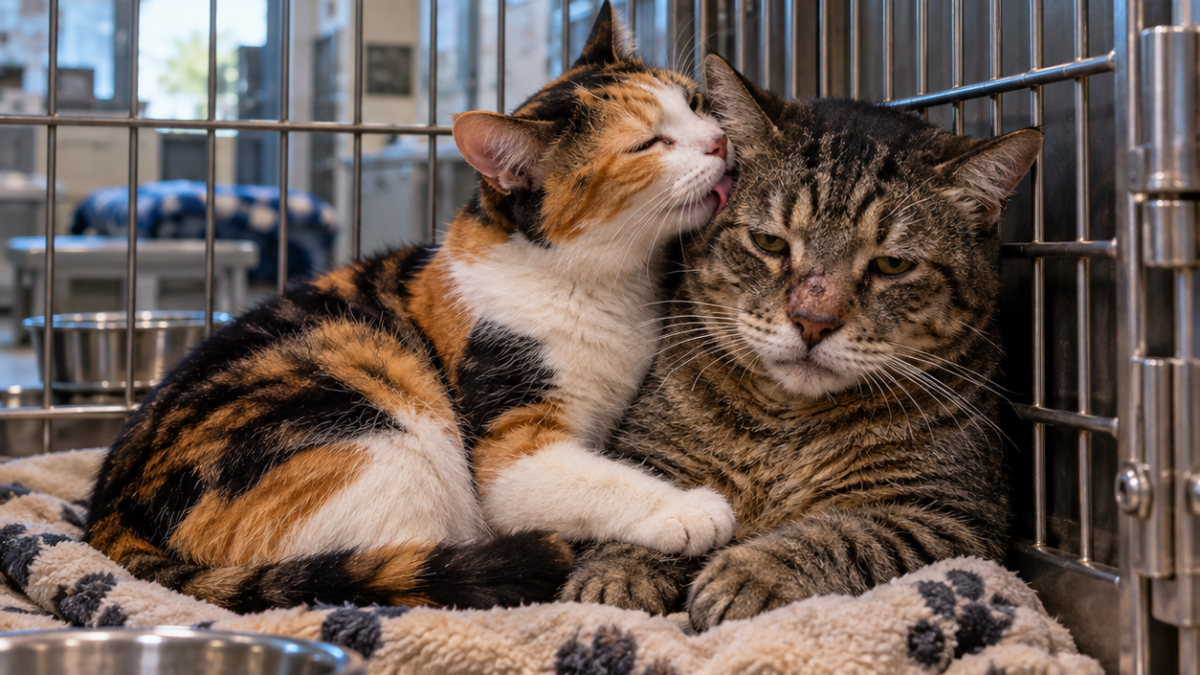
Two 8-Year-Old Cats Were Scheduled to Die at 9 A.M. Because No One Would Take Them Together—and one of them was still grooming the other.
PART3:
Some evenings we sat on opposite ends of the couch while the television played to an audience of two people who were no longer listening.
That was the condition of our marriage when we walked into that shelter.
So no, we were not looking for cats.
Then I noticed the card.
BONDED PAIR.
MUST STAY TOGETHER.
URGENT.
I stopped a shelter worker.
She was young, maybe twenty-five, with purple-framed glasses and a name tag that said EMILY.
“What does urgent mean?”
Her face changed.
People who work in shelters learn how to answer that question.
They also learn to hate answering it.
“We’re full,” she said.
“How long have they been here?”
“Fifty-seven days.”
Ben looked at her.
“And that’s long?”
“For senior cats?”
She hesitated.
“Yes.”
“How old are they?”
“Eight.”
“That’s senior?”
“Here, it might as well be eighty.”
She immediately looked embarrassed.
“I’m sorry. That sounded terrible.”
“No,” I said. “I understand.”
Emily crouched beside the cage.
“Naya gets attention because she’s smaller and friendly once she trusts you. We’ve had several applications for her.”
“And Nero?”
Emily’s eyes moved toward the big gray cat.
“No serious ones.”
“Why?”
“People want kittens. Or young cats. Nero is older, bigger, has the scar, and he shuts down around strangers.”
Nero stared at us as though he understood every word.
“What happens if someone takes Naya?”
Emily looked at Ben before answering.
“We tried separating them once.”
Naya stopped grooming Nero.
Her head lifted.
Emily continued quietly.
“We moved Naya to the adoption room for a weekend because someone was interested in her. Nero stopped eating.”
“How long?”
“Almost two days.”
Ben shifted beside me.
“And Naya?”
“Cried until her voice went hoarse. Scratched at the kennel door so much we had to treat her paws.”
I looked back through the bars.
Naya had returned to grooming Nero.
“We put them back together Sunday night,” Emily said. “Nero ate within an hour.”
“When did they come here?”
“Their owner went into long-term care.”
“Did she abandon them?”
“No.”
That answer came quickly.
“No. She had a stroke. From what we were told, she couldn’t care for herself anymore. There was no family member able to take them.”
Emily looked at the floor.
Then she said the sentence that changed our lives.
“If no one adopts them tonight, they’re on tomorrow morning’s list.”
Ben’s head snapped toward her.
“What time?”
“Nine.”
Something dropped inside my chest.
Naya stood.
There was food in a shallow stainless-steel bowl near the cage wall.
She pushed it toward Nero with her paw.
He sniffed it.
Ate several bites.
Then stepped away.
Only after he moved did she begin eating.
I looked at Ben.
He shook his head.
“No.”
“They’re going to die.”
“I heard her.”
“We have room.”
“We barely have money.”
“They don’t need much.”
“They need food.”
“We can buy food.”
“They need litter. Vaccines. Vet visits. What if one gets sick?”
“We’ll figure it out.”
“With what?”
His voice was still quiet, but something sharp had entered it.
“With money we don’t have?”
I felt embarrassed.
The embarrassment became anger because anger was easier.
“So we just leave them here?”
“What do you want me to say?”
“I want you to care.”
The second the words came out, I wanted them back.
Ben looked at me.
Not angry.
Wounded.
There is a difference.
And I knew immediately which one I had caused.
“Caring doesn’t pay the electric bill,” he said.
Then he walked away.
I apologized to Emily and followed him.
We made it to the parking lot without speaking.
Ben climbed into our twelve-year-old Honda and closed the door.
I got into the passenger seat.
He put the key in the ignition.
Did not turn it.
Rainwater crawled down the windshield.
Through the glass entrance, I could see the shelter hallway.
For almost a minute, neither of us said anything.
Finally Ben spoke.
“I do care.”
“I know.”
“No.”
His voice cracked.
“You don’t.”
I turned toward him.
He kept staring through the windshield.
“Since I lost that job, I wake up every morning feeling like I’m failing at something.”
“Ben—”
“Let me finish.”
So I did.
“I used to fix things.”
His hands tightened around the steering wheel.
“Boilers. Locks. Drywall. Pipes. Whatever broke, somebody called me because they believed I could make it work again.”
I had never heard him describe his job that way.
He swallowed.
“Now I can’t even fix us.”
My throat tightened.
“We’re not broken.”
“Aren’t we?”
He finally looked at me.
His eyes were wet.
“I can’t promise we’ll make rent next month. I can’t tell you when I’ll have steady work. I can’t replace the tires. I can’t stop checking the bank account every three hours like staring at the number will make it grow.”
I reached for him.
He pulled one hand from the steering wheel and wiped his face with his sleeve.
“And now there are two animals in there that need somebody to promise they’ll be okay.”
He laughed once.
There was nothing funny in it.
“I can’t make that promise, Claire.”
“I’m scared too.”
“I know.”
“No. I mean it.”
I moved closer.
“I’m terrified.”
His face turned toward mine.
“I’m terrified we made a mistake with this apartment. I’m terrified they’ll cut my hours again. I’m terrified that every time you leave for an interview and come home pretending it didn’t matter, one day you’re going to believe it.”
He looked down.
“And I’m terrified that if we only make decisions based on what could go wrong, eventually there won’t be anything left of us except fear.”
Before he could answer, movement behind the shelter window caught my attention.
Emily was carrying Nero down the hallway in a small plastic crate.
Probably for an exam.
Naya was still in the cage.
The second Nero disappeared from beside her, she threw herself against the door.
Even through the glass, we heard her cry.
Nero twisted inside the crate.
He pushed his face against the wire opening, trying to look backward.
Naya forced one paw through the cage bars.
Nero pushed his paw through the crate.
They were six feet apart.
They could not touch.
Ben covered his mouth.
For a long time, he said nothing.
Then he asked, “Our lease still allows cats?”
I stared at him.
“Yes.”
“Two?”
“Yes.”
“You checked?”
“Three months ago.”
He wiped his face again.
“I’m not saying this is smart.”
“I know.”
“I’m not saying everything will be okay.”
“I know.”
“I’m serious.”
“So am I.”
He started the engine.
Then shut it off.
I looked at him.
“What are you doing?”
Ben opened his door.
“Going back inside.”
The adoption paperwork took until almost closing.
The shelter had two separate carriers ready.
The moment Emily put Naya into one, she began crying.
Nero shoved both front paws through the bars of the other.
Ben stood there watching.
“No.”
Emily froze.
“What?”
“Do you have a bigger carrier?”
She found an old hard-sided carrier in the supply room.
The moment its door opened, Naya climbed inside beside Nero.
She tucked her head beneath his chin.
Nero wrapped his tail around her.
Ben lifted the carrier carefully.
He looked through the vent holes.
“No one’s separating you again.”
At the time, I thought he was talking to the cats.
Years later, I understood he had been talking to all four of us.
Nothing magically improved because we adopted them.
That is the lie people like to tell about rescue stories.
They want the door of the shelter to close behind you, music to swell, and every problem to become smaller because love arrived.
Our problems stayed exactly the same size.
Our checking account stayed low.
Ben stayed unemployed.
My hours stayed terrible.
Our car still made a grinding noise when we turned left.
But the apartment changed.
Nero claimed the corner of the couch beside Ben.
Every morning, when Ben opened his laptop to fill out applications, Nero jumped beside him.
Rejected.
Nero stayed.
No response.
Nero stayed.
Position filled.
Nero stayed.
Naya chose me.
Every evening when I came home, she sat three feet from the door.
Not at the door.
Three feet away.
As though welcoming me too enthusiastically would compromise her dignity.
At night, both cats slept between us.
The first time Ben and I laughed together in weeks happened because Nero rolled off the back of the couch while sleeping and landed in Ben’s lap with an expression of personal betrayal.
A few weeks later, Ben found part-time repair work.
Then another job.
Then enough contract work that we caught up on the electric bill.
Three months later, a property company offered him full-time maintenance work.
The pay was not great.
He took it before the manager finished explaining the benefits.
I got my hours back.
We were not rich.
We were not secure.
We were breathing.
Eleven months after the shelter, the call came.
Tuesday morning.
7:14.
Ben was packing sandwiches into a paper bag.
Nero sat beside his boots.
Naya watched birds from the windowsill.
My phone rang.
Unknown number.
I almost ignored it.
Most unknown calls during that period involved bills or people offering loans at criminal interest rates.
Something made me answer.
“Hello?”
“Is this Claire?”
“Yes.”
“Claire Morgan?”
“Yes.”
“Are you the family who adopted two cats named Nero and Naya?”
My eyes moved toward Ben.
He stopped folding the sandwich bag.
“Who is this?”
“My name is Carla Reeves.”
The woman sounded exhausted.
“My aunt is Martha Hale.”
I did not recognize the name.
Then Carla said, “She used to own them.”
Naya jumped down from the windowsill.
She walked toward me and rubbed her face against my ankle.
Carla explained that Martha had suffered a severe stroke nearly two years earlier.
Her husband had already died.
She could no longer walk without assistance.
For months, she could barely speak.
The cats had been surrendered because the rehabilitation facility did not accept animals and Carla’s husband had a severe allergy.
“Her condition has improved,” Carla said.
“That’s good.”
“She’s been moved to a residential care home.”
I waited.
“They allow residents to keep one small pet.”
One.
The word chilled me.
“My aunt keeps asking for Naya.”
Ben heard the name.
His face changed.
“What?”
I held up one finger.
Carla continued.
“She remembers Nero. She loves Nero. I need you to understand that.”
“But?”
“But Naya slept with her every night.”
I looked at the calico circling my ankles.
“My aunt says having Naya back would give her something to wake up for.”
Ben shook his head.
Firmly.
No.
“I’m not asking you to answer today,” Carla said.
“There’s nothing to answer,” Ben said loudly.
Carla went silent.
I covered the phone.
“Ben.”
“No.”
“We should hear her out.”
“We heard enough.”
Carla spoke.
“Is that your husband?”
“Yes.”
“Can I meet both of you?”
Ben picked up his lunch bag.
“I have to work.”
“Ben.”
He bent down.
Nero pressed his forehead into Ben’s palm.
Then Ben looked at Naya.
His expression softened.
“I meant what I said that night.”
I knew immediately.
No one’s separating you again.
Then he left.
I agreed to meet Carla Saturday.
I told myself there was a difference between listening and agreeing.
That distinction felt less convincing every hour.
For four days, I imagined Martha.
A woman in a small room.
A narrow bed.
A television too high on the wall.
Pictures of a life she could no longer physically return to.
I imagined her waking every morning wondering where her cats were.
Then I imagined Nero at the shelter.
Refusing food.
Naya bleeding from her paws.
By Saturday, I had managed to feel guilty toward everyone.
Carla arrived shortly after two.
She was in her early fifties.
Short brown hair.
Deep lines around her mouth.
She carried a canvas bag.
Ben opened the door.
“I’m Carla.”
“I know.”
She offered her hand.
He hesitated before shaking it.
Naya hid beneath the dining table.
Nero watched from the hallway.
Carla saw them and stopped.
“Oh.”
Her eyes filled.
Naya backed farther beneath the chair.
Nero stayed where he was.
Carla sat slowly.
“She looks exactly the same.”
“Naya?”
Carla nodded.
“Nero has more gray.”
“He’s nine now,” Ben said.
“So is she.”
“We know.”
Carla opened the canvas bag.
“I didn’t come here to take them.”
Ben remained standing.
“Good.”
“I came because my aunt deserves to be part of the conversation.”
“She surrendered them.”
“She signed those papers when she could barely hold a pen.”
“That’s not our fault.”
“No.”
Carla looked at him.
“But it wasn’t hers either.”
I watched Ben’s jaw tighten.
Carla removed a photo album.
The first picture showed Naya stretched across a woman’s lap.
Martha.
Silver hair.
Red sweater.
Healthy.
Smiling.
The next photograph showed Nero sitting on a kitchen counter.
His nose did not have the scar yet.
Another showed both cats asleep inside a laundry basket.
Naya’s paw rested across Nero’s neck.
Exactly the way she slept beside him in our house.
Carla turned another page.
Martha sat on a porch beside an older man.
Nero was in his lap.
Naya balanced along the back of Martha’s chair.
“That’s George,” Carla said.
“My uncle.”
“What happened to him?” I asked.
“Heart failure.”
She stared at the photograph.
“Four years ago.”
Ben finally sat.
“Nero was his?”
“At first.”
Carla touched the picture.
“Nero spent weeks searching the house after George died. Every night he sat by the back door waiting.”
My stomach tightened.
“He stopped eating?”
Carla looked up.
“How did you know?”
Ben answered.
“Because he did it when they separated him from Naya.”
Carla’s face changed.
She reached deeper into the bag and removed a faded blue blanket.
The moment she unfolded it, Naya came out from under the table.
Everyone froze.
Naya walked straight to the blanket.
Sniffed one corner.
Then another.
Her body became still.
Carla placed it on the floor.
Naya stepped onto it.
Turned twice.
Lay down.
Carla covered her mouth.
“My aunt slept with that blanket every night.”
Ben looked at me.
The certainty in his face cracked.
Only slightly.
But I saw it.
Carla reached toward Naya.
Stopped before touching her.
“She used to sleep on Martha’s left side.”
Naya tucked her paws beneath her.
“She still does,” I said.
Carla smiled through tears.
“I thought she might.”
Nero came forward.
He smelled the blanket.
Then Carla’s shoe.
Carla stayed completely still.
Nero looked at her.
For one second, something passed through his expression.
Recognition.
Memory.
Or maybe I only wanted to see it.
Then he walked away.
He sat beside Ben.
Carla noticed.
“He always chose men.”
“Maybe because of George,” Ben said.
“Maybe.”
She opened the photo album to the final page.
Martha was in a wheelchair.
One side of her face sagged.
Her hands rested uselessly in her lap.
The chair stood beside an empty window.
“This was one week after they surrendered the cats.”
Ben looked away.
“She stopped cooperating with therapy for a while,” Carla said. “Barely spoke.”
“Why didn’t you take them?”
The accusation in my voice surprised even me.
Carla did not defend herself.
“My husband has asthma and a severe cat allergy. We were also caring for his mother at home.”
“No friends?”
“I called everyone.”
“Rescues?”
“Every one within two hours.”
“And?”
“Full.”
Ben stood.
“You know they almost died?”
Carla stared at him.
“What?”
“Hours.”
Her face went pale.
“They were hours from being euthanized.”
“I didn’t know.”
“We did.”
“I didn’t know.”
He told her about the card.
The list.
Nine in the morning.
Nero refusing food.
Naya tearing her paws against the cage.
Carla listened.
When Ben finished, she pressed both hands against her knees.
“I thought the shelter would keep them until placement.”
“They couldn’t.”
“I was told they would try.”
“They tried.”
Ben’s voice sharpened.
“We were the last try.”
Carla looked at the floor.
Then at Naya.
Then Nero.
When she raised her eyes again, they were wet.
“And you saved them.”
“Yes.”
“Then thank you.”
That quiet answer disarmed him more effectively than anger would have.
Carla took a breath.
“I still need to ask.”
“No.”
“Ben.”
“I know what you’re asking.”
“My aunt is dying.”
The room changed.
I looked at her.
“What?”
“Not tomorrow.”
Carla rubbed her hands together.
“But she has congestive heart failure. Her kidneys are getting worse. The doctor won’t give us a timetable.”
Naya lifted her head.
“My aunt is surrounded by people who are paid to be there. She lost her husband. Her house. Her ability to walk. Half her independence.”
Carla looked at Ben.
“I am asking whether she has to lose every piece of her old life because a care home says one cat.”
“You’re asking us to break them apart.”
“For one cat.”
“There is no ‘one cat’ with them.”
“She raised Naya for eight years.”
“And Nero needs her.”
“My aunt needs her.”
Nero jumped onto Ben’s chair.
Ben placed his hand over his back.
“Nero nearly starved the last time somebody decided his need mattered less.”
Carla stood.
“And Martha nearly gave up on therapy when both of them disappeared.”
I stepped between them.
“Enough.”
Neither moved.
Neither looked evil.
That was what made it unbearable.
Nobody in that room was fighting because they did not care.
We were fighting because everyone cared about someone different.
Carla opened her bag.
“There is something else.”
She removed an envelope.
“I spoke with the care home.”
Ben stared at it.
“They charge a monthly pet fee. I will cover it.”
“That isn’t the problem.”
“I know.”
“I don’t think you do.”
“I’m also willing to cover Naya’s veterinary expenses.”
“We don’t need your money.”
“I didn’t say you did.”
“Then stop offering it.”
“I’m trying to make this possible.”
“For who?”
Carla’s voice hardened.
“For a seventy-six-year-old woman who may die without seeing the animal that slept beside her through her husband’s death.”
Ben’s face went still.
Our finances were better.
Not good.
Nero needed dental work.
Our car needed brakes.
The washing machine sounded like it had loose bolts inside.
Carla saw the hesitation on my face.
“I’m not buying her.”
“It sounds like it,” Ben said.
“I’m solving practical problems.”
“They aren’t practical problems.”
“Everything becomes practical when somebody has to pay.”
Ben flinched.
Carla regretted the sentence immediately.
I saw it.
Ben did too.
But words do not return to your mouth after they have done their damage.
He walked toward the door.
“This meeting is over.”
“Ben.”
“Claire.”
Carla packed the photographs.
She lifted the blue blanket.
Naya stood.
She followed it with her eyes.
Carla noticed.
“My aunt is asking to see her.”
Ben opened the door.
“No.”
“Not keep her.”
“No.”
“One visit.”
“No.”
Carla stopped beside him.
“Do you hear yourself?”
“Yes.”
“She is an old woman in a wheelchair.”
“I’m protecting the cats.”
“From what?”
“Another separation.”
“From a visit?”
“From humans deciding their bond is inconvenient.”
Carla’s expression changed.
“Compassion only seems easy for you when you get to be the hero.”
Ben stared at her.
Carla stepped into the hallway.
I followed.
“Carla.”
She looked at me.
“I’m sorry.”
“For what?”
“All of this.”
“No.”
She wiped beneath one eye.
“You’re sorry because you don’t know which pain to choose.”
She left.
Naya went straight to the spot where the blue blanket had been.
She smelled the floor.
Nero joined her.
Ben watched.
“She had no right.”
“She’s grieving.”
“So am I.”
“She isn’t entirely wrong.”
He turned.
“You want to give Naya away?”
“No.”
“Then what?”
“I want Martha to see her.”
“No.”
“One visit.”
“No.”
“Why?”
“You know why.”
“You’re scared.”
“Yes.”
His answer stopped me.
Ben lowered his voice.
“I’m scared we walk into that room and Naya remembers her.”
“That’s possible.”
“I’m scared she wants to stay.”
I stared at him.
That was the truth underneath everything.
He was not only protecting Nero.
He was terrified the cats would prove he had never really been their family.
I sat beside him.
Nero climbed into his lap.
Ben pressed his face into the cat’s fur.
“When I lost my job,” he said, “I thought you’d eventually figure out you were better off without me.”
“Ben.”
“I did.”
His voice was muffled against Nero.
“I stopped believing I had anything anybody needed.”
Nero began to purr.
“Then this idiot sat beside me every morning.”
I smiled through tears.
“He didn’t care about the job.”
“No.”
“He cared where you were.”
Ben looked at me.
“What if Naya sees Martha and realizes we were just the people in between?”
“We weren’t.”
“You don’t know that.”
“I do.”
“How?”
“Because love isn’t a lease.”
He frowned.
“You don’t replace one home when you find another.”
I touched Nero’s head.
“You carry both.”
Three days later, Carla sent me a picture.
Martha sat in her wheelchair holding a stuffed calico cat.
The toy looked cheap.
Too bright.
Too clean.
Her hands were wrapped around it.
Under the photo, Carla wrote:
She asked if Naya still sleeps on the left side.
I showed Ben.
He stared.
“No.”
“You don’t know what I’m asking.”
“Yes, I do.”
“One visit.”
“No.”
“You come.”
Silence.
“Thirty minutes.”
“An hour.”
“Forty-five.”
“Deal.”
“If Naya cries, we leave.”
“Immediately.”
“If Nero stops eating, there is no second visit.”
“Agreed.”
“And we do not discuss giving Naya back.”
“Agreed.”
Ben looked toward the cats.
“I still think this is a mistake.”
“So do I.”
That was the first thing we had agreed on all week.
The care home was a converted house on a quiet street.
Flower boxes beneath the windows.
A wooden wheelchair ramp.
A brass plaque near the door.
WILLOW CREST RESIDENTIAL CARE.
Carla met us downstairs.
Ben carried Naya in the large carrier.
“Where’s Nero?” Carla asked.
“Home.”
She looked surprised.
“I thought you’d bring them together.”
“The home only allows one.”
“For permanent residency. Visits are different.”
Ben stared at her.
“You didn’t mention that.”
“I didn’t know you were considering a visit.”
His jaw tightened.
“Can he come next time?”
“Yes.”
“Next time?”
Carla almost smiled.
“If there is one.”
Martha’s room was upstairs.
She sat beside the window.
Pale green sweater.
Silver hair.
A cup of untouched tea.
She looked smaller than the woman in the photographs.
The stroke had pulled one side of her mouth downward.
Her weak hand rested in her lap.
She saw the carrier.
Her good hand began shaking.
“Naya?”
Naya stood.
Pressed her nose against the door.
Martha made a sound I will never forget.
Half laugh.
Half sob.
“Oh, baby.”
I put the carrier beside her wheelchair.
Martha tried to open it.
Her fingers could not manage the latch.
I did.
Naya did not move.
She smelled the air.
Looked at me.
Looked at Ben.
Then at Martha.
“Naya,” Martha whispered.
One paw emerged.
Then another.
Naya climbed onto Martha’s lap.
Martha folded over her.
No one spoke.
Naya sat perfectly still.
Then she lifted one paw.
Placed it against Martha’s neck.
Carla turned away.
I covered my mouth.
Ben found my hand.
Naya began to purr.
Martha cried silently into her fur.
After a while, she leaned back.
Studied Naya.
“You got fat.”
Ben laughed before he could stop himself.
Martha looked at him.
“You must be Ben.”
“Yes.”
“Carla told me you love them.”
“I do.”
“I can see.”
Naya curled against her stomach.
Martha stroked her.
Unevenly.
Slowly.
“Where’s Nero?”
Ben stiffened.
“At home.”
Martha’s smile vanished.
“Alone?”
“He’s safe.”
“But where does he think she is?”
Ben said nothing.
Martha looked at Carla.
“I told you.”
Carla stepped closer.
“Told me what?”
“They stay together.”
“You asked for Naya.”
“I asked you to find Naya.”
“You said you wanted her back.”
“I do.”
Carla stared at her.
Martha lowered her face toward the cat.
“I want George back too.”
The room went quiet.
“I want my house.”
Her voice trembled.
“My garden.”
She touched her weak leg.
“This.”
Her hand moved to the side of her face damaged by the stroke.
“This.”
She looked down at Naya.
“I want everything.”
Carla swallowed.
“But wanting something does not make it mine to take.”
“You raised her.”
“And Nero loves her.”
“You love her.”
“Yes.”
“You need her.”
Martha’s eyes filled.
“Yes.”
Carla crouched beside the wheelchair.
“Then let us bring her home.”
Martha looked at her niece.
“This is not her home.”
Naya raised her head.
“Her home is with them.”
Ben closed his eyes.
I felt his hand tighten around mine.
Martha looked at him.
“You saved them?”
Ben nodded.
“Together?”
“Yes.”
“Even when it was hard?”
“Yes.”
She studied him for several seconds.
“Then thank you.”
“You don’t owe us.”
“I do.”
“No.”
“People think giving up an animal is one decision.”
She stroked Naya’s back.
“It isn’t.”
Nobody moved.
“You make the decision when you sign the paper.”
Her breathing became heavier.
“Then again the first morning you wake up and they aren’t beside you.”
Carla looked down.
“Again when you eat breakfast.”
Martha’s eyes moved to the window.
“Again when you hear something at the door and think it is them.”
She smiled sadly.
“Again when you wake from a dream and for three seconds believe you are still home.”
Ben lowered his head.
“I blamed Carla.”
Carla’s eyes filled.
“The nurses.”
Martha tapped the wheelchair.
“My body.”
She looked at Ben.
“Mostly myself.”
“You had a stroke,” he said.
“So?”
“It wasn’t your fault.”
“Knowing that and feeling that are not the same thing.”
Ben stared at her.
Martha smiled.
“Carla told me you lost your job.”
“She really does talk too much.”
“She worries too much.”
“That too.”
“Did you feel like you failed Claire?”
Ben hesitated.
“Yes.”
“Were you wrong?”
“Yes.”
“Did that stop the feeling?”
“No.”
Martha nodded.
“Then you understand.”
For the next hour, Martha told us about the cats.
Nero stealing dinner rolls.
Naya opening bathroom cabinets.
Nero sitting beside George every Sunday during baseball games.
Naya sleeping on Martha’s left side because the right side belonged to George.
They had found Nero and Naya behind a mechanic’s garage.
Not siblings.
Not even the same age.
But when someone tried to take one from the cardboard box where they had hidden, the other followed.
“They have always chosen each other,” Martha said.
When it was time to leave, Naya was asleep in her lap.
Ben looked terrified.
So was I.
Martha stroked Naya’s head.
“Naya.”
The cat opened her eyes.
“You go home.”
Naya blinked.
“To Nero.”
Naya stood.
Stretched her paws against Martha’s chest.
Then jumped down.
She walked straight to Ben.
Rubbed against his legs.
The relief in his face almost broke me.
He knelt.
Naya climbed into the carrier without resistance.
Martha watched.
“Bring Nero next Sunday.”
Ben looked at her.
“Next Sunday?”
“If an old woman is allowed to be greedy for one hour.”
He smiled.
“We’ll bring him.”
At home, Nero was waiting behind the door.
The moment Naya cried from inside the carrier, Nero answered.
He ran.
Ben opened the carrier.
Naya stepped out.
Nero smelled her face.
Her ears.
Her back.
Then pressed his forehead against hers.
Naya licked the scar across his nose.
The same way she had in the shelter.
Ben sat on the floor.
“I’m sorry.”
Neither cat acknowledged him.
They were too busy making sure the other was real.
We began visiting Martha every Sunday.
Both cats came.
The staff allowed it because they traveled in one carrier and stayed in Martha’s room.
Naya always climbed onto Martha first.
Nero initially stayed beside Ben.
Martha never reached for him.
Never forced him.
“Still mad at me?” she asked one Sunday.
Nero stared.
“You always were dramatic.”
By the third visit, she showed him an old wooden brush.
Nero smelled it.
Sat down.
She brushed him.
By the fifth visit, he sat beside her wheelchair.
By the eighth, he climbed into her lap.
He barely fit.
Martha laughed so hard she started coughing.
Naya occupied the armrest.
Martha placed one hand on each cat.
“I thought I’d never have this again.”
Ben stood near the window.
“You do.”
“For an hour.”
“An hour counts.”
Martha looked at him.
“Yes.”
“It does.”
Ben started bringing his tools.
First he repaired Martha’s dresser.
Then her closet handle.
Then her wheelchair footrest.
Other residents noticed.
A lamp appeared outside Martha’s door with a note.
Then a loose cabinet hinge.
Then a radio with a broken antenna.
I worried people were taking advantage of him.
Ben did not.
For years he had confused usefulness with a paycheck.
Martha helped him understand they were not the same.
One afternoon she watched him repair her bedside table.
“You look different when you fix things.”
“How?”
“Less angry.”
“I’m not angry.”
Martha raised one eyebrow.
Ben laughed.
“Fine.”
“Why are you angry?”
“Depends on the day.”
“No.”
She shook her head.
“Why are you angry underneath the day?”
The screwdriver stopped turning.
Ben stared at the floor.
“Because everything feels one mistake away from falling apart.”
Martha nodded.
“That sounds exhausting.”
“It is.”
“Most things fall apart slowly.”
He looked at her.
“That is supposed to comfort me?”
“It means you usually have time to ask for help.”
“I’m bad at that.”
Martha smiled.
“You are terrible at it.”
Carla and Ben improved too.
Slowly.
Awkwardly.
The turning point came when Martha’s wheelchair brake jammed.
Ben lay on the floor examining it while Carla held a flashlight.
“You’re pointing it in my eyes.”
“I’m pointing it at the bolt.”
“You are illuminating my corneas.”
“Then move your head.”
“You’re bad at flashlights.”
“You’re bad at gratitude.”
Martha laughed from the bed.
After that, something softened.
One afternoon Carla pulled me into the hallway.
“I was wrong.”
“About what?”
“Asking for Naya.”
“You were trying to help.”
“I was trying to fix grief.”
She looked through the doorway.
Nero was asleep with his head against Martha’s foot.
Naya sat beside the window.
“I thought if I put Naya back in her room, everything would become what it was.”
She wiped her eyes.
“But nothing could become what it was.”
“No.”
“It could only become less lonely.”
That sentence stayed with me.
Some losses do not have solutions.
They only have witnesses.
Winter arrived.
Martha’s health began slipping.
At first, she slept through twenty minutes of our visits.
Then thirty.
She repeated stories.
Called Ben “George” once.
The moment she realized it, she cried.
“I’m sorry.”
Ben crouched beside her.
“Don’t apologize.”
“You’re not him.”
“No.”
She touched his hand.
“But sometimes you stand by that window exactly like he did.”
Ben smiled.
“Was he handsome?”
“No.”
Martha smiled.
“Terrible-looking man.”
Ben laughed.
Her kidneys worsened.
Her heart weakened.
Still, Sundays remained sacred.
Then one Thursday night, the care home called.
Martha had developed pneumonia.
“She’s comfortable,” the nurse said.
Those words frighten you when someone is old.
Comfortable often means there is nothing left to fix.
Ben had just come home from a ten-hour shift.
Dust covered his jacket.
His dinner was still in the microwave.
“We’ll be there,” he said.
We loaded the cats.
Carla stood outside Martha’s room when we arrived.
Her face was swollen from crying.
“She keeps asking for them.”
Ben lifted the carrier.
“We brought both.”
Martha looked tiny in the bed.
A clear tube ran beneath her nose.
Naya jumped onto the mattress.
Nero followed.
Martha’s eyes opened.
“Naya?”
The calico moved onto her chest.
“Nero?”
His ears turned toward her voice.
Martha smiled.
“There you are.”
We stayed three hours.
She drifted in and out.
Every time she woke, she counted them.
“One.”
Her hand touched Naya.
“Two.”
Nero.
Then her eyes closed.
At ten, the night supervisor entered.
“I’m sorry. Visiting hours ended.”
Carla stood.
“Can the cats stay?”
“One pet may stay overnight with prior approval.”
“They’re both registered visitors.”
“Visitors are different.”
Ben stood.
“They stay together.”
“I understand.”
“No.”
His voice remained calm.
“I don’t think you do.”
The supervisor was not cruel.
That made it worse.
She explained allergies.
Insurance.
Staffing procedures.
Resident safety.
Policy.
One animal.
Carla looked at Martha.
“She may not have another night.”
“I know.”
“Then call someone.”
“It’s after ten.”
“Call anyway.”
The supervisor hesitated.
Ben looked toward the bed.
Naya lay across Martha’s chest.
Nero curled against her hip.
Carla whispered, “Leave Naya.”
Ben turned.
“No.”
“Aunt Martha needs her.”
“Nero needs her.”
“Nero has you.”
“That isn’t the same.”
“One night.”
“To you.”
Carla’s face tightened.
“This may be the last night of her life.”
“I know.”
“Then how can you take Naya away?”
Ben looked like someone had hit him.
I took him into the hallway.
“I think Naya should stay.”
His face changed.
“You promised.”
“I promised they wouldn’t lose each other.”
“This is separating them.”
“For one night.”
“That phrase doesn’t mean anything to a cat.”
“Nero will be with us.”
“He won’t understand.”
“No.”
I looked through the doorway.
Martha’s hand lay on Naya.
“Maybe love sometimes requires doing something the person you love cannot understand.”
Ben stared at me.
“And compassion sometimes becomes an excuse for making someone else survive the pain.”
We stood there.
Both right.
Both wrong.
There was no clean answer.
Finally Ben said, “One hour.”
Carla frowned.
“What?”
“We take Nero downstairs for one hour. Naya stays.”
The supervisor agreed.
Ben lifted Nero.
Nero twisted toward the bed.
Naya stood immediately.
Martha woke.
“What’s happening?”
“We’re taking Nero downstairs,” I said.
“Naya will stay with you.”
Martha looked at me.
Then Ben.
Then Carla.
“No.”
“Aunt Martha—”
“No.”
“It’s one night.”
Martha touched Naya.
Her eyes filled.
“I love you.”
Naya pressed into her hand.
Martha looked at Nero.
“I love you too.”
Nero stopped struggling.
“Take them home.”
Carla began crying.
“You need them.”
“So do they.”
“But you may not wake up tomorrow.”
Martha closed her eyes briefly.
“I know.”
When she opened them, her voice was barely above a whisper.
“I spent months believing love meant getting them back.”
She breathed.
“It doesn’t.”
Another breath.
“Love means not asking them to break for me.”
The supervisor looked at the bed.
Then at the clock.
“I’ll call the administrator.”
The first number did not answer.
The second did not answer.
The third did.
Two minutes later, she returned.
“Both cats may stay until six.”
Carla covered her face.
Ben lowered Nero onto the bed.
He immediately pressed against Naya.
“I’ll stay,” Ben said.
I stayed until midnight.
Carla stayed too.
Before I left, Martha was awake.
Naya rested on her chest.
Nero beside Ben.
Martha looked at all three.
“My family.”
I drove home alone.
The apartment felt wrong.
The bowls.
The toys.
The empty couch.
The silence had shape.
For the first time, I understood what Martha meant about waking up and making the same loss again.
At 4:38 in the morning, Ben called.
I answered immediately.
“Martha died.”
I sat upright.
“What happened?”
“She woke up around four.”
His voice broke.
“She asked whether both cats were still there.”
I closed my eyes.
“What did you say?”
“I told her yes.”
“What did she say?”
Ben began crying.
“She said, ‘Then everything important is here.’”
I covered my mouth.
“Naya was on her chest,” Ben continued. “Nero was against her side.”
“Was she scared?”
“No.”
“In pain?”
“I don’t think so.”
He took a shaking breath.
“She touched both of them.”
I waited.
“Then she looked at me.”
“What did she say?”
“She told me I wasn’t useless.”
My heart cracked.
“She said, ‘A useless man doesn’t build a home out of almost nothing.’”
Ben cried harder.
“I didn’t know what to say.”
“You didn’t need to.”
“I told her thank you.”
“That was enough.”
“Then she closed her eyes.”
He stopped.
“And?”
“She was gone.”
I drove back before sunrise.
Carla met me in the hallway.
One look at each other and every argument disappeared.
We held each other.
Ben sat beside the bed.
Naya was in his lap.
Nero stood near Martha’s hand.
I touched her shoulder.
“Thank you.”
For the cats.
For Ben.
For loving them first.
For letting them go twice.
Carla removed the blue blanket from Martha’s bed.
“She wanted them to have this.”
Naya stepped onto it immediately.
Nero smelled the edge.
Carla laughed through her tears.
“Of course.”
A month after the funeral, Carla came to our apartment carrying the photo album and an envelope.
“The pictures belong here,” she said.
Ben studied every photograph.
This time he asked questions.
What food had Nero loved?
Did Naya always steal socks?
Had Nero always hated closed doors?
Where did they sleep?
Carla answered.
Then she pushed the envelope toward Ben.
He pushed it back.
“No.”
“You don’t know what it is.”
“I know I don’t want money.”
“It isn’t from me.”
Ben stopped.
“From Martha.”
Inside was a handwritten letter.
Carla said a staff member had helped Martha write it several weeks before she became sick.
Ben read aloud.
“Dear Ben and Claire,
Thank you for keeping the promise I could not keep.
Please use this for Nero and Naya.
Not because they are still mine.
Because love does not stop belonging to us just because somebody else carries it forward.
Do not waste time deciding who saved whom.
A family is sometimes just the people and animals who refuse to let each other disappear.
Martha.”
There was a check for sixteen hundred dollars.
Ben stared.
“We can’t.”
“She wanted you to.”
“She needed this.”
“Her final expenses were covered.”
Ben looked at me.
“Nero’s dental surgery,” I said.
He closed his eyes.
“That feels wrong.”
Carla reached across the table.
“You spent a year believing accepting help meant failure.”
He looked at her.
“Martha knew that.”
Ben folded the letter carefully.
“We’ll use it for the cats.”
“That’s what she wanted.”
That spring, Nero had his dental surgery.
Naya stayed beside him all night.
She groomed his face.
Waited until he ate before touching her own food.
Some things never changed.
Ben kept visiting Willow Crest.
At first he repaired the things he had promised Martha he would fix.
Then the staff started calling him for paid maintenance work.
He refused payment for anything inside Martha’s old room.
One afternoon, the new resident living there asked why.
Ben tightened a closet hinge.
“A friend used to live here.”
That was all he said.
Carla became part of our lives.
Dinner every few months.
Birthday calls.
Pictures of the cats.
Grief became something we carried together rather than against one another.
Two years passed.
Nero and Naya turned eleven.
Their faces grayed.
Naya became rounder.
Ben called her his little loaf.
Nero developed arthritis.
He still waited for Naya before eating.
Every Sunday morning, sunlight crossed our floor around nine.
The time they had once been scheduled to die.
Sometimes I looked at that light and wondered how much life can hide behind a single hour.
Then Naya stopped eating.
At first we blamed her teeth.
Then her stomach.
Then age.
The veterinarian ran bloodwork.
Called us the next morning.
I knew from her voice.
Cancer.
Aggressive.
Advanced.
Ben sat across from the veterinarian with both hands clasped between his knees.
“How long?”
“Weeks.”
He stared at her.
“Months?”
“Possibly.”
“Years?”
She did not answer.
Nero was in the carrier beside us.
He had come because we could no longer take Naya anywhere alone.
Ben looked at him.
“He can’t lose her.”
The veterinarian’s face softened.
“I’m sorry.”
“No.”
Ben shook his head.
“You don’t understand.”
“I do.”
“No.”
His voice cracked.
“He stopped eating the last time.”
I placed my hand over his.
Naya came home with medication.
For three weeks, she improved.
She ate chicken.
Sat in sunlight.
Stole half a piece of turkey from Ben’s sandwich.
We convinced ourselves the doctor had been wrong.
Hope can make educated people believe ridiculous things.
Then one morning Naya tried to jump onto the couch and could not.
Nero climbed down.
He sat beside her on the floor.
She rested her head against his shoulder.
Ben turned away.
The following week, the veterinarian told us the medication was no longer controlling her pain.
There are sentences you think you are prepared to hear.
You aren’t.
“What would you do?” Ben asked.
The veterinarian looked at Naya.
“If she were mine?”
“Yes.”
“I would let her go before the pain takes everything else.”
Ben left the room.
I found him outside behind the clinic.
He was crying.
“I promised him.”
I knew who he meant.
“You kept the promise.”
“No.”
“You did.”
“He’s going to lose her.”
“We all are.”
“I told him nobody would separate them.”
I held his face.
“Death is not somebody separating them.”
“To him it will be.”
We brought Naya home.
We gave her three days.
Not because she needed three.
Because we did.
Carla came.
She brought Martha’s photo album.
She sat on the floor.
Naya climbed weakly into her lap.
Nero stayed pressed against her side.
Carla stroked them both.
“Aunt Martha would hate this.”
“I hate it too,” I said.
Carla cried.
“Do you think she knew?”
“Knew what?”
“That someday they’d lose each other anyway.”
I looked at Nero.
“I think that’s why she told us not to waste time deciding who saved whom.”
The veterinarian came to our apartment Friday afternoon.
Naya lay on Martha’s blue blanket.
Nero beside her.
We had asked whether he could stay.
The veterinarian said yes.
Naya’s breathing was shallow.
Ben sat on the floor.
I sat beside him.
Carla sat across from us.
The veterinarian gave the first injection.
Naya relaxed.
Nero began grooming her face.
The scar on his nose touched her forehead.
Ben broke.
“No.”
He whispered it.
Then louder.
“No, no, no.”
I put my arms around him.
Naya’s eyes were half closed.
Nero kept licking her.
The veterinarian waited.
When it was time, she looked at us.
I nodded.
Ben could not.
The final injection entered the catheter.
Naya took one breath.
Then another.
Then none.
Nero stopped grooming.
He stared at her.
For several seconds, nobody moved.
Then he nudged her face.
Once.
Twice.
He licked her ear.
Waited.
Nudged her again.
Ben made a sound I had never heard from another human being.
Nero stood.
Walked around Naya.
Smelled her paws.
Her side.
Her mouth.
Then he lay down.
Pressed himself against her body.
Exactly the way he had sat beside her in the shelter.
We gave him almost an hour.
When the veterinarian finally wrapped Naya, Nero followed.
He cried once when she lifted her.
One sound.
Short.
Confused.
For eleven years, I had heard every kind of sound that cat could make.
I had never heard that one.
After Naya was gone, Nero stopped eating.
The first day, we expected it.
The second, we worried.
By the third, Ben was sitting on the kitchen floor holding bits of chicken beneath Nero’s nose.
“Please.”
Nero turned his head.
“Buddy.”
Nothing.
“Come on.”
Nero walked to the front door.
Sat.
Waited.
He did it every morning.
Every afternoon.
Every night.
Naya had spent years waiting there for me.
Now Nero waited for her.
Ben carried him to the bowl.
Nero walked back to the door.
We tried medication.
Appetite stimulants.
Special food.
Hand feeding.
The veterinarian found no new physical disease.
“He’s grieving.”
“How long does that last?” Ben asked.
“There isn’t a schedule.”
At night Nero slept on the blue blanket.
Not beside us.
Not anymore.
He chose the place where Naya used to curl.
Every few hours, he woke.
Walked through the apartment.
Checked beneath the table.
The bathroom.
Bedroom.
Front door.
Then returned to the blanket.
Ben began sleeping on the couch.
“I don’t want him alone.”
“You have work.”
“I don’t care.”
“You need sleep.”
“So does he.”
One morning I woke at five and found Ben asleep on the floor.
His hand rested on Nero’s back.
For the first time since Naya died, Nero was eating.
Three pieces of dry food.
Ben woke.
Saw the bowl.
He smiled.
“There you go.”
Nero ate two more.
We celebrated five pieces of cat food like a medical miracle.
He survived.
For seven months.
He never returned to who he had been.
But he stayed.
He sat beside Ben.
He waited by the door less often.
He slept with us again.
Sometimes, in the middle of the night, I woke and found him licking the empty space where Naya used to lie.
The following spring, his kidneys failed.
He was twelve.
The veterinarian offered treatment.
Fluids.
Medication.
More time.
“How much?” Ben asked.
“We can’t know.”
“Would he be comfortable?”
“For a while.”
Ben looked at Nero.
Nero looked tired.
Not suffering.
Just tired.
That night we brought him home.
We unfolded Martha’s blue blanket.
Ben took the photo album from the shelf.
We looked at Nero’s entire life.
Young beside George.
Sleeping with Naya.
In Martha’s lap.
At the shelter.
On our couch.
Beside Ben’s laptop during unemployment.
On the windowsill.
Old.
Gray.
Loved.
Near midnight, Nero stood.
Walked to the apartment door.
Sat.
Ben looked at me.
“He hasn’t done that in months.”
Nero waited.
Five minutes.
Ten.
Then he returned to the living room.
He climbed onto the blue blanket.
Turned twice.
Lay down.
Ben stretched beside him on the floor.
I sat against the couch.
Nero placed one paw on Ben’s wrist.
At two in the morning, his breathing changed.
“Claire.”
I was already awake.
Ben lifted his head.
“Nero?”
The cat opened his yellow eyes.
Ben touched the scar on his nose.
“You can go.”
His voice broke.
“I’m sorry I couldn’t keep that promise forever.”
Nero blinked.
Ben swallowed.
“But she’s been waiting a long time.”
I covered my face.
“You go find your girl.”
Nero’s paw flexed once against Ben’s wrist.
Then relaxed.
His breathing became slower.
Slower.
Slower.
Until there was nothing left to count.
Ben pressed his forehead against Nero’s.
I sat beside them until sunrise.
At nine that morning, sunlight crossed the living-room floor.
The exact time Nero and Naya had once been scheduled to die.
The blue blanket was empty.
For the first time in years, no gray cat lay pressed against a calico one inside that patch of light.
I thought the silence after Murphy died had been difficult.
I thought the apartment after Martha died had been difficult.
I knew nothing.
Two food bowls remained on the floor.
Two carriers in the closet.
Two indentations on the couch.
Fur on blankets.
Scratch marks on a chair leg.
Tiny pieces of lives everywhere.
Ben did not remove their bowls.
Neither did I.
A week passed.
Then two.
Then a month.
One Sunday morning, I found Ben sitting in the sunlight.
Martha’s letter was in his hands.
He read the final sentence aloud.
“A family is sometimes just the people and animals who refuse to let each other disappear.”
He looked at me.
“They disappeared anyway.”
I sat beside him.
“No.”
He laughed bitterly.
“Claire.”
“They died.”
“That’s what disappearing is.”
“No.”
I picked up the photograph of Nero and Naya asleep in Martha’s old laundry basket.
“This is disappearing.”
I pointed toward the empty room.
“When nobody remembers you were here.”
Ben stared at the picture.
Six weeks later, Emily from the county shelter called.
I had not spoken to her in years.
She remembered us immediately.
“You’re the couple with Nero and Naya.”
My throat tightened.
“We were.”
Silence.
“Oh, Claire.”
I told her.
Both of them.
She cried.
Then she said something I had not expected.
“I’m actually calling because of them.”
“What do you mean?”
“The shelter changed its bonded-pair policy.”
I sat down.
“What?”
“Senior bonded animals can’t be separated for adoption anymore without a behavioral review.”
I closed my eyes.
“That’s good.”
“There’s more.”
Emily hesitated.
“We started a small emergency foster fund.”
“For what?”
“For bonded seniors who are at risk because of space.”
I stopped breathing.
“We named it Martha’s Promise.”
I could not speak.
“Carla contacted us.”
Of course she had.
“She donated the remainder of Martha’s estate.”
I started crying.
Emily’s voice softened.
“She told us about the blanket.”
I laughed through tears.
“She would.”
“We’ve saved fourteen bonded pairs since January.”
Fourteen.
Twenty-eight animals.
Twenty-eight lives that did not have to find out what it meant to wait behind separate doors.
That evening, I told Ben.
He said nothing for a long time.
Then he went into the closet.
He brought out the large carrier.
The one Nero and Naya had shared.
“What are you doing?”
“Cleaning it.”
“Why?”
He looked at me.
“Because somebody may need it.”
Three days later, the shelter called.
Two senior cats.
Ten years old.
Sisters.
Their owner had died.
The shelter was full.
They needed a foster home for one weekend.
Only one weekend.
Ben and I drove there in silence.
When we entered the adoption hallway, I saw the cage.
Two cats pressed together in the back corner.
One black.
One orange.
Neither came to the door.
Neither begged.
They just stayed together.
Ben stopped.
For a moment I thought he was going to turn around.
Instead, he crouched.
The orange cat watched him suspiciously.
The black cat hid behind her.
Ben placed his fingers against the bars.
“You don’t know me,” he whispered.
The orange cat blinked.
“That’s okay.”
He opened the carrier.
Martha’s blue blanket was inside.
Old.
Thin.
Frayed along the edges.
The cats smelled it.
The black one came forward first.
Ben looked at me.
His eyes filled.
I knew what he was remembering.
A rainy parking lot.
An unpaid electric bill.
Two cats with hours left.
A man who believed losing his job had made him useless.
An old woman who taught him otherwise.
I knelt beside him.
“One weekend?”
Ben wiped his face.
“Don’t start.”
I smiled.
“I didn’t say anything.”
“You were going to.”
“No.”
“Yes, you were.”
The orange cat climbed into the carrier.
The black one followed.
They curled together on Martha’s blanket.
Ben closed the door.
He lifted the carrier.
Then he stopped.
For several seconds, he only stood there.
Finally he looked through the vent holes.
His voice shook.
“No one’s separating you.”
This time, I knew exactly who he was talking to.
All of them.
Nero.
Naya.
Martha.
Me.
Himself.
Every frightened creature that had ever been told love was inconvenient.
Every grieving person who thought letting go meant betrayal.
Every broken family trying to understand whether home belonged to the person who came first or the person who stayed.
The truth was something Martha had understood before the rest of us.
Love is not proved by possession.
It is not a debt.
It is not a contest.
Sometimes love means holding on until your hands ache.
Sometimes it means opening the carrier.
Sometimes it means sitting beside someone during their final night and making sure everything important is still there.
And sometimes, years later, it means standing in another shelter with an empty place in your heart that will never truly close, choosing to open it anyway.
Because Nero and Naya did die.
Martha died.
George died.
Every living thing we loved in that story eventually left us.
That is the cruel bargain.
We do not get to save anyone forever.
We only get time.
An hour.
A year.
Twelve years.
One final night beneath a worn blue blanket.
For a long time, I believed the tragedy was that we could not keep our promise to Nero and Naya.
Now I understand we did.
Nobody separated them.
Not the shelter.
Not poverty.
Not fear.
Not Martha.
Not the care home.
Not even us.
Naya went first because life chose for us.
Nero spent seven lonely months carrying the absence of her.
And on the final night of his life, he lay on the blanket that had belonged to their first home, beside the man from their second home, while sunlight waited somewhere beyond the dark.
I like to believe that when Nero finally stopped breathing, the waiting ended.
I like to believe Naya was no longer behind a closed door.
I like to believe Martha had both hands working again, George was sitting on the porch, and somewhere there was a laundry basket large enough for two old cats who had spent their entire lives refusing to let each other disappear.
I cannot prove any of that.
But every Sunday at nine, sunlight still reaches the place on our living-room floor where they used to sleep.
The new cats sometimes lie there now.
And beneath them is a faded blue blanket with frayed edges, carrying the scent of homes that no longer exist and love that somehow does.
Ben still looks at the clock.
So do I.
Neither of us says anything.
We do not need to.
Because at nine o’clock, on a morning years ago, Nero and Naya were supposed to die in a shelter where nobody wanted them.
Instead, they came home.
They saved a marriage.
They gave an unemployed man a reason to get out of bed.
They returned to a dying woman who had believed she failed them.
They helped a niece forgive herself.
They changed a shelter rule.
They gave other bonded animals time.
Then, one by one, they left.
And that is the part nobody tells you about rescue.
Sometimes the life you save does not stay long enough.
Sometimes it stays twelve years and it still is not long enough.
Sometimes the reward for loving something with your entire heart is that one day you are the person left holding the empty blanket.
But I would still walk into that shelter again.
I would still look at Ben.
I would still say, “They’re going to die.”
I would still argue in the parking lot.
I would still sign the papers we could barely afford.
I would still carry them home.
Even knowing Martha would die.
Even knowing Naya would die in front of us.
Even knowing Nero would spend months waiting at a door she would never walk through again.
Even knowing Ben would one day lie on the floor with his forehead pressed against an old gray cat and whisper that it was finally okay to go find her.
I would choose every painful second again.
Because grief is not proof that love failed.
Grief is the receipt.
It is what remains in your hand after life has taken back everything it only loaned you.
And sometimes, when the house is quiet and the sunlight lands at exactly nine o’clock, I swear the old blue blanket sinks in two places.
One small.
One large.
Side by side.
As if somewhere beyond everything we understand, Naya finally found the left side again.
And Nero, after waiting long enough, found his way back beside her.








