Thugs Trapped a Blind Nurse and Her K9—Then Her Combat Training Left Them Begging
PART2:
Or more accurately, what Danny Okafor had just read aloud from the chart while I cross-checked the electronic record on my tablet through voice assist.
“Read that dosage again,” I said.
Danny paused.
Then repeated it.
Hydromorphone.
Four milligrams.
Patient with renal compromise.
GFR under thirty.
I set the tablet down.
“That’s wrong.”
Danny lowered her voice.
“Dr. Hargrove signed off on it twenty minutes ago.”
“I don’t care who signed it. That’s twice the indicated threshold for her renal function. You give her that dose and her kidneys start failing before morning.”
The trauma bay was busy.
Voices overlapped.
A monitor alarmed somewhere down the hall.
A family member was crying two curtains away.
Danny hesitated.
“Sarah, Hargrove has been running this floor for eleven years.”
“And I’ve been reading dosage protocols long enough to know when a patient is about to be harmed. Get me a supervisor.”
I did not get a supervisor.
I got Dr. Garrett Hargrove.
I heard him before he spoke.
Heavy steps.
Confident.
Too confident.
He moved like a man who believed every room had already agreed with him before he entered.
“What’s the problem?”
It was not a question.
I turned toward him.
“The Madsen order. Four milligrams for a patient with a GFR under thirty. I’m flagging it.”
“Her pain management is my call.”
“Her renal function makes that dose dangerous.”
“My call,” he repeated, slower now, the way men like him speak when they have decided the person in front of them needs to be placed back into the correct category.
I kept my voice level.
“I’m documenting a safety concern under hospital protocol. If you override it, you can, but my objection is going into the record.”
The room went quiet.
That specific quiet.
The kind that happens when everyone nearby realizes something important has been said out loud and no one knows who will pay for it.
Hargrove exhaled through his nose.
“You know what I think the problem is?”
He was not talking to me now.
He was talking to the room.
“I think the problem is we have someone in this department who has no business being here.”
My hand settled lightly on Codex’s harness.
His body was still beside my left leg.
Too still.
Hargrove continued.
“A nurse who physically cannot verify what she is administering without depending on other people to do the seeing for her is a liability to every patient she touches.”
Nobody spoke.
My jaw tightened.
“That is a very specific thing to say in front of witnesses, Doctor.”
“I’m saying it because it’s true.”
He moved closer.
“You caught a dosage flag. Good. You want a gold star? Write it in your diary. But do not stand in my trauma bay questioning my clinical judgment when you are not qualified to evaluate what you cannot see.”
Codex made a sound low in his chest.
Not a growl.
A frequency.
A warning.
I kept my hand on his back.
“Dr. Hargrove, I’m asking you one more time to review the order.”
“And I’m asking security to remove you from this department.”
Two security officers escorted me out at 7:15 p.m.
They were not cruel.
That almost made it worse.
One of them, a young man named Peter, kept apologizing under his breath all the way to the elevator.
“I’m sorry, ma’am.”
I said nothing.
“Really. I heard what you said about the dosage. I think you were right.”
“I was right.”
The elevator descended.
Codex stood pressed against my left leg, warm and steady.
Peter’s voice dropped.
“So what happens to the patient?”
“Someone else catches it,” I said, “or they don’t.”
I paused.
“That’s the problem.”
Outside, Drenwick smelled like rain that had not fallen yet.
The city had that electric heaviness it gets before a storm, when the air feels charged and every sound carries farther than it should.
I had a 9:40 train to catch at Veilar Station.
It was a fifteen-minute walk from Callaway.
I did not take cabs unless necessary.
I had been blind for three years.
I knew Drenwick by sound, slope, echo, wind, surface, smell, and rhythm. I knew the cracked pavement near the pharmacy. The vent that blew warm bakery air across Hale Street. The hollow metallic echo beneath the underpass. The place where taxis idled too close to the curb.
I walked.
My mind kept circling the Madsen order.
Four milligrams.
GFR twenty-eight.
Not borderline.
Not debatable.
Dangerous.
The sort of error that did not happen in a properly functioning system unless someone was too arrogant to care or too protected to fear consequences.
By the time I reached Veilar Station, my anger had cooled into something more useful.
Documentation.
Memory.
Sequence.
Names.
Witnesses.
The 9:40 train was delayed.
Then canceled.
The boards were down because of signal work, so I gathered updates from fragments of passenger conversation.
“Nothing until eleven-thirty.”
“Signal fault northbound.”
“Unbelievable.”
“Should’ve taken a cab.”
I stayed.
Codex and I found a bench near the far end of Platform Three.
Veilar was a deep commuter station with wide tile floors, old ventilation, and a concourse that always smelled faintly of machine oil and cleaning chemicals. I knew it well. I knew the pitch of the turnstiles. The echo pattern near the central stairs. The strange acoustic dead zone near Platform Two where sound flattened.
At 11:28, the delayed train arrived.
I heard doors open farther down the platform.
Too far.
The boarding point had shifted because of the signal work.
By the time I realized it, passengers were already moving.
I rose fast, but not fast enough.
The train doors closed.
The carriages pulled away into the tunnel with a long metallic exhale.
I had missed it by forty feet and twenty seconds.
Then the station went quiet.
Not empty.
Quiet.
There is a difference.
Empty means nothing is there.
Quiet means something is waiting.
I took out my phone to call Danny.
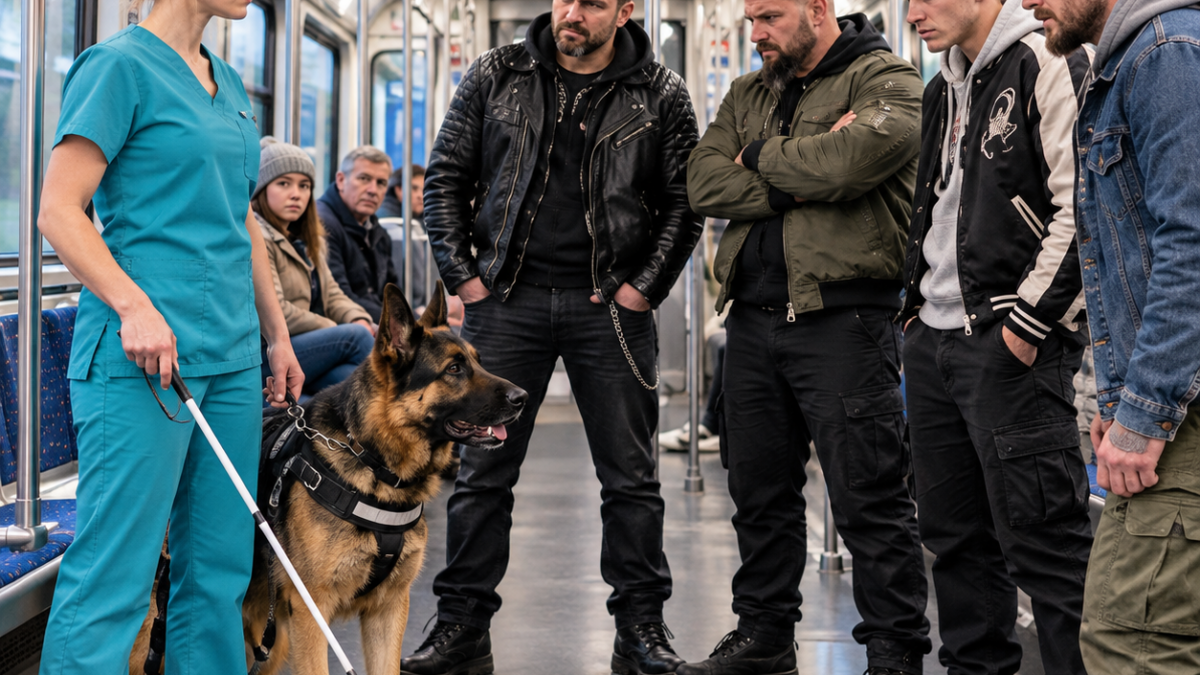
That was when the emergency gate clicked shut behind me.
Codex’s ears went flat.
Three sets of footsteps came from the maintenance alcove near the far stairwell.
Different weights.
Different gaits.
Spread out.
Practiced.
Triangulating.
I put the phone back into my pocket.
I did not reach for anything.
I did not scream.
I lowered my right hand from Codex’s harness and let it hang at my side.
A young man’s voice came from my left.
“Station’s closed, sweetheart.”
Maybe twelve feet away.
Slightly elevated tone.
Mid-twenties.
Trying to sound casual while doing something that was not casual at all.
“End of the line.”
I tilted my head toward him.
“That so?”
“Wallet. Phone.”
A pause.
Then deliberately.
“And the dog.”
Codex’s breathing changed.
He had found all three.
Front-left.
Rear-right.
One moving shallow to my blind side because people love clichés.
I said quietly, “You really do not want the dog.”
Someone laughed.
Not warmly.
The man on the left stepped closer.
Then I heard it.
A folding blade snapping open.
Manual folder.
Loose pocket carry.
Right hand.
No tremor.
I marked his position precisely.
Behind me and right, another one shifted weight.
Trying to get around my shoulder.
I noticed.
“Last chance to reconsider,” I said.
Nobody reconsidered.
“Codex.”
My voice dropped into a tone he knew better than my pulse.
“Guard.”
What happened next took four seconds.
The man with the knife expected a service dog.
He met a war dog.
Codex crossed the platform in three strides and hit him square in the chest with both front paws, driving him backward into the tiled wall so hard the impact cracked across the empty station.
The blade went skittering somewhere across the floor.
I moved before the echo died.
Not blindly.
Never blindly.
Blindness is not the absence of information.
It is a different relationship with it.
The second man breathed sharply, already panicking. He had gone left, trying to circle. His shoe scraped tile. His jacket pulled tight across his chest. I pivoted toward the sound and brought my elbow up.
The strike caught his jaw.
Not elegant.
Not cinematic.
Just angle, force, and muscle memory.
He dropped with a choked sound and hit the floor hard enough to make the third man freeze.
Codex had the first man pinned.
The second was down.
The third still had something heavy in his hand.
“Drop whatever you’re holding,” I said.
Silence.
Then metal hit concrete.
A flashlight.
“Both hands where I can hear them.”
The third man went to his knees so fast his kneecaps cracked against tile.
“Please,” he said. “Please, lady.”
Amazing how quickly “sweetheart” becomes “please” when the wrong woman answers back.
I called Codex off.
He released immediately but stayed over the first man, chest low, teeth visible, ready.
The man curled around his arm, making sounds that were not words.
I reached for my phone.
I never made the call.
The explosion came from below.
It was not a bomb.
I knew that in the first two seconds.
Electrical.
Catastrophic surge.
Old infrastructure meeting too much current and losing.
The station lights died all at once.
Emergency lighting came up near the exits in a dim red wash, but the main platform fell into darkness.
For me, light had no meaning.
For everyone else, the world had just disappeared.
Then I heard the train.
Not the one I had missed.
This sound came from inside the tunnel.
Wrong speed.
Wrong angle.
Brakes screaming.
Metal fighting rail.
Then the hollow, brutal impact of several thousand tons of train striking something it should not have struck.
The screaming started seconds later.
Inside the tunnel.
Passengers.
Smoke.
Pain.
Fear.
I stood still for exactly three seconds.
Inventory.
Three attackers behind me.
One injured.
One dazed.
One terrified enough to obey.
Emergency gate locked.
Station power compromised.
Tunnel incident.
Multiple casualties.
No responders yet.
Medical training active.
Codex’s ear was bleeding from where he had hit the wall during the takedown.
I pulled off my outer jacket, pressed it briefly against the cut, and felt him lean into the pressure without complaint.
Minor.
He would hold.
I turned toward the tunnel.
The third man’s voice shook behind me.
“Lady. Where are you going?”
“Tunnel.”
“There was a crash.”
“I know.”
I paused.
“Call 911. Veilar Station. Platform Three. Partial derailment in the north tunnel. Multiple casualties. Electrical failure. Smoke present. Can you remember that?”
A beat.
“Yeah. Yeah, I can.”
“Then do it.”
Codex and I went into the dark.
The smoke was sharp but not heavy yet.
I moved by tunnel acoustics, memory, airflow, and Codex’s body ahead of me on the lead. Voices bounced from the walls. Some close. Some trapped behind metal. A woman repeating the same phrase over and over. Someone praying. A child crying too rhythmically, too long.
Then I heard a sound I knew better than almost any sound in the world.
Labored breathing.
Wet.
Tight.
A child in respiratory distress.
The first derailed car had tilted at an angle that jammed the door. I found the seam with both hands. Metal was bent, not locked.
I braced.
Pushed.
Nothing.
Repositioned.
Shoulder into it.
Again.
The door moved two inches.
Again.
Enough.
I squeezed through sideways into a tilted train car full of panic.
Someone shouted, “Help! Someone’s here!”
“I’m a nurse,” I said, loud and clear. “Everyone listen to me. I need the child who can’t breathe brought to me now.”
A stunned silence.
Then someone whispered, “She’s blind.”
“Yes,” I said. “And I can hear a child going into bronchospasm, which means we have about four minutes before this becomes very bad. Please stop stating observations and put her in front of me.”
Her name was Nadia.
Eight years old.
Asthma.
No inhaler.
Her mother’s hands shook so hard I had to give her a job before terror swallowed her.
“Hold her. That’s all. Hold her.”
I worked in the dark, in a tilted train car, with no equipment and no light, smoke threading slowly around us.
I positioned Nadia’s airway.
Controlled her breathing.
Used the passengers who could see to clear debris.
Had two people prop the rear emergency door for ventilation.
Directed another to check who could walk and who could not.
Codex sat beside Nadia’s mother and let the woman grip his fur because sometimes procedure is less important than keeping someone from breaking.
Nadia’s breathing eased.
Then I heard a voice from the second car.
Older.
Male.
Trying to sound authoritative.
Failing.
“I’m a physician. Someone needs to— We need to—”
I knew that voice.
Dr. Garrett Hargrove was trapped behind a crumpled connecting door, in a dark train car full of injured passengers, sounding exactly like a man who had just discovered authority is not the same thing as competence.
I moved toward the gap.
“Dr. Hargrove.”
Silence.
“Who’s there?”
“Sarah Voss.”
A longer silence.
Then, “How are you—”
“How many patients do you have?”
“I— At least six injured. One unconscious. Older woman with a broken arm. I can’t see properly.”
“Then tell me what you can assess by touch. Start with the unconscious man.”
He did.
I guided him through the protocol.
Airway.
Breathing.
Cervical risk.
Response to stimuli.
Pulse.
Positioning.
I did not do it to humiliate him.
I did it because people were hurt.
Because a patient does not stop needing care because the doctor on the other side of the door tried to end my career four hours earlier.
It took twelve minutes for transit officers to reach us from the opposite tunnel entrance.
Seventeen for emergency services to establish a corridor through the station.
By then, Nadia was breathing.
One car had been organized into an evacuation chain.
The unconscious man in Hargrove’s car had an open airway and improvised spinal support.
Then I heard boots.
Military boots.
Organized.
Fast.
A command voice cut through the chaos.
“Clear a path. Medical response team from Alden Moore.”
I went still.
I knew that voice before he said my name.
“Voss.”
Low.
Not a question.
“Major Callum,” I said. “Or is it Colonel now?”
“Colonel as of last year.”
Colonel Adrian Callum had been my commanding officer once.
Then my friend.
Then one of the people I disappeared from when I decided to build a civilian life without dragging the old war into it.
He stood in front of me now in a dark tunnel full of smoke and injured people, taking in the situation with the kind of silence only dangerous professionals know how to use.
“You were in here alone.”
“Codex was with me.”
“You came in before first response.”
“There was a child in bronchospasm.”
He exhaled.
Then his voice sharpened.
“Who is the physician in the second car?”
Hargrove answered from behind the damaged door.
“I’m Dr. Garrett Hargrove. Attending physician at Callaway Regional. I was managing—”
“The patients in your car were stabilized via remote guidance from someone on the other side of a crumpled door,” Callum said evenly. “That someone was Nurse Voss.”
Silence.
Then Callum continued, quieter.
“And I am going to want to understand why the nurse I just watched manage a mass casualty incident in a dark tunnel was removed from your department four hours ago.”
Nobody said anything.
Codex pressed against my leg.
The crisis part was ending.
The accounting part was beginning.
And Garrett Hargrove had no idea how much worse it was going to get.
At 1:18 a.m., I returned to Callaway Regional by ambulance because the paramedics insisted my hand and hip needed checking and because Codex’s ear needed stitches.
I told them to take me to Callaway.
The young paramedic objected.
I repeated myself.
She took me to Callaway.
Inside the emergency entrance, I heard administrative voices near the charge desk.
One belonged to Sandra Wye, the overnight nursing supervisor.
The other belonged to Hargrove.
He had arrived before me.
Of course he had.
“Documentation review will show the order was clinically defensible,” he was saying.
Sandra’s voice was flat.
“The patient’s pain management was altered in the record at 7:03 p.m., Garrett. That is forty-eight minutes after Sarah flagged the original order and twenty-two minutes after security removed her from the department.”
Silence.
“I was clarifying the notation.”
“You changed the dosage field and the clinical rationale field. The system logged them separately because they were made eleven minutes apart.”
My hand tightened on Codex’s harness.
Sandra had found the audit trail.
In minutes.
Hargrove had thought the system would protect him because he had learned where things could be hidden.
He had forgotten that systems also record.
By morning, the situation had grown.
Hargrove filed a counter-report claiming my actions in the tunnel were reckless and that my blindness raised questions about my clinical fitness.
That was how men like him worked.
They did not need the lie to survive forever.
They only needed it to exist long enough to make someone else spend their life disproving it.
Then the transit safety division called.
The emergency gate at Veilar Station had not malfunctioned.
It had been manually disabled from inside the maintenance corridor six days earlier.
The attack was not random.
One of the men’s phones connected to a burner.
The call log showed a call made at 6:58 p.m.
Seven minutes after I told Hargrove I was putting the medication objection into the record.
Before security removed me.
Before I left the hospital.
Before I reached Veilar.
Someone had known my route.
Someone had prepared the gate.
Someone had sent those men.
Captain Adara Mensah from the JAG office and Colonel Callum’s team began pulling logs.
My accommodation file had been accessed at 6:44 p.m.
Hargrove’s credentials.
His terminal.
My transit route was in that file because accessible route planning was part of my employment accommodation.
Fourteen minutes later, someone called the burner linked to the men waiting at Veilar.
That was when the case stopped being about a medication order.
By evening, they found a locked steel case in Hargrove’s private office.
Inside were off-system files.
Shadow documentation.
Incident reports that did not exist in the official system.
Performance concerns built around nurses who had raised safety flags, questioned orders, or had documented disability accommodations.
I was in one of those files.
So were others.
Odet Ferris.
Yara Obasi.
A partially sighted nurse.
A nurse with hearing loss.
A nurse with mobility accommodation.
People pushed out quietly, one by one, each departure wrapped in paperwork clean enough to avoid attention and ugly enough to end a career.
Then came Brent Fino.
Deputy Director of Hospital Operations.
The man who managed complaint routing.
The man who decided which complaints rose and which died quietly in administrative language.
Fino had been the bridge.
Hargrove built the files.
Fino buried the complaints.
Then Fino provided information to an external network targeting disabled commuters in transit stations.
Six confirmed victims connected to Callaway.
Former employees.
People isolated by manufactured performance disputes.
People whose complaints had been sent back into the same system that harmed them.
People attacked after they were no longer institutionally useful.
I heard Odet Ferris’s voice on the phone from a quiet office at Alden Moore.
Careful.
Precise.
The voice of someone who had spent years making sure no one could call her emotional.
“He started with small things,” she said. “Documentation concerns. Then an incident with a patient’s family. A version of events that wasn’t true. Fino called me in for mediation. Fifteen minutes. Then the complaint closed.”
She had left nursing.
A good nurse.
Gone.
Not because she could not do the job.
Because the system made staying too expensive.
After the call, I sat with Codex’s head on my knee and understood that what I had stumbled into had been operating in the dark for years.
Touching people one at a time.
Hurting them one at a time.
Making each person think they were alone.
The next night, someone came to my apartment door.
Codex froze before the handle turned.
Professional breathing outside.
Not panicked.
Not amateur.
Someone trained enough to retreat when the conditions changed.
I escaped down the fire escape with Codex and met Callum’s team at a transit hub.
That was the last time anyone told me I was overreacting.
Fino ran.
He was caught at a rest stop before midnight.
He asked for an attorney, then began talking when evidence closed around him.
The network organizer was arrested the following morning.
The three men from Veilar remained in custody.
The man Codex had pinned was tied to a prior assault in Merwick City.
Hargrove’s first attorney withdrew after Fino’s second interview.
That told me more than any press release could.
People withdraw when the story they agreed to defend collapses under evidence they were not shown before breakfast.
A week later, the clinical fitness review Hargrove triggered against me was closed.
Dr. Fern Cassidy, the board chair, read the decision in a voice built for formal rooms.
“The counter-report does not establish a credible basis for clinical fitness concerns.”
She paused.
“Ms. Voss’s actions during the Veilar Station incident were consistent with her professional training and represent exactly the kind of clinical and operational competence reflected in her employment record.”
Dr. Naveen Oay asked if I wanted to say anything.
I said, “Not to the board. I’d like to go back to work.”
He told me to take the day.
I did.
The trials came months later.
Hargrove was convicted of falsifying medical records and reckless endangerment related to the Madsen order.
His license was revoked.
The medical board’s findings included twelve words I will never forget:
Targeting based on accommodation status.
Clean words.
Institutional words.
Permanent words.
Brent Fino received a federal sentence after cooperating.
The network organizer received fourteen years.
The three men from Veilar received sentences based on involvement.
The one Codex took down got the longest of the three.
The man who came to my apartment door was caught later and sentenced for criminal intimidation.
Callaway opened reviews for the employees driven out under Hargrove and Fino’s system.
Five of six departures were found to involve institutional failure.
Three accepted the acknowledgment and moved on.
One returned to a quieter department.
Odet Ferris came back to emergency nursing.
On her first shift back, she stood in the break room with a paper cup of coffee, careful as ever.
“You’re going to be good at this,” I told her.
She looked at me.
“I was always good at this.”
I smiled.
“Yes,” I said. “You were.”
The city held a commendation ceremony in November.
I attended because the people giving it needed to give it, and sometimes accepting a public thank-you is less about pride than about letting the right record exist.
Mayor Petra Holloway read the formal language.
Then she stepped away from the prepared remarks.
“This commendation exists because a nurse flagged a medication order,” she said. “That is where this starts. Not in a tunnel. Not in a confrontation. In a trauma bay, at the end of a long shift, when she saw something wrong and said so on the record.”
I stood with Codex beside me.
Yara Obasi stood nearby.
So did Danny.
Sandra.
Oay.
Mensah.
Callum.
Other nurses who should never have been forced to leave jobs they were qualified to do.
Reporters waited outside.
I gave them one statement.
“I did not overcome blindness,” I said. “I am blind. That is not something I am defeating. What I overcame was a system that decided blindness meant I was less qualified to notice things than someone with full vision. That assumption was wrong, and it hurt people for a long time.”
A camera clicked.
I continued.
“The people who paid the highest price were not me. They were the staff members driven out of jobs they could do and the commuters targeted because someone decided disability made them easier to dismiss.”
I put one hand lightly on Codex’s harness.
“My part was that I was in the right place on the right night to pull the thread, and I had enough training and stubbornness to keep pulling.”
That was all I said.
Weeks later, I met Nadia at a coffee shop near Callaway.
She was eight, intense, and very serious about deciding whether she wanted to be a nurse, a veterinarian, or both.
She asked how Codex knew what to do in the dark.
“Training,” I said. “And experience.”
She asked how I knew where things were without seeing them.
“Sound. Memory. Pattern. Your brain learns to use what it has.”
“Proprioception,” she said proudly.
I nearly laughed.
“Yes. Exactly.”
She nodded.
“I want to learn that.”
“You can.”
When I left the coffee shop, I thought about a nurse named Bridget who had once stood beside my rehabilitation bed at 3:00 a.m., eleven days after I became permanently blind, when I was angry and grieving and drowning in a darkness that had nothing to do with the lights.
Bridget had not been gentle.
She had been better than gentle.
She had been useful.
“You can grieve this and still choose what you do next,” she told me. “Those are not the same decision. One you don’t control. The other one you do.”
I understood it slowly.
Then completely.
On a Tuesday night in a dark tunnel, with a child struggling to breathe, I chose what I was going to do next.
That is the part people misunderstand about being underestimated.
It hurts.
It costs.
It grinds down the people forced to keep proving what should have been obvious.
But being told you are less than you are does not make you less than you are.
It makes the people who said it wrong.
That wrongness does not resolve itself in one dramatic moment.
Not in one fight.
Not in one takedown.
Not in one courtroom.
It resolves through evidence.
Through continued presence.
Through every shift worked.
Every order flagged.
Every patient stabilized.
Every complaint routed somewhere it cannot be buried.
Every dark tunnel entered because someone inside still needs help.
A year after Veilar, I accepted a position in Callaway’s new Nursing Practice Standards Office.
Independent of department heads.
Responsible for reviewing medication disputes, patient safety concerns, and accommodation compliance.
I accepted on one condition.
I kept clinical hours in the emergency department.
Dr. Oay agreed.
On my first day in the new role, I still arrived at 6:45 a.m. for shift.
Danny handed me a tablet.
“Bay Two is yours. Possible acetaminophen toxicity.”
That was the entire ceremony.
Perfect.
Codex pressed against my leg as I moved toward the curtain.
His left ear had a small notch now from the station wall.
My palm had three faint scars from the tunnel.
My hip complained in cold weather.
There were more files in my record than before.
More people watching.
More reasons for rooms to recalculate when I entered.
None of that was the point.
The point was Bay Two.
The patient behind the curtain.
The work.
I stepped through.
And here is the truth.
I was blind before they trapped me in that station.
I was blind when the blade opened.
I was blind when Codex hit the first man.
I was blind when the train crashed.
I was blind when I entered the tunnel.
I was blind when I stabilized Nadia.
I was blind when I talked Hargrove through an assessment he should have been able to lead himself.
And I was blind when the records, logs, files, complaints, and testimony pulled an entire hidden system into daylight.
Blindness was never the weakness in that story.
Their assumption was.
And assumptions, when documented properly, make excellent evidence.








