They Tried to Separate the Two Terrified Kittens—Until One Woman Heard the Sound That Stopped the Shelter Cold.
PART2:
She gave me the kind of smile people give when they already know life is about to hand you something else.
“Come on,” she said. “I’ll show you what we have.”
Her name was Teresa.
She led me down a narrow hallway lined with kennels.
Some cats slept through our footsteps.
Some pressed against the bars.
One old black cat watched me like he had already judged my entire personality and found it weak.
I almost picked him.
Then we stopped in front of Cage 17.
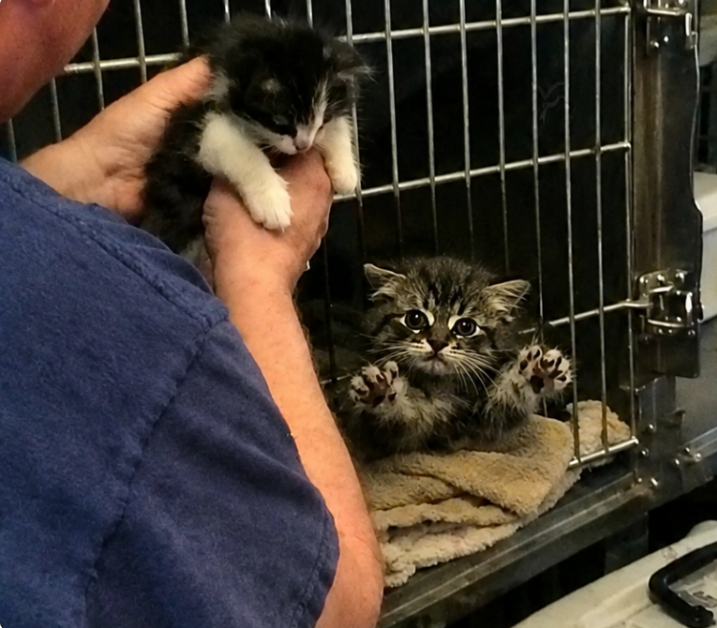
Two kittens were inside on one folded towel.
They were so pressed together they looked like one small, frightened creature with too many paws.
The one in front sat up straight when I stepped closer.
Tiny chest out.
Ears up.
Doing his best to look brave.
The other had her face buried against his side like she wanted to disappear into him.
Neither of them made a sound.
Teresa lowered her voice.
“They came in together.”
I crouched.
“How old?”
“About ten weeks, maybe eleven. They were found behind a shopping center near the loading docks.”
“Are they littermates?”
“We think so. Same age, same location. They act like it.”
The male kitten had a white stripe down his nose and a dark patch over one eye.
His fur was orange and brown, though the shelter lighting made it appear dull.
The female was smaller, cream-colored, with a gray tail and enormous green eyes.
“They panic when they’re separated,” Teresa added.
I kept staring at them.
The front one looked exhausted, but determined.
The smaller one trembled so hard I could see it all the way down her back.
“They’ve been here almost a month?”
“Twenty-six days.”
A month of people stopping, asking questions, then choosing something easier.
A month of surviving only because neither one had been left behind yet.
I should have nodded and kept walking.
Instead, I asked, “Can I see him?”
The second I said it, the smaller kitten lifted her head.
Teresa opened the cage slowly and reached in.
The little male froze, but allowed her to pick him up.
And that was when it happened.
The kitten left in the cage let out a sound so sharp and broken that every person in the room turned.
It was not a meow.
It was not even crying.
It sounded like terror with a heartbeat.
She lunged forward so fast she slipped on the towel, caught herself, and kept reaching through the air toward him as if she could pull him back by force.
The kitten in Teresa’s arms started shaking too.
Not fussing.
Not wriggling.
Shaking.
He stretched every inch of his little body toward the cage, toward her, toward the only thing in that place that probably still felt familiar.
Teresa immediately lowered him back inside.
The female kitten threw herself against his chest.
For several seconds, neither moved.
The room had gone silent.
A young volunteer at the next kennel lowered the water bowl in her hand.
Someone behind us whispered, “Oh, my God.”
Teresa closed the cage door.
The two kittens remained pressed together, their sides moving in quick, frightened breaths.
I knew that sound.
Not exactly.
But close enough.
I knew what it was to lose the one thing that made a strange place feel survivable.
A year earlier, my daughter had packed up her car and moved across the country.
She was supposed to.
She had every right.
I had been proud enough to tell her so.
But after she left, I had stood in her empty room and felt as though someone had quietly removed a wall from the house.
I looked at the kittens.
“How long have they been here?” I asked.
“Almost a month.”
That hit me harder than expected.
A month of waiting.
A month of people wondering whether they wanted one kitten, then deciding two were too much.
A month of being passed over because the safest thing for them was also the most inconvenient thing for everyone else.
Teresa watched me.
“They calm down once they’re together again.”
I looked down at the carrier by my feet.
One cat.
That was the plan.
One food bowl.
One vet bill.
One warm body.
But behind the bars, the little female had gone quiet only because she was out of breath. Her mouth was open. Her eyes were fixed on her brother as if blinking might make him disappear.
I heard myself say it before I had fully decided.
“Please don’t separate them.”
Teresa’s expression softened.
“I know.”
“I’ll take both.”
For a moment, she did not move.
Then she closed her eyes for half a second, as if she had been carrying that hope around all day and was afraid to set it down.
“You’re sure?”
“No,” I admitted.
That made her smile.
“But I’m taking them.”
The paperwork took twenty minutes.
I signed the adoption forms with one kitten inside a carrier and the other pressed against the first through the metal door.
Teresa gave me food samples, vaccination records, a blanket, and a lecture about keeping them indoors until they were fully settled.
Then she crouched beside the carrier.
“They need names.”
I looked through the wire door.
The male kitten blinked at me.
The female tucked her nose against his shoulder.
“Benno,” I said.
Teresa repeated it.
“Benno.”
His ears moved.
“And Poppy.”
The little female shifted closer to her brother.
Teresa smiled.
“Benno and Poppy. Good names.”
The ride home was all rustling and tiny frightened movements inside the carrier.
At every red light, I talked to them as though they understood every word.
“You’re okay.”
“We’re almost there.”
“Nobody’s taking anybody away.”
I had secured the carrier on the passenger seat with the seat belt.
The kittens stayed pressed together.
When the car turned, Benno’s body shifted and Poppy immediately climbed over him to make sure he was still there.
I reached one hand toward the carrier at a red light.
“I know,” I whispered. “I know.”
The house looked different when I opened the front door.
It was the same little ranch house with the same faded blue shutters and the same porch where Anna had learned to ride a bicycle.
But that morning, the walls felt as though they were waiting.
I had prepared the spare bedroom with a litter box, food, water, and a folded quilt.
I opened the carrier.
Benno stepped out first.
Slow.
Careful.
Still trying to be brave.
Poppy came right behind him and pressed herself against his side so tightly it was as though she needed to prove he was real.
They moved beneath the bed together.
I sat on the floor in my socks and waited.
For almost an hour, nothing happened.
Then Benno’s nose appeared beneath the bed frame.
Poppy’s nose appeared beside it.
I stayed still.
Eventually, Benno crept out.
Poppy followed.
They inspected the food bowl.
They inspected the litter box.
They inspected the closet door.
Then they returned beneath the bed.
I read a book while sitting on the floor.
I did not read aloud because I felt foolish.
Instead, I turned pages and pretended I was not watching.
At sunset, Benno climbed onto the folded quilt.
Poppy curled beside him.
He put one paw over her back.
That was the first time I saw them sleep.
They looked impossibly small.
Two warm bodies sharing one heartbeat.
I left the bedroom door open that night.
At two in the morning, I woke to a soft thump.
Poppy had climbed onto the bed.
Benno was behind her.
They crossed the blanket together and settled against my knees.
I did not move.
I lay in the dark, listening to their tiny breaths.
The house was still quiet.
But it no longer felt empty.
That was the first thing Benno and Poppy gave me.
Not companionship exactly.
Something more fragile.
Proof that silence did not always mean absence.
Sometimes it meant two frightened lives were learning the shape of safety.
The first few days, they barely ate unless I sat on the floor and pretended not to watch.
They used the litter box only if it was placed where they could see each other.
They slept pressed together.
If one woke, the other woke too.
I learned this the messy way.
I had started with one litter box in the laundry room and another in the bathroom because every article I read made it sound as though cats preferred privacy.
The first time I shut the bathroom door without realizing Poppy was inside, I heard her immediately.
A sharp, panicked cry came from behind the door.
Benno launched himself against it.
I dropped the basket of towels I was carrying and opened the door.
Poppy came out low to the ground, ran straight into him, and stayed pressed against his side so hard I thought she might disappear into his fur.
Benno circled her twice.
Then he licked the top of her head.
I sank to the floor in the hallway.
The kittens looked at me.
I started crying.
Not the dramatic kind.
Not the kind that made you collapse over a kitchen table.
The tired kind.
The kind that came when you realized love was going to ask more of you than you had budgeted.
Poppy walked over and put one paw on my ankle.
Benno sat beside her.
I wiped my face.
“Fine,” I whispered. “I understand.”
After that, I stopped closing doors between them.
I bought a third litter box.
I moved the food bowls so they could see each other from opposite sides of the room.
I put a night-light in the hallway.
I left the bedroom door open every night.
I adjusted my entire house around the fear of two kittens who had once survived behind a shopping center by refusing to be separated.
A week after the adoption, I took them to the veterinarian.
I put them in the same carrier.
The waiting room was full of ordinary noises.
Dogs barking behind closed doors.
A toddler crying.
The hum of an aquarium filter.
Poppy pressed herself against Benno’s side.
Benno placed one paw over her tail.
The technician opened the carrier door.
“Oh,” she said. “They’re a matched set.”
I smiled.
“That is one way to put it.”
The examination was not terrible.
Benno received his vaccinations without much complaint.
Poppy complained for both of them.
When the veterinarian listened to Poppy’s chest, Benno pushed his face against the carrier door and made a low, angry sound.
“Someone is protective,” the veterinarian said.
“He doesn’t like her being out of reach.”
“Have you tried separating them at home?”
“No.”
“You may eventually need to.”
“Why?”
“For appointments. Grooming. Illness. There are times when they may need individual care.”
“I understand.”
The veterinarian studied the kittens.
“Bonded animals can become overdependent.”
“They can also comfort each other.”
“Of course.”
The appointment ended with two vaccinations, medication for a mild intestinal infection Poppy had picked up before adoption, and a bill much higher than I had expected.
I looked at the number and felt something ugly flicker through me.
For a second, I thought about what one kitten would have cost.
One vaccine series.
One food bowl.
One carrier.
One future problem at a time.
The point is that there is the life you plan on paper, and then there is the life that swipes your card and asks whether you would like a receipt.
I drove home with the carrier on the passenger seat and the clinic bag beside it.
The kittens slept against each other.
I looked at them at a red light and thought something I hated myself for thinking.
Maybe the woman at the shelter had been right to warn me.
Maybe Carol, my neighbor, would be right when she told me two kittens were too much.
Maybe I had let the emptiness in my house make a decision for me.
Then Poppy woke.
She lifted her head and searched for Benno.
He shifted closer to her.
She settled again.
I drove the rest of the way home.
The next afternoon, I carried laundry down the hall when Benno darted between my legs and Poppy startled in the opposite direction.
I did not notice she had slipped into the spare bedroom.
I shut the door and kept walking.
For almost an hour, Poppy was silent.
I assumed she had gone beneath the couch.
Benno searched the apartment.
He checked the kitchen.
He checked the bathroom.
He checked beneath the bed.
Then he stopped in the hallway and began making a sound I had never heard from him before.
It was not a meow.
It was not a cry.
It was a small, desperate call repeated over and over.
I dropped the laundry basket so quickly that half the towels fell out.
“Benno?”
He ran toward the spare bedroom door.
I opened it.
Poppy came out low to the ground.
She ran straight into his chest hard enough to rock him backward a step.
Benno wrapped both front legs around her.
They stayed that way for almost a minute.
I sank to the floor in the hallway.
I wish I could tell you that was the moment all my doubt disappeared.
It wasn’t.
Knowing does not pay a bill.
Love does not make veterinary appointments disappear.
A person can understand the bond and still feel afraid of what it costs.
That evening, I called the shelter.
Teresa answered.
“How are the babies?”
“Together.”
She laughed.
“Of course.”
“I accidentally shut Poppy in a room.”
There was a pause.
“What happened?”
“Benno searched for her. Then he started calling.”
“Did she answer?”
“No. She must have been too scared.”
Teresa sighed.
“That’s why we put the warning on the cage.”
“I know.”
“You did the right thing.”
“I almost didn’t.”
“Most people don’t. They hear ‘bonded pair’ and think it means they’ll cuddle sometimes. They don’t understand that some animals use each other as an anchor.”
“Is that what they are?”
“Anchors?”
“Yes.”
“I think so.”
I looked through the living-room doorway.
Benno and Poppy were asleep on a blanket.
Poppy’s face was tucked beneath Benno’s chin.
“Do you think I’m selfish for keeping both?”
Teresa was quiet for a moment.
“Why would it be selfish?”
“Because I live alone. Because they cost money. Because I wanted one cat and came home with two.”
“Did you take them because you wanted twice as much attention?”
“No.”
“Did you take them because you thought separating them would hurt?”
“Yes.”
“Then it sounds like you made a decision based on what they needed.”
“But I needed something too.”
“That doesn’t make it selfish.”
I leaned back against the kitchen counter.
“I don’t know the difference anymore.”
“The difference between love and selfishness?”
“Yes.”
“Selfishness asks what the other creature can give you. Love asks what you are willing to protect even when it asks more than you planned.”
I looked at the kittens.
They were sleeping so deeply that their paws twitched.
Teresa added, “You can love them and still be tired. You can be happy you adopted them and still worry about money. Both things can be true.”
I closed my eyes.
“Thank you.”
“Claire?”
“Yes?”
“Don’t let practical people convince you that feeling deeply is the same as thinking badly.”
I wrote that sentence down.
I kept it on the refrigerator for almost a year.
A woman in my neighborhood named Carol came over one afternoon carrying a loaf of homemade bread.
She had heard the kittens through the wall, though I had no idea how.
By “heard,” I mean Benno had launched himself into the front window after spotting a leaf, and half the street had probably heard him.
I invited her in.
The kittens were wrestling beneath the coffee table.
Poppy chased Benno around one leg.
Benno circled back.
They collided, rolled apart, then immediately returned to each other.
Carol smiled.
“They’re adorable.”
“Thank you.”
“How old are they now?”
“About thirteen weeks.”
She watched them circle each other once and settle beneath the table.
Then she looked at me.
“You know, my niece is looking for a kitten.”
I felt my shoulders tense.
“Just one?”
“She only wants one.”
I knew before she finished.
“The little girl would be perfect,” Carol said.
I looked at Poppy.
The smaller one.
The softer one.
The one who looked like pity in fur form.
“She’s very attached to her brother.”
“Cats adjust.”
“She panics when they’re apart.”
“Most kittens do at first.”
“She stopped breathing normally when we separated them at the shelter.”
Carol waved one hand.
“That sounds dramatic.”
“It was.”
She set the bread on my kitchen table.
“I’m not saying you should get rid of one. I’m just saying you could give the little one to my niece. She’d have a good home.”
I looked at Poppy.
Benno had climbed onto the couch now.
Poppy followed.
He lowered himself so she could step over his front legs.
“I’m keeping both,” I said.
Carol looked surprised.
“You’re sure?”
“Yes.”
“It’s a lot for one person.”
“I can manage.”
“You live alone.”
“Yes.”
“Two kittens will keep you busy.”
“I know.”
She gave me a sympathetic smile.
“I’m just thinking practically.”
That word landed like a bruise.
Practically.
The same bruise as my daughter’s voice when she asked whether I needed the kittens because she had left.
The same bruise as every quiet adult thought that began with be realistic.
I accepted the bread.
Carol left ten minutes later.
Afterward, I wrapped it and put it in the freezer without cutting a slice.
I sat on the floor with Benno and Poppy.
“People keep trying to split you up,” I told them.
Benno blinked.
Poppy pressed her side against him.
“I’m not going to let them.”
That evening, I opened the adoption folder and read the shelter notes again.
Bonded pair.
Do not separate.
The phrase was typed in capital letters.
I wondered how many people had ignored it.
How many animals had been separated because one person wanted a kitten and did not want to understand the cost of taking only one.
I wondered how many people had told themselves the animals would adjust.
Animals adjusted to many things.
They adjusted to empty rooms.
New cages.
Different voices.
Hunger.
Fear.
That did not mean the losses were harmless.
The next afternoon, my daughter called.
I answered on the second ring.
“Hi, Mom.”
Her voice entered my kitchen and filled it.
I smiled.
“Hi, baby.”
“Did you really adopt two cats?”
“Apparently.”
“Apparently?”
“I had a plan.”
“You had a plan?”
“I did.”
“What happened to it?”
“It met Benno and Poppy.”
She laughed.
It was the first real laugh I had heard in my kitchen since she left.
I told her about the shelter.
I told her about the sound Poppy made when Teresa lifted Benno.
Anna became quiet.
“That sounds awful,” she said.
“It was.”
“Are they okay now?”
“They’re sleeping on my bed.”
“Both?”
“They don’t do anything separately.”
Anna laughed again.
“Sounds like you.”
I pretended to be offended.
“Excuse me?”
“You and Dad.”
The warmth left the room.
My husband, Daniel, had died six years earlier.
He had been sick for almost a year. During the final months, I had slept in a chair beside his bed because he became frightened when he woke alone.
Anna had been seventeen.
She had watched me rearrange my life around his illness until there was no space left for grief.
After he died, she moved through the house like a person walking through a museum.
Quiet.
Careful.
Never touching anything.
I had thought I was protecting her.
She later told me I had made the house feel like a place where no one was allowed to breathe.
We had survived that period.
But survival was not the same as understanding.
“I’m sorry,” Anna said.
“It’s okay.”
“No, it’s not.”
I looked down at Benno, who was sleeping with one paw over Poppy’s neck.
“You’re right,” I said. “They do sound like us.”
“Are they helping?”
I knew what she meant.
“Maybe.”
“Do you feel less lonely?”
I looked around the kitchen.
There were two kitten bowls beneath the window.
A stuffed mouse sat near the refrigerator.
The laundry basket contained a blanket covered in fur.
“Yes,” I said.
Anna became quiet again.
Then she asked, “Do you need them because I left?”
The question was gentle.
That made it more dangerous.
I could have answered quickly.
I could have said no.
I could have reassured her and protected both of us from the truth.
Instead, I said, “I don’t need them because you left. But the house changed when you did.”
“I know.”
“I’m proud of you.”
“I know.”
“I’m still learning how to be proud and lonely at the same time.”
Anna did not speak for several seconds.
Then she said, “I’m still learning how to leave without feeling like I hurt you.”
My throat tightened.
Benno stirred in his sleep.
Poppy’s paw moved across his chest.
“I don’t want you to stay because you’re afraid I’ll be lonely,” I said.
“I know.”
“But I don’t want you to pretend it didn’t change anything.”
“I’m not pretending.”
We stayed on the phone for almost an hour.
When we hung up, I stood in the kitchen with the dark screen in my hand.
The house was quiet again.
But it was a different kind of quiet.
There were kittens sleeping in the next room.
There was a message from my daughter waiting on my phone.
And there was a truth I had finally admitted aloud.
I was not trying to replace Anna.
I was trying to learn who I was when love was no longer needed in the same way.
A month after I brought the kittens home, a small problem became a serious one.
Poppy had developed a habit of chewing the corner of the rug beneath the dining table.
At first, I thought she was playing.
Then she began swallowing small fibers.
The veterinarian warned me that fabric could cause an obstruction.
I bought chew-safe toys.
I covered the rug.
I rearranged the room.
Poppy found another corner.
Benno watched her with what looked like disapproval.
One morning, I found her crouched beneath the table, breathing quickly.
She would not eat.
Benno sat in front of her and refused to move.
I called the veterinary clinic.
“Bring her in,” the technician said.
“Can Benno come?”
“He can come, but we may need to examine Poppy alone.”
I felt the old fear rise.
“He will panic.”
“So will she.”
I put both kittens in the carrier.
The clinic waiting room was full.
A large dog barked in the corner.
Poppy pressed against Benno.
Benno stared at the dog through the carrier bars, his body positioned between it and his sister.
The technician carried Poppy to the examination room.
Benno began calling.
Not loudly.
But constantly.
He moved back and forth inside the carrier.
His paws struck the plastic floor.
The technician paused at the doorway.
“Do you want him in the room?”
“Yes.”
“But he may interfere.”
“Then let him watch.”
The veterinarian examined Poppy while Benno sat on the counter beside us.
He did not touch her.
He did not interfere.
He simply watched.
The X-ray showed irritation but no obstruction.
The veterinarian prescribed medication and told me to remove every loose fabric edge from the house.
When Poppy returned to the carrier, Benno immediately curled around her.
I paid the bill.
It was another amount larger than expected.
In the car, I sat behind the steering wheel and cried.
Not because of the bill.
Because I had spent the entire appointment wondering whether choosing them had been a mistake.
Then Poppy reached through the carrier and touched Benno’s paw.
He touched hers back.
I started the engine.
No, I thought.
The mistake would have been pretending they were not connected because a single life was easier to explain.
The most difficult conversation came a few weeks later.
I was carrying groceries inside when I found my landlord standing on the porch.
His name was Mr. Harding.
He was a narrow man with a permanent frown and a habit of examining my house as if he expected to find evidence of unpaid rent in the flower beds.
“I received a complaint,” he said.
“About what?”
“Animals.”
“They’re cats.”
“I know what they are.”
“The lease allows one pet.”
“I permitted one cat.”
“I adopted two kittens.”
“That is not the same thing.”
I set the groceries down.
“They are both under ten pounds.”
“It is still two animals.”
“They are bonded.”
Mr. Harding looked through the window.
Benno and Poppy were sitting together on the armchair.
His face did not change.
“Bonded?”
“They cannot be separated.”
“That sounds like your problem.”
“It is.”
“Then you will need to choose one.”
The words were so casual that they hurt more than if he had shouted.
I stared at him.
“No.”
He blinked.
“No?”
“I’m not choosing one.”
“Then you will need to move.”
The grocery bag shifted at my feet.
I could smell oranges, coffee, and the damp cardboard of the milk container.
“Are you evicting me?”
“I am giving you notice that you are in violation of the lease.”
“The lease says one pet.”
“Yes.”
“These kittens were adopted as a bonded pair.”
“You should have adopted one.”
I looked through the window again.
Poppy had curled against Benno.
Benno was watching the porch.
“I’m not giving either one away.”
Mr. Harding’s expression hardened.
“You have thirty days.”
He left before I could respond.
I stood on the porch long after his truck disappeared.
Moving would cost money.
The rental market had changed.
I could not afford a larger place easily.
The thought of losing the house terrified me.
For three days, I searched local tenant laws and animal welfare regulations.
I called the shelter.
I called a legal-aid office.
I called the veterinary clinic and asked for a letter explaining the kittens’ bond.
Teresa told me not to panic.
“I’ve seen landlords change their minds when they realize someone is willing to fight.”
“I don’t want a fight.”
“Neither did they.”
The shelter director helped me write an appeal.
The veterinarian provided medical records stating that forced separation could cause severe stress and that keeping the pair together was in their best welfare interest.
My sister printed copies.
Anna called every night.
Mr. Harding received the letter.
He ignored it.
On the twenty-ninth day, he sent a notice by certified mail.
I sat at the kitchen table with the envelope in front of me.
Benno sat beneath my chair.
Poppy climbed onto my lap.
I stared at the paper.
For one terrible moment, I thought about taking Poppy back to the shelter.
Maybe she would be adopted quickly.
Maybe a family would take her.
Maybe she would adjust.
I almost believed the lie because it sounded responsible.
Then Benno lifted his head.
He looked at Poppy.
Poppy touched her nose to his chin.
The decision became clear.
I called the legal-aid office again.
Two weeks later, Mr. Harding’s attorney withdrew the notice after learning that the adoption records showed the kittens had been placed as a pair and that the lease language did not clearly define the number of animals allowed under a single-pet exception.
Mr. Harding did not apologize.
He sent me a new lease with a higher pet deposit.
I paid it.
Then I planted flowers along the walkway.
I did not tell him that some fights were worth having.
I simply kept the kittens.
The experience changed how I looked at people who claimed to be practical.
Sometimes practical meant wise.
Sometimes it meant avoiding responsibility.
Sometimes it meant making the vulnerable pay for a system designed around convenience.
The difference was whether anyone had bothered to ask what would happen after the decision.
What would happen to Poppy after Benno was gone?
What would happen to Benno after Poppy was gone?
What happened to people when the one living creature who knew them best was treated like an optional possession?
I began researching bonded animals more seriously.
I learned that shelters often had no formal way to document emotional dependence.
A dog could be listed as needing medication.
A cat could be listed as aggressive.
A pair could be labeled “bonded,” but there was often no explanation of what that meant.
Sometimes one animal simply slept beside the other.
Sometimes they groomed each other.
Sometimes they showed signs of distress when separated.
And sometimes, like Benno and Poppy, one animal would stop eating and the other would begin searching the building.
I asked Teresa whether the shelter needed help rewriting its intake forms.
She laughed.
“Are you trying to become my unpaid administrator?”
“I’m offering.”
“That is how it starts.”
We created a new section:
Bonded Relationship Assessment.
Did the animals seek each other when separated?
Did one refuse food or become distressed?
Did they use each other for comfort?
Could either animal be safely handled alone?
What would separation likely cause?
It was not perfect.
No form could capture the sound Poppy made when Benno was lifted from the cage.
But it was a beginning.
The shelter began placing clearer warnings on cages.
BOND MUST BE PLACED TOGETHER.
Not because every pair was impossible to separate.
Because people deserved to understand what they were being asked to decide.
A year after I brought Benno and Poppy home, the shelter held an adoption event.
I brought the cats for their anniversary photographs.
Teresa cried when she saw how large they had become.
Benno was long and elegant, with a white blaze down his face.
Poppy had grown into a graceful cream-and-gray cat with bright green eyes.
They still moved together.
But they no longer panicked if one crossed a doorway first.
Teresa crouched in front of them.
“Do you remember this place?”
Benno sniffed her hand.
Poppy hid behind him.
Teresa laughed.
“Some things never change.”
I looked toward Cage 17.
“Do you think they remember being separated?”
“I think their bodies remember.”
“Is that why they still check on each other?”
“Probably.”
Poppy stepped out from behind Benno and touched her nose to Teresa’s fingers.
Teresa’s eyes filled.
“Look at you,” she whispered.
Poppy allowed one stroke.
Then she returned to Benno.
A family entered the shelter while we were there.
A father, a mother, and a little boy who could not have been older than six.
The boy wanted a kitten.
He stood in front of a cage containing two orange tabbies.
The mother said, “We only need one.”
The father smiled.
“They’re just playing.”
The boy pointed at the cage.
“They need each other.”
His father laughed.
“They’re cats.”
The boy shook his head.
“No. They’re scared.”
The mother opened the cage door.
One kitten tried to climb into her arms.
The other began calling.
The mother paused.
The father stopped laughing.
The boy looked up at them.
“See?”
Nobody spoke.
Teresa knelt beside the family.
“They’re bonded,” she explained. “If you have room for two, they should stay together.”
The father looked at the cage.
The mother looked at the kittens.
The boy turned around and saw Benno and Poppy sitting side by side in the carrier.
“Are those two brothers?” he asked.
“Sister and brother,” I said.
“Did you take both?”
“Yes.”
“Why?”
I looked at him.
“Because they were afraid without each other.”
The boy nodded as though that answer made perfect sense.
His parents exchanged a glance.
An hour later, they adopted both orange kittens.
Teresa hugged me in the parking lot.
“You see?” she said.
“See what?”
“Sometimes one story is enough to change the next decision.”
The following year, I began volunteering at a small senior living community that had partnered with the shelter.
The facility had once refused all animals except service dogs.
Then a resident named Harriet had asked why her little spaniel could not visit.
Her dog, Benny, had slept beside her for twelve years.
When Harriet moved into the facility, Benny stayed with her daughter.
Harriet stopped eating.
The staff said she was adjusting.
Her daughter said she was grieving.
A nurse suggested bringing Benny to the window.
Harriet smiled for the first time in three weeks.
The facility director eventually created a supervised animal-visitation room.
That was where I brought Benno and Poppy.
The first resident we visited was named Elaine.
She had arthritis in both hands and a voice like tissue paper.
When Winston—when I say Winston now, I mean the old cat from another story; but in this story we should keep Benno and Poppy. Need not introduce name confusion. Let’s continue with Benno and Poppy.
When Benno and Poppy climbed onto the blanket over Elaine’s lap, she did not say anything for almost a full minute.
She simply rested her fingertips on Benno’s back while Poppy curled against his side.
Then her breathing changed.
Longer.
Deeper.
Like part of her had unclenched.
“I forgot how warm they are,” she whispered.
That line stayed with me.
I forgot how warm they are.
What a brutal sentence.
What a whole nation of loneliness packed into six words.
Elaine had owned cats most of her life.
Her last one had died the year before.
She had not wanted another animal because she was afraid of losing it.
“I thought it was safer not to love anything,” she told me.
I looked at Benno and Poppy.
“Did that work?”
She smiled sadly.
“No.”
Poppy lifted her head.
Elaine touched her cheek.
“She knows.”
“Poppy knows many things.”
“So does the boy.”
Benno had moved one paw across Poppy’s back.
Elaine watched him.
“They’re keeping each other brave.”
“Yes.”
She looked at me.
“Who keeps you brave?”
The question caught me off guard.
I looked down at the kittens.
“Sometimes they do.”
Elaine nodded.
“Then they are not just pets.”
“No.”
“What are they?”
I thought about that.
“Family.”
She smiled.
“People get nervous when you say that.”
“People get nervous when love is inconvenient.”
Elaine’s fingers moved over Poppy’s fur.
“People got nervous when my husband was dying and I wanted to sleep beside him.”
“What did they say?”
“That I needed rest.”
“Did you?”
“Yes.”
“Did you stay?”
“Yes.”
She looked toward the window.
“He died with my hand in his.”
Benno closed his eyes.
Elaine whispered, “That mattered.”
It did.
I understood that now.
A clean room mattered.
Medicine mattered.
Food mattered.
Rules mattered.
But presence mattered too.
The things we could not measure often became the things we remembered most clearly.
Benno and Poppy never became cheerful therapy cats.
They remained opinionated, suspicious, and completely unwilling to perform beyond their terms.
If a resident moved too quickly, Poppy disappeared beneath the nearest chair.
If someone reached for Benno without warning, he turned his back.
But when a person sat quietly enough, and their hands trembled for the same reasons Walter’s had—or Elaine’s, or mine—Poppy seemed to understand.
She would go to them.
Not always.
But often enough to make the room fall silent each time.
Maybe she knew grief by scent.
Maybe she knew stillness.
Maybe love leaves marks we do not have names for.
I only knew she kept choosing the people who looked most like they had run out of being held.
Benno always followed.
Not because she could not manage without him anymore.
Because he wanted to.
That distinction changed me.
They had begun as two terrified animals who could not survive a closed door.
They became two companions who could cross a room alone and still choose to return to each other.
I wondered whether that was what Anna and I were learning too.
Not how to stay attached by fear.
How to remain connected across distance.
That summer, Anna called me from Colorado.
“Mom, I need advice.”
“What happened?”
“My roommate is moving out.”
“That doesn’t sound like an emergency.”
“It is if you have to find a new roommate.”
“What do you need to know?”
“How do you decide whether someone is trustworthy?”
I looked at Benno and Poppy asleep in a patch of sunlight.
“You watch what they do when nobody is asking them to be kind.”
Anna was quiet.
“That’s very specific.”
“I’ve had experience.”
“With the kittens?”
“With people.”
She laughed.
“Do Benno and Poppy trust me?”
“Poppy is still deciding.”
“Benno?”
“He would probably accept a treaty.”
“Can I visit this summer?”
“Of course.”
There was a pause.
“Mom?”
“Yes?”
“Do you still feel lonely?”
The question no longer frightened me.
“Yes.”
“More or less?”
“Less often.”
“Because of the kittens?”
“Because I stopped treating loneliness like evidence that someone had failed me.”
Anna inhaled softly.
“I like that.”
“I’m still working on it.”
“Me too.”
When she visited in August, she brought a small wooden sign for my hallway.
It said:
HOME IS WHERE NO ONE GETS LEFT BEHIND.
I hung it above the kittens’ food bowls.
Benno ignored it.
Poppy tried to climb it.
Anna laughed so hard she had to sit down.
The visit lasted four days.
This time, Anna did not ask whether I had adopted the kittens because she had moved away.
I did not ask whether she felt guilty for leaving.
We did not avoid the subject.
We simply did not need to explain everything anymore.
On the second night, we sat on the living-room rug.
Benno slept against Anna’s thigh.
Poppy was curled in my lap.
Anna scratched Benno behind the ear.
“Do you think they’ll always stay this close?” she asked.
“I don’t know.”
“Would you be sad if they grew apart?”
“Yes.”
“Even if it meant they were okay?”
“Yes.”
She nodded.
“That makes sense.”
I looked at her.
“Does it?”
“I think so.”
She rested her cheek against Benno’s head.
“Love isn’t always about keeping people exactly where they started.”
“No.”
“It’s about not abandoning them while they change.”
I stared at my daughter.
She looked older than twenty-four that night.
Not in her face.
In her understanding.
I reached across the rug and touched her hand.
“I’m sorry,” I said.
“For what?”
“For making you feel like leaving meant hurting me.”
Anna’s eyes filled.
“I’m sorry I thought I could leave without changing anything.”
“You were allowed to change things.”
“So were you.”
Poppy stirred in my lap.
Benno opened one eye.
Anna smiled through tears.
“They’re listening.”
“They always do.”
The house became quiet after she left.
But this time, I did not panic.
I walked through the rooms.
I washed the coffee cups.
I folded the blanket.
I checked on the kittens.
Benno was asleep on the armchair.
Poppy was on the windowsill.
They were not touching.
I stood in the doorway and watched.
Poppy looked toward Benno.
Benno opened his eyes.
They held each other’s gaze across the room.
Then Poppy returned to sleep.
Benno did the same.
They did not need to cross the space.
They knew it was safe.
I understood then that healing did not always mean forgetting what had happened.
It meant learning that the old danger was no longer in charge.
There would still be hard days.
There would still be medical bills.
There would still be moments when Poppy panicked after a loud noise.
There would still be mornings when Benno moved stiffly and needed help climbing onto the bed.
There would still be nights when I missed Anna so sharply that the house seemed to lean toward the empty driveway.
But fear no longer made every decision.
Love had become wider than fear.
That was the gift of the two kittens.
They taught me that being bonded did not mean being trapped.
It meant having a place to return to.
A year later, I tried to leave them alone overnight.
I was going to spend one night at Anna’s apartment before flying back home.
The carrier was ready.
The food was measured.
The water bowls were full.
The instructions were written on the counter.
I checked the locks twice.
Benno sat beside the suitcase.
Poppy crouched near the bedroom door.
I knelt between them.
“I’ll be back tomorrow.”
Benno blinked.
Poppy pressed against his side.
I left.
At Anna’s apartment, I called my sister twice.
“They’re fine,” she said.
“Did they eat?”
“Yes.”
“Did Poppy hide?”
“For twenty minutes.”
“Did Benno call for her?”
“Apparently.”
I sat on Anna’s couch.
The room smelled like laundry detergent and coffee.
“Mom,” Anna said, “you can survive one night away from them.”
“I know.”
“You’re checking because you’re worried.”
“I know.”
“You’re also checking because you miss them.”
“I know.”
She leaned against my shoulder.
“Do you think they miss you?”
“Probably not. They have each other.”
Anna smiled.
“That’s not what you’re asking.”
I looked toward the dark window.
The answer frightened me.
“I want them to need me,” I said.
Anna was quiet.
Then she took my hand.
“Maybe they don’t have to need you in the same way I did.”
I looked at her.
She squeezed my fingers.
“Maybe they just need to know you come back.”
I thought about that all night.
The next morning, I returned home.
Benno and Poppy were sitting at the window.
The moment I unlocked the door, Benno ran toward me.
Poppy followed.
They did not act as though they had been abandoned.
They acted as though they had expected me to return.
I sat down on the floor.
Benno climbed onto my lap.
Poppy curled beside us.
Anna had been right.
They did not need me to be their entire world.
They needed me to be reliable.
That was enough.
The hardest moment came in November.
It had been raining all afternoon.
The sky had that early-dark look November gets before dinner.
I was in the kitchen sorting laundry when I heard Poppy cry.
I knew immediately that something was wrong.
It was the same sound from the shelter.
A sharp, terrified call.
Benno was not beside her.
I ran toward the hallway.
The spare-bedroom door was open.
The back door was also open.
Cold rain blew across the kitchen floor.
The screen door swung in the wind.
Benno stood near it, soaked and trembling.
Poppy was nowhere.
My body went cold.
“Benno!”
He ran outside.
I followed without shoes.
Rain struck my face.
The yard was dark, and water moved across the grass in shining sheets.
Benno disappeared beneath the hedge.
I ran after him.
“Benno, stop!”
He did not stop.
He ran toward the alley.
I grabbed a flashlight from the porch and called my sister.
“Poppy is missing.”
“What?”
“The back door opened. Benno went after her.”
“I’m coming.”
I ran into the alley.
Rainwater rushed along the curb.
I could hear Benno crying, but I could not see him.
He had never been outside.
Poppy had never been outside.
Every second mattered.
“Benno!” I shouted.
A movement flashed beneath a parked car.
I crouched.
Benno was under the chassis, staring toward the opposite side of the alley.
His body was trembling.
I held out one hand.
He moved deeper beneath the car.
Behind me, a soft cry came from the yard.
I turned.
Poppy was standing beneath the neighbor’s porch.
She was soaked.
Her cream fur had turned dark against her tiny body.
She saw Benno.
Benno saw her.
The moment Poppy heard him, her whole body changed.
She ran from beneath the porch.
Benno crawled out from beneath the car.
He ran toward her so fast he nearly slipped in the rain.
They collided in the middle of the alley.
Poppy wrapped herself around his neck.
Benno pressed his face into her wet fur.
I stopped breathing.
My sister arrived behind me carrying an umbrella.
She froze at the scene.
“They found each other,” she whispered.
I was already moving.
I ran to them, lifted Poppy carefully, and tucked her against my chest.
She was ice-cold and shaking so hard my coat trembled with her.
Benno followed us toward the house.
The second I set Poppy down inside, he rushed to her so fast he nearly fell over himself.
He licked her face.
He circled her.
He checked every part of her body.
Poppy pressed herself against his side.
I wrapped them both in towels.
My sister stood in the kitchen, pale.
“What happened?”
“I don’t know.”
“The door must not have latched.”
“I thought it was locked.”
“You couldn’t have known.”
But I could see the truth in my mind.
If Poppy had gotten out first, Benno would have followed.
If Benno had gotten out first, Poppy would have followed.
Neither one had run away.
They had gone looking for the other.
I sat on the floor too.
The kittens huddled against my legs beneath the towels.
My sister knelt beside me.
For a while, none of us spoke.
Then she said, “You know what this reminds me of?”
I looked at her.
She glanced toward the front window.
“Anna.”
I knew what she meant.
When my daughter was little, she had followed me from room to room.
If I went downstairs, she came downstairs.
If I went to the bathroom, she waited outside the door.
When Daniel got sick, Anna had begun checking on me constantly.
She would come home from school and ask whether I had eaten.
She would stand in the hallway at night and listen for movement from her father’s room.
When she left for Colorado, she had cried in the driveway.
I had hugged her and said, “You have to go.”
She had answered, “I know.”
But her eyes had asked whether leaving meant she had failed me.
I looked down at the two kittens.
“I taught her to feel responsible for my loneliness,” I said.
My sister’s expression softened.
“You were grieving.”
“I was.”
“You were raising a child and caring for a dying man.”
“I still made her feel like she had to choose between her life and me.”
“You can’t change that.”
“No.”
“But you can stop repeating it.”
I stroked Poppy’s damp fur.
She pressed against Benno.
“I don’t want these kittens to grow up believing they are responsible for keeping me whole.”
My sister looked at me.
“Then don’t make them.”
The words were simple.
The work was not.
For the next several weeks, I practiced leaving the house without overexplaining.
I practiced allowing them to sleep in different rooms.
I practiced going to work without checking the security camera every hour.
I practiced loving them without making them responsible for my emotional survival.
It was harder than I expected.
Love could become controlling when fear wore its clothing.
I wanted Benno and Poppy to stay close because they had suffered together.
But I also needed them to become confident enough to exist separately if life demanded it.
So I began gentle exercises.
Short periods.
A baby gate between rooms.
Treats placed where both could see each other.
Soft music playing in the background.
I did not force separation.
I gave them the opportunity to discover that distance did not always mean disappearance.
At first, Poppy cried if Benno moved beyond the gate.
Benno returned immediately.
Then one afternoon, he stayed.
He sat on the other side of the room and watched her.
Poppy stood at the gate.
Her body trembled.
I sat on the floor between them.
“You’re both okay,” I said.
Benno blinked.
Poppy took one step away from the gate.
Then another.
She climbed onto the armchair.
Benno stayed where he was.
The distance between them was only six feet.
But for Poppy, it was enormous.
She closed her eyes.
Benno lowered his head.
Neither panicked.
After two minutes, Poppy climbed down and walked back to him.
She touched her nose to his shoulder.
Then she returned to the chair.
That was the first time they chose closeness rather than needing it.
I cried after they went to sleep.
Not because I was sad.
Because healing often looks like the thing you once feared.
A gap.
A pause.
A little more independence.
Then a return that is chosen instead of desperate.
The kittens grew older.
Benno became a large, quiet cat who preferred windowsills and warm laundry.
Poppy remained smaller and more cautious.
She disliked visitors but loved cardboard boxes.
Benno tolerated visitors but hated cardboard boxes.
They were different in almost every way.
Except that they still chose each other.
When one slept, the other usually slept nearby.
When one explored, the other watched.
When one became frightened, the other did not always rush over anymore.
Sometimes Benno stayed where he was and waited for Poppy to return.
Sometimes Poppy crossed the room alone and came back simply because she wanted to.
The bond had not weakened.
It had matured.
That distinction mattered.
People often confuse closeness with dependence.
They assume that if two animals love one another deeply, they must remain physically attached every moment.
But real security is not the inability to be apart.
It is knowing that separation does not mean abandonment.
Benno and Poppy had finally learned that.
So had I.
I began bringing them to the senior community more regularly.
Harriet and Benny became familiar faces.
Samuel’s wife, who lived with dementia, never remembered my name but always remembered Poppy.
Elaine saved a soft blue blanket for Benno.
Eleanor, the director who had once opposed the visitation program, started volunteering in the room.
One afternoon, I found her sitting on the floor beside Poppy.
“I used to think rules kept people safe,” she said.
“They do sometimes.”
“I thought that was enough.”
“Sometimes it is.”
“And sometimes it isn’t.”
“No.”
She stroked Poppy’s back.
“My mother had a dog.”
I had heard the story before, but she had never told it to me directly.
“She lived in a facility when I was young,” Eleanor continued. “The dog wasn’t allowed inside. My mother asked for him every night.”
“What happened?”
“I thought she would forget.”
“Did she?”
“No.”
Eleanor’s voice broke.
“She died believing I chose the rule over her.”
Poppy lifted her head.
Eleanor touched her cheek.
“I spent years telling myself I had done the responsible thing.”
“What do you tell yourself now?”
“That responsible and merciful are supposed to be the same thing.”
I looked at her.
“Sometimes mercy is what makes responsibility worth doing.”
She nodded.
The visitation program expanded.
It did not solve every problem.
Some residents were too ill to participate.
Some animals were too frightened.
Some families refused.
Some administrators still believed the entire idea was sentimental nonsense.
But people began asking different questions.
Could a resident see the animal before being moved?
Could emotional bonds be included in a care plan?
Could a pet be considered part of a person’s support system?
Could one room be made safe instead of banning every animal?
Those questions changed more than the policy.
They changed the language.
At Cedar House, staff stopped saying “the pet issue.”
They began saying “the companion visit.”
It was a small difference.
It mattered.
Three years after I adopted Benno and Poppy, Teresa called me from the shelter.
“We have another pair,” she said.
“Are they bonded?”
“Strongly.”
“How old?”
“Two older cats. One has kidney disease. The other is healthy.”
“Are they being separated?”
“There’s a rescue willing to take the sick one.”
“And the other?”
“They want to place him separately.”
I closed my eyes.
“Why?”
“They say the healthy one is more adoptable alone.”
I looked across my living room.
Benno was asleep in the armchair.
Poppy sat on the windowsill.
They were not touching.
But Poppy opened her eyes when I said Benno’s name.
Benno’s ears moved when she shifted.
“Send me the records,” I said.
“What are you planning?”
“I don’t know yet.”
I did not have room for two more cats.
I did not have the money.
I did not have the energy.
And I did not believe every rescue decision could be solved by one person taking another pair home.
So I did what I had learned to do.
I asked better questions.
Had the cats been observed separately?
Did the healthy one search for the sick one?
Did the sick one eat more when the other was nearby?
Were there safe ways to house them together?
Could a foster family take both?
The shelter director agreed to conduct an assessment.
A week later, they found a retired couple willing to adopt the pair.
They were not people who had planned for two cats.
They had planned for one.
But the shelter showed them the pair’s behavior.
The old gray cat would not eat unless his companion slept beside him.
The younger-looking one groomed his face each morning.
When separated, both stopped using the litter box.
The couple watched the cats through the kennel bars.
Then the woman turned to her husband.
“We’re taking both.”
He nodded.
Teresa called me afterward.
“You didn’t adopt them,” she said.
“No.”
“You didn’t even meet them.”
“No.”
“But you helped.”
I smiled.
“Sometimes helping means making sure someone else understands what they’re seeing.”
That was the lesson I had needed when I first entered Cage 17.
Not everyone who saw Benno and Poppy would have been able to take them.
But everyone could have stopped pretending they were interchangeable.
Everyone could have listened.
That was enough to change the outcome.
Benno and Poppy grew old together.
Not old in the way Walter’s cat had been old.
But older.
Their kitten energy softened into adult rhythms.
They stopped climbing the curtains.
They stopped attacking every cardboard box.
They slept longer.
They complained louder.
They still had separate favorite places.
Benno preferred the armchair.
Poppy preferred the window.
But every night, before settling down, they met in the hallway.
Nose to nose.
A brief inspection.
A silent confirmation.
Then they went to sleep.
I watched them one evening while Anna was on a video call from Colorado.
She had married a kind man named Mason.
They had a toddler now.
A little girl named Lily who appeared on the screen wearing a yellow sweater and carrying a stuffed rabbit.
“Grandma,” Lily said. “Show me the cats.”
I turned the camera.
Benno was on the armchair.
Poppy was beside the window.
Lily pressed her face close to the screen.
“They’re holding hands?”
“They’re touching paws.”
“Why?”
“Because they love each other.”
Lily thought about that.
“Do they have to stay together?”
“No.”
“Then why do they?”
“Because they choose to.”
She nodded.
That answer satisfied her.
Anna smiled at me from the screen.
“You’ve taught her well.”
“I think the cats did.”
After the call ended, I sat in the dark living room.
The television was off.
The house was quiet.
But it was not the quiet I had feared after Anna left.
It held the sound of Benno breathing in the chair.
The soft scratch of Poppy’s paw against the window ledge.
The distant ticking of the hallway clock.
The quiet had become inhabited.
That was different from being full.
A full house can still be lonely.
An inhabited house contains evidence that love has somewhere to go.
Benno and Poppy had given me that.
They had also taught me that I could love someone without owning their future.
Anna had left and still belonged to me.
The kittens could cross a room and still come back.
Loss could happen without meaning love had failed.
Distance could exist without becoming abandonment.
Those were not lessons I had learned easily.
I had needed two frightened kittens to teach me.
The final difficult moment came when Benno developed kidney disease.
He was nine years old, which was not ancient, but his body had always been smaller and more fragile than Poppy’s.
The veterinarian explained the treatment plan.
Special food.
Extra fluids.
Medication.
Regular blood tests.
Poppy stayed beside his carrier throughout the appointment.
When the veterinarian spoke about monitoring Benno’s appetite, Poppy stared at her as though she had been personally assigned the job.
At home, Poppy began sleeping beside his food bowl.
If Benno did not eat, she called me.
If he tried to hide, she found him.
She did not understand the medicine.
She understood responsibility.
I had to learn not to let her carry all of it.
I began feeding Benno in a quiet room with the door open.
Poppy sat outside where she could see him.
He ate more when she was there.
Sometimes he would stop and look toward her.
She would blink.
Then he would continue.
The veterinarian asked whether Poppy was becoming distressed.
“Yes,” I said.
“Then you need to protect her too.”
That was harder.
I had spent years learning not to separate them unnecessarily.
Now I had to learn that together did not mean one had to witness every difficult moment.
I brought Poppy into the room during treatment, but I did not let her watch every procedure.
I gave her a bed beside Benno’s.
I gave her time with me alone.
At first, she protested.
Then she adapted.
Benno’s illness became part of the household without becoming the whole household.
There were good mornings and bad mornings.
There were days he ate eagerly.
There were days he turned his face away.
Poppy remained close.
Not panicked.
Close.
One evening, I found Benno asleep in the armchair and Poppy sitting on the rug below him.
She was not touching him.
She was watching.
I sat beside her.
“You don’t have to guard him every second,” I said.
She looked at me.
“He’s okay.”
Benno opened one eye.
Poppy lifted her head.
He blinked at her.
She settled down.
I realized then that she was no longer keeping him alive through fear.
She was simply accompanying him.
There was a difference between guarding someone from death and being present while they lived.
That distinction saved me.
Benno lived another year.
A good year.
Not a perfect year.
He grew thinner.
His fur lost some shine.
He stopped jumping onto the bed, so I placed a padded step beside it.
Poppy continued sleeping against his back.
They still met in the hallway each night.
Nose to nose.
A silent confirmation.
In the final week, Benno stopped climbing the stairs.
I carried him to the bedroom.
Poppy followed behind.
I placed him on the heating blanket.
She curled beside him.
Anna flew home.
She arrived with Lily, who was now old enough to understand that Benno was sick.
She sat on the floor near the bed.
“Can I pet him?”
“Yes.”
Lily touched Benno’s head carefully.
Poppy watched.
Benno opened his eyes.
Lily began to cry.
“Is he going to die?”
I answered honestly.
“Yes.”
“Can we make him not?”
“No.”
She looked at me.
“Then why are we here?”
I put my hand over hers.
“Because he should not be alone.”
Lily nodded.
She placed her other hand on Poppy.
The cat allowed it.
We sat there for hours.
No one tried to make the moment beautiful.
It was sad.
It was uncomfortable.
It smelled like medicine, warm blankets, and rain against the windows.
But Benno was not alone.
The next morning, he was still breathing.
The veterinarian came to the house.
Poppy stayed beside him.
Anna held Lily in the doorway.
I sat on the floor.
Benno’s eyes moved from me to Poppy.
Poppy leaned forward and touched her forehead to his.
His breathing slowed.
I began humming.
It was a melody Anna remembered from childhood, one I had sung when Daniel was sick.
Benno’s ears moved.
Poppy tucked herself against his shoulder.
I continued humming.
Benno closed his eyes.
He died beneath the warmth of the blanket with Poppy beside him and the sound of familiar voices around him.
I had known it was coming.
That did not make it less painful.
Poppy searched the house for him for three days.
She checked the armchair.
The bedroom.
The hallway.
The closet.
She sat outside the bathroom door.
She called once, then waited.
I did not rush her.
I sat on the floor beside her.
I kept the water bowl near the chair.
I read aloud.
Grocery lists.
Newsprint.
Recipes.
The dullest things.
She did not care about the words.
She cared about the voice.
Walter had known that.
I understood it now in a different way.
Sometimes the most loving thing one person can do for another is leave instructions for how to be gentle after they are gone.
Benno had not left written instructions.
But he had taught Poppy how to survive his absence.
He had spent years showing her that distance did not always mean disappearance.
That a closed door could open again.
That a trusted person could leave and return.
That love could remain even when a body could not.
Poppy grieved.
But she did not stop eating.
She did not hide forever.
She slept on the armchair.
She began sitting beside me instead of beside Benno’s empty bed.
It took time.
Of course it did.
Healing always does.
Two weeks after Benno died, Poppy climbed onto my lap.
She had not done that since he was sick.
She turned in a circle, placed one paw against my chest, and settled.
I did not move.
I rested my hand over her back.
She began to purr.
The sound was faint.
But steady.
I cried into her fur.
Not because she had replaced him.
Because she had trusted me enough to remain.
That was different.
I continued taking Poppy to the senior community.
At first, I was afraid she would not go without Benno.
She stayed inside the carrier during the first visit.
Elaine sat beside her and waited.
Poppy’s ears appeared near the carrier door.
Elaine read Walter’s note aloud because she had heard the story so many times.
“Say his name softly,” she read.
“Move slower.”
“Put the water bowl near the chair.”
“Sit on the floor.”
Poppy stepped out.
She walked to Elaine.
Then she climbed onto the blanket.
Elaine cried.
“I thought she would be lost without him,” she whispered.
“She is,” I said.
“Then why did she come?”
“Because being lost is not the same as being unable to find a new path.”
Poppy settled against Elaine’s hand.
The room became quiet.
I watched the old cat and the old woman sit together.
Both had lost someone.
Both had been told, in one way or another, to be grateful for what remained.
Both had needed permission to grieve what was gone.
And both had found comfort without pretending the loss had not happened.
That was what I wanted people to understand.
Love did not become less real because it could not last forever.
A bond did not become unreasonable because it caused inconvenience.
A person did not become difficult because they asked for the one familiar face that made a frightening place survivable.
An animal did not become spoiled because it could not instantly forget its person.
Sometimes grief was the correct response.
Sometimes refusing to move on was not the problem.
Sometimes the problem was that everyone else was moving too quickly.
Poppy lived another four years.
She became less anxious with age, though she never became outgoing.
She chose her people carefully.
She preferred older residents.
She liked quiet children.
She avoided men wearing heavy boots.
Nobody knew why.
I never forced her to explain.
She slept against the backs of my knees every night.
Not every other night.
Every night.
The first time I woke up and realized the routine had continued without Benno, I lay in the dark and smiled through tears.
Poppy had not forgotten him.
Neither had I.
But she had decided that life was still worth occupying.
That was enough.
My daughter visited every summer.
Lily grew taller.
She still asked about Benno.
We kept his photograph in the hallway.
Poppy sometimes sat beneath it.
Anna once asked whether I would adopt another cat after Poppy was gone.
I told her I did not know.
She nodded.
“You don’t have to decide before you need to.”
That was another lesson I had learned.
Love did not require promises about the future.
It required attention to the life in front of you.
Poppy’s final days were peaceful.
She slept more.
She moved slowly.
She still complained when dinner was late.
She still watched birds from the window.
She still liked her name said softly.
One evening, I found her sitting beside the blue blanket Benno had used.
I took it from the closet and placed it near the armchair.
Poppy climbed onto it.
She turned twice.
Then she settled.
I sat beside her and opened the old adoption folder.
The shelter documents were worn now.
The ink had faded.
The warning remained:
Bonded pair.
Do not separate.
I thought of Cage 17.
The single folded towel.
The frightened cry.
The people who had turned away because two kittens required more than one.
I thought of the life that might have happened if I had not listened.
Poppy looked at me.
I touched her forehead.
“I remember,” I whispered.
Her eyes closed.
“I remember the first time you called for him.”
She breathed slowly.
“I remember the first night you slept beside me.”
Her paw moved.
“I remember Benno.”
Poppy pressed against my hand.
“And I remember that you taught me something.”
She opened one eye.
“Being alone is not the same as being abandoned.”
Her eyes closed again.
We sat together until the room went dark.
Poppy died two mornings later.
She died in the armchair beneath the blue blanket, with sunlight on her face and my hand resting against her back.
I did not let her leave the world alone.
I did not make her brave.
I did not tell her she needed to move on.
I simply stayed.
We buried her beneath a small cedar tree in my sister’s yard.
Benno’s ashes were placed beside her.
The shelter director came.
Teresa came.
Anna came with Lily.
Eleanor came from the senior community.
Even Mr. Harding, my former landlord, stood near the tree with his hat in his hands.
The memorial stone carried both names.
BENNO AND POPPY
BORN TOGETHER
LOVED TOGETHER
NEVER SEPARATED
Lily placed two flowers beneath it.
“Are they together now?” she asked.
I looked at the stone.
“They are.”
“Do they need each other?”
I thought about that.
“Maybe not.”
“Then why are they together?”
“Because they choose to be.”
Lily nodded.
It made sense to her.
Children sometimes understand what adults complicate.
The shelter still runs the bonded-animal program.
The senior community still allows companion visits.
The forms still ask whether an animal has a familiar person, a preferred companion, or a relationship that helps it feel safe.
The question is printed clearly:
“What helps this animal feel at home?”
It sounds simple.
It changed everything.
I still volunteer at the shelter.
I still sit on the floor with frightened animals.
I still say their names softly.
Move slower.
Put the water bowl near the chair.
Read the note out loud.
These are tiny things.
Until they save somebody.
I went to that shelter for one cat.
I came home with two.
But that is not the whole truth.
The whole truth is that I came home with proof that some broken things heal best side by side.
I came home with a daily reminder that being easy is not the same as being whole.
I came home with two small lives that refused to survive alone, and in learning how to keep them together, I stopped pretending I was meant to do the same.
I did not need two kittens in the practical sense.
I could have survived with one.
The litter would have lasted longer.
The clinic visits would have been simpler.
The windowsill would have had room for fewer paws.
I could have managed.
The real question was whether I was willing to make my life smaller just because smaller was easier to explain.
I no longer think that was irresponsibility.
I think it was recognition.
I recognized that the female kitten was not being dramatic.
I recognized that the male kitten was not simply protective.
I recognized that two frightened beings had found a way to keep one another alive.
And I recognized something in myself.
I had spent years believing that needing someone made me weak.
My daughter’s departure had exposed that belief.
Benno and Poppy helped me replace it with something truer.
Needing love was not weakness.
It was part of being alive.
The danger was not needing people or animals.
The danger was making one person responsible for your entire existence.
Anna was allowed to leave.
Poppy was allowed to grieve.
Benno was allowed to die.
And I was allowed to love them all without demanding that any of them remain exactly where I had first found them.
That was the hardest lesson.
It was also the most freeing.
Sometimes love arrives in a shape you did not plan for.
Sometimes it comes with four paws, frightened eyes, and another life already attached to it.
Sometimes it asks you to carry twice as much.
And sometimes, when you finally agree, you discover you were never being asked to carry it alone.
Benno carried Poppy.
Poppy carried Benno.
And together, they carried me through the quietest years of my life.
The house is quiet now.
Not empty.
Quiet.
There is a difference.
The armchair remains beside the window.
The blue blanket is folded across its back.
The hallway clock still ticks.
The refrigerator still hums at night.
Sometimes I leave the television on, just to hear another voice.
Sometimes I sit on the floor even though nobody is hiding beneath the bed.
I still catch myself listening for two sets of paws.
I still turn toward the hallway when I hear a soft movement.
Then I remember.
Some waiting is no longer about return.
Some waiting is remembrance.
I think of Cage 17.
I think of the little female kitten throwing herself toward her brother.
I think of the shelter going silent.
I think of the decision that changed my life before I understood what it would cost.
Please don’t separate them.
I’ll take both.
Those were the words I spoke that day.
But they became more than an adoption decision.
They became a promise.
That when love was inconvenient, I would not automatically call it unreasonable.
That when grief was quiet, I would not call it unimportant.
That when a frightened creature reached for the only thing keeping it steady, I would listen before asking it to adjust.
And that when someone I loved needed room to grow, I would not confuse distance with abandonment.
I went to the shelter for one cat.
I came home with two.
I thought I was saving them.
I was wrong.
They were teaching me how to stay.








