They Returned Oliver to the Shelter Because He Followed Them Everywhere—Now the 5-Year-Old Cat Still Watches Every Stranger Like They Might Finally Stay.
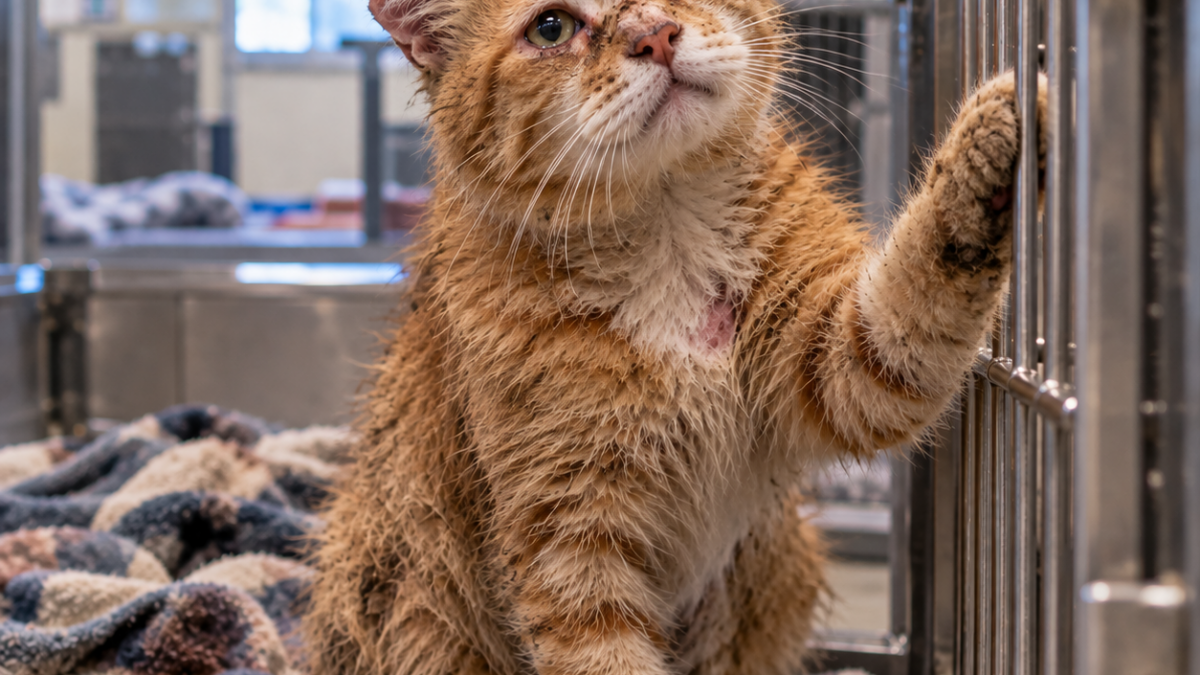
PART3:
The cat looked at me.
Not recognition.
Probably.
Five years is a long time.
But he looked up when I said his name.
My stomach dropped.
Erin stood beside the carrier.
Mark was behind her.
Sophie wasn’t there.
I looked from them to Oliver.
“What happened?”
Erin crossed her arms.
Not defensively exactly.
More like she was holding herself together.
“We need to return him.”
I hate that sentence.
Shelter workers hear it often enough that we’re supposed to become professional about it.
We don’t.
You learn not to show everything.
That’s different.
“Is he sick?”
“No.”
“Litter box?”
“Fine.”
“Biting?”
“No.”
“Other pets?”
“We don’t have any.”
“Then what happened?”
Erin looked at Mark.
Mark looked at the floor.
Finally she said:
“He’s just… a lot.”
I waited.
“What does that mean?”
“He needs constant attention.”
Oliver sat quietly inside the carrier.
Erin continued.
“He follows us everywhere.”
I thought I had misheard.
“Everywhere?”
“Yes.”
“Like…”
“Room to room.”
“That’s what he’s always done.”
“I know.”
Her voice sharpened slightly.
“I know, Rachel.”
I took a breath.
“Okay.”
“If I sit down, he wants to sit next to me.”
I said nothing.
“If Mark works from home, Oliver sits outside his office door.”
Still nothing.
“If Sophie closes her bedroom door, he waits outside it.”
I looked toward Mark.
He seemed deeply uncomfortable.
Erin continued.
“He sleeps with us.”
“You let him?”
“He cries if we close the door.”
“Meows?”
“Yes.”
“Scratches?”
“Sometimes.”
“Damages the door?”
“No.”
“Sprays?”
“No.”
“Attacks?”
“No.”
“Then what exactly is the surrender reason?”
Erin’s eyes filled.
That surprised me.
She looked away.
“We can’t give him what he wants anymore.”
That sentence changed the tone.
Not completely.
But enough.
I lowered my voice.
“What’s changed?”
Erin did not answer immediately.
Mark did.
“My mother moved in.”
I looked at him.
“She has early dementia.”
“Oh.”
“She needs care.”
He continued.
“Erin switched jobs.”
“More hours.”
“Sophie’s in middle school.”
“Everything changed.”
I looked at Oliver.
“So he’s stressed.”
“Maybe.”
Erin wiped one eye quickly.
“He became more attached.”
“How much more?”
“If I go downstairs, he follows.”
“If I shower, he’s outside the bathroom.”
“If I go into the laundry room, he’s there.”
“If I sit with Mark’s mom, he tries to get beside me.”
“We’re tripping over him.”
“I’ve stepped on his tail twice.”
“He cries outside doors.”
“At night he moves from Sophie’s room to ours to the hallway.”
“I can’t…”
She stopped.
Mark put one hand on her shoulder.
She pulled away.
Not angrily.
Overwhelmed.
“I can’t have one more living thing needing me every second.”
There it was.
Not:
We hate the cat.
Not:
He’s inconvenient.
Something more complicated.
Still painful.
Still Oliver losing his home.
But complicated.
I asked:
“Have you talked to a veterinarian?”
“Yes.”
“Behaviorist?”
“No.”
“We can’t afford one right now.”
“Could we help?”
Erin shook her head.
“I don’t want help keeping him.”
That sentence did make me angry.
I tried not to show it.
“Why?”
She looked at me.
“Because I am done.”
Silence.
Mark lowered his head.
I looked at him.
“You agree?”
He took too long.
That told me the answer.
Finally:
“I think…”
Erin stared at him.
He changed direction.
“I think this is best.”
For whom?
I wanted to ask.
I didn’t.
A shelter intake room is not a courtroom.
Anger does not improve an animal’s next hour.
I asked the practical questions.
Food.
Medication.
Veterinary records.
Favorite toys.
Sleeping habits.
Fear triggers.
Oliver listened from the carrier.
At one point, I opened the door.
He immediately stepped toward Erin.
She took half a step backward.
Not dramatically.
Just reflexively.
Oliver stopped.
I will never forget that.
He looked up.
She closed her eyes.
“Please.”
I didn’t know whether she was talking to me.
Or him.
I crouched.
“Come here, Ollie.”
He turned toward me.
He allowed me to lift him.
He was heavier than the kitten I remembered.
Warm.
Healthy.
Soft.
Nothing physically wrong.
He pushed both front paws against my shoulder.
Then looked over it.
Toward Erin.
I could feel his body leaning.
Wanting to go back.
Erin started crying.
“Don’t.”
I held him closer.
She wiped her face.
“This is exactly what I mean.”
Oliver stretched one paw toward her.
“He does this.”
Her voice cracked.
“He makes you feel like you’re abandoning him every time you leave the room.”
I thought:
Maybe because you are leaving him.
But I didn’t say it.
Mark filled out the surrender form.
Name:
Oliver.
Age:
Medical concerns:
None.
Behavior concerns:
Overly attached.
Follows household members constantly.
Difficulty tolerating closed doors.
Needs more attention than family can provide.
Then the final box:
Reason for surrender.
Mark wrote:
TOO NEEDY / NOT A GOOD FIT FOR CURRENT FAMILY SITUATION.
I stared at those words.
Too needy.
The same behavior people had adored when he was twelve weeks old.
The same thing that made Sophie say:
He picked me.
Five years later:
Too much.
Life has an ugly habit of turning traits into flaws when circumstances change.
A talkative person becomes exhausting.
A dependent parent becomes difficult.
An affectionate animal becomes needy.
Sometimes the trait never changed.
The room around it did.
Before they left, Mark asked:
“Can he keep the blanket?”
Inside the carrier was a blue fleece blanket.
“Of course.”
“Sophie put it in.”
Erin looked away.
I asked:
“Does Sophie know you’re here?”
Silence.
Mark nodded.
“Where is she?”
“School.”
My stomach tightened.
“She didn’t want to come?”
Erin gave a strange laugh.
“She wanted to come too much.”
I understood.
Maybe.
They left.
Oliver watched the door close.
Then looked at me.
I wish I could tell you I knew what to say.
I didn’t.
People love writing sentences for abandoned animals.
You didn’t deserve this.
You’re safe now.
Someone better will come.
All true, maybe.
But a cat does not understand moral reassurance.
He understands:
The people who smelled like home walked through that door.
I remained.
I carried Oliver to a quiet enclosure in the back cat room.
Not because he had behavior problems.
Because the front adoption room was loud and busy.
I put his blue blanket inside.
Food.
Water.
Litter.
A cardboard scratcher.
A little cave bed.
Oliver stepped into the enclosure.
Immediately turned around.
Watched me.
I closed the door.
His face changed.
Not panic.
Something worse.
Attention.
Every movement I made mattered.
I walked away.
Oliver came to the front.
I turned.
He was standing on his hind legs with both front paws against the glass.
No meow.
Just watching.
I went back.
Opened the door.
He stepped directly into my chest.
No hesitation.
I sat on the floor.
Oliver climbed into my lap.
Pressed his head beneath my chin.
Started purring.
I hated how easy it was.
He had known me for maybe twenty minutes as an adult.
That was enough.
Not because I was special.
Because Oliver was built for closeness.
That afternoon, I began reading his medical records.
Regular vaccinations.
Neutered.
Dental cleaning at three.
Healthy weight.
No chronic disease.
Veterinary notes:
Friendly.
Very social.
Seeks handling.
Mild distress when separated from owner during exam.
One note from the previous year:
Owner reports increased vocalization when household routines change.
Possible stress-related attachment behavior.
Recommendation:
Environmental enrichment.
Predictable routine.
Consider behavioral consultation if worsening.
Nothing about aggression.
Nothing destructive.
No urine marking.
No biting.
No attacking.
His crime was proximity.
That night, after the shelter closed, I checked on him.
Oliver was awake.
“Hey.”
He stood immediately.
I opened the kennel.
He climbed onto me.
That became the pattern.
For the next several days, Oliver did not play much.
He ate.
Used the litter box.
Accepted treats.
But if someone entered the room, he wanted contact.
Not frantic.
Not wild.
He simply moved toward people.
Volunteer sits?
Oliver beside them.
Volunteer stands?
Oliver follows as far as the enclosure allows.
Someone walks away?
Oliver waits at the door.
Around five every afternoon, something stranger happened.
He became alert.
He would be sleeping.
Then suddenly sit up.
Walk to the front.
Watch the hallway.
Five o’clock.
Every day.
I noticed on day three.
Then four.
Then five.
I checked the intake notes.
Previous household routine:
Mark home around 5:10 most workdays.
Sophie home earlier.
Erin often home 5:30 to 6.
Oliver was waiting for them.
Not consciously the way we wait for appointments.
But his body knew.
The light outside changed.
Shelter sounds changed.
Some internal clock said:
They come home now.
And every day, nobody did.
On day six, a family met him.
Nice couple.
Two children.
Oliver was perfect.
Climbed into the mother’s lap.
Rubbed against the father.
Let the children pet him.
Then followed the mother to the door when the visit ended.
She looked at me.
“He really does follow you.”
“Yes.”
“Like all the time?”
“Probably.”
She smiled nervously.
“We want something a little more independent.”
I nodded.
Fair.
Not rejection.
Fit matters.
But when they left, Oliver sat at the door.
Again.
The next day, a young man met him.
Loved him.
Then mentioned he worked twelve-hour hospital shifts.
“Would that be hard for him?”
I answered honestly.
“Maybe.”
He adopted a calmer senior cat instead.
Right choice.
Still:
Oliver waited.
A week after surrender, I found something beneath the blue blanket.
A folded piece of notebook paper.
At first I assumed it was medical information.
I opened it.
The handwriting was young.
Sophie.
Please don’t think Oliver is bad.
He sleeps outside my door when I’m sad.
He follows my mom because she used to carry him everywhere when he was little.
He waits at the garage door for my dad.
He isn’t trying to be annoying.
He just doesn’t like people disappearing.
Please let him sleep near somebody.
I sat on the floor.
Read it again.
Then once more.
At the bottom:
I’m sorry, Oliver.
I love you.
My anger came back.
Hard.
Not at Sophie.
Not even entirely at her parents.
At the whole situation.
At the way adults make choices animals and children have to absorb.
At the fact that Sophie had apparently been told goodbye without being allowed to say it in person.
At the words:
He just doesn’t like people disappearing.
I folded the note.
Put it in his file.
Then took it out again.
That felt wrong.
I placed it in a protective sleeve and hung it behind his kennel information, not visible to visitors unless staff showed them.
Some stories belong to the animal.
Not the internet.
On day eleven, Nora came in.
I remember her because she did almost everything differently from most adopters.
She was sixty-four.
Gray hair cut just below her ears.
Wool coat.
No husband.
No children with her.
No phone out taking pictures.
She stood at the front desk and said:
“I want an adult cat.”
Linda smiled.
“Any preference?”
“Not really.”
“Age?”
“Older than kitten.”
“Temperament?”
Nora hesitated.
“Company.”
Linda nodded.
“Affectionate?”
“Yes.”
“Lap cat?”
“Maybe.”
Then Nora said:
“I don’t want one who wants to be left alone.”
Linda looked at me.
I was across the room.
We both knew.
“Rachel?”
I walked over.
“Can you show her Oliver?”
Nora followed me.
Oliver was sleeping when we arrived.
He heard the door.
Sat up.
Walked to the glass.
Nora crouched.
He stared.
She did not put her fingers through.
Did not make kissing noises.
Just looked.
“How old?”
“Five.”
“Healthy?”
“Yes.”
“Why is he here?”
There it was.
I could have softened it.
Instead:
“His family returned him because he wanted more closeness than they could give.”
Nora frowned.
“What does that mean?”
“He follows people.”
“How terrible.”
I couldn’t tell whether she was joking.
She was.
“He likes sitting beside you.”
“Scandalous.”
“He may sleep near you.”
Nora’s mouth twitched.
“What a menace.”
“He doesn’t love closed doors.”
That made her pause.
“How bad?”
“Meowing.”
“Scratching?”
“Sometimes.”
“Damage?”
“Not according to his family.”
“Litter box?”
“Perfect.”
“Biting?”
“No.”
“Furniture destruction?”
“Normal scratching.”
“Counter surfing?”
“Probably.”
Oliver meowed.
Nora looked at him.
“What else?”
I thought about the note.
“He seems to have a hard time when people leave.”
She nodded slowly.
“How long has he been back?”
“Eleven days.”
“Back?”
“He was adopted from here as a kitten.”
Something changed in her face.
“He lived with them five years?”
“Yes.”
“And then they brought him back because he followed them?”
“Life in the home changed.”
I told her a little.
Not everything.
No names.
No judgment.
Caregiving.
Work.
Household stress.
Oliver became more attached.
Family overwhelmed.
Nora listened.
Then asked:
“Can I meet him?”
We opened the enclosure.
Oliver stepped out.
Sniffed Nora’s shoes.
Then sat beside her.
No dramatic leap.
Nora remained still.
After perhaps thirty seconds, Oliver put one paw on her knee.
She looked at me.
“That’s it?”
“What?”
“That’s the excessive neediness?”
“Give him time.”
Oliver placed the second paw up.
Then climbed into her lap.
Nora laughed.
Softly.
“Oh.”
He circled once.
Lay down.
Head against her stomach.
Purr.
Nora stopped laughing.
One hand rested on his back.
Oliver’s eyes closed.
I waited.
Several minutes.
Nora asked:
“Can I see the surrender paperwork?”
That request surprised me.
“We don’t normally give adopters the original form.”
“Can you tell me exactly what it says?”
I did.
Too needy.
Follows household members constantly.
Difficulty with closed doors.
Needs more attention than family can provide.
Nora stroked Oliver.
Then said:
“My husband died fourteen months ago.”
I looked at her.
“I’m sorry.”
“He was sick a long time.”
I nodded.
“After he died, everyone worried about me.”
“Family?”
“My sister.”
“Friends.”
“My husband’s brother.”
“They called constantly.”
“Invited me places.”
“For about three months.”
She gave a small smile.
“Then everybody’s life went back to normal.”
Her hand continued moving along Oliver’s back.
“Mine didn’t.”
Oliver purred.
“I retired two years before he got sick.”
“So now I have a house that was built for two people and apparently no one informed the house there’s only one left.”
I didn’t know what to say.
Nora looked around the shelter.
“I came here because I want something that notices when I walk into a room.”
Oliver shifted closer.
She looked down.
“I suppose he qualifies.”
I felt my throat tighten.
“Probably.”
She asked:
“Can he sleep on the bed?”
“That seems to be his preference.”
“Good.”
“Why good?”
“My husband snored for thirty-eight years.”
Nora smiled.
“I haven’t slept properly since it got quiet.”
Oliver’s eyes opened.
Nora scratched his cheek.
Then she asked:
“What aren’t you telling me?”
That caught me.
“What?”
“You like him.”
“Yes.”
“You look worried.”
I hesitated.
Then told her about five o’clock.
How he waited.
How he watched the hallway.
Nora’s face softened.
Then I told her about Sophie’s note.
Not the names.
I paraphrased.
She listened.
When I finished, Nora did something I didn’t expect.
She cried.
Not dramatically.
One tear.
Then another.
Oliver looked up.
He stood.
Put both front paws against her chest.
Nora laughed through it.
“Oh, no.”
He rubbed his head under her chin.
“Absolutely not.”
Purr.
“You don’t get to fix this.”
Oliver disagreed.
Nora looked at me.
“What happens if I take him and he waits for them?”
“He might.”
“For how long?”
“I don’t know.”
“What if he never loves me like that?”
I thought carefully.
“That can’t be the reason you adopt him.”
She nodded.
“I know.”
“He may always carry old habits.”
“Yes.”
“He may become more secure.”
“Maybe.”
“He may still follow you everywhere.”
Nora smiled.
“I hope so.”
That was when I knew.
Not because Oliver needed somebody desperate enough to tolerate him.
Because Nora understood what she was choosing.
Closeness.
Not as a flaw to be fixed.
As part of the animal.
She filled out the application.
References.
Veterinary history.
Housing.
Her last cat had died six years earlier.
Eighteen years old.
Kidney disease.
She had kept every vet record.
Her house was paid off.
No other pets.
Quiet.
She spent most days home.
On paper, almost absurdly perfect.
Still, I made her wait twenty-four hours.
Shelter policy.
She hated me.
“You’re going to make me leave without him?”
“For one night.”
“Cruel.”
“Policy.”
“I dislike policy.”
Oliver sat beside her.
Nora looked down.
“I’m coming back.”
My chest hurt at those words.
She touched his head.
“I mean it.”
Oliver followed her to the door.
When she left, he stayed there.
Five o’clock came.
He watched the hallway.
That night, I worried I had projected too much onto Nora.
Two lonely beings do not automatically make a healthy match.
A grieving person is not a therapeutic assignment for an animal.
An animal with attachment needs is not medicine.
They both deserved more than symbolism.
The next morning, Nora arrived twelve minutes before opening.
She was sitting in her car when Linda came in.
At nine exactly, she walked through the door carrying a new cat bed.
I looked at it.
“You bought something already?”
“Two things.”
“What else?”
“Stairs.”
“Stairs?”
“For my bed.”
“He’s five.”
“So am I, spiritually.”
I laughed.
She completed the adoption.
Then came the moment I always watch closely.
Carrier.
Door.
Cat goes in.
Human signs.
Normal.
Except Oliver had already been returned once.
When I picked him up, he stiffened as soon as he saw the carrier.
The change was immediate.
Body low.
Pupils wide.
No.
My stomach dropped.
Nora noticed.
“What?”
“He remembers something.”
“The carrier?”
“Probably.”
Oliver tried to back away.
Not aggressive.
Terrified.
The last time he had gone into a carrier with his family, he came back to the shelter and they disappeared.
Nora set the carrier down.
Sat on the floor.
“Don’t put him in yet.”
“We need to transport safely.”
“I know.”
“Give me a minute.”
She placed her hand inside.
Nothing.
Oliver watched.
Nora took the blue blanket.
The one Sophie had sent.
Put it inside.
Oliver stepped closer.
Sniffed.
Nora whispered:
“We’re not coming back here today.”
I knew he did not understand the sentence.
Still.
He entered.
Slowly.
Nora closed the door.
Oliver meowed.
Once.
Nora put her fingers against the carrier.
“I’m here.”
Another meow.
“Still here.”
I walked them to the car.
Before she left, Nora said:
“Is there any way his old family can know he’s okay?”
I hesitated.
“We can contact them if they requested updates.”
“Did they?”
I checked.
Mark had.
Erin had not.
“Yes.”
“Tell them.”
Then:
“And the girl?”
My throat tightened.
“We’ll tell the parent.”
Nora nodded.
“Good.”
She drove away.
I watched until the car disappeared.
Then I went inside and cried in the supply closet like a professional.
That afternoon, Nora sent one photograph.
Oliver beneath her dining-room table.
Caption:
WE HAVE NOT MOVED FOR 47 MINUTES.
Ten minutes later:
He came out.
Picture:
Oliver beside her ankle.
Then:
Bathroom supervision has begun.
Picture:
Oliver outside the bathroom door.
Then:
I understand the complaint now. He is relentless.
My stomach dropped.
Before I could respond, another message appeared.
I love him.
I laughed out loud.
The first week was not perfect.
That matters.
Oliver followed Nora constantly.
Kitchen.
Living room.
Bedroom.
Laundry.
Bathroom.
If she closed a door, he meowed.
So Nora started practicing.
Door closes ten seconds.
Opens.
Treat.
Thirty seconds.
Opens.
Minute.
No drama.
Not because she wanted him to become independent enough not to need her.
Because she wanted him to learn one thing:
Closed did not mean gone.
The first nights, Oliver paced.
Bed.
Hallway.
Bedroom door.
Front room.
Back again.
Nora barely slept.
She called me on day three.
“He’s checking the front window every hour.”
“I’m sorry.”
“Why are you sorry?”
“Because it’s hard.”
“It is.”
Pause.
“I’m not returning him.”
“I didn’t say—”
“I know.”
Another pause.
“I just wanted you to hear me say it.”
That sentence mattered.
“Okay.”
“He can be difficult.”
“Yes.”
“He can make me crazy.”
“Yes.”
“And I’m not returning him.”
“Okay.”
She sighed.
“Good.”
I smiled.
“Good.”
By week two, Oliver slept at the foot of her bed.
Then beside her hip.
Then directly on her pillow.
Nora sent:
This arrangement was not negotiated.
I replied:
Check your adoption contract.
She answered:
I regret everything.
Then a photograph of Oliver asleep against her face.
About a month after adoption, Nora noticed the five-o’clock behavior.
She called.
“You weren’t exaggerating.”
“What happened?”
“Four fifty-eight.”
“He got off the couch.”
“Walked to the front window.”
“Sat.”
“How long?”
“Forty minutes.”
My heart sank.
“I’m sorry.”
“Stop apologizing.”
“He’s grieving.”
“I know.”
“What did you do?”
Nora was quiet.
“Sat with him.”
That became their routine.
At five, Oliver went to the window.
Nora sat nearby.
No pulling him away.
No forcing play.
No saying:
Forget them.
Just company.
After three weeks, the waiting shortened.
Forty minutes.
Twenty.
Ten.
Then one evening, Nora called me crying.
“What happened?”
“He didn’t go.”
“What?”
“Five o’clock.”
“He stayed asleep.”
I smiled.
“He didn’t go to the window?”
“No.”
“Where is he?”
“On my lap.”
Silence.
Then Nora whispered:
“I think he finally believes this is where evening happens now.”
That line stayed with me.
A home is partly where your body expects the day to continue.
Oliver’s old clock had belonged to another family.
Slowly, Nora entered the schedule.
Morning coffee.
Oliver.
Laundry.
Oliver.
Lunch.
Oliver.
Reading.
Oliver.
Garden.
Oliver at the screen door.
Five o’clock.
Nora.
Dinner.
Nora.
Bed.
Nora.
Routine became attachment.
Attachment became safety.
Safety became ordinary.
Three months after adoption, I received an email from Mark.
How is Oliver?
Short.
I replied:
Doing very well. He has been adopted into a quiet home with someone who enjoys an affectionate companion. He is healthy and settling in.
Mark responded almost immediately.
Thank you.
Then another email.
Can you tell Sophie?
That bothered me.
Tell her yourself, I thought.
Instead:
Of course.
I asked whether he wanted a photo sent to the family email.
He said yes.
Nora gave permission.
I sent one image.
Oliver asleep beside Nora on the couch.
Mark replied:
Sophie is crying.
I stared.
Then:
Good crying?
His response:
Both.
A week later, Mark asked whether Sophie could visit Oliver.
That was not a simple question.
The adoption was complete.
Nora had no obligation.
Reintroducing old family could confuse Oliver.
Or not.
We did not know.
I called Nora.
Explained.
Silence.
Then:
“What do you think?”
“I think it’s your decision.”
“Helpful.”
“I genuinely don’t know.”
“Does the girl want him back?”
“I don’t think so.”
“Parents?”
“No.”
Another silence.
“I want to meet her.”
“Nora.”
“What?”
“You don’t have to.”
“I know.”
“Why?”
“Because there’s a note in my nightstand written by a child asking strangers not to think my cat is bad.”
I had forgotten I gave Nora a copy of Sophie’s note.
She continued.
“I want that child to know someone believed her.”
We arranged a visit at the shelter.
Neutral place.
Sophie came with Mark.
She looked older than five years should have made her compared to the adoption photograph.
Thirteen now.
Tall.
Nervous.
She held something in both hands.
A stuffed mouse.
Oliver’s old toy.
Nora arrived with Oliver in a carrier.
When Sophie saw him, she froze.
Oliver saw her.
Everything happened at once.
A sound came out of him.
Not a normal meow.
High.
Urgent.
Sophie dropped to her knees.
“Oliver.”
He pressed against the carrier door.
Nora opened it.
Oliver ran.
Not fast like a kitten.
But directly.
Onto Sophie’s legs.
She collapsed around him.
Crying.
Hard.
“I’m sorry.”
Again.
Again.
“I’m sorry.”
Oliver rubbed his face against her.
Purred.
Mark turned away.
Nora sat across the room.
Silent.
For five minutes, Sophie and Oliver existed in their old world.
Then Oliver looked around.
Saw Nora.
He stepped off Sophie’s lap.
Walked to Nora.
Rubbed against her leg.
Then returned to Sophie.
Back and forth.
Sophie laughed through tears.
“He likes you.”
Nora smiled.
“He runs my household.”
Sophie wiped her face.
“He sleeps on your bed?”
“Yes.”
“Like right by your head?”
“Unfortunately.”
Sophie laughed.
“He used to sleep on mine.”
“I know.”
That made Sophie pause.
“You read my note?”
Nora nodded.
“Rachel gave me a copy.”
Sophie looked embarrassed.
“I was mad.”
“You were sad.”
“Both.”
“Fair.”
Sophie looked at Oliver.
“Do you think he hates us?”
Nora answered before I could.
“No.”
Not:
He understands.
Not:
He forgives you.
Just:
“No.”
Sophie looked at her.
“How do you know?”
Nora pointed.
“He’s sitting on your shoe.”
Oliver was.
Sophie smiled.
Then Mark spoke.
“We failed him.”
The room changed.
Sophie looked at her father.
Mark sat down.
“No excuses.”
He looked toward Nora.
“Our house was chaos.”
“My mother needed help.”
“Erin was exhausted.”
“I was working.”
“Sophie was upset.”
“And Oliver kept asking for attention.”
He rubbed his hands together.
“We decided the cat was the one thing we could remove.”
Sophie whispered:
“Dad.”
“I know.”
He looked at her.
“I know.”
Then at Oliver.
“We told ourselves he’d get another home.”
“He did,” Nora said gently.
Mark nodded.
“I know.”
“But that doesn’t make what we did feel better.”
Nora said:
“It probably shouldn’t.”
I looked at her.
So did Mark.
She continued.
“You can regret something without pretending it never happened.”
Mark nodded slowly.
Sophie asked:
“Would you ever give him back?”
Nora’s answer came immediately.
“No.”
Sophie looked startled.
Then relieved.
Nora softened.
“I mean, no.”
“He’s my family now.”
“But you can love him.”
“You can miss him.”
“You can know he’s safe.”
Sophie touched Oliver’s back.
“I don’t want him back if it means he could get returned again.”
Mark closed his eyes.
That sentence hurt him.
Good.
Some pain teaches.
Oliver stayed with Sophie almost the entire visit.
When it was time to leave, everyone watched.
Would he follow her?
Sophie stood.
Oliver stood.
My chest tightened.
She walked toward the door.
Oliver followed three steps.
Stopped.
Looked back.
Nora was sitting in the chair.
Oliver turned.
Walked back.
Jumped beside her.
Sophie cried again.
But she smiled.
“He knows.”
Nora put one arm around Oliver.
“What?”
Sophie wiped her face.
“Where home is.”
That visit changed something.
Not only for Sophie.
For Nora too.
She had worried, privately, that she was second choice.
She told me later.
“I thought if they came back, he’d want them more.”
“Animals don’t rank love like job applicants.”
“I know.”
“Do you?”
“No.”
She laughed.
“Apparently not.”
The visit did not erase Oliver’s five years with them.
Why would we want it to?
A new home does not require an old life to become meaningless.
That is another thing people get wrong.
We want rescue stories clean.
Bad family.
Good family.
Before.
After.
But Oliver had loved them.
Especially Sophie.
That love had been real.
So was the hurt.
So was Nora.
All of it could exist.
Six months passed.
Oliver gained a small amount of weight.
Not that he needed much.
He became more playful.
A wand toy became his obsession.
He still followed Nora.
Everywhere.
She began sending me photos with captions:
Kitchen supervisor.
Bathroom security.
Laundry inspector.
Gardening consultant.
Personal space violation.
One photograph showed Nora trying to read while Oliver lay directly across the book.
Caption:
HE HAS STRONG LITERARY OPINIONS.
I asked:
“Still too needy?”
Her reply:
NOT NEEDY ENOUGH. HE LEFT THE ROOM FOR FOUR MINUTES TODAY.
A year after Oliver’s adoption, Nora had a medical scare.
Nothing major in the end.
Chest pain.
Emergency room.
She spent one night in the hospital.
Her sister stayed at the house with Oliver.
Nora called me from the hospital.
“He’s waiting at the front door.”
“How do you know?”
“My sister sent video.”
“He’ll be okay.”
“I know.”
Pause.
“I finally understand why his first family got overwhelmed.”
That surprised me.
“What do you mean?”
“Being needed can be heavy.”
“Yes.”
“And?”
“And I still want him.”
There it was.
Understanding is not the same as excusing.
Nora continued.
“I used to think they were simply cruel.”
“I don’t anymore.”
“But they were responsible for what they chose.”
“Yes.”
“Both things.”
“Yes.”
That was the lesson Oliver kept forcing on all of us.
Two things can be true.
A person can be overwhelmed and still hurt someone.
An animal can be difficult and still deserve commitment.
A surrender can sometimes be necessary.
And sometimes it can be the decision people make because they do not know how to ask for help.
Not every story has the same answer.
Oliver’s did.
He needed someone who wanted the exact thing his old household could no longer tolerate.
Presence.
Nora recovered.
Came home.
Her sister opened the front door.
Oliver ran toward her.
The video still exists.
He did not walk.
Ran.
Nora sat down on the entryway floor.
Oliver climbed onto her chest.
Meowed.
Purred.
Rubbed his face everywhere.
Nora cried.
Her sister laughed.
Then Nora said:
“I came back.”
Oliver kept rubbing.
“I came back.”
Again.
“I came back.”
Maybe she was teaching him.
Maybe herself.
Years passed.
Oliver aged.
Five became six.
Then seven.
Sophie occasionally sent birthday cards through the shelter.
Nora kept them.
One read:
Happy birthday, Ollie.
I hope you still sleep by someone’s head.
Nora replied through me with a picture of Oliver lying across her pillow.
Sophie wrote back:
Yep. That’s him.
Mark never asked to visit again.
But once a year, usually near Oliver’s adoption anniversary, he emailed:
Still doing okay?
I answered:
Yes.
Eventually:
Older.
Still affectionate.
Still loved.
He always replied:
Thank you.
No grand redemption.
No reconciliation.
Just a man living with a choice.
Sometimes that’s the consequence.
Not punishment.
Knowledge.
Oliver became a small local favorite because Nora volunteered at our shelter after adopting him.
Not immediately.
About a year later.
She came in one Tuesday.
“I need something to do.”
“You have Oliver.”
“He naps seventeen hours a day.”
“Fair.”
She began sitting with shy cats.
Not kittens.
Adults.
Especially returns.
Whenever someone surrendered an animal for behavior that sounded emotionally complicated, Nora never immediately judged.
She asked:
“What happened?”
Then:
“What does the animal need next?”
That distinction made her one of our best volunteers.
Once a two-year-old dog was returned for chewing furniture.
The internet post attracted angry comments.
“MONSTERS.”
“PEOPLE LIKE THIS SHOULDN’T OWN PETS.”
Nora read the surrender notes.
Owner had developed cancer.
Chemotherapy.
Dog left alone ten hours.
Young dog developed destructive behavior.
Owner’s daughter tried helping.
Could not manage.
Nora closed the file.
“Everybody wants a villain.”
I nodded.
“Why?”
“Because if someone is evil, then tragedy is avoidable.”
“What do you mean?”
She looked at me.
“If bad things only happen because bad people make bad choices, then the rest of us can believe we’re safe.”
“But sometimes life just gets hard.”
“Yes.”
She paused.
“And then people make choices inside that hardness.”
Some better.
Some worse.
That was Nora.
Not soft in the sense of excusing everything.
Kind in the more difficult way.
She kept accountability and compassion in the same hand.
Oliver had taught her.
Or grief had.
Maybe both.
At eight years old, Oliver developed diabetes.
Nora learned injections.
Twice daily.
He hated the first week.
Then accepted it because treats followed.
I visited.
She demonstrated like a nurse.
“See?”
Oliver ate the treat.
“You’re good at that.”
“I was married to a man who refused to take blood-pressure medicine unless I put it beside his coffee.”
“So basically same skill set.”
“Exactly.”
Oliver remained affectionate.
If anything, age made him more attached.
Nora loved it.
Mostly.
There were days she wanted space.
That mattered too.
Love does not mean enjoying every second of someone else’s needs.
Once she called me.
“I’m hiding in my car.”
“What?”
“Driveway.”
“Why?”
“Oliver is inside.”
I laughed.
“Are you hiding from your cat?”
“I have been touched for six consecutive hours.”
“Nora.”
“He sat on me during breakfast.”
“Followed me while I vacuumed.”
“Sat outside the shower.”
“Then screamed while I took out trash.”
“I need twelve minutes.”
I laughed so hard she hung up.
Ten minutes later, photograph.
Oliver sitting inside front window staring at the car.
Caption:
HE FOUND ME.
The point was not that Nora never found Oliver overwhelming.
She did.
The difference was what she did with that feeling.
She found ways to breathe without deciding he had to disappear.
Closed door training.
Enrichment.
Automatic feeder.
Window perch.
Scheduled play.
Her sister occasionally watched him.
Nora took weekends away.
Oliver survived.
Closeness became manageable because boundaries were built without rejection.
That matters.
Affection is not a flaw.
But neither does loving an affectionate animal mean a person must surrender every boundary.
The answer is not:
Let the cat control your life.
The answer is:
Understand who you adopted.
Teach security.
Create routine.
Ask for help.
Make space for both beings.
Oliver learned Nora could close the bathroom door and return.
She learned he could cry for thirty seconds without the world ending.
They met each other halfway.
That may be what commitment actually looks like.
Not endless tolerance.
Adjustment.
When Oliver turned ten, Sophie came back to the shelter.
Not for him.
For a cat.
She was eighteen.
College freshman locally.
Living at home.
I recognized her immediately.
She recognized me too.
“Rachel?”
“Sophie?”
She smiled.
Then cried.
Still Sophie.
“How’s Oliver?”
“Good.”
“Old.”
“Bossy.”
She laughed.
“Nora still has him?”
“Of course.”
Sophie nodded.
“I knew.”
She was there with Erin.
That surprised me.
Erin looked older.
Tired.
Quieter.
We had not spoken since the surrender.
“Hello, Rachel.”
“Hi.”
Sophie wanted to adopt a cat for the household.
I looked at Erin.
She knew what I was thinking.
“We’re not doing this unless we’re ready.”
Her voice was firm.
Sophie said:
“Mom wanted a senior.”
That surprised me even more.
“Why?”
Erin looked toward the adoption room.
“Because I owe myself the experience of doing one thing differently.”
I did not respond.
She continued.
“Not because a new cat replaces Oliver.”
“I know.”
“And I’m not trying to make myself feel better.”
“Okay.”
“I just…”
She swallowed.
“Mark’s mother died.”
“I’m sorry.”
“Thank you.”
“We’ve had time.”
She looked down.
“I think about Oliver a lot.”
I said:
“He’s happy.”
“I know.”
“Nora sends Sophie pictures.”
Good.
Erin smiled sadly.
“I used to hate that.”
“What?”
“That he was happy somewhere else.”
I waited.
“Because if he struggled, maybe it meant we had been right.”
That honesty stopped me.
“And when he did well…”
“It meant?”
“It meant the problem wasn’t that nobody could live with him.”
I did not soften it.
“No.”
Erin nodded.
“It was us.”
“At that time.”
She looked at me.
I added:
“At that time.”
Life changes.
People change.
That does not undo damage.
But it matters.
Erin eventually adopted a thirteen-year-old female cat named Mabel.
Independent.
Arthritic.
Liked affection exactly twice a day.
A very different animal.
A better fit.
Sophie sent Nora a photograph.
Nora showed me.
“Look.”
Mabel sleeping on Erin’s lap.
Oliver sitting beside Nora in the foreground of a different photograph.
Two homes.
Two cats.
Not replacement.
Continuation.
Oliver reached twelve.
Then thirteen.
His diabetes remained controlled.
Kidneys aging.
Arthritis.
Nora put ramps beside the bed.
He used them.
Unlike Jasper in some other rescue stories, Oliver had always accepted useful furniture because dignity had limits when sleeping beside Nora was involved.
At thirteen, he no longer followed room to room every time.
He slept more.
Sometimes Nora would go into the kitchen and realize Oliver had remained on the couch.
She told me the first time it happened.
“He didn’t follow me.”
“You’ve complained about that for eight years.”
“I know.”
“Enjoy it.”
“I hate it.”
That’s love too.
The behavior that once exhausted you becomes precious when time removes it.
Nora began carrying him sometimes.
Not because he demanded it.
Because his legs were stiff.
She would place him beside her.
Oliver leaned against her.
Still.
Always contact.
One winter, I visited their house.
Snow outside.
Oliver asleep beside the radiator.
Nora making tea.
Her home did not feel empty.
Pictures.
Books.
Plants.
Oliver’s beds.
Too many.
I counted six.
“You have one cat.”
“He needs options.”
“He sleeps on your bed.”
“He likes knowing the beds exist.”
I laughed.
Then Oliver woke.
Slowly stood.
Walked toward Nora.
Sat on her foot.
She looked down.
“There.”
“What?”
“He still does it.”
“What?”
“Chooses the room I’m in.”
Her eyes filled.
“I used to think I needed him because my husband died.”
I waited.
“Then I worried that was unfair.”
“To Oliver?”
“Yes.”
“Like I adopted him to fill a hole.”
“Did you?”
“At first?”
She considered.
“Maybe.”
“And now?”
“Now he’s not filling anything.”
She touched his head.
“He’s just Oliver.”
That was the healthiest thing she could have said.
Animals are not replacement people.
They do not heal grief by becoming someone else.
They join the life that remains.
Oliver had not replaced Nora’s husband.
Nora had not replaced Sophie.
New love is not a substitute.
It is additional.
At fourteen, Oliver’s kidneys worsened.
Slowly.
Special diet.
Fluids eventually.
Medication.
Nora handled everything.
Then one day, she called me.
“Can you come over?”
Something in her voice told me.
I arrived that afternoon.
Oliver was on the bed.
Thin.
Tired.
Still alert.
He looked up.
Meowed.
I sat beside him.
“Hi, Ollie.”
He put one paw on my leg.
Nora stood by the window.
“The vet says days.”
I looked at her.
“Maybe a week.”
She nodded.
“I know.”
“You okay?”
“No.”
Fair.
We sat.
After a while, Nora said:
“I want Sophie to know.”
“Okay.”
“If she wants to come.”
“Are you sure?”
“Yes.”
I contacted her.
She came the next day.
Twenty-two years old now.
Oliver had been part of her life since she was seven.
Five years physically.
Then years through photographs and occasional visits.
She sat on Nora’s bedroom floor.
Oliver was asleep.
Sophie touched his paw.
“He looks so old.”
Nora smiled.
“So do I.”
Sophie laughed.
Then cried.
“He followed me everywhere.”
“I know.”
“He used to sit outside the bathroom.”
“He still does when he’s feeling dramatic.”
Sophie stroked his face.
“I thought he would forget me.”
Nora said:
“Maybe he forgot some things.”
Sophie nodded.
“That’s okay.”
Oliver opened his eyes.
Looked at Sophie.
Then lifted his head.
She leaned close.
He rubbed his forehead against her hand.
Sophie broke.
“I’m sorry.”
Nora started crying too.
I looked away.
Some moments do not need witnesses staring.
Sophie whispered:
“You weren’t too much.”
That sentence.
After all those years.
“You were never too much.”
Oliver purred.
Barely.
Nora reached over.
Placed one hand on his back.
Sophie put hers beside it.
Two homes.
Two chapters.
One cat.
The next morning, Oliver stopped eating.
The veterinarian came to Nora’s house that evening.
Nora asked if I would stay.
I did.
Sophie came too.
Not Erin.
Not Mark.
Sophie.
Oliver lay on the blue blanket.
The same blanket that had returned to the shelter with him nine years earlier.
Nora had kept it all that time.
Faded.
Washed nearly transparent.
I recognized it immediately.
“You kept this?”
“Of course.”
Oliver’s head rested against Nora’s leg.
She stroked him.
“You know what I used to worry about?”
I sat beside her.
“What?”
“That someday he’d realize he picked the wrong person.”
“Nora.”
“I know.”
She laughed through tears.
“Ridiculous.”
“Yes.”
Oliver moved closer to her.
Nora smiled.
“Show-off.”
Sophie whispered:
“He picked you every day.”
Nora closed her eyes.
That was exactly it.
Forever home is not one signature.
Not a promise made during adoption.
It is a choice repeated on ordinary days.
When the cat wakes you.
When the vet bill arrives.
When you’re tired.
When you want privacy.
When life becomes crowded.
When the animal becomes old.
When loving them becomes work.
Especially then.
The veterinarian gave Oliver the sedative.
His body relaxed.
Nora held him.
Sophie stroked his head.
I sat near his feet.
No one made a speech.
Eventually Nora whispered:
“You never loved too much.”
Oliver’s breathing slowed.
“I just needed to learn there was room for it.”
Sophie cried.
Nora kissed his forehead.
“You can stop following me now.”
Her voice broke.
“I know where you’re going.”
Then Oliver died.
Quietly.
In the room of the person he had followed for almost nine years.
Not a shelter kennel.
Not watching a hallway.
Not waiting at five o’clock.
Home.
Afterward, Nora sat holding him.
No one rushed her.
Eventually she looked at me.
“Do you remember what I said the first day?”
I did.
My house is too empty.
Maybe we have the opposite problem.
“Yes.”
She smiled sadly.
“He fixed that.”
Then shook her head.
“No.”
“That’s not right.”
“What?”
“He didn’t fix my house.”
She looked around.
“He taught me how to live in it again.”
Months later, Nora returned to the shelter.
I saw her at the front desk.
My stomach tightened.
“You okay?”
“No.”
“Fair.”
Linda asked:
“Ready?”
Nora shook her head.
“No cat.”
Then held up a volunteer application.
“I want to sit with the clingy ones.”
I laughed.
She volunteered for six more years.
Every returned cat.
Every shy adult.
Every animal labeled difficult, needy, loud, aloof, demanding, fearful.
Nora asked the same question.
“What does that word actually mean?”
Sometimes “needy” meant untreated anxiety.
Sometimes boredom.
Sometimes poor fit.
Sometimes lack of boundaries.
Sometimes an animal simply loved companionship.
Labels are shortcuts.
Useful sometimes.
Dangerous when they replace understanding.
Oliver’s old surrender form remained in our records.
Too needy.
I never changed it.
Records should stay accurate.
But years later, when we updated our behavior notes template, I added a line:
DESIRED HUMAN INTERACTION LEVEL.
Low.
Moderate.
High.
Very high.
I hated the word needy after Oliver.
Need is not character failure.
It’s information.
The goal is not to find an animal with no needs.
It is to find a home whose capacity matches them.
Some person wants an independent cat who sleeps alone.
Good.
Some wants a cat beside them all day.
Also good.
Some animals want quiet.
Some want contact.
Neither is wrong.
The tragedy happens when difference becomes blame.
Oliver had never been defective.
His first family had not been equipped for who he became during the hardest period of their life.
They made a decision that hurt him.
They knew it.
Sophie carried that guilt for years.
Mark did too.
Erin eventually learned from it.
And Nora?
Nora did not rescue Oliver by being perfect.
She sometimes hid in her car for twelve minutes because she wanted nobody touching her.
She traveled.
Closed doors.
Set boundaries.
Got frustrated.
Oliver complained.
They adjusted.
The promise was never:
I will enjoy every part of you.
It was:
Your difficult days will not make you disposable.
That is what Oliver needed.
Maybe what most living things need.
For years, people online shared his shelter photograph.
Brown tabby.
Green eyes.
Sitting near the enclosure door.
Captions appeared:
RETURNED FOR LOVING TOO MUCH.
TOO NEEDY.
HE JUST WANTED LOVE.
I understood why people shared it.
But those captions always bothered me a little.
They made the story too easy.
Oliver was not simply a saintly cat rejected by cartoon villains.
He was an intensely social animal returned by a family under enormous stress who made a choice they later regretted.
That is harder.
Less satisfying.
More useful.
Because most abandonment does not begin with someone waking up and deciding to be cruel.
Sometimes it begins with overwhelm.
Silence.
Shame.
No one asking for help.
Then one choice.
Then another.
Until the carrier is sitting on a shelter counter.
Understanding that does not mean every choice becomes acceptable.
It means prevention requires more than anger.
Affordable veterinary care.
Behavior resources.
Temporary foster help.
Pet-friendly housing.
Support for caregivers.
Respite.
Education.
Sometimes keeping an animal in a home requires helping the humans stay functional too.
Oliver taught our shelter that.
We eventually created a small return-prevention program.
Nothing fancy.
Behavior consultations.
Temporary food support.
Short emergency fosters.
Lists of pet-friendly rentals.
Low-cost veterinary referrals.
Did it stop every surrender?
No.
But some.
A young mother once called because her cat cried every night after a new baby arrived.
Before Oliver, perhaps we would have said:
Bring him in if you can’t manage.
Instead, we helped.
Routine.
Play.
Safe room.
Vet check.
Door training.
The cat stayed.
One.
Just one.
But one animal’s entire world.
I thought about Oliver.
Maybe that was part of what he left behind.
Not just Nora’s memories.
A different question.
Instead of:
What’s wrong with this animal?
Ask:
What is this behavior trying to tell us?
And instead of:
Why can’t this person handle it?
Ask:
What would make handling it possible?
Sometimes the answer remains surrender.
Sometimes rehoming truly is the safest, kindest option.
But sometimes the difference between forever and goodbye is help arriving before shame does.
Years after Oliver died, Sophie came back again.
Not to adopt.
She had become a social worker.
That made sense somehow.
She walked into the shelter carrying a framed photograph.
Oliver and Nora.
Nora sitting on the couch.
Oliver stretched across her lap.
Both looking toward the camera.
On the back, Sophie had written:
HE WAS NEVER TOO MUCH.
HE JUST NEEDED A HOME WITH ROOM FOR THE WAY HE LOVED.
We hung it in the staff room.
Not the lobby.
Too sentimental for Linda.
She claimed.
But I caught her staring at it more than once.
Nora died several years later.
Her sister called to tell me.
She left a small donation to the shelter.
The note attached said:
For cats who follow people into bathrooms.
I laughed until I cried.
That was Nora.
Even grief had a punchline.
We used the money to create a tiny emergency foster fund.
Nothing named after her.
She would have hated that.
But in my head, I called it Oliver’s Room.
Room.
That word mattered.
Erin once told me their life had no room left.
Nora came in because her life had too much room.
Oliver moved from one to the other.
Not because one human was good and one was evil.
Because fit can change the meaning of the same behavior.
In one house:
Why are you following me again?
In another:
Where did you go?
In one house:
Please leave me alone.
In another:
Come sit with me.
Same cat.
Same love.
Different capacity.
Whenever I think about Oliver now, I do not picture the shelter kennel.
Or even the surrender.
I picture five o’clock at Nora’s house.
Years after adoption.
I visited once around that time.
The clock passed five.
Oliver did not go to the window.
He was asleep beside Nora.
She was reading.
One hand rested on his back.
Nothing happened.
No dramatic music.
No miracle.
No one cried.
He simply slept through the hour when he used to wait for people who were not coming.
That may have been the most beautiful moment of his entire story.
He no longer needed to watch the door.
The person he loved was already in the room.
Oliver’s mistake had never been loving too much.
There was no such mistake.
He simply loved in a way that required presence.
And after being returned for it, he found someone who did not ask him to become smaller.
Someone who could say:
Yes, follow me.
Yes, sit beside me.
Yes, sleep near me.
Yes, wait outside the bathroom if you insist.
Yes, I will need space sometimes.
Yes, I will come back.
Yes, you are still wanted.
Again.
Again.
Again.
Until one frightened cat stopped measuring love by whether a door opened.
Until he stopped waiting at five.
Until following someone was no longer a desperate question.
It was just Oliver walking behind Nora from one room to another because that was where his person was.
And for the rest of his life, nobody asked him to apologize for it.








