They Mocked the Shy Nurse During Coffee Break—Then a Disguised Navy SEAL Slipped Her a Note and the Entire ER Went Silent
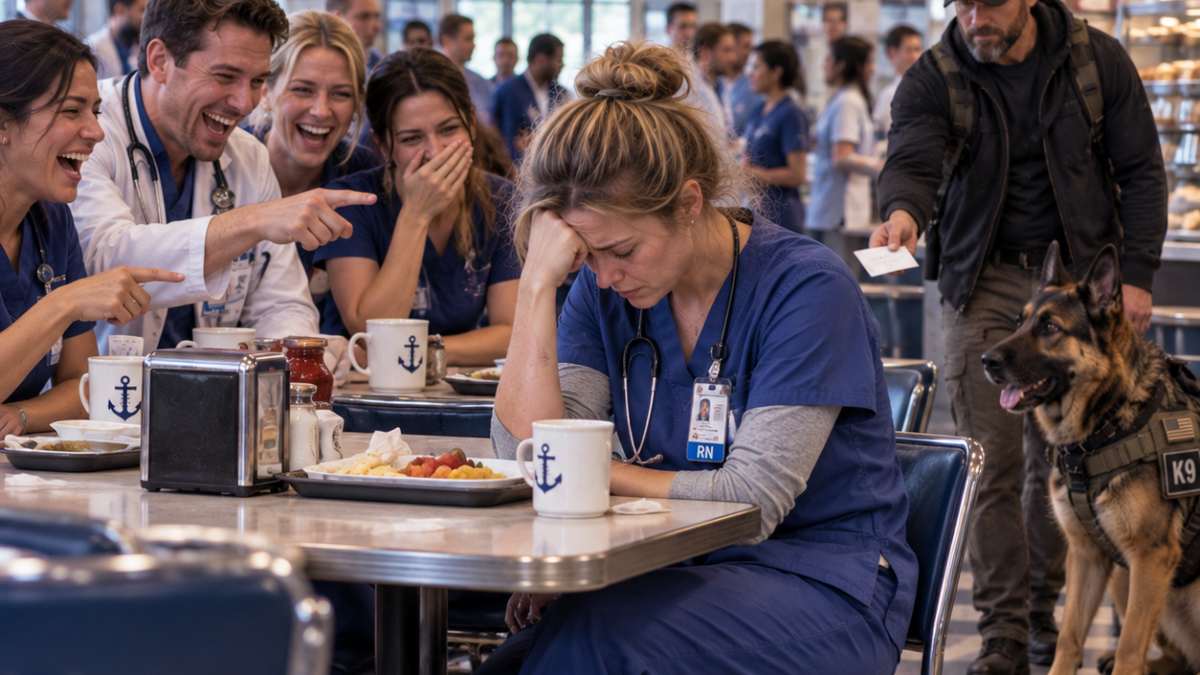
They Mocked the Shy Nurse During Coffee Break—Then a Disguised Navy SEAL Slipped Her a Note and the Entire ER Went Silent.
They Mocked the Quiet Nurse as “Nobody” During Coffee Break—Then a Navy SEAL Slipped Her a Note and Revealed She Had Pulled 11 Men From 300 Feet Underwater.
For two and a half years, Brooke Tanner let the staff at Chesapeake Naval Medical Center call her “Nurse Nobody,” laugh at her fear of water, and film her humiliation because telling them who she really was would mean opening a door she had nearly died trying to close.
Then a bearded stranger in a black cap crossed the cafeteria with a German shepherd at his side, slipped a brass Navy diving coin beneath Brooke’s cold coffee, and handed her a note that began with one word nobody at that table understood: “Chief.”
Four minutes later, a sailor pulled from forty-one-degree water arrived without a pulse, the doctor prepared to pronounce him dead, and the quiet nurse everyone had mocked stood over the body and said, “Nobody is dead until they are warm and dead.”
“Brooke Tanner is afraid of a bathtub.”
Kip Dunlevy held his phone six inches above the cafeteria table.
A tiny red light glowed near the camera lens.
Recording.
Again.
Brooke stared into her coffee.
It had gone cold ten minutes ago.
She held the mug with both hands anyway.
There were things worse than bad coffee.
Being noticed was one of them.
The Anchor Room at Chesapeake Naval Medical Center was loud that afternoon.
Hospital staff packed the cafeteria between shifts.
Navy banners hung from the balcony railing.
A mural of an aircraft carrier covered the far wall.
Every ceramic mug on every table had a tiny white anchor painted near the handle.
Somebody behind Brooke laughed too loudly.
Someone dropped a fork.
Ice rattled inside plastic cups.
Normal sounds.
Safe sounds.
Brooke kept her eyes down.
Kip tilted the phone closer.
“Episode forty-one of Cafeteria Chronicles.”
His voice took on the fake announcer tone that had made him popular with younger staff.
“Today’s guest: Chesapeake’s bravest night-shift nurse.”
A few people laughed.
Not cruelly at first.
That almost made it worse.
“Come on, Brooke,” Kip said. “Polar Plunge is Saturday. Fifty hospital staff. Pier Six. Forty degrees of character building.”
“I already said no.”
Her voice was quiet.
Too quiet for Kip.
“Why?”
“I have an ear problem.”
Dr. Ryan Toliver leaned back in his chair.
He was thirty-nine, handsome in a polished way, and fully aware that people thought so.
White coat open.
Hospital badge clipped perfectly straight.
He lifted his coffee.
“A bad ear.”
Brooke nodded.
“Doctor’s orders.”
Toliver grinned.
“She’s got a bad ear, bad knee, and apparently a medical allergy to fun.”
More laughter.
Denise Carter covered her mouth.
Maya Benton—one of the respiratory therapists—looked uncomfortable but smiled anyway.
Kip pointed the camera.
“Brooke, say it for the people.”
“No.”
“Say, ‘I am terrified of water.’”
PART2:
Her thumb tapped the side of the mug.
Tap.
Tap.
Tap.
Steady rhythm.
Four beats.
Pause.
Four beats.
Nobody noticed.
Nobody except Hallie Brooks.
Hallie was twenty-four.
Fresh out of nursing school.
Young enough to still believe workplaces naturally corrected unfairness if someone simply looked uncomfortable enough.
She sat at the far end of the table.
“Kip.”
He ignored her.
“Come on, Brooke.”
“Turn it off.”
Brooke did not look up.
He leaned closer.
“What was that?”
“Please stop filming me.”
He laughed.
“Aww.”
Then toward camera:
“Nurse Nobody has feelings.”
That name.
Nurse Nobody.
It had started six months earlier.
Brooke worked nights.
Never joined staff happy hours.
Never talked about family.
Never posted old photos.
Her online footprint might as well have belonged to a ghost.
She knew every medication on her floor.
Never missed a chart.
Could place an IV in veins other nurses gave up on.
Stayed with dying patients after shift.
Quietly covered other people’s work without reminding them.
But she avoided stories.
Where had she trained?
Various places.
Military?
A long time ago.
Married?
No.
Children?
No.
Why did she always sit with her back against the wall?
Habit.
Why did she know how to tie six kinds of rescue knot?
YouTube.
That lie had been particularly weak.
People stopped asking.
Then Kip had called her Nurse Nobody in a video.
It stuck.
Brooke was thirty-four.
Five-foot-six.
Ash-blonde hair pulled into a bun that always loosened by mid-shift.
Gray-blue eyes.
Cobalt scrubs faded from washing.
There was an old burn scar beneath her left sleeve.
A thin pale rope scar crossed her right palm.
A small curved line hid behind her left ear.
Nobody at Chesapeake knew what any of them meant.
Brooke preferred it that way.
Toliver tapped the signup sheet.
“Dip one toe.”
“No.”
“We’ll cheer.”
“I can’t.”
Kip’s grin widened.
“Can’t or won’t?”
Brooke finally looked at him.
“Does it matter?”
For half a second something in her eyes made his smile hesitate.
Then someone dropped a metal tray behind them.
Crash.
Every head turned.
Every head except Brooke’s.
Her gaze moved immediately to the cafeteria doors.
Then the kitchen entrance.
Then the windows.
Three exits.
She always counted.
Hallie saw it.
Kip didn’t.
Brooke’s fingers tightened around the mug.
The word plunge had already done enough.
The crashing tray did the rest.
Cafeteria disappeared.
Black water.
Cold pressure.
A steel bell groaning somewhere above her.
A tether line pulled taut across one glove.
Radio static.
Danny Kell’s voice in her headset.
Chief, line’s fouled.
Then:
Chief—
Then nothing.
Her coffee trembled.
Tap.
Tap.
Tap.
Four.
Breathe.
Four.
Anchor Room came back.
Warm lights.
Blueberry muffin on untouched plate.
Kip’s stupid phone.
Toliver’s amused face.
Hallie watching her with concern.
“Last chance,” Kip said.
“Say it.”
Brooke’s jaw tightened.
“No.”
“Come on.”
“No.”
“You wear that RN badge like it means something, but we can’t get you off the dock.”
Hallie’s face changed.
“Kip.”
“What?”
“Enough.”
Kip turned phone toward her.
“Hallie Brooks, defender of Nurse Nobody.”
“Turn it off.”
“It’s content.”
“It’s cruel.”
That quieted a few people.
Kip shrugged.
“She knows I’m joking.”
Brooke said nothing.
That was the wound.
Not the jokes.
The people who understood the jokes had crossed a line and still said nothing because silence was easier than becoming the next target.
She knew something about that too.
Brooke had spent thirteen years around men trained to move toward danger.
Yet this bright hospital cafeteria made her feel smaller than a flooded diving bell ever had.
Because danger underwater had rules.
Pressure.
Depth.
Gas.
Temperature.
Time.
Humiliation was less predictable.
Fighting back meant explaining.
Explaining meant being seen.
Being seen meant someone might connect Brooke Tanner to another name.
A rank.
A photograph.
A citation she had never collected.
A dead man whose hand she still felt in dreams.
Keep head down.
Give them nothing.
Let it burn itself out.
She had lived that way for two and a half years.
Then the cafeteria door opened.
A man entered wearing a black baseball cap low over his forehead.
Small subdued American flag patch above brim.
Dark beard.
Black jacket zipped high.
Jeans.
Work boots.
Nothing military enough to draw immediate attention.
That was deliberate.
Brooke recognized that before she recognized him.
People who have spent years trying not to be noticed recognize others doing the same.
At his left knee walked a German shepherd.
Large.
Dark sable coat.
Black working harness.
No decorative therapy-dog patches.
Just one laminated visitor tag clipped near shoulder.
The dog moved with head level and eyes alert.
Not wandering.
Not sniffing tables.
Working.
Cashier pointed.
“Sir, dogs aren’t allowed in dining area.”
The man held up the laminated tag.
“Cleared at front desk.”
The cashier started to argue.
Then stopped.
Something in his tone discouraged unnecessary conversation.
He scanned the room.
Not searching randomly.
Table by table.
Faces.
Then his eyes found Brooke.
The dog saw her almost simultaneously.
Its ears snapped upright.
Stride changed.
Brooke’s heart stopped.
No.
The shepherd pulled half a step ahead.
The man whispered:
“Atlas.”
Dog slowed.
But tail had begun moving.
Brooke looked away.
Too late.
He crossed room.
Conversation died table by table.
A stranger with a service dog approaching one nurse was enough to create curiosity.
He stopped beside Brooke.
Atlas sat.
Then leaned hard against her shin.
Brooke looked down.
The dog stared up.
She whispered:
“Hey.”
Atlas’s tail struck tile once.
Twice.
The man’s jaw tightened.
Brooke looked at him.
“I think you have wrong table.”
“No, ma’am.”
His voice was low.
“I’ve got the right one.”
Kip raised phone again.
“Oh, this is good.”
The stranger never looked at him.
“Put the phone down.”
Kip laughed.
“Excuse me?”
“Phone.”
Still calm.
“Down.”
Kip lowered it maybe an inch.
Brooke studied stranger’s face.
Recognition came slowly.
Not because she had forgotten.
Because three years and a beard changed people.
“Wes?”
His eyes softened.
Just once.
“Yes, ma’am.”
Hallie looked between them.
Toliver sat forward.
“Brooke?”
She did not answer.
Wes reached inside jacket.
Several people stiffened.
His hand came out holding a folded sheet of paper.
He placed it beneath Brooke’s mug.
Something metallic sat inside.
Clink.
Brooke stared.
“Don’t.”
“I have to.”
“No.”
His voice dropped.
“I wouldn’t be here if I had another door.”
Her fingers touched paper.
Cold traveled through them before she even opened it.
A brass coin rolled into her palm.
Heavy.
Worn at edges.
A diving bell stamped on front.
Around it:
BELL RINGER
UNDERSEA RESCUE
300 FT
On reverse:
11
Brooke forgot how to breathe.
Wesley Howard.
Senior Chief Wesley Howard.
One of eleven.
She unfolded note.
Block letters.
Chief—
Cape Charles.
Four swimmers went into the bay at Thimble Shoal.
Two recovered conscious.
Two inbound Chesapeake.
Eli Marsh has no pulse.
They are going to want to stop.
Do not let them.
—Wes
Brooke read it twice.
Her thumb moved over number eleven.
Kip whispered:
“What is that?”
She did not hear.
Black water rose again.
Steel bell.
A flooded swimmer delivery vehicle.
Danny.
His umbilical line twisted against steel.
Cold so deep it stopped feeling like cold and became pressure.
She shut coin inside fist.
Its edge cut skin.
Hallie leaned closer.
“Brooke?”
No answer.
Wes crouched slightly.
“I can’t say your name in here.”
She looked at him.
“Too many phones.”
His eyes flicked toward Kip.
“Too many ears.”
“I’m not her anymore.”
“I know.”
“You shouldn’t have come.”
“I know.”
“Then why?”
“Because Eli has been down too long.”
Brooke’s pulse raced.
“He’s young?”
“Twenty-seven.”
“Core?”
“Unknown.”
“Submersion?”
“Thirty-eight minutes before rescue boat reached him.”
She closed eyes.
Too long.
Maybe.
Not necessarily.
“How long CPR?”
“Twenty-four minutes and counting when medic called.”
Toliver leaned toward them.
“Who is Eli?”
Brooke ignored him.
Wes whispered:
“Your call, Chief.”
That word.
Chief.
Kip’s phone lifted again.
Hallie slapped his wrist down.
“Stop.”
He stared.
“Seriously?”
“Stop.”
Before anyone said more, overhead speaker clicked.
“Trauma alert. Two cold-water immersion casualties inbound from Thimble Shoal. Military. Trauma One and Two. First patient in cardiac arrest. ETA four minutes.”
The cafeteria changed.
Nurses rose.
Doctors grabbed coffee.
Toliver stood.
Kip gave a humorless little laugh.
“Cold-water rescue.”
Nobody responded.
He looked at Brooke.
“Guess Polar Plunge volunteers came early.”
Still nobody laughed.
Brooke placed coin in scrub pocket.
Both palms flattened on table.
She stood.
Not dramatically.
But everybody who knew her noticed something.
Her back straightened.
Shoulders settled.
Chin lifted.
Hands stopped shaking.
Wes stepped away.
Brooke looked at Toliver.
“Ryan.”
He blinked.
She had never called him by first name.
“How many liters of saline do you have warming?”
“What?”
“Warmed saline. One-oh-four degrees. How many?”
“Two?”
“That’s not enough.”
“Brooke—”
“Maybe three.”
“I need every bag available.”
Toliver stared.
“Why?”
“Because you have four minutes.”
She turned.
“Maya, get every forced-air warming unit on floor.”
Maya stood without thinking.
“Denise, rapid infuser.”
Denise rose.
“Hallie, two sixteen-gauge IV kits, central-line tray, Foley irrigation setup.”
Hallie nodded.
Toliver recovered.
“Hold on.”
Brooke kept walking.
“Brooke.”
She stopped.
“You’re on break.”
“Not anymore.”
“You’re night shift.”
“Patient doesn’t care.”
“I’m running trauma.”
“Yes.”
“And you are going to let me.”
Brooke looked at him.
“I will.”
Toliver relaxed slightly.
Then she continued:
“Until you try to pronounce him before he’s warm.”
His expression hardened.
“Excuse me?”
“You heard me.”
“You have not even seen patient.”
“I know enough.”
Kip stood, phone up again.
“Okay, who exactly do you think you are?”
Brooke turned.
Kip smiled nervously.
“You’ve spent two years acting like you’re afraid of your own shadow and now you’re commanding an ER?”
Wes stepped behind her.
“She is nobody’s nobody.”
Kip’s smile disappeared.
Wes continued:
“Get out of her way.”
Brooke walked.
No hurry.
That was another thing Hallie noticed.
Everyone else ran toward emergencies.
Brooke moved with controlled speed.
No wasted motion.
As if panic cost oxygen.
By time Trauma One doors opened, Brooke had tied gown and pulled gloves.
Two firefighters rolled stretcher hard.
A medic knelt on mattress performing compressions.
Water soaked sheets.
The patient looked dead.
Gray-white skin.
Blue lips.
Eyes partially open.
“Petty Officer Second Class Eli Marsh, twenty-seven!”
Medic shouted.
“Underwater approximately thirty-eight minutes. CPR twenty-four minutes. VF on monitor. No ROSC.”
“Core?”
Toliver asked.
“Seventy-eight point eight Fahrenheit rectal.”
A second stretcher entered adjacent bay.
Another sailor.
Conscious.
Violently shivering.
Maya and second team took him.
Brooke looked at clock.
3:17 p.m.
Toliver moved to medication cart.
“Epinephrine one milligram.”
Nurse reached syringe.
Brooke said:
“No.”
Room stopped.
Toliver slowly turned.
“What?”
“Not yet.”
“Brooke.”
“Core is twenty-six Celsius.”
“I know.”
“Below thirty.”
“I know hypothermia.”
“Then don’t stack drugs.”
Toliver’s mouth tightened.
“You are a floor nurse.”
“Night nurse.”
She corrected almost absently.
His eyes flashed.
“Step back.”
Brooke looked at monitor.
Fine ventricular fibrillation.
“Potassium.”
“What?”
“Draw it now.”
“Why?”
“If it’s catastrophically high, prognosis changes.”
“Brooke.”
“Potassium.”
Hallie already drew.
Toliver saw.
“You’re taking direction from her now?”
Hallie swallowed.
“I’m taking blood.”
Brooke said:
“One shock.”
Toliver stared.
“Two hundred joules.”
“We normally repeat—”
“Not until he warms.”
“Why?”
“Cold myocardium won’t respond normally.”
She looked at him.
“You can shock all afternoon and accomplish nothing but wasting time.”
Toliver hesitated.
Then:
“Charge.”
Defibrillator whined.
“Clear.”
Body jumped.
Monitor returned to fine VF.
Toliver shook head.
“No change.”
Brooke nodded.
“Good.”
“Good?”
“Means we stop trying same thing and warm him.”
Toliver wiped forehead.
“Thirty-eight minutes submerged.”
“Yes.”
“Twenty-four minutes CPR.”
“Yes.”
“Pupils fixed.”
“At seventy-eight degrees, pupils tell you very little.”
“He has no pulse.”
“He’s profoundly hypothermic.”
Toliver looked at clock.
Brooke knew exactly what he was thinking.
Resources.
Futility.
Dead tissue.
Brain injury.
The judgment all emergency physicians must eventually make.
Then tech ran in.
“Potassium six point one.”
Brooke exhaled.
“There.”
Toliver glanced.
“What?”
“That’s survivable.”
“It proves nothing.”
“It proves we keep going.”
He looked at monitor.
Then at Eli’s gray face.
“No pulse.”
Brooke’s voice lowered.
“Nobody is dead until they’re warm and dead.”
Somebody near doorway inhaled sharply.
The old phrase.
Used in cold-water medicine because deep hypothermia can preserve brain while stopping heart.
Toliver knew it.
Everyone in emergency medicine knew it.
But knowing phrase from textbook and believing it after twenty-four minutes of CPR were different things.
Toliver’s shoulders sagged.
“I’m calling.”
Brooke stared.
“Ryan.”
“Time of death, 3:21.”
“Don’t.”
“Nurse Tanner.”
“No.”
Everyone froze again.
Toliver’s face flushed.
“Out.”
Brooke stayed.
“Nurse Tanner, step out.”
A voice came from doorway.
“I’d listen to her.”
Command Master Chief Leon Ortiz stood there.
Silver hair.
Navy working uniform.
Rows of ribbons.
Senior enlisted adviser for medical center.
Toliver’s jaw tightened.
“Master Chief.”
“Doctor.”
“This is a clinical decision.”
“Yes.”
“So with respect—”
“With respect, I said I’d listen to her.”
“Based on what?”
Ortiz looked at Brooke.
Not answer.
Question.
Permission?
She stared at Eli.
Danny’s hand flashed through memory.
Cold glove.
Line twisting.
Radio:
Chief, we’re losing pressure.
Then:
Chief, you have to let go.
Her heart raced.
For years she had promised not to stand here again.
Not in rooms where someone’s life depended on knowledge she wished she could forget.
Not with freezing hands.
Not with black water in her head.
Then she looked at Eli’s right hand hanging off bed.
Blue nails.
Curled fingers.
Same hand.
Different man.
Brooke stepped to head.
“My name is Chief Hospital Corpsman Brooke Tanner.”
Silence.
Kip stood outside glass.
Phone slowly lowering.
Brooke continued:
“I served thirteen years as a Navy diving medical technician attached to Undersea Rescue Command.”
Toliver’s face went blank.
“I have treated severe immersion hypothermia at depth, on deck, in chambers, and during prolonged resuscitation.”
She looked directly at him.
“Give me twenty minutes.”
Toliver said nothing.
“If he is warm enough and still dead after that, I will stand beside you while you call it.”
Ortiz folded arms.
Wes stood behind glass with Atlas.
The dog sat.
Watching.
Toliver swallowed.
“Twenty.”
Brooke nodded.
“That’s enough.”
Then room changed.
“Compressions do not stop.”
She pointed.
“Swap every two minutes.”
“Hallie, bilateral large-bore lines.”
“Denise, forced air from neck to knees.”
“Maya, warmed saline through rapid infuser.”
“Warm humidified oxygen.”
“Temperature continuously.”
She turned.
“Kip.”
He froze.
“Me?”
“You wanted to be part of Polar Plunge.”
His face drained.
“This isn’t funny.”
“No.”
Her voice never rose.
“It isn’t.”
She pointed at Eli’s chest.
“Hands here.”
Kip looked at Toliver.
Toliver looked away.
Brooke said:
“Lower half sternum.”
“I’m not trained.”
“You took BLS.”
“Last year.”
“Then remember.”
Kip stepped forward.
Phone slid from hand.
Clattered on tile.
Still recording.
Nobody picked it up.
“Two inches.”
Brooke positioned his hands.
“Elbows locked.”
He began compressions.
“One, two, three…”
“Faster.”
“Four, five—”
“Use your weight.”
“Seven, eight…”
His voice shook.
By twenty compressions sweat formed at hairline.
“Don’t be gentle.”
Brooke said.
“He does not need gentle.”
Kip pushed.
The same man who called her nobody now held another man’s circulation in his arms.
Maybe punishment.
Maybe lesson.
Brooke did not know.
She only knew they needed hands.
Warmed fluids ran.
Forced-air blanket inflated.
Humidified oxygen through tube.
Temperature climbed slowly.
79.1.
79.8.
80.6.
The second sailor in Trauma Two was stable.
Conscious.
Maya kept Brooke updated.
Brooke looked toward Toliver.
“We need ECMO.”
“Civilian center across bridge.”
“Call.”
“Traffic is thirty-five minutes.”
“Call anyway.”
Toliver did.
Then looked at Brooke.
“What if they don’t get here?”
“Then we are machine.”
He almost laughed.
Then realized she meant it.
Brooke requested bladder lavage.
Warm saline in.
Drain.
Repeat.
Toliver said:
“Pleural lavage?”
“If no bypass available.”
“That is aggressive.”
“He is dead if we stop.”
Brooke’s eyes met his.
“Pick the risk you can live with.”
Toliver stared.
Then reached for chest-tube tray.
“Right first.”
Brooke stood beside him.
“Fifth intercostal. Over rib.”
“I know how to place chest tube.”
“I know.”
“You’re talking me through it.”
“Yes.”
“Why?”
“Because your hands are shaking.”
He looked down.
They were.
Brooke did not smile.
Did not humiliate.
“Mine do too.”
She said.
“Keep going.”
He made incision.
Tube advanced.
Cold pink fluid drained.
Warm saline followed carefully.
Then left side.
Temperature crept upward.
82.
82.9.
83.5.
Minutes stretched.
CPR shifts rotated.
Hallie.
Respiratory therapist.
Kip again.
His face soaked.
Arms trembling.
“I can’t.”
“Yes, you can.”
Brooke said.
“My arms—”
“Ten more.”
“Chief—”
“Ten.”
He pushed.
“One.”
“Two.”
“Three.”
At seven his voice broke.
At ten someone replaced him.
He stumbled back.
Looked at Brooke with something new.
Not admiration yet.
Maybe shame.
Brooke’s own hands began trembling around 3:30.
She felt it before anyone said anything.
Pump hum.
Oxygen hiss.
The smell of wet clothing.
Cold skin.
Black water.
Danny Kell.
Three hundred feet.
Saturation bell cable twisting.
A flooded swimmer delivery vehicle resting wrong on seafloor.
One rescue bell.
Eleven men.
Two trips.
No room for fear.
Then Danny’s umbilical fouled.
Brooke heard him in headset.
“Chief.”
Static.
“Chief, line’s caught.”
She reached.
Could not see him fully.
Black.
Only lights.
Her glove found his.
Cold even through neoprene.
Pressure rising.
Bell commander screaming they had to ascend.
Danny’s fingers slipping.
“Chief.”
She held.
“You don’t let go.”
Then line jerked.
His hand left hers.
Not because she chose.
Because physics did.
Still felt like choice.
Brooke gasped.
Trauma bay blurred.
“Chief?”
Hallie’s voice.
Near.
“Brooke?”
83.8.
Kip counting.
Somebody changing IV bag.
Wes beyond glass.
Atlas beside him.
Wes did not wave.
Did not come in.
He simply held her eyes.
I am here.
Brooke inhaled.
Exhaled.
Her hands steadied.
“Keep going.”
84.6.
85.1.
85.9.
“Prepare epinephrine.”
Toliver looked.
“You said no.”
“Not yet.”
She watched.
“Thirty Celsius first.”
86.0.
86.2.
86.4.
“Now.”
Epinephrine.
One milligram.
“Rhythm check.”
VF.
“Third shock.”
Toliver:
“Two hundred.”
“Clear.”
Body lifted.
Monitor went chaotic.
Then line changed.
One spike.
Pause.
Another.
Another.
Maya whispered from doorway:
“Oh my God.”
Denise pressed fingers to neck.
“Pulse.”
Nobody moved.
“I’ve got a pulse.”
Kip covered mouth.
Hallie laughed and cried simultaneously.
Toliver stepped toward monitor.
“Sinus bradycardia.”
Thirty-eight.
“Pressure?”
“Sixty-eight over forty.”
Brooke did not celebrate.
“Norepinephrine low dose.”
“Warm saline wide.”
“Slow active warming.”
Toliver looked confused.
“Slow?”
“Peripheral vasodilation. Rewarming shock.”
He nodded.
“Right.”
“No fever. Don’t overshoot.”
He stared at her.
Then obeyed.
Twenty minutes later civilian ECMO team arrived.
Machine rolled through doors.
They stopped.
Patient had pulse.
Core ninety-three.
Blood pressure supported.
Pink returning to cheeks.
ECMO physician looked at Toliver.
“You got ROSC?”
Toliver looked at Brooke.
“We did.”
Not I.
We.
That mattered.
Brooke walked beside stretcher toward ICU elevator.
Her hand rested lightly on rail.
When doors closed, she released.
Then walked directly into stairwell.
Door shut.
She made it two steps down.
Sat.
Hands began shaking.
Then shoulders.
Then entire body.
She pressed palms to eyes.
Three years.
Not gone.
Never gone.
Just waiting.
The stairwell door opened quietly.
Hallie came in.
Sat two steps lower.
No touching.
No questions for a full minute.
Brooke whispered:
“I thought I was fixed.”
Hallie looked up.
“You saved him.”
“That’s not what I said.”
“I know.”
Brooke laughed once.
Tears came.
“I thought if I stayed away from water long enough…”
She swallowed.
“…if I stopped diving, stopped answering calls, stopped hearing people call me Chief…”
Her breath shook.
“I thought eventually my body would forget.”
Hallie waited.
“It doesn’t.”
“No.”
Brooke wiped face.
“It never goes away.”
Hallie said:
“Maybe it doesn’t have to.”
Brooke looked.
“You sound twenty-four.”
“I am.”
“Then don’t say wise things.”
Hallie smiled.
“Sorry.”
Brooke leaned head against wall.
After a while Hallie asked:
“Who’s Danny?”
Brooke closed eyes.
“What?”
“You said it in there.”
“I did?”
“Once.”
Brooke looked toward floor.
“He was my diver.”
Silence.
“My friend.”
Hallie did not say:
Not your fault.
Good.
People throw that sentence at guilt like a blanket.
Sometimes it only makes person underneath feel unseen.
Brooke continued.
“Petty Officer Danny Kell.”
“We were at three hundred feet.”
“Rescue vehicle flooded.”
“Eleven swimmers trapped.”
“One bell.”
She stared at rope scar across palm.
“I took first group up.”
“Went back down.”
“Danny came with me.”
“Second descent…”
Her voice weakened.
“His line fouled.”
“What happened?”
“Pressure shifted.”
“I had his hand.”
Hallie listened.
“And then?”
“I didn’t.”
That was all Brooke could say.
Hallie moved up one step.
Shoulder beside hers.
No words.
Sometimes kindness works best without language.
When they returned to hallway, people were waiting.
Maya.
Denise.
Toliver.
Respiratory staff.
Two corpsmen.
Command Master Chief Ortiz.
Wes.
Atlas.
Kip stood apart.
Scrubs soaked with sweat.
His phone in his hand.
Screen dark.
Ortiz straightened.
“Senior Chief Howard.”
Wes stepped forward.
Brooke shook head.
“Don’t.”
He looked at her.
“They need to know.”
“No.”
Kip whispered:
“We do.”
Brooke stared.
He lowered eyes.
Wes began.
“Three years ago off Cape Charles, two swimmer delivery vehicles flooded during a classified training evolution.”
The hallway quieted.
“Eleven men trapped.”
He touched brass coin hanging beneath collar.
“Navy sent one rescue bell.”
Brooke stared at floor.
“Chief Tanner took it down.”
Wes’s voice remained steady.
“Then took it down again.”
Somebody inhaled.
“She brought every survivor she could reach to surface.”
His jaw tightened.
“She lost Petty Officer Danny Kell on second descent.”
Brooke’s eyes closed.
“He was her tender and diver.”
Wes continued:
“She held him until line failed.”
“Then she turned around…”
His voice broke.
“…and went back for us.”
Silence so deep you could hear air handler.
“I am one of the eleven.”
He placed hand over chest.
Atlas sat.
Wes looked toward ICU.
“So is Eli Marsh now.”
Brooke shook head.
“No.”
Wes turned.
“Don’t.”
“No.”
“You don’t get to shrink this.”
“I did my job.”
“You did it after your diver died in your hand.”
Brooke’s face tightened.
“Wes.”
“You came back down.”
“That was my job.”
“It was everybody’s job.”
His voice rose slightly.
“You were the one who did it.”
Ortiz stepped forward.
“Chief Tanner.”
Brooke turned.
“There is something else.”
She sighed.
“Please don’t.”
“An envelope in my safe.”
“What envelope?”
“Navy and Marine Corps Medal.”
Kip looked up sharply.
Brooke’s face went still.
“You never attended ceremony.”
“I know.”
“You never signed receipt.”
“I know.”
“You resigned.”
“Yes.”
“Why?”
Brooke said nothing.
Ortiz softened.
“I’m not asking for room.”
Wes answered anyway.
“Because Danny died.”
Brooke turned on him.
“That is not yours.”
“No.”
Wes nodded.
“But you keep punishing yourself with it.”
“That is mine.”
He stopped.
Fair.
Kip moved.
One step.
Then another.
He stood in front of Brooke.
No phone raised.
“I’m sorry.”
She looked.
His eyes were red.
“I filmed you.”
No response.
“I called you nobody.”
Nothing.
“I made everybody laugh.”
He swallowed.
“You handed me his chest.”
Brooke remembered his counting.
His arms shaking.
“You showed me what being useful feels like.”
He lifted phone.
Opened video folder.
Forty-one cafeteria clips.
Brooke recognized thumbnails.
Her head down.
Coffee.
Kip laughing.
He selected all.
Delete.
Phone asked confirmation.
His thumb hovered.
Then pressed.
Gone.
He looked up.
“Do you want me to say that fixes it?”
Brooke asked.
“No.”
“Good.”
He flinched.
“Don’t apologize only to me.”
His brow furrowed.
“What?”
“Everybody else you’ve made small.”
Kip looked away.
“They didn’t get dramatic rescue to prove you wrong.”
That landed harder.
“You shouldn’t need somebody to secretly be a hero before you treat them decently.”
His face crumpled.
“I know.”
“No.”
Brooke said gently.
“You’re starting to.”
Toliver approached last.
He looked exhausted.
For once, polished confidence gone.
“Chief.”
“Brooke.”
“Brooke.”
Pause.
“I pronounced him.”
“You tried.”
“I was wrong.”
“You listened when challenged.”
“Eventually.”
“Yes.”
He looked down.
“If Ortiz hadn’t walked in…”
Brooke knew question.
Would he have stopped?
She did not answer.
Toliver said:
“I was ready to stop because he looked dead.”
“He was dead.”
Toliver looked up.
Brooke continued:
“Cold gave you time.”
He swallowed.
“I dismissed you because of where you worked.”
“No.”
She said.
“You dismissed me because of what you thought I was.”
He accepted.
“Yes.”
Then:
“Will you teach us?”
“What?”
“Cold-water protocol.”
She studied him.
“Every step?”
“Every step.”
A faint smile.
“Gladly.”
“Saturday,” he said awkwardly.
“What?”
“Polar Plunge.”
Brooke’s expression hardened.
“I’m not doing it.”
“Of course.”
He raised both hands.
“I’m never mentioning it again.”
She almost laughed.
Four days later, Eli Marsh woke.
The first thing he asked was:
“Am I dead?”
Hallie laughed.
“No.”
“Feels like it.”
“You were close.”
He blinked.
“Who kept yelling?”
“Which person?”
“Woman.”
Hallie smiled.
“Brooke.”
“Chief?”
“You remember?”
“Voice.”
He closed eyes.
“She kept saying keep going.”
Hallie’s throat tightened.
“Yes.”
Eli slept.
Two hours later he woke again.
“Was nurse with bell real?”
Hallie looked toward hallway where Brooke was charting.
“Very.”
Recovery was long.
Neurologic testing.
Kidney function.
Pulmonary complications.
Physical therapy.
But Eli walked out eventually.
Wes came with Atlas.
The second sailor, Petty Officer Grant Lawson, recovered quickly and returned weeks later with coffee for everyone.
Eli took longer.
When finally discharged, he stopped beside Brooke.
“Chief.”
“Nurse.”
He smiled.
“Wes told me.”
“Wes talks too much.”
“You saved me.”
“The team did.”
“You all say that.”
“Because it’s true.”
Eli looked at her left hand.
It trembled faintly.
“You okay?”
Brooke laughed.
“You almost froze to death and you’re asking me?”
“Deflection.”
“You have learned annoying medical words.”
He smiled.
Then serious.
“I don’t remember water.”
“Good.”
“I remember cold.”
Brooke nodded.
“I remember somebody counting.”
“Kip.”
“The guy who made videos?”
“Yes.”
Eli laughed weakly.
“That’s weird.”
“Life is.”
Then:
“I remember you saying I wasn’t allowed to quit.”
Brooke’s eyes filled.
“I said that?”
“Maybe.”
She had said it to Danny too.
Years ago.
In black water.
You are not allowed to quit on me.
For a second grief rose.
Then changed.
Not gone.
Changed.
She looked at Eli.
“You listened.”
“So did you.”
He hugged her.
Carefully.
She allowed it.
The hospital did not forget cafeteria.
That could have become another kind of problem.
Brooke suddenly received invitations.
Committees.
Ceremonies.
Leadership lunches.
People who had ignored her now wanted her photograph.
She declined almost all.
She did not want transformation from invisible to mascot.
Kip stopped filming coworkers.
Completely.
At first people teased him.
“What happened to Cafeteria Chronicles?”
He said:
“I got tired.”
That was all.
Then one day Brooke saw him intervene when resident mocked environmental-services worker’s accent.
Nothing dramatic.
“Knock it off.”
He said.
Resident stopped.
Kip did not look around to see who noticed.
Brooke did.
Good.
Toliver changed more slowly.
Pride rarely dies from one incident.
But it can be retrained.
During trauma conferences he began asking nurses first:
“What are you seeing?”
He still argued.
Still overconfident sometimes.
But “night nurse” stopped being insult.
Three months later, a junior nurse challenged medication dose.
Old Toliver might have brushed her aside.
New Toliver stopped.
Checked.
She was right.
He thanked her in front of room.
Brooke said nothing.
Hallie nudged her.
“What?”
“He’s learning.”
“People do occasionally.”
Command Master Chief Ortiz offered Brooke formal reserve role with undersea medical unit.
Training only.
No deployment without consent.
Come when she wanted.
Leave when she needed.
Brooke stared at paperwork for two weeks.
Finally signed.
Not because she wanted old life.
Because she realized staying away had not made Danny less dead.
It only made her world smaller.
First training day back, she stood on pier for twenty minutes before boarding.
Wes beside her.
Atlas lying near boots.
“You don’t have to.”
“I know.”
“Could go home.”
“I know.”
“You’re shaking.”
“I know.”
Wes smiled.
“You always hated when people point that out.”
“Yes.”
“Sorry.”
“No you’re not.”
“No.”
They boarded.
Brooke taught rewarming protocols.
Dive casualties.
Gas embolism.
Drowning.
She did not enter water.
Not first day.
Nobody asked.
Second month she stood at edge in wetsuit.
Could not jump.
A young corpsman beside her said:
“Chief, want me to go first?”
She almost said no from pride.
Then:
“Yes.”
He went.
She followed thirty seconds later.
Cold struck.
Memory came.
Danny.
Line.
Dark.
But then surface.
Sun.
Wes shouting.
Atlas barking from dock.
Her own breath.
She climbed out shaking.
Not victory.
Not cure.
Just one entry.
One exit.
Enough.
When Polar Plunge returned following winter, Brooke surprised everyone.
She signed sheet.
Kip checked twice.
“You?”
“Do not make content.”
“I don’t even have camera.”
“Good.”
Fifty staff gathered Pier Six.
Bay gray.
Wind sharp.
Temperature forty-two.
Hallie wore Santa hat.
Maya brought cider.
Denise blankets.
Toliver stood in ridiculous shorts and regretted everything.
Kip held towels.
No phone.
Wes waited near end with thermos.
Atlas wore tiny life vest he clearly hated.
Brooke walked dock in plain black swimsuit.
No sleeve covering burn scar.
Rope line visible across palm.
Pale cut behind ear exposed.
Hallie looked at her.
“You sure?”
“No.”
Brooke said.
“But I’m going.”
Toliver whispered:
“Bad ear?”
Brooke glared.
He immediately raised hands.
“Sorry.”
She smiled.
“Doctor’s orders.”
Wes laughed.
Brooke stood edge.
Water beneath.
The dark tried to become old dark.
Three hundred feet.
Steel.
Danny.
She let memory come.
Did not fight.
Did not obey.
Then stepped.
Cold hit like fist.
For one second body panicked.
Up vanished.
Down vanished.
Then feet kicked.
She broke surface.
Air.
Light.
Fifty people shouted her name.
Not Juniper.
Not Chief.
Not hero.
“BROOKE!”
She laughed.
Actual laugh.
Wes held hand from dock.
She ignored it first second.
Then took.
Let him help her out.
That mattered too.
Receiving help.
Atlas shook water onto her.
“You’re terrible.”
Dog wagged.
Kip wrapped towel around shoulders.
He looked emotional.
Brooke said:
“If you cry I’m pushing you in.”
He laughed.
“Fair.”
She looked toward water.
It was still water.
Not Danny.
Not death.
Just cold bay.
She knew nightmares would return.
She knew certain sounds would still open old rooms.
She knew fear did not disappear because crowd cheered.
But trauma had lost one inch of territory.
Sometimes that is recovery.
Not conquering.
Reclaiming inches.
A year after Eli’s rescue, hospital invited Brooke to speak at mandatory staff training.
She almost refused.
Then Hallie said:
“If you don’t, Toliver will give PowerPoint.”
Brooke agreed immediately.
She stood in auditorium.
No uniform beyond scrubs.
No medal.
She still had not picked it up.
Ortiz kept threatening to deliver it to her locker.
Brooke looked at doctors, nurses, corpsmen, custodians, security.
Kip sat front.
Toliver beside him.
Her first slide had no title.
Just sentence:
YOU DO NOT KNOW WHAT SILENCE IS HOLDING UP.
She let them read.
Then spoke.
“I’m not here because I used to be a diving medical technician.”
Pause.
“I’m here because what happened before you knew that matters more.”
She looked around.
“Some of you were kind to me.”
“Some weren’t.”
“Most were silent.”
Several people shifted.
“I’m not asking anybody to feel guilty forever.”
“But I want you to remember what changed after you learned my history.”
She clicked.
Second slide:
NOTHING ABOUT MY VALUE CHANGED THAT DAY.
Room quiet.
“I was same nurse before Wes walked into cafeteria.”
“Same training.”
“Same hands.”
“Same scars.”
“Same fear.”
“The only thing that changed was what you knew.”
Toliver lowered eyes.
Brooke continued:
“That means problem wasn’t that I hadn’t proven myself.”
“The problem was that people decided I deserved less respect until I did.”
Nobody moved.
“You will work with quiet people.”
“Awkward people.”
“People with accents.”
“People who flinch.”
“People who do not explain themselves.”
“People who look inexperienced.”
“People who look frightening.”
“People you simply do not like.”
She paused.
“They do not need a secret medal before you treat them like human beings.”
Kip’s eyes filled.
Brooke clicked final slide.
ASK BEFORE YOU ASSUME.
Simple.
“That’s it.”
Somebody at back laughed.
“Chief, that’s whole presentation?”
“Yep.”
Toliver called:
“No hypothermia algorithm?”
“Next hour.”
Groans.
Brooke smiled.
Life moved.
Rosa—not part original file but we can introduce perhaps a cafeteria worker? Better we haven’t introduced her. We didn’t. Fine.
Two years passed.
Brooke became charge nurse nights.
Not because of legend.
Because she was good.
That distinction mattered to her.
Kip transferred to flight medicine eventually.
Before leaving he gave her old cafeteria mug.
Anchor on side.
Underneath, where nobody could see unless lifted, he had written:
NOT NOBODY.
Brooke stared.
“Corny.”
“I know.”
She kept it anyway.
Toliver eventually apologized in public.
Not immediately.
Months after rescue.
During departmental meeting.
“I made jokes about Nurse Tanner’s fear of water.”
He said.
“I treated an injury I didn’t understand as entertainment.”
No excuses.
“I was wrong.”
Brooke accepted.
Then told him:
“Never make junior staff earn safety from senior staff.”
He nodded.
That became bigger than her.
Department established anti-harassment policy for informal filming.
No recordings without consent in staff spaces.
Some complained.
Kip supported it loudest.
Growth is strange.
Sometimes person who caused harm becomes strongest witness against repeating it.
Wes kept visiting.
Atlas adored cafeteria.
Cashier stopped objecting.
Eli returned every anniversary with twelve donuts although Brooke repeatedly said staff needed fruit.
“Survived hypothermic arrest.”
He told her.
“I’m eating donut.”
Fair.
Grant Lawson came too.
The two swimmers became friends with staff.
One year Eli met Danny Kell’s mother.
That was Brooke’s idea.
Almost became mistake.
She had avoided Mrs. Kell for years.
Guilt.
Then one day letter arrived.
Danny’s mother, Margaret, had seen local story.
She asked:
Could we meet?
Brooke nearly threw letter away.
Instead drove.
Margaret opened door.
Smaller than Brooke remembered.
Gray hair now.
She hugged without warning.
Brooke froze.
Then cried.
“I’m sorry.”
First words.
Margaret pulled back.
“For what?”
“I let him go.”
“No.”
“I had his hand.”
“I know.”
“I should’ve—”
“Stop.”
Brooke did.
Margaret looked directly at her.
“Danny wrote about you.”
Brooke’s knees weakened.
“What?”
“Before deployment.”
She brought box.
Letters.
One mentioned Chief Tanner.
“She is mean as hell underwater and the reason half these idiots come home.”
Brooke laughed through tears.
Margaret handed letter.
“You think my son died believing you failed him?”
Brooke could not answer.
“He chose that work.”
Margaret continued.
“He knew risk.”
“I still let go.”
“No.”
Her voice broke.
“The line took him.”
Brooke stared.
That was different sentence.
Not:
It wasn’t your fault.
Specific.
True.
The line took him.
For three years memory had edited itself.
Brooke’s hand opening.
Danny slipping.
Her failure.
But line had snapped sideways.
Pressure.
Metal.
Force.
She had not chosen.
That distinction did not erase grief.
It loosened one knot.
Margaret asked:
“Who’s sailor you saved?”
“Eli.”
“Bring him sometime.”
Brooke did.
Margaret served pie.
Eli awkwardly said:
“I’m sorry your son died.”
Margaret said:
“I’m glad you didn’t.”
That was enough.
Brooke watched two stories occupy same kitchen.
Loss.
Survival.
Neither canceling other.
That helped.
She eventually collected medal.
Not ceremony.
Ortiz gave envelope in office.
Brooke opened alone.
Navy and Marine Corps Medal.
Citation describing undersea rescue.
Heroism.
Eleven lives.
Danny’s name nowhere.
That bothered her.
She took medal to engraver.
On back she added:
D.K.
Then placed in drawer.
Not wall.
She did not need proof.
The brass coin stayed in scrub pocket for years.
Number eleven.
Worn smooth.
Whenever difficult case came, thumb found edge.
Not superstition.
Reminder.
People can come back from farther than they look.
Eli proved that.
Brooke too.
One night a new resident came to Chesapeake.
Twenty-six.
Nervous.
Dropped a tray.
It crashed.
Brooke flinched.
Resident froze.
“Oh, sorry.”
Brooke laughed.
“I’m okay.”
Kip’s replacement nurse, young and curious, whispered:
“Is it true she used to be terrified of water?”
Brooke heard.
Turned.
“Yes.”
The nurse reddened.
“Sorry.”
“Don’t be.”
“Are you still?”
Brooke considered.
“Yes.”
That surprised them.
“But you do rescue training.”
“Yes.”
“How?”
Brooke smiled.
“Fear and action are allowed in same body.”
Then walked away.
That was answer she wished someone had given her years earlier.
Bravery is not lack of fear.
Too cliché.
Better:
Fear does not get sole voting rights.
It can speak.
It cannot always decide.
Brooke still chose aisle seats near exits.
Still tapped cups four times.
Still had bad ear from pressure injury.
Still hated being filmed.
Still occasionally woke believing ceiling was steel bell.
Still called Danny’s name in dreams.
And still walked into trauma bays.
Some wounds become companions rather than enemies.
You learn where they sit.
What wakes them.
How to make room without handing them steering wheel.
Years later, Chesapeake renovated Anchor Room.
New tables.
Better lights.
Old anchor mugs sold as surplus.
Brooke bought one.
The exact mug from day, she thought.
Maybe not.
Didn’t matter.
She kept it at home.
Sometimes morning coffee cooled untouched while she stared outside.
But nobody filmed.
Nobody laughed.
Atlas eventually retired.
Wes adopted him.
Old shepherd slowed.
Muzzle white.
Hip stiff.
Brooke visited.
Atlas still leaned against shin.
“Traitor.”
Wes said:
“He likes you better.”
“Because I don’t make him run.”
“Fair.”
When Atlas died, Wes called.
Brooke drove over.
Stayed.
No grand gesture.
Just hand on dog’s side until breath stopped.
Wes cried.
Brooke made coffee.
Grief had become something she could stand beside without trying to repair.
That was perhaps biggest change.
You cannot always bring someone up.
Sometimes you sit with loss.
Danny had taught that painfully.
Eli taught opposite.
Know difference.
Fight when there is physiology to fight.
Let go when there isn’t.
Medicine is cruel partly because wisdom means learning both.
The most famous sentence from Eli’s case became:
Nobody is dead until they are warm and dead.
Staff printed on cold-water protocol card.
Brooke hated that people credited her.
“It is not my phrase.”
She corrected endlessly.
But story traveled anyway.
Nurse Nobody saved frozen sailor.
She hated headline even more.
One reporter asked:
“How does it feel to prove everyone wrong?”
Brooke answered:
“I wish nobody had needed saving for me to be treated differently.”
Reporter went quiet.
That quote made final article.
Good.
Because revenge version was easy.
Bullied nurse secretly hero.
Mockers humbled.
Apology.
Cheers.
But real lesson was not that Brooke deserved respect because she had been extraordinary.
She deserved it when she was ordinary.
At coffee table.
Quiet.
Shaking.
Saying no.
That should have been enough.
A person’s boundaries do not require heroic explanation.
If someone says stop filming, stop.
If someone says no to water, no.
You do not need to know dead diver at three hundred feet.
You do not need medal.
You do not need scars.
No should not need biography.
Kip understood that better than anyone eventually.
When his own daughter turned fourteen, she asked why he never posted photos without asking.
He told her:
“Because I learned somebody else’s story isn’t content just because your phone can see it.”
Brooke heard that years later.
Smiled.
People can change.
Not all.
Enough.
Eli eventually returned to diving duty.
That scared Brooke.
He visited before clearance.
“I need you to say something.”
“What?”
“That I should go.”
“No.”
His face fell.
“Why?”
“Because that’s your decision.”
“But you saved me.”
“Doesn’t make me owner of your future.”
He thought.
“I’m scared.”
“Good.”
“Good?”
“Means you understand.”
“I thought you’d tell me fear shouldn’t stop me.”
“No.”
Brooke looked at him.
“Sometimes fear is information.”
“How do I know?”
“You listen.”
“And then?”
“You choose.”
Eli returned.
Carefully.
Years later became instructor.
His safety brief always included prolonged hypothermia.
Students complained.
He said:
“You can complain after you’ve been dead twenty-four minutes.”
That got attention.
Brooke attended one class.
He introduced her:
“This is Chief Tanner.”
She corrected:
“Nurse Tanner.”
He smiled:
“Same problem.”
Students laughed.
Brooke did too.
The brass coin still number eleven.
Wes once offered new coin with number twelve for Eli.
Brooke refused.
“Why?”
“Eleven belongs to old rescue.”
“What about Marsh?”
“He gets own story.”
Good answer.
So Wes had separate coin made.
Number one.
On it:
WARM AND ALIVE.
Eli carries it.
Brooke cried when saw.
Denied.
Bad ear apparently caused watery eyes.
Nobody believed her.
At Chesapeake, one handwritten note eventually appeared behind nurse station.
Nobody knew who placed it.
Brooke suspected Hallie.
Hallie blamed Kip.
Kip blamed Toliver.
It read:
THE QUIETEST PERSON IN THE ROOM MAY BE HOLDING THE WHOLE ROOM UP.
Brooke rolled eyes.
“Too dramatic.”
Hallie refused remove.
“It’s true.”
“Still dramatic.”
“It can be both.”
Fine.
Years after cafeteria incident, new nurse asked Brooke:
“Were you really called Nurse Nobody?”
Brooke looked at handwritten note.
Then at crowded ER.
Toliver consulting resident respectfully.
Kip visiting from flight medicine.
Hallie now charge nurse days.
Wes’s old brass coin in pocket.
She said:
“Yeah.”
“Did it bother you?”
“Yes.”
“Why didn’t you tell them who you were?”
Brooke thought.
Then:
“Because I shouldn’t have had to.”
That was answer.
Not shame.
Not secret.
Not classified mission.
Because dignity should not depend on résumé.
The nurse nodded.
Brooke walked toward Trauma Three.
A patient needed her.
That remained simplest part.
Someone needed help.
She went.
People used to ask how woman afraid of water could spend thirteen years in undersea rescue.
Wrong question.
Courage did not make water less black.
Training did not make depth less dangerous.
Rank did not make death lighter.
Brooke descended because people were below.
Years later, she walked into freezing trauma bay for same reason.
Someone was below.
Metaphorically this time.
A young sailor so cold his heart had stopped.
Everybody else looking at clock.
She knew path down.
So she went.
And when she came back, she brought more than Eli Marsh.
She brought part of herself.
Not all.
Never all.
Enough.
On the final anniversary before Wes retired, he and Eli met Brooke in Anchor Room.
Same cafeteria.
Different table.
Atlas gone.
Kip away.
Hallie working.
Toliver in surgery.
Wes placed something beside coffee.
Folded paper.
Brooke groaned.
“No.”
He smiled.
“Open it.”
“If this is another casualty—”
“It isn’t.”
She unfolded.
A photograph.
Old.
Undersea rescue crew.
Eleven men.
Brooke younger.
Danny beside her.
Both wearing dive gear.
Danny grinning.
On back Wes had written:
You brought us up.
Danny brought you back.
Brooke stared for long time.
“What does that mean?”
Wes sipped coffee.
“You’ve spent years thinking his death pulled you down.”
Brooke looked.
“Maybe remembering him is also why you kept going back for people.”
She swallowed.
“That’s sentimental.”
“Yep.”
“You’re getting old.”
“Yep.”
She turned photo again.
Danny.
Alive.
Not cold.
Not slipping.
Smiling.
Another new picture.
Or old picture recovered.
Sometimes healing is not creating new memories.
Sometimes it is finding the ones trauma buried.
Brooke placed photo inside badge holder.
Finished coffee.
Still warm.
That made her smile.
Then overhead speaker sounded.
“Trauma alert.”
She stood.
No transformation anymore.
No hidden chief emerging.
No need.
Brooke Tanner simply rose.
A nurse.
A former diver.
A survivor.
A woman still afraid sometimes.
A woman still capable.
All true simultaneously.
As she left, Wes called:
“Chief.”
She turned.
He raised coffee.
She shook head.
“Retired.”
Then walked into ER.
And if her hand trembled when doors slammed, nobody mistook it for weakness anymore.
Not because they had learned she once carried eleven men out of black water.
Not because she had medal hidden in drawer.
Not because Navy SEAL had crossed cafeteria in disguise and called her Chief.
They had finally learned something more important.
A person does not need a secret past to deserve respect.
Silence is not emptiness.
Fear is not failure.
And sometimes the strongest person in the room is the one who has spent years saying nothing because she already knows exactly how much noise survival can make.








