They Looked Down on the Injured Nurse—Until the SEAL K9 Made Everyone Stop and Watch
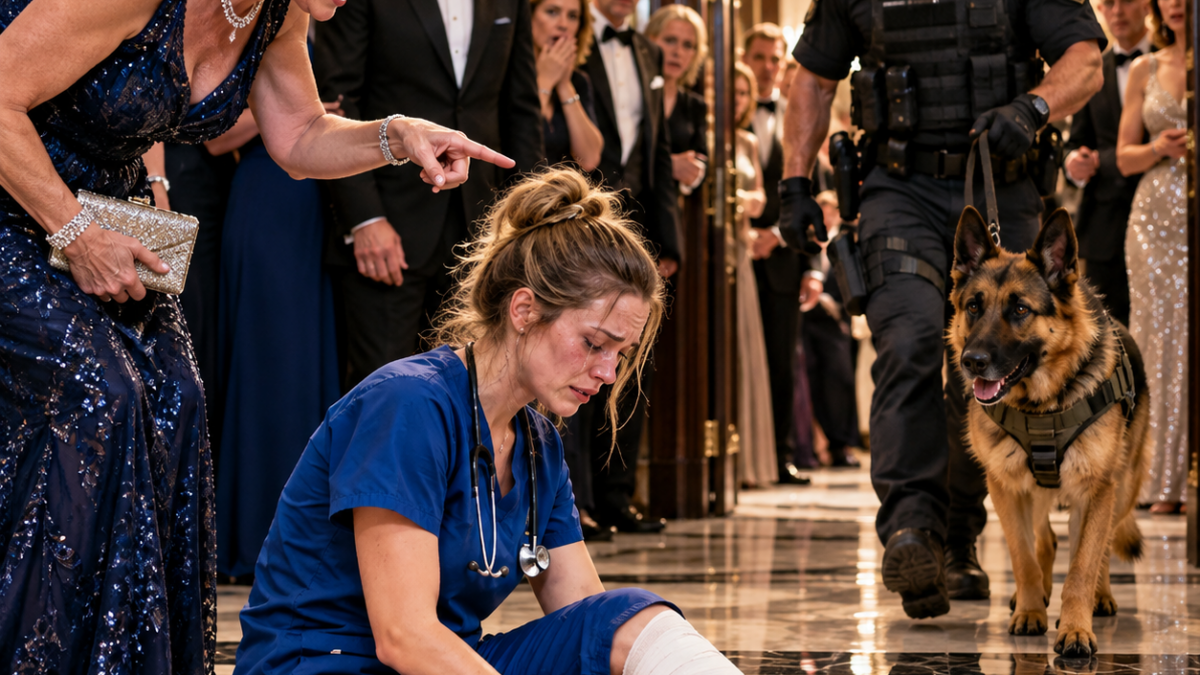
PART3:
I wore a faded navy jacket over plain medical scrubs because even on weekends, I still felt most like myself in them. My right leg ached beneath my pant leg. Cold weather always found the scar.
I carried the small paper bag of treats in my left hand.
Blue ribbon tied around the top.
No name.
No fuss.
I had almost reached the veterans charity booth when two well-dressed shoppers stepped around me with exaggerated impatience.
One of them sighed.
Loudly.
The other muttered, “Maybe crowded places aren’t the best choice if you move that slowly.”
A few quiet chuckles followed.
Not many.
Just enough.
That is how cruelty often works.
It does not need a crowd.
Just two or three people willing to confirm that your pain has inconvenienced them.
I lowered my eyes for only a moment.
Then I kept walking.
I had learned long ago that not every misunderstanding deserves an answer.
Still, the words landed.
They always do.
No matter how strong people think you are, being dismissed leaves a mark. Mine simply had company.
Across the plaza, a black SUV rolled quietly to the curb.
I did not notice it at first.
Why would I?
I was concentrating on the brick path, the crowd, and keeping the paper bag from swinging against my crutch.
The driver stepped out, scanned the area, and opened the rear door.
A tall man emerged wearing a simple dark jacket, dark jeans, and sunglasses. He moved with a controlled stillness I had seen before in military patients—people who did not waste motion because they had learned the cost of chaos.
Beside him stepped a German Shepherd.
Magnificent was the only word.
His sable coat caught the morning sun. His posture was perfectly balanced, calm but alert. His harness was black, fitted cleanly against his powerful chest.
A patch on the side read: TITAN.
Children pointed.
Adults smiled.
A few people lifted phones, because a dog like Titan did not enter a public space unnoticed.
Titan ignored all of it.
He did not look at the children.
He did not react to the music.
He did not sniff the air for food, though the market smelled of sausage, bread, coffee, and kettle corn.
His amber eyes searched the crowd with a focus so intense that even from a distance, people began stepping aside without knowing why.
Then he froze.
His ears rose.
His breathing changed.
The man holding the leash noticed immediately.
That man was Ethan Walker.
I did not know his name in that moment.
Not consciously.
But later, when memory returned in full, I would remember the title everyone used at the rehabilitation center.
Chief Walker.
Former Navy SEAL.
Injured during a mission no one discussed in detail.
A man who had arrived at Bethesda with a body full of damage, a face full of discipline, and a dog who watched over him as if every breath mattered.
Titan had been more than a service dog.
More than a K9 partner.
He had been Ethan’s shadow, his anchor, his warning system, his silent witness during the most painful months of recovery.
But at the farmers market, I did not know any of that yet.
I only knew that I had reached the veterans charity booth, and I was tired.
I placed the paper bag gently beside the donation basket.
A volunteer smiled.
“Oh, thank you. Are these for the dogs?”
“Yes,” I said. “Peanut butter treats. No sugar. No salt.”
“That’s very kind of you.”
I smiled back.
“It’s nothing.”
Then I sensed something beside me.
Not someone.
Something.
A quiet presence.
I turned slowly, expecting another volunteer.
Instead, I found myself looking directly into Titan’s amber eyes.
He sat inches from my left leg.
Not jumping.
Not pulling.
Not begging.
Sitting.
Perfectly still.
His tail rested against the brick. His ears softened. His breathing was slow and calm.
The entire market seemed to draw a breath around us.
“Well,” I whispered, because old habits are hard to break and I had spoken gently to frightened patients, children, dogs, and grieving husbands for most of my adult life. “Hello there.”
Titan lowered his head.
Slowly.
Carefully.
Then he rested his chin against my uninjured knee.
It was not a trick.
No one had commanded it.
No one had guided him.
The movement was so gentle that I barely felt the weight.
But the emotion behind it hit me hard enough that my throat tightened.
I looked around.
“Is he yours?” the volunteer asked.
I shook my head.
“No. I’ve never seen him before.”
Even as I said it, the words felt wrong.
Not false.
Incomplete.
Because something about him was familiar.
Not his face exactly.
His eyes.
Calm.
Intelligent.
Watchful.
I had seen eyes like that beside hospital beds. In therapy rooms. Under fluorescent lights. Waiting through pain without complaint.
I reached down carefully and ran my fingers through the thick fur behind his ears.
Titan closed his eyes and released one long breath.
A sigh.
A surrender.
A sound so full of relief that several people nearby stopped talking.
The guitarist near the fountain kept playing, but even his notes seemed to soften.
A man reached us seconds later.
“I’m sorry,” he said, genuine embarrassment in his voice. “He has never done this without permission.”
I looked up.
Tall.
Dark jacket.
Sunglasses removed now.
Sharp features.
Tired eyes.
Ethan Walker.
I did not know it yet, but memory was already moving.
“You don’t need to apologize,” I said. “He has better manners than most people I meet.”
Ethan smiled, but his attention remained on Titan.
Something extraordinary was happening, and he knew it better than anyone.
He knelt beside the German Shepherd.
“Titan.”
The dog opened his eyes for only an instant, then looked back at me.
He did not move away.
Ethan’s brow furrowed.
Titan sniffed my sleeve.
Then my hand.
Slowly.
Deliberately.
As if searching for something buried beneath years, rain, antiseptic, soap, scar tissue, and change.
I continued stroking his neck.
A scent rose from his harness.
Leather.
Cedar.
A faint trace of antiseptic.
And with it came a flash of memory.
A rehabilitation room.
Bright lights.
Rubber mats.
Parallel bars.
A large German Shepherd lying beside a therapy bench while a wounded man gripped metal rails and tried to take one more step.
I inhaled.
Ethan noticed.
“Has he met you before?” he asked quietly.
I looked at Titan.
“I’m not sure,” I said. “But something feels familiar.”
Titan lifted one paw.
Very carefully, he rested it against the toe of my shoe.
A few people nearby raised phones.
Not in mockery this time.
In wonder.
The gesture was so deliberate it felt like language.
Then my fingers brushed a small metal service tag behind his harness.
A memory snapped into place.
Bethesda.
The military rehabilitation center.
Two years earlier.
I had volunteered there after my emergency room schedule ended.
Not every day.
But often.
More often than I admitted, because I had been exhausted then too and volunteering after shifts made very little practical sense.
But nursing is not always practical.
Sometimes you go where the hurt is because you recognize it.
I remembered the therapy gym.
I remembered a patient they called Chief Walker, though I rarely spoke directly to him at first. He worked harder than anyone in the room and acted like every stumble was a personal failure. His jaw stayed tight. His eyes watched everything. He did not like help.
His German Shepherd never left his side.
Titan.
I remembered bringing fresh water every afternoon because Titan’s bowl always emptied during long sessions. I remembered placing folded blankets near the therapy mat when the air conditioning made the room too cold. I remembered slipping homemade peanut butter treats into my scrub pocket after someone mentioned the dog never accepted food from strangers unless he trusted them.
I remembered kneeling beside Titan one evening when Ethan was still in therapy.
“You’re working hard too,” I had whispered to the dog.
Titan had accepted one treat from my palm, then looked at me like he had made a decision.
I looked at Ethan now.
“The rehabilitation center in Bethesda,” I said softly. “You were there after your first phase of physical therapy began.”
Ethan went still.
“How do you know that?”
“Because I volunteered extra shifts there.” I looked down at Titan and smiled. “You were always one of the last patients to leave the therapy gym. And he never stopped watching you, even when everyone else went home.”
Ethan stared at me.
His face shifted through disbelief, concentration, and something like recognition trying to find its way through fog.
“I remember a voice,” he said.
I swallowed.
“A lot of people were helping you.”
“No.” His eyes stayed on me. “This voice used to say, ‘You’re doing better than you think, Chief Walker.’”
I smiled before I could stop myself.
“I did say that.”
Ethan’s face changed.
Not dramatically.
But something in him lowered its guard.
He looked at Titan.
Then back at me.
“You brought the water.”
“I did.”
“The extra blankets.”
“When the room was too cold.”
“The paper bags of treats.”
“My grandfather’s recipe.”
Ethan laughed once, but it broke in the middle.
“I never knew.”
“You weren’t supposed to. You were busy healing.”
He shook his head slowly.
“You stayed late almost every evening.”
“Some patients needed encouragement after official visiting hours ended.”
My voice softened.
“Sometimes people heal faster when someone simply sits beside them for a while.”
For a moment, the farmers market disappeared.
I was back under fluorescent lights, watching patients fight for inches.
I had learned then that rehabilitation was not always dramatic. It was not always triumphant music and inspiring speeches. Sometimes it was a man taking three steps and hating himself because he remembered when he could run. Sometimes it was a dog standing patiently through another failed attempt. Sometimes it was a nurse saying the same sentence again and again until the patient borrowed enough belief to try once more.
Ethan lowered his eyes.
“There were days I didn’t think I’d come back from that.”
“I know.”
“You saw that?”
“I saw a lot of people facing the hardest version of themselves.”
He looked at Titan.
“And he remembered you.”
Titan pressed closer against my leg.
I ran one hand over his shoulder.
“I suppose he remembered the treats.”
Ethan shook his head.
“No. He remembers kindness better than food.”
The crowd around us had grown.
The woman who had complained about my slow pace stood a few yards away now, her reusable shopping bag clutched to her chest. The man beside her would not meet my eyes.
No one laughed anymore.
That should have felt satisfying.
It did not.
Being proven worthy in public is still painful when you never asked to be judged in the first place.
I shifted my weight on the crutch, uncomfortable with the attention.
Ethan noticed.
“You still do the same thing,” he said.
“What do you mean?”
He nodded toward the charity table.
“You help people without telling them. You helped me without introducing yourself. You baked treats for Titan without leaving your name. And today you came here planning to leave another donation without anyone knowing who brought it.”
I glanced at the paper bag.
“If the dogs enjoy them, that’s enough for me.”
The volunteer opened the bag carefully.
Inside were dozens of peanut butter treats tied with simple blue ribbon.
Beneath them rested the note I wrote every week.
For every working dog who still believes kindness is worth protecting.
The volunteer’s eyes filled.
“You made all of these?”
I nodded.
“Every Friday night.”
“Every week?”
“For almost a year.”
Ethan looked stunned.
“You never missed a week?”
“Some weeks I baked sitting down because my leg hurt too much to stand very long.” I shrugged gently. “But the dogs shouldn’t have to miss their treats because I had a difficult day.”
The silence that followed was different.
Deep.
Uncomfortable.
Reflective.
The kind that makes people meet themselves and not always enjoy the introduction.
The woman who had criticized me earlier stepped forward.
Her face had changed completely.
“Ma’am,” she said softly.
I turned.
She swallowed.
“I owe you an apology.”
“You don’t owe me anything.”
“Yes,” she said. “I do. I judged you before I knew a single thing about you. I only saw the crutch. I never stopped to wonder about the person carrying it.”
I had spent years calming other people’s shame, so the words came naturally.
“We all have moments we wish we could do differently. What matters is what we choose after that.”
Her eyes filled.
“Thank you.”
Several others stepped forward after that.
Not all had laughed.
Most had only looked away.
But sometimes looking away becomes its own kind of failure, and that morning, people seemed to understand it.
An elderly veteran approached with a cane polished smooth from years of use.
“My wife was a nurse for thirty-eight years,” he said. “She always told me the strongest people rarely talk about what they carry.”
“She sounds like someone I would have liked very much,” I said.
He looked at Titan sitting proudly beside me.
“I think that fine dog just reminded all of us to pay better attention.”
Then Titan moved.
He stood, turned, and positioned himself directly beside my left shoulder.
Perfectly aligned.
Perfectly still.
His head rose.
His chest lifted.
His ears settled forward.
The disciplined posture was so precise that every veteran in the area seemed to recognize it before I did.
A retired Marine near the coffee stand removed his baseball cap.
Another man placed one hand over his heart.
I looked down at Titan.
“What is he doing?” I whispered.
Ethan’s voice was thick when he answered.
“He’s honoring someone he believes earned it.”
My breath caught.
“No.”
“Yes.”
“I don’t deserve that.”
Ethan smiled gently.
“That is probably the exact reason you do.”
I rested one trembling hand on Titan’s shoulder.
I had spent my career beside beds, not on stages. I knew how to comfort people, encourage them, help them sit up, clean wounds, start IVs, speak to families, and chart what mattered.
I did not know how to stand in the middle of a farmers market while a former SEAL K9 offered me more respect than many humans had managed to give.
For several long seconds, no one spoke.
The market continued around us in softened fragments.
A child whispered, “Daddy, why is the dog sitting like that?”
Her father replied quietly, “Because he’s saying thank you.”
The volunteer behind the table looked at the donation box.
Then looked again.
People had started adding money.
Not in a rush.
Not for show.
Quietly.
Folded bills.
Checks.
A few larger donations from people who asked no questions.
Parents guided children toward the display of service dog photographs and explained that courage was not always loud. That some heroes wore uniforms, some wore scrubs, some walked with crutches, and some had four paws and better manners than most of us.
The volunteer’s eyes widened.
“We usually collect enough in an entire weekend to cover one month of supplies,” she said. “We’re almost there in less than an hour.”
I smiled.
“Then today turned out better than expected.”
Ethan studied me.
Even then, I think he understood.
The attention embarrassed me.
The donations made me happy.
That told him exactly who I was.
Titan eventually relaxed from his formal posture.
He sat again beside me, shoulder touching my leg, as though the matter had been settled. Then his nose nudged the paper bag.
I laughed.
“You remember those treats better than I expected.”
Ethan smiled.
“He has an excellent memory for kindness.”
I reached into the bag and looked at Ethan.
“May I?”
His smile deepened.
“You never needed permission before.”
I knelt carefully, one hand braced against my crutch. My leg protested, but I ignored it. Titan waited with perfect patience until I held out the treat.
He accepted it from my fingertips with extraordinary gentleness.
A little girl watching nearby whispered, “He says thank you without talking.”
Her father squeezed her shoulder.
“Sometimes actions speak louder than words.”
Before Ethan left that morning, he surprised me.
“There’s a charity dinner next month,” he said. “Retired military working dogs and medical volunteers. I’ve been invited to speak.”
“That sounds wonderful.”
“I’d like you to come as my guest.”
I almost laughed.
Not because he was funny.
Because the idea was absurd.
“I don’t think I belong at an event like that.”
Ethan shook his head.
“You belong there more than I do. They already know my story. They should know yours.”
“I don’t have a story.”
Titan looked at me.
Ethan looked at Titan.
I sighed.
“Fine. I have a story. But only if the focus stays on the dogs and the volunteers.”
“I had a feeling you’d say that.”
The volunteer behind the table stepped forward holding a small blue ribbon.
“Would you mind?” she asked.
Before I could answer, she tied it carefully to the handle of the paper bag.
“Every year we give one of these to someone who reminds us why this work matters.”
My eyes burned.
I touched the ribbon but said nothing.
I did not need to.
Titan stepped back to my side and leaned gently against me.
Accepting the honor with me.
Several weeks later, I nearly canceled twice before leaving for the charity dinner.
I stood in front of my bedroom mirror wearing a simple navy dress and comfortable low heels. My crutch rested beside me, visible and necessary.
For months, I had tried not to make it noticeable.
That night, I decided not to hide it.
It had carried me.
That deserved some respect too.
The ballroom overlooked Charleston Harbor. Warm chandeliers glowed above round tables decorated with blue flowers, framed photographs of working dogs, and handwritten stories from families whose lives had been changed by service animals and medical volunteers.
Ethan stood near the stage in a dark suit.
Titan rested beside him, harness polished, eyes calm.
When Titan saw me, his ears lifted.
Ethan followed his gaze and smiled.
“You came.”
“I said I would.”
“You also looked like you might run.”
“I considered it.”
“Titan would’ve found you.”
“I believe that.”
The dinner was lovely.
Too lovely, honestly.
I had never been comfortable around formal praise. Nurses are used to appreciation arriving in small ways—a thank-you card, a tired smile, a family member remembering your name. Public recognition felt heavier.
When the master of ceremonies welcomed everyone, Ethan was invited to the podium.
The room applauded.
He stood there for a moment, then shook his head slightly.
“Tonight is not really about me,” he began.
The room quieted.
“Most people believe courage is measured in dramatic moments. Missions. Medals. Rescues. Survival. I used to think that too.”
His eyes moved toward me.
“Then I met people who changed lives through ordinary kindness almost no one noticed.”
My stomach tightened.
Ethan continued.
“There was a nurse who stayed after long shifts because someone needed encouragement. She never asked for recognition. She never expected anyone to remember. The only reason her story is being told tonight is because one remarkable dog refused to forget.”
Every eye in the ballroom turned toward me.
I wanted the floor to open.
Titan stood.
Without command, he walked across the polished floor and stopped beside my chair exactly as he had done at the market.
Then he sat proudly at my side.
Soft laughter and emotional murmurs moved through the room.
Ethan continued.
“People often thank those who wear uniforms, carry titles, or receive medals. We should. But some of the greatest acts of service happen when no audience is watching. They happen in quiet hospital rooms, empty hallways, therapy gyms after hours, and ordinary moments where someone chooses compassion over convenience.”
The applause began before he finished.
Then the room stood.
A standing ovation.
For me.
I remained seated for a moment, overwhelmed in a way pain had never managed to make me. Then I reached for my crutch and stood slowly.
Titan stayed beside me.
I walked to the front because Ethan waved me forward, and because Titan seemed to think the matter was decided.
At the microphone, I looked out over veterans, nurses, families, handlers, and volunteers.
I had no speech prepared.
So I told the truth.
“Please remember the people who care for others after everyone else has gone home,” I said. “There are more of them than you know.”
That was all.
The applause grew louder.
Not because the words were dramatic.
Because they were true.
After the event, families lined up not for photographs with Ethan, but to introduce their children to Titan and to thank me for reminding them that kindness deserves to be practiced, not merely admired.
I accepted every handshake awkwardly.
Titan accepted attention with far more grace.
Before leaving, I knelt beside him one last time.
It took effort.
My leg ached.
My hand shook slightly.
I rested my forehead against his.
“Thank you for remembering,” I whispered.
Titan leaned into my hand with complete trust.
Ethan stood nearby.
“There are some debts you can’t repay,” he said softly.
I looked up.
“No. But you can honor them.”
He nodded.
Outside, the harbor reflected thousands of lights across the calm water. The night air smelled faintly of salt and rain.
Ethan walked slowly beside me toward the parking lot.
Titan stayed between us, matching my pace without being asked.
For the first time in a long while, I did not feel like the slow person everyone had to move around.
I felt accompanied.
There is a difference.
That is what Titan gave me back.
Not dignity.
I had not lost that.
Not worth.
That had never belonged to strangers.
He gave me back the experience of being seen correctly.
Not as a limp.
Not as a crutch.
Not as a woman moving too slowly through someone else’s morning.
As a nurse.
As a witness.
As someone who had carried others when she could barely carry herself.
Years have passed since the farmers market, and Titan is older now. So am I. Ethan and I became friends in the steady way adults do when respect comes before small talk.
Once a month, we help with the retired working dog program.
I still bake the treats.
Sometimes standing.
Sometimes sitting.
Always with blue ribbon.
At every event, Titan finds me first.
No matter how many people are there.
No matter how much time has passed.
He walks through the crowd with that same quiet certainty, sits beside my left leg, and waits for one hand to rest on his shoulder.
People still stop and watch.
Children still whisper.
Adults still ask how he knows me.
Ethan always gives the same answer.
“He remembers who showed up when no one was watching.”
That is the kindest thing anyone has ever said about me.
And the most accurate.
Because in the end, that is what all real service comes down to.
Not uniforms.
Not titles.
Not applause.
Showing up.
In the room after visiting hours.
In the therapy gym after everyone else leaves.
At the farmers market with a paper bag of treats.
Beside a woman with a crutch when the world has forgotten to look deeper.
They looked down on me that morning because I moved slowly.
Titan remembered that I had once helped others move forward.
And when he sat beside me in that crowded plaza, proud and still and certain, he reminded everyone watching of something too many people forget.
Courage does not always arrive standing tall.
Sometimes it leans on a crutch.
Sometimes it bakes dog treats while sitting down because the pain is too sharp to stand.
Sometimes it speaks softly in hospital rooms after the official shift has ended.
And sometimes, years later, a loyal dog recognizes it before anyone else does.








