They Heard a Cat Crying Beneath a Dumpster for Hours—Then the Vet Found Out Why He Couldn’t Stand
PART3:
The cat flattened his ears.
His pupils were huge.
Fear.
Pain.
Exhaustion.
Lena slid a towel slowly toward him.
He hissed.
Then cried.
Not anger.
Panic.
She stopped.
“You’re okay.”
He was not okay.
But sometimes rescuers say things they hope will become true.
Getting him out took nearly twenty minutes.
He could not crawl properly.
Every attempt to shift his body made him vocalize.
Eventually Lena managed to loop the towel gently around him and pull him forward just enough to support his hips.
When he emerged from beneath the dumpster, the woman who had first heard him covered her mouth.
The cat was smaller than she expected.
Maybe seven pounds.
Maybe less.
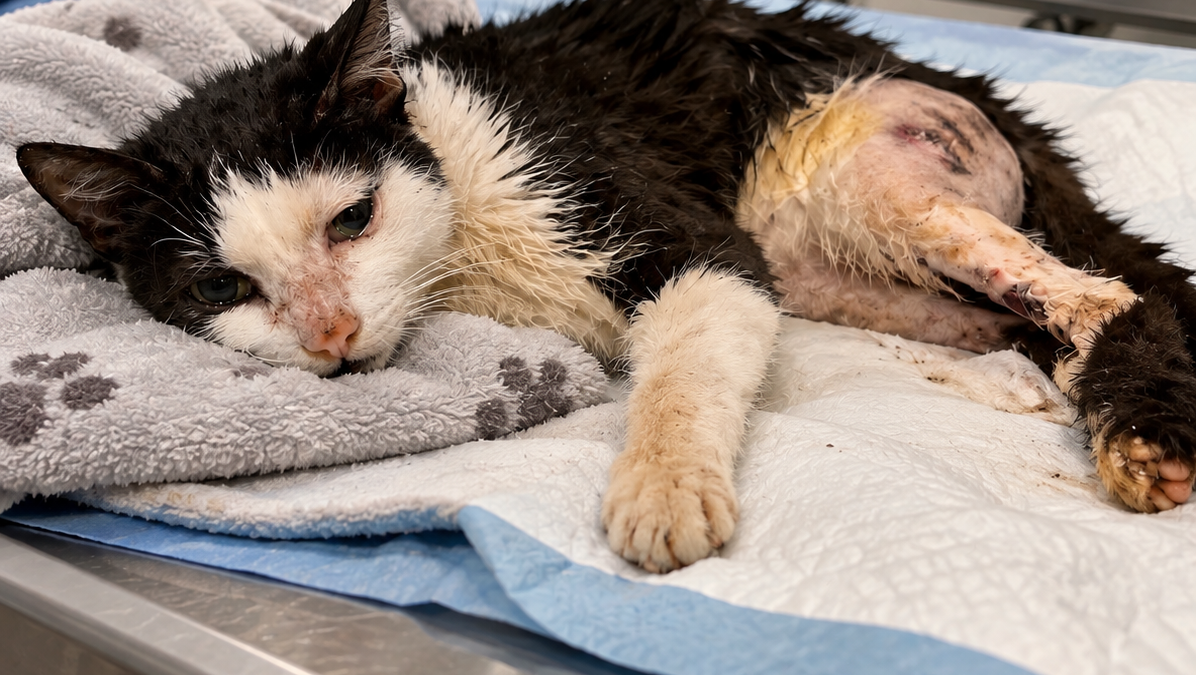
His fur was dirty with grease and dust.
One hind leg sat at an unnatural angle.
His pelvis looked wrong even without an X-ray.
Lena placed him inside the carrier on a folded blanket.
The cat did not fight anymore.
That worried her.
Animals in severe pain sometimes stop resisting not because they trust you.
Because they have nothing left.
She drove straight to the veterinary hospital.
At intake, the staff moved quickly.
Pain medication.
Temperature.
Heart rate.
Hydration.
Bloodwork.
Radiographs.
The cat cried when they repositioned him.
One technician whispered:
“I know. I know.”
Nobody knew his name.
So the paperwork said:
UNKNOWN MALE CAT.
FOUND UNDER DUMPSTER.
Then one of the technicians looked at his pale gray coat and said:
“He looks like frost.”
Someone else replied:
“Firn.”
“What?”
“Firn. Old snow.”
The name stuck.
Firn.
He had a name before the X-rays were finished.
The veterinarian, Dr. Maya Chen, stood in front of the images for a long time.
Lena watched her.
“That bad?”
Dr. Chen pointed.
“The pelvis is fractured in multiple places.”
Another line.
“Here.”
Then another.
“And here.”
“Car?”
“Most likely.”
“Can he walk again?”
Dr. Chen did not answer immediately.
“That depends.”
Nobody likes that answer.
But honest medicine contains a lot of depends.
She continued.
“The good news is I don’t see obvious spinal damage.”
Lena exhaled.
“The bad?”
“His pelvis is unstable. He’s in significant pain. And if we leave it like this, he may heal badly enough that normal movement becomes impossible.”
“Surgery?”
“Yes.”
“How soon?”
“As soon as he’s stable enough.”
Firn spent that night in a warmed kennel.
For the first few hours, he barely moved.
When someone opened the door, his eyes widened.
But he did not hiss anymore.
He simply watched.
A technician offered food.
He turned his head away.
Water.
Nothing.
Pain medication helped.
Fluids helped.
By midnight, he finally licked a little wet food from a spoon.
The technician nearly celebrated.
“Good boy.”
Firn stopped.
Looked at her.
Then took another lick.
By morning he had eaten almost half a tablespoon.
Small victories become enormous when an animal is badly injured.
The surgery was scheduled for the following day.
It took hours.
The orthopedic surgeon stabilized the pelvis as much as possible.
Afterward, Firn woke slowly.
Groggy.
Confused.
Pain controlled.
He tried to shift.
Could not.
A nurse rested one hand near his chest.
“Don’t.”
He settled.
For the next several days, everything revolved around keeping him still.
That is difficult with cats.
Even injured ones.
Especially once pain starts improving.
Firn became more alert.
Then more opinionated.
He disliked medication.
He disliked being examined.
He disliked the cone.
He disliked the entire concept of confinement.
This was encouraging.
A cat who was annoyed had energy left.
By the end of the first week, he was eating.
By the second, he was sitting more upright.
By the third, he began placing some weight on his hind legs.
Carefully.
Weakly.
But weight.
Everyone began to believe the hardest part was behind him.
That belief lasted four days.
It started with stiffness.
At first, nothing dramatic.
One morning Firn did not stand when breakfast arrived.
The technician assumed he was sleepy.
She placed the bowl closer.
He ate lying down.
Odd.
Later that afternoon, she encouraged him to rise.
Firn pushed with his front legs.
His back legs barely responded.
She frowned.
“Come on, buddy.”
He tried again.
Nothing.
By evening he could not stand.
The next morning, he was worse.
Everyone’s first fear was the pelvis.
Surgical failure.
Nerve damage.
A new injury.
X-rays were taken.
The fixation looked stable.
No obvious new fracture.
Dr. Chen examined him.
Firn objected loudly when certain joints were moved.
Not just the pelvis.
Hocks.
Knees.
Even one front leg.
“That’s new.”
Bloodwork.
Inflammatory markers.
Repeat exam.
Nothing fit neatly.
Lena visited that afternoon.
She had followed Firn’s recovery closely and expected to see a cat preparing for discharge.
Instead, she found him lying on a blanket.
“What happened?”
Dr. Chen shook her head.
“We’re figuring it out.”
“He can’t walk?”
“Not right now.”
“Did the surgery fail?”
“No.”
“Then what?”
“I don’t know yet.”
That sentence hurt.
Firn had already survived the dumpster.
The pelvic fractures.
Major surgery.
Weeks of confinement.
Now this.
Lena sat beside the kennel.
Firn lifted his head.
His eyes looked clearer than they had on rescue day.
He recognized her.
At least she liked to think he did.
She put one finger near the bars.
He sniffed it.
Then rested his chin back down.
“You’ve got terrible timing.”
Firn blinked.
Over the next several days, the veterinary team tested possibilities.
Infection.
Immune-mediated disease.
Reaction to trauma.
Post-surgical complication.
Neurologic problems.
Nothing fully explained it.
Then a specialist reviewed the case.
Dr. Aaron Patel, a veterinary internist with an interest in inflammatory disorders, watched Firn attempt to stand.
He asked:
“How quickly did the stiffness develop?”
“About forty-eight hours.”
“Any fever?”
“Mild.”
“Joint swelling?”
“Yes.”
“Multiple limbs?”
“Yes.”
He studied the blood results.
Then said:
“This may not be orthopedic anymore.”
Dr. Chen looked at him.
“What are you thinking?”
“Inflammatory polyarthritis.”
Lena, who happened to be there, frowned.
“Arthritis?”
“Not normal arthritis.”
Dr. Patel explained.
This was not the slow wear-and-tear disease people associate with old age.
It was inflammation affecting multiple joints.
Rare.
Painful.
Potentially severe enough that an animal simply refuses or becomes unable to stand.
Firn had survived one major injury only for his immune system—or some inflammatory trigger associated with his illness and recovery—to create an entirely different problem.
Further testing supported the diagnosis.
That was the bad news.
The good news?
There was treatment.
Firn started medication.
Nobody promised immediate results.
That would have been unfair.
The first day, nothing changed.
Second day, still mostly lying down.
Third day, he shifted himself more easily.
Fourth morning, a technician opened his kennel with breakfast.
Firn pushed up.
Front legs.
Then hind legs.
He stood.
For maybe two seconds.
Then sat.
The technician froze.
“Did you just—”
Firn looked at her.
She called Dr. Chen.
“He stood.”
“How long?”
“Two seconds.”
“That counts.”
It did.
That afternoon he did it again.
Three seconds.
Then five.
The following day, one shaky step.
Then another.
The entire recovery team became ridiculous about it.
Every tiny improvement was reported like breaking news.
“Firn walked four steps.”
“Firn stood while eating.”
“Firn turned around without falling.”
“Firn tried to climb.”
The last one was less celebrated.
“No climbing.”
Firn disagreed.
His personality emerged as his pain decreased.
He was not the helpless, tragic cat people imagined from his rescue photographs.
He was mischievous.
Demanding.
Food motivated.
Very interested in whatever humans were doing.
He discovered that if he meowed loudly enough, someone usually appeared.
Considering how his story began, nobody had the heart to discourage this.
He abused the system immediately.
Breakfast late by three minutes?
Meow.
Door closed?
Meow.
Technician walked past without greeting him?
Meow.
One nurse laughed.
“You cried under a dumpster for hours and nobody came. Now you’ve decided nobody gets to ignore you ever again.”
That seemed accurate.
Physical therapy started slowly.
Supported standing.
Gentle range-of-motion exercises.
Short controlled walks.
Firn hated some of it.
He tolerated more when treats were involved.
The goal was not speed.
Strength.
Balance.
Confidence.
His body had spent weeks learning not to trust movement.
First because movement hurt from the fracture.
Then because every joint hurt.
Even after treatment reduced inflammation, Firn hesitated.
One therapist described it perfectly.
“His body is getting better faster than his confidence.”
So they stopped forcing milestones.
They made movement rewarding.
Food a few steps away.
A toy nearby.
A soft bed across the room.
Eventually curiosity started beating fear.
One afternoon, a feather toy slipped from a volunteer’s hand.
It landed several feet from Firn.
He stared.
The volunteer reached down to pick it up.
Firn moved first.
One step.
Two.
Three.
Then a sudden awkward burst.
Not graceful.
Not quite running.
But definitely faster than anyone had seen him move.
He reached the toy.
Pounced.
Everyone laughed.
Firn looked around as if confused by the attention.
Then attacked the feather again.
That was the first time Dr. Chen allowed herself to say:
“I think he’s going to be okay.”
Weeks passed.
Firn gained weight.
His coat changed.
It became clean.
Soft.
Fuller.
The sharp edges of his spine disappeared.
He learned to jump onto low platforms.
Then slightly higher ones.
He chased toys.
Played with paper balls.
Ate enthusiastically.
Very enthusiastically.
The cat who once had to be coaxed to lick food from a spoon became the cat who attempted to steal another patient’s chicken.
“Excuse me.”
A technician caught him halfway across the counter.
Firn froze.
“You are on restricted activity.”
He blinked.
“This is not restricted.”
Firn continued.
She picked him up.
He protested.
That was when staff began looking for a foster home.
A shelter environment is useful for medical care.
Not for learning how to be somebody’s cat.
A volunteer named Jenna agreed to take him.
She expected a quiet recovery patient.
Firn arrived at her apartment and hid for twenty minutes.
Then emerged.
Inspected every room.
Found a windowsill.
Found the food.
Found the sofa.
Found Jenna’s pillow.
By the second night, he was sleeping beside her head.
“So much for shy.”
His first week in foster care proved something important.
Firn did not simply want to survive.
He wanted to live.
There is a difference.
Survival is breathing.
Eating enough.
Maintaining body temperature.
Living is discovering sunlight on a rug and choosing to sleep there.
Chasing dust.
Watching birds.
Stealing a pen.
Learning the refrigerator door sometimes means food.
Firn did all of it.
His walking improved almost daily.
There were still stiff mornings.
Medication continued.
Follow-up appointments continued.
Nobody pretended the unusual arthritis could simply be forgotten.
But his trajectory had changed.
At one visit, Dr. Patel watched him walk down the hallway.
No support.
Tail up.
He smiled.
“Remember when he couldn’t stand?”
Jenna did.
Everyone did.
Firn reached the end of the hallway.
Then turned and trotted back.
Not limped.
Trotted.
Lena happened to be visiting the clinic that afternoon.
She saw him.
For a moment, she did not recognize him.
This solid little cat with bright eyes and a thick coat looked nothing like the animal she had pulled from beneath a dumpster.
“Firn?”
He stopped.
Looked.
Then walked toward her.
She crouched.
“You look expensive.”
He rubbed against her knee.
“You have no idea how many people worried about you.”
Firn purred.
The first time Lena had ever heard him do it.
That nearly broke her.
She sat on the floor.
Firn climbed partly into her lap.
“I remember when you wouldn’t let me touch you.”
Purr.
“You bit the towel.”
Purr.
“You screamed at everybody.”
Purr.
“Now look at you.”
He kneaded her leg.
“Okay. That hurts.”
Some things never become perfect.
Firn would always carry evidence of what happened.
The repaired pelvis.
A slightly unusual gait when tired.
Medical monitoring.
Possibility of future inflammatory flares.
But perfection was never the goal.
Comfort.
Mobility.
Safety.
Joy.
Those were enough.
Eventually he became available for adoption.
His listing included the truth.
History of severe pelvic trauma.
Surgery.
Rare inflammatory polyarthritis.
Ongoing veterinary considerations.
The rescue worried that medical history might scare people away.
Then applications arrived.
Several.
One stood out.
A woman named Sophie.
She lived alone.
Worked from home.
Had experience with cats needing medication.
No other pets.
Quiet apartment.
She wrote:
“I don’t need a perfect cat. I want the cat who needs the kind of home I can give.”
Jenna cried when she read it.
“This is unfair.”
Firn was asleep on her laptop.
She nudged him.
“You’re leaving me, apparently.”
Firn opened one eye.
“Rude.”
The adoption meeting happened at Jenna’s apartment.
Sophie sat on the floor.
Did not reach for him.
Firn watched from the doorway.
Five minutes.
Ten.
Then walked over.
Sniffed her hand.
She stayed still.
He rubbed his cheek against her fingers.
Jenna looked away.
“Oh, come on.”
Sophie smiled.
“That good?”
“He doesn’t do subtle.”
Firn climbed into Sophie’s lap.
Decision made.
The day he left foster care, Jenna cried.
A lot.
Sophie cried too.
Firn did not.
Firn was busy investigating the carrier.
At his new home, he adjusted quickly.
Window.
Couch.
Food.
Bed.
Sophie sent updates.
Day one:
He ate everything.
Day three:
He discovered the bathroom sink.
Week one:
He sleeps with me.
Week three:
He ran across the apartment at 2 a.m. for no reason.
Jenna replied:
That means he’s officially healthy.
Months later, Firn returned to the veterinary hospital for a routine check.
A new technician brought him down the hall.
Several longtime staff members heard the name.
“Firn?”
People started appearing from rooms.
Dr. Chen came out.
Leah.
Dr. Patel happened to be there.
Sophie looked confused.
“Is he famous?”
Dr. Chen laughed.
“To us.”
Firn was placed on the floor.
He walked.
Then trotted.
Someone rolled a small ball toward him.
He ran after it.
Actually ran.
Full speed.
Tail high.
He overshot the ball.
Turned.
Ran again.
Nobody spoke for a second.
Because memory is strange.
They were not seeing only the cat in front of them.
They were seeing the other Firn too.
Cold.
Dirty.
Crying beneath a dumpster.
Back legs dragging.
Then after surgery:
Unable to stand.
They remembered lifting him.
Turning him.
Supporting him.
Worrying.
Testing.
Waiting.
And now he was annoyed because the ball had rolled beneath a cabinet.
Leah wiped her eyes.
“This is ridiculous.”
Dr. Chen said:
“You’re crying.”
“No.”
“You absolutely are.”
“Air conditioning.”
“Sure.”
Sophie picked Firn up.
He squirmed.
“Apparently emotional reunions are not his thing.”
Everyone laughed.
That was perfect.
He was done being a tragedy.
He was a cat.
A spoiled one.
A healthy-enough one.
A loved one.
That was what everyone had wanted.
There is a tendency to turn stories like Firn’s into something inspirational.
“He never gave up.”
Maybe.
But Firn did not cure himself with determination.
He cried because he hurt.
He hid because he was scared.
He stopped standing because his joints were inflamed.
His recovery happened because somebody heard him.
Somebody stopped.
Somebody called for help.
Rescuers crawled under a dumpster.
Veterinarians repaired his pelvis.
Technicians noticed when his recovery changed.
Doctors kept looking when the first explanation no longer fit.
Medication worked.
Physical therapy worked.
Foster care worked.
Time worked.
And Firn did his part.
He kept responding.
Kept eating.
Kept trying.
But nobody should look at a suffering animal and believe surviving is simply about fighting hard enough.
Sometimes survival depends on being found.
That may be the most important part of Firn’s story.
The woman who stopped near the dumpster could easily have kept walking.
She was busy.
She had somewhere to be.
The sound was faint.
Someone else might have handled it.
Except someone else had not.
Firn had already been crying for hours.
So she stopped.
Listened.
Looked.
Called.
Stayed.
A simple chain of decisions.
No dramatic rescue equipment.
No heroic speech.
Just:
There is an animal crying.
I am not leaving until I know why.
That decision changed everything.
Because beneath that dumpster was not a hopeless cat.
There was a cat with a broken pelvis that could be repaired.
Later there was not a cat doomed never to walk again.
There was a patient with an unusual inflammatory disease that could be treated once somebody recognized it.
Again and again, Firn’s future changed because someone refused to accept the easiest explanation.
Maybe he is just feral.
No.
He is injured.
Maybe the surgery failed.
No.
Something else is happening.
Maybe he will never stand.
Wait.
Find the cause.
Treat it.
Maybe his life will always be medical crisis after medical crisis.
No.
Give him a home.
Let him become ordinary.
Today, Firn’s favorite things are not dramatic.
Sunny windows.
Warm blankets.
Chicken.
Cardboard boxes.
A particular red toy mouse.
Sleeping across Sophie’s keyboard whenever she is trying to work.
He occasionally gets stiff.
He still needs veterinary monitoring.
Sophie watches closely.
But most days, there is nothing in his behavior that would tell a stranger how his story began.
That is exactly how everyone likes it.
Because recovery is not supposed to make suffering your identity forever.
Firn was the dumpster cat.
Then the pelvic-fracture cat.
Then the cat who could not stand.
Then the rare-arthritis case.
But eventually?
He became Firn.
Just Firn.
The cat who yells for breakfast.
The cat who runs down the hallway after toys.
The cat who steals Sophie’s chair the moment she stands.
The cat who gained enough weight that his veterinarian once looked at the scale and said:
“All right. We can stop celebrating every ounce now.”
Firn disagreed.
He celebrated by eating.
Sometimes Sophie looks at the old rescue photograph.
Tiny cat beneath a dumpster.
Dirty fur.
Terrified eyes.
And then looks toward the couch.
Firn on his back.
One paw in the air.
Completely safe.
The difference is almost difficult to understand.
Not because miracles happened.
Because ordinary people did not walk away.
One person heard a cry.
One rescue answered.
One veterinary team kept asking questions.
One foster opened her home.
One adopter said:
“I don’t need a perfect cat.”
That is how lives change sometimes.
Not all at once.
One decision at a time.
Listen.
Stop.
Look.
Help.
Try again.
And months after Firn cried beneath that dumpster believing nobody was coming, he ran across a veterinary floor so fast he skidded past the toy everyone had thrown for him.
The room laughed.
Firn turned around.
Ran back.
And for a few seconds, every person who remembered where he started simply stood there watching.
Because the cat who once could not drag himself out from beneath a dumpster was running simply because he could.








