They Cut Down 22 Trees on My Property to Improve Their “View”—Then I Found Out Their Perfect Backyards Had Been Living Off My Water.
They Cut Down 22 Trees on My Property to Improve Their “View”—Then I Found Out Their Perfect Backyards Had Been Living Off My Water.
The first thing I noticed was the silence.
Not peaceful silence.
Not the soft country quiet I had spent most of my life learning to love.
This was the kind of silence that makes your skin tighten before your mind understands why.
The kind that feels wrong because something that should have been there is suddenly missing.
I pulled into my driveway just after five on a Thursday afternoon, dusty from a long day in town, one hand on the wheel, the other still stained with grease from fixing a busted trailer latch behind the feed store.
Normally, that time of day, the wind moved through the maples along my eastern boundary and made the whole place sound alive.
Leaves whispering.
Branches rubbing together.
Birds fussing somewhere up high.
That green wall had been there my entire life.
It softened the heat in summer.
It broke the winter wind before it hit the house.
It hid my porch from the new subdivision on the ridge and kept their world from pressing too hard against mine.
But when I stepped out of my truck that day, there was no whisper.
No shade shifting across the ground.
No rustle above me.
Just open sky where there had never been open sky before.
I stood there with my keys in my hand, staring at the edge of my property, and for a few seconds my brain refused to name what my eyes were seeing.
Then it did.
My trees were gone.
All of them.
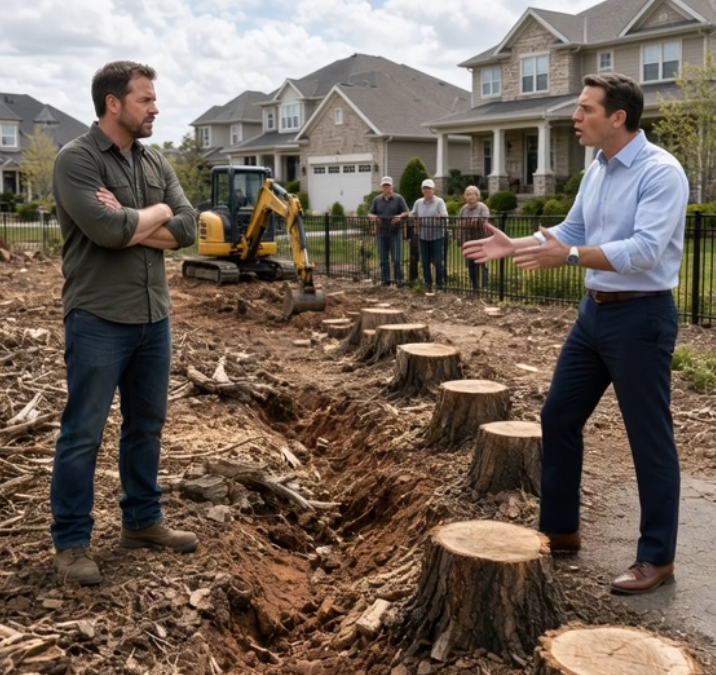
Twenty-two old maples, some close to thirty feet tall, cut down to raw stumps in a long ugly line beside the property boundary.
The land looked stripped.
Exposed.
Wounded.
Sawdust covered the grass like dirty snow.
Fresh tire tracks ran through the soft earth.
The stumps were so new the cut surfaces still looked pale and wet, with rings opened to the air like someone had sliced through time and left it bleeding.
I walked toward them slowly.
I did not run.
I did not yell.
I just walked, one boot after the other, because some kinds of shock make you move like an old man.
When I reached the first stump, I put my hand on it.
It was still warm.
That warmth hit me harder than anything.
It meant I had only missed them by a few hours.
Whoever had done it had been on my land that morning while I was working, while my house sat quiet, while the trees my grandfather planted were falling one by one and nobody called me.
Nobody knocked.
Nobody asked.
PART2:
Nobody even had the decency to lie to my face first.
My grandfather planted those maples before I was born.
He used to tell me he put them there for whoever came after him.
He said every family needed a line of trees between them and the foolishness of the world.
Back then, the land beyond that boundary was pasture.
Nothing but grass, wild onion, and an old cattle lane that led to the north ridge.
The world had not reached us yet.
Then time did what time does.
The pasture sold.
Survey stakes appeared.
Bulldozers came.
The ridge turned into Crest Hollow Estates, a high-end development with oversized houses, fake stone fronts, decorative fences, and tiny identical saplings planted in mulch circles like apologies.
I did not love it, but I did not fight it.
People have a right to build on land they own.
I kept to myself.
They kept to themselves.
The maples stood between us.
That was the arrangement.
At least I thought it was.
Taped to the third stump was a laminated notice.
Bright white paper.
Black lettering.
PART3:
Official-looking enough to fool someone who wanted to be fooled.
I pulled it loose and read it under the open sky my trees used to block.
TREE REMOVAL COMPLETED UNDER NEIGHBORHOOD IMPROVEMENT ORDINANCE.
OBSTRUCTION OF SIGHTLINES AND COMMUNITY VIEW CORRIDOR.
NONCOMPLIANT VEGETATION REMOVED FOR COLLECTIVE PROPERTY ENHANCEMENT.
CREST HOLLOW ESTATES ARCHITECTURAL AND LANDSCAPE COMMITTEE.
Underneath that, in smaller letters:
NO FURTHER ACTION REQUIRED.
No further action.
I read those three words again.
Then again.
Then I folded the notice slowly and put it in my shirt pocket.
My hands were steady.
That scared me a little.
I have learned over the years that when anger comes hot, a man might shout, throw something, say more than he should. But when anger comes cold, when it slides into you clean and quiet, that is when every movement becomes careful.
And I was very careful as I turned from the stumps and looked up toward the ridge.
Crest Hollow Estates sat above my land like a row of smug teeth.
Behind their houses, wide glass doors opened onto manicured backyards. Perfect green lawns. Stone patios. Fire bowls. Outdoor kitchens. White umbrellas. Infinity-edge pools designed to look as if water spilled into the valley.
And now, for the first time, they had a clear view.
My view.
My land.
My dead trees.
At the center of that ridge, directly above my eastern boundary, stood the biggest house in the subdivision.
Three stories.
Gray stone.
Black-framed windows.
A deck big enough to land a helicopter on.
That was where Preston Vale lived.
Preston Vale was the president of the Crest Hollow Estates HOA, a man who had introduced himself six months earlier by walking up my driveway in loafers, tapping on my porch railing as though inspecting it, and saying, “You must be the owner of the rustic parcel below us.”
Rustic parcel.
That was what he called the farm my family had held since 1912.
He had a smooth face, silver hair, and the kind of smile that looked professionally installed. His wife, Marissa, wore tennis skirts on weekdays and spoke to people like customer service had ruined her expectations of humanity.
They had built their house directly behind my maple line.
For months, they had been complaining about their view.
Not to me at first.
I heard it from Travis at the feed store.
Then from my mail carrier.
Then from old Mrs. Bell, who lived on the road behind the development and knew everyone’s business because everyone was too careless around an eighty-year-old woman in a garden hat.
“They say your trees block the sunset,” she told me one morning.
“They’re supposed to.”
“They say they paid for a valley view.”
“They should have bought the valley.”
She laughed so hard she had to grip her cane.
I did not think much of it then.
Rich people complained the way pond frogs croaked.
Background noise.
Then Preston came to my porch.
It was early May, and the maples were full, leaves bright and tender from spring.
I had been repairing the screen door when his black SUV rolled up my gravel drive without invitation.
He stepped out holding a leather folder.
“Mr. Harlan?” he said.
“Caleb Harlan,” I answered.
He extended a hand.
“Preston Vale. Crest Hollow Estates HOA president.”
I looked at his hand.
Then at his shoes in my dust.
“What can I do for you?”
The hand lowered.
His smile stayed.
“We’ve been hoping to discuss the tree line along your eastern boundary.”
“No.”
He blinked.
“I’m sorry?”
“No.”
“You haven’t heard the proposal.”
“I heard enough.”
He gave a polite chuckle.
“I think we may have gotten off on the wrong foot.”
“You drove up my private road to talk about cutting my trees.”
“Trimming,” he said. “Selective trimming. View restoration, really.”
“My trees do not need restoration.”
“Several homes along the ridge were marketed with panoramic valley views. The mature growth along your boundary has become an unexpected visual obstruction.”
“Those trees were there before your ridge had plumbing.”
His smile thinned.
“Yes, well, development does change usage expectations.”
“Not mine.”
He opened the leather folder anyway.
Inside were color renderings.
My land, apparently.
My tree line, reduced by half.
Their houses above, glowing in sunset.
The renderings made my maples look like messy brush that had accidentally wandered into luxury.
“We’re prepared to cover removal costs,” Preston said. “And replace the trees with a lower privacy planting. Something more appropriate. Perhaps native shrubs.”
“I already have native trees.”
“Tall trees.”
“That’s how trees work.”
His smile finally disappeared.
“Mr. Harlan, surely you understand that your property affects neighboring values.”
“My grandfather understood that too. That’s why he planted the maples.”
Preston closed the folder.
“Would you at least consider a partial reduction?”
“No.”
“May I ask why?”
I looked past him toward the green line moving in the wind.
“Because they’re mine.”
He stared at me for a few seconds, as if ownership was a quaint rural superstition.
Then he nodded.
“I see.”
But he did not see.
Men like Preston never see a refusal as an answer.
They see it as a delay.
After that, the letters started.
Not legal letters.
Not at first.
Community notices.
Friendly requests.
“Collaborative landscape discussions.”
One was titled Shared Views, Shared Values.
I threw that one in the stove.
Then came an invitation to a Crest Hollow Estates board meeting, despite the fact that I did not live in Crest Hollow Estates and would rather have attended a dental surgery performed by raccoons.
Then a packet from their architectural committee, explaining that obstructive vegetation near a view corridor could negatively impact community harmony.
I mailed it back with one sentence written across the top.
Not my community.
Two weeks later, Preston’s tone changed.
He sent a certified letter claiming the tree line “encroached visually” upon HOA-regulated sightlines.
I pinned that letter to the refrigerator because it was the stupidest phrase I had ever seen typed by an adult.
Encroached visually.
I should have taken it more seriously.
Not because his argument had merit.
Because arrogance does not need merit to become dangerous.
By June, they had started standing on the ridge and pointing down at my land like generals planning a campaign.
I saw them at sunset sometimes.
Preston and Marissa.
A few neighbors.
Wineglasses.
Phones.
Pointing.
Looking.
Planning.
Still, I never thought they would cross the line.
That was my mistake.
I had spent my life dealing with weather, livestock, machinery, drought, bad fences, and county bureaucrats. I had forgotten that certain people are more destructive than storms because storms do not believe they are entitled.
I looked at the stumps until the sun began to slide behind Crest Hollow.
Without the maples, their houses burned gold in evening light.
Their patios glowed.
Their windows flashed.
Their perfect view had arrived.
I turned away and walked to my barn.
Inside, the air smelled of hay, oil, and old wood.
I took down the survey maps from the metal cabinet where my father had kept them wrapped in brown paper. Original deeds. Boundary descriptions. Easements. Water rights. Timber records. My grandfather had saved everything.
He used to say, “Paper beats memory when liars arrive.”
I laid the maps across the workbench and switched on the old lamp.
There it was.
Eastern boundary.
Clear as a church bell.
The maple line stood eight to twelve feet inside my property, not on the line, not near enough for confusion, and certainly not on Crest Hollow land.
I took photos of the maps.
Then I called Sheriff Nolan.
He answered on the fourth ring.
“Caleb?”
“Nolan.”
“You sound like you’re about to make my evening difficult.”
“My trees are gone.”
Silence.
“What trees?”
“The maples along the east boundary.”
“All of them?”
“Twenty-two.”
“Storm?”
“HOA.”
Another silence.
This one longer.
“I’ll be there in twenty.”
Sheriff Nolan Briggs had known me since high school, which meant he knew two important things: I did not call him over nonsense, and I did not use the word HOA unless I was already considering biblical solutions.
He arrived in a county cruiser just as dusk settled.
He stepped out, adjusted his hat, and stared at the open boundary.
“Well,” he said quietly. “That’s a crime scene.”
“Good. I was hoping you’d say that.”
He walked the line slowly, flashlight moving over stumps, sawdust, tire tracks, and broken branches. When he reached the laminated notice, I handed it to him in an evidence bag I had taken from the drawer where I kept old veterinary records.
He read it twice.
“Neighborhood Improvement Ordinance,” he said.
“There isn’t one.”
“No.”
“View corridor?”
“No.”
“Noncompliant vegetation?”
He looked at the stumps.
“Trees were on your property?”
“Yes.”
“You got survey?”
“In the barn.”
“Cameras?”
“One on the driveway. Doesn’t catch the east line. Maybe caught trucks coming in.”
We checked.
The camera showed two white work trucks entering my driveway at 8:37 that morning.
No company logo.
A chipper followed at 8:44.
At 12:13, the trucks left loaded with cut maple logs.
That almost made me lose my temper.
Not the trucks.
Not the timing.
The logs.
They had not just cut my trees.
They had taken the wood.
My grandfather’s maples were probably stacked somewhere by then, waiting to become mulch, firewood, or lumber sold to someone who would never know what they were touching.
Nolan watched the footage with his jaw set.
“Can you send me that?”
“Yes.”
“You speak to Vale?”
“Not yet.”
“Don’t.”
I looked at him.
He sighed.
“Caleb.”
“I’m calm.”
“That’s what worries me.”
He took my statement.
Photographed everything.
Measured tire tracks.
Collected the notice.
Then he looked up toward Crest Hollow.
Their patios were lit now.
I could hear faint music.
Laughter.
Someone up there was celebrating their sunset.
Nolan followed my gaze.
“You want me to go knock?”
“Tonight?”
“Yes.”
“No.”
That surprised him.
I looked at the stumps again.
“If they did this, they’re not going to confess because you show up after supper. They’ll say contractor mistake. Boundary confusion. Miscommunication. Emergency ordinance. Whatever lie sounds expensive enough.”
Nolan studied me.
“You got something in mind?”
“Yes.”
“Legal?”
I looked at him.
“Very.”
“That took too long.”
I almost smiled.
Almost.
He left me with a case number and a warning not to trespass, threaten, destroy property, or do anything that would make him fill out more paperwork than necessary.
I promised nothing except that I understood the words.
After he drove away, I stood in the stripped darkness and listened.
For the first time in my life, I could hear Crest Hollow clearly from my porch.
A woman laughing.
Ice clinking in glasses.
Outdoor speakers playing something smooth and forgettable.
Water trickling from one of their decorative fountains.
Sprinklers ticking.
That last sound made me turn my head.
Sprinklers.
At nine o’clock at night.
Across the ridge, Crest Hollow’s backyards shimmered green under landscape lights. Perfect lawns. Fresh hydrangeas. Imported ornamental grasses. Flower beds. Pools. Fountains. A whole luxury ridge kept lush through a summer that had turned every natural field around us brown.
I listened to the ticking water.
Then I looked toward the old springhouse behind my barn.
And for the first time that day, my anger smiled.
Because Preston Vale had forgotten something.
Maybe he had never known it.
Maybe the developer had buried it in paperwork and everyone after him had mistaken convenience for right.
But my grandfather had known.
My father had known.
I knew.
Crest Hollow’s perfect backyards did not stay alive because their HOA was good at landscaping.
They stayed alive because of Harlan Spring.
The spring sat halfway up my western pasture, under a low stone springhouse built by my great-grandfather. It fed a cold, steady flow into a buried line that ran east across my property, then up toward the old ridge pasture.
Back when the land beyond my boundary belonged to the Whitcomb farm, that water fed two cattle troughs and a small irrigation ditch.
There was an old recorded easement from 1953 allowing “limited agricultural water conveyance for livestock use and seasonal pasture irrigation.”
Limited.
Agricultural.
Pasture.
Livestock.
When the Whitcomb family sold the pasture to the developer, the easement did not disappear, but it also did not magically become permission to run a luxury subdivision’s lawns, pools, fountains, and landscaping.
During construction, I had noticed workers connecting new lines near the old trough feed. I asked the site supervisor about it. He told me they were “temporary construction water lines” and that the permanent system would be municipal.
I told him not to damage my spring line.
He told me not to worry.
Any time a contractor says don’t worry, I worry.
But the development finished. People moved in. Life went on. My spring still flowed. My house still had its well. My pastures still watered. I had no reason to examine their system.
Until that night.
I walked to the springhouse with a flashlight.
The door creaked open.
Inside, the old stone walls sweated cold moisture. Water moved through the collection box, clear and steady as it had for generations. The main valve to my pasture line sat where it always had, dark iron, old but maintained.
Beside it, a newer PVC branch line had been tied into the system, running east underground toward the ridge.
Not temporary.
Not removed.
Not asked about.
I crouched beside it and brushed away spiderwebs.
There was a shutoff valve.
Bright blue handle.
Installed by someone who had assumed no one would care enough to turn it.
I did not touch it yet.
Not that night.
Cold anger is useful, but only if you let it finish becoming strategy.
The next morning, I made three calls.
First, to Nolan.
Second, to a surveyor named Elaine Porter who had done boundary work for half the county and hated developers with the pure steady flame of a woman who had been lied to by men in clean boots for thirty years.
Third, to an attorney named Rebecca Shaw.
Rebecca and I had history.
Not romantic.
Worse.
She had represented my late brother’s ex-wife in a property dispute and had taken me apart on cross-examination so thoroughly that I recommended her to anyone who needed a lawyer afterward.
When I told her what happened, she said, “Do not touch anything until I see the documents.”
“I haven’t.”
“You sounded like you considered it.”
“I considered several things.”
“Were any of them felonies?”
“Not after breakfast.”
She sighed.
“I’ll be there at noon.”
Elaine arrived first.
She brought a GPS rover, two assistants, and the expression of someone who hoped the wrong party had money.
By ten-thirty, she had flags along the true boundary.
By eleven-fifteen, she had confirmed what I already knew.
Every stump was inside my property.
Not inches.
Feet.
The closest stump was six feet inside.
The farthest was nearly fourteen.
Elaine stood over the survey line with her hands on her hips.
“They didn’t accidentally cross this.”
“No?”
“No. You could miss by a foot with bad assumptions. Maybe two if you’re sloppy. Fourteen feet is not confusion. Fourteen feet is confidence.”
Rebecca arrived at noon in a navy suit completely unsuitable for a farm but somehow did not get dust on it.
Lawyers like her made dust nervous.
She reviewed the survey.
The deed.
The old water easement.
The camera footage.
The laminated notice.
The photos of the stumps.
Then she walked to the springhouse and looked at the blue valve.
“Who installed this?”
“I don’t know.”
“Did you approve it?”
“No.”
“Written agreement?”
“No.”
“Payment?”
“No.”
“Any lease, amended easement, utility agreement, water sharing document, HOA contract, developer request?”
“No.”
She stared at the line for a long moment.
Then she smiled slightly.
That smile would have frightened me if I were Preston Vale.
“Well,” she said. “That’s interesting.”
“How interesting?”
“The kind of interesting that makes arrogant people suddenly discover they prefer polite negotiation.”
Elaine joined us inside the springhouse, ducking under the doorway.
Rebecca pointed to the pipe.
“Can you confirm where that goes?”
Elaine looked at it.
“With ground-penetrating radar? Probably. With records? Maybe. With a shovel and common sense? Faster.”
By mid-afternoon, Elaine’s crew had traced enough of the branch line to confirm it ran toward Crest Hollow. It connected near the old agricultural conveyance path, then disappeared under the landscaped rear common area of the subdivision.
Rebecca pulled the recorded easement from the county database on her tablet.
She read it twice.
“This does not authorize residential irrigation.”
“No.”
“It does not authorize pools.”
“No.”
“It does not authorize fountains.”
“No.”
“It does not even authorize their HOA to use it unless they’re running livestock on the ridge.”
“If Preston has cattle in his kitchen, I haven’t been informed.”
Rebecca looked toward the ridge.
“Do they know this water is yours?”
“I doubt it.”
“Do they know they’re using it?”
“Someone does.”
She nodded.
Then she gave me lawyer eyes.
“Caleb, I need you to listen carefully. You cannot shut off water used for essential residential service. Drinking water, sanitation, fire suppression, anything municipal or domestic. That would create risk and give them arguments.”
“It’s irrigation.”
“We verify that first.”
“I know my own spring.”
“We verify.”
So we did.
Rebecca filed an emergency records request with the county utility office. Crest Hollow homes were connected to municipal water for domestic service. The subdivision’s rear landscaping system, however, used a “supplemental non-potable irrigation source” installed during development and maintained by the HOA.
Supplemental.
Non-potable.
I knew exactly what that meant.
My spring.
The county had no private water agreement on file.
The developer had never recorded one.
The HOA had been using my spring line for years to keep their ridge green, likely assuming the old pasture easement covered it, or assuming no one would ever ask.
They had cut down my maples for their view.
And they had been watering that view with my land.
By Friday morning, Rebecca had drafted letters.
One to Preston Vale.
One to the Crest Hollow Estates HOA board.
One to the landscaping company listed in their public filings.
One to the tree service Nolan had identified through traffic camera footage leaving my road.
And one notice posted at the springhouse valve, photographed and timestamped.
PRIVATE NON-POTABLE IRRIGATION LINE.
UNAUTHORIZED CONNECTION UNDER REVIEW.
TEMPORARY SHUTOFF PENDING LEGAL DETERMINATION OF RIGHTS AND DAMAGES.
DO NOT TAMPER.
At 11:00 a.m., with Rebecca beside me, Elaine filming, and Sheriff Nolan present because he wanted “to keep the county from becoming entertainment,” I turned the blue valve.
The handle resisted at first.
Then moved.
Ninety degrees.
Closed.
Somewhere underground, water stopped flowing toward Crest Hollow Estates.
Nothing dramatic happened.
No thunder.
No music.
No immediate scream from the ridge.
Just a soft change in the pipe.
A pressure sigh.
Like the land exhaling.
I locked the valve cover and walked back to the house.
Then I waited.
It took them six hours.
At 5:17 p.m., Preston Vale’s black SUV came down my gravel drive so fast it threw dust over my mailbox.
He got out before the engine fully stopped.
This time, he did not smile.
“What did you do?”
I was sitting on the porch with a glass of iced tea.
Duke, my old hound, lifted his head from beside my chair, decided Preston was not worth standing for, and went back to sleep.
I looked at Preston.
“Good afternoon.”
“Our irrigation system is down.”
“Is it?”
“Don’t play games with me.”
I took a sip.
“You came onto my property again.”
He stopped at the bottom step.
The memory of our first conversation flickered across his face.
This time, he stayed in the drive.
“Turn the water back on.”
“What water?”
His jaw tightened.
“The rear landscape line.”
“My spring line?”
“Our subdivision has rights.”
“No.”
“We have an easement.”
“For limited agricultural livestock and seasonal pasture irrigation. Crest Hollow Estates is not a cow.”
His face flushed.
“You don’t understand how development conversions work.”
“I understand how deeds work.”
“Our lawns are dying.”
“It’s been six hours.”
“The pumps are losing pressure. The fountains shut down. The pool autofill systems—”
“Use municipal water.”
“That costs a fortune.”
“Sounds like a community issue.”
He pointed toward the stumps.
“This is about the trees.”
“This is about property.”
“You can’t cut off a neighborhood’s water because you’re upset about landscaping.”
“It is not your neighborhood’s water. It is not drinking water. It is not emergency water. It is my private spring feeding an unauthorized irrigation connection across my property.”
Preston stared at me like he was trying to make reality feel embarrassed.
“You are going to regret this.”
“No, Preston. I regret leaving town Thursday morning.”
His eyes sharpened.
“I don’t know what you think happened, but the tree removal was performed under HOA landscape authority.”
“You have no authority on my land.”
“That boundary was ambiguous.”
I smiled then.
Just slightly.
It was not a kind smile.
“No, it wasn’t.”
For the first time, uncertainty crossed his face.
I set my glass down.
“The sheriff has the notice. The surveyor has the boundary. My lawyer has the easement. And I have footage of the trucks entering my driveway.”
Preston’s mouth tightened.
“The contractor must have entered from the wrong access point.”
“And cut twenty-two trees eight to fourteen feet inside the wrong property?”
He said nothing.
“The wood is missing too,” I added.
That bothered him.
Good.
“The HOA will address any misunderstanding through proper channels,” he said.
“You do that.”
“Meanwhile, restore the water.”
“No.”
“Caleb—”
“Mr. Harlan.”
His face hardened.
“You have no idea who you’re dealing with.”
I leaned back in my chair.
“That’s the first true thing you’ve said.”
He left in a spray of dust.
I watched him go, then called Rebecca.
“He came.”
“What did he say?”
“That I’ll regret it.”
“Good. Threats simplify tone.”
By Monday, Crest Hollow’s perfection had begun to wilt.
Summer had turned mean that year.
Ninety-eight degrees on Saturday.
One hundred on Sunday.
No rain in the forecast.
Without my spring feeding their irrigation system, the ridge looked different almost immediately.
Hydrangeas drooped first.
Then the ornamental grasses.
The sod closest to the patio edges yellowed in patches, especially around the houses where landscapers had overdesigned everything to survive on constant watering rather than common sense.
The fountains went dry.
The infinity pool spillovers stopped.
By Tuesday, work crews were hauling hoses from municipal spigots and trying to keep the worst of it alive.
By Wednesday, the HOA sent its first legal letter.
It accused me of unlawful interference, retaliatory action, community endangerment, tortious conduct, and “malicious deprivation of shared landscape resources.”
Rebecca enjoyed that one.
She read it aloud in my kitchen while eating one of the biscuits Mrs. Bell had brought after hearing about the trees.
“Shared landscape resources,” she said. “That is adorable.”
“Can they do anything?”
She licked biscuit crumbs from her thumb.
“They can spend money being wrong.”
“Is that legal strategy?”
“That is often legal strategy.”
Her reply was not adorable.
She attached the deed.
The easement.
The utility confirmation.
The survey.
The police report number.
The arborist appointment confirmation.
The timestamped valve closure notice.
Then she wrote:
Mr. Harlan has not deprived Crest Hollow Estates of any lawful water right. He has discontinued an unauthorized non-potable irrigation diversion from his private spring system pending investigation into trespass, timber theft, property damage, and unauthorized utility connection. If your client believes it possesses a valid enforceable right to use Mr. Harlan’s spring for residential landscape irrigation, please produce the recorded instrument establishing that right.
They did not produce one.
Instead, they held an emergency HOA meeting.
I know because three Crest Hollow residents came to my gate that evening.
Not Preston.
Not Marissa.
A young couple named Ryan and Elise Turner, who had bought one of the smaller ridge houses eighteen months earlier, and an older woman named Patricia Lowell, whose backyard had more roses than lawn.
They stood outside my locked gate looking embarrassed.
I walked down with Duke limping beside me.
Ryan raised one hand.
“Mr. Harlan?”
“Yes.”
“We’re not here to yell.”
“That puts you ahead of your president.”
Elise winced.
“Can we talk for five minutes?”
I opened the pedestrian gate but did not invite them up to the house.
They stepped inside and immediately looked toward the empty tree line.
Elise’s hand went to her mouth.
“Oh my God,” she whispered. “I didn’t realize it was that bad from down here.”
That mattered.
Not enough.
But it mattered.
Patricia stared at the stumps for a long time.
“I thought they were trimming.”
“No.”
Ryan looked sick.
“At the meeting, Preston said the trees were on disputed common view land.”
“There is no disputed common view land.”
“I figured that out when your lawyer’s letter got forwarded around.”
Elise glanced back toward the ridge.
“They’re telling everyone you shut off emergency water.”
“I shut off unauthorized irrigation from my spring.”
“That’s what we thought.”
Patricia’s mouth tightened.
“They lied to us.”
I did not soften it.
“Yes.”
The three of them stood with that for a moment.
Then Ryan said, “Our backyard is mostly native plantings. We’ll be fine. But some houses are… not fine.”
“Preston’s?”
Elise almost smiled.
“Preston’s is dying the loudest.”
Patricia gave me a sharp look.
“I don’t blame you for shutting it off.”
That surprised me.
She continued.
“I would have burned the ridge down if someone cut my roses.”
“Patricia,” Elise said.
“What? I’m old, not dishonest.”
I liked her immediately.
Ryan shifted.
“There are people in Crest Hollow who want this fixed without more war.”
“Then they should start by telling the truth.”
“What does that look like?”
I looked at the stumps.
“Preston resigns. The HOA identifies who authorized the cutting. The contractor returns or accounts for the wood. Your board acknowledges the water line was unauthorized. Then my lawyer talks to whoever your new lawyer is.”
Elise nodded slowly.
“And the water?”
“No.”
Patricia smiled.
“Good.”
Ryan looked surprised.
She turned on him.
“They cut down a man’s trees and stole his spring. You don’t ask for the hose back while the sawdust is still fresh.”
That woman would have gotten along with my grandfather.
On Thursday, the arborist arrived.
His name was Owen Laird, and he treated trees the way some men treat rare books. He moved slowly from stump to stump, measuring diameter, photographing cuts, counting rings, examining root zones, making notes in a small waterproof pad.
He did not speak much.
That made me trust him.
At the nineteenth stump, he stopped.
“How old did you say these were?”
“My grandfather planted them around 1965.”
Owen nodded.
“Looks right. Some younger replacements in the line, but most are fifty-plus. Healthy too.”
“They were.”
He looked at me.
There was no pity in his face.
Just professional anger.
“That’s the hard part. They weren’t hazards. No disease. No emergency removal justification from what I can see.”
“Value?”
He exhaled.
“Replacement value for mature maples this size is going to be substantial. Appraised landscape value, loss of privacy, environmental value, timber conversion, trespass damages depending on statute… You need a lawyer.”
“I have one.”
“Good. Get a mean one.”
“She eats men like Preston for breakfast.”
“Good.”
His report came four days later.
Rebecca read it and went quiet.
That was how I knew the number was large.
“How bad?” I asked.
“For them?”
“Yes.”
She turned the report around.
Between replacement valuation, restoration costs, diminished property privacy, timber value, potential treble damages for willful cutting, trespass, and unauthorized removal, the exposure was more than Preston’s view was worth.
Much more.
I sat back.
“Granddad would have liked that.”
“Your grandfather planted expensive trees.”
“He planted shade.”
“Shade appreciates.”
Meanwhile, Crest Hollow turned brown.
Not all of it.
The sensible yards survived.
The native plantings held.
The homes whose owners had not built private botanical kingdoms on top of a ridge looked a little stressed but fine.
But the perfect backyards?
Preston’s especially?
They suffered theatrically.
Marissa Vale’s hydrangea wall collapsed into limp blue-gray sadness.
Their imported sod turned yellow in wide patches.
The vertical fountain behind their pool dried into streaks of mineral stain.
A row of young birches along their patio crisped at the edges.
Their gardeners came daily, dragging hoses, adjusting timers, arguing near the pool equipment. Every gallon now ran through municipal meters.
Mrs. Bell called me twice a day with updates she claimed not to enjoy.
“Marissa was outside this morning yelling at a landscaper in white linen pants.”
“The landscaper?”
“No, her. Who gardens in linen?”
“People with problems they deserve.”
“She pointed at your house.”
“Did it help?”
“No. The grass remains dead.”
By the second week, Crest Hollow residents had split into factions.
I learned this through Patricia, who began bringing me muffins under the pretense of neighborly concern.
The Preston faction claimed I was extorting the HOA and damaging community property.
The Turner faction argued the HOA had created the disaster by trespassing and lying about the water.
The silent faction said nothing publicly but began replacing their lawns with drought-tolerant landscaping very quickly.
At the next emergency meeting, according to Patricia, Preston tried to maintain control.
He stood in the clubhouse under recessed lighting, in front of a room full of angry homeowners, and said, “We acted in good faith to preserve shared community value.”
Patricia raised her hand.
He ignored her.
She stood anyway.
“I have a question.”
“Patricia, we’re following an agenda.”
“I’m sure you are. Did the HOA authorize tree removal on land it did not own?”
Preston adjusted his cuffs.
“The boundary status was represented to us as—”
“By whom?”
“Our landscape committee had reason to believe—”
“By whom?”
He looked toward Marissa.
She looked at the floor.
Someone in the back said, “Answer her.”
Preston’s voice cooled.
“This is an ongoing legal matter.”
Patricia nodded.
“Of course. Here’s another. Did the HOA know our irrigation system was using Mr. Harlan’s private spring?”
“Our system was inherited from the developer.”
“That is not what I asked.”
Murmurs.
Ryan Turner stood.
“I’d like that answer too.”
Preston said, “The HOA has always understood the irrigation system to be part of the development infrastructure.”
“Based on what document?” Ryan asked.
Preston did not have one.
By the end of that meeting, three board members resigned.
Preston did not.
Not yet.
Men like him do not step down when the ship hits rocks.
They blame the rocks for poor communication.
The tree service owner cracked first.
His name was Dale Mercer.
He showed up at my gate on a Wednesday morning driving a white truck with the company logo newly removed from the door.
Too late.
I was splitting kindling near the barn when he called out.
“Mr. Harlan?”
I set the maul down.
Dale was mid-forties, sunburned, nervous, and carrying a folder like it might protect him from consequence.
“I was told I should speak to you.”
“By who?”
“My attorney.”
“That was expensive advice.”
He swallowed.
“I cut the trees.”
“I know.”
He looked toward the stumps.
His face tightened.
“I didn’t know they were yours.”
“You came down my driveway.”
“They told me it was a service access road.”
“Who told you?”
He looked toward the ridge.
“Preston Vale.”
There it was.
Dale opened the folder with shaking hands.
“I have the work order. Emails. Map they gave me. They said it was HOA-controlled view corridor land and that the adjoining owner had been notified.”
“Did you check the boundary?”
“No.”
“Why?”
His face reddened.
“Because I was stupid.”
At least he had the courage to say it.
He continued.
“They paid extra for same-day removal and haul-off. Said they wanted it done while the adjoining owner was away because you had been difficult.”
Cold moved through me again.
“Those exact words?”
He nodded.
“Email?”
“Yes.”
“Give it to my lawyer.”
“I already sent it to mine. He said we need to cooperate.”
“You took the wood.”
Dale closed his eyes briefly.
“Yes.”
“Where is it?”
“At my yard. Most of it. Some got chipped.”
My jaw tightened.
He said quickly, “What’s left, I’ll return. All of it. Logs, chips, whatever you want. I know it doesn’t fix it.”
“No.”
“I’m sorry.”
I looked at him then.
Really looked.
He seemed smaller than he had when he arrived.
Not innocent.
But not the source.
A blade, not the hand.
“You should have checked.”
“I know.”
“You should have knocked.”
“I know.”
“You should have refused to cut old trees without a survey.”
“I know.”
His voice broke slightly on the third one.
I picked up the maul again.
“Rebecca Shaw will contact you.”
He flinched at her name.
Good.
“Mr. Harlan?”
I looked at him.
“I’ve cut trees for twenty years,” he said. “I’ve never done anything like this.”
“Now you have.”
He nodded as if accepting a sentence.
Then he left.
Two days later, a flatbed truck brought back the logs.
Not all.
Enough to hurt.
The maple trunks lay stacked near my barn, cut into sections, bark scarred by chains and dirt.
I stood beside them for a long time.
My grandfather had planted them.
I had climbed two of them as a boy.
My daughter had hung a tire swing from the seventh when she was six.
My wife had collected leaves from them in October and pressed them between wax paper for no reason except that pretty things deserved saving.
Now they were logs.
I put one hand on the nearest trunk and whispered, “I’m sorry.”
Then I called a sawyer.
If the trees could not stand, they would become something that remained.
Preston resigned three weeks after the tree service emails surfaced.
His resignation letter was a masterpiece of cowardice.
In light of recent distractions and the unfortunate politicization of landscape matters, I believe it is in the community’s best interest for me to step aside.
Patricia forwarded it to me with one line.
Translation: caught.
Marissa stopped attending meetings.
Their backyard turned the color of old straw.
The new interim HOA president was Elise Turner.
Her first official act was to send me a letter.
Not from an attorney.
From herself.
Dear Mr. Harlan,
On behalf of the newly reconstituted Crest Hollow Estates Board, I want to formally acknowledge that the prior Board’s actions regarding your trees and the irrigation line were wrong. We are reviewing all records, cooperating with legal counsel, and suspending any claim to use of the spring line unless and until valid rights are established.
This letter is not a substitute for legal resolution. It is simply something that should have been said sooner.
We are sorry.
Respectfully,
Elise Turner
Acting HOA President
I read it twice.
Then I handed it to Rebecca.
She read it once.
“Smart woman.”
“Does it change anything?”
“It changes tone. Not damages.”
“Good.”
Rebecca filed suit the following month.
Trespass.
Timber theft.
Conversion.
Property damage.
Unauthorized water diversion.
Declaratory judgment on the easement.
Injunctive relief preventing further entry or use of the spring system.
The complaint read like a shovel hitting buried pipe.
Every strike solid.
Preston was named individually.
So was the HOA.
So was the tree service, though Dale’s cooperation later softened that portion.
The developer’s successor company got pulled in after records showed the unauthorized irrigation tie-in had been installed during construction and never properly documented.
That was when things became truly expensive.
Preston countersued.
Of course he did.
He claimed emotional distress, loss of view enjoyment, interference with HOA operations, and something about “malicious rural hostility.”
Rebecca kept a copy of that phrase on her office wall for morale.
His countersuit lasted nineteen days.
A judge dismissed most of it at the first hearing.
I attended.
Preston wore a charcoal suit and looked offended by the existence of consequences.
The judge, a woman named Margaret Ellison, read through the filings with the expression of someone who had left her patience in chambers.
When Preston’s attorney argued that my tree line had interfered with Crest Hollow’s expected view corridor, Judge Ellison looked over her glasses.
“Counsel, are you suggesting your client’s view preference created a right to remove trees from another person’s land?”
The attorney coughed.
“No, Your Honor, but the HOA believed—”
“That is not what I asked.”
“No, Your Honor.”
When Rebecca argued the water issue, Preston’s attorney tried to imply my shutoff had been retaliatory.
Judge Ellison asked, “Was the water domestic?”
“No, Your Honor.”
“Fire suppression?”
“No.”
“Municipal?”
“No.”
“Was there a recorded agreement allowing the HOA to use the plaintiff’s spring for residential irrigation?”
A pause.
“No, Your Honor.”
“Then I’m struggling to see why the plaintiff was obligated to continue an unauthorized diversion from his own property.”
I could have kissed that woman on the forehead.
I did not.
Because Rebecca would have billed me for making things weird.
The case settled before trial.
They always said it might.
I almost wished it had gone before a jury, but Rebecca reminded me juries were human, unpredictable, and occasionally allergic to math.
The settlement terms were confidential in parts.
Not all.
Here is what I can say.
The HOA paid.
Preston paid.
The developer’s insurer paid.
The tree service paid less because Dale cooperated and produced the emails that proved intent.
The court entered a permanent order confirming that Crest Hollow had no right to use Harlan Spring for residential irrigation.
The old agricultural easement was extinguished by agreement because there was no longer pasture or livestock use on the ridge.
The unauthorized line was capped and removed at the property boundary.
The HOA funded full restoration planning for my eastern boundary.
Not shrubs.
Not ornamental apologies.
Trees.
Real trees.
A professional restoration crew planted new maples, oaks, and native understory in a staggered privacy buffer designed by an arborist who understood that a tree line is not a decoration.
It will take years to grow.
Maybe I will not live to see it reach what my grandfather planted.
That truth still hurts.
Some losses cannot be paid back inside a human lifetime.
But money can buy planting.
Money can buy fencing.
Money can buy accountability.
And sometimes accountability is the only fertilizer justice has.
As for the old maple logs, the sawyer worked carefully.
He cut boards from the best trunks.
Beautiful wood.
Pale, warm, with grain that curled like water.
I used some to build a long table for my porch.
Not fancy.
Solid.
Heavy.
The kind of table that does not move unless several people agree to move it.
Maggie came home the weekend I finished sanding it.
She ran her hand over the surface.
“These are the maples?”
“Yes.”
She went quiet.
Then she sat at the table and cried.
Not loudly.
Just enough.
She had grown up under those trees too.
People forget that land carries childhood for more than one generation.
That evening, we ate dinner at the table.
Cornbread.
Beans.
Tomatoes from the garden.
Duke slept under it like he had inherited the shade.
The sun set behind Crest Hollow, but without the old maples the light came too hard, too direct, too exposed.
Maggie looked toward the ridge.
“Do you hate them?”
It was a fair question.
I thought about Preston.
Marissa.
The laughter I imagined from their deck.
The sawdust.
The warm stump under my palm.
The blue valve handle turning.
The brown lawns.
The court filings.
The returned logs.
The new saplings trembling in their protective tubes.
“I hate what they did,” I said.
“That’s not what I asked.”
I looked at my daughter.
She had her mother’s talent for refusing evasions.
“I hate Preston,” I said. “Less than I did.”
She nodded.
“That’s honest.”
“It’s not noble.”
“Didn’t ask noble.”
The following spring, Patricia invited me to Crest Hollow.
I almost said no before she finished the sentence.
“It’s not a social call,” she said over the phone. “It’s a board vote.”
“I’m not on your board.”
“No, thank God. You’d last ten minutes.”
“Then why am I coming?”
“Because we’re voting to replace the rear lawns with drought-tolerant landscaping and permanent municipal irrigation meters for those who insist on wasting money. I thought you might enjoy watching common sense arrive late and overdressed.”
I went.
Not because I wanted to stand in their clubhouse.
Because Patricia was right.
I enjoyed it.
The meeting was tense but productive.
Elise presented the plan.
Native grasses.
Rain gardens.
Reduced turf.
Transparent water billing.
No shared private source.
No more “community view corridor” language in the governing documents.
At that phrase, half the room looked at the floor.
The vote passed overwhelmingly.
Preston’s house had already gone on the market.
The listing described the backyard as “a blank canvas for custom outdoor design.”
Mrs. Bell called it “dead grass with delusions.”
The new owners, a quiet couple from Colorado, came to meet me before closing.
That alone put them ahead of Preston forever.
The husband, Aaron, stood at my gate holding a folder.
“We wanted to introduce ourselves.”
“Why?”
His wife, Sloane, elbowed him gently.
“Because we’re going to be neighbors,” she said.
That was a better answer.
Aaron looked embarrassed.
“We also wanted to say we know some of what happened. Not everything, I’m sure. The disclosure packet was… thick.”
“Good.”
“We don’t want trouble.”
“Neither did I.”
Sloane looked past me toward the new trees.
“We love maples.”
I studied her face.
She seemed to mean it.
That helped.
They bought the house.
Six months later, Aaron helped me repair a fence after a storm dropped a branch over the west pasture.
He did not have to.
He just showed up with gloves.
That is how neighbors begin.
Not with view corridors.
With gloves.
Years have passed now.
Not many.
Enough.
The new tree line is taller than I expected. The maples are still young, but they have taken hold. The oaks are slower, stubborn in the way oaks are. The understory fills in each summer with serviceberry, dogwood, and spicebush. Birds have returned first. Then squirrels. Then the wind began to find leaves again.
Not the same sound.
Not yet.
Maybe never.
But something.
Crest Hollow looks different too.
Less absurdly green.
More honest.
Some residents still keep perfect lawns and pay municipal water rates high enough to finance regret.
Others have embraced native plantings and now brag about pollinators as if they invented bees.
Patricia’s roses survived because she learned to water them properly.
Elise remained HOA president for two years, then stepped down before the job turned her into the kind of person who used phrases like “collective property enhancement.”
Preston moved to a gated community two counties over.
I heard later he joined their architectural committee.
Some men learn nothing.
The water line remains capped.
The spring still runs.
Cold.
Clear.
Mine.
Sometimes I open the springhouse door just to listen to it.
The sound steadies me.
Water has a patience people should envy.
It moves where it can.
Waits where it must.
And given enough time, it exposes every weak place.
The new porch table has aged well.
Rain darkened it.
Sun warmed it.
The grain still catches light in the evenings, curling and shifting like leaves used to.
On the underside, where no one sees unless they crawl beneath it, I carved my grandfather’s name.
Thomas Harlan.
Then my father’s.
Eli Harlan.
Then mine.
Caleb Harlan.
Maggie said I should leave space.
“For who?” I asked.
She shrugged.
“For whoever comes after.”
So I did.
Because my grandfather was right about that part.
You plant trees for whoever comes after.
You build fences for whoever comes after.
You keep papers, protect water, and stand your ground for whoever comes after.
And sometimes, when people cut down what they had no right to touch, you take what is left and make a table strong enough to hold the truth.
People ask me sometimes if shutting off the irrigation was revenge.
They expect me to deny it.
I do not.
Revenge was in the room.
I will not pretend otherwise.
When I turned that valve, I thought about Preston’s lawn.
His hydrangeas.
His fountains.
His smug glass deck facing the open wound where my trees had stood.
I wanted him to feel loss.
Just a little.
Just enough.
But revenge alone would have burned hot and stupid.
What I did was lawful.
Documented.
Measured.
And permanent.
That is the difference between rage and consequence.
Rage breaks what belongs to someone else.
Consequence stops someone else from stealing what belongs to you.
They cut down my trees for their view.
So I shut off the water that kept that view perfect.
Not their drinking water.
Not their safety.
Not anything they had a right to.
Just the quiet stolen flow from my family’s spring.
The flow they had mistaken for theirs because it had been convenient for too long.
That is how entitlement works.
It uses something without asking.
Enjoys it without gratitude.
Builds around it.
Then acts robbed when the owner finally closes the valve.
The first thing I noticed that day was the silence.
I still remember it.
The wrongness.
The open sky.
The warm stump under my hand.
For a long time, I thought the story ended there, with absence.
But it did not.
This morning, before writing this down, I stood on the porch with coffee in my hand.
The young maples along the eastern boundary moved in the wind.
Not loud yet.
Not full.
But enough to whisper.
Duke is gone now, buried under the seventh maple where the old tire swing used to hang. Maggie said he would have wanted shade eventually. She was right.
The ridge is still there.
The houses are still there.
People are still people.
But between their world and mine, the new trees are growing.
Slowly.
Quietly.
With no concern at all for property values, architectural committees, or men who think money gives them permission to reach across a boundary line.
The foolishness of the world is still out there.
My grandfather knew it always would be.
That is why he planted trees.
And that is why I planted more.








