The Vet Was Seconds Away From Euthanizing a Frozen, Dying Cat—Until She Found a Mysterious Key Clenched Between His Teeth. What It Revealed About His 79-Year-Old Owner Left Everyone in Tears.
PART3:
Twice he reached over at red lights and touched the blanket until he felt movement.
“Stay with me, old man.”
The cat did not respond.
By 6:31, Ray pulled into the parking lot of Hadley Veterinary Clinic.
The building was dark except for a light in the back.
He pounded on the glass.
A woman in blue scrubs appeared.
She looked annoyed until she saw what he was holding.
Then the door opened immediately.
Dr. Laura Hadley had been a veterinarian for fourteen years.
At forty-one, she had learned that people often misunderstood what that meant emotionally.
Children assumed veterinarians spent their days hugging puppies.
Adults imagined routine vaccines, kittens, and cheerful golden retrievers.
There was plenty of that.
There was also cancer.
Neglect.
Hit-and-run animals.
Old dogs whose hips no longer worked.
Cats whose owners waited months too long because goodbye hurt too much.
There were families who spent money they did not have.
Families who refused to spend twenty dollars.
Animals surrendered because they scratched furniture.
Animals brought in too late because someone had hoped the problem would simply disappear.
Laura had developed a professional shell.
Not indifference.
Never that.
Distance.
You could care deeply without allowing every suffering animal to follow you home in your head.
At least that was what she told herself.
She examined the gray tabby at 6:47.
The initial numbers were terrible.
Body weight: 1.9 kilograms.
Severe dehydration.
Hypothermia.
Heart rate weak.
Respiration shallow.
Left rear leg fractured in two places.
One fracture simple.
The second open and badly contaminated, the bone having broken through the skin long enough for infection to begin.
Both ears showed advanced frostbite.
Tail tip blackened.
Several paw pads damaged.
No microchip.
No collar.
No tattoo.
Unneutered male.
Estimated age: twelve to fourteen years.
Laura listened to the heart.
The cat watched her.
No hissing.
No swatting.
No resistance.
That was not good.
Sick cats often became defensive.
Dying cats sometimes stopped caring.
Her veterinary technician, Emily Chen, stood beside the table.
“Can we save the leg?”
Laura looked at it.
“No.”
“Amputation?”
“Maybe.”
Emily glanced at the cat.
“Can he survive anesthesia?”
“That’s the bigger question.”
Raymond Bell sat in the waiting room, still wearing only his flannel work shirt because his winter coat remained wrapped around the cat.
Laura stepped outside.
Ray stood immediately.
“How bad?”
She chose her words carefully.
“He’s in shock. He’s severely dehydrated and hypothermic. His rear leg is badly broken, and one fracture has been open long enough that infection is a serious concern.”
Ray rubbed both hands over his face.
“But you can fix him?”
Laura hated that question.
Not because it was unreasonable.
Because people often asked it as though medicine was a switch.
Fix.
Don’t fix.
Life rarely respected those categories.
“The leg would have to be amputated.”
Ray nodded quickly.
“Okay.”
“He’s very old.”
“So?”
Laura studied him.
“He might not survive stabilization. He might not survive surgery. The frostbite may cost part of his ears and tail. He could need weeks of hospitalization and recovery.”
Ray’s confidence softened.
“How much?”
There it was.
The question nobody wanted to ask.
Laura gave him a rough estimate.
Ray stared at the floor.
He was a county snowplow driver.
His wedding ring was scratched.
His work shirt had been repaired at one elbow.
He swallowed.
“I don’t have that.”
“I understand.”
“Does the clinic have a fund?”
“A small one. It’s almost empty.”
“What happens if nobody pays?”
Laura paused.
“He’s suffering.”
Ray looked through the waiting-room window toward the treatment area.
“So you put him down.”
“We may have to.”
His jaw tightened.
“I almost hit him.”
“You didn’t.”
“If I hadn’t been on that road—”
“He would have frozen.”
Ray looked at her.
Laura put a hand on his arm.
“You did the right thing.”
“That doesn’t feel like enough.”
“It was everything you could do.”
He slowly nodded.
Then he sat again.
“I’m not leaving yet.”
“You don’t have to stay.”
“I know.”
He looked toward the treatment room.
“I just don’t want him to die with nobody here.”
That stayed with Laura.
She returned to the cat.
Emily had wrapped him in warming blankets.
A heating pad sat beneath them.
His eyes were almost closed.
Laura examined the leg once more.
The bone was exposed.
Tissue around it was dark.
Even with aggressive treatment, amputation would be necessary.
The cat needed IV fluids.
Blood work.
Antibiotics.
Pain medication.
Surgery.
Postoperative monitoring.
Potential wound treatment for the frostbite.
Weeks of rehabilitation.
And after all that?
A thirteen-year-old, three-legged cat with no owner.
Shelters were full.
Foster homes limited.
Senior cats difficult to place.
Laura had made this decision before.
Hundreds of times.
Sometimes the humane choice was not the most dramatic rescue.
Sometimes kindness meant refusing to prolong suffering simply because humans were afraid of death.
She prepared the euthanasia medication.
Emily looked at her.
“You’re sure?”
Laura looked at the cat.
“No.”
That was another thing people misunderstood.
Being a professional did not mean certainty.
It meant making decisions when certainty was unavailable.
“But I think it’s kinder.”
Emily nodded.
“I’ll get Ray.”
“No.”
Laura glanced through the window.
“He said he’d stay in the waiting room.”
“He doesn’t want to be in here?”
“He doesn’t think he can.”
“Okay.”
Laura drew the medication.
Placed the syringe on the stainless-steel table.
The cat’s eyes opened.
“Hey,” she whispered.
She put one gloved hand on his head.
“I’m sorry, sweetheart.”
He blinked slowly.
His fur was wet near the neck.
His face had the roughness of a cat who had lived hard recently, but something about him did not feel feral.
His claws were worn.
Not broken.
Worn smooth in a way she usually saw in indoor cats who used scratching posts or carpet.
There were old scars beneath the fur.
But his teeth showed years of veterinary dental work.
Someone had cared for him once.
“You had a home, didn’t you?”
The cat’s jaw shifted.
Laura frowned.
Something dark appeared between his teeth.
She leaned closer.
“What is that?”
The cat’s mouth remained tightly closed.
At first she thought it was plant matter.
A twig.
Plastic.
Possibly something he had tried to eat.
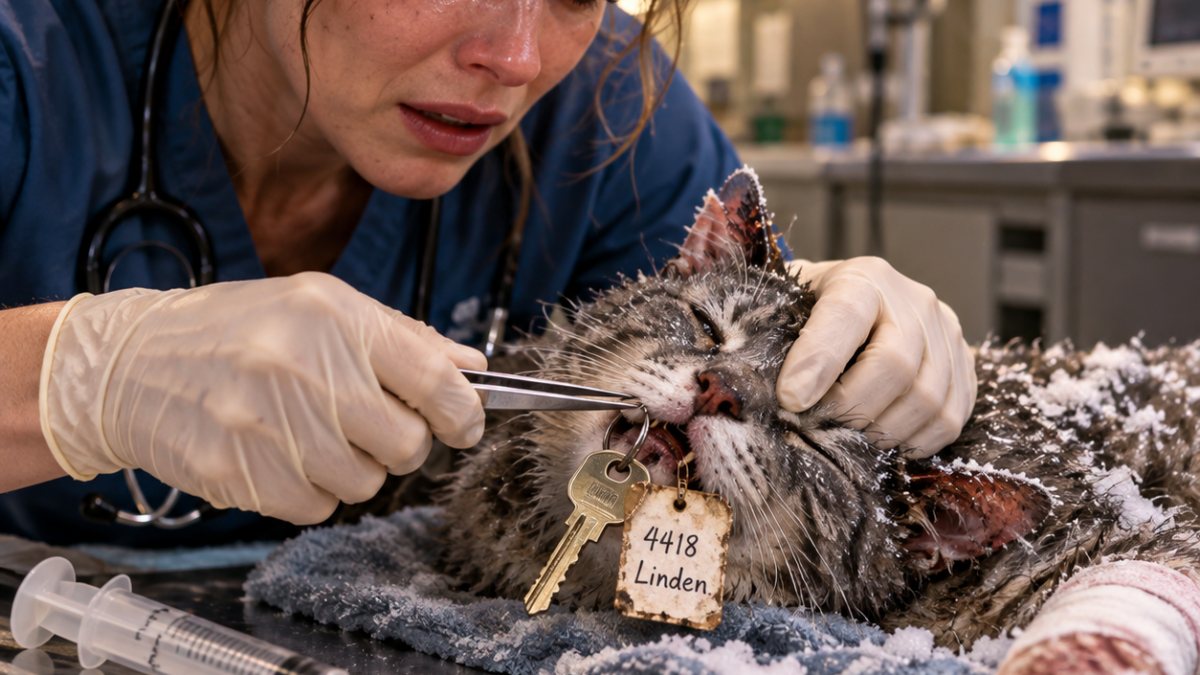
Laura reached for forceps.
“Sorry.”
She gently opened his jaw.
The cat made a weak sound but did not fight.
Laura grasped the object.
Pulled.
Metal clicked against the table.
She stared.
A key.
A small brass house key.
Attached to a thin ring.
And attached to the ring was a tiny rectangle of paper sealed beneath yellowed tape.
Emily stepped closer.
“What the hell?”
Laura picked up the key.
The paper was wet and chewed at the edges.
She moved beneath the examination lamp.
There was handwriting.
Faded.
Shaky.
Nearly erased.
Laura tilted it.
Emily leaned over her shoulder.
“Can you read it?”
“Maybe.”
Laura squinted.
Two lines.
At first only numbers.
Then a word.
Linden.
Above it:
In case I forget.
Laura stopped breathing for a second.
Emily whispered, “That’s an address.”
Laura looked back at the cat.
Then at the syringe.
The room seemed different.
Not because the cat had suddenly become healthier.
He had not.
Not because the medical facts had changed.
They had not.
But a key was not random debris.
Someone had written an address on it.
Someone who feared forgetting.
And this dying cat had carried it in his mouth.
“How long could he have been holding that?” Emily asked.
Laura shook her head.
“I have no idea.”
“Do cats do that?”
“Carry things? Sure.”
“For miles?”
“I don’t know.”
She picked up the syringe.
Emily watched.
Laura put it back in the cabinet.
“Start fluids.”
Emily blinked.
“We’re treating him?”
“We’re stabilizing him.”
“With what money?”
Laura looked at the key.
“We’ll figure that out later.”
She went to the waiting room.
Ray stood.
“It’s done?”
“No.”
His face changed.
“What happened?”
Laura held out the key.
Ray stared.
“He had that?”
“In his mouth.”
“What is it?”
“There’s an address.”
Ray looked toward the treatment room.
“You think he belongs there?”
“I don’t know.”
“But maybe.”
“Yes.”
Laura grabbed her coat.
Emily appeared behind her.
“Where are you going?”
“To Linden Road.”
“You have appointments at eight.”
“Move my first two.”
“Laura—”
“I need forty-five minutes.”
“Google says thirty-eight each way.”
Laura was already walking.
“Move three.”
She drove through falling snow with the key in her coat pocket.
4418 Linden Road was thirty-five kilometers away.
The farther she traveled, the more she questioned herself.
What exactly was she doing?
Driving across the county because an old cat had a key in his mouth?
It might not even be his.
A child could have dropped it.
The cat could have found it near a garbage can.
The address might no longer exist.
The handwriting might belong to someone dead years ago.
She was a veterinarian.
Not a detective.
At 7:52, she turned onto Linden Road.
Rural.
Snow-covered fields.
Old mailboxes.
Sparse houses.
Then she saw 4418.
A small white farmhouse.
Sagging porch.
Bare maple trees.
No vehicle in the driveway.
Mail overflowed from the box.
Laura parked.
The place felt wrong immediately.
Not abandoned for years.
Abandoned suddenly.
A plastic watering can remained near the porch.
A newspaper sat frozen beneath snow.
Wind lifted one corner of a handwritten note taped to the front door.
Laura climbed the steps.
WELLNESS CHECK COMPLETED.
PLEASE CONTACT COUNTY SHERIFF.
A phone number was written below.
She called from her car.
Twenty-two minutes later, a sheriff’s cruiser turned into the driveway.
Deputy Mark Ellis stepped out.
Mid-fifties.
Heavy coat.
Tired face.
He approached cautiously.
“Dr. Hadley?”
“Yes.”
He looked at the farmhouse.
“You called about Elliot Mercer?”
“I don’t know.”
“Then why are you here?”
Laura pulled the key from her pocket.
“I found this inside a cat.”
Deputy Ellis stared at her.
“Inside?”
“In his mouth.”
“That’s somehow stranger.”
“He’s an elderly gray tabby.”
Something changed in Ellis’s face.
“Walter?”
Laura’s pulse jumped.
“You know the cat?”
Ellis walked closer.
“Gray tiger stripe? White patch under his chin? Nick in one ear?”
“Yes.”
He swore softly.
“What?”
“That’s Elliot’s cat.”
The cold suddenly felt sharper.
“Who’s Elliot?”
Ellis looked toward the house.
“Elliot Mercer. Seventy-nine.”
“Where is he?”
“A memory-care facility outside Millhaven.”
Laura touched the key in her hand.
“How long?”
“Six weeks.”
She stared.
Ellis continued.
“I found him three miles from here walking down Route 8 in pajamas.”
“In winter?”
“December sixth.”
“Was he hurt?”
“Hypothermic. Confused.”
“Dementia?”
“Advanced cognitive decline, apparently. Nobody knew how bad it had gotten.”
Laura looked toward the house.
“What happened to the cat?”
“We thought animal services had collected him.”
“They didn’t.”
“No.”
“You checked?”
Ellis frowned.
“I called after Elliot was taken to the hospital. They said they’d send somebody.”
Laura looked away.
“Someone must’ve come?”
“I don’t know.”
“He’s been outside six weeks.”
Ellis’s face changed.
“Jesus.”
Laura pulled out the tag.
“In case I forget — 4418 Linden.”
Ellis stared.
Then closed his eyes.
“That sounds like Elliot.”
“You knew him?”
“A little.”
“How?”
“I found him that night.”
He looked down the road.
“He couldn’t tell me his name. Kept saying he needed to get home because Walter would be waiting.”
Laura swallowed.
“Did he remember the cat?”
“That was practically all he remembered.”
Ellis approached the front door.
“I’m going in.”
“Do you have authority?”
“Property was secured under welfare order.”
He removed a key from a lockbox.
Laura held up hers.
“This might work.”
Ellis tried the cat’s key.
The lock turned.
Neither spoke.
Inside, the farmhouse was cold.
The electricity had been disconnected.
Their breaths fogged.
Everything remained exactly where someone had left it.
A coffee mug beside the sink.
Reading glasses on a newspaper.
A cardigan over a kitchen chair.
And on the floor—
A ceramic bowl.
WALTER.
Empty.
Laura crouched.
Beside it sat a water dish dry enough for dust to have collected inside.
Ellis rubbed one hand over his face.
“Damn.”
Laura looked around.
“How did nobody get him?”
“I don’t know.”
“He was left here.”
“I know.”
“For six weeks.”
“I know.”
The anger in Ellis’s voice told her he was directing it at himself.
They moved into the living room.
A blue blanket was folded on the sofa.
Cat hair clung to it.
Scratch marks ran along the side of an armchair.
On the fireplace mantel sat photographs.
Elliot younger.
A woman Laura assumed was his wife.
A child.
Later photographs showed Elliot alone.
Then Elliot holding a gray kitten.
Laura lifted the frame.
The kitten could not have been more than three.
Gray tabby.
White chin.
Small notch in the right ear.
Walter.
“You’re sure?” Ellis asked.
Laura nodded.
“Same cat.”
There were more.
Walter sleeping on Elliot’s chest.
Walter on the porch.
Walter wearing a red Christmas bow.
Walter sitting beside a birthday cake.
Someone had loved this animal deeply.
Laura felt sick thinking about the syringe.
Then she remembered the medical reality.
Love did not mend open fractures.
The key had delayed one decision.
It had not guaranteed a happy ending.
“Look.”
Ellis pointed toward the kitchen counter.
An open notebook lay beside a pill organizer.
The handwriting wandered across the page.
Groceries.
Call Susan.
Doctor Monday?
Below it:
Walter — 13.
Insulin? NO.
Check with Dr. M.
Door — leave cracked for him.
Laura turned the page.
More fragmented notes.
Turn stove off.
Keys bowl.
Feed Walter morning.
Feed Walter evening.
Then, written in thick black ink and underlined twice:
KEY ON HIS COLLAR — IN CASE I FORGET.
Laura sat in the kitchen chair.
Ellis read over her shoulder.
“What does that mean?”
“I think Elliot put his own house key on Walter’s collar.”
“Why?”
Laura looked toward the empty bowl.
“Maybe because he knew he was forgetting how to get home.”
Ellis stared.
“The cat wasn’t wearing a collar.”
“No.”
“Then how did the key get in his mouth?”
Laura looked at the paper tag.
The ring had a tiny broken metal loop attached.
“Collar probably broke.”
“Walter picked up the key?”
“It looks that way.”
“And carried it?”
“Yes.”
“For how long?”
Laura shook her head.
“No one will ever know.”
They stood in silence inside the frozen kitchen.
Laura imagined an old man wandering down a road in pajamas.
A cat waiting beside an empty bowl.
One day.
Two.
Then hunger.
Cold.
Maybe Walter went looking.
Cats rarely behave the way sentimental stories demand.
They are practical animals.
Territorial.
Independent.
But they bond.
Deeply.
Some return to houses after years.
Some search rooms for dead companions.
Some sleep beside hospital equipment.
Whatever Walter had been doing for six weeks, his body told the story.
He had traveled.
He had starved.
He had frozen.
He had been injured.
And somewhere along the way his collar had come off.
But the key remained.
Ellis said quietly, “Do you think he was trying to bring it somewhere?”
“I don’t know.”
“You’re a vet.”
“That doesn’t make me a mind reader.”
He gave a sad smile.
“No.”
Laura looked at the handwriting again.
In case I forget.
She stood.
“I need to get back.”
“Is Walter going to live?”
“I don’t know.”
Ellis nodded.
“Can Elliot see him?”
“Not yet.”
“If he makes it?”
Laura folded her arms.
“If Walter survives surgery, we’ll figure something out.”
Back at the clinic, blood work was better than Laura expected.
Bad.
But not hopeless.
Walter’s kidneys were stressed but functioning.
Liver values elevated.
White blood cell count high.
Anemic.
Dehydrated.
But alive enough to fight.
Laura called her husband, Ben.
He answered on the third ring.
“You’re calling before nine, which means either you forgot something or you bought another animal.”
“I didn’t buy one.”
“That pause worries me.”
“I need to spend some money.”
“How much?”
She told him.
Silence.
“On what?”
“A cat.”
More silence.
“How many cats?”
“One.”
“Laura.”
“I almost euthanized him.”
“That does not usually lead into spending thousands of dollars.”
“He had a key in his mouth.”
Ben paused.
“I need more context.”
She told him everything.
The snowplow.
The key.
Elliot.
The farmhouse.
When she finished, Ben sighed.
“You’re going to do it no matter what I say.”
“I’m asking.”
“No, you’re informing politely.”
Laura smiled despite herself.
“Maybe.”
“Can we afford it?”
“Yes.”
“Then save the cat.”
Walter’s surgery was scheduled for that afternoon.
First came warming.
Fluids.
Antibiotics.
Pain management.
Repeat blood tests.
Laura stayed beside him longer than she needed to.
He finally lifted his head.
His yellow eyes focused on her.
“You’d better not make me regret this.”
Walter blinked.
“You have no idea what I just volunteered for.”
He tried to growl.
It came out as a rasp.
Laura smiled.
“There you are.”
The amputation took nearly two hours.
The leg came off high at the hip.
Damaged tissue was worse than expected.
The frostbitten tail tip would need removal later once the tissue line declared itself.
Part of one ear was dead.
But Walter survived anesthesia.
He survived recovery.
He survived the first night.
Then the second.
On day three, he ate half a spoonful of chicken pâté.
Emily actually cheered.
Walter glared at her.
Laura laughed.
“That means he’s feeling better.”
Ray Bell returned the next morning.
He carried Laura’s cleaned work jacket.
“My wife washed it.”
“You didn’t have to.”
“She said the cat probably bled on it.”
“He did.”
“How is he?”
Laura brought Ray into the recovery room.
Walter lay in a heated enclosure.
Bandage around his body.
One rear leg gone.
Ray’s face crumpled.
“You saved him.”
“He’s not out of danger.”
“But he’s alive.”
“Yes.”
Ray crouched.
“Hey, old man.”
Walter lifted his head.
Ray smiled.
“I almost flattened you with a county truck.”
Walter stared.
“I know. Not a good first impression.”
Laura watched the two of them.
“You want to know who he is?”
Ray turned.
“You found the house?”
“His name is Walter.”
“That fits.”
“His owner is alive.”
Ray stood.
“Seriously?”
“Memory-care facility.”
Laura explained.
Ray listened quietly.
When she mentioned Elliot remembering Walter while forgetting his own name, he looked away.
“My dad had Alzheimer’s.”
“I’m sorry.”
“Last year of his life he thought I was his brother.”
He looked at Walter.
“But he remembered our old beagle’s name until the week he died.”
Laura thought about Elliot.
“How long was your father sick?”
“Eight years.”
Ray’s voice softened.
“Memory’s weird.”
“Yes.”
“Doesn’t disappear in order.”
“No.”
Ray wiped his face.
“Can I donate something?”
“You already did.”
“I drove him eighteen kilometers.”
“And he’s alive because you did.”
Ray shook his head.
“Give me the clinic fund information.”
Walter spent ten days in the clinic.
Ray donated fifty dollars.
Then another hundred anonymously, although Laura recognized his handwriting on the envelope.
Someone at the sheriff’s office heard about Walter.
Then someone at county public works.
Without Laura asking, small donations began appearing.
Twenty dollars.
Thirty-five.
One hundred.
A child mailed eight dollars in coins with a note:
FOR THE SNOW CAT.
Laura put the note beside Walter’s cage.
Still, she did not publicize the story.
Elliot’s privacy mattered.
Walter’s survival was not entertainment.
On her day off, Laura drove sixty-five kilometers to Millhaven Memory Care Center.
She carried only her phone.
The facility smelled faintly of disinfectant, coffee, and laundry detergent.
A nurse named Janice led her down a quiet hallway.
“How lucid is he?” Laura asked.
“It depends on the hour.”
“Will he understand who I am?”
“Probably not.”
“Can I show him something?”
Janice smiled.
“That’s usually better than explaining.”
Elliot sat near a window wearing a gray cardigan.
He was thin.
White hair.
Hands folded in his lap.
A half-finished puzzle sat on the table.
Janice crouched beside him.
“Mr. Mercer? You have a visitor.”
Elliot looked at Laura.
“Are you Susan?”
“No.”
He frowned.
“I’m sorry.”
“That’s okay.”
Laura sat.
“My name is Laura.”
“Laura.”
“Yes.”
“I know a Laura.”
“Maybe.”
His eyes drifted toward the window.
Laura took out her phone.
“I wanted to show you a picture.”
He looked politely uninterested.
She turned the screen toward him.
Walter lay asleep on a heated pad.
Bandaged.
Alive.
Elliot stared.
His expression did not change at first.
Then his fingers moved.
“Can I see?”
Laura brought the phone closer.
He leaned forward.
His breath shook.
One finger touched the screen.
“Walter.”
Laura felt her throat close.
Janice stood very still.
Elliot touched the photograph again.
Tears filled his eyes.
“My boy.”
“Yes.”
“Where did you find him?”
Laura did not know how much truth would help.
“In the snow.”
Elliot’s face crumpled.
“I left him.”
“No.”
“I left him.”
“You got sick.”
“I left the door.”
His words became confused.
“The key. I had the key.”
Laura reached into her coat pocket.
She had brought it without deciding whether to show him.
She placed it in his palm.
Elliot stared.
His hand began shaking.
“Walter’s.”
“Yes.”
“I put it there.”
“On his collar?”
“So he could come.”
Laura swallowed.
“So he could come where?”
“Home.”
He looked at her.
Suddenly his eyes were clearer than they had been moments before.
“I forgot.”
His voice broke.
“So I gave Walter the house.”
Laura felt tears slip down her face.
Elliot looked back at the photograph.
“He found me.”
Laura could not answer.
He touched Walter’s image.
“He found me.”
Nine weeks after the snowplow stopped, Walter returned to Elliot.
By then he had healed.
Mostly.
He moved awkwardly on three legs, but with the stubborn determination of an animal insulted by gravity.
The damaged tip of his tail had been removed.
Part of his right ear was missing.
His fur had grown back over shaved areas in uneven patches.
He had gained nearly a kilogram.
He had also developed opinions.
He hated liquid medication.
Despised nail trims.
Loved roast chicken.
And had discovered that if he screamed loudly enough at 5:00 a.m., veterinary technicians arrived with breakfast.
Laura drove him to Millhaven on a Tuesday afternoon.
The facility director had approved a trial visit.
Walter sat inside a soft carrier on the passenger seat.
At a red light, Laura looked at him.
“Do you remember him?”
Walter blinked.
“If this goes badly, I’m blaming you.”
Walter turned his head away.
“You’ve become arrogant since surviving.”
At Millhaven, Janice met them at the entrance.
“Elliot’s having a pretty good day.”
“Does he know Walter’s coming?”
“No.”
“Why?”
“We thought seeing him would be easier than anticipating him.”
Laura nodded.
They entered Elliot’s room.
He sat in a chair near the bed.
A Western played quietly on television.
He looked at Laura.
“Doctor.”
She smiled.
He remembered that much today.
“Hello, Elliot.”
He looked at the carrier.
“What’s that?”
Laura placed it on the bed.
Her hands suddenly felt nervous.
She unzipped the door.
For several seconds Walter did nothing.
Then a gray face appeared.
One damaged ear.
Yellow eyes.
Walter stepped out.
Three legs.
Slow.
Elliot stopped breathing.
“Walter?”
The cat froze.
His ears moved forward.
Elliot’s hands began shaking.
“Walter.”
The cat stepped toward him.
Laura expected caution.
Instead Walter gave one rough, broken meow.
Elliot made a sound Laura would remember for the rest of her life.
Half laugh.
Half sob.
He held out both arms.
Walter crossed the bed.
Jumped awkwardly onto the chair.
Then climbed onto Elliot’s lap.
The old man bent over him.
“No.”
He was crying openly.
“No, no, no.”
Walter pushed his face beneath Elliot’s chin.
Elliot buried both hands in his fur.
“My boy.”
Janice covered her mouth.
Laura turned away.
Elliot rocked slowly.
“You came home.”
Walter began to purr.
Laura had heard thousands of cats purr.
In exam rooms.
Recovery wards.
Homes.
Shelters.
She had never heard anything that felt like that.
The sound filled the little room.
Elliot’s eyes closed.
His hand moved over Walter’s back.
Again.
Again.
As though muscle memory had been waiting six weeks for permission to return.
He whispered, “I’m sorry.”
Walter purred louder.
That first visit lasted forty minutes.
The second lasted two hours.
By the fourth, Walter slept on Elliot’s bed.
Then the facility director called Laura.
“We’ve been discussing something.”
“What?”
“Permanent placement.”
Laura paused.
“With Elliot?”
“Yes.”
“Can you do that?”
“We have a pet policy for certain residents.”
“And his cognition?”
“Actually improves when Walter is here.”
Laura said nothing.
The director continued.
“He eats more.”
“What?”
“He remembers meals because he feeds Walter first.”
Laura smiled.
“He asks fewer times where he is.”
“Seriously?”
“Walter seems to orient him.”
A week later, Walter moved into Millhaven.
His things fit in one box.
Food.
Bowls.
Medication.
Blanket.
A small scratching pad.
Elliot cried when the carrier arrived.
Walter behaved as if the room had always belonged to him.
He slept on the foot of the bed the first night.
By the third, he slept on Elliot’s chest.
For the next 212 days, they lived together.
The staff noticed changes almost immediately.
Elliot still had dementia.
Walter did not cure it.
There were bad mornings.
Days when Elliot believed his wife was alive.
Afternoons when he asked to go home every ten minutes.
Times he did not recognize Laura.
Times he called Janice by his sister’s name.
But Walter remained.
And somehow, Walter often reached places language could not.
If Elliot became agitated at night, Walter climbed onto his lap.
If he refused medication, staff sometimes let him watch Walter receive a vitamin treat first.
“Walter took his,” Janice would say.
Elliot would sigh.
“Show-off.”
Then swallow his pills.
Some days he remembered everything about the cat.
“Found him behind Mercer Hardware,” he told Laura once.
“Which location?”
“The old one.”
“How old was he?”
“Tiny.”
He smiled.
“Mean little thing.”
Walter slept beside him.
“Bit me the first week.”
Laura laughed.
“He still might.”
“He loved Margaret.”
“Your wife?”
Elliot’s eyes softened.
“Yes.”
“When did she die?”
He looked confused.
Then sad.
“Long time?”
“Probably.”
He stroked Walter.
“He looked for her.”
Laura did not ask more.
Another afternoon, Elliot had no idea who Walter was.
He stared at the cat on his lap.
“Whose animal is this?”
“Yours.”
“I don’t own a cat.”
Walter pushed his head beneath Elliot’s hand.
Elliot began scratching automatically.
“Well.”
He looked at Janice.
“He seems to own me.”
The staff laughed.
Even on days when memory failed, affection survived.
Laura visited often.
Sometimes weekly.
Sometimes every other week.
Ray Bell visited too.
The first time he met Elliot, he seemed nervous.
“I’m the guy who found Walter.”
Elliot stared.
“You stole my cat?”
Ray’s face panicked.
Then Elliot laughed.
It was one of his good days.
“Come here.”
He shook Ray’s hand.
“Thank you.”
Ray cried in the hallway afterward.
“Didn’t think I’d do that.”
Laura handed him a tissue.
“He does that to people.”
“Cat or old man?”
“Both.”
Winter became spring.
Walter discovered the courtyard.
On warm days Elliot sat in a wheelchair beneath a maple tree while Walter lay in the grass beside him.
Residents who rarely spoke came outside to see the cat.
Walter developed a routine.
Breakfast with Elliot.
Morning nap in the window.
Inspection of the nurses’ station.
Lunch begging.
Afternoon sleep.
Evening on Elliot’s chest.
He became, unofficially, everyone’s cat.
But Elliot always knew one thing.
“Walter’s mine.”
Even on confused days.
Even when he forgot Laura’s name.
“Walter’s mine.”
Seven months after Walter moved in, Elliot’s health declined quickly.
Not because of dementia alone.
His heart was failing.
Kidneys weakening.
He stopped eating well.
Then he stopped walking.
Laura visited on a Sunday.
Elliot looked smaller beneath the blankets.
Walter lay beside his ribs.
Laura sat.
“Hi, Elliot.”
His eyes opened.
“Doctor.”
“Yes.”
“You saved my boy.”
“We saved each other.”
He looked at Walter.
“Good cat.”
“The best.”
Elliot smiled.
“Don’t tell him.”
“He already knows.”
His hand moved weakly over Walter’s back.
“Laura.”
She leaned closer.
“Yes?”
“When I go…”
Her throat tightened.
“Elliot.”
“Listen.”
She did.
“Don’t send him somewhere strange.”
“I won’t.”
“He likes beds.”
“I know.”
“He hates closed doors.”
“I know.”
“Chicken.”
“Yes.”
“Not fish.”
Laura smiled through tears.
“Definitely not fish.”
Elliot closed his eyes.
“Good.”
She sat with him another hour.
Three days later, Millhaven called at 4:12 in the morning.
Laura woke before the second ring.
She knew.
Janice’s voice was quiet.
“Elliot died about twenty minutes ago.”
Laura closed her eyes.
“Was he alone?”
“No.”
“Walter?”
“On his chest.”
Laura breathed out.
Janice started crying.
“He wouldn’t leave.”
“I’ll come.”
“You don’t have to come this early.”
“I’m coming.”
The sky was still black when Laura drove to Millhaven.
Ben came with her.
They entered Elliot’s room.
The bed had been changed.
Elliot was gone.
Walter sat on the pillow.
Waiting.
Laura stopped.
For eleven years Walter had lived with one man.
Then lost him once.
Found him again.
Now lost him permanently.
She approached slowly.
“Hey.”
Walter looked at her.
No meow.
She sat on the bed.
He sniffed her hand.
Then looked toward the doorway.
Laura understood enough about animals not to invent certainty.
She did not know what Walter believed.
Whether he expected Elliot to return.
Whether death made sense to cats.
Whether scent told him what humans needed words to understand.
But he waited.
For almost forty minutes.
He watched the door.
Finally Laura opened the carrier.
Walter did not move.
She waited.
Eventually he walked inside.
No fight.
No protest.
Laura closed the carrier.
Janice handed her a small bag.
“His things.”
Walter’s blanket.
Bowls.
Medication.
A framed photo.
And an envelope.
“What’s that?”
“Elliot’s niece finally came three months ago.”
“The relative you were trying to find?”
“Yes.”
“She helped arrange some paperwork.”
Janice smiled sadly.
“Elliot asked her to write something.”
Laura opened it in the car.
Dr. Hadley,
If Walter needs a home after me, I hope you take him.
He trusts you because you brought him back.
I do too.
I’m sorry I forgot so much.
I didn’t forget that.
Elliot.
Laura cried all the way home.
Walter entered her house just after sunrise.
Ben opened the carrier.
Their Labrador, Daisy, approached.
Walter hissed.
Daisy immediately retreated.
Ben laughed.
“Strong start.”
Walter stepped out on three legs.
Examined the room.
Walked directly past the expensive orthopedic cat bed Laura had bought.
Jumped onto their bed.
Curled beside her pillow.
Laura stood in the doorway.
“Well.”
Ben folded his arms.
“Elliot warned you.”
“That he likes beds.”
“Apparently yours specifically.”
Walter slept.
For twelve hours.
Over the following weeks, he adjusted.
He screamed for breakfast.
Bullied Daisy away from sunbeams.
Refused fish.
Demanded chicken.
Slept at Laura’s feet.
And every morning, when Laura dressed for work, she saw the brass key.
She had placed it in a small wooden bowl on her dresser beside her own house keys.
Sometimes she picked it up.
The paper tag had been preserved beneath clear archival film.
The words were still visible.
In case I forget — 4418 Linden.
Months after Elliot died, Laura woke from a nightmare.
Not about Elliot.
About Walter.
The clinic.
The stainless-steel table.
The syringe.
In the dream, she never saw the key.
She gave the injection.
Walter’s breathing stopped.
Then somewhere far away, Elliot sat in a memory-care room asking where his cat was.
Laura woke crying.
Ben turned on the bedside lamp.
“What happened?”
She sat against the headboard.
Walter lifted his head at the foot of the bed.
“I killed him.”
Ben looked at Walter.
“He seems pretty alive.”
“In the dream.”
“Oh.”
She wiped her face.
“I had the syringe in my hand.”
Ben sat beside her.
“You’ve told me.”
“I was seconds away.”
“You made the best medical decision you had with the information available.”
“What if I hadn’t seen it?”
“The key?”
“Yes.”
“Then you would have made the best decision you had.”
“But I would have been wrong.”
Ben was quiet.
Laura looked toward Walter.
“He saved his own life.”
“How?”
“He carried proof.”
Ben frowned.
“Proof of what?”
“That he belonged somewhere.”
Laura looked at the wooden bowl.
“That somebody was waiting for him even if that person couldn’t remember how to say it.”
Years passed.
Walter grew older.
Sixteen.
Then nearly seventeen.
He moved more slowly.
Arthritis stiffened his remaining rear leg.
Laura built small ramps beside the bed.
He needed kidney medication.
He hated it.
Every evening became a negotiation involving chicken paste and profanity.
The snowplow driver still sent Christmas cards.
So did Elliot’s niece.
Millhaven kept Walter’s photograph near the front desk.
A small plaque below it read:
WALTER MERCER
RESIDENT COMPANION
2023–2024
Laura hated the word companion at first because it sounded too small.
Then she changed her mind.
Maybe companion was one of the largest words available.
It meant staying.
Not fixing.
Not rescuing.
Staying.
One January morning, years after she first met Walter, snow began falling before dawn.
Laura stood in her bedroom buttoning her coat.
Walter slept on the bed.
Ben was downstairs making coffee.
She reached into the wooden bowl for her car keys.
Her fingers touched Elliot’s key first.
She picked it up.
Metal warmed quickly in her palm.
She could still picture everything.
Ray standing in the waiting room without his coat.
Emily asking whether they could save the leg.
Walter nearly motionless beneath towels.
The syringe beside his head.
That tiny flash of metal between his teeth.
4418 Linden.
She wondered again how Walter had carried it.
Maybe only a mile.
Maybe ten.
Maybe he had picked it up the morning Ray found him.
Maybe he had carried it for weeks.
The truth did not need the most miraculous version.
What mattered was that he had carried it at all.
A house key had no value to a cat.
Not in the human sense.
Walter could not unlock a deadbolt.
Could not read the address.
Could not explain Elliot Mercer.
Yet somehow that little piece of metal remained with him after the collar disappeared.
And when Laura found it, one life opened another.
Walter woke.
He made a rusty meow.
“You’re awake.”
Another meow.
“You already ate.”
Walter stared.
Laura looked at the clock.
“Ben fed you.”
Walter continued staring.
She laughed.
“Elliot warned me about you.”
The name still did something.
Walter’s ears moved.
Laura noticed.
Even now.
“Elliot.”
Walter blinked.
She sat on the bed.
His head pushed into her hand.
For several minutes, she forgot work.
Forgot appointments.
Forgot weather.
She stroked the old gray fur.
Once, she had believed the most compassionate thing she could give Walter was a painless death.
Sometimes she still believed she had not been wrong.
That was important.
The lesson was not that euthanasia was cruel.
Laura had performed hundreds more since that morning.
Some were necessary.
Some were gifts.
Mercy did not always look like rescue.
What Walter taught her was something different.
A medical chart could tell her the condition of a body.
It could not always tell her the unfinished business surrounding a life.
Walter’s chart had said:
Thirteen-year-old intact male.
No owner.
No chip.
Catastrophic fracture.
Frostbite.
Poor prognosis.
Financially unclaimed.
Every fact had been correct.
And together they had still failed to describe him.
He was also:
Walter Mercer.
Loved for thirteen years.
Missing from a white farmhouse on Linden Road.
Belonging to an old man who no longer remembered his own address but remembered his cat.
Carrier of one brass house key.
The last living connection between a confused man and the home he had forgotten.
Laura often thought about that difference.
Facts were essential.
But people—and animals—sometimes existed beyond the facts available at first glance.
One evening, a young veterinarian named Priya joined the clinic.
Fresh from residency.
Brilliant.
Careful.
Terrified of making mistakes.
During her first month, Priya faced a difficult euthanasia case involving an elderly dog whose family could not afford advanced treatment.
Afterward she sat in the break room crying.
“I keep thinking maybe there was something else.”
Laura sat across from her.
“There is almost always something else.”
Priya looked up.
“That isn’t comforting.”
“It isn’t supposed to be.”
“Then how do you do this for fourteen years?”
“Seventeen now.”
“That makes it worse.”
Laura smiled.
Then she told her about Walter.
Not as a miracle story.
Not as proof that every hopeless case deserved unlimited intervention.
She told it exactly as she remembered.
A snowplow.
A dying cat.
A syringe.
A key.
An old man.
When she finished, Priya asked, “So what am I supposed to learn from that?”
Laura thought for a moment.
“Look twice.”
“That’s it?”
“Sometimes.”
She stood.
“Medicine requires us to decide quickly. Compassion occasionally requires us to look once more before we do.”
Priya nodded.
Then noticed Walter’s photo on Laura’s phone.
“He’s cute.”
“He’s a tyrant.”
Years later, people who heard fragments of the story often wanted to make Walter into something larger than he was.
A heroic cat.
A supernatural bond.
A miracle animal.
Laura always resisted.
Walter was a cat.
Stubborn.
Food-motivated.
Frequently rude.
He once knocked Ben’s glasses into a water glass because breakfast was late.
He bit a veterinary technician who tried to trim his nails.
He stole turkey from a Thanksgiving platter with only three legs and no remorse.
He was not an angel.
That made the story better.
Love did not need perfection.
Neither did loyalty.
Elliot had not been a saint either.
His niece eventually told Laura that he had been stubborn, argumentative, and terrible at accepting help.
After Margaret died, he refused to move.
Refused home health.
Refused memory testing.
He covered his house in handwritten notes rather than admit that he was becoming lost inside it.
Walter was not proof that Elliot had lived perfectly.
Walter was proof that even when memory stripped away almost everything else, attachment remained.
The last year of Elliot’s life contained things he could not name.
He forgot dates.
Rooms.
Faces.
But each morning at Millhaven, he searched for a gray cat.
That mattered.
Laura kept Elliot’s handwritten notebook page too.
The original eventually went to his niece.
She made a copy.
Walter — 13.
Door — leave open for him.
KEY ON HIS COLLAR — IN CASE I FORGET.
Those words stayed above Laura’s clinic desk.
Not where clients could see.
For her.
On difficult days.
Especially after euthanasias.
One winter evening, Ray Bell stopped by the clinic after retirement.
His beard had gone almost completely white.
Walter was sleeping in Laura’s office.
Ray crouched.
“Still alive?”
Walter opened one eye.
Laura said, “Insult him again and he’ll outlive you personally.”
Ray laughed.
“You remember me, old man?”
Walter yawned.
Ray looked at Laura.
“He doesn’t.”
“Maybe not.”
“That’s okay.”
He stroked Walter’s head.
“I remember him.”
Laura watched.
That sentence contained more than Ray knew.
Maybe that was the thread running through the entire story.
Elliot forgot.
Walter remembered enough to search.
Walter eventually forgot parts too.
Ray remembered finding him.
Laura remembered the syringe.
Nathan—no, there was no Nathan in this story, just countless strangers who became connected through an animal none of them expected to matter.
Memory moved from one life to another.
When one person could no longer carry something, someone else carried it.
Elliot’s address.
Walter carried the key.
Walter’s story.
Laura carried that.
Elliot’s love.
The staff carried it after he died.
Perhaps that was what survival sometimes meant.
Not continuing forever.
Nothing does.
Perhaps survival meant ensuring something unfinished reached the next pair of hands.
Walter was seventeen when his kidneys began failing badly.
Laura knew before the blood tests confirmed it.
He drank more.
Ate less.
Lost weight.
Slept longer.
There was no dramatic rescue available this time.
No hidden key.
No forgotten owner.
No surgery that could buy meaningful years.
Laura treated what could be treated.
Changed his diet.
Adjusted medication.
Gave fluids.
Ben cooked chicken.
Walter rallied.
Then declined.
One morning he refused chicken.
Laura sat beside him.
“Really?”
Walter looked tired.
She offered it again.
Nothing.
Her heart broke quietly.
That evening, she carried him to the bedroom.
Placed him on the pillow.
Ben sat beside them.
“Is it time?”
Laura stared at Walter.
For years she had feared this question because of how their story began.
She had nearly euthanized him once.
Now she feared waiting too long because of guilt.
That would not be kindness either.
She examined him as his doctor.
Then held him as his family.
“Yes.”
Ben nodded.
“When?”
“Tomorrow.”
That night Walter slept between them.
At 4:00 a.m., Laura woke.
Walter was awake.
She touched his head.
“I know.”
His purr was faint.
Barely there.
She reached toward the wooden bowl.
Took Elliot’s key.
Placed it beside Walter on the blanket.
“Look what you carried.”
His eyes half closed.
“I still don’t know why.”
She smiled through tears.
“Maybe you were smarter than all of us.”
Walter breathed slowly.
Laura thought about Elliot’s last morning.
Walter lying on his chest.
Waiting beside an empty bed.
Now there would be no one waiting for Walter.
Unless Laura allowed herself to imagine things she did not usually say aloud.
She was a scientist.
A veterinarian.
A woman comfortable with biology.
But grief makes philosophers of everyone.
She whispered, “If you see him, tell him I kept my promise.”
Walter’s paw moved.
Touched her wrist.
At 8:17 the next morning, Dr. Laura Hadley prepared a syringe.
Just as she had years earlier.
Same clinic.
Different room.
Ben stood beside her.
Emily, who had become clinic manager, came in briefly to say goodbye.
Ray had visited the night before.
Walter lay on his favorite blanket.
No fear.
No snow.
No shattered leg.
No hunger.
Laura put one hand on his head.
For a strange moment she was back at 6:47 on that first morning.
The syringe.
The frozen ears.
Something hidden between his teeth.
But this time there was nothing left to discover.
Nothing unfinished she needed to chase across the county.
Walter had delivered everything.
The key.
The address.
The old man.
The goodbye.
Laura kissed his forehead.
“You can stop carrying things now.”
Ben put his hand over hers.
Walter exhaled.
Laura gave the medication.
He died peacefully beneath her hand.
For several minutes she could not move.
Then Emily entered.
She saw the key beside the blanket.
And understood.
Laura buried Walter’s ashes with Elliot.
Not all of them.
His niece gave permission for a small memorial stone beside Elliot’s grave.
WALTER MERCER
A GOOD CAT
HE FOUND HIS WAY HOME
Laura kept a little urn at home.
And the key.
Always the key.
Years later, when someone asked why an old tarnished house key sat in a wooden bowl among the keys Laura actually used, she never gave the short answer.
There wasn’t one.
Because it was not simply a key to 4418 Linden Road.
It had opened a veterinary treatment room that morning.
Opened a frozen farmhouse.
Opened a forgotten life.
Opened a path between an old man and the animal he thought he had lost forever.
And, in some ways, it changed Laura too.
Before Walter, she believed professionalism meant accepting that difficult decisions sometimes had to be made without knowing every story.
After Walter, she still believed that.
But she added one more rule.
Look again.
Before deciding nobody is waiting.
Before deciding an animal belongs to no one.
Before deciding a life has nothing unfinished attached to it.
Look again.
Sometimes there really is nothing else.
Sometimes mercy is still goodbye.
But every once in a while, hidden beneath all the obvious suffering, there is a clue.
A photograph.
A phone number.
A worn collar.
A house key clenched between frozen teeth.
Something small enough to overlook.
Something carrying an entire world.
On the final night Walter lived in Laura’s house, snow fell outside the bedroom window.
Not a storm.
Just quiet flakes.
Laura remembered Ray Bell’s truck.
A gray shape in the road.
The distance between a plow blade and one fragile body.
A few feet.
Maybe less.
People later called Walter lucky.
Laura was never sure that was the right word.
Luck was Ray seeing him in time.
Luck was the truck stopping.
Luck was the clinic light being on before opening.
But the rest?
The key was not luck.
Elliot had placed it on Walter’s collar because he knew his memory was leaving him.
Walter had somehow kept it after the collar was gone.
Laura had noticed it seconds before the injection.
One small act connected to another.
A confused old man trying to prepare for forgetting.
A cat carrying something he could not possibly understand the way humans understood it.
A veterinarian deciding to look one more time.
A deputy unlocking a farmhouse.
A photograph proving a name.
A notebook explaining a promise.
And nine weeks later, three-legged Walter crossing a bed toward the man who had loved him for thirteen years.
People often said Elliot remembered Walter.
Laura thought that description was incomplete.
For 212 days, Walter remembered Elliot for both of them.
He stayed when names vanished.
Stayed when dates disappeared.
Stayed when rooms became unfamiliar.
Stayed when the old man woke frightened.
Stayed when his body began failing.
Stayed until Elliot’s final breath.
And when Elliot could no longer carry the memory of home by himself, Walter carried what remained.
First the key.
Then the love.
Maybe that was why Laura never stopped seeing the little brass key as more than metal.
Because some animals do not survive simply because they are stronger than death.
Sometimes they survive because somewhere ahead of them is a person who still needs to be found.
Sometimes they keep moving through cold, hunger, injury, and darkness because something in them has not accepted that the story is over.
And sometimes, when the world assumes they are carrying nothing at all, they arrive with the one thing that proves they still have something left to deliver.








