The Vet Said the Blind, Toothless Cat Might Not Survive the Week—Then He Reached Through the Cage and Wouldn’t Let Go of My Hand
PART3:
Three years after he died, his armchair still sat beside the living-room window.
Brown leather.
Worn on the right arm where he rested his elbow.
I cleaned around it.
Vacuumed beneath it.
Dusted the lamp beside it.
But I did not sit there.
No one did.
When Emily visited, she sat on couch.
Nancy once tried the chair and I said:
“Not there.”
Too quickly.
Too sharply.
She moved without comment.
I apologized later.
She told me:
“You’ll know when.”
I hated that.
People say things like that because they mean well.
You’ll know when.
When what?
When it stops hurting?
When your marriage becomes furniture?
When you are ready to let someone else sit where your husband used to breathe?
I did not know.
So the chair stayed empty.
Then one Tuesday afternoon, I opened the linen closet.
The blankets smelled like cedar blocks and old fabric.
I stood there almost twenty minutes.
Then took them down.
Washed what could be washed.
Folded everything.
Put them in two cardboard boxes.
The next morning I drove them to Mountain Hollow Animal Rescue.
Robert liked animals.
He never wanted pets because he said our work schedules were unfair.
But every stray dog somehow got half his sandwich.
Every cat in our neighborhood knew his truck.
After he died, donating the blankets to animals felt easier than giving them to Goodwill.
Maybe because cats do not know what a widow is.
Mountain Hollow operated out of an old converted farmhouse.
Small.
Volunteer-run.
Dogs in outdoor runs.
Cats in two rooms.
A veterinary treatment area added behind the kitchen.
I carried one box inside.
A woman named Lisa met me.
“Blankets?”
“Yes.”
“You have no idea how badly we need these.”
“Some are old.”
“They don’t care.”
That made me smile.
I brought second box.
Signed donation form.
That should have been the end.
Then I heard a sound.
Not a meow exactly.
A cracked little cry.
I turned.
The cat room door stood open.
Cages lined the far wall.
Some cats came forward.
One orange kitten reached through bars immediately.
A black-and-white adult sat with his back turned.
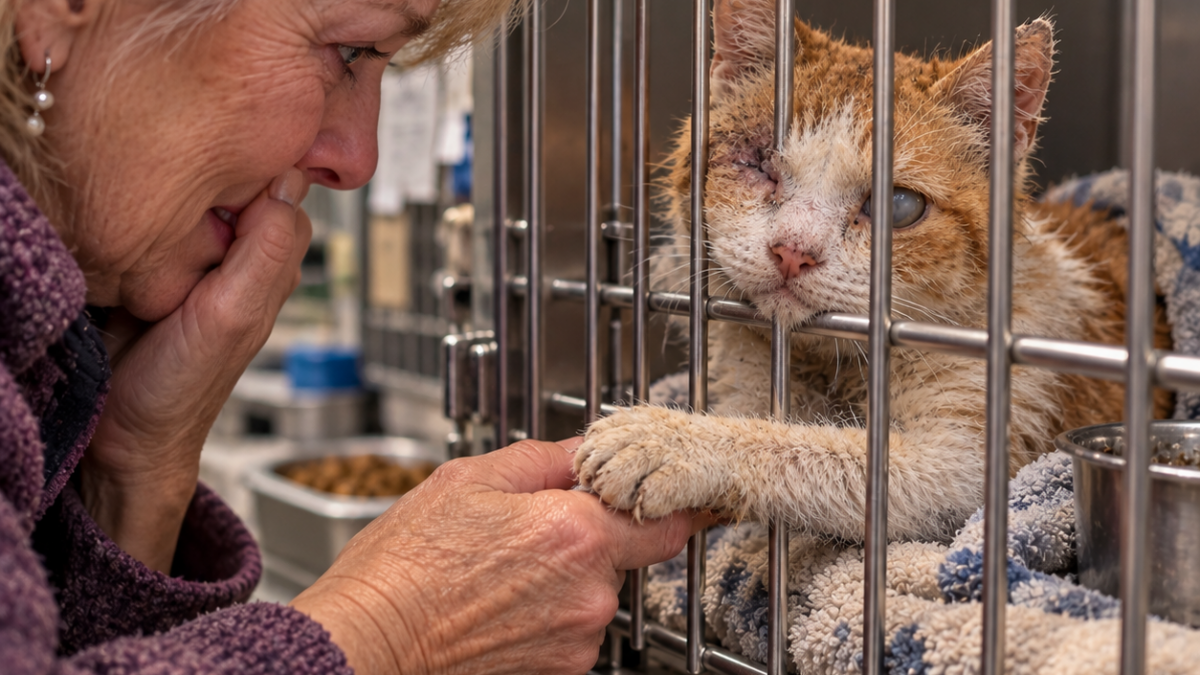
And near the bottom row, wrapped in an old gray towel, was Chester.
I did not know his name yet.
At first I thought he was asleep.
He was curled very tightly.
Orange-and-white coat dull.
Patchy around shoulders.
Thin enough that his hips showed.
One ear had a small notch.
His left eye socket had healed closed.
The remaining right eye was cloudy blue-white.
A card clipped to the cage said:
CHESTER
Approx. 12 years
Male
Found stray
SPECIAL MEDICAL NEEDS
I crouched.
“Hello.”
His ear moved.
He lifted his head.
The cloudy eye looked nowhere near me.
Blind.
I leaned a little closer.
“You poor thing.”
That was when his paw came through the bars.
Slowly.
Feeling.
Not swatting.
Searching.
The pads brushed empty air.
I placed one finger beneath them.
Chester’s paw closed.
Weakly.
But definitely.
I smiled.
“Well, hello to you too.”
He did not purr.
He held.
I stayed there.
After maybe thirty seconds, I pulled my hand away because my knees hurt.
Chester made a sound.
That sound.
I still cannot describe it properly.
A tiny broken cry.
Not loud.
Not demanding.
Almost confused.
He pushed his paw farther through the bars.
Searching again.
I gave him my finger.
He held on.
Lisa had come in behind me.
“He likes you.”
I laughed.
“He can’t even see me.”
“Maybe that’s why.”
“What happened to him?”
She became quieter.
“Animal control found him behind a grocery store.”
“When?”
“Three weeks ago.”
“He’d been wandering.”
“Skin and bones.”
“Eye already gone?”
“Yes.”
“What about the other?”
“Severe damage.”
“No vision.”
“He’s also…”
She paused.
“What?”
“Sick.”
The card had already told me that much.
“How sick?”
“Our vet can explain better.”
“I’m not adopting.”
It came out too quickly.
Lisa smiled.
“I didn’t ask.”
“I know.”
Chester still held my finger.
I looked down.
“I just came with blankets.”
“I know.”
I stayed twenty minutes.
Maybe thirty.
Eventually I stood.
Chester released only because my hand physically left reach.
He cried once.
I walked toward door.
Stopped.
Looked back.
His paw was still through the bars.
I went home without a cat.
For the rest of that day, I thought about one.
At dinner, I ate soup at kitchen table.
I could hear refrigerator hum.
A truck pass.
Heating system click.
Nothing else.
I remembered Chester’s paw.
I told myself it was manipulative thinking.
Cats reach through cages.
Rescue animals want attention.
He would have done it to anyone.
Probably.
I washed one bowl.
One spoon.
One mug.
Walked through living room.
Robert’s chair empty.
Went upstairs.
At 2:13 a.m., I woke thinking I heard that cracked little meow.
Ridiculous.
The next morning I called Mountain Hollow.
“Hi.”
“This is Margaret Ellis.”
“I brought blankets yesterday.”
Lisa remembered.
“Chester?”
I sighed.
“Yes.”
She laughed.
“Come talk to Hannah.”
Dr. Hannah Brooks was thirty-something.
Maybe forty.
Brown hair twisted into messy knot.
Green scrubs.
Tired eyes.
Kind face.
She did not sell Chester to me.
I appreciated that.
We sat in tiny consultation room.
“Before we talk adoption, I need to be very honest.”
“Okay.”
“Chester is diabetic.”
I knew enough to understand insulin.
“He requires injections approximately every twelve hours.”
“Okay.”
“He has several infections we’re treating.”
“Skin.”
“Upper respiratory.”
“His mouth was badly infected.”
“He has no functional teeth left.”
“Did you remove them?”
“Most were already gone.”
“We removed remnants causing pain.”
I swallowed.
“Can he eat?”
“Yes.”
“Wet food.”
“Softened food.”
“He does fairly well.”
She continued.
“He’s blind.”
“I noticed.”
“One eye surgically absent from old injury.”
“The other likely from chronic disease or trauma.”
“We don’t expect vision.”
“Will it hurt?”
“Not currently.”
“What else?”
Hannah looked at chart.
“His kidneys are not perfect.”
“But not in failure right now.”
“He’s underweight.”
“Arthritic.”
“We don’t know exact age.”
“Twelve is estimate.”
She paused.
Then:
“Margaret, he may not have years.”
I stared.
“How long?”
“I can’t tell you.”
“A week?”
“Possible if he declines.”
“Months?”
“Possible.”
“A year?”
“Yes.”
“More?”
“Also possible if diabetes stabilizes and other issues respond.”
That uncertainty sat between us.
I hated it.
Robert’s doctors had spoken this language.
Could be.
Might.
We hope.
We’ll know more.
When time becomes medically uncertain, every answer feels like refusal.
Hannah continued:
“He’s going to need work.”
“Glucose monitoring.”
“Insulin.”
“Routine.”
“Vet visits.”
“Watching for hypoglycemia.”
“Changes in appetite.”
“You can’t just leave food and go away for weekend.”
“I don’t go away.”
The sentence sounded sadder aloud.
Hannah noticed.
She did not comment.
“Are there other adults at home?”
“No.”
“Family nearby?”
“Daughter in Charlotte.”
“About two hours?”
“Depending traffic.”
She nodded.
“I’m not telling you not to adopt him.”
“I just don’t want you feeling trapped.”
I almost laughed.
Trapped.
I had lived three years in a house arranged around a dead man’s absence.
A cat’s insulin schedule did not sound like trap.
But I understood her point.
“What happens if no one takes him?”
“We keep caring.”
“Foster, hopefully.”
“Sanctuary maybe.”
“Could stay here.”
“Would he be euthanized?”
“Not for inconvenience.”
She said it firmly.
“If his quality of life fails and suffering cannot be controlled, we’ll make medical decision.”
“But right now?”
“He wants food.”
“Warmth.”
“Contact.”
“That counts for something.”
“Has anyone applied?”
She shook her head.
“People stop at age.”
“Then blind.”
“Then diabetes.”
“No teeth doesn’t help.”
I looked through small window in door.
Chester’s cage not visible.
I could still picture paw.
“I want to see him.”
Hannah walked me in.
Chester was awake.
The second I spoke:
“Hey, buddy.”
His head lifted.
His paw came through.
Hannah watched.
“Well.”
“What?”
“He doesn’t do that with me.”
“Maybe he hates veterinarians.”
“Reasonable.”
I touched paw.
He closed around my finger.
I stayed longer this time.
Three days later I returned.
Then again.
I did not tell Emily.
I did not tell Nancy.
I barely told myself what I was doing.
Every visit, Chester reached.
Sometimes he slept until hearing my voice.
Then head up.
Paw.
On fifth visit, Lisa opened cage.
“You want to hold him?”
“I don’t know.”
“That’s not no.”
She placed towel on lap.
Chester was lighter than he looked.
Maybe six pounds.
He trembled when lifted.
Then settled against my chest.
His head moved side to side, mapping by sound and smell.
I spoke.
“It’s me.”
He pressed forehead beneath my chin.
Something inside me cracked.
Robert had done that sometimes.
Not forehead exactly.
He would lean head against my shoulder when exhausted after treatment.
I closed eyes.
“No.”
I whispered.
Lisa thought I meant Chester.
“You okay?”
“Yes.”
But I was crying.
I had not held another living thing close in a long time.
Not like that.
Not someone needing me to stay still.
Chester’s paw landed on my wrist.
Again.
That night I called Emily.
“I’m thinking about adopting a cat.”
Silence.
Then:
“You?”
“Yes.”
“Mom, you don’t like cats.”
“I like cats.”
“You told Dad cats were judgmental.”
“They are.”
“What kind?”
“Old.”
“How old?”
“About twelve.”
“Healthy?”
“No.”
“How unhealthy?”
I listed.
Emily interrupted halfway.
“Mom.”
“What?”
“Blind?”
“Yes.”
“Diabetic?”
“Yes.”
“No teeth?”
“Yes.”
“Are you adopting a cat or opening hospice?”
I laughed despite myself.
Then Emily softened.
“Seriously.”
“Are you sure?”
“No.”
“What happens if he gets worse?”
There it was.
Same question everyone asks when deciding whether to love something temporary.
What happens if it gets worse?
You hurt.
You lose.
You grieve.
As if avoiding love prevents grief instead of creating a different kind.
“I don’t know.”
Emily sighed.
“I just don’t want you going through…”
She stopped.
“Through what?”
“You know.”
“Your dad?”
“Yes.”
“I’m already going through that.”
Silence.
“I know.”
“No, honey.”
“I don’t think you do.”
I regretted it immediately.
Emily’s voice went small.
“Okay.”
“I’m sorry.”
“No.”
“You’re right.”
She had lost father too.
Grief can make people compete over the same death without meaning to.
“I’m scared for you.”
She said.
“I know.”
“I don’t want another thing dying in that house.”
Neither did I.
But houses do not become safer because nothing lives there.
I did not say that yet.
A week later Chester was medically stable enough for a home.
Hannah trained me.
Insulin drawing.
Injection technique.
Signs of low blood sugar.
How to monitor eating.
What to do if he refused food.
Emergency numbers.
She had me practice with saline.
My hands shook.
“I was a high-school secretary for twenty-two years.”
I said.
“I have never injected anything.”
“You’ll learn.”
“What if I hurt him?”
“You probably will annoy him.”
“That’s different.”
She made schedule.
7 a.m.
7 p.m.
Consistency.
I bought supplies.
Glucose meter.
Wet food.
Low-sided litter box.
Fountain he never used.
Soft bed.
Second bed.
Third bed because apparently grief makes people overspend on cats.
Then I signed adoption papers.
MARGARET ELLIS.
CHESTER.
I looked at line.
“Does this mean he’s mine?”
Lisa smiled.
“If he agrees.”
He came home wrapped in one of Robert’s donated blankets.
I almost lost composure in parking lot.
It was the green wool one.
I had brought it to let go.
The rescue had washed it again and used it in his cage.
Now it came back containing a cat.
Life is rude with symbolism.
First night was awful.
Chester did not understand house.
Blind cats map spaces, but mapping takes time.
He bumped the side of hallway.
Walked into table leg.
Cried.
I spoke from kitchen.
“Here.”
He followed voice.
Then overshot.
Cried again.
I got down on floor.
Tapped gently.
“Chester.”
He found my knee.
Pressed against it.
I rearranged everything.
Not physically moved furniture—quite the opposite.
I committed to never moving furniture unnecessarily.
I put textured rugs as landmarks.
One by food.
One outside litter box.
One beside couch.
I placed cardboard edges near dangerous corners temporarily.
Baby gate at stairs until he learned.
Wind chime? No—too confusing. I used distinct textures and soft verbal cues.
I wore slippers that made faint sound so he could track me.
The first insulin injection took eleven minutes.
Not because Chester fought.
Because I cried.
Ridiculous.
I pinched loose skin.
Held syringe.
Could not.
“What if I do it wrong?”
Chester screamed because breakfast was late.
That solved paralysis.
“You are extremely unsympathetic.”
I injected.
He barely noticed.
I laughed.
“Of course.”
Second injection easier.
Third routine.
Then first low-glucose scare.
He became wobbly one afternoon.
I panicked.
Called Hannah.
Followed emergency instructions.
Went in.
Dose adjusted.
I sat in car afterward with both hands on steering wheel.
“What have I done?”
I whispered.
Chester sat in carrier yelling.
Answer:
I had adopted a medically complicated elderly cat.
That was what I had done.
The first three weeks nearly broke me.
Sleep disrupted.
Meals scheduled around his.
Cleaning accidents.
Finding food textures he could eat without teeth.
Learning his cries.
There were many.
Hungry cry.
Lost cry.
Angry cry.
Where-are-you cry.
The last one was worst.
If he woke and could not locate me, he would stand in hallway and make a cracked, desperate sound.
I would answer:
“Bedroom.”
He learned.
Sometimes at 3 a.m.:
“I’m here.”
He would follow voice slowly.
Tap.
Tap.
Whiskers.
Paws.
Then find side of bed.
I bought little pet steps.
He learned in four days.
Then began sleeping against my calves.
I had not slept touching another warm body since Robert died.
The first night Chester curled against my legs, I lay rigid.
Afraid moving would disturb him.
Then I started crying quietly.
Chester snored.
He had an outrageous snore for six pounds.
Robert snored too.
Louder.
I said into dark:
“You two would have gotten along.”
Chester snored harder.
I took it as agreement.
Emily called regularly.
“Still alive?”
“Very.”
“How’s sugar?”
“Better.”
“How are you?”
That question always came second.
“I’m tired.”
“Mom.”
“What?”
“You sound tired.”
“I am.”
“Do you need help?”
“No.”
“You always say no.”
“I’m fine.”
There it was.
The same easy answer Nora? not relevant. Need avoid contamination.
I was not fine.
Not exactly.
I was overwhelmed.
But something was happening beneath exhaustion.
My days had shape again.
Not grief routines.
Living routines.
7 a.m. insulin.
Breakfast.
Clean bowl.
Medication.
Short porch time.
Laundry.
Grocery.
7 p.m. insulin.
Chester’s demands.
I began talking aloud.
At first to cat.
Then about everything.
“Gas is ridiculous.”
“Emily says I need new phone.”
“Your father—”
I stopped.
“Robert would hate this weather.”
Chester listened without seeing face.
Sometimes he turned ear.
Sometimes slept.
It was enough.
One evening, about four weeks after adoption, Chester refused dinner.
Not entirely.
He sniffed.
Walked away.
My stomach dropped.
I tried another flavor.
Nothing.
Warmed it.
Nothing.
Added water.
Nothing.
He sat beside bowl.
Tired.
I looked at clock.
Insulin depended on eating.
I called Hannah.
She gave instructions.
Monitor.
Hold or adjust per veterinary guidance based on his specific plan. We had a clear protocol.
I followed.
Then sat on kitchen floor.
Exhausted.
“I don’t know if I can do this.”
Chester’s ears moved.
I cried.
“I don’t know if I’m helping.”
He stood.
Slowly.
Walked toward voice.
His shoulder bumped cabinet.
He corrected.
Reached my knee.
Then climbed halfway onto my lap.
His paw came down on my wrist.
Same place.
I lost it.
Not delicate tears.
Ugly crying.
“Robert should be here.”
I said to cat.
“He would know what to say.”
That was untrue.
Robert usually said the wrong thing first.
Then fixed.
“I’m tired of eating alone.”
“I’m tired of everybody asking if I’m okay when they want yes.”
“I’m tired of being the strong widow.”
“I’m tired of that chair.”
Chester sat.
Paw.
No wisdom.
No speech.
He could not see my face.
He did not need to.
That was first night I understood I had not adopted him because he needed me more.
We were both creatures with damaged maps.
Trying to locate home by sound.
The next morning he ate.
Not enough.
But some.
Over following days appetite returned.
Infections cleared.
His fur softened.
The bald patches filled.
He gained almost a pound over two months.
His glucose became more predictable.
Hannah looked pleased.
“Look at him.”
Chester yelled at her.
“He hates me.”
She said.
“He has excellent judgment.”
I said.
Then his personality arrived.
This sick, trembling animal I had mistaken for fragile saint was a tyrant.
Breakfast at 6:58?
Unacceptable.
Dinner two minutes late?
War crime.
If I opened tuna and did not share smell immediately, he screamed toward ceiling like betrayed opera singer.
He stole my blanket.
Not Robert’s.
Mine.
The blue knitted one Nancy gave me.
He dragged it by claws? toothless, so used paws and body, bunching until he could nest.
He learned house.
Not merely enough to survive.
Perfectly.
Bedroom to hallway.
Hallway to kitchen.
Kitchen to living room.
He counted turns through body memory.
If I left laundry basket in wrong place, he bumped it and yelled at me.
My fault.
Always.
Then he discovered Robert’s armchair.
I was making tea.
He walked along living-room rug.
Found chair with whiskers.
Circled base.
I stopped.
“No.”
He placed front paws on seat.
“Chester.”
He climbed.
Blind.
Arthritic.
Determined.
He settled into worn leather hollow where Robert’s body had sat for years.
I stood holding tea.
Every muscle tightened.
“Get down.”
Chester ignored.
“Chester.”
He circled twice.
Curled.
Then started snoring.
I stared.
For three years no one had sat there.
Not Emily.
Not Nancy.
Not me.
And now this blind, toothless orange cat had occupied it without permission.
I should have been angry.
I was.
For maybe five seconds.
Then his paw twitched in sleep.
His mouth hung slightly open because no teeth.
A tiny snore whistled.
I laughed.
One sound.
Then another.
Suddenly I was laughing so hard I had to set tea down.
I sat on couch.
Covered face.
Laughing and crying simultaneously.
“Robert.”
I said.
“You would hate this.”
Actually he would have loved it.
That made me laugh harder.
From then on, it was Chester’s chair.
I did not decide.
He did.
Something inside room changed.
The chair stopped being altar.
Became furniture again.
Important furniture.
Loved.
But usable.
The first time Emily visited after adoption, she walked into living room.
Stopped.
Chester was asleep in chair.
“Mom.”
“Yes?”
“That’s Dad’s chair.”
“I know.”
“You let him—”
“I didn’t exactly get vote.”
She stared.
I watched her face.
For one second I worried she was angry.
Then Chester snored.
Emily’s mouth twitched.
“Is that him?”
“Yes.”
“He sounds like Dad.”
We both burst out laughing.
That night, Emily sat on floor beside chair.
Chester sniffed hand.
Then placed paw over fingers.
She looked at me.
“Oh.”
“Yes.”
“This is how he gets you.”
“Yes.”
“Manipulative.”
“Extremely.”
She scratched his chin.
He leaned.
Then she grew quiet.
“Mom.”
“What?”
“Was house really that lonely?”
I looked at her.
She had tears.
I almost protected her.
That is what mothers do.
Even adult daughters.
Say:
No, honey.
I’m fine.
You have your life.
Do not feel guilty.
Instead, Chester had apparently ruined my ability to lie politely.
“Yes.”
Emily looked down.
“I should have come more.”
“No.”
“Mom.”
“You had work.”
“Kids.”
“Mark.”
“Your own life.”
“That doesn’t mean—”
“No.”
I touched hand.
“You called.”
“You loved me.”
“I also didn’t tell you.”
“Why?”
“Because I didn’t want to be somebody you had to manage.”
Her face broke.
“You’re my mom.”
“Exactly.”
We sat.
Chester snored between us.
That Saturday was first of more visits.
Not every week.
Life still life.
But Emily started coming monthly instead of every few months.
Sometimes alone.
Sometimes with husband.
Sometimes grandkids.
The house got louder.
Chester hated grandkids initially.
Too many footsteps.
He retreated bedroom.
We taught them:
Don’t chase.
Let him come.
By third visit, my grandson Caleb sat floor reading comic aloud.
Chester followed voice.
Curled beside him.
Caleb whispered:
“He likes Spider-Man.”
“Apparently.”
At two months, Chester crashed.
That is word.
One morning he did not yell for breakfast.
That alone terrified me.
I found him in Robert’s chair.
Head low.
Breathing strange.
He would not stand.
I touched.
Cold-ish.
Not right.
I wrapped him in green blanket.
The one from rescue.
Drove to Hannah.
Every red light was personal insult.
At clinic, they took him back.
I sat waiting room holding empty blanket.
And suddenly it was three years earlier.
Hospital.
Robert.
Plastic chair.
Fluorescent lights.
A doctor behind double doors.
Waiting for someone to come tell me whether life had changed.
My hands shook.
I pressed blanket to mouth.
Nancy? I hadn’t called. Emily? Too early.
A woman across from me held beagle.
She looked at me.
“You okay?”
“No.”
Honest.
She nodded.
“Me neither.”
We sat.
Forty minutes.
Maybe ninety.
Time in waiting rooms is fake.
Finally Hannah came.
I stood so fast dizzy.
“He’s alive.”
First words.
I nearly collapsed.
“What happened?”
“His glucose destabilized.”
“Dehydration.”
“Possible infection flare.”
“We’ve treated.”
“He’s responding.”
“Can I see?”
“In a few minutes.”
I started crying.
Hannah touched shoulder.
“Margaret.”
“I can’t do this again.”
She understood wrong? Maybe not.
“Again?”
“My husband.”
“Oh.”
“He died in hospital.”
“I sat just like this.”
Hannah’s face softened.
“I’m sorry.”
“I thought…”
I could not finish.
She said:
“Chester is stable right now.”
“Not promise.”
“Not forever.”
“Right now.”
Right now.
That was enough.
I went into treatment area.
Chester lay on clean fleece.
IV line.
Tiny.
Older than dirt.
Angry-looking.
“Hey, buddy.”
His ear moved.
I approached.
His eye stayed closed.
Then paw lifted.
Searching.
I put fingers there.
He held.
“I’m here.”
I bent over.
“I’m not going anywhere.”
Those words startled me.
Because Robert had said them once.
Early in cancer.
I had believed forever instead of meaning.
He meant:
I’m here now.
Maybe that is all anyone can honestly promise.
Chester came home two days later.
More monitoring.
Dose adjustments.
New schedule notes taped refrigerator.
Emily called.
I sent picture first.
Chester in Robert’s chair.
My hand on armrest.
His paw resting over mine.
Phone rang almost immediately.
“Mom.”
“Hi.”
“That photo.”
“What?”
“Dad’s chair.”
“Yes.”
“You never let anyone sit there.”
“I know.”
Silence.
Then I said:
“I think I finally realized keeping it empty wasn’t bringing him back.”
Emily cried.
So did I.
Saturday she drove up.
We drank coffee at kitchen table.
Two mugs.
For first time I took two because there were actually two people.
That detail almost undid me.
Emily noticed.
“Mom?”
“Nothing.”
“What?”
“I used to take two mugs by accident.”
She reached across table.
“Oh, Mom.”
We sat.
Chester yelled from living room because we were ignoring him.
Emily laughed.
“He has timing.”
“Terrible.”
She stayed night.
Next morning she sat in Robert’s chair after Chester jumped down.
I saw.
Heart kicked.
Then softened.
She looked at me.
“Okay?”
I breathed.
“Yes.”
That was another beginning.
Not replacing Robert.
Nothing replaced him.
That is mistake people make when talking about second chances.
As if new love fills exact shape of old one.
It does not.
Chester did not become my husband.
The chair did not forget Robert.
I did not stop grieving because cat needed insulin.
What changed was capacity.
Grief had convinced me room had only one chair.
Love had occupied it once.
Therefore empty forever.
Chester, being blind and rude, did not understand symbolic restrictions.
He climbed up.
Slept.
Snored.
And proved memory could share space with something alive.
Months passed.
Then a year.
The cat Hannah thought might not survive week survived seasons.
Spring.
Summer.
Another winter.
He gained weight.
Not much.
Enough.
Coat became glossy orange.
White chest fluffy.
Still no teeth.
Still blind.
Still diabetic.
Still medically complicated.
But happy.
I learned his world.
Blindness did not make him helpless.
People assumed.
He navigated by scent, whiskers, memory, sound.
If something moved, problem.
So furniture stayed.
If grandchildren dropped backpack in hallway, I moved immediately.
He found sunny patch by warmth.
Knew refrigerator opening.
Knew treat drawer.
Knew my footsteps from everyone else.
How?
No idea.
Emily would walk in.
His ears turn.
I walked in.
Head up immediately.
“Don’t flatter yourself.”
Emily said.
“He associates you with food.”
Fine.
I accepted.
Hannah taught me diabetes management deeper.
Regular blood checks.
Signs.
Diet.
Medication.
We had bad days.
Good.
One year anniversary adoption, rescue posted photo.
BEFORE:
Chester skeletal in towel.
AFTER:
Chester in Robert’s chair looking like judgmental potato.
Caption:
Senior, blind, diabetic, toothless—and home.
I hated word rescue slightly.
Who rescued whom?
Cliché.
True clichés become clichés because repeated truth.
I had thought I was helping animal nobody wanted.
Meanwhile Chester forced me to reenter my own life.
Not through inspiration.
Through inconvenience.
He needed food.
Vet.
Insulin.
So I had to get up.
He needed routine.
So days mattered.
He screamed if I withdrew.
Loneliness thrives when nobody notices you disappear.
Chester noticed if I was five minutes late.
That is powerful medicine.
Not medical.
Human.
I started volunteering at Mountain Hollow one morning a week.
Not because Chester turned me animal activist.
Because Lisa asked if I could fold laundry.
I was excellent at folding laundry.
Years of marriage.
I sat with senior cats.
Not adopt all.
Important.
I learned sometimes presence is enough.
I told people:
“Don’t overlook ugly old ones.”
Then felt guilty calling ugly.
Chester was objectively strange-looking.
One eye.
Gums.
Crooked whiskers.
Beautiful.
All true.
One afternoon, a widower named Samuel came in.
Seventy-two.
Wanted kitten.
I asked:
“Why kitten?”
“More years.”
Understandable.
He walked past ten-year-old tuxedo.
Then stopped.
Cat reached paw.
I laughed.
Samuel looked.
“What?”
“Nothing.”
He adopted tuxedo.
I did not interfere.
Mostly.
Two years after Chester came home, Emily said:
“You’re different.”
“How?”
“You answer phone.”
“I always answer.”
“No.”
“You used to let it ring.”
“Sometimes.”
“You go places.”
“I went places.”
“Grocery store is not places.”
Rude.
But right.
I joined church book group.
Went to lunch more.
Visited Charlotte overnight.
That required planning.
Pet sitter trained insulin.
First overnight away, I called sitter four times.
Emily took phone.
“He will survive twenty-four hours.”
“You don’t know.”
“He survived streets.”
“He has standards now.”
We laughed.
I stayed.
Came home.
Chester yelled at me thirty minutes.
Then slept on my chest.
Punishment.
Three years after adoption, Chester was approximately fifteen.
Hannah had stopped predicting time.
“So much for week.”
I teased.
She pointed.
“I said might.”
“Veterinarian loophole.”
“Always.”
His kidneys worsened slightly.
Arthritis more.
We added steps.
Pain management.
Hydration support as prescribed.
Every six months became gift.
Then four-year anniversary.
I was seventy-one.
Chester sixteen-ish.
Robert dead seven years.
That math surprised.
I still talked to Robert.
Less desperately.
More naturally.
“Emily got promotion.”
“Caleb starts high school.”
“Chester threw up on rug.”
I kept Robert’s photo beside chair.
Chester knocked it over weekly.
No respect.
One night I sat on couch.
Chester in chair.
Rain outside.
I realized I was happy.
That word scared me.
Widows sometimes experience happiness like betrayal.
I let feeling sit.
Robert would not want empty chair.
I knew.
People had told me for years.
Knowing when it comes from inside is different.
I said aloud:
“I’m happy, Bob.”
Then cried.
Chester snored.
Of course.
His final decline came slowly.
Not dramatic.
He started sleeping more.
Eating less sometimes.
His diabetes harder to regulate.
Kidney values worsening.
Hannah talked quality of life.
The conversation I had dreaded.
“Not today.”
She said first.
“But we need to watch.”
“How do I know?”
“Good days.”
“Bad days.”
“Eating.”
“Comfort.”
“Interaction.”
“Things he enjoys.”
“What does he enjoy?”
“Yelling at me.”
Hannah smiled.
“Then if he stops yelling, call.”
He kept yelling.
For months.
Then one morning, silence.
I found him in Robert’s chair.
Head up, but tired.
He ate half breakfast.
Still took insulin under adjusted vet plan.
Then slept.
That evening he did not come when I spoke.
Not because deaf.
Because weak.
I called Hannah.
We went in.
Labs.
Fluids.
Treatment.
He rallied.
Came home.
Two more weeks.
I knew.
The heart recognizes endings before mind admits.
I slept on couch near chair.
One night Chester climbed down.
Slow.
Walked toward me.
I lowered hand.
He put paw on wrist.
Same.
From cage.
Kitchen floor.
Hospital.
Now.
I held it.
“Hey, buddy.”
His cloudy eye faced somewhere past my shoulder.
“I know.”
I cried.
“You don’t have to hold on for me.”
The phrase came without planning.
Maybe for him.
Maybe Robert.
Maybe myself.
“You did enough.”
Chester purred.
Very faint.
He slept against me.
Next morning, Hannah came to house.
I had asked.
I could not make his last place another clinic if avoidable.
We sat by Robert’s chair.
Green wool blanket.
Chester curled.
Emily drove from Charlotte.
Made it before.
She sat floor.
Held my shoulder.
Chester’s paw rested in my hand.
Hannah explained each step.
I listened.
Then Chester was gone.
Quiet.
No drama.
One breath.
Then not another.
I had survived this before.
Different.
Not easier.
People minimize pet grief because scale seems unequal.
Of course losing cat was not losing husband.
But grief does not need equivalence to be real.
Chester had lived inside the part of my life after Robert.
He had witnessed recovery without knowing it.
Losing him closed chapter.
I cried for days.
Then something important happened.
I did not close house again.
That was Chester’s last gift.
After Robert, I had responded to loss by freezing.
Chair.
Blankets.
Routines.
After Chester, I grieved and stayed in motion.
I still went book group.
Still volunteered.
Still visited Emily.
Still used Robert’s chair.
Yes.
Used.
Two weeks after Chester died, I sat in it myself for first time.
The leather felt cool.
Worn.
I touched right arm.
Robert’s elbow place.
Chester claw marks near seat.
Both histories.
I sat.
Emily called.
“Where are you?”
“In Dad’s chair.”
Silence.
Then:
“How is it?”
I looked at window.
Mountains blue-gray in distance.
“Comfortable.”
“He always said.”
“I know.”
“Are you okay?”
I thought.
“Yes.”
Not automatic yes.
A real one with sadness inside.
“Yes.”
A month later Mountain Hollow asked if I wanted Chester’s cage card.
They had kept because volunteers loved him.
CHESTER
Approx. 12
SPECIAL MEDICAL NEEDS
I framed it?
No.
I put it in notebook drawer with Robert’s old watch.
Some things do not need walls.
Then Lisa called months later.
“Margaret.”
“No.”
“I haven’t asked.”
“You have rescue voice.”
She laughed.
“There’s an old cat.”
“No.”
“Fourteen.”
“No.”
“Arthritis.”
“No.”
“Friendly.”
“Definitely no.”
“Okay.”
Pause.
“One eye?”
I sighed.
“I’m hanging up.”
I did not adopt that cat.
Someone else did.
Important.
Not every story repeats.
I fostered occasionally.
Short-term.
Seniors mostly.
One weekend.
Two weeks.
Medical respite.
No permanent adoption for while.
My house stayed alive without needing exact replacement.
That was growth too.
Years later, when people asked about Chester, they expected sentimental line:
“He saved me.”
I resisted.
Because he was cat.
He did not understand widowhood.
He did not heal trauma intentionally.
He needed home.
I gave one.
In process, caring for him changed me.
That is enough.
But if someone presses?
Yes.
He gave me second chance.
Not because magical.
Because being needed made me practice living.
Because his blindness forced me to speak aloud.
Because his schedule forced mornings and evenings.
Because his illness forced me to confront fear of loss instead of avoiding attachment.
Because his ridiculous snoring turned a sacred empty chair back into place someone could rest.
Because his paw gave me something to hold while I admitted how lonely I had become.
Love returned through routine.
That was Chester’s method.
Insulin at seven.
Food.
Water.
Clean bowl.
Paw.
Repeat.
Robert’s love had been like that too, I realized.
Coffee every morning.
Oil changed before I asked.
Gas tank filled.
Porch light on.
Not grand gestures.
Routine.
Maybe that was why Chester’s care fit my grief.
The form was familiar.
Love as maintenance.
Love as showing up twice a day whether tired or not.
Love as noticing appetite.
Love as keeping furniture where blind body expects it.
Love as remembering another creature cannot see your face but knows your footsteps.
That was Robert.
That was Chester.
Different species.
Same lesson.
Emily once asked:
“Do you think Dad sent him?”
I laughed.
“You sound like your grandmother.”
“Well?”
“I don’t know.”
“What do you think?”
I looked at empty chair.
“I think I donated blankets and a cat grabbed me.”
She smiled.
“Romantic.”
“I’m practical.”
Then I added:
“But if your father arranged it, he picked a cat exactly as stubborn as himself.”
Emily laughed.
That answer became family version.
Grandchildren still talk about Chester.
Caleb remembers yelling.
My granddaughter Sophie remembers no teeth.
“He gummed my finger.”
“Yes.”
“He was gross.”
“He loved you.”
“Still gross.”
Fair.
They made Christmas ornament with orange paw.
It hangs every year.
Robert’s ornament nearby.
No hierarchy.
Family expands.
That is perhaps final lesson.
Love after loss is not replacement.
It is addition.
You do not erase old name to write new one.
You keep both.
Robert.
Chester.
Emily.
Grandchildren.
Friends.
A house can hold more than one absence and more than one return.
The day I met Chester, I believed I was giving away the last physical pieces of Robert’s final months.
Blankets.
Objects.
I thought donating them meant letting go.
Then one came back wrapped around old cat.
I used to think that was cruel irony.
Now I think it was accurate.
Letting go is rarely one-directional.
You release something.
Something else enters.
Not equal.
Not substitute.
Just life refusing to remain empty because you decided it should.
The green blanket stayed with Chester his whole life.
After he died, I washed it.
Folded it.
For one terrifying second I almost put it back in linen closet.
Top shelf.
A new shrine.
Then I stopped.
I carried it to Mountain Hollow.
Lisa looked at me.
“You sure?”
“Yes.”
“Really?”
“Yes.”
She took.
A week later she sent photo.
A frightened tabby kitten wrapped in green wool.
I cried.
Then smiled.
That was the first time I understood what I had been trying to do three years before I met Chester.
Blankets are meant to keep living things warm.
Chairs are meant to be sat in.
Mugs are meant to hold coffee.
Houses are meant to contain noise.
Memories are meant to travel with us, not replace us.
Robert would always be dead.
That sentence became easier to say.
Not easier to feel.
But true.
Chester would always be gone too.
Also true.
And I was still here.
That mattered.
I am older now than I was when Chester reached through cage.
The rescue has remodeled cat room.
His cage is gone.
Hannah has gray in hair.
Lisa moved to Tennessee.
Emily visits more.
I still live outside Asheville.
Robert’s armchair sits by window.
I sit there mornings.
Coffee.
One mug.
Not because I forgot Robert.
Because I remember I only need one.
Sometimes a foster cat uses footstool.
Sometimes nobody.
The room is allowed to be quiet without being dead.
That distinction took me years.
I keep one photograph of Chester in chair.
He looks awful, objectively.
One eye gone.
Other cloudy.
Mouth slightly open.
Orange fur sticking in every direction.
One paw stretched toward my hand.
People see photo and say:
“Poor thing.”
I understand.
But I correct.
“He wasn’t poor thing.”
“He was Chester.”
Bossy.
Persistent.
Hungry.
Annoying.
Brave maybe.
Mostly cat.
He lived longer than anyone predicted.
Not forever.
Long enough.
That phrase became important.
Robert and I had forty-one years.
Not forever.
Long enough to build life that still echoes.
Chester and I had fewer.
Still enough.
Enough to change chair.
Enough to change mornings.
Enough to reconnect mother and daughter.
Enough to teach me caring for something knowing it may die is not foolish.
It is what everyone is doing all the time.
We just pretend otherwise when subjects are young and healthy.
Every love is temporary because every life is.
That does not make it less valuable.
It makes holding on—and eventually letting go—part of same act.
The first time Chester touched me, he could not see my face.
He had no teeth.
One eye missing.
The other blind.
His body shook.
He was old.
Sick.
Unwanted.
And still he reached.
That is what I remember most.
Not weakness.
Reach.
He had been wandering streets.
Hungry.
Hurting.
Yet when a human knelt near him, he extended a paw.
Maybe for balance.
Maybe warmth.
Maybe attention.
Maybe no poetic reason at all.
But I touched it.
He held.
I pulled away.
He cried.
So I gave my hand back.
Everything after began there.
Years later, on his last night, he did same.
Paw on wrist.
The gesture had become our language.
At the rescue it meant:
Stay.
On the kitchen floor:
I found you.
At the hospital:
You came.
At the end:
Still here.
And I was.
That was all I could give him finally.
Presence.
No cure.
No bargain.
No promise that time would change its mind.
Just:
“I’m here, Chester.”
“I’m not going anywhere.”
For that moment, true.
Maybe that is what love actually is.
Not forever.
Not protection from loss.
Not keeping chairs empty so no one can disturb what came before.
It is reaching when you can.
Holding when someone reaches back.
And understanding that when hand eventually opens, everything it held still mattered.
I thought I was adopting an old cat nobody wanted.
The truth is simpler.
Two old creatures met at a bad point in both their lives.
One could not see.
One had forgotten how.
And somehow, between insulin syringes, sleepless nights, an empty armchair, and one stubborn little paw, we helped each other find the house again.








