The Shelter Gave Him 24 Hours—The Tiny Calico Spent Every One of Them Refusing to Let Him Die
PART3:
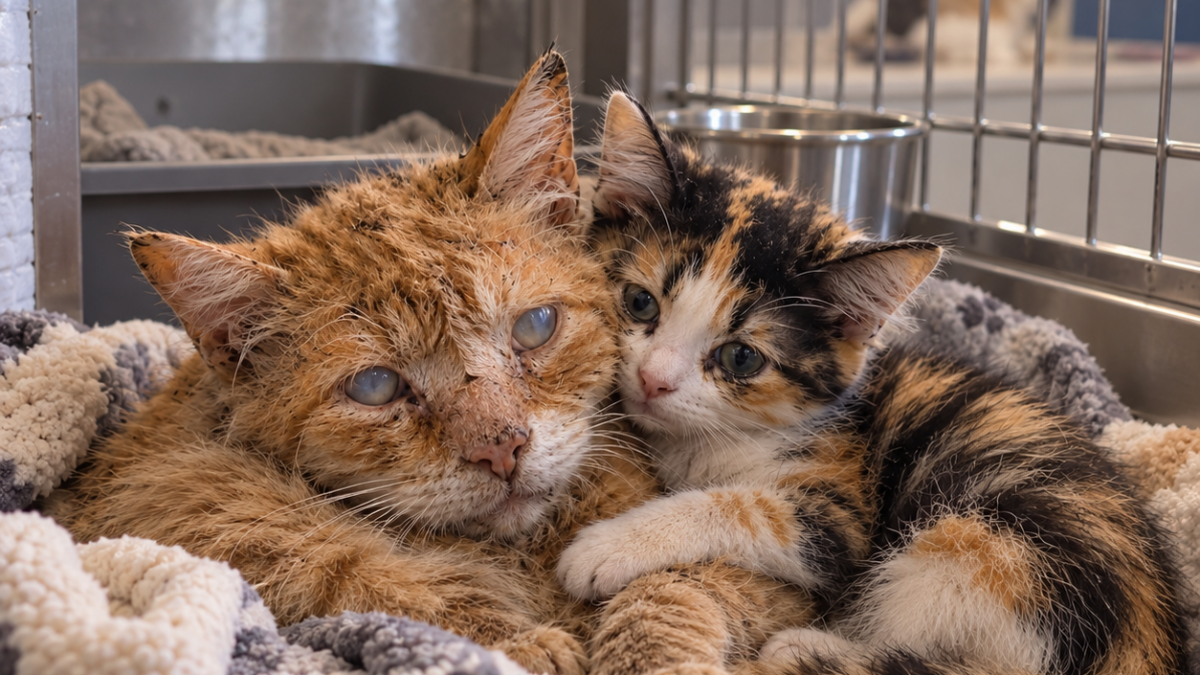
Not normal cloudy.
Blind.
The old cat attempted to stand.
His front legs straightened.
His back end barely followed.
He made it halfway up before collapsing against the frozen dirt.
The calico immediately turned.
She pressed herself against him.
Caleb stopped reaching.
“Oh.”
That one word came out differently.
He crawled farther beneath the trailer.
The smell told him more.
Urine.
Damp fur.
Old wood.
Animals who had been sheltering too long in one place.
The calico was young.
Maybe a year.
Maybe two.
Hard to tell because she was so thin.
The ginger looked ancient.
His coat had lost the healthy smoothness of a cared-for cat.
There were mats near the hindquarters.
His ribs showed beneath fur.
His eyes did not track Caleb’s movement.
The old cat lifted his nose instead.
Smell.
Sound.
That was how he knew where the stranger was.
Caleb spoke softly into his radio.
“I have two.”
Static.
Then dispatch.
“Two cats?”
“One elderly. One younger.”
“You need assistance?”
“Maybe.”
The calico growled.
Tiny sound.
Almost ridiculous coming from such a small animal.
But there was nothing humorous about the way she positioned herself.
She was between Caleb and the old cat.
Guarding him.
He tried a different angle.
Placed a little wet food on a plastic lid.
Pushed it forward.
The calico sniffed.
Hesitated.
She was clearly hungry.
Her body showed it.
Yet she did not eat immediately.
Instead she stepped backward.
Toward the ginger.
She nudged his face.
Once.
Twice.
The old cat lifted his nose.
Smelled the food.
Caleb watched the calico move aside.
Only then did the ginger crawl forward.
He ate slowly.
Very slowly.
The calico waited.
She did not put her face into the dish beside him.
Did not steal.
Did not shove him away.
She sat.
Watched.
When he stopped, she ate what remained.
Caleb stared.
“What are you doing?”
He knew the cat did not understand.
But the question came anyway.
Because suddenly the little tracks across the field began making sense.
He backed out and walked toward the barn.
The property owner, a man named Ed Lawson, stood waiting in a heavy canvas coat.
“You found her?”
“Two.”
Ed frowned.
“Two?”
“There’s an old orange cat under there too.”
“I never saw him.”
“He’s not moving much.”
Ed looked toward the trailer.
“I’ve only seen the small one.”
“How long?”
“Couple weeks.”
“What did you put out?”
“Kibble. Scraps once or twice.”
“Water?”
“Yeah, but it freezes.”
Caleb looked down.
Tiny tracks crossed the snow.
Back.
Forth.
A repeated path.
“How often did she come?”
“Every day.”
“Once?”
Ed thought.
“Sometimes twice.”
Caleb followed the tracks.
Near the barn wall, he saw disturbed snow.
Small holes.
Scratching marks.
There were feathers near one.
Mouse fur near another.
He looked back toward the trailer.
“You have rodents around here?”
Ed laughed.
“It’s a barn.”
Caleb said nothing.
He returned to the opening.
This time he brought two carriers.
He knew separating them during rescue might be unavoidable.
But the calico had already made it clear that she would complicate that decision.
He put a towel around his arm.
Reached.
The old ginger did not resist.
That scared him more than resistance would have.
A frightened cat with strength fights.
This one simply sagged.
Caleb got one arm beneath his chest.
Another under his back legs.
The body was shockingly light.
Cold.
Too cold.
He started to pull him toward the opening.
The calico exploded.
One second she was sitting.
The next she was attached to Caleb’s glove.
Teeth through the outer fabric.
Claws around his wrist.
Not attacking randomly.
Holding.
Trying to stop him from taking the ginger away.
“Easy!”
Caleb froze.
The little cat twisted toward the old one.
Made a sound that was not quite a meow.
Not quite a cry.
The ginger lifted his head.
Caleb understood.
“You think I’m taking him.”
The calico’s teeth remained in the glove.
“I’m not.”
She did not believe him.
Fair.
He changed the plan.
He placed the ginger back.
The calico released immediately.
She moved against his side.
Caleb backed out.
Called dispatch.
“Send me another carrier and another person.”
“You have two carriers.”
“I need help bringing them together.”
“Together?”
“Yes.”
He did not feel like explaining.
Twenty minutes later another officer arrived.
They brought a larger crate.
One took the ginger.
The other blocked the opening so the calico could not disappear deeper beneath the trailer.
She fought.
Bit.
Twisted.
Then saw the ginger being placed into the large crate.
Stopped.
The crate door remained open.
Caleb stepped back.
The calico looked at him.
Then at the carrier.
The old ginger made a weak sound.
Barely audible.
The calico walked straight inside.
No trap.
No net.
No force.
She climbed over him.
Turned around.
Curled against his chest.
Caleb shut the door.
“That was easier.”
The other officer looked at his glove.
“You got bitten.”
“Worth it.”
They drove to the shelter with the heater running harder than Caleb had ever used it.
The calico stayed pressed against the ginger the entire way.
At the shelter, veterinary technician Leah Morgan met them at the intake door.
“How bad?”
Caleb shook his head.
“Old one’s cold.”
“How cold?”
“Cold cold.”
They moved quickly.
Crate onto table.
Door opened.
The calico came out first.
Then immediately turned toward the ginger.
Leah reached for him.
The calico growled.
Caleb said:
“She’s protective.”
“I see that.”
“She won’t leave him.”
Leah crouched.
“Okay.”
She let the calico watch.
The ginger was lifted onto a warming blanket.
Temperature.
Far below normal.
Gums pale.
Skin tenting from dehydration.
Heart rate weak.
Body weight alarmingly low.
The veterinarian, Dr. Hannah Lee, came in.
One look.
Then another.
“How old?”
“Unknown.”
She checked teeth.
Eyes.
Joints.
“Fifteen plus.”
The calico stayed under the edge of the table.
Never farther than two feet away.
Dr. Lee touched the ginger’s abdomen.
“Kidneys feel small.”
Blood was drawn.
Fluids started.
Warm packs placed carefully.
Oxygen nearby.
The ginger barely reacted.
That was the problem.
Caleb stayed longer than he normally would have.
He did not know why.
Maybe because of the calico.
Maybe because he had watched her refuse to eat until the old cat did.
Maybe because those little tracks across the field would not leave his mind.
“How long do you think they were out there?”
He asked.
Leah shrugged.
“Long enough.”
The bloodwork came back.
It was bad.
Severe dehydration.
Elevated kidney values.
Anemia.
Malnutrition.
Hypothermia.
Possible chronic kidney disease made much worse by exposure.
Dr. Lee looked at the old cat.
Then at the tiny calico.
“What are we calling them?”
“Nothing yet.”
Leah looked at the intake sheet.
“Farm trailer cats.”
“That’s depressing.”
Caleb said:
“Call the old one Lucky.”
Dr. Lee shook her head.
“Absolutely not.”
“Why?”
“There are fourteen Luckys in the system.”
Fair.
The calico climbed onto the corner of the warming blanket.
Dr. Lee watched.
“She related?”
“Probably not.”
“How do you know?”
“We don’t.”
Later examination suggested they were not mother and kitten.
Not siblings.
Not even close in age.
No obvious biological relationship at all.
Just two cats who had somehow ended up surviving together.
Dr. Lee lowered her voice.
“The old one might not make twenty-four hours.”
Caleb looked at her.
“That bad?”
“Yes.”
“Can you save him?”
“We can warm him. Hydrate him. Support him. Treat what’s treatable.”
She paused.
“But his body has almost nothing left.”
The calico began grooming the ginger’s ear.
Slow strokes.
Dr. Lee watched.
“What about her?”
“Frostbite on paw edges.”
Leah examined them.
“Some claw damage.”
The pads were cracked.
Small areas raw.
Claws worn unusually short.
Dr. Lee looked at Caleb.
“Where exactly were they?”
“Trailer to barn.”
“How far?”
“Maybe forty yards.”
“Tracks?”
“Back and forth.”
Ed Lawson later gave more information.
He had found half-eaten field mice near the opening under the trailer.
A sparrow once.
Small scraps of food carried away from the barn.
He assumed the calico was storing food.
Now everyone wondered if she had been bringing it to the blind cat.
Nobody could prove every detail.
But the evidence was hard to ignore.
The old ginger was nearly blind.
Could barely walk.
Could not possibly have been making that forty-yard trip through deep snow.
Yet he had survived.
Something had kept bringing resources to him.
And the only other animal sheltering beneath that trailer was a four-pound calico with worn claws and damaged paws.
Leah said:
“She was keeping him alive.”
Dr. Lee answered carefully.
“She was contributing to his survival.”
Leah looked at her.
“That’s veterinarian language.”
“Yes.”
“You know what I mean.”
“I do.”
They placed the two cats together in a warmed medical kennel.
Not because it was standard.
Because the old cat became visibly distressed when the calico was removed for her own exam.
He lifted his head.
Tried to stand.
Cried once.
When she returned, he stopped.
That settled the question.
Together.
The calico curled around him.
Exactly as she had beneath the trailer.
The shelter staff eventually named them Holden and Parish.
Nobody remembers exactly who suggested which name.
Names often happen that way in shelters.
Someone says one.
It sticks.
Holden slept most of the first day.
Parish barely slept at all.
She watched.
Every technician.
Every opening of kennel door.
Every syringe.
Every bag of fluids.
If someone reached toward Holden too fast, she moved between them.
Not attacking.
Just there.
Leah began talking to her before touching him.
“Parish, I’m checking his catheter.”
The little cat would stare.
“I know.”
Stare.
“He needs this.”
Eventually Parish learned Leah was safe.
By late afternoon she allowed Leah to touch Holden without climbing between them.
At six that evening, Dr. Lee repeated bloodwork.
Still bad.
Maybe slightly better.
Maybe not.
“Another twelve hours.”
Leah asked.
“You think he can make it?”
“I don’t know.”
Parish was eating now.
More than she had under the trailer.
A little wet food.
Then back to Holden.
She washed his face.
He slept.
The shelter posted their story that evening.
Not dramatically.
A few photographs.
Two rescued cats from dangerous cold.
Senior blind ginger in critical condition.
Young calico refusing to leave his side.
Donations requested for medical care.
The post spread.
First locally.
Then beyond.
People shared the photograph of Parish curled around Holden.
Comments multiplied.
People offered money.
Blankets.
Homes.
Some asked to adopt Parish.
Others offered to take Holden.
The shelter answered the same way.
Not available yet.
Medical hold.
And if they left?
Staff increasingly agreed they should leave together.
The next morning, snow was still falling when the front desk received a phone call.
A woman named Elaine Porter.
Fifty-eight.
Lived about ninety minutes away.
She had seen the post.
“Are they still there?”
“Yes.”
“Both?”
“Yes.”
“Can I meet them?”
“They aren’t cleared for adoption.”
“I understand.”
“Holden is very sick.”
“I understand.”
“He may not survive.”
There was a pause.
Elaine said:
“I still want to come.”
The staff tried to explain that driving through the weather was not necessary.
She came anyway.
Ninety minutes in good conditions became nearly two hours in snow.
Elaine arrived in boots and a thick green coat with snow packed around the cuffs.
She did not ask first about Parish.
She asked:
“How is the old one?”
Dr. Lee spoke with her.
Kidneys.
Age.
Blindness.
Unknown history.
Guarded prognosis.
Even if he stabilized, he might have months.
Maybe less.
Maybe more.
No promises.
Elaine listened.
Then:
“And the little one?”
“Recovering.”
“Will you separate them?”
“We’d rather not.”
“Good.”
Dr. Lee studied her.
“You understand what adopting Holden could mean?”
Elaine nodded.
“Medication.”
“Yes.”
“Subcutaneous fluids possibly.”
“Okay.”
“Special diet.”
“Okay.”
“More veterinary visits.”
“Okay.”
“Potentially losing him soon after adoption.”
Elaine’s eyes watered.
“I know.”
“Some people decide that’s too much.”
“I’m sure.”
“Why do you want both?”
Elaine looked through the small window toward the medical room.
Parish lay against Holden.
“Because she already made the decision.”
Dr. Lee waited.
Elaine continued.
“That little cat nearly froze keeping him alive.”
She shook her head.
“I’m not going to be the person who rewards that by taking him away.”
The shelter did not hand them over that day.
Holden was still too unstable.
But Elaine filled out the paperwork.
Both cats.
No hesitation.
The application asked:
Reason for adopting.
She wrote:
They belong together.
Over the next week, Holden improved enough to leave intensive medical care.
Not cured.
Improved.
Important difference.
His kidneys remained compromised.
He stayed blind.
His gait was slow.
He needed help.
But he ate.
Drank.
Gained a little weight.
Started grooming himself again.
One afternoon Leah watched him lift a paw and clean his face.
She nearly cried.
Parish was already stronger.
Her paws healed.
She gained ounces.
Her coat began to look less dull.
But her most consistent behavior did not change.
Where Holden went, Parish went.
When he slept, she slept.
When he ate, she often waited nearby.
When he became disoriented in the larger recovery room, she approached.
Sometimes rubbed against him.
Sometimes simply stood where he could smell her.
Holden learned the room.
Food on right.
Water near wall.
Litter box close to bed.
Parish learned it faster.
Staff began noticing something.
She often moved ahead of him.
Not obviously guiding.
Just existing where he needed reassurance.
Holden followed sound.
Her paws.
Her breathing.
The little chirps she made when excited.
He could not see her.
Did not need to.
Elaine visited twice before they were released.
The first time Parish stayed away from her.
The second, she climbed onto the chair beside Elaine.
Holden slept in a blanket.
Elaine did not reach.
She waited.
After several minutes Parish sniffed her sleeve.
Elaine whispered:
“I’m taking both of you.”
Parish blinked.
“Just so we understand each other.”
The staff laughed.
Ten days after rescue, Holden and Parish left the shelter.
Together.
Elaine had prepared one quiet room in her house.
Three beds.
Low litter boxes.
Food at consistent locations.
Furniture arranged so Holden would not have to navigate changing obstacles.
A heated pad by the window.
Small steps beside the sofa.
She expected Holden to hide.
He did not.
He stepped out of carrier.
Stopped.
Smelled.
Parish came out behind him.
Walked past.
Holden turned toward the sound.
Followed.
They explored the room in slow circles.
Parish first.
Holden behind.
After twenty minutes they found the heated window bed.
Parish climbed up.
Holden attempted to follow.
Missed once.
Elaine moved to help.
Parish jumped down.
Walked beside him.
He tried again.
Made it.
Parish climbed back up.
They curled together.
Elaine took one photograph.
Then sat on the floor and cried.
Not because it was sad.
Not exactly.
Because ten days earlier those two bodies had been curled beneath frozen metal in fourteen-below weather.
Now sunlight fell across them through a warm window.
Holden slept.
Parish’s chin rested over his neck.
Elaine did not post the photograph for hours.
She just watched.
The first months were not easy.
Holden needed medical care.
Frequent labs.
Medication.
Fluids beneath the skin.
Diet adjustments.
Some days he ate well.
Some days Elaine sat beside him for twenty minutes encouraging three bites.
Parish became suspicious of the fluid bag.
She would sit nearby and stare at Elaine as if conducting a performance review.
“You know I’m helping him.”
Parish continued staring.
“He would like you to stop judging me.”
Holden slept through the argument.
Elaine learned his blind-cat routes.
Bedroom wall.
Hall runner.
Kitchen mat.
Window bed.
Water.
Litter.
He mapped the house through whiskers, scent, memory, and sound.
Furniture stayed mostly still.
If Elaine moved a chair, Parish investigated first.
Sometimes Holden followed her.
When he got confused, he called.
A low rough meow.
Parish almost always appeared.
Elaine began calling it his locator signal.
“Where’s my girl?”
Holden would meow.
Small paws.
Then Parish.
There were moments when Elaine wondered who was caring for whom.
Parish was young.
She should have been climbing curtains.
Attacking toys.
Creating trouble.
She did all of that.
Especially at night.
She once knocked three books from a shelf at 2:00 a.m. and then looked offended when Elaine woke up.
She chased bottle caps.
Stole bread ties.
Sat inside grocery bags.
But if Holden made that low uncertain sound, Parish stopped.
Always.
Head up.
Listen.
Then go.
Not every time immediately.
She was still a cat.
Sometimes she finished whatever criminal activity she was committing.
But she went.
Elaine began to understand their relationship was not sentimental in the human way people online described it.
Parish was not a tiny nurse.
Holden was not helpless every second.
They annoyed each other.
Holden occasionally stepped on her.
Parish sometimes stole his food.
Once she smacked him on the head because he walked directly across her tail.
But underneath all of it was attachment.
Familiarity.
A shared map of the world.
The old cat knew where the young one was.
The young one noticed when the old one needed something.
They had survived together long enough that together had become normal.
Spring arrived.
Snow disappeared.
Holden discovered the window.
Or more accurately, discovered sunlight.
He could not see the birds.
But he heard them.
Every morning he climbed onto the heated bed and turned his face toward the open screen.
Birdsong.
Wind.
Leaves.
Parish sat beside him watching everything he could only hear.
Elaine sometimes wondered what his life had been before the trailer.
Had he lived inside?
Almost certainly.
He knew litter boxes.
Human voices.
Soft beds.
He leaned into scratches.
Somebody had loved him once.
Or at least lived with him.
How did a blind senior cat end up under an abandoned trailer?
Nobody knew.
Had he been dumped?
Wandered?
Lost after an owner died?
Had Parish met him before or after he became homeless?
No answer.
Elaine learned to live with that.
There is a temptation with rescued animals to create a perfect backstory.
To fill empty spaces.
Holden and Parish did not need one.
The facts were enough.
When found, Holden could barely survive.
Parish stayed.
That was enough.
Summer came.
Holden gained weight.
Not much.
But enough that his spine no longer felt quite as sharp.
He learned Elaine’s voice.
When she called from kitchen, he turned.
When she sat on couch, he found her feet.
Parish became fearless.
She slept in windows.
Chased insects.
Made friends with one neighbor and hated another for reasons known only to her.
Every night, though, she returned to Holden.
Same bed.
Same position.
Curled against his side.
Sometimes completely on top of him.
Elaine bought a second heated bed.
Parish ignored it.
Of course.
By autumn, Holden’s kidney values worsened.
Not suddenly.
Slowly.
Dr. Lee had warned Elaine.
Chronic kidney disease often moves like that.
Better.
Stable.
Then less stable.
Elaine added fluids.
Changed food.
Adjusted medications.
Holden still enjoyed the window.
Still ate treats.
Still purred when his chin was scratched.
Those things mattered.
Quality of life became the conversation.
Not “How long can we keep him alive?”
But:
“Does he still want his days?”
For a long time, the answer remained yes.
Parish seemed to know bad days before Elaine did.
She stayed closer.
On good days she disappeared into other rooms.
On difficult ones she was beside him.
Elaine did not romanticize it.
Maybe Holden smelled different.
Moved differently.
Made sounds Elaine could not hear.
Animals notice tiny changes.
Whatever the mechanism, Parish noticed.
Winter returned.
This time Holden experienced it from behind glass.
One morning snow began before sunrise.
Elaine woke and found both cats at the window.
Holden sitting.
Parish beside him.
The yard turned white.
Elaine thought of the trailer.
Forty yards.
Back and forth.
Four pounds against Vermont cold.
She sat beside them.
“Not this year.”
Parish looked at her.
“No frozen trailers.”
The cat blinked.
“We’re done with that.”
Holden purred.
The sound was faint.
But there.
Fourteen months after his rescue, Holden stopped eating.
At first Elaine thought it was another bad morning.
He had those.
She offered warmed food.
Nothing.
Chicken.
Nothing.
His favorite treat.
He sniffed.
Turned away.
Parish sat beside him.
By evening Holden had barely moved from the window bed.
Elaine called the veterinarian.
Bloodwork the next morning confirmed what she already feared.
Kidney values had worsened dramatically.
He was weak.
Nauseated.
Dehydrated despite treatment.
Elaine asked the question everyone dreads.
“Can we turn this around?”
Dr. Lee was quiet.
“Maybe briefly.”
“What does briefly mean?”
“Days.”
Elaine stared at Holden.
Parish was pressed against his back.
“Will he feel better?”
“We can make him more comfortable.”
“That’s not what I asked.”
Dr. Lee understood.
“Probably not enough.”
Elaine cried.
Then asked:
“Can I take him home tonight?”
“Yes.”
She brought both cats home.
May 2022.
Warm evening.
Windows open slightly.
Birds outside.
Holden spent his final night in the place he loved.
The window bed.
Parish against him.
Elaine on the floor nearby.
She barely slept.
Around three in the morning, Holden woke.
Lifted his head.
Meowed once.
Parish immediately moved closer.
She touched her nose to his face.
Then began grooming his forehead.
Elaine covered her mouth.
Some things become unbearable because they are so small.
A paw.
A lick.
A cat doing what she had always done.
Stay.
By morning Holden could not stand comfortably.
Elaine knew.
Dr. Lee came to the house.
She offered the clinic.
Elaine said no.
Not because clinics are cruel.
Because Holden had spent enough of his life being moved.
He was home.
The heated bed sat beneath him.
Sun through window.
Parish curled against his ribs.
Dr. Lee sat on the floor.
“Are you ready?”
Elaine looked at Holden.
“No.”
Then:
“But he is.”
She stroked his head.
“Hey, old man.”
Holden’s ear moved.
“You did good.”
Parish watched her.
Elaine’s voice broke.
“You both did.”
The first medication made him sleepy.
His body relaxed.
Parish lifted her head.
Sniffed him.
Lay back down.
Holden’s breathing slowed.
Elaine kept one hand on him.
Parish kept one paw touching his shoulder.
When his heart stopped, nothing dramatic happened.
The room simply became quieter.
Dr. Lee listened twice.
Then removed the stethoscope.
“He’s gone.”
Elaine cried.
Parish did not understand death as a human understands it.
Nobody should pretend she did.
But she knew something had changed.
She stayed beside him.
Sniffed his face.
Licked his ear.
Waited.
When Dr. Lee eventually lifted Holden, Parish stood.
Followed.
Elaine asked:
“Can she have a minute?”
So they laid him back down.
Parish returned to the place beside his ribs.
Same position she had taken under the trailer.
Same position she had taken on the shelter blanket.
Same position every night in the window bed.
She remained there a long time.
After Holden’s body was taken away, Parish searched.
Hallway.
Bedroom.
Window.
Kitchen.
Back again.
At dinner she did not eat.
Elaine sat beside her.
“He’s not coming back.”
Parish stared toward the hallway.
“I’m sorry.”
The next morning, she still barely ate.
Second day, she spent most of her time on Holden’s bed.
Elaine worried.
Called Dr. Lee.
“Give her time, but watch her closely.”
That evening Parish finally ate.
A few bites.
Then more.
By the third day she drank normally.
A week later she chased a moth.
Elaine cried again.
Because grief and life are not opposites.
Sometimes they occupy the same room.
Parish continued sleeping on the old window bed.
At first alone.
Then gradually stretched out.
Took more space.
She became healthier.
Heavier.
Her coat shone.
She discovered that without Holden’s medication schedule, breakfast could apparently be demanded at 5:30 a.m.
She perfected the technique.
One paw directly on Elaine’s cheek.
“Parish.”
Meow.
“It’s five-thirty.”
Meow.
“You survived a Vermont winter. You can survive thirty more minutes.”
Parish disagreed.
Life continued.
That is the part stories often skip.
The heroic rescue.
The sacrifice.
The death.
Those are dramatic.
But devotion is not only dramatic.
It is repetition.
Returning.
Forty yards there.
Forty yards back.
Again.
Again.
Again.
Then years later:
Window bed.
Water bowl.
Warm room.
Wake.
Eat.
Sleep.
Keep living.
Parish did.
People online continued sharing the old photograph.
Tiny calico wrapped around blind ginger.
Sometimes Elaine read the comments.
“She saved him.”
Maybe.
“He saved her.”
Maybe too.
“Pure love.”
Perhaps.
Elaine preferred simpler language.
“They stayed.”
That was what she had witnessed.
Neither cat could solve the other’s life.
Parish could not restore Holden’s sight.
Could not reverse his age.
Could not repair his kidneys.
Could not make the Vermont winter warm.
Holden could not protect Parish’s paws.
Could not stop her hunger.
Could not hunt for her.
Neither had enough power to fix the situation.
But companionship is not always fixing.
Sometimes companionship is presence when fixing is impossible.
That was the thing Elaine understood differently after knowing them.
We tend to believe love proves itself by solving problems.
Medicine.
Money.
Rescue.
Answers.
But sometimes there is no solution.
There is only:
I’m still here.
Parish had done that beneath the trailer.
Holden was blind.
Weak.
Old.
The rational survival strategy for a young cat might have been leaving.
Find a barn.
Find a house.
Find people.
Find somewhere warmer.
Instead there were tracks.
Forty yards to food.
Forty yards back.
The shelter staff could never prove exactly how many journeys.
Or what Parish understood.
Or whether she consciously thought:
Holden needs me.
Animals do not narrate their motives for us.
That is probably good.
Humans would ruin them with explanations.
But the evidence of behavior remained.
She traveled.
Returned.
Shared food.
Stayed close.
Refused rescue without him.
Settled only when he was near.
And when he died fourteen months later, she returned to the same place beside him.
Whatever word we choose for that behavior does not make it smaller.
Instinct.
Bond.
Attachment.
Loyalty.
Love.
The word matters less than the act.
She came back.
Elaine kept Holden’s collar in a drawer.
Not displayed.
Not made into a shrine.
His photograph stayed near the window.
Parish sometimes sat beneath it.
Probably because sunlight was good there.
Elaine never pretended otherwise.
One morning, nearly a year after Holden died, snow began falling heavily.
Parish jumped onto the window bed.
Watched flakes.
Elaine sat nearby drinking coffee.
The room was warm.
Heating vent humming.
Parish tucked paws beneath herself.
Safe.
Elaine looked at the tiny cat and thought about the first shelter report.
Four pounds.
Frostbitten paws.
Worn claws.
Then about Holden.
Fifteen years old.
Blind.
Barely standing.
One or two days from death.
He lived fourteen more months.
Not fourteen perfect months.
There were medications.
Bad days.
Vet visits.
Fluid needles.
Age.
Decline.
But there were also fourteen months of sunlight.
Warm blankets.
Birdsong.
Food whenever he wanted it.
Hands that knew how to touch him without startling him.
And every night:
Parish.
That mattered.
People sometimes measure rescue by years.
How long did the animal live afterward?
A decade feels like success.
Weeks can feel like tragedy.
Elaine stopped thinking that way.
Holden got fourteen months.
Someone might say:
Only fourteen months.
Elaine never did.
Fourteen months is hundreds of mornings.
Hundreds of meals.
Hundreds of naps.
Four seasons.
A spring.
A summer.
An autumn.
Another winter.
A final spring.
Fourteen months is enough time for a blind old cat to learn a new house.
Enough time to recognize a new voice.
Enough time to find a favorite window.
Enough time to understand that food comes every day.
Enough time to stop sleeping on frozen dirt.
Enough time to become somebody’s cat again.
That is not “only.”
That is a life restored at the end.
Parish gave him the bridge to reach it.
The rescuers carried him out.
The veterinarians stabilized him.
Elaine gave him a home.
But before any of those people arrived, there had been a little calico walking through snow.
Again.
And again.
And again.
A tiny animal doing the only things available to her.
Find food.
Find water.
Return.
Stay warm together.
Do not leave.
People often want extraordinary love to look extraordinary.
Big gestures.
Sacrifice everyone can see.
But nobody saw Parish while it was happening.
No cameras.
No audience.
No shelter post.
No thousands of comments.
Just frozen ground.
A blind cat beneath rusted metal.
And one small set of tracks leading away and coming back.
That may be the most beautiful part.
She did not know anyone would ever know.
She did not know rescuers were coming.
She did not know someone would drive ninety minutes through snow.
She did not know Holden would get a heated bed.
She just kept returning.
Today, when Parish sits beside that same warm window, there is an empty space where Holden once slept.
She no longer searches the hallway for him.
She eats.
Plays.
Sleeps.
Chases light across the floor.
Her life became larger after his ended.
That does not erase him.
It means she survived too.
Maybe that is what devotion should do when it is healthy.
Not trap the living beside the dead forever.
Carry them as far as you can.
Then keep going.
Parish carried Holden through a Vermont winter.
The shelter carried him through the next twenty-four hours.
Elaine carried him through the final fourteen months.
And when his body could not go farther, Parish stayed beside him one last time.
Then eventually stood up.
Ate.
Returned to the window.
Kept living.
If you want to understand what those two cats meant to each other, you do not need to imagine human sentences in their heads.
You only need the tracks.
Forty yards through -14°F cold.
Forty yards back.
A tiny calico with damaged paws.
A blind ginger who should not have survived.
And a pattern written into the snow over and over again:
Leave.
Find what he needs.
Come back.
Leave.
Find what he needs.
Come back.
Until one day people finally noticed.
Sometimes love is not fixing someone.
Sometimes it is not curing them.
Not making them young.
Not giving them back what they lost.
Sometimes love is much smaller.
And much harder.
It is refusing to let someone face the cold alone.
That was Parish.
Four pounds of fur.
Frostbitten paws.
Worn claws.
Nothing impressive about her size.
Nothing dramatic about what she had available.
No miracle.
No power.
Just persistence.
She could not save Holden forever.
Nobody could.
But she kept him alive long enough for help to find them.
Long enough for him to feel heat again.
Long enough for someone to call him theirs.
Long enough to sleep by a sunny window.
Long enough to hear birds through an open screen.
Long enough to spend every night with the little cat who had once curled around him beneath a frozen trailer.
And in the end, maybe that was never about how many months he got.
Maybe it was about what those months contained.
Warmth.
Safety.
Food.
Home.
And her.
Always her.
Right beside him.








