The Navy SEAL’s K9 Ignored Every Handler and Refused Every Command—Then a Quiet Nurse Stepped Forward and Said One Word.
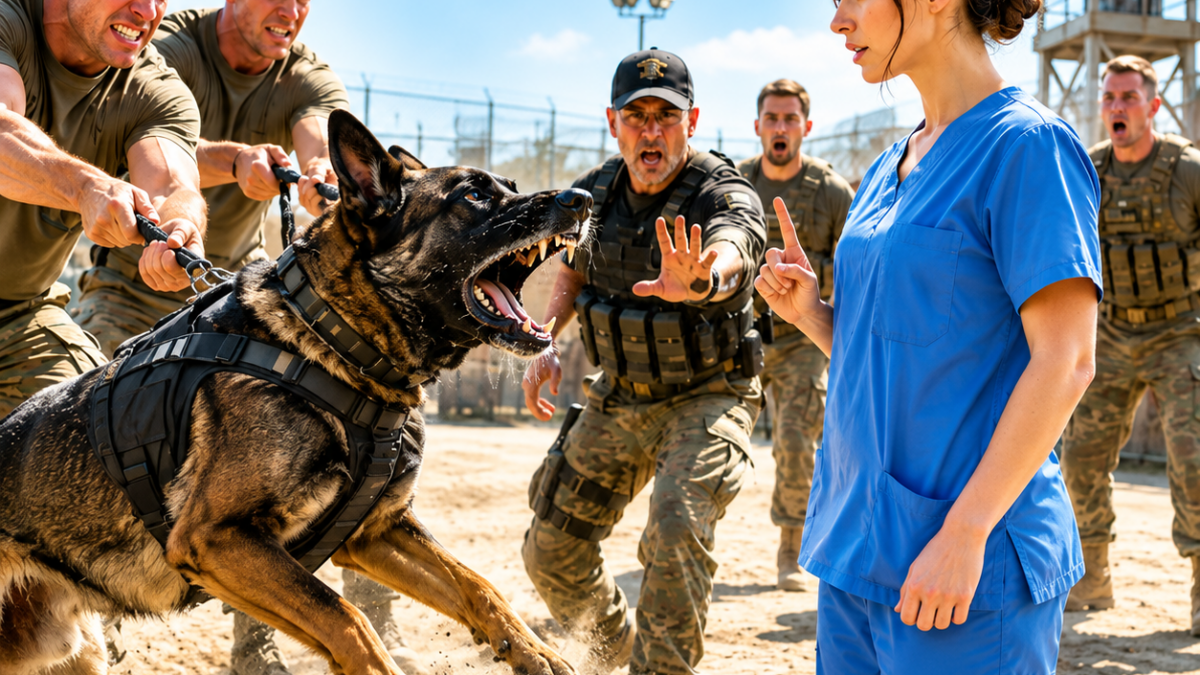
PART2:
That afternoon, I was reviewing discharge paperwork when the first call came through.
Incoming military trauma.
Male.
Late thirties.
Unstable vitals.
Blast injury.
Multiple fractures.
K9 present.
That last line made every nurse at the desk look up.
“K9 present?” Jamie asked.
Jamie was twenty-six, sharp, fast, and still new enough to think unusual meant interesting instead of dangerous.
I set the clipboard down.
“Clear the south bay.”
She blinked.
“For the patient?”
“For the dog.”
The ambulance came in hard.
Rear doors flew open.
Two corpsmen jumped out first.
Then a stretcher.
Then Ranger.
PART3:
The dog hit the ground beside the stretcher like a black-and-tan shadow, eyes locked on Cole Maddox’s body, ears forward, mouth closed.
Not barking.
Not lunging.
Not confused.
Focused.
That was worse.
A confused dog can sometimes be redirected.
A focused working dog has already chosen a mission.
Cole was conscious, barely.
His face was gray under the dust and dried blood.
His left leg was stabilized.
His right shoulder had been packed tight.
There was a cervical collar around his neck and an oxygen mask over his mouth.
His hand hung off the side of the stretcher.
Ranger walked under it.
Not beside it.
Under it.
His back brushed Cole’s fingers every few steps, and even half-conscious, Cole’s hand twitched once against the dog’s fur.
The corpsman shouted, “He won’t separate!”
“Who authorized the dog in the bay?” Dr. Harlan snapped.
“Nobody authorized anything,” the corpsman said. “He got in the ambulance himself.”
Dr. Harlan was a brilliant trauma surgeon and an impatient man with the emotional range of a locked filing cabinet.
“Security,” he said. “Get the dog out.”
That was the first mistake.
A hospital security officer stepped toward Ranger with both hands raised.
“Easy, boy.”
Ranger turned his head.
Nothing else moved.
Just the head.
The officer froze.
Every person in that bay felt the change.
The dog had not growled.
He had not bared his teeth.
He simply looked at the man and made it clear that one more step would become a decision.
The officer stepped back.
Smart man.
We rolled Cole toward trauma room three.
Ranger followed.
Dr. Harlan blocked the doorway.
“No dog in the trauma room.”
Ranger moved between him and the stretcher.
Fast.
Silent.
Precise.
One second he was beside Cole.
The next he was in front of the doctor, body low, shoulders squared, eyes fixed.
Still no bark.
Still no growl.
Just presence.
Dr. Harlan lifted both hands.
“Somebody control this animal.”
The corpsman swallowed.
“Chief Maddox is the only one who controls him.”
Cole’s eyes opened halfway.
Behind the oxygen mask, his lips moved.
No sound came out.
Ranger glanced back at him.
That tiny movement told me everything.
The dog was not out of control.
He was waiting for a command from a man who could not give one.
The hallway filled within minutes.
Two SEALs arrived first, both in civilian clothes, both still carrying the look of men who had changed shirts but not left the mission. One was tall and blond with a cut over his eyebrow. The other was shorter, broader, with hands that looked like they had been broken more than once.
The tall one stepped forward.
“Ranger. Heel.”
Ranger did not move.
“Ranger. Stand down.”
Nothing.
The shorter SEAL tried next.
“Ranger. Out.”
The dog’s ears shifted.
Not obedience.
Warning.
The SEAL stopped.
“That’s not good,” Jamie whispered beside me.
“No,” I said. “It isn’t.”
Then came the kennel master.
Then military police.
Then a veterinary officer.
Then a commander whose name I did not catch because everyone kept talking over everyone else.
Every command failed.
Heel.
Down.
Out.
Release.
Back.
Kennel.
Place.
Stand down.
Ranger ignored them all.
He remained planted between Cole and the trauma room, body angled to protect his handler from anyone trying to move too close. Every time we tried to roll Cole forward, Ranger shifted with him. Every time someone reached toward Cole’s chest, Ranger stepped in.
Not attacking.
Blocking.
That distinction mattered.
But it did not change the problem.
Cole was bleeding internally.
His pressure was dropping.
We needed imaging, airway access, blood, surgery prep, and time we did not have.
Dr. Harlan’s face reddened.
“I don’t care what medals that dog has. If he keeps blocking care, we sedate him.”
The veterinary officer said, “You try to sedate him like this and someone gets hurt.”
“Then muzzle him.”
The kennel master looked at him as if he had suggested wrestling lightning.
“You don’t muzzle Ranger when he is in protection lock.”
“Protection lock?” Harlan snapped. “This is a hospital, not a battlefield.”
The shorter SEAL looked at the doctor.
“With respect, sir, that dog does not know that.”
I had been quiet until then.
Quiet does not mean absent.
I was watching Ranger’s feet.
His breathing.
His shoulders.
His eyes.
Most people watch a dog’s teeth when they are afraid.
Teeth are late information.
Feet tell you first.
Ranger’s paws were set wide. Weight forward, but not spring-loaded. Tail low, not tucked. Ears high. Eyes moving between Cole, the room, and every hand that came too close.
He was not panicking.
He was guarding a downed partner inside a chaotic space full of strangers.
And everyone kept shouting commands like volume was the missing ingredient.
“Stop talking,” I said.
Nobody listened.
That happens often in hospitals when a nurse speaks at normal volume.
So I said it again.
“Stop talking.”
This time, the tone carried.
Not loud.
Flat.
The kind of voice you use when someone is about to contaminate a sterile field or step into traffic.
The hallway quieted by degrees.
Dr. Harlan turned toward me.
“Nurse Ellison—”
“Every person giving that dog a different command is making him more certain the room is unsafe.”
The kennel master looked at me.
“You have experience with working dogs?”
I did not answer right away.
That was a door I did not open often.
“I have experience with animals under stress.”
The commander stepped closer.
“We need him moved.”
“No,” I said. “You need him convinced moving Cole is not abandoning Cole.”
The room held.
Then the tall SEAL said, “Can you do that?”
I looked at Ranger.
He looked back.
For the first time since the ambulance arrived, the dog’s eyes left Cole and settled fully on me.
It was not trust.
Not yet.
It was assessment.
I took one step forward.
The kennel master caught my arm.
“Ma’am, don’t.”
I looked down at his hand.
He released me.
I stepped into the space at the edge of Ranger’s boundary and stopped.
I did not reach for him.
I did not crouch.
I did not make kiss noises or say good boy.
That is what people who do not understand working dogs do. They try to make them pets at the exact moment the dog is being a soldier.
Ranger did not need sweetness.
He needed clarity.
Cole’s breathing grew rougher behind him.
The monitor alarm sharpened.
Jamie whispered, “Pressure’s dropping.”
I heard her.
So did Ranger.
His ears flicked toward the alarm.
His body tightened.
He thought the machine was part of the threat.
“Turn that alarm down,” I said.
Dr. Harlan snapped, “We need to hear—”
“Turn it down.”
Jamie did it.
The high alarm softened to a lower tone.
Ranger’s ears shifted back toward Cole.
Better.
I took another step.
Ranger’s head lowered half an inch.
The whole room stopped breathing.
I spoke to him in the calmest voice I owned.
“Ranger.”
His ears came forward.
Not because he obeyed.
Because he recognized his name when it was not shouted like a weapon.
“Your man needs help.”
No movement.
“Cole needs help.”
At the sound of Cole’s name, the dog’s eyes sharpened.
Behind the oxygen mask, Cole’s fingers twitched again.
Ranger felt it.
I saw the tiny ripple under his coat.
That was the line.
Not command.
Connection.
I looked at Cole.
His eyes were barely open, but they were on me now. Foggy. Pain-glazed. Trying.
I leaned closer, but not past Ranger.
“Chief Maddox,” I said. “I need the release word.”
His lips moved.
Nothing.
I shook my head.
“Not out loud. Blink if there is a release word.”
One blink.
“Is it standard?”
No blink.
Good.
“Is it one word?”
One blink.
“English?”
A pause.
One blink.
The commander said, “We have his command sheet.”
The kennel master flipped through a file.
I held up one hand.
“No.”
He looked offended.
“If that dog is ignoring listed commands, the real word is not on that sheet.”
Cole’s eyes moved.
Barely.
But they moved to mine.
Yes.
I stepped closer.
Ranger let me.
Not much.
But enough.
“Chief,” I said quietly, “does Ranger think you are still on mission?”
One blink.
“Does he need a transfer command?”
Cole’s eyes closed.
Opened.
One blink.
The kennel master whispered, “A transfer command?”
The shorter SEAL’s face changed.
“Cole wouldn’t give that to just anyone.”
“No,” I said. “He wouldn’t.”
I looked back at Cole.
“Can you give it?”
His breathing hitched.
His lips moved under the mask.
I leaned in as far as Ranger allowed.
The sound was almost nothing.
Not a word.
A breath shaped like one.
I caught only the first letter.
M.
Then Cole’s eyes rolled back.
“Pressure’s falling,” Jamie said.
Dr. Harlan stepped forward.
Ranger shifted instantly, blocking him again.
We were out of time.
The room leaned toward panic.
I did not.
M.
One word.
English.
Private.
Transfer command.
Something Cole would trust.
Something Ranger would obey only if it came from the right mouth in the right tone.
I looked at the dog.
Then at Cole.
Then at the name printed on Cole’s wristband.
Cole Maddox.
Maddox.
M.
No.
Too obvious.
His hand twitched again.
Three fingers.
Not random.
I had seen that before.
Not from him.
From someone else.
Years earlier.
A Marine in Kandahar with a military working dog named Sable. He had used a private command when medics needed to take him. Not release. Not heel. Something softer.
Mercy.
That was what he had called it.
A word that meant the dog was not failing by stepping aside.
A word that told the animal protection was changing hands.
I looked at Ranger and felt an old memory move under my ribs.
A dusty aid station.
A handler bleeding through a stretcher strap.
A dog refusing to move.
A young nurse kneeling in sand, learning that sometimes the right command is not about dominance.
It is about permission.
I had not thought about that day in years.
I did not want to think about it now.
But Ranger was waiting.
Cole was dying.
So I lowered my shoulders, softened my hands, and said one word.
“Mercy.”
Ranger’s entire body changed.
Not dramatically.
That is not how trained dogs move when the command is real.
His ears lowered first.
Then his weight shifted back.
Then his head turned toward Cole, as if asking a final question.
I repeated it.
“Mercy, Ranger.”
He exhaled.
One long breath through his nose.
Then he stepped aside.
No one moved.
They were too stunned.
I was not.
“Now,” I said.
The trauma team surged forward.
Ranger did not leave Cole.
He walked beside the stretcher, but he no longer blocked us. When we moved through the trauma room doors, I pointed to the far corner beside the equipment cart.
“Place.”
Ranger hesitated.
I added, “Mercy holds.”
He went to the corner.
Sat.
And watched every hand.
Dr. Harlan glanced at me once.
There were questions in his eyes.
There was no time for them.
“Airway,” he ordered.
The room became movement.
Blood.
Lines.
Monitors.
Scissors cutting fabric.
Gloved hands.
Numbers called out.
Pain medication.
Pressure.
Respiration.
Chest sounds.
X-ray.
Ultrasound.
Surgery prep.
Through all of it, Ranger sat in the corner like a statue made of discipline and heartbreak.
Every time Cole’s vitals dipped, Ranger’s ears rose.
Every time we moved too quickly, his claws clicked once against the floor.
Every time Cole groaned, Ranger leaned forward but did not break position.
Mercy held.
Barely.
But it held.
It took sixteen minutes to stabilize Cole enough to move him to surgery.
Sixteen minutes is nothing in ordinary life.
In trauma, sixteen minutes is a country you cross on your knees.
As we rolled Cole toward the elevator, Ranger stood.
The kennel master moved to stop him.
I shook my head.
“He comes.”
Dr. Harlan said, “Absolutely not.”
I looked at him.
“You want him holding outside the OR doors or tearing through a waiting room because he thinks you disappeared with his handler?”
Harlan stared at me.
Then muttered, “Fine. Outside the OR. Not inside.”
“That is all he needs.”
Ranger walked beside us.
Not ahead.
Not blocking.
Beside.
At the surgical doors, I turned to him.
“Down.”
He did.
The kennel master whispered, “How is he listening to you?”
I looked through the doors as Cole disappeared inside.
“He is not listening to me.”
Ranger placed his chin on his front paws.
“He is listening for him.”
The surgery lasted four hours and thirty-eight minutes.
Ranger did not move.
Not for water.
Not for food.
Not when other dogs barked somewhere down the service hall.
Not when a floor buffer started up near the elevators and made three enlisted men jump.
He remained outside the OR doors, eyes fixed forward, waiting for the only person who mattered to come back out alive.
During the second hour, the commander approached me.
He had introduced himself by then as Commander Hayes, Cole’s commanding officer. Gray at the temples. Controlled voice. Grief held so tightly it had nowhere to leak.
“Nurse Ellison,” he said, “we need to talk about that command.”
“I assumed you would.”
“Mercy is not in Ranger’s file.”
“I assumed that too.”
“How did you know it?”
I looked at the coffee machine across the hall.
It was making burned hospital coffee that smelled like punishment.
“I heard a similar command years ago.”
“Where?”
I did not answer.
He waited.
Military men are good at waiting when they think silence is strategic.
Nurses are better.
Finally, he said, “You served?”
I looked at Ranger.
“No.”
That was technically true.
I had not worn the uniform.
I had not taken the oath in the way he meant.
But years ago, I had worked with a civilian medical response team attached to overseas evacuation units. Afghanistan. Iraq. Places the paperwork called temporary and my dreams still called present.
I had treated soldiers, contractors, interpreters, children, handlers, dogs, and once a frightened goat nobody could explain.
I had learned enough to know that war follows people home in pieces.
Sometimes in a scar.
Sometimes in a sound.
Sometimes in the way a dog refuses to leave a body on a stretcher.
Commander Hayes studied me.
“You were downrange.”
I did not deny it.
His voice softened.
“Medical contractor?”
“Trauma nurse. Civilian support.”
“How long?”
“Long enough.”
That usually ended the question.
It did this time.
At the third hour, the shorter SEAL brought a bowl of water for Ranger.
The dog ignored it.
“Ranger,” he said softly. “Drink.”
No response.
I took the bowl.
Set it in front of Ranger.
Then said, “Mercy holds. Drink.”
Ranger’s eyes flicked toward me.
Then he lowered his head and drank.
The SEAL stared at me like I had opened a locked door.
“What is your name?” I asked him.
“Petty Officer Grant.”
“Grant, when Cole wakes up, he needs to see calm faces.”
His throat moved.
“Yes, ma’am.”
“That includes yours.”
He nodded.
It was not a nurse’s place to command SEALs.
I did it anyway.
Hospitals blur rank when death enters the room.
At 7:42 p.m., Dr. Harlan came out.
Everyone stood.
Ranger stood too.
Harlan pulled off his cap.
“He made it through surgery.”
The hallway breathed.
Not relaxed.
Not happy.
But alive.
Harlan continued, “He is critical. Next twenty-four hours matter. But he is alive.”
Ranger made a sound then.
Not a bark.
Not a whine.
Something low, pulled from deep in his chest.
The sound of a creature who had been holding up the world and had not known whether he was allowed to set it down.
I crouched beside him.
“Mercy held,” I said.
For the first time, Ranger leaned his shoulder against my knee.
That was when my hands started shaking.
Not before.
Not when he blocked the trauma doors.
Not when Cole’s pressure dropped.
Not when I gave the command.
Then.
When it was over enough for my body to understand what had almost happened.
Jamie saw it.
She came beside me with a cup of water.
“You okay?” she asked.
“No.”
She nodded.
“Me neither.”
Good nurses tell the truth in small rooms.
Cole did not wake that night.
Ranger was allowed into ICU under conditions so strict Dr. Harlan listed them like federal law.
One corner.
No bed contact.
Leash attached.
No interference.
Handler team present.
Immediate removal if unsafe.
Ranger obeyed none of the spirit of those rules, but enough of the wording to keep everyone alive.
He entered the room slowly.
Cole lay under monitors, tubes, dressings, and white blankets that made him look smaller than any SEAL should look.
Ranger stopped three feet from the bed.
His nose worked.
Once.
Twice.
Then he stepped forward and placed his head lightly against the side rail.
Not on Cole.
Not interfering.
Just close enough.
The ICU nurse on duty was named Beth. She had twenty years of experience and no patience for nonsense.
She looked at the dog.
Then at me.
“If he pees on my floor, I’m blaming you.”
“He won’t.”
“He better not be smarter than the resident.”
“He is.”
Beth considered that.
“Fair.”
For three days, Cole drifted between sedation and pain.
Ranger remained near him.
The hospital adapted around the dog the way hospitals adapt around impossible things that become necessary.
We changed cleaning routes.
Moved supply carts.
Adjusted alarms.
Briefed every shift.
Posted a sign outside the ICU door.
MILITARY WORKING DOG PRESENT. DO NOT APPROACH. CHECK WITH NURSE.
Denise from radiology made a second sign under it.
THIS MEANS YOU, DOCTOR HOLLIS.
It helped.
By the second day, Ranger had become part of the unit’s rhythm. Nurses learned to step around his tail. Corpsmen took shifts walking him in the service yard. The kennel master brought food he barely ate unless someone said, “Mercy holds.”
That part worried me.
A dog cannot live inside a command forever.
Neither can a man.
On the fourth morning, Cole woke.
I was there because I had taken the early shift after lying to myself that I was not personally invested.
Ranger lifted his head before the monitor changed.
That is how I knew.
Cole’s fingers moved.
Then his eyelids.
Ranger stood.
I stepped closer to the bed.
“Chief Maddox,” I said. “You’re in Portsmouth. You’re safe. You’re in ICU. Surgery went well. Ranger is here.”
His eyes opened fully at the dog’s name.
The ventilator was gone by then, but his throat was raw. His voice came out broken.
“Ranger.”
The dog moved before I could stop him.
Not rough.
Not wild.
He put both front paws gently on the edge of the mattress and lowered his head until Cole’s hand could reach him.
Cole’s fingers sank into the fur between his ears.
Ranger closed his eyes.
The room went silent.
Machines beeped.
Air moved through vents.
Somewhere down the hall, a cart rolled past.
Cole looked at me.
His gaze was unfocused, but aware.
“You gave it,” he rasped.
I did not pretend not to understand.
“Yes.”
His hand stayed on Ranger.
“How?”
“I guessed.”
His mouth barely moved.
“That word isn’t guessable.”
“No,” I said. “It isn’t.”
He watched me.
The question stayed between us.
Finally, I said, “I heard something like it before.”
“Where?”
“Afghanistan.”
His eyes changed.
Ranger felt the shift and lifted his head.
Cole whispered, “You were medical.”
“Yes.”
“K9 team?”
“Once.”
The room narrowed around memory.
I did not want to tell him.
He did not need the whole story.
But Ranger was looking at me, and Cole had nearly died trusting a word from my mouth.
So I gave him enough.
“There was a handler,” I said. “Marine. His dog wouldn’t let us extract him. He used a transfer command. Not the same word. Same idea. Permission to let someone else protect him.”
Cole’s jaw tightened.
“Did he make it?”
I looked at the floor.
“No.”
Cole closed his eyes.
Ranger lowered his head again.
“I’m sorry,” he said.
He was the one in the hospital bed, wrapped in bandages, and he was apologizing to me.
That is the kind of thing that makes anger hard to hold.
“His dog did,” I said.
Cole opened his eyes.
“What happened to him?”
“She retired with the handler’s brother.”
“That’s good.”
“Yes.”
It had taken me years to believe that.
Cole’s fingers moved weakly over Ranger’s head.
“I used Mercy after our second deployment,” he said. “Ranger wouldn’t stand down after an IED hit our convoy. He kept trying to get back to a man we couldn’t reach. I needed a word that didn’t mean quit.”
I nodded.
“That’s why it worked.”
His eyes found mine.
“You understood the difference.”
“Yes.”
The difference between stopping and quitting.
Between stepping aside and abandoning.
Between letting doctors work and betraying a partner.
That difference had saved Cole’s life.
Over the next week, Cole improved slowly.
Military men like him hate slowly.
They want recovery to be another operation. Objectives. Timelines. Progress. Completion.
Bodies do not care.
Pain came hard.
Physical therapy came harder.
There were moments when Cole snapped at people.
Moments when Ranger refused to eat.
Moments when Dr. Harlan muttered that the dog was a bad idea and then stood outside Cole’s room watching Ranger sleep with his head under the bed rail.
One night, Cole had a nightmare.
Not a normal nightmare.
A full-body fight against whatever place his mind had dragged him back to.
The monitor spiked.
He thrashed, gasped, reached for something that was not there.
Ranger lunged up, barking once so loud the night nurse dropped a medication cup.
Security rushed the hallway.
I got there first.
Cole was half out of bed, lines pulling, eyes open but not present.
Ranger was trying to climb onto the mattress.
“Hold him!” someone shouted.
“No,” I snapped. “Back up.”
I stepped to the bed.
“Cole.”
No response.
His breathing was fast and ragged.
Ranger barked again.
Not aggression.
Alarm.
I looked at the dog.
Then at the man.
“Ranger,” I said. “Mercy close.”
The dog stopped barking.
He climbed halfway onto the bed, pressed his chest against Cole’s side, and went still.
Cole’s hand found him.
His fingers gripped fur.
“Maddox,” I said firmly. “You are in Portsmouth. ICU. Ranger is with you. You are not there.”
His eyes moved.
Not to me.
To the dog.
His breathing hitched.
Then slowed.
One breath.
Then another.
Ranger stayed pressed against him until the shaking passed.
Afterward, Dr. Harlan stood in the doorway with his arms crossed.
“That is definitely against policy,” he said.
I looked at him.
He sighed.
“I’ll revise the policy.”
That was the closest thing to tenderness Harlan could manage.
It counted.
By week three, Cole could sit up for longer periods.
By week four, he could stand with assistance.
By week five, he walked twelve steps down the rehab hall while Ranger paced beside him with the gravity of a drill instructor.
The first time Cole nearly fell, three therapists lunged.
Ranger got there first.
He braced against Cole’s good side just long enough for him to regain balance.
The lead therapist looked at me.
“Is that allowed?”
“Were you faster?”
“No.”
“Then today it’s allowed.”
Hospital rules are important.
So is common sense.
The story of Ranger and the command spread.
Not online.
Not at first.
Hospitals have their own underground river of stories. The nurse on night shift tells radiology. Radiology tells respiratory. Respiratory tells pharmacy. Pharmacy tells the cafeteria. By Friday, the cafeteria lady was giving Ranger unseasoned chicken and calling him Sergeant.
He accepted the chicken.
Not the promotion.
Then the base commander requested a formal review.
That was when the tone changed.
A conference room.
A long table.
Commander Hayes.
Dr. Harlan.
The kennel master.
A JAG officer.
Two SEAL representatives.
Me.
Ranger was not invited, which I considered a mistake. He had more firsthand knowledge than half the room.
The JAG officer asked how I knew the command.
I answered truthfully.
Experience with a prior military working dog trauma event.
He asked whether Cole had authorized me to use it.
“Not clearly,” I said. “He was deteriorating.”
“Then on what authority did you issue a private handler command?”
I looked at him.
“The authority of not letting him die in a hallway.”
Dr. Harlan coughed.
Commander Hayes looked at the table.
The JAG officer did not appreciate my phrasing.
“Protocol matters, Nurse Ellison.”
“Yes,” I said. “That is why Chief Maddox is alive to review it with you.”
Silence.
Then Dr. Harlan spoke.
“I was the attending physician. Ranger’s position prevented trauma intervention. Nurse Ellison assessed the working dog’s behavior, reduced stimulus, obtained patient cues to the extent possible, and issued a command that enabled care without injury to staff, animal, or patient.”
The JAG officer looked at him.
“You support her decision?”
Harlan folded his hands.
“I support results when they are accompanied by competence.”
From Harlan, that was practically a love letter.
Commander Hayes said, “Chief Maddox has also submitted a statement.”
He slid a page across the table.
I did not read it then.
I read it later in the break room.
Mara Ellison did not interfere with military working dog protocol. She understood it faster than the rest of us. Ranger did not obey her because she took control from me. He obeyed because she gave him permission to let others keep me alive. I owe her my life. So does my dog.
I sat in that break room for a long time.
Jamie found me there.
“You crying?”
“No.”
“You are.”
“I am not.”
“You’re holding a tissue.”
“It was nearby.”
She sat across from me.
“You know, the whole hospital thinks you’re some secret war hero now.”
“I am a nurse.”
“That does not make the sentence less true.”
I folded Cole’s statement carefully.
“People use hero when they don’t know what else to call survival.”
Jamie softened.
“Maybe. But sometimes survival does good work.”
I had no answer for that.
Cole was discharged from inpatient care after forty-nine days.
Not fully healed.
Not even close.
But alive.
Ranger walked him out.
That detail was nonnegotiable.
The hospital staff lined the corridor in that unofficial way people do when they pretend they just happened to be standing there. Nurses. Corpsmen. Doctors. Technicians. Security officers. Cleaning staff. Beth from ICU. Denise from radiology. Dr. Harlan standing with his arms crossed like applause was contagious and he had immunity.
Cole walked with a cane in one hand and his other hand resting lightly on Ranger’s harness.
Every step cost him.
He took them anyway.
When he reached the exit, he stopped in front of me.
Ranger sat.
Cole looked thinner than when he arrived, older somehow, but his eyes were clear.
“Nurse Ellison,” he said.
“Chief Maddox.”
“I need to give you something.”
“You do not.”
He ignored that.
From his jacket pocket, he took a small black patch.
Worn.
Faded.
The edges soft with use.
Not a unit patch I recognized.
Just a black field with a thin gray line running through it and one word stitched under it.
MERCY.
I did not reach for it.
“No,” I said quietly.
Cole’s face did not change.
“Please.”
Ranger looked up at me.
That unfair dog.
Cole said, “I had two made. One on my vest. One spare. I thought it was for Ranger’s retirement shadow box someday.”
His hand stayed extended.
“I think it belongs with you.”
My throat tightened.
“I only did my job.”
“No,” he said. “You remembered what everyone else forgot.”
“What?”
He looked down at Ranger.
“That he was not disobeying. He was protecting.”
I took the patch.
It weighed almost nothing.
It felt heavy anyway.
Ranger stood, stepped forward, and pressed his forehead lightly against my leg.
Not obedience.
Not command.
Choice.
I placed my hand once on the top of his head.
“Mercy holds,” I whispered.
Cole heard me.
His eyes shone, though he would probably deny it under oath.
“Yes,” he said. “It does.”
They left through the automatic doors into bright afternoon sun.
No music.
No parade.
No speech.
Just a wounded SEAL, a scarred dog, and a word that had carried them both across the line between death and morning.
Months passed.
Cole came back for outpatient rehab.
Ranger came with him.
At first, Ranger still watched everyone like the hospital might betray him. Slowly, that changed. He learned the rehab schedule. Learned which nurses carried treats. Learned that Dr. Harlan’s office trash can held nothing worth stealing. Learned that Beth from ICU would not tolerate paws on clean bedding unless emotionally necessary.
Cole improved.
Not perfectly.
Not quickly.
But steadily.
He walked without the cane by Christmas.
Still limped when tired.
Still hated being told to rest.
Still listened when Ranger blocked the hallway and refused to move until he sat down.
“Traitor,” Cole would mutter.
Ranger never looked sorry.
One afternoon in January, Cole found me in the courtyard outside the rehab wing.
I was sitting alone with coffee, watching rain move across the pavement.
Ranger came first, of course.
He sat beside my bench.
Cole lowered himself next to me with a quiet grunt.
“You always sit where you can see the exits,” he said.
“So do you.”
“Occupational hazard.”
“Yes.”
For a while, neither of us spoke.
Then he said, “Do you ever think about going back?”
“To where?”
“You know where.”
I watched rain gather on the leaves of a small ornamental tree.
“No.”
He nodded.
“Do you ever leave?”
That was a different question.
The honest kind.
I held the coffee cup between both hands.
“Not really.”
Cole looked at Ranger.
“He doesn’t either.”
“I know.”
“Is that why he trusted you?”
“No.”
“Then why?”
I thought about the aid station in Kandahar.
The handler who did not make it.
The dog who did.
The years I had spent keeping my voice calm because if I let one memory break through, more might follow.
“I think,” I said slowly, “Ranger trusted that I would not ask him to abandon you.”
Cole nodded once.
Rain tapped against the bench.
“And you?” he asked.
I looked at him.
“Did you trust me?”
His mouth twitched.
“I was unconscious for part of it.”
“Convenient.”
“But yes.”
That word sat between us.
Small.
Difficult.
Earned.
Ranger leaned against my leg again.
Cole watched him.
“He doesn’t do that with many people.”
“I know.”
“He may think you’re part of the team now.”
“I am not joining the Navy.”
“Probably for the best. You’d outrank everyone by Tuesday.”
I smiled.
It surprised both of us.
That spring, the hospital created a new protocol for military working dogs accompanying wounded handlers.
Not because of a committee.
Though a committee took credit.
Because Ranger had shown everyone what the old policy failed to understand.
A military working dog is not luggage.
Not equipment.
Not a pet to be removed from a clinical area because the room is complicated.
A trained dog in protection mode can be a risk, yes.
But also a partner.
A witness.
A stabilizer.
Sometimes the only thing keeping a wounded man attached to the world.
The protocol included stimulus reduction, handler cue assessment, kennel master coordination, medical priority language, and a transfer-of-guard framework.
Dr. Harlan hated that last phrase.
He said it sounded like a medieval ceremony.
I said it sounded accurate.
He kept it.
The first training session included nurses, corpsmen, military police, physicians, and handlers.
I taught part of it.
Reluctantly.
Jamie sat in the front row grinning like she had personally arranged my discomfort.
Ranger attended too.
Officially as demonstration support.
Unofficially because he refused to stay home.
At the end, a young corpsman asked, “What do we do if the dog refuses every listed command?”
The room went still.
Everyone knew the story.
I looked at Ranger.
Then at the corpsman.
“You stop assuming refusal means disobedience.”
He wrote that down.
I continued.
“You ask what the dog thinks his job is. Then you decide whether you need to stop him, redirect him, or help him finish it safely.”
Dr. Harlan raised his hand from the back.
I sighed.
“Yes, Doctor?”
“What if the dog is smarter than the orthopedic resident?”
“He probably is.”
The room laughed.
Even Harlan.
Quietly.
Progress comes in strange forms.
A year later, Cole retired from active duty.
Not by choice, not fully.
His body had made decisions his pride had not approved.
Ranger retired with him.
That part was not negotiable.
The ceremony was small.
Outside, near the training field.
Not public.
No cameras except one official photographer and Jamie, who pretended not to be crying behind her phone.
Cole wore dress blues.
Ranger wore his working harness one last time.
Commander Hayes spoke.
The kennel master spoke.
Cole did not.
Not until the end.
He stood with one hand on Ranger’s back and looked at the small group gathered there.
“I have been told I should say something about service,” he said. “About sacrifice. About teamwork. About the bond between handler and dog.”
Ranger looked bored.
Cole glanced at him.
“He hates speeches.”
Soft laughter moved through the group.
Cole continued.
“So I’ll keep it simple. Ranger brought me home more than once. The last time, he had help.”
His eyes found mine.
I looked down immediately.
Cowardly, perhaps.
But effective.
Cole said, “Some people give orders. Some people take control. And some people understand the mission well enough to change the outcome without needing credit.”
He reached into his pocket.
Not again, I thought.
But this time, it was not for me.
He removed Ranger’s active-duty tag from the harness and clipped it onto a leather collar.
Retired.
Still his.
Ranger stood perfectly still.
Then Cole gave the final command.
“Home.”
The dog stepped forward.
Not to the kennel master.
Not to Commander Hayes.
To Cole.
The ceremony ended there because everyone understood anything after that would be too much.
Later, as people drifted away, Cole walked over with Ranger.
“Ellison,” he said.
“Maddox.”
“Still pretending you’re just a nurse?”
“Still pretending you follow medical advice?”
He smiled.
Ranger pressed his head against my hand.
Cole looked toward the field.
“We bought a place near the water.”
“That sounds good.”
“Quiet.”
“Even better.”
“There’s a guest room.”
I raised an eyebrow.
“Subtle.”
“Ranger insisted.”
“Ranger cannot speak.”
Cole looked down at the dog.
“He communicates.”
Ranger wagged his








