The Lunch Lady Saw a Six-Year-Old Hide Food in Napkins—What He Was Carrying Home Broke Her Heart
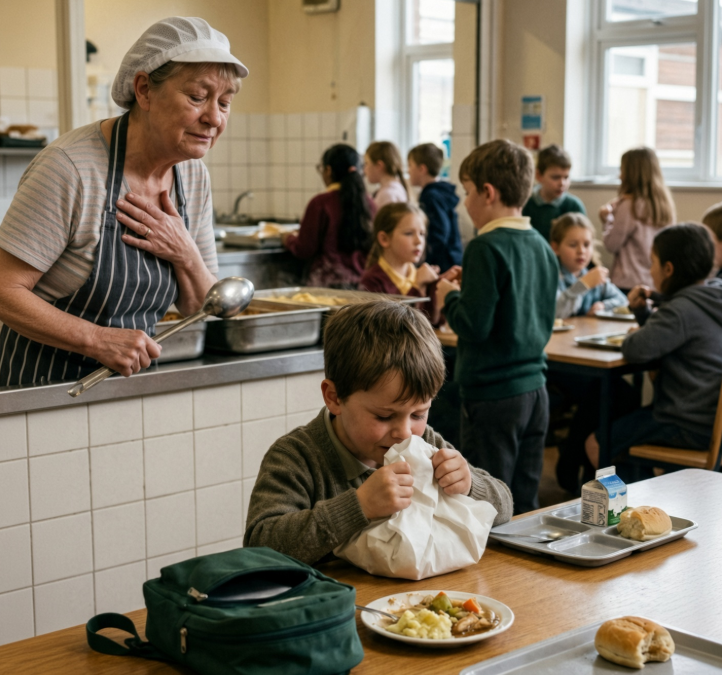
The Lunch Lady Saw a Six-Year-Old Hide Food in Napkins—What He Was Carrying Home Broke Her Heart.
The first time I saw Oscar hide food in his schoolbag, I thought he was being naughty.
By the eighth day, I realized he was not stealing lunch.
He was carrying dinner home to the one person he loved most, wrapping a grown man’s dignity in paper napkins because that was all his small hands had.
My name is Eileen Harper.
I am sixty-two years old, and for twenty-two of those years, I have been the anchor of the Birchfield Primary canteen.
That sounds grander than it is.
In truth, my kingdom is steam, trays, ladles, aprons, hairnets, and the never-ending smell of gravy that somehow follows me home no matter how thoroughly I wash. My days are measured in portions. Shepherd’s pie on Tuesdays. Fish fingers on Fridays. Roast chicken when the budget allows. Custard thick enough to stand a spoon in if Mrs. Bennett in Year Three has not complained that it is “too gloopy” again.
I know which children hate peas.
I know which ones pretend to hate peas but eat them when nobody is looking.
I know which child will ask for extra potatoes before he even reaches the hatch.
I know who forgets lunch money.
I know who comes in loud because they are happy, and who comes in loud because home has taught them silence is dangerous.
After twenty-two years, you start to think you have seen every kind of child.
Then Oscar came through the line.
Oscar Bell was six years old, small for his age, with dark blond hair that never quite lay flat and a face too solemn for a boy still young enough to lose his front teeth. He had large gray eyes that seemed to be constantly doing arithmetic no child should have to do.
Not sums from a worksheet.
Other calculations.
How much time until home.
How much food can fit in a pocket.
How much worry can be hidden before adults start asking questions.
He started at Birchfield that September.
New shoes. Too stiff.
New jumper. Slightly too big.
A rucksack almost half the size of him, navy blue with a little plastic rocket clipped to the zip.
On his first day, he came through the dinner line quietly, accepted his tray with both hands, whispered thank you, and sat at the far end of the long oak table.
Most new children fidget.
They look around.
They copy others.
They ask where to put their fork.
Oscar did not.
He sat perfectly still and stared at his food.
That day, it was roast chicken, mashed potatoes, carrots, and gravy.
A good meal.
Warm.
Filling.
The kind children usually destroy in under ten minutes if they like gravy as much as they claim to.
Oscar took one bite.
Then another.
Then stopped.
I noticed because children who do not eat are part of my job.
Some are fussy.
Some are nervous.
Some are trying to prove a point to parents who are not there.
Some simply do not like carrots, which, in fairness, is a valid position when the carrots have been boiled by a council-approved steamer until they surrender all personality.
I watched him for a minute, then went back to serving.
The next day, he did the same.
Collected the tray.
Sat at the far end.
Four small bites.
Then nothing.
By the fourth day, I asked his teacher quietly, “Does Oscar eat breakfast?”
Miss Allen frowned.
“I think so. His mum says mornings are rushed, but he seems all right in class.”
“Any allergies?”
“No.”
“Upset tummy?”
“Not that I know of.”
On Friday, it was fish fingers.
Even children suspicious of vegetables usually trust fish fingers.
Oscar took exactly three bites.
Then sat watching the clock.
That was when curiosity turned into a cold little knot in my stomach.
By Monday, I stopped pretending not to notice.
PART2:
I stepped back into the shadows near the kitchen hatch, where the children thought adults became invisible. It is useful sometimes, being underestimated by six-year-olds.
Oscar looked left.
Then right.
Then down at his tray.
He took four small bites of chicken.
Not enough to fill him.
Just enough to make it look, from a distance, like he had eaten.
Then, with the careful precision of a diamond thief, he reached into his pocket and pulled out a stack of paper napkins.
My breath caught.
Oscar spread one napkin on his lap.
Then another.
He moved quickly but neatly.
Chicken first.
Potatoes next.
Carrots tucked into the corner.
He even scraped a little gravy carefully into the middle, not enough to soak through but enough to make the food taste of something later.
Then he folded the napkins into a parcel.
Once.
Twice.
Pressed the sides.
Slipped the parcel into the deepest pocket of his rucksack.
Zipped it closed.
Then he carried his tray to the return area, empty.
He walked away with a clean tray, a full schoolbag, and the careful posture of a child holding up a secret larger than himself.
My knees weakened.
I had to sit down on the little stool behind the serving counter.
“Eileen?” asked Nora, my assistant. “You all right?”
I could not answer for a moment.
I watched Oscar go back to class, his rucksack bumping against his narrow back.
“I don’t know yet,” I said.
PART3:
There are ways to investigate a child without frightening them.
You learn that in a school.
You do not storm in waving accusations.
You do not snatch bags.
You do not say, “Why are you stealing food?” because children who are already carrying adult burdens hear shame much faster than concern.
So I did quiet digging.
I spoke to Miss Allen again.
Then to the office.
Then, carefully, to Mrs. Patel, the family support worker, who knew how to listen without turning every worry into a crisis too soon.
There were no obvious red flags in the system.
No unexplained bruises.
No missed school.
No dirty uniform.
No shouting at pickup.
No frightening adult at the gate.
Oscar’s mother, Claire Bell, worked two jobs.
Morning shifts at a care home.
Evening shifts cleaning offices near the industrial estate.
She paid what she owed.
Answered school messages when she could.
Came to parents’ evening looking exhausted, apologizing three times for being five minutes late.
A single mother trying to keep the lights on.
That described half the families we saw in one form or another.
Then Mrs. Patel mentioned the grandfather.
“Arthur Bell,” she said softly. “Claire’s father. He had a stroke in July.”
I put both hands flat on the table.
“He lives with them?”
“Yes. Came home from hospital at the end of August.”
“Can he manage alone?”
Mrs. Patel hesitated.
That hesitation answered before her words did.
“He has carers in the morning. Claire does what she can before work and after. But the evening gap is difficult.”
“How difficult?”
She sighed.
“Difficult enough.”
Arthur Bell had once been the kind of man everyone in the neighborhood knew.
He repaired bicycles in his shed.
Grew runner beans.
Volunteered at the church jumble sale.
Fixed other people’s gates without being asked.
Oscar worshipped him.
That was the word Miss Allen used.
Worshipped.
Every drawing Oscar made had Grandad in it somewhere.
Grandad in a chair.
Grandad in the garden.
Grandad with Oscar.
Grandad holding Oscar’s hand.
Before the stroke, Arthur had walked Oscar to school most mornings. He had waited at the gate wearing a flat cap and carrying a little bag of raisins because, according to Oscar, “Grandad says raisins are sweets pretending to be good.”
After the stroke, Arthur came home frail.
One side weak.
Speech slow.
Pride wounded in a way no discharge paperwork could measure.
He could no longer stand long enough to cook.
Could no longer safely lift pans.
Could not cut food easily.
Claire left something ready when she could, but life had become a chain of impossible timings. A care home shift that ran late. Buses missed. Cleaning work that could not be refused because rent did not care about strokes.
Oscar came home before his mother.
Arthur was there.
Hungry sometimes.
Trying not to be.
Too proud to say.
Oscar had noticed.
Of course he had.
Children notice everything adults think they are hiding.
That night, I went home and stood in my own kitchen for a long time.
My husband, Terry, had been gone six years. The house was quiet in the evenings now. No radio football. No cough from the sitting room. No “What’s for tea, Eileen?” shouted as if the fridge were a mysterious locked temple only I could interpret.
But my cupboards were full.
Too full, if I am honest.
Tins lined in rows.
Pasta.
Soup.
Tea bags.
Biscuits for visitors who rarely came.
I opened the fridge and stared at the leftovers from Sunday roast.
Chicken.
Potatoes.
Carrots.
Gravy in a jug.
Oscar had wrapped nearly the same meal in paper napkins with the seriousness of a surgeon.
I sat at the kitchen table and cried.
Not loudly.
At sixty-two, you learn there are different types of crying.
There is the dramatic kind, when the body wants witnesses.
And there is the quiet kind, when the heart simply leaks because it cannot hold one more thing.
This was the quiet kind.
The next day, I watched Oscar again.
Four bites.
Napkins.
Parcel.
Rucksack.
By then, I understood.
Oscar was not misbehaving.
He was not hoarding.
He was not stealing from the school.
He was feeding his grandfather.
A six-year-old boy had made himself a provider.
And the part that nearly broke me was not the food.
It was the care.
He did not shove the chicken into his bag.
He wrapped it neatly.
He tucked the vegetables in.
He protected the gravy as best he could.
He was not just saving calories.
He was carrying home dignity.
A warm school dinner, slightly crushed, wrapped in paper, hidden like treasure.
That Monday, I decided napkins were not good enough.
I arrived early.
Before the ovens were fully heated, before the first trays came out, before the building filled with the sound of children shouting in corridors, I stood in the storage room and searched the shelves.
We had old plastic containers from staff meals.
Most were scratched.
Some lids did not match.
I rejected them.
If Arthur Bell was going to become part of my kitchen, he was not getting a cracked tub with a missing corner.
At the back of the shelf, I found a sturdy insulated Tupperware container with a proper seal.
Blue lid.
Clean.
Respectable.
I washed it twice.
Then I filled it at lunch until the lid barely closed.
Roast beef.
Potatoes.
Carrots.
Extra gravy in a little sealed pot.
A slice of apple crumble wrapped separately because no man recovering from a stroke should be denied pudding if I had anything to say about it.
Then I took out a permanent marker and wrote on the lid:
STAFF TASTING SAMPLE
FOR OSCAR’S GRANDFATHER
PLEASE PROVIDE FEEDBACK
Nora read it over my shoulder.
“Eileen.”
“What?”
Her eyes had filled.
“Nothing.”
At 3:15, I waited by the gates.
Children poured out in waves, coats half-zipped, book bags dragging, voices bouncing off the playground walls.
Oscar came out near the middle.
Rucksack on.
Rocket charm swinging.
He saw me and froze.
Poor little thing.
His face changed immediately.
Adults forget how terrifying it is for a child when a grown-up knows a secret.
I walked over slowly, container warm in both hands.
“Oscar.”
He swallowed.
“Yes, Mrs. Harper?”
I knelt because I have always believed adults should kneel when saying something important to a child.
Standing makes the words too heavy.
I held out the container.
He looked at it.
Then up at me.
His eyes went wide with fear.
Not embarrassment.
Fear.
The fear of a system discovering what love had forced him to do.
“I didn’t…” he whispered. “I wasn’t stealing.”
Those words tore straight through me.
“I know, love.”
His lower lip trembled, but he held it firm.
“I was going to bring the napkins back.”
That nearly finished me.
“You can eat your lunch in the hall now,” I whispered.
He blinked.
“The kitchen needs a critic to test our takeaway meals for the elderly.”
His brow furrowed.
“We do?”
“We do now.”
I tapped the lid.
“We’ve chosen your grandad. Very important job. We need honest feedback. Too much salt? Not enough gravy? Carrots too soft? He must tell us.”
Oscar stared at me.
His small hands slowly closed around the warm box.
“He’s a very good taster,” he said.
“I suspected as much.”
“He used to say the chip shop near our flat was criminally under-salted.”
“Then he is exactly the expert we need.”
The tension in Oscar’s shoulders broke.
Not all of it.
Children like Oscar do not drop burdens completely.
They loosen one finger at a time.
But something eased.
He hugged the container against his chest.
“Is it really okay?”
“Yes.”
“Will Mum get in trouble?”
“No.”
“Will Grandad?”
“No.”
“Will I?”
I shook my head.
“No, Oscar. You did something kind. But you should not have to go hungry to do it.”
He looked away quickly.
That was when I saw tears standing in his eyes.
He refused to let them fall.
He was too brave for that.
Too practiced.
Too little.
“I had some,” he said.
“Four bites is not lunch.”
His eyes snapped back to mine.
He had not realized I knew that much.
I smiled gently.
“From now on, you eat your meal. The kitchen will prepare your grandad’s official sample separately.”
He held the container tighter.
“Every day?”
“We will see what the program requires.”
That was adult language.
Children find adult language reassuring when it is used kindly.
It sounds like rules.
Rules can feel safe.
Oscar nodded once.
Sharp.
Serious.
Like he had accepted a position on the board.
“I’ll ask him to do proper feedback.”
“Excellent.”
Then he looked at me with a gravity that belonged to someone three times his age.
“Mrs. Harper?”
“Yes?”
“Can we not tell him it’s because he needs it?”
I had to look down for a second.
When I looked back, I said, “No. We won’t tell him that.”
Oscar breathed out.
“Thank you.”
That was how the Birchfield Tasting Program began.
At first, it was just me.
Then Nora.
Then Miss Allen found out because Oscar drew a picture of Grandad eating “staff testing beef” and proudly labeled the gravy.
Then Mrs. Patel helped make sure we were not creating more trouble than we solved.
We did it carefully.
Quietly.
No announcements.
No charity labels.
No pity.
Every day, a container waited behind the counter after lunch.
Sometimes stew.
Sometimes pasta bake.
Sometimes chicken casserole.
On Fridays, fish and chips wrapped properly because Arthur Bell, according to Oscar, had “standards about fish.”
I made feedback forms.
Not official ones.
Just little slips of paper.
Meal:
Temperature:
Gravy level:
Vegetable texture:
Pudding score:
Oscar took them home solemnly.
At first, I thought he was humoring me.
Then the forms started coming back.
Arthur’s handwriting shook.
Some letters wandered.
But he filled them in.
Meal: Shepherd’s pie
Temperature: Good warm
Gravy level: More next time please
Vegetable texture: Peas acceptable
Pudding score: 10 but would test again to confirm
I laughed so hard I had to sit down.
Oscar watched me from the other side of the hatch, eyes bright.
“Grandad says scientific results need repeating.”
“Your grandad is a wise man.”
“He says apple crumble should be tested twice weekly for accuracy.”
“I see.”
“Maybe three times.”
“Tell him the kitchen will consider his proposal.”
The next day, I sent apple crumble.
With custard.
Twice the usual amount.
The program grew because kindness has a way of leaking through cracks.
Miss Allen began slipping little notes into Oscar’s reading folder.
Not about the meals.
Just ordinary encouragement.
Mrs. Patel quietly arranged a proper benefits check for Claire without making her feel exposed. The school office found a transport contact for one of Arthur’s appointments. A parent who worked at a community food hub made sure “surplus” groceries appeared once a week in a plain carrier bag labeled for “recipe testing.”
Oscar started eating lunch again.
That was the first miracle.
He did not attack his food greedily.
Children like Oscar do not change habits overnight.
At first, he ate half.
Then three-quarters.
Then one Tuesday, he cleared the plate.
I saw it from the hatch and had to turn away.
“Don’t start crying into the custard,” Nora said.
“I am not crying.”
“You’re making the custard salty.”
Oscar gained color.
Just a little.
His cheeks filled out.
He stopped watching the clock during lunch.
He began sitting nearer the other boys.
At first, he only listened.
They talked about football.
He watched, spoon halfway to his mouth.
Then one day, a boy named Tyler said something completely wrong about Manchester United, and Oscar slammed his spoon down.
“That’s not true.”
The whole table turned.
Oscar explained, with great authority, exactly why Tyler was wrong.
I stood behind the hatch smiling like a fool.
For the first time since September, Oscar was not calculating food, time, hunger, and secrecy.
He was arguing about football.
A child should have room for foolish arguments.
It is one of the luxuries of being little.
I met Claire properly two weeks later.
She came to the office after Mrs. Patel asked if she had a moment.
I expected defensiveness.
People brace themselves when schools ask to talk.
Especially tired parents.
Especially single mothers used to being judged by people whose lives are tidier on paper.
Claire Bell looked worn to the bone.
Not neglectful.
Not careless.
Worn.
She had dark circles under her eyes and hair pinned up badly with a clip that had given up near one side. Her work trousers were clean but frayed at the hem. Her hands were cracked from washing.
When Mrs. Patel explained, Claire went white.
Then red.
Then covered her face.
“I didn’t know,” she whispered.
That was all.
I believed her.
Some people might not.
Some people want mothers to know everything.
But exhaustion is a fog.
It covers what would otherwise be obvious.
Claire knew her father needed more than she could give.
She knew Oscar adored him.
She knew money was short and evenings were difficult.
But she did not know her son had been wrapping lunch in napkins and smuggling it home like contraband love.
“I thought he was eating at school,” she said.
“He is now,” I told her quickly. “He is.”
“I should have seen.”
Mrs. Patel moved a box of tissues closer.
Claire did not take one.
“I work mornings,” she said, voice shaking. “Then I come home for twenty minutes if the bus is kind. Then cleaning shift. Dad says he eats. Oscar says he’s fine. Everybody says they’re fine.”
Her laugh broke in the middle.
“I hate that word.”
I thought about how often I had said I was fine after Terry died.
Fine is the word people use when truth would make everyone uncomfortable.
Claire looked at me.
“Did he ask you not to tell Dad?”
“Yes.”
She closed her eyes.
“Of course he did.”
“He loves him.”
“I know.”
“No,” I said softly. “I mean, he really loves him.”
Claire nodded, tears finally slipping down her face.
“He saved me after my husband left,” she whispered.
“Oscar?”
“Dad.”
She wiped her cheek with the back of her hand.
“He took us in. Never once made me feel like a failure. He’d say, ‘We don’t keep score in family, Claire.’”
Her mouth trembled.
“Now he needs me, and I’m always gone.”
Mrs. Patel leaned forward.
“You are not always gone. You are working to keep them housed and fed.”
Claire shook her head.
“That sounds noble when you say it. It feels awful when you’re living it.”
No one argued with that.
Sometimes truth deserves the respect of silence.
We made a plan.
Not a dramatic one.
No grand rescue.
Real life rarely allows those.
We arranged practical things.
Meals.
A check-in.
Support forms.
A referral for additional care hours.
A community volunteer who could stop by twice a week.
A food voucher that Claire accepted only after Mrs. Patel called it “temporary household stabilization,” because people often accept help more easily if the words sound official and less like charity.
Then we discussed Arthur.
Claire was afraid telling him would humiliate him.
Oscar was afraid too.
So we did not tell him.
Not exactly.
The Birchfield Tasting Program became more formal.
Arthur Bell became, on paper and in spirit, our Senior Community Meal Critic.
I printed a certificate.
Nora laminated it.
Miss Allen helped Oscar decorate the border with tiny stars.
It read:
BIRCHFIELD PRIMARY CANTEEN
OFFICIAL COMMUNITY MEAL CRITIC
MR. ARTHUR BELL
FOR SERVICES TO GRAVY, PUDDING, AND HONEST OPINIONS
Oscar carried it home in his reading folder.
The next day, he came running to the hatch.
Not walking.
Running.
“Mrs. Harper!”
“What is it?”
“Grandad put the certificate on the wall!”
“Did he?”
“By the telly.”
“That is a place of honor.”
“He said he’s never been an official critic before.”
“How did he feel about it?”
Oscar grinned.
“He wore his good shirt for dinner.”
I turned away to stir something that did not need stirring.
Arthur’s feedback became the highlight of my mornings.
Meal: Beef stew
Comment: excellent carrots, beef needs longer, gravy brave
Meal: Fish pie
Comment: respectable but potato top shy
Meal: Sponge pudding
Comment: would recommend to a friend if I had any left
Meal: Lentil soup
Comment: suspiciously healthy but acceptable with bread
The children found out eventually.
Not all of it.
Children always find pieces.
They knew Oscar took something home.
They knew his grandad was a “food judge.”
Some teased him at first.
Not cruelly.
Just childishly.
“Your grandad rates carrots?”
Oscar lifted his chin.
“Yes. He’s an official critic.”
That stopped them.
Official titles have power in primary schools.
Soon other children wanted their grandparents to be critics too.
That could have become a problem.
Instead, it became something better.
In November, I asked the headteacher, Mr. Wilkes, if I could pilot a small project.
He was cautious.
Headteachers live in fear of budgets, policies, complaints, and enthusiastic lunch ladies with ideas.
“What sort of project?” he asked.
“A community meal link.”
He blinked.
“That sounds like something with paperwork.”
“Everything has paperwork.”
“That does not comfort me, Eileen.”
I explained.
Not Oscar’s details.
Never his details.
But the wider truth.
We had elderly people nearby who were isolated.
Families stretched thin.
Surplus portions some days.
A kitchen that could do more than feed children between 12:00 and 1:00 if allowed.
Mr. Wilkes removed his glasses.
“Are we legally permitted?”
“I’ve looked into the food safety guidance.”
“Of course you have.”
“I have forms.”
“Of course you do.”
“I also have Mrs. Patel willing to coordinate referrals.”
He sighed.
That meant yes was approaching but had to pass through bureaucracy first.
“We start small,” he said.
“Very small.”
“No public announcement yet.”
“Agreed.”
“No names.”
“Never.”
“And Eileen?”
“Yes?”
“No heroics that get the school sued.”
I smiled.
“I prefer useful miracles.”
He pointed at me.
“That is exactly the kind of sentence that precedes trouble.”
By December, the Birchfield Community Tasting Program existed officially enough to be safe and unofficially enough to remain kind.
Three elderly residents.
Then five.
Then seven.
Meals labeled as samples.
Feedback encouraged.
Dignity preserved.
Arthur remained our strictest critic.
He gave one pasta bake a 6.
Oscar delivered the review with grave seriousness.
“Grandad says pasta should not squeak.”
Nora was offended for a full day.
Then she changed the recipe.
Arthur gave the next one an 8.5.
Nora pretended not to be pleased.
Christmas approached.
Primary schools at Christmas are chaos wrapped in glitter.
Nativity rehearsals.
Paper snowflakes.
Children losing costume pieces.
Teachers surviving on biscuits.
Parents asking whether the concert starts at two or half past two despite receiving four letters.
In the canteen, we prepared for the Grandparents’ Lunch.
It was an old Birchfield tradition, stopped during the pandemic years and brought back because Mr. Wilkes believed schools should be stitched into the lives around them.
Children could invite grandparents or older family friends for a meal.
We served roast turkey, potatoes, vegetables, stuffing, gravy, and Christmas pudding.
The hall filled with walking sticks, wheelchairs, perfume, aftershave, cardigans, hearing aids, proud smiles, and children nearly bursting because someone special had entered their school world.
Oscar had been talking about it for weeks.
“Grandad’s coming if his leg behaves.”
“Grandad says he has a tie with robins on it.”
“Grandad says he might bring his critic notebook.”
On the morning of the lunch, Oscar could barely sit still.
He came through the canteen doors early, looking toward the entrance every few seconds.
Then Arthur Bell arrived.
I knew it was him before Oscar shouted.
He was tall but thin, leaning heavily on a cane. His suit hung loose on his frame, but it had been pressed perfectly. His tie did indeed have robins on it. One side of his face still held the softness left by the stroke, and his left hand curled slightly, but his eyes were bright.
Oscar ran to him, then slowed at the last second, remembering balance.
He took his grandfather’s hand and led him into the hall like guiding royalty.
“Careful, Grandad. There’s a bump.”
“I see it, Captain.”
“Your seat is here.”
“Excellent.”
“I told Mrs. Harper you’re strict about gravy.”
“As all civilized men should be.”
Oscar beamed.
I stood behind the serving hatch and pressed one hand to my apron.
Nora whispered, “Don’t cry.”
“I am not.”
“You are.”
“Check the sprouts.”
Arthur ate slowly.
Oscar watched every bite with the focused anxiety of a stage manager on opening night.
“Good?” he asked.
Arthur chewed thoughtfully.
“Turkey strong. Potatoes confident. Sprouts unnecessary but traditional.”
Oscar nodded.
“I’ll tell Mrs. Harper.”
After the meal, Arthur rose with effort.
Oscar immediately jumped up to help.
Together, they made their way to the hatch.
I wiped my hands on a towel and stepped forward.
“Mr. Bell.”
He reached through the hatch with a shaky hand.
I took it.
His grip was weaker than it once must have been, but still warm.
“Oscar tells me the school has a surplus of food,” he said.
His voice was gravelly but rich.
“He says you’d have to throw it away if we didn’t help you out by eating it.”
I looked at Oscar.
He stood behind his grandfather, giving me the tiniest conspiratorial wink I had ever seen.
That boy.
That beautiful, serious, impossible boy.
He had maintained the story to the end.
Not to deceive for selfish reasons.
To protect the old man’s pride.
To make him feel useful.
To turn need into service.
Arthur smiled slowly.
“Thank you for letting me be of use, Eileen. The dinners are the best in England.”
My throat tightened so hard I could barely speak.
“Well,” I said, “we could not do it without you.”
Arthur nodded, accepting this responsibility with the dignity of a man receiving an appointment from the Crown.
“I shall continue to be honest.”
“I expect nothing less.”
“The carrots today were better.”
“I will inform Nora.”
“She should be encouraged.”
Behind me, Nora made a noise that was either a laugh or a sob.
Arthur looked down at Oscar.
“Come along, Captain. We must not obstruct the hatch.”
Oscar took his hand.
Before they walked away, Arthur turned back.
“And Eileen?”
“Yes?”
His eyes rested on mine.
Not fooled, perhaps.
Not entirely.
But willing to accept the kindness in the shape it had been offered.
“Some people feed the stomach,” he said. “Some manage the harder bit.”
He tapped his chest with his free hand.
“You and my boy have managed both.”
Then he shuffled away, Oscar beside him, both of them moving slowly through the noisy hall.
I stood behind the hatch with tears running down my face.
This time, I did not pretend otherwise.
After Grandparents’ Lunch, the program became part of Birchfield.
Not loudly.
Not with banners or newspaper stories.
Quietly.
Properly.
Usefully.
Local shops donated containers.
Parents contributed when they could.
The church offered delivery volunteers.
The school governors approved a small fund.
Mr. Wilkes claimed it was all very administrative and policy-driven.
But I caught him once reading Arthur’s feedback forms and laughing alone in his office.
By spring, Arthur was walking a little better.
Still with a cane.
Still slowly.
But he came to school one afternoon to speak to Year Two about “food criticism.”
He wore the robin tie even though Christmas had passed months earlier.
He told the children a critic must be fair, brave, and willing to apologize if he has been unkind to cabbage.
Oscar sat in the front row glowing with pride.
Claire came too.
She stood at the back with her work uniform still on, eyes wet, hands clasped tightly.
Afterward, she hugged me.
Not polite.
Not quick.
A real hug.
“I don’t know how to thank you,” she whispered.
I held her back.
“You keep going,” I said. “That’s thanks enough.”
“I nearly missed it,” she said.
“What?”
“What Oscar was carrying.”
I looked at him across the room.
He was helping Arthur fold feedback sheets.
“We all nearly did.”
That was true.
The thought stayed with me.
How many children carry parcels adults never see?
Not always food.
Sometimes fear.
Sometimes bills overheard through walls.
Sometimes a parent’s sadness.
Sometimes a secret shame.
Sometimes the belief that if they are good enough, quiet enough, useful enough, they can hold a family together with both small hands.
Children should not have to be anchors.
But sometimes they become them.
Our job is not to admire how strong they are and leave them carrying the weight.
Our job is to notice.
To kneel down.
To take some of it away.
Oscar did not stop loving like a provider.
That was part of him.
Some children are born with hearts that look for what others need.
But slowly, he became a child again in the places that mattered.
He ran at lunch.
Spilled custard down his jumper.
Argued about football.
Forgot his jumper on the playground.
Lost his reading book.
Laughed with his whole mouth open.
Once, he complained that carrots were “too orange.”
I nearly cheered.
Because a child complaining about carrots is a child no longer measuring them for a man waiting at home.
At the end of the school year, Oscar brought me a card.
The front had a drawing of me behind the serving hatch with a spoon in one hand and a crown on my head.
I looked alarmingly rectangular.
Inside, in careful pencil, it said:
Dear Mrs Harper,
Thank you for letting Grandad be a food tester.
He says you saved the gravy of Britain.
Love from Oscar.
Underneath, in shaky handwriting, Arthur had added:
And possibly more than the gravy.
I kept that card.
It is still in my kitchen drawer.
Years passed.
Oscar moved up through the school.
He grew taller.
Lost teeth.
Gained them back.
Decided football mattered less than science.
Then decided football mattered again.
Arthur came to three more Grandparents’ Lunches.
Each time, thinner.
Slower.
Still strict.
Still wearing a tie.
The last feedback form he ever sent said:
Meal: Chicken casserole
Comment: warmth arrived before taste, which is as it should be
Pudding score: grateful
Arthur died the following winter.
Peacefully, Claire told us.
At home.
Oscar beside him.
He was ten by then.
Old enough to understand death.
Young enough to still look betrayed by it.
At the funeral, Oscar placed the laminated critic certificate inside Arthur’s coffin.
Then, after a moment, he took it back.
Claire looked surprised.
Oscar said, “I think he’d want me to keep doing quality control.”
That sounded like Arthur.
We framed the certificate in the canteen.
Not in a showy place.
Just near the kitchen door where staff could see it.
BIRCHFIELD PRIMARY CANTEEN
OFFICIAL COMMUNITY MEAL CRITIC
MR. ARTHUR BELL
Every time I look at it, I remember the little boy with napkins in his pocket.
Oscar is sixteen now.
Tall.
Kind.
Still too serious sometimes, but with a dry humor that I am certain came from Arthur.
He volunteers twice a month with the community meal program.
He delivers food after school to elderly residents who know him by name.
He still insists on feedback forms.
Last Christmas, he came back to Birchfield to help serve Grandparents’ Lunch.
I watched him from behind the hatch.
He was wearing an apron too small for him and explaining to a seven-year-old that gravy distribution was “a matter of structural importance.”
I laughed so hard Nora had to take over serving potatoes.
At the end of the meal, Oscar found me by the old storeroom.
“Mrs. Harper?”
“Yes, love?”
He was far too tall for me to call love now.
I did anyway.
He held out a container.
Blue lid.
Same kind we had used years before.
Inside was a slice of apple crumble.
“I thought you should test this,” he said.
I looked at the lid.
On it, in permanent marker, he had written:
STAFF TASTING SAMPLE
FOR MRS. HARPER
PLEASE PROVIDE FEEDBACK
For a moment, the school hallway blurred.
The noise faded.
And I saw him again at six years old, eyes wide with terror, holding warm food like it might save the world.
Maybe it did.
Not the whole world.
But Arthur’s.
Oscar’s.
Mine, a little.
I took the container.
“I am a very strict critic,” I warned.
He smiled.
“I was trained by the best.”
I have served school dinners for twenty-two years.
Longer now, actually.
Twenty-three if we are counting properly, which Nora says we should because knees like mine deserve formal recognition.
I have seen thousands of children grow up and move on.
Some I remember because they were loud.
Some because they were funny.
Some because they came back years later with children of their own.
But I will never forget Oscar Bell.
The little boy at the far end of the table.
The one who took four bites and saved the rest.
The one who taught me that love does not always arrive grandly.
Sometimes it does not look like a speech, a donation, or a heroic rescue.
Sometimes it looks like a six-year-old wrapping chicken and carrots in paper napkins because his grandfather cannot cook.
Sometimes it looks like a lunch lady writing “tasting sample” on a plastic lid.
Sometimes it looks like a proud old man pretending to believe a beautiful lie because that lie lets everyone keep their dignity.
And sometimes, if you are lucky, it becomes something bigger.
A program.
A community.
A reminder.
A kitchen can feed more than hunger.
A child can reveal what adults failed to see.
An old man can regain purpose through a spoonful of gravy and a feedback form.
And a school dinner, packed properly and carried home warm, can become the quietest kind of love.
The kind that does not ask to be admired.
Only noticed.








