The Little Girl Never Asked Us for Help—She Just Hid Her Thumb Inside Her Fist, and When Her Smiling Stepfather Flashed a Deputy’s Badge, Five Veterans Realized the Danger Went Far Beyond One Family.
PART2:
The kind of woman who could call a six-foot-five veteran sweetheart and somehow make it sound like an order.
We had just finished arguing over whether Tommy’s chili fries legally qualified as food when I noticed booth seven.
Man.
Woman.
Girl.
Nothing dramatic.
That was the point.
The man looked perfect.
Late thirties.
Clean haircut.
Pressed blue button-down.
Dark jeans.
Polished boots.
Easy smile.
Not loud exactly.
Confident.
He joked with Patty.
Said “Yes, ma’am.”
Complimented the pie.
Asked about the roads.
Everything practiced.
Everything normal.
The woman beside him was maybe thirty-four.
Thin.
Dark blond hair.
Sweater despite how warm the diner was.
Hands in her lap.
PART3:
She smiled whenever he looked at her.
Stopped smiling when he looked away.
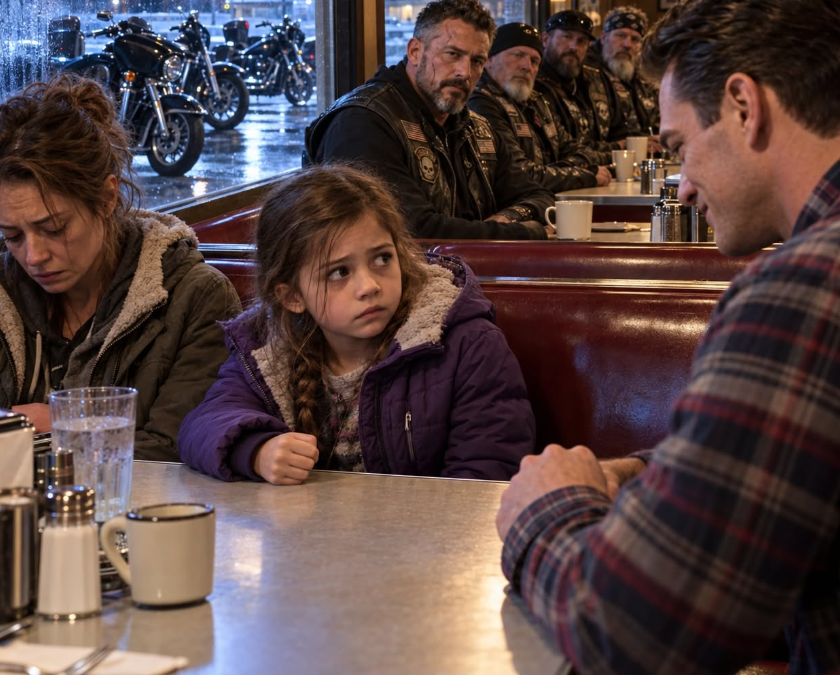
The girl sat across from them.
Purple winter coat.
Brown hair tied in two uneven braids.
Eight, maybe.
Her grilled cheese sat untouched.
Hot chocolate untouched.
She was not looking around the diner the way bored children do.
She was watching the man.
There is a difference between looking at an adult and monitoring one.
Children who feel safe glance away.
They daydream.
Fidget.
Ask annoying questions.
Kids who are afraid watch hands.
Voice.
Posture.
They track mood the way infantry tracks weather.
Mason noticed too.
He had spent eleven years as an Army medic and another seven working emergency rooms.
Without turning his head, he said:
“You watching seven?”
“Yeah.”
Deacon stopped eating.
“What?”
“Nothing yet.”
Luis shifted slightly in the booth.
Tommy sighed.
“I hate when you say yet.”
I kept watching.
The girl reached beneath the table.
For a second I thought she dropped something.
Then she raised one hand.
Low.
Near the edge of the booth.
She looked directly at me.
Thumb folded into palm.
Four fingers closed over it.
One slow motion.
Then opened again.
My stomach turned cold.
I had seen the gesture in training material.
So had Mason.
It did not prove anything.
Signals never do.
Context matters.
But context was beginning to pile up.
The girl did it again.
Thumb in.
Fingers over.
Then she stopped.
I looked at Mason.
He was already pulling out his phone.
Deacon whispered:
“What is it?”
“Possible distress signal.”
Tommy glanced toward the booth.
I grabbed his wrist beneath the table.
“Do not stare.”
He stopped.
Luis said quietly:
“Police?”
“Not yet.”
That answer bothered him.
It bothered me too.
But the man at booth seven had not committed anything we could see.
A child was signaling.
A woman looked terrified.
That was enough to pay attention.
Not enough to surround a table with five bikers and turn uncertainty into chaos.
Patty approached with the coffee pot.
I held my cup out.
“Know them?”
Her smile stayed on her face.
Her eyes changed.
“No.”
“How long?”
“Almost an hour.”
She poured.
“Girl eaten?”
“No.”
“Woman?”
Patty glanced toward booth seven.
“Couple bites.”
“The man?”
“Two burgers.”
Tommy whispered, “Of course.”
Patty ignored him.
“He pays attention every time either one goes to the bathroom.”
That mattered.
“Either gone?”
“The woman went once.”
“Alone?”
Patty shook her head almost invisibly.
“He stood outside the hallway.”
I looked at Mason.
Mason had his phone below table level.
Texting.
“Who?”
“Rachel.”
Rachel Ford worked child welfare investigations for the state.
She had volunteered with our veterans’ family outreach project after too many cases where ex-service members ended up in ugly custody situations during addiction or mental-health crises.
She knew us.
More important, she knew the law better than we did.
“Distance?”
“Twenty minutes.”
“Tell her don’t come official-looking.”
Mason typed.
We stayed.
That sounds simple.
It wasn’t.
Staying without staring took effort.
We ordered food none of us wanted.
Tommy complained loudly about the weather.
Luis told an unnecessarily long story about a transmission problem.
Deacon flirted badly with Patty.
I drank coffee and watched booth seven reflected in the chrome napkin holder.
The man kept smiling.
His name, we would learn, was Brent Holloway.
At the time, he was just the man in the pressed shirt.
He cut the girl’s grilled cheese in half without asking.
Moved the plate closer.
“Eat.”
She shook her head.
His smile remained.
“Emma.”
She picked up half.
Held it.
Did not bite.
The woman’s hand moved under the table.
The man looked at her.
She stopped.
That tiny movement told me more than a bruise would have.
He controlled the space.
Not dramatically.
Efficiently.
When he spoke, everyone adjusted.
Then he stood.
The woman stood immediately.
The girl followed.
He placed one hand at the woman’s lower back.
Someone not watching closely might have called it affectionate.
I did not.
His fingers were spread.
Pressure.
Direction.
Steering.
They moved toward the register.
As they passed our booth, the girl looked at me.
Three seconds.
I gave her nothing obvious.
No smile.
No nod.
No hero performance.
Just eye contact.
I see you.
That was all.
The man paid by card.
Patty returned with the receipt.
She passed near us.
Mason looked down.
Name printed at the bottom.
BRENT HOLLOWAY.
They went outside.
Dark pickup.
The woman opened the rear door for Emma.
Holloway looked back through the diner window before getting in.
Not at us specifically.
At the room.
Scanning.
That made me like him less.
Mason was already searching.
Thirty seconds.
Then:
“Caleb.”
He turned the phone.
Deputy Brent Holloway.
Roanoke County Sheriff’s Office.
Twelve years service.
Community outreach commendation.
Youth baseball assistant coach.
Photo beside the sheriff at a county safety fair.
Another beside a judge.
Luis looked at the screen.
“That explains the confidence.”
Deacon said:
“Or we’re inventing a story because a nervous kid made a hand gesture.”
He was right to say it.
That was Deacon.
Former military police.
Hated conclusions without evidence.
I nodded.
“Which is why nobody moves.”
Rachel texted.
FIVE MINUTES.
The pickup still sat outside.
Engine running.
Holloway smoking beneath the awning.
Woman and girl inside the cab.
Rachel arrived in an old Subaru wearing jeans, boots, wool coat.
No government vehicle.
No badge visible.
She entered.
Ordered coffee.
Did not look at us.
Patty brought the mug.
Quietly told her enough.
Rachel walked back outside carrying a paper cup.
She approached Holloway as if asking directions.
I watched through the glass.
He smiled.
Answered.
She laughed at something.
Then returned inside.
Two minutes later, Holloway brought Emma in alone.
That surprised me.
The woman stayed in the pickup.
Holloway sat Emma at the counter.
Ordered hot chocolate.
Apparently Rachel had told him her niece was carsick and asked if the diner restroom was open, then made some comment about Emma looking cold enough to need something warm.
Whatever she said, Holloway had decided demonstrating normal father behavior was useful.
Emma sat at the counter.
Rachel two stools away.
We did nothing.
Hot chocolate arrived.
Emma stared at it.
Rachel asked Patty where the restroom was.
Emma immediately said she needed to go.
Holloway’s eyes sharpened.
“I’ll wait here.”
Emma slipped off the stool.
Rachel stood at the same time.
“Oh, I’ll show you. I was going anyway.”
Holloway’s face changed for half a second.
Then the smile returned.
“It’s right there.”
Rachel laughed.
“So it is.”
They went down the hallway.
Door closed.
Holloway looked toward us.
Directly.
No more pretending.
I held his stare.
Mason whispered:
“He knows.”
“Yes.”
“How?”
“Doesn’t matter.”
Ninety seconds passed.
Holloway stood.
So did I.
He moved toward the hallway.
I stepped into the aisle.
Not close.
Not touching.
Just occupying space.
He smiled.
“You mind?”
“Yes.”
The smile thinned.
“I need to check on my daughter.”
“Restroom’s occupied.”
“Move.”
“No.”
The diner became quieter.
Not silent.
But people notice tension even when they do not understand it.
Holloway looked at my vest.
BLACK RIVER RIDERS.
Veteran patch.
He looked at the four men behind me.
Then back.
“This doesn’t concern you.”
“That girl made it concern me.”
His eyes changed.
There.
Confirmation.
He knew exactly what she had done.
He reached inside his jacket.
My body reacted before thought.
Weight shift.
Hands.
Distance.
Mason half rose.
But Holloway pulled out a leather badge wallet.
Opened it.
Sheriff’s star.
He placed it flat against the tabletop.
“Deputy Brent Holloway.”
No one spoke.
“This is family business.”
I looked at the badge.
Then him.
“Badge doesn’t make family business private.”
His jaw tightened.
“You interfering with a deputy?”
“No.”
“You’re blocking me.”
“I’m standing.”
“Move.”
From behind me, Rachel’s voice cut through the diner.
“I need a witness.”
Everything changed.
I turned.
Rachel stood at the end of the hall.
Emma beside her.
Still not crying.
That somehow made it worse.
The girl held Rachel’s hand so tightly her knuckles had gone pale.
Rachel’s expression was professional now.
No pretense.
“Mr. Holloway, my name is Rachel Ford. I’m a licensed child welfare investigator with the Commonwealth.”
Holloway stared.
“I know who you are.”
Interesting.
Rachel noticed too.
She continued.
“Emma has disclosed information sufficient for an emergency safety assessment.”
Holloway smiled again.
“Emma gets anxious.”
Rachel said nothing.
“She tells stories.”
Nothing.
“Her mother fills her head.”
Nothing.
Then:
“I’m taking my daughter home.”
Rachel answered:
“No.”
The word stayed level.
Holloway’s smile disappeared.
“You don’t have authority to detain my child without law enforcement.”
“You are law enforcement.”
“Exactly.”
Rachel nodded.
“Which is why I contacted state authorities.”
That hit.
His face remained controlled.
But not his eyes.
“Emma.”
The girl stared at him.
“Come here.”
She did not move.
“Emma.”
Her grip tightened around Rachel.
Holloway took one step.
I shifted.
So did Deacon.
Mason remained seated.
Hands visible.
Luis discreetly started recording on his phone.
Tommy did the same.
Holloway noticed.
He looked at me.
“You guys think you’re helping?”
Nobody answered.
He pointed toward Emma.
“You don’t know that child.”
I said:
“No.”
“You don’t know her mother.”
“No.”
“You don’t know what happens in our house.”
“That appears to be the issue.”
His face hardened.
Rachel said:
“Brent, you may sit down and cooperate while I coordinate with state investigators, or you may leave voluntarily.”
He laughed.
“Voluntarily.”
“Yes.”
“You think I’m leaving my child with five bikers and a caseworker?”
“I’m staying with her.”
He looked toward Emma again.
Something entered his expression.
Fear.
Not of us.
Not physical fear.
Fear of what she had said.
He pulled out his phone.
Made one call.
Short.
“It’s me.”
Pause.
“June’s.”
Pause.
“Yes.”
He looked directly at Rachel.
“She talked.”
Pause.
“I know.”
Then he ended the call.
That was the moment the story stopped being only about one family.
Holloway put his phone away.
Walked toward the front door.
Too easily.
I said:
“That’s it?”
He turned.
“What were you hoping for?”
“Nothing.”
He smiled.
“Good answer.”
Then left.
We watched him return to the pickup.
The woman inside looked at him.
He said something.
She flinched.
Then he got in.
The pickup remained parked.
Rachel brought Emma into a booth behind us.
Patty locked the diner door.
June herself emerged from the kitchen.
I had not known she was still there.
Short woman.
White hair.
Apron.
She looked at the locked door.
“What in God’s name did you boys bring me?”
“Nothing yet,” Tommy said.
June pointed at him.
“That’s not comforting.”
Rachel crouched beside Emma.
“What did you tell me in the restroom?”
Emma stared at the tabletop.
Rachel kept her voice low.
“You won’t get in trouble.”
The girl whispered:
“The room.”
“What room?”
“Basement.”
I watched Mason’s expression change.
Rachel asked:
“Is the room locked?”
Emma nodded.
“Who goes inside?”
“Brent.”
She never called him Dad.
I noticed.
“Anyone else?”
“Sometimes men.”
“How many?”
“I don’t know.”
“Do you go inside?”
Emma shook her head quickly.
“Never?”
“He says I’ll get taken away.”
Rachel paused.
“What is inside?”
Emma’s eyes stayed down.
“Pictures.”
“What kind?”
“Kids.”
Every adult in the booth went still.
“Do you know the children?”
“No.”
“Are they photographs like school pictures?”
Emma shook her head.
“I don’t know.”
Rachel changed direction.
“Anything else?”
“Folders.”
“What folders?”
“Names.”
“How do you know?”
“I opened one once.”
“Why?”
“Mom was looking for papers.”
“What papers?”
Emma looked toward the window.
Pickup still there.
“Stuff to leave.”
Rachel breathed slowly.
“Did your mother tell you she wanted to leave Brent?”
Tiny nod.
“What happened?”
“He found out.”
“How?”
“Someone told him.”
That sentence chilled me.
Rachel continued carefully.
“You said men visit?”
Emma nodded.
“Do you recognize them?”
“One.”
“Who?”
“A judge.”
Nobody spoke.
Rachel did not react visibly.
“How do you know he’s a judge?”
“He was on TV.”
“What about the others?”
“One has an eagle.”
“An eagle?”
Emma raised a finger.
“Pin.”
“Where?”
“On his coat.”
“Round?”
“Yes.”
“Anything else about it?”
“Gold eagle. Blue around it.”
Rachel sat back slightly.
Her face changed.
Mason saw it.
“You know something?”
“Maybe.”
Her phone buzzed.
Before she could answer, Mason’s did too.
Unknown number.
One photograph.
Our motorcycles outside.
Taken from across the highway.
Below it:
CHECK UNDER ROOK’S HANDLEBAR.
I felt every muscle tighten.
“Someone’s watching.”
Deacon moved toward the window.
“Don’t.”
I stood.
Went outside alone.
Rain had become sleet.
The pickup was gone.
I reached my motorcycle.
Under the left grip, tucked behind a cable, was folded paper.
No envelope.
Block letters.
Six lines.
HOLLOWAY ISN’T THE TOP.
THE EAGLE IS CALLED THE HAWTHORNE CIRCLE.
THEY HAVE PEOPLE IN THE SHERIFF’S OFFICE.
THEY HAVE A PROSECUTOR.
THEY HAVE A JUDGE.
DO NOT LET THEM TAKE THE GIRL.
I read it twice.
Then headlights turned into the lot.
Four vehicles.
Two county cruisers.
Two black SUVs.
I went inside.
Locked door behind me.
“Company.”
Everyone turned.
The silver-haired man stepped from the first SUV.
Dark coat.
No uniform.
Behind him two men.
The first cruiser parked near the exit.
The second farther back.
Boxing the diner.
The silver-haired man walked toward the door.
Under the awning light I saw it.
Round pin.
Gold eagle.
Blue border.
I held up the note.
Rachel’s face went white.
“Everyone start recording.”
June said:
“Who is he?”
Rachel whispered:
“Victor Hawthorne.”
“You know him?”
“Everybody in county government knows him.”
“Job?”
“Former Commonwealth’s attorney.”
Former.
That didn’t sound reassuring.
“What now?”
“He’s on the county public safety advisory board.”
Deacon muttered:
“Of course he is.”
Hawthorne knocked once.
Then tried the door.
Locked.
He looked through the glass.
Saw me.
Smiled.
Not friendly.
He pointed.
Open.
I didn’t.
He knocked again.
June walked forward.
“This is my diner.”
I looked at her.
“You sure?”
“Boy, I’ve owned this place thirty-eight years. If anybody gets to make a bad decision about the door, it’s me.”
She unlocked it.
Hawthorne entered.
Cold air followed.
Two men came behind him.
No visible badges.
Hawthorne removed his gloves.
Looked around.
His eyes stopped on me.
“Caleb Maddox.”
Hearing my full name told me how quickly they had done their homework.
“Victor Hawthorne.”
His eyebrows rose.
“Then we can save introductions.”
“Maybe.”
He looked toward Rachel.
Then Emma.
“The child is being transferred into county custody.”
Rachel said:
“By whom?”
“Sheriff’s office.”
“You have a removal order?”
“Emergency authority.”
“Under what statute?”
His eyes narrowed.
Rachel did not blink.
“Show me the paperwork.”
Hawthorne turned toward me.
“This doesn’t involve you.”
“That line’s popular tonight.”
“I understand you served.”
I almost laughed.
“You researched fast.”
“Small county.”
He glanced at my vest.
“Veterans usually understand chain of command.”
“Not my chain.”
Behind him, one of the men shifted.
His coat opened.
Holstered pistol.
I said loudly:
“Everyone keep hands visible.”
Phones were already up.
Truckers.
Young couple in booth three.
Patty.
Tommy.
Luis.
Mason.
June’s grandson had apparently been in the kitchen and was now recording too.
Hawthorne saw.
For the first time, irritation entered his face.
He turned toward Rachel.
“Ms. Ford, you are interfering with lawful custody.”
“Show me the order.”
“You’ll receive documentation.”
“When?”
“After transfer.”
“No.”
Hawthorne’s voice became colder.
“You’re not understanding.”
Rachel replied:
“I understand perfectly.”
Emma sat beside June now.
Purple coat zipped to chin.
Feet not touching floor.
Hawthorne looked at her.
“Emma.”
She froze.
“Come here.”
No movement.
“Your mother is waiting.”
Emma’s face tightened.
That was a lie.
I knew before anyone proved it.
Rachel said:
“Where is Claire Holloway?”
Hawthorne ignored her.
“Emma, come here.”
I stepped between his line of sight and the child.
He looked at me.
“Move.”
“No.”
One of the armed men approached.
Deacon stepped into his path.
No threat.
No raised fists.
Simply two hundred pounds of former military police occupying exactly enough space.
The man stopped.
His right hand hovered too close to his coat.
Deacon said calmly:
“Don’t make your next decision the one they play in court.”
The man lowered his hand.
Smart.
Outside, the county cruiser near the exit moved sideways.
Tommy saw it through the window.
“They’re closing us in.”
I turned toward the people filming.
“Keep recording the vehicles too.”
Hawthorne’s face hardened.
“You think a bunch of cell phones protects you?”
“No.”
I looked around the diner.
“But it makes editing history harder.”
That hit.
Something changed.
Then we heard motorcycles.
At first distant.
Then louder.
More.
A lot more.
Mason almost smiled.
“What did you do?”
He shrugged.
“Asked for witnesses.”
Headlights filled the parking lot.
Black River riders.
Twelve.
Then five more.
Then trucks from the charity event.
Men.
Women.
Nobody armed beyond whatever they legally carried every other day.
Nobody threatened anyone.
They parked.
Removed helmets.
Started recording.
The cruiser at the exit was now surrounded by cameras.
No dark corner.
No private hallway.
No single official report able to rewrite everything later.
Hawthorne looked outside.
Then at me.
I saw it happen.
He realized he had lost privacy.
Power like his did not require everyone to obey.
It required most people not to see.
“This isn’t over,” he said.
“No.”
I looked toward Emma.
“I don’t think it is.”
Hawthorne turned.
Walked out.
His men followed.
The cruisers stayed thirty seconds longer.
Then left too.
The diner remained silent until their taillights disappeared.
June locked the door again.
Tommy exhaled.
“I could use something stronger than coffee.”
June pointed toward the coffee pot.
“That’s all you’re getting.”
Rachel’s hands were shaking.
That frightened me more than Hawthorne had.
“You okay?”
“No.”
“Who was he really?”
She sat.
“Victor Hawthorne was Commonwealth’s attorney for eleven years.”
“Why leave?”
“Private practice.”
“Meaning?”
“Meaning he now represents half the county’s wealthy families and sits on boards with the other half.”
Mason asked:
“The judge?”
Rachel looked at Emma.
Then lowered her voice.
“I’ve seen the eagle pin before.”
“Where?”
“A charity gala.”
“Who had it?”
She hesitated.
“Judge Warren Bell.”
The room chilled.
Rachel’s phone finally connected.
She had been trying to reach State Investigator Naomi Grant.
Grant worked for a statewide public integrity unit attached to the attorney general’s office.
Rachel trusted her.
That mattered more than titles.
Naomi answered.
Rachel put her on speaker.
“Where are you?”
“June’s Diner.”
“Do not move.”
“We have a child.”
“I know.”
Rachel frowned.
“How?”
“We got another call.”
“From who?”
“Can’t tell you.”
Rachel told her about Hawthorne.
Silence.
Then:
“Keep everyone there.”
“County deputies were with him.”
“I heard.”
“How?”
“Your phone was open when he came in.”
Rachel looked down.
She had apparently never ended the connection attempt.
Naomi had heard part of it.
“State team is thirty-five minutes out.”
“Naomi.”
“What?”
“Emma says there’s a basement room.”
Long silence.
“What else?”
“Records. Photographs. Names.”
Another silence.
“The eagle.”
Naomi inhaled slowly.
“All right.”
That tone told me she had been waiting a long time to hear something.
“What do you know?”
“I’ll tell you when I arrive.”
“That’s not enough.”
“It has to be.”
Then:
“Do not let county officers remove that child unless I am physically present or a state judge issues a verified order through my office.”
Rachel looked at Emma.
“Understood.”
Naomi continued:
“Where’s Holloway?”
“Gone.”
“Find out if his vehicle is still nearby.”
Luis looked outside.
“No.”
Naomi said:
“We’ll handle it.”
Twenty minutes later, another call came.
Different number.
Naomi.
“Holloway was stopped.”
“Where?”
“Seven miles west.”
“By who?”
“State police.”
Rachel closed her eyes.
“Is Claire with him?”
“No.”
My stomach tightened.
“Where’s Emma’s mother?”
“We’re looking.”
Then Naomi said:
“Holloway is requesting counsel.”
“Expected.”
Pause.
“Before he did, he gave us three names.”
That changed Rachel’s expression.
“He’s talking?”
“He’s scared.”
“Of Hawthorne?”
“Apparently.”
By the time state investigators arrived, sleet covered the motorcycles outside.
Naomi Grant walked in first.
Mid-forties.
Dark suit under winter coat.
Hair pulled back.
No drama.
She showed credentials to June before anyone else.
That made me trust her slightly more.
Two state police investigators followed.
Then a woman from a specialized child forensic interview team.
No county officers.
Naomi looked at the room.
Phones.
Veterans.
Truckers.
Coffee.
Emma.
“Who is Caleb?”
I raised a hand.
She looked at me.
“You’re Rook?”
“Yes.”
“Anonymous note?”
I handed it over in a plastic menu sleeve Patty had suggested so we would not touch it more.
Naomi almost smiled.
“Good.”
“Army taught us something.”
“Apparently.”
She read.
Her face became unreadable.
Rachel asked:
“What do you know?”
Naomi sat.
“Fourteen months ago, our unit began reviewing irregularities in family-court transfers in three counties.”
Nobody spoke.
“Children being moved between placements after sealed hearings.”
“Why?”
“Supposedly safety.”
“And actually?”
“We didn’t know.”
“What did you have?”
“Financial records.”
Naomi removed a notebook.
“Certain nonprofits receiving county grants.”
“Connected to Hawthorne?”
“One.”
“Which one?”
“Hawthorne Family Stability Foundation.”
Luis cursed softly.
Naomi continued.
“Money went from that foundation into legal-defense funds, consulting companies and private residential programs.”
Mason asked:
“For children?”
“Yes.”
“Abuse?”
“We haven’t proven that.”
Good answer.
Naomi would not turn suspicion into fact just because the story wanted it.
“Then what?”
“We had complaints.”
“What kind?”
“Parents saying custody decisions changed after they reported deputies, prosecutors or politically connected spouses.”
Rachel’s face went still.
Naomi nodded.
“You’re thinking of Claire.”
“Yes.”
“We saw her original complaint.”
Rachel leaned forward.
“What?”
“It wasn’t destroyed.”
“Then why—”
“It was misclassified.”
“Accidentally?”
Naomi looked at her.
“You know I can’t answer that yet.”
Rachel leaned back.
Angry.
Naomi continued.
“Several case files contained court orders entered unusually quickly. Others were sealed beyond normal practice. One judge appeared repeatedly.”
“Bell.”
Naomi did not answer.
That was answer enough.
“And the eagle?”
Naomi looked at the note.
“We’ve seen it in photographs.”
“Group?”
“Private civic club.”
“Hawthorne Circle?”
“That’s what the informant called it.”
Informant.
I looked toward the kitchen.
An older cook named Warren—different Warren—had been there all night.
Quiet man.
Late sixties.
Thin.
Never made eye contact when Hawthorne came in.
I filed it away.
Naomi asked:
“Emma said she saw records in the basement?”
Rachel nodded.
The forensic interviewer approached Emma.
Not Naomi.
That mattered.
She introduced herself.
Asked Emma whether she wanted her mother.
Emma whispered:
“Yes.”
“We’re finding her.”
“Brent said she left.”
“Do you believe that?”
Emma shook her head.
The interviewer said:
“Okay.”
No promise.
No leading.
Just okay.
Emma went with her to a quieter part of the diner with Rachel nearby.
The rest of us remained.
Naomi looked at me.
“What exactly did Emma signal?”
I demonstrated.
Thumb in palm.
Fingers close over.
Naomi nodded.
“You recognized it.”
“Yes.”
“Why?”
“Training.”
“Did anyone tell her what to say?”
“No.”
“Did you question her?”
“Rachel did.”
“Did you confront Holloway physically?”
“No.”
“Anyone touch him?”
“No.”
“Threaten?”
“No.”
“Did any riders block county vehicles?”
“No.”
She looked out at motorcycles packed into the lot.
“That’s going to be argued.”
“They could leave.”
“Could they?”
“Yes.”
Deacon spoke.
“We intentionally left the southern driveway open.”
Naomi looked impressed despite herself.
“You thought of that?”
“Former MP.”
“Of course.”
Naomi nodded.
“Good.”
I understood then.
Every detail mattered now.
Not just what happened.
What could be proved.
Hawthorne’s attorneys would say intimidation.
Mob interference.
Contamination of a child’s statement.
Political vendetta.
Anything to make evidence look like emotion.
Naomi knew.
So did we now.
“Everyone preserve original video,” she said.
“Do not edit.”
“Do not post.”
That caused groans.
She looked at the riders.
“I mean it.”
One woman raised a hand.
“Already livestreamed.”
Naomi closed her eyes.
“Fantastic.”
“Sorry.”
“No, actually.”
She reconsidered.
“That may help preserve timing.”
She looked at us.
“But nobody adds commentary.”
Tommy put his phone down.
“I feel personally attacked.”
Around midnight, Claire Holloway was found.
Not missing.
Hiding.
At a motel eighteen miles away.
She had fled the pickup after Brent made the phone call.
He had told her Emma had “ruined everything” and ordered her to wait in the truck while he went inside.
When he came back out after Rachel intervened, Claire asked where Emma was.
Brent said county people would handle her.
Claire believed that meant Emma would disappear into placement.
Because Brent had threatened exactly that for years.
At a red light near the interstate, Claire opened the passenger door and ran.
No coat.
No purse.
She found the motel clerk.
Asked to use the phone.
The clerk called state police after seeing an alert connected to Emma.
Claire arrived at June’s Diner at 12:47 a.m.
I remember the exact minute because Patty’s wall clock clicked as the door opened.
Claire stepped inside.
Hair wet.
Borrowed motel sweatshirt.
Face empty.
Emma was asleep in booth four.
Rachel beside her.
Claire stopped.
For several seconds she did not move.
Then she crossed the diner.
Slow.
As if sudden movement might wake somebody from a dream.
She sat.
Touched Emma’s hair.
That touch stayed with me.
I had watched Brent touch Claire and Emma all night.
His hand directed.
Pressed.
Moved.
Owned.
Claire’s hand simply rested.
Emma did not wake.
That was the difference.
Claire started crying.
No sound.
Just tears.
Rachel moved closer.
“She’s safe.”
Claire whispered:
“For how long?”
That question revealed everything.
Not:
Is she safe?
For how long?
A woman who had stopped believing safety lasted.
Naomi sat across from her.
“Ms. Holloway, I’m Naomi Grant.”
Claire’s whole body tensed.
“Police?”
“State investigator.”
“Same thing.”
“No.”
Claire laughed bitterly.
“You all say that.”
Naomi did not defend herself.
Good.
Claire looked around at the veterans.
“Who are they?”
I said:
“People who noticed Emma.”
Claire looked at me.
“Why?”
I did not know how to answer.
Because she signaled?
Because I was watching?
Because luck?
Finally:
“She looked like she wanted someone to.”
Claire covered her mouth.
Emma stirred.
Opened her eyes.
Saw her mother.
“Mommy?”
Claire collapsed over her.
The sound she made did not belong in a diner.
It belonged somewhere private.
But there are moments privacy is a luxury grief does not wait for.
Emma crawled into her arms.
For several minutes nobody moved.
Then Emma whispered:
“I did the hand.”
Claire pulled back.
“What?”
“The thing you showed me.”
That was when we learned Claire had taught her the signal.
Months earlier.
After seeing a domestic violence awareness video.
She had practiced with Emma once.
Only once.
“If we’re somewhere and you can’t say anything,” Claire had told her, “do this.”
Emma remembered.
Claire had nearly forgotten teaching her.
I looked toward the window.
Sleet falling.
Motorcycles lined beneath parking lights.
Five men entered that diner looking for coffee.
That was all.
Sometimes the distance between disaster and rescue is one remembered lesson and one person looking at the right moment.
Claire’s interview lasted hours.
Not with us present.
We waited.
Coffee.
Food.
Silence.
Around two thirty, state teams executed search warrants.
Holloway residence first.
Nobody told us details immediately.
Good.
Real investigations do not narrate themselves for witnesses.
But little pieces came.
Locked basement room existed.
Records existed.
Multiple electronic devices seized.
Photographs.
Financial documents.
External drives.
Old phones.
Files containing names connected to family-court cases.
That did not mean every terrifying theory was true.
But it meant Emma had told the truth.
The circle widened.
At 3:12, Naomi came from the parking lot.
Her face had changed.
“Hawthorne is in custody.”
Rachel stood.
“For what?”
“Obstruction and evidence-related charges at the moment.”
“Judge Bell?”
Naomi hesitated.
Then:
“Federal agents served a warrant at his home.”
The diner went silent.
“Arrested?”
“Yes.”
Mason whispered:
“Jesus.”
Naomi looked exhausted.
“Assistant Commonwealth’s Attorney Peter Sloan is being questioned.”
“And sheriff’s office?”
“Two deputies suspended pending investigation.”
“Names?”
“Not yet.”
Rachel asked:
“Brent?”
“Talking.”
“How much?”
“Enough.”
Men like Brent build protection through certainty.
They believe the network exists for them.
Then the moment they realize they are expendable, loyalty becomes a bargaining chip.
By four, Holloway had identified seven people.
Then eleven.
He handed investigators accounts.
Emails.
Storage locations.
A private messaging group.
He described the Hawthorne Circle not as one monstrous conspiracy with matching robes and secret handshakes.
That would have been easier.
It was uglier because it was ordinary.
Men who did favors.
A judge expedited an order.
A deputy discouraged a complaint.
A prosecutor declined a case.
A foundation paid for counseling at a particular facility.
A politically connected lawyer referred families to another.
Each action explainable alone.
Together, they formed a machine.
Not every person involved knew every part.
That mattered legally.
Some were corrupt.
Some negligent.
Some cowardly.
Some probably convinced themselves they were protecting reputations or avoiding messy domestic disputes.
But children and vulnerable parents kept paying the price.
Hawthorne did not create every bad decision.
He understood how to connect them.
That was his power.
Emma’s basement discovery gave investigators a bridge between financial evidence and actual cases.
Claire’s original complaint gave timeline.
Holloway’s cooperation gave names.
The anonymous informant gave structure.
And Hawthorne’s decision to walk personally into a public diner with cameras everywhere gave prosecutors something no sealed court record could provide.
Arrogance.
Recorded.
By sunrise, eleven people had been detained, arrested, suspended, or placed under immediate investigation.
A sitting family court judge.
An assistant prosecutor.
Two sheriff’s deputies.
Hawthorne.
Three private contractors.
Others.
Not everyone was eventually convicted of the worst suspicions.
That is important.
The internet later flattened everything.
It always does.
Some charges were dismissed.
Some people had only ethics violations.
Some lost licenses.
Some pleaded guilty to obstruction, records tampering, bribery, unlawful disclosure, or conspiracy charges.
The crimes were complicated.
The damage was not.
Claire had asked for help three times before Emma signaled us.
Three.
The first was a domestic complaint after Brent shoved her into a wall.
Report disappeared into “insufficient evidence.”
Second was through family court when she asked for temporary separation.
The judge ordered counseling.
With a provider funded partly through Hawthorne’s foundation.
Third was a private conversation with another deputy.
That deputy warned Brent.
After that, Brent told Claire:
“You see? There is nowhere you can go that doesn’t come back to me.”
She believed him.
Why wouldn’t she?
The system had demonstrated his point.
That was the part that made me angriest.
Not one evil man.
A woman learning from experience that reporting danger could increase danger.
The investigation lasted almost two years.
Emma and Claire went into protected housing.
Not witness protection in the movie sense.
Secure address.
Advocates.
Legal support.
New school.
Therapy.
Eventually a small apartment in another county.
Black River offered money.
Rachel said no at first.
Formal assistance needed documentation.
So we created documentation.
Veterans are extremely good at turning emotion into committees when necessary.
We partnered with an existing nonprofit.
No direct cash.
Paid utility deposit.
Furniture through donation channels.
School supplies.
Legal transportation.
Everything clean.
Trackable.
Boring.
Boring is good when powerful defense attorneys are looking for reasons to claim witnesses were bought.
I did not see Emma for three months.
That surprised me.
Part of me expected the story version.
Little girl rescued.
Veterans become honorary uncles.
Weekly visits.
Cute photographs.
Real life was healthier.
Emma did not need five strange men becoming permanent symbols of the worst night of her life.
She needed school.
Friends.
Her mother.
Therapy.
Sleep.
Normal problems.
So we stayed away.
Rachel sent updates only when Claire agreed.
Emma was eating.
Nightmares decreasing.
Still panicked around police uniforms.
Hated dark pickup trucks.
Would not sit with her back to a door.
That one hurt.
I understood too well.
Six months later, Rachel invited us to a small community center.
Claire and Emma wanted to see us.
All five went.
No motorcycles.
Emma had asked.
The noise bothered her now.
So we drove Mason’s minivan.
He denied owning it emotionally.
“You have car seats in the back,” Tommy said.
“They’re my sister’s.”
“There are cracker crumbs everywhere.”
“Shut up.”
Emma had grown.
Not much.
But something about her face looked different.
Less watchful.
She ran to Claire first whenever someone new entered the room.
Then relaxed.
Good.
She saw me.
Stopped.
For a second I worried.
Then she raised her hand.
Thumb outside.
Palm open.
No fist.
I smiled.
She walked over.
“You look weird without your vest.”
“That seems rude.”
“You do.”
“Good to see you too.”
She smiled.
That was the first real smile I had ever seen from her.
She handed each of us a folded paper.
Mine showed a motorcycle.
Crooked wheels.
Five stick figures.
Underneath:
THANK YOU FOR SEEING ME.
Same message as the drawing she made that first morning.
I still keep both.
One in my vest.
One framed at home.
Claire stood nearby.
She looked healthier.
Not healed.
People misuse that word.
Healing is not returning to the person you were before something happened.
Sometimes that person is gone.
Healing is becoming someone who can live afterward.
Claire said:
“I owe you—”
I interrupted.
“No.”
She smiled slightly.
“I figured you’d say that.”
“Then don’t start.”
“I wasn’t going to say money.”
“What?”
She looked toward Emma.
“I owe you the rest of the sentence.”
I waited.
“I owe you the truth.”
That scared me.
She continued.
“Emma wasn’t the first child who tried to signal.”
My stomach tightened.
“What do you mean?”
Claire sat.
Several years before Brent married her, his first wife had a son.
Twelve years old.
The boy repeatedly told school staff he was afraid of Brent.
Reports were made.
Nothing proven.
The mother later lost primary custody during an ugly substance-abuse dispute.
The boy was placed with relatives.
Eventually moved out of state.
Claire found one of his old statements in the basement files.
“Is he okay?”
“Alive.”
She nodded.
“Investigators found him.”
“And?”
“He’s talking.”
I looked away.
Another child.
Older now.
Years spent wondering whether adults heard him.
That case became part of the prosecution.
Not because every allegation could be proved.
Because patterns matter when records exist.
Another mother came forward.
Then another.
One former clerk from family court.
A probation officer.
A deputy who had retired early after refusing to alter a report.
That was how the network really collapsed.
Not one heroic night.
People imagine corruption breaks when a brave person exposes everything.
Usually it breaks because the first credible crack allows ten frightened people to stop thinking they are alone.
Emma was the crack.
But so was the anonymous note.
The note became its own mystery.
Naomi never identified the source during active cases.
Years later, after prosecutions were finished, I learned enough to guess.
June’s cook.
His name was Harold Vance.
Sixty-eight.
Quiet.
Former courthouse maintenance supervisor.
He had worked inside county buildings for twenty-six years before retiring.
His daughter had lost custody of her son after a case involving one of Hawthorne’s favored attorneys.
Harold spent years collecting names.
Photocopies.
Photographs.
Nothing sufficient alone.
He started feeding information to state investigators after recognizing the eagle pin at a private courthouse event.
That night in the diner he saw Holloway.
Then Hawthorne’s number appeared on Holloway’s phone screen while Holloway stood near the counter.
Harold understood.
He texted Mason through a number found from Black River’s public charity page.
Why us?
Because he had seen Emma looking toward our booth.
Simple as that.
Harold never wanted recognition.
I respected that.
When he died three years later, Black River attended the funeral.
No speeches about secret heroes.
His daughter knew.
That was enough.
Deputy Brent Holloway pleaded guilty.
Multiple counts.
Evidence tampering.
Official misconduct.
Obstruction.
Domestic violence-related charges.
Other charges tied to unlawful sharing of confidential information.
He cooperated against Hawthorne.
People argued whether cooperation made him less monstrous.
I never understood the question.
Cooperation can reduce a sentence.
It does not rewrite who needed saving from you.
Judge Bell resigned before trial.
Then pleaded guilty to federal corruption charges connected to favorable rulings and undisclosed financial benefits.
Assistant prosecutor Sloan lost his license and was convicted on obstruction-related charges.
Two sheriff’s deputies were fired.
One was convicted.
The other was cleared of criminal conduct but found to have violated policy by sharing confidential information.
The sheriff himself was never charged.
That surprised people.
Some wanted everybody at the top to be guilty.
Evidence did not support that.
What it supported was bad enough.
The sheriff had tolerated a culture where loyalty often mattered more than scrutiny.
He resigned the following year.
Hawthorne fought longest.
Men like him often do.
Money.
Lawyers.
Connections.
He called the entire investigation a political attack.
Said veterans had intimidated officers.
Said Rachel manipulated Emma.
Said Claire was unstable.
Said Holloway lied for a deal.
Said the eagle pin was merely the symbol of a civic leadership society.
Some of that was technically true.
The pin did represent a real civic society.
That did not make the private network surrounding it imaginary.
Evidence did that work.
Emails.
Bank records.
Messages.
Case files.
Witnesses.
The basement devices.
Holloway’s testimony.
The clerk.
The former deputy.
Mothers.
Children.
Eventually a jury convicted Hawthorne of multiple federal corruption and obstruction offenses.
Not every charge.
Enough.
I watched none of the verdict on television.
I was riding.
That surprised everyone.
Mason called.
“You don’t want to see?”
“No.”
“Why?”
Because I realized years earlier the verdict was not the ending.
Men going to prison does not put childhood back where it was.
Emma still had nightmares.
Claire still flinched at unknown cars.
One boy had spent years thinking nobody believed him.
Another mother had lost custody during the period investigators later questioned.
Justice mattered.
Absolutely.
But punishment and repair are different jobs.
Courts handle one.
People handle the other.
Black River changed after that night.
We had always done charity.
Toy drives.
Roof repairs.
Veteran support.
Emma changed what we noticed.
Mason proposed training riders in recognizing signs of domestic abuse and child distress.
Deacon objected immediately.
“Bad idea.”
“Why?”
“We are not investigators.”
Correct.
Luis said:
“Then teach people how not to act like one.”
That became the program.
Not superhero training.
Almost the opposite.
Observe.
Do not escalate.
Do not isolate a child yourself.
Contact qualified professionals.
Preserve evidence.
Avoid leading questions.
Record only where lawful.
Create witnesses.
Know when immediate danger requires emergency intervention.
Most important:
A signal is not proof.
It is a reason to pay attention.
That distinction became central.
People wanted the dramatic version.
“See the sign. Save a child.”
No.
See the sign.
Slow down.
Notice context.
Get appropriate help.
The night at June’s worked because we did not surround Holloway after Emma’s gesture.
If we had, he might have dragged her away.
Used his badge.
Created a confrontation.
Destroyed evidence.
Maybe hurt someone.
We waited.
Rachel came.
Witnesses formed.
State investigators arrived.
Anger was not allowed to outrun proof.
That lesson mattered to me personally.
Years earlier in Afghanistan, I had made a decision quickly.
Too quickly.
A vehicle approached a checkpoint.
Did not respond as expected.
I read movement as threat.
Ordered escalation.
Nobody died.
Thank God.
But a family was injured.
Two children.
One badly.
I carried that for years.
The investigation said my decision fell within rules of engagement.
Everyone told me that should help.
It did not.
Rules can tell you whether you were punishable.
They cannot tell you how to sleep afterward.
That night at June’s, every old instinct screamed action.
Grab Holloway.
Block vehicle.
Confront.
Demand.
Instead we waited.
Watched.
Called someone trained.
When he showed the badge, we did not treat the badge as truth.
When Hawthorne arrived, we did not throw punches.
We created witnesses.
Patience felt weaker than action.
It wasn’t.
Months after Hawthorne’s conviction, Mason and I sat outside June’s.
The diner still operated.
June had replaced the booths.
Kept booth seven.
“Morbid,” I told her.
“History,” she answered.
She was seventy-three then and still terrifying.
Emma had not returned.
She did not want to.
That made sense.
Mason handed me coffee.
“You ever think about that night?”
“Every day.”
“Same.”
He looked toward the parking lot.
“You think we did the right things?”
“Mostly.”
“Mostly?”
“Tommy livestreamed.”
Mason laughed.
“Saved us.”
“Could’ve hurt the case.”
“Didn’t.”
“That’s not how you judge choices.”
He looked at me.
“Army answer.”
“Old man answer.”
“You’re forty-five.”
“Ancient.”
We sat.
Then Mason asked:
“Do you ever think we got lucky?”
“Yes.”
That answer surprised him.
“We got very lucky.”
“How?”
“Emma knew the signal.”
“Yeah.”
“We noticed.”
“Yeah.”
“Patty cooperated.”
“Yeah.”
“Rachel was close.”
He nodded.
“Hawthorne got arrogant.”
“Very.”
“Anonymous source acted.”
“Okay.”
“Naomi was already investigating.”
Mason stared into his coffee.
“You’re saying if any piece failed…”
“I’m saying systems shouldn’t require that much luck.”
That became the next thing we worked on.
Rachel helped.
So did Naomi after retirement.
June provided pie and strong opinions.
We created a local awareness project with shelters, diners, gas stations, libraries, veteran groups, motorcycle clubs, churches, and hospital waiting rooms.
Not posters saying LOOK FOR THIS SECRET SIGNAL AND BECOME A HERO.
Resources.
Domestic violence numbers.
Child welfare contacts.
Instructions for staff dealing with disclosures.
Safe-call procedures.
Training about coercive control.
Private restroom resource cards.
Ways to ask whether someone feels safe without putting them at greater risk.
Boring infrastructure.
That matters more than dramatic rescues.
A woman used one of those cards eighteen months later.
Called from a grocery-store restroom.
Another teenager asked a librarian for help.
A bartender noticed a customer controlling another woman’s phone and contacted an advocate.
Most never became news.
Good.
Safety should not require becoming a story.
Emma stayed in our lives lightly.
Christmas card.
Birthday message.
Occasional visit.
When she turned twelve, she asked to ride on a motorcycle.
Claire said absolutely not.
Emma negotiated.
Helmet.
Parking lot only.
Five miles per hour.
Claire finally agreed.
I put Emma behind me.
Tiny hands around my jacket.
We made three circles around an empty church lot.
She laughed the whole time.
When we stopped:
“Faster next time.”
“No.”
“You’re scared.”
“Yes.”
She grinned.
“Good.”
At fifteen, Emma spoke at a youth safety conference.
I did not attend initially.
She asked me to.
So I sat in the back.
She told the story differently than we did.
That taught me something.
Our version was about the signal.
The diner.
Badge.
Corruption.
Her version was about months before.
The first time Brent checked her mother’s phone.
The first time he removed a bedroom door.
The first time he told Emma good children do not make their mothers cry.
The first time Claire whispered that some adults use nice voices when they want people outside the house to believe them.
Emma said:
“People ask why I didn’t tell my teacher.”
She paused.
“Because I thought Brent could hear everything.”
The room went completely silent.
“He couldn’t.”
She looked toward Claire.
“But fear doesn’t have to be true to control you.”
That sentence stayed with me.
She spoke about the hand signal.
How Claire showed her once.
How she almost did not use it.
Why?
Because I looked frightening.
The audience laughed softly.
She smiled toward me.
“Rook looked like he was in a motorcycle gang.”
I whispered:
“Club.”
She heard.
“Whatever.”
More laughter.
Then serious again.
“I almost didn’t do it because I thought maybe he’d tell Brent.”
My chest hurt.
“But he looked at me like he understood.”
She looked down.
“He didn’t smile.”
That surprised people.
“I needed that.”
“Why?”
Someone asked later during questions.
Emma answered:
“Because smiling would’ve made Brent notice.”
Exactly.
A stranger’s restraint had mattered more than reassurance.
After the talk, she found me.
“You cried.”
“No.”
“You did.”
“Allergies.”
“Inside?”
“Very aggressive conference-center pollen.”
She rolled her eyes.
Then hugged me.
Not long.
Enough.
Claire eventually remarried.
Good man named Aaron.
High school history teacher.
The first time she introduced him to me, I made him nervous on purpose.
She punched my shoulder.
“Stop.”
“I said nothing.”
“Your face said plenty.”
Aaron eventually joined Black River charity rides.
Not the club.
He preferred bicycles.
Tommy called that suspicious.
Emma went to college.
Psychology first.
Changed majors twice.
Ended up studying public policy.
That surprised everyone except Claire.
She said:
“Of course she wants to redesign systems.”
Emma rolled her eyes.
“I just want a job.”
Normal answer.
Beautiful answer.
Normality became my favorite thing about her.
She complained about roommates.
Failed one chemistry exam.
Had a boyfriend Claire hated.
Then broke up.
Dyed part of her hair blue.
Changed it back.
Forgot my birthday once.
I was thrilled.
The girl who had once been reduced in everyone’s minds to survivor became annoying, funny, complicated, ordinary.
That is success nobody films.
Years later, she asked me something I had never expected.
“Do you hate Brent?”
We were sitting outside Black River’s clubhouse during a toy drive.
I thought.
“Yes.”
She nodded.
“Me too sometimes.”
“Sometimes?”
She picked at a label on her water bottle.
“He was nice sometimes.”
I said nothing.
People get uncomfortable when abuse survivors say that.
They want monsters consistent.
Easier.
Emma continued.
“He taught me to throw a baseball.”
I waited.
“Bought me a bike.”
Silence.
“Made pancakes shaped like Mickey Mouse.”
She looked angry at herself.
“Does that make me stupid?”
“No.”
“Why do I remember good stuff?”
“Because it happened.”
She looked at me.
“Can someone be awful and not awful every second?”
“Yes.”
“That sucks.”
“Yes.”
She laughed slightly.
Then:
“I hate when people act like I should’ve known.”
“You were eight.”
“I know.”
“Adults didn’t know.”
“They should’ve.”
“Some should’ve.”
She stared toward the parking lot.
“I don’t want him to be a monster.”
“Why?”
“Because if he’s a monster, nobody learns anything.”
That was wiser than most adults.
She continued.
“He looked normal.”
“Very.”
“He had friends.”
“Yes.”
“People liked him.”
“Yes.”
“So if everyone tells themselves dangerous people always look dangerous…”
“They miss the dangerous ones who don’t.”
She nodded.
That became another part of our training later.
No monster language.
Behavior.
Evidence.
Patterns.
Power.
What does someone do?
Not:
What does evil look like?
My own life changed after Emma too.
Not dramatically at first.
I still rode.
Still worked at a security systems company.
Still woke from nightmares.
Still kept relationships at arm’s length.
My marriage had ended years earlier because I was physically present and emotionally deployed somewhere else.
My ex-wife, Sarah, once told me:
“You don’t live with people, Caleb. You monitor them.”
She was right.
I used competence to avoid intimacy.
Helped everyone.
Needed nobody.
After Emma, that became harder to justify.
A child had asked for help without words.
We understood because we were looking.
Then I began wondering how many people in my own life I never really looked at because they did not signal in a way I recognized.
My brother.
Depressed after divorce.
I called him.
Actually listened.
Tommy.
Drinking too much.
We confronted him.
He hated us.
Then went to treatment.
Luis.
Marriage falling apart.
Deacon.
Nightmares worsening.
Mason.
Exhausted from hospital work.
Me.
Maybe especially me.
I started therapy again.
Not because Emma healed me.
Children should never carry that responsibility.
I went because watching Claire learn to ask for help again made my excuses sound thin.
I called Sarah.
Not to get her back.
Too late.
To apologize correctly.
No defense.
No war story.
No explanation disguised as accountability.
“I made you lonely while sitting next to you.”
She was quiet.
Then:
“Yes.”
“I’m sorry.”
“Thank you.”
We did not reconcile.
That was not the point.
An apology can be successful without returning what you lost.
Black River changed too.
Our club used to define brotherhood mostly as response.
Bike breaks?
We come.
House burns?
We come.
Veteran dies?
We ride.
After Emma, we added another idea.
Notice before crisis.
Call the guy who’s suddenly missing rides.
Ask why someone’s wife stopped showing up.
Do not assume the quiet teenager at an event is rude.
Do not confuse authority with trustworthiness.
Do not confuse accusation with guilt either.
Hold both.
Watch.
Verify.
Help.
Rachel came to our clubhouse every year to repeat one line:
“You are not investigators.”
Everyone groaned.
She pointed.
“You laugh, but I mean it.”
Deacon would answer:
“We know.”
“You absolutely do not.”
She was usually right.
June’s Diner became unofficial neutral ground for the program.
June hated the description.
“This is a restaurant.”
Then installed resource cards in both bathrooms.
Patty retired.
Came back three mornings a week because retirement “had too much daytime.”
The booth where Emma sat remained.
Purple upholstery after renovation.
Coincidence.
June denied symbolism.
Nobody believed her.
One February night, exactly ten years after Emma signaled, the five of us met there again.
Same group.
Older.
More gray.
Tommy sober eight years.
Mason remarried.
Luis a grandfather.
Deacon’s knees destroyed.
Me fifty-one and finally capable of sitting with my back to part of a room.
Not completely.
Progress.
June brought pie.
“On the house.”
“Why?”
“Because you’re old.”
“That’s discrimination.”
“Pay if you’re offended.”
We accepted charity.
Then the door opened.
Emma walked in.
Eighteen.
Purple coat.
Not the same one obviously.
She claimed the color was accidental.
Claire behind her.
Aaron too.
Emma walked to booth seven.
Sat.
Looked around.
“Smaller than I remember.”
Everything from childhood is.
I sat across.
She smiled.
Then placed her hand on the table.
Thumb visible.
Fingers open.
“You know I almost didn’t do it.”
“You told me.”
“No.”
She looked at her hand.
“I mean I started.”
“What?”
“The first time.”
I leaned forward.
“When?”
“Before you saw.”
My stomach tightened.
“I did the signal once under the table.”
Nobody noticed.
“Then I thought maybe it was stupid.”
“Emma.”
“I waited.”
She looked at me.
“Then Mason looked over.”
Mason went still.
“I thought maybe he saw.”
Mason’s eyes filled.
“I didn’t.”
“I know.”
She smiled.
“Then you looked.”
I remembered.
Purple coat.
Grilled cheese.
Tiny hand.
“There were probably ten people in that diner.”
“More.”
“Only you guys understood.”
“That was luck.”
“Partly.”
She shook her head.
“You were looking.”
There it was.
Not heroism.
Attention.
She continued:
“People think seeing is passive.”
I waited.
“It isn’t.”
She looked toward Claire.
“Sometimes seeing means deciding something counts before you know how the story ends.”
Claire wiped one eye.
Emma smiled at her.
Then reached into her bag.
Pulled out something laminated.
My original torn placemat drawing.
Crooked motorcycle.
Five stick figures.
THANK YOU FOR SEEING ME.
“You kept that?”
“You gave it to me.”
“I made another.”
I reached inside my vest.
Different vest now.
Same inner pocket.
Pulled out the old folded paper.
Edges worn.
Emma stared.
“You carry that?”
“Not every day.”
Lie.
She knew.
“You’re ridiculous.”
“Yes.”
She took a photograph.
Then put her hand flat against the table.
Her thumb touched mine.
No signal.
No fear.
Just a young woman sitting inside a diner where the worst night of her childhood changed direction.
A lot of people tell this story wrong.
They say five veterans rescued a little girl from a corrupt deputy.
Not exactly.
Emma rescued herself first.
She remembered a signal.
Used it.
Risked being seen.
Claire rescued herself when she ran from that pickup.
Rachel did her job.
Harold passed information.
Naomi’s team had spent fourteen months doing boring investigative work no one celebrated.
Witnesses kept cameras running.
Prosecutors later spent years turning chaos into evidence.
Juries listened.
Therapists helped repair what courts could not.
And yes, five veterans happened to look up.
That’s all we did at first.
Looked up.
Maybe that sounds too small for a story people want to call heroic.
Good.
Because small things matter before dramatic things happen.
A waitress noticing a child has not eaten.
A medic noticing she is monitoring someone’s hands.
A mother teaching one safety signal months earlier.
A stranger not smiling because smiling might draw attention.
A phone call.
A locked door.
A room full of witnesses.
A person asking for the paperwork.
All small.
Together, they became a wall.
The most dangerous people I ever met rarely looked dangerous.
That was true overseas.
True at home.
Power wears uniforms.
Suits.
Friendly smiles.
Volunteer badges.
Church pins.
Expensive watches.
Sometimes leather vests too.
Appearances tell you very little.
Behavior tells you more.
Who gets quieter when someone enters?
Who changes their story?
Who needs privacy?
Who does not allow questions?
Who wants trust without accountability?
Who says:
You don’t understand.
This is family business.
Stay out of it.
Emma taught me another thing.
Silence does not mean consent.
A calm child is not necessarily a safe child.
A smiling spouse is not necessarily a happy spouse.
A respected man is not necessarily a trustworthy man.
And a frightened person does not owe you a perfect disclosure before you start paying attention.
But attention is not accusation either.
That distinction protects everyone.
We could have been wrong about Holloway.
That night, before Emma spoke, we had to allow for that.
People deserve evidence.
Even people we dislike.
Especially then.
So we waited.
Got professionals.
Created witnesses.
Asked for documents.
Let the facts become larger than our anger.
That is what I am proud of.
Not that twenty motorcycles eventually surrounded a parking lot.
Not that men with veteran patches stared down a powerful official.
Nothing heroic about outnumbering somebody.
I’m proud nobody threw a punch.
Nobody drew a weapon.
Nobody let rage become the excuse used to take Emma away.
We made it public.
Then let evidence work.
Years earlier, I thought strength was speed.
See threat.
Act.
That kept me alive.
It also hurt innocent people once.
Age taught me another kind.
Wait when waiting is safe.
Slow down when certainty is incomplete.
Make space for the person with the least power to speak.
Emma had the least power in June’s Diner.
Eight years old.
No badge.
No title.
No car.
No money.
No authority.
She still changed everything.
One thumb.
One fist.
One look.
Hawthorne had judges.
Prosecutors.
Deputies.
Money.
Connections.
Emma had a gesture.
In the end, hers mattered more because people chose to notice.
There is a line from that night I think about more than the arrests.
More than the eagle pin.
More than Hawthorne walking through the door.
It came near dawn.
Investigators were packing equipment.
Claire and Emma were preparing to leave for protected housing.
Emma walked outside.
Purple coat zipped.
Sky turning gray.
Motorcycles covered in ice.
She came to me.
“You kept your promise.”
I had promised her during the confrontation I would stay until Rachel said she was safe.
“I told you I would.”
She pulled out the placemat drawing.
Handed it to me.
I read the words.
Thank you for seeing me.
My throat closed.
I said the thing adults always say because we want children to believe futures can be guaranteed.
“You’re going to be okay.”
Emma studied me.
Then answered:
“I already decided I was going to be okay.”
I smiled.
She added:
“I just needed somebody else to decide with me.”
I have carried that sentence longer than any medal.
People do not always need you to rescue them.
Sometimes they need you to stand beside the decision they are already trying to make.
Leave.
Speak.
Report.
Survive.
Start over.
Ask for help.
Believe themselves.
Claire had spent years trying to leave alone.
Emma spent one night asking silently for someone to see.
Once they were no longer alone, the balance changed.
Before she got into Rachel’s car, Emma turned.
Lifted her hand.
The same hand.
Earlier, thumb trapped inside her fist.
Now palm open.
Thumb raised.
Visible.
Safe.
I raised mine.
She left.
We stood in the parking lot.
Five tired veterans.
Seventeen motorcycles.
Truckers.
Waitresses.
State investigators.
Ordinary people who had accidentally become witnesses to something larger than any of us.
Nobody celebrated.
There are victories that feel terrible because understanding what you stopped means understanding how long it existed before you arrived.
Mason handed me coffee.
“You okay?”
I looked toward the empty road.
Thought about Afghanistan.
The family at the checkpoint.
The decisions I could not undo.
Then about Emma asleep beside Claire.
“I think I’m getting there.”
He nodded.
That was enough.
We started our motorcycles one by one.
Morning light came over the Virginia hills.
I felt the folded drawing against my chest.
For years, I believed the worst moments of my life were the ones that defined me.
I know better now.
Sometimes the moment that changes you is almost invisible.
A thumb hidden inside a fist.
A child who has run out of safe words.
Five tired men looking up from coffee at exactly the right time.
And the choice—before you know how dangerous it might become—to quietly tell someone:
I see you.
You’re not imagining this.
You’re not alone.
And until the right people arrive, I’m staying right here.








