The HOA Set Up a Luxury Auction on My $10 Million Lakefront and Started Taking Bids—So I Waited Until the Gavel Came Down Before I Stepped Out of the Trees.
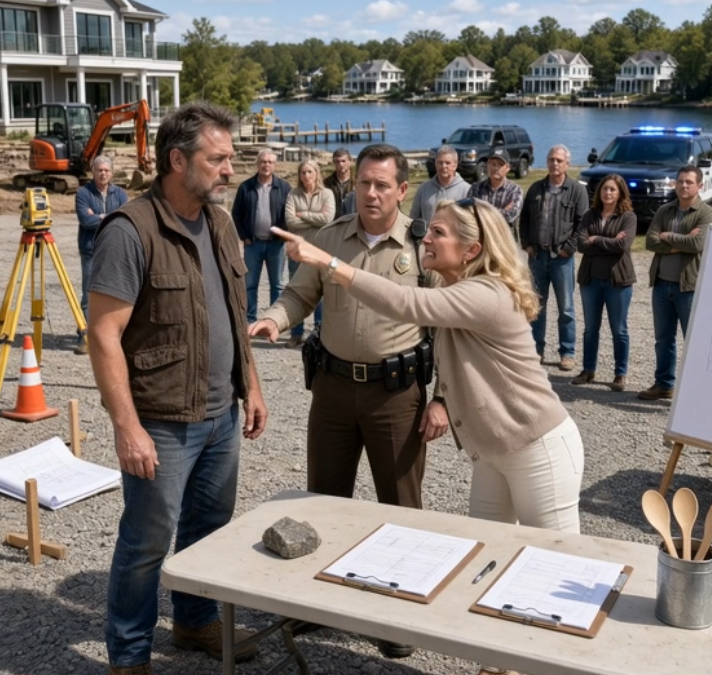
The HOA Set Up a Luxury Auction on My $10 Million Lakefront and Started Taking Bids—So I Waited Until the Gavel Came Down Before I Stepped Out of the Trees.
Brenda Higgins stood at a mahogany podium on my grandfather’s hill and sold thirty-two acres she did not own to a room full of wealthy buyers.
I could have stopped her before the first bid, but I stayed hidden under the oaks with the sheriff listening on speakerphone and waited for the one word that would turn her little auction into a criminal case.
When her gavel hit the podium and she said “sold,” every deed, survey stone, recorded exemption, and family warning my grandfather left behind finally came alive.
I knew Brenda Higgins had lost her mind when I saw white leather chairs on my grandfather’s hill.
Not folding chairs.
Not picnic chairs.
White leather chairs.
Forty of them, lined in perfect rows beneath a cream-colored canopy overlooking Lake Waverly, with champagne buckets, velvet ropes, a mahogany podium, two catering stations, three private security guards, and a brass sign that read:
EXECUTIVE LAKEFRONT PARCEL AUCTION
My land.
My hill.
My lakefront.
My grandfather’s old survey stone sat twenty feet behind that podium, half-hidden under decorative ivy someone had placed there to make stolen ground look curated.
I stopped at the tree line and stared.
For a moment, I thought maybe I was seeing a film crew.
Maybe a wedding shoot.
Maybe some ridiculous influencer event arranged by one of the rich families from Ridgewater Estates.
Then Brenda stepped behind the podium with a wireless microphone and said, “Welcome, esteemed buyers, to the most exclusive lakefront opportunity in the county.”
That was when my anger went very still.
I did not walk out right away.
I stayed beneath the shade of the oaks with mud on my boots, a locked steel briefcase in my right hand, and thirty-two acres of family history spread below me like evidence waiting for a judge.
The auctioneer stood beside Brenda in a gray suit.
A drone hovered above the canopy.
A videographer adjusted his camera near the drink table.
Men and women in expensive clothes sat facing the water, holding bidder cards and glossy brochures that showed renderings of luxury estates built across the hill where my grandmother had planted wild daffodils in 1962.
The brochure title made my jaw tighten.
The Waverly Ridge Collection.
Private gated lakefront estates.
Starting bids from $2.5 million.
I looked at the land beneath their polished shoes.
That ridge was not a collection.
It was not an opportunity.
It was not association green space.
It was not abandoned.
It was the last untouched piece of Vance family lakefront, deeded before Ridgewater Estates was even a dream in some developer’s head.
My name is Kevin Vance.
I grew up on that lake.
PART2:
I learned to swim in the cove below that hill, where the water runs cold even in August because three springs feed it from limestone cracks under the ridge. I caught my first bass under the fallen cedar near the north bank. I broke my left wrist falling from the sycamore near the old boat path. I kissed a girl named Rachel Pruitt behind the pump house when I was sixteen and thought a summer romance was the same thing as destiny.
Every important part of my childhood had mud from that hill on it.
My grandfather, Thomas Vance, bought the land in 1954 after fifteen years working a sawmill and saving every dollar he could keep away from taxes, doctors, and broken equipment.
He was not wealthy.
He was not educated beyond eighth grade.
But he knew land.
He knew water.
And he knew beautiful places make greedy people patient.
That was why he separated the lakefront hill from every later development agreement.
When Ridgewater Estates was built in the eighties, the developer wanted that hill more than anything.
Grandpa said no.
Then he said no again.
Then he had an attorney write the no into history.
The thirty-two lakefront acres were excluded from the subdivision plat.
Excluded from association authority.
Excluded from dues, assessments, common-area maintenance, architectural control, lake-use fees, landscaping rules, and every future HOA covenant unless a Vance signed a recorded agreement saying otherwise.
No Vance ever did.
The county recorder had the exemption.
The state land registry had the exemption.
The original subdivision partition agreement had the exemption in bold type because my grandfather did not trust fine print to save fools from pretending.
My father used to say the whole hill was a monument to Grandpa’s favorite word.
No.
For years, everyone respected it.
The old Ridgewater residents knew the boundary. They waved when I drove the farm road. They fished the public dock and left my shoreline alone. They knew the daffodils belonged to my grandmother, the old survey stone belonged to my grandfather, and the ridge itself belonged to the Vance family.
Then the old houses began selling.
New money came in.
The HOA got ambitious.
PART3:
The board started talking about “unlocking community value.”
That phrase should scare any landowner.
It always means somebody has found something valuable that does not belong to them.
Brenda Higgins became HOA president three years before the auction.
She arrived in Ridgewater with a white Lexus, a lake-view house, a husband nobody ever saw, and a voice that made every sentence sound like she was closing on a hostile acquisition. She wore pastel suits, pearls, and perfume strong enough to make bees reconsider their life choices. She introduced herself at the first annual meeting as “a strategic governance professional,” which meant she had spent a career making ordinary things sound expensive.
Within six months, she had reorganized committees.
Within a year, she had rewritten enforcement schedules.
Within eighteen months, she had convinced the HOA to hire a “community assets consultant” to identify underutilized spaces.
Underutilized.
Another dangerous word.
It did not take long for Brenda’s eyes to land on my hill.
At first, she tried politeness.
A letter came on thick cream paper.
Dear Mr. Vance,
Ridgewater Estates Homeowners Association is conducting a long-range community value assessment. As part of this process, we are reviewing access, usage, and maintenance opportunities relating to certain lakefront ridge areas historically associated with the Ridgewater community.
We would appreciate your cooperation in clarifying the status of Parcel 9B.
Parcel 9B.
That was what the county called my grandfather’s hill.
My family called it Vance Ridge.
I wrote back with one sentence.
Parcel 9B is privately owned Vance family land and is not associated with Ridgewater Estates HOA.
Brenda replied with six pages.
I did not read past the first paragraph before calling my attorney.
My attorney, Claire Benton, had represented my family since my father’s estate went through probate. She was seventy-two, smoked too much, wore red lipstick to depositions, and believed bad legal arguments should be handled the same way one handles raccoons in a chicken coop: quickly, loudly, and with no sympathy.
“She wants your hill,” Claire said after reading the letter.
“She can want a lake monster too. Doesn’t make it hers.”
Claire tapped the page.
“She’s using the word associated too much.”
“Is that illegal?”
“No. Just stupid in a way that gets expensive.”
Claire sent Brenda a formal letter with copies of the exemption, the recorded subdivision partition agreement, the deed, the plat map, and tax records showing that my family had paid every dollar on that land for decades.
Brenda went quiet for two months.
Then came the surveyors.
I found them on the ridge one morning in orange vests, setting flags near the old stone.
They claimed they had been hired to “verify community boundaries.”
I called the sheriff.
They left.
Brenda claimed it was a misunderstanding.
Then came the landscaping crew.
They mowed part of the old path and cut three young cedars near the cove.
I called the sheriff again.
Brenda claimed it was a vendor mapping error.
Then came the first false sign.
RIDGEWATER ESTATES NATURE OVERLOOK
RESIDENT ACCESS ONLY
I took it down and carried it to Brenda’s front porch.
She opened the door wearing tennis whites and sunglasses big enough to hide a guilty conscience.
I handed her the sign.
“This was on my land.”
Her smile was thin.
“That area has historically functioned as community open space.”
“No, it has historically functioned as my family’s private property.”
“Kevin, I think you’re being unnecessarily territorial.”
“About land I own? Yes. That’s the point of ownership.”
Her smile disappeared.
“You know, there are families in this community who would love to enjoy that ridge.”
“They can enjoy the view from land they paid for.”
“That sounds selfish.”
“No. Selfish is putting up signs on land you don’t own and hoping the owner is too polite to remove them.”
She stepped closer.
“Ridgewater is changing.”
“Not on my hill.”
For a moment, neither of us spoke.
Then she said, very softly, “Everything changes eventually.”
I should have listened harder to that.
Over the next year, Brenda escalated from nuisance to strategy.
She began calling Parcel 9B “legacy open space” in HOA newsletters.
She had the ridge included in a glossy “community vision map” handed out at a homeowner picnic.
She told new buyers that Ridgewater had “potential expansion rights” along the lake.
She invited developers to “informational walkthroughs” without telling me.
Each time, Claire sent letters.
Each time, Brenda retreated just enough to avoid immediate consequences.
Then she got clever.
She stopped saying the HOA owned the land.
She started saying the HOA had “equitable development interest.”
Claire read that phrase and laughed so hard she coughed for a full minute.
“Equitable development interest,” she said. “That is not a right. That is a wish wearing a necktie.”
Still, wishes can fool people when printed on heavy paper.
Three weeks before the auction, I found out something was coming.
Not from Brenda.
From a man named Aaron Pike.
Aaron was a local real-estate photographer who had shot drone footage of my ridge without permission. He also happened to be the younger brother of my high school friend Marcus. When Marcus found out what the footage was for, he called me immediately.
“Kev,” he said, “you need to check your email.”
“What did Aaron do?”
“He got hired by Ridgewater to shoot promotional footage for something called the Waverly Ridge Collection.”
I went cold.
“What collection?”
“Luxury lakefront estate auction.”
The words did not make sense at first.
Then they made perfect sense.
Brenda was not trying to convince me anymore.
She was trying to create a sale so large, so public, and so financially tangled that she could force me into court from a defensive position.
That is how people like Brenda think.
If they cannot win by law, they create chaos and call the cleanup negotiation.
Marcus sent me the brochure PDF.
There it was.
My hill.
My shoreline.
My grandmother’s daffodil slope digitally replaced by a limestone driveway.
My grandfather’s survey stone erased from the renderings.
The old spring cove labeled Private Marina Potential.
Thirty-two acres divided into five estate lots.
Starting bids from $2.5 million.
Estimated total value: $10 million plus.
Presented by Ridgewater Estates HOA in partnership with Higgins Community Holdings and Northstar Auction Group.
Higgins Community Holdings.
Brenda had put her own private company between the HOA and the auction.
That was when I called Claire.
She read the brochure in silence.
Then she said, “Kevin, I want you to breathe before I say what I’m about to say.”
“That bad?”
“That interesting.”
“Interesting is worse than bad.”
“Correct.”
She explained it carefully.
A fake listing was civil.
Trespass was civil and possibly criminal.
Misrepresentation to bidders could become fraud.
But an actual auction, with Brenda publicly claiming authority to sell and accepting a bid, especially after receiving written notice that the land was privately owned, could become something much larger.
The key was evidence.
Clear evidence.
Not rumor.
Not brochure language she could later call preliminary.
Not preparations she could blame on a vendor.
We needed her voice.
Her claim.
Her sale.
Claire told me to call Sheriff Walt Emery.
Walt had been sheriff for eighteen years and had known my father. He was a patient man with a face like carved oak and the habit of letting silence do half his interviewing for him.
I met him and Claire in his office the next morning.
I brought the briefcase.
Inside were copies of every deed, plat, exemption, tax record, survey, letter, and photograph related to Parcel 9B. My grandfather’s original attorney had kept carbon copies. My father had kept everything else. I had added recordings, photos, trespass reports, and Brenda’s letters.
Walt opened the file and whistled softly.
“Your granddad did not play around.”
“No.”
Claire leaned forward.
“Sheriff, Brenda Higgins has been formally notified multiple times that this property is private Vance land, excluded from Ridgewater HOA authority.”
Walt nodded.
“And now she’s hosting an auction.”
“On the land,” I said.
His eyebrows lifted.
“On the land?”
“With chairs.”
“Chairs?”
“White leather ones.”
He leaned back.
“Well. That is criminally tacky even before we get to the law.”
Claire did not smile.
“We need you there.”
Walt looked at her.
“To stop it?”
“To hear it.”
His face changed.
He understood immediately.
“If I intervene before she completes the act, she’ll claim misunderstanding.”
“Exactly,” Claire said.
“If I wait too long, buyers may transfer money.”
“I’m not suggesting we let funds move. I’m suggesting you let her make the representation clearly, on record, in front of witnesses.”
Walt looked at me.
“You comfortable with that?”
“No.”
“Good answer.”
He tapped the brochure.
“Private event?”
“On private land,” I said. “Mine.”
Walt nodded slowly.
“All right. I’ll be nearby. You call me when she starts making ownership claims. Keep me on the line. If she reaches bid acceptance, I step in.”
Claire added, “And I’ll have an injunction ready to file the second she says sold.”
That was the plan.
Let Brenda talk.
Let the buyers hear her.
Let the sheriff hear her.
Let the word sold turn arrogance into evidence.
The morning of the auction, I parked my truck half a mile away behind the old pump house and walked in through the oak line carrying the briefcase.
It had rained the night before.
Mud sucked at my boots.
The lake was glassy under a pale blue sky.
The ridge smelled like wet leaves, limestone, and daffodil stems crushed under rich people’s shoes.
When I reached the tree line, the event was already fully staged.
White leather chairs.
Cream canopy.
Champagne.
Security.
Drone.
Mahogany podium.
Glossy brochures.
Velvet ropes.
And Brenda Higgins glowing with the satisfaction of a woman who believed theft became legitimate if catered properly.
I stayed hidden at first.
I called Sheriff Emery.
He answered on the first ring.
“You there?”
“Yes.”
“Can you see her?”
“Yes.”
“Can she see you?”
“No.”
“Good. I’m staged at the lower gate with two deputies. Call is recording through dispatch. Claire is with me.”
Claire’s voice came faintly over the line.
“Kevin, do not lose your temper.”
“I’m looking at white leather chairs on my grandfather’s hill.”
“So lose it later.”
Brenda tapped the microphone.
The speakers hummed.
“Good morning, everyone.”
The crowd quieted.
“Welcome to Waverly Ridge, one of the most extraordinary lakefront opportunities in the region. On behalf of Ridgewater Estates and Higgins Community Holdings, I want to thank you for joining us for this exclusive offering.”
Sheriff Emery said quietly through the phone, “We hear her.”
I did not move.
Brenda continued.
“For decades, this ridge has been part of the Ridgewater experience. Its views, shoreline, and natural beauty have defined our community identity.”
Lie.
“Today, we begin a new chapter by opening this land to visionary buyers who understand stewardship, luxury, and legacy.”
Bigger lie.
The auctioneer stepped forward.
“Ladies and gentlemen, before bidding begins, please confirm you have reviewed the bidder packet, including proposed parcel divisions, buildable envelopes, lake access terms, and association integration requirements.”
Association integration requirements.
My teeth pressed together.
A man in the front row raised his hand.
“Can you clarify title status?”
Brenda smiled.
I leaned forward slightly.
There it was.
The question.
“Certainly,” she said. “The property is controlled through Ridgewater-associated legacy rights and development authority held by Higgins Community Holdings in coordination with the HOA.”
Sheriff Emery’s voice came through the phone.
“Say that again, Brenda.”
She did not, of course.
The buyer frowned.
“So the HOA owns it?”
Brenda’s smile did not move.
“The HOA has the authority to convey development rights under the offering structure.”
Claire whispered through the call, “She’s dancing.”
I knew.
Brenda was too slippery to say outright what she knew could hang her.
Then another buyer, an older woman with diamond earrings, asked, “Will title insurance be available at closing?”
Brenda paused.
Just half a beat.
“Title will be delivered through the designated transaction entity.”
Claire muttered, “Oh, that’s garbage.”
The auctioneer quickly stepped in.
“All title and closing matters are addressed in the packet. Today’s event concerns bid selection and purchase-position award.”
Purchase-position award.
More fog.
Brenda had built herself a vocabulary maze.
But greed makes people impatient.
Bidders do not like fog when millions of dollars are involved.
A man in a navy blazer stood near the aisle.
“I need a simple answer,” he said. “Are we bidding on land or not?”
Brenda’s eyes flashed.
She did not like being challenged in front of an audience.
“You are bidding on the right to acquire exclusive lakefront estate parcels within the Waverly Ridge Collection.”
“Owned by whom?”
Brenda lifted her chin.
“Higgins Community Holdings has secured the necessary authority to bring these parcels to market.”
There it was again.
Necessary authority.
Not ownership.
Not deed.
Not title.
Authority.
The auctioneer sensed tension and tried to move forward.
“Let’s begin with Parcel A, the premier lake-view building site, approximately six point four acres with shoreline access and elevated build platform. Opening bid, two point five million.”
A bidder card went up.
“Two point five.”
Another.
“Two point six.”
Another.
“Two point eight.”
The numbers climbed while I stood in the trees listening to strangers bid on my grandfather’s hill.
Three million.
Three point two.
Three point five.
The old survey stone sat behind the podium under decorative ivy, patient and half-hidden, as if Grandpa himself were waiting to see how stupid the living could become.
My hands tightened around the briefcase handle.
Sheriff Emery said softly, “Kevin.”
“I’m here.”
“Stay with us.”
“I’m here.”
The bidding reached four million on Parcel A alone.
The winner was a developer from Houston named Grant Ellison, according to the auctioneer. He wore a tailored suit, sunglasses, and the relaxed posture of a man who believed all problems had wire-transfer instructions.
The auctioneer looked at Brenda.
“Madam President?”
Brenda stepped to the microphone, glowing.
“We have four million dollars for Parcel A. Going once.”
The gavel lifted.
“Going twice.”
The gavel hovered.
Claire whispered through the phone, “Not yet.”
My heartbeat pounded in my ears.
Brenda smiled at Grant Ellison.
Then she struck the podium.
“Sold.”
That single word landed across the ridge like a gunshot.
Sheriff Emery said, “Move.”
I stepped out of the trees.
The closest security guard saw me first.
“Sir, this is a private event.”
“Yes,” I said. “It is. Mine.”
Heads turned.
Brenda froze behind the podium.
For one beautiful second, her face showed the one emotion she had tried hardest to avoid.
Recognition.
Then rage covered it.
“Kevin,” she said into the microphone by mistake, amplifying my name across the ridge. “You are trespassing.”
That got a murmur from the crowd.
I walked through the chairs with the steel briefcase at my side.
Mud from my boots marked the white event carpet.
Good.
“Actually,” I said, “everyone else is.”
The auctioneer stepped away from the podium.
Security moved toward me.
I stopped and lifted my phone.
“Sheriff Emery, are you hearing this?”
The speaker was on.
Sheriff Emery’s voice came out clear.
“I heard her say sold.”
The crowd shifted.
Brenda’s eyes widened.
At the lower farm road, engines approached.
Two sheriff’s SUVs came over the rise, followed by Claire Benton’s dark sedan and a county vehicle I recognized from the recorder’s office.
The drone above the canopy wobbled as someone lost focus.
Brenda killed the microphone.
Too late.
Sheriff Emery parked beside the catering tent and stepped out in full uniform.
Deputies followed.
Claire emerged from her car carrying a folder thick enough to ruin someone’s week.
Brenda left the podium and marched toward them.
“Sheriff, this is a private commercial transaction. I want this man removed.”
Walt looked around at the chairs, bidders, champagne, sign, podium, and old survey stone.
“Mrs. Higgins, on whose land?”
She stiffened.
“Higgins Community Holdings has authority—”
“No,” I said.
Every head turned back to me.
I placed the briefcase on the podium.
The mahogany surface looked expensive.
I enjoyed scratching it with the steel corner.
I unlocked the latches.
Inside were laminated copies of the deed, plat, exemption, partition agreement, tax records, survey map, and every letter Claire had sent.
I pulled out the original framed copy of my grandfather’s exemption page.
The one with bold type.
The one my father used to say was the best thing a lawyer ever charged the family for.
I held it up.
“This land is Parcel 9B, Vance family property. It was excluded from Ridgewater Estates in 1983. Excluded from HOA authority. Excluded from dues, assessments, common-area designation, architectural control, lake-use provisions, development transfer, and every covenant Ridgewater has unless a Vance signs a recorded agreement.”
I looked at Brenda.
“No Vance ever did.”
Grant Ellison stood slowly from the front row.
“Is this true?”
Brenda pointed at me.
“This is a disputed matter.”
Claire laughed.
Not loudly.
Just enough.
“No, it is not.”
She walked to the podium and handed Sheriff Emery a packet.
“This is the recorded exemption from the county recorder’s office. This is the state registry confirmation. This is the original subdivision partition agreement. This is my March letter putting Mrs. Higgins and Ridgewater HOA on notice. This is my July letter putting Higgins Community Holdings on notice. This is the cease-and-desist after unauthorized survey activity. This is the trespass report. This is the brochure representing private Vance land as available for auction.”
Sheriff Emery took the documents.
Grant Ellison turned toward Brenda.
“You told us title was secured.”
Brenda’s face tightened.
“I said authority was secured.”
“You sold me Parcel A.”
“That was a bid acceptance subject to documentation.”
The auctioneer spoke suddenly.
“Mrs. Higgins, you instructed us this was seller-controlled land.”
Brenda turned on him.
“I instructed you to follow the offering packet.”
He stepped back.
“I have emails.”
The crowd reacted to that.
Brenda’s face went pale beneath her makeup.
Claire’s eyes brightened.
“Oh,” she said. “We will want those.”
A woman in the second row stood.
“I flew in from Chicago for this.”
A man near the drink table snapped, “Is this a scam?”
Brenda grabbed the microphone again.
“This event is being disrupted by a hostile landowner attempting to interfere with Ridgewater’s community development rights.”
I stepped beside the old survey stone and pulled away the decorative ivy.
“There,” I said.
Everyone looked.
The stone was weathered and square, set deep in the hilltop soil. My grandfather had placed it after the 1954 survey. On one side, still visible beneath moss and time, were the carved letters:
VANCE
On the other side:
1954
“This is the western boundary marker,” I said. “It has been here longer than Ridgewater, longer than this HOA, longer than every fake brochure on those chairs.”
Sheriff Emery approached the stone, looked at it, then at the survey map.
He turned to Brenda.
“Mrs. Higgins, did you have permission from Mr. Vance to be on this property?”
Her lips pressed together.
“The HOA has historically maintained—”
“Did you have permission?”
She said nothing.
“Did you have a deed?”
No answer.
“Court order?”
No answer.
“Recorded development rights?”
No answer.
“Written agreement from a Vance?”
Her jaw worked.
“This land is essential to Ridgewater’s future.”
“That is not an answer,” the sheriff said.
“No,” I said. “It’s a confession.”
Brenda looked at me with hatred so focused it almost felt solid.
“You were never going to do anything with it,” she snapped. “You let it sit. Thirty-two acres of premium lakefront wasted because your family is emotionally attached to weeds and rocks.”
I felt the old anger rise.
But it stayed steady.
“My grandmother’s daffodils are not weeds. My grandfather’s survey stone is not a rock. And leaving land whole is not wasting it.”
Grant Ellison stepped into the aisle.
“I want my deposit returned immediately.”
Several bidders began speaking at once.
“Deposit?”
“You took deposits?”
“What escrow company?”
“Who has the money?”
That was when the mood changed from confusion to danger.
Brenda had collected deposits.
Not just bidder registration fees.
Deposits.
Claire turned to Sheriff Emery.
“That is new.”
Sheriff Emery’s expression hardened.
“Mrs. Higgins, did you collect funds related to this auction?”
Brenda lifted her chin.
“All funds are held pending transaction processing.”
“Where?”
“Higgins Community Holdings manages preliminary participation deposits.”
“In what account?”
Her eyes flickered.
The sheriff saw it.
So did Claire.
So did I.
The auctioneer was already on his phone.
One security guard quietly removed his earpiece and stepped away like a man reconsidering his employer.
Deputy Lawson began taking statements from bidders.
Deputy Miles told the drone operator to land the drone and preserve footage.
Claire spoke softly to me.
“Kevin, don’t say anything else about deposits.”
“Why?”
“Because this just grew teeth.”
The county recorder, Paula Jenkins, arrived ten minutes later in a county SUV. Brenda looked personally offended to see her, as if public records had no business attending an event built on ignoring them.
Paula had worked in the recorder’s office for thirty-one years and treated recorded documents like scripture. She was short, round, and cheerful until someone lied about a deed.
Then she became frightening.
She reviewed the copies, then looked at Brenda.
“There is no recorded conveyance from the Vance family to Ridgewater HOA or Higgins Community Holdings.”
Brenda said, “That office has made indexing errors before.”
Paula smiled.
It was not friendly.
“That is why I brought the physical archive scan.”
She held up a folder.
“The exclusion is indexed correctly. The plat note is indexed correctly. The parcel remains privately assessed to Kevin Vance. Taxes are current. No transfer. No lien. No easement granting sale authority. No development agreement.”
The bidders heard every word.
Brenda’s world shrank visibly around her.
Grant Ellison removed his sunglasses.
“You represented this as a legitimate offering.”
Brenda’s composure cracked.
“Mr. Ellison, you of all people understand that strategic land assembly often requires resolving legacy obstacles.”
“Legacy obstacles?” I repeated.
She looked at me.
“You are one man blocking millions in value.”
“No,” Sheriff Emery said. “He is the owner.”
That sentence settled over the ridge.
Simple.
Final.
Owner.
Brenda had spent years burying that word under association language, development language, community language, legacy language, authority language.
The sheriff dug it back up in four syllables.
Owner.
Brenda turned to leave.
Deputy Lawson stepped into her path.
“Ma’am, we’re not done.”
“I have nothing further to say without counsel.”
“That may be wise.”
Sheriff Emery nodded toward the podium.
“But you’re not leaving with any records, devices, or materials connected to this auction until we determine what has been represented and what funds have been collected.”
“This is outrageous.”
“No,” he said. “White leather chairs on private land is outrageous. We are past that now.”
I almost smiled.
Almost.
The bidders were escorted to the lower road one by one after giving statements. Many were angry. Some were embarrassed. A few looked at me like I had personally ruined their dream of buying a stolen hill.
I did not care.
The caterers packed silently.
The auctioneer surrendered emails and contracts.
The videographer handed over camera cards after Claire explained what evidence preservation meant.
The drone operator looked like he might faint.
By late afternoon, the canopy still stood, but the luxury had drained from it. Without champagne glasses and bidder confidence, it looked like what it was: a trespass tent.
Brenda sat in the back of a sheriff’s SUV, not handcuffed yet, but close enough to consequence that even her posture had changed.
I walked to the old survey stone.
The ivy lay in a heap beside it.
I brushed moss from the carved letters.
VANCE.
My grandfather had carved those letters with a hand chisel and a temper, according to my father. The surveyor offered to set a metal pin. Grandpa said pins could be ignored by men with maps, but stone made fools bend down and read.
He had been right.
Claire joined me.
“You all right?”
“No.”
“Good. I’d worry if you were.”
I looked down the hill toward the cove.
“My grandfather warned us about this.”
“About Brenda?”
“About beautiful places making greedy people patient.”
Claire nodded.
“He sounds like he would have been a good witness.”
“He would have scared the judge.”
“Even better.”
The legal aftermath lasted almost two years.
At first, Brenda claimed everything was a misunderstanding caused by “ambiguous legacy documents.”
That lasted until the auctioneer produced emails.
In one, Northstar Auction Group asked:
Please confirm seller of record or controlling ownership entity for Waverly Ridge parcels.
Brenda replied:
Do not use “seller of record” language in buyer-facing materials. Refer to “development authority” and “transaction entity.” Legacy title issues will be resolved post-award.
Legacy title issues.
That phrase became famous in court.
In another email, a title consultant warned:
Parcel 9B appears excluded from Ridgewater plat and remains in Vance ownership. No recorded acquisition found. Recommend obtaining written owner consent before marketing.
Brenda forwarded that email to herself with one sentence added:
Vance will fold once serious money is on table.
I read that line in Claire’s office.
Then I read it again.
Vance will fold.
My grandfather would have risen from the grave just to spit tobacco on her shoes.
The deposits turned out to be worse than anyone expected.
Brenda had collected “participation deposits” from eight interested buyers through Higgins Community Holdings. Some deposits were $50,000. Grant Ellison’s was $250,000. The funds were supposed to be refundable but had already been partially moved into consulting accounts, event expenses, “administrative reserve,” and a mysterious strategic development fund controlled by Brenda.
Fraud charges followed.
So did civil suits from the bidders.
Ridgewater HOA tried to distance itself from Brenda, claiming she acted through her private company without full board authorization. That was partly true and partly cowardice.
Board emails showed several members had concerns.
They also showed those members stopped asking questions once Brenda promised the auction would create an HOA windfall large enough to reduce dues for five years.
Greed makes silence sound responsible.
The HOA got sued anyway.
By bidders.
By me.
By its own residents after special assessments were proposed to cover legal defense.
Brenda resigned as president two days after the auction.
Her resignation letter said she had “acted boldly to advance Ridgewater’s future.”
Claire read that line and said, “Prison memoir title.”
Criminal proceedings took longer.
Brenda hired an expensive defense attorney who argued that property law is complex, that Ridgewater had longstanding community association interests, that Brenda genuinely believed she had development authority, and that the auction was preliminary.
Then prosecutors played the video.
Brenda at the podium.
Her voice clear.
“We have four million dollars for Parcel A. Going once. Going twice.”
Gavel strike.
“Sold.”
Then my voice.
“Sheriff Emery, are you hearing this?”
Then the sheriff.
“I heard her say sold.”
The jury heard it too.
Brenda’s attorney tried to argue that sold meant sold subject to conditions.
The prosecutor stood up and asked, “What condition allows someone to sell another family’s land?”
Nobody had much to say after that.
Brenda was convicted on fraud-related charges, attempted theft by deception, and criminal trespass tied to the event. Some charges were reduced. Some were dismissed. The law is not as emotionally satisfying as stories need it to be.
But she was sentenced.
Not forever.
Not enough, according to my uncle.
But enough to remove her from Ridgewater and give every HOA president in the county a cautionary tale in white leather.
The civil judgment was more satisfying.
The court confirmed, in language so clear even Brenda could not varnish it, that Parcel 9B was private Vance property, excluded from Ridgewater Estates and any HOA authority. The court ordered Ridgewater to record a new notice referencing the original exemption and prohibited the HOA from marketing, accessing, maintaining, regulating, or representing any interest in the property.
They also had to pay damages.
The auction company settled.
The security company settled.
The HOA settled.
Brenda’s company collapsed.
Grant Ellison got his deposit back and, to his credit, sent me a short letter afterward.
Mr. Vance,
I was one of the bidders at the auction. I should have done more due diligence before participating. Your restraint that day likely prevented a much larger disaster. I apologize for standing on your family’s land believing I had a right to buy it.
Respectfully,
Grant Ellison
I kept that letter.
Not because it fixed anything.
Because it is rare for wealthy men to admit they should have asked one more question before writing a check.
The hill took longer to heal than the lawsuits.
People think land is unharmed if no bulldozer arrives.
That is not true.
Forty chairs left dents in wet ground.
Catering trucks tore ruts in the path.
The canopy stakes punctured the daffodil slope.
Someone dumped ice and citrus peels near the spring run.
The drone crew trampled young ferns.
Decorative ivy had been wired around my grandfather’s stone.
I cleaned it myself.
For three weekends, I worked with a shovel, rake, pruning shears, and a kind of anger that had nowhere else to go. I removed every scrap of event trash. I lifted flattened daffodil bulbs and replanted what I could. I spread straw on the ruts. I reset stones along the old path. I cleared the spring run with my hands until cold water moved properly again.
On the fourth weekend, my daughter came with me.
Her name is Emily.
She was nineteen then, home from college, old enough to understand legal theft and young enough to still believe the world should be more embarrassed by it.
She stood beside the survey stone and ran her fingers over the carved letters.
“Grandpa Thomas made this?”
“Your great-grandfather.”
“He carved the name himself?”
“That’s the story.”
She looked out over the lake.
“Are you going to keep it forever?”
I looked at her.
“That depends.”
“On what?”
“On whether you want it someday.”
She stared at me.
“I thought you’d never ask.”
That hit me harder than any court order.
For years, I had assumed the hill was my burden to protect because I was the last one close enough, stubborn enough, and sentimental enough to fight. Emily had grown up mostly in the city after her mother and I divorced. She loved the lake, but I did not know if she loved it as inheritance or just memory.
She crouched near the daffodils.
“Dad,” she said, “this place is the only part of the family that never pretended to be something else.”
I had to look away.
The next spring, the daffodils came back.
Not all of them.
Enough.
Yellow scattered across the hill in uneven drifts, stubborn and bright beneath the oaks. I stood at the top near the stone and watched them move in the wind. The lake below flashed silver. Ridgewater’s rooftops showed through trees in the distance, quiet for once.
The HOA had a new board by then.
A cautious one.
Their first act was to send me a formal apology.
Their second was to cancel all “community asset expansion initiatives.”
Their third was to hire a boundary surveyor and install signs at every actual HOA property line.
Progress, I suppose.
One afternoon, a new Ridgewater resident stopped me near the public dock.
He was maybe thirty, carrying a fishing rod and a toddler on his hip.
“Mr. Vance?”
“Yes.”
“I’m sorry to bother you. We just moved in. I wanted to ask… is that hill yours?”
He pointed toward the ridge.
I looked at him carefully.
“Yes.”
He nodded.
“Okay. I thought so. The welcome packet says it’s private land and not HOA property. My son keeps wanting to climb it because of the flowers. I told him we don’t go where we’re not invited.”
I looked at the toddler, who was holding a plastic fish.
“What’s his name?”
“Ben.”
“Ben can see the daffodils from the public dock.”
The man smiled.
“That’s what I told him.”
I surprised both of us by saying, “Maybe in spring I’ll open it for one day. Guided walk. No drones. No chairs.”
His face lit up.
“That would be amazing.”
“Maybe,” I said.
Not a promise.
But not a no.
My grandfather loved no, but he also loved teaching people why no mattered.
There is a difference between keeping land private because you hate people and keeping it private because you love the land enough to protect it from carelessness.
I think he knew that.
I think I am still learning it.
Two years after the auction, I installed a small wooden sign beside the farm road.
VANCE RIDGE
PRIVATE FAMILY LAND
PROTECTED SINCE 1954
Below that, in smaller letters, Emily insisted we add:
PLEASE ENJOY THE VIEW RESPECTFULLY FROM PUBLIC ACCESS AREAS
I wanted something less polite.
She said the sign was not for Brenda.
She was right.
Brenda Higgins became a story people told at HOA meetings across the county.
Do your due diligence, or you’ll pull a Brenda.
Do not market what you do not own.
Do not confuse common area with wishful thinking.
Do not say sold while the sheriff is listening.
That last one stuck.
People laughed when they said it.
I did too sometimes.
But not always.
Because behind the absurdity was something serious.
Brenda did not almost steal my land because she was ridiculous.
She almost stole it because enough people wanted her lie to be true.
The bidders wanted a luxury opportunity.
The HOA wanted money.
The board wanted lower dues.
The auction company wanted commission.
The videographer wanted footage.
The caterer wanted payment.
The security guards wanted a job.
Nobody wanted to bend down and read the survey stone.
Nobody wanted to ask why a thirty-two-acre lakefront ridge in the middle of a wealthy subdivision was supposedly available through an HOA president’s private company.
Nobody wanted to hear the word no when millions of dollars were whispering yes.
That is how land gets stolen.
Not always by force.
Often by vocabulary.
Legacy rights.
Development authority.
Community value.
Underutilized asset.
Strategic opportunity.
Those phrases sound cleaner than theft.
That is why people use them.
But the land knows.
Records know.
Survey stones know.
Families know.
And sometimes, if you are lucky and your grandfather was stubborn enough, the county recorder knows too.
I still walk the ridge every Sunday morning.
I start at the old farm road, climb past the oak line, stop at the survey stone, then follow the slope down to the spring cove. In April, I count daffodil patches. In July, I check for erosion after summer storms. In October, I cut back invasive vines. In winter, I stand in the quiet and listen to wind move across frozen water.
Sometimes I imagine Grandpa Thomas walking beside me, sawmill shoulders, rough hands, eighth-grade education, and a mind sharper than every consultant Brenda ever hired.
He would have hated the white leather chairs.
He would have hated the brochure.
He would have hated Brenda calling his hill an opportunity.
But I think he would have liked the ending.
Not because she went to prison.
Not because the HOA paid.
Not because bidders looked foolish in expensive shoes.
He would have liked that the word no held.
Through time.
Through greed.
Through glossy brochures.
Through champagne buckets.
Through a mahogany podium on stolen ground.
He would have liked that his survey stone was still there after all of it, half-covered in moss, carved with our name, refusing to move.
The last untouched piece of Vance lakefront remains untouched.
No estate gates.
No private marina.
No limestone driveway.
No Waverly Ridge Collection.
Just oaks, daffodils, limestone springs, cold water, and a stone that has outlasted every person who thought paper lies could erase carved truth.
People still ask me why I did not stop Brenda before the auction began.
I could have.
I had the deeds.
I had the lawyer.
I had the sheriff waiting below the hill.
I could have walked out during the welcome speech and ruined her show before a single bid was called.
But Brenda Higgins had spent three years living inside soft language.
Associated.
Legacy.
Authority.
Opportunity.
Community value.
She had hidden behind words with blurred edges.
So I waited for one that did not blur.
Sold.
A small word.
Clean.
Final.
A word that turned pretending into action.
A word the sheriff could hear.
A word the bidders could hear.
A word my grandfather’s hill could answer.
And when Brenda struck that gavel on my land, with my grandfather’s survey stone behind her and thirty-two acres of Vance history beneath her polished shoes, she thought she had just sold the future.
She was wrong.
She had finally purchased the consequences.








