The HOA Sent Fake “Police” Across My 640-Acre Lake Ranch—Then I Found the Secret They Were Building Behind Their Badges
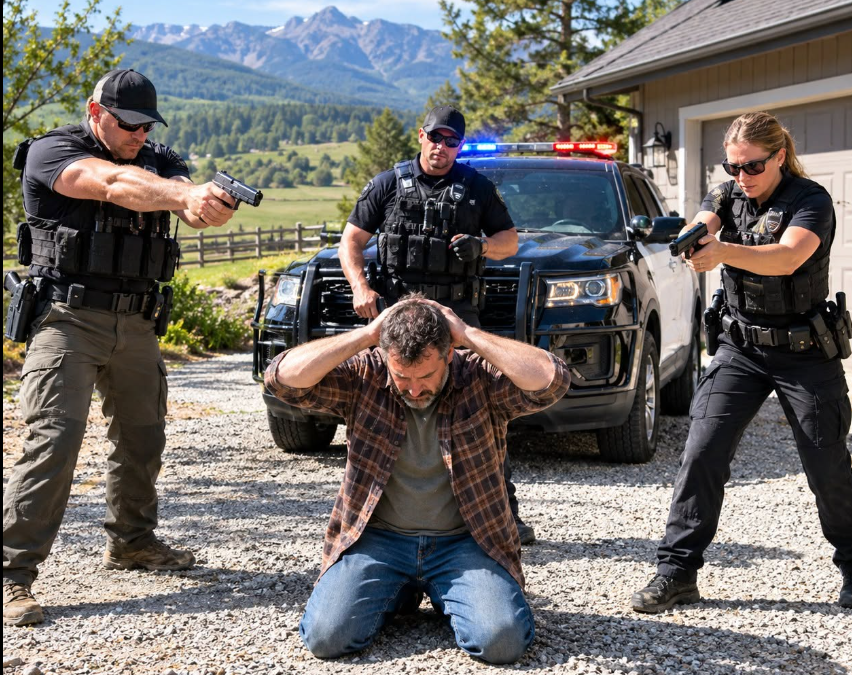
PART2:
My father had run cattle there. His father had run cattle before him. The gravel road those Jeeps used had always been ours. It ran from the western side of the ranch, followed the lake, and eventually met County Road 18.
Private.
Never dedicated to public use.
Never deeded to Canyon Ridge Estates.
Never maintained by the county.
Never offered as a shortcut for anyone who bought a house behind a fancy stone entrance and decided old ranch land looked more convenient than building a proper road.
That matters because the second morning, the Jeeps came back.
Same vehicles.
Same uniforms.
Same route.
No lights this time.
I raised a hand when the first one passed.
The driver looked straight at me.
Did not stop.
By Friday, they had crossed three more times.
Different hours.
Same route.
Sometimes early.
Sometimes after dark.
Never stopping at a house.
Never checking a fence.
Never responding to anything that resembled an emergency.
That was when I realized they were not patrolling my ranch.
They were using it.
Saturday afternoon, I parked my pickup across the gravel road.
Not aggressively.
Just enough that if they wanted through, they would have to stop.
I heard tires grinding over caliche before I saw them. Two white Jeeps rounded the cottonwoods, the first slowing about twenty feet from my truck.
The driver lowered his window.
Up close, the uniform looked convincing. Dark navy shirt. Metal shield. Radio. Duty belt. The kind of thing a person sees and instinctively assigns authority to before his mind catches up.
“What’s the problem?” he asked.
I almost laughed.
“That’s what I was going to ask you.”
“We’re conducting an official patrol.”
“On whose property?”
He glanced toward the lake.
“Sir, I need you to keep this roadway clear.”
Roadway.
Not ranch road.
Not private road.
Roadway.
I stepped closer.
“Who are you with?”
He tapped the shield on his chest.
“Security enforcement.”
“That isn’t an agency.”
The passenger leaned toward the center console.
“Mr. Bennett, move your vehicle.”
That stopped me.
I had not introduced myself.
“How do you know my name?”
Neither answered.
The driver lifted his radio and said something too low for me to hear. Then he looked at me.
“Do not interfere with official operations.”
I felt my temper rise.
But anger would not tell me who they were.
So I moved the pickup.
They drove through.
This time, I paid attention.
No sheriff’s star on the door.
No state insignia.
No county number.
No department name.
Only a shield logo and small lettering.
When I got home, I pulled video from the cameras.
Years earlier, I had mounted two trail cameras because cattle thieves and trespassers do not send appointments. One covered the western approach. The second caught vehicles along the lake road.
I reviewed a week of footage.
Monday. 6:18 a.m.
Tuesday. 7:04.
Wednesday. 6:31.
Friday. 8:12 p.m.
Saturday. Right after our confrontation.
I printed still frames.
Then I took an old ranch map and traced their path.
Every single run entered beside Canyon Ridge Estates.
Every one followed the north edge of Bennett Lake.
Every one exited at County Road 18.
Same route.
Again.
Again.
Again.
I called the Canyon County Sheriff’s Office.
The dispatcher took my name and address.
Then placed me on hold.
When she returned, her voice had changed.
“Mr. Bennett, we don’t show any units dispatched to your property.”
“What about patrol operations?”
“Nothing assigned.”
“Another agency?”
She paused.
“There are no listed law-enforcement operations on Bennett Lake Ranch.”
I looked through my kitchen window toward the road.
“So those weren’t your deputies?”
“No, sir.”
That answer landed harder than I expected.
For nearly a week, men had driven across my property using flashing red-and-blue lights and language designed to sound official.
And I had stepped aside.
I thanked her, then reopened the clearest image.
This time, I zoomed in on the badge.
From twenty feet, convincing.
On a screen?
Different.
No county seal.
No agency name.
Just a shield.
Below it, after enlarging the image twice, I could read two words.
COMMUNITY PATROL.
I sat back.
Beyond my window, Bennett Lake caught a break in the clouds. Silver water. Cottonwoods. And beyond the tree line, the roofs of Canyon Ridge Estates.
That created a new question.
Why did an HOA need men dressed like police driving across my private ranch every day?
The answer started with Diane Mercer.
Diane was fifty-two, president of Canyon Ridge Estates, and a former luxury real-estate broker who had turned property access into a religion. She understood roads. She understood lake views. She understood exactly what happened to land values when a piece of property gained or lost either one.
I had met her three times before the Jeeps started.
All three meetings were about the same thing.
My western acreage.
Canyon Ridge had been built east of Bennett Lake Ranch. The first phases stopped at my property boundary, but developers had wanted more land from the beginning.
Diane’s first offer had been polite.
The second had been generous.
The third arrived in a glossy folder with conceptual drawings that bothered me before I understood why.
The drawings showed future homes.
New streets.
Greenbelts.
A development footprint spreading farther west.
Across land I had never agreed to sell.
I closed the folder.
“Not interested.”
Diane folded her hands.
“Everything has a number, Mr. Bennett.”
“Not everything.”
She did not understand why.
Most people did not.
My wife Helen had died five years earlier.
Cancer.
Fast at first.
Then painfully slow.
Before she died, we chose a place for her grave ourselves. A ridge above Bennett Lake beneath an old live oak. From there, you could see the water, most of the western pasture, the road, and the far cattle pond.
I still carried coffee up there some mornings.
And when my time came, I intended to be buried beside her.
So when Diane talked about acreage, I did not hear acreage.
I heard bulldozers near the place where my wife was buried.
I rejected the last offer in March.
Soon after that, the patrol Jeeps appeared.
Once I made that connection, I drove to Canyon Ridge.
The clubhouse looked more like a resort than the office of a homeowners association. Stone entrance. Decorative fountain. Perfect lawn. The kind of place that makes people confuse dues with law.
Diane met me in a conference room.
I put three photographs on the table.
“Your people?”
She looked once.
“Canyon Ridge Community Patrol.”
“So they work for the HOA.”
“They provide contracted security.”
“Tell them to stop driving across my ranch.”
Diane folded her hands.
“Our patrol personnel use designated community access routes.”
“My ranch is not a community access route.”
A patient smile crossed her face.
“I think there’s confusion.”
Then she opened a cabinet and pulled out a rolled map.
That told me she had expected the conversation.
She spread it across the table.
Canyon Ridge appeared in neat colored blocks.
Existing lots.
Roads.
Clubhouse.
Drainage.
Then I saw a red line.
It ran west.
Across my property boundary.
Across the western pasture.
Along Bennett Lake.
Straight to County Road 18.
Printed beside the line:
EMERGENCY ACCESS CORRIDOR B.
I stared at it.
“What is this?”
“Our secondary emergency route.”
“That’s my road.”
“It is an established access route.”
“Established by who?”
“Our development records recognize it.”
I looked at Diane.
“I don’t care what your map recognizes. Who gave Canyon Ridge the legal right to cross Bennett Lake Ranch?”
Her smile thinned.
“The corridor has existed for years.”
“Show me the easement.”
Silence.
Only two seconds.
Enough.
“Recording number?”
“Your attorney can request appropriate records.”
“I don’t need an attorney to ask for a recording number.”
Diane leaned back.
“Nobody is trying to take your ranch.”
“Then keep your vehicles off it.”
“The HOA has safety obligations.”
“And I have a deed.”
That was the first time her expression changed.
Barely.
Then she rolled the map halfway closed.
“You know this conflict is unnecessary.”
“Good. End it.”
“There is another solution.”
I knew what was coming.
Another folder.
Updated purchase offer.
She slid it toward me.
“The western strip would solve several access issues.”
Access.
There it was.
Not safety.
Not patrol coverage.
Access.
I pushed the folder back.
“Helen is buried on that ridge.”
Diane glanced toward the map.
“I understand sentimental value.”
“No.”
She looked at me.
“You understand acreage.”
I stood.
“My answer is no.”
“Development doesn’t stop because one property owner dislikes change.”
“I don’t dislike change.”
I tapped the red line.
“I dislike people drawing roads across land they don’t own.”
Before leaving, I pointed once more at Corridor B.
“If that easement exists, send it.”
She did not answer.
I was almost at the door when she spoke.
“Growth eventually finds the road it needs.”
I stopped.
Not enough to call a threat.
Probably intentional.
I turned.
She was already rolling the map.
That evening, I walked to Helen’s grave.
From the ridge, Canyon Ridge looked harmless.
Roofs through trees.
Streetlights.
Families.
Nothing sinister.
That was the strange part.
So had the patrol Jeeps.
So had Diane’s map.
Official-looking things gain power because people mistake appearance for foundation.
A red line does not become a property right because somebody prints it professionally.
The next morning, I stopped treating the Jeeps like an annoyance.
I treated them like evidence.
New signs went up at the western gate.
PRIVATE RANCH.
NO THROUGH TRAFFIC.
NO ENTRY WITHOUT OWNER PERMISSION.
I moved an old commercial padlock onto the chain.
Mounted a better camera in a cottonwood.
A second camera watched the road.
Cloud upload.
Time stamps.
I photographed the signs.
The lock.
The gate.
Then emailed the photographs to myself.
If Canyon Ridge had a legal right, it could prove one.
Until then, the gate stayed shut.
Two days passed.
Nothing.
No patrol.
No lights.
For a moment, I thought Diane had backed down.
Thursday morning, 5:42.
My phone buzzed beside the bed.
Motion detected.
West Gate.
I opened the feed.
White Jeep.
One man stepped out.
Broad shoulders.
The same driver from Saturday.
Later, I learned his name was Travis Boone.
He walked directly to the gate.
Did not call.
Did not knock.
Did not inspect my warning signs.
He reached into his pocket.
Pulled out a key.
I sat upright.
He inserted it into my lock.
Turned.
The padlock opened.
No bolt cutters.
No broken chain.
No hesitation.
He unlocked my gate like he had done it before.
Twenty-three seconds later, the Jeep drove through.
I was in my pickup before it reached the lake road.
I did not chase him.
I drove to the gate.
The chain hung open.
The lock was intact.
I held it in my hand.
Then remembered something.
That lock was old.
I liked repairable hardware. When I moved it to the western gate, I had never changed the cylinder.
Three keys had existed.
Exactly three.
I drove home and opened the drawer beneath the kitchen phone.
Spare truck keys.
Fence tags.
An old pocketknife Helen used to cut feed sacks.
At the back, an envelope.
Two brass keys.
Both opened the lock.
The third was missing.
Not lost.
Loaned.
Years earlier, during utility construction near the western boundary, my father had allowed a contractor temporary access. Equipment. Trenchers. Concrete trucks. Utility crews.
One ranch gate key had been issued so somebody would not have to call every morning.
When the project ended, everyone moved on.
I assumed the key had been returned.
Apparently assumption had just opened my gate fifteen years later.
At seven, Travis returned from the County Road 18 side.
I waited inside the gate.
He stopped.
I held up the lock.
“Where did you get the key?”
His face stayed flat.
“We have authorized access.”
“That wasn’t my question.”
“My orders come through Canyon Ridge.”
“I spoke to Canyon Ridge.”
“Then you know this is an emergency corridor.”
“I know Diane has a map.”
His eyes narrowed.
“That key belongs to Bennett Lake Ranch. Who gave it to you?”
He looked past me.
“Mr. Bennett, I’m not discussing operational procedures.”
“Opening my locked gate isn’t an operational procedure.”
He shifted into drive.
I did not block him.
I raised my phone and recorded.
Before leaving, he lowered the window.
“Locking this gate doesn’t change the access rights.”
That sentence mattered.
He believed what he had been told.
Or wanted me to believe he did.
I called Rachel Foster.
Rachel was a land-use attorney. Property rights. Easements. Boundary fights. Exactly the kind of lawyer Diane had probably assumed I would never hire.
I sent Rachel photographs.
Video.
The fake badge.
My best sketch of Diane’s map.
She called ten minutes later.
“Start at the beginning.”
I did.
The Jeeps.
The uniforms.
The red-and-blue lights.
The map.
The purchase offers.
The key.
Rachel interrupted only once.
“He used a key?”
“Yes.”
“Opened your lock normally?”
“Yes.”
“Did you ever give Canyon Ridge a key?”
“No.”
“Your father?”
“Not Canyon Ridge. Construction years ago.”
“What year?”
“I’d have to look.”
“Who received it?”
“Some developer or contractor.”
She went quiet.
Then: “Don’t replace the lock yet.”
“Why?”
“That key may be more valuable than the gate.”
The next morning, we went to county records.
Rachel started with my property.
Not Canyon Ridge.
“People make a mistake,” she told me. “They start with the other side’s claim.”
“What do we start with?”
“What your land actually carries.”
My deed was clean.
Six hundred forty acres.
Lake.
Pasture.
Road.
No HOA declarations.
No Canyon Ridge easement.
Then an older file surfaced.
My father’s signature.
TEMPORARY CONSTRUCTION ACCESS LICENSE.
Rachel stopped.
“There.”
The agreement was between my father and the developer working east of us.
Purpose: temporary construction traffic for utility installation.
Duration: eighteen months.
No residential access.
No patrol access.
No emergency corridor.
No transfer to successors.
No transfer to HOA.
No future-development rights.
Then Rachel tapped a paragraph.
“Read that.”
I did.
Repeated entry under the license would not create or establish a permanent easement, prescriptive right, implied right, or future claim of access.
I read it again.
Diane’s red line appeared in my mind.
“She doesn’t have an easement.”
Rachel shook her head.
“Not from this.”
The clerk found an attachment.
Temporary gate key issued.
Return required at termination.
No return receipt.
That did not prove who physically handed Travis the key fifteen years later.
But it proved something else.
The key had existed for one temporary reason.
That reason had expired.
Rachel prepared two letters.
One was a preservation notice.
Canyon Ridge and its patrol contractor were ordered to preserve maps, logs, GPS records, photographs, communications, invoices, access documents, and anything related to Bennett Lake Ranch.
The second demanded the recorded instrument supporting Emergency Access Corridor B.
“If Diane has another easement,” Rachel said, “she gets a chance to produce it.”
“And if she doesn’t?”
“She gets to explain why she is acting as if she does.”
I also met with Sheriff Daniel Ortiz.
I showed him the video of Travis unlocking the gate.
He watched twice.
“Did you authorize him?”
“No.”
“Rachel find an easement?”
“The opposite.”
I handed over the certified license.
Daniel read the expiration clause.
Then the no-prescriptive-right clause.
“This is useful.”
“Useful enough to stop them?”
“Useful enough that this is no longer an innocent misunderstanding.”
That was not instant justice.
I respected Daniel more for that.
He did not arrest people because I arrived angry. He did not turn property law into roadside theater. He preserved the record.
Diane had lawyers.
The developer had money.
If this became a real land fight, outrage would last five minutes.
Documents would last forever.
Two quiet days followed.
Then Canyon Ridge responded.
No easement.
Instead: Emergency Access Corridor B was based upon historic community and emergency access usage.
Historic usage.
Rachel called.
“They’re leaning on use because they don’t have the instrument.”
“But the old license says use can’t create rights.”
“I know.”
Then she sent me a spreadsheet.
She had organized every Jeep trip from my videos.
Date.
Time.
Direction.
Entry.
Exit.
The pattern was obvious.
These were not patrols.
They were repetitions.
Same route.
Again and again.
Entering Canyon Ridge.
Crossing Bennett Lake Ranch.
Exiting County Road 18.
Then doing it days later.
Rachel said, “I don’t think they’re just using your road.”
“What are they doing?”
“I don’t know yet.”
Then she asked the question that changed the case.
“Who is documenting each trip?”
Sheriff Ortiz helped identify the patrol company.
Canyon Ridge Community Patrol.
Private security.
Not police.
No peace-officer authority.
Rachel obtained the business registration.
Owner: Travis Boone.
Then the HOA security contract.
The contract limited patrol services to Canyon Ridge streets, HOA facilities, common areas, and contracted community property.
Bennett Lake Ranch appeared nowhere.
Neither did Corridor B.
Rachel placed the contract beside Diane’s map.
“Her map says they have the route.”
“Travis’s contract doesn’t.”
“Exactly.”
“So why drive it?”
“Because whatever they’re doing with your road apparently wasn’t something they wanted stated in the patrol agreement.”
Pressure began elsewhere.
At Miller’s Feed, a man I had known fifteen years stopped talking when I entered.
At a diner, two Canyon Ridge residents stared at me.
One muttered something about evacuation routes.
Sunday outside church, a woman asked whether it was true I had threatened security officers.
“No.”
She looked uncomfortable.
“That’s what they’re saying.”
“Who?”
She would not answer.
I learned Monday.
Diane had held an HOA meeting.
She called me unstable.
Hostile.
A threat to emergency safety.
A landowner obstructing a long-established evacuation corridor.
She repeated the claim until residents stopped asking for the deed behind it.
That hurt more than I expected.
I had lived in that county most of my life.
Pulled pickups from flooded ditches.
Fixed fences while neighbors were gone.
Allowed kids to fish the south bank if they asked.
Now people were being told I wanted families trapped behind a locked gate during emergencies.
That evening, I went to Helen’s ridge.
Only briefly.
Self-pity was not going to protect the road.
Rachel sent a second demand.
Stop representing Bennett Lake Ranch as an established HOA emergency route unless Canyon Ridge could produce a recorded legal right.
Diane’s lawyer responded with four paragraphs and no easement.
Same phrase.
Historic access usage.
Rachel called again.
“They’re avoiding the instrument because there probably isn’t one.”
“They keep emphasizing use.”
“Yes.”
I thought about the Jeeps.
“Then somebody is manufacturing the use.”
Rachel went quiet.
“Exactly.”
The first real break came from inside Canyon Ridge.
Susan Hale.
Sixty-four.
HOA treasurer.
She called from an unfamiliar number.
“Mr. Bennett?”
“Yes.”
“I’m Susan Hale. Canyon Ridge board.”
I waited.
“I think we need to talk.”
We met in a hardware-store parking lot.
She stayed in her car, window down, nervous.
“I don’t know what Diane has told you.”
“She says I closed an emergency road.”
Susan nodded.
“That’s what worries me.”
As treasurer, she reviewed invoices.
Regular patrol bills were familiar.
Clubhouse.
Gate.
Neighborhood rounds.
Then new charges appeared.
Extra mileage.
Photography.
GPS documentation.
Route verification.
“Did the board approve that?” I asked.
“Not that I remember.”
“What route?”
“Diane said emergency access work.”
Rachel’s question returned.
Who was keeping records of the trips?
“Can you show me the invoices?” I asked.
Susan looked toward the road.
“If Diane knows I’m copying records—”
“Don’t copy anything you aren’t authorized to copy.”
She stared at me.
“I need truth, Susan. Not evidence someone can throw out later.”
That surprised her.
Good.
Two nights later, Susan came to my kitchen with the HOA laptop. Rachel joined by phone.
Susan opened the payment system.
Ordinary patrol invoices.
Then a larger one.
Mileage.
GPS logging.
Photographic documentation.
And at the top:
PHASE 3 – EMERGENCY ACCESS VALIDATION.
I read it twice.
“Phase Three?”
Susan looked at me.
“Diane hasn’t announced Phase Three to homeowners.”
Those four words changed everything.
Until then, I thought Diane wanted my western land because developers always want land.
Now HOA money was paying to document a road across my ranch for a future development phase residents did not even know existed.
The uniforms mattered less.
The logs mattered more.
Someone was collecting evidence.
Three days later, we met at a roadside café.
Susan could legally access board files through her treasurer credentials. Rachel was careful. No secret downloads. No stolen files. No altered records. Everything had to be preserved properly.
Susan opened earlier invoices.
Four months before the Jeeps began crossing regularly: Route assessment.
Next month: GPS documentation.
Then: Photographic verification.
Finally: Phase 3 emergency access validation.
Rachel wrote every date.
“Who is Ryan Caldwell?”
Susan looked up.
“Developer.”
I knew the name.
Never met him.
Susan opened a preliminary project summary she was authorized to review.
Canyon Ridge Phase Three.
Seventy proposed homes.
New streets.
Expanded infrastructure.
Eight-figure projected construction value.
And on the western side, a red line.
Across my road.
Emergency Access Corridor B.
“Why do they need my road?” I asked.
Rachel did not guess.
She told Susan to open planning correspondence.
Three documents later, we found it.
County reviewers had concerns.
The seventy-home layout depended too heavily on one entrance. Before Phase Three could move forward, the developer had to demonstrate a secondary route for emergency ingress and egress.
Ryan Caldwell’s response identified Corridor B.
Bennett Lake Ranch.
My road.
I felt something cold settle beneath my ribs.
“If I refuse access?”
Rachel read the planning comment.
“Then their design has a major problem.”
“How major?”
“Potentially very expensive.”
The terrain around Canyon Ridge made another road difficult. Rock. Elevation. Drainage. My existing ranch road was the easy solution.
Diane’s purchase offers suddenly made perfect sense.
She did not merely want acreage.
She needed access.
And I had said no.
Rachel reopened the patrol invoices.
“They’re not billing security calls.”
“Route validation,” I said.
“Exactly.”
Supporting pages listed mileage, entry points, exit points, GPS references, photographs, repeated runs.
Always the same route.
“They’re building a record,” I said.
Rachel nodded.
“Looks like it.”
“Of trespassing.”
“To us,” she said.
She turned the laptop.
“But imagine a county reviewer sees this six months later without your side.”
Repeated patrol use.
Maps.
Photos.
HOA invoices.
GPS.
Same route.
Emergency corridor.
Everything made the road look established.
Every time I stepped aside because the badge looked official, another entry could be added.
Another date.
Another piece of invented history.
Rachel laid the 2008 license beside Susan’s laptop.
“That is why this language matters. Repeated use could not create permanent rights. Not even legitimate old use. Unauthorized patrols certainly could not.”
Susan looked pale.
“I approved payments.”
“You approved patrol expenses,” I said.
“Diane told me safety work.”
Rachel added, “Preserve exactly what you were shown and told.”
Susan nodded.
Then she said, “There’s another file.”
The document was signed by Diane Mercer.
Additional patrol services.
Emergency Corridor B continuity verification.
Support of Phase Three planning.
Attached route logs.
Dozens.
Date.
Time.
Vehicle number.
Direction.
Road condition.
GPS reference.
Photographs.
Rachel compared them against my camera archive.
“Cole. May eighteenth.”
I checked.
No Jeep.
Susan checked her log.
Full westbound patrol.
6:14 a.m.
Complete corridor verified.
False.
“May twenty-third.”
Nothing on my cameras.
No vehicle entered from Canyon Ridge.
No vehicle passed the lake.
HOA log: Corridor clear. Full route verified.
We checked more.
Half matched real trespasses.
Half did not.
Somebody had not merely documented illegal crossings.
Somebody had logged crossings that never occurred.
Rachel became very still.
“We stop.”
Susan looked confused.
“We found more.”
“Exactly,” Rachel said. “We preserve everything properly now.”
Formal preservation demands went out.
Canyon Ridge Estates.
Patrol company.
Diane Mercer.
Travis Boone.
Ryan Caldwell.
No deletions.
No corrected logs.
No destroyed communications.
No discarded GPS records.
Then the evidence went to Sheriff Ortiz.
The next day, Rachel and I sat in Daniel’s office.
Certified 2008 license.
Camera logs.
Patrol contract.
Phase Three planning documents.
False entries.
Daniel pointed toward the mismatched dates.
“If these were just internal records, that’s one problem.”
Rachel nodded.
“If they were submitted to the county?”
“Bigger.”
She handed him the preliminary Phase Three package.
Secondary emergency access.
The narrative described Corridor B as an existing route supported by routine community safety patrol use.
Attached: patrol activity summary.
Same dates.
Including the false ones.
I stared.
“They gave this to the county?”
“Yes.”
That was why history mattered.
They were not preparing to argue access someday.
They were already using the manufactured history.
Daniel called state investigators.
Two days later, we met Trooper Mark Ellis.
Mark did not care about HOA personalities.
That helped.
He focused on the patrol company.
Police-style light bars.
Shield badges.
Commands.
Official patrol.
Do not interfere with official operations.
Threats about arrest.
He watched the videos, pausing on Travis’s uniform.
“What did they call themselves?”
“They never said police.”
“That matters.”
“They wanted me to think they were.”
“That also matters.”
Mark pointed at the Jeep.
“Looking official isn’t automatically impersonation. Conduct matters. Statements matter. What they intended you to believe matters.”
That was the first time anyone framed it properly.
The uniform was not the whole deception.
The projected authority had a purpose.
Make me move.
Make me open the road.
Make every crossing look uncontested.
Mark opened a state review.
Three days later, Canyon Ridge residents started forwarding an email to me.
Subject: EMERGENCY ACCESS DEMONSTRATION.
Saturday morning.
Diane planned to bring board members.
Residents.
Safety representatives.
Community Patrol.
She accused me of obstructing a long-established evacuation route.
They would demonstrate that Corridor B remained usable.
I read it twice.
Rachel called.
“Don’t respond.”
“She’s bringing them onto the ranch again.”
“She’s bringing witnesses.”
“That’s worse.”
“No,” Rachel said. “That’s better.”
Diane thought public pressure would force me to unlock the gate.
She wanted cameras.
Residents.
Patrol Jeeps completing the route.
One more performance.
What she did not know:
The sheriff had the false logs.
State investigators had the patrol footage.
Mark knew the time and place.
Susan was cooperating.
Friday evening, I went to Helen’s ridge.
The lake caught the final light.
Beyond it, Canyon Ridge sat quiet and bright.
For weeks, Diane had been manufacturing history.
Saturday, she planned to perform it.
For the first time, I knew exactly what she would do next.
So did state police.
Saturday morning arrived gray and windy.
Rachel stood beside me at the western gate in jeans, boots, and a document case. No suit. Nothing casual about her.
“Don’t argue more than necessary,” she said.
“I know.”
“Let them explain themselves.”
At 9:03, the first Jeep appeared.
Then a second.
Then a third.
White.
Shield logos.
Behind them came Diane’s black SUV, Ryan Caldwell’s pickup, then two vehicles carrying residents and board members.
A photographer stepped out.
Diane had brought an audience.
Perfect.
The patrol Jeeps stopped outside the locked gate.
Travis Boone exited.
He read the signs.
Looked at me.
Then Rachel.
His expression tightened.
Diane stepped forward with a folder.
“Mr. Bennett.”
I said nothing.
She turned slightly so residents could hear.
“As everyone can see, the established emergency corridor has been unlawfully obstructed.”
Rachel spoke.
“Established by what recorded instrument?”
Diane turned.
“And you are?”
“Rachel Foster. Counsel for Mr. Bennett.”
That slowed her.
Diane opened the folder.
Same glossy map.
“Emergency Corridor B has existed for years.”
Rachel did not look at it.
“Recording number.”
Diane’s jaw tightened.
“Our legal team has addressed this.”
“Then the number should be easy.”
Silence.
Residents shifted.
Travis stepped forward.
“This is an emergency-readiness demonstration, not a property debate.”
Rachel looked at him.
“Are you a peace officer?”
His eyes narrowed.
“We’re authorized community enforcement.”
“That’s not what I asked.”
He turned toward me.
“Open the gate.”
“No.”
His hand moved toward the radio.
“Mr. Bennett, interfering with emergency personnel may subject you to arrest.”
Weeks earlier, that sentence might have worked.
Not now.
I kept my voice level.
“Are you telling me you have authority to arrest me?”
Travis hesitated.
Diane interrupted.
“Nobody said he has arrest authority.”
Rachel looked at her.
“He just used the word arrest.”
The photographer’s camera clicked.
Diane glanced toward him.
First sign she understood the performance was failing.
Ryan Caldwell approached.
“This is ridiculous. That road has been used continuously.”
Rachel turned.
“By permission?”
He stopped.
“By established practice.”
“That’s not an easement.”
Diane snapped the map closed.
“We aren’t litigating property law on a roadside.”
Rachel nodded.
“Then stop claiming a property right on a roadside.”
Wind moved through the cottonwoods.
Engines idled.
Nobody moved.
Then Travis made the choice that changed the morning.
He reached into the Jeep and activated the light bar.
Red.
Blue.
Flashing across my gate.
My PRIVATE RANCH sign.
Rachel’s face.
Diane’s folder.
Residents stepped backward.
Travis raised his voice.
“Final instruction. Open the emergency access gate.”
I looked at him.
“This is not an emergency access gate.”
“It is designated as such by Canyon Ridge authority.”
“No.”
He stared at me.
I stared back.
Then I heard engines.
Not the Jeeps.
More.
Everyone turned toward County Road 18.
The first marked state police cruiser appeared from the south.
Then another.
Then two more.
Real insignia.
Real agency markings.
Real emergency lights.
At nearly the same moment, two additional state units approached from the north.
Six state police vehicles.
Both sides of the gate.
The color left Diane’s face.
Not dramatically.
Enough.
Beside real law enforcement, Canyon Ridge Community Patrol suddenly looked like what it was.
Costumes with vehicles.
Trooper Mark Ellis exited the lead cruiser.
No rush.
No theatrical hand on a weapon.
He walked toward us, two troopers behind him, and looked at the gate, the signs, the three patrol Jeeps, then Travis’s flashing light bar.
“Turn that off.”
Travis did not move.
Mark repeated, “Light bar off. Now.”
Travis reached inside and killed it.
Silence.
Mark looked at the three drivers.
“Vehicle keys on the hoods. Step away from the Jeeps.”
One began to protest.
Mark raised a hand.
“We’ll sort out authority in a minute.”
Diane stepped forward.
“Trooper, I’m Diane Mercer, president of Canyon Ridge Estates. This is a scheduled emergency access demonstration.”
Mark looked at her.
“I’m aware.”
That stopped her.
Ryan Caldwell moved backward toward his truck.
A trooper near the north approach shifted into his path.
Not aggressive.
Just present.
Mark turned to Travis.
“Identification.”
Travis handed over his wallet.
Then, after a pause, removed the shield badge.
Mark turned it over in his palm.
“What agency issued this?”
No answer.
“What agency issued this badge?”
Diane stepped closer.
“It’s a community patrol credential.”
Mark never looked away from Travis.
“I asked him.”
Travis finally answered.
“Canyon Ridge Community Patrol.”
Mark nodded.
“That’s what I thought.”
Then Susan Hale stepped out from among the residents.
Folder in hand.
Diane saw her.
For the first time that morning, fear crossed her face openly.
“Susan.”
Susan walked past her, stopped beside Rachel, and handed the folder to Mark.
The wind caught one loose page.
Rachel held it down.
Across the top:
PHASE 3 – EMERGENCY ACCESS VALIDATION.
Mark looked at Susan.
“You’re prepared to identify these records?”
She swallowed.
“Yes.”
Diane’s voice sharpened.
“You have no authority to release board documents.”
Susan turned.
“I’m the treasurer.”
Rachel added, “And she is cooperating with investigators.”
Residents stopped looking at me.
They looked at Diane.
That was the real power shift.
Not the patrol Jeeps being surrounded.
Not the light bar going dark.
Not even the state police.
It happened when Canyon Ridge’s own treasurer handed over the paper trail.
For weeks, Diane had told residents I was blocking their safety route.
Now their money appeared to have financed the manufacture of one.
State police separated everyone.
Patrol drivers stood beside the Jeeps. Troopers photographed badges, lights, radios, vehicle markings, documents.
Diane protested.
“These are contracted security officers.”
Mark answered, “Then we’ll document exactly what authority they were contracted to exercise.”
Sheriff Ortiz arrived with a file in hand.
My original evidence.
Camera footage.
Gate photographs.
Certified 2008 license.
Rachel laid copies across the hood of Daniel’s cruiser.
“Temporary,” she said, pointing.
“Construction only.”
Another clause.
“Non-transferable.”
Expiration.
“No prescriptive rights.”
Mark read it.
Then looked at Diane.
“Do you have another recorded easement?”
“Our counsel has documentation regarding historic usage.”
Rachel answered.
“We have requested the instrument twice.”
Mark asked, “Is there a recorded easement, yes or no?”
Diane folded her arms.
“I would need to defer to counsel.”
Mark returned the license.
“Then right now, I don’t have one.”
Susan identified the financial records.
Regular patrol.
Extra mileage.
GPS.
Photography.
Route validation.
Authorization signed by Diane.
Phase Three planning.
Her voice shook.
But she continued.
“I reviewed payments without being told the development purpose.”
Diane stared.
Susan added, “You told me it was community safety.”
Residents heard every word.
Ryan Caldwell attempted to redirect.
“Phase Three is a private development matter.”
Rachel looked at him.
“Then why is Bennett Lake Ranch in your county access package?”
No answer.
She handed Mark the planning submission.
Secondary emergency access.
Corridor B.
Routine patrol history.
Mark compared dates.
“May eighteenth.”
I opened my camera index.
No Jeep.
Susan’s route log said full corridor verified.
“May twenty-third.”
Nothing.
HOA log said complete route, clear.
We checked more.
Some crossings happened.
Trespasses.
Others existed only on paper.
Ryan’s face changed first.
He understood what those false records meant.
The case was no longer only about private security trespassing.
A false access history had apparently been incorporated into a county development submission.
Mark closed the folder.
“Nobody leaves until statements are complete and relevant records are preserved.”
Diane snapped, “Are you accusing me of falsifying government documents?”
Mark’s voice stayed flat.
“I’m not accusing anybody of anything on the side of a road. I’m preserving evidence and determining who created, approved, and submitted these records.”
That answer hit harder than accusation.
There was nothing to fight.
No shouting match.
No speech.
Process.
Real process.
By late afternoon, state units left one by one.
The patrol Jeeps did not complete their demonstration.
Nobody crossed Bennett Lake Ranch.
Nobody proved Corridor B.
Diane stood near her SUV while Canyon Ridge residents passed without speaking.
Susan stopped beside me.
“I should have asked questions sooner.”
“You asked when it mattered.”
She nodded.
Then left.
Rachel stayed.
“The roadside part is over.”
I knew what she meant.
Court would not care how convincing Travis’s badge looked from twenty feet.
A judge would care about my deed, the expired license, the false logs, the development submission, and one question.
Could Canyon Ridge produce a valid legal instrument granting access?
Three months later, Rachel and I sat in district court.
The certified 2008 agreement rested in a binder.
Across from us sat Canyon Ridge attorneys and Ryan Caldwell’s development counsel.
Diane was not at the table.
By then, even the HOA had begun separating itself from her decisions.
The hearing was not dramatic.
No shouting.
No surprise witnesses.
Paper.
Rachel started with my deed.
Six hundred forty acres.
Bennett Lake.
Western pasture.
Gravel road.
All mine.
Then the access license.
Eighteen months.
Construction only.
Expired.
Non-transferable.
Expressly incapable of creating future easement rights through repeated use.
The HOA lawyer argued historic access.
Rachel asked for the recorded easement.
None.
He pointed to patrol history.
Rachel placed my camera logs beside HOA records.
Some patrols existed without permission.
Others did not exist at all.
Then Phase Three.
The same supposed usage history had been submitted as evidence that my ranch road was an established emergency route.
The judge looked over his glasses.
“So Canyon Ridge asks this court to recognize an access right based partly on repeated use when the underlying access document expressly states repeated use cannot create such a right?”
The attorney shifted.
“Our position concerns long-standing community reliance.”
“Reliance is not a recorded easement.”
The room became still.
Ryan’s lawyer tried another argument.
Safety.
Future Phase Three residents required secondary emergency access.
Rachel responded immediately.
“There are no Phase Three residents.”
The judge looked at her.
“The project has not been approved. My client is being asked to surrender private property rights to cure an access defect in a proposed seventy-home development whose developer failed to secure lawful access before designing the project.”
That ended that line.
The judge took the issue under advisement.
Two weeks later, Rachel called before breakfast.
“We got it.”
Permanent injunction.
Canyon Ridge Estates.
The HOA.
Patrol contractors.
Developers.
Agents.
Anyone acting for them.
No easement.
No routine access.
No claimed Corridor B.
They could enter only with my permission or under genuine lawful emergency authority.
Emergency Access Corridor B disappeared with one court order.
Phase Three stalled immediately.
Without my road, the existing design no longer satisfied secondary-access requirements.
County review suspended.
Financing paused.
Within weeks, the proposal was withdrawn.
Canyon Ridge terminated Travis Boone’s patrol company.
The state investigation continued.
Use of emergency lighting.
Projected authority.
False route records.
I did not follow every detail.
I no longer needed to.
The people involved would answer to the real process they had tried to imitate.
Diane’s ending was quieter.
Special HOA meeting.
More residents than chairs.
Susan attended.
Diane called the route-validation invoices a misunderstanding connected to community safety.
Susan asked one question.
“Why were homeowner dues paying to validate access for a private seventy-home development?”
Nobody answered well.
Diane resigned before the removal vote finished.
That was enough for me.
I did not want her destroyed.
I wanted her out of decisions involving my property.
Settlement came later.
Canyon Ridge reimbursed documented legal expenses.
Road damage caused by repeated patrol traffic was repaired.
Every known copy of the old gate key had to be surrendered.
Most importantly, the HOA signed a written acknowledgment.
Bennett Lake Ranch was not part of Canyon Ridge Estates.
Not subject to its access rules.
Not subject to its development maps.
No emergency corridor crossed my property.
Rachel handed me the document in her office.
I read the last paragraph twice.
Temporary permission did not become ownership.
Repeated use did not create authority where the governing agreement expressly denied it.
A key did not become a property right because somebody forgot to return it.
I signed.
Then went home.
The ranch changed almost immediately.
Not physically.
Quietly.
No white Jeeps.
No fake light bars.
No men in tactical uniforms telling me to move on my own road.
No motion alerts at dawn.
No trucks crossing by the lake.
The land settled back into itself.
Weeks later, on a Sunday morning, I carried coffee up to Helen’s ridge.
The lake below was bright.
Cattle moved slowly in the far pasture.
Beyond them, Canyon Ridge remained.
Same houses.
Same streets.
Same people.
That mattered.
I had never wanted them gone.
I did not hate the subdivision.
I hated the assumption that my boundary disappeared whenever their plans became inconvenient.
There is a difference.
I sat beside Helen’s grave.
For a while, nothing moved except wind in the live oak.
Then I heard a vehicle stop near the western gate.
An older pickup.
A man about my age got out.
A boy, maybe ten, climbed from the passenger side.
Fishing rods in the bed.
I watched.
The man did not touch the gate.
Did not test the lock.
Did not drive around the sign.
He read the sign.
PRIVATE RANCH.
NO ENTRY WITHOUT OWNER PERMISSION.
Then he found the phone number I had posted for legitimate requests.
My phone rang.
“Cole Bennett.”
“Mr. Bennett, my name is Frank. I live over in Canyon Ridge.”
I could see him from the ridge.
“My grandson’s visiting. Susan said you sometimes let people fish the South Bank.”
“I do sometimes.”
“I figured I’d ask.”
That was all.
No badge.
No map.
No invented corridor.
No claim of emergency authority.
A question.
I looked toward Helen’s headstone.
Then toward the lake.
“Sure.”
The boy threw both fists into the air.
His grandfather laughed.
“South Bank only,” I said. “Catch and release.”
“Absolutely.”
“One condition.”
“Name it.”
“Close the gate behind you.”
He did.
That was what Diane never understood.
I had not spent months trying to keep everybody out.
I had spent months protecting the right to decide who came in.
There is an enormous difference between permission and authority.
Frank asked.
I said yes.
That made him welcome.
Travis ordered me aside.
That made him a trespasser.
One afternoon months later, I changed the lock cylinder.
Brand-new hardware.
New keys.
Two copies.
One in my drawer.
One in the ranch safe.
No third key.
I held the old padlock for a minute before setting it on the workbench.
That old key had caused nearly as much trouble as Diane’s map.
Except the key itself had done nothing wrong.
My father had loaned it legally.
For eighteen months.
For construction.
Permission had existed.
Then expired.
That distinction was the whole case.
A person can have permission today and no right tomorrow.
Businesses understand that in leases.
Contractors understand it in job sites.
Apparently some developers forget it when the road is useful.
I kept the old lock.
Not as a trophy.
A reminder.
Temporary access is still temporary even if somebody keeps the key.
Years later, people still ask about the state police scene.
They want the dramatic version.
Six cruisers.
Three fake patrol Jeeps.
Red and blue lights.
Diane going pale.
Travis forced to set his keys on the hood.
The badge held in a trooper’s palm.
“What agency issued this?”
It makes a good story.
But that morning was not where I won.
If the case had depended on spectacle, I might still have lost.
The real victory happened months earlier in a county records office when Rachel pointed to one paragraph.
Repeated use shall not create a permanent easement.
That sentence beat every flashing light Diane could buy.
Then the court made it permanent.
Documents did what anger could not.
They separated what people claimed from what people actually owned.
I think about that whenever I hear somebody say possession is nine-tenths of the law.
People say things like that because they sound wise.
Property law is not a proverb.
A key is not ownership.
A patrol log is not an easement.
A map is not a deed.
Use is not permission.
Permission is not permanence.
And a badge without authority is just metal on a shirt.
The western road still runs along Bennett Lake.
Same gravel.
Same cottonwoods.
Same ridge where Helen rests beneath the live oak.
Sometimes, when I drive it early in the morning, I still remember the first time those white Jeeps came through and I stepped aside.
I do not beat myself up for that anymore.
They counted on me being reasonable.
They counted on the lights.
The uniforms.
The badges.
The language.
They counted on every decent person’s instinct to get out of the way of what looks official.
But official is not the same as lawful.
And when the truth finally came out, it did not come from yelling at a gate.
It came from cameras, records, patience, and a few honest people who decided not to let a red line on a developer’s map become history.
The ranch is quiet again now.
The kind of quiet land has when nobody is trying to rename it.
And if anyone ever claims Canyon Ridge has a road across Bennett Lake Ranch, they will not need flashing lights, fake badges, or an emergency demonstration.
They will need a deed.
They will need a recording number.
They will need permission.
And if they do not have any of those, they can turn around at the gate like everybody else.








