The HOA Secretly Flooded My Backyard for Three Years and Fined Me Every Time I Complained—Then an Engineer Found One Recorded Easement That Changed Where All Their Water Could Go.
PART2:
The old community center had been plain brick with a cracked sidewalk and a patio nobody used except teenagers hiding from adults. After the renovation, it had a wide flagstone terrace, stone planters, decorative lights, a covered entrance, and a parking lot that could handle pool parties, board meetings, holiday events, and whatever else Constance imagined civilized people did under string lights.
At the ribbon cutting, she stood on the new patio in a cream suit and said, “Millbrook Pines deserves facilities that reflect who we are becoming.”
Denise squeezed my hand and whispered, “More expensive?”
I laughed.
A month later, it rained.
Not a hurricane.
Not even a major storm.
Just a hard spring rain that came in after midnight, drummed on the roof, filled the gutters, and moved east by morning.
When I opened the back door at six-thirty, my yard was underwater.
Not damp.
Not soggy.
Underwater.
A wide brown sheet covered the grass from the back fence to the deck stairs. Mulch floated out of Denise’s butterfly garden. Tomato cages leaned like shipwrecks. The sandbox looked like a pond. Water pressed against the lower fence boards and curled around the deck posts.
I stood in the doorway wearing slippers and a bathrobe, staring at what used to be my backyard.
Denise came up behind me.
“Oh my God.”
I stepped onto the deck.
The boards creaked under me.
The water was moving.
That was the detail that mattered.
It was not just standing water from rain. It had current. Slow, muddy, steady current, entering from the back left corner near the common-area slope.
I pulled on boots and walked down into it.
The water reached above my ankles in the shallow spots and halfway up my calves near the fence. Red clay swirled through it. Pine needles floated in tangled mats. I followed the flow to the back corner.
There, under the fence line, water gushed through three gaps like it had been aimed there.
I looked uphill.
Behind the fence, the community-center lawn stretched green and perfect toward the new patio. The parking lot sat higher. The new landscaping beds curved along the slope. Everything up there looked wet but controlled.
All the uncontrolled water was in my yard.
I filed my first complaint that afternoon.
I attached photographs.
I described the flow.
I noted that the flooding began after the community-center renovation.
Three days later, Constance arrived in her white Escalade.
The magnetic HOA placard was attached to the door.
She parked in front of my house like she was conducting an inspection and walked around to the back with her binder tucked against her ribs.
The yard still smelled like mud.
My vegetable beds were flattened.
The butterfly garden looked like someone had stirred it with a boat paddle.
Constance stood on the deck and looked out with an expression of practiced concern.
“Garrett,” she said, “I understand this is frustrating.”
“Frustrating is when the coffee maker breaks. This is property damage.”
She made a note in her binder.
“Water follows grade.”
“Not like this.”
“The community center is uphill. Your lot is lower. That is simply nature.”
I stared at her.
“Nature did not install a new parking lot and point runoff at my fence.”
Her eyebrows lifted.
“That is an accusation.”
“It is an observation.”
“The renovation was professionally designed.”
“Then the professional needs to come look at where the water went.”
She closed the binder.
“The HOA cannot be responsible for every low-area drainage issue on private lots.”
“My lot did not flood before your project.”
“Correlation is not causation.”
I almost smiled.
People love phrases like that because they make avoidance sound educated.
I pointed to the back corner.
“Water is entering there.”
She looked but did not step off the deck. Her shoes were spotless.
“You may need to improve your yard drainage.”
“I need the HOA to stop sending water into my yard.”
Her calm hardened.
“Garrett, I understand you are upset, but you must not make unsupported allegations against the association. The board takes community harmony seriously.”
“Community harmony is not going to rebuild my garden.”
She handed me a printed sheet.
I looked down.
It was a violation notice.
REAR YARD APPEARANCE — UNSIGHTLY CONDITION VISIBLE FROM COMMON AREA.
I looked at the flooded mud behind my fence.
Then back at her.
“You are fining me because your water destroyed my yard?”
“I am notifying you that the condition must be corrected within fourteen days.”
“That condition is caused by flooding.”
“Then I suggest you address the flooding.”
And there it was.
The first time Constance turned damage into my responsibility.
I should have hired an attorney then.
Instead, I did what reasonable people do before they learn reasonableness is sometimes interpreted as weakness.
I tried to fix it.
I bought bags of topsoil.
I regraded around the vegetable beds.
I added French drains along the deck.
I replaced mulch.
I drilled extra weep holes near the bottom of the fence.
I spent weekends knee-deep in red clay, trying to convince myself this was a one-time problem.
Then it rained again.
The yard flooded again.
Worse.
This time, water came with enough force to push under the fence and carry loose soil toward the deck. One of the support posts shifted. The old sandbox floated six inches from where it had sat for fifteen years.
Denise stood at the kitchen window with tears in her eyes.
“That was the kids’ sandbox.”
“I know.”
“It survived three moves and two teenagers learning to drive, but not an HOA patio.”
“I know.”
She laughed once, bitterly.
“I hate that woman.”
Denise did not hate easily.
That told me something.
Over the next three years, the flooding became a season.
Spring rain.
Summer thunderstorms.
Fall downpours.
Every time water fell hard enough on the community center’s roof and parking lot, my backyard became its destination.
My garden died first.
Then the fence began to rot from the bottom.
Then the deck shifted enough that the back door started sticking during humid weather.
Then our insurance company sent a notice after the second claim for water-related structural damage.
Premium increase.
Risk review.
Possible exclusion if drainage not corrected.
Meanwhile, Constance fined me repeatedly for the effects of the flooding.
Unmaintained rear landscaping.
Standing water nuisance.
Fence discoloration.
Deck deterioration.
Improper drainage modification.
Unauthorized gravel installation.
Failure to maintain lawn.
I appealed each fine.
Each appeal was denied.
Sometimes by the board.
Sometimes by Constance acting as appeals chair.
That was convenient.
At one appeal hearing, I brought printed photos showing water pouring under the fence from the common area.
Constance looked at them and said, “Photographs capture moments. They do not establish responsibility.”
I brought repair invoices.
She said, “Home maintenance is a private homeowner obligation.”
I brought a letter from my insurance adjuster stating the flooding appeared to originate off-site.
She said, “The adjuster is not a drainage engineer.”
I asked for the HOA’s renovation drainage plans.
She said, “Association infrastructure documents are not subject to casual homeowner fishing expeditions.”
I asked for the name of the contractor.
She said, “The board is not on trial.”
By the end of the second year, Denise wanted to move.
I did too, sometimes.
But moving felt like surrendering the house we had built a life around. Our kids still came back for holidays. Our grandson, Lucas, had taken his first steps on that deck before it started sinking. Denise’s butterfly garden had been a gift from our daughter after Denise finished cancer treatment. Every corner of that yard meant something.
Constance knew that.
People like her always know which attachments make people hesitate.
Then came the storm that cracked the deck footing.
It was late April.
Thunder rolled over Greensboro just after dinner. Rain hit hard at nine and kept coming for four hours. I stayed awake, watching the back fence through flashes of lightning.
At 11:23 p.m., I saw the water surge.
Not flow.
Surge.
It came from the common area like someone had opened a gate.
A muddy wave pushed under the fence, hit the raised beds, broke one open, and slammed against the deck stairs.
I grabbed a flashlight and ran outside.
Denise shouted after me, but I barely heard her over the rain.
I waded through knee-deep water toward the fence. Lightning lit the slope beyond.
For the first time, I saw it clearly.
Water was not simply running downhill across the grass.
It was erupting from a hidden outlet near the base of the community-center slope.
A pipe.
Half-buried under pine straw, pointed directly toward my property line.
The pipe vanished under the landscaping they installed during the renovation.
I stood in the storm with rain in my eyes and mud around my knees, staring at the thing Constance had spent three years calling nature.
The next morning, I cut the ruined section of fence away.
Denise stood beside me holding an umbrella while I photographed the pipe.
It was twelve inches wide.
Black corrugated plastic.
Hidden behind shrubs, pine straw, and a decorative boulder placed just far enough from the fence to obscure it from my side.
The pipe outlet was less than eight feet from my property line.
It discharged toward my backyard.
Not accidentally.
Not vaguely.
Directly.
I sent the photos to Constance, the board, the management company, my insurance agent, and every homeowner email address I could find.
Subject line:
HOA DRAINAGE PIPE DISCHARGING INTO MY PROPERTY
Constance replied forty-seven minutes later.
Mr. Hollenbeck,
Your unauthorized removal of rear fencing has created an open visual disruption between your lot and association common area. Please restore the fence within seven days to avoid additional enforcement.
Regarding your allegation, the observed pipe is part of historical community drainage infrastructure. The association will not accept liability for naturally occurring runoff patterns or homeowner drainage deficiencies.
Constance Drewry
President, Millbrook Pines HOA
Historical community drainage infrastructure.
I printed the email.
Then I called an engineer.
His name was Malcolm Reyes.
He was recommended by a commercial client I trusted. Malcolm specialized in stormwater, erosion control, and drainage disputes. He arrived on a Tuesday morning in a battered pickup with a laser level, soil probe, measuring wheel, drone, rain boots, and the calm face of a man who had seen many people lie about water.
He stood in my backyard, looked at the pipe, looked at the slope, looked at the community center, and said, “Well, that’s rude.”
I knew then I had hired the right man.
He spent six hours on-site.
He took elevations.
He measured slope.
He traced visible drainage paths.
He flew the drone over the community center and parking lot.
He inspected the roof leaders.
He found three catch basins behind the patio.
He found a buried line running from those basins down toward the pipe at my fence.
Then he did the thing that changed everything.
He went to the county records office.
Two days later, he called me.
“Garrett,” he said, “you need to sit down.”
“I’m an electrician. We never sit when news starts like that.”
“Sit anyway.”
I sat.
Malcolm continued.
“The HOA has a recorded stormwater easement for the community-center drainage system.”
“That sounds bad for me.”
“Not this one. The easement directs discharge to a county-approved retention basin on HOA common land east of the community center.”
I waited.
He kept going.
“In 2009, when the development was built, the approved drainage plan routed roof and parking-lot runoff away from private lots. The easement specifically prohibits concentrated discharge onto Lot 118.”
“That’s my lot.”
“Yes.”
I gripped the phone.
“Say that again.”
“The recorded easement specifically prohibits concentrated discharge onto your lot.”
For three years, Constance had told me water flowing downhill was nature.
But the county file said the opposite.
The original engineers had known my lot was lower. They had designed around it. They had created a protected route so community-center runoff would go east into a retention basin, not south into my backyard.
Something had changed during the renovation.
“Malcolm,” I said, “can you prove they rerouted it?”
“Yes.”
“How sure?”
“Garrett, their new patio catch basins connect to a line that bypasses the original easement path and dumps into the pipe behind your fence.”
I closed my eyes.
Denise was across the kitchen, watching my face.
“What else?” I asked.
“There is more.”
“There’s always more.”
“The pipe outlet on the common area is unpermitted under the current plan. I found no county approval for discharge at that location. And if they altered the drainage during renovation without county approval, they likely violated their own recorded stormwater maintenance agreement.”
I laughed.
I could not help it.
It came out rough.
Denise mouthed, What?
I held up one finger.
Malcolm said, “Do you want my professional recommendation?”
“Yes.”
“Do not block anything yourself yet. Do not touch their pipe. Do not step onto common area. Let me write the report. Then you take it to the county stormwater office, your attorney, and your insurance company.”
“That’s your recommendation?”
“My personal recommendation is less polite. But professionally, yes.”
I hired an attorney the next morning.
Her name was Elise Warren.
She was in her early fifties, had silver-black hair pulled into a low bun, and carried herself with the confidence of someone who had spent years explaining to developers that gravity does not care how much money they have.
She read Malcolm’s preliminary report in silence.
Then she read Constance’s emails.
Then she read the violation letters.
By the time she finished, her expression had gone very still.
“Elise?” I asked.
She looked up.
“Your HOA president is either careless, dishonest, or both.”
“That seems accurate.”
“She continued fining you after being notified of the pipe?”
“Yes.”
“And denied access to records?”
“Yes.”
“And described the pipe as historical infrastructure?”
“Yes.”
“It is not.”
“No.”
She tapped the report.
“We are going to ask nicely once.”
“Why?”
“Because courts enjoy proof that reasonable people were reasonable before unreasonable people stayed unreasonable.”
She sent a formal demand letter to Millbrook Pines HOA, Constance, the management company, and the board.
The letter requested immediate cessation of discharge onto my property, production of all drainage plans and renovation records, suspension of fines, reimbursement for damages, and cooperation with county stormwater review.
Constance responded personally.
Not through HOA counsel.
Personally.
Ms. Warren,
Your client purchased a lower-elevation lot and now seeks to shift responsibility for natural drainage patterns onto the association. Millbrook Pines will not subsidize Mr. Hollenbeck’s failure to maintain his property. Any attempt to obstruct established drainage may expose him to enforcement, civil liability, and potential injunctive action.
Constance Drewry
President
Elise read it and smiled.
Not warmly.
“Good,” she said.
“Good?”
“She threatened you in writing.”
“I noticed.”
“She also called illegal discharge established drainage. Judges love confidence when it is wrong.”
The county inspection happened nine days later.
Constance tried to control it from the start.
She arrived at the community center wearing a navy pantsuit, standing beside the management company representative and two board members who looked like they wished they had taken up golf instead of volunteer governance.
The county stormwater inspector, Priya Coleman, stepped out of her truck with a tablet and a yellow safety vest.
Priya had no patience for performance.
Constance approached her with a folder.
“Ms. Coleman, we appreciate the county’s assistance in clarifying this homeowner misunderstanding.”
Priya looked at the folder.
Then at Constance.
“I’ll review site conditions first.”
“Of course, but I do think context—”
“Site conditions first.”
I liked Priya immediately.
We walked the property.
Malcolm showed elevations, pipe location, drainage basins, and original easement maps.
Priya followed with her tablet, occasionally asking sharp questions.
Constance kept trying to answer questions not directed to her.
Priya finally stopped.
“Mrs. Drewry, I need to hear from the engineer.”
Constance’s mouth tightened.
Malcolm led us behind the community center to the new flagstone patio.
Three catch basins collected water from the patio and roof leaders. A buried pipe ran beneath the landscaping toward my fence. Priya traced the visible line, checked the outlet, then pulled up the original county plan.
Her face changed.
Not dramatically.
Enough.
“This line should run east,” she said.
“Yes,” Malcolm replied.
“It runs south.”
“Yes.”
Constance stepped forward.
“The renovation contractor may have made minor modifications to improve efficiency.”
Priya looked at her.
“Was a revised stormwater plan submitted?”
Constance hesitated.
“The project was patio beautification.”
“That is not what I asked.”
The management company representative started sweating.
Priya looked at the pipe outlet.
“This is concentrated discharge onto a private residential lot.”
Constance said, “Water flows downhill.”
Priya did not even blink.
“Approved stormwater infrastructure exists so that it does not flow downhill into Mr. Hollenbeck’s yard.”
Silence.
I almost closed my eyes.
After three years of being told I was unreasonable, hearing a county official state the obvious felt like oxygen.
Priya issued a notice of violation two days later.
The HOA was ordered to stop the unapproved discharge, submit a corrective stormwater plan, restore drainage to the approved easement route, and provide a temporary mitigation plan within ten business days.
Constance did not comply.
She doubled down.
The HOA sent me a new violation letter accusing me of “interference with association drainage assets” because Malcolm had photographed the pipe.
They assessed me $2,500 in fines.
They also threatened legal action if I “impeded existing water movement.”
Elise filed suit the next morning.
The complaint included trespass by water, nuisance, negligence, violation of recorded easement, property damage, improper fines, breach of HOA obligations, and a request for injunctive relief.
The board panicked.
Not publicly at first.
But panic has a smell.
Within forty-eight hours, three homeowners contacted me privately.
One said his dues had increased because of “drainage reserve replenishment.”
Another said Constance had told residents I was trying to “destroy the community center.”
A third, a retired accountant named Vivian Cho, sent me something much better.
Board minutes.
Not the polished annual meeting minutes.
Internal board minutes.
Vivian had served briefly as treasurer before resigning after Constance removed her from financial review for “negative attitude.”
The minutes showed that the renovation contractor had originally quoted a higher price to tie drainage into the approved easement path.
Constance rejected the cost.
A cheaper change order redirected runoff through “existing low-area outlet behind Lot 118.”
Lot 118.
My house.
The contractor noted that county approval might be needed.
Constance wrote in the meeting margin:
Avoid unnecessary permitting delays. Existing drainage condition can be characterized as historical.
Historical.
She had used that word with me because she had planned it with them.
When Elise read the minutes, she said nothing for nearly a full minute.
Then she said, “Garrett, this case just changed.”
“How?”
“From mistake to knowing choice.”
The court issued a temporary order prohibiting the HOA from assessing further fines against me related to drainage conditions. It also required the association to cooperate with county inspection and produce renovation records.
Constance arrived at the hearing with the leather binder.
Her attorney, a tired man named Philip Grant, looked as if he had inherited the case from an enemy.
Elise presented Malcolm’s report, the county notice, the recorded easement, photographs, videos, invoices, insurance letters, and the internal board minutes.
Judge Randall listened quietly.
Constance tried to whisper to her attorney twice.
He moved his chair slightly away from her.
That told me a lot.
After hearing arguments, the judge looked at the HOA’s attorney.
“Mr. Grant, am I understanding correctly that your client redirected concentrated stormwater discharge toward the plaintiff’s residential lot despite a recorded easement prohibiting that result?”
Grant stood.
“Your Honor, the association disputes the characterization—”
The judge held up one hand.
“Did the water discharge onto his lot?”
“Yes, but—”
“Was there a recorded easement directing that water elsewhere?”
“Yes, but—”
“Did the county issue a notice of violation?”
“Yes.”
“Did your client continue fining the plaintiff after the issue was raised?”
Grant’s shoulders lowered slightly.
“Yes.”
The judge leaned back.
“Then I strongly suggest your client stop digging.”
Constance stiffened.
I nearly laughed because the problem was actually water, not dirt, but the meaning landed just fine.
The real turn came when Priya Coleman approved my barrier.
It was not a wall.
That is what Constance called it later because wall sounded hostile.
It was a county-approved swale berm and backflow prevention barrier built entirely on my property line, designed by Malcolm and reviewed by the county. It did not touch HOA property. It did not block natural sheet flow from ordinary rainfall. It did one very specific thing.
It prevented the HOA’s concentrated pipe discharge from entering my yard.
In plain English, it sent their illegal water back where it came from.
The permit required careful grading, compacted clay core, stone reinforcement, and a shallow redirection channel along my side of the fence line. The county made sure it would not damage neighboring private lots or public roads. It simply stopped my backyard from being the drainage basin for Millbrook Pines’ community center.
Constance found out the morning construction began.
A crew arrived at 7:00 a.m.
By 7:18, her white Escalade was parked behind the community center with the magnetic HOA placard attached.
She came marching across the common lawn in beige slacks and a powder-blue blazer, leather binder clutched to her chest.
“What is this?” she demanded.
I stood beside Malcolm near the survey stakes.
“Construction.”
“You do not have approval.”
I pointed to the permit displayed in a plastic sleeve on a temporary post.
“Yes, I do.”
She walked to it, read, and went pale.
“This is unacceptable.”
“It was accepted by the county.”
“You are obstructing drainage.”
“I am preventing unpermitted concentrated discharge onto my property.”
“You are going to flood the community center.”
That sentence was the first honest thing she had said in three years.
I looked at her.
“No, Constance. Your drainage system is going to show you where it has been sending water.”
She called the sheriff.
Then the county.
Then her attorney.
Nobody stopped the work.
The barrier took two days.
On the first day, crews removed the ruined remains of my fence and excavated along the line. They compacted clay, shaped the berm, installed stone at the redirection points, and set temporary erosion controls. Neighbors gathered at the edges of the common area, pretending to walk dogs or check mail.
By noon, someone had posted photos online.
By evening, the neighborhood forum was on fire.
Is Garrett building a wall against the HOA?
Will this flood the community center?
Why did the county approve this?
Did the HOA really route water into his yard?
Constance posted an official statement:
The Association is aware of unilateral homeowner activity that may impact community drainage patterns. We are evaluating all options.
Vivian Cho replied publicly:
The “community drainage pattern” is illegal discharge into his backyard. I have the board minutes.
The post disappeared within twenty minutes.
Screenshots did not.
On the second day, the crew finished the berm and installed a new fence line raised slightly above grade with drainage gaps placed where Malcolm designed them, not where the HOA wanted water to escape. The yard looked raw but protected.
Denise stood beside me at sunset.
For the first time in years, she looked at the backyard without bracing for loss.
“Do you think it will work?” she asked.
“Yes.”
“When will we know?”
I looked at the sky.
Clouds were building west of Greensboro.
“Soon.”
The rain came three days later.
Hard.
By then, half the neighborhood seemed to be watching.
Some from windows.
Some from porches.
Some from under umbrellas near the community center lawn.
Constance stood on the flagstone patio with two board members, her white Escalade parked close enough to look official.
I stood on my deck beside Denise, Malcolm, Elise, and my neighbor Walt Peters, who had brought binoculars for no reason other than being retired.
Rain hit the roof.
Gutters filled.
The community center downspouts emptied into the catch basins.
For several minutes, nothing dramatic happened.
Then water began flowing from the hidden pipe.
It struck the new barrier at my property line.
Stopped.
Rose.
Then turned.
Exactly as designed.
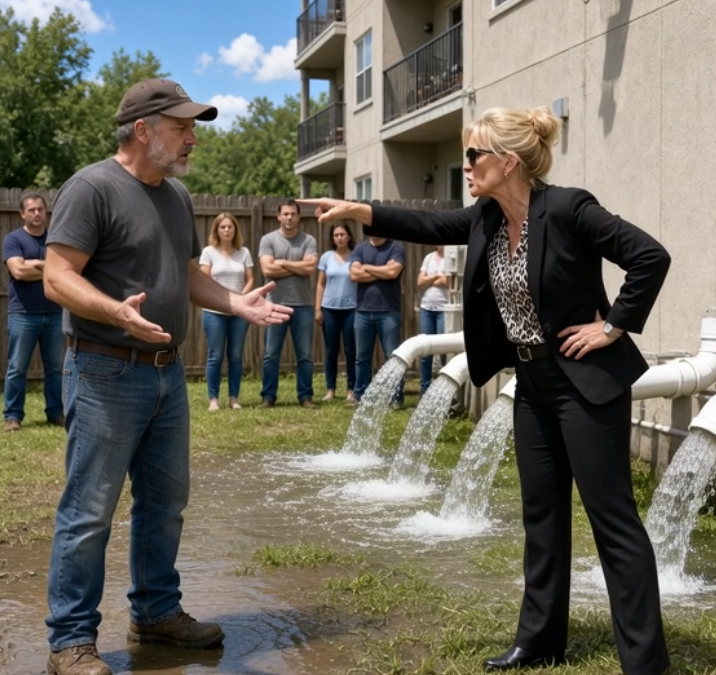
Instead of pouring into my yard, the water backed along the redirection channel, spread across the common-area low strip, and began moving back toward the community-center lawn.
Within ten minutes, the grass behind the patio was soaked.
Within twenty, water pooled around the lower landscaping beds.
Within thirty, a brown sheet spread toward the flagstone patio.
Constance shouted something I could not hear.
Malcolm watched calmly.
“Flow rate is about what I estimated,” he said.
Walt lowered his binoculars.
“That woman is about to become a believer in gravity.”
The water reached the patio steps.
Then the bottom edge of the flagstone terrace.
Then the first row of decorative planters.
People were filming now.
Of course they were.
Constance stepped backward as water surrounded her spotless shoes.
For three years, she had stood on that dry patio telling me water flowing downhill was nature.
Now nature had been legally redirected to its source.
Not onto private homes.
Not into another neighbor’s yard.
Back toward the infrastructure that had created it.
The community center lawn became the basin my backyard had been forced to be.
The water rose across the lower patio but did not enter the building because Malcolm’s design allowed overflow toward the approved easement once the HOA cleared the blocked route. That was important. We did not create damage. We revealed it.
Priya Coleman arrived during the storm.
I did not call her.
Someone from the county did after seeing the online video.
She stood under a county rain jacket, watched the flow, checked the berm, and nodded once.
“Barrier is performing as approved,” she said.
Constance heard that.
Her face twisted.
“This is flooding association property.”
Priya looked at the water surrounding the patio.
“No. This is association water remaining on association property because it can no longer discharge illegally onto Lot 118.”
The board members stared at the pooling water.
Residents gathered behind them, murmuring.
One man shouted, “So this is what was going into Garrett’s yard?”
No one answered.
They did not need to.
Everyone could see it.
The rain did in one hour what three years of complaints had failed to do.
It made the invisible visible.
The emergency board meeting happened the next evening.
I attended with Denise, Elise, Malcolm, Priya from the county, and what appeared to be half the neighborhood.
Constance tried to control the room.
She failed immediately.
A homeowner near the front stood before she finished reading the agenda.
“Did we knowingly reroute drainage onto Garrett’s property?”
Constance adjusted her glasses.
“The situation is more nuanced than—”
Vivian Cho stood.
“I have the minutes.”
The room shifted.
Constance’s mouth tightened.
Vivian held up a folder.
“I have the change order notes, the treasurer packet, and the margin notation about avoiding permitting delays.”
Constance said, “Those documents were taken out of context.”
Elise stood.
“Then we welcome production of the full context in discovery.”
That shut the room down for three seconds.
Then everyone started talking at once.
The board attorney, Philip Grant, looked like he wanted to crawl under the table.
Priya Coleman spoke next.
She explained the county’s findings in plain language. Original drainage was supposed to run east to the retention basin. The renovation redirected concentrated runoff south toward my lot. No approved revised stormwater plan had been filed. The HOA had violated the recorded easement and county requirements.
The room grew quieter as she spoke.
Not because people were calm.
Because they were understanding.
Understanding is heavier than anger at first.
Malcolm presented photos of my yard damage.
The pipe.
The flooding.
The deck supports.
The rotten fence.
The cracked footing.
Denise stood beside me, arms folded tightly.
When the photo of the ruined butterfly garden appeared, she looked down.
Our daughter had planted that garden with her after chemo.
I took her hand.
Then Elise played a video.
It was from the storm.
Water striking the barrier.
Backing up.
Turning toward the community center.
Pooling where everyone could see.
The room watched in silence.
When it ended, Elise said, “For three years, my clients were told this was natural drainage from their own low lot. Now you have seen that the volume and concentration came from association infrastructure.”
A man in the back said, “Why were they fined?”
All eyes moved to Constance.
She lifted her chin.
“The association must enforce standards uniformly.”
That was the wrong answer.
A woman near the aisle stood.
“You fined them for damage you caused?”
Constance said, “The cause was disputed.”
Vivian snapped, “Because you disputed it.”
The room erupted.
The board called for order.
No one cared.
By the end of the meeting, three board members had resigned. The remaining members voted to remove Constance as president pending investigation. She refused to accept the vote, claiming procedural defects, until Philip Grant quietly advised her that fighting removal while under active drainage violation review would be unwise.
She gathered her binder slowly.
Then she looked at me.
“You have damaged this community.”
Denise stepped forward before I could answer.
“No,” my wife said, voice shaking but clear. “You used our home to protect your patio. Then you punished us for drowning.”
The room went silent.
Constance looked at Denise.
For one second, I thought she might apologize.
Instead, she said, “Emotional statements do not change facts.”
Denise’s face went cold.
“You’re right,” she said. “The water did.”
People still talk about that line.
The civil settlement took nearly a year.
The HOA’s insurance carrier fought.
The renovation contractor blamed the board.
The board blamed Constance.
Constance blamed the contractor, the weather, the county, me, Malcolm, Denise, and finally “legacy grading deficiencies” that no one could find in any record.
Discovery destroyed her.
Emails showed she had approved the cheaper reroute.
Meeting notes showed she knew permitting might be required.
Violation logs showed fines against me increased after I complained.
The management company produced one email that became the center of everything.
From Constance to the board:
Hollenbeck will complain, but his lot is already low. Characterize runoff as natural grade issue. Avoid admitting infrastructure contribution.
Characterize.
Not investigate.
Not correct.
Characterize.
That word cost the HOA more than the patio.
The final settlement paid for deck repairs, fence replacement, landscaping restoration, insurance premium increases, engineering fees, legal fees, and three years of improper fines with interest. The HOA also had to restore the drainage system to the recorded easement path, remove the illegal pipe outlet, and submit annual stormwater inspection reports to the county for five years.
Constance was personally named in a separate action by the HOA’s own insurer for acting outside approved authority.
She sold her house six months later.
Her last newsletter, sent before her removal from all association communication systems, warned residents about “activist homeowners exploiting technicalities to undermine community standards.”
Vivian printed it and framed it beside a photo of the flooded patio.
The caption read:
Technicality.
I laughed when I saw it.
Really laughed.
The first spring after the repairs, it rained for two days.
Denise and I stood at the kitchen window, holding coffee, watching the backyard.
The new fence stood straight.
The restored butterfly garden glistened.
The deck remained solid.
Water fell from the sky, soaked into the lawn, moved in shallow natural sheets, and drained the way a normal yard drains.
No brown surge.
No pipe discharge.
No current strong enough to move mulch.
Just rain.
Denise leaned her head against my shoulder.
“It feels quiet,” she said.
I nodded.
For three years, every forecast had felt like a threat. Every dark cloud brought tension into the house. Every heavy rain made us check the yard like people waiting for bad news from a doctor.
That morning, weather became weather again.
A month later, our grandson Lucas came over.
He was six then.
He ran straight into the backyard, stopped near the maple tree, and looked around.
“Where did the swamp go?” he asked.
Denise laughed.
“Grandpa fixed it.”
Lucas looked at me with deep seriousness.
“Did you fight the swamp?”
“In a way.”
“With a sword?”
“With an engineer.”
He seemed disappointed.
Then he inspected the new raised beds and decided worms were more interesting than justice.
That summer, Denise replanted the butterfly garden.
Our daughter came to help.
Lucas dug holes too shallow and called them tunnels.
I rebuilt the sandbox.
Not because any child needed it.
Because Denise and I did.
Some things you rebuild for function.
Some you rebuild because loss should not get the last word.
Millbrook Pines changed after that.
Not overnight.
Communities do not become wise from one lawsuit. But the new board adopted open-record policies, required county verification before infrastructure work, separated appeal authority from enforcement, and ended Constance’s habit of allowing one person to function as president, prosecutor, judge, and executioner.
The magnetic HOA placard disappeared.
Nobody missed it.
The community center patio still exists.
It has better drainage now.
The association spent far more fixing the system properly than it would have cost during the renovation. That is usually how arrogance bills itself: first cheap, then devastating.
Every time I pass the community center, I look at the lawn where the water pooled during that storm.
There is no sign.
No plaque.
No official reminder.
But people remember.
They remember Constance standing in water up to her expensive ankles while the county inspector explained gravity, permits, and illegal discharge in front of half the neighborhood.
They remember Denise saying, “The water did.”
They remember that the problem had not been mysterious.
It had been hidden.
There is a difference.
That is the lesson I carried from electrical work into that fight.
Hidden does not mean harmless.
A bad connection behind a wall can sit for years until heat reveals it.
A drainage pipe under landscaping can ruin a home while paperwork pretends nothing is wrong.
An HOA president can sound calm, professional, and reasonable while using authority to make someone else absorb the damage.
Eventually, though, current finds the fault.
Water finds the path.
Records find the lie.
And if you are patient enough, stubborn enough, and lucky enough to hire the right engineer, you can make the truth flow backward until everyone sees where it came from.
People sometimes ask if I sent the water back out of revenge.
The honest answer is no.
Revenge would have been sneaking out at night with concrete bags and a shovel.
Revenge would have been flooding the patio on purpose without permits.
Revenge would have been doing to them what they did to me.
What I did was different.
I followed the law more carefully than they ever had.
I hired an engineer.
I got the county involved.
I built exactly what I was allowed to build on my own property.
I did not send one gallon anywhere it did not already belong.
I simply stopped accepting gallons that did not belong to me.
That distinction matters.
Especially when people in authority try to confuse boundaries with aggression.
My yard was not a basin.
My fence was not an outlet.
My deck supports were not community infrastructure.
My wife’s butterfly garden was not a sacrifice zone for a patio project the board wanted cheaper.
And my patience was not permission.
The last time I saw Constance Drewry, she was loading boxes into her white Escalade.
The magnetic placard was gone from the door.
Without it, the SUV looked smaller.
She saw me across the street.
For a moment, I thought she would look away.
She did not.
She stood there with a cardboard box in her hands and said, “You must feel very proud.”
I walked to the edge of my driveway.
“No,” I said. “I feel dry.”
Her mouth tightened.
There was nothing she could say to that.
So she got into the Escalade and drove away from Millbrook Pines forever.
That evening, it rained.
Just a light rain.
The kind that taps softly on windows and makes pine needles shine.
Denise and I sat on the rebuilt deck under the covered section, listening.
No panic.
No flashlights.
No mud surge.
No angry emails.
Just rain falling where rain falls, water moving where water is allowed, and a backyard that finally belonged to us again.
After a while, Denise reached for my hand.
“You know,” she said, “I think the butterflies will come back.”
I looked at the garden.
New milkweed.
New coneflowers.
New mulch.
Fresh soil.
A few early blooms already opening despite everything.
“I think so too,” I said.
And they did.
By July, the garden moved with monarchs, swallowtails, bees, and all the small bright lives that return when people stop drowning the place they need.
That was enough for me.
More than enough.
Because the real victory was never watching Constance stand in floodwater.
It was watching Denise kneel in dry soil again.
It was seeing Lucas run through grass without sinking to his ankles.
It was walking onto my deck after a storm and feeling wood hold firm beneath my feet.
It was opening an insurance bill without dread.
It was learning that a property line can be more than a legal boundary.
Sometimes it is the place where you finally stop letting someone else’s negligence become your burden.
For three years, the HOA told me water flowing downhill was simply nature.
They were partly right.
Water does follow the path it is given.
So does responsibility.
They had redirected both into my backyard and expected me to drown quietly.
But they forgot something every electrician knows and every honest engineer can prove:
A hidden fault does not disappear because someone covers it.
It waits.
It warms.
It spreads.
And eventually, when the pressure builds and the right person traces the line, the whole system lights up and shows exactly where the problem began.
That is what happened in Millbrook Pines.
Not a miracle.
Not revenge.
Just gravity, records, permits, and one stubborn homeowner who finally stopped being the lowest point in the neighborhood.








