The HOA President Waved an Overweight Truck Onto My Private 5-Ton Bridge and Called the Posted Limit “Just a Rusty Number”—Then I Heard One Crossmember Crack Beneath the Rig.
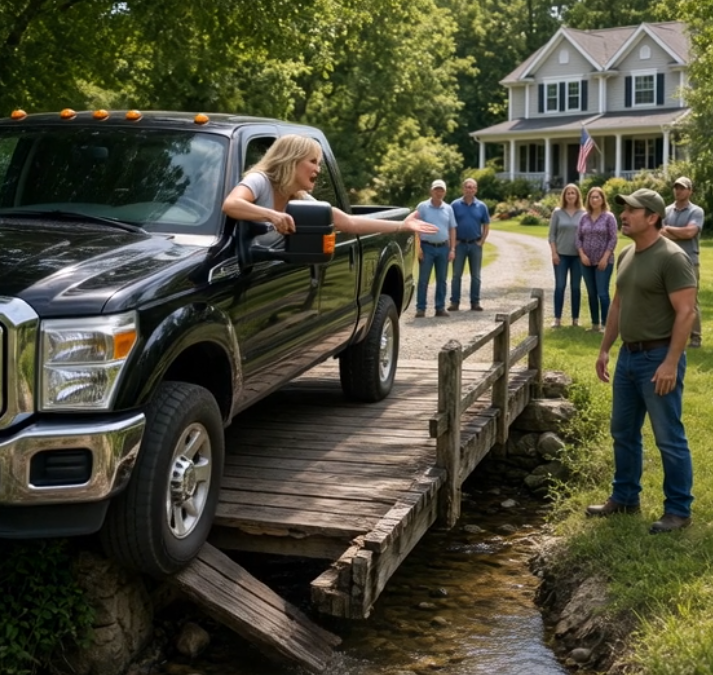
The HOA President Waved an Overweight Truck Onto My Private 5-Ton Bridge and Called the Posted Limit “Just a Rusty Number”—Then I Heard One Crossmember Crack Beneath the Rig.
The truck was already halfway onto my bridge when Karen smiled across the creek and told me not to make things difficult.
The boards groaned so loudly I heard them from my porch, but she kept waving the driver forward like a five-ton weight limit sign was only decoration.
By the time one hidden crossmember cracked beneath that rig, Karen had no idea she had just signed her own downfall in timber, steel, and county records.
My name is Nathan Mercer.
I owned 4.2 acres at the edge of Briar Hollow, a planned subdivision where the houses sat close enough together for neighbors to complain about porch lights, wind chimes, flag colors, and the emotional tone of mulch.
My property was older than all of it.
Long before Briar Hollow had brick columns at the entrance and an HOA president with a lanyard, the land had been pasture, creek bottom, and one narrow timber-and-steel bridge built over a drainage stream by the man who owned the place before me.
That bridge was not scenic.
It was not decorative.
It was not some charming little rustic feature for neighborhood brochures.
It was a single-lane structure spanning a creek that cut across the back side of my lot, joining the eastern bank to the gravel route that led to the county road.
It had weathered boards, steel supports, cedar approach posts, and an aluminum placard bolted at the entrance.
WEIGHT LIMIT 5 TONS.
COUNTY PERMIT BR-2018-04471.
Those words mattered.
That number mattered.
But Karen Whitmore would later call it a rusty number.
She would say it with a clipboard tucked under her arm, sunglasses perched on her head, and the confidence of a woman who believed her opinion could overrule gravity if she said it in a meeting.
I had lived on that land eleven years.
I bought it after my wife died and after I realized I could not keep living in the house where every room still expected her voice.
People tell you grief softens with time.
That is true, mostly.
But in the first year, grief is not soft.
It is furniture in the dark.
It is a coffee mug you cannot throw away.
It is a pillow that still holds the shape of someone you loved.
So I sold the old place in town and bought the property outside Briar Hollow because I wanted quiet, space, and a piece of land that asked nothing from me except maintenance.
The creek was the first thing I loved about it.
It ran shallow most of the year, slow and brown over stone, but after heavy rain it rose fast and loud, carrying leaves, branches, and the kind of stubborn force that reminds you nature does not attend HOA meetings.
The bridge was the second thing I loved.
Not because it was beautiful, though in early fall when the sycamores turned yellow above it, it had its moments.
I loved it because it was useful.
It had a job.
It carried light vehicles from one side of the creek to the other.
It connected homes, deliveries, and routines.
It did not pretend to be more than it was.
I respected that.
When I bought the property, the title report came thick as a phone book.
Most people glance at those papers, nod at wherever the closing agent points, and sign.
I read everything.
I had spent twenty-eight years in commercial insurance before retiring early, which meant I had learned a painful truth about property.
The most expensive sentence in the world is usually hidden in a document nobody wanted to read.
So I read the deed.
I read the survey.
I read the title exceptions.
I checked the county recorder.
PART2:
I looked for easements, recorded rights, maintenance obligations, utility corridors, historical access claims, anything that might affect the bridge.
There was nothing.
No HOA access easement.
No recorded maintenance easement.
No prescriptive easement judgment.
No utility easement across the bridge approach.
No developer reservation.
Nothing.
The bridge sat on my land.
Both banks were mine.
The stream bed under it was mine.
The approaches were mine.
The structure itself was mine.
That should have made things simple.
It did not.
Briar Hollow’s eastern back section had thirty-one homes tucked behind my property.
The original developer had built those homes in a configuration that made my bridge the easiest way to reach the county road.
Not the only theoretical way.
But the practical one.
There was an outer service road that looped far around through a neighboring tract, but it was narrow, badly maintained, and inconvenient enough that everyone preferred the bridge.
When the subdivision was new, the use was light.
Personal cars.
A pickup now and then.
The mail carrier.
Small delivery vans.
A plumber’s truck.
The original landscaping crew drove an old half-ton pickup with a small mower trailer that cleared the limit easily.
Nobody made a production of it.
People waved.
I waved back.
The bridge carried normal neighborhood life without complaint.
For years, that was our silent agreement.
They used it carefully.
PART3:
I maintained it properly.
No one acted like convenience had magically become ownership.
Then Karen became HOA president.
Karen Whitmore did not arrive like a storm.
Storms at least announce themselves with clouds.
Karen arrived like a policy update.
First she joined the architectural committee.
Then she became “community standards coordinator.”
Then she ran for HOA president on a campaign of restored excellence, elevated presentation, disciplined maintenance, and something she called access consistency.
That last phrase should have warned everybody.
It certainly warned me.
Karen was mid-fifties, always dressed in crisp athletic polos, pressed khaki pants, and shoes too clean for anyone who claimed to inspect the grounds personally.
She wore an HOA lanyard like a sheriff’s badge.
Her hair was cut into a blond helmet, her smile was precise, and her eyes had the bright, restless shine of someone who enjoyed catching people unprepared.
The first time she came to my door, she introduced herself without waiting for me to ask.
“Mr. Mercer,” she said. “I’m Karen Whitmore, president of the Briar Hollow Homeowners Association.”
I looked past her toward the subdivision.
“I know who you are.”
She blinked once, as if my lack of excitement had been rude.
“I’m conducting a review of community access infrastructure.”
“That sounds important.”
“It is.”
She glanced toward the bridge.
“We need to discuss the route across your property.”
“No, we don’t.”
Her smile held, but only because she tightened it.
“Thirty-one Briar Hollow households depend on that crossing.”
“I know.”
“And the HOA has historically used that route for maintenance, emergency coordination, and community services.”
“Historically used does not mean legally owns.”
She gave a short laugh.
“Let’s not be adversarial.”
“I’m not.”
“Good.”
“I’m being accurate.”
That was the first time she really looked at me.
Not as a neighbor.
As a problem.
She said she wanted to formalize “access expectations.”
I told her if the HOA wanted formal rights, it needed a lawyer, a surveyor, a negotiation, and my consent.
She said that sounded unnecessarily hostile.
I said using my bridge without understanding its limits sounded unnecessarily expensive.
She asked what I meant.
I pointed toward the sign.
“Five tons.”
She glanced at it.
“Yes, I saw your little sign.”
That was the first mistake.
Calling it little.
The second came three weeks later, when Karen fired the old landscaping crew and hired a regional contractor called GreenScape Municipal Services.
Their equipment was not neighborhood-scale.
It was commercial-scale.
Heavy diesel cab.
Flatbed trailer.
Zero-turn mowers.
Fuel tank.
Irrigation equipment.
Chemical sprayers.
Toolboxes.
Steel ramps.
The first time I saw one of their rigs approach the bridge, I stepped out onto my porch and felt my stomach tighten before the front wheels touched the planks.
I knew weight.
Not like an engineer knows weight, but like an insurance man who had spent years reading loss reports after people discovered too late that load ratings are not suggestions.
The rig looked too heavy.
Much too heavy.
I walked quickly down the gravel drive and held up one hand before the truck entered.
The driver stopped.
He rolled down the window.
“Morning,” he said.
“Morning.”
I pointed to the placard.
“That bridge is posted five tons.”
He leaned forward to see it.
Then he looked back at the trailer.
“I was told this was the route.”
“Who told you?”
“HOA lady.”
Of course.
I called Karen that afternoon.
She answered like she had been expecting me and had already written my personality into a report.
“Mr. Mercer.”
“Your new landscaping contractor tried to bring an overweight rig across my bridge.”
“Our contractor is licensed and insured.”
“That has nothing to do with the bridge rating.”
“This is scheduled HOA maintenance.”
“That has nothing to do with the bridge rating either.”
She sighed.
A theatrical sigh.
A sigh designed to suggest she was speaking to a child holding scissors.
“The community depends on that route.”
“The community does not get to exceed an engineered load limit because the other road is inconvenient.”
“The sign was posted by you.”
“Under county permit.”
There was a pause.
Then she said, “We’ll review it.”
She did not review it.
Over the next four years, the heavy equipment crossings became normal.
Not daily.
Not constant.
But frequent enough to matter.
Forty times by my estimate.
Maybe more.
Commercial landscaping rigs.
A septic service vehicle once.
Utility contractor trucks.
I raised the issue twice at open HOA meetings.
Both times, I stayed calm.
Both times, I brought copies of the county permit, the engineer’s certification, and a written objection.
Both times, Karen thanked me for my input with a smile that made the words sound disinfected.
At the first meeting, she said, “Briar Hollow has historical access to the bridge route.”
At the second, she said, “The HOA will continue maintaining established access patterns.”
Both statements went into the minutes.
That mattered.
At the time, most people in the room looked bored.
Load limits were not exciting.
Bridge ratings were not gossip.
Easements were the kind of topic that made homeowners check their phones and wonder if the refreshments included cookies.
Karen knew that.
She understood public attention better than she understood property law.
She framed my objection as obstruction.
She told residents I was trying to create access anxiety.
She said I had a pattern of “ownership aggression.”
That phrase reached me through Margaret Caldwell, one of the back-section homeowners who depended on the bridge for her daily drive.
Margaret was seventy-four, retired from teaching fifth grade, and could make three words sound like a disciplinary hearing.
She stopped by one afternoon with a jar of peach preserves and said, “Karen has been calling you difficult.”
I took the jar.
“She is not wrong.”
Margaret’s mouth twitched.
“She means it differently.”
“I assumed.”
Margaret lived in the back section and had used the bridge since before I owned the place.
She was always respectful.
She drove slowly.
She waved.
She once left me a Christmas card thanking me for keeping the bridge maintained, which was more gratitude than the entire HOA had managed in eleven years.
That afternoon, she told me Karen had been telling people the HOA would “resolve the Mercer bridge problem.”
“The bridge isn’t a problem,” I said.
“No,” Margaret said. “Karen is.”
I liked Margaret.
The actual breaking point came on a Tuesday morning at 7:14.
I remember the time because I wrote it down later, and because some moments burn numbers into you.
I was on my porch with coffee when I heard the diesel engine.
Heavy.
Deep.
Wrong.
I stood.
A GreenScape rig rolled toward the bridge from the subdivision side.
Large cab.
Flatbed trailer.
Zero-turn mower strapped to the deck.
Fifty-gallon fuel tank riding unsecured in the rear.
I walked down fast, boots crunching gravel.
Karen stood on the far bank in a white polo embroidered with the HOA logo, clipboard under one arm, lanyard against her chest.
She saw me and lifted her chin before I said a word.
The truck’s front tires reached the bridge approach.
I pointed at the sign.
“That bridge is posted at five tons.”
The driver hesitated.
Karen did not.
“That sign is years old.”
“That rig is closer to eight tons loaded.”
Karen rolled her eyes.
“HOA maintenance is an essential service for ninety-six families.”
“Turn it around.”
“You don’t get to block community access because of a rusty number.”
A rusty number.
I looked at the aluminum placard bolted to weathered cedar.
County permit number in the lower right corner.
Five-ton rating from a licensed structural engineer.
Installed under county code.
Filed with the building department.
A number backed by calculations, liability, and a professional stamp.
Karen looked at it and saw an inconvenience.
“You need to stop the truck,” I said.
She turned toward the driver and made a forward motion with her hand.
“Keep going.”
The driver’s face tightened.
He did not want to be part of it.
But he was being directed by the client.
The truck rolled forward.
The first boards groaned beneath the front axle.
I felt the sound in my jaw.
The bridge had a voice if you listened long enough.
Normal traffic made it creak.
Light pickups made it thump.
This was different.
This was strain.
The kind of low, bending complaint that travels through timber when stress finds old grain.
The cab crossed.
The trailer followed.
The planks flexed under the rear axle in a way I had not seen before.
Karen glanced at me, almost amused.
“You always make this dramatic.”
I said nothing.
The last trailer tire reached the far side.
Then I heard it.
A crack.
Sharp.
Dry.
Below the deck.
Not loud enough for the neighborhood.
Not dramatic enough for Karen.
But clear enough for anyone who understood that structures do not make new sounds for no reason.
Karen had already turned back to her clipboard.
“Just ignore him,” she told the driver. “He pulls this every time.”
Then she added, loud enough for me to hear, “He thinks he owns everything out here.”
I did not answer.
That was the first smart thing I did.
She was right about one thing.
I did own everything out there.
The bridge.
The planks.
The steel.
The approaches.
The creek bed below.
The sign she had just dismissed.
And because I owned it, I understood something she did not.
The next move had to be calm.
If I yelled, she would make the story about my temper.
If I blocked the truck, she would make the story about access interference.
If I threatened her, she would walk into the next meeting and call me unstable.
So I stood beside the sign and watched the truck disappear into the subdivision.
Karen gathered her clipboard, satisfied with herself, and walked after it.
I went inside.
I opened a notebook I kept in the kitchen drawer.
I wrote the date.
7:14 a.m.
GreenScape commercial rig.
Flatbed trailer.
Zero-turn mower.
Fuel tank.
Estimated load above posted five-ton limit.
Karen Whitmore present.
Directed crossing after verbal warning.
Audible stress event from lower crossmembers.
Then I called the county structural engineer.
Not my attorney.
Not Karen.
Not Bill from the board.
Not the HOA office.
An engineer.
Because Karen could argue with me.
She could spin a meeting.
She could call a warning hostile.
She could call a county placard a rusty number.
But she could not bully timber back together.
The engineer’s name was Paul Granger.
He was the same structural engineer who had certified the bridge six years earlier.
Paul was calm, precise, and allergic to exaggeration.
When I told him what I heard, he did not gasp.
He did not speculate.
He said, “I’ll come out tomorrow morning.”
That was how I knew it was serious.
Paul arrived at eight the next day with an inspection kit, a flashlight, a moisture meter, a measuring gauge, and the patient expression of a man who trusted evidence more than people.
He climbed under the bridge.
I stood on the bank with coffee I did not drink.
The creek moved below him, brown and steady.
Every few minutes, I heard the click of a camera.
Then measurements.
Then more silence.
After forty minutes, Paul came back up the bank.
He removed his gloves.
He looked at the bridge before he looked at me.
“Two stress fractures,” he said.
My stomach sank, even though I had expected it.
“Where?”
“Lower crossmembers.”
“Fresh?”
“Progressive.”
He wiped his hands.
“Consistent with repeated loads above the posted rating.”
“Is it safe?”
“For normal traffic under the limit, yes.”
He paused.
“For now.”
Those two words changed the air.
For now.
Paul wrote a preliminary inspection note that afternoon.
He documented two stress fractures in the downstream lower crossmembers.
He included photographs with scale markers.
He stated that no vehicles over the posted five-ton limit should cross pending further assessment.
I read the note three times.
Then I began writing the warning letter.
I took two evenings to draft it because anger writes quickly and badly.
I needed precision.
I listed the date and time of Karen’s directed crossing.
I included the truck description.
I referenced the county permit number on the posted sign.
I attached Paul’s preliminary inspection note.
I attached my photographs of the placard.
I stated the bridge was private property owned and maintained by me.
Then I wrote the paragraph that would later be read aloud in a conference room while Karen stared at the wall.
Any further crossing of this privately owned bridge by HOA-contracted or HOA-authorized vehicles exceeding the posted five-ton weight limit will constitute a knowing violation of the property owner’s rights and will result in the HOA being held fully liable for all structural damage, remediation costs, and civil liability arising from continued overloading or structural failure.
No insults.
No threats beyond consequence.
No colorful language.
No rusty-number remark.
Just notice.
I sent it certified mail to Karen personally and to the HOA’s registered address.
Signature required.
Five days later, Karen signed for it.
That same week, Margaret stopped by again.
This time, she did not bring preserves.
She brought papers.
“I think you should have these,” she said.
We sat at my kitchen table.
She slid two HOA letters across to me.
Both were signed by Karen.
Both concerned driveway damage caused by HOA contractor vehicles in the back section.
One incident had knocked loose eight stones from Margaret’s driveway border.
The second had knocked loose eleven.
Margaret had photographs.
She had invoices.
She had paid eight hundred dollars out of pocket to reset them.
The HOA had denied responsibility.
I read Karen’s written response.
Maintenance vehicles operating in designated access corridors conduct authorized association activity, and the association assumes no liability for incidental property contact during the performance of scheduled services.
Incidental property contact.
That was Karen language at its finest.
A phrase clean enough to disinfect a lie.
“Why didn’t you push back?” I asked.
Margaret folded her hands.
“I did.”
Her voice was quiet.
“She fined me for interfering with maintenance access.”
I looked up.
“She what?”
“Two hundred dollars.”
“For complaining about damage?”
“For delaying scheduled service by questioning the contractor.”
My jaw tightened.
“Did you pay?”
“Yes.”
“Margaret.”
“I was tired.”
That sentence did more to harden my resolve than Karen’s arrogance ever could have.
I had been treating this like a property dispute.
It was bigger than that.
Karen had built a system where the HOA caused harm, denied responsibility, punished complaint, and called all of it community management.
I told Margaret to keep every original document.
She said she had copies too.
Of course she did.
Retired teachers and insurance men were dangerous for the same reason.
We kept paper.
The next week, I attended the HOA open meeting.
I sat in the back row.
Karen sat at the front table with four board members, a stainless tumbler, and my warning letter.
She held it up like evidence of my poor character.
“Mr. Mercer has sent what I can only describe as a legal threat letter,” she announced.
Sixty-five homeowners sat in folding chairs.
Some turned to look at me.
I did not move.
Karen continued.
“He is attempting to use a weight limit sign he posted himself without HOA consultation to hold our maintenance operations hostage.”
A board member named Greg chuckled.
Greg was a man who laughed at power when he thought it was on his side.
“Is he actually going to sue us over a piece of wood over a creek?”
A few people laughed.
Karen smiled.
“Our attorney has reviewed the matter.”
That was interesting.
I wondered what she had shown him.
“The letter has no legal weight.”
That was more interesting.
“We are proceeding with scheduled maintenance as planned.”
I wrote that down.
Then Karen looked directly at me.
“And I am moving that any homeowner who physically obstructs or interferes with scheduled HOA maintenance access routes be fined five hundred dollars per incident.”
The room shifted.
Back-section residents looked down.
Front-section residents looked relieved because the problem had been converted into someone else’s trouble.
The motion passed four to one.
Only one board member voted against it.
A retired accountant named Denise Carter.
I did not know Denise well, but I remembered that vote.
It mattered later.
I left without speaking.
Karen probably thought she had won because the meeting ended with her in control and me silent in the back row.
She misunderstood silence.
Silence is not surrender when you are taking notes.
The next morning, I requested the meeting minutes in writing.
Then I bought a trail camera.
Weatherproof housing.
Motion activated.
Timestamped.
Night capable.
I mounted it on a fence post at the bridge entrance where it captured the crossing lane, vehicle plates, and the five-ton sign in the same frame.
I tested it with my pickup.
Perfect angle.
Sign visible.
Plate centered.
Timestamp locked.
No interpretation required.
While I was testing it, David from the back section walked over.
David worked construction and had the heavy shoulders and measuring eyes of a man who understood load without needing a calculator.
He stood beside me and watched the camera blink.
“About time somebody recorded it,” he said.
“You’ve noticed?”
He gave me a look.
“Nathan, I build retaining walls for a living.”
He pointed at the bridge.
“That planking moves wrong when those rigs cross.”
“Do you have anything?”
He hesitated.
Then he pulled out his phone.
“Maybe.”
Three months earlier, David had filmed a GreenScape rig crossing the bridge because the flex bothered him.
Thirty-eight seconds.
The vehicle identifiable.
The sign visible.
The trailer bouncing.
The planks dipping under load.
He had not known what to do with it.
Now he did.
He sent it to me.
My file grew.
Title report.
County recorder search.
Engineer certification.
County permit.
Two prior written objections from HOA meetings.
Minutes documenting Karen’s historical access claims.
Photographs.
Preliminary inspection note.
Certified warning letter.
Karen’s signed receipt.
Meeting minutes where she announced continued use and fines.
Margaret’s damage letters.
David’s footage.
Trail camera installed.
I called a real estate attorney named Helen Ward.
Helen had represented me years earlier on a boundary question with a neighbor whose fence wandered drunk across the survey line.
She was sharp, direct, and not impressed by emotional storytelling unless it came with exhibits.
I brought everything.
She read quietly for almost an hour.
At one point, she took off her glasses and said, “She called the sign self-posted?”
“Yes.”
Helen looked at the county permit.
“Bold.”
“That seems to be her brand.”
She kept reading.
When she finished, she arranged the papers in a straight stack.
“The bridge is private property.”
“I know.”
“No recorded easement.”
“I know.”
“No prescriptive easement judgment.”
“I know.”
“The posted limit is supported by a county permit and engineering certification.”
“Yes.”
“The certified warning eliminates any ignorance defense.”
I nodded.
“And the meeting minutes help prove they chose to continue anyway.”
I felt something loosen in my chest.
Not relief exactly.
Confirmation.
Helen looked at me.
“What do you want?”
“I want them to stop sending overweight vehicles across the bridge.”
“And if they don’t?”
“I want them to pay for what they break.”
She nodded.
“That is a reasonable position.”
Reasonable.
Karen had made the word sound like weakness for years.
From Helen, it sounded like armor.
We agreed not to file yet.
One warning was enough, but the strongest case would come if the HOA ignored it after receiving notice.
I hated that part.
Waiting for someone to do the wrong thing is not satisfying in real life.
It feels like standing beside a bucket while the ceiling leaks and hoping the roof collapses in a documented way.
But Helen was right.
Karen had the letter.
Karen had the meeting minutes.
Karen had the sign.
Karen had Paul’s preliminary report.
If she chose to continue, the choice would be hers.
Six weeks later, the trail camera triggered at 7:14 a.m.
I did not know until evening.
I pulled the memory card after dinner, as I had done every few days, and loaded the files on my laptop.
There it was.
A septic service vehicle.
Heavy single rear axle.
Tank visible.
HOA work order clipped on the dashboard, visible through the windshield.
Plate captured.
The five-ton sign sharp in the upper right corner.
The truck crossed slowly.
Forty-one seconds.
I watched the clip once.
Then again.
Then a third time without breathing properly.
Karen had done it.
Not accidentally.
Not in confusion.
Not before notice.
Six weeks after signing the certified receipt.
After standing in front of sixty-five homeowners and announcing the HOA would proceed.
After threatening fines for anyone who interfered.
She had authorized another overweight commercial vehicle across my bridge.
I did not call her.
I did not email the board.
I did not post in the neighborhood group.
The time for debate was over.
I called Paul.
The next morning, he performed a full formal assessment.
This time he was under the bridge for more than an hour.
He measured everything.
Photographed everything.
Marked the cracks.
Checked the crossmembers.
Inspected the approaches.
When he came back up, his face was still professional, but his mouth was a hard line.
“The previous fractures have widened.”
I closed my eyes.
“And?”
“There is a longitudinal crack along one of the main lower crossmembers.”
I opened my eyes.
“Main structural member?”
“Yes.”
“Causation?”
“Cumulative fatigue consistent with repeated loading above the rated limit.”
He glanced toward the bridge.
“The progression since my last inspection is consistent with at least one additional high-load event.”
I thought of the septic truck on the trail camera.
Forty-one seconds.
A whole lawsuit in less than a minute.
Paul’s formal report arrived four days later.
Fourteen pages.
Photographs indexed and labeled.
Measurements.
Scale markers.
Professional stamp.
Repair estimate between forty-seven and sixty-two thousand dollars.
A causation section written in plain language.
Cumulative fatigue damage consistent with repeated loading above the posted rated limit, with progression between preliminary inspection and current assessment consistent with one or more additional high-load events during the intervening period.
Then came the paragraph that changed the case from property damage to safety exposure.
In its current condition, the bridge carries elevated risk of partial structural failure under additional overloading events. If a driver, pedestrian, worker, or bystander were on or near the structure during such a failure, associated injury liability could be significant.
I sat at my kitchen table and read that paragraph twice.
The creek outside moved steadily under the bridge.
Thirty-one households still depended on that crossing for normal vehicles.
Margaret drove it.
David drove it.
Kids in the back section crossed it in family cars on their way to school.
Amazon vans crossed it.
Nurses leaving night shift crossed it at dawn.
Karen was not just risking my property.
She was risking their access and safety so she could avoid admitting she was wrong.
I called Helen.
“It’s time,” I said.
“I’ll file.”
That was all.
No drama.
No revenge speech.
No threat.
Just the next correct step.
Helen filed the civil complaint two weeks later.
Damage to private property.
Trespass by authorized agents.
Negligence.
Declaratory judgment confirming no HOA easement.
Injunction against overweight HOA-authorized vehicle crossings.
Costs.
Attorney fees where available.
She also submitted Paul’s report to the county building department because the damaged structure had been permitted.
That triggered an independent county inspection.
Karen did not know that part yet.
She was too busy preparing theater.
Two days after the HOA was served, Karen called an emergency meeting.
I did not attend.
Helen advised me not to.
“Karen wants a face to fight,” she said. “Do not give her one.”
So I stayed home.
Margaret went with her phone in her lap and the disciplined calm of a woman who had taught fifth graders during indoor recess.
She recorded the meeting.
Karen stood at the front of the clubhouse wearing a navy HOA blazer.
Behind her sat the board, pale and stiff.
Beside her stood the HOA’s attorney, a polished man named Brandon Pike who looked like he billed in six-minute increments and smiled in disclaimers.
Karen opened strong.
She always did.
“A homeowner in our community,” she said, “is attempting to use a self-posted sign on a privately owned bridge to extort this HOA into paying for improvements he was responsible for maintaining.”
Some residents murmured.
Back-section homeowners looked worried.
Karen pressed on.
“This is not a legitimate legal action. This is an attack on the ninety-six families who depend on that route for their daily lives.”
That line got applause from about a third of the room.
Not the back section.
They sat quiet.
Margaret told me later she noticed that.
The people with the most at stake were not clapping.
They had watched the trucks.
They had heard the bridge.
They knew Karen’s confidence did not make the crossing safer.
Then Attorney Pike stepped up.
He explained the HOA’s defense.
Open and continuous historical use.
Established community access.
Potential prescriptive easement.
Reliance by homeowners.
Maintenance necessity.
Implied rights.
He used words that sounded expensive enough to calm people who did not know what they meant.
Then someone asked, “What about the five-ton sign?”
Karen answered before the attorney could.
“That sign was posted unilaterally by Mr. Mercer without HOA consultation.”
Margaret told me later that she nearly stood up.
But she did not.
She knew her moment was not there.
Karen continued.
“It carries no binding authority over established community access routes.”
Attorney Pike nodded.
That nod would haunt him.
Then he announced the HOA intended to file a counterclaim for interference with established access rights and seek attorney fees from me personally.
The room relaxed.
That was the false peak.
Every good disaster has one.
The moment when foolish people mistake motion for control.
Karen had a lawyer.
Karen had a microphone.
Karen had a room half willing to believe her because believing her meant they might not have to pay.
But in my kitchen, when Margaret sent me the recording that night, I watched it twice and felt only quiet.
Karen’s entire public defense rested on two claims.
The sign had no legal authority.
Historical use created enforceable access rights.
Both were wrong.
Not complicated wrong.
Not debatable wrong.
Not reasonable-minds-may-differ wrong.
County-records-and-permit wrong.
The deposition came on a Thursday morning in Helen’s conference room.
I attended because I had to.
Karen arrived with Attorney Pike, a leather portfolio, and the same composed expression she wore at meetings.
She sat across the table from me and did not look directly at me.
That was new.
Helen opened gently.
That was how she preferred to begin before closing doors.
“Mrs. Whitmore, can you describe the basis for the HOA’s position that the posted five-ton weight limit carried no binding authority?”
Karen straightened.
“The sign was posted by Mr. Mercer without HOA consultation.”
“Anything else?”
“The community’s historical access predates the sign.”
“And in your view, that historical access supersedes the sign?”
“Yes.”
Helen nodded.
Then she placed a document on the table.
“This is county building permit BR-2018-04471.”
Attorney Pike leaned forward.
“It authorizes installation of a load-rating placard on the privately owned bridge structure located at Mr. Mercer’s property.”
Helen slid it across.
“The permit is supported by the licensed structural engineer’s certification on page two.”
She tapped the page.
“The five-ton rating is the certified limit.”
Karen stared at the paper.
Attorney Pike picked it up.
He read.
The room went quiet.
I could hear the HVAC system in the ceiling.
I could hear a pen roll slightly on the table.
Pike read the front page.
Then page two.
Then the county stamp.
Then the engineer’s certification.
He set it down slowly.
That was the first crack in Karen’s case.
Not a loud one.
Not dramatic.
Just a professional document placed where her confidence had been.
Helen continued.
“Mrs. Whitmore, did you check this permit before telling sixty-five homeowners that the sign carried no legal authority?”
Karen’s lips pressed together.
“No.”
“Did you ask the county building department whether the sign was permitted?”
“No.”
“Did you ask the engineer whose name appeared in Mr. Mercer’s warning letter?”
“No.”
“Did you read the warning letter?”
Karen glanced at Pike.
He said nothing.
“I skimmed it.”
Helen placed the certified mail receipt beside the permit.
“Is that your signature?”
“Yes.”
“Dated six weeks before the septic service vehicle crossed the bridge?”
Karen hesitated.
“Yes.”
Helen placed the warning letter beside it.
“The letter specifically warned that any further HOA-authorized overweight crossings would result in the HOA being held liable for structural damage.”
Karen shifted.
“It was written in a threatening tone.”
Helen glanced at me.
I kept my face still.
“Please identify the threatening words.”
Karen looked at the letter.
She had not expected that.
“It was the implication.”
“The implication that the HOA would be liable for damage it caused?”
Karen said nothing.
Helen placed the trail camera photos next.
Vehicle.
Plate.
Timestamp.
Sign.
Work order.
Forty-one seconds frozen into exhibits.
“Do you recognize this vehicle?”
“It appears to be a septic contractor.”
“HOA-authorized?”
“Yes.”
“Scheduled under your administration?”
“Yes.”
“After receipt of the warning letter?”
“Yes.”
“Did you inform the contractor the bridge had a posted five-ton limit?”
Karen swallowed.
“I don’t recall.”
“Did you provide an alternate route?”
“I don’t recall.”
“Did you instruct any HOA staff or contractor that no vehicle over five tons should cross?”
“I don’t recall.”
Helen put Paul’s fourteen-page report on the table.
“The engineer’s report attributes the bridge damage to cumulative overloading above the posted rating, with progression consistent with high-load events after the preliminary inspection.”
Attorney Pike rubbed his forehead.
Karen looked at the report like it was written in another language.
Then Helen placed the county inspection report on top of the stack.
That was the document Karen did not know existed.
“The county building department conducted an independent inspection after receiving the mandatory damage filing.”
Pike picked up the report quickly.
Too quickly.
Helen continued.
“The county inspector confirmed structural compromise and issued a citation to the septic contractor for operating an overweight vehicle on a county-permitted structure.”
Karen whispered, “Citation?”
It was the first unguarded word she had said all morning.
Helen looked at Pike.
“This is no longer only a dispute between private parties.”
Pike requested a recess.
Karen stood so fast her chair nearly tipped.
They left the room for twenty-two minutes.
I sat still.
Helen checked her notes.
The documents remained on the table, arranged like stepping stones across a creek Karen had decided did not exist.
When they returned, Pike’s face had changed.
The smooth confidence was gone.
“We will withdraw the counterclaim for interference with access rights,” he said.
No explanation.
None was needed.
The county permit had killed the sign argument.
The recorder’s records killed the easement argument.
The warning letter killed the ignorance argument.
The trail camera killed the denial argument.
Paul’s report killed the causation argument.
The county citation killed the “just a private dispute” argument.
Karen sat beside him, upright but empty.
The shape of authority remained.
The substance had drained out.
The deposition continued for another hour.
Helen asked whether Karen had authorized the September maintenance schedule.
Yes.
Whether she had received my written objections at prior meetings.
Yes.
Whether those objections appeared in HOA minutes.
She believed so.
Whether she had ever obtained a court judgment establishing prescriptive easement rights over my bridge.
No.
Whether the HOA had a recorded easement.
She did not know.
Helen placed the county recorder search on the table.
Zero.
No access easement.
No prescriptive easement.
No maintenance easement.
No bridge rights.
Nothing.
Karen looked smaller with every page.
Not humble.
Never humble.
Just cornered.
By the end, Pike was no longer defending her version.
He was containing damage.
That afternoon, Helen compiled exposure.
Repair estimate: fifty-two thousand dollars from the selected contractor.
HOA legal defense fees already drawn from reserves: sixty-eight thousand.
County remediation and citation compliance: eighteen thousand.
Potential attorney fee exposure.
Insurance review.
Liability policy repricing.
Reserve impacts.
Multi-year premium increase.
Total actuarial exposure across the HOA crossed $1.2 million.
One point two million.
Because Karen called a permitted engineering limit a rusty number.
Because a board let personality substitute for records.
Because an attorney repeated what his client wanted true before checking county files.
Because sixty-five homeowners heard a warning and trusted the woman with the lanyard more than the man with the documents.
The board removed Karen as HOA president within forty-eight hours.
The vote was four to one.
Greg, the board member who had laughed about suing over “a piece of wood over a creek,” made the motion.
Margaret called me afterward.
“You should have seen his face,” she said.
“Whose?”
“Greg’s.”
“Was he laughing?”
“No.”
“Good.”
Karen did not resign gracefully.
People like Karen never do.
She sent a long email to the neighborhood claiming she was stepping back to prevent further distraction.
Then she called the legal action a misunderstanding.
Then she said the HOA had been betrayed by incomplete information.
Then she implied I had waited deliberately for damage to occur.
That last part did not land well.
By then, the back-section homeowners had started talking.
Margaret shared her driveway letters.
David shared his video.
Denise, the accountant who had voted against Karen’s fine motion, shared her concerns about legal fees.
Another homeowner revealed Karen had rejected a proposal two years earlier to assess the bridge route formally because, in Karen’s words, “asking too many questions creates ownership complications.”
That email became famous.
Ownership complications.
As if ownership itself were a little administrative inconvenience.
The first settlement conference was quiet.
No courtroom drama.
No judge slamming a gavel.
Just two attorneys, a conference table, bottled water, and numbers.
The HOA’s insurance representative attended remotely.
Karen was not allowed to speak except through counsel.
That may have been the first good decision her side made.
Helen’s position was straightforward.
The bridge was private property.
The sign was valid.
The HOA had no easement.
The HOA received formal written notice.
The HOA publicly chose to proceed.
An overweight HOA-authorized vehicle crossed.
Damage progressed.
The engineer documented causation.
The county corroborated the safety issue and cited the contractor.
The HOA owed repair costs, legal recognition of ownership, future restrictions, and costs related to compliance.
Pike tried to soften the language.
Helen did not let him.
He wanted “acknowledges the bridge is located on land owned by Mr. Mercer.”
Helen required “the bridge is private property owned solely by Mr. Mercer.”
He wanted “HOA will make reasonable efforts to observe posted limits.”
Helen required “HOA agrees the posted five-ton limit is valid, binding, enforceable, and shall be respected in perpetuity.”
He wanted “future commercial access shall be coordinated.”
Helen required “no HOA-contracted, HOA-authorized, or HOA-directed vehicle exceeding the posted limit may cross without prior written approval from Mr. Mercer.”
He wanted no mention of easements.
Helen required express acknowledgment that no easement of any kind existed, recorded, prescriptive, implied, or otherwise.
I watched her work and understood why precision costs money.
Every word was a fence post.
Set wrong, the line wandered.
Set right, it held.
The case settled six weeks after Karen’s deposition.
The agreement was recorded at the county courthouse.
That mattered to me more than the check.
Money repaired timber.
Records repaired boundaries.
The HOA paid the full fifty-two thousand dollars for structural repair.
It paid county compliance costs.
It absorbed legal defense fees from reserves.
It accepted the insurance repricing that would raise premiums for years.
It filed the consent agreement publicly.
It sent a written notice to all ninety-six homeowners explaining the bridge’s status.
The notice was not written in Karen’s language.
No community access narrative.
No shared corridor.
No historical route spin.
Just facts.
The bridge is privately owned.
The HOA holds no easement.
The five-ton posted limit is valid and enforceable.
Personal vehicles, pedestrians, bicycles, and light trucks under the posted limit may continue crossing by owner permission as before.
Commercial HOA vehicles exceeding the posted limit may not cross.
Alternative service routing has been arranged.
That last line was the part that made me laugh.
Alternative service routing.
For four years, Karen had acted like no other route existed.
Within three weeks of her removal, the new board found one.
It cost more.
It took longer.
It required planning.
In other words, it was inconvenient.
That was all Karen had been fighting.
Not impossibility.
Inconvenience.
The first meeting under the new HOA president drew a full house.
The new president was Denise Carter, the retired accountant who had voted against Karen.
Denise wore no lanyard.
No blazer.
No community standards pin.
She carried a binder, but it looked like it contained numbers rather than fantasies.
She opened the meeting by reading the consent agreement aloud.
Every clause.
Every acknowledgment.
Every obligation.
People shifted uncomfortably when she reached the part about no easement.
They grew quiet when she read the repair cost.
They went dead silent when she explained the reserve hit, legal fees, county costs, and insurance premium increase.
Then Denise said, “These costs were avoidable.”
That sentence landed harder than any speech.
She continued.
“The board received written notice.”
She looked at the room.
“The prior president signed for it.”
A few people turned toward the empty chair where Karen used to sit.
“The board proceeded anyway.”
She took a breath.
“That will not happen again under my administration.”
Nobody applauded at first.
I think people were too busy realizing applause had helped create the problem.
Then Margaret stood.
She was small, steady, and somehow more commanding than Karen had ever been.
“I want to say something,” she said.
Denise nodded.
Margaret turned to the room.
“I live in the back section. My household depends on that bridge. I was afraid, for months, that this dispute would cost us access.”
She looked toward me.
“Mr. Mercer never tried to take access away from us.”
Her voice sharpened.
“He tried to keep overweight commercial equipment from damaging the only practical route many of us use.”
No one moved.
“I filed two complaints when HOA maintenance vehicles damaged my driveway.”
She lifted her letters.
“I was dismissed.”
A murmur moved through the room.
“I paid out of pocket.”
She looked at the board.
“I expect this association to treat homeowners like adults from now on.”
Then she sat.
For a moment, the room was silent.
Then people applauded.
Not the careless applause Karen used to collect after giving them an enemy.
This was slower.
More ashamed.
More real.
Denise read a formal apology from the board to me.
Two paragraphs.
Clear.
Specific.
Not dramatic.
I appreciated it more than I expected.
When the meeting ended, several homeowners approached me.
Some apologized.
Some explained.
Some said they had only believed what Karen told them.
That last one irritated me, but I tried not to show it.
Belief is not a weather event.
People choose where to place it.
David came over last.
He shook my hand.
“You saved that bridge.”
I looked toward the dark windows.
“No.”
I said it quietly.
“I made them stop pretending it couldn’t break.”
The repair crew came the next week.
Five days of work.
Licensed contractor.
County inspection scheduled.
New crossmembers.
Reinforced approaches.
Fresh timber cut to spec.
Steel checked and cleaned.
Drainage regraded.
Hardware replaced.
The bridge looked raw and clean afterward, like an old man after surgery.
Stronger, but aware of what had been cut out.
On the last day, after the crew packed up, I carried the new sign from my garage.
Same size as the old one.
Same wording.
Same five-ton rating.
Same permit number.
But this one had better hardware and sharper lettering.
I stood at the post where Karen had stood that morning with her clipboard.
I could still see it.
Her white polo.
Her dismissive glance.
Her hand waving the driver forward.
Her voice saying, “Don’t make this difficult.”
The truck groaning across my planks.
The crack from below.
Her phrase.
A rusty number.
I set the sign against the cedar post.
I lined up the bolts.
As I tightened the first one, I thought about all the ways people try to steal responsibility.
They rename it.
They outsource it.
They vote around it.
They hire lawyers to decorate it.
They call it historical access, essential service, community need, or established pattern.
But responsibility waits.
It does not care what title is on your lanyard.
It waits in county records.
In meeting minutes.
In certified receipts.
In photographs.
In cracks along a lower crossmember.
In the signature line of a settlement agreement.
I tightened the last bolt and stepped back.
WEIGHT LIMIT 5 TONS.
COUNTY PERMIT BR-2018-04471.
Clean.
Clear.
Impossible to pretend away.
Margaret walked over from the far bank.
She had driven her sedan across slowly, under the limit as always.
“Looks good,” she said.
“Looks expensive.”
She smiled.
“Not for you.”
“No.”
“For everyone.”
Her smile faded.
“Yes.”
We stood together listening to the creek.
After a moment, she said, “Some people blame you.”
“I know.”
“Does that bother you?”
“Yes.”
“Good.”
I looked at her.
She shrugged.
“If it didn’t bother you, I’d worry.”
That was Margaret.
Compassion with a ruler in her hand.
Karen avoided me after that.
For a while, anyway.
She did not attend the first few meetings after her removal.
She stopped posting in the community group.
Her HOA lanyard disappeared.
But humiliation has a long aftertaste, and Karen had never been good at swallowing anything she did not control.
About two months after the settlement, I found a letter in my mailbox.
No return address.
Typed.
Mr. Mercer,
I hope you are satisfied with the division you have created.
Ninety-six families will now bear increased costs because you insisted on escalating a manageable disagreement.
Communities require compromise.
Your refusal to compromise has hurt people who trusted this association.
I folded the letter and put it in my file.
Then I wrote a reply I never sent.
Mrs. Whitmore,
Compromise is not when my bridge absorbs your mistake so your meeting minutes remain convenient.
I left it at that.
A week later, I saw her at the grocery store.
She stood near the produce section inspecting apples like she suspected them of violating guidelines.
When she saw me, her whole body tightened.
For a moment, I thought she would turn away.
Instead, she pushed her cart toward me.
“Nathan.”
“Karen.”
“You must feel proud.”
“Not particularly.”
“You got what you wanted.”
“I got what the records supported.”
Her eyes narrowed.
“You know, a decent neighbor would have worked with the HOA privately.”
“I tried that.”
“You ambushed us with lawyers.”
“I warned you in writing.”
“You wanted us to fail.”
“No.”
I looked at her cart.
Organic apples.
Sparkling water.
A small basil plant.
“I wanted you to stop.”
Her mouth tightened.
“You could have just built a stronger bridge.”
There it was.
The sentence beneath every argument she had ever made.
Not our mistake.
Your burden.
Not our overloading.
Your inadequate structure.
Not our lack of easement.
Your selfishness.
Not our failure to route equipment properly.
Your refusal to donate property to our convenience.
I said, “You could have just used the other road.”
She looked away.
That was the closest she came to admitting the truth.
The other road existed.
It had always existed.
It was longer.
It cost more.
It required Karen to admit the bridge was not hers to command.
That was unacceptable to her.
She pushed her cart past me.
“This community will remember what you cost them.”
I answered before she got away.
“No, Karen.”
She stopped.
“They’ll remember what you signed for.”
She did not turn around.
But her shoulders rose.
Then she walked away.
The insurance increase hit the next billing cycle.
Not all at once.
Not in a way that ruined anyone.
But enough to sting.
The HOA dues adjustment came with a breakdown prepared by Denise.
Repair settlement.
Legal defense fees.
County compliance.
Insurance premium adjustment.
Reserve replenishment schedule.
It was honest.
That made people angrier, not calmer.
Truth has that effect when people were expecting excuses.
At the next meeting, Greg stood and apologized publicly for supporting Karen’s motion to ignore my warning.
It was awkward.
He looked like a man trying to swallow a doorknob.
But he did it.
“I treated a safety warning like a personal dispute,” he said. “That was wrong.”
Then he turned toward me.
“I’m sorry.”
I nodded.
That was all he was getting, but it was not nothing.
Denise introduced new procedures.
All legal claims required independent document verification.
All contractor routes had to be reviewed for property rights and load limits.
No board member could characterize a legal document at an open meeting unless counsel had reviewed the underlying records.
All fines relating to access interference were suspended pending legal review.
Margaret’s driveway fine was refunded.
So was her eight hundred dollars for repairs.
When Denise announced that, Margaret folded her arms and said, “Plus interest?”
The room laughed.
Denise looked at her notes.
“Yes.”
The room laughed harder.
That was when I knew Briar Hollow might survive.
Not because the HOA became perfect.
HOAs do not become perfect.
They become less dangerous when enough people start reading.
Summer settled in.
The bridge carried sedans, bicycles, kids on scooters, delivery vans under the limit, and Margaret’s old blue Toyota.
No heavy commercial rigs.
GreenScape now entered through the outer service road with smaller equipment staged from a parking area the HOA had to lease.
It was less efficient.
It was also legal.
Every few weeks, I walked down to inspect the bridge.
Not obsessively.
Just enough.
The new crossmembers held.
The approaches drained properly.
The creek ran clear.
The sign stayed bright.
Sometimes a driver slowed before crossing and looked at it.
That made me happy in a way I cannot fully explain.
Respect is not always dramatic.
Sometimes it is a brake tap.
One Saturday morning, a young couple from the back section walked across with their toddler in a stroller.
The father waved.
“Beautiful day, Mr. Mercer.”
“It is.”
The toddler pointed at the sign.
“Five!”
His mother laughed.
“Yes, five.”
I smiled.
At least somebody in Briar Hollow could read the number correctly.
In late August, Denise came by my house.
She carried a folder and looked mildly uncomfortable.
That worried me because Denise was only uncomfortable when the numbers were weird.
“Do you have a minute?” she asked.
“Sure.”
We sat on the porch.
She handed me the folder.
Inside was a proposed maintenance agreement.
Not an easement.
Not a right.
Not an HOA claim.
A simple annual contribution toward bridge inspection costs in recognition that many homeowners used the route.
My eyebrows rose.
“This was your idea?”
“Margaret’s.”
“Of course.”
Denise clasped her hands.
“It is voluntary from the association, subject to your acceptance, no property rights granted, no access expansion, no commercial crossing authority.”
I read the language.
It was careful.
Respectful.
Legally clean.
“What does your attorney say?”
“He drafted it.”
“That’s a promising start.”
Denise almost smiled.
“I thought so.”
I looked toward the bridge.
For years, I had paid every maintenance cost myself while the HOA acted entitled to the benefit.
Now, after all the damage, after all the money wasted, they were finally asking the right way.
No lanyard.
No threat.
No historical access speech.
Just a document and a question.
I signed a week later after Helen reviewed it.
The HOA began contributing to annual inspections.
The bridge remained mine.
The limit remained binding.
The agreement said so three different ways because Helen and Denise were both women who understood the beauty of over-clear language.
That fall, the county held a small infrastructure safety workshop after the Briar Hollow case made local news.
I was invited to speak.
I declined.
Paul spoke instead.
He used my bridge as an anonymized example.
Everyone knew anyway.
His point was simple.
Posted load limits on private bridges are not decorative.
Repeated overloading can create hidden structural fatigue long before visible failure.
The cost of compliance is almost always lower than the cost of denial.
Karen did not attend.
But someone told me her new neighborhood had no HOA.
I hoped that was true.
For their sake.
The final confrontation came in October.
I was down by the bridge replacing a reflector when Karen pulled up on the subdivision side.
She had not crossed.
Credit where due.
She parked before the bridge and stepped out.
No lanyard.
No clipboard.
Just Karen in a gray sweater, looking tired.
I stayed where I was.
She walked to the edge of the approach and stopped beside the sign.
For a long moment, she stared at it.
Then she said, “I hated that sign.”
“I noticed.”
She gave a small, humorless laugh.
“I thought you put it there to control us.”
“No.”
“I really did.”
I leaned against the post.
“Karen, I put it there because an engineer told me what the bridge could safely carry.”
She nodded, but it looked painful.
“I know that now.”
The creek moved below us.
A leaf drifted under the span.
She looked older than she had at the deposition.
Not kinder necessarily.
Just less armored.
“The board sent me the final cost allocation,” she said.
“I saw it.”
“People are furious.”
“Yes.”
“With me.”
“Yes.”
Her jaw moved slightly.
“I keep thinking if I had just turned the truck around that morning…”
She stopped.
That was the first honest sentence I had ever heard from her.
Not complete.
Not apology.
But honest.
I did not help her finish it.
She needed to hear the silence after her own words.
Finally she said, “I believed if I gave an inch, you would take the whole route away.”
“No, Karen.”
I looked at the bridge.
“You believed if you admitted one limit, all your authority would crack.”
Her eyes flashed, then lowered.
Maybe she wanted to deny it.
Maybe she could not.
“I was trying to protect the community.”
“You were protecting your image.”
That hit.
She looked at me.
“You don’t know that.”
“I know the difference between protecting access and ignoring a safety limit.”
She swallowed.
“I was wrong about the sign.”
“Yes.”
“I was wrong about the easement.”
“Yes.”
“I was wrong about the trucks.”
“Yes.”
Her mouth tightened.
“You could make this easier.”
“I could.”
“But you won’t.”
“No.”
She nodded slowly.
Not approving.
Accepting the shape of the boundary.
“I’m selling my house.”
I had heard rumors.
Still, hearing it from her felt different.
“Where will you go?”
“Closer to my daughter.”
“That sounds good.”
She looked down at the creek.
“They removed me from every committee.”
“I know.”
“I suppose you’re pleased.”
I thought about that.
“I’m pleased the bridge is safe.”
She turned away.
For a second, I thought the conversation was over.
Then she said, very quietly, “I am sorry about what I said.”
I waited.
“The rusty number.”
I looked at the sign.
Then at her.
“That number was doing its job.”
She nodded.
“I know.”
She walked back to her car without crossing the bridge.
That mattered.
More than the apology, maybe.
She did not step onto the structure.
She respected the line.
Late that month, Karen moved.
No dramatic scene.
No crowd.
No final speech at a meeting.
A moving truck came through the outer road because it was too heavy for the bridge.
I watched from my porch as it took the long way.
That was the cleanest ending I could have asked for.
Not her humiliation, though there had been plenty.
Not the settlement, though it mattered.
Not the recorded agreement, though I still keep a copy in my fireproof safe.
The ending was a heavy truck choosing the legal route because a sign said five tons and everyone finally understood that five meant five.
Winter came.
Rain swelled the creek.
The repaired bridge held.
Water rushed under it, brown and loud, carrying branches, leaves, and the occasional plastic bottle from somewhere upstream.
I checked the crossmembers after the first storm.
Dry where they needed to be.
Solid where they needed to be.
No new movement.
No fresh cracks.
I stood beneath the bridge in rubber boots with a flashlight and felt the strange peace of a problem solved properly.
Above me, a car crossed slowly.
Margaret’s Toyota.
I could tell by the rattle near the rear bumper.
She stopped on the far side and called down, “Still there?”
“Still here.”
“Bridge?”
“Also still here.”
“Good.”
Her window rolled up.
She drove home.
That was what the bridge was for.
Not politics.
Not ego.
Not HOA performance.
A safe crossing.
A practical route.
A structure doing its job because people respected its limits.
Sometimes I think about Karen’s phrase.
A rusty number.
It was meant to belittle the sign.
To make engineering sound petty.
To make private ownership sound selfish.
To make a legal warning sound like one man’s attitude problem.
But the funny thing about numbers is that they do not care whether you respect them.
Five tons remains five tons when you roll your eyes.
Five tons remains five tons when a board votes four to one.
Five tons remains five tons when an attorney says prescriptive easement into a microphone.
Five tons remains five tons when a commercial rig weighs eight.
And timber remembers every pound.
That is the part Karen never understood.
Structures keep score.
So do records.
So do people who have been dismissed too many times.
I never wanted Briar Hollow’s homeowners to pay higher dues.
I never wanted Margaret to worry about access.
I never wanted a lawsuit.
I wanted what I said at the beginning.
Turn the heavy trucks around.
Use the other road.
Respect the sign.
It took Karen four years, one warning letter, a cracked crossmember, a deposition, a county citation, a recorded consent agreement, and over a million dollars in exposure to learn what the placard had been saying the whole time.
Weight Limit 5 Tons.
That was not hostility.
It was protection.
Not just for me.
For Margaret.
For David.
For the thirty-one households in the back section.
For every driver who trusted the boards under their tires.
For every child in a back seat.
For every contractor who did not know an HOA president had decided convenience mattered more than safety.
A year after the settlement, Denise invited me to the annual meeting.
This time I went.
Not because there was conflict.
Because there was none.
The financial report was boring.
The maintenance schedule was boring.
The contractor access plan was boring.
The bridge inspection report was very boring.
It was one of the best meetings I had ever attended.
Near the end, Denise read a short update.
“The bridge inspection has been completed for the year.”
She looked at me briefly.
“No issues found.”
A few people clapped.
Just a few.
Enough.
After the meeting, Greg approached me again.
He had changed too.
Less eager to laugh before thinking.
“I drive the long way whenever I have my boat trailer,” he said.
“I appreciate that.”
He nodded.
“I should have understood sooner.”
“Yes.”
He gave a small smile.
“You don’t soften much, do you?”
“I’m working on it.”
Margaret appeared beside him.
“No, he isn’t.”
We all laughed.
That was when I knew the bridge dispute had become history instead of an open wound.
People could joke now because the structure was safe, the rules were clear, and Karen no longer stood at the front of the room turning confusion into control.
After everyone left, I walked home across the bridge.
The moon was up.
The creek below reflected broken silver light.
Halfway across, I stopped and rested my hand on the railing.
The planks were cool beneath my shoes.
Solid.
Quiet.
I thought about the first crack I heard that Tuesday morning.
How small it had sounded.
How easy it would have been to ignore.
How many disasters begin as a sound only one person notices.
That is why warnings matter.
Not because every warning becomes catastrophe.
Because some warnings are the last cheap chance to prevent one.
Karen received one warning.
A clear one.
Certified.
Signed for.
Documented.
She ignored it.
That was the heart of the whole case.
Not the bridge.
Not the HOA.
Not even the money.
One warning was enough to separate mistake from choice.
After that, everything had her name on it.
I reached the far side and looked back at the sign.
It caught my flashlight beam.
WEIGHT LIMIT 5 TONS.
COUNTY PERMIT BR-2018-04471.
The creek ran below it, indifferent as ever.
Water does not care about lawsuits.
Bridges do not care about egos.
Wood does not care about lanyards.
And county records do not care who speaks loudest in a clubhouse.
Karen thought authority meant being able to tell people what to ignore.
She learned, too late, that real authority is the thing still standing after the shouting stops.
A deed.
A permit.
A stamped engineering report.
A certified letter.
A camera timestamp.
A signed consent agreement.
A repaired bridge.
And one clean sign on a cedar post, saying exactly what it had always said.
Five tons.








