The HOA President Tried 40 “Master Keys” on My SUV and Called 911 When None of Them Worked—Then Dispatch Asked Her One Question She Wasn’t Ready to Answer.
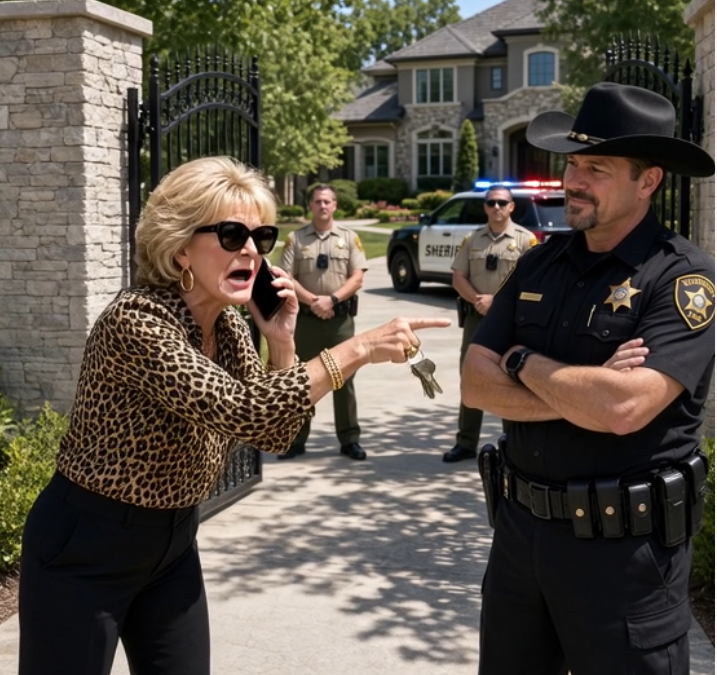
The HOA President Tried 40 “Master Keys” on My SUV and Called 911 When None of Them Worked—Then Dispatch Asked Her One Question She Wasn’t Ready to Answer.
The first thing Karen Whitfield tried to steal from me was not my car.
It was the word no.
She thought a laminated badge, a brass ring full of keys, and one panicked 911 call could turn my private property into her kingdom—but she had no idea the man recording her was the county sheriff.
I watched Karen Whitfield try seven different keys on my SUV before I said a word.
Not because I was confused.
Not because I was scared.
Because after twenty-six years in law enforcement, I had learned that people reveal more when they believe silence is weakness.
It was 7:15 on a Saturday morning in Pine Ridge Hollow, a mountain cabin community tucked against the Blue Ridge foothills in western North Carolina. The air still had that early coldness that makes sound travel farther. Mist hung low over the gravel road. Pine needles clung wet to the edges of the parking area. Somewhere behind the cabins, a creek moved over stone with the patient sound of water that had no interest in human stupidity.
I had just come back from the general store with coffee, eggs, bacon, and a paper bag of biscuits wrapped in foil.
Then I saw Karen beside my black SUV.
She stood with her hip angled toward the driver’s door, shoulders squared, chin high, forcing one key after another into the lock.
The brass ring in her hand was enormous.
At least forty keys.
Maybe more.
Cabin keys.
Mailbox keys.
Storage room keys.
Utility closet keys.
Clubhouse keys.
Keys tagged with little plastic labels.
Some yellow.
Some red.
Some handwritten.
Some official-looking.
Not one of them belonged to my vehicle.
That did not stop her.
Metal scraped against paint as she twisted another key hard enough to bend it.
I placed my grocery bag carefully on the pavement.
“Step away from my SUV.”
Karen did not look at me.
“I am conducting a compliance inspection.”
“You are trying to break into my car.”
“These are HOA master keys,” she said. “They provide emergency access throughout the community.”
“My SUV is not community property.”
“All vehicles parked near shared facilities are subject to inspection.”
She selected a smaller silver key and pushed it into the lock.
It stopped halfway.
Karen forced it harder.
My jaw tightened.
I moved closer but remained outside arm’s reach.
“You are damaging the lock.”
PART2:
“If your vehicle were properly registered, the master system would work.”
“That sentence makes no sense.”
She finally looked at me.
Karen Whitfield was fifty-two, blond, immaculate, and permanently surrounded by the invisible confidence of someone accustomed to other people backing up when she stepped forward. Her green polo shirt was tucked into white pants. The words PINE RIDGE HOA PRESIDENT were embroidered in gold over her left chest. A laminated badge hung from her neck.
The badge displayed her photograph, the HOA seal, and the words COMMUNITY AUTHORITY.
It had no legal meaning.
Karen wore it like a federal credential.
“You must be David Carter,” she said. “Cabin Twelve.”
“David Clark.”
“I submitted my vehicle information when I bought the cabin.”
“Your file is incomplete.”
“Then send me a written request.”
“I do not need your permission to inspect community assets.”
“This vehicle belongs to me.”
“If you have nothing to hide, you should cooperate.”
I had heard that sentence hundreds of times during my career.
It usually came from people who believed privacy itself proved guilt.
I took out my phone and began recording openly.
Karen’s expression sharpened.
“You may not film HOA officers performing official duties.”
“You are not an officer.”
“I am president of this association.”
“And you are standing beside my damaged car lock with a ring of keys that do not belong to it.”
She raised the key ring between us.
“These open every authorized door in Pine Ridge.”
“Then use one on the clubhouse. Stay away from my vehicle.”
Karen lowered her voice.
PART3:
“I know when people are concealing something. You arrived three months ago. You rarely attend meetings. You keep irregular hours. You drive a vehicle with dark windows. And you speak to me as though community rules do not apply to you.”
“The windows are legal. My hours are private. The rules apply where the HOA has authority. Your authority does not include searching my car.”
Something about the precision of that answer bothered her.
Her eyes narrowed.
“What exactly do you do for a living?”
“I work in public service.”
“What kind?”
“The kind that understands consent.”
She stared at me.
I stared back.
The mountain air stayed still around us.
Behind Karen, Pine Ridge looked peaceful in the way gated communities often do before you learn what people have been doing behind the gate. Cedar cabins with green roofs. Gravel lanes. Split-rail fencing. A little clubhouse with a stone chimney. A lake the developer called private even though it was more of a pond with ambition. A sign near the entrance that read:
PINE RIDGE HOLLOW
A COMMUNITY OF PEACE, PRIVACY, AND TRADITION
I had liked that sign the first time I drove in.
Now I understood it was missing a word.
Control.
Karen had introduced herself three days after I closed on Cabin Twelve.
I was carrying boxes from the SUV when she appeared on my porch holding a clipboard.
Not walked up.
Appeared.
People like Karen have a way of entering your space as if they were always supposed to be there.
“Welcome to Pine Ridge,” she said.
Her smile was bright and empty.
“Thank you.”
“I’m Karen Whitfield, HOA president.”
“I figured.”
Her eyes flicked toward the open front door.
“Moving alone?”
“Yes.”
“Any family joining you?”
“Visitors from time to time.”
“We require all overnight guests to be registered.”
“I’ll review the bylaws.”
She laughed softly, as if I had made a cute mistake.
“Oh, I don’t think reviewing will be necessary. I can summarize the important parts.”
That was the first warning.
Anyone who does not want you to read the rules is usually abusing them.
She stepped closer to the door.
“I’ll just take a quick look inside and make sure the previous owners left the unit in compliance.”
“No.”
The smile paused.
Just a fraction.
“No?”
“No.”
Her fingers tightened on the clipboard.
“It’s standard.”
“Not today.”
“I have master access if needed.”
“Then I suggest you don’t need it.”
That was the first time I saw the real Karen Whitfield.
Not the polished HOA president.
Not the welcome-basket dictator.
The woman underneath.
The one who believed refusal itself was an insult.
She looked past me into the cabin.
Then back at my face.
“We’ll revisit this.”
“No,” I said. “We won’t.”
Three months later, she was trying keys in my SUV lock.
That is the thing about petty power.
It never forgets the first no.
It just waits for a place to punish it.
Karen turned back to the SUV and lifted another key.
I moved one step closer.
“Do not put another key in that lock.”
She froze.
Not because I had raised my voice.
I had not.
Because I had stopped sounding like a homeowner.
For the first time, something uncertain moved across her face.
Then pride rescued her from caution.
“You are obstructing an HOA compliance inspection.”
“No. I am stopping an attempted unlawful entry into my vehicle.”
“This SUV is parked within view of shared facilities.”
“It is parked in front of my cabin.”
“The road is maintained by Pine Ridge.”
“The road ends ten feet behind me.”
“The community has inspection rights.”
“No, it does not.”
She looked toward the clubhouse.
A small security golf cart was parked near the porch. Its amber light was off. The man sitting in it wore a gray jacket with Pine Ridge Patrol stitched on one sleeve. His name was Dennis Ballard. Former mall cop. Current Karen accessory.
He had watched the entire exchange without getting out.
Karen lifted her chin.
“Dennis.”
He started the golf cart.
Its electric motor whined as he rolled toward us.
I kept my phone recording.
Dennis stopped beside Karen and climbed out with visible reluctance.
He was a heavy man in his late forties with a sunburned scalp and a belt full of equipment he did not know how to carry comfortably. Radio. Flashlight. Pepper spray. Handcuffs.
Handcuffs bothered me.
Not because private security can never carry restraints under any circumstance. Laws vary. Contracts vary. Context matters.
But Dennis had the posture of a man who had been told cuffs create authority.
That kind of man worries me.
Karen pointed at me.
“Mr. Clark is refusing inspection and interfering with a community officer.”
Dennis looked at me.
Then at my phone.
Then at the SUV.
“Sir,” he said, “maybe we can all just—”
“Dennis,” Karen snapped.
He swallowed.
The poor man was afraid of her.
That was not a defense.
But it was useful information.
He straightened and tried again.
“Sir, HOA policy allows us to verify vehicles parked on common-access routes.”
“This is not a common-access route.”
Karen waved the key ring.
“He has refused to register properly.”
“My registration is on file.”
“It is incomplete.”
“Because you keep inventing missing fields.”
Her eyes flashed.
“Driver’s license number.”
“No.”
“Insurance policy number.”
“No.”
“Spare vehicle key.”
“Absolutely not.”
Dennis looked startled by that one.
I turned to him.
“You knew she was collecting spare vehicle keys?”
He looked at Karen.
Then away.
Karen’s voice sharpened.
“Emergency access.”
“To private vehicles?”
“For safety.”
“For control.”
She stepped closer.
“People who follow rules do not fear oversight.”
There it was again.
The philosophy of every small tyrant in a polished shirt.
Obedience as innocence.
Privacy as guilt.
I looked down at the key ring.
“Where did you get those keys?”
Her mouth tightened.
“Association records.”
“From previous owners?”
“From residents who understand community responsibility.”
“Do you have keys to cabins?”
“Emergency access is required.”
“Required by what?”
“The board.”
“Not the law.”
Karen stared at me.
Then smiled.
It was small, satisfied, and dangerous.
“You keep talking about law.”
I said nothing.
“I think you’re hiding something in that vehicle.”
“Based on what?”
“Behavior.”
“Refusing an illegal search is not suspicious behavior.”
“It is here.”
I looked at Dennis.
“Did you hear that?”
Dennis shifted uncomfortably.
Karen pointed toward my phone.
“Stop recording.”
“No.”
“Turn it off.”
“No.”
“I am ordering you as HOA president.”
“No.”
Her face reddened.
The third no landed harder than the first two.
For a second, I thought she might slap the phone from my hand.
Instead, she reached into the back pocket of her white pants and pulled out her own phone.
“Fine,” she said. “If you want law, we’ll get law.”
She dialed.
I watched her press three numbers.
That was when I smiled.
Just a little.
Karen saw it.
Her eyes narrowed.
“Emergency services,” a dispatcher answered faintly through the speaker. “What is your emergency?”
Karen put the phone on speaker, probably because she wanted me to hear myself being reported.
“This is Karen Whitfield, president of Pine Ridge Hollow Homeowners Association,” she said. “I need law enforcement at Cabin Twelve immediately.”
“What is the nature of the emergency?”
“We have a suspicious man refusing lawful inspection of a vehicle near community facilities.”
The dispatcher’s voice stayed calm.
“Is anyone injured or in immediate danger?”
“He is being confrontational.”
“Is he armed?”
Karen looked at me.
Then at the SUV.
Then at Dennis.
“I don’t know. He drives a black SUV with dark windows. He refuses to identify his occupation. He is filming HOA personnel and preventing access to a vehicle we believe may contain unauthorized materials.”
Unauthorized materials.
That was new.
I almost admired the improvisation.
Almost.
The dispatcher asked, “What is the address?”
“Cabin Twelve, Pine Ridge Hollow, off Laurel Creek Road.”
A pause.
“Ma’am, are you reporting a crime in progress?”
“Yes. Obstruction. Possible trespassing. Refusal of inspection. Potential threats against community authority.”
Another pause.
Dispatchers are trained to stay calm, but they also learn to recognize nonsense.
The woman on the line did not sigh.
But she wanted to.
“What is the man’s name?”
Karen looked triumphant.
“David Clark.”
The line went quiet.
Not silent.
Quiet in the way a room goes quiet when someone has opened the wrong file.
“Can you repeat the name?” the dispatcher asked.
“David Clark. Cabin Twelve.”
Another pause.
This one longer.
I knew why.
The county computer system had just connected my cabin address to my tax record, my vehicle registration, and my name.
Sheriff David Clark.
Sitting sheriff of Watauga County.
Owner of the black SUV Karen had just tried to break into with HOA master keys.
The dispatcher’s voice changed.
Not dramatically.
Professionally.
“Ma’am, can you describe the man?”
Karen smiled at me while answering.
“White male. Late fifties. Gray hair. Approximately six feet. Aggressive posture. Recording us without consent.”
The dispatcher asked, “Is the man wearing a firearm?”
Karen’s eyes dropped briefly to my belt.
I was wearing jeans, a flannel shirt, and hiking boots. My concealed sidearm was not visible.
“I can’t tell.”
“Do not approach him.”
Karen blinked.
“I’m already beside him.”
“Ma’am, step away from the man and the vehicle.”
Karen frowned.
“Excuse me?”
“Step away from the man and the vehicle. Deputies are being dispatched.”
Karen’s face tightened.
“Good. Please tell them I want him removed from Pine Ridge property.”
The dispatcher’s voice remained flat.
“Units are en route.”
Karen ended the call.
Then she looked at me with renewed confidence.
“You should have cooperated.”
I put my phone down slightly but kept recording.
“Karen.”
“What?”
“You may want to call your attorney.”
She laughed.
A sharp little sound.
“For what?”
I looked toward the entrance road.
“Because dispatch knows who you just reported.”
Her smile faded.
“What is that supposed to mean?”
Dennis took one step back.
He had begun to understand something was wrong.
Karen had not.
People like Karen rarely sense cliffs until gravel shifts under their feet.
I said nothing.
A full minute passed.
Then another.
Karen crossed her arms and stood beside my SUV as if guarding evidence.
I picked up my grocery bag and placed it on the hood, away from the damaged lock. The biscuits were probably cold by then. That irritated me more than it should have.
Dennis leaned toward Karen.
“Maybe we should wait by the clubhouse.”
“Do not be ridiculous,” she said. “We are complainants.”
He looked at me again.
I met his eyes.
He looked away fast.
The first sheriff’s cruiser arrived four minutes later.
Then a second.
Then a third.
They did not come with sirens screaming.
They did not need theater.
They came fast enough to make gravel spit from under the tires and controlled enough to show training.
Deputy Erin Lowe stepped out first.
Twenty-nine.
Smart.
Steady.
Former Marine.
One of the best deputies in my department.
She looked at Karen.
Then Dennis.
Then me.
For one tiny fraction of a second, her face said, Sheriff, what fresh hell is this?
Then professionalism locked it down.
“Sheriff,” she said. “Are you all right?”
Karen’s head snapped toward me.
The word seemed to hit her physically.
Sheriff.
Not sir.
Not Mr. Clark.
Sheriff.
Dennis closed his eyes.
Karen looked from Deputy Lowe to me.
Then at the SUV.
Then at the key ring in her own hand.
For the first time that morning, she did not speak.
I almost enjoyed that.
Almost.
“Deputy Lowe,” I said, “I’m fine. Mrs. Whitfield attempted to access my vehicle with a ring of HOA keys, damaged the driver’s-side lock, claimed inspection authority, and called 911 when I refused consent.”
Deputy Lowe’s eyes moved to the lock.
Then the keys.
Then Karen.
Karen recovered in fragments.
“This is a misunderstanding.”
Deputy Lowe said, “Ma’am, set the keys on the ground.”
Karen stiffened.
“I am HOA president.”
“Set the keys on the ground.”
“These are association property.”
“Set them on the ground now.”
Something in Deputy Lowe’s voice did what my warnings had not.
Karen lowered the brass ring to the pavement.
It landed with a heavy metallic clatter.
Forty keys.
Forty chances to violate someone’s boundary.
A second deputy, Marcus Bell, secured them in an evidence bag.
Karen watched as if he had just taken a royal scepter.
“This is completely unnecessary,” she said.
Deputy Lowe turned on her body camera.
“Mrs. Whitfield, did you attempt to open Sheriff Clark’s vehicle?”
“I attempted to verify compliance.”
“That is not what I asked.”
Karen looked toward me.
Then back at Lowe.
“I used the master key ring.”
“To open a private vehicle?”
“To determine whether the vehicle was properly registered.”
“Do you normally use keys to determine registration?”
Karen’s mouth tightened.
“I had reason to believe the vehicle was noncompliant.”
“What reason?”
“It had dark windows.”
“The sheriff’s office SUV?”
Karen flinched.
Just slightly.
Good.
Reality was catching up.
“I did not know it was a sheriff’s office vehicle.”
I looked at the front of the SUV.
From the front, it was unmarked.
From the sides, the county seal and sheriff’s office lettering were visible if you walked three feet either direction.
Karen had not walked.
She had assumed.
Deputy Bell glanced at the side of the SUV, then at Karen.
“You didn’t see the door markings?”
Karen’s voice sharpened.
“I approached from the front.”
“To break into the driver’s-side lock?” he asked.
Her face reddened.
“I did not break into anything.”
I pointed to the scratches.
“You damaged the lock.”
“That was preexisting.”
I laughed once.
I could not help it.
Karen’s eyes cut to me.
“You think this is funny?”
“No,” I said. “I think it’s recorded.”
That shut her up.
Deputy Lowe asked, “Mrs. Whitfield, do you possess keys to private residences in Pine Ridge?”
Karen hesitated.
Dennis looked at the ground.
Deputy Lowe noticed.
So did I.
Karen said, “The HOA maintains emergency access where owners have consented.”
“That’s not what I asked.”
Karen lifted her chin.
“Yes, we maintain keys.”
“To occupied private cabins?”
“For emergencies.”
“Who controls that key ring?”
“The board.”
“You personally had it today.”
“As president.”
“For a vehicle inspection.”
Karen blinked.
She heard it that time.
The absurdity.
Not enough to stop lying.
Enough to slow down.
“I believed there could be a safety issue.”
“What safety issue?”
“The vehicle was unregistered in our system.”
Deputy Lowe stared at her.
“Mrs. Whitfield, do you understand that not having a complete HOA file is not an emergency?”
Karen’s lips pressed together.
“I understand that communities have standards.”
Deputy Lowe glanced at me.
I kept my face neutral.
The second cruiser’s dash camera was pointed toward us. My phone was still recording. Lowe’s body camera was recording. Bell’s body camera was recording. The clubhouse security camera, ironically, was probably recording too.
Karen Whitfield had called 911 to create an audience.
She got one.
Just not the one she wanted.
Deputy Lowe turned to Dennis.
“Sir, name?”
“Dennis Ballard.”
“Role?”
“Pine Ridge Patrol.”
“Are you law enforcement?”
“No, ma’am.”
“Do you have any authority to search vehicles?”
“No, ma’am.”
Karen shot him a furious look.
He swallowed.
“Do you have authority to detain residents?” Lowe asked.
“No, ma’am.”
“Do you carry handcuffs?”
Dennis’s face went pale.
“Yes, ma’am.”
“Why?”
He looked at Karen again.
Deputy Lowe said, “Don’t look at her. Answer me.”
Dennis’s shoulders sagged.
“Mrs. Whitfield said patrol needed compliance tools.”
Compliance tools.
I had heard enough.
“Deputy Lowe,” I said, “secure the key ring and document the vehicle damage. I want written statements from both. Ask dispatch to preserve the 911 call. Contact County Attorney Moss and tell him we may need a warrant for HOA records relating to key control, resident files, and emergency access policies.”
Karen’s eyes widened.
“A warrant?”
I turned to her.
“You called law enforcement.”
She went pale.
“I called for assistance.”
“You called 911 to report a man refusing to let you search his vehicle.”
“I did not know—”
“That he was sheriff?” I finished. “That is becoming your only defense. It is not as strong as you think.”
Her voice dropped.
“You cannot retaliate against me because of my position.”
“No, Mrs. Whitfield. But I can investigate you because of your actions.”
The next hour peeled Pine Ridge open.
It started with the key ring.
Cabin 3.
Cabin 7.
Cabin 9.
Clubhouse office.
Maintenance shed.
Pool storage.
Mail kiosk.
Gate control room.
Cabin 12.
My cabin.
That one made my skin go cold.
I had changed the locks after buying the property.
Or thought I had.
Apparently, the back utility door still had an old secondary lock I had never used.
Karen had a key to it.
So did she have keys to other cabins whose owners had changed only the front deadbolt?
Deputy Bell photographed every tag.
Dennis gave a statement after Karen demanded he remain silent and Deputy Lowe informed him that Karen was not his attorney.
His statement changed the case completely.
According to Dennis, Pine Ridge maintained what Karen called “the continuity key archive.”
Every owner was required—or pressured—to submit emergency access keys when purchasing a cabin. The old bylaws mentioned access for fire, flood, and utility emergencies, but over the years Karen had expanded that into inspections.
Smoke detector inspections.
Porch clutter inspections.
Guest occupancy checks.
Pet verification.
Holiday decoration compliance.
Noise source investigation.
Vehicle inspection.
If a resident refused entry, Karen marked their file “noncooperative.” Then fines followed. Then threats. Then suspension of amenities. Then, in two cases, forced locksmith charges.
I asked Dennis one question.
“Has Karen ever entered a cabin when the owner was away?”
He looked at the ground.
“Yes.”
Karen exploded.
“Dennis!”
Deputy Lowe stepped between them.
“Mrs. Whitfield, do not interfere.”
Dennis looked miserable.
But once men like Dennis start telling the truth, they often keep going because stopping means sitting alone with what they helped do.
He told us about Cabin 4.
A widow named Elaine Porter.
Karen entered while Elaine was in Charlotte caring for her sister and photographed prescription bottles on the kitchen counter because she suspected “unregistered long-term occupancy.” Karen later fined Elaine for having a guest because a second toothbrush was found in the bathroom.
The toothbrush belonged to Elaine’s dead husband.
She kept it in the cup.
Dennis told us about Cabin 18.
A young couple, the Harpers, who rented their cabin on weekends to help pay the mortgage. Karen entered between rentals and photographed a child’s stuffed animal, then claimed they were running an illegal daycare.
Fine: $1,500.
He told us about Cabin 22.
A retired veteran named Paul Ng who installed an interior camera after noticing drawers slightly open. The camera recorded Karen entering with the key ring and looking through his desk.
Karen claimed she was inspecting for “flammable paper accumulation.”
Paul reported it to the HOA board.
The board was Karen and two people who did not want to fight her.
Nothing happened.
Until now.
By noon, Pine Ridge was no longer quiet.
Residents gathered in small knots near the clubhouse, whispering, watching deputies photograph my SUV and the key ring. Karen stood near the patrol cart, arms crossed, refusing to answer further questions without “association counsel.” Dennis sat on the clubhouse steps, head in his hands.
The brass ring of keys lay inside an evidence bag on the hood of Deputy Bell’s cruiser.
I kept looking at it.
I have seen guns that bothered me less.
A gun is honest about what it is.
That key ring had disguised itself as safety.
It was not safety.
It was access without consent.
It was the physical shape of Karen’s belief that no door in Pine Ridge should be able to close against her.
At 1:30 p.m., County Attorney Moss arrived.
Harold Moss was thin, bald, impatient, and allergic to theatrical people. He stepped out of his sedan, looked at the evidence bag full of keys, then at Karen’s badge.
“Community Authority,” he read aloud.
Karen stiffened.
“I am president of the HOA.”
“I can read embroidery.”
That was Harold’s way.
No warm-up.
He pulled me aside.
“You want a warrant?”
“Yes.”
“For the HOA office?”
“Yes. Key records, owner files, violation records, inspection photos, any communications about warrantless entry, master keys, vehicle inspections.”
He looked toward the clubhouse.
“Probable cause is growing legs and dancing.”
“Can you get a judge today?”
“For this? I can get three judges.”
He did not get three.
He got one.
By 4:10 p.m., deputies served a search warrant on the Pine Ridge clubhouse office.
Karen screamed.
Not cried.
Not objected.
Screamed.
“You cannot enter association records without board authorization!”
Harold Moss stood beside Deputy Lowe.
“Ma’am, this is a judicially authorized warrant.”
“I am the board president!”
“And yet, the judge signed it anyway. Life surprises us.”
They found more than I expected.
That is rare.
Usually people overestimate villains.
Karen exceeded expectation.
The HOA office had four locked file cabinets.
Cabin files.
Owner files.
Guest logs.
Printed photos.
Interior photos.
Medicine cabinets.
Kitchen counters.
Bedroom closets.
Desk drawers.
Vehicle interiors through windows.
Stacks of violation notices with handwritten notes in Karen’s careful slanted script.
Possible unreported guest.
Suspicious locked drawer.
Religious item on mantle—check decoration rules.
Medication indicates possible long-term caregiver.
Political book visible—monitor for signage.
And then, worst of all:
May access during owner absence if emergency inspection needed.
May access.
Not “may” as a name.
May as permission.
Karen had written herself permission to enter people’s homes.
In a folder labeled Vehicle Compliance, deputies found forms requesting registration, proof of insurance, VIN, emergency contact, spare vehicle key, and “consent to inspection of enclosed cargo areas upon reasonable HOA request.”
Reasonable HOA request.
No law.
No court.
No probable cause.
Just Karen.
In another drawer, they found a small envelope labeled Cabin Twelve.
My cabin.
Inside was a printed photo of my SUV, a copy of my closing record, a handwritten note about my irregular hours, and a line that made Deputy Lowe swear under her breath.
Possible law enforcement affiliation. Confirm before escalation.
Karen had known there was a chance.
She had proceeded anyway.
That was not the only surprise.
The search also found cash.
Not a fortune.
Enough.
$18,400 in envelopes labeled “inspection settlements.”
Residents who had paid cash to avoid formal violations.
No receipts.
No board approval.
No accounting entries.
Karen said nothing after that.
For the first time since I met her, she seemed to understand that silence was smarter than control.
But she had learned too late.
The arrests happened at sunset.
Karen Whitfield was charged initially with attempted breaking and entering of a motor vehicle, injury to personal property, misuse of 911, and obstruction-related offenses. More charges came later after the search: misdemeanor breaking or entering, financial crimes, extortion-related counts under state law, and identity/privacy violations tied to improper access and records.
Dennis was not arrested that day.
He cooperated.
Some residents hated that.
I understood.
Cooperation is not absolution.
But cases are built from witnesses as much as outrage.
Dennis gave us the map.
Karen had built the machine.
The next week, Pine Ridge held an emergency meeting.
The clubhouse was packed.
Not with the usual ten people who cared about mulch color.
Everyone came.
Cabin owners drove in from Raleigh, Charlotte, Greenville, Atlanta.
Seasonal owners attended by video.
People who had never met each other were suddenly united by the sickening possibility that Karen had used their keys.
Elaine Porter sat in the front row.
White hair.
Small hands.
A photograph of her late husband tucked into her purse because, she told Estelle, “He should hear this too.”
Paul Ng stood near the back, arms crossed, face carved from stone.
The Harpers sat together, the wife crying quietly while her husband held a folder of fines.
I attended out of uniform.
Not as chair.
Not as sheriff.
As a property owner.
Harold Moss advised me not to speak unless necessary.
Estelle told him that was like advising a thunderstorm not to rain.
The temporary board chair, a nervous accountant named Julia Raines, opened the meeting.
“I think we all know why we’re here.”
Paul Ng stood.
“No. Say it.”
Julia blinked.
Paul’s voice was controlled.
“Say why we are here.”
The room went quiet.
Julia swallowed.
“We are here because former HOA President Karen Whitfield is under criminal investigation for unauthorized access, misuse of association keys, improper fines, and other misconduct.”
Paul nodded once and sat.
That mattered.
Abuse loves vague language.
Misconduct.
Concerns.
Irregularities.
No.
Name the thing.
Elaine Porter spoke next.
She walked slowly to the microphone.
For a moment, she only held the stand.
Then she said, “Karen went into my cabin while I was away.”
No one moved.
“She photographed my bathroom. My kitchen. My husband’s toothbrush.”
Her voice broke on toothbrush.
Estelle reached for my hand.
Elaine steadied herself.
“My husband, Robert, died four years ago. I know it is silly to keep his toothbrush. I know people will say I should have thrown it away. But grief makes its own rules. That toothbrush hurt no one.”
She looked around the room.
“But Karen used it to accuse me of hiding an unauthorized occupant.”
Someone gasped.
Elaine lifted her chin.
“I paid the fine because I was ashamed.”
Her voice grew stronger.
“I am not ashamed anymore.”
That sentence changed the room.
One by one, people stood.
The Harpers.
Paul Ng.
A man fined for “unapproved interior curtains” after Karen photographed through a window.
A woman whose adult son had been questioned at the gate because Karen suspected “unreported residency.”
A retired nurse whose medication delivery schedule was noted in her file.
A widower who admitted he had handed over a spare key because Karen said emergency responders might not save him otherwise.
Fear had isolated them.
Truth gathered them.
By the end of the meeting, the board voted unanimously to remove Karen, terminate all unauthorized access policies, change the locks on every common facility, destroy the master key archive under supervision, notify all owners whose keys had been held, refund improper fines, and hire independent counsel to audit five years of records.
Then Paul Ng stood again.
“What about criminal complaints for the entries?”
Every face turned toward me.
I rose slowly.
“I can’t give legal advice as your neighbor. As sheriff, I can tell you this: if you believe someone entered your cabin without permission, file a report. Bring documents, dates, photos, camera footage if you have it. We will take every report.”
Elaine raised her hand slightly.
“Even if it happened a year ago?”
“Yes.”
“Even if we paid the fine?”
“Yes.”
“Even if we feel stupid?”
I looked at her.
“Especially then.”
She nodded.
By the next afternoon, we had twenty-three reports.
By the end of the week, forty-one.
The case became bigger than Pine Ridge.
News traveled fast in mountain counties, especially when an HOA president, a sheriff’s SUV, and a ring of keys are involved. Reporters called it “Master Key Karen.” I hated the nickname, not because it was inaccurate, but because it made the story sound smaller than it was.
This was not a quirky HOA dispute.
This was a private authority structure that had normalized unlawful access because the people harmed were too polite, too afraid, too absent, or too embarrassed to resist.
Karen had not become Karen alone.
She had been enabled by every owner who said, “That’s just how she is.”
By every board member who signed minutes without reading them.
By every resident who enjoyed strict enforcement until it reached their door.
By every management company that cashed checks and ignored complaints.
By every person who treated privacy as suspicious.
The investigation took months.
Karen’s attorney tried everything.
She had acted in good faith.
She believed the keys were authorized.
The governing documents were ambiguous.
Residents consented by buying in.
Emergency access justified broad inspection.
She never intended theft.
She had no criminal motive.
Then prosecutors showed the cash envelopes.
The interior photos.
The handwritten notes.
The warnings about me.
The 911 call.
The video of her trying key after key in my SUV while insisting master access applied to private vehicles.
Her attorney stopped saying good faith.
Eventually, Karen took a plea.
Not to everything.
They never do.
But enough.
Misdemeanor breaking or entering counts.
Financial misconduct.
Misuse of emergency services.
Restitution.
Probation.
Permanent prohibition from serving on any HOA board, management committee, or community enforcement role.
The judge also ordered her to write apology letters to identified victims.
Elaine burned hers in a pie tin.
I did not blame her.
The sentencing hearing was crowded.
Karen wore gray.
No pearls.
No green polo.
No badge.
Without the costume, she looked smaller but not softer.
That disappointed me.
Some people meet consequences and discover remorse.
Some discover only humiliation.
Karen’s statement was carefully written.
She apologized for “overstepping.”
For “misinterpreting authority.”
For “causing discomfort.”
The judge interrupted.
“Mrs. Whitfield, entering people’s homes without lawful permission is not discomfort.”
Karen blinked.
The judge continued.
“Using keys entrusted for emergencies as tools of surveillance is not overstepping. Attempting to access a private vehicle and then calling 911 on the owner when you were refused is not misinterpretation. These were choices.”
Karen looked down.
For the first time, I saw her hands tremble.
Elaine Porter spoke.
She did not tremble.
“You made me feel foolish for missing my husband,” she told Karen. “You took a private piece of my grief and turned it into evidence against me. I want you to know that I put Robert’s toothbrush back in the cup.”
Karen did not look at her.
Elaine smiled faintly.
“And I changed the lock.”
Paul Ng spoke next.
“You entered a veteran’s home without permission,” he said. “That is a dangerous thing to do to a man who has spent years learning to wake up fast. You are alive because I was visiting my brother that weekend.”
Karen looked up then.
Just briefly.
Good.
She needed to hear it.
The Harpers spoke.
So did others.
When it was my turn, I did not speak as sheriff.
I spoke as Cabin Twelve.
“Your first mistake was not trying my SUV lock,” I said. “It was believing no should require credentials.”
Karen stared at the table.
“You thought refusal was something only powerful people could afford. You were wrong. Every person in Pine Ridge had the right to say no to you. Elaine had that right. Paul had that right. The Harpers had that right. I had that right before dispatch knew my title.”
I paused.
The courtroom stayed silent.
“The law does not protect me because I’m sheriff. It protects me because I’m a person standing beside my own vehicle. That is the part you never understood.”
The judge ordered restitution.
Fines.
Probation.
Community service outside any leadership role.
No contact with victims except through required written apology submitted to the court.
Karen left without speaking to me.
That suited me fine.
Pine Ridge changed after that.
Not perfectly.
No community becomes healthy because one tyrant falls.
There is always cleanup.
Policies had to be rewritten.
Locks changed.
Keys returned or destroyed.
Management companies replaced.
Audit reports reviewed.
Insurance notified.
Lawyers paid.
Neighbors who once smiled through fear had to learn how to talk honestly.
The new HOA packet included a bold first page:
THE HOA DOES NOT HOLD MASTER KEYS TO PRIVATE CABINS.
NO BOARD MEMBER MAY ENTER PRIVATE PROPERTY WITHOUT OWNER CONSENT, A TRUE EMERGENCY, OR LAWFUL ORDER.
PRIVATE VEHICLES ARE NOT SUBJECT TO HOA SEARCH.
CALL 911 ONLY FOR REAL EMERGENCIES.
I approved of that last line.
Estelle approved of another change.
The new board abolished the Community Authority badges.
At the first meeting after the reforms passed, someone placed Karen’s old laminated badge in a shadow box labeled:
WHAT NOT TO DO
That was probably petty.
It was also effective.
My SUV lock was repaired.
Karen paid for it.
The scratch remained faintly visible if you knew where to look.
I never had it buffed out.
Not because I wanted to keep anger alive.
Because some marks are useful.
They remind you where the line is.
A few months later, I was carrying firewood onto the porch when Elaine Porter walked up the gravel drive holding a small plate covered in foil.
“Sheriff,” she said.
“Elaine.”
“I brought lemon bars.”
“That’s dangerous. Estelle likes lemon bars.”
“I brought enough for Estelle. These are mostly for her.”
“Fair.”
She handed me the plate.
Then looked toward my SUV.
“I still feel embarrassed sometimes.”
“You shouldn’t.”
“I know. But knowing and feeling are not neighbors.”
That was a good sentence.
I told her so.
She smiled.
“I keep thinking I should have known better. I should have asked. I should have called someone.”
“You were pressured by someone pretending to have authority.”
“She didn’t have a gun.”
“No. She had your grief. That was enough.”
Elaine’s eyes filled.
She nodded once.
Then she said, “The toothbrush is still there.”
“Good.”
“And I bought new towels. Bright red. Completely against the old color guide.”
I smiled.
“Reckless.”
“I’m becoming dangerous.”
“I’ll alert dispatch.”
She laughed.
A real laugh.
That was worth more than Karen’s apology.
Winter came early that year.
Snow dusted the cabin roofs in December, turning Pine Ridge into the kind of postcard that makes people forget how complicated communities can be. May came up for Christmas with Estelle and me. She loved the cabin, mostly because the loft felt like a secret room and the creek froze at the edges.
She was twelve by then and carried herself with the fierce alertness of someone raised partly by grief and partly by grandparents who did not believe in lying to children.
She noticed the new policy packet on the kitchen table.
“What’s this?”
“HOA reforms.”
She made a face.
“Boring grown-up drama.”
“Very boring.”
Estelle snorted from the stove.
May flipped through the pages until she reached the key policy.
She read silently.
Then looked up.
“People gave her keys to their houses?”
“Some did. Some were pressured. Some came with old files.”
“Why?”
“They thought they had to.”
“Because she said so?”
“Yes.”
May frowned.
“That’s not a good reason.”
“No,” I said. “It isn’t.”
She looked out the window toward the snowy road.
Then said, “Mom always told me if someone says they’re allowed to do something to you, you can still ask who allowed it.”
My throat tightened.
Annalee.
Still teaching from the grave.
“She was right,” I said.
May nodded and went back to reading.
On Christmas Eve, Pine Ridge held a small gathering at the clubhouse.
No formal program.
No badges.
No speeches about harmony.
Just hot chocolate, cookies, bad carols, and residents who were finally learning the difference between community and control.
Elaine brought lemon bars.
Paul Ng brought dumplings.
The Harpers brought their toddler, who tried to eat a pine cone.
Dennis Ballard came too.
That surprised people.
He no longer worked patrol. He had cooperated fully, paid his own fine for his role, and taken a maintenance job down in Boone. He stood near the door holding a plate of cookies, looking like a man who expected to be asked to leave.
Paul saw him first.
For a long moment, neither moved.
Then Paul walked over.
The room quieted.
Dennis swallowed.
“Mr. Ng,” he said. “I’m sorry.”
Paul stared at him.
Then nodded once.
“I know.”
That was all.
Not forgiveness.
Not absolution.
But not nothing.
A community, if it is honest, must make space for accountability without pretending accountability is the same as exile forever. That line is hard. Pine Ridge was still learning it.
So was I.
After the gathering, I stepped outside onto the clubhouse porch.
Snow fell lightly through the yellow glow of the lamps. The lake was dark. The cabins beyond the trees glowed warm through frosted windows. Somewhere inside, May was laughing at something Estelle said. Elaine was probably giving someone unwanted lemon bars. Paul was telling Dennis the exact wrong way to stack firewood because veterans and former patrol officers apparently needed new battles.
My phone buzzed.
A text from Deputy Lowe.
Merry Christmas, Sheriff. No HOA arrests tonight?
I replied:
Not yet. Night is young.
She sent a laughing emoji and a warning to stay out of trouble.
I looked toward the parking area.
My black SUV sat under a thin layer of snow.
Lock repaired.
Scratch still there.
Mine.
The word no is a small word.
Two letters.
Children learn it early.
Adults spend years being trained out of it.
Be polite.
Be agreeable.
Don’t cause trouble.
Don’t make a scene.
Don’t question the person with the badge, the title, the clipboard, the key ring, the confident voice.
Karen Whitfield had built her whole little empire on people surrendering that word.
No.
No, you cannot enter.
No, you cannot search.
No, you cannot keep my key.
No, you cannot turn grief into evidence.
No, you cannot call control community.
No, you cannot use 911 as your personal enforcement tool.
No.
She tried to steal that word from me beside my SUV at 7:15 on a Saturday morning.
She failed.
Not because I was sheriff.
That only made the ending louder.
She failed because the word was never hers to take.
Months later, the brass key ring sat in the evidence room at the sheriff’s office, tagged, photographed, and logged. Forty-three keys in total. Forty-three doors Karen believed she had a right to open.
Sometimes new deputies asked about it during training.
I would take the bag out, set it on the table, and let them look.
“This,” I would tell them, “is what fake authority looks like when it gets comfortable.”
They expected me to talk about warrants.
Probable cause.
Search and seizure.
I did.
But I always started with the simpler lesson.
“Before law gets complicated,” I told them, “remember this: a person’s locked door means something. Their car door means something. Their refusal means something. Never let a title, a uniform, a badge, or a policy make you forget that.”
Then I would hold up Karen’s laminated badge.
COMMUNITY AUTHORITY.
The deputies always laughed.
I never did.
Because behind that ridiculous badge were real people who paid real money, felt real fear, and lost real privacy.
Ridiculous things can still do damage when people obey them.
That is the part worth remembering.
Pine Ridge Hollow is quieter now.
Not perfect.
Quiet.
There are still arguments about roof stains, rental limits, gravel maintenance, and whether the clubhouse thermostat should be locked. Human beings can turn anything into governance if left unattended.
But the locks belong to owners now.
The HOA office has no master wall of keys.
The patrol cart has no handcuffs.
The clubhouse badge shadow box remains.
The heron flag outside Elaine’s cabin violates no rule because the rule was removed after residents realized beauty is not a crisis.
And every so often, when someone new buys into Pine Ridge and asks why the community packet is so intense about keys, vehicles, and 911 calls, someone tells them the story.
Not always accurately.
Stories improve themselves in mountain air.
Some say Karen tried to steal the sheriff’s SUV.
She did not.
Some say dispatch laughed when they realized who she had called about.
They did not.
Some say I arrested her personally.
I did not.
Some say the key ring weighed ten pounds.
It only felt that way.
But the important part stays true.
A woman with a fake badge thought her title gave her access to every door in Pine Ridge.
A man beside his own vehicle told her no.
She called 911.
And dispatch learned before she did that the “suspicious resident” refusing her inspection was the county sheriff.
By the time deputies arrived, the law had already done what it does best when people let it.
It drew a line.
Karen spent years believing lines were things she could move with enough confidence.
Property lines.
Privacy lines.
Authority lines.
Human lines.
But that morning, standing in cold mountain air with forty-three keys in her hand and my damaged SUV lock beside her, she finally met one that would not move.
No.
That was the line.
And she never got past it.








