The HOA President Poured Concrete Into My Water Tank—Nineteen Days Later, Her Luxury Shower Gave Her the Answer She Never Wanted.
PART3:
I have spent most of my adult life thinking about pressure zones, pipe diameter, storage, hydraulic demand, contamination risk, redundancy, and all the invisible pieces that make water appear when someone turns a faucet.
So when my father died in 2019 and I inherited the property, I knew exactly what I had inherited.
Not just eighteen acres.
Not just an old concrete pump house.
Not just my grandfather’s cistern.
I inherited a functioning water system.
And attached to that system was something Brenda Kesler would eventually learn about far too late.
A recorded water easement.
That easement dated back to 2011, when a developer named Paul Westbrook bought about 130 acres south of our property.
His plan was a subdivision called Pinerest Meadows.
One hundred forty-two lots.
Community pool.
Fitness center.
Walking trails.
Landscaped entrances.
A guard house.
Upscale Hill Country living.
That was what the brochure promised.
But Westbrook had a problem.
Water.
Extending the municipal main from Dripping Springs was expensive enough to threaten his timeline.
The engineers warned him the system would struggle during peak demand and drought restrictions.
The first phases of the subdivision needed pressure support, especially in summer.
So Westbrook came to my father.
The agreement was straightforward.
Thirty-eight homes in phases one and two would connect to our spring-fed system as a supplementary source. Those homes would still have municipal service, but our cistern would stabilize pressure during high demand and drought restrictions. The HOA would pay an annual maintenance fee and share certain upgrade costs.
The agreement was recorded.
It appeared in the subdivision documents.
It appeared in closing disclosures.
It appeared on the plat.
It was not secret.
It was not temporary.
It was not informal.
It was a legal utility easement tied directly to the infrastructure.
My father maintained the system exactly as Dutch had.
He kept a spiral-bound notebook in the pump house.
Blue ballpoint pen.
Dates.
Pressure readings.
Filter changes.
Water quality results.
Repairs.
Flow rates.
Short, precise entries.
The last entry he wrote was dated March 14, 2019.
Spring flow steady. Pressure good. System clean.
Two weeks later, he was gone.
I kept the notebook.
And I kept using blue pens.
That was the life I had when Brenda Kesler arrived in Pinerest Meadows.
At first, she was simply another homeowner.
Lot 47.
White Cadillac Escalade.
Ash-blond bob.
Designer clothes.
Perfect makeup.
Cartier bracelets.
Statement earrings.
Expensive shoes selected less for walking than for announcing she had entered a room.
She carried herself like someone accustomed to being obeyed before she had finished giving instructions.
I had dealt with politicians, developers, contractors, inspectors, attorneys, angry taxpayers, county commissioners, and engineers who believed math became optional if they spoke confidently enough.
I knew Brenda’s type.
She did not ask questions because she wanted information.
She asked questions because she wanted confirmation.
There is a difference.
In March 2022, Brenda became HOA president.
Nineteen votes.
That was all.
Nineteen votes in a community of 142 homes because almost nobody else cared enough to run or vote.
Brenda interpreted that as a mandate.
Her campaign theme was simple.
Curb appeal matters.
She repeated it constantly.
At meetings.
In emails.
In newsletters.
According to Arthur Pulk, a retired municipal engineer who lived in Pinerest Meadows, Brenda once spent twenty minutes at a board meeting discussing whether a resident’s trash can had remained visible six inches beyond the side of a garage.
Arthur told me later, “Caleb, she treats landscaping like national security.”
I laughed.
I should not have.
Six weeks after taking office, Brenda drove onto the edge of my gravel road while I was checking the pressure gauge near the cistern hatch.
She stepped out wearing cream linen pants, platform espadrilles, and a silk blouse. Without saying hello, she began photographing the pump house.
Front.
Side.
Roof.
Door.
Ventilation louvers.
Access hatches.
She moved slowly, holding her phone at different angles.
I watched for nearly a minute.
Finally, I said, “Can I help you?”
She looked over.
“Hi. Brenda Kesler. HOA president.”
“I know.”
She seemed disappointed that I was not impressed.
Then she pointed at the pump house.
“I’m here about that.”
The pump house is not beautiful.
It is twelve feet by six feet. Concrete block. Corrugated metal roof. Steel door. Two ventilation louvers. Inside are pump controls, filtration equipment, pressure regulation, UV treatment, and the distribution manifold.
It was built to move water.
It was not built to win an architectural award.
Brenda stared at it like somebody had abandoned a refrigerator on her front lawn.
“And those,” she added.
She pointed toward the three heavy steel access hatches set flush with the earth.
They were painted safety yellow.
Required.
Functional.
Bolted and secured.
“What about them?” I asked.
“This entire setup is a disgrace.”
I said nothing.
She continued.
“It’s embarrassing. It looks like a sewage plant in the middle of a luxury neighborhood.”
“It’s a permitted water system.”
“I know what you call it.”
“I don’t call it anything. That’s what it is.”
Her expression tightened.
“Our homeowners paid premium prices for these properties. Half a million dollars in some cases. They shouldn’t have to look at something that resembles a junkyard utility station.”
I glanced toward Pinerest Meadows.
From most homes, the pump house was barely visible through trees and terrain.
“That system supplies water to thirty-eight homes in your subdivision.”
“I’m aware there’s some kind of arrangement.”
“Recorded easement.”
She waved one hand.
“Whatever the paperwork calls it, visually it is unacceptable.”
I nearly smiled.
Visually unacceptable.
Water infrastructure judged as though it were patio furniture.
“What exactly are you asking me to do?” I asked.
“Bury it.”
“It’s already partially underground.”
“Then bury the rest.”
“That would make maintenance impossible.”
“Landscape it.”
“Some screening could interfere with access.”
“Build something attractive around it.”
“Emergency access has to remain clear.”
She exhaled through her nose.
“Then pour a decorative patio over those hatches.”
I stared at her.
She stared back.
That was when I realized she was serious.
“You cannot pour anything over those hatches.”
“Why not?”
“Because they’re access points to an operational cistern.”
She tilted her head.
“Everything can be redesigned.”
“Not because an HOA president dislikes the color.”
Her expression changed.
Not dramatically.
Just enough.
A slight narrowing of the eyes.
The first visible sign that I had moved from uncooperative neighbor to problem.
“I think,” she said, “we’ll need to revisit this.”
“There’s nothing to revisit.”
“I’m sure there’s a solution that works for everyone.”
“The system already works for everyone. That’s the point.”
She smiled then.
A controlled smile.
Professional enough to look polite from thirty feet away.
Cold enough that standing five feet from it felt different.
“We’ll see.”
She returned to her Escalade.
She sat inside for several minutes typing on her phone.
Then she drove away.
That was our last civil conversation.
The first letter arrived eleven days later.
Pinerest Meadows Homeowners Association letterhead.
Formal notice.
Unauthorized utility structure.
Unshielded ground-level hazards.
Aesthetic nonconformity.
Liability exposure.
Thirty-day deadline.
Two-hundred-dollar-per-day fine for failure to comply.
I read the letter twice.
Then I laughed.
My property was not inside Pinerest Meadows.
I was not a member of the HOA.
Their covenants did not apply to me.
They had exactly zero authority to issue fines against my property.
But Brenda had printed the letter on expensive paper, so apparently she believed jurisdiction could be created through typography.
I sent it to my attorney, Margaret Cho Woodward.
Margaret specialized in water rights and land-use disputes. She called me ten minutes later.
“Is this serious?”
“Apparently.”
“You’re not in the HOA.”
“I know.”
“Your parcel isn’t even part of the subdivision.”
“I know.”
“They’re threatening to fine you.”
“That’s what the letter says.”
There was a pause.
Then Margaret laughed.
“All right,” she said. “I’ll handle it.”
Her response was short.
My property was outside HOA jurisdiction. The system operated legally under county permits and a recorded easement. Future correspondence was to go through her office.
That should have ended it.
Instead, it offended Brenda.
Letters four through seven became progressively more imaginative.
The pump house was suddenly a “commercial facility.”
The bolted steel hatches became an “attractive nuisance.”
My private property was described as posing danger to children who would have needed to climb a fence, cross land they did not own, cut locks, and remove bolted covers to encounter the alleged danger.
Brenda demanded a landscape screening plan.
She included photographs of boxwoods.
One letter contained a mood board.
Another threatened “all available legal remedies.”
The sentence was bolded and underlined.
Margaret called me.
“She sent me shrubbery.”
“I saw.”
“Caleb, I went to law school for this.”
“I know.”
“I’m being threatened with hydrangeas.”
I laughed.
Margaret did not.
“Don’t underestimate someone because she’s ridiculous,” she said. “Ridiculous people still cause real damage.”
That sentence stayed with me.
In November, Brenda filed a complaint with Hays County code enforcement. She alleged that I was operating an unpermitted commercial water distribution facility.
When the code enforcement officer arrived, I had everything ready before he stepped out of his truck.
Permits.
Inspection certificates.
Water tests.
System diagrams.
Maintenance logs.
Easement documents.
He inspected the pump house, the electrical installation, the UV system, the access points, the tank vent, and the filtration stage.
Finally, he shut his clipboard.
“Mr. Reigns,” he said, “this is one of the cleanest private systems I’ve inspected.”
“Thank you.”
“I’ll mark the complaint unfounded.”
He started toward his truck, then stopped.
“Off the record?”
“Sure.”
“This is the third complaint Ms. Kesler has filed with us in six months.”
“About me?”
“Not all about you.”
He rubbed his forehead.
“She is professionally exhausting.”
I filed his report with the rest of the documents.
The folder was getting thicker.
When legal complaints failed, Brenda turned to the homeowners.
She launched a petition calling my infrastructure a “blight on the aesthetic character of the community.”
Forty-one people signed.
That meant 101 did not.
Brenda called the forty-one signatures “overwhelming community consensus.”
At the next board meeting, she proposed spending fifteen thousand dollars from HOA reserves to hire counsel and challenge the water easement.
Arthur Pulk objected.
Arthur was seventy-one, a retired municipal engineer with a quiet voice and gray hair. He was usually more interested in coffee than conflict, but water systems were one subject that could still make him argue.
According to the minutes, Arthur said, “You understand that this easement supports pressure for thirty-eight homes during drought restrictions, correct?”
Brenda answered, “The municipal system is perfectly capable of supplying this neighborhood.”
Arthur shook his head.
“No, it isn’t.”
“We’re not here to debate engineering theory.”
“It’s not theory.”
“Arthur—”
“The main is undersized.”
“We have municipal water.”
“You have municipal water supplemented by Caleb’s system.”
“That’s your interpretation.”
Arthur stared at her.
“No, Brenda. That’s hydraulics.”
The board voted four to one to challenge the easement anyway.
Arthur was the only dissenting vote.
Their first attorney sent Margaret a four-page letter asking me to voluntarily decommission the system.
Margaret called me laughing so hard she could barely speak.
“He’s asking you to shut down the water source his clients use.”
“Maybe they don’t realize it.”
“Oh, he realizes it now.”
She responded with system documentation.
By the next afternoon, that attorney had apparently advised Brenda that the easement was valid and that a judge would likely want to know why the HOA was spending resident money to eliminate infrastructure supporting resident water pressure.
Brenda fired him.
Then she hired another attorney.
Vera Sandival.
Aggressive litigator.
Three hundred fifty dollars an hour.
Vera argued the supplementary system was no longer necessary because municipal water had since reached the subdivision.
Technically, municipal water was available.
Functionally, the argument ignored demand.
The municipal main serving Pinerest Meadows was six inches.
One hundred forty-two homes.
During ordinary use, it survived.
During peak demand, pressure sagged.
During Stage 2 and Stage 3 drought restrictions, district pressure reductions made the original problem obvious.
That was why my system mattered.
It equalized pressure for those thirty-eight homes.
I gave Margaret hydraulic data.
Peak-demand estimates.
Historical pressure records.
Drought-flow comparisons.
The water district provided a letter describing the spring system as an important part of local drought resilience.
The county rejected the challenge in eleven days.
Brenda did not surrender.
She called the Texas Commission on Environmental Quality and reported my system as a possible contamination source.
A hydrogeologist came out.
She tested the spring.
The cistern.
The output.
Three sampling points.
She reviewed filtration.
Checked the UV unit.
Inspected maintenance records.
Her final report found the water exceptionally clean.
No action warranted.
I printed the report.
I framed it.
Then I hung it inside the pump house beside something far more valuable to me.
My grandfather’s original system diagram.
Pencil.
Drawn on the back of an old feed-store receipt.
Two documents separated by decades.
One created by a man who did not finish seventh grade.
The other by a scientist with a doctorate.
Both said the same thing.
The system worked.
Then Brenda went quiet.
For three weeks, I heard nothing.
No letters.
No complaints.
No petitions.
No angry emails forwarded from Margaret.
Nothing.
I should have been relieved.
Instead, I became uneasy.
Brenda’s silence did not feel like surrender.
It felt like preparation.
On Friday, June 14, 2024, I drove to Houston.
My daughter Emily was twenty-two and studying environmental science at Rice University. I tried to visit once a month. Sometimes we ate somewhere nice. Sometimes she made me walk around campus while explaining research I only half understood and pretended not to be proud enough to embarrass her.
That weekend was supposed to be normal.
I left Friday morning.
Arthur knew I was gone.
Nobody else needed to know.
What I did not realize was that Brenda had been paying attention to my routine.
One weekend most months, my truck disappeared toward Houston.
She had noticed.
She had even asked Jean at the guard house when she had last seen me leave.
Jean apparently answered without suspicion.
Why would she suspect anything?
Brenda was the HOA president.
By then, she had trained everyone around her to interpret authority as permission.
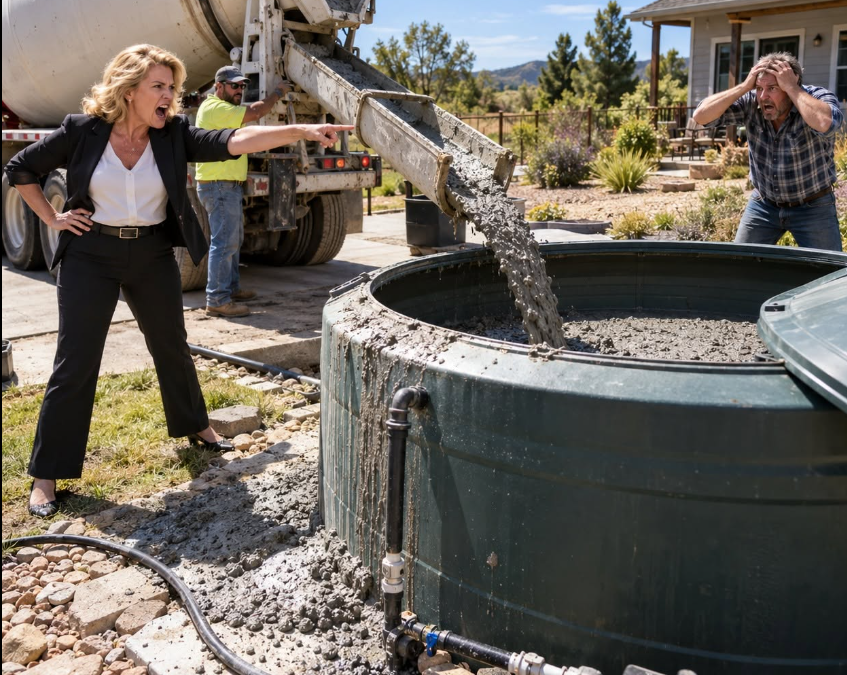
Saturday morning, Arthur was sitting on his back patio drinking coffee when he heard a heavy diesel engine.
He looked toward my property.
A concrete truck was coming up my gravel access road.
Arthur later told me his first thought was that I had scheduled work and forgotten to mention it.
Then he saw Brenda.
White capri pants.
Lavender silk top.
Wedge sandals.
Sunglasses.
Standing beside the truck like a foreman at a construction site.
Arthur put down his coffee and walked toward his fence.
Two workers were near the main cistern hatch.
The padlock was already on the ground.
Cut.
One worker lifted the steel cover.
Arthur pulled out his phone and called me.
I did not answer.
I was having breakfast with Emily.
My phone was on silent.
He called again.
And again.
By the time he started leaving voicemails, the truck had backed into position.
The driver lowered the chute.
Arthur shouted from the fence.
“Hey! What are you doing?”
Brenda turned.
“They’re handling it.”
“Handling what?”
“The abandoned cistern.”
Arthur walked closer.
“That is not abandoned.”
Brenda pushed her sunglasses down over her eyes.
“It has been a safety hazard for years.”
“No, it hasn’t.”
“The board has addressed the issue.”
“I am on the board.”
That stopped her for half a second.
Then she recovered.
“This is emergency remediation.”
“No board vote authorized this.”
“Arthur, don’t start.”
“Brenda, stop that truck.”
She turned away.
Arthur shouted at the driver.
“Sir! That tank is operational!”
The driver looked toward Brenda.
Brenda stepped between them.
“I’m the property manager. I hired you. Continue.”
Arthur moved closer.
“You are not the property manager.”
Brenda’s voice hardened.
“Get off this property.”
Arthur almost laughed.
“This isn’t your property either.”
She ignored him.
The driver had paperwork.
A handwritten authorization on HOA letterhead.
Emergency infrastructure remediation.
B. Kesler.
HOA President.
Pinerest Meadows.
Brenda had also told the driver the cistern was abandoned.
She paid twelve hundred dollars in cash.
The driver believed her.
Wet concrete began sliding down the chute.
Arthur said the sound was what he remembered most.
A heavy, wet grinding sound.
Concrete falling into darkness.
Gray slurry disappearing through the hatch my grandfather had installed forty-eight years earlier.
Arthur started photographing everything.
The truck.
License plate.
Workers.
Chute.
Cut lock.
Brenda.
The open hatch.
He took twenty-seven photographs.
In several, Brenda stood with her arms crossed.
In one, she leaned toward the hatch.
Arthur shouted one last time.
“You don’t understand what you’re doing!”
Brenda looked at him.
“This should’ve been done years ago.”
“You’re destroying an active water system.”
She gave him a dismissive smile.
“You’ll thank me later.”
Those were her words.
You’ll thank me later.
The pour lasted roughly forty minutes.
Two and a half cubic yards of quick-setting concrete.
Not nearly enough to fill a twenty-thousand-gallon cistern.
It did not need to.
The concrete fell directly over the portion containing the pump assembly and distribution manifold.
It buried the spring inlet.
Encased electrical conduit.
Covered the submersible pump.
And, most critically, sealed the manifold feeding supplementary water toward the thirty-eight connected homes.
Brenda had not filled the tank.
She had done something worse.
She had plugged its heart.
Then she left.
At 11:15, her Escalade passed back through the Pinerest Meadows gate.
Within an hour, she posted a photograph in the neighborhood Facebook group.
Dangerous abandoned infrastructure. Finally sealed. Safety first. You’re welcome, neighbors.
Prayer-hands emoji.
Sparkle emoji.
Fourteen likes.
Six comments thanking her.
Arthur replied:
You have no idea what you just did.
Brenda deleted his comment within minutes.
At 2:15 that afternoon, I finally looked at my phone.
Twenty-three missed calls.
Eight voicemails.
Messages from Arthur.
The most recent contained a photograph.
I opened it.
And stared.
The truck chute was extended over my cistern.
Gray concrete was pouring down.
For several seconds, I could not process what I was seeing.
My first reaction was not anger.
It was disbelief.
I enlarged the photo.
I recognized the hatch.
I recognized my pump house in the background.
I recognized Brenda.
My grandfather’s system.
My father’s notebook.
Forty-eight years of work.
Concrete.
I called Arthur.
He answered before the first full ring ended.
“Caleb.”
“What happened?”
“I’m sorry.”
“What happened?”
“She brought in a concrete truck.”
“Who?”
“You know who.”
I closed my eyes.
“Brenda?”
“She told them she was the property manager. Said it was abandoned.”
“Did they pour?”
Arthur went silent.
That told me everything.
“How much?”
“Two, maybe three yards.”
I stood beside my truck in a Houston parking lot while people walked past carrying shopping bags and iced coffees.
The world looked absurdly normal.
“Did you get pictures?”
“Twenty-seven.”
“Cut lock?”
“Photographed.”
“Truck?”
“Yes.”
“Driver?”
“Yes.”
“Authorization?”
“He said she gave him something on HOA letterhead.”
I leaned against my truck.
Arthur lowered his voice.
“Caleb, she lied to him.”
“I know.”
“No, I mean clearly lied. Told him she managed your property.”
“I understand.”
“She smiled while they poured it.”
That was when the anger arrived.
Not hot.
Not explosive.
Cold.
The kind of anger that organizes itself.
“Send me everything.”
“I already backed it up.”
“Good.”
“I’m sorry.”
“You tried to stop them.”
“Wasn’t enough.”
“No.”
I looked toward the restaurant where Emily was waiting.
Then back at the photograph.
“No,” I repeated. “But the pictures will be.”
I drove home that afternoon.
I did not stop.
By evening, the concrete had already begun setting.
The access hatch remained open.
The cut padlock lay in the grass.
I knelt beside the opening with a flashlight.
Gray concrete had filled the lower access shaft and flowed around the pump housing. Electrical conduit disappeared into it. The spring inlet was buried. The manifold was beneath several feet of material that would soon cure to roughly four thousand PSI.
I sat in the grass.
My hands were shaking.
I remembered standing beside that same hatch as a child while my father checked pressure.
I remembered Dutch telling me not to drop rocks into the tank.
I remembered the smell inside the pump house.
Cool concrete.
Mineral water.
Metal.
Oil.
My family’s history was not sentimental in the usual way.
We did not have antique furniture or silverware or expensive paintings.
We had systems.
Tools.
Drawings.
Equipment.
The cistern was a piece of my grandfather’s thinking still operating in the earth.
Brenda had looked at it and seen ugliness.
I looked at it and saw three generations of work.
For a few minutes, I wanted to call her.
I wanted to ask whether she understood what she had done.
Then the engineer in me took over.
Feelings could wait.
Water could not.
I traced the system mentally.
The manifold fed thirty-eight individual supplementary lines.
Each house blended that source with municipal supply through a secondary connection designed to maintain pressure.
With the manifold sealed, the spring side lost pressure.
But residents would not necessarily notice immediately.
Municipal water remained available.
Residual pressure would mask the failure under ordinary conditions.
The real problem would come under stress.
I pulled out my phone and checked drought status.
Stage 2 drought watch had already been issued.
Stage 3 restrictions were likely within weeks.
I knew exactly what happened during Stage 3.
Municipal pressure was reduced.
That was when our cistern normally carried the difference.
Without it, those thirty-eight homes would be dependent entirely on an undersized municipal main operating under reduced pressure.
I sat beside the concrete-filled tank and looked toward Pinerest Meadows.
I could see rooftops through the trees.
One of them belonged to Brenda.
I knew something she did not.
She had destroyed the system supporting her own water pressure.
I called Margaret that evening.
She listened without interrupting.
When I finished, there was a long silence.
Then she said, “This isn’t an HOA disagreement anymore.”
“I know.”
“This is criminal property damage.”
“I know.”
“Destruction of permitted utility infrastructure. Interference with an easement. Possibly fraud depending on what she told the concrete company.”
“She claimed she was the property manager.”
Margaret exhaled.
“That’s useful.”
“I’d rather have my tank.”
“I know.”
“What do I do first?”
“Document everything.”
“Already started.”
“Police report.”
“Tomorrow.”
“Insurance notice.”
“Okay.”
“Repair estimate.”
“Monday.”
Then Margaret paused.
“And Caleb?”
“Yeah?”
“Disconnect the subdivision lines.”
I looked toward the pump house.
“All thirty-eight?”
“Immediately.”
“The municipal supply will carry them for now.”
“Probably.”
“During Stage 3—”
“I know.”
I understood why she was saying it.
Damaged infrastructure created contamination risk.
Concrete debris.
Compromised components.
Backflow.
Unknown pressure conditions.
If I left the system connected and contaminated water entered those homes, the liability could become mine.
Margaret said, “You cannot guarantee water quality through a destroyed system.”
“No.”
“Then shut it down.”
At 9:15 that night, I entered the pump house.
The framed TCEQ report still hung beside Dutch’s pencil diagram.
I looked at both.
Then I closed every distribution valve.
One by one.
Thirty-eight homes.
Thirty-eight connections.
Silent.
I stood there after the final valve closed.
I did not call Brenda.
I did not call the residents.
The board received formal notice through counsel afterward.
But that night, I simply shut down a system that had run continuously through nearly half a century.
When the pump house became quiet, I felt the absence physically.
The system always had a low hum.
Not loud.
Just there.
That night, there was nothing.
Sunday morning, I started building the case.
Every photograph was copied three times.
Timestamps.
GPS data.
Arthur’s written statement.
The Facebook post.
Screenshots of comments.
The deleted reply.
The cut padlock.
Concrete tracks.
Truck tire marks.
Previous letters.
County complaints.
TCEQ complaint.
Easement challenges.
Attorney correspondence.
Petition.
Board minutes.
Years of water testing.
Original permits.
Maintenance records.
I laid documents across my kitchen table.
Brenda had spent two years creating a paper trail proving motive.
Every complaint.
Every threat.
Every attempt to shut the system down.
Every statement calling it a blight.
Every demand that I bury it.
Now the folder that had once felt annoying looked like evidence.
Monday morning, Buck Reeves from Central Texas Underground Solutions inspected the damage.
He climbed down as far as possible, used a borescope, examined structural areas, and tested what remained accessible.
After two hours, he stood beside his truck with a tablet.
“Best case?”
I asked.
He looked at me.
“Ninety-four thousand.”
My jaw tightened.
“Best case?”
“Excavate access. Break out the concrete. Replace the pump. Replace the manifold. New filtration components depending on contamination. Recommission the system. Pressure test all connections.”
“Time?”
“Twelve to sixteen weeks.”
“Worst case?”
“If the tank walls cracked from the pour or removal?”
“Yeah.”
“Full rebuild.”
“How much?”
“Could hit one-forty-two.”
I nodded.
Buck looked toward the hatch.
“Who does something like this?”
“HOA president.”
He stared at me.
“You’re kidding.”
“No.”
“She knew it was active?”
“She was told repeatedly.”
Buck slowly shook his head.
“Then she’s about to have a very expensive education.”
Monday afternoon, I filed a criminal complaint with the Hays County Sheriff’s Office.
I brought photographs.
Arthur’s statement.
Concrete company information.
Damage estimate.
Easement documents.
The deputy reviewing the packet stopped at the Facebook screenshot.
“She posted this herself?”
“Yes.”
He read it again.
“You’re welcome, neighbors?”
“Yes.”
“And that’s the tank?”
“Yes.”
He stared at me.
“People really do document their own crimes.”
“Apparently.”
The concrete driver cooperated immediately.
He was angry.
Not merely because police were involved.
Because Brenda had used him.
She had told him the cistern was abandoned and that she had authority.
He provided the invoice.
Her handwritten authorization.
Details of the cash payment.
His statement.
By then, the case had become much simpler.
I also sent formal notice to every HOA board member individually.
The letter stated that the supplementary water system had been destroyed through unauthorized vandalism and had been disconnected for safety. It explained that the thirty-eight connected homes would temporarily rely solely on municipal supply.
Arthur told me what happened when the letters arrived.
Marcus Webb called him first.
“She actually did it?”
Arthur answered, “Yes.”
“She told us she was going to plant screening.”
“She poured concrete into the tank.”
“Jesus.”
Julia Chen reportedly said, “She told me it was abandoned.”
Dorothy Finch, a retired schoolteacher in her seventies, read the letter twice.
Then she removed her glasses.
According to Arthur, her exact words were, “That woman has finally lost every bit of sense God gave her.”
Arthur said, “I’ve been warning you.”
Dorothy looked at him.
“Arthur, now is not the time.”
Arthur smiled.
“I know.”
Then he told me, “But Caleb, it was absolutely the time.”
June became July.
Central Texas summer arrived hard.
Temperatures climbed.
High nineties.
One hundred.
One hundred two.
One hundred three.
The kind of heat where concrete radiates warmth long after sunset.
Lawns faded.
Reservoir levels dropped.
Drought restrictions tightened.
On July 3, Stage 3 mandatory restrictions were announced.
Residential use was limited.
Outside designated watering windows, municipal delivery pressure dropped dramatically.
I saw the notice and knew what was coming.
For most Pinerest Meadows residents, Stage 3 was inconvenient.
For thirty-eight homes, it was different.
They had spent years with my cistern silently smoothing pressure fluctuations.
Their showers stayed steady.
Washing machines filled normally.
Outdoor faucets remained useful.
Most homeowners probably had no idea why.
Now they were going to learn.
The first complaint came July 5.
Low shower pressure.
Then another.
Then another.
Washing machines filling slowly.
Dishwashers behaving strangely.
Second-floor bathrooms producing weak flow.
Sprinkler heads barely rising.
By July 8, Brenda had received at least six complaints.
She told everyone the same thing.
“It’s the drought restrictions.”
Technically, she was partially right.
Drought restrictions were causing the municipal pressure reduction.
What she refused to say was why only certain homes were experiencing serious problems.
Phases three through six were mostly fine.
One hundred four houses.
Normal enough pressure.
The trouble clustered in phases one and two.
Thirty-eight houses.
Exactly the thirty-eight once connected to my system.
Arthur started keeping track.
Of course he did.
He printed a subdivision map.
Every low-pressure complaint received a red dot.
Homes with no problem received blue dots.
Within days, the red dots formed a perfect footprint.
Arthur brought the map to Marcus Webb.
Marcus studied it.
He traced the red cluster with one finger.
Then he looked at Arthur.
“Oh no.”
Arthur nodded.
“Now you understand.”
“Every one?”
“Every reported pressure failure.”
Marcus looked toward Brenda’s street on the map.
Lot 47 had a red dot.
He whispered, “Her house too?”
Arthur smiled.
“Especially her house.”
The final moment came Wednesday, July 17.
7:42 p.m.
The evening watering window had closed.
Municipal pressure dropped to roughly fifty-five percent.
Outside temperature remained above one hundred degrees.
Brenda had just returned from Pilates.
She went upstairs to her master bathroom.
I was not there.
Obviously.
What happened next reached me through Julia, then Arthur.
I will admit that when Arthur told me, I sat down because I wanted to enjoy every word.
Brenda’s master shower was expensive.
Large rainfall head.
Chrome fittings.
Stone surround.
The kind of bathroom featured in real-estate listings with phrases like spa-inspired retreat.
She stepped in.
Turned the water on.
At first, pressure was adequate.
She shampooed her hair.
Then the flow weakened.
The rainfall effect softened.
She adjusted the handle.
The water thinned further.
She turned the valve higher.
Nothing.
The shower fell from steady flow to drizzle.
From drizzle to intermittent streams.
Then to drops.
The pipes made a hollow metallic sound.
Air.
Pressure collapsing.
The final trickle sputtered.
Stopped.
Brenda stood there with shampoo in her hair and conditioner across her shoulders.
No water.
Not low water.
No useful flow at all.
She apparently stared at the shower head, turned the controls back and forth, waited, and tried again.
Nothing.
Then came the moment I had imagined beside my ruined cistern nineteen days earlier.
She understood.
Her first thought was not municipal main break.
Not plumber.
Not faucet.
The tank.
That tank.
The ugly tank.
The disgusting tank.
The abandoned infrastructure.
The thing she had spent two years trying to eliminate.
The thing she had finally filled with concrete while smiling.
She stood beneath her dead rainfall shower and understood that she had destroyed the system that used to keep it running.
There was nowhere to redirect the blame inside that bathroom.
No board meeting.
No letterhead.
No petition.
No attorney.
No designer blazer.
Just silence from the pipes.
For the first time since I had met Brenda Kesler, consequences had reached her before she could speak over them.
The next morning, Marcus called an emergency HOA board meeting.
Every member attended.
Brenda arrived looking composed.
At least from a distance.
White structured blazer.
Silk camisole.
Pearl choker.
Cartier bracelets.
Perfect hair.
Perfect makeup.
Arthur told me later, “She looked like she was going to a fundraiser.”
“Was she nervous?”
“Her hands were.”
Arthur came prepared.
Recorded easement.
Pressure complaint map.
Copy of the criminal report number.
Photographs.
And one special item.
Brenda’s Facebook post.
He had printed it in color.
Eleven by seventeen.
Then laminated it.
When he told me that, I laughed for the first time in weeks.
“You laminated it?”
“I wanted durability.”
“Arthur.”
“It’s evidence.”
“You laminated the prayer-hands emoji.”
“I did.”
At the meeting, Arthur placed it directly in front of Brenda.
Dangerous abandoned infrastructure. Finally sealed. Safety first. You’re welcome, neighbors.
Brenda looked at the page.
Nobody spoke.
Arthur began.
“You poured concrete into the supplementary water system serving thirty-eight homes.”
Brenda straightened.
“I addressed a hazard.”
“You lied to the concrete company.”
“I did not lie.”
“You told them you were the property manager.”
“I was acting on behalf of the community.”
“You don’t manage Caleb’s property.”
“The infrastructure affected our neighborhood.”
“That doesn’t give you ownership.”
Brenda looked toward the other board members.
“This system should have been modernized years ago.”
Marcus interrupted.
“Did the board authorize concrete?”
Brenda hesitated.
“We discussed remediation.”
“Concrete, Brenda.”
“We discussed the issue extensively.”
“Did we vote to pour concrete into the tank?”
Silence.
Julia spoke next.
“You told me you were putting in screening.”
Brenda turned toward her.
“I said I was resolving the issue.”
“No. You told me landscaping.”
“Julia, don’t mischaracterize—”
“I am not mischaracterizing anything.”
Arthur slid the red-dot map across the table.
“These are the pressure complaints.”
Brenda glanced down.
Arthur continued.
“Every red dot is a home previously supported by Caleb’s cistern.”
She said nothing.
“Every one.”
Brenda looked at Marcus.
He would not meet her eyes.
Arthur tapped Lot 47.
“Your house is one of them.”
Her jaw tightened.
“This drought is unprecedented.”
Arthur shook his head.
“No, it isn’t.”
“Pressure reductions—”
“Are normal during Stage 3.”
“Exactly.”
“Which is why the cistern exists.”
Brenda’s face changed.
Arthur later said that was the moment everyone saw fear replace arrogance.
Not much.
A flicker.
But visible.
Arthur leaned forward.
“That system has operated since 1976. It was permitted, inspected, tested, and legally protected by an easement older than this board. You had been told all of that repeatedly.”
“I believed it was unsafe.”
“No, you believed it was ugly.”
Brenda stared at him.
Arthur continued.
“You tried county code enforcement. They found no violation. You tried an easement challenge. You lost. You called TCEQ. They said the water was clean. You hired attorneys because Caleb refused to cooperate with letting you destroy his property.”
Brenda slapped one hand lightly against the table.
“I was elected to protect property values.”
That was when Dorothy Finch leaned forward.
She had been silent.
Small woman.
Cardigan.
Reading glasses attached to a beaded chain.
She looked at Brenda for several seconds.
Then she said quietly, “Brenda, thirty-eight families have weak water pressure because you wanted prettier landscaping.”
Brenda’s voice sharpened.
“That is not a fair characterization.”
Dorothy did not blink.
“You hired a truck.”
“It was remediation.”
“You cut a lock.”
“I didn’t personally cut—”
“You entered property that wasn’t yours.”
“The system affected—”
“You filled a working water tank with concrete.”
Brenda inhaled.
“I was protecting this community from a safety hazard.”
Dorothy leaned closer.
“The only safety hazard in this community is you.”
The room went silent.
Dorothy continued.
“And if you touch one more thing that doesn’t belong to you, I will personally call the sheriff and hold the door open for him.”
Brenda stared at her.
Nobody rescued her.
Nobody changed the subject.
Nobody complimented her leadership.
Nobody deferred.
The vote happened minutes later.
Four to one.
Brenda Kesler was removed as HOA president.
The only vote supporting her was her own.
Her committee roles were revoked.
Her access to the management office was canceled.
The board authorized a formal apology to me.
Arthur delivered it to my house the next morning.
He stood on my porch holding an envelope.
“I helped write it.”
“I figured.”
“Brenda did not.”
“I figured that too.”
I opened it.
The letter acknowledged unauthorized destruction of my infrastructure. It apologized for the board’s failure to intervene sooner. It confirmed that Brenda had acted without board authority.
I finished reading.
Arthur looked uncomfortable.
“We should’ve listened.”
“Yes.”
He nodded.
“I know.”
I did not soften it for him.
Arthur had listened.
Others had not.
Good people sometimes help destructive people simply by deciding conflict is too inconvenient.
Brenda had not gained power because everyone agreed with her.
She gained it because most people preferred silence to confrontation.
Nineteen votes had put her in office.
Months of shrugs had kept her there.
Now thirty-eight homes had weak water pressure.
Arthur looked toward the damaged cistern.
“Can it be fixed?”
“Yes.”
“How long?”
“Months.”
He lowered his head.
“People are angry.”
“They should be.”
“At her.”
“They should also be angry at themselves.”
Arthur looked at me.
I handed him the letter.
“She told everyone exactly who she was.”
He said nothing.
“People kept assuming somebody else would stop her.”
Arthur nodded slowly.
“That’s fair.”
On July 22, criminal charges were filed.
Criminal mischief related to the property damage.
A second allegation related to Brenda’s false representation to the concrete company was also added during the case.
When Margaret called me, her tone was completely different from the amused voice she had used months earlier when Brenda’s attorneys were sending ridiculous letters.
“Charges are filed.”
“I saw.”
“Now we focus on the civil case.”
“What do you want to seek?”
“Everything we can document.”
The repair estimate was approximately ninety-four thousand dollars.
There was lost maintenance revenue.
Emergency water costs.
Attorney fees.
Additional damages arising from intentional destruction.
Margaret said, “We’re naming Brenda individually.”
“Not the HOA?”
“She acted outside board authority.”
“Good.”
The HOA’s insurance carrier reached the same conclusion.
Coverage was denied for intentional criminal conduct performed outside authorized duties.
Brenda’s homeowners policy was not designed to pay for deliberate property destruction either.
For perhaps the first time since she had become president, Brenda discovered that titles did not automatically transfer consequences to somebody else.
The legal documents went to her.
Not Pinerest Meadows HOA President.
Not Community Representative.
Brenda Kesler.
Individual defendant.
Her defense attorney eventually contacted Margaret.
By then, the evidence was overwhelming.
Twenty-seven photographs.
Arthur’s statement.
Truck driver.
Invoice.
Handwritten authorization.
Cut lock.
Prior threats.
Board records.
Facebook post.
Engineering documents.
Repair estimate.
The question was no longer whether Brenda had done it.
The question was how expensive admitting it would become.
Her attorney proposed settlement.
Negotiations lasted weeks.
The first offer was low.
We rejected it.
The second improved.
We rejected it.
At one point Margaret said, “Her lawyer wants us to consider that she believed she was acting in the community’s interest.”
I laughed.
“Did the concrete believe that?”
“What?”
“Nothing.”
Margaret chuckled.
“I’ll tell them intent doesn’t repair a manifold.”
The settlement was finalized September 9, 2024.
One hundred seventy-eight thousand dollars.
Ninety-four thousand for repairs.
Eighteen thousand in lost maintenance revenue.
Twelve thousand related to emergency water delivery.
Thirty-two thousand in legal fees.
Twenty-two thousand in punitive damages after negotiation.
Margaret called shortly after the agreement was executed.
“It’s done.”
“She’s paying?”
“Yes.”
“Personally?”
“Yes.”
I sat at the same kitchen table where I had built the evidence file.
For several seconds, I felt almost nothing.
People imagine victory in lawsuits feels dramatic.
It usually does not.
It feels administrative.
Numbers.
Documents.
Signatures.
Deadlines.
The emotion arrives later.
I looked out the window toward the pump house.
Money did not undo what she had done.
It would not remove the months of disruption.
It would not restore my grandfather’s original pump.
But it meant the cost would not be transferred to me.
Or to thirty-eight homeowners.
Or to the HOA reserve.
The person who ordered the destruction would pay to rebuild what she destroyed.
That mattered.
Brenda reportedly used a home equity line to fund the settlement.
Three weeks later, Lot 47 went on the market.
Listed at $465,000.
Eventually accepted around $412,000.
A substantial loss.
There was irony in that.
For two years, Brenda had repeated the phrase curb appeal as though property value were a moral principle.
She had threatened my family’s water system because she believed it diminished the visual quality of the neighborhood.
In the end, nothing damaged the value of her house more effectively than her own reputation.
Prospective buyers could repaint walls.
Replace flooring.
Change landscaping.
They could not easily erase the story everyone on the street knew.
The former HOA president who destroyed the neighborhood’s backup water system.
The woman who bragged online afterward.
The woman whose own shower stopped.
The woman removed from office by a four-to-one vote.
The criminal case continued separately.
In October, Brenda accepted a plea arrangement.
She pleaded no contest to a reduced misdemeanor criminal-mischief charge. She received probation, community service, and a substantial fine. The additional fraud-related count was dropped under the agreement.
Margaret called it practical.
“Trials are uncertain.”
“I know.”
“She has a record, financial consequences, probation, service requirements, and the civil settlement.”
“I know.”
“Are you disappointed?”
I thought about it.
“No.”
That surprised me.
Months earlier, I had imagined wanting the harshest possible punishment.
By October, I did not.
I wanted my system back.
I wanted the pipes repaired.
I wanted the spring flowing through the manifold again.
I wanted to stop talking about Brenda Kesler.
Consequences had already reached her in every direction.
Legal.
Financial.
Social.
Personal.
I did not need to spend another year hoping for something worse.
By Thanksgiving, Brenda was leaving.
Arthur called me that morning.
“Moving truck at Lot 47.”
“Today?”
“Right now.”
I almost drove over.
Then decided against it.
I had no reason to watch.
Arthur did.
So did several neighbors.
Gray-uniformed movers carried boxes and furniture. Brenda wore white jeans, a cashmere wrap, and her Dior sunglasses.
Of course she did.
Arthur said she directed the loading with the same rigid precision she had brought to board meetings, as though controlling the placement of furniture inside a moving truck could restore some fraction of authority.
Eventually, the truck pulled away.
Then Brenda’s white Escalade followed.
Her custom plate was still attached.
PRES1.
At the guard house, Jean waved.
Jean waved at everybody.
Even Brenda.
Brenda did not wave back.
The neighbors watched her leave.
Nobody cheered.
Nobody shouted.
Nobody needed to.
The quiet was enough.
There is a particular silence after a storm passes.
Not celebration.
Relief.
The damage remains.
But the thing causing it is finally moving away.
The cistern rebuild began in October.
Buck Reeves and his crew started by opening the access area and breaking into the hardened concrete.
Four feet of cured material.
Jackhammers.
Cutting tools.
Excavation equipment.
Dust.
Noise.
Piece by piece, they removed what Brenda had ordered poured into the system.
One afternoon, Buck called me over.
“We found your pump.”
It came out encased in gray concrete.
Twisted wiring protruded from one side.
The metal housing was barely visible.
It looked like a fossil.
Something excavated from the ruins of a civilization instead of a piece of equipment that had been operating normally only months earlier.
I stood beside it.
Buck said, “Want us to dispose of it?”
I looked at the pump.
“No.”
“You keeping it?”
“Yeah.”
“Why?”
I thought about the question.
“Reminder.”
Of what, I did not say.
Maybe of arrogance.
Maybe of negligence.
Maybe of how quickly functioning systems can be destroyed by people who do not understand them.
Maybe of the fact that evidence sometimes deserves to stay visible.
The good news came later.
The cistern walls were intact.
The concrete had destroyed the pump and manifold, but the main tank structure survived.
And the spring?
Still flowing.
It had never stopped.
For months, water had continued traveling through limestone toward the buried inlet, pushing against concrete, accumulating wherever gravity allowed, waiting.
I remember standing beside the excavation after Buck told me.
“The spring’s good?”
He nodded.
“Strong as ever.”
Something about that hit me harder than I expected.
People like Brenda imagine destruction as final.
Fill it.
Seal it.
Cover it.
Problem gone.
But water is patient.
Water does not care about someone’s title.
It does not care about a petition.
Or an HOA election.
Or a Facebook post.
Given enough time, it keeps looking for a path.
Fourteen weeks.
New manifold.
New pump.
New filtration stage.
New UV equipment.
New access hatches.
Tamper-resistant locks.
Cellular alarm sensors.
Pressure testing.
Water-quality testing.
Flushing.
Recommissioning.
Final cost: about ninety-four thousand two hundred dollars.
Paid from the settlement.
On January 22, 2025, the system was ready.
I woke before sunrise.
The air was cold.
Hill Country winter cold is not dramatic by northern standards, but after months of Texas heat, the chill felt clean.
Arthur arrived carrying two gas-station coffees.
“You didn’t need to come.”
“Yes, I did.”
“Why?”
“Important infrastructure events require witnesses.”
“Is that an engineering code?”
“It should be.”
We entered the pump house.
The equipment looked different.
Cleaner.
Newer.
Digital monitoring where older controls had been.
But Dutch’s original pencil diagram still hung on the wall.
So did the framed TCEQ report.
And on a shelf sat a piece of the concrete that had once entombed the pump.
At eight o’clock, I began opening the valves.
Slowly.
One by one.
The pump started.
Low hum.
I had missed that sound.
Water moved.
The pressure gauge climbed.
Forty PSI.
Forty-eight.
Fifty-five.
Sixty.
Sixty-two.
Then steady.
Holding.
I watched the needle.
Arthur stood behind me.
Neither of us spoke until the system stabilized.
Then he raised his coffee.
“Dutch would be proud.”
I looked at my grandfather’s drawing.
“I think so.”
Arthur took a sip.
“Your dad too.”
That one hurt a little more.
I nodded.
“Yeah.”
Outside, the spring kept running.
Inside, the pump hummed.
For the first time since June 15, the system felt alive again.
The new HOA board did not repeat the old mistakes.
They negotiated a formal updated water-use agreement.
Higher maintenance contribution.
Shared upgrade costs.
Quarterly reports.
Clear responsibilities.
Emergency procedures.
And one provision Arthur insisted on.
No HOA officer could interfere with the Reigns water infrastructure without written owner consent and a four-fifths supermajority board vote.
Arthur called it the Brenda Clause.
I told him we should choose something more professional.
He refused.
“It communicates the risk.”
“It communicates gossip.”
“It communicates history.”
The name stuck.
Thirty-seven of the original thirty-eight homes rejoined immediately.
The only holdout was Lot 47.
Not because Brenda objected.
She was long gone.
A young couple had bought the house.
The Garcias.
They had heard fragments of the story but did not understand the system.
Arthur invited them for coffee.
Three weeks later, they signed too.
One afternoon, I saw Mrs. Garcia walking near the pump house.
She stopped at the fence.
“So this is it?”
“This is it.”
She looked at the concrete building.
“Honestly, from the stories, I expected something enormous.”
“Nope.”
“Brenda really hated that?”
“Apparently.”
Mrs. Garcia stared at it.
Then laughed.
“It’s not even that ugly.”
I smiled.
“It doesn’t matter.”
She looked confused.
“What?”
“It was never supposed to be pretty.”
That remains the part people misunderstand.
Infrastructure disappears when it succeeds.
Roads.
Bridges.
Drainage.
Electricity.
Water.
Nobody throws a party because pressure stays at sixty PSI.
Nobody sends a thank-you card because a valve works.
Nobody posts on Facebook because a pump starts exactly when it is supposed to.
People notice systems only after something breaks.
My grandfather knew that.
My father knew that.
I learned it professionally.
Brenda learned it in a shower.
I still maintain the system.
Every quarter.
Same routine.
Water samples.
Filter inspection.
UV output.
Pump current.
Pressure.
Flow.
I still use the spiral notebook.
The original one eventually filled, so I bought another almost identical to it.
And I still write in blue ballpoint.
Not because it is technically necessary.
Because some things are worth continuing simply because the people before you did them well.
Every January, near the anniversary of the rebuild, I walk to the main hatch early in the morning.
I unlock it.
Lift the cover.
Look down.
Cold spring water.
Clear.
Moving.
Always moving.
Sometimes I think about that photograph Arthur took.
Brenda leaning toward the opening while concrete poured in.
Smiling.
Completely certain she had won.
There was a period when that photograph made me furious.
Now it mostly seems strange.
Because everything she wanted that morning turned against her.
She wanted the system gone because she thought it hurt property values.
She lost money on her house.
She wanted control.
She was removed from office.
She wanted admiration from the neighborhood.
The neighborhood watched her leave in silence.
She wanted to prove the system was unnecessary.
Its destruction proved exactly how necessary it was.
She wanted the ugly infrastructure hidden.
Instead, everyone in Pinerest Meadows learned exactly where it was, exactly what it did, and exactly why it mattered.
And she wanted me to surrender because she believed persistence could overcome ownership, engineering, law, and common sense.
Instead, she ended up paying to rebuild the entire thing.
The irony is almost too perfect.
But the part I remember most is not the lawsuit.
Not the settlement.
Not Brenda standing without water in an expensive shower.
Not even Arthur’s laminated Facebook post.
It is the morning the pressure gauge climbed again.
Forty.
Fifty.
Sixty.
Sixty-two.
Holding.
Arthur standing behind me with terrible coffee.
My grandfather’s pencil drawing on the wall.
My father’s handwriting in the old notebook.
The low mechanical hum returning to a room that had been silent for months.
That sound mattered.
Because Brenda had mistaken appearance for value.
She believed anything unattractive was disposable.
Anything old was obsolete.
Anything she did not understand was unnecessary.
Dutch believed something different.
He believed you judged a system by whether it worked.
Nearly fifty years after he rented a backhoe and began digging into limestone with two teenage sons beside him, his water was still running.
A developer had depended on it.
Thirty-eight families had depended on it.
An entire HOA had spent years taking it for granted.
One woman had tried to destroy it because she did not like looking at it.
And after everything she poured into that tank, everything she spent trying to erase it, everything that followed when her own pipes ran dry, the spring was still there.
The cistern still holds.
The pump still hums.
Thirty-eight homes still receive the pressure support my grandfather designed before most of their owners were born.
And whenever I turn the final valve after maintenance and hear water moving through those lines again, I think about what Brenda said while the concrete truck was pouring.
“You’ll thank me later.”
I never did.
But I will give her credit for one thing.
Before Brenda Kesler, almost nobody in Pinerest Meadows understood what that old concrete pump house did.
Now everybody does.
They understand why the hatches stay accessible.
They understand why the easement exists.
They understand why Arthur asks questions before voting.
They understand why the new agreement contains a four-fifths approval clause.
They understand why the cheapest-looking structure near their expensive homes may be one of the most valuable things in the neighborhood.
Most of all, they understand the lesson my grandfather learned long before any of us.
The things keeping a community alive do not need designer landscaping.
They do not need luxury finishes.
They do not need approval from a woman wearing expensive earrings.
They need maintenance.
They need protection.
They need people willing to understand them before deciding they are ugly.
My grandfather’s cistern was never beautiful.
It was never supposed to be.
It was built to work.
It was built to last.
And despite concrete, lawsuits, drought, arrogance, and one HOA president who believed appearance mattered more than function, it is still doing exactly that.
Still working.
Still lasting.








