The HOA President Filed 23 Complaints Trying to Shut Down My $6 Million Marina—Then Deputies Arrived at the Lake and Put the Padlock on Her Docks Instead.
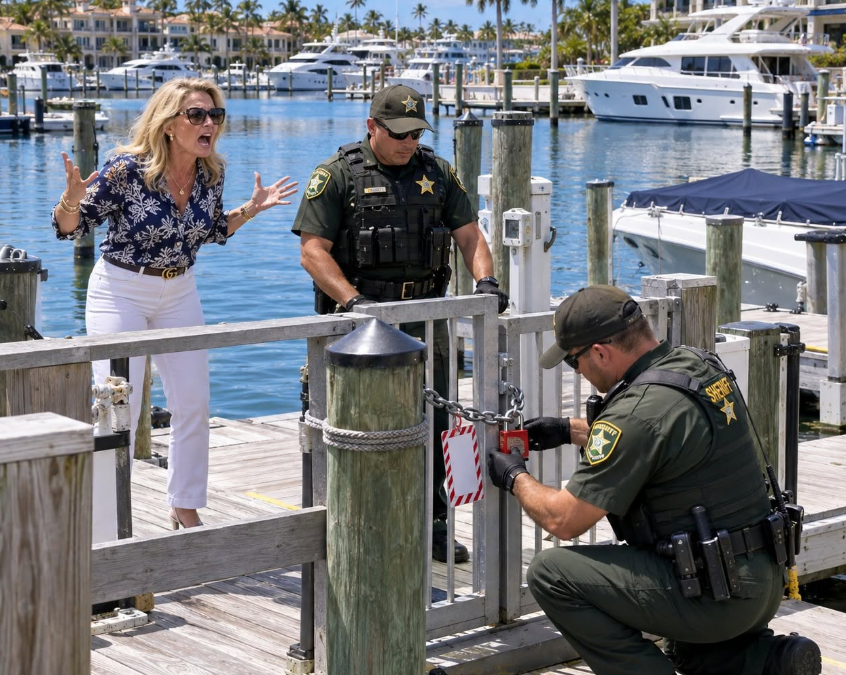
The HOA President Filed 23 Complaints Trying to Shut Down My $6 Million Marina—Then Deputies Arrived at the Lake and Put the Padlock on Her Docks Instead.
The HOA president spent six months filing twenty-three complaints against my marina, hoping the county would finally shut me down.
She thought every inspection, every rumor, and every customer doubt would clear the way for her shiny new private boat club across the lake.
Instead, the deputies she helped bring to Lake Briarwell ended up stretching a chain across her own dock ramp while forty stunned homeowners watched the padlock snap shut.
My name is Cal Hart.
I had owned Hartline Marina on Lake Briarwell for almost twenty years when Priscilla Holloway decided I was the problem standing between her neighborhood and what she called “the future of lake living.”
The phrase sounded impressive.
It looked even better printed across glossy brochures beside photographs of expensive boats, polished docks, and smiling families holding champagne glasses.
But before Priscilla arrived, Lake Briarwell had never needed that kind of language.
People came because of the water.
Simple as that.
At sunrise, the lake turned silver near the eastern shore.
By eight, bass fishermen were pulling out.
By ten, families arrived with coolers, sunscreen, and children too excited to walk normally.
Afternoons smelled like gasoline, cedar, lake water, sunscreen, and whatever somebody happened to be cooking on a pontoon.
By sunset, most of the noise faded.
Ropes creaked against cleats.
Gulls circled.
Boat motors became distant.
That rhythm had been my life for nearly two decades.
Hartline Marina was not the newest facility on the lake.
It was not supposed to be.
The office had old blinds.
The dock boards had been replaced in sections over the years, so they never matched perfectly.
The fuel dock was functional rather than beautiful.
My storage sheds looked like storage sheds.
But everything worked.
Everything was inspected.
Everything had records.
And that mattered more to me than polished signs.
My wife, Elena, understood that.
She helped me rebuild the marina after a major storm tore through Lake Briarwell almost twenty years earlier.
Half the old docks were gone.
Several sections had twisted apart.
PART2:
The shoreline looked like someone had taken a hammer to it.
At the time, most reasonable people probably would have walked away.
Elena was not reasonable about quitting.
Neither was I.
For months, we rebuilt.
She handled permits, invoices, vendor calls, insurance confirmations, and county correspondence while I spent long days on the water with contractors.
She would stand on a half-finished dock holding a clipboard and shout numbers at me over the wind.
“Cal, that piling is six inches off!”
“It is not.”
“It is.”
“You’re looking crooked.”
“I am married to a marine surveyor. I know what crooked looks like.”
She was usually right.
That was the irritating part.
When we finally reopened fully, Elena painted the marina sign herself.
HARTLINE MARINA.
Simple white letters.
Blue background.
Nothing fancy.
I still remember her standing on a ladder with paint on her cheek, refusing to let me help because apparently my engineering degree did not qualify me to paint letters.
Four years before Priscilla entered my life, Elena died.
Cancer.
Fast enough to make the word unfair feel useless.
The marina kept operating because life has a cruel habit of continuing whether you agree with it or not.
Customers still needed slips.
Fuel deliveries still arrived.
Insurance renewals still had deadlines.
Storms still damaged dock hardware.
PART3:
For months after Elena died, I sat at her old desk every morning before opening.
Coffee.
Silence.
Usually five minutes.
Sometimes twenty.
Then I got up and worked.
That became my routine.
By the time Priscilla Holloway arrived, Hartline Marina was worth somewhere around six million dollars, depending on how aggressively you valued waterfront commercial property, active slips, fuel infrastructure, equipment, and lake access.
I never thought of it that way.
Six million sounded like something you would read in an appraisal.
To me, it was docks, fuel tanks, office chairs, insurance folders, repairs, twenty years of mornings, and one faded photograph of Elena laughing because a wave had soaked both of us during reconstruction.
Priscilla saw value differently.
I first noticed her across the lake.
My dock manager, Ryan Mercer, pointed her out one Tuesday afternoon.
Ryan was thirty-two.
Hardworking.
Smart.
Still young enough to believe storing paperwork was a personal insult.
He came into the office carrying three inspection binders.
“Where do these go?”
I looked at him.
“You know where.”
“Cabinet.”
“After?”
“Scanning.”
“Good.”
He sighed.
“Nobody keeps records like you.”
“That is why you should.”
“You’ve told me.”
“Not enough, apparently.”
He rolled his eyes.
Then pointed through the window.
“You see that?”
Across the water, bulldozers and construction trucks moved along the shoreline near a new development called Briarwell Pointe.
The neighborhood had appeared fast.
Luxury homes.
Stone entrance.
Clubhouse.
Landscaping.
Large lots.
The kind of place selling not only houses but identity.
A white SUV stood near the cleared shoreline.
Beside it was a woman holding a tablet.
She was watching crews.
Not casually.
Measuring.
Pointing.
Directing.
“Developer?” Ryan asked.
“No idea.”
I went back to the folders.
At the time, she meant nothing to me.
Three weeks later, she pulled into my parking lot.
White SUV.
Of course.
She parked directly in front of the marina office.
Light green linen shirt.
White pants.
Sunglasses.
Tablet.
The entire presentation looked calculated.
She stepped out and surveyed the fuel station, slips, storage buildings, boat ramp, and parking area.
Most first-time visitors look at the lake.
Priscilla looked at infrastructure.
That told me something.
She approached while I was helping a customer tie down a pontoon.
“Mr. Hart?”
“Cal.”
She extended her hand.
“Priscilla Holloway. President of the Briarwell Pointe Homeowners Association.”
We shook.
“What can I do for you?”
“Actually, I think we can do something for each other.”
There are sentences business owners learn to distrust.
That is one of them.
I led her into the office.
She remained standing.
Did not take the chair.
People who remain standing in someone else’s office usually intend to control how long the meeting lasts.
She tapped her tablet.
“Your marina is currently the largest established access point on this section of Lake Briarwell.”
“Correct.”
“That creates opportunity.”
“Usually when someone says opportunity, they want something I own.”
She smiled.
“Direct.”
“I try.”
She began describing a partnership.
Preferred slip allocations for Briarwell Pointe residents.
Joint events.
Shared waterfront programming.
Priority access.
Possibly branding.
Maybe a community shuttle from their clubhouse.
The language flowed beautifully.
What it meant was simple.
She wanted Hartline Marina to function like an amenity for her HOA without the HOA buying the marina.
“We operate independently,” I said.
“Of course.”
“Then there’s nothing to discuss.”
Her smile stayed.
“Lake communities evolve, Cal.”
“So do marinas.”
“Expectations evolve.”
There it was.
Expectations.
Then standards.
She talked about modern presentation.
Resident experience.
Premium lake access.
Property values.
The future.
Nothing openly threatening.
Still, I felt uncomfortable.
Before leaving, she stopped beside the photograph of Elena and me after the storm reconstruction.
“You built something impressive.”
“We did.”
Her eyes stayed on the photograph.
“I’d hate to see it struggle to keep up with changing expectations.”
Then she left.
Ryan came into the office.
“How’d that go?”
I looked through the window at her SUV disappearing.
“You ever meet somebody polite enough to make you check your locks afterward?”
He laughed.
“That bad?”
“Not yet.”
I had no idea how quickly not yet would turn into twenty-three county complaints.
The first came less than two weeks later.
Formal county notice.
Excessive marina noise.
I read it twice.
That particular week, storms had kept half the boats tied up.
We had operated fewer launches than normal.
Still, the county had a process.
Complaint received.
Response requested.
I pulled weather reports.
Security timestamps.
Launch records.
Fuel sales.
Operating hours.
Everything.
Submitted on time.
Ryan laughed when he saw the folder.
“Overkill.”
“Never.”
Three days later, complaint number two arrived.
Unsafe dock conditions.
County inspector came out.
Walked the marina.
Checked boards.
Fasteners.
Railings.
Fire extinguishers.
Emergency ladders.
Slip spacing.
No significant violation.
Then complaint three.
Fuel handling concerns.
Inspection.
Records.
No issue.
Complaint four.
Traffic pattern problems.
Complaint five.
Operating beyond approved capacity.
Complaint six.
Improper signage.
Seven.
Questionable shoreline inspections.
Eight.
Emergency access obstruction.
Nine.
Boat storage safety.
Ten.
Environmental concerns.
By number ten, I stopped laughing entirely.
County employees remained professional.
That part mattered.
Nobody stormed in treating me like a criminal.
They had a duty to investigate.
A complaint does not prove misconduct.
But every complaint creates work.
Emails.
Photographs.
Document requests.
Site visits.
Scheduling.
Staff time.
Legal review.
Customer questions.
Reputation.
My old career had been marine surveying.
For years I inspected marinas and waterfront structures for insurance companies.
That experience taught me something very early.
Facilities usually do not collapse because one board looks ugly.
They collapse because somebody cannot prove what was done.
Permit missing.
Inspection missing.
Maintenance record missing.
Insurance endorsement missing.
One signature.
One date.
One forgotten filing.
That is why my office had cabinets full of binders Ryan hated.
Every complaint Priscilla’s campaign generated met a document.
Noise accusation?
Operating records.
Dock safety?
Inspection file.
Fuel concerns?
Tank certification.
Capacity?
Original approvals.
Shoreline?
Permits.
The complaints did not stick.
But they achieved something else.
Rumors.
That mattered.
One afternoon, I stopped at a hardware store.
Two men near checkout were talking.
One said, “I heard Hartline’s under investigation.”
The other answered, “Our HOA president says there are safety problems.”
Neither recognized me.
I walked past.
Said nothing.
The county never declared Hartline unsafe.
But county inspection becomes county investigation.
Then investigation becomes something must be wrong.
Facts move slowly.
Rumors use speedboats.
A longtime customer named Walter Briggs called me the next morning.
Walter had kept the same slip for eight years.
“Cal.”
“Walter.”
“My daughter keeps asking about the county.”
“What about it?”
“She heard there are safety issues.”
“Have you ever had one?”
“No.”
“Have you seen one?”
“No.”
“Then what changed?”
Silence.
“People are talking.”
Exactly.
Walter renewed.
Another customer delayed.
One moved his boat elsewhere.
Not many.
Enough to make me notice.
That was when I understood the complaints were doing damage even without penalties.
You do not need to shut down a business if you can make customers nervous enough to leave voluntarily.
Complaint fifteen arrived.
Then sixteen.
Seventeen.
Ryan started keeping count on a whiteboard.
I erased it.
He wrote it again.
“Morale,” he said.
“It isn’t funny.”
“I know.”
By complaint twenty-three, I spread every notice across the conference table.
Twenty-three separate allegations.
Twenty-three replies.
Twenty-three investigations or administrative reviews.
Twenty-three opportunities for me to make one mistake.
Ryan stood beside me.
“You think it’s her.”
“Yes.”
“Can we prove that?”
“Not yet.”
Across the lake, Briarwell Pointe was expanding.
And then I noticed lumber near the shoreline.
Not landscaping lumber.
Dock material.
Pilings.
Decking.
Hardware.
Survey stakes.
Workers.
Something significant was going up.
For months, Priscilla had made everyone look at Hartline Marina.
I finally started looking at her shoreline.
A week later, Ryan walked into the office carrying a glossy flyer.
BRIARWELL PRIVATE BOAT CLUB.
Artist rendering.
Beautiful docks.
Reserved slips.
Exclusive member events.
Premium lake access.
Founding memberships.
He dropped it on my desk.
“Guess they’re competing with us.”
I read.
“Maybe.”
“Think it’s permitted?”
That question changed everything.
“I don’t know.”
The brochure looked finished.
Official.
Membership tiers.
Deposits.
Planned events.
No permit numbers.
No approval references.
Most homeowners would never notice that.
I did.
Not because every brochure needs a permit number.
Because I knew that shoreline.
The area Priscilla was building on was more complicated than she advertised.
Certain buffer conditions.
Environmental sensitivities.
Setbacks.
Review requirements.
Nothing impossible.
Just paperwork heavy.
And if Priscilla had paperwork, I wanted to know.
Not to sabotage the project.
To understand whether the person accusing me of twenty-three compliance failures was building correctly herself.
A diner conversation added urgency.
I was eating breakfast near the courthouse when two men behind me talked about Briarwell.
“My brother bought one of the first slips.”
“How much?”
“Three thousand deposit.”
“Already?”
“They’re going fast.”
Money.
Deposits changed the situation.
People were not merely admiring renderings.
They were paying based on promises.
Back at the marina, I watched the construction more carefully.
The docks were substantial.
Permanent.
Not temporary floats.
One customer named Frank had a daughter living in Briarwell Pointe.
He came into the office Monday after a neighborhood event.
“You hear what they’re saying over there?”
“What?”
“Boat club’s basically sold as done.”
“What does basically mean?”
“They’re collecting reservation money. Membership money. People assume approvals are finished.”
Assume.
That word has damaged more real estate projects than concrete ever has.
That night, I pulled an old shoreline map from my office.
Spread it across my kitchen table.
Coffee.
Reading glasses.
Lake Briarwell shoreline zones.
Setback areas.
Public access.
Environmental overlays.
The proposed docks sat close to a section I remembered as sensitive.
I stared long enough to realize I needed an attorney.
Marris Keaton specialized in property and land use.
Sharp.
Calm.
Allergic to exaggeration.
We met for coffee.
I showed her the flyer.
Photos.
Map.
Complaint history.
She listened.
Then said, “Don’t accuse anyone.”
“I wasn’t planning to.”
“You are angry.”
“Yes.”
“Angry people love conclusions.”
“I’ve been a surveyor.”
“Then behave like one.”
Fair.
She tapped the brochure.
“The interesting question isn’t whether they’re building.”
“What is?”
“Whether they have permission to build what they’re selling.”
Exactly.
Marris started public records requests.
Shoreline permits.
Dock approvals.
Environmental review.
Construction authorization.
County planning documents.
Anything related to the Briarwell shoreline project.
We expected a file.
We found gaps.
Large ones.
Three days later, she called.
“Come to my office.”
“Bad?”
“Interesting.”
Her conference table held maps and county logs.
She highlighted the location.
“This is the boat club.”
“Yes.”
“Here are permits associated with the parcel.”
I flipped through.
Then again.
“Where’s the dock permit?”
She did not answer.
I looked up.
“Where’s the shoreline authorization?”
She spread her hands.
“That is the question.”
One missing record can mean a filing has not been indexed properly.
Several missing approvals, while construction visibly advances, become more concerning.
We kept digging.
No accusations.
No phone calls to Priscilla.
Records.
Procedure.
A planning employee explained the publicly available process.
Major shoreline structures generally required applications.
Reviews.
Environmental consideration where applicable.
Compliance checks.
Approvals.
“What if those are absent?” I asked.
He chose his words carefully.
“Then the process isn’t complete.”
Not complete.
Yet memberships were being sold.
Construction was nearing completion.
One day, Ryan was reviewing drone footage we used after storms.
“Cal.”
He paused the video.
Briarwell shoreline from above.
New docks extending farther than I expected.
Then I saw vegetation.
Reed beds.
Thick buffer area.
“Freeze that.”
We compared the image with environmental mapping Marris had obtained.
Close match.
That made everything more serious.
Protected shoreline buffers do not mean nothing can ever be built.
They mean scrutiny matters.
Erosion.
Water quality.
Habitat.
Disturbance.
Mitigation.
You do not just drive pilings where convenient.
At least not if process is followed.
Then a customer named Leonard brought me a full Briarwell membership packet.
Reservation form.
Fee schedule.
Slip assignments.
Membership benefits.
Payment instructions.
Professional.
Polished.
No mention of approvals still pending.
No permit references.
Everything communicated certainty.
Marris reviewed it.
“Your marina is clean,” she said one evening.
I looked across the lake.
“And theirs?”
“Generating questions.”
For months, I had felt like the defendant.
Every week, defend.
Reply.
Photograph.
Explain.
Now the spotlight shifted.
That did not make me happy exactly.
It made me curious.
Because Priscilla had built her entire campaign around compliance.
Standards.
Safety.
Modernization.
The cleaner alternative.
Her own brochure described Briarwell’s club as a safer, more controlled approach to lake access.
Same language.
Marris noticed it.
“The complaints weren’t random.”
“What do you mean?”
“Look at the narrative.”
She placed the Hartline complaint categories beside Briarwell marketing.
Unsafe.
Outdated.
Traffic.
Fuel.
Inspection.
Then Briarwell:
Managed.
Safe.
Modern.
Compliant.
Community controlled.
The campaign made Hartline look questionable while Briarwell positioned itself as the solution.
Competition is legal.
Marketing is legal.
Complaints are legal if filed properly.
But if those complaints created scrutiny while Briarwell itself skipped approvals, that irony belonged to Priscilla.
We built a packet.
No demand for shutdown.
No accusation of criminal behavior.
Just records.
Twenty-three complaint histories.
My inspection results.
Briarwell brochures.
Public permit logs.
Shoreline maps.
Construction photographs.
Drone images.
Membership materials.
Marris sent it to harbor compliance and requested a comprehensive review of shoreline structures connected to the same lake access issues officials had repeatedly been asked to examine.
Fair.
If Lake Briarwell needed compliance scrutiny, apply compliance scrutiny.
Then we waited.
The hardest part was silence.
Priscilla became more confident.
Boat club preview announcement.
Founding member event.
Photos online.
Real estate agents promoting it.
Future of lake living.
Elevated waterfront experience.
Responsible access.
Two weeks before opening, I ran into her outside a restaurant.
“Cal.”
“Priscilla.”
“I hear you’re still busy.”
“Always.”
“Good. I like seeing local businesses succeed.”
That woman could turn a sentence into a knife while smiling.
Then she said, “You should attend our boat club preview.”
“Maybe.”
“It might give you modernization ideas.”
I almost laughed.
“Maybe it will.”
She genuinely thought she had won.
That was obvious.
My marina had been forced through months of complaints.
Her project was almost finished.
Members had paid.
Opening planned.
She was standing at the finish line.
Meanwhile, county staff were reading.
That is the thing about paperwork.
It moves quietly.
No social media campaign.
No speeches.
Just someone comparing file A with file B.
Preview day arrived perfect.
Clear sky.
Calm lake.
Fresh docks looked expensive.
Parking filled with luxury SUVs.
White tents.
Flowers.
Catering.
Registration table.
Residents carrying brochures.
Founding member badges.
Priscilla moved through the crowd receiving congratulations.
I arrived around eleven.
Old pickup.
Marris beside me with a folder.
“You nervous?” she asked.
“No.”
“Good.”
We had nothing left to do.
At that stage, interference would have been foolish.
Priscilla stepped onto a small platform.
Microphone.
“Today represents a major step forward for our community.”
Applause.
She spoke about responsible lake access.
Property values.
Modern amenities.
Future.
Standards.
Then a county vehicle turned into the parking lot.
Priscilla noticed.
Her smile widened.
I almost knew what she thought.
Validation.
Perhaps she expected officials to congratulate her.
Another vehicle followed.
A harbor compliance officer stepped out.
Two county deputies.
They did not approach me.
Did not approach the microphone.
They went straight toward the docks.
Conversations faded.
The officer checked plans.
Measurements.
Markers.
Pilings.
Photos.
Then turned.
“Who is responsible for this facility?”
Priscilla stepped forward.
“I am president of the HOA.”
“Good. We need to discuss authorization records.”
Her smile weakened.
“Everything should be in order.”
The officer did not argue.
“We were unable to verify several required approvals during review.”
The crowd went quiet.
Priscilla said, “There must be a misunderstanding.”
“Possibly,” he replied.
Professional answer.
Then he said, “Based on complaint history involving lake access operations, the county conducted a broader review of related shoreline structures.”
Twenty-three complaints.
There they were.
Coming home.
Priscilla had spent months demanding scrutiny.
Scrutiny widened.
And widened straight across the lake.
The officer continued.
“Our records do not reflect approved permits for several dock installations, and portions appear to extend into an area subject to protected shoreline buffer requirements.”
A man raised his reservation packet.
“What does that mean?”
Another asked, “Are our slips legal?”
A woman said, “We paid deposits.”
Questions multiplied.
Priscilla tried to speak.
“Everyone, please remain calm.”
The officer walked to the dock post.
Removed a bright red notice.
Pressed it flat against fresh cedar.
UNPERMITTED SHORELINE STRUCTURE.
ACCESS CLOSED PENDING COUNTY REVIEW.
Then one deputy carried a heavy chain toward the main ramp.
That chain became the image everybody remembered.
Not the speech.
Not the red notice.
The chain.
He stretched it across the entrance.
Metal scraped against wood.
The second deputy held the ends.
Padlock.
Click.
Forty homeowners watched.
Silence.
Then Priscilla pointed at me.
“You should be inspecting his marina.”
The officer barely looked my direction.
“Ma’am, we’re inspecting structures associated with complaints and records under review.”
A retired dentist held up a receipt.
“We paid for access.”
Someone else raised a welcome packet.
BRIARWELL PRIVATE BOAT CLUB.
Another homeowner had an email confirmation.
Suddenly nobody looked at Hartline Marina.
They looked at Priscilla.
I stood beside my truck.
Hands in jacket pockets.
For months, she had treated attention like a weapon.
Now she had all of it.
She tried explaining.
“Temporary administrative issue.”
The officer interrupted gently.
“At this time, access is closed pending permit, environmental, shoreline, and construction review.”
Every word made the crowd heavier.
I caught Priscilla’s eye.
“You probably should’ve checked the permits before building.”
That was all.
I did not need a speech.
The chain already made my point.
The preview ended.
Not formally.
Events rarely have a moment where someone announces, Celebration canceled because dock may be illegal.
Instead, energy drains.
Caterers stand awkwardly.
Residents stop eating pastries.
Real estate agents put brochures away.
People leave in groups while talking quietly.
Priscilla spent the next hour answering questions she had never expected.
Refunds?
Timelines?
Who approved construction?
Who signed contracts?
Was environmental review completed?
Were slips actually assignable?
I went home.
Ryan was waiting at Hartline.
“How bad?”
“Chain.”
He smiled.
“They shut it?”
“Pending review.”
He leaned against the counter.
“Twenty-three complaints.”
“Don’t.”
“I didn’t say anything.”
“You were going to.”
“Yes.”
County review expanded over the next weeks.
Contracts requested.
Construction invoices.
Engineering records.
Membership payments.
Marketing.
Environmental documents.
Every request created more questions.
I stayed out.
That was important.
Once formal process began, my personal anger no longer mattered.
Hartline had submitted facts.
County did the rest.
Briarwell residents were angry.
I did not blame them.
Most had done nothing wrong.
They bought homes.
Read HOA materials.
Trusted leadership.
Paid deposits because professional brochures said reserved slips.
People generally assume major structures have permits.
That is normal.
You do not buy a boat slip and ask to inspect environmental approvals unless you have been trained by someone like Elena to distrust missing paperwork.
A special HOA meeting was scheduled.
I did not attend.
I did not live there.
This was their governance problem.
People who attended told me the clubhouse overflowed.
Residents demanded timelines.
Financial records.
Construction authorization.
Who knew what.
When.
How much had been collected.
Why construction advanced without finalized approvals.
The meeting lasted hours.
Eventually leadership changes were announced.
Priscilla stepped down.
No dramatic arrest.
No courtroom.
No screaming on the dock.
Just the end of a presidency built on certainty.
County required corrective action.
Some sections had to be removed.
Shoreline buffer areas needed restoration.
Further review before any future project.
Membership fees and reservation deposits started being refunded.
Not instantly.
But they came.
Some residents were furious.
Others embarrassed.
Most just wanted their money and peace.
Meanwhile, Hartline Marina became boring again.
The complaints stopped.
Routine inspections returned to routine.
Walter renewed.
Frank renewed.
Customers who had delayed came back.
A few Briarwell residents eventually rented slips from me.
I did not gloat.
Did not charge them extra.
Did not lecture.
One older homeowner walked into my office carrying coffee.
He studied Elena’s photographs.
Looked at the binders.
Then said, “All this time they kept telling us you were the problem.”
I smiled.
“I heard.”
He nodded at the filing cabinet.
“Turns out you were the only one keeping records.”
That stayed with me.
Because Hartline was not saved by revenge.
It was saved by boring habits.
Inspect.
File.
Scan.
Document.
Answer.
Repeat.
People love dramatic victories.
The chain was dramatic.
The red notice was dramatic.
Priscilla losing control at her own preview event was dramatic.
But none of that happens without twenty years of boring compliance work.
If my permits were a mess, her complaints might have found something.
If my fuel records were incomplete, maybe Hartline really would have faced sanctions.
If my dock inspections were missing, I could not complain about anyone else’s project.
Documentation gave me moral and practical ground.
That is why Ryan stopped joking about binders.
At least for a while.
A month after Priscilla stepped down, I found him scanning an inspection before I asked.
I stared.
“What?” he said.
“Nothing.”
“Say it.”
“I am witnessing growth.”
“Shut up.”
I laughed.
Life moved on.
One spring morning, I replaced the marina entrance sign.
Elena’s original had faded.
Wood cracked.
Paint peeling.
I could have ordered a modern aluminum sign.
Backlit.
Fancy logo.
Something Priscilla probably would have approved.
Instead, I copied Elena’s exact design.
Same blue.
Same white letters.
HARTLINE MARINA.
Ryan held the ladder.
“You know we could upgrade.”
“Don’t use that word.”
“Modernize?”
“Worse.”
“Elevate?”
I looked down.
He laughed.
I tightened the final bolt.
Sunlight reflected across Lake Briarwell.
Boats rocked gently.
A gull landed on the fuel dock railing.
For the first time in months, the shoreline felt quiet.
That was what I wanted.
Not to defeat Briarwell.
Not to humiliate Priscilla.
Quiet.
A marina should have enough drama from weather and boat owners.
It does not need HOA politics.
I thought the story was over.
Mostly, it was.
But aftermath has a way of teaching lessons the conflict itself hides.
Several Briarwell homeowners eventually visited Hartline and told me what happened behind the scenes.
One named Martin had reserved a slip early.
Three-thousand-dollar deposit.
He sat across from Elena’s old desk.
“I feel stupid.”
“Why?”
“I never asked about permits.”
“Why would you?”
“Because apparently I should have.”
“Martin, you bought a reservation from your HOA. Most people would assume they handled approvals.”
He shook his head.
“I showed that brochure to my brother. Bragged about it.”
“Nothing wrong with being excited.”
“Still.”
I leaned back.
“Ask better questions next time. That’s all.”
He looked toward the binders.
“Can I see how marina permitting works?”
I spent thirty minutes explaining.
Shoreline reviews.
Inspections.
Environmental considerations.
Insurance.
Maintenance records.
Not because I enjoyed saying I told you so.
Because informed customers make better lake users.
Martin eventually rented a slip.
Good customer.
Never late.
Another resident was angrier.
Susan Avery.
Not related to Priscilla.
She came in and asked, “Did you know before we paid?”
“No.”
“When did you know?”
“I suspected permit gaps after construction had already started and membership marketing was public.”
“Why didn’t you warn us?”
Fair question.
“Because suspicion isn’t proof.”
She stared.
“You could have said something.”
“I could have spread a rumor. That’s different.”
She did not like the answer.
I understood.
But I stood by it.
If I had walked into Briarwell shouting illegal docks before records were clear, I would have been doing exactly what Priscilla did to me.
Accuse first.
Let reputation carry the damage.
I refused.
Marris felt the same.
Evidence first.
Then process.
Susan returned a week later.
“I’m still mad.”
“Fair.”
“But I get it.”
That meant something.
Marris and I had one final lunch after the county corrective orders became clear.
“You handled it well,” she said.
“I wanted to tell Priscilla much worse things.”
“I know.”
“Several times.”
“I know.”
“How?”
“You have a face.”
I laughed.
Then she became serious.
“The twenty-three complaints helped you.”
“They cost me customers.”
“Yes.”
“They wasted months.”
“Yes.”
“They helped?”
“They forced you to organize a perfect record.”
I considered that.
“They also gave county officials a documented reason to look broadly at lake access issues.”
Exactly.
Priscilla’s weapon created the framework that exposed her own weakness.
There is a lesson in that.
If you demand aggressive enforcement against someone else, make sure your own paperwork survives the same standard.
People forget symmetry.
Rules feel wonderful when pointed outward.
Less wonderful when they turn around.
The county never shut Hartline because Hartline complied.
Priscilla’s project failed because critical approvals were not finalized before construction and sales moved ahead.
Same county.
Same lake.
Same principle.
That fairness mattered to me.
I did not want favoritism.
I wanted consistency.
Ryan once asked whether I would ever partner with Briarwell after everything.
“Maybe.”
He looked shocked.
“Seriously?”
“If new leadership wants legitimate arrangements.”
“After twenty-three complaints?”
“New leadership didn’t file them.”
“What if residents want preferred slips?”
“They can ask.”
“You’d negotiate?”
“Maybe.”
He shook his head.
“You are less petty than I hoped.”
“I’m old.”
“That hasn’t stopped you before.”
Fair.
The truth was, business and resentment do not mix well.
Briarwell residents lived across the lake.
They owned boats.
Hartline had slips.
If arrangements made sense, fine.
The difference would be choice.
Priscilla wanted control without ownership.
Future leaders could negotiate like adults.
A year later, Briarwell’s new board approached.
No demand.
No threats.
A simple proposal for a limited block of seasonal reservations at normal market rates.
No exclusive branding.
No control over marina operations.
No claim Hartline belonged to the HOA.
We agreed to a trial.
It worked.
Nobody died.
Amazing what consent can accomplish.
That agreement did more to improve relations than all Priscilla’s community standards speeches combined.
I sometimes saw the corrected shoreline across the lake.
Portions of the old boat club structure were gone.
Vegetation restoration underway.
The remaining development looked quieter.
Less promotional.
That was not necessarily a defeat.
Sometimes correction is simply reality forcing a project into legal shape.
Maybe someday Briarwell builds approved docks.
I would have no problem.
Competition does not frighten me.
Bad process does.
If they build legally, maintain safely, and offer something better, customers can choose.
That is business.
What Priscilla did was different.
She tried to weaken a competitor through complaints while presenting an unfinished approval process as finished.
That was the line.
One evening, an old fisherman named Hank stopped at the fuel dock.
Not the Hank from another story.
Just Hank.
He had watched everything from a distance.
“Cal.”
“Yeah?”
“You know what I liked?”
“What?”
“You never yelled.”
“I yelled privately.”
“That doesn’t count.”
“I yelled at a stapler.”
He laughed.
“Still. People expected you to explode.”
“I almost did.”
“Why didn’t you?”
I looked at the water.
“Elena would’ve killed me.”
He laughed again.
But I meant it.
My wife had a phrase.
“Do not give stupid people useful evidence.”
If someone provokes you and you lose control, suddenly the story becomes your reaction instead of their conduct.
Priscilla wanted me angry.
Twenty-three complaints.
Rumors.
Customers questioning safety.
Every time I imagined confronting her publicly, I heard Elena.
Do not give stupid people useful evidence.
So I answered paperwork with paperwork.
That habit saved me.
One missing permit can become expensive.
I had told Ryan that for years.
Priscilla proved it on a spectacular scale.
The biggest difference between Hartline and Briarwell was not old versus modern.
It was not private business versus HOA.
It was not working-class marina versus luxury subdivision.
It was documentation.
My structures looked older.
My files were complete.
Their docks looked perfect.
Their file was not.
Appearances lie.
Records do not care.
I think that is why the chain shocked people.
The dock looked finished.
Beautiful.
Fresh cedar.
New hardware.
Expensive boats.
Registration table.
Flowers.
Catering.
Everything visually communicated legitimacy.
Then a deputy stretched one ugly metal chain across it.
Suddenly appearance meant nothing.
That chain represented something no brochure could overcome.
Authority rooted in records.
Years later, people still mention the preview event.
Sometimes with exaggeration.
“They arrested Priscilla at the dock.”
No.
“They confiscated all the boats.”
No.
“They demolished everything that day.”
No.
Reality was slower.
Access closed.
Review.
Corrective action.
Refunds.
Leadership change.
Environmental restoration.
Future approvals.
Not as cinematic.
More believable.
One thing I became careful about afterward was telling the story accurately.
Priscilla filed or caused complaints connected to Hartline.
Twenty-three total.
But I never claimed every complaint was knowingly false unless evidence supported that.
Some may have been filed by residents repeating concerns.
Some categories could be legitimate subjects for review even when no violation existed.
What mattered was the pattern and the marketing narrative around it.
Accuracy protects credibility.
Once you exaggerate one detail, people question the rest.
Priscilla learned the opposite lesson.
She took small concerns and inflated them until Hartline sounded dangerous.
That strategy worked temporarily.
Then every investigation ended without the disaster she promised.
Eventually customers noticed.
Walter once said, “You’ve been inspected more than any marina I’ve used.”
“Probably.”
“And you’re still open.”
“Correct.”
“So either the county’s incompetent or you’re fine.”
“I recommend the second interpretation.”
He laughed.
The complaints accidentally produced an unusual endorsement.
Twenty-three opportunities for inspectors to find serious problems.
They did not.
Hartline’s reputation recovered stronger than before.
Not because I advertised county inspected twenty-three times.
Though Ryan wanted to print shirts.
I stopped him.
He actually designed one.
HARTLINE MARINA: COMPLAINED ABOUT 23 TIMES, STILL FLOATING.
“No.”
“It’s funny.”
“No.”
“We’d sell hundreds.”
“No.”
Elena would have bought one.
That was the annoying truth.
I kept the design in a drawer.
One summer storm hit Lake Briarwell about two years later.
Heavy wind.
Several trees down.
Power outages.
Hartline sustained moderate damage.
A section of dock railing gone.
One roof panel peeled.
Nothing catastrophic.
Briarwell residents called asking whether they could help.
That surprised me.
A dozen showed up.
Martin.
Susan Avery.
Several others.
Ryan organized work.
We spent a Saturday clearing debris.
At lunch, someone looked across the lake toward their neighborhood.
“Funny.”
“What?”
“Two years ago we thought you were the dangerous marina.”
I smiled.
“Now you’re working for free.”
He laughed.
That day felt like closure.
Communities recover through ordinary work, not formal statements.
People carrying lumber together.
Sweeping.
Fixing.
Eating sandwiches.
Priscilla’s campaign had divided the lake into old versus new.
Hartline versus Briarwell.
That division was never necessary.
Most residents just wanted water access.
Safety.
Fair prices.
A place for their boats.
The conflict had been created from leadership incentives, not ordinary needs.
Once leadership changed, normal relationships returned.
The first time Briarwell rented ten seasonal slips from me, Ryan put the agreement on my desk.
“Should we put twenty-three in the contract somewhere?”
“No.”
“Discount code?”
“No.”
“Complaints get one free fuel fill?”
“No.”
He grinned.
“Fine.”
I signed.
Business.
Elena would have liked that.
She believed grudges were expensive maintenance.
Keep only the ones worth paying for.
I stopped carrying Priscilla’s.
I do not know much about what she did afterward.
Somebody told me she moved.
Another said she stayed but stopped participating in HOA politics.
I never verified.
Did not need to.
The moment she stepped down, her role in my daily life ended.
That is something people misunderstand about victory.
They imagine winning means watching the other person suffer.
No.
Winning is when you stop needing to watch.
My marina remained.
Her project got corrected.
Life moved.
That was enough.
I kept every complaint file.
All twenty-three.
Separate binder.
Ryan labeled it PRISCILLA.
I changed the label.
COUNTY COMPLAINT HISTORY.
“Boring.”
“Accurate.”
“She filed them.”
“Some were anonymous.”
“Still boring.”
That binder eventually became useful during insurance renewal.
Underwriter asked about regulatory history.
I handed over inspection results.
Twenty-three reviewed concerns.
No major finding.
Premium stayed reasonable.
Paperwork keeps paying dividends.
One rainy afternoon, I opened complaint number one.
Noise.
I remembered the first irritation.
The disbelief.
Had no idea what was coming.
Then I flipped to complaint twenty-three.
Shoreline compliance.
Irony.
That last complaint had pushed county attention deeply enough into lake structure records that later review of Briarwell became easy.
Sometimes people build their own consequences one form at a time.
Not because the universe is poetic.
Because systems retain information.
Every complaint creates a record.
Every response creates a record.
Every permit creates a record.
Every missing permit leaves an absence.
Those records eventually meet.
When they do, narrative loses power.
That is why Priscilla’s confidence failed so quickly at the preview.
She was standing on a finished story.
The county officer was holding unfinished paperwork.
Paper won.
The red notice stayed on the dock for weeks.
People photographed it.
Shared it.
I never reposted.
Did not need to.
One photograph reached Ryan.
He showed me.
Priscilla in the background.
Chain in the foreground.
“Frame this.”
“No.”
“Why?”
“I don’t want her face in my office.”
He understood.
Instead, I framed something else.
A copy of Hartline’s latest clean inspection.
Hung it near Elena’s photograph.
That was the only public statement I wanted.
Work passed.
Records complete.
Open for business.
Years after, young marina operators occasionally called me for advice.
“How do you survive complaints?”
“Depends if the complaint is legitimate.”
“What if it isn’t?”
“Answer it anyway.”
“Every one?”
“Yes.”
“That’s expensive.”
“Less expensive than ignoring one.”
“What if somebody’s targeting you?”
“Then your clean record becomes more valuable each time.”
Not glamorous.
But true.
Never treat a nuisance complaint as permission to become sloppy.
That is exactly what pressure campaigns hope for.
Fatigue.
You miss a deadline.
You forget a document.
You snap at an inspector.
Suddenly the target looks difficult.
I refused.
Inspectors were doing their jobs.
I treated them well.
Coffee.
Access.
Files.
No speeches about conspiracy.
Darren, the inspector who handled several early complaints, later told me, “We appreciated that.”
“What?”
“You didn’t make us the enemy.”
“You weren’t.”
“You’d be surprised.”
I believed him.
People often attack messengers.
Bad strategy.
County did not file complaints.
County processed them.
That distinction helped.
When county later reviewed Briarwell, I trusted the same process.
I could not demand fair treatment for myself and then demand punishment for someone else.
Review.
Facts.
Outcome.
That consistency made peace easier afterward.
The six-million-dollar valuation came up during a later refinancing.
The appraiser walked the property.
Asked about complaint history.
I explained.
He reviewed the files.
No impact beyond temporary reputation issue.
“People online make it sound like the marina almost closed.”
“People online need hobbies.”
He laughed.
Value remained strong.
If Priscilla’s goal had been to pressure me into partnership or sale, she failed.
I never learned whether she hoped eventually to buy Hartline.
No evidence.
So I do not claim it.
She wanted Briarwell’s boat club to become the preferred access model.
That was clear from the marketing.
Maybe Hartline was simply inconvenient competition.
Maybe she wanted control.
Whatever the deeper motive, I did not need to invent it.
Her actions were enough.
Twenty-three complaints.
Marketing comparison.
Boat club construction.
Missing approvals.
That story speaks.
One winter morning, the lake froze lightly near shore.
Rare.
Beautiful.
I walked the empty docks.
Elena used to love winter marina days because nobody bothered us.
I stood near the end.
Across the water, Briarwell shoreline looked ordinary.
No crowd.
No banner.
No chain.
Just houses and trees.
I imagined telling Elena everything.
She would have listened.
Then asked, “Did you keep copies?”
“Yes. All of them.”
She would have smiled.
“Good.”
Then she would have asked, “Did you yell?”
“Not publicly.”
“Good.”
Then she would have made fun of Priscilla’s linen pants.
I laughed alone.
Ryan saw from shore.
“You okay?”
“Fine.”
He probably thought old age.
Maybe.
Grief changes.
At first, Elena’s absence made the marina feel empty.
Later, her habits became guidance.
Records.
Patience.
Work.
The story with Priscilla became one more example of why our original discipline mattered.
If Elena had not built that filing system with me after the storm, I might not have maintained it so obsessively.
If I had not, complaints could have buried us.
In that sense, she helped save Hartline years after she was gone.
That means more to me than the chain ever will.
One day the new Briarwell president invited me to speak at a community meeting about shoreline compliance.
I almost refused.
Then agreed.
I stood where Priscilla once spoke.
No dramatic story.
I explained basics.
Before building, know jurisdiction.
Before selling access, confirm authorization.
Environmental buffers matter.
Private property boundaries matter.
Keep records.
Do not assume contractor paperwork means government approval.
One resident asked, “What’s the biggest mistake people make?”
“Believing confidence equals completion.”
Another asked, “How do we know permits are final?”
“Ask to see them.”
Simple.
Afterward, a woman approached.
She had lost time waiting for her original reservation refund.
“I was angry at you.”
“I know.”
“How?”
“You told me.”
“Oh.”
She smiled.
“Sorry.”
“No need.”
“I thought you caused the shutdown.”
“I submitted records.”
“Same thing.”
“No.”
She thought.
“Okay. I get the distinction now.”
Good.
That distinction was the heart of everything.
I did not padlock Priscilla’s docks.
County did.
I did not declare them illegal.
County determined permitting deficiencies and compliance issues requiring closure and correction.
I gave officials information.
That is all.
People like simple revenge stories.
Cal gets attacked.
Cal gets revenge.
Reality was better.
Priscilla demanded enforcement.
I asked enforcement to be consistent.
That is not revenge.
That is symmetry.
The deputy who locked the chain later came by Hartline for fuel with a personal boat.
I recognized him.
“You’re the lock guy.”
He laughed.
“That’s a new one.”
“You remember Briarwell?”
“Hard to forget.”
“People acted like you enjoyed it.”
“I was doing paperwork with a padlock.”
That was exactly right.
He did not hate Priscilla.
Did not know me personally.
He enforced closure.
Professional.
That neutrality made the moment powerful.
Priscilla expected relationships and confidence to matter.
Instead, the deputy cared about the order.
No permit.
No access.
Chain.
Click.
Simple.
I bought him coffee.
Not because he helped me.
Because he liked terrible marina coffee, apparently.
Ryan upgraded the machine eventually.
Elena’s old one finally died.
I kept it in storage for a while.
Then realized I was turning the marina into a museum.
Threw it away.
That was hard.
But necessary.
Not every object needs preservation.
Some things should keep moving.
The marina did.
We replaced docks gradually.
Modernized electrical.
Improved booking systems.
Added safer fuel monitoring.
Yes, modernized.
Priscilla would have enjoyed the word.
The difference was I chose the pace.
Customer needs.
Regulations.
Economics.
Not pressure from an HOA across the lake.
Hartline looked better five years later than during the conflict.
Still felt like Hartline.
That was important.
Modernization does not require surrendering identity.
One afternoon, a new customer complimented the marina.
“Feels old school.”
“That’s either good or insulting.”
“Good.”
“Then thank you.”
He pointed across the lake.
“I heard there used to be a private club over there.”
“There was a project.”
“What happened?”
“Paperwork.”
He laughed.
I did not elaborate.
Not every customer needs a nine-thousand-word history.
But if I did tell the full story, I always ended at the same place.
The chain.
Because that moment compressed six months into ten seconds.
Priscilla standing beside a finished dock.
Residents holding paid reservations.
Deputy pulling metal across the entrance.
Padlock closing.
Authority shifting from confidence to documentation.
I can still hear the click.
Not loud.
But forty people heard it like thunder.
That is how consequences often arrive.
Quiet.
A signature.
A notice.
A locked gate.
A returned deposit.
A resignation email.
No fireworks.
Just process.
Years later, Ryan became general manager.
I cut back.
Semi-retired.
Actually semi this time.
He still mocked my filing habits but became worse than me.
Cloud backups.
Redundant records.
Digital permit dashboard.
Inspection reminders.
He once called me because a dock bolt report had not been uploaded.
“Ryan.”
“What?”
“You’re becoming me.”
“Don’t say that.”
“You are.”
“Take it back.”
“No.”
Elena would have laughed.
Hartline outlasted the conflict because it had systems.
People change.
Owners age.
Managers move.
Systems carry responsibility forward.
That is what Priscilla lacked.
Her project depended on her confidence.
When confidence collapsed, everything did.
A strong project should survive its promoter.
Permits.
Contracts.
Environmental review.
Governance.
If those exist, one person stepping down does not destroy the structure.
Briarwell had to rebuild because too much rested on assumptions.
That is the bigger lesson.
Never let enthusiasm outrun approval.
Especially around water.
Waterfront projects are unforgiving.
One wrong piling can affect navigation.
One disturbed buffer can accelerate erosion.
One fuel system mistake can contaminate shoreline.
Regulation is not always bureaucracy for its own sake.
Sometimes it protects people who never attend HOA meetings.
I knew that from surveying.
Priscilla treated compliance as marketing language.
County treated it as procedure.
Procedure won.
The twenty-three complaints eventually became something I almost appreciated.
Almost.
They forced Hartline to prove itself repeatedly.
They made records stronger.
They exposed rumors.
They made me pay attention across the lake.
Without them, maybe I would not have noticed Briarwell until opening.
Would county eventually catch the permit gaps?
Probably.
Maybe.
But the timeline could have been longer.
More money collected.
More construction completed.
More environmental disturbance.
In trying to weaken Hartline, Priscilla accelerated scrutiny that stopped her own project earlier than it might otherwise have been stopped.
That irony is not revenge.
It is cause and effect.
File enough complaints about lake access, officials start looking at lake access.
All of it.
One summer, Walter Briggs brought his granddaughter to the marina.
She was maybe eight.
Asked why I had so many binders.
“Because adults forget things.”
Walter laughed.
“That’s his whole philosophy.”
She opened one.
Inspection records.
“Boring.”
“Yes.”
“Why keep them?”
“Because boring papers keep exciting problems away.”
She looked unconvinced.
Children have healthy priorities.
She wanted ice cream.
I bought her one.
Maybe that is the final stage of any conflict.
When the next generation finds your evidence boring.
Means crisis is over.
Priscilla’s name stopped coming up.
New residents did not know the story.
Good.
Communities should not live forever inside scandals.
The corrective process worked.
Leadership changed.
Money returned.
Shoreline restored where required.
Hartline continued.
Briarwell continued.
That is enough.
No need for permanent enemies.
I never spoke to Priscilla again.
Not once.
I saw her from a distance at a grocery store maybe a year later.
She saw me.
We nodded.
No confrontation.
What would we say?
You filed twenty-three complaints.
You got my docks closed.
Neither sentence captures reality.
Better to let silence finish it.
The most important conversation happened without words.
At preview day.
Her eyes met mine after the red notice went up.
She knew.
I knew.
Everything else belonged to records.
I like endings like that.
Clean.
The last time I checked, Hartline Marina remained busy.
The sign I copied from Elena’s design weathered in sunlight.
Ryan replaced a section of decking.
Walter still complained about fuel prices.
Frank still forgot to call before arriving late.
Lake still turned silver at dawn.
The marina’s estimated value rose above six million eventually.
I never used that number unless dealing with banks or insurance.
Value is strange.
Priscilla viewed property values as leverage.
I viewed value as responsibility.
Six million dollars of waterfront infrastructure can disappear in one storm, one fire, one bad lawsuit, one environmental problem, one missing permit.
That keeps a person humble.
You do not own permanence.
You manage risk.
Keep records.
Maintain.
Respect water.
Respect law.
That is the job.
The same morning I installed the new entrance sign, I stood back and looked at it.
HARTLINE MARINA.
No word modern.
No word premium.
No word exclusive.
No phrase future of lake living.
Just the name.
Boats behind it.
Water.
Docks.
Enough.
Ryan came beside me.
“Think Priscilla would approve?”
“Don’t care.”
“Good answer.”
He walked away.
I remained.
Elena’s photograph was in my pocket.
I carried it sometimes during anniversaries.
The two of us standing on that rebuilt dock twenty years earlier.
Wet clothes.
Tired faces.
She believed paperwork mattered because work mattered.
If you build something worth keeping, document it.
Protect it.
Maintain it.
Do not let someone else’s confidence rewrite reality.
Priscilla tried twenty-three times.
Twenty-three complaints.
Twenty-three attempts to make Hartline look unstable.
Every one forced a question.
Every answer pointed back to complete records.
Then those same questions crossed the lake.
The question Priscilla hoped would destroy me became the one that destroyed her narrative.
Where are the permits?
She had no answer strong enough.
The deputy did.
He had a chain.
He had an order.
He pulled the chain across the brand-new dock ramp while forty homeowners watched.
Then came the padlock.
Click.
I have heard louder sounds on Lake Briarwell.
Thunder.
Engines.
Storm waves.
Breaking docks.
But none changed a room full of people faster than that lock.
In one second, the brochure stopped being reality.
The speech stopped being reality.
The HOA president stopped being reality.
The paperwork became reality.
And that is why, even now, whenever somebody tells me records are boring, I smile.
Boring saved my marina.
Boring exposed twenty-three complaints for what they were.
Boring revealed a dock project being sold ahead of completed approvals.
Boring returned deposits.
Boring restored shoreline.
Boring ended a presidency.
And boring kept Hartline open.
People like Priscilla often believe power belongs to whoever can create the loudest story.
I learned the opposite from water, from surveying, from my wife, and from twenty years of keeping boats afloat.
Reality does not need volume.
It just needs proof.
So when the complaints came, I answered.
When customers worried, I showed records.
When I suspected something across the lake, I did not accuse.
I checked.
When permit gaps appeared, I did not demand punishment.
I submitted evidence.
When county arrived, I stayed out of the way.
And when Priscilla pointed at me beside her newly chained docks and demanded officials inspect my marina instead, I almost felt sorry for her.
Almost.
Because twenty-three times, she had asked the county to look harder.
Eventually they did.
They just looked in both directions.
Hartline survived.
Her boat club did not survive in the form she had promised.
That was not because I had more influence.
It was not because my marina was worth six million dollars.
It was not because the county liked me better.
It was because when officials opened my folders, they found what they needed.
When they opened hers, too much was missing.
That is the whole story.
Everything else is noise on the water.








