The HOA President Cut My Ranch Gate, Moved Her “Community Trail” Onto My Land, and Told the Sheriff I Was Trespassing—Then He Opened My Father’s Deed and Asked Her One Question.
PART2:
The world changes whether ranch men approve or not. I understood that. My father understood it too, though he grumbled every time he saw another construction truck roll past the fence.
“They bought Harrow land,” he told me once, standing beside the gate with his thumbs hooked in his belt. “They didn’t buy Turner land. Remember that.”
“I know, Dad.”
“No,” he said. “Know it on paper.”
That was my father.
He believed memory mattered, but paper protected memory from people who lied.
When the developer first surveyed Silver Pines, Dad marched down to the county office and asked for a copy of every recorded plat. He compared them against his own deed. He walked the fence line with the county surveyor. He made sure the ridge was marked clearly.
Then he placed an extra copy of the Turner Ranch deed in a blue folder and wrote across the front in black marker:
BOUNDARIES — DO NOT MISPLACE
After he died, I kept that folder behind the seat of my truck.
Some men carry a pistol.
I carried my father’s paperwork.
For the first few years, Silver Pines and I got along.
The old developer respected the fence. The first homeowners mostly kept to themselves. Sometimes a ball came over. Sometimes a dog got loose. Sometimes a kid asked if the cows were friendly, and I had to explain that cows were friendly until they were not.
Then the original developer sold the last lots and disappeared.
The HOA took over.
That was when Patricia Wells arrived.
She was not the first HOA president Silver Pines had, but she was the first one who acted like the title came with a crown.
Patricia was in her early sixties, thin, polished, and expensive in a way that made even casual clothes look like a strategy. She wore white jeans to outdoor meetings. She drove a black Range Rover with a Silver Pines Estates decal on the rear window. She spoke slowly, like every sentence had been reviewed by counsel and approved by a mirror.
Her husband, Gerald, rarely spoke. He walked two steps behind her at neighborhood events, holding folders, bottled water, or whatever else Patricia decided made him useful.
Within six months of becoming president, Patricia created committees.
Community Enhancement.
Boundary Beautification.
Trail Access.
Long-Range Land Use.
Those names should have warned me.
The first letter came in March.
It was addressed to “Adjacent Landowner,” which told me everything about the respect behind it.
Dear Adjacent Landowner,
Silver Pines Estates is conducting a community access evaluation relating to historically shared ridge pathways and scenic trail corridors. As part of this review, we request cooperation regarding access to the southern ridge area adjoining Silver Pines common land.
Sincerely,
Patricia Wells
President, Silver Pines Estates HOA
Historically shared ridge pathways.
There had never been a shared pathway.
There had been a cattle trail, a fence line, and one teenage boy from the Harrow family who used to sneak across to smoke cigarettes behind the cedar stand in 1986.
I wrote back by hand.
Mrs. Wells,
The southern ridge is part of Turner Ranch. There is no shared access, no HOA trail, and no Silver Pines common land on my side of the fence.
Do not enter my property without permission.
Caleb Turner
I thought that would be enough.
It never is with people who believe polite words can dissolve property lines.
Two weeks later, Patricia came to my gate.
I saw her from the barn. Her Range Rover was parked outside the chain. She stood beside it in cream slacks, sunglasses, and boots that looked like they had never been asked to meet manure.
I walked down with my dog, Red, trotting beside me.
“Mr. Turner,” she called through the gate. “I hoped we could speak neighbor to neighbor.”
“That depends on whether you understand which side of the gate you’re standing on.”
Her smile paused.
Then returned.
“I believe there may be some confusion about the ridge area.”
“No confusion here.”
“The Silver Pines community has long understood that ridge as part of the natural buffer and trail corridor associated with our development.”
“Then Silver Pines has long understood wrong.”
She took off her sunglasses.
Her eyes were pale blue and hard.
“We are not seeking conflict.”
“Then stop seeking my land.”
“It is not that simple.”
“It is exactly that simple.”
She opened a leather folder and pulled out a map.
Glossy.
Colored.
Professional.
It showed Silver Pines Estates in pale green, common areas in darker green, walking paths in dotted lines, and my south ridge shaded as something labeled:
FUTURE RIDGE NATURE TRAIL
I looked at it for three seconds.
Then I laughed.
Patricia did not like that.
“Something funny?”
“Yes. You printed a fantasy.”
“This was prepared by our planning consultant.”
“Then your planning consultant needs a deed.”
Her mouth tightened.
“Mr. Turner, land use evolves.”
“Ownership does not evolve because you add green shading.”
The sunglasses went back on.
That was the end of neighbor to neighbor.
After that, the little things started.
Silver Pines residents appeared near my fence, pointing phones at the ridge.
A drone flew over my pasture twice.
Someone tied orange ribbon to three fence posts on my side.
A trail camera caught two men in polo shirts stepping over the fence and taking measurements near the dry creek bed.
I called the sheriff.
Deputy Daniel Reeves came out both times.
Back then he was not sheriff yet, just a senior deputy with a calm face and a habit of listening longer than most people expected. He walked the fence with me, photographed the ribbons, reviewed my deed, and wrote reports.
“You think she’s testing the line?” he asked.
“She knows the line.”
“Then she’s testing you.”
I looked toward the Silver Pines rooftops.
“She’s going to fail.”
He smiled faintly.
“I’ll put that in the unofficial section.”
The official reports did not stop Patricia.
They made her quieter.
That worried me more.
Quiet people with money and bad intentions do not quit.
They plan.
Over the next year, Patricia started calling the ridge “the preserve” in HOA newsletters.
The Silver Pines Preserve.
She described it as a “natural amenity under development.”
She announced that the Trail Access Committee was exploring “passive recreational use.”
She invited residents to a “future nature corridor presentation.”
Then came the assessment packet.
A Silver Pines homeowner named Bill Marlow brought it to me.
Bill was seventy-two, widowed, and one of the few people in the subdivision who still spoke to me like a human being instead of a boundary inconvenience. He had grown up on a farm and knew better than to trust an HOA president with a laser pointer.
He drove up one morning in his old Ford and handed me a packet through the gate.
“Caleb,” he said, “you need to see this.”
Inside was a full-color proposal.
SILVER PINES RIDGE PRESERVE ACCESS PLAN
Trail signage.
Benches.
Observation platform.
Birding stations.
A proposed annual assessment of $1,850 per household for “land stewardship and improvement.”
And there, in the middle of the packet, was Patricia’s map.
My ridge shaded dark green.
The property line between Turner Ranch and Silver Pines had been removed.
Not blurred.
Not mislabeled.
Removed.
The map made it look like Silver Pines flowed straight over my fence and across my south pasture to the dry creek bed.
I felt my father’s voice inside me.
Know it on paper.
Bill watched my face.
“She told us the ridge was HOA-controlled land that prior boards had failed to activate.”
“Activate,” I repeated.
“I asked about your fence. She said it was an obsolete agricultural barrier.”
I looked toward the old cedar posts.
My father had driven half of them himself.
“She said that?”
Bill nodded.
“And folks believed her?”
“Most folks believe anything in a binder if the font looks expensive.”
That was the truth.
I called my attorney, Susan Hale.
Susan had handled my father’s estate, two grazing leases, and one boundary dispute involving a neighbor who thought moving a fence line after dark counted as negotiation. She was sixty-five, sharp as barbed wire, and had no patience for people who confused confidence with evidence.
I emailed her the assessment packet.
She called me seven minutes later.
“Caleb,” she said, “where did this map come from?”
“Silver Pines HOA.”
“Did you alter it?”
“No.”
“Did they?”
“They removed my property line.”
There was a silence.
Then she said, “Do not throw anything at Patricia Wells until I get there.”
“I wasn’t planning to.”
“You were thinking about it.”
“Yes.”
“That’s why I said it.”
Susan sent a letter the same day.
Not a friendly letter.
It referenced my deed, the county plat, the recorded survey, the assessor’s map, the sheriff reports, the HOA packet, and the false representation of Turner Ranch land as HOA property.
It demanded immediate withdrawal of the packet, correction to all homeowners, preservation of communications, and written confirmation that Silver Pines claimed no ownership or access rights over Turner Ranch.
Patricia did not reply.
Instead, she held the vote.
According to Bill, she told residents my attorney’s letter was “an intimidation tactic from an adjacent owner resistant to community improvement.”
The assessment passed.
One hundred ninety-four homes.
One thousand eight hundred fifty dollars each.
Over three hundred fifty thousand dollars collected for land Patricia did not own.
That was when the situation stopped being annoying and became something else.
Something with teeth.
I filed a civil action to stop any work.
Susan requested an emergency hearing.
The court date was set for the following Monday.
Patricia knew it.
That was why she came on Friday.
Before sunrise.
I was feeding horses when Red started barking.
Not the lazy bark he gave deer.
The hard bark.
The gate bark.
I stepped outside the barn and heard an engine at the front entrance.
Then another.
Then metal clanging.
I got in my truck and drove down the gravel road fast enough to throw dust behind me.
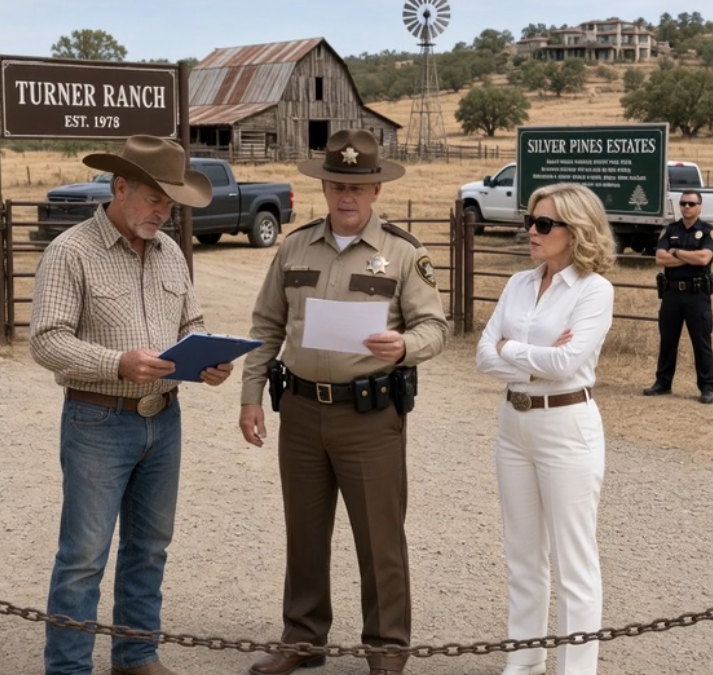
When I came around the last bend, I saw the chain first.
Cut clean.
Lying in the dirt behind the open gate.
Then the flatbed trailer.
Then the two HOA agents unloading green trail signs.
Then the private security guard in a black polo standing inside my ranch gate with one hand near his belt.
And then Patricia Wells.
Ten feet inside Turner Ranch.
White jeans.
Pressed blouse.
Sunglasses.
Clipboard.
Like a woman touring property she had already decided was hers.
One of the green signs leaned against the trailer.
SILVER PINES RIDGE PRESERVE
RESIDENT TRAIL ACCESS
HOURS: DAWN TO DUSK
I parked my truck sideways across the ranch road and stepped out.
“What the hell are you doing?”
The security guard moved between us.
“Sir, stay back.”
I looked at him.
“You’re standing on my ranch.”
He squared his shoulders.
“This access has been authorized.”
“By who?”
“Silver Pines HOA.”
I laughed once.
Patricia turned, calm as church glass.
“Mr. Turner, this confrontation is unnecessary.”
“You cut my chain.”
She glanced at it like it was litter someone else should clean up.
“The chain was obstructing community access.”
“The chain was on my gate.”
“The gate crosses an activated trail corridor.”
The words were so stupid I almost could not answer.
Behind her, an HOA agent lifted a signpost from the trailer.
I pointed at him.
“Put that down.”
He froze.
Patricia said, “Continue.”
He did not continue.
Good instincts.
I took out my phone and called the sheriff.
By then, Daniel Reeves had been elected sheriff. The dispatcher knew my voice. More importantly, she knew Turner Ranch had an active boundary dispute with Silver Pines.
“Caleb,” she said, “is anyone armed?”
“Private security is here. I see a sidearm.”
“Are weapons drawn?”
“No.”
“Step back and wait for deputies.”
“I’m not stepping off my road.”
“Caleb.”
“I’ll wait.”
I hung up.
Patricia smiled.
“I already called law enforcement.”
“I’m sure you did.”
“You are behaving aggressively.”
“I found strangers inside my locked ranch gate after my chain was cut.”
“Because you have unlawfully restricted access for months.”
The security guard lifted his radio.
“Ma’am, maybe we should wait.”
Patricia ignored him.
She looked toward my south ridge.
“This isn’t your land anymore.”
For a second, I heard nothing.
Not the windmill creaking behind the barn.
Not the deputy siren in the distance.
Not the guard’s radio clicking against his belt.
Only those words.
This isn’t your land anymore.
My father had bought that ridge with diesel grease under his nails.
He had read the deed three times before he signed it.
He had walked every line, driven every fence post, and taught me that land did not stay yours because you loved it.
It stayed yours because you recorded it, marked it, paid taxes on it, and remembered where the line was when someone else decided to forget.
I wanted to shout.
I wanted to grab the cut chain and throw it at her feet.
Instead, I did what Dad would have done.
I walked to my truck, opened the passenger door, and pulled out the blue folder.
The one he had labeled.
BOUNDARIES — DO NOT MISPLACE
Inside was the original ranch deed.
The county plat.
The survey record.
The tax map.
The photos.
The emails.
The screenshots.
The assessment packet.
The altered HOA map.
Everything Patricia thought a man in muddy boots would never be organized enough to keep.
Sheriff Daniel Reeves arrived with two deputies.
He stepped out of his SUV slowly, eyes moving over the open gate, cut chain, trailer, signs, security guard, Patricia, me, and the blue folder in my hand.
His face did not change.
That was why I liked Daniel.
He did not react before facts arrived.
Patricia walked toward him immediately.
“Sheriff Reeves, thank goodness. Mr. Turner has been blocking Silver Pines’ community access for months. He’s aggressive, noncompliant, and dangerous.”
I said nothing.
The sheriff glanced at me.
Then at the cut chain.
“Who cut the chain?”
Patricia’s smile tightened.
“The obsolete barrier was removed to restore access.”
“That did not answer my question.”
The security guard looked at the ground.
One HOA agent suddenly became very interested in the trailer hitch.
Patricia said, “The association authorized removal.”
Sheriff Reeves looked at the deputies.
“Photograph the chain.”
Then he looked at me.
“Caleb.”
I handed him the blue folder.
“Start with the deed.”
He opened it on the hood of his SUV.
Patricia lifted her map.
“Sheriff, I have the current Silver Pines community plan right here.”
“I’ll look at that too.”
He read my deed first.
Slowly.
That mattered.
He read the legal description out loud enough for everyone to hear.
“Beginning at the iron pin located at the northwest corner of the Harrow tract, thence south along the existing fence line…”
Patricia shifted.
He continued.
“…including the ridge parcel extending east to the dry creek bed, recorded as part of Turner Ranch…”
The deputy taking photos looked up.
The security guard took one step backward.
Sheriff Reeves read the next page.
Then the county plat.
Then the survey record.
Then he looked at Patricia’s glossy map.
For a long time, he said nothing.
The morning wind moved dust around our boots.
Finally, he placed the two maps side by side on the hood.
One official.
One HOA.
Then he asked the question she had not prepared for.
“Mrs. Wells, who removed the property line from this?”
Patricia blinked.
“What?”
He tapped the HOA map.
“The recorded boundary between Silver Pines and Turner Ranch is here on the county plat. On your map, it’s gone. Who removed it?”
Her face did not change enough for most people to notice.
But I noticed.
So did the sheriff.
“This map was prepared by our planning consultant.”
“Name.”
She hesitated.
“Landmark Community Design.”
“Did they remove the boundary, or did you instruct them to?”
“That is not how planning documents work.”
“It is exactly how false maps work.”
The deputy stopped writing for half a second.
Patricia’s jaw tightened.
“Sheriff, with respect, this is a civil dispute.”
“No,” he said. “It may have started as one. But I’m looking at a cut chain, trespass, attempted installation of signs, a false map, and an assessment packet representing private land as HOA property.”
The security guard looked like he wanted to evaporate.
Sheriff Reeves turned to him.
“Who hired you?”
“Silver Pines HOA, sir.”
“Who told you this was HOA property?”
He looked at Patricia.
The sheriff did not.
He kept his eyes on the guard.
“Answer.”
“Mrs. Wells.”
Patricia snapped, “I provided association documentation.”
The sheriff picked up the altered map.
“This?”
“It is a community-use plan.”
“It is missing the owner’s boundary.”
“It reflects intended trail integration.”
“That is not ownership.”
Her calm finally cracked.
“Silver Pines residents paid for this access.”
I looked at her.
That was the sentence.
The one that confirmed everything.
Sheriff Reeves heard it too.
“Paid who?”
Patricia stopped.
Her lips parted slightly.
Then closed.
The sheriff’s voice lowered.
“Mrs. Wells, paid who?”
No answer.
I pulled the assessment packet from the folder and handed it to him.
He read the cover.
SILVER PINES RIDGE PRESERVE ACCESS PLAN
He flipped pages.
Trail access assessment.
Land stewardship.
Signage.
Observation platform.
Resident access.
South ridge preserve.
He looked at me.
“They collected money for this?”
“Ask Bill Marlow. Ask the homeowners. One thousand eight hundred fifty dollars per house.”
Sheriff Reeves turned slowly back to Patricia.
“Mrs. Wells.”
She lifted her chin.
“The funds are for community improvements.”
“On his land?”
“For land under association access claim.”
“Do you have a deed?”
“The association has longstanding equitable—”
“Do you have a deed?”
She did not answer.
“Easement?”
Silence.
“Court order?”
Silence.
“Recorded agreement from Mr. Turner?”
Her mouth tightened.
“The matter was under review.”
The sheriff closed the folder.
“Then you should have waited outside the gate.”
One deputy escorted the HOA agents away from the trailer. The other spoke to the security guard and collected his information. The green signs were photographed, then placed back on the flatbed.
Patricia began protesting once the sheriff told her she had to leave the ranch.
“You cannot remove us from land under active access dispute.”
Sheriff Reeves looked at her.
“I can remove trespassers from private property when the owner requests it and the deed is sitting on my hood.”
“This is outrageous.”
“No,” I said. “Cutting my chain was outrageous.”
She looked at me like she hated that I had learned language.
The sheriff gave Patricia and her crew formal trespass warnings. He did not arrest her that morning. That frustrated me at first, but Susan later explained why.
“Arresting her at the gate would feel good,” she said. “Building the fraud case will hurt more.”
Susan was right.
Because the gate was only the beginning.
The emergency hearing happened Monday.
Patricia showed up in a navy suit with an attorney from Dallas. The attorney looked confident until Susan handed him the sheriff’s report, photographs of the cut chain, the altered map, the assessment packet, and the deed.
His confidence thinned by the minute.
Judge Maribel Santos listened while Patricia’s attorney argued that Silver Pines had a “good-faith belief” in historical community access.
Susan stood and said, “Your Honor, good faith does not cut chains before sunrise.”
The judge looked at the photographs.
Then at Patricia.
Then at the official plat.
She issued a temporary injunction that same day.
Silver Pines HOA, its board members, agents, contractors, security personnel, and residents were prohibited from entering Turner Ranch, installing signs, representing ownership or access rights, collecting funds for improvements on Turner land, or using any map that showed Turner Ranch as association property.
Patricia sat motionless at the defense table.
But I saw her hand grip the pen so hard her knuckles turned white.
That was when the homeowners started turning on her.
At first, they had believed her.
I understood why, even if it angered me. Most people do not check county records. They look at a glossy packet, hear confident words, and assume someone else verified the facts.
But once the sheriff’s report spread through Silver Pines, confidence became panic.
Bill Marlow called me after the first emergency HOA meeting.
“She tried to blame you,” he said.
“For what?”
“For obstructing access, legal expenses, negative publicity, emotional stress, and something called recreational deprivation.”
I stared at my kitchen wall.
“Recreational deprivation?”
“Caleb, I swear I’m not making that up.”
I laughed for the first time in days.
Bill continued, “Then someone asked where the assessment money went.”
“And?”
“She said funds had been allocated.”
“To what?”
“Planning, consulting, security, signage deposits, and trail activation expenses.”
“Trail activation again.”
“Then Vivian Spears stood up with printed county maps.”
I did not know Vivian Spears then.
I learned to appreciate her.
She was a Silver Pines resident, retired title examiner, and apparently the only person in the room who knew how to read a legal description without getting dizzy. She had pulled the recorded plat herself after the gate incident.
According to Bill, Vivian walked to the front of the room, laid the official map beside Patricia’s map, and said, “The president removed another man’s ranch from reality and charged us for access to it.”
That sentence ended Patricia’s control of the meeting.
The board tried to continue.
Residents shouted.
Patricia accused Vivian of spreading misinformation.
Vivian responded by reading my father’s deed aloud.
Not all of it.
Just enough.
The same lines Sheriff Reeves had read at the gate.
Beginning at the iron pin.
Existing fence line.
Ridge parcel.
Turner Ranch.
By the end of the meeting, three board members had resigned.
Patricia refused.
That did not save her.
Discovery did what discovery does.
It made arrogance searchable.
Emails came out.
The first was from Landmark Community Design to Patricia.
The Turner boundary appears to exclude the proposed ridge trail area from Silver Pines property. Recommend confirming ownership or obtaining access agreement from Turner Ranch before presenting to residents.
Patricia forwarded it to herself with the note:
Do not include boundary clutter in presentation map. Residents need to see the vision.
Boundary clutter.
My father’s land was boundary clutter.
Another email was worse.
A board member named Alan Pierce had asked:
Do we have legal access to the ridge? Concerned about Turner reaction.
Patricia replied:
Turner is one man with cattle fencing and outdated paperwork. Once homeowners approve funding, the momentum will force resolution.
I read that line in Susan’s office.
Outdated paperwork.
The deed.
The plat.
The survey.
The tax record.
Everything Patricia did not want to respect was “outdated paperwork.”
Susan looked at me over her glasses.
“You all right?”
“No.”
“Good. I don’t want you all right. I want you patient.”
Patience paid.
The sheriff’s office opened a criminal investigation into trespass, criminal mischief for the cut chain, possible fraud related to the assessments, and falsification of documents if the altered map had been used to obtain money.
The county attorney got involved.
The state real estate commission got a complaint because Patricia had marketed access tied to land she did not own.
Silver Pines’ insurance carrier sent its own investigator.
That was when Patricia’s story began changing.
First she said the map was conceptual.
Then she said the planning consultant made an error.
Then she said the board approved everything.
Then she said residents misunderstood the packet.
Then she said the assessment was not for land access, but for “preliminary community planning.”
Unfortunately for her, the packet had a sentence on page four:
Upon assessment approval, Silver Pines residents will receive controlled access to the Ridge Preserve trail corridor.
Controlled access.
To my land.
There was also an invoice from the security company labeled:
Turner Gate Access Activation — Day 1
Day 1.
As if they planned more.
The civil case settled faster than the criminal matter.
Silver Pines agreed to refund the special assessment to all homeowners, pay my attorney fees, repair the gate, replace the chain and lock, remove all references to the ridge from HOA materials, record a formal acknowledgment that the ridge belonged to Turner Ranch, and install a permanent sign on their side of the fence stating:
PRIVATE PROPERTY BEYOND THIS LINE
TURNER RANCH
NO SILVER PINES ACCESS
I wrote that sign myself.
Susan said it lacked elegance.
I said elegance had caused enough trouble.
The board also agreed to preserve the original fence and pay for a new survey marker at the corner where Patricia’s map had erased the line.
The day the surveyor set the marker, I stood beside Bill Marlow and Vivian Spears on the Silver Pines side.
Vivian looked at the fresh metal cap in concrete.
“People hate lines until lines protect them.”
I nodded.
“You should run the HOA.”
She gave me a look.
“I would rather eat glass.”
Fair enough.
Patricia was removed from office two weeks later.
She did not resign gracefully.
People like Patricia never do.
Her resignation letter said she had been punished for “visionary leadership misunderstood by rural obstructionism.”
Bill mailed me a copy with a sticky note:
Thought you might want proof she learned nothing.
I pinned it to the wall in the barn for a while.
Then I took it down because my horses did not deserve that kind of negativity.
The criminal case took nearly a year.
Patricia’s attorney argued that she relied on consultants, believed in a good-faith access claim, and never intended to defraud anyone. He said the assessment funds were held for community planning. He said the gate incident was an unfortunate misunderstanding caused by “unclear rural boundary practices.”
Unclear rural boundary practices.
My father would have hated that phrase.
The prosecutor played bodycam footage from the gate.
Patricia standing inside Turner Ranch.
The cut chain in the dust.
The trail signs on the trailer.
Her voice saying, “This isn’t your land anymore.”
Then Sheriff Reeves reading the deed.
Then his question.
“Mrs. Wells, who removed the property line from this?”
The courtroom listened to the silence after that question.
Silence is evidence when it lands in the right place.
Then came the emails.
Boundary clutter.
Momentum will force resolution.
Outdated paperwork.
The jury did not like those words.
Patricia was convicted of fraud connected to the assessment, criminal trespass, and criminal mischief. Some charges were reduced. Some were dismissed. That is how court works. It rarely gives you the perfect ending anger wants.
But she was convicted.
She received probation, fines, restitution obligations, and a court order barring her from serving on any HOA board or managing association funds during the probation period. The restitution to Silver Pines homeowners mattered more than jail would have.
They had paid for a lie.
Now the lie had to pay them back.
After sentencing, Patricia turned toward me in the hallway.
For a moment, she looked older.
Not sorry.
Just smaller.
“You could have worked with us,” she said.
I looked at her.
“No. You could have asked.”
Her face hardened.
“We offered progress.”
“You offered theft with benches.”
She had no answer.
Good.
The ranch changed after that, but not in the way Silver Pines wanted.
I repaired the gate.
Stronger this time.
New steel posts.
A heavier chain.
Better cameras.
A sign that said:
TURNER RANCH
PRIVATE PROPERTY
RECORDED SINCE 1978
Below that, in smaller letters, I added something my father used to say:
KNOW IT ON PAPER
People slowed down to read it.
Some laughed.
Some did not.
Silver Pines residents stopped approaching the fence for a long time. Then, slowly, normal life returned. Dogs barked. Kids rode bikes. Lawn crews cut grass. Delivery trucks got lost. Houses sold. New families moved in.
One afternoon, a young Silver Pines father named Marcus walked over to the fence with his little boy.
I was repairing a gate hinge.
He stopped a respectful distance away.
“Mr. Turner?”
“That’s me.”
“My son wanted to see the cows.”
The boy hid behind his father’s leg.
I looked at the child.
Then at Marcus.
“Fence is there for a reason.”
“Yes, sir. We’re staying on this side.”
That answer did more to repair neighbor relations than any HOA newsletter.
I leaned on the fence.
“What’s his name?”
“Tyler.”
“Tyler, that red cow over there is meaner than she looks.”
The boy peered through the wire.
“She looks nice.”
“That’s how she gets you.”
He giggled.
Marcus looked embarrassed.
“I’m sorry about what happened with Patricia. We moved in after, but people still talk.”
“They should.”
“She told everyone you were hoarding land.”
I smiled a little.
“I was owning it.”
He nodded.
“There’s a difference.”
“Yes.”
He looked toward the ridge.
“It’s beautiful.”
“It is.”
“I understand why people wanted access.”
“I understand wanting. I don’t understand taking.”
Marcus nodded again.
Then he said, “Thank you for not hating all of us.”
I thought about that.
Hate is heavy.
Ranch work already gives a man enough to carry.
“I don’t hate people for buying houses,” I said. “I hold people responsible for crossing fences.”
“That’s fair.”
It was.
A year after the gate incident, Sheriff Reeves stopped by with coffee.
He found me near the barn, replacing a cracked water trough.
“You busy?”
“Always.”
He handed me a cup anyway.
We stood in the shade while Red slept under the truck.
“Patricia’s restitution payments started,” he said.
“Heard that.”
“Silver Pines got a new board.”
“Heard that too.”
“They invited me to speak about property boundaries at their annual meeting.”
I laughed.
“You going?”
“Yes.”
“Wear boots.”
He smiled.
Then he looked toward the south ridge.
“You ever think about selling that piece?”
“Everybody asks me that.”
“I’m not everybody.”
“No.”
“So?”
I watched the ridge.
October light had turned the grass gold again. Deer moved between the cedars. The old windmill creaked behind the barn. Somewhere beneath all that quiet were my father’s boot prints, my own younger footprints, and the long invisible line between what people wanted and what they had the right to touch.
“No,” I said. “I don’t think about selling.”
Sheriff Reeves nodded.
“I figured.”
“Why ask?”
“Because now that everyone knows how valuable it is, someone else will.”
He was right.
That is the thing about winning one fight over land.
It does not mean no one will ever come again.
It means the next person will come with a different map.
So I made the paper stronger.
Susan helped me update the ranch trust. We recorded additional boundary affidavits, filed a new certified survey, and placed conservation restrictions on part of the ridge so no future buyer, heir, developer, HOA, or creative liar could pretend it was an unclaimed opportunity.
Some people called that extreme.
I called it listening to my father.
Two months after the trust was updated, I took the blue folder from behind the truck seat and added copies of the new records.
The folder was old by then.
Corners worn.
Marker fading.
BOUNDARIES — DO NOT MISPLACE
I set it on the kitchen table and ran my fingers over the words.
My father had written them for himself.
Then for me.
Maybe someday for someone after me.
I used to think the folder was about land.
It was not.
Not entirely.
It was about refusing to let someone with a nicer printer rewrite your life.
Patricia Wells had not just wanted a trail.
She wanted the power to rename things.
My pasture became a preserve.
My fence became an obsolete barrier.
My deed became outdated paperwork.
My refusal became aggression.
Her trespass became activation.
That is how theft begins in places where people wear clean shoes.
They change the words first.
Then they bring signs.
Then they bring guards.
Then they act shocked when the person with the deed says no.
But no held.
At the gate.
In court.
On paper.
On the land.
The chain Patricia cut still hangs inside my barn.
Not on the gate.
I replaced that.
The old cut chain hangs beside my father’s saddle, with the green HOA trail sign the sheriff released back to me after the case closed.
SILVER PINES RIDGE PRESERVE
RESIDENT TRAIL ACCESS
I keep it there as a reminder.
Not because I enjoy anger.
Because memory is a fence too.
Every time I walk past it, I remember Patricia standing in the dust, pointing at my ridge, saying, “This isn’t your land anymore.”
And I remember Sheriff Daniel Reeves reading my father’s deed out loud at the gate.
Beginning at the iron pin.
Existing fence line.
Ridge parcel.
Turner Ranch.
There are few sounds sweeter than the truth spoken plainly in front of someone who thought lies were enough.
The ridge is still quiet now.
No benches.
No observation platform.
No trail signs.
No resident access hours.
Just grass, oak trees, cedar shadows, deer paths, limestone, wind, and the dry creek bed waiting for rain.
In the evenings, I walk there with Red.
Sometimes I stop at the fence line and look toward Silver Pines. Their rooftops catch the sunset. Kids ride bikes on curved streets. Dogs bark behind decorative fences. Families grill dinner. Lights come on in windows.
They have their land.
I have mine.
That is not hostility.
That is peace.
Peace requires lines.
Not because lines keep all people apart.
Because lines tell people how to come together without stealing from one another.
My father knew that.
He knew land did not stay yours because you loved it.
It stayed yours because you recorded it, marked it, paid taxes on it, remembered it, defended it, and refused to let someone else’s ambition become your confusion.
So when people ask what happened the morning Patricia Wells tried to take Turner Ranch, I tell them the simple version.
She cut my chain.
She brought signs.
She brought security.
She brought a false map.
I brought the blue folder.
And when the sheriff read my deed at the gate, the land did what land always does when the truth is finally spoken over it.
It stayed exactly where it was.








