The HOA President Charged 60 People $35 Each to Party on My Private Lakefront—Then She Told Me, “You Don’t Matter Here,” Without Knowing Who She Was Talking To.
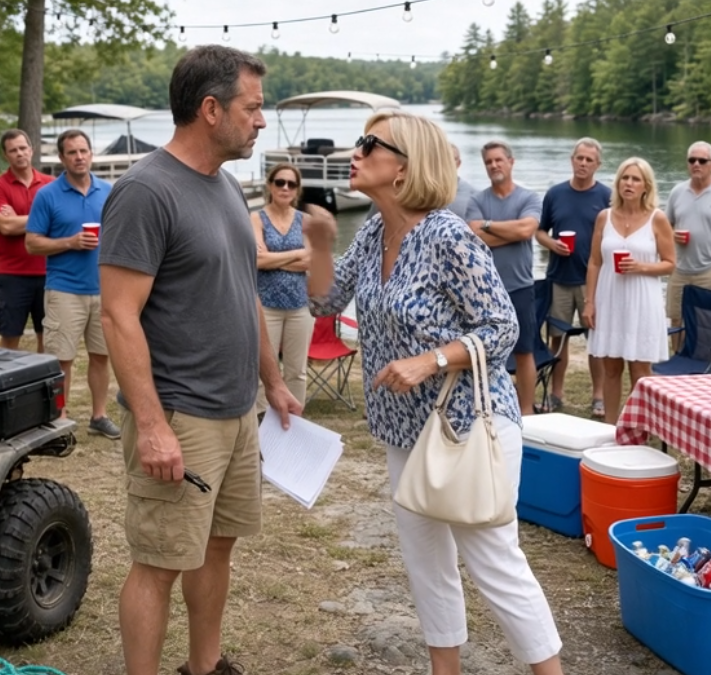
The HOA President Charged 60 People $35 Each to Party on My Private Lakefront—Then She Told Me, “You Don’t Matter Here,” Without Knowing Who She Was Talking To.
She sold tickets to my shoreline like grief had made me invisible.
She put grills on my grass, strangers on my dock, speakers under my oak trees, and a cash box on the picnic table my wife and I built together.
Then she told me I did not matter there—until the sheriff arrived, looked past her sundress and clipboard, and said, “Ma’am, do you understand whose land you’re standing on?”
“Get off my lakefront.”
The woman in the white sundress turned from the cash table like I had interrupted her wedding vows.
Sixty people stood on my grass.
Three grills smoked beside my shoreline.
Kids were jumping off my dock.
A country band was testing speakers under my oak trees.
A metal cash box sat on a folding table beside a printed QR code, and a handwritten sign read:
WEEKEND LAKE BASH
$35 PER PERSON
On my property.
On my shoreline.
On the only piece of peace I had left after burying my wife.
The woman smiled at me like she had been waiting for this moment.
“Your lakefront?”
She laughed loud enough for nearby guests to turn.
“That is adorable.”
I held my coffee cup in one hand and my fishing rod in the other.
“This is my lot.”
“You are trespassing.”
Her sunglasses slid down her nose.
“Honey, I have been running events here for four years.”
“Sixty people paid to be here today.”
“You are just some lonely man living in a cabin.”
“I am asking you politely to leave.”
“Politely?”
She stepped closer.
The smell of sunscreen, lighter fluid, perfume, and lake mud hung between us.
“Let me make this real simple,” she said. “You do not matter here. You never did. Take your sad little fishing rod and go back to your crack shack before I have you removed.”
For a few seconds, I did not answer.
Not because I was afraid of her.
Not because I did not know what to say.
Because my eyes had moved past her shoulder to the picnic table near the oak tree.
My picnic table.
The one my wife, Caroline, and I had built the first summer after we bought the lake lot.
It leaned a little to the left because Caroline insisted she could hold a board steady while laughing at a dragonfly that kept landing on my hat. I told her the table would be crooked forever. She told me crooked things had more personality.
Now two strangers were sitting on it with beer cans beside their shoes.
One of them had carved something into the edge with a pocketknife.
I felt that more than I expected.
That table had survived storms, summer heat, winter ice, and ten years of Caroline setting lemonade pitchers on it while telling me I grilled fish too long.
It had not survived Karen Mallory’s “Weekend Lake Bash.”
I lowered my coffee cup carefully onto the grass.
Then I rested the fishing rod against the side of the dock.
“Who are you?” I asked.
Her smile widened.
“Oh, you really don’t know.”
“No.”
She touched the laminated badge hanging from a lanyard around her neck.
The badge displayed a fake seal, a photo of her, and the words:
KAREN MALLORY
PRESIDENT
LAUREL COVE LAKESIDE HOA
The HOA.
Of course.
Laurel Cove sat on the other side of the access road, a neat little cluster of vacation homes, short-term rentals, boat garages, and lake-view decks owned by people who used words like community character when they meant control. Their decorative entrance sign sat a quarter mile from my cabin, framed by flower beds and solar lanterns.
My lot was not inside Laurel Cove.
It never had been.
PART2:
My cabin had been built in 1968 by a retired lineman who wanted to fish before breakfast and never attend another meeting in his life. The lot sat at the end of a narrow gravel spur outside the HOA boundary, bordered by the lake on one side and county land on the other. It was old, private, and quiet.
That was why Caroline and I had bought it.
The first time she stepped out of the truck and saw the water through the trees, she stopped talking.
Caroline almost never stopped talking.
She had stood there with one hand on the hood, watching sunlight move across the lake, and whispered, “Elias, this is it.”
So we bought it.
Not because it was fancy.
It was not.
The cabin leaned in places. The screen door stuck. The dock needed work. The roof had moss. The kitchen cabinets looked like they had been installed by a man who owned only one level and did not trust it.
But Caroline loved it immediately.
She called it our breathing place.
For twelve years, that lake lot was where we came when the world got too loud.
Then cancer made the world loud in a way no lake could quiet.
After she died, I could not come back for almost a year.
When I finally did, I expected grief.
I expected silence.
I did not expect a woman in a sundress selling tickets to strangers on my grass.
Karen tilted her head at me.
“Laurel Cove manages all lakefront activity on this side of the water.”
“No, it doesn’t.”
“Yes, it does.”
“No,” I said again. “It does not.”
Her smile hardened.
Behind her, a man in a straw hat opened the cash box and dropped bills inside. Someone laughed near the grills. A speaker screeched as the band tested a microphone.
Check one. Check one. Lake Bash, baby.
My jaw tightened.
Karen followed my gaze and looked pleased.
“You’re upsetting my guests.”
“Your guests are on my land.”
“They are community guests.”
“They paid you.”
PART3:
“They paid an event fee.”
“To use my dock.”
“To enjoy HOA-managed lakefront recreation.”
I looked at the dock.
A teenage boy ran to the end and jumped off, cannonballing into the water. Two younger kids cheered from the edge. A woman I had never seen before was spreading towels across the bench where Caroline used to sit with her feet tucked under her.
I raised my voice.
“Everyone needs to get off the dock.”
The band quieted.
A few people turned.
Karen’s smile vanished.
“Do not address my attendees.”
“That dock is private, and I have no idea what condition it’s in under that load.”
A man near the grill shouted, “Lady said it was rented!”
I looked at him.
“She lied.”
The word landed hard.
Karen’s head snapped toward me.
“Excuse me?”
“You heard me.”
A murmur moved through the crowd.
The man at the grill lowered his tongs.
Karen stepped close enough that I could see tiny gold flecks in her sunglasses.
“You need to be very careful.”
“No. You do.”
Her nostrils flared.
“I have insurance.”
“Not for this.”
“I have permits.”
“Not for this.”
“I have county approval.”
“No, you don’t.”
“You don’t know what I have.”
I looked at the cash table, the grills, the band, the folding chairs, the coolers, the kids on the dock, the parking mess along the gravel road, the portable toilet trailer backed halfway into my wildflower patch.
“I know what you don’t have,” I said.
“And what is that?”
“My permission.”
For the first time, anger slipped through her polished face.
She turned sharply toward a man near the cash table.
“Brad!”
A broad man in a navy polo walked over. His shirt said LAUREL COVE EVENT SECURITY across the chest. He wore cargo shorts, mirrored sunglasses, and a radio clipped to his belt.
Not law enforcement.
Not close.
But he walked with the puffed-up confidence of a man who had been told a polo shirt made him important.
Karen pointed at me.
“Remove him.”
Brad looked me up and down.
I was sixty-one years old, wearing faded jeans, an old gray T-shirt, rubber boots, and a ball cap with a sun-bleached brim. I had not shaved in three days. My cabin needed paint. My coffee had gone cold. I looked exactly like what Karen had called me.
A lonely man with a fishing rod.
Brad mistook that for weakness.
“Sir,” he said, “this is a private HOA event.”
“You got one word right.”
His face tightened.
“Which word?”
“Private.”
He stepped closer.
“I’m going to ask you to leave the event area.”
I almost laughed.
Instead, I reached into my back pocket slowly and pulled out my phone.
Karen snapped, “Do not film my guests.”
“I’m documenting trespass, unpermitted commercial activity, possible fraud, property damage, and unsafe use of a private dock.”
Brad’s sunglasses hid his eyes, but his mouth changed.
He had enough sense to hear words like fraud and unsafe differently than Karen did.
Karen did not.
She lifted her chin.
“Call whoever you want. By the time anyone gets here, this event will be over, and you’ll still be the crank in the cabin who tried to ruin a charity fundraiser.”
“Charity?”
She smiled again.
“For lake beautification.”
I looked at the cash box.
“Whose lake?”
“Our lake community.”
I took one step past her toward the sign.
Karen blocked me.
“Do not touch association property.”
I read the smaller line under the ticket price.
Proceeds support Laurel Cove shoreline preservation.
Beside the sign sat a printed QR code taped to a clipboard.
I zoomed my phone camera.
The payment name loaded.
Mallory Events LLC.
Not Laurel Cove HOA.
Not a charity.
Karen’s company.
I looked at her.
She saw my face and knew I had caught something.
“Administrative processor,” she said quickly.
“I didn’t ask.”
“It’s how we manage vendor payments.”
“For your private company.”
Her lips thinned.
Brad shifted his weight.
The crowd had begun to understand that the morning had stopped being a party and started being something they might later have to explain.
I dialed the sheriff’s office non-emergency line.
Karen laughed.
“Oh, please do. Deputy Collins works our events every summer.”
“Good,” I said. “Then he’ll know the address.”
The dispatcher answered.
“County sheriff’s office.”
“This is Elias Ward at 174 Lake Spur Road. I need deputies at my property. Active trespass, unpermitted paid event, approximately sixty people, commercial equipment, children on a private dock, and a security employee threatening removal.”
Karen’s expression changed at the address.
Not enough.
But slightly.
She had spent four years using this land, and I wondered if she had ever bothered learning its real parcel number.
The dispatcher asked, “Is anyone injured?”
“Not yet.”
“Any weapons?”
“None visible.”
“Are you safe?”
I looked at Brad.
“Yes.”
Karen spoke loudly toward the phone.
“This is Karen Mallory, Laurel Cove HOA president. This is a civil misunderstanding. We have full event authorization.”
The dispatcher asked, “Sir, did you say 174 Lake Spur?”
“Yes.”
A pause.
Not long.
Long enough.
“Deputies are being sent.”
“Thank you.”
I ended the call.
Karen crossed her arms.
“There. You’ve performed your little drama. Now leave before you embarrass yourself further.”
“This is my land.”
“No,” she said, louder now, turning so the crowd could hear. “This is community lakefront. This man has been squatting in that broken-down cabin and harassing legitimate Laurel Cove residents for months.”
That was new.
I had spoken to exactly three Laurel Cove residents since returning to the cabin.
One asked if I knew a good bait shop.
One apologized because her dog chased a squirrel into my brush.
One warned me Karen was “a lot.”
Karen raised her voice more.
“He refuses to participate in the community. He refuses to maintain his structure. He refuses to comply with shoreline rules. And now he is trying to shut down a fundraiser for families.”
People like Karen know how to turn an audience into a weapon.
A few guests looked at me with irritation.
A woman near the coolers said, “We paid to be here.”
A man with a sunburned neck added, “Take it up with the HOA, buddy.”
Buddy.
I smiled without humor.
“I am taking it up.”
Karen pointed toward my cabin.
“That structure should have been condemned years ago.”
My cabin.
Caroline’s curtains still hung in the kitchen window.
Her wind chime still turned under the porch roof.
Her blue mug still sat on the shelf because I had never found the strength to move it.
Karen did not know any of that.
She did not care.
To her, grief looked like neglect.
Age looked like weakness.
Quiet looked like permission.
She leaned toward me and lowered her voice again.
“You think because your wife died, everyone has to tiptoe around you forever?”
The world narrowed.
Sound fell away.
The band.
The lake.
The crowd.
Even the kids shouting from the dock.
All of it pulled back until there was only Karen’s face and the sentence she had chosen.
My wife.
She had used my wife as leverage without knowing her name.
Brad heard it.
So did the man at the cash table.
So did a woman standing close enough to cover her mouth.
Karen realized she had gone too far only after the words were already out.
But pride is a terrible editor.
Instead of apologizing, she straightened.
“This community has moved on,” she said. “Maybe you should try it.”
I looked at her for a long moment.
Then I said, “My wife’s name was Caroline.”
Karen blinked.
“And before another word comes out of your mouth, understand something. I have removed armed fugitives from motel rooms, transported cartel witnesses across state lines, stood between judges and men who wanted them dead, and served warrants on people who thought a locked door made them safe.”
Her expression changed.
Finally.
I continued, my voice still quiet.
“So when I tell you to get off my lakefront, Karen, I am not asking because I don’t know what else to do. I am asking because you should be given one clean chance to leave before this becomes everything you cannot control.”
Brad took a step back.
Karen stared at me.
“What are you talking about?”
Before I could answer, the first patrol car came down the gravel spur.
Then a second.
Then a third.
The crowd shifted.
The music stopped completely.
Dust followed the cruisers as they rolled onto the open area near my driveway. The lead car parked beside my truck. The second stopped by the cash table. The third blocked the gravel lane so no one could leave easily.
Deputy Mark Collins stepped out first.
I recognized him.
Karen had been right about one thing.
He had worked Laurel Cove events before.
He was mid-forties, tan, heavyset, and immediately uncomfortable when he saw Karen. That interested me.
“Karen,” he said.
“Deputy Collins, thank God.” She rushed toward him with both arms out as if greeting a rescue party. “This man is disrupting our permitted event and threatening my guests.”
Collins looked at me.
Then he looked at the dock, the cash table, the grills, the band, the crowd, the sign, the QR code, and finally the cabin.
His face tightened.
“Sir,” he said to me, “your name?”
“Elias Ward.”
Collins froze.
Just a fraction.
But I saw it.
Good cops recognize names.
So do bad ones.
He knew mine.
Maybe not from the neighborhood. Maybe from courthouse work. Maybe from a transport detail years earlier. Maybe from the federal building in Atlanta before I retired to Tennessee.
But he knew enough.
Karen saw his hesitation.
“What is wrong with you?” she hissed. “Do your job.”
Collins ignored her.
“Marshal Ward?” he asked carefully.
The word moved through the crowd like wind over dry leaves.
Marshal.
Not park marshal.
Not lake marshal.
Federal marshal.
Karen’s face went blank.
Brad whispered something I could not hear.
I reached into my back pocket again, removed my credential case, and opened it just enough for Collins to see.
“Retired,” I said. “Deputy United States Marshal, twenty-nine years. Property owner, full time.”
Collins swallowed.
“Yes, sir.”
Karen recovered badly.
“Retired?” she snapped. “Then he has no authority here.”
I closed the credential case.
“He doesn’t need federal authority to own land,” Collins said.
That was the first useful thing he had said.
Karen turned on him.
“This is Laurel Cove lakefront.”
“No, ma’am,” I said. “It is not.”
Deputy Collins looked at the second deputy.
“Start clearing the dock.”
Karen’s mouth fell open.
“What?”
Collins raised his voice.
“Everyone off the dock and away from the shoreline until we determine ownership and safety.”
A man near the dock protested.
“We paid!”
Collins looked at him.
“Then you may want a receipt.”
That shut down half the grumbling.
The deputies moved people off the dock. Parents called children out of the water. The band unplugged the speakers. Someone turned off the grills. The party began collapsing under the weight of reality.
Karen grabbed Collins by the sleeve.
He looked down at her hand.
She released it.
“This is outrageous,” she said. “You have worked our events. You know this area is community-managed.”
Collins did not answer.
That told me he had known something was wrong for a while.
Maybe not everything.
Enough.
I said, “Deputy, the deed and survey are inside.”
Karen laughed sharply.
“Of course they are.”
I looked at her.
“I also have cameras.”
She stopped laughing.
“Cameras?”
“Trail cameras. Dock camera. Cabin camera. Driveway camera. I installed them three weeks ago after I found tire tracks by my fire pit and beer cans in Caroline’s garden.”
Karen’s mouth opened.
Closed.
I continued.
“I have footage of at least three prior events. Cash table. QR code. Your SUV. Your company banner. Guests using my dock. Someone cutting the chain on my side gate. Someone dumping trash into my burn barrel. Someone breaking the bench on the dock.”
The man in the straw hat at the cash table slowly stepped away from the box.
Karen’s voice thinned.
“You recorded children?”
“I recorded my private property. You brought children onto it without permission.”
Deputy Collins’s expression darkened.
The other deputies had now cleared the dock. One stood beside the cash table. Another was photographing the sign.
Karen pointed at me.
“This is harassment. This man is unstable. His wife died, and he has been watching people from the woods.”
I saw Collins flinch at the sentence.
Good.
Even he knew she had touched something ugly.
I looked at him.
“Would you like the survey?”
“Yes, sir.”
Karen said, “I demand to see it.”
“No,” Collins said.
She whipped toward him.
“I am HOA president.”
“And you are currently part of an investigation.”
Her face changed.
“Investigation?”
He did not answer.
I walked to the cabin, passing the porch where Caroline’s wind chime moved in the lake breeze. Inside, the house smelled faintly of cedar, old books, and coffee. I took the folder from the top drawer of the desk.
The folder had been Caroline’s idea.
She believed in documents.
I believed in memory.
She said memory did not impress county clerks.
As usual, she was right.
Inside were copies of the deed, survey, tax record, dock permit, shoreline easement map, and the original plat showing the Laurel Cove boundary stopping 312 feet from my lot line.
When I returned, Karen was on her phone whispering harshly.
“…get here now. Bring the board file. No, I don’t care what meeting you’re in. This is an emergency.”
I handed the folder to Collins.
He reviewed it on the hood of his cruiser.
Deputy Angela Reyes joined him.
She had sharper eyes than Collins and less patience for Karen.
Reyes looked at the survey.
Then at the shoreline.
Then at the HOA entrance road visible through the trees.
“This lot isn’t in Laurel Cove,” she said.
“No,” I replied.
Karen snapped, “It is managed recreational frontage.”
Reyes looked up.
“Show me where.”
Karen held out her hand toward the folder.
Reyes did not give it to her.
“Your documents,” Reyes said. “Show me yours.”
Karen looked toward the cash table.
Then toward Brad.
Then toward the road.
For the first time all morning, she had no paper ready.
That is when I understood.
She had never needed paper before.
She had used confidence instead.
For four years, nobody challenged her because people paid, partied, left, and assumed someone else had checked. The HOA residents liked having a lakefront party spot. Guests liked the cheap lake access. Vendors liked getting paid. Deputies doing off-duty traffic work liked easy money. Karen liked cash moving through Mallory Events LLC.
The only person harmed was the old man in the cabin who wasn’t there to complain.
Until I came back.
Reyes turned to Collins.
“This needs CID.”
Collins nodded.
Karen’s voice rose.
“CID? For a property misunderstanding?”
I said, “You sold access to my property for four years.”
Karen pointed at me.
“You abandoned it.”
I stepped closer.
“Say that again.”
She hesitated.
“Excuse me?”
“Say that again with the body cameras recording.”
She looked down.
Both deputies’ cameras were on.
So was my phone.
So were my cabin cameras.
The whole lakefront was finally listening.
Karen’s jaw flexed.
“I mean the property appeared unused.”
“My wife died.”
“That does not give you the right to disrupt established community use.”
There it was.
The argument under every theft.
We got used to taking it, so it became ours.
Deputy Reyes said, “Mrs. Mallory, I would advise you to stop talking until you speak with an attorney.”
Karen recoiled.
“Are you threatening me?”
“No. I’m trying to prevent you from making our reports longer.”
Someone in the crowd laughed.
Only once.
Then stopped when Karen looked over.
The man at the cash table tried to pick up the metal box.
Deputy Reyes saw him.
“Leave that where it is.”
He froze.
“It’s just event money.”
“Yes,” she said. “We noticed.”
By noon, the lake bash was over.
Not paused.
Over.
Deputies collected names from vendors, guests, and staff. Parents wrapped children in towels and left angry, embarrassed, or suddenly very interested in refunds. The band packed equipment in silence. Brad from event security gave a statement in which he insisted he believed Karen had permission. The grill men said they were hired through Mallory Events LLC and had never seen HOA paperwork. The portable toilet driver came back to remove the trailer and accidentally told Deputy Reyes he had serviced “this location for Mallory parties” nine times in two years.
Karen stood near the oak tree, arms crossed, sunglasses back on, performing dignity for an audience that was already leaving.
Then a black pickup arrived.
A man climbed out wearing khakis, deck shoes, and a face full of panic.
“Karen,” he called. “What happened?”
She rushed to him.
“Finally. Tell them.”
The man was Richard Mallory.
Her husband.
Treasurer of Laurel Cove HOA.
Owner, as I later learned, of forty percent of Mallory Events LLC.
He carried a binder.
That binder, I suspect, was supposed to save her.
Instead, it ended her.
Deputy Reyes asked to see the authorization documents.
Richard opened the binder with trembling hands and produced a printed map labeled:
LAUREL COVE COMMON RECREATION ZONE
On the map, my lot had been shaded green.
My cabin had been omitted entirely.
The dock was labeled:
COMMUNITY LAKE ACCESS POINT B
I stared at the map.
So did Collins.
So did Reyes.
“This is not the county plat,” I said.
Richard swallowed.
“It’s an internal HOA planning map.”
“You erased my cabin.”
Karen said quickly, “It was outdated.”
I looked at her.
“No. It was convenient.”
Reyes asked, “Who created this map?”
Richard said nothing.
Karen said, “The previous board.”
Reyes looked at the date in the corner.
It was printed twelve days earlier.
Karen’s face tightened.
Reyes smiled slightly.
Not kindly.
“Twelve days is previous, I guess.”
Richard closed the binder.
Reyes put a hand on it.
“Leave it open.”
He froze.
She looked at Collins.
“Now we definitely need CID.”
The detective arrived at 1:40.
Detective Luis Herrera.
Calm, compact, and allergic to lies.
He asked me to walk him through everything from the beginning.
So I did.
I told him about returning to the cabin after Caroline’s death.
About finding beer cans in the fire pit.
About tire tracks by the garden.
About hearing music from the lake one Saturday when I arrived late and seeing the last cars pulling away.
About installing cameras.
About discovering online posts advertising “exclusive private lake bash access” through Mallory Events LLC.
About waiting until I could document an active paid event because one trespass complaint might become a warning, but a commercial event with ticket sales, vendors, and a fabricated HOA map would become something harder to wave away.
Detective Herrera took notes.
“You knew they’d be back today?”
“Yes.”
“How?”
I showed him the screenshot.
Weekend Lake Bash
Laurel Cove Private Shoreline
Limited Spots
$35 Advance / $45 Gate
Hosted by Mallory Events
At the bottom:
No outside alcohol. Children welcome. Dock access included.
Herrera looked at Karen.
She was watching us from under the oak tree.
“You were going to let it happen?”
“I was going to let evidence happen.”
He looked back at me.
“Marshal thinking.”
“Widower patience.”
He nodded once.
That was the first time anyone had recognized both parts.
Not just the lawman.
Not just the grieving man.
Both.
By three o’clock, Karen and Richard were no longer speaking without their attorney. The cash box, QR code sign, event binder, vendor contracts, and one laptop from the check-in table were collected under warrant. Deputies photographed damage to the dock, ruts in the grass, scorch marks near the grills, broken branches under the oaks, trash left near the shoreline, and the carving on Caroline’s picnic table.
That carving read:
K + B 4EVER
I hoped K and B broke up by Tuesday.
Petty, yes.
Understandable, also yes.
When the last cruiser left, the lakefront looked wrong.
Quiet, but not peaceful.
Trash bags lined the driveway. Grass was flattened where people had stood. The air smelled like smoke and spilled beer. A red plastic cup floated near the dock until I hooked it with my fishing rod and threw it into a trash bag.
I stood under the oak trees as the sun lowered.
Caroline’s table sat crooked in the grass.
More crooked now.
The carved letters cut pale into the old wood.
I ran my fingers over them once.
Then I sat down.
For the first time that day, I felt tired.
Not angry.
Not alert.
Tired in the deep way grief returns after adrenaline leaves.
I heard tires on gravel and looked up.
Deputy Reyes had come back.
She walked across the grass carrying two bottles of water.
“Thought you might need one,” she said.
I took it.
“Thanks.”
She looked at the table.
“That yours?”
“My wife and I built it.”
Her face softened.
“I’m sorry.”
“For the table?”
“For all of it.”
I nodded.
Sometimes that is the only answer available.
She sat on the other end of the table without asking. I appreciated that.
After a minute, she said, “You really were a marshal?”
“Twenty-nine years.”
“Retired?”
“Yes.”
“Miss it?”
“No.”
“Liar.”
I almost smiled.
“Sometimes.”
She looked out at the water.
“My dad was a deputy in Polk County. Retired after thirty-one years. First month home, he reorganized the garage seven times and tried to label the refrigerator shelves.”
“Sounds about right.”
“Mom threatened to make him apply for a job.”
“That also sounds right.”
Reyes looked back at the shoreline.
“You handled today better than I would have.”
“No, I didn’t.”
She glanced at me.
“I wanted to throw them in the lake.”
She smiled.
“But you didn’t.”
“I’m old. My knees require strategic anger.”
That got a laugh from her.
Then she grew serious.
“We’ll follow the money.”
“You should.”
“This won’t just be trespass.”
“No.”
She stood.
“Lock your gate tonight.”
“I will.”
“And Mr. Ward?”
“Yes?”
“Don’t let them make you feel like your grief made you weak.”
I looked at her.
She gave a small shrug.
“People like Karen aim at whatever looks tender. Doesn’t mean they’re strong. Means they’re cruel.”
Then she walked back to her cruiser.
I sat there long after she left.
The investigation took four months.
It became uglier than the lake bash.
Mallory Events LLC had collected more than $86,000 over four summers using my lakefront lot as the main attraction. Weekend bashes. Sunset socials. Paddleboard clinics. Fireworks viewings. Private rental packages. Even one “exclusive lakeside wedding rehearsal dinner,” which explained the stack of white chairs I had once found behind the storage shed.
Laurel Cove residents had received discounted tickets.
Nonresidents paid full price.
Karen and Richard told everyone the money supported shoreline beautification, community maintenance, and lake preservation. In reality, most payments went straight to Mallory Events. A smaller portion moved through an HOA “recreation enhancement” account that Richard controlled. Some vendors were paid in cash. Insurance certificates listed the event location as “Laurel Cove Common Area,” supported by the fabricated map.
The actual county plat said otherwise.
Over and over.
My lot.
My dock.
My shoreline.
My taxes.
My liability.
My dead wife’s garden trampled by strangers with wristbands.
The civil suit came first.
My attorney, Nora Whitcomb, had a voice like warm tea and a litigation style like a bear trap.
At our first meeting, she reviewed the documents in silence.
Then she looked up.
“Mr. Ward, do you want quiet compensation or public correction?”
“What’s the difference?”
“Quiet compensation gets you money faster. Public correction makes them admit what they did.”
I thought of Karen saying, You do not matter here.
“Public correction.”
Nora smiled.
“I was hoping you’d say that.”
We sued Karen, Richard, Mallory Events LLC, Laurel Cove HOA, and the management company that had ignored at least two owner complaints about “events near the old Ward cabin.”
The complaint included trespass, conversion, unjust enrichment, property damage, nuisance, fraud, and false commercial representation.
Nora added a line I loved:
Defendants monetized Plaintiff’s private grief space as if abandonment were a transferable property interest.
I told her Caroline would have liked that sentence.
Nora said, “Then we keep it.”
Criminal charges followed.
Not as many as people online demanded once the story got out, but enough.
Karen and Richard were charged with fraud-related counts, criminal trespass connected to repeated commercial use, falsification of documents, and tax-related referrals. The cash handling brought in state revenue investigators. The fake insurance location triggered another investigation. The HOA board tried to distance itself until emails showed two board members knew the map was “legally questionable” but approved event promotion because, in one member’s words, “the old cabin guy never shows.”
The old cabin guy.
That phrase went into the lawsuit too.
Laurel Cove erupted.
Not because everyone cared about my property.
Some did.
Many cared because their dues had supposedly funded lake access they now learned did not belong to them.
Some residents were furious at Karen.
Some were furious at me for “taking away” the lakefront events.
One woman wrote me a letter saying her children had made priceless memories on my dock and I should be ashamed for involving police.
I wrote back one sentence:
They were priceless to you because I was unknowingly paying the price.
Nora told me not to send letters anymore.
At the first court hearing, Karen saw me in a suit.
I had not worn one since Caroline’s funeral.
The weight of it made me irritable.
Karen stood outside the courtroom with her attorney, wearing navy instead of white, pearls instead of sunglasses, and an expression built from injured innocence.
When she saw me, she said, “This could have been handled neighbor to neighbor.”
I stopped.
Turned.
For a moment, her attorney looked like a man seeing a train headlight.
“Karen,” he said quietly.
She ignored him.
“You ruined people’s summer over a misunderstanding.”
I looked at her.
“A misunderstanding is when someone parks in the wrong driveway. You sold tickets to my land for four years.”
She raised her chin.
“You weren’t using it.”
“My wife was dead.”
Her face twitched.
I stepped closer, lowering my voice.
“You saw an empty chair and thought it meant no one owned the table.”
For once, she had no reply.
Inside the courtroom, things moved the way legal things do.
Slowly.
Precisely.
Without the emotional rhythm victims want.
The judge did not care about my grief the way I did.
That is not criticism.
Judges cannot afford to feel everything fully.
The judge cared about deeds, plats, payments, maps, emails, insurance documents, and whether Karen had knowingly represented private property as HOA-managed recreational frontage.
She had.
The key evidence was not my testimony.
It was Richard’s email.
Sent to Karen two years earlier after a vendor asked for proof of site authorization.
K,
Technically Ward lot is separate parcel. Since owner absent and Laurel Cove has used lake strip for years, we can treat as customary access unless challenged. Avoid putting parcel number on public docs.
Karen replied:
Agreed. No one cares about the cabin. Keep map simple.
No one cares about the cabin.
I read that line maybe thirty times.
Each time, the anger felt different.
The first time, hot.
The tenth, cold.
The thirtieth, sad.
Because Caroline had cared.
I had cared.
The cabin had held birthdays, anniversaries, terrible pancakes, rainstorms, arguments, apologies, and one final spring afternoon when Caroline sat on the dock wrapped in a blanket and said, “Promise me you’ll come back here after.”
I promised.
Then failed for nearly a year.
Karen mistook that absence for opportunity.
The settlement conference happened in December.
Nora sat beside me.
Karen and Richard sat across from us with two attorneys and faces drawn tight by months of public humiliation. Laurel Cove’s insurance representative looked like she wanted to dissolve into the wall. The HOA board’s new president attended in person and did not make eye contact with anyone.
They offered money.
A lot of money.
Nora wrote the number on a pad and slid it to me.
I looked at it.
Then at Karen.
“No.”
Her attorney sighed.
Nora did not react.
She already knew.
The attorney said, “Mr. Ward, this is a substantial settlement.”
“I’m aware.”
“What more do you want?”
“Public admission. Written correction to every person who bought a ticket. Refunds. Restitution for property damage. Permanent boundary signage paid by Laurel Cove. Removal of every fabricated map. Resignation of all board members who approved or concealed use of my lot. And Karen and Richard barred from managing HOA funds or events.”
Karen leaned forward.
“You want to destroy us.”
“No,” I said. “I want to make sure you can’t keep profiting from pretending other people don’t exist.”
Richard looked down.
Karen’s attorney whispered to her.
She shook her head.
“No public admission,” she said.
Nora closed her folder.
“Then we try it.”
Karen blinked.
Nora stood.
“I enjoy juries,” she said.
She did.
That was the problem for Karen.
Three weeks later, they agreed.
The public statement ran in the county paper, on the Laurel Cove website, and by direct email to everyone who had purchased tickets through Mallory Events.
It said, in part:
Mallory Events LLC and certain former representatives of Laurel Cove Lakeside HOA acknowledge that events advertised as taking place on Laurel Cove-managed lakefront were held on privately owned property belonging to Elias Ward without lawful permission. The property was never owned, leased, managed, or controlled by Laurel Cove HOA. Ticket purchasers were misinformed. Mr. Ward did not authorize public or commercial use of his land, dock, shoreline, or facilities.
I framed a copy.
Not because I needed to see Karen apologize.
Because I needed to see the word privately.
Privately owned property.
Not abandoned.
Not community-managed.
Not customary access.
Mine.
The refunds were ugly.
People complained.
Some demanded reimbursement for travel, food, coolers, sunscreen, emotional distress, and “lost lake memories.”
Nora said no to almost all of it.
Mallory Events dissolved.
Richard resigned as HOA treasurer.
Karen resigned as HOA president before the board could remove her.
Two board members followed.
The management company lost the Laurel Cove contract.
The criminal case ended in pleas to reduced charges, fines, probation, restitution, and tax penalties. Karen avoided jail, which disappointed the internet more than it disappointed me. I had spent enough of my career around custody to know it does not fix everything people want it to fix.
What mattered more was that she lost the thing she valued most.
Authority.
No more badge.
No more cash table.
No more maps.
No more standing on land that was not hers and telling the owner he did not matter.
The restoration took longer than the lawsuit.
I repaired the dock first.
Not upgraded.
Repaired.
New boards where needed. Reinforced posts. Better ladder. Stronger bolts. A gate at the top with a sign:
PRIVATE DOCK
NO PUBLIC ACCESS
NO EVENTS
Then the grass.
Then the fire pit.
Then Caroline’s garden.
That was hardest.
Her little patch near the cabin had been wild by the time I returned. Lavender, coneflowers, rosemary, black-eyed Susans, and herbs that refused to die even when neglected. Party guests had trampled half of it. Someone had stuck a tiki torch in the middle and burned a circle into the soil.
I knelt there one morning with gloves, a trowel, and no idea what I was doing.
Caroline had been the gardener.
I was the man who carried mulch.
Deputy Reyes came by with a bag of compost and three lavender plants.
“You garden?” I asked.
“No,” she said. “But my mother does, and she said a grieving man with a trowel is a community emergency.”
That sounded like something Caroline would have said.
So I let Reyes help.
We worked for two hours.
Mostly wrong, probably.
But honestly.
When we finished, the garden looked bare but intentional.
That was enough.
The picnic table stayed crooked.
I sanded out the carved letters as best I could. They did not disappear completely. Wood remembers. But the scar faded into grain.
I considered replacing the table.
Could not do it.
Instead, I added a small brass plate underneath where only someone sitting close would see.
Caroline Ward
Builder of Crooked Tables
Keeper of This Shore
The first morning I fished again, fog lay low over the lake.
No music.
No grills.
No strangers.
Just water, birds, and the old dock creaking under my boots.
I carried coffee in Caroline’s blue mug, which I had finally taken off the kitchen shelf and washed. I sat on the bench where she used to sit and watched the sun climb over the tree line.
For a while, I did not cast.
I just sat.
People think peace is quiet.
It is not.
Peace is belonging to the quiet.
For four years, while I stayed away, Karen had filled this place with noise and called it community. She had sold what she did not own, laughed at what she did not understand, and mistaken grief’s absence for surrender.
But the lake had waited.
The cabin had waited.
Even the crooked table had waited.
I cast once.
Badly.
Caroline would have mocked me.
I smiled for the first time in a way that did not hurt.
A few months later, Laurel Cove installed a new sign near their walking path facing my boundary.
PRIVATE PROPERTY BEYOND FENCE
NO HOA OR EVENT ACCESS
RESPECT NEIGHBORING LANDOWNERS
It was plain.
Boring.
Beautiful.
The new HOA president, a retired accountant named Denise Alvarez, came personally to tell me before it went up.
“We should have done this years ago,” she said.
“Yes.”
She winced.
“I deserved that.”
“You did.”
She nodded.
“I also brought something.”
From her tote bag, she pulled out an envelope.
Inside were printed copies of every old online event page, stamped VOID, and a USB drive containing the deleted website files for my records.
“We’re trying to clean everything out,” she said.
“Good.”
“I know this doesn’t fix it.”
“No.”
“But we are sorry.”
I looked at her.
She did not rush to fill the silence.
That made me believe her more than the apology.
“Thank you,” I said.
She turned to leave, then stopped.
“Mr. Ward?”
“Yes?”
“Some residents want to know if there’s any possibility of lawful access someday. Paid. Limited. Proper contract. Insurance. Whatever you require.”
I looked past her at the lake.
At the dock.
At the table.
At Caroline’s garden.
“No.”
She nodded once.
No argument.
No pressure.
No community language.
Just acceptance.
That felt like real change.
“No,” she said softly, “is a complete answer.”
“Yes,” I replied. “It is.”
The following spring, I hosted exactly one gathering on the lot.
Not public.
Not paid.
Not advertised.
Deputy Reyes came.
Detective Herrera came.
Nora came with her husband and two daughters.
Mrs. Whitcomb from the next county came because she had heard the story through a friend and wrote me a letter about losing her own husband; she brought peach cobbler and cried when she saw the lake.
Denise Alvarez came too, as a neighbor, not HOA president.
There were maybe twelve people total.
I grilled fish too long.
Caroline would have been vindicated.
We ate at the crooked picnic table.
Nobody carved anything into it.
At sunset, I stood near the dock and looked at the people gathered on the grass. Quiet people. Invited people. People who knew why the place mattered.
For so long, I had believed returning to the cabin meant returning to loss.
But that evening, I understood something else.
A place can hold grief and still make room for life.
What Karen had stolen was not only land use.
It was the meaning of the place.
She turned Caroline’s shore into a commodity.
A ticketed view.
A backdrop for other people’s weekends.
Taking it back required law, yes.
Surveys.
Warrants.
Depositions.
Settlement terms.
But restoring it required something quieter.
Coffee at sunrise.
Lavender in burned soil.
A crooked table repaired instead of replaced.
A fishing rod in my hand.
The word no spoken without apology.
Months later, I saw Karen once.
At the county courthouse.
She was leaving a hearing related to the tax penalties. Her hair was shorter. No sundress. No sunglasses. No laminated badge.
She saw me near the security line.
For a moment, I thought she might say something.
She did not.
Then, because some people cannot help touching the stove again, she spoke as she passed.
“I hope that empty lot keeps you company.”
I looked at her.
The old anger stirred.
But it had less room now.
“No,” I said. “It keeps its promises.”
She frowned, not understanding.
That was fine.
Not everything is for Karen Mallory to understand.
I drove back to the cabin that afternoon.
The road curved through pines and sunlight. The Laurel Cove sign passed on my left. Their flower beds were neat. Their walking path clean. Their clubhouse freshly painted.
Then I turned onto the gravel spur.
My gravel spur.
The tires crackled over stone.
The lake appeared through the trees, silver under the late-day sky. The cabin waited at the end, old and imperfect and mine. Caroline’s wind chime moved under the porch roof.
I parked.
Walked down to the shoreline.
Unlocked the dock gate.
Sat on the bench.
Across the water, laughter carried faintly from somewhere far enough away to belong to someone else.
That was all right.
The lake was big.
My lot was small.
But small does not mean available.
Quiet does not mean abandoned.
Grief does not mean weak.
And a man alone with a fishing rod may still know exactly where every line is drawn.
Karen Mallory had hosted weekend bashes on my lakefront for four years because she believed no one who mattered would stop her.
She was wrong.
The land mattered.
Caroline mattered.
I mattered.
And when the law finally arrived, the first thing it did was not shout, threaten, or perform.
It looked at the survey.
Because sometimes justice begins with a simple line on paper.
One side was Laurel Cove.
The other side was mine.
And no amount of music, money, sunglasses, fake maps, or HOA confidence could move that line one inch.








