The HOA President Called 911 the Moment I Opened My Garage and Screamed That My Porsche Was Hers—Then She Pulled Out a “Purchase Contract” I Had Never Seen Before.
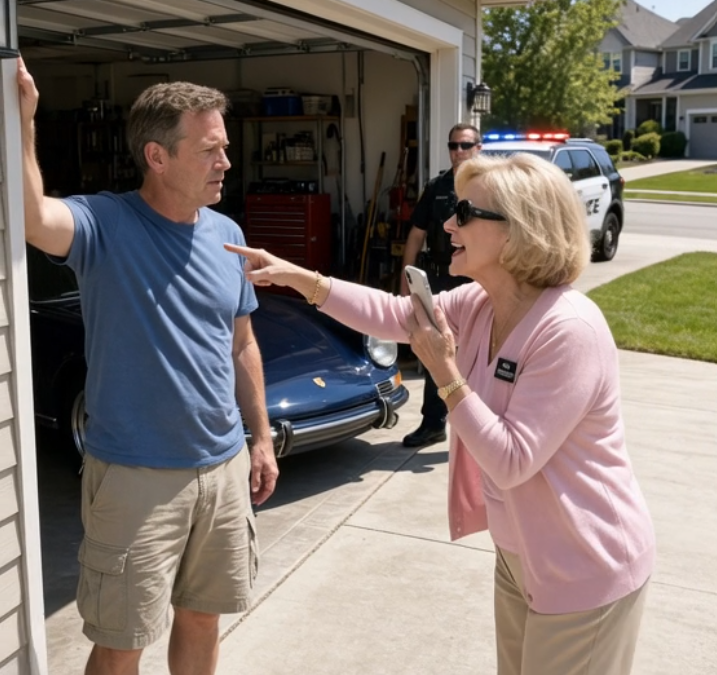
The HOA President Called 911 the Moment I Opened My Garage and Screamed That My Porsche Was Hers—Then She Pulled Out a “Purchase Contract” I Had Never Seen Before.
The first time Rebecca Whitmore tried to steal my Porsche, she brought four police cruisers and a forged purchase contract.
The second time, she brought a tow truck, a fake lien, and enough gasoline to burn my house to the foundation.
By the time I learned why she was obsessed with my car, three families had already lost their homes, her husband had been dead for five years, and I had become the next man she intended to bury.
My name is Daniel Morrison.
I was thirty-five years old when I moved into Willowbrook Heights, a quiet-looking suburban development outside Dallas.
At least, it looked quiet from the real-estate photographs.
The neighborhood had tree-lined streets, stone entry signs, identical black mailboxes, and enough decorative ponds to make every listing use the phrase “resort-style living.” It seemed like the right place to disappear for a while.
My divorce had been finalized two months earlier.
There had been no affair, no screaming match, no dramatic betrayal that would have made the story easy to explain. My marriage simply wore itself down beneath years of long workdays, missed dinners, delayed conversations, and the exhausting politeness of two people who had stopped fighting because fighting still required hope.
Allison told me she felt lonelier sitting beside me than she would living alone.
I wanted to argue.
Instead, I realized she was right.
So I signed the papers, left her the downtown house, and bought a smaller place in Willowbrook Heights.
The house sat at the end of a cul-de-sac, tucked behind two live oaks and a row of hedges trimmed so perfectly they looked computer-generated. It had three bedrooms, a kitchen too large for one man, a home office with south-facing windows, and a private two-car garage connected directly to my workspace.
That garage mattered.
I worked as a freelance architect, and I kept expensive equipment inside: drafting monitors, laser measuring tools, model supplies, a 3D printer, old project files, and enough computers to make the average burglar feel inspired.
But the garage mattered for another reason too.
The car.
A black Porsche 911 Turbo.
I had wanted one since college, back when my entire financial plan consisted of instant noodles, scholarship money, and the hope that somebody would eventually pay me to draw buildings.
After the divorce, I told myself I deserved one irresponsible decision.
Some men bought motorcycles.
Some booked trips to tropical islands.
Some adopted emotional support hobbies involving golf clubs and bad decisions.
I bought German engineering with an unnecessarily powerful engine and seats that seemed designed specifically to punish anyone carrying more than ten pounds of body fat.
I loved it.
The car was not a substitute for my marriage.
It was not therapy.
It did not repair anything broken inside me.
But on certain mornings, when the road was empty and the engine settled into that deep mechanical growl, I remembered what it felt like to enjoy something without explaining why.
That alone was worth more than I wanted to admit.
The trouble began on a Saturday in early January.
I had a downtown meeting with a client who wanted me to redesign an old warehouse into luxury apartments. At seven in the morning, I walked into the garage carrying coffee in one hand and my laptop bag in the other.
I pressed the opener.
The metal door rolled halfway up.
Then I saw a woman standing directly in front of it.
She held her phone horizontally, recording me.
She wore a bright pink velour tracksuit, white sneakers, and enough hairspray to survive a tornado. Her blond hair rose above her head in a stiff wave. A laminated card hung from her neck on a red lanyard.
REBECCA WHITMORE
WILLOWBROOK HEIGHTS HOA PRESIDENT
Most residents called her Becky.
I had met her once during closing.
PART2:
She had handed me a welcome packet thick enough to stop a bullet and warned me that visible garbage cans could reduce neighboring property values. At the time, I assumed she was merely enthusiastic in the way HOA presidents sometimes are when they mistake mailbox uniformity for civilization.
That morning, her eyes were wide and unfocused.
“Do not move,” she screamed.
I stopped with the coffee mug halfway to my mouth.
“Good morning to you too.”
“I am recording this theft.”
“What theft?”
She swung the phone toward my Porsche.
“That car.”
“My car?”
Her mouth twisted.
“Do not play games with me.”
I looked behind me, then back at her.
“I’m sorry. Who exactly are you accusing of stealing my car from my garage?”
“You are in possession of a stolen vehicle.”
I stared.
The garage door hummed faintly overhead, still half-open. Cold January air slid beneath it and wrapped around my ankles.
“Rebecca,” I said slowly, “you need to move away from my garage door.”
“I have already called the police.”
Of course she had.
Behind her, down the cul-de-sac, I saw two neighbors standing in bathrobes near their driveway. Another front door cracked open. Curtains moved. Willowbrook Heights had the alert system of a prairie dog colony whenever drama appeared before breakfast.
“Why did you call the police?” I asked.
She lifted her chin.
“Because that Porsche belongs to the Whitmore estate.”
I laughed.
I did not mean to.
It just came out.
PART3:
Rebecca’s face reddened.
“This is not funny.”
“No,” I said. “It’s insane.”
She shoved a folder toward the gap beneath the garage door as if paperwork could crawl in and arrest me.
“I have documentation.”
“I have a title.”
“I have a purchase contract.”
“For my car?”
“For my late husband’s car.”
That was the first time she said it.
Late husband.
I did not know then what those words meant in her head.
I did not know about Eric Whitmore, the man whose portrait still hung above her fireplace five years after his funeral. I did not know about the fire on Balsam Court, or the foreclosure on Lot 17, or the insurance investigator who had retired early after a heart attack and left questions unfinished in a cardboard box.
I knew only that my HOA president was standing in my driveway at seven in the morning, filming me like she had caught me robbing myself.
“I bought this Porsche from a dealer in Plano six months ago,” I said. “Clean title. Texas registration. Insurance in my name.”
“Because you laundered it through a dealer.”
That sentence made my eyebrows lift.
“Laundered it?”
“You people always think paperwork hides sin.”
“You people?”
She ignored that.
At the end of the cul-de-sac, a police cruiser turned in.
Then another.
Then two more.
Four police cruisers rolled down my quiet street because Rebecca Whitmore had apparently convinced dispatch that a black Porsche in a garage required a tactical neighborhood response.
I set my coffee on the workbench.
Then I took out my phone and started recording too.
Rebecca smiled when she saw the first officer step out.
It was the smile of someone who believed authority was a vending machine: insert outrage, receive obedience.
The first officer was tall, Black, and looked old enough to have heard every absurd property dispute in Dallas County twice. His nameplate read HENDERSON. Behind him came a younger officer, then two more. None of them looked happy to be standing in a cul-de-sac over a sports car at sunrise.
Officer Henderson looked from Rebecca to me.
“Who called?”
“I did,” Rebecca announced. “I am Rebecca Whitmore, president of Willowbrook Heights HOA. This man is in possession of my deceased husband’s stolen Porsche.”
I leaned against the workbench.
“Officer, my name is Daniel Morrison. This is my house. That is my car. I have the title inside.”
Rebecca swung her phone toward me.
“He is lying.”
Henderson looked at her.
“Ma’am, please lower your voice.”
“She has been screaming in my driveway for ten minutes,” I said.
“I have not been screaming. I have been documenting.”
“She called my garage opening a theft.”
Officer Henderson took a slow breath.
“Mr. Morrison, do you have proof of ownership?”
“Yes.”
“Can you get it?”
I looked at Rebecca.
“Is she going to stay out of my garage while I do?”
Henderson turned to her.
“Ma’am, step back from the garage.”
“This is association business.”
“This is police business now. Step back.”
She did, but barely.
I went inside and got the title packet from my office safe. Divorce had made me organized in a way marriage never had. I had folders for everything now: house documents, insurance, taxes, client contracts, vehicle paperwork. Allison used to handle half of that. Losing a marriage teaches you quickly how many invisible systems love used to maintain.
When I returned, Henderson was looking at Rebecca’s folder.
His expression was neutral, but the younger officer beside him looked confused.
I handed him my title, purchase paperwork, registration, and insurance card.
He compared documents.
Rebecca watched with furious confidence.
“Officer,” she said, “my contract predates his title.”
Henderson did not look up.
“This purchase contract says Eric Whitmore sold a 2018 black Porsche 911 Turbo to Rebecca Whitmore for one dollar on March 3 of this year.”
“Yes.”
“Ma’am,” Henderson said carefully, “you said Eric Whitmore is your late husband.”
“That is correct.”
“When did he pass?”
Her jaw tightened.
“Five years ago.”
The younger officer’s eyes flicked to me.
I looked away because I did not trust my face.
Henderson blinked once.
“Your husband signed a vehicle purchase contract this year despite passing away five years ago?”
Rebecca’s lips thinned.
“It was part of the estate. The date reflects processing.”
“It has a signature.”
“He signed transfer documents before death.”
“That are dated this year.”
“The attorney handled it.”
“What attorney?”
She hesitated.
“Estate counsel.”
“Name?”
Her nostrils flared.
“I do not have to provide that in my own neighborhood.”
Henderson closed the folder.
“Ma’am, this does not establish ownership of Mr. Morrison’s vehicle.”
“You haven’t even run the VIN.”
“We will.”
He did.
The VIN matched my Porsche.
My title.
My dealer purchase.
My registration.
No theft report.
No lien.
No estate claim.
No Whitmore connection.
Rebecca stood there on my driveway as the facts quietly walked past her and refused to kneel.
Officer Henderson handed back my documents.
“Mr. Morrison, everything checks out.”
“Thank you.”
Rebecca stepped forward.
“No. That is impossible.”
Henderson turned to her.
“Ma’am, do not make another false report regarding this vehicle.”
Her eyes widened.
“False report?”
“Yes.”
“I am the victim here.”
“You are not the listed owner. The vehicle is not stolen. You provided a document with a deceased person’s signature dated years after death. I strongly suggest you speak to an attorney before making further claims.”
For the first time that morning, Rebecca looked uncertain.
Not scared.
Just thrown off balance.
Then her eyes found the Porsche again.
That strange unfocused hunger returned.
“He promised me,” she whispered.
Nobody responded.
Because none of us knew what to do with that.
Officer Henderson noticed though.
So did I.
The officers left after taking statements. Henderson gave me his card before he went.
“If she comes back,” he said quietly, “call before engaging.”
“You think she will?”
He looked down the street, where Rebecca was storming toward her house with her folder clutched under one arm.
“Yes.”
That was not comforting.
I missed my downtown meeting.
My client was annoyed until I explained that the HOA president had called police because she believed my Porsche belonged to her dead husband.
He laughed for forty-five seconds and rescheduled.
I did not laugh.
Something about Rebecca’s face stayed with me.
Not the anger.
Anger I understood.
It was the certainty underneath it. The way she looked at my car not like she wanted it, but like it had betrayed her by being in my garage.
That afternoon, I read the Willowbrook Heights HOA packet more carefully.
Rebecca Whitmore was not just president.
She was the entire gravitational field.
Her name appeared everywhere.
Architectural Review Committee.
Landscape Standards Subcommittee.
Violation Appeals Chair.
Security Liaison.
Community Safety Coordinator.
Welcome Committee.
Newsletter Editor.
She had been president for four consecutive terms, though the bylaws limited presidents to two. There was a note in the last annual meeting minutes stating that “due to lack of alternative candidates, term restrictions were waived by unanimous consent.”
Unanimous consent usually means nobody wants to fight the person holding the clipboard.
I checked the neighborhood forum.
Rebecca posted constantly.
Reminders about trash cans.
Warnings about unapproved holiday decorations.
Photos of cars parked too long on streets.
Messages about “maintaining our community’s legacy.”
That phrase appeared often.
Our community’s legacy.
Property values.
Standards.
Security.
Legacy.
I found one old post from three years earlier about a house fire on Balsam Court.
Tragic loss last night at the Patterson residence. Please keep the family in your thoughts. The HOA will coordinate cleanup expectations once emergency services conclude their investigation.
Cleanup expectations.
Their house had burned, and Rebecca was already thinking about expectations.
I scrolled further.
Another fire, two years earlier.
A garage fire on Larkspur Lane.
Another, eighteen months after that, on Willowbend Drive.
Three fires.
Three families gone.
All described as unfortunate, disruptive, and requiring rapid restoration to protect neighboring values.
I told myself not to make patterns where none existed.
Divorce had left me too much time alone with thoughts.
Still, I bookmarked the posts.
That evening, my neighbor from across the cul-de-sac walked over while I was checking the mailbox.
His name was Sam Delgado. Retired firefighter. Sixty-eight. White beard. Limp in his left leg. The kind of man who looked like he had no interest in neighborhood politics until politics got too close to something combustible.
“You met Becky,” he said.
“That what we’re calling this morning?”
He looked toward her house two streets over.
“She’s not right about that car.”
“I noticed.”
“No,” Sam said. “I mean she’s really not right about it.”
I waited.
Sam lowered his voice.
“Her husband, Eric, had a black Porsche. Older model. He died in it.”
My skin prickled.
“In a crash?”
“Fire.”
The word sat between us.
“He was found off Route 9,” Sam said. “Car burned. Official report said single-vehicle accident, fire after impact. This was five years ago.”
I looked back at my closed garage.
“My car isn’t his.”
“I know.”
“Does she?”
Sam sighed.
“That depends on the day.”
I studied him.
“You think she believes my Porsche is her husband’s car?”
“I think she believes a lot of things when it helps her avoid the truth.”
“What truth?”
He looked toward the decorative pond at the end of the cul-de-sac.
“Eric was leaving her.”
That changed the temperature of the conversation.
Sam continued, “People don’t talk about it much because Becky made sure they didn’t. But he had packed a bag. There were rumors. Divorce attorney. Hidden accounts. Maybe another woman, maybe not. Then he died. After that, Becky turned the HOA into… whatever this is.”
“A kingdom.”
“A bunker,” Sam said.
I looked at him.
He pointed toward my garage.
“That car is a ghost to her.”
I should have taken that more seriously.
Instead, I thought the police warning would be enough.
It was not.
For the next two weeks, Rebecca escalated in small, irritating ways.
First came an HOA violation letter.
GARAGE DOOR OPENED BEYOND REASONABLE ACCESS PERIOD.
I read it three times because I thought I had misunderstood.
According to Rebecca, my garage door had remained open for “approximately nine minutes” during the police response, exposing “stored items and a noncompliant vehicle aesthetic inconsistent with Willowbrook Heights presentation standards.”
I sent a polite response asking which bylaw regulated vehicle aesthetics inside a private closed garage.
She did not answer.
Then came another violation.
EXCESSIVE ENGINE NOISE.
The Porsche had been started at 7:12 a.m. on a weekday, creating “disturbance incompatible with quiet enjoyment.”
I had not driven the Porsche that morning.
I sent a screenshot from my security camera showing the car under a cover in the garage all day.
No response.
Then a third.
UNREGISTERED COMMERCIAL ACTIVITY.
Because I worked from home.
I replied with the bylaw section allowing home office use without client traffic.
No response.
Rebecca did not want compliance.
She wanted pressure.
I installed two more exterior cameras.
I also called Officer Henderson and told him about the letters.
He listened quietly.
“Document everything,” he said.
“I am.”
“Good. But Mr. Morrison?”
“Yes?”
“Do not underestimate someone who has made a fantasy part of her identity.”
That sentence kept me awake longer than I liked.
The second major incident happened on a Thursday night.
It was 11:38 p.m.
I remember because I had fallen asleep on the couch with architectural drawings open on my laptop and woke to my phone buzzing with a motion alert.
GARAGE CAMERA: MOVEMENT DETECTED.
I opened the feed.
A tow truck was backing into my driveway.
No lights except the amber bar.
Behind it stood Rebecca Whitmore in a navy tracksuit, hair sprayed high even at midnight, holding another folder.
Two men climbed out of the tow truck.
One started lowering the flatbed.
I was out the door in under thirty seconds.
“What are you doing?” I shouted.
The tow driver froze.
Rebecca turned with an expression of triumph so pure it almost looked childlike.
“Enforcing a lien.”
I stared at her.
“What lien?”
She held up papers.
“HOA recovery lien for unpaid fines, storage violation penalties, legal administrative fees, and vehicle nuisance abatement.”
The tow driver looked between us.
“Ma’am,” he said to Rebecca, “you said this was a repossession.”
“It is.”
I walked toward him.
“It is not. This car is in my garage, on my property, with no lien, no repossession order, and no court judgment.”
Rebecca snapped, “He is lying. He is in violation of association rules.”
The driver swallowed.
He was maybe thirty, heavyset, exhausted, and clearly not paid enough to get shot over suburban paperwork.
“Sir, she had documents.”
“Did she have a court order?”
“No, but—”
“Did she show proof of secured lien on the vehicle title?”
He looked at Rebecca.
“She said HOA liens transfer to personal property.”
I almost laughed again.
This time it was less funny.
“HOA liens do not let her tow a car out of my attached garage at midnight.”
Rebecca stepped forward.
“You owe this association $18,640.”
“I owe this association nothing.”
“You refused to cure violations.”
“You invented violations.”
The tow driver began raising the flatbed.
“Yeah,” he said, “I’m not touching this.”
Rebecca spun toward him.
“You are contractually obligated.”
“Nope.”
“I will have your license.”
“Lady, I tow cars. I don’t steal them from rich guys’ garages because someone in velour hands me a fake paper.”
“I am HOA president.”
“Congratulations.”
He climbed back into the truck.
Rebecca pounded one fist against the passenger door.
“You cannot leave!”
He left.
I called the police.
Rebecca called someone too.
Not the police.
Someone named Alan, based on how she screamed into the phone while standing in my driveway.
“Alan, he refused. No, I told him. I had the lien. He refused because Daniel interfered.”
Daniel.
Not Mr. Morrison.
Not homeowner.
Daniel.
My name sounded wrong in her mouth.
When Officer Henderson arrived, he looked older than he had two weeks earlier.
“Mrs. Whitmore,” he said, “we talked about this.”
She pointed at me.
“He is hiding assets subject to association recovery.”
Henderson took the papers.
He scanned them.
His face changed.
Not confusion.
Concern.
“Who prepared this?”
“The association.”
“Who signed it?”
“I did, as president.”
“Did an attorney prepare it?”
“This is internal enforcement.”
He looked at the signature block.
“Mrs. Whitmore, this document claims to be a lien recorded with the county clerk.”
“It will be.”
“It says it already was.”
She stiffened.
“Administrative timing.”
“That is not a thing.”
The second officer, a woman named Price, stepped closer.
“Mrs. Whitmore, are you attempting to remove Mr. Morrison’s vehicle from his garage?”
“I am enforcing association rights.”
Officer Price looked at me.
“Did she enter the garage?”
“No. Tow driver refused before touching anything.”
“Good.”
Rebecca’s eyes snapped to her.
“Good?”
“Yes,” Officer Price said. “Because this could have become burglary very quickly.”
Rebecca’s face went white.
Henderson told her to leave.
She refused.
He told her again.
She shouted that the entire police department was enabling theft.
Then she said something that made the night go silent.
“Eric would still be alive if men like him didn’t get to drive away with what belongs to other people.”
Nobody moved.
Henderson looked at me.
I looked at Rebecca.
Rebecca looked at the closed garage.
For a moment, she was not seeing me at all.
She was seeing five years ago.
Maybe longer.
Then she turned and walked into the dark without another word.
Officer Price watched her go.
“What was that about?”
Sam Delgado answered from his porch.
He had come outside in slippers, holding a flashlight.
“Her husband burned to death in a Porsche.”
Officer Price closed her notebook slowly.
“That explains something.”
“No,” Henderson said. “It explains nothing. But it tells us where to look.”
That was the beginning of the real investigation.
Not official at first.
Not openly.
But Officer Henderson started asking questions.
So did I.
I hired an attorney named Priya Nair, because by then Rebecca had created enough false documents that I wanted someone between me and whatever came next. Priya was sharp, calm, and had the unsettling ability to read a document once and immediately identify the place where someone lied.
When I showed her Rebecca’s fake lien, her expression did not change.
But she said, “Oh, that is bold.”
“Is bold lawyer language for illegal?”
“In this case, yes.”
She sent the HOA a cease-and-desist letter that used phrases like fraudulent instrument, harassment, tortious interference, attempted conversion, and preservation of evidence.
Rebecca replied personally.
Not through counsel.
The email arrived at 2:14 a.m.
Mr. Morrison,
You may hide behind attorneys, but you cannot hide from the truth. That vehicle entered this community under false pretenses. Willowbrook Heights will not become a shelter for stolen property, moral corruption, or predatory men who exploit widows.
The Porsche will be returned.
Rebecca Whitmore
HOA President
Priya read it and said, “She should stop writing things.”
“She won’t.”
“No. She won’t.”
Then Priya did something smarter than anything I had done.
She requested HOA records.
Financials.
Violation logs.
Meeting minutes.
Insurance correspondence.
Legal invoices.
Architectural complaints.
All documents mentioning me, my house, my vehicle, Eric Whitmore, fires, liens, towing, nuisance abatement, or emergency enforcement.
Rebecca denied the request.
Priya filed in court.
That forced the door open.
What came out was worse than I expected.
The first strange thing was the fines.
Rebecca had fined the previous owner of my house repeatedly for “garage noncompliance,” “vehicle visibility,” and “storage of unauthorized high-value personal property.” Those fines began after the previous owner bought a classic Mercedes.
Then he sold the house abruptly.
Before him, the owner of Lot 14 received fines related to a Corvette visible in the driveway.
That house later caught fire.
Garage origin.
Ruled electrical.
The family moved out and sold at a loss.
Lot 22 had a BMW M4.
Repeated fines.
Then a fire.
Garage origin.
Ruled accidental.
Lot 31 had a restored Mustang.
Repeated fines.
Then a fire that destroyed the garage and half the house.
Ruled undetermined.
Three families.
Three expensive cars.
Three homes damaged by fire after escalating HOA enforcement.
All within four years.
All after Eric Whitmore’s death.
I sat in Priya’s office while she laid the documents across a conference table.
Violation letters.
Insurance notes.
Complaint emails.
HOA meeting minutes.
Photos Rebecca had taken of garages, driveways, cars, windows.
“Daniel,” Priya said, “this pattern is not normal.”
“No kidding.”
“She may have been targeting residents with high-value vehicles.”
“Why?”
Priya tapped one document.
That was when I saw it.
An HOA bank statement from two years earlier.
A payment from an insurance settlement recovery fund into the association reserve account.
Then another.
Then another.
After each fire, the HOA collected fees, repair compliance penalties, architectural restoration deposits, emergency cleanup assessments, legal fees, and, in one case, a settlement from a homeowner desperate to sell.
Rebecca had turned disaster into revenue.
But money still did not explain the obsession with my Porsche.
Sam did.
He came over one night with a cardboard box.
“I probably should’ve given this to someone years ago,” he said.
“What is it?”
“Eric Whitmore’s accident file. Copies.”
“Why do you have that?”
He looked at me for a long moment.
“I was first on scene.”
I carried the box to my kitchen table.
Sam sat heavily across from me.
“I was still with Dallas Fire then. We got the call around 1:20 a.m. Car off Route 9. Fully involved. By the time we arrived, there wasn’t much to do.”
He opened the box.
Photos.
Reports.
Newspaper clipping.
A fire department incident narrative.
Insurance correspondence.
A handwritten note.
Sam tapped the note.
“I wrote that after. Not official. Just things that bothered me.”
I read.
No skid marks before impact.
Driver-side door appeared damaged before fire.
Fuel odor unusually strong around exterior burn pattern.
Victim ID delayed due to fire severity.
Witness heard argument at Whitmore house earlier.
I looked up.
“Sam.”
He nodded.
“I raised concerns. Investigator said it was consistent with crash fire. Police said no evidence of foul play. Rebecca had a lawyer within forty-eight hours. Big life insurance. Bigger silence.”
“Are you saying she killed her husband?”
“I’m saying Eric was leaving her, his car burned with him in it, and five years later she’s trying to get her hands on every man’s sports car that reminds her of his.”
The room felt suddenly smaller.
“Why didn’t you push harder?”
Sam’s face folded inward.
“I did. For a while. Then my wife got sick. Then I retired. Then the department changed investigators. Then everybody moved on because that’s what people do when the dead man has no loud relatives left to keep asking.”
He looked at me.
“And because Becky scares people.”
I thought about her standing in my driveway saying Eric would still be alive.
Not grieving.
Accusing.
Claiming.
As if cars, husbands, neighbors, and houses were all things that could be possessed by force if paperwork sounded official enough.
“What do I do with this?” I asked.
“Give it to someone who can still do something.”
So I did.
Priya contacted Officer Henderson.
Henderson contacted a detective in arson and financial crimes.
The detective’s name was Marisol Vega.
She was short, unsmiling, and had the kind of eyes that made people confess to things they had only considered doing. She came to my house two days later with Henderson, Sam, and a fire investigator named Paul Keene.
They reviewed the box.
Then the HOA records.
Then my security footage.
Then Rebecca’s forged purchase contract and fake lien.
Detective Vega said very little.
That worried me.
People who say little are often building something large.
Finally, she asked, “Do you have reason to believe Mrs. Whitmore may attempt to damage your property?”
I thought of the tow truck.
The late-night email.
The fires.
“Yes.”
“Then we are going to treat that possibility seriously.”
That was how my garage became bait.
I did not love that phrase.
Detective Vega did not call it bait.
She called it “a monitored protective operation.”
But let’s be honest.
It was bait.
They installed additional cameras.
Not obvious ones.
They checked the garage alarm, exterior lights, side gate, fence line, and back alley access. They asked me to park the Porsche in the garage as usual and keep my routine normal. A patrol car drove by more often but not too often. Sam kept an eye from across the cul-de-sac with the enthusiasm of a retired firefighter who had been waiting five years for permission to be suspicious again.
Priya filed for a temporary restraining order against Rebecca and the HOA, prohibiting them from approaching my property, contacting tow companies, issuing fines related to my vehicle, or making claims of ownership.
The court hearing was set for the following Monday.
Rebecca did not wait that long.
She came on Sunday night.
It was 2:06 a.m. when my phone buzzed.
Not the regular camera alert.
The silent alarm Detective Vega’s team had set.
GARAGE PERIMETER BREACH.
I sat up in bed.
For one second, divorce, house, Porsche, HOA, everything vanished, and I was only a man in the dark listening to his own heart.
Then my phone lit again.
DO NOT EXIT. POLICE EN ROUTE.
I opened the live feed.
Rebecca stood near the side of my garage.
She was not wearing pink.
She wore black leggings, a dark hoodie, gloves, and a baseball cap pulled low over her hair. She looked smaller without the HOA costume.
More dangerous.
A white utility van idled near the curb with its lights off.
Beside her were two plastic containers.
My mouth went dry.
I watched her move along the garage wall, looking toward the side door.
She had something in one hand.
Not a gun.
A tool.
She tried the door.
Locked.
She bent near the threshold.
I could not hear through the feed, but I could see enough.
Gasoline.
She had brought gasoline to my house.
The realization was not dramatic.
It was cold.
Absolute.
She was not trying to tow the Porsche.
She was going to burn it.
And if my house went with it, if I went with it, maybe that fit the story she had been telling herself since Eric died.
Men in sports cars leave.
Men in sports cars betray.
Men in sports cars must be stopped before they drive away.
My bedroom door was twenty feet from the garage entry hall.
I thought of Allison telling me she felt lonelier beside me than alone.
I thought of the quiet after she left.
I thought of buying that car because I wanted one thing in my life that was only joy.
Then I thought of three families standing in front of burned homes while Rebecca posted cleanup expectations.
My phone buzzed again.
POLICE ON SCENE. STAY INSIDE.
Blue and red light exploded across the windows.
Rebecca froze.
A voice shouted from outside.
“Rebecca Whitmore! Dallas Police! Step away from the garage!”
She ran.
Not toward the van.
Toward the garage side door.
I do not know if she meant to force it open, finish what she came to do, or hide. She made it three steps before Officer Price tackled her onto my lawn.
The containers tipped.
The smell reached even inside after a few seconds, sharp and chemical through the vents.
I stood in my hallway shaking with a baseball bat in my hand I did not remember grabbing.
Detective Vega called.
“You can come out when an officer reaches the front door. Do not enter the garage.”
My knees felt loose.
“Did she light anything?”
“No.”
“Is anyone hurt?”
“No.”
A pause.
Then Vega said, “We’ve got her.”
I sat down on the floor.
Not gracefully.
Just down.
When I finally stepped outside, Rebecca was sitting handcuffed beside a cruiser, hair fallen loose, face streaked with grass and fury.
She saw me.
Her expression changed.
Not shame.
Not fear.
Hatred.
“You don’t deserve it,” she screamed. “You don’t deserve to drive away.”
I stopped on the porch.
Detective Vega turned toward her.
Rebecca kept screaming.
“He said he was leaving for one night. One night. He packed like I was nothing. Like this house, this neighborhood, everything we built was nothing. He thought he could drive away in that car and start over. They all think they can drive away.”
Sam stood across the street in his robe, one hand over his mouth.
Officer Henderson looked at the ground.
Rebecca twisted against the cuffs.
“I stopped him,” she sobbed, suddenly collapsing inward. “I stopped him. He was mine.”
The night went silent.
Detective Vega stepped closer.
“Rebecca,” she said carefully, “are you talking about Eric?”
Rebecca’s breathing came hard.
Then she looked at the Porsche visible through the garage window.
Or maybe she looked through time.
“He promised me forever,” she whispered.
Vega said nothing.
Rebecca’s voice turned childlike and ruined.
“So I made sure he kept it.”
That was the confession.
Not clean.
Not complete.
But enough to reopen everything.
The next months were ugly.
Rebecca was charged first with attempted arson, attempted burglary, forgery, harassment, and making false reports related to me. Then the Eric Whitmore case was reopened. Then the three house fires were reopened. Investigators searched her home, HOA office, storage unit, computers, financial records, and old correspondence.
They found things.
Not all at once.
But enough.
A hidden folder with photos of residents’ cars.
A notebook tracking violations, fines, insurance claims, and fire dates.
Draft lien documents.
Copies of keys to common HOA utility areas.
Old emails from Eric Whitmore to a divorce attorney.
A life insurance policy increased six months before his death.
A deleted message recovered from a laptop: If you leave me, you leave with nothing.
The official story of Eric’s death changed.
Not quickly.
Not easily.
But it changed.
The fire investigator who had signed off years earlier had missed things. Or ignored them. Or been pressured. That part became its own quiet scandal.
The other fires were harder.
Not every case produced enough evidence for full charges. Time had damaged scenes. Houses had been rebuilt or sold. Memories had faded. But investigators found a pattern of Rebecca being near each property shortly before the fires, escalating enforcement before each incident, and using HOA authority afterward to extract money, force sales, or punish families she believed had challenged her control.
Lot 14’s owner testified that Rebecca had called his Corvette “a betrayal of neighborhood values.”
Lot 22’s owner said she screamed at him for “flaunting freedom” after he mentioned moving to Colorado.
Lot 31’s widow broke down in court and said Rebecca sent violation notices while smoke damage was still being assessed.
Rebecca’s trial took nearly a year to begin.
By then, Willowbrook Heights had changed.
The HOA board collapsed first.
Three members resigned when records showed they had ignored complaints about Rebecca’s behavior for years because “no one else wanted the job.” A court-appointed monitor temporarily oversaw the association. Priya helped a group of residents rewrite bylaws, install term limits that could not be waived casually, require third-party audits, and limit the president’s unilateral power.
Sam ran for the board.
He won by a landslide.
His campaign slogan was unofficial but effective:
Less arson, more common sense.
Someone made yard signs.
I kept one.
The neighborhood apologized in the way neighborhoods do: unevenly.
Some people brought casseroles.
Some avoided eye contact.
Some admitted they had known Rebecca was unstable but thought staying quiet was easier.
Some insisted nobody could have known.
Sam had no patience for that.
“At least three families knew,” he said at the first new board meeting. “Nobody listened because the houses were still standing. Until they weren’t.”
I remained in Willowbrook Heights.
People asked why.
Allison asked too, after she drove over one Saturday with a box of old architectural books she found while cleaning the downtown house.
“You could sell,” she said, standing in my kitchen.
“I know.”
“You probably should.”
“Maybe.”
She looked toward the garage door.
“Are you keeping the car?”
“Yes.”
She smiled faintly.
“I figured.”
We stood in the strange peace of people who had once loved each other badly but did not hate each other now.
“I’m sorry,” I said.
“For what?”
“For being absent when we were married.”
She looked down.
“Thank you.”
“I thought work was how I protected the life we were building.”
“I know,” she said. “But I needed you inside it.”
That landed gently, which somehow made it hurt more.
“I’m learning,” I said.
She nodded toward the garage.
“Try not to learn everything from a Porsche.”
I laughed.
So did she.
That was the first time since the divorce that laughing with her did not feel like stepping on broken glass.
Rebecca’s trial was the kind people followed online with too much hunger.
HOA Karen.
Porsche Widow.
Suburban Fire Queen.
The headlines made her sound ridiculous.
She was not ridiculous.
She was dangerous.
That mattered.
Turning her into a meme made people comfortable because memes cannot burn houses down. But Rebecca Whitmore had used bylaws, grief, forged paperwork, social pressure, and neighborhood politeness as weapons for years. She had hidden violence behind laminated badges and violation letters.
At trial, the prosecution played my garage footage.
The first incident.
The forged contract.
The midnight tow attempt.
The final night.
Then they played a recording from my porch camera after Rebecca’s arrest.
You don’t deserve to drive away.
I stopped him.
He was mine.
So I made sure he kept it.
The courtroom went utterly still.
Eric Whitmore’s sister sat two rows behind the prosecution. I had met her once before trial. Her name was Claire. She lived in Oregon and had never believed her brother’s death was an accident, but Rebecca had cut her out so completely that she could not get traction with police at the time.
When the recording played, Claire covered her face and folded over like a person struck from inside.
That moment stayed with me more than Rebecca’s rage.
Because behind every crime story are people who had been saying the truth in rooms where nobody wanted to hear it.
Rebecca’s defense argued grief, delusion, trauma, procedural uncertainty, and lack of direct evidence in older fires. Her attorney tried to separate the attempted arson at my home from Eric’s death. He tried to paint me as a wealthy divorced man who misunderstood a grieving widow’s breakdown.
Detective Vega destroyed that gently.
She walked the jury through the documents.
Dates.
Fines.
Fires.
Financial gains.
Forged signatures.
Insurance.
Threats.
Patterns.
Rebecca’s own words.
Priya testified about the fraudulent lien.
Officer Henderson testified about the first false police call.
Sam testified about Eric’s crash scene.
I testified for half a day.
The defense asked me whether I enjoyed provoking Rebecca.
“No,” I said.
“Yet you kept the vehicle despite knowing it distressed her.”
“The vehicle belonged to me.”
“You could have stored it elsewhere.”
“I could have. She also could have not tried to steal it, tow it, or burn my house down.”
The prosecutor hid a smile behind his hand.
Rebecca stared at me the entire time.
Not with madness.
With ownership denied.
That frightened me more.
In the end, the jury convicted her on the charges connected to me and Eric.
The older house fires did not all result in convictions, though they were considered in sentencing where legally allowed. That disappointed people who wanted perfect justice.
Justice is rarely perfect.
But it was real enough.
Rebecca Whitmore was sentenced to decades in prison.
When the sentence was read, she did not cry.
She turned toward me and smiled.
It was small.
Cold.
“You’ll sell it someday,” she mouthed.
Maybe she meant the car.
Maybe the house.
Maybe the life she could not control.
I looked away.
That was the last time I saw her in person.
A year after her conviction, Willowbrook Heights held a memorial meeting for the families affected by the fires. Not a celebration. Not a spectacle. A reckoning.
The Pattersons came back for the first time since losing their home on Balsam Court. The Kim family from Lot 22 came with their teenage son, now taller than both parents. Mrs. Alvarez from Lot 31 brought a framed photo of her garage before the fire, with her husband’s restored Mustang shining inside.
Claire Whitmore came too.
She stood beside a small table holding Eric’s photo.
Not the portrait Rebecca had used in newsletters.
A different one.
Eric in jeans, laughing beside a lake, one hand shading his eyes, alive in a way formal photos never capture.
Claire spoke briefly.
“My brother was not a perfect man,” she said. “None of us are. But he was not property. No spouse is. No neighbor is. No community belongs to one person’s fear.”
Her voice shook.
“For years, I thought nobody heard me. Tonight I want to say thank you to everyone who finally listened. And I want to say to those who did not listen sooner: let that discomfort teach you something.”
Nobody clapped.
It was not that kind of speech.
Afterward, Sam unveiled a new plaque near the clubhouse entrance.
In memory of those harmed by silence, fear, and abuse of power.
May this community never again confuse control with care.
Rebecca would have hated it.
Good.
I still live in the house at the end of the cul-de-sac.
The Porsche still sits in my garage.
I drive it less than people think.
Not because I am afraid.
Because after everything, it became more than a car, and sometimes I miss when it was just irresponsible joy on four wheels.
But on certain mornings, I still take it out early.
Before the dog walkers.
Before the sprinklers.
Before the neighborhood wakes up and remembers its rules.
The engine turns over with that deep mechanical growl, and for a moment I am back to the reason I bought it in the first place.
Not to escape.
Not to replace a marriage.
Not to prove anything.
Just to feel the road open ahead and know I am allowed to keep going.
That is what Rebecca hated.
Not the Porsche itself.
Not me, not really.
She hated the idea that someone could leave, begin again, choose a life beyond her control, and drive away with the evidence.
Eric tried.
She stopped him.
Others tried.
She punished them.
I arrived with a black Porsche, a closed garage, and no idea I had parked beside a ghost she had been chasing for five years.
The first time she came for my car, she brought police and a dead man’s signature.
The second time, she brought a tow truck and a fake lien.
The final time, she brought gasoline and the same belief that had destroyed everything she touched:
If she could not own something, nobody else deserved to keep it.
But she forgot one thing.
Garages have cameras now.
Neighbors eventually talk.
Paper trails survive longer than lies.
And sometimes the man you think you can intimidate is not hiding anything.
He is just tired, divorced, over-caffeinated, standing in his own garage with a clean title in one hand and enough documentation to bury a kingdom built out of forged signatures and fear.
People in Willowbrook Heights still talk about Rebecca in low voices.
They say she was crazy.
Maybe she was.
But crazy is too easy a word when power helped her.
She was enabled.
Elected.
Excused.
Feared.
Obeyed.
That is how small tyrants grow large enough to become dangerous. Not all at once. Not with flames at first. With violation letters. With whispers. With neighbors deciding it is easier to let her have her way. With boards waiving rules because nobody else wants the job. With people mistaking control for competence.
I learned that a quiet neighborhood can hide screaming things.
I learned that forged paper can look official until one patient person reads the dates.
I learned that grief without accountability can become a weapon.
And I learned that sometimes the most dangerous person in the suburbs is not the stranger at the gate.
It is the woman with the laminated badge, the perfect lawn, the emergency contact list, and a smile sharp enough to make everyone hand her power just so she will stop asking for it.
My Porsche was never hers.
Neither was Eric.
Neither was Willowbrook Heights.
Neither was I.
And the morning I opened my garage to find Rebecca Whitmore filming me, screaming that my car belonged to her, she thought she was catching a thief.
She was wrong.
She had finally filmed the beginning of her own ending.








