The HOA Padlocked My Private Well and Declared My Water a “Community Resource”—Then I Felt Something Moving Beneath the Dirt Along My Property Line.
PART3:
But apparently existing outside the HOA became a statement all by itself.
Then the drought came.
It started gradually.
Dry weeks.
Then dry months.
City restrictions tightened.
First alternate watering days.
Then reduced irrigation.
Then no lawn watering.
No filling pools.
No washing cars except under narrow exceptions.
Bills climbed anyway.
The residents behind my fence complained constantly.
Their carefully maintained grass turned yellow.
Shrubs browned.
The decorative entrance fountain was switched off.
The retention pond dropped low enough to expose mud along one edge.
I understood why people were frustrated.
Water is one of those things nobody thinks much about until somebody starts limiting it.
I had been thinking about it for years.
I had saved money.
Read county requirements.
Reviewed the geology.
Talked with drillers.
Checked permit rules.
Finally, I decided it was time.
I was going to put in a private well.
Not an enormous commercial system.
Not something designed to drain an aquifer.
A basic agricultural and household backup system.
Submersible pump.
UV filtration.
Above-ground storage.
Enough capacity to irrigate my garden, support the property, and give me some independence from city restrictions.
I filed everything.
Paid county fees.
Received approvals.
Hired a licensed drilling crew.
The work began in early April.
The rig arrived shortly after sunrise.
Anyone who has ever been near well drilling knows subtlety is not part of the process.
Diesel engine.
Steel.
Mud.
Vibration.
The bit began cutting through clay.
I stood on my porch with coffee watching the crew work.
That was when I first saw Karen Caldwell.
She was standing beyond my eastern fence.
Cranberry-colored jacket.
Thick binder tucked against one arm.
The posture of somebody who had already reached a conclusion before starting the conversation.
She waited until I looked toward her.
Then raised her voice over the drilling rig.
“Excuse me.”
I continued watching the crew for a few seconds.
“Are you the owner of this property?”
“That depends who’s asking.”
She gave me a professional smile.
It was the sort of smile that seemed to contain a complaint before she had even opened her mouth.
“I’m Karen Caldwell, president of the Ridgerove Lakes Homeowners Association.”
“I know who you are.”
That surprised her.
“We have serious concerns about this drilling activity.”
I looked back at the drilling rig.
Then at her.
“What concerns?”
She opened the binder.
“There are potential impacts to the community.”
“This isn’t HOA property.”
“We understand that.”
“Good.”
“But your parcel directly borders ours.”
“It does.”
“And this drilling could affect shared groundwater resources.”
I almost smiled.
“Shared groundwater resources.”
“Yes.”
She said it with extraordinary confidence.
“There are aquifer considerations that affect every resident in this area.”
I had spent enough of my career listening to people use technical vocabulary they did not understand.
My patience for it was limited.
“My permit is posted at the gate.”
“I saw it.”
“Then you know the county approved the well.”
She tapped a pen against the binder.
“County approval doesn’t necessarily address community resource equity.”
There it was.
Resource equity.
Another impressive phrase floating without an actual regulation underneath it.
“What exactly are you asking me to do?”
“Pause drilling.”
“No.”
She blinked.
“I haven’t finished.”
“You’re asking me to suspend permitted work on private agricultural land because the HOA next door wants to conduct a review.”
“We want to verify compliance.”
“With what?”
She paused.
“Local groundwater regulations.”
“Which regulation?”
Another pause.
I could almost see her searching the binder for something that did not exist.
“I can provide you with the relevant documentation.”
“You do that.”
“So you will suspend operations?”
“No.”
Her mouth tightened.
I nodded toward the rig.
“Have a good morning, Karen.”
I turned around.
Behind me, she called, “This could become a formal matter.”
I kept walking.
That should have been my warning.
Karen Caldwell did not treat no as an answer.
She treated it as an invitation to manufacture authority.
The well was completed by the end of the week.
I remember the first clear water better than I remember most birthdays.
The test flow began cloudy.
Normal.
Then it cleaned.
Cool water poured steadily into the tank.
I put my hand underneath it.
There is something almost primitive about watching clean water come directly from ground you own.
No meter ticking.
No HOA committee.
No city watering schedule.
Just land, pump, pipe, gravity, electricity, engineering.
The crew completed testing.
The county inspection passed.
Every component checked out.
I connected the filtration system.
Logged the initial readings.
Then I stood beside the finished wellhead and felt something close to peace.
It lasted four days.
The first letter arrived in a Ridgerove Lakes envelope.
Embossed crest.
Heavy paper.
Bold headline.
NOTICE OF UNAUTHORIZED RESOURCE EXTRACTION.
I read that part out loud.
“Unauthorized resource extraction.”
The county permit was still hanging ten feet away.
According to the HOA letter, I had failed to submit groundwater disclosures to the Ridgerove Lakes Resource Management Committee.
I read that twice.
There was no Ridgerove Lakes Resource Management Committee.
I checked.
Not because I doubted myself.
Because if somebody is willing to invent authority, I want to know exactly how much effort they put into the fiction.
No committee.
No adopted rule.
No jurisdiction.
Nothing.
The final sentence threatened legal action if I continued operating the well.
I carried the letter into my office.
Opened a filing cabinet.
Started a new folder.
I wrote one word across the tab.
FICTION.
Then I went outside and watered my tomatoes.
For the next couple of weeks, the letters continued.
Groundwater impact.
Environmental review.
Shared resource concern.
Community infrastructure.
Each document became more official-looking.
Each contained more words.
None created actual authority.
I filed them all.
Meanwhile, the well ran perfectly.
The pressure was steady.
Water quality remained good.
I adjusted the UV system.
Expanded irrigation to a few garden beds.
Watched tomatoes stop struggling.
For the first time that summer, my property looked alive while the subdivision across the fence slowly browned beneath municipal restrictions.
I knew that bothered them.
I did not realize how much.
One Saturday morning, I was pouring a second cup of coffee when I saw vehicles approaching.
Three of them.
White Lexus.
Silver sedan.
Small pickup with a magnetic Ridgerove Lakes sign attached to the door.
They parked beside my gate in a neat line.
Karen exited the Lexus.
Same cranberry jacket.
Sunglasses this time.
A man stepped from the sedan wearing an HOA polo.
Another woman wore pearls and carried a phone.
They stood together for a moment reviewing papers.
Then began walking toward my gate.
I opened it before they could stage some dramatic entrance.
“Morning.”
Karen gave me that thin smile.
“Mr. Hart.”
“Karen.”
“We’re conducting a follow-up evaluation regarding your groundwater structure.”
“Evaluation.”
“Yes.”
“I don’t remember requesting one.”
She ignored that.
“Residents have expressed concern.”
“Residents are allowed to be concerned.”
“We need to assess potential impacts to community infrastructure.”
“You don’t.”
The HOA polo man stepped forward.
“With respect, sir, groundwater extraction affecting adjacent pressure zones falls within our oversight mandate.”
I looked at him.
“Pressure zones.”
“Yes.”
“Which aquifer layer is your subdivision drawing from?”
He hesitated.
I continued.
“How deep is your community supply?”
Another pause.
“What is the distance from this wellhead to your nearest water infrastructure?”
Silence.
I pointed toward the posted permit.
“My well is roughly two hundred feet from your nearest decorative system and draws at a different depth than anything you’re talking about.”
Karen interrupted.
“That doesn’t eliminate risk.”
“No. Basic hydrology does.”
Her jaw tightened.
“Our technician needs access.”
I looked toward the pickup.
The driver had begun unloading equipment.
Tripod.
Electronic device.
Something that looked more suited to locating utilities than analyzing an aquifer.
“No.”
Karen removed her sunglasses.
“Excuse me?”
“You’re not coming onto my property.”
“We are requesting reasonable access.”
“And I’m refusing.”
“This review is legitimate.”
“Then show me the law that gives you access.”
Her stare hardened.
“Refusal to cooperate will be documented.”
“Perfect.”
I pointed toward the woman recording on her phone.
“She can document this too.”
The pearl-wearing woman held the phone a little higher.
I walked to the fence post and tapped the laminated county permit.
“This is legal.”
Then I pointed at the ground.
“This is private.”
Then at them.
“And you have no authority on this side of the line.”
Nobody spoke for several seconds.
The drilling rig was gone.
No machinery.
Just birds and the quiet ticking of hot vehicle engines.
Finally, Karen replaced her sunglasses.
“You’ll hear from our attorney.”
I smiled.
“Send the county a copy.”
The three of them turned around.
The vehicles left in a cloud of dust.
I watched until they disappeared.
Then I closed the gate.
Three days later, I found tool marks on the pump.
Fresh gouges.
Scratches around the fasteners.
One control lever felt loose.
Somebody had tried to get inside.
That changed everything.
Letters were annoying.
Trespass was different.
Tampering with my water system was something else entirely.
I examined every mark.
Photographed each one.
Then drove into town and bought a trail camera.
I mounted it inside an old wooden birdhouse high on a cedar post.
From the road, it looked harmless.
From inside, it had a perfect view of the wellhead.
I also installed steel sleeves around the critical valves.
Heavy chain.
Reinforced lock.
I did not expect hardware alone to solve the problem.
The purpose was friction.
If somebody wanted to interfere with my system, I wanted them to work hard enough that the camera had time to see them.
Two nights later, it happened.
2:14 a.m.
Infrared footage.
A figure entered from the eastern side.
Dark clothes.
Hood.
Gloves.
Straight toward the pump.
No hesitation.
That told me something.
They knew exactly where they were going.
Bolt cutters came out.
They tried the chain.
Could not get through.
Then they moved toward the intake and spent several minutes probing around it.
The movement was clumsy.
Maybe trying to stuff material inside.
Maybe foam.
Maybe rags.
Whatever the plan, the reinforced fittings defeated it.
After several minutes, the person left.
I watched the video three times.
My first instinct was anger.
My second was training.
Document.
Preserve original file.
Make copy.
Photograph camera placement.
Record time.
Do not contaminate anything.
The next morning, I drove the memory card to the sheriff’s substation.
The deputy watched.
“Recognize them?”
“No.”
“Vehicle?”
“None visible.”
“Face?”
“Covered.”
He sighed.
“We’ll open a report.”
“I figured.”
Without identification or a plate, I knew what would happen.
The footage would sit.
Maybe somebody would connect it later.
Maybe not.
I was not disappointed.
The report itself mattered.
Now there was a record.
My permits mattered.
The HOA letters mattered.
Tool marks mattered.
Midnight footage mattered.
People often think evidence means one dramatic photograph.
Usually, evidence is accumulation.
A dozen boring things that become devastating when placed in order.
I started another binder.
Dates.
Times.
Letters.
Camera files.
Photographs.
Every encounter.
If Karen wanted bureaucracy, I was going to give her enough bureaucracy to bury herself.
I still underestimated her.
One morning, I walked toward the pump and stopped dead.
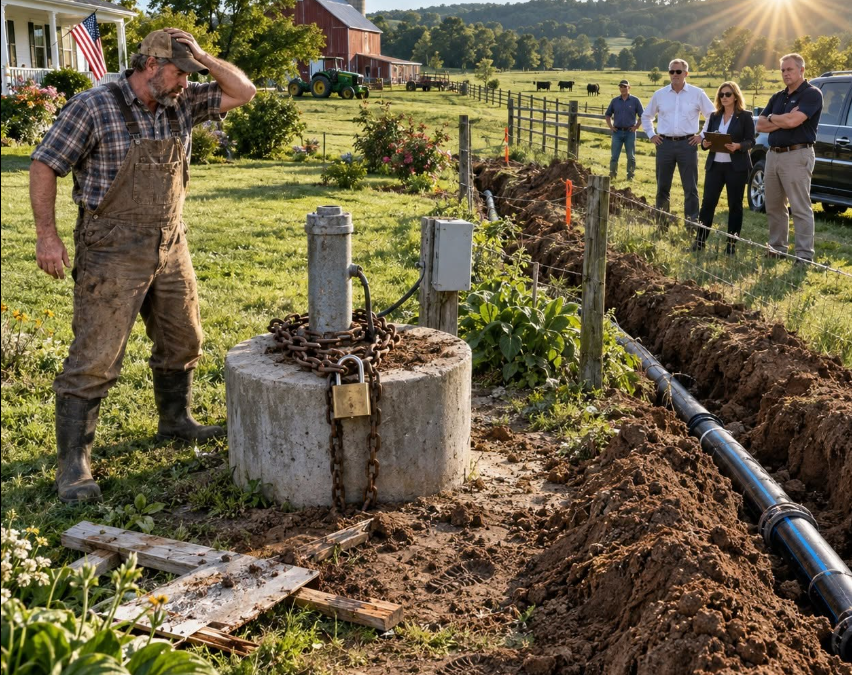
A brand-new commercial padlock had been attached to my main valve.
Not mine.
Shiny.
Heavy.
Stamped with the Ridgerove Lakes emblem.
Below it hung a laminated sign.
COMMUNITY RESOURCE TEMPORARILY SECURED FOR ASSESSMENT.
DO NOT REMOVE UNDER PENALTY OF LAW.
I stared at it.
I did not move for several seconds.
That was the moment this stopped feeling like harassment.
They had branded my well.
Their logo.
Their lock.
Their warning.
On my land.
On a county-permitted private system.
It was not just interference.
It was a claim.
I imagined my father standing there.
The thought made my anger colder.
Dad had kept that property through bad years.
Debt.
Repairs.
Weather.
Market downturns.
He had sold old trucks when he needed money.
I had used part of what remained from that collection to help finance the well.
And now a subdivision that had existed for barely two years had attached its crest to my pump as if three generations of Hart ownership meant nothing.
I wanted to cut the lock.
It would have taken seconds.
I had tools ten yards away.
I did not touch it.
Instead, I took photographs.
Wide angle.
Property context.
Close-up.
Serial markings.
HOA emblem.
Sign wording.
Zip ties.
Valve position.
Then video.
Then I drove to the county water management office.
Phil was the inspector who had handled part of my paperwork.
Mid-forties.
Wrinkled khakis.
Permanent look of a man who needed coffee.
I put the permit and photographs on his desk.
He stared.
“They locked your well?”
“Yes.”
“On your property?”
“Yes.”
“With their own lock?”
I enlarged the photograph.
“There’s the logo.”
Phil leaned back.
“Well.”
“That good or bad?”
“For them?”
He whistled.
“Bad.”
He pulled up county code.
“Interfering with a permitted water system is pretty clear. Trespass is separate.”
“I want to file formally.”
“You want the lock removed?”
“Yes, but not yet.”
He looked at me.
“Why?”
“I want county personnel to witness it.”
That brought a small smile.
“You’ve done this before.”
“Not with an HOA.”
He laughed.
“We’ll schedule somebody.”
I left the lock in place.
By the time I returned home, another notice had appeared at my front gate.
NOTICE OF TEMPORARY RESOURCE TRANSFER.
The letter referenced an emergency community water share plan.
Again, it did not exist.
They were writing laws to themselves and pretending the rest of the world was obligated to obey.
I called Rachel Gant.
Rachel and I had known each other since our Army days. She had worked JAG. Later, she moved into civilian practice and handled property disputes among other things.
I emailed her the entire file.
She called twenty minutes later.
“They’ve lost their minds.”
“That was my professional assessment too.”
“Cut the lock.”
“I’m waiting for county witnesses.”
“You are legally within your rights to remove it.”
“I know.”
“We can start action today.”
“I know.”
She paused.
“What are you doing?”
“Giving them room.”
“For what?”
“To make more mistakes.”
There was silence.
Then she laughed.
“Daniel.”
“What?”
“You’re building a case instead of fighting a fight.”
“Exactly.”
“You always were irritating.”
“I appreciate that.”
“No, you don’t.”
That night, I sat on the porch.
The locked pump was visible in moonlight.
Beyond the fence, a vehicle moved slowly along the HOA service road.
Dark SUV.
It stopped.
Idled.
Lights dimmed.
Nobody got out.
I stood.
I had an unloaded shotgun resting across my arm.
Not pointed.
Not threatened.
Just visible.
The SUV remained another minute.
Then drove away.
The following morning, Phil called.
County compliance officer.
Deputy.
Nine a.m. the next day.
They would witness removal.
Perfect.
Except when I went outside before dawn the next morning, the lock was gone.
So was the sign.
No broken metal.
No cut chain.
No discarded zip ties.
Nothing.
For a second, I wondered whether I had somehow imagined the whole thing.
Then I remembered the camera.
Phil and the deputy arrived at nine.
The bare valve created an awkward moment.
“You sure it was here?” the deputy asked.
I looked at him.
“Come with me.”
We went into the barn.
I pulled the new camera card.
At 3:43 a.m., a dark SUV entered frame.
A gloved person stepped out.
They walked to the well.
Produced a key.
Not bolt cutters.
A key.
Unlocked the HOA padlock.
Removed the sign.
Collected everything.
Returned to the vehicle.
The entire cleanup took less than a minute.
The deputy leaned closer.
“They came back to remove it.”
“Before you arrived.”
“They knew?”
“I don’t know.”
Phil pointed toward the screen.
“Can you freeze that?”
I stopped the footage.
The rear plate reflected brightly in infrared.
Perfect.
The deputy copied the number.
Rachel called later that afternoon.
The vehicle was registered to the Ridgerove Lakes HOA fleet.
Not Karen personally.
The association.
Her voice changed.
“Daniel, this is much bigger now.”
“I know.”
“They put the lock on.”
“Probably.”
“They removed it after you filed a complaint.”
“Yes.”
“Using an HOA vehicle.”
“Yes.”
“That’s evidence removal.”
“I know.”
She exhaled.
“Stop sounding pleased.”
“I’m not pleased.”
“You sound pleased.”
“I sound organized.”
“You sound terrifyingly organized.”
That evening, I walked out to the well.
The lock was gone.
The pump worked.
But scratches remained.
I ran my hand across the steel.
I knew something had changed.
Until then, I had been defending the well.
Now I was building a complete record against the organization targeting it.
Rachel filed formal notices.
County zoning.
Water resources.
State water regulators.
Everything was attached.
Photos.
Vehicle plate.
Camera stills.
HOA letters.
Fabricated resource plan.
Inspection paperwork.
My kitchen table became a command center.
I printed the original permit in color.
Added drilling receipts.
Flow tests.
Inspection reports.
Hydrology notes.
Every document went in chronological order.
The HOA’s letters created their own story.
First concern.
Then invented jurisdiction.
Then threats.
Then physical interference.
Then the lock.
Then the cleanup.
I delivered one copy to Dana Kulich at rural infrastructure and resource management.
Dana had steel-gray hair and the expression of somebody who had spent twenty years hearing excuses.
She watched the footage twice.
“This is unusual.”
“Criminal was the word Phil used.”
She did not disagree.
“HOAs generally do not attempt to claim private utilities outside their covenants.”
“I noticed.”
She tapped the paperwork.
“Leave this.”
“Gladly.”
Three days later, Ridgerove Lakes sent me an offer.
That was how they framed it.
An offer.
They regretted recent misunderstandings.
They wanted cooperation.
Their proposed “interim agreement” would connect my well to HOA infrastructure under joint supervision.
Joint supervision.
They had tried to lock my pump.
Now they wanted me to sign over shared control voluntarily.
In exchange, I would receive vague potential tax considerations and favorable treatment regarding future zoning issues.
Issues over which they still had no authority.
I read it twice.
Then called Rachel.
“You seeing this?”
“I’m looking at it.”
“They think I’m stupid.”
“No.”
“What?”
“They think you’re tired.”
That stopped me.
Rachel continued.
“This is what institutions do when pressure stops working. They repackage surrender as cooperation.”
I looked through the window at the well.
“So what do you recommend?”
“Do not sign anything.”
“Wasn’t planning to.”
“Send it to me.”
I did.
Then I ordered a sign.
Heavy steel.
White background.
Red letters.
PRIVATE WELL.
COUNTY PERMITTED.
TRESPASSERS WILL BE PROSECUTED.
Below it:
SMILE.
YOU’RE ON CAMERA.
I mounted it directly on my side of the property line.
Solar lights illuminated it after dark.
The next day, code enforcement arrived.
Young officer.
Malik.
He walked toward me already looking embarrassed.
“Complaint about unauthorized signage.”
“Let me guess.”
He glanced toward the subdivision.
“I can’t say.”
“You don’t have to.”
He measured.
Checked setback.
Looked at the sign.
Then at me.
“It’s fine.”
“I know.”
“I still have to document the complaint.”
“Document everything.”
He smiled.
Then lowered his voice.
“Off the record?”
I waited.
“This HOA has been pushing people.”
“Me specifically?”
“Not just you.”
That interested me.
He mentioned another resident who had been fined over something as minor as a bird feeder.
He could not provide names officially.
He did not need to.
The point mattered.
This was not personal.
Karen had not suddenly become obsessed with Daniel Hart.
Ridgerove Lakes had developed a culture of overreach.
My mistake, from their perspective, was refusing to comply.
For several days, things became quiet.
Too quiet.
I checked the pump every morning.
Pressure.
UV system.
Storage tank.
Valves.
Cameras.
Nothing.
The tomatoes grew.
The well hummed.
For almost a week, I felt like maybe the lawyers and agencies had finally created enough resistance.
Then Rachel texted.
Check the Ridgerove Lakes app.
I downloaded it using a spare email.
The pinned post came from Karen.
URGENT IRRIGATION OVERFLOW AFFECTING RIDGEROVE GREENBELT.
Preliminary findings suggested possible linkage to unauthorized groundwater extraction on adjacent private property.
I laughed once.
Then stopped.
That was clever.
They were not directly accusing me.
Not yet.
They were planting the idea.
My well.
Unauthorized extraction.
Flooded greenbelt.
Residents could connect those dots without Karen ever stating the accusation plainly.
I drove toward the greenbelt.
Stayed on the public road.
Did not enter HOA land.
The lawn was saturated.
Standing water covered sections of grass.
The runoff trench barely moved.
Two board members stood near the problem.
A landscaper probed the ground.
Then I saw white PVC.
A broken pipe protruded from the trench wall.
Fresh glue.
Bright surface.
Recent work.
Water seeped steadily from the failed joint.
I recorded video from the public side.
Zoomed in.
The more I watched, the clearer it became.
This was irrigation water.
Their irrigation water.
Nothing to do with my well.
I returned home.
Opened county maps.
Old utility plans.
Parcel overlays.
My well was at a different depth.
Sealed casing.
No plausible connection to their surface irrigation flooding.
I called Phil.
“They’re blaming my well for the greenbelt.”
“I saw.”
“You saw the post?”
“Everybody saw the post.”
“I want independent inspection.”
“I’ll find somebody.”
While waiting, I walked my property line.
Recorded elevation.
Drainage direction.
Distances.
I took a sample of the standing water from where it reached an accessible edge and used a basic kit I kept around.
Chlorine.
High.
Treated municipal water.
Not raw groundwater.
When Oscar, the county inspector, arrived, I showed him everything.
Older man.
Silver beard.
The look of somebody who had inspected enough bad plumbing to stop being surprised.
He examined the broken joint.
Scraped it.
Shook his head.
“Recent repair.”
“How recent?”
“Few weeks, maybe.”
He traced the pipe.
“This feeds their sprinkler grid.”
“My well?”
“Nothing to do with it.”
“Can you write that?”
“I was going to.”
The county report would take forty-eight hours.
Karen moved in twenty-four.
Another notice appeared.
Emergency community hearing.
RESOURCE CONFLICT AND ENVIRONMENTAL IMPACT.
Rachel told me not to attend.
“They want a performance.”
“I know.”
“They want you angry.”
“I know.”
“They want video.”
“I know.”
“Then don’t go.”
I went.
Sometimes avoiding the theater gives the actors control of the entire stage.
I arrived one minute before seven.
Clean jeans.
Flannel.
No binder except one thin folder.
The clubhouse went quiet when I entered.
Karen sat center.
Board members on either side.
Residents occupied half the chairs.
I stayed at the back until public comment.
Karen saw me.
“Mr. Hart.”
I walked forward.
I placed county maps on the table.
Photographs of the broken sprinkler line.
Water test results.
Preliminary inspector findings.
I spoke for several minutes.
No shouting.
“You claimed my well was affecting the greenbelt.”
Karen interrupted.
“We said there was a possible linkage.”
“And the county says there isn’t.”
“We haven’t received a final report.”
“You will.”
I placed another page down.
“My well is permitted.”
Another.
“Different depth.”
Another.
“Sealed casing.”
Another.
“The water flooding your greenbelt contains treated municipal chlorine.”
Several residents leaned forward.
I looked at Karen.
“You tried to access my property.”
Her face remained still.
“You sent letters claiming authority you do not have.”
No answer.
“Someone tampered with my pump.”
Murmurs.
“An HOA padlock was placed on my valve.”
Karen finally spoke.
“That statement is disputed.”
I pulled out a photograph.
Placed it in front of her.
The Ridgerove Lakes emblem was clearly visible.
“Then somebody is counterfeiting your lock.”
Silence.
I put down another photograph.
Trail camera image.
HOA SUV.
“They came back before county witnesses arrived and removed it.”
Karen’s mouth tightened.
I leaned forward slightly.
“Now you are implying my well caused flooding created by your own failed irrigation repair.”
A man in the audience whispered something.
Karen tried to regain control.
“This hearing is about community safety.”
“No.”
I looked around the room.
“This is about a board pretending jurisdiction exists because nobody has forced it to prove otherwise.”
Karen’s face reddened.
“I strongly object to that characterization.”
“Object to the county.”
I gathered my papers.
“Stop.”
Just that.
No threat.
No speech.
“Stop.”
Then I walked out.
An older man in the last row gave me a nod as I passed.
Someone whispered, “He’s right.”
I heard it.
Karen heard it too.
After that meeting, things became quiet again.
No new letters.
No more nighttime visitors.
No app posts.
I wanted to believe it was ending.
Then I felt the vibration.
Early morning.
Northeast corner of my property.
A low mechanical hum through the soil.
At first, I thought it was the submersible pump.
I shut my system down.
The vibration continued.
I knelt.
Placed my palm against the dirt.
Thrum.
Pause.
Thrum.
Mechanical.
I went inside and pulled maps.
Old easement plats.
Utility corridors.
Historic ranch drawings.
One abandoned service corridor crossed near that corner. It had carried shallow irrigation decades earlier.
The records showed it decommissioned.
The next morning, I took a shovel.
I dug carefully.
Six inches.
Nothing.
A little more.
The shovel scraped plastic.
I stopped.
Cleared dirt by hand.
White PVC.
Bright.
New.
My pulse changed.
I followed it.
The pipe ran toward my well.
I exposed more.
Then more.
Ten yards in, I found an artificial landscaping rock.
The kind designed to hide pumps or electrical boxes.
I lifted it.
Underneath sat a junction.
Manual valve.
Digital flow meter.
Y connector.
One line ran toward Ridgerove Lakes.
The other ran toward my well.
I stared.
The meter was active.
Numbers changing.
I sat back on my heels.
For weeks, they had argued that my well was a community problem.
Then they had tried to claim it.
Then they had offered to connect it.
And apparently, while I was reading their letters, somebody had already connected it without permission.
They were stealing the water.
I felt anger rise so quickly my hands shook.
Then training took over.
Do not destroy evidence.
Do not cut pipe.
Do not start digging wildly.
Photograph.
Measure.
Record.
I took wide shots.
GPS coordinates.
Close-ups of every fitting.
Serial numbers.
Flow meter reading.
Direction.
Depth.
Artificial rock.
Trench alignment.
Then video.
The installation was not improvised.
Somebody had planned it.
Straight trench.
Professional fittings.
Careful backfill.
Concealment.
It had been designed to disappear.
That realization was worse than the theft.
This was not one board member with a garden hose.
This required equipment.
Time.
Materials.
Knowledge.
Somebody had approved it.
I called Rachel.
She answered on the second ring.
“I found something.”
“What kind of something?”
“A buried PVC line.”
Silence.
“Connected where?”
“My well system toward Ridgerove.”
Another silence.
“Do not touch anything.”
“I know.”
“Daniel.”
“I’m documenting.”
“Send pictures.”
I sent them.
She called back almost immediately.
“Oh, they’re finished.”
“Not yet.”
“That’s a siphon.”
“Looks that way.”
“Meter?”
“Yes.”
“Reading?”
I gave it.
She swore.
I installed a shutoff on my side without disturbing the evidence path.
Lockable.
Hidden.
Closed it.
Then waited.
Less than a day.
Malik texted.
Ridgerove Lakes had filed an emergency work order.
Mainline pressure loss in the greenbelt irrigation zone.
He asked whether I knew anything.
I replied:
Observe only.
Rachel and I escalated.
County Environmental Crimes Unit.
State Water Resources Control Board.
All evidence attached.
The buried line.
Meter.
Camera footage.
Vehicle sightings.
HOA letters.
Municipal consumption records that showed suspicious changes.
This was no longer about annoying neighbors.
It was unauthorized diversion from a permitted private system.
Two days later, state investigators arrived.
Three unmarked sedans.
The lead investigator introduced herself as Tanya Moreno.
Direct.
Professional.
No small talk.
“We received your report.”
“I figured.”
“Show us the connection.”
I led them to the exposed junction.
From that point on, I mostly stayed quiet.
They photographed.
Measured.
Took soil samples.
Downloaded data from the digital flow meter.
Followed the line.
Checked valves.
Compared timestamps.
One investigator worked on a laptop.
Eventually Tanya looked at the numbers.
“More than thirteen thousand gallons.”
I stared at her.
“What?”
“Recorded diversion.”
“How long?”
“Less than two weeks based on the meter data we can currently verify.”
Thirteen thousand gallons.
There are numbers you intellectually understand before emotionally understanding them.
That was one.
While Karen accused me of threatening their water security, their system had been quietly drawing mine.
While they called my well unauthorized, somebody had built an unauthorized pipe to steal from it.
While I defended myself at meetings, gallons had been moving underground.
Tanya looked at me.
“This is not ambiguous.”
“Meaning?”
“Multiple violations.”
That afternoon, officials served Ridgerove Lakes with a notice.
Unauthorized diversion.
Tampering.
Environmental violations.
Initial fines.
The early figure was fifty thousand dollars with more potentially coming.
The community app exploded.
Residents started asking why state vehicles were present.
Why their water pressure had changed.
Whether the HOA had tapped a private well.
Karen said nothing.
That silence was unlike her.
Then neighbors started contacting me.
At first quietly.
A retired mechanic named Walt told me about a five-hundred-dollar fine over backyard beehives.
Another woman described being ordered to remove native wildflowers.
Others mentioned clotheslines.
Paint.
Vegetable gardens.
Petty notices.
Threats.
Things that individually sounded small.
Together they looked like a system.
Karen and the board had trained people to comply by making resistance feel more expensive than surrender.
Pay the fine.
Remove the plants.
Repaint the wall.
Stop asking questions.
My well was different only because I had refused at the first step.
I started posting brief video updates.
No speeches.
No insults.
Just facts.
“This is the buried line.”
“This is the meter.”
“This is the county permit.”
“This is the state notice.”
I called the channel The Well Line.
I expected a few local views.
Within two days, one clip passed ten thousand.
Then sixty thousand.
People from across the state began commenting.
Farmers.
Ranchers.
Suburban homeowners.
People trapped in ridiculous HOA disputes.
Water rights questions.
Stories about boards claiming powers they did not have.
Rachel called one evening.
“A television station wants you.”
“No.”
“I haven’t finished.”
“Still no.”
“ABC7 Investigates.”
I sighed.
“They’re working on suburban water practices.”
“I don’t want this becoming a circus.”
“It already is. The question is whether facts are in the center ring.”
I sat on the porch looking at the well.
The pump cycled.
Steady.
Quiet.
Rachel continued.
“This isn’t just your case anymore.”
I knew she was right.
The next morning, I agreed.
Before the news crew could arrive, the state investigation expanded.
More officials.
Auditors.
HOA oversight personnel.
They wanted names.
Board minutes.
Signatures.
Work orders.
Emails.
I gave them everything I had.
Then somebody else gave me something.
An unmarked envelope arrived in my mailbox.
Printed emails.
Internal HOA chain.
Karen’s name.
Instructions regarding the siphon installation.
I read one line three times.
The adjacent owner is unlikely to notice minor nighttime draw given the depth and volume.
Minor nighttime draw.
They knew.
That sentence erased every remaining possibility that the installation had been some misunderstanding.
Karen knew the water was not theirs.
She knew I had not agreed.
She expected I would not notice.
She directed them to keep the disturbance minimal.
I called Rachel.
“Smoking gun.”
“That was my thought.”
“This proves intent.”
“Yes.”
“This could move beyond administrative penalties.”
“How far?”
“Potential criminal referral.”
I sat quietly.
I did not feel triumphant.
Mostly tired.
For months, I had wondered whether I was dealing with entitlement or actual calculated wrongdoing.
Now I knew.
The full state operation began on an ordinary morning.
I was drinking coffee when several government vehicles drove through the Ridgerove entrance.
One went toward the greenbelt.
Another to the clubhouse.
From my property, I could see movement.
Karen’s Lexus was already there.
Tanya arrived with other investigators.
Deputies.
Auditors.
Hard cases.
Equipment.
Karen intercepted them near the clubhouse.
Even from a distance, I recognized the body language.
Chin high.
Hands moving.
Argument.
Tanya handed her official paperwork.
Karen opened it.
Read.
Stopped moving.
Later, I learned the investigation named individual board members.
Illegal infrastructure.
Falsified or misleading records.
Resource diversion.
At the greenbelt, investigators taped off the exposed connection.
Residents emerged from houses.
Phones appeared.
People gathered at the edge.
Karen walked toward them.
“Everyone, please remain calm.”
Same Karen voice.
Polished.
Controlled.
“This is a routine compliance review.”
Tanya turned.
Her response carried across the gathering.
“This is a criminal investigation into unauthorized diversion of private water resources.”
Silence.
Tanya continued.
She invited residents with information regarding fees, water usage, infrastructure decisions, or misrepresentation to come forward.
Somebody laughed.
Not because it was funny.
Because years of pressure had just punctured.
Then one person clapped.
Slowly.
Another joined.
Karen stood still.
For the first time since I had met her, she looked like somebody whose binder no longer mattered.
Violation notices appeared on the clubhouse.
Maintenance shed.
Other facilities.
Residents began talking.
Not whispering.
Talking.
Marcus, one of the quieter board members, came to my fence that afternoon.
He looked sick.
“I didn’t know.”
I continued tightening a gate hinge.
“Didn’t know what?”
“The pipe.”
“You signed letters.”
“I know.”
“The resource transfer notice?”
“I signed board authorization.”
“Then you knew enough.”
He flinched.
“Karen said it was emergency preparedness.”
I stopped working.
“She told us drought conditions created an obligation.”
“To steal water?”
“She didn’t call it that.”
“Of course she didn’t.”
Marcus looked toward the subdivision.
“She said county officials would eventually support us if we classified it as community welfare.”
“And you believed her.”
“I wanted to.”
That answer was more honest.
He continued.
“When the water bills dropped, I assumed management had improved.”
“You didn’t ask?”
He shook his head.
“Why?”
He stared at the ground.
“She made people afraid.”
“Of what?”
“Liability. Being removed. Personal exposure.”
“So you stayed quiet.”
“Yes.”
The word barely came out.
I put the hammer down.
“Then stop.”
He looked at me.
“Stop being quiet.”
“What should I do?”
“Talk to Tanya.”
He nodded.
“Tell her everything.”
That evening, Marcus posted publicly.
He apologized.
Said Mr. Hart had never been the problem.
Said the board had failed residents.
Promised cooperation.
Called for resignations.
The responses flooded in.
People described their own experiences.
Karen’s account remained silent.
Consequences came quickly after that.
The final state penalty numbers eventually arrived.
One hundred eighty-seven thousand dollars.
Ninety-two thousand tied to unauthorized diversion.
Forty-five thousand related to tampering.
Fifty thousand under environmental and disclosure violations.
I reread the figures.
Not because I enjoyed them.
Because months earlier, these people had threatened me over a well they had no jurisdiction over.
Now actual authorities were writing numbers on actual violations.
The HOA’s enforcement powers were suspended.
No architectural enforcement.
No surprise fines.
No liens.
No clipboard patrols.
Then came the bigger consequence.
A dissolution vote.
Residents would decide whether Ridgerove Lakes HOA should continue existing.
Karen made one final public statement.
Long.
Emotional.
Misunderstandings.
Technical disagreements.
External actors.
She referred to me as well-meaning but misinformed.
That part almost impressed me.
Even after investigators dug up the siphon, she could not write the sentence:
I was wrong.
The residents answered for her.
You stole water.
Resign.
My dues funded that pipe?
Vote to dissolve.
Enough.
The comments became overwhelming.
Three days before the vote, Karen disappeared.
Her Lexus stopped appearing.
Blinds closed.
Then a moving truck arrived.
Boxes left the house.
By the following morning, a homemade FOR SALE sign stood in the yard.
Underneath it:
NO HOA RESTRICTIONS.
I stood at my gate staring.
Then I laughed.
I could not help it.
The woman who had spent years defending HOA restrictions as the foundation of civilization was now advertising their absence as a real estate benefit.
She left before the vote.
The vote happened on Saturday.
Forty-seven households eligible.
Most participated directly or through proxies.
The result was overwhelming.
Ninety-four percent supported dissolution.
Ridgerove Lakes HOA ceased to exist.
I did not attend the celebration.
There were sodas.
Cake.
People standing around the clubhouse relieved.
I stayed home.
That evening, I found a card beneath my gate latch.
Twenty-two households had signed it.
The message was simple.
Your fight gave us back our homes.
You didn’t just defend your well.
You reminded us we still own ours.
Behind the card was a photograph.
My well in the foreground.
Fresh barn-red paint.
Lawn chairs nearby.
Children playing through sprinkler mist.
Adults holding lemonade.
A dog shaking water everywhere.
People laughing.
No permits.
No committees.
No enforcement letters.
Just neighbors.
I pinned the picture to my refrigerator.
The magnet I used was shaped like an oak leaf.
The same symbol the HOA had stamped on threatening letters.
That amused me more than I expected.
Spring changed the property.
Investigation trenches filled in.
Grass grew.
The line where the siphon had been exposed softened beneath new vegetation.
I upgraded the pump housing.
Improved the valves.
Kept the cameras.
Not because I still expected sabotage.
Because documentation had become part of the system.
I added a small digital display showing flow and pressure.
Transparency.
Anybody standing nearby could see exactly what the well was doing.
Then I added a bronze plaque.
PRIVATE WELL.
PERMITTED.
PROTECTED.
FOUGHT FOR.
People started stopping by.
Not demanding.
Asking.
A young father wanted to know about rainwater collection.
An older couple asked about county permitting for a well of their own.
Teenagers rode bicycles over and read the plaque.
I answered questions.
That surprised me.
Before the conflict, I valued privacy.
Afterward, I valued informed neighbors.
There is a difference between somebody intruding into your life and somebody genuinely wanting to learn.
Rachel called every few months.
The civil matters eventually settled.
Karen paid restitution and relocated.
I heard she moved into a condominium community with strict association rules.
I never verified how she felt about that.
Did not care.
Marcus started writing publicly about community governance and transparency.
He asked me to contribute.
I declined.
I had written enough letters for one lifetime.
Everything I wanted to say was already visible.
The red pump.
The restored ground.
The uninterrupted water.
People sometimes slowed down when driving past the property.
I suppose the well became a local landmark.
Not because it was impressive.
It was still just a pump, casing, filters, and storage.
But stories change objects.
To somebody who did not know the history, it was a well.
To people who did, it was the place where a ridiculous abuse of authority finally met resistance.
One warm afternoon, I found several kids sitting near the rocks by the pump.
Sandwiches.
Bicycles tossed in the grass.
When they saw me, one jumped up.
“Sorry, Mr. Hart.”
“For what?”
“We didn’t know if we could sit here.”
I looked at the property line.
“You’re fine.”
They relaxed.
One boy pointed toward the well.
“Is the story true?”
“Which story?”
“The secret pipe.”
“Yes.”
“The state investigators?”
“Yes.”
“They really stole water?”
“Yes.”
“How much?”
“More than thirteen thousand gallons that we could verify during one period.”
His eyes widened.
“Whoa.”
Another kid asked, “And then you destroyed the HOA?”
I laughed.
“No.”
They looked disappointed.
“The HOA destroyed itself.”
“How?”
“By believing nobody would ever make it prove what authority it actually had.”
That answer was not dramatic enough for them.
But it was true.
I did not win because I screamed louder.
I did not win because I intimidated Karen.
I did not win because I was a veteran.
I won because every time they made another move, I documented it.
Permit.
Photograph.
Timestamp.
Letter.
Camera.
Plate number.
Meter reading.
County report.
Email.
I stayed calmer than they expected.
People who rely on intimidation need the other person to react emotionally.
They need anger.
They need a shouting match.
They need you to make one stupid mistake they can enlarge until nobody remembers what they did first.
I refused.
When they sent letters, I filed them.
When they tampered with the pump, I installed cameras.
When they locked the well, I photographed the lock.
When they removed it, the camera caught the vehicle.
When they blamed me for flooding, I got an independent inspection.
When I found the siphon, I did not rip it out.
I recorded it.
When Karen denied wrongdoing, her own emails eventually answered her.
Patience is not weakness.
Sometimes patience is letting the other person keep digging until everyone can see the hole.
That whole experience changed how I thought about ownership.
A deed is paper.
A permit is paper.
Rights written in law are still words.
All of those things matter.
But ownership becomes real when somebody challenges it.
What are you willing to defend?
What are you willing to document?
How much pressure can somebody apply before you surrender simply because surrender is easier?
Most HOA abuse does not begin with secret pipes.
It begins small.
A letter.
A warning.
A fine.
A claim spoken confidently enough that the target assumes it must be legitimate.
Karen’s first request sounded almost reasonable if you did not listen carefully.
Pause drilling.
Let the board review things.
Consider shared impacts.
Then came resource equity.
Then compliance.
Then access.
Then the lock.
Then the fake transfer plan.
Then the siphon.
Each step depended on the previous step becoming normal.
That is how overreach works.
A boundary moves an inch.
Nobody reacts.
Then another inch.
Then another.
Soon somebody is standing on your property explaining why what belongs to you has always belonged to them.
I think about the first morning Karen stood beyond my fence.
Cranberry jacket.
Binder.
Drilling rig roaring.
She believed authority traveled with her because people in Ridgerove Lakes had treated it that way.
If Karen issued a notice, people complied.
If Karen cited a section, nobody looked it up.
If the board threatened a fine, homeowners paid.
The system survived on assumption.
I did not share the assumption.
That was the entire problem.
Months after everything ended, I found the original unauthorized resource extraction letter in my FICTION folder.
I sat at the kitchen table and read it again.
The language seemed even stranger now.
Jeopardizing shared subterranean resources.
Failure to cooperate.
Legal action.
I placed it beside the state findings.
On one side was invented authority.
On the other was actual authority.
The contrast was almost funny.
Almost.
Then I remembered the footage of somebody approaching my pump at two in the morning.
The scratches.
The lock.
The buried pipe.
Thirteen thousand gallons.
It stopped being funny.
I never learned who physically installed every section of the siphon.
Contractors worked on it.
Maintenance records existed.
Karen’s emails established direction and intent.
For me, that was enough.
I did not need to know which individual held the shovel.
The important question was who created a culture in which burying a secret pipe onto somebody else’s system could be treated like routine maintenance.
That answer was clear.
One afternoon, Tomas from farther down the county road stopped by.
He was not part of Ridgerove Lakes.
Old farming family.
He walked around the well.
Read the bronze plaque.
“You always have to make things dramatic?”
“You drove here to read it.”
“Fair.”
He kicked lightly at the dirt.
“So was it worth it?”
“What?”
“All of it.”
I looked toward the subdivision.
Without HOA enforcement, the houses had already begun looking more human.
Different flowers.
Different paint on a front door.
A vegetable bed where somebody had once been warned it violated landscaping uniformity.
A clothesline.
Children’s toys left outside.
Tiny things.
Freedom often looks unimpressive.
“Yes.”
“You’d do it again?”
“Tomorrow.”
He nodded.
“Figured.”
Then he pointed at the pump.
“Water good?”
“Best in the county.”
“That’s what everybody with a well says.”
“Mine has paperwork.”
He laughed.
That summer, tomatoes grew so heavily I could barely eat them fast enough.
I gave some away.
There was a small irony in that.
The fight had begun because somebody tried to force sharing.
When it ended, I shared more than before.
Voluntarily.
That word matters.
Voluntarily.
Giving is generosity only when keeping is also an option.
Community is meaningful only when participation is not coercion.
Sharing water because a neighbor needs help is decent.
Taking someone’s water in secret and calling it resource stewardship is theft with better vocabulary.
The pump continued cycling.
Clear water.
Cold.
Dependable.
Sometimes I stood beside it and listened.
People imagine wells as silent.
They are not.
There is vibration.
Relay clicks.
Water moving.
Pump cycles.
A low mechanical rhythm.
After everything that happened, those sounds became reassuring.
Because now I knew exactly what was connected to my system.
Nothing hidden.
Nothing unauthorized.
No buried line disappearing beneath an artificial rock.
Every valve visible.
Every gallon accounted for.
The cameras remained.
One lens still looked toward the eastern boundary.
Somebody once asked why I kept surveillance after Karen was gone.
“Don’t you trust the neighbors now?”
“Yes.”
“Then why the cameras?”
“Because trust and records aren’t enemies.”
That came from experience.
Trust people.
Verify systems.
It works in engineering.
It works in life.
One morning in April, almost a year after the first drilling rig arrived, I stood at the same spot where Karen had introduced herself.
The fence was unchanged.
My property still looked rougher than the subdivision.
Barn.
Pasture.
Wild grass.
The well glowed red in early sun.
Across the boundary, somebody was planting flowers in colors that definitely would not have passed the old landscaping committee.
I smiled.
My father would have liked that.
Dad had always distrusted unnecessary committees.
He believed most problems could be solved by a person, a wrench, and enough patience.
I think he would have appreciated the well too.
Not the fight.
The well.
That is something people forget when telling the story.
The well was never supposed to be a symbol.
It was supposed to water tomatoes.
That still makes me laugh.
All those investigators.
All those letters.
State regulators.
Television interest.
Hundreds of comments.
Nearly two hundred thousand dollars in penalties.
A dissolved homeowners association.
And underneath everything was one simple thing.
I wanted tomatoes during a drought.
I wanted water on my own land.
They could have ignored me.
Nothing would have happened.
I would have watered the garden.
Maybe expanded the orchard.
Sat on my porch.
Minded my business.
Karen turned a permitted well into a war because she could not tolerate something useful existing beyond her control.
That was her mistake.
She thought the conflict was about water.
It was not.
It was about consent.
She believed community need allowed her board to redefine private property.
She believed enough paperwork could create authority.
She believed a logo on a padlock made the lock legal.
She believed nobody would notice the pipe.
And even if I noticed, she probably believed I would do what people usually did.
Complain.
Get angry.
Threaten.
Then give up because fighting institutions is exhausting.
She was right about that last part.
It was exhausting.
But I did not give up.
Sometimes I wonder what would have happened if I had cut the first HOA lock immediately and thrown it away.
Maybe the story ends there.
Maybe Karen sends another letter.
Maybe I send one back.
Maybe the siphon still happens and I never know who did it.
Maybe they blame the greenbelt flooding on me successfully because I do not have county reports ready.
Maybe residents believe them.
One calm decision changed everything.
Do not cut the lock.
Photograph it.
Wait for witnesses.
That decision created the next piece.
The cleanup footage.
That created the plate.
That connected the vehicle.
The vehicle helped show association involvement.
Then the hidden line.
Meter.
Emails.
Investigation.
Big cases are built out of small disciplined choices.
That is the engineer in me.
Structures fail at connections.
Cases succeed the same way.
Connection by connection.
Rachel likes to tell people I outsmarted the HOA.
I disagree.
They outsmarted themselves.
All I did was refuse to interrupt them.
The day she told me the final civil settlement was completed, I was repairing the split-rail fence.
Phone rang.
“It’s finished.”
“What is?”
“Your case.”
“Oh.”
“That is your reaction?”
“I’m holding a fence rail.”
“Daniel.”
“What?”
“Months of litigation are complete.”
“Did the paperwork clear?”
“Yes.”
“Then good.”
“You are impossible.”
“I’ve heard that.”
“Karen’s restitution is finalized.”
“Fine.”
“You don’t want details?”
“Is my well still mine?”
“Yes.”
“Is the siphon gone?”
“Yes.”
“Is the HOA gone?”
“Yes.”
“Then I’m going back to my fence.”
She laughed.
“Enjoy retirement.”
“I was trying.”
After the call, I stood there for a minute.
The afternoon was warm.
The pump started behind me.
Water moved into the storage tank.
Nothing dramatic.
Exactly the way I wanted it.
I finished the fence.
That evening, I sat on the porch with something cold in my hand.
One of the original goals.
Sometimes victory is not cheering.
Sometimes victory is returning to the boring life somebody interrupted.
I watched sunset settle over five acres my family had held for generations.
The subdivision lights came on one house at a time.
No HOA patrol.
No notices.
No SUV stopping along my boundary.
Just homes.
People.
Different choices.
A neighborhood instead of a managed display.
I thought about the signed card on my refrigerator.
Your fight gave us back our homes.
That sentence still makes me uncomfortable.
I did not give anybody a home.
Their houses had always belonged to them.
I think what they meant was something else.
Fear had made their ownership feel conditional.
Karen’s board had trained them to ask permission for ordinary life.
My fight reminded them that rules have limits.
Authority has limits.
And sometimes the person saying “you must” is depending entirely on the fact that nobody asks:
According to what law?
That is the question that started my entire fight.
According to what law?
Karen never had a good answer.
So she invented committees.
Plans.
Mandates.
Shared resource concepts.
Emergency provisions.
When fiction failed, she moved to force.
When force failed, concealment.
When concealment failed, blame.
When blame failed, theft came into daylight.
By then, every new strategy only proved the original problem.
There had never been lawful authority.
Only confidence.
I still have the padlock photographs.
The physical lock disappeared with whoever removed it.
The sign too.
But the image remains.
Ridgerove emblem.
Fake legal warning.
My pump underneath.
Sometimes during community workshops, somebody asks me what moment made me angriest.
They expect the hidden pipe.
No.
The hidden pipe shocked me.
The padlock made me angry.
Because stealing water in secret is criminal behavior.
Putting your logo on somebody else’s property and ordering them not to touch it is something more personal.
It says:
I believe your ownership exists only until I decide otherwise.
That idea bothered me more deeply than the gallons.
Maybe that comes from my family.
Maybe the Army.
Maybe age.
Maybe all three.
I spent much of my adult life building systems in places where ownership and infrastructure could become matters of survival.
Water points.
Temporary bridges.
Drainage.
Access.
I learned that control over infrastructure quickly becomes control over people.
Karen understood that instinctively even if she did not understand hydrology.
Whoever controls water controls choices.
She wanted the HOA involved because my well made me independent.
Then drought made my independence valuable.
Then value became temptation.
That was the progression.
By the time somebody buried PVC under my soil, they had stopped seeing the well as my property.
It had become a resource they felt entitled to manage.
People can justify extraordinary behavior once they change the nouns.
My well becomes community water.
Trespass becomes inspection.
Theft becomes stewardship.
A siphon becomes emergency infrastructure.
Evidence removal becomes cleanup.
Words matter.
That was another lesson.
Never accept somebody else’s label before looking at the thing itself.
The HOA called my well unauthorized.
The county called it permitted.
They called the lock community protection.
The county called it interference.
They called the pipe stewardship.
Investigators called it unauthorized diversion.
One side had prettier stationery.
The other had jurisdiction.
That difference cost Ridgerove Lakes one hundred eighty-seven thousand dollars and eventually its existence.
I did not cause that.
Their decisions did.
The last time somebody asked whether I missed having an HOA next door, I thought they were joking.
They were not.
“They kept the neighborhood looking neat.”
“It still looks fine.”
“But standards slip.”
I looked across the fence.
One house had a blue door.
Another had sunflowers.
Somebody had built a slightly crooked raised bed.
Children’s bicycles lay in one driveway.
A clothesline moved behind another house.
“Looks terrible,” I said.
The person laughed.
So did I.
The community did not collapse without Karen.
Property values did not vanish overnight.
Chaos did not consume the streets.
People figured things out.
When streetlights required maintenance, they worked with the municipality.
Landscaping common areas became contracted services.
Neighbors talked directly.
Some disagreed.
That is normal.
What disappeared was the assumption that a board needed to supervise every expression of ownership.
One of the teenagers who used to sit near my well came back months later with his father.
They were considering putting in a rain collection system.
The father had printed county rules.
Actual county rules.
He spread them across my workbench.
“I figured I should check before I build anything.”
“That already puts you ahead of Ridgerove Lakes.”
He laughed.
His son pointed at one section.
“What does this mean?”
We spent half an hour reading it.
That meant more to me than the state fines.
People were learning the right habit.
Find the actual rule.
Understand why it exists.
Comply where authority is legitimate.
Push back where somebody is inventing it.
There is nothing rebellious about that.
It is simply citizenship with a backbone.
The well keeps flowing.
The tomatoes keep growing.
The barn is still standing.
I finally repainted it.
White with red trim.
Not because a committee approved the palette.
Because I liked it.
Sometimes I still catch myself looking toward the eastern road when an unfamiliar SUV slows down.
Old habits.
But nobody stops.
No cranberry jacket.
No binder.
No technician asking for access.
No midnight figure with bolt cutters.
Peace returned so gradually I did not notice at first.
Then one day, I realized a full month had passed without me checking the trail camera footage every morning.
That felt like the actual ending.
Not the vote.
Not the fines.
Not Karen moving.
The morning I forgot to be suspicious.
I poured coffee.
Walked outside.
Checked the pressure gauge.
Pulled one ripe tomato from the vine.
Sat on the porch.
That was all.
No fight.
No evidence.
No case.
Just home.
Sometimes people ask whether I regret pushing back.
No.
Not for a second.
I regret that it became necessary.
I regret the hours.
The tension.
The nights listening for vehicles.
The legal bills.
The fact that something as ordinary as drilling a permitted well could become a months-long confrontation.
But I would make the same decision again.
Because ownership is not arrogance.
Privacy is not hostility.
Independence is not antisocial.
A boundary is not an insult.
And sharing only means something when the choice belongs to the person doing the sharing.
My name is Daniel Hart.
I built a well on land my family had held for generations.
The county approved it.
I paid for it.
I maintained it.
I intended to use it quietly.
Then an HOA next door decided that because they wanted my water, they had a right to it.
They sent letters.
I kept them.
They threatened me.
I documented it.
They entered my property.
I installed cameras.
They locked my pump.
I photographed the lock.
They removed the evidence.
The camera recorded their vehicle.
They blamed their own flooding on my well.
County inspectors proved otherwise.
They buried a pipe.
I found it.
Investigators measured more than thirteen thousand gallons of unauthorized diversion.
Their own emails revealed the intent.
Then the people who had spent years obeying them finally started asking questions.
The fines came later.
The investigation came later.
The dissolution came later.
Those were consequences.
The real turning point happened much earlier.
It happened the first morning Karen stood beyond my fence and asked me to stop drilling.
I told her no.
One word.
No.
Not because I wanted conflict.
Because there was no lawful reason to say yes.
Everything that happened afterward came from their refusal to accept that boundary.
Today, the well casing is barn red.
The water runs clear and cold.
A plaque beside it reads:
PRIVATE WELL.
PERMITTED.
PROTECTED.
FOUGHT FOR.
I used to wonder whether “fought for” sounded too dramatic.
Then I remember the hidden pipe.
The fake resource plan.
The HOA lock.
The infrared footage.
The thirteen thousand gallons.
No.
It fits.
A person’s land is more than coordinates on a deed.
It is work.
Memory.
Responsibility.
And sometimes defense.
You can share it.
Improve it.
Pass it down.
Invite people onto it.
Give from it.
But the choice has to remain yours.
Karen thought a board title changed that.
She thought enough paperwork could erase a property line.
She thought a suburban logo stamped into steel mattered more than a county permit.
She thought I would never feel the vibration beneath the soil.
She thought I would never dig.
She thought the buried pipe would stay buried.
That was the mistake that ended everything.
Because lies work best when nobody looks beneath the surface.
I looked.
And once that white PVC came out of the dirt, the entire story changed.
The board could argue about letters.
They could reinterpret meetings.
They could call the padlock a misunderstanding.
They could call the greenbelt flooding an environmental concern.
They could call me difficult.
But nobody could explain away a buried pipe connected to somebody else’s well.
The meter did not care about Karen’s vocabulary.
Thirteen thousand gallons were thirteen thousand gallons.
The trench did not care about HOA authority.
It crossed where it had no right to cross.
The emails did not care about public relations.
They contained her own words.
That is why I still believe the best answer to intimidation is often not louder intimidation.
It is evidence.
Let people talk.
Let them write.
Let them stamp logos on things.
Let them send letters.
Keep everything.
Take pictures.
Read the law.
Know your boundary.
Know your rights.
And when somebody crosses that boundary, do not make their case easier by losing control of yourself.
Make them prove theirs.
Ridgerove Lakes could not.
In the end, the same well Karen called a threat became the thing that exposed how her board operated.
The same neighbors who once stayed quiet signed the card on my refrigerator.
The same community that had lived under constant notices voted overwhelmingly to dissolve the association.
The same land Karen tried to reach beneath still belongs to me.
And every morning, long before the subdivision wakes, I can hear the pump cycle.
A soft mechanical hum.
Then water.
Clear.
Cold.
Steady.








