The HOA Laughed at My Safety Wall—Then the Hill Collapsed and Took Their Homes First
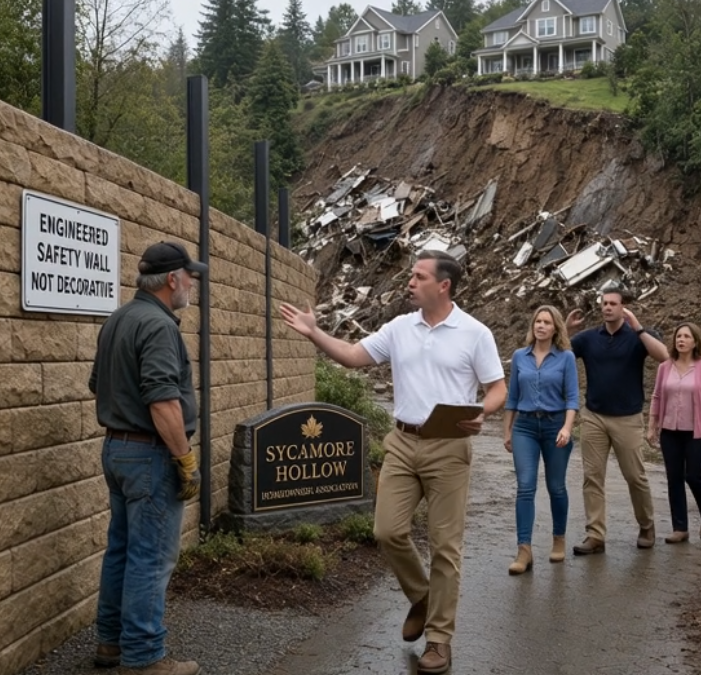
PART2:
The sound was light, polished, dismissive.
The kind of laugh men use when they believe a rulebook makes them smarter than gravity.
“Mr. Donnelly,” he said, “we appreciate that retirement gives people time for projects. But this is a community, not a private engineering experiment.”
Across the street, Brad laughed.
“Maybe he’s building a bunker,” he called. “Fort Donnelly. Population one.”
Janet tilted her head, eyes moving over the stacked stone, pressure-treated timbers, steel mesh, and rebar anchors.
“It really does lower the tone of the street,” she said.
I picked up the post driver.
The steel felt heavy and honest in my hands.
“Carl,” I said, “when this slope goes, it won’t care about tone.”
He sighed as if I had disappointed him.
“You have seventy-two hours to submit an architectural review application. Until approval is granted, all construction must stop. If you continue, we’ll issue fines.”
I drove the next anchor into the clay.
The metallic ring cut across the cul-de-sac.
Once.
Twice.
Three times.
Carl waited for me to look at him.
I did not.
Finally, he said, “You’ve been warned.”
Then he walked away.
The laughter followed him.
I kept working.
PART3:
Because laughter does not hold back mud.
My name is Martin Donnelly.
I am sixty-four years old, retired from thirty years as a geotechnical engineer for the state department of transportation, and I know what unstable ground looks like long before it becomes a disaster.
Most people think a landslide starts when the hill collapses.
It does not.
A landslide starts quietly.
A hairline crack through grass.
A fence post leaning half an inch out of plumb.
A shallow depression that collects water after rain.
A patch of lawn that stays wet longer than it should.
A retaining wall that bulges but does not yet fail.
A slope that breathes differently under your boots.
The earth speaks before it moves.
The trouble is that most people only listen after it screams.
I first noticed the depression in March.
It was just beyond my back deck, near the place where the lawn began its slow descent toward the ravine. My daughter, Maggie, had gone back to college after spring break, leaving the house too quiet again. After she left, I started walking the yard every morning with black coffee and no real purpose except to fill the space she used to occupy.
That was when I saw the garden posts.
Evelyn had installed them twenty years earlier for climbing roses.
They had always stood straight.
Now they leaned slightly toward the ravine.
Not enough for a neighbor to notice.
Enough for me.
I stood there that morning with my coffee cooling in my hand, staring at those posts like they had spoken my name.
Evelyn had loved that slope.
She used to say it was the reason we bought the house. Not the kitchen. Not the school district. Not the cul-de-sac with its maples and quiet sidewalks.
The slope.
In summer, the grass turned deep green, and the trees along the ravine filled out so thick that the neighborhood behind us disappeared. In fall, the oaks flamed orange and red. In winter, the bare branches revealed the creek at the bottom, a silver thread cutting through shale and clay.
I used to tease her.
“You married an engineer and still fell in love with erosion.”
She would smile without looking up from her roses.
“I married an engineer because somebody has to tell me when the pretty things are trying to kill us.”
Evelyn had been gone three years by the time the garden posts leaned.
Cancer took her in a way that felt both slow and sudden, the way a storm builds for days and still shocks you when the roof finally lifts. After she died, I kept the roses alive because I could not keep her alive. It was not the same, but grief accepts poor substitutes when there are no good ones.
So when I saw those posts leaning toward the ravine, I felt something colder than concern.
I felt recognition.
I set my coffee on the deck railing and walked the slope.
The ground was damp underfoot though we had not had heavy rain in six days.
That was the second sign.
Surface water drains.
Groundwater lingers.
The grass near the posts had a slight ripple to it, a shallow crescent almost invisible unless you knew to look across it instead of down at it.
Third sign.
I crouched and pressed my fingers into the soil.
Clay.
Saturated.
Soft enough that my thumb sank nearly to the first knuckle.
Fourth sign.
Then I saw the crack near the Japanese maple.
Only six inches long.
Thin as a knife cut through the turf.
But it curved parallel to the ridge.
That was not a mole tunnel.
That was tension.
I stood there for a long time.
The neighborhood behind me was just waking up.
Garage doors opening.
Sprinklers clicking.
A garbage truck groaning two streets over.
Somewhere, Brad Coats’s golden retriever barked at absolutely nothing, as it did every morning with military discipline.
Everything looked normal.
That was what bothered me most.
Disasters love normal.
Normal keeps people from moving.
I spent the rest of that week walking every yard that backed up to the slope.
Not trespassing.
Not at first.
I stayed on the common drainage easement behind our row, the one most homeowners forgot existed because the HOA landscapers mowed it and everybody pretended ownership ended wherever convenience said it did.
Sycamore Hollow had twelve homes along the ridge.
Mine sat near the western curve of the cul-de-sac.
To my left was Janet Rivers, retired school principal, chair of the HOA landscaping committee, and unofficial inspector of everyone’s mailbox paint. To her left was Brad Coats, real estate agent, amateur barbecue expert, professional loud talker. Farther down were the Ivers family, the Nguyens, the Merritts, a rental owned by someone in Arizona, and finally Carl Whitmore’s house at the eastern bend, a large beige Colonial with a sunroom he had added after somehow deciding his own architectural requests were always consistent with community standards.
The slope ran behind all of us.
The ravine below had been stable when the subdivision was built twenty-seven years earlier. I checked the original plats and grading plans in the county archive after we bought the house. The developer had cut the lots into the upper bench and left the natural slope mostly intact.
Mostly.
That word always matters.
Over the years, homeowners had changed things.
Patios.
Decks.
French drains that did not outlet where they were supposed to.
Downspouts extended toward the ravine because nobody wanted water near their foundations.
Sprinklers overwatered ornamental shrubs whose roots held about as much soil as a handful of yarn.
The HOA had replaced deep-rooted native grasses with shallow turf because turf looked clean.
Clean, in my profession, often meant fragile.
I took notes.
Measured lean.
Photographed cracks.
Marked damp areas with small flags.
That was my first mistake.
In Sycamore Hollow, putting orange flags in the ground was basically declaring war.
Janet saw them before lunchtime.
She appeared at the fence wearing gardening gloves and an expression of practiced concern.
“Martin?”
I was on one knee photographing a separation crack forming along the back edge of the Merritts’ decorative stone border.
“Yes, Janet?”
“What are the little flags for?”
“Movement markers.”
Her smile stayed in place.
“Movement?”
“Slope movement.”
She looked down the hill, then back at me.
“I don’t see anything moving.”
“That’s why I’m marking it.”
She blinked.
“Is this something the HOA approved?”
“The hill?”
“The flags.”
“No.”
Her lips pressed together.
“You know, people get nervous when they see things like this.”
“They should.”
“That’s not very reassuring.”
“Neither is the slope.”
She gave a soft laugh, the kind that had ended many parent-teacher conferences in her previous life.
“Martin, you’ve always had a technical mind. I admire that. But sometimes, after a loss, people become very sensitive to risks.”
There it was.
Evelyn.
Not by name, of course.
People in polite neighborhoods did not weaponize grief directly. They wrapped it in concern first.
I stood slowly.
“Janet, this has nothing to do with my wife.”
“I didn’t mean—”
“Yes, you did.”
Her face stiffened.
“I only meant you might be seeing danger because you’re used to looking for it.”
“I’m seeing danger because it’s there.”
She glanced again toward the slope.
All she saw was grass.
So that was all she believed.
Two days later, Carl sent the first email.
Subject: Unauthorized Markers in Common View Corridor
Dear Mr. Donnelly,
It has come to the Board’s attention that you have placed multiple orange survey flags along the rear slope area adjacent to several properties. While we appreciate resident engagement, all visible markers, stakes, indicators, signage, or similar items must receive prior written approval from the Architectural Review Committee if visible from neighboring homes or common areas.
Please remove the markers within forty-eight hours.
Regards,
Carl Whitmore
President, Sycamore Hollow HOA
I read the email twice.
Then I opened a new message.
Dear Mr. Whitmore,
The markers identify active tension cracks, saturated soil zones, and measurable slope movement along the rear drainage easement. Removal would interfere with ongoing safety assessment. I recommend the Board retain a licensed geotechnical engineer immediately and suspend irrigation on the rear slope until the area is evaluated.
Regards,
Martin Donnelly, P.E. Retired
I attached seventeen photographs.
Carl replied eleven minutes later.
Mr. Donnelly,
Please submit all concerns through the appropriate HOA maintenance portal.
Regards,
Carl
The maintenance portal had three categories.
Landscaping.
Streetlights.
Pool access.
I selected landscaping.
Description: The hill behind our houses may collapse.
A week passed.
The flags disappeared.
Not all at once.
A few the first day.
More the second.
By the third morning, only four remained.
I found two in Janet’s trash can when I walked past on garbage day. I did not confront her. I simply took new measurements and replaced every flag with a small wooden stake hammered flush with the grass where it would be harder for someone with a coffee cup and passive-aggressive patriotism to remove.
Then came the rains.
April opened like the sky had cracked.
Five inches in four days.
Not record-breaking, but enough.
The ravine creek swelled brown and loud at the bottom. Water sheeted over lawns and collected behind mulch beds. The slope behind Carl’s sunroom developed a damp crescent that stayed wet even after two dry afternoons.
I emailed again.
This time, I copied the entire board.
Subject: Urgent Slope Stability Concern — Rear Ravine Lots
Board Members,
I am documenting progressive instability along the rear slope behind lots 14 through 25. Indicators include ground cracking, differential settlement, leaning garden structures, persistent saturation, and visible toe erosion near the ravine. Continued irrigation and concentrated downspout discharge may worsen conditions.
I strongly recommend:
- Immediate suspension of slope irrigation.
- Temporary redirection of roof drainage away from the rear slope.
- Professional geotechnical evaluation.
- Installation of emergency erosion control measures before the next major storm.
Failure to act may result in property damage and potential risk to residents.
Martin Donnelly
I attached more photos.
Carl responded the next morning.
Dear Mr. Donnelly,
The Board appreciates your concern. Our landscaping vendor has reviewed the rear slope and reported no visible issue beyond minor seasonal runoff. Please refrain from alarming residents with speculative engineering claims. The Board will continue monitoring the situation through appropriate channels.
Regards,
Carl Whitmore
Appropriate channels.
The phrase annoyed me enough that I printed the email and placed it in a folder labeled HILL.
Old habits.
Documentation is an engineer’s form of prayer.
By May, the cracks had widened.
Not dramatically.
A quarter inch in places.
Half an inch behind the rental property.
The garden posts leaned more.
A section of Janet’s back fence line dipped low enough that her gate no longer closed cleanly. She blamed humidity.
Brad’s sprinkler system broke and ran all night along the slope before anyone noticed. By morning, water had cut a shallow channel through the mulch and down toward the ravine.
I knocked on his door at seven.
He answered in gym shorts, holding a protein shake.
“Morning, Marty.”
Nobody called me Marty except people trying to make not listening sound friendly.
“Your rear sprinkler zone stuck open last night.”
He looked past me toward the backyard.
“Seriously?”
“Yes. You need to shut that zone down and call someone.”
“Yeah, yeah. I’ll get to it.”
“Today.”
He laughed.
“Man, you always this intense before breakfast?”
“Brad, that slope is already saturated. Extra water is not harmless.”
He leaned against the doorframe.
“This about your hill theory?”
“It’s not a theory.”
“Carl said the landscapers checked it.”
“Landscapers are not geotechnical engineers.”
“No, but they know lawns.”
I stared at him.
“The lawn is not the problem.”
He raised both hands.
“Okay, okay. I’ll turn it off.”
He did not turn it off.
By noon, water still sprayed across the back slope, glittering prettily in sunlight while it helped pry the hill apart grain by grain.
That was the day I started building the wall.
Not a decorative wall.
Not one of those low suburban stone borders people install because they saw something similar in a magazine called Modern Cottage Living.
A real wall.
Temporary but strong.
Reinforced timber cribbing.
Drainage stone.
Filter fabric.
Steel mesh.
Rebar anchors driven deep into competent material.
A catchment trench to intercept shallow sliding debris.
Relief paths for water.
The kind of field-built emergency structure you put together when bureaucracy moves slower than gravity.
Could it stop a major rotational slide?
No.
Nothing I could build alone behind my house could stop an entire hillside if the failure plane went deep enough.
But most slope failures do not happen like movie cliffs dropping into the ocean.
They move in phases.
Sloughs.
Mudflows.
Debris sheets.
Shallow slides that load lower sections and trigger more movement.
My wall was not meant to defeat the mountain.
It was meant to buy time.
Deflect shallow debris.
Slow runoff.
Protect my foundation.
Keep the first failure from becoming an immediate catastrophe at my back door.
In engineering, buying time is not small.
Sometimes time is the only thing between warning and obituary.
The first day I worked, no one said anything.
Neighbors watched from windows.
I saw curtains move.
By the third day, Brad had jokes.
By the fifth, Janet took photos.
By the seventh, Carl arrived with his clipboard.
That was the morning he laughed.
The morning I drove the anchor into the clay while he threatened fines.
The morning Sycamore Hollow decided I was not protecting my home, but embarrassing theirs.
The fines started Monday.
$250 for unauthorized exterior construction.
$100 daily penalty for continued noncompliance.
$75 for visible materials stored in driveway.
$50 for “nonconforming safety signage” because I had placed a small warning marker near the soft ground that said WATCH YOUR STEP.
I pinned every notice to the wall in my garage.
Maggie came home the following weekend and found me sharpening a post hole digger beneath a row of HOA violation letters.
She stood there with her duffel bag still over one shoulder.
“Dad.”
I looked up.
“What?”
“Why does the garage look like you’re preparing evidence for a trial?”
“Because people are stupid.”
“That does not narrow it down.”
I wiped the file on a rag.
She walked closer and read the notices.
Her face changed as she moved from one page to the next.
“They’re fining you for a wall?”
“For saving them from physics.”
“Are they actually wrong?”
“No.”
She raised an eyebrow.
“Dad.”
I set the tool down.
“Their enforcement authority over emergency protective work is questionable. Their judgment is not questionable. Their judgment is terrible.”
Maggie sighed.
She was twenty-one and had inherited Evelyn’s eyes, my stubbornness, and neither of our patience for nonsense disguised as procedure.
“Show me.”
We walked to the backyard.
The wall stood half-finished then, about four feet high at its tallest point, stepped with the slope, backed by stone, tied into the ground with anchors. It was not pretty, but it was clean work. Strong lines. Functional.
Maggie stopped near the roses.
“You’re really worried.”
“Yes.”
“Not HOA-annoyed worried. Real worried.”
I looked toward the ravine.
The trees at the bottom moved in a wind we could not feel.
“The ground is changing faster than it should.”
She was quiet for a moment.
“Should I be scared?”
I hated the question.
Not because it was dramatic.
Because it was reasonable.
“No,” I said.
She looked at me.
“Dad.”
“You should be aware.”
“That’s engineer for scared.”
“It is engineer for aware.”
She crossed her arms.
“What happens if it goes?”
I walked her through it.
The tension cracks near the upper bench.
The saturated clay seam.
The toe erosion where the creek had undercut the slope.
The added water from downspouts and sprinklers.
The possibility of a shallow translational slide feeding into deeper movement.
I kept my voice calm.
Technical.
Objective.
Halfway through, Maggie stopped me.
“Dad.”
“What?”
“I asked what happens.”
I looked at the houses along the ridge.
“If the failure starts shallow, yards go first. Fences. decks. patios. My wall should slow material behind this lot. Maybe deflect it. Maybe keep enough of our foundation protected until emergency crews respond.”
“And the other houses?”
I did not answer quickly enough.
Maggie understood.
“Have you told them?”
“Yes.”
“And?”
“They’re more worried about tone.”
She gave me a long look.
“Mom would have hated this.”
“She hated HOAs.”
“She hated preventable stupidity more.”
That one landed.
Because it was true.
Evelyn was soft with people, but never with foolishness that hurt them.
She had been a school nurse for thirty-three years. She believed in Band-Aids, flu shots, apology notes, and telling adults when they were behaving like unsupervised toddlers.
If she had been alive, Carl Whitmore would have feared our porch.
That night, after Maggie went to bed, I sat at the kitchen table with the HILL folder open in front of me.
Photos.
Emails.
Measurements.
HOA notices.
Rainfall data.
I added one more page.
A certified letter to the HOA Board.
It was no longer polite.
Board Members,
This letter serves as formal notice that the rear slope behind Sycamore Hollow lots 14 through 25 shows visible signs of progressive instability. I have repeatedly notified the Board of these conditions. The Board has failed to obtain qualified geotechnical evaluation and has instead directed enforcement action against emergency protective work on my property.
If the slope fails and damages property or endangers residents, the Board’s prior notice and failure to act may be material.
I recommend immediate evacuation planning for rear-lot homes during major storm events and emergency consultation with a licensed geotechnical engineer.
Respectfully,
Martin Donnelly, P.E. Retired
I mailed it certified the next morning.
Carl called me two days later.
Not emailed.
Called.
That told me the letter had bothered him.
“Martin,” he said, voice stiff, “your latest communication was unnecessarily hostile.”
“Accurate.”
“You are creating liability concerns.”
“The hill is creating liability concerns. I’m creating a paper trail.”
A pause.
“You understand that sending inflammatory letters to Board members can be considered harassment.”
“Documented safety warnings are not harassment.”
“You are not acting in the spirit of the community.”
“Carl, the spirit of the community won’t support a saturated slope.”
He exhaled sharply.
“Take down the wall.”
“No.”
“Submit an application.”
“No.”
“Then the Board will pursue all remedies available under the covenants.”
“Good. Put everything in writing.”
He hung up.
Two days later, I received notice of a hearing.
Sycamore Hollow HOA Board Special Session
Subject: Donnelly Architectural Violation and Unsafe Structure
Thursday, 7:00 p.m.
Community Clubhouse
Unsafe structure.
That phrase made me laugh so hard Maggie came downstairs to ask if I was okay.
The clubhouse was full when I arrived.
Of course it was.
Nothing drew a suburban crowd faster than the promise of someone else being corrected in public.
Carl sat at the front table with Janet, Brad, and two other board members: Melissa Vance, treasurer, who always looked terrified of conflict but voted with Carl anyway, and Ron Patel, secretary, who was a decent man when alone and a coward when seated beside authority.
A projector screen had been set up.
On it was a photo of my wall taken from Janet’s second-floor window.
Bad angle.
Unflattering.
It made the wall look larger than it was and somehow more criminal.
Carl called the meeting to order.
I sat in the front row with my folder on my lap.
Maggie had wanted to come.
I told her no.
She was furious.
I told her being furious from home was safer.
Carl began with a prepared statement.
“Residents of Sycamore Hollow deserve to know that the Board takes all covenant violations seriously, especially those affecting community aesthetics, property values, and resident safety.”
He clicked to the next slide.
Another photo of the wall.
This one had red circles around steel anchors.
“As you can see, Mr. Donnelly has installed an unapproved structure visible from multiple homes. The materials do not conform to our approved exterior palette. The scale exceeds allowable decorative wall height. There are exposed industrial components, including rebar and mesh.”
Industrial components.
As if I had built a refinery.
Brad leaned into his microphone.
“And let’s be honest. It looks ridiculous.”
Soft laughter moved through the room.
I sat still.
Carl nodded gravely, as though Brad had provided expert testimony.
“The Board has also received concerns that Mr. Donnelly has been making alarming claims about a so-called landslide risk.”
“So-called,” I repeated.
Carl looked at me.
“You’ll have your opportunity.”
“I’m enjoying yours.”
His jaw flexed.
He continued.
“Our landscaping vendor has reviewed the slope and found no imminent hazard. We therefore believe Mr. Donnelly’s actions are unnecessary, unauthorized, and disruptive.”
He clicked again.
A slide appeared titled BOARD PROPOSED ACTION.
Immediate cessation of all construction.
Removal of unapproved wall within fourteen days.
Restoration of lawn to approved condition.
Payment of outstanding fines.
Additional penalties for noncompliance.
Carl folded his hands.
“Mr. Donnelly, you may now speak.”
I stood with my folder.
“Thank you.”
I walked to the front and faced the room.
Not Carl.
The room.
Because Carl had already decided.
Some of the others had not.
“My name is Martin Donnelly. I spent thirty years as a geotechnical engineer for the state DOT. My job was to evaluate soils, slopes, retaining systems, embankments, washouts, roadway failures, and landslide risks across this state.”
Brad muttered, “Here we go.”
I ignored him.
“In March, I observed initial signs of slope movement behind my home and neighboring lots. Since then, I have documented progressive instability.”
I held up the first photo.
“Leaning garden posts.”
Second.
“Crescent tension cracking.”
Third.
“Persistent saturation.”
Fourth.
“Toe erosion near the ravine.”
Fifth.
“Fence deformation.”
Sixth.
“Surface drainage concentrating along the rear slope.”
I turned back to the room.
“These are not aesthetic concerns. They are physical indicators.”
Janet leaned toward her microphone.
“Martin, with all due respect, most of us don’t see what you’re talking about.”
“That’s why people hire engineers.”
A few faces shifted.
Not laughter this time.
Carl cut in.
“The Board has already stated our vendor found no hazard.”
“Your vendor mows lawns.”
“He maintains the slope.”
“He cuts grass on top of a problem he is not qualified to interpret.”
Brad snorted.
“So now everyone’s an idiot except you?”
“No,” I said. “Gravity is neutral. It does not care who is offended.”
A murmur passed through the room.
I opened the folder and removed copies of my letters.
“I have notified this Board multiple times. I have recommended professional evaluation. I have recommended stopping irrigation. I have recommended emergency drainage measures. Instead, the Board removed markers, issued fines, and scheduled a hearing about aesthetics.”
Carl’s face reddened.
“That is a mischaracterization.”
“It is a sequence of documented events.”
Melissa Vance looked down at the table.
Ron Patel shifted uncomfortably.
Good.
There were cracks there too.
I could work with cracks.
A man in the third row raised his hand.
It was David Nguyen.
He had two kids, a quiet wife, and a backyard playset near the slope.
“Mr. Donnelly,” he said, “are you saying our houses could slide?”
Carl immediately answered.
“No one is saying that.”
“I am,” I said.
The room went still.
David’s face changed.
“How likely?”
“That depends on rainfall, groundwater, subsurface conditions, and whether the failure plane is shallow or deep. I cannot give you a probability without testing.”
“But possible?”
“Yes.”
Janet looked angry now.
“Martin, that is irresponsible.”
“No. What’s irresponsible is pretending possible means impossible because the alternative is inconvenient.”
Carl stood.
“This is exactly the kind of fearmongering the Board is concerned about.”
“Then hire a geotechnical engineer and prove me wrong.”
Silence.
I let it sit.
Carl looked at Melissa.
Melissa looked at the budget binder.
Ron looked at the table.
Brad rolled his eyes.
Finally, Carl said, “A full engineering study would be extremely expensive.”
“So are houses.”
That line landed.
I saw it hit David.
I saw it hit Mrs. Merritt in the back row.
I saw it hit one of the renters who had probably not known until that moment that his backyard sat above a ravine with a temper.
Carl recovered quickly.
“The Board cannot authorize emergency expenditures based solely on one resident’s personal assessment.”
“I’m not asking you to rely solely on me. I’m asking you to get a second opinion.”
Brad leaned back.
“Or maybe you’re just trying to scare everyone so they let you keep your ugly wall.”
I looked at him.
“Brad, your sprinkler system ran for ten hours into a moving slope.”
His grin vanished.
“What?”
“You added thousands of gallons of water where it did not belong.”
“That’s ridiculous.”
“I photographed the channel.”
I held up the photo.
Brad stared.
Others did too.
Carl banged the gavel he had bought despite the HOA not being a court.
“This is becoming unproductive.”
“That’s true,” I said. “Because the hill is still moving and we are discussing approved stone colors.”
The meeting ended the way HOA meetings often do: with no one convinced enough to act, but everyone sufficiently irritated to pretend something had been accomplished.
The Board voted four to one to order removal of my wall.
Ron Patel was the one no vote.
He did not look at Carl when he raised his hand.
Afterward, while people stacked chairs and whispered, David Nguyen approached me.
His wife, Linh, stood beside him holding their youngest daughter’s hand.
“Can you look at our yard tomorrow?” he asked.
“Yes.”
Linh’s face was pale.
“Should we keep the kids away from the playset?”
“Yes.”
That was all I said.
It was enough.
By the end of the week, I had looked at five yards.
David’s was bad.
The Merritts’ was worse.
The rental property had a crack wide enough to slide two fingers into, hidden under grass near the rear fence. The tenant, a young man named Aaron, swore it had not been there when he moved in.
Carl refused to let me inspect his yard.
Janet refused too.
Brad told me to stay off his property unless I wanted to be charged with trespassing.
So I kept building my wall.
The fines piled up.
$250 became $500.
Then $1,200.
Then $3,600.
A letter arrived from the HOA attorney, a man named Philip Greaves whose stationery looked more expensive than his argument.
Dear Mr. Donnelly,
Our firm represents the Sycamore Hollow Homeowners Association. Your continued refusal to remove the unauthorized structure constitutes a willful violation of the Declaration of Covenants, Conditions, and Restrictions. If you fail to remove the structure within seven days, the Association may seek injunctive relief, recover attorney’s fees, and pursue all remedies available by law.
I wrote back myself.
Mr. Greaves,
Please preserve all HOA records, communications, meeting minutes, vendor reports, resident complaints, photographs, and correspondence concerning rear slope conditions, drainage, irrigation, and my warnings regarding slope instability.
In the event of slope failure, these materials may be relevant to claims involving negligence, property damage, and failure to act after notice.
Regards,
Martin Donnelly
He did not reply.
But Carl stopped calling me Marty at meetings.
That felt like progress.
June came hot and wet.
Thunderstorms rolled in every few days, dumping hard rain that ran down gutters, pooled in backyards, and disappeared into the slope. The ravine creek cut deeper into the toe. I could hear it at night from my deck, louder than it used to be.
By then, the wall behind my house was complete.
Not beautiful.
But strong.
I had tied it into the existing grade with stepped returns and drainage stone. I installed a temporary swale to move water toward the side yard and away from the slope face. I sandbagged the base of the deck stairs and stored extra timbers under a tarp.
Carl sent another violation notice.
This one included the phrase militaristic appearance.
Maggie found that hilarious.
“Dad, your wall has been accused of being tactical.”
“It does have better discipline than the Board.”
She took photos and sent them to her engineering friends.
One replied with: That wall looks like it pays taxes and owns a pocketknife.
I did not understand the joke, but Maggie laughed for five minutes, so I allowed it.
The final warning came July 8th.
Not from the HOA.
From the ground.
I was on the deck just after dawn when I heard a sound behind Janet’s property.
Not loud.
Not dramatic.
A wet tearing sound.
Like cloth ripping underground.
I grabbed my boots and went out.
A section of her lawn near the rear fence had dropped nearly two inches overnight.
Two inches.
People who do not understand slopes may think two inches is small.
It is not small when the earth moves as a body.
A crack now ran behind three houses.
Janet’s, Brad’s, and the rental.
The grass had separated in a jagged line just beyond the fence posts.
The posts leaned hard toward the ravine.
I took photos.
Then I knocked on Janet’s door.
She opened wearing a robe and irritation.
“Martin, it is 6:40 in the morning.”
“Your backyard moved overnight.”
She blinked.
“What?”
“You need to stop using the rear yard and call the county building department.”
Her expression cooled.
“I’m not doing this right now.”
“Janet.”
“No. You have been obsessed with this for months. You have frightened half the neighborhood, cost the HOA legal fees, and turned your property into an eyesore.”
“Come look.”
“I have guests coming this weekend.”
I stared at her.
“What does that have to do with anything?”
“I am not roping off my yard because you’ve decided the grass is dramatic.”
I almost shouted.
I almost said something about Evelyn. About pride. About how many people I had seen stand in front of obvious danger and explain why danger had poor timing.
Instead, I said, “Do not let anyone near the rear fence.”
Then I left.
Brad was worse.
He opened the door holding a phone.
“What?”
“Your backyard is cracking.”
He stared at me.
“You woke me up for that?”
“Yes.”
“Get off my porch.”
“Brad—”
“No. I’m done. Carl was right. You’re harassing people. You don’t get to come here every time a worm farts under the lawn.”
“Your house may be at risk.”
“My house is worth nine hundred thousand dollars and passed inspection.”
“Inspections are not slope stability analyses.”
He pointed down the walkway.
“Leave.”
So I left.
Then I called the county.
The county receptionist transferred me to building.
Building transferred me to public works.
Public works transferred me to stormwater.
Stormwater transferred me to environmental services.
Environmental services transferred me back to public works.
By 10:30, I was speaking to a man named Tim who sounded like he had been born tired.
“Sir, if this is on private HOA property, the county’s role may be limited unless there is an immediate public safety threat.”
“There is.”
“Has there been a collapse?”
“Not yet.”
“Any structures damaged?”
“Not yet.”
“Roadway affected?”
“Not yet.”
He sighed.
“I can create a service request.”
“Tim, I am telling you there are active signs of slope failure behind occupied homes.”
“I understand, sir.”
He did not understand.
Not really.
To him, my disaster was a form.
A service request number.
A queue.
I gave him everything anyway.
Photos.
Address.
Measurements.
My credentials.
He promised someone would review it.
Someone.
Somewhere.
Someday.
That evening, the weather service issued a flash flood watch.
Three to six inches of rain possible over forty-eight hours.
Localized higher totals.
Training thunderstorms.
Saturated soils.
I stood in the kitchen reading the alert on my phone.
Maggie watched my face.
“How bad?”
“Bad.”
“Dad.”
I looked up.
She had come home for summer by then, working remotely at the kitchen table and pretending not to monitor me monitoring the hill.
“I want you to stay at Aunt Rebecca’s tomorrow night,” I said.
“No.”
“Maggie.”
“No.”
“This is not negotiable.”
“Exactly. I’m not negotiating.”
I set the phone down.
“If the slope fails—”
“If the slope fails, you’ll be here alone?”
“I know this property. I know what to watch.”
“And I know you.”
That stopped me.
Her voice softened.
“You’ll stay because of Mom’s roses, because of the house, because of whatever stubborn old-man code you pretend is logic. And if something happens, I am not getting a phone call saying you were out there in a raincoat trying to argue with mud.”
“I do not argue with mud.”
She gave me Evelyn’s exact look.
The one that said I had chosen the wrong hill to defend.
I looked away first.
“Fine,” I said. “But you sleep downstairs in the front room. Away from the slope side.”
“I’ll pack a bag.”
“That is not what I said.”
“It is what I heard.”
Thunder rolled far off.
That night, I could not sleep.
At midnight, I walked the back of the house with a flashlight.
Rain had started lightly.
The wall glistened.
Water moved through the drainage stone exactly as intended, spilling into the side swale and away from the house. Behind Janet’s yard, the crack had widened. I could see it from my property line with the flashlight beam.
At 1:12 a.m., I emailed the Board again.
Subject: Emergency Recommendation — Evacuate Rear-Lot Homes During Storm
Board Members,
Due to current flash flood conditions, saturated slope indicators, widening cracks, and recent measurable displacement, I strongly recommend immediate voluntary evacuation of homes backing the ravine until the storm passes and a qualified engineer evaluates the slope.
This is not an aesthetic dispute. This is a safety warning.
Martin Donnelly
I copied the county service address, Carl, every board member, and every resident whose email I had.
At 1:26 a.m., Brad replied all.
Marty, for God’s sake, go to bed.
At 1:31, Janet replied.
Please stop frightening families in the middle of the night.
At 1:42, Carl replied only to me.
You are creating panic and may be held responsible for damages caused by your reckless statements.
At 1:45, David Nguyen replied all.
We’re taking the kids to my brother’s house until the storm passes. I’d rather feel silly tomorrow than sorry tonight.
Nobody replied to him.
But I saw lights turn on at the Merritts’ house fifteen minutes later.
Then the rental.
Then the Ivers family.
Not everyone left.
But some did.
Sometimes some is all you get.
The rain intensified before dawn.
By 5:00 a.m., water ran down the street in silver sheets. Gutters overflowed. Thunder shook windows. The ravine creek roared loud enough that I could hear it through closed doors.
Maggie and I had packed emergency bags by the front entrance.
Flashlights.
Documents.
Medication.
Water.
Portable radio.
My HILL folder in a waterproof case because pettiness and preparedness are not mutually exclusive.
At 6:18, I saw the first real movement.
It happened behind Brad’s house.
A section of lawn near his rear patio dropped with a soft, rolling slump. Not a full collapse. A warning. The ground settled maybe six inches, pulling his decorative fence panels crooked.
I called him.
No answer.
I called again.
No answer.
I called Carl.
Straight to voicemail.
I put on my rain jacket.
Maggie grabbed my arm.
“No.”
“I need to warn them.”
“You already did.”
“They may still be asleep.”
“Call 911.”
“I will. After—”
“No. Before.”
She was right.
I called 911.
The dispatcher stayed calm.
I explained the slope movement, the addresses, the risk, the ongoing storm.
She said responders were already dealing with flooded roads but would send police and fire as soon as available.
As soon as available.
I looked out the back window.
The hill did not care about dispatch priority.
At 6:31, I left the house.
Maggie cursed at me in a way her mother would have corrected after the emergency.
Rain hit like thrown gravel.
I crossed my side yard and reached Janet’s fence first. Her back lawn had split open along the crack line. The rear half of the yard sagged toward the ravine, pulling shrubs with it.
I pounded on her side door.
No answer.
I pounded again.
Finally, lights flicked on.
Janet appeared behind the glass in a robe, face angry until she saw my expression.
“Get to the front of the house,” I shouted through the rain.
“What?”
“Now.”
The ground behind her gave a low groan.
Not metaphorical.
A real sound.
Wood under strain.
Soil tearing.
Roots snapping.
Janet heard it.
Her face emptied.
I pointed toward the street.
“Front door. Now.”
This time she moved.
I ran to Brad’s.
His driveway was empty.
For one absurd moment, I felt relief.
Then I remembered his detached garage apartment.
His teenage son, Tyler, stayed there sometimes.
I ran harder.
The side gate stuck from ground movement. I kicked it twice and forced it open. Water rushed around my boots. Behind the garage, the lawn had dropped nearly a foot.
I pounded the apartment door.
“Tyler!”
Nothing.
“Tyler!”
A sleepy voice answered, muffled.
“What?”
“Get out! Now!”
The door opened, and Tyler Coats stood there shirtless, hair wild, eyes half closed.
“Mr. Donnelly?”
“Shoes. Phone. Out.”
“My dad said you’re not supposed to be—”
The hillside cracked.
A sound like a rifle shot split the rain.
Tyler looked past me.
The color drained from his face.
He grabbed shoes and bolted.
We were halfway down the side path when the first section went.
Brad’s rear patio dropped.
Just dropped.
One second it existed.
The next, the outer edge vanished downward with a wet roar, dragging patio furniture, potted plants, a stainless grill, and a section of railing into the moving brown mass behind it.
Tyler screamed.
I grabbed his arm and shoved him toward the driveway.
“Run!”
We reached the street as Brad’s back deck tore loose.
Across the cul-de-sac, Janet stumbled out her front door clutching a framed photo and one slipper. Maggie was already outside, waving her toward our driveway.
Then the hill truly failed.
People think landslides are fast.
Some are.
Some move like an avalanche of earth, sudden and absolute.
This one began in pieces.
Brad’s yard first.
Then the rental.
Then Janet’s rear fence.
The upper layer of saturated soil slid over the clay beneath it, carrying grass, shrubs, fences, decks, and years of landscaping in a slow, terrible surge toward the ravine.
The sound was impossible to describe.
A grinding roar.
Wet thunder.
Wood breaking.
Metal twisting.
People shouting.
Rain swallowing half of it.
Carl’s house sat farther east, where the slope curved. For months, his sunroom had looked perfectly safe from the street. From behind, I had suspected the opposite. Water from his roof and patio had been dumping toward the slope through a decorative drainage channel that looked charming and functioned like a loaded hose pointed at his foundation bench.
His sunroom went next.
I saw the windows flex.
Then the rear supports shifted.
Then the whole glass-walled addition tilted backward as if bowing to the ravine before tearing away from the main house.
Carl Whitmore ran out his front door in a blue robe, barefoot, holding his laptop over his head against the rain.
For one insane second, he looked more offended than afraid.
Then he turned and saw his sunroom vanish behind the house.
His mouth opened.
No sound came out.
My wall held.
Not untouched.
Not cleanly.
The first wave of muddy debris slammed into the upper run hard enough to shake the timbers. Stone shifted. Water blasted through the drainage layer. Mud splattered halfway up my deck stairs.
But the wall held.
It caught the shallow slide coming off the section behind my property and diverted the water toward the side swale. The anchors groaned. One timber bowed. The mesh strained.
But it held.
The roses behind it bent under rain and mud.
They did not go over.
Maggie stood beside me in the street, soaked to the skin, staring at the line between our house and Janet’s.
On one side, my wall was battered and ugly and standing.
On the other, Janet’s manicured yard was half gone.
Fire trucks arrived at 6:52.
Police at 6:57.
By then, the main failure had already happened.
Neighbors gathered in the rain wearing pajamas, coats, mismatched shoes, and the stunned expressions of people whose sense of control had just been repossessed by the planet.
No one laughed.
Emergency crews moved house to house.
Gas lines checked.
Power shut off to the rear-lot homes.
Residents moved back.
Police taped off the slope.
A firefighter asked who had called in the warning.
Maggie pointed at me.
Then, because she is my daughter, she added, “He sent emails for months and everyone ignored him.”
The firefighter looked at the wall behind my house.
“Yours?”
“Yes.”
“Built it yourself?”
“Yes.”
He gave it a long look.
“Ugly as hell.”
“I know.”
He nodded.
“Good thing it’s there.”
That was the nicest thing anyone had said about it.
At 8:10, a county engineer arrived.
Her name was Priya Desai.
Late forties, hard hat, rain gear, sharp eyes.
She walked the street first, then the rear access path, then stood near my battered wall with her arms folded.
“You Donnelly?”
“Yes.”
“You filed the service request?”
“Yes.”
She looked at the slope.
Then at the wall.
Then back at me.
“You’re retired DOT?”
“Yes.”
She pointed at the wall.
“This is yours?”
“Yes.”
She crouched and examined the drainage stone, anchor layout, deformation, and debris line.
Then she stood.
“Who told you to remove it?”
I looked across the street.
Carl stood under an umbrella held by Melissa Vance. His face had gone gray.
“The HOA.”
Priya stared at him.
For a moment, she said nothing.
Then she looked back at me.
“Do you have documentation?”
Maggie laughed.
It was not a happy sound.
“My dad has documentation of breakfast.”
I went inside and retrieved the waterproof case.
Emails.
Photos.
Letters.
Meeting notes.
Certified mail receipts.
Violation notices.
The HOA attorney’s letter.
My emergency warning sent at 1:12 a.m.
Brad’s reply.
Janet’s reply.
Carl’s threat.
Priya stood under my porch and read in silence while rain hammered the roof.
Halfway through, her eyebrows lifted.
Near the end, her mouth tightened.
“This needs to go to county counsel,” she said.
Carl appeared at the edge of my driveway, wet and pale.
“Ms. Desai,” he said, trying to recover the voice of HOA authority, “we’re obviously dealing with a very unfortunate natural event.”
Priya looked at him.
“Natural, yes. Unfortunate, yes. Unexpected, no.”
He blinked.
“I’m sorry?”
She held up my printed photographs.
“These indicators are clear. Someone should have called a qualified engineer months ago.”
Carl’s lips parted.
“The Board relied on our landscaping vendor.”
Priya stared at him so long the rain seemed to get quieter.
“Your landscaping vendor is not qualified to evaluate slope instability behind occupied structures.”
I almost smiled.
Almost.
Brad came across the street then, soaked and furious.
“My deck is gone,” he shouted at no one in particular.
His son Tyler stood behind him wrapped in a blanket, looking smaller than any teenager wants to look.
Brad pointed at me.
“You knew this would happen.”
“Yes,” I said.
The word hit him harder than denial would have.
“You knew and you let it happen?”
Maggie stepped forward.
Her voice cut through the rain.
“He warned you.”
Brad looked at her.
“He came to your door,” she said. “He emailed everyone. He called the county. He told your son to run while you were not even home.”
Brad’s mouth shut.
Tyler looked at his father.
“He got me out,” the boy said quietly.
Brad turned toward him.
Something in his face broke.
Not enough to make him humble forever.
Enough for that morning.
He looked back at me, but the anger had nowhere clean to land anymore.
So it collapsed into silence.
Janet stood near the curb, clutching the framed photo she had saved. It was an old picture of her husband, who had died before I moved in. Her robe was soaked. Her hair clung to her face. She looked at my wall, then at the wreckage behind her house.
“It really did move,” she whispered.
I did not answer.
There was nothing kind to say that would also be honest.
By afternoon, local news trucks arrived.
Of course they did.
A hillside collapse in a nice HOA neighborhood checked every box.
Drone footage.
Crying homeowners.
Mud.
A dramatic before-and-after image.
Reporters stood at the edge of the cul-de-sac saying phrases like sudden disaster and shocked residents while my printed emails sat in a county folder proving the disaster had been sudden only to people committed to not reading.
One reporter approached me.
“Mr. Donnelly, neighbors say you built the wall that protected your property. Did the HOA try to stop you?”
Carl, standing ten feet away, turned sharply.
I looked at the camera.
“Yes.”
The reporter’s eyes lit up.
“Can you explain?”
I could have.
I could have buried Carl right there.
I could have read the fines aloud.
I could have said Article Seven, Section Three into a microphone while half the neighborhood stood ankle-deep in consequences.
Instead, I looked toward the damaged homes.
Janet was crying near an emergency vehicle.
Brad was talking to his son.
Carl was staring at his house as if the ravine had personally betrayed him.
I said, “I warned the Board that the slope was unstable. They disagreed. The county has the records now.”
The reporter waited for more.
I did not give it.
Maggie told me later I should have.
Maybe she was right.
But there is a difference between accountability and performance.
I wanted the first.
Not the second.
The lawsuits began before the mud dried.
Insurance companies sent adjusters.
The HOA attorney sent a letter advising residents not to speak publicly about ongoing matters.
The county issued emergency condemnation notices for three homes and restricted occupancy for four more.
Carl resigned as HOA president nine days after the collapse.
His resignation email used the phrase personal reasons.
Brad forwarded it to me with no comment.
I printed it and added it to the folder because I am, at my core, exactly the kind of man who keeps folders.
The engineering report came six weeks later.
It was not kind.
Progressive slope instability.
Contributing surface water mismanagement.
Inadequate deep-rooted vegetation.
Uncontrolled irrigation.
Toe erosion.
Observable warning signs preceding failure.
Emergency protective measures at Lot 18, my property, reduced debris impact and likely limited structural damage to the residence.
That last sentence became famous in Sycamore Hollow.
Not because I spread it.
Because Maggie did.
She highlighted it in yellow, took a picture, and sent it to the neighborhood group chat with no caption.
Sometimes restraint skips a generation.
The HOA’s insurance carrier did not enjoy the folder.
Neither did the Board.
Neither did Philip Greaves, whose expensive letter ordering removal of my wall became Plaintiff’s Exhibit 12 in at least two civil claims.
Residents sued the HOA.
The HOA sued the landscaping company.
The landscaping company sued its subcontractor.
The insurance company reserved rights in a letter so dense it could have been used as building material.
I was deposed for seven hours.
The attorney for the HOA asked whether I had built the wall partly out of personal hostility toward the Board.
“No,” I said.
“Were you angry at the Board?”
“Yes.”
“So anger played a role?”
“No.”
“You just said you were angry.”
“I was also hungry several times while building it. Hunger did not design the drainage layer.”
The court reporter tried not to smile.
The attorney moved on.
When asked why I continued construction after receiving violation notices, I said, “Because the hill continued moving after receiving them too.”
Maggie framed that transcript page for my birthday.
Rebuilding took nearly a year.
Three houses were demolished.
Two were stabilized with deep foundation work that cost more than their owners wanted to say aloud.
The HOA imposed a special assessment so large that residents stopped caring about mailbox color for a while.
A real geotechnical firm designed a proper slope stabilization system across the rear lots: soldier piles, lagging, subdrains, regraded surfaces, native deep-rooted plantings, monitored inclinometers, and actual maintenance protocols.
Funny thing about real safety work.
It is expensive.
Ugly at first.
Difficult to approve.
And still cheaper than pretending.
My emergency wall stayed through construction.
The contractors called it “the old man’s fort.”
But respectfully.
When the permanent stabilization was complete, they asked if I wanted my wall removed.
I stood behind the house and looked at it.
Weathered timbers.
Mud stains.
Bent mesh.
Stone still packed tight.
It had done its job.
Evelyn’s roses had survived behind it.
So had the house.
So had we.
“Leave part of it,” I said.
The contractor looked surprised.
“As a retaining feature?”
“As a reminder.”
He left a section near the roses, reinforced and cleaned up, integrated into the new drainage.
The HOA approved it unanimously.
Life in Sycamore Hollow changed after that.
Not magically.
People remained people.
Janet still cared too much about landscaping, though she stopped using the phrase lower the tone.
Brad still talked loudly, though less often about things he did not understand.
Carl moved six months after the settlement.
His house, repaired and disclosed within an inch of its life, sold below market to a young couple from out of state who asked me if the neighborhood was quiet.
“Usually,” I said.
Ron Patel became HOA president.
At his first meeting, he proposed creating a safety and infrastructure committee.
Everyone looked at me.
I said no.
Maggie kicked me under the table.
I said yes.
The committee’s first rule was simple.
Aesthetics do not outrank safety.
We put it in writing.
Article One.
Section One.
I made sure of that.
David Nguyen’s kids eventually returned to their backyard after the permanent stabilization. Their old playset was gone, swallowed in the slide, but the new one sat farther from the slope, anchored properly, with drainage routed away from the rear grade.
Every time I saw his youngest daughter swinging there, I thought about the night he answered my email and left.
I thought about how close safety sometimes comes to feeling foolish.
I thought about how many people would rather be confidently wrong than temporarily embarrassed.
One evening, almost a year after the collapse, Janet came to my door.
She held a small pot with a rose cutting in it.
For a moment, neither of us spoke.
She looked older.
So did I, probably.
“I found this near the old fence line before they removed the debris,” she said. “It was from one of Evelyn’s climbers, I think.”
I took the pot carefully.
The cutting was small but alive.
Green at the stem.
Stubborn.
“Thank you.”
Janet nodded.
Rain clouds gathered beyond the rooftops, soft gray this time, not yet threatening.
She looked toward the side yard.
“I owe you an apology.”
I waited.
She folded her hands.
“I treated your warning like a personal inconvenience. I made it about appearances because appearances were easier to manage than fear.”
That was more honest than I expected.
“I also said things about grief that were unfair,” she added.
“Yes.”
Her mouth trembled.
“I’m sorry.”
I looked down at the rose cutting.
Evelyn would have accepted immediately.
Not because Janet deserved it.
Because Evelyn understood that people do not become better if every apology is rejected on arrival.
“I appreciate that,” I said.
It was not forgiveness exactly.
But it was a door unlocked.
Janet looked relieved anyway.
“Your wall saved my kitchen,” she said quietly. “The engineer told me. If the slide had carried farther west without that deflection…”
She stopped.
I knew.
So did she.
“You should have listened,” I said.
“I know.”
No argument.
No defense.
Just the truth.
That was enough for one evening.
Later, I planted the cutting beside the remaining wall section.
Maggie helped.
We worked at dusk, hands in damp soil, fireflies blinking near the new native grasses planted along the stabilized slope.
“You think it’ll grow?” she asked.
“Maybe.”
“Mom’s roses always did.”
“Your mother bullied plants into thriving.”
Maggie laughed softly.
Then she sat back on her heels and looked at the wall.
“You ever regret not making them listen harder?”
That question had lived in me for a year.
I had asked it in different forms at three in the morning.
Could I have done more?
Shouted louder?
Called sooner?
Gone to the media?
Filed an injunction myself?
Dragged Brad by the collar into his backyard and forced him to look?
Engineers live with aftermath differently than other people. We do not just see what happened. We see every branch where it might have changed.
“I regret that being right was not enough,” I said.
Maggie was quiet.
Then she nodded.
“That’s a hard answer.”
“Most true ones are.”
A month later, the first rose bloomed.
Small.
Pale pink.
Almost shy.
It opened against the cleaned stone of the wall everyone once hated.
I stood there a long time looking at it.
Behind it, the slope no longer rolled down in a pretty, dangerous sheet of shallow grass. It stepped and drained and held. It looked engineered now. Less natural, maybe. Less soft.
Safer.
People walking past sometimes called it ugly.
Not to me.
Not anymore.
I knew what pretty had cost.
I knew what ugly had saved.
That summer, Ron asked me to give a short presentation at the annual HOA meeting about recognizing drainage problems.
I told him I would do ten minutes.
It became forty-five.
Nobody complained.
Not even Brad.
I brought photos.
Not of the collapse at first.
Of small things.
A leaning post.
A wet patch.
A crack through grass.
A downspout aimed toward a slope.
A fence gate that no longer latched.
“These are warnings,” I told them. “Not drama. Not inconvenience. Not someone being negative. Warnings.”
People took notes.
Actual notes.
I looked at Carl’s old seat, now occupied by a young father who had moved in after the repairs. He was writing quickly, brow furrowed.
Good.
The earth speaks before it moves.
Maybe now, someone else would listen sooner.
At the end of the meeting, Brad raised his hand.
That alone was enough to make half the room tense.
He stood awkwardly.
“I just want to say something.”
Ron looked nervous.
I folded my arms.
Brad cleared his throat.
“My son Tyler is alive because Martin came to our garage apartment that morning.”
The room went silent.
Brad looked at me, and for once, there was no grin, no performance, no salesman polish.
“I didn’t listen. I made jokes. I called him crazy. Then he ran through a storm to get my kid out while my backyard was coming apart.”
His voice cracked slightly.
“I’ve never said thank you in public. I should have.”
He swallowed.
“Thank you.”
I nodded once.
“You’re welcome.”
He sat down.
Nobody clapped.
Good.
Some things deserve silence more than applause.
Three years have passed since the hill collapsed.
Sycamore Hollow looks different now.
The rear slope is stronger, though less charming. Native grasses grow deep and wild where shallow turf used to shine. Drainage channels cut clean paths to controlled outlets. Inspection ports sit behind locked caps. Every spring, a licensed engineer walks the slope with instruments, notes, and the authority to ruin the Board’s afternoon.
The HOA budget has an infrastructure reserve now.
Not optional.
Not decorative.
Real money for real things.
Roofs.
Drainage.
Retaining systems.
Roads.
The community still argues, of course.
About pool hours.
Holiday lights.
Basketball hoops.
Whether trash cans can be visible before six o’clock.
Civilization remains fragile.
But when someone mentions safety, the room changes.
People listen.
That is something.
My house still stands.
So does the section of wall near Evelyn’s roses.
The first cutting Janet brought me has grown tall enough to climb the stone. Every spring, pale pink blooms spill over the top, softening the timbers, hiding the bent mesh, making the whole thing look almost intentional.
People tell me it is beautiful now.
I always find that funny.
It became beautiful only after it was no longer needed to prove anything.
Sometimes, on quiet mornings, I take my coffee outside and walk the yard the way I did after Maggie left for college. The ground beneath my boots feels different now. Drained. Reinforced. Stable.
Not invincible.
Never that.
Engineers know better than to trust the word permanent.
But stable.
That is enough.
I stop by the wall and touch the stone.
Cold in winter.
Warm in summer.
Honest year-round.
I think about the laughter.
Carl with his clipboard.
Brad calling it Fort Donnelly.
Janet saying it lowered the tone of the street.
I think about the rain.
The crack.
Tyler stumbling barefoot toward the road.
The deck dropping away.
The roar of mud behind houses whose owners believed property values could negotiate with geology.
And I think about Evelyn.
Her roses.
Her voice.
Pretty things can try to kill us.
I used to think the lesson was simple.
I was right.
They were wrong.
The wall held.
The HOA learned.
End of story.
But age, grief, and mudslides have a way of stripping pride down to something more useful.
The real lesson was not that I was right.
Being right did not stop the hill.
Being right did not save every deck, every sunroom, every yard, every dollar.
Being right only mattered because I acted before anyone agreed with me.
That is the part people forget.
Warnings do not protect anyone unless someone is willing to look foolish while preparing.
So yes, they laughed when I stacked the first stone.
They fined me.
Mocked me.
Threatened me.
Called my wall ugly, unauthorized, disruptive, and militaristic.
Then the hill collapsed.
It took their perfect lawns first.
Their decorative fences.
Their approved patios.
Their regulation shrubs.
Their sunrooms with matching trim.
And when the mud finally reached my yard, it hit the wall they had ordered me to tear down.
The wall shuddered.
Bent.
Groaned.
Held.
Not because it was pretty.
Not because it had permission.
Because it was built for the truth beneath the grass.
That is what I tell people now when they ask about the old scar of stone behind my house.
The earth does not care what a board approves.
Water does not read bylaws.
Clay does not respect property values.
And safety, real safety, almost always looks excessive right up until the moment it looks necessary.
By then, you either built the wall…
Or you wish you had.








