The HOA Forced Me to Tear Out My Fully Approved Swimming Pool—Three Months Later, Their President Called 911 After Seeing What I Had Built Around My House Instead.
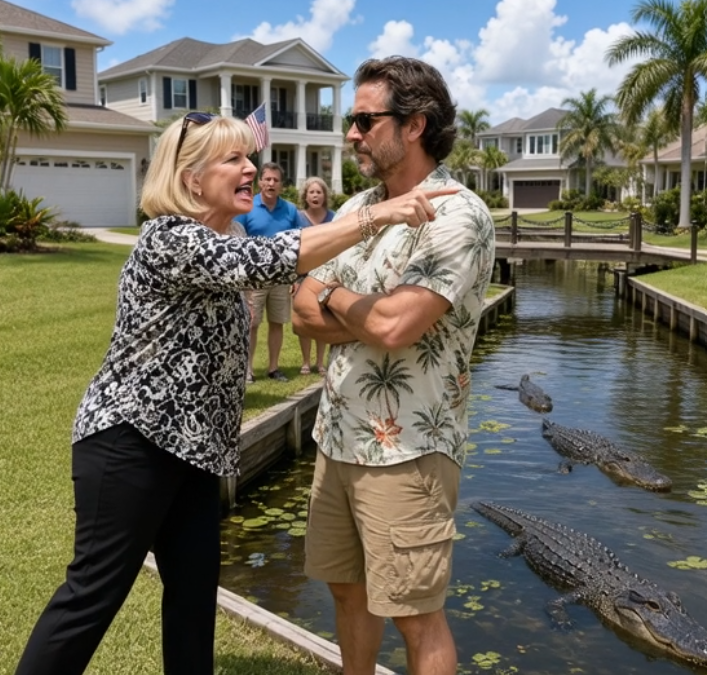
PART2:
Karen lived four houses away in a white colonial home with black shutters, symmetrical hedges, and a front lawn so perfect that I suspected she trimmed individual blades of grass with scissors.
She had spent years serving on the architectural committee.
When the previous HOA president moved to Arizona, Karen ran unopposed.
Most homeowners ignored the election.
That was our first mistake.
Within months, Karen reorganized committees, rewrote enforcement procedures, and began issuing violation notices with frightening enthusiasm.
She objected to basketball hoops.
She objected to wind chimes.
She objected to children leaving bicycles beside garages.
She objected to garden flags that remained displayed more than seven days after a holiday.
She once sent a warning letter to Mike because his teenage son washed a truck in the driveway.
The complaint claimed visible soap suds created a temporary aesthetic disturbance.
Karen’s power did not come from persuasive leadership.
It came from exhaustion.
Most people would rather move a trash can, remove a decoration, or pay a small fine than spend three evenings reading bylaws and attending a meeting.
Karen understood that.
She made resistance inconvenient.
Then she mistook surrender for agreement.
The pool ban began with an orange flyer taped to my mailbox.
I found it on a Saturday morning while carrying coffee into the backyard.
Emma and Noah were already in the pool.
Rachel sat beneath the umbrella grading spelling tests.
The sun reflected across the water.
Everything felt calm.
Then I read the first line.
ATTENTION RESIDENTS.
NEW HOA REGULATION.
PROHIBITION OF PRIVATE SWIMMING POOLS.
I assumed it concerned new construction.
That would have been unreasonable enough, but at least it would not affect us.
Then I reached the second paragraph.
All above-ground and in-ground swimming pools, including previously approved installations, were declared inconsistent with Willow Creek’s newly adopted “open-landscape aesthetic.”
Owners had thirty days to remove them.
Daily fines of two hundred dollars would begin on the thirty-first day.
The HOA reserved the right to pursue legal action, place liens, and recover enforcement costs.
I read the flyer twice.
Rachel noticed my expression.
“What happened?”
I handed it to her.
She read in silence.
Then she looked toward the pool.
“They cannot make us remove this.”
“That is what they are trying to do.”
“It was approved.”
“I know.”
“We spent years paying for it.”
“I know.”
“The children use it every day.”
“I know.”
Noah swam to the edge.
“Are we in trouble?”
“No,” I said immediately. “Keep swimming.”
Emma climbed onto the steps.
“What does the paper say?”
Rachel folded it before Emma could see more.
“Nothing you need to worry about today.”
Emma was eleven.
Old enough to know when adults were lying to protect her.
Young enough to still want to believe them.
That afternoon, I pulled out the original pool approval packet.
City permit.
Final inspection.
HOA architectural approval.
Email from the old board president saying, “Looks great, Daniel. Enjoy it.”
Enjoy it.
I stared at those two words for a long time.
Then I wrote Karen Whitmore a letter.
Mrs. Whitmore,
Our pool was approved by the City of Brookhaven and the Willow Creek Estates HOA in 2017. I have attached the approved plans, inspection records, and architectural authorization.
The new rule cannot retroactively revoke approval for an existing lawful improvement. Please confirm in writing that our property is grandfathered and not subject to removal.
Regards,
Daniel Mercer
I expected a correction.
Maybe a clarification.
At worst, some bureaucratic back-and-forth.
Karen responded the next morning.
Mr. Mercer,
The board has reviewed your materials. While your pool may have received prior approval, the current board has determined that private swimming pools are incompatible with Willow Creek’s updated open-landscape aesthetic.
Prior boards cannot permanently bind the community to outdated visual standards.
Removal deadline remains unchanged.
Failure to comply will result in enforcement.
Community harmony requires sacrifice.
Regards,
Karen Whitmore
HOA President
Community harmony requires sacrifice.
I read the line aloud to Rachel.
She set down her coffee.
“She sounds like a villain in a children’s movie.”
“She writes like a villain in a zoning hearing.”
“What are you going to do?”
“Fight it.”
Rachel smiled faintly.
“That was not a question.”
I hired an attorney.
That was expensive.
Karen counted on that.
My attorney, Marissa Blake, specialized in property disputes, HOA litigation, and making people regret writing stupid emails.
She reviewed the bylaws.
Then the amendments.
Then the original architectural approval.
Then the new pool ban.
“This is garbage,” she said.
“That is the legal term?”
“The polite one.”
“So we win?”
Marissa leaned back.
“Eventually, likely. Quickly, no.”
That was the problem.
Karen did not need to be right forever.
She only needed to make being right expensive.
The HOA began fining us.
Two hundred dollars a day.
Then four hundred.
Then special legal assessment fees.
Then “community impact charges.”
Marissa filed objections.
Karen filed responses.
The board held hearings and denied our appeal because the board was Karen, two neighbors terrified of her, and Harold Jenkins, who looked like he wanted to disappear into his folding chair.
At one hearing, Karen sat beneath the clubhouse chandelier with a stack of documents in front of her and smiled as if she were presiding over a Supreme Court case instead of a neighborhood tantrum.
“Mr. Mercer,” she said, “the issue is not whether your family enjoys the pool. I’m sure you do. The issue is whether one homeowner’s preferences should outweigh the visual integrity of the entire community.”
I looked around the room.
“Half the community has used that pool.”
“That is irrelevant.”
“No, Karen. That is the community.”
Her smile sharpened.
“Please address the chair properly.”
“You are the chair now?”
“I am HOA president.”
“Then as HOA president, show me where the bylaws allow retroactive removal of an approved improvement.”
She tapped her papers.
“The board has authority to regulate exterior features visible from neighboring lots.”
“My pool is behind hedges.”
“It is visible from aerial view.”
I stared at her.
“Aerial view?”
She turned one page around.
There was a drone photo of my backyard.
My pool.
My patio.
Rachel’s umbrella.
Noah’s pool toys.
My stomach went cold.
“You flew a drone over my property?”
Karen did not blink.
“The architectural committee conducted a visual compliance review.”
Rachel gripped my hand under the table.
Marissa’s eyes changed.
Not angry.
Sharper than angry.
“Mrs. Whitmore,” Marissa said, “please preserve all drone footage, communications, and metadata related to that flight.”
Karen’s smile faltered.
Only a little.
But I saw it.
So did Marissa.
The fight could have gone on for months.
Maybe a year.
Maybe longer.
But Karen found a faster weapon.
She filed a lien.
Not just against the fines.
Against the house.
That was when Rachel cried.
Not in front of the children.
Not in front of Karen.
At the kitchen sink, after midnight, with the dishwasher humming and the pool lights glowing outside like a memory under water.
“We did everything right,” she whispered.
“I know.”
“We asked permission.”
“I know.”
“We saved for years.”
“I know.”
“They can just do this?”
“They can try.”
She turned toward me, eyes red.
“Daniel, I teach kids every day to be fair. To follow rules. To tell the truth. What do I tell our children when following rules is not enough?”
I had no answer.
That hurt more than the lien.
Then came the letter from the HOA attorney.
It warned that continued refusal could result in foreclosure proceedings if fines and legal fees remained unpaid.
Foreclosure.
Over a pool.
A pool they had approved.
A pool where my children learned to swim.
A pool where neighbors gathered and Rachel graded spelling tests.
A pool Karen did not like because it represented joy she did not control.
I sat in my office at 2:00 a.m., reading that letter again and again.
Then I opened the bylaws.
Not the pool ban.
The whole thing.
I read until sunrise.
By six o’clock, I knew two things.
First, Karen had boxed us in on swimming pools.
Maybe not legally forever, but practically enough to hurt us badly before we won.
Second, the bylaws had a strange gap.
They prohibited private swimming pools.
They defined a swimming pool as “a structure, basin, or contained body of water intended for human swimming, wading, recreation, bathing, or aquatic exercise.”
They also prohibited “decorative ponds exceeding two hundred square feet” unless approved by architectural review.
They prohibited “livestock, poultry, and exotic pets.”
They prohibited “standing water likely to create mosquito conditions.”
They prohibited “unapproved fences.”
They prohibited “visible above-ground tanks.”
They did not prohibit stormwater management features approved by the county.
They did not prohibit conservation habitat.
They did not prohibit drawbridges.
I read that last part twice.
Then I started laughing.
Rachel found me at the desk.
“You look insane.”
“I may have found the line.”
“What line?”
“The line Karen forgot to ban.”
Rachel stared at the open binder.
Then at my laptop.
Then at my expression.
“Daniel.”
“Yes?”
“Whatever you are thinking, please make it less illegal.”
“I am thinking permits.”
“That did not comfort me.”
It should have.
I am an environmental engineer.
That detail matters.
I designed stormwater systems for commercial developments, municipal facilities, wetland mitigation sites, retention ponds, and ecological restoration projects. I knew more about drainage easements, habitat buffers, erosion control, basin capacity, and water-quality filtration than any normal human should admit at dinner parties.
Karen had attacked my swimming pool.
She had not realized I could read a watershed map the way she read violation schedules.
Willow Creek Estates had a known stormwater problem.
During heavy rain, runoff collected behind the homes on our side of the neighborhood, flowed toward a narrow culvert, and overwhelmed the ditch near the back lane. The HOA had delayed upgrades for years because landscaping mattered more to Karen than drainage.
My lot sat on the low corner.
I could legally apply for a private stormwater improvement if I met county requirements.
And if the feature qualified as water-quality treatment, habitat enhancement, and runoff retention, HOA aesthetic preferences would not automatically override county approval.
I did not want a pond.
I did not want a moat.
I wanted my pool.
But Karen had made one thing clear.
If my family could not swim in approved water, I had no reason to preserve a backyard designed for her comfort.
I called Marissa first.
She listened in silence.
Then she said, “I’m sorry. Did you say moat?”
“Ornamental stormwater feature.”
“Daniel.”
“With a controlled habitat island.”
“Daniel.”
“And possibly rescued juvenile alligators.”
Silence.
Then, “I need coffee before you continue.”
The alligators were Rachel’s fault.
That is important.
I proposed the stormwater moat as half joke, half revenge, half engineering solution.
Yes, that is three halves.
I was tired.
Rachel was the one who remembered that her school had hosted a wildlife conservation presentation the previous year. A licensed rehabilitation center outside Gainesville temporarily housed injured and nuisance-captured juvenile reptiles until relocation or educational placement. They sometimes partnered with permitted private conservation sites for short-term habitat, under strict supervision.
She said it casually.
“I wonder if your habitat island would qualify for something like that.”
We both stared at each other.
Then she said, “No.”
I said, “You brought it up.”
“I withdraw.”
“Too late.”
“No, Daniel.”
“Temporary rescued juvenile alligators.”
“No.”
“Under professional supervision.”
“No.”
“With two barriers.”
“No.”
“Technically educational.”
“No.”
“Karen banned joy.”
Rachel covered her face with both hands.
“You are becoming a Florida headline.”
“North Carolina headline, technically.”
“Do not lawyer me in our kitchen.”
The children loved the idea immediately.
That did not help my case with Rachel.
Emma wanted to name one Professor Teeth.
Noah wanted to name all of them Chomp.
Rachel said nobody was naming any alligator because we were not getting alligators.
Three weeks later, we were meeting with county stormwater staff, a landscape architect, a wildlife rehabilitation director named Dr. Lena Ortiz, Marissa, and one extremely confused contractor.
The plan was ridiculous.
It was also legal.
The old pool would be demolished.
Not filled in.
Removed.
The backyard would be regraded to create a perimeter stormwater channel around the rear and side of the house, connecting to an approved retention basin and filtration wetland feature.
A stone pedestrian bridge would cross the channel from the driveway to the front entry.
A smaller maintenance bridge would access the back patio.
The moat would be deep enough for stormwater function, landscaped with native plants, aerated, filtered, and secured with fencing integrated into stonework and hedges.
The central habitat platform would be isolated from human access.
Any wildlife placement would require state approval, professional supervision, feeding protocols, safety barriers, signage, emergency procedures, and temporary licensing.
Karen could not call it a swimming pool because nobody could swim in it.
She could not call it an ornamental pond because it exceeded pond definition and operated as a permitted stormwater improvement.
She could not call the alligators pets because they were not ours.
They were rehab animals temporarily housed by a licensed facility.
She could not call the fencing unapproved because county safety rules required it.
She could not claim mosquito danger because the system included circulation, filtration, aeration, native mosquito-control plants, and inspection.
She could not claim it violated the open-landscape aesthetic because the same rule that destroyed my pool did not regulate county-approved drainage infrastructure.
Karen had built a weapon out of technical language.
I simply built a better one.
The day the excavator broke the pool, Karen came to watch.
Of course she did.
She stood on the sidewalk in white capri pants, sunglasses, and victory.
The children stood at the kitchen window crying.
Rachel held Noah against her side.
Emma refused to look away.
The excavator arm came down.
Concrete cracked.
Blue tile shattered.
Water drained through a temporary pump hose into a permitted discharge line.
Karen smiled.
I saw her.
She wanted me to see her.
I walked outside.
She lifted one hand in a little wave.
“Good morning, Daniel.”
I said nothing.
“I know this is difficult,” she said.
“No, you don’t.”
Her smile stayed in place.
“Change is always hard. But in time, I think you’ll see this was best for Willow Creek.”
I looked back at the broken pool.
Then at her.
“Karen, did you ever ask yourself what kind of person enjoys this?”
Her smile faded.
Only for a second.
Then she recovered.
“I enjoy compliance.”
“That is worse.”
She gave a small laugh.
“You always were dramatic.”
Behind me, the excavator cracked another section of pool wall.
I forced myself not to turn.
“You won this part,” I said.
Karen tilted her head.
“This part?”
“Yes.”
Her eyes narrowed slightly.
“Meaning?”
I smiled.
Not much.
“You’ll see.”
That was the first time Karen looked uncertain.
The neighborhood watched the construction for weeks.
At first, people thought we were installing some kind of garden.
Then a drainage channel.
Then a decorative water feature.
Then the stone archway went up.
Then the drawbridge.
Then the reinforced habitat fencing.
Then the signs.
PRIVATE CONSERVATION HABITAT
NO ENTRY
AUTHORIZED PERSONNEL ONLY
Karen sent her first violation notice before the water was even in.
Unapproved landscape alteration.
Marissa responded with the county permit.
Karen sent another.
Unauthorized bridge structure.
Marissa responded with the county access approval and safety compliance note.
Karen sent another.
Visible fencing inconsistent with open-landscape aesthetic.
Marissa responded with state-required wildlife containment specifications.
Karen sent another.
Potential nuisance water feature.
I responded personally with eighteen pages of hydrological calculations.
Marissa told me that was petty.
I said it was educational.
Then the alligators arrived.
Three juvenile American alligators.
All under four feet.
All rescued from unsafe human interaction situations.
One had a damaged tail tip.
One had scarring along the back from a boat strike.
One had been illegally kept by someone who thought wild animals were social media props.
Dr. Ortiz brought them in a wildlife transport vehicle with two staff members, state paperwork, and the calm professionalism of a woman who had handled both reptiles and bureaucrats and knew which one bit harder.
The children watched from inside the house.
Not outside.
Inside.
Safety protocol.
Rachel stood beside them, arms crossed.
“I cannot believe this is my life,” she said.
Noah pressed his face to the glass.
“That one is definitely Chomp.”
“No,” Rachel said.
Emma whispered, “Professor Teeth.”
“No names,” Rachel said.
I stood outside with Dr. Ortiz as her team transferred the animals into the secured habitat.
Karen arrived six minutes later.
I had expected ten.
She was improving.
She marched down the sidewalk with two board members, Harold Jenkins, and a stack of notices clutched to her chest.
She stopped at the edge of my property and stared.
The drawbridge crossed the moat in front of her.
Water gleamed beneath it.
Native plants lined the edges.
Small fountains bubbled for circulation.
A stone arch framed the entrance.
And in the middle, on a floating platform, three small alligators settled into the sun like they had been invited by God and county planning.
Karen opened her mouth.
Nothing came out.
I will treasure that memory forever.
Then she found her voice.
“What have you done?”
I held up the binder.
“Complied.”
Her face went red.
“This is not compliance.”
“It is not a swimming pool.”
“You built a moat.”
“Stormwater feature.”
“With alligators.”
“Temporary conservation habitat.”
“You are insane.”
“No. I am permitted.”
Harold Jenkins, standing behind her, whispered, “Are those real?”
One alligator opened its mouth.
Harold stepped back.
Karen pointed at me.
“You will remove them immediately.”
“No.”
“You will drain this… this swamp.”
“No.”
“You will dismantle that bridge.”
“No.”
“You cannot surround your house with reptiles just because you are angry.”
“I agree. That would be reckless. Which is why I surrounded my house with a permitted stormwater feature and accepted temporary placement of rehabilitated wildlife through proper channels.”
“You think you’re clever.”
“I think I read the bylaws.”
She lifted the stack of papers.
“I have violation notices.”
“I have permits.”
“This neighborhood is not a zoo.”
“It is also not a dictatorship.”
Her eyes flashed.
Then she called the police.
That brought us back to Officer Ramirez standing on my drawbridge while Karen accused a sunbathing alligator of threatening her.
Officer Ramirez had been a police officer for eighteen years.
You could see it in his face.
He had handled domestic disputes, traffic crashes, bar fights, noise complaints, stolen bikes, and at least one person who called 911 because a raccoon looked judgmental.
But he had never handled a permitted HOA revenge moat.
He flipped through the binder slowly.
County stormwater approval.
Engineering plan.
Safety inspection.
State wildlife temporary habitat authorization.
Rehabilitation center agreement.
Containment protocols.
Liability insurance.
Emergency contact numbers.
Site map.
Photos.
Maintenance schedule.
Mosquito-control plan.
HOA correspondence.
Original pool approval.
Pool ban.
Fine notices.
Lien letter.
Drone photo.
Officer Ramirez paused at the drone photo.
He looked at Karen.
“You flew a drone over his backyard?”
Karen stiffened.
“That is not relevant.”
“It feels relevant to me.”
The younger officer, whose name tag read Park, was trying very hard not to smile.
Ramirez looked back at the binder.
“So,” he said slowly, “this is not a pool.”
“Correct,” I said.
“And the alligators are not pets.”
“Correct.”
“And this is permitted.”
“Yes.”
“And the HOA made you remove a permitted swimming pool.”
Karen snapped, “That is not the issue.”
Officer Ramirez looked at her.
“Ma’am, I’m still trying to figure out what the issue is.”
“The issue is he has created a dangerous eyesore.”
Park glanced at the moat.
To be fair, it was beautiful.
The water curved around the front of the house, edged with stone and native plants. Dragonflies skimmed the surface. The fountain bubbled softly. The drawbridge looked like something out of a storybook if the storybook had liability waivers.
Park said, “It’s actually kind of impressive.”
Karen whipped toward him.
He cleared his throat.
“From a construction standpoint.”
Ramirez handed me back the binder.
“I don’t see a criminal issue.”
Karen’s mouth fell open.
“You are leaving this here?”
“I am not a county engineer, wildlife officer, or HOA attorney.”
“But it’s dangerous.”
“So are swimming pools,” I said.
Karen glared at me.
Ramirez lifted one hand.
“Mrs. Whitmore, if you believe there is a code violation, you can contact the appropriate county department. If you believe the permits were wrongly issued, you can appeal through administrative channels.”
Karen looked horrified.
“Administrative channels?”
I almost felt sorry for her.
Almost.
Ramirez continued, “But as of right now, I’m not arresting Mr. Mercer for having documents.”
Park muttered, “Or alligators.”
Ramirez gave him a look.
Park straightened.
Karen pointed at the habitat.
“What if they escape?”
Dr. Ortiz, who had arrived during the police conversation, stepped forward.
“They won’t.”
Karen turned.
“And you are?”
“Dr. Lena Ortiz, director of Gulf Coast Wildlife Rehabilitation.”
“This is your fault?”
Dr. Ortiz smiled.
Professionally.
Dangerously.
“I prefer to think of it as conservation partnership.”
Karen looked at the officers.
“You hear this? They are all in on it.”
Officer Ramirez closed his notebook.
“Ma’am, I’m going to advise everyone to stay off Mr. Mercer’s property unless invited.”
Karen lifted the violation notices.
“The HOA has enforcement authority.”
“Not police authority,” Ramirez said.
That sentence landed beautifully.
Karen heard it.
Harold heard it.
The board members heard it.
So did three neighbors standing on the sidewalk pretending to walk dogs.
Officer Ramirez and Officer Park left twenty minutes later.
Karen stayed.
She stood at the edge of my property, staring at the moat like she could make it illegal by hating it hard enough.
Finally, she said, “This is not over.”
“No,” I said. “It isn’t.”
That was true.
The moat was only the beginning.
Karen called everyone.
County planning.
County stormwater.
State wildlife.
Animal control.
Code enforcement.
The health department.
The mayor’s office.
A local news station.
The governor’s constituent line, according to one exhausted staffer who later called Marissa to ask if this was “the alligator pool situation.”
Every agency reviewed the same documents.
Every agency reached the same conclusion.
Unusual.
Annoying.
Permitted.
Karen’s problem was simple.
The law did not require my property to make her comfortable.
Then the neighborhood began choosing sides.
Some people hated the moat.
Those were mostly Karen loyalists or people who had never once visited our pool but had strong feelings about “what Willow Creek should look like.”
Some people loved it.
Those were mostly children, engineers, and residents who had received one too many orange flyers from Karen.
Noah became briefly famous at school.
Not because I wanted him talking about it.
Because children are bad at operational secrecy.
“My dad built a moat with alligators because the HOA banned our pool” is not a sentence any eight-year-old can be expected to keep private.
By Friday, a local reporter stood outside the neighborhood entrance.
By Saturday, the story had spread across three counties.
The headline was predictable:
HOA BANS FAMILY POOL, HOMEOWNER BUILDS ALLIGATOR MOAT IN RESPONSE
Karen hated the publicity.
At first.
Then she tried to use it.
She gave an interview in front of the clubhouse wearing a navy blazer and pearl earrings, looking as if she had been born near a microphone.
“This is not about one family,” she said. “This is about community standards, safety, and the danger of weaponizing loopholes.”
The reporter asked, “Was the Mercer pool previously approved?”
Karen’s smile tightened.
“The community’s needs evolve.”
“Did the HOA issue fines and threaten liens?”
“Enforcement is always a last resort.”
“Did you fly a drone over their backyard?”
Karen blinked.
“That has been mischaracterized.”
The reporter turned to me for comment.
I stood beside the drawbridge with Marissa and Dr. Ortiz.
I did not wear a blazer.
I wore work boots.
That was strategic.
“The HOA forced us to remove a lawful approved pool,” I said. “We complied. The new feature is permitted, inspected, and safer than the swimming pool they banned. Nobody enters the habitat. Nobody touches the animals. The alligators are under professional care. The only thing endangered here is Karen’s belief that her preferences are law.”
Marissa whispered, “Nice.”
The clip went viral.
Karen’s interview did not help her.
But the real damage came from Harold Jenkins.
Quiet Harold.
Hamburger Harold.
The treasurer who came to our summer cookouts and pretended he did not like swimming.
Harold showed up at my house the following Tuesday.
He stood on the far side of the drawbridge, staring at the water.
“Daniel?”
“Yes?”
“May I come across?”
“Are you here as treasurer or neighbor?”
He hesitated.
“Neighbor.”
I lowered the bridge.
He crossed carefully, eyes flicking toward the habitat platform.
The alligators did nothing.
Harold still looked relieved.
We sat on the front porch.
Rachel brought lemonade.
Harold held his glass with both hands.
“I owe you an apology,” he said.
Rachel leaned against the porch post.
“For what part?”
He winced.
“All of it.”
I said nothing.
He continued.
“I knew the pool ban was wrong.”
That hurt more than I expected.
Rachel’s face went still.
Harold looked down.
“I told myself it was just board politics. Karen had the votes. The attorney said it might be defensible. I didn’t want the fight.”
“You came to our cookouts,” Rachel said softly.
“I know.”
“Our children called you Mr. Harold.”
“I know.”
“You watched them swim in that pool.”
His eyes filled.
“I know.”
Rachel turned away.
That was worse than if she had yelled.
Harold reached into a folder and removed several pages.
“These are board emails.”
I looked at them.
Karen had written:
The Mercers will resist, but if we make an example early, others will comply. Their pool is popular, which is precisely why it must go. Private gathering spaces reduce clubhouse engagement and undermine HOA programming.
I read that twice.
Private gathering spaces reduce clubhouse engagement.
It had never been about aesthetics.
Not really.
Karen did not hate the pool because it damaged community.
She hated it because community happened there without her.
Another email:
Apply maximum daily fines. Once lien pressure begins, Mercer will either remove pool or become a warning.
Rachel read over my shoulder.
Her face hardened.
Harold whispered, “I am sorry.”
I looked at him.
“Why bring this now?”
He glanced toward the moat.
“Because I watched Karen stand on television and talk about safety after she used our board to hurt your family. And because my grandson asked why I let Mrs. Whitmore take away the pool.”
He swallowed.
“I didn’t have a good answer.”
Marissa filed the emails the next morning.
That changed everything.
We amended our lawsuit.
Selective enforcement.
Bad-faith action.
Improper retroactive rulemaking.
Abuse of lien process.
Invasion of privacy through drone surveillance.
Retaliatory fines.
And a claim that the pool ban had not been enacted for legitimate aesthetic reasons but to force social activity into HOA-controlled spaces and punish non-board community gatherings.
Karen’s attorney stopped smiling after that.
The HOA’s insurance carrier got involved.
Then the management company.
Then residents began demanding financial records.
Why had clubhouse event revenue declined?
Why had Karen been pushing “HOA-sponsored recreation nights” with paid attendance?
Why had the pool ban been introduced two weeks after our free neighborhood cookout drew more families than Karen’s Memorial Day clubhouse picnic?
People started connecting dots Karen had assumed they were too tired to notice.
That is how small tyrants fall.
Not all at once.
Dot by dot.
The emergency HOA meeting was held in the clubhouse.
Karen tried to prevent me from attending because of pending litigation.
Marissa sent one email.
I attended.
So did Rachel.
So did Mike and Dana.
So did Mrs. Alvarez.
So did almost every parent whose children had swum in our pool.
Karen sat at the front table with two board members and a face arranged into offended patience.
Harold sat in the audience.
That told everyone something.
Karen opened with a prepared statement.
“Recent events have created division in our community. Certain residents have chosen spectacle over cooperation. While the board respects individual feelings, our duty is to protect Willow Creek’s character.”
Mike stood before she finished.
“Our kids swam at Daniel’s house for years. You didn’t protect character. You killed it.”
Applause broke out.
Karen banged the gavel.
“This is not a debate.”
Mrs. Alvarez stood next.
She was seventy-two, five feet tall, and had the moral force of a courthouse bell.
“You sent me a letter last year because my grandchildren’s chalk drawings stayed on the driveway overnight,” she said. “You called that visual clutter. Now you call Daniel’s family pool a threat to community. I think you do not know what community is.”
More applause.
Karen’s face reddened.
A father from two streets over stood.
“I paid your clubhouse family-night fee twice. Both times there were six kids there. Daniel’s cookouts had thirty. Maybe the problem wasn’t his pool. Maybe the problem was nobody wanted to attend events run like prison orientation.”
Even Harold laughed at that.
Karen pointed the gavel at him.
“Harold, control yourself.”
He stood.
“No.”
The room went silent.
Karen stared.
“What did you say?”
Harold’s voice shook, but he kept going.
“I said no. I should have said it months ago.”
That was the moment the meeting changed.
Not when I spoke.
Not when Marissa presented evidence.
When quiet Harold chose a side.
He turned to the room.
“I voted for the pool ban. I told myself Karen had done the research. I told myself Daniel could afford the fight. I told myself it wasn’t worth dividing the board.”
He looked at Rachel.
“I was wrong. I am sorry.”
Rachel nodded once.
Not forgiveness.
Not yet.
But recognition.
Harold continued.
“The emails you’ve seen are real. Karen pushed maximum enforcement before we even held appeals. She wanted the Mercers pressured. She wanted their pool gone because people gathered there instead of at paid HOA events.”
Karen stood.
“That is a gross distortion.”
Harold turned to her.
“No. It is the first honest thing said at this table in months.”
The room erupted.
Karen tried to adjourn the meeting.
Residents voted to continue.
She said they could not.
Marissa calmly cited the bylaws Karen herself had revised.
That was satisfying.
By the end of the night, the residents had enough signatures to call a recall vote.
Two weeks later, Karen Whitmore was removed as HOA president.
Not gracefully.
Not quietly.
She accused the neighborhood of hysteria.
She accused me of ecological terrorism.
She accused Rachel of manipulating parents through “pool nostalgia.”
She accused Harold of betrayal.
She accused Marissa of legal bullying.
She accused the alligators of being a public menace.
The alligators remained unavailable for comment.
The lawsuit settled in the spring.
The HOA agreed to rescind the retroactive pool ban, release all fines and liens, pay our attorney fees, compensate us for the destroyed pool, and formally acknowledge that our original pool had been lawfully approved.
They also agreed to pay for either reconstruction of the pool or conversion of the current stormwater feature after the wildlife placement ended.
Karen personally was not part of every financial term, but the settlement included a provision barring her from serving on any HOA board or committee for ten years.
That mattered.
To me.
To Rachel.
To everyone who had been fined into silence.
The drone issue went separately.
The HOA paid a privacy settlement and adopted rules prohibiting unauthorized aerial surveillance of private backyards.
The county, delighted by the chaos and slightly annoyed by the publicity, clarified local guidance on HOA stormwater interference.
Dr. Ortiz’s rehabilitation center received so much attention that donations tripled.
Emma said Professor Teeth had become a philanthropist.
Rachel said if she heard that name one more time, she would move.
Noah still called all three alligators Chomp.
Quietly.
Because he valued dessert.
The alligators stayed for four months.
During that time, my house became the most famous address in Willow Creek.
Children begged their parents to walk past it.
Adults pretended not to be curious.
Reporters called.
One television station asked if they could film from the sidewalk.
I said no.
They filmed from the sidewalk anyway.
The alligators mostly did nothing.
That disappointed the internet.
They basked.
They ate under supervision.
They floated.
They opened their mouths to regulate temperature and caused Karen to file two more complaints after her removal.
Both were denied.
One afternoon, after the legal settlement was signed, Rachel and I stood on the drawbridge watching Dr. Ortiz and her staff prepare the animals for transport to a larger facility.
Emma stood beside us.
Noah held Rachel’s hand.
The alligators were loaded safely, one by one.
No drama.
No lunging.
No cinematic goodbye.
Just professionals doing careful work.
Noah sniffed.
Rachel looked down.
“Are you crying over Chomp?”
“No.”
“You are.”
“He was brave.”
“He was an alligator.”
“He fought the HOA.”
I crouched beside him.
“Technically, he mostly napped.”
“That was his strategy.”
I could not argue with that.
After the transport van left, the habitat platform looked strangely empty.
The moat remained.
Water moving gently.
Plants taller now.
Fountains bubbling.
Dragonflies skimming the surface.
Rachel leaned against me.
“What now?”
I looked at the backyard where the pool had been.
At the water around us.
At the bridge.
At the children.
At the place Karen had tried to turn into a warning.
“Now we decide what we want.”
Emma looked up.
“Can we rebuild the pool?”
Noah nodded eagerly.
“With no alligators?”
Rachel said, “That is usually how pools work.”
I looked at her.
She smiled, but there was sadness in it.
The old pool was gone.
Even if we rebuilt it perfectly, it would not be the same.
That was the cruelest part of winning late.
You do not always get back what was taken.
Sometimes you get proof it should not have been taken.
That is not the same thing.
But it is something.
We decided not to rebuild the old pool exactly.
Instead, we redesigned the space.
The moat stayed, but without wildlife.
It became a stormwater garden wrapping the back of the house, with a small bridge, fish-free water, native plants, and a little stone seating area.
Behind it, where the old patio had been, we built a new pool.
Smaller.
Deeper blue.
With wider steps.
A fountain shaped like a heron because Mrs. Alvarez said every pool that survived a legal war deserved a bird.
The HOA approved it.
Unanimously.
The new board even sent a letter saying, “We look forward to seeing the Mercer family enjoy their approved backyard improvement.”
Rachel read it aloud and said, “Approved backyard improvement? They mean pool.”
I said, “Legal trauma changes vocabulary.”
The first cookout after the new pool opened was not annual.
It was not even planned.
Mike came over with burgers.
Dana brought fruit.
Mrs. Alvarez brought iced tea.
Harold brought swimming trunks in a grocery bag and looked so embarrassed that Rachel hugged him before he could apologize again.
Children came.
Parents came.
Neighbors who had never spoken to each other stood ankle-deep in the water arguing about barbecue sauce.
The pool lights came on at dusk.
The water turned turquoise.
For a moment, it looked almost like before.
Almost.
Then Noah stood on the steps and raised a plastic cup.
“To Chomp!”
Twenty children shouted, “To Chomp!”
Rachel covered her face.
I laughed so hard my chest hurt.
Even Harold laughed.
Maybe that was the moment I knew Karen had truly lost.
Not when the police refused to arrest me.
Not when the permits held.
Not when the residents removed her.
Not when the settlement was signed.
When my son could turn the whole ugly story into a toast for a temporary alligator.
Karen moved out six months later.
Her house sold to a young couple with twin toddlers and a golden retriever that immediately violated three old rules by existing loudly.
The new board welcomed them anyway.
A year after the pool war, Willow Creek looked mostly the same from the street.
Same lawns.
Same hedges.
Same brick mailboxes.
Same sidewalks.
But underneath, something had changed.
People read ballots now.
They attended meetings.
They questioned fines.
They asked whether rules made sense or simply made power easier.
The HOA still had rules.
Good.
Communities need rules.
But rules should protect people from harm, not protect one person’s ego from joy.
That distinction became Willow Creek’s unofficial motto after Mrs. Alvarez said it at a meeting and someone put it on a coffee mug.
Karen would have hated the mug.
That made everyone like it more.
Sometimes visitors still ask about the moat.
It is hard not to.
It curves around the back of the house, beautiful and strange, with stone edges, lilies, reeds, and two small wooden bridges. At sunset, the water catches the sky. Children love telling new kids that alligators once lived there.
Parents always look at me to confirm.
I always say, “Temporarily.”
Rachel always adds, “Professionally supervised.”
Noah always whispers, “Chomp.”
Life moved on.
But I kept the original binder.
All of it.
Pool approval.
Pool ban.
Fine notices.
Lien letter.
Engineering plans.
Moat permits.
Wildlife authorizations.
Police report.
Settlement agreement.
Harold’s emails.
Karen’s drone photo.
Sometimes, when someone tells me an HOA would never go that far, I show them the binder.
Not to brag.
Not to relive it.
To remind them that petty power becomes dangerous when ordinary people get too tired to challenge it.
Karen did not begin by banning my pool.
She began with soap suds.
Wind chimes.
Bicycles.
Chalk drawings.
Small things.
Tiny intrusions.
Little tests.
Each one taught her who would resist and who would comply.
By the time she came for the pool, she thought exhaustion had already won.
She forgot something.
People will tolerate a lot for themselves.
They will tolerate less when their children cry at the kitchen window watching an excavator break the place where they were happy.
And they will tolerate almost nothing when the person responsible smiles while it happens.
Karen thought the pool ban was the end.
She thought the cracked blue tile was proof that rules belonged to her.
But the law is a strange thing.
So is engineering.
So are alligators.
She used technicalities to destroy joy.
I used technicalities to expose her.
I did not build the moat because I loved reptiles.
I built it because Karen Whitmore needed to learn that compliance is not the same as surrender.
She told me private swimming pools did not belong in Willow Creek.
So I removed the pool.
Then I built something safer, stranger, more permitted, more documented, more impossible for her to control.
And when she stood at my gate demanding my arrest because an alligator had the audacity to possess teeth, she finally met the monster she had created.
Not the reptile.
The paperwork.
A few weeks ago, Officer Ramirez came by off duty for the new summer cookout.
He stood on the bridge with a paper plate in one hand, looking over the water.
“No alligators this year?” he asked.
“No.”
“Kind of disappointing.”
“You too?”
He grinned.
“My daughter still talks about it.”
Rachel handed him iced tea.
“Please do not encourage my husband.”
Officer Ramirez looked at me.
“Wouldn’t dream of it.”
Behind us, the children splashed in the new pool.
Mrs. Alvarez sat beneath the umbrella.
Harold claimed he had come only for hamburgers.
The evening smelled like chlorine, grilled corn, sunscreen, and summer.
Not lighter fluid and anger.
Not wet concrete and broken tile.
Summer.
I looked at the pool.
Then at the moat.
Then at Rachel laughing with Dana near the patio steps.
This was not the backyard we had before.
It was not untouched.
It had scars.
But it was ours again.
That mattered.
Karen once told me community harmony required sacrifice.
She was half right.
Community does require sacrifice.
It requires sacrificing ego.
Control.
The pleasure of winning every small fight.
The belief that rules matter more than people.
Karen sacrificed none of that.
So she lost the community she claimed to protect.
As for me, I sacrificed a pool and accidentally gained a legend.
I would not recommend the method.
It was expensive.
Stressful.
Ridiculous.
And for several months, my house looked like a medieval wildlife sanctuary designed by an angry civil engineer.
But I will say this.
The day Karen stood behind Officer Ramirez, clutching violation notices while a juvenile alligator yawned in the sun and every single permit in my binder said she was powerless, I understood something important.
Joy needs defending.
Sometimes with lawsuits.
Sometimes with neighbors.
Sometimes with engineering.
And occasionally, under the right professional supervision, with alligators.
The pool is back now.
The moat remains.
Karen is gone.
And every time the fountain bubbles beside the lilies, I remember the lesson she taught me by accident.
If someone uses the rules to take away your peace, learn the rules better than they do.
Then build something they cannot touch.








