The HOA Forced Me to Tear Down the Dam Protecting My Land—Three Days Later, I Watched the River Reach the Homes They’d Built Downstream.
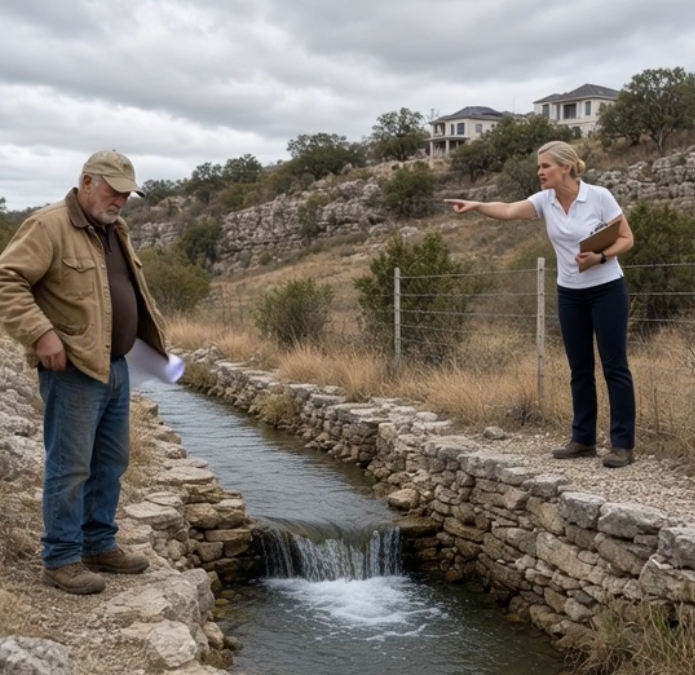
The HOA Forced Me to Tear Down the Dam Protecting My Land—Three Days Later, I Watched the River Reach the Homes They’d Built Downstream.
Dorinda Fitch told me to knock down the dam like she was asking me to move a lawn chair.
Three days later, she stood barefoot in floodwater outside her million-dollar clubhouse, screaming for somebody to stop the river she had set free.
But water does not take orders from HOA presidents, and Thornbriar Creek had been waiting years to show Ridgecrest Estates exactly what my little dam had been holding back.
“Knock it down.”
Four words.
That was all Dorinda Fitch gave me for eleven years of work, sweat, stone dust, summer heat, and every careful decision I had made to keep Thornbriar Creek from eating my land alive.
No engineer.
No inspection.
No hearing.
No one from the Ridgecrest Estates HOA had ever stepped down into that creek bed, put a boot on the limestone apron, watched the water slow and fan out the way it was supposed to, or asked why my pecan trees had come back after years of dying one by one.
Just a woman in a white polo shirt, holding a clipboard, standing on the road beyond my fence like she had purchased authority in bulk.
“Knock it down,” she repeated.
I looked past her, toward the creek.
It was late February in Central Texas, one of those gray days when the air smells like cedar, wet limestone, and rain that may or may not decide to arrive. Thornbriar Creek ran low behind my lower pasture, steady and narrow, slipping over the face of the little dam I had built with permits, certified plans, and my own two hands over eleven summers.
Four feet at its highest point.
Eighteen feet across the creek bed.
Local limestone.
Concrete core.
Engineered apron.
Not pretty in the way suburban people like things to be pretty.
No decorative railings.
No fountain.
No landscaping stones set in a cute crescent around it.
It was working pretty.
County pretty.
Water-management pretty.
The kind of structure only someone who understands flow rates and erosion can love properly.
Dorinda did not love it.
Dorinda saw something outside her rules.
That was enough.
“Show me the rule,” I said.
Her mouth tightened.
She had expected fear, confusion, maybe irritation.
She had not expected a retired county water systems technician who kept permits in a fireproof box and knew exactly what water did when fools tried to argue with it.
She lifted her clipboard and tapped a paper with one polished fingernail.
“The Ridgecrest Estates HOA has determined that your unauthorized impoundment structure interferes with downstream stormwater flow dynamics.”
“My land is not in Ridgecrest Estates.”
“It is adjacent to Ridgecrest Estates.”
“That doesn’t answer my question.”
“The structure affects our drainage easement.”
“No,” I said. “It doesn’t.”
Her eyes narrowed.
PART2:
“We’ll see you in court, Mr. Voss.”
I almost laughed.
Not because it was funny.
Because I already knew what Thornbriar Creek would do if that dam came out.
I knew the grade.
I knew the channel.
I knew the waterline on the stones after a hard rain.
I knew what was downstream, what had been built too close, what had not been finished, and what all those neat new houses were quietly depending on without a single person in their HOA understanding it.
I could have explained.
I almost did.
Instead, I looked at Dorinda’s clipboard, her white polo, her pearl-white Escalade idling behind her, and the two Ridgecrest board members standing back near the hood like witnesses to a victory that had not happened yet.
Then I stopped trying to save them from themselves.
My name is Harlan Voss.
I am sixty-three years old, retired from the county utility district after twenty-seven years of water systems work.
I was never rich.
Never famous.
Never the guy whose name went on a plaque.
I was the guy down in the trench in July, checking valves, repairing pump stations, mapping rural service lines, clearing intake screens, answering emergency calls when rain overwhelmed drainage that somebody on paper had sworn would be sufficient.
That kind of job teaches you a hard truth.
Water does not care what people approve in meetings.
It does not care what a developer promised, what an HOA president believes, what a lawyer writes in a forty-one-page complaint, or what a county commissioner wishes would happen before election season.
Water goes where the land sends it.
PART3:
And if you have spent enough years watching it move, you learn not to lie to yourself about what comes next.
I bought my twelve acres in the late 1990s, back when the edge of Thornbriar County was still half scrub, half cattle pasture, and the developers had not yet discovered how much money could be made by painting everything beige and calling it exclusive.
The place was not grand.
Twelve acres on the edge of the Thornbriar Creek floodplain.
Central Texas hill country.
Cedar.
Limestone.
A few old pecans.
Patches of native grass.
A lower pasture that turned silver in winter and burned dull gold in late summer.
The creek cut through the back quarter, seasonal but serious when it wanted to be.
I paid cash for most of the land after saving for four years. The day I signed the deed, I drove out alone, parked at the gate, and stood there listening to the creek.
That was why I bought it.
Not the house.
There was no house yet.
Not the road frontage.
It was rough.
Not investment potential.
I hated that phrase even then.
The creek.
That sound.
Water moving over stone has a way of making a man believe the world is older than his troubles and will remain after them.
My father had been gone two years by then. My marriage had ended the year before that, quietly and with less fighting than sadness. My son, Eli, was thirteen and visited on weekends. I wanted a place where he could learn to drive a tractor, catch perch, fix pipe, curse cedar thorns, and know that not every good thing came with pavement.
At first, Thornbriar Creek behaved.
Most days, it was a ribbon of water slipping over limestone shelves. In late summer, it narrowed to pools. After rain, it rose brown and loud, but it stayed mostly where the banks told it to stay.
Then the county grew.
That is the polite way of saying men in pressed shirts started looking at pastureland the way coyotes look at chickens.
First came the road widening.
Then the utility extensions.
Then survey crews.
Then the first subdivision two miles north.
Then another.
Then Ridgecrest Estates.
By the time Ridgecrest broke ground, Eli was grown and living in San Antonio, working in HVAC and raising a daughter who could already identify a crescent wrench by age four. I was nearing retirement. My back hurt more often than not. My hands had scars from tools, valves, barbed wire, and one unfortunate raccoon incident I prefer not to discuss.
The land around mine changed faster than the creek could adjust.
That is the part people forget.
A creek is not just water.
It is math with mud in it.
Every driveway, roof, culvert, curb, patio, pool deck, and compacted lawn changes that math.
Rain that used to soak into pasture now runs hard over concrete.
Water that once spread slow through grass now shoots through storm drains and comes out angry.
Developers call it drainage.
I call it concentrated impatience.
Thornbriar Creek started cutting deeper in 2008.
At first, it was subtle.
A little more bank loss after storms.
Tree roots exposed where the water turned behind my lower pasture.
Gravel bars shifting.
One pecan near the bend leaned toward the creek and died the next spring.
Then two more.
I walked the banks after every heavy rain with a measuring rod and a notebook, not because anyone paid me to, but because old habits do not retire.
By 2010, I knew I had a problem.
The creek was incising.
The bed had dropped nearly a foot in places.
That meant the banks were higher, steeper, and more likely to shear off in chunks. The water moved faster through my stretch instead of spreading out. It tore at the toe of the bank, undermined roots, and carried soil downstream like it had a grudge.
I could have ignored it.
Lots of people ignore water until it comes through the back door.
I had spent too many nights answering those calls.
So I did it right.
I hired a small engineering firm in Waco.
I got a survey.
I pulled records.
I met with the county floodplain administrator.
I filed for a minor creek stabilization permit.
I notified the downstream landowner at the time, a rancher named Bobby Salas, who told me if my little stone dam slowed the creek enough to keep his lower fence from washing out again, he would personally bring beer.
The plans called it a low-water grade-control structure.
I called it the dam because I am not paid by syllable.
It was not designed to stop a flood.
That is important.
A four-foot limestone structure across a seasonal creek is not Hoover Dam.
It was meant to slow normal and moderate flow, stabilize the bed, reduce erosive velocity, hold grade, spread water slightly across the natural bench in heavy rain, and protect the lower pasture from continued downcutting.
In plain English, it made the creek behave.
Not always.
Not perfectly.
Water never becomes tame.
But it behaved better.
I built most of it myself because I was younger then and stubborn in ways my doctor would later describe as “not medically advisable.”
Eleven summers.
Not full time.
A few weeks here, a few weekends there.
Stone by stone.
Form by form.
Pour by pour.
Some years I had money for materials.
Some years I did not.
Some years the creek undid a week of work overnight and I sat on a rock at dawn wondering if I was an idiot.
Then I rebuilt it stronger.
The first time water flowed clean over the finished apron, I stood ankle-deep in the creek and laughed like a fool.
The pecans came back.
Not all.
Some were gone forever.
But new leaves filled branches I had thought were finished. Grass returned to patches that had been raw dirt for years. The lower pasture held moisture longer. The banks stopped collapsing every time a storm rolled through.
And downstream?
Downstream got steadier water.
Less sediment.
Less sudden cutting.
Bobby noticed before anybody else.
He stood beside me after one good spring storm, boots sunk in mud, looking at his fence still standing.
“I don’t know what all that rock cost you, Harlan,” he said, “but it’s the first thing in twenty years that made this creek act like it had manners.”
That was all the award I needed.
Then Bobby sold.
Not because he wanted to.
Because taxes climbed, his knees failed, his kids did not want cattle, and a developer offered more money than his family could afford to refuse.
That pasture became Ridgecrest Estates.
Exclusive hill country living.
Gated entrance.
Private trails.
Community clubhouse.
Resort-style pool.
Preserved natural creek corridor.
That last phrase still makes me want to spit.
They preserved it the way a taxidermist preserves a deer.
They straightened parts of the old drainage swales, built up pads, carved roads, installed culverts where water had never agreed to be narrowed, and sold creekside lots at a premium to people who liked the word natural as long as nature behaved decoratively.
I attended one county meeting during the approval stage.
Just one.
I stood in the back wearing work boots while men in suits clicked through slides showing blue arrows moving politely across maps.
When public comment opened, I walked to the microphone.
“My name is Harlan Voss. I own the upstream tract along Thornbriar Creek. That creek has changed significantly over the last fifteen years due to upstream development. Any downstream subdivision needs serious detention, wide natural buffers, and conservative finished-floor elevations. The existing channel cannot take concentrated runoff like a concrete ditch.”
The developer’s engineer smiled.
I knew that smile.
It was the smile of a man whose calculations had already been paid for.
He said, “Our stormwater design meets county requirements.”
I said, “County requirements are minimums.”
He said, “We have modeled the hundred-year event.”
I said, “Did your model include debris?”
He said, “Standard roughness coefficients were applied.”
I said, “That means no.”
A few people chuckled.
The county commissioners did not.
The project was approved.
Of course it was.
They never reject money wearing renderings.
For the first few years after Ridgecrest was built, things were quiet.
The residents kept to their ridge.
I kept to my land.
Occasionally, I saw golf carts near the creek corridor. Once, a woman in white pants tried to walk across my lower pasture because her fitness app showed a trail there.
I told her the trail was actually a cow path and the cows had not authorized public use.
She left confused.
Then Dorinda Fitch became HOA president.
I knew her before she knew me.
People like Dorinda announce themselves in small ways first.
New signs near the entrance.
A newsletter with too many capital letters.
Rules about trash cans, garage doors, basketball hoops, holiday lights, visible hoses, and “unapproved native growth.”
She had moved from Houston with her husband, a retired commercial real estate man who played golf badly and smiled like a tax shelter.
Dorinda took over Ridgecrest as if she had been waiting her whole life for a kingdom small enough to control.
The trouble started with mosquitoes.
That is what her first letter said.
Dear Adjacent Property Owner,
The Ridgecrest Estates HOA has received resident concerns regarding increased mosquito presence near the creek corridor. It has come to our attention that an impoundment feature upstream of our community may be contributing to standing water conditions…
I stopped reading for a full minute.
Standing water.
My dam did not create a swamp.
It created a shallow pool that flushed with every normal flow and supported frogs, dragonflies, minnows, birds, and every natural mosquito predator Central Texas had not yet managed to poison.
The real mosquito factory was Ridgecrest’s decorative retention pond by the clubhouse, where over-fertilized runoff sat warm and green behind stone edging.
I wrote back politely.
Polite is important at first.
It helps later when you stop.
I explained the structure, attached permits, maintenance records, photos of flow conditions, and a short note explaining that mosquito concerns should be evaluated by a pest professional and likely originated in low-circulation ornamental water features within Ridgecrest.
Dorinda did not answer.
Two weeks later came the second letter.
This one accused the dam of “altering natural hydrology.”
That was like accusing a fence of altering natural trespass.
Yes.
That was the point.
I sent more documents.
A month passed.
Then came a drone.
I was repairing a gate near the lower pasture when I heard it.
A high whine above the pecans.
I looked up and saw a quadcopter hovering over my creek.
It drifted low, then sideways, camera pointed directly at the dam.
I raised one hand and waved.
Not friendly.
The drone climbed and zipped back toward Ridgecrest.
That evening, I emailed Dorinda.
Do not fly drones over my property again.
She replied:
The HOA reserves the right to inspect drainage features impacting community infrastructure.
I replied:
The HOA reserves nothing over my land. The next drone may be returned in pieces if it lands on my side of the fence.
My son Eli called that night.
“Dad, did you threaten to shoot down an HOA drone?”
“No.”
“You told them it might come back in pieces.”
“If it lands.”
“That’s a threat adjacent.”
“It’s an educational boundary.”
He sighed.
Eli worries about me the way adult children worry when they realize their parents are not becoming more manageable with age.
“Just call a lawyer before you do anything weird.”
“I’m not doing anything weird.”
“You own three water pressure gauges older than I am.”
“That is called preparedness.”
“That is called evidence in a competency hearing.”
I laughed despite myself.
Then Dorinda appeared at my fence in February with her clipboard and her order.
Knock it down.
That was when I knew politeness had ended.
After she left, I walked to the dam.
The creek slid over the limestone face in a thin shining sheet. Water gathered briefly in the pool above, then spilled cleanly across the apron and continued downstream toward Ridgecrest.
I stood there a long time.
Not because I was uncertain.
Because I was sad.
A man can know he is right and still be tired of proving it.
The lawsuit arrived nine days later.
Ridgecrest Estates Homeowners Association v. Harlan Voss.
The complaint accused me of maintaining an unauthorized obstruction, interfering with drainage easements, increasing mosquito hazards, creating potential upstream and downstream flooding, and refusing reasonable HOA requests for remediation.
Reasonable.
That word did heavy lifting for people who had never lifted anything else.
They asked for injunctive relief requiring removal of the dam before the spring storm season.
They attached drone photos, selective floodplain maps, a letter from a landscape drainage consultant, and one highly dramatic declaration from Dorinda Fitch stating that my “homemade dam” presented “a grave and immediate threat to community safety.”
Homemade.
I read that word three times.
Then I called my lawyer.
Her name was Maribel Santos.
She had represented the utility district for years and had a voice that made contractors remember documents they had previously misplaced.
“Harlan,” she said when she answered, “please tell me you are calling about fishing rights.”
“I got sued by an HOA.”
“I prefer fishing rights.”
“So do I.”
I sent her everything.
Permits.
Plans.
Inspection notes.
Maintenance logs.
Photos from the last decade.
Rainfall records.
Old correspondence.
The original county approval.
The letter from Bobby Salas.
My notes from the Ridgecrest approval meeting.
Maribel called me back two hours later.
“Your paperwork is annoyingly complete.”
“Thank you.”
“That was not praise. It means I have to read all of it.”
“Bill me.”
“Oh, I will.”
She paused.
“They’re bluffing in some places, but not entirely. There’s an old drainage easement across part of the creek corridor.”
“On their side.”
“Yes. But they’re trying to argue your structure affects the easement function downstream.”
“It improves it.”
“I know. You know. We’ll need someone with letters after their name to say it in court.”
“I had one.”
“From eleven years ago. We need current.”
So we hired an engineer.
Dr. Luis Andrade.
Hydrology and fluvial geomorphology.
A small man with silver hair, field boots, and the cheerful intensity of someone who loved rivers more than most people love their children.
He came out three days later with two assistants, survey gear, and more enthusiasm than February deserved.
He walked the creek for six hours.
Upstream.
Downstream.
Across my land.
Along the fence overlooking Ridgecrest’s creek corridor.
He studied the dam, the apron, the banks, the sediment, the vegetation, the culverts below Ridgecrest Drive, and the detention pond outlets.
By sunset, his cheerfulness had dimmed into professional disgust.
He stood with me above the lower bend and pointed downstream.
“The dam is not their problem.”
“No.”
“It may be the reason they have not yet discovered their problem.”
“That’s what I thought.”
He looked at me then, one professional recognizing another.
“They built too close.”
“Yes.”
“They narrowed the overbank area.”
“Yes.”
“That culvert under their walking path is undersized.”
“Yes.”
“Their detention pond emergency spillway discharges badly.”
“Yes.”
“And this grade-control structure has been reducing peak erosive force entering their reach during smaller storms.”
“That is what it was designed to do.”
He looked back at the water.
“If a large enough storm comes through and that structure is gone, the creek will regain energy quickly.”
“How quickly?”
He glanced toward Ridgecrest.
“Quickly enough that I would not want to own one of those creekside lots.”
His report was clear.
It stated the dam was permitted, structurally intact, functioning as a grade-control and energy-dissipation feature, and not the source of Ridgecrest’s drainage risk. It recommended against removal without a downstream mitigation plan.
We filed it with the court.
Ridgecrest filed a counter-report.
Their consultant, a man named Darren Pyle, had visited once, taken photos from the Ridgecrest side, and concluded that the dam was “nonstandard” and “potentially obstructive.”
Potentially.
That word is where weak opinions go to hide.
The hearing was set for March 12.
It rained the night before.
Not hard.
Enough to freshen the creek.
I wore my best jeans, a clean shirt, and the boots my granddaughter called my funeral boots because they were the only ones without visible manure history.
Dorinda arrived in a cream suit.
Not white polo this time.
Courtroom armor.
She sat behind Ridgecrest’s attorney, a tall man named Graham Bell who wore glasses he probably did not need and spoke as though every sentence had been notarized by God.
Maribel sat beside me with a yellow legal pad and a stack of exhibits thick enough to injure someone.
Judge Palmer presided.
He was near seventy, bald, and had the weary expression of a man who had heard too many neighbors explain why their fence was morally superior to someone else’s.
Graham Bell opened with urgency.
He described my dam as an unapproved obstruction threatening a residential community.
He said spring storms were approaching.
He said the HOA had a duty to protect residents.
He said delay could expose homes to danger.
Then Maribel stood and explained that Ridgecrest was attempting to use emergency relief to avoid its own drainage design failures. She walked through the permits, the engineering report, the lack of HOA jurisdiction, and the fact that my structure predated Ridgecrest’s homes.
Judge Palmer listened carefully.
That gave me hope.
Hope is dangerous in court.
Then Graham Bell did something clever.
He stopped arguing ownership.
He stopped arguing HOA authority.
He argued uncertainty.
He said the court did not have to determine final rights that day. It only had to prevent potential risk during storm season. He said two experts disagreed. He said residents should not be forced to live downstream of an unmonitored private dam while litigation continued.
Unmonitored.
Private dam.
He made it sound like I had built a secret reservoir in the hills with dynamite and moonshine.
Maribel objected to half of it.
Judge Palmer frowned through most of it.
Then he made the kind of compromise judges make when they want nobody to be happy and believe that means fairness.
He did not order full demolition.
He ordered temporary breaching of the central spillway section before forecast spring storms, pending final resolution.
Temporary.
As if you can temporarily unbuild stone and concrete.
As if water politely waits for a final hearing.
I stood when the order was read.
“Harlan,” Maribel whispered.
But I could not stay seated.
“Your Honor, if that structure is breached without downstream mitigation, Ridgecrest is at greater risk, not less.”
Judge Palmer looked over his glasses.
“Mr. Voss, your attorney has made that argument.”
“No, sir. I’m not arguing. I’m warning.”
Graham Bell stood.
“Your Honor—”
Judge Palmer raised a hand.
“Mr. Voss, I understand this is frustrating. The order is limited and temporary.”
“With respect, water doesn’t understand temporary orders.”
The courtroom went quiet.
For a second, Judge Palmer’s face shifted.
Maybe irritation.
Maybe doubt.
Then it was gone.
“The order stands.”
Dorinda smiled.
Just barely.
I saw it.
That little victory smile.
The kind of smile people wear when they think a judge has made them right instead of merely powerful for the moment.
Outside the courthouse, she walked past me with Graham Bell beside her.
“I hope you’ll comply quickly,” she said.
I looked at her.
“You have no idea what you’ve done.”
Her smile widened.
“We protected our community.”
“No,” I said. “You removed the thing protecting it.”
Her face hardened.
“Still blaming everyone else, Mr. Voss?”
“No. I’m documenting everyone else.”
That night, I called Eli.
“They ordered breach.”
He went quiet.
“How bad is that?”
“Depends on rain.”
“Forecast?”
“Bad.”
“How bad?”
“Three-day system. Gulf moisture. Slow front. Could be nothing. Could be six inches.”
“Dad.”
“I know.”
“Can you appeal?”
“Maribel is filing, but not before the deadline.”
“So what are you going to do?”
I looked out the kitchen window toward the dark creek.
“Comply.”
“That doesn’t sound like you.”
“I’ve spent my life telling people not to ignore water. I’m not going to ignore a judge.”
The next morning, I hired a contractor I trusted.
Not because I could not breach the dam myself.
Because I wanted witnesses, invoices, equipment logs, photographs, and someone else to verify exactly what was removed.
His name was Russell Cade, and he had built low-water crossings, farm ponds, and culverts across three counties.
When I told him what the court ordered, he took off his cap and scratched his head.
“They want you to cut that dam?”
“Yes.”
“Why?”
“Because they sued me.”
“No, I mean why in a thinking sense?”
“They skipped that step.”
Russell stood beside the creek, looking downstream.
“You got houses down there now.”
“Yes.”
“Close?”
“Yes.”
He spat into the grass.
“Hell of a thing.”
We started at dawn.
Maribel came.
Dr. Andrade came.
Eli drove up from San Antonio with my granddaughter Lucy in the backseat because he said if the family dam was being murdered, witnesses should be properly represented.
Lucy was six.
She wore pink rain boots and asked if Dorinda was a villain.
I told her real life was more complicated.
Eli said, “No, she’s a villain.”
I did not correct him.
Dorinda sent two board members to observe.
They stood on the road above the fence with umbrellas and phones, filming like tourists at an execution.
I filmed too.
Every cut.
Every stone removed.
Every section breached.
Russell used a saw, hammer drill, small excavator, and more patience than I had in me. We opened the central spillway section enough to satisfy the order, cutting down the crest and removing the water-slowing face that had spread the flow across the apron.
By mid-afternoon, Thornbriar Creek ran through the gap sharper and faster.
Not dramatic in low flow.
But I could already hear the difference.
The water had lost its manners.
Dr. Andrade stood beside me, arms folded.
“That will headcut in a storm.”
“Yes.”
“Sediment release too.”
“Yes.”
He looked downstream.
“You should send another warning.”
“I already drafted it.”
That evening, Maribel sent certified notices to Ridgecrest, their attorney, the county floodplain office, emergency management, and Judge Palmer’s clerk.
Notice of Increased Downstream Risk Following Court-Ordered Breach.
It explained that the grade-control structure had been partially removed under court order, that storm forecasts indicated significant rainfall, and that downstream property owners should be alerted to potential increases in flow velocity, sediment transport, debris movement, and bank erosion.
Dorinda replied through counsel.
Ridgecrest Estates rejects Mr. Voss’s continued fearmongering and reserves all rights.
Fearmongering.
That word arrived at 8:42 p.m.
At 9:13, the first thunder rolled.
Rain began just before midnight.
Soft at first.
Steady by dawn.
By noon, Thornbriar Creek had risen six inches.
By evening, it ran brown.
The water shot through the breach in the dam like a dog slipping a leash, fast and narrow, tearing at the cut edges.
I stood under a slicker and watched it.
Eli stood beside me.
Lucy was inside watching cartoons because childhood should be protected from adult stupidity as long as possible.
“That bad?” Eli asked.
“Not yet.”
“But?”
“But the creek is cutting.”
The exposed channel below the breach had already begun to scour. Water that once flowed over the apron in a wide sheet now concentrated through the gap, picking up speed, biting at the bed, carrying gravel downstream.
Rain fell all night.
At 3:00 a.m., I woke without knowing why.
Old utility workers sleep like firefighters after enough years.
Some part of you hears trouble before sound reaches your ears.
I pulled on boots and went outside.
The creek was roaring.
Not running.
Roaring.
My flashlight beam caught debris moving through the breach.
Branches.
Foam.
Sediment.
Water slapped hard against the banks below, climbing higher than I liked.
By sunrise, Thornbriar had jumped its lower shelf.
My side pasture flooded first, but it always did in big rain. That land was meant to take water. Native grass bent under the flow. The pecans stood in shin-deep brown current, roots gripping.
Downstream, toward Ridgecrest, the channel narrowed.
That was where the trouble would start.
At 7:20, the county issued a flood watch.
At 8:05, I called emergency management.
“This is Harlan Voss on Thornbriar Creek. The breached grade-control structure is releasing high-velocity flow downstream toward Ridgecrest Estates. Their creekside lots need notification.”
The dispatcher took notes.
At 8:37, I called again.
At 9:10, Dr. Andrade called them too.
At 10:02, Maribel forwarded another warning to Ridgecrest’s attorney.
No response.
At 10:46, Patricia from Ridgecrest called me.
I did not know her well. She had bought Bobby Salas’s old ranch house site before Ridgecrest absorbed that road. She was one of the few residents who had ever waved at me like a normal person.
“Harlan,” she said, her voice tight, “the creek behind us is running wild.”
“Where are you?”
“Lot 18. High side. We’re okay. But the water is chewing at the walking trail.”
“Get away from the creek. Tell your neighbors.”
“Dorinda says the HOA is monitoring.”
“Dorinda couldn’t monitor a bathtub.”
“I know. That’s why I called you.”
Behind her, I heard someone shout.
Then Patricia said, “Oh my God.”
“What?”
“The trail bridge just went.”
The first bridge at Ridgecrest was decorative.
I had always hated it.
Too low.
Too narrow.
Built like a wedding photo prop.
It crossed the creek near the clubhouse greenbelt, right where floodwater needed room to spread.
When debris hit it, the bridge caught branches, cedar limbs, trash, and sediment like a strainer.
Water backed up behind the jam.
Then, with nowhere else to go, it went around.
That is what water does.
By 11:30, Ridgecrest’s creek corridor was no longer a corridor.
It was a river.
A real one.
Brown.
Fast.
Carrying pieces of their own landscaping back to them.
It tore out sections of trail.
Lifted benches.
Ripped decorative boulders from carefully arranged beds.
The undersized culvert beneath Ridgecrest Lane clogged next, just as Dr. Andrade had warned it would. Once blocked, water spread across the road and began pushing toward the low lots built along the “preserved natural creek amenity.”
Preserved.
Natural.
Amenity.
Three words no river has ever respected.
I drove to the ridge entrance at noon, not into the subdivision, just to the county road above it where I could see enough.
Rain hammered the windshield.
Emergency lights flashed near the gate.
Residents stood under umbrellas and golf cart roofs, staring downhill.
Dorinda was there in a yellow rain jacket, hair plastered to her face, shouting into a phone.
I parked near the shoulder and stepped out.
She saw me immediately.
Even in that mess, she found room for outrage.
“You,” she shouted.
I stayed where I was.
A sheriff’s deputy held people back from the flooded road.
The creek had spread behind the first row of homes. Brown water moved across perfect lawns, around patio furniture, through flower beds, under fences, carrying mulch, toys, planters, and one expensive outdoor cushion spinning slowly like a dead fish.
A man in deck shoes yelled, “Why isn’t the drainage working?”
No one answered.
Because the drainage was working exactly as built.
That was the problem.
Dorinda pushed toward me until the deputy blocked her.
“You did this!”
I looked at the water.
“No. You asked for this in writing.”
Her mouth opened.
Rain ran down her face.
“You sabotaged the creek.”
“I complied with a court order your HOA requested.”
“This never happened before!”
“I know.”
That landed.
For one second, she had nothing.
Then a crash sounded behind the clubhouse.
Everyone turned.
The ornamental retaining wall along the pool deck failed first.
It had been holding saturated fill behind the clubhouse lawn, never designed for floodwater pushing from the creek side. Stones popped outward one after another. The wall bulged, split, then collapsed in a dirty wave.
Water rushed through the opening.
Someone screamed.
The resort-style pool disappeared under muddy floodwater within minutes.
Lounge chairs lifted and drifted.
The cabana refrigerator tipped over.
A white pergola twisted sideways.
Dorinda stared as if the river had broken a contract.
By 1:15, water entered the first house.
Lot 7.
The Kesslers.
Finished-floor elevation too low by my eye from the day construction started.
They had paid extra for creek access.
Now the creek accessed them back.
Firefighters went door to door.
Deputies evacuated the lower homes.
Some residents had already left after Patricia warned them.
Others had trusted the HOA email sent at 9:00 a.m.
Ridgecrest Estates HOA is aware of elevated creek conditions and is actively monitoring. Residents are advised to avoid the trail system until further notice.
Actively monitoring.
That phrase aged poorly.
By 2:00, the rain intensified again.
A training band moved over the county and sat there like it had unpaid business.
Thornbriar Creek rose another foot.
The water found the old floodplain.
Not the mapped greenbelt.
Not the landscaped corridor.
The old one.
The one visible on county aerials from 1978.
The one Bobby Salas’s cattle had known to avoid during storms.
The one Ridgecrest Estates had filled, narrowed, decorated, and sold as premium backyard space.
The river took it back house by house.
Not all at once.
Not like a movie wave.
It came with steady, grinding certainty.
Back fences went first.
Then sheds.
Then patios.
Then outdoor kitchens.
Then the lower rooms of houses built just high enough for the model and just low enough for consequence.
I stood under the edge of a deputy’s canopy, soaked through, watching Dorinda’s world dissolve.
I did not feel triumph.
That surprised me.
I had expected maybe a little satisfaction.
After months of being called reckless, stubborn, ignorant, dangerous, unreasonable, and noncompliant, I thought vindication would taste better.
It did not.
It tasted like rainwater and bile.
Because I could see children crying in SUVs.
I could see an old man carrying a photo album over his head.
I could see a woman standing in floodwater screaming that her cat was still inside.
Whatever Dorinda deserved, not everyone there deserved that.
Water does not separate the guilty from the adjacent.
That is why fools should not be allowed to command it.
I walked toward the deputy.
“Which house has the cat?”
He blinked at me.
“What?”
“The woman yelling. Which house?”
“Harlan,” Sheriff Nolan Briggs said behind me, “do not even think about it.”
I turned.
Nolan had arrived in a rain jacket, hat low, looking like he had already aged three years since breakfast.
“Nolan.”
“No.”
“I know that reach.”
“No.”
“The water is shallow on the upper approach.”
“No.”
“There’s a side gate—”
“Damn it, Harlan.”
The woman screamed again.
Nolan looked toward her.
Then at me.
Then cursed.
“Ten minutes. Rope on you. Firefighter goes with. You ignore one instruction, I drag you out myself.”
We got the cat.
A furious orange creature named Mr. Biscuits, who rewarded rescue by biting the firefighter through his glove.
The woman cried anyway and thanked us both.
Nolan told me I was too old for this.
I told him Mr. Biscuits disagreed.
By late afternoon, the rain finally weakened.
The damage had already been done.
Five homes flooded badly.
Four more took water in garages and lower rooms.
The clubhouse was wrecked.
The pool was a mud pit.
The trail system was gone in sections.
The decorative bridge had vanished.
The creek had carved a raw new channel through the place where Ridgecrest’s brochure had once promised tranquil creekside living.
My land flooded too.
The lower pasture was underwater.
Some fence line was gone.
Sediment covered part of the grass.
But the house was safe.
The barn was safe.
The pecans stood.
And above the breached dam, I could see exactly what had happened.
The structure’s cut section had allowed the creek to accelerate and drop grade. The channel below had scoured. That released sediment and energy downstream. Without the full crest spreading flow, the water ran sharper, harder, and faster toward Ridgecrest.
Was my dam capable of stopping that entire storm?
No.
I will never lie about water.
But would the intact structure have slowed the first surge, reduced channel cutting, trapped debris, and lowered the violence of the flow entering their narrowed corridor?
Yes.
That was exactly why it existed.
Dr. Andrade confirmed it two days later.
The county confirmed it after that.
But by then, the mud was already in their walls.
The aftermath began before the creek fully dropped.
Insurance adjusters arrived.
News trucks too.
Because “HOA forces man to remove dam before flood” is the kind of headline that makes producers salivate.
Dorinda refused interviews.
For once, wisdom found her.
Her attorney sent a statement blaming unprecedented rainfall and upstream private infrastructure failure.
Maribel read it aloud in my kitchen and laughed so hard she had to sit down.
“Upstream private infrastructure failure,” she said. “They ordered the failure.”
Dr. Andrade’s post-flood report was not long, but it was devastating.
Removal of the central control section increased downstream velocity during the storm event.
The Ridgecrest creek corridor contained undersized crossings and vulnerable encroachments.
The clubhouse retaining wall was not designed for flood loading.
Several affected structures were built within or immediately adjacent to the functional overbank area.
The former grade-control structure likely reduced erosive energy during previous events.
Likely.
Engineers love that word because it is honest.
Lawyers love it less, but Maribel said it was enough.
Judge Palmer called an emergency status conference after Maribel filed the report and the flood documentation.
This time, the courtroom felt different.
Dorinda was not smiling.
Neither was Graham Bell.
Judge Palmer looked older.
I almost felt sorry for him.
Almost.
He had made a bad order based on bad fear.
But he had also been maneuvered by people who wanted a quick win over a man they considered inconvenient.
Maribel spoke first.
She did not shout.
She did not accuse.
She simply laid the timeline on the table like pieces of pipe.
Permitted structure.
HOA complaint.
Expert report advising against removal.
Temporary breach order.
Certified warning.
Forecasted storm.
HOA dismissal of warning.
Flood.
Damage.
Post-event engineering assessment.
By the time she finished, even the bailiff looked mad.
Graham Bell stood and said, “Your Honor, we maintain the rainfall event exceeded ordinary expectations.”
Judge Palmer looked at him.
“Counsel, I am not interested in hearing the rain blamed for falling.”
That was the first good sentence I had heard in that courtroom.
The temporary order was dissolved.
I was authorized to repair the dam immediately.
Ridgecrest was ordered not to interfere.
Final liability would be determined later, but the judge made one thing clear.
“I will not entertain further arguments based on aesthetics, preference, or generalized HOA authority over property outside its jurisdiction.”
Dorinda stared at the table.
I stared at the judge.
For a brief moment, he looked back at me.
Not apologizing.
Judges rarely do.
But something in his face said he understood.
It would have to be enough.
Rebuilding the dam took seven months.
Not because the structure was huge.
Because everything had to be studied, documented, redesigned, improved, and approved under more scrutiny than the original project ever received.
This time, the county participated.
Emergency management too.
Ridgecrest, now under new board leadership after Dorinda resigned “to focus on family and recovery,” contributed through a settlement fund they did not call an admission of fault.
They never call it that.
Dorinda sold her house six months later.
The listing described it as “beautifully restored after recent creek enhancement work.”
Mrs. Patricia from Lot 18 printed the listing and mailed it to me with a sticky note.
Creek enhancement = flood, apparently.
I kept it.
The new dam was stronger.
Same location.
Better apron.
Side overflow bench.
Debris notch.
Monitoring markers.
A staff gauge.
A maintenance access agreement with the county.
Not because I needed more permission.
Because the creek had become bigger than one man’s pasture.
The rebuilt structure did not protect Ridgecrest from every possible storm.
Nothing could, short of moving the homes that never should have been built that close.
But it restored grade control, slowed the channel, reduced erosion, and forced everyone downstream to finally respect the corridor.
Ridgecrest had to rebuild their drainage.
Real drainage.
Not brochure drainage.
They removed the decorative bridge, widened the creek corridor, tore out the ruined trail sections, relocated the clubhouse utilities, rebuilt the pool farther from the bank, and converted the lowest lots’ backyards into a floodable greenbelt with native grass and warning markers.
Some homeowners sued the HOA.
Some sued the developer.
The HOA sued its former engineering consultant.
The developer sued the contractor.
The contractor sued a subcontractor no one had heard of until paperwork required a sacrifice.
Money moved.
Slowly.
Angrily.
Imperfectly.
But it moved.
The strangest thing was how quiet Ridgecrest became afterward.
No more letters about mosquitoes.
No more drones.
No more HOA representatives at my fence.
For almost a year, the only person from Ridgecrest who came by was Patricia.
She brought peach cobbler the week the dam repairs finished.
“I figured you deserved something sweet after saving us from ourselves twice,” she said.
“I did not save you the first time.”
“No. But you tried.”
That mattered more than she knew.
We sat on my porch while the creek ran low and clear in the distance.
She told me Dorinda’s old board had ignored at least three residents who raised concerns about the creek trail flooding in smaller storms. They had not wanted to affect property values. They had not wanted disclosures. They had not wanted “negativity” during home resale season.
That word again.
Negativity.
People call warnings negative when they want danger to remain polite.
A few weeks later, Ridgecrest’s new HOA president came to see me.
His name was Aaron Phelps.
Young for the job.
Forties maybe.
Former Army Corps of Engineers project manager.
When he introduced himself, I nearly laughed.
“You’re overqualified,” I said.
He smiled.
“For an HOA? Absolutely.”
He had mud on his boots.
That helped.
“I came to ask if you’d be willing to sit on a creek advisory group.”
“No.”
He nodded.
“I expected that.”
“Good.”
“How about one meeting a year?”
“No.”
“Two hours. We bring Dr. Andrade. County staff attends. We review maintenance, storm season prep, and resident education.”
“No.”
He looked toward the creek.
“Mrs. Lowell said you’d say no three times before considering it.”
“Patricia talks too much.”
“She also said to mention that if you refuse, she’ll organize the meeting on your porch.”
I closed my eyes.
That sounded like her.
“One hour,” I said.
Aaron smiled.
“Yes, sir.”
“And no muffins.”
“I can’t control Patricia.”
“No one can.”
So once a year, I sit in a folding chair at the Ridgecrest clubhouse, which now smells faintly of new drywall and humility, and explain to people who paid too much for creekside views that water is not a decorative feature.
I show them photos.
The dam before breach.
The breach.
The flood.
The bridge jam.
The scoured banks.
The rebuilt structure.
I explain detention.
Velocity.
Debris.
Overbank flow.
Maintenance.
I explain why native grass matters.
Why fences near creeks need breakaway sections.
Why low bridges are traps.
Why “hundred-year storm” is not a promise to wait one hundred years.
People take notes now.
That still feels strange.
At the first meeting, a man in the back raised his hand and asked, “So are you saying the HOA caused the flood?”
Aaron started to answer in careful, diplomatic language.
I did not.
“I’m saying the rain caused the water, the land shaped the flow, the developer underestimated the creek, and the HOA forced removal of a structure that had been reducing damage for years.”
The room went very quiet.
Then Patricia said, “So yes.”
People looked at their shoes.
I let them.
Truth is not improved by padding.
My dam stands again now.
Better than before.
Not bigger.
Better.
Water slips over it most days with the same clean sound that made me buy this land decades ago. After rain, it rises, spreads, slows, and moves on with less anger than it had during those three days.
I visit it most evenings.
Not because I distrust it.
Because a man should visit the things he built before they are tested.
The limestone has already started to weather.
Algae greens the wet face in spring.
Dragonflies returned first.
Then frogs.
Then minnows in the pool above.
The pecan trees keep leafing out each year, though one old one near the bend never fully recovered from the flood. I have left it standing because woodpeckers like it and because not everything damaged needs to be removed to remain useful.
Lucy is eight now.
She calls it Grandpa’s Water Wall.
I told her the proper term is grade-control structure.
She told me that name needs a nap.
She may be right.
Last summer, she stood with me on the creek bank after a rain, watching water pour across the apron.
“Did the bad lady ever say sorry?” she asked.
“Not to me.”
“Why not?”
“Some people would rather move than apologize.”
She considered that.
“Did she learn?”
I watched foam spin below the apron, caught briefly in a small eddy before rejoining the flow.
“I don’t know.”
Lucy frowned.
“That’s not a good ending.”
“No,” I said. “But it’s a true one.”
She thought for a while.
Then she pointed downstream.
“Did they learn?”
I looked toward Ridgecrest.
Native grass moved in the breeze where flooded backyards used to be. The new bridge sat higher, wider, with debris clearance underneath. Warning markers stood along the greenbelt. The clubhouse was farther from the creek now, less grand maybe, but smarter.
“Yes,” I said. “Some of them did.”
She nodded, satisfied.
“That’s better.”
Children understand justice differently than adults.
Cleaner.
Less concerned with legal fees.
More concerned with whether fools remain fools.
I wish the world worked that way.
It does not.
But sometimes, after enough damage, foolishness becomes expensive enough to resemble education.
People ask me if I am glad Ridgecrest flooded.
The answer is no.
I am glad the truth came out.
I am glad no one died.
I am glad the dam was rebuilt.
I am glad Dorinda Fitch no longer has authority over so much as a sprinkler schedule.
But I am not glad children watched water come through their back doors because adults preferred control to understanding.
I am not glad elderly people carried medicine through floodwater.
I am not glad walls had to be torn out, floors replaced, photos dried, insurance battles fought, and neighbors turned against one another.
Vindication is not the same as joy.
That is something I learned late.
When you warn people and they laugh, part of you imagines the moment they realize you were right. You think it will feel clean.
It does not.
It feels muddy.
It feels tired.
It feels like standing in rain beside a flooded road while someone screams for a cat.
Still, I keep the documents.
The old permit.
The first plans.
Dorinda’s letter.
The lawsuit.
Judge Palmer’s temporary order.
My warning notice.
The flood photos.
The final engineering report.
The settlement agreement.
The rebuilt dam inspection certificate.
They sit in a fireproof box with the deed to my land and Lucy’s first drawing of the creek, where she colored the water purple because, in her words, “blue was too obvious.”
Eli says I should let some of it go.
He is not wrong.
But paper beats memory when liars arrive.
My father taught me that.
The creek confirmed it.
A few months ago, a new Ridgecrest resident wandered down to the fence while I was checking the staff gauge. He had moved into one of the higher lots and did not know the whole story.
He waved.
“That your dam?”
“Yes.”
“HOA says it’s important.”
I almost laughed.
“They say that now?”
“Yeah. They said it protects the creek corridor.”
I looked at the water slipping over the limestone.
“Well,” I said, “even HOAs can learn if the tuition gets high enough.”
He smiled politely, not fully understanding.
That was fine.
Not everyone needs the whole story.
Some people only need the result.
A working dam.
A safer creek.
A greenbelt where homes should not have been.
A community a little less arrogant than it used to be.
As for me, I still live on my twelve acres.
Still curse cedar.
Still fix things that deserve retirement more than I do.
Still walk the creek after storms.
Still listen to water.
That is the thing about water.
It tells the truth continuously.
Over stone.
Against banks.
Through grass.
Around roots.
Under bridges.
It speaks in levels, stains, scours, deposits, cracks, and bends.
Most people hear noise.
I hear memory.
I hear warnings.
I hear the day Dorinda Fitch stood at my fence and said, “Knock it down.”
I hear the three days after.
I hear the river taking back what never should have been promised to manicured lawns and sales brochures.
And every time Thornbriar Creek slides over the rebuilt limestone face, slowing just enough, spreading just right, I think about all the people who believed authority could replace understanding.
They were wrong.
They were always wrong.
The dam did not fail them.
The creek did not betray them.
I did not flood them.
Their own arrogance did what arrogance always does.
It removed the thing standing between them and the consequences.
Water simply delivered the lesson.








