The HOA Fined Me Thousands and Ordered My Propane Tank Off My Own Ranch—Then an Inspector Found Their Pump Station Sitting on My Land Instead.
PART2:
I serviced the line. I logged inspections. I answered calls in storms. I fixed regulators in sleet. I kept forty-seven of those houses supplied through winters cold enough to make copper pipe sing. I did it quietly because that was the arrangement, and because most people only appreciate infrastructure when it fails.
Celeste Whitaker had been president of the Cedar Hollow Homeowners Association for about eight months when she first walked down my driveway.
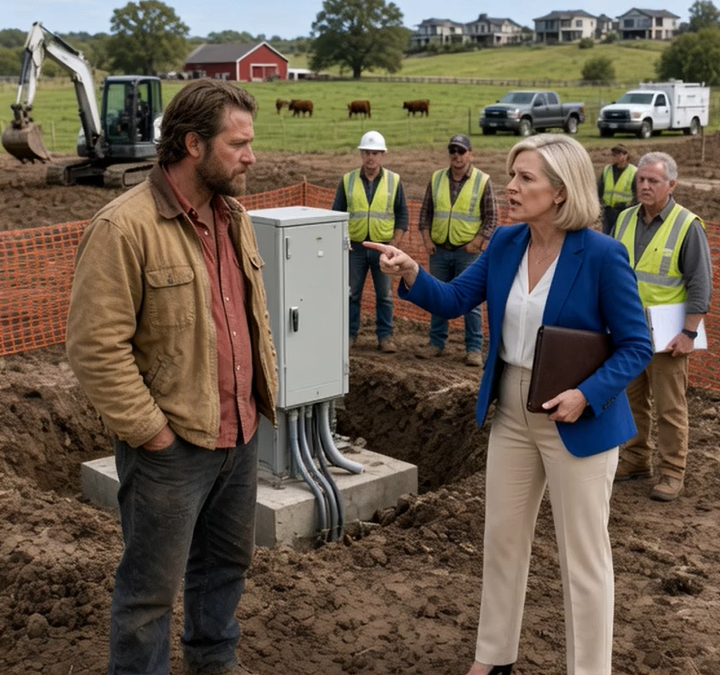
She drove a white crossover she kept spotless in a place where the roads became gravel slush from November through March. Under one arm, she carried a burgundy folder the way some people carry a badge.
I was on a creeper beneath my truck when she arrived. The first thing she saw of me was a pair of boots and a stained sleeve. I think that settled the whole matter for her before I ever stood up.
Celeste looked past me at the workshop, the utility trailer, and the coveralls hanging from a nail beside the door. Then she asked in a bright, helpful voice whether I was the maintenance contractor working out there.
I told her I was not.
I told her I lived there.
She tilted her head toward the cedar siding, low roofline, and porch I had rebuilt myself two summers earlier.
“In Cedar Hollow?” she asked.
The way she said it made clear she was reciting a conclusion rather than asking a question.
“Not exactly.”
I let the answer sit because the accurate explanation takes about four minutes and a plat map. I have learned that people who introduce themselves with folders are not usually listening yet.
Celeste smiled the smile I would come to know very well over the following months. It arrived before her sentences and generally outlasted them.
“We’re all neighbors here,” she said. “Neighbors help each other maintain standards.”
Then she looked over my shoulder toward the white cylinder behind the arborvitae.
Her smile remained.
Her eyes began doing arithmetic.
PART3:
I could have told her the whole truth right then. I want to be honest about that because it mattered later, and because I have replayed that afternoon more times than is probably good for me.
Instead, I told her my parcel predated the subdivision and was not governed by Cedar Hollow’s architectural covenants.
That was true.
Provable.
And completely useless as a conversational tool.
Celeste heard it as an excuse. She explained slowly that Cedar Hollow had spent years creating a cohesive community identity, that appraisals were sensitive to visual clutter along the southern sightlines, and that she was sure a reasonable man would want to become part of the solution.
“What does the solution look like?” I asked.
“Screening. Relocation. Ideally removal.”
Then she suggested I have my supplier take the tank away and switch to something more appropriate, like the small tanks people kept for grills.
I told her the tank served my home and business.
She said the word business the way another person might say infestation.
That was the first time she looked down on me.
It was not the last that week.
Two days later, I passed Celeste at the mailbox cluster where I collect my parcels. She was standing beside Tessa Monroe, one of the board members, a tall bookkeeper who usually kept reading glasses pushed into her hair.
Celeste greeted me warmly enough.
Then she turned to Tessa.
“I was just telling her that Mr. Avery was going to help us with the tank situation.”
Tessa politely asked whether I could simply build a fence around it.
Celeste answered before I could.
“A fence would only draw attention to it.”
I stood there holding my own mail while two people planned the rearrangement of my property.
On the walk back down my driveway, I did what I usually do when I get angry.
Nothing.
I have wondered since whether that silence was patience or cowardice.
A week later, an envelope arrived with the association’s return address printed in an ornate font that must have cost somebody a vote.
Inside was a single page of letterhead addressed to the owner of record.
Across the top, in bold capital letters, was the heading:
UNAUTHORIZED PROPANE STORAGE SYSTEM.
Below that were four numbered findings, each citing a section of the Cedar Hollow Declaration of Covenants, Conditions, and Restrictions. At the bottom was an instruction ordering me to bring my property into compliance within fourteen days.
I read the letter standing in my driveway with my keys still in my hand.
Then I read it again inside the kitchen with the lights on.
The letter was procedurally flawless.
It was also addressed to a parcel over which the association had no authority whatsoever.
More importantly, it demanded the removal of equipment that forty-seven of their own houses were, at that very moment, quietly drawing fuel through.
The fine schedule was on the second page. I had missed it the first time because it was stapled behind the compliance instructions.
There was an initial $500 assessment under the fuel-storage provision. Then $100 per day for every day the alleged violation continued beyond the cure period, accruing until the equipment was removed or approved by the architectural review committee.
At the bottom was a checkbox offering me the opportunity to submit an application for retroactive approval along with a nonrefundable $75 filing fee.
I sat at my kitchen table with a pencil and calculated the daily accrual.
The number became large quickly enough to sting even a man with no mortgage.
Then I put the pencil down.
Paying attention to the number was exactly what the number had been designed to make me do.
That night, I wrote three sentences from my shop computer.
My property is not subject to Cedar Hollow HOA covenants. The propane system referenced in your notice is legally permitted and maintained under the recorded Shared Utility Easement dated May 14, 2001. Please confirm in writing whether Cedar Hollow HOA is ordering disconnection, removal, or shutdown of any equipment serving association-connected properties.
I attached a copy of the easement.
I attached the county permit.
I attached the latest inspection record.
Then I sent it to the association’s office, Celeste, and every board member whose email address appeared on the HOA website.
The next morning, Celeste replied with one sentence.
Your refusal to comply has been noted.
That was the moment I should have hired a lawyer.
Instead, I went back to work.
The problem with being self-employed is that a crisis has to stand in line behind every service call already booked by people who will still be cold if your personal life gets complicated. I had a furnace to diagnose in Little Fork, a water heater pilot assembly to replace near Mill Road, and an elderly widow named Mrs. Duncan who swore her kitchen smelled like gas every time it rained.
Mrs. Duncan did not have a gas leak.
She had a dead mouse in the wall.
That was still easier to solve than Celeste Whitaker.
By Friday, the HOA had sent a second notice. This one accused me of operating a commercial fuel storage facility without architectural approval. It included photos of my tank taken from the Cedar Hollow side of the fence. One image had a red circle around the regulator cabinet. Another had an arrow pointing to my workshop. Someone had added the words INDUSTRIAL ACTIVITY in red.
I recognized the angle.
Celeste had stood on a neighbor’s retaining wall to get the shot.
I called the association office and asked to speak with her.
“She’s in a compliance meeting,” the receptionist said.
“I’ll hold.”
“She may be a while.”
“I work in heating,” I said. “Waiting in uncomfortable places is half my profession.”
Celeste came on eleven minutes later.
“Nolan,” she said, as though we were old friends who had disappointed each other over brunch.
“I received your second notice.”
“Good. Then we’re communicating.”
“No,” I said. “You’re mailing things. Communication involves listening.”
There was a pause.
“I understand this may feel personal,” she said.
“It became personal when you photographed my property and accused me of violations that don’t apply.”
“We are protecting our community.”
“From heat?”
“From visual nuisance. From unapproved commercial use. From dangerous materials stored near homes.”
“The system you’re calling dangerous serves those homes.”
She laughed softly.
Not because I had made a joke.
Because she thought I had.
“Nolan, please don’t exaggerate.”
I leaned back in my chair and looked through the office window at the tank beyond the trees.
“I’m not exaggerating.”
“Cedar Hollow homes do not depend on your tank.”
“Forty-seven of them do.”
“That is absurd.”
“It’s recorded.”
“That old document is not what you think it is.”
I closed my eyes.
That sentence told me Celeste had finally read the easement and had decided the facts were inconvenient.
“What do you think it is?”
“A legacy arrangement,” she said. “Temporary. Outdated. Certainly not a license for you to keep an enormous propane installation in plain view forever.”
“The agreement stays in force until Cedar Hollow builds an independent permitted system or connects to municipal gas.”
“We’re exploring modernization options.”
“Modernization is fine. Trespassing is not. Cutting off access is not. Fining me is not.”
Her voice cooled. “You may want to be careful how you speak to the president of the association.”
“And you may want to be careful how you speak to the man whose valve feeds your lower loop.”
Another pause.
This one was different.
Then she said, “Is that a threat?”
“No. It’s a question.”
“I don’t appreciate intimidation.”
“I don’t either,” I said. “So I’ll ask plainly. Are you certain you want me to shut it down?”
She laughed.
I remember that laugh better than I remember some birthdays.
It was small and sharp and careless.
“Mr. Avery,” she said, “you are not as important as you think you are.”
Then she hung up.
That weekend, a third notice arrived.
This one was hand-delivered.
It came Saturday morning in a white envelope tucked under my shop door with blue painter’s tape. Across the top was stamped FINAL OPPORTUNITY TO CURE.
The HOA gave me seventy-two hours to remove, relocate, or fully screen the propane storage system. If I failed, Cedar Hollow reserved the right to pursue “self-help remedies, including contractor access for abatement of visible nuisance equipment.”
They were not just threatening fines anymore.
They were threatening to come onto my land.
I spent Saturday afternoon doing what I should have done two weeks earlier.
I called my attorney, Lydia Crane.
Lydia had handled my purchase of the property years before. She was seventy, wore red-framed glasses, and had the unnerving habit of letting people talk themselves into traps while she watched with a pleasant expression. When I emailed her the notices, she called me back in less than ten minutes.
“Nolan,” she said, “tell me you did not ignore the old easement all these years.”
“I serviced it every year.”
“Do you have logs?”
“Yes.”
“Inspection records?”
“Yes.”
“Payment records?”
“Yes.”
“Correspondence?”
“Yes.”
“Good. Then we have a paper trail and an idiot.”
“Which idiot?”
“Let’s be optimistic and assume only one for now.”
She sent a formal letter that afternoon. It was six pages long and had the kind of calm language that sounds almost gentle until you realize every paragraph is a door locking from the other side.
She informed Cedar Hollow HOA that my property was not subject to its covenants, that any attempt to fine me was void, that any attempt to access my property without consent would be trespass, and that interference with the shared propane distribution equipment could create public safety and civil liability exposure.
She also wrote one sentence I underlined after printing it:
If the association maintains that the propane system is unauthorized, unsafe, or subject to removal, Mr. Avery will have no choice but to initiate a safety shutdown of the association-fed branch pending inspection and written clarification of responsibility.
Celeste responded Monday at 6:12 a.m.
Your threat to disrupt community utility service has been forwarded to counsel. The tank remains unauthorized. Proceed accordingly.
So I did.
At 7:45 that morning, I called the county fire marshal’s office. At 8:03, I spoke with the state LP gas inspector assigned to our region, a man named Grant Halvorsen, who sounded like he had been born unimpressed and had spent fifty-five years refining it.
I explained the situation.
He asked three questions.
“Is the branch separately valved?”
“Yes.”
“Can you shut it down without depressurizing your own system?”
“Yes.”
“Do you have documentation that the HOA ordered removal of the equipment?”
“Yes.”
“Then lock it out, tag it, document it, and do not restore service until I look at it,” he said. “If they are claiming your equipment is unauthorized, they don’t get to keep using it while calling it illegal.”
At 8:31, I walked out to the regulator cabinet with my phone recording, opened the panel, photographed the gauge, turned the branch valve feeding Cedar Hollow’s lower loop, installed a lockout device, and hung a red tag that read SERVICE SUSPENDED PENDING SAFETY REVIEW.
I did not touch the line feeding my house or shop.
My furnace kept running.
My water stayed hot.
Forty-seven Cedar Hollow homes lost gas service.
Within the hour, every phone in the association office was ringing.
By 9:22, Celeste was at my gate.
She had not come alone.
Two board members stood with her. Tessa Monroe looked pale and worried. The other was Ron Vale, a retired dentist with a golf visor and the permanent expression of a man inconvenienced by lesser species. Behind them were six residents in winter coats, including a young mother holding a toddler and an older man I recognized from service calls but could not name.
Celeste gripped the bars of my gate.
“What did you do?”
I stood on my side with my hands in my jacket pockets.
“I complied with your order.”
“Turn it back on.”
“No.”
Her eyes widened. She had expected anger. She had prepared for anger. She had not prepared for no.
“You have no right to shut off heat to families.”
“You told me the system was unauthorized.”
“That does not mean you can retaliate.”
“It means I cannot continue operating a system you have declared unauthorized, unsafe, and subject to removal.”
The young mother stepped forward. “My stove won’t light. My water heater’s out. Nobody told us anything about this.”
I looked at her, and for the first time that morning, my calm cracked at the edge.
“What’s your name?”
“Dana.”
“Dana, I am sorry you got blindsided. You should have been told years ago how your utility service works.”
Celeste cut in. “Do not speak to residents as if you are their provider.”
“I am their provider.”
“No, you are a disgruntled neighbor.”
I reached into my jacket and pulled out a folder. Not burgundy. Plain manila. I handed Dana a copy of the recorded easement.
“Your house is in the lower loop,” I said. “Lot twenty-eight. You draw propane through a shared branch line from my station. Your HOA pays for that service out of the Shared Utility Reserve.”
Dana stared at the document.
Ron Vale scoffed. “This is nonsense.”
I handed him a copy too.
He did not take it.
Tessa did.
Her face changed as she read.
“Celeste,” she said quietly, “did you know about this?”
Celeste did not look at her. “This is not the time.”
“That sounds like yes.”
Celeste pointed at me. “This man is weaponizing a technicality.”
“No,” I said. “You weaponized your letterhead. I used a valve.”
By noon, Cedar Hollow was in chaos.
The upper homes still had service because they were on individual tanks installed during later phases. The lower homes did not. Residents who had never attended an HOA meeting were suddenly demanding answers. People wanted to know why they had been paying into a utility reserve no one had explained. They wanted to know why the president had ordered removal of the equipment feeding their homes. They wanted to know why the board had called my system dangerous while depending on it.
Celeste wanted one thing.
She wanted the gas back on before people realized she had caused the outage.
At 1:15, Lydia called me.
“Do not open that valve.”
“I wasn’t planning to.”
“I just spoke with the HOA’s attorney.”
“And?”
“She is not having a good day.”
“Celeste?”
“The attorney. Apparently, she knew nothing about these notices until residents started calling her.”
That made me smile despite myself.
Lydia continued. “Inspector Halvorsen will be at your property tomorrow morning at ten. Fire marshal may attend. Keep all cameras running.”
I looked through the kitchen window toward the arborvitae.
“Why would you say that?”
“Because people who create emergencies to hide mistakes often create bigger emergencies trying to fix them.”
That night, I did not sleep much.
Partly because I knew people were cold and angry because of a mess I had not started but had become part of. Partly because I kept seeing Dana’s toddler wrapped in a blue blanket at my gate. Mostly because my father’s voice kept drifting through my head.
Dad had been a pipefitter for thirty-seven years. He raised me to respect pressure, whether it lived in a tank, a line, or a person. “Everything holds until it doesn’t,” he used to say. “Your job is to notice before the rupture.”
He had died three years earlier in the old room above the garage, refusing hospice until the last possible week because he did not want strangers “messing with the thermostat.” I inherited his tools, his stubbornness, and his belief that a man could be quiet without being weak.
But lying awake that night, I wondered whether quiet had invited this.
At 2:18 a.m., my driveway camera lit up.
I sat up in bed before the notification finished vibrating.
Headlights moved past the gate.
Not into my main drive.
Along the old service lane at the southern fence line.
I pulled on jeans, grabbed my coat, and opened the camera app.
A white utility truck had stopped near the arborvitae screen behind my tank. Behind it came a flatbed carrying what looked like a small metal skid unit under a tarp. Two men climbed out wearing reflective jackets. A third person stepped from a dark SUV.
Celeste.
I watched her point toward my regulator station.
One of the men shook his head.
She pointed again, harder.
They began unloading equipment.
I called Lydia first.
She answered like she had been waiting with the phone on her chest.
“They’re here,” I said.
“Do not go outside.”
“They’re installing something.”
“Call the sheriff. Then send me the footage.”
By the time deputies arrived, the truck was gone.
Celeste’s SUV was gone.
But something new stood behind my arborvitae.
A gray metal cabinet mounted on a concrete pad that had not existed the day before. Two flexible hoses ran from a portable propane cylinder rack into a small pump assembly, then into a hacked connection near the buried branch line access. The installation was crooked, half-hidden with a cheap lattice screen, and buzzing faintly from a temporary generator sitting under a tarp.
I stood fifteen feet away with a flashlight and felt the blood drain from my face.
They had not just trespassed.
They had modified a propane distribution system in the dark.
Deputy Miles Harper, who looked too young to have seen the kind of stupidity he was now photographing, lowered his flashlight.
“Is that yours?”
“No.”
“Do you know what it is?”
“Yes.”
“What is it?”
“A lawsuit with a pressure gauge.”
At 9:58 the next morning, Inspector Grant Halvorsen stepped out of a state pickup wearing a tan jacket, steel-toe boots, and the expression of a man already disappointed in everyone involved.
County Fire Marshal Elise Baird arrived two minutes later.
Celeste arrived at 10:07 with Ron Vale and a lawyer I had never seen before.
By then, the illegal pump station was wrapped in yellow caution tape.
Inspector Halvorsen walked around it once.
Then again.
He did not speak for nearly three minutes.
That was somehow worse than yelling.
He crouched near the connection, took a photo, stood, and looked at me.
“Mr. Avery,” he said, “why is there an unpermitted propane transfer pump station tied into a residential distribution branch on your ranch?”
I looked at Celeste.
For once, she had no smile.
“I was hoping,” I said, “you could ask her.”
Everyone turned.
Celeste lifted her chin. “The HOA installed a temporary community utility solution after Mr. Avery unlawfully disrupted service.”
Inspector Halvorsen stared at her.
Then he looked at the fire marshal.
Then back at Celeste.
“You installed this?”
“The association contracted emergency service restoration.”
“Through whom?”
“Our vendor.”
“What licensed gas contractor?”
Celeste’s lawyer touched her arm. “Celeste—”
But Celeste was too used to rooms bending for her.
“QuickFlow Utility Services,” she said. “They were authorized to access the easement.”
Halvorsen’s voice stayed flat. “Authorized by whom?”
“The association.”
“The association does not own this parcel.”
“The easement grants utility access.”
“To maintain an existing line,” I said. “Not install unpermitted equipment at two in the morning.”
Celeste snapped, “You created a crisis.”
“No,” Fire Marshal Baird said.
Her voice cut through the yard cleanly.
Everyone looked at her.
She held up the red lockout tag I had hung on the branch valve the day before. “This is a documented safety shutdown in response to disputed authorization. It is lawful. What is behind that tape is an unpermitted fuel transfer installation tied into occupied residences without inspection, without pressure test records, without emergency clearance, and from the look of it, without basic sense.”
Ron Vale took one step back.
Celeste’s lawyer closed his eyes.
Inspector Halvorsen pointed at the pump station. “Who signed the work authorization?”
Celeste said nothing.
Fire Marshal Baird looked at me. “Mr. Avery, do you have cameras covering this area?”
“Yes.”
Celeste finally looked scared.
Not sorry.
Scared.
There is a difference.
By noon, the state inspector had shut down the illegal pump station, the sheriff had opened a trespass and reckless endangerment investigation, and QuickFlow Utility Services had thrown Celeste under the nearest available bus.
Their owner, a man named Harlan Briggs, arrived in a panic after Halvorsen called him. He brought a folder. In that folder was a signed emergency access authorization stating that Cedar Hollow HOA owned the utility easement area and had full right to install temporary service equipment.
The signature at the bottom belonged to Celeste Whitaker.
Attached was a site map showing my land labeled as Cedar Hollow Common Utility Area.
That phrase had never appeared in any recorded document.
Harlan looked at the real plat map Lydia provided and went gray.
“She told us the ranch owner had abandoned the utility station,” he said.
I stared at him.
“Abandoned?”
“That you were refusing access and had no active permit.”
“My permit is posted inside the cabinet you cut beside.”
He swallowed. “I didn’t cut it. My night crew did.”
Inspector Halvorsen looked up from his clipboard. “That is not the defense you think it is.”
The story moved faster after that than any honest man could control.
By dinnertime, Cedar Hollow residents had seen the sheriff’s cars, the state truck, the yellow tape, and the generator behind my trees. Someone posted a photo on the neighborhood forum with the caption:
WHY IS THERE A GAS PUMP STATION ON NOLAN’S PROPERTY?
Celeste deleted it.
Someone posted it again.
Then Dana, the young mother from my gate, posted the easement.
That stayed up for fourteen minutes before being removed.
Then Tessa Monroe posted it herself from her board account with a single sentence:
Residents deserve to know the truth.
That one stayed up because Tessa changed the admin password first.
The emergency HOA meeting was called for Thursday night at the Cedar Hollow clubhouse.
I did not plan to attend.
Lydia told me not to.
“You are the property owner, the service provider, the witness, and likely the plaintiff,” she said. “You do not need to walk into a room full of angry people and become the evening’s entertainment.”
She was right.
Then Dana knocked on my kitchen door at 5:30 p.m. with her toddler on her hip.
“I’m sorry,” she said before I could speak.
I looked down at the child. “Is your house warm?”
“We’re staying with my sister. Most of us are using electric heaters or family places. It’s a mess.”
“I’m sorry.”
“No,” she said. “That’s why I came. People are saying you’re punishing us.”
“I’m not.”
“I know that now. But a lot of people don’t. Celeste is telling everyone you’re trying to extort the neighborhood.”
I laughed once, without humor. “Of course she is.”
Dana shifted her daughter to the other hip. “You should come tonight.”
“My attorney disagrees.”
“Your attorney doesn’t have to live next to these people after they decide what story to believe.”
That landed.
So at 6:55 that evening, I walked into the Cedar Hollow clubhouse carrying a binder, three recorded documents, and every ounce of patience I owned.
The room was packed past fire code, which Fire Marshal Baird would have hated had she been there. Residents filled folding chairs, lined the walls, and stood in the hallway. People who had never looked at me twice stared as though I were either a villain or a utility bill come to life.
Celeste sat at the front table with Ron Vale and two other board members. Tessa sat at the far end, separate enough to make a point. The HOA attorney sat beside Celeste, whispering urgently.
Celeste ignored him.
She opened the meeting by striking the table with a little wooden gavel, which felt ambitious for a woman under active investigation.
“This emergency session has been called,” she said, “to address the deliberate and hostile interruption of utility service by a nonmember property owner.”
The room erupted.
Some people shouted at me.
Some shouted at her.
Some shouted questions no one could answer.
Celeste let it go on just long enough to make fear bloom, then raised her hand.
“I understand your anger,” she said. “I share it. For months, this board has attempted to resolve a nuisance condition involving Mr. Avery’s industrial propane installation. Unfortunately, rather than cooperate, he chose to endanger Cedar Hollow families by shutting off service in the middle of winter.”
Dana stood. “You ordered him to remove the tank.”
Celeste’s smile tightened. “Dana, please let the board present the full picture.”
“You hid the full picture.”
A murmur rolled through the room.
Tessa leaned toward her microphone. “I move that Mr. Avery be allowed to speak.”
Ron Vale said, “Absolutely not.”
Tessa looked at him. “Then I move you explain why the board authorized an unpermitted installation on land we do not own.”
Ron’s mouth opened.
Nothing useful came out.
People turned toward Celeste.
She said, “There are legal complexities.”
That was when Inspector Halvorsen walked in.
I had not known he was coming.
Neither had Celeste.
He entered with Fire Marshal Baird and Deputy Harper behind him. The room quieted in waves, like wind dying down.
Celeste stood. “This is a private association meeting.”
Halvorsen looked around. “Not when you are discussing an active hazardous fuel installation serving occupied homes.”
Fire Marshal Baird added, “And not when residents’ safety depends on accurate information.”
Celeste’s attorney put both hands over his face.
Halvorsen walked to the front of the room and placed a folder on the table.
“I’ll keep this simple,” he said. “The propane system on Mr. Avery’s property is permitted. The recorded shared utility easement is valid. The HOA has been using that system for years. Mr. Avery did not unlawfully shut down service. He performed a documented safety lockout after the association repeatedly declared the equipment unauthorized and ordered its removal.”
Someone in the back said, “So why didn’t we know?”
Tessa answered before anyone else could.
“Because we didn’t read our own records.”
Celeste shot her a look.
Tessa did not look away.
Halvorsen continued. “Yesterday morning, my office discovered an unpermitted pump and transfer station installed on Mr. Avery’s property without his consent. That installation was unsafe and has been disabled. The investigation into who authorized it is ongoing.”
Ron Vale leaned toward his microphone. “Inspector, isn’t it true Mr. Avery could restore service right now if he wanted?”
Halvorsen looked at him.
“No.”
Ron blinked. “No?”
“No. Because your association created a documented dispute over the legal status and safety of the system, then an unauthorized modification was made to that system. Before service can be restored, the branch must be inspected, pressure-tested, and cleared. If damage is found, repairs must be completed by a licensed contractor with permission from the property owner.”
The room turned on Celeste in a way I had never seen a room turn.
Not all at once.
Not dramatically.
But face by face.
People began understanding that the outage had not started with my valve.
It had started with her pride.
Dana stood again. “Celeste, did you know our homes used that tank when you sent him the fine?”
Celeste said, “I knew there was an outdated arrangement.”
“That’s not what I asked.”
Celeste’s eyes hardened. “I knew enough to know Cedar Hollow should not be dependent on one man’s private equipment.”
I finally spoke.
“You were right about that part.”
The room went silent.
I stepped forward, binder in hand.
“Cedar Hollow should not be dependent on my system forever. That was never the plan. The easement was meant as a bridge until the subdivision built its own permitted system or connected to municipal gas. But instead of doing that honestly, your board kept paying the reserve, kept using the gas, kept letting residents believe everything was normal, and then fined me for the equipment keeping your homes warm.”
Celeste said, “You benefited from the payments.”
“Yes. For service, fuel share, inspections, emergency calls, and maintenance. All documented. If your board wanted to end the arrangement, you had legal options. You could have negotiated. You could have built a compliant station. You could have told residents the truth.”
I looked at the crowd.
“I would have helped. I still will help. But I will not let anyone trespass onto my land in the dark and turn a fuel system into a guessing game.”
An older man near the aisle stood slowly. His name came back to me then: Arthur Bell. I had replaced his furnace blower two winters before. He had paid with a check and a jar of his wife’s pickles.
“My wife is on oxygen,” he said. “We have electric backup, but if this had gone wrong, if that pump thing had leaked…”
His voice broke.
He looked at Celeste.
“You told us he was the danger.”
Celeste’s lips parted, but no sentence came.
Because there was no sentence that could survive the room anymore.
The first board resignation came that night.
Tessa Monroe stood, removed her board name badge, and set it on the table.
“I will not serve on a board that hides utility records from residents, fines a nonmember without authority, and installs equipment on private property without consent,” she said.
Then she turned to me.
“I am sorry, Mr. Avery.”
It was not enough.
But it was real.
The second resignation came three minutes later from a board member who admitted she had voted for the propane notices without reading the easement. Ron Vale did not resign that night. He tried to argue procedure until a resident asked whether procedure was going to relight her furnace.
Celeste refused to step down.
That surprised no one.
The next morning, Lydia filed for an emergency injunction. By noon, a judge had barred Cedar Hollow HOA, its officers, contractors, agents, and vendors from entering my property or touching utility equipment without written permission and inspector approval.
By Friday, the sheriff’s office had executed a warrant for HOA records.
By Monday, local news vans were parked near the Cedar Hollow entrance.
The headline was simple and cruel:
HOA FINES MAN FOR PROPANE TANK SERVING ITS OWN HOMES.
Celeste gave one interview from her driveway.
That was a mistake.
She stood in a camel coat in front of her white crossover and told the reporter, “This is what happens when private individuals hold communities hostage through outdated infrastructure.”
The reporter asked, “Did you authorize a pump station to be installed on Mr. Avery’s land?”
Celeste said, “Emergency circumstances require decisive action.”
The clip aired at six.
By seven, Lydia had sent it to the district attorney.
QuickFlow’s night crew cooperated immediately. They admitted they were told the HOA owned the utility access area. They admitted Celeste was present. They admitted they were instructed to work after dark because “the ranch owner had become unstable.” One technician had recorded part of the conversation on his phone because he was worried about liability.
In that recording, Celeste said, “Once service is restored through our equipment, Avery loses leverage. Then we can deal with the tank permanently.”
That sentence became the center of everything.
The civil case.
The criminal inquiry.
The recall petition.
The state regulatory hearing.
Everything.
Celeste had not been trying to protect residents.
She had been trying to beat me.
Even worse, she had used the residents as the weapon and the shield.
For six days, Cedar Hollow’s lower loop remained shut down. Temporary heaters were distributed. Families stayed with relatives. The county set up a warming room at a church. I spent those days doing inspections with state officials, answering questions, and helping identify the safest way to restore service without giving the HOA control over my property.
I also met people I had served for years without knowing their names.
Dana brought coffee one morning and apologized again.
Arthur Bell brought pickles.
A teenager named Mason helped me carry barricades and said his dad used to call my place “the junk shop.” Then he looked embarrassed enough that I almost felt bad for him.
“Your dad ever need a tow?” I asked.
“Twice.”
“Then it’s a useful junk shop.”
Mason smiled.
On the seventh day, service was restored under a temporary court-approved operating agreement. The branch passed pressure testing. The illegal pump station was removed and impounded as evidence. The HOA was required to pay for independent monitoring, emergency notification, and a full engineering plan for permanent utility independence.
When I opened the valve, I did it with Inspector Halvorsen beside me, Fire Marshal Baird watching, and three cameras recording.
The gauge rose slowly.
Steady.
Controlled.
No leaks.
No drama.
That is how fuel systems should work.
People think justice feels like a gavel or a siren.
Sometimes it feels like a needle holding pressure exactly where it should.
The recall election happened three weeks later.
Celeste fought it until the last possible hour. She mailed letters claiming she had been targeted by “anti-community interests.” She accused Tessa of betrayal. She accused me of greed. She accused the county of overreach. She accused the media of sensationalism. She accused everyone except the woman who had signed the fake map.
At the recall meeting, the clubhouse could not hold the crowd, so they moved it to the middle school gym.
I attended only because I was subpoenaed to provide documents.
Celeste stood at a podium beneath a basketball hoop and tried to save her kingdom with the same smile she had worn in my driveway.
“Cedar Hollow deserves leadership that protects standards,” she said. “I made difficult decisions under pressure. I will not apologize for defending this community from neglect, hazards, and intimidation.”
Dana stood from the third row.
“My daughter slept in a coat because of your difficult decisions.”
Arthur Bell stood beside her.
“My wife cried because she thought the heat might fail again.”
Tessa stood at the board table with a stack of records.
“You signed a map claiming Mr. Avery’s land was common utility area. That was false.”
Celeste gripped the podium. “I relied on advice.”
“From whom?”
No answer.
Ron Vale, who had finally realized loyalty would not keep him from being sued, stood and said, “Celeste told us counsel approved the approach.”
The HOA attorney, seated near the aisle, stood so fast his chair scraped.
“For the record, I did not.”
That was the sound of a door closing.
Celeste was removed by a vote so lopsided the room seemed almost stunned by its own unity.
She walked out before the meeting ended.
No one followed her.
That, more than anything, told me her power was gone.
The criminal charges came later: trespass, reckless endangerment, falsification of documents, and conspiracy related to the illegal installation. Her lawyer negotiated. QuickFlow paid fines and lost its license pending review. Ron Vale resigned from the board and moved six months later. Tessa became interim president, though she made everyone promise never to call her “president” with the same tone Celeste had enjoyed.
The settlement took longer.
Lawsuits always do.
Cedar Hollow’s insurance company tried to argue the HOA’s actions were outside coverage because illegal acts had been intentional. The HOA tried to argue Celeste acted beyond authority. Celeste tried to argue the board had approved enough of the plan to share blame. Everyone pointed at everyone else until Lydia finally said in mediation, “Wonderful, then we agree there is plenty of blame to fund a settlement.”
I received compensation for trespass, damage to the line access, legal fees, security upgrades, lost work, and the unauthorized use and interference with my property.
But the more important agreement was not money.
It was clarity.
Cedar Hollow had eighteen months to build an independent, permitted propane system or connect to municipal gas. Until then, the shared line would operate under transparent resident notices, proper emergency procedures, and a payment schedule everyone could see. No HOA officer could modify, access, or even inspect equipment on my side of the fence without written approval, license verification, and advance notice.
The association also had to record a corrective document against every Cedar Hollow deed, explaining the easement in plain language.
That was Lydia’s idea.
“Never underestimate the public value of making future idiots read,” she said.
By spring, Cedar Hollow had changed.
Not perfectly.
Neighborhoods do not become humble overnight. People still cared about mulch color and mailbox paint. Someone still filed a complaint about a basketball hoop being three inches too close to a driveway. Civilization remained fragile.
But people waved now when I drove past.
Some apologized.
Some did not.
A few pretended they had always been on my side, which was annoying but mostly harmless.
Dana’s daughter began calling me “Mr. Gas Man,” which I accepted as better than several alternatives. Arthur Bell brought me pickles every month until I finally admitted I could not eat that many pickles and he said that was not his problem.
One Saturday in May, Tessa came down my driveway carrying a folder.
I looked at it.
She looked at me.
Then she held it up. “Too soon?”
“Depends what’s in it.”
“Engineering proposals.”
“That folder may live.”
She laughed.
We stood near the tank, the same tank Celeste had called an ugly slab dragging down property values. Sunlight glinted along its curved white side. The arborvitae moved softly in the wind.
Tessa looked at it for a long moment.
“You know,” she said, “I used to hate seeing that thing.”
“A lot of people did.”
“I didn’t know what it was doing.”
“That’s true of most useful things.”
She nodded. “The new board wants to plant a proper screen on the Cedar Hollow side. Not to hide evidence. Just to make the boundary nicer. We’ll pay for it. You choose the plants.”
I looked at her carefully.
“No fences. No locked gates. No blocking the regulator. No decorative boulders over the line. No committee choosing a theme.”
She smiled. “No theme.”
“Native shrubs only.”
“Fine.”
“And a plaque.”
Her smile faded a little. “A plaque?”
“Small one. On your side. It says: Before you regulate what you do not understand, ask what it serves.”
Tessa stared at me.
Then she started laughing.
“You’re serious?”
“Completely.”
She wiped her eyes. “I’ll put it to a vote.”
The plaque was approved, thirty-one to twelve.
I still wonder about the twelve.
The permanent Cedar Hollow system was installed the following winter at the far end of the subdivision on land the HOA actually owned. It was inspected, permitted, pressure-tested, and documented so thoroughly that even Inspector Halvorsen admitted it was “less stupid than expected,” which from him was a standing ovation.
On the day the lower loop disconnected from my station for good, I walked the line with the engineers. The old branch was capped and marked. My tank remained, still serving my house, my shop, and my work. For the first time in twenty years, Cedar Hollow was no longer quietly breathing through my ranch.
I expected to feel relieved.
I did.
But I also felt something stranger.
For years, that buried line had made me part of a neighborhood that did not claim me. It had connected my old cedar house to sixty polished homes above it in a way most people never saw. They had judged the tank, the workshop, the coveralls, the mud, the utility trailer, and the man beneath the truck without realizing their comfort depended on the very things they dismissed.
When the line was capped, that hidden relationship ended.
What replaced it was better.
Not dependence.
Respect.
A month later, Cedar Hollow held a small community meeting outdoors near the new utility station. Tessa invited me. I almost did not go, but Lydia said, “Go. Let them clap. It builds character for everyone.”
So I went.
There was coffee, folding chairs, a table of cookies, and a surprising number of people who looked uncomfortable in the honest way people do when they know they owe you something but do not want to make it weird.
Tessa spoke first. She explained the new system, the emergency plan, the inspection schedule, and the resident notification process. Then she thanked the county, the engineers, the fire marshal, and finally me.
I stood near the back with my hands in my pockets.
People turned.
For a second, I saw the old story in their faces.
The maintenance contractor.
The nuisance.
The angry neighbor.
The man with the ugly tank.
Then Dana started clapping.
Arthur Bell joined her.
Then Mason.
Then most of the crowd.
It was not thunderous. It was not movie applause. It was awkward, uneven, and late.
But it was something.
Tessa waved me up.
I shook my head.
She waved harder.
I went, because refusing would have become its own kind of drama.
She handed me the microphone.
I looked out at Cedar Hollow, at the pale houses on the hill and the people who lived inside them, at the new permitted station humming safely behind its fence, at the road leading down toward my old cedar place.
“I don’t have much to say,” I began.
Someone near the front muttered, “That’s a first for this neighborhood,” and people laughed.
I waited.
“When this started,” I said, “a lot of people thought the problem was a tank. It wasn’t. The problem was that decisions were being made by people who cared more about appearances than consequences. A tank is easy to judge. A line underground is easy to forget. But both matter.”
I looked at Dana and Arthur and Tessa.
“I’m glad your homes have an independent system now. That’s how it should have been handled from the beginning. I’m also glad we got here without anyone getting hurt. Because if there’s one thing my father taught me, it’s that pressure does not care about pride. It only cares whether the system was built honestly.”
I handed the microphone back.
That was all.
Later, as people drifted away, Inspector Halvorsen walked up beside me with a paper cup of coffee.
“I saw the plaque,” he said.
“And?”
“Sentimental.”
“That sounds like criticism.”
“It’s not.”
Coming from him, that was practically an embrace.
We stood in silence for a while.
Then he said, “You handled it better than most would have.”
I looked toward the hill where Celeste Whitaker’s old house stood with a for-sale sign in the yard.
“I don’t know about that.”
“I do.”
I thought about the morning I shut the valve. Dana’s toddler in a blanket. Arthur’s fear. Celeste’s smile. The illegal pump station buzzing in the dark. The inspector asking why it was on my land. The room going silent when the truth finally had witnesses.
“I was angry,” I said.
“Anger isn’t the problem,” Halvorsen replied. “Bad fittings are.”
That was the closest thing to wisdom I had heard all week.
Celeste moved out before summer.
I saw her once more.
It was a Tuesday morning, gray and wet, the kind of rain that turns gravel into soup. A moving truck sat in front of her house. She was standing near the curb in a beige coat, watching two men carry boxes from the garage.
I was driving past after a service call.
For a moment, our eyes met.
She looked older.
Not broken.
Not redeemed.
Just smaller without an audience.
I could have stopped. I could have said something sharp enough to carry home. I had earned a few sharp sentences if anyone had.
Instead, I lifted one hand from the steering wheel.
Not a wave exactly.
An acknowledgment that she existed and no longer mattered.
She did not wave back.
That was fine.
Some people teach you where your boundaries are by trying to erase them.
That was Celeste’s gift, though she never meant to give it.
I went home, parked beside the workshop, and walked out to the tank. Rain tapped against the white steel. The regulator cabinet hummed softly. My service log sat dry in its sleeve.
On the Cedar Hollow side of the fence, the new shrubs had taken root. Small green leaves shivered under the rain. Behind them stood the plaque, mounted low on a cedar post.
Before you regulate what you do not understand, ask what it serves.
I stood there longer than I meant to.
Maybe because the whole ugly mess had started in that exact spot.
Maybe because for months I had felt like I was defending more than a tank. More than a line. More than four and a half acres the HOA wanted to treat like leftover space.
I had been defending the right to exist without being polished into someone else’s idea of acceptable.
My old cedar house was not ugly.
My workshop was not a nuisance.
My tank was not an embarrassment.
My work was not beneath anyone.
And my silence had never been permission.
That is what Celeste never understood.
Quiet men still know where the valves are.
I went back inside, washed my hands, poured coffee into the chipped mug my father used to keep by the stove, and opened the next day’s schedule.
A furnace tune-up at nine.
A regulator replacement at eleven.
A no-heat call near Mill Road after lunch.
Ordinary work.
Honest work.
The kind that keeps people warm whether or not they ever think to ask who made it possible.
Outside, the rain kept falling on the tank, the shrubs, the buried line, and the sign that would outlast every HOA board member who voted against it.
And for the first time since Celeste Whitaker walked down my driveway with her burgundy folder and her polished little smile, my land felt quiet again.
Not because no one could see it.
Because now they finally understood what they were looking at.








