The HOA Dug a 1,240-Foot Storm Drain Through My Family Farm Without Permission—Then I Saw Where Their Trench Was Headed and Stopped Trying to Stop Them.
PART3:
Mostly because we ignored one another.
Kids kicked soccer balls over the fence. I tossed them back.
A man in running clothes once asked if he could jog “through the crop rows” because the subdivision loop was boring. I told him no. He looked offended, but he did not try it again.
Their sprinklers ran too often.
Their dogs barked at my combine.
Their HOA sent newsletters about “rural harmony” that somehow never mentioned that rural places existed before them.
Still, nothing serious happened.
Then the water started showing up.
Not on my land at first.
On theirs.
Stonebridge Meadows had been built on ground that looked high and dry until heavy rain proved otherwise. Their streets dipped. Their backyards pooled. Their detention pond filled faster than the glossy brochure had promised. After two years of wet springs, homeowners began complaining that sump pumps were running constantly and basements smelled damp.
I heard all this from Carl Jensen at the elevator, who had a niece living in the subdivision.
“They’re mad at the developer,” he told me one morning while we waited for grain tickets. “But the developer’s long gone, so they’re mad at each other now.”
“That’s usually how it works,” I said.
He laughed.
“They got a new HOA president. Marilyn Hollis. Retired corporate something. You know the type.”
I did not know her then.
I would.
The first letter came in September.
It arrived on heavy cream paper with Stonebridge Meadows Homeowners Association printed at the top in navy blue. The margins were perfect. The wording had that expensive stiffness of people who believe politeness can disguise entitlement.
Dear Property Owner,
The Association thanks you in advance for your cooperation with upcoming drainage improvements designed to benefit the community. Work will begin in the fall. Temporary access will be required across the eastern portion of your property. Disturbance will be minimal and restored upon project completion.
Signed,
Marilyn Hollis
President, Stonebridge Meadows HOA
I sat at my kitchen table and read it twice.
Then a third time.
The thing that bothered me first was not even the proposed drainage work.
It was the tone.
Not “we request.”
Not “we would like to discuss.”
Not “may we schedule a meeting?”
They thanked me in advance for cooperation they had no right to expect.
I called the number on the letter.
Marilyn answered on the fourth ring.
“Stonebridge Meadows HOA, this is Marilyn.”
“This is Tessa Fletcher. I received a letter about drainage improvements across my property.”
“Oh yes,” she said brightly. “Ms. Fletcher. I’m glad you called.”
“I’m sure you are. Let me be clear. You do not have permission to access my property or perform work on it.”
There was a pause.
Not confusion.
Annoyance covered in perfume.
“Well,” Marilyn said, “the project engineer identified the most direct route to the county drainage ditch, and that route crosses a portion of your field.”
“The engineer can identify the moon if he wants to. He still does not have permission to dig through my farm.”
Her voice cooled slightly.
“This improvement benefits the broader community.”
“It benefits your subdivision.”
“It addresses stormwater management concerns affecting one hundred forty homes.”
“Then you should manage your stormwater on your land.”
“We are prepared to restore any affected area.”
“You cannot restore eighty-year-old clay tile with a rake and grass seed.”
Another pause.
This one sharper.
“Ms. Fletcher, I think perhaps you misunderstand the scope.”
“I understand perfectly. You want to dig a trench through my field to move water from Stonebridge Meadows to the county ditch.”
“That is a simplified version.”
“It is an accurate version.”
“We are working with contractors and professionals.”
“Good. Then they can tell you about easements, permits, drainage law, and trespass.”
Marilyn laughed softly.
It was not a nice laugh.
“I was hoping we could be neighborly.”
“Neighborly starts with asking.”
I hung up.
That should have been enough.
It was not.
Over the next month, I received three more letters.
The second included a map with a neat blue line crossing my eastern field.
The third offered a “temporary access accommodation” of eight hundred dollars.
The fourth warned that “failure to cooperate may result in legal action due to interference with necessary water management improvements.”
I sent each one to my attorney, Evan Leary, who had handled the farm transfer after Dad died and had the weary demeanor of a man who had spent thirty years watching people create avoidable lawsuits.
He wrote them a letter.
It was short.
It was beautiful.
It said no.
It also said any entry onto my land without written permission would be considered trespass, any damage to crops or drainage infrastructure would be pursued civilly, and any attempt to connect private drainage to the county ditch without proper approval could trigger county enforcement.
I thought that would stop them.
I underestimated Marilyn Hollis.
The first time I met her in person was at a county drainage board meeting in November.
I had gone because Evan told me to keep my eyes open. Stonebridge was on the agenda, requesting information about ditch capacity. They were not asking for permission to cross my land. Not officially. They were gathering “preliminary guidance.”
Marilyn sat in the front row wearing a white blazer and pearls, her silver hair cut into a precise bob that did not move when she turned her head. She looked like the type of woman who never raised her voice because she had spent her life making other people lower theirs.
When the board reached public comment, she stood with a folder in hand.
“My name is Marilyn Hollis,” she said. “I am president of Stonebridge Meadows Homeowners Association. We represent one hundred forty families, many of them young families, seniors, and hardworking professionals whose homes have been negatively affected by outdated rural drainage patterns.”
I almost laughed out loud.
Outdated rural drainage patterns.
That meant gravity.
She continued, “We are seeking a reasonable, community-minded solution that allows stormwater to move efficiently to the existing county ditch system.”
A board member named Frank Weller leaned into his microphone.
“Mrs. Hollis, are you asking to connect to County Ditch 6?”
“At this stage, we are exploring options.”
“Do you have an easement across intervening private property?”
She smiled.
“We are in discussions.”
I raised my eyebrows.
No, we were not.
Frank looked over his glasses.
“You will need documented rights of access, engineering approval, and a permit before any connection to the county ditch.”
“Of course,” Marilyn said smoothly.
Then she glanced back at me.
It was quick.
A little flash of triumph.
As if being told she needed permission was merely part of the performance, not an actual barrier.
After the meeting, she approached me in the hallway.
“Ms. Fletcher.”
“Mrs. Hollis.”
“I wish we had gotten off on better footing.”
“Then stop trying to put your water through my cornfield.”
Her smile tightened.
“You know, some farmers understand that communities evolve.”
“And some HOA presidents understand property lines. We are both disappointed.”
A man behind her coughed to hide a laugh.
Marilyn’s eyes hardened.
“You are being unnecessarily adversarial.”
“You sent me a legal threat after I told you no.”
“I sent you a notice of possible remedies.”
“I framed it.”
That got under her skin.
Good.
She stepped closer.
“This project is happening.”
“No, it isn’t.”
“Progress does not stop because one landowner is sentimental.”
That word.
Sentimental.
I thought of my grandfather standing knee-deep in a trench in 1938, lowering clay tile into mud by hand because he believed his children deserved ground that could grow.
I thought of my father clearing outlets with a shovel while chemo hollowed him out.
I thought of the old plywood map in the machine shed.
My voice went quiet.
“Mrs. Hollis, you have mistaken memory for weakness.”
She blinked.
I walked away before I said something less useful.
Winter came.
Then spring.
The letters stopped.
I told myself they had gotten legal advice from someone competent.
Stonebridge’s detention pond stayed high through April. Their lawns squished. Sump pumps ran. Their Facebook group, according to Carl Jensen, turned into a swamp of complaints, accusations, and photos of standing water beside decorative patios.
“Marilyn’s under pressure,” Carl told me in May. “People want something done.”
“People always want something done after they build houses where water already had plans.”
By June, I planted corn in the east field.
It came up strong.
Even rows. Healthy green. The kind of stand that makes a farmer look over a field and feel, for one dangerous second, that the year might be kind.
The summer held hot and mostly dry.
Then late August brought rain.
A lot of it.
Three storms in nine days.
Stonebridge flooded badly. Not catastrophic, but enough for sandbags at garage doors and photos on the evening news. Marilyn gave an interview in front of the subdivision sign, wearing a raincoat spotless enough to look symbolic.
“Our homeowners are suffering because regional infrastructure has not kept up with development,” she said into the camera. “We need cooperation from all stakeholders.”
I watched from my kitchen while eating toast over the sink.
“All stakeholders,” I muttered.
My dog, June, lifted her head from the rug.
“She means me.”
June wagged once, uninterested in politics unless they involved cheese.
The morning everything changed, I woke before my alarm.
Farmers do that when something is wrong.
Sometimes it is weather. Sometimes an animal. Sometimes a sound the sleeping brain hears but does not name until the body is already moving.
At first, I thought it was thunder.
A deep metallic rumble somewhere beyond the house.
Then came the backup alarm.
Beep.
Beep.
Beep.
I sat straight up.
It was 5:47 a.m.
The eastern sky had barely started to gray.
I pulled on jeans, boots, and the flannel hanging over the chair. June followed me downstairs, nails clicking on the old wood floor, already alert.
The rumble came again.
Not thunder.
Equipment.
I stepped onto the porch.
In the distance, beyond the machine shed, yellow light swept across my cornfield.
For one second, I could not process what I was seeing.
Then the excavator arm rose above the corn like the neck of some prehistoric animal.
My field.
My corn.
My tile.
I was in the truck before I remember grabbing the keys.
June barked from the porch as I tore down the lane and cut along the field road. Mud slapped the wheel wells. My headlights bounced over ruts. The closer I got, the clearer it became.
An excavator was four hundred feet inside my east field.
A trench ran behind it like a wound.
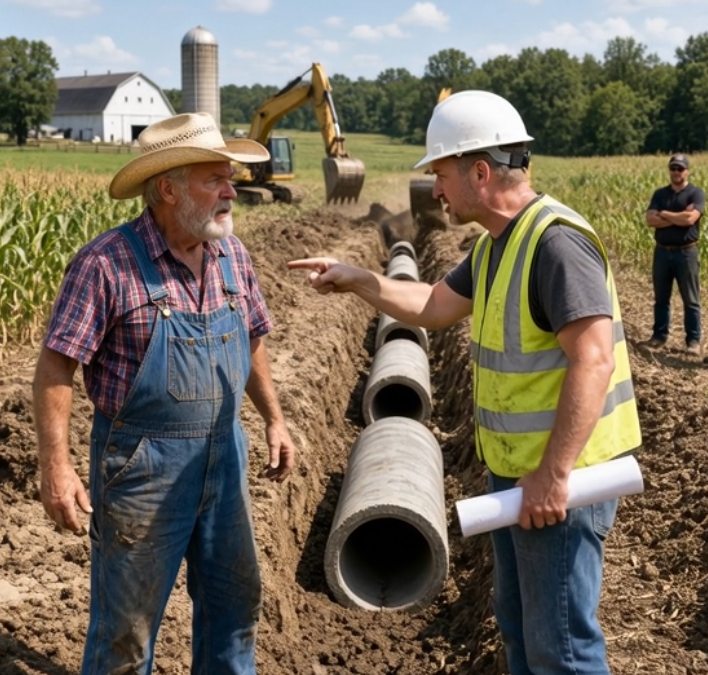
Corn lay crushed in two wide paths where machines had driven through. Rich black soil piled high on either side. Broken clay tile pieces littered the ground, curved red-brown shards shining wet in the morning light.
For a moment, I saw my grandfather’s hands.
Then everything in me went cold.
I slammed the truck into park and jumped out.
“Shut it down!” I shouted.
The excavator kept digging.
A man in a hard hat stood near a laser level tripod. Another worker in an orange vest looked at me, then away.
And there, standing on a pile of my dirt like a queen on conquered ground, was Marilyn Hollis.
White rain boots.
Tan trench coat.
Clipboard.
She looked absurd.
She also looked pleased.
“Shut the machine down!” I yelled again.
The operator glanced toward Marilyn.
She lifted one hand.
The bucket paused.
The engine idled heavily.
I walked toward her, boots sinking into torn soil.
“What the hell are you doing?”
Marilyn’s mouth pinched.
“Good morning, Ms. Fletcher.”
“You are trespassing on my farm.”
“We are completing emergency drainage work approved by the association.”
“You do not own this land.”
“We have a contractor’s determination that this route is necessary.”
“I do not care if you have a determination from God. You are on my property without permission.”
The contractor approached cautiously.
“Ma’am, maybe we should—”
Marilyn cut him off.
“Continue work.”
“No,” I snapped. “Do not move that bucket another inch.”
The operator froze.
Marilyn turned to me, and for the first time I saw open contempt.
“If you step in front of that machine, Ms. Fletcher, I will have you arrested.”
I stared at her.
On my land.
In my corn.
Beside the broken bones of my grandfather’s drainage system.
“You are threatening to arrest me on my own farm?”
“I am warning you not to interfere with contracted infrastructure work.”
“You mean illegal excavation.”
Her eyes flashed.
“We have homeowners with flooded basements.”
“You have homeowners because someone built houses without respecting water. That is not my emergency.”
“It becomes your emergency when your outdated drainage contributes to downstream backups.”
I almost could not believe what I was hearing.
“My drainage has been working since before your subdivision was a field survey.”
“Then perhaps it is time the land served a broader purpose.”
There it was.
The naked thing beneath all the polished letters.
My land existed in her mind as a solution she had not yet been allowed to use.
I took out my phone and called the sheriff.
While it rang, Marilyn smiled.
Not nervous.
Smiled.
“You may call whomever you like.”
“I intend to.”
The dispatcher answered.
“This is Tessa Fletcher at 421 County Road 19. I have unauthorized excavation on my farm. Contractors are actively damaging drainage tile and crops. I need a deputy.”
Marilyn’s expression tightened for the first time.
Maybe she had expected me to argue.
Maybe she had expected tears.
She had not expected calm documentation.
So I started taking pictures.
The trench.
The machines.
The broken tile.
The workers.
Marilyn.
The survey stakes.
The blue spray-painted line cutting across my field.
The open pipe stacked on a trailer.
The county ditch in the far distance, hidden beyond the last rows.
That was when I saw it.
The line.
The angle.
The trench was not random.
It was heading east-northeast, straight across my low acres, toward the old outlet path. Not toward the place my tile drained naturally, but toward the county ditch where the bank curved near the old culvert.
I knew that curve.
Everyone who farmed that stretch knew it.
County Ditch 6 looked like an ordinary drainage ditch if you did not know better. Grass banks. Slow brown water. Cottonwoods leaning over the edge. But beneath the surface, near that curve, was something that had caused three lawsuits, two board hearings, and one fistfight at the feed mill back in my father’s day.
The county interceptor.
A buried concrete structure installed in 1974 after a flood washed out two roads and nearly took the old school bus bridge. It regulated flow into the main ditch and protected the downstream farms from surge discharge. The county owned an easement around it. Nobody connected to it without approval. Nobody altered banks near it without permits. And absolutely nobody dumped subdivision stormwater into it through an unapproved private trench.
Marilyn did not know that.
Her engineer should have.
Or maybe he did and assumed he could ask forgiveness later.
I looked at the trench again.
One thousand two hundred and forty feet, if her own letters were accurate.
A straight shot from Stonebridge’s detention basin, through my field, toward the county ditch.
She was not just trespassing.
She was about to make the county her victim too.
The anger in me shifted.
It became quiet.
Useful.
I stopped arguing.
Marilyn mistook that for fear.
“Finally,” she said.
I turned toward her slowly.
“Did you pull a county connection permit?”
Her chin lifted.
“Our engineer handled the necessary review.”
“That is not what I asked.”
“I am not required to explain association infrastructure planning to you.”
“Did you notify the drainage board?”
She looked irritated.
“This is temporary storm relief.”
“With twelve-inch pipe?”
Her eyes flicked to the trailer.
Just once.
Enough.
The contractor heard it too.
He looked at the pipe, then at the ditch, then at me.
“What county structure?” he asked.
Marilyn snapped, “Keep working.”
I pointed toward the east end of the field.
“Four hundred feet past that fence line is a county flow-control interceptor with a recorded maintenance easement. If you cut that bank or connect without a permit, this stops being a neighbor dispute and becomes county infrastructure damage.”
The contractor went pale.
Marilyn’s smile vanished.
“You are bluffing.”
“No,” I said. “I am a Fletcher. We know where the water goes.”
The sheriff’s deputy arrived eighteen minutes later.
Deputy Colin Price was thirty, maybe thirty-one, with a calm face and the cautious gait of a man who had been called to too many property disputes where everybody believed being loud made them legal. I had known him since he was a kid showing pigs at the county fair. His mother bought eggs from my aunt.
He stepped out of the cruiser, took in the excavator, the trench, the broken corn, Marilyn on the dirt pile, and me standing in mud with my phone.
His eyebrows lifted.
“Tessa.”
“Colin.”
He looked at Marilyn.
“Ma’am.”
Marilyn descended the pile carefully, clipboard held like a shield.
“Deputy, thank goodness. This property owner is interfering with emergency drainage work.”
Colin looked at the excavator four hundred feet inside my field.
Then at me.
Then back to her.
“Do you have written permission to be on this property?”
Marilyn’s lips tightened.
“We have a documented community emergency.”
“That is not what I asked.”
“We notified Ms. Fletcher months ago.”
“That is also not what I asked.”
I almost smiled.
Colin was young, but he had been raised around farm people and county meetings. He knew the difference between an answer and fog.
Marilyn pulled papers from her clipboard.
“We have engineering plans.”
“Do you have an easement?”
“These improvements benefit—”
“Ma’am.”
His voice sharpened.
“Do you have an easement or signed access agreement allowing excavation on Ms. Fletcher’s property?”
She said nothing.
The contractor quietly removed his hard hat.
Colin turned to him.
“Shut the machine off.”
The operator killed the engine.
The sudden silence hit harder than the noise.
Wind moved through the broken corn.
Somewhere, a crow called from the fence line.
Colin walked the trench, taking photos. He looked at the shattered tile pieces and frowned.
“This yours?” he asked me.
“Clay drainage tile. 1938. They cut through at least two laterals and one main from what I can see.”
He whistled softly.
The contractor closed his eyes like a man imagining his insurance premium catching fire.
“What’s your name?” Colin asked him.
“Ed Rawlins. Rawlins Excavating.”
“Mr. Rawlins, who hired you?”
“Stonebridge HOA.”
Marilyn interrupted.
“Through approved association procurement.”
Colin ignored her.
“Who authorized work on this parcel?”
Rawlins swallowed.
“We were told access had been resolved.”
“By who?”
His eyes moved toward Marilyn.
She went rigid.
I lifted my phone and took another photo.
That was petty.
I do not regret it.
Colin called the county engineer.
Then the drainage commissioner.
Then, after I mentioned the interceptor, he called Frank Weller from the drainage board.
Frank arrived forty minutes later in a county pickup, wearing rubber boots and the expression of a man whose morning had been ruined by someone else’s stupidity. He was sixty-seven, broad-bellied, red-faced, and had spent so many years dealing with drainage disputes that he could smell an illegal outlet before he saw one.
He walked to the trench, looked east, then west.
“Who drew this route?”
Nobody answered.
Frank looked at Marilyn.
“You?”
“Our engineer—”
“Name.”
She hesitated.
“Barton Civil Solutions.”
Frank’s mouth flattened.
“Of course.”
He turned to me.
“Tessa, you got your grandfather’s tile map?”
I looked toward the machine shed in the distance.
“Yes.”
“Get it.”
Marilyn objected immediately.
“That is not relevant to whether—”
Frank rounded on her.
“Lady, you are standing in a cornfield on land you do not own, beside a trench you had no recorded right to dig, pointing a twelve-inch drain toward a county structure you did not have permission to touch. Everything is relevant.”
She shut her mouth.
I drove back to the shed.
My hands shook for the first time once I was alone.
Not from fear.
From the delayed violence of seeing the field torn open.
Inside the machine shed, morning light slipped through gaps in the metal siding. Dust floated in the beams. The air smelled like oil, old grain, and the faint sweetness of hay from another life. The tile map hung on the south wall, exactly where it had always been.
Four nails.
Plywood.
Pencil lines.
My grandfather’s block letters.
I stood beneath it for a moment.
“I’m sorry,” I whispered.
Then I pulled it down.
The board was heavier than I remembered.
On the back, in handwriting I had not seen in years, my father had written notes in marker: repairs in 1982, outlet cleared in 1996, north lateral patched 2008. Three generations of water knowledge on one old piece of plywood.
I carried it back like evidence from a sacred crime.
By the time I returned, more vehicles had arrived.
A county engineer.
Two more deputies.
A truck from Soil and Water.
A white SUV with Barton Civil Solutions on the side.
And behind them, three Stonebridge homeowners standing near the road, phones out, watching from the fence.
Marilyn looked furious now.
Not embarrassed.
Furious.
People like her did not mind causing damage.
They minded witnesses.
I leaned the plywood map against my truck.
Frank stepped close.
His face changed when he saw it.
“I’ll be damned,” he murmured.
The county engineer, a woman named Priya Shah, crouched in front of the board.
“This is the original tile layout?”
“My grandfather drew it after installation.”
“Do you have any other records?”
“Repair notes. Dad’s notebooks. Some receipts from later patches.”
She traced one pencil line with her finger.
“This trench crossed here.” She pointed. “And here.”
“Yes.”
“And their proposed line continues…” She turned, sighting across the field. “Straight through your main junction.”
My throat tightened.
The main junction.
The heart of the system.
Frank cursed under his breath.
Rawlins, the contractor, looked sick.
Marilyn folded her arms.
“With respect, old pencil drawings do not supersede the urgent needs of one hundred forty homes.”
Priya stood.
Her voice was cool.
“No, but county drainage law does.”
Marilyn’s eyes narrowed.
“Are you implying—”
“I’m stating that no private entity may alter, connect to, or discharge into county-regulated drainage infrastructure without approval. I’m also stating that this trench appears to have damaged private agricultural drainage infrastructure and may redirect flow in a manner that affects downstream properties.”
She looked toward the east.
“And if this connects where I think it does, your association has a serious problem.”
Marilyn’s confidence began to crack around the edges.
Just a little.
But I saw it.
“Then perhaps,” she said, “we pause and discuss a reasonable resolution.”
I laughed.
I did not mean to.
It just came out.
Every head turned toward me.
Marilyn’s face reddened.
“Something amusing?”
“Yes,” I said. “The word pause. You did not pause when I told you no. You did not pause when my attorney told you no. You did not pause before putting an excavator in my corn at dawn. You paused when the county showed up.”
Frank looked like he was trying not to smile.
Marilyn’s voice sharpened.
“I will not be lectured by someone who refuses to help her neighbors.”
“Neighbors do not steal land before breakfast.”
One of the Stonebridge homeowners near the fence lowered his phone.
Marilyn noticed.
Her posture changed immediately.
The performance returned.
She turned toward them, voice loud enough to carry.
“This is exactly the obstruction we have faced. Our families have endured flooding while adjacent landowners refuse reasonable cooperation.”
That was when an older man stepped away from the fence.
I recognized him vaguely. He lived in Stonebridge, lot near the back, always walked a golden retriever along the subdivision road. His name, I later learned, was Daniel Price. No relation to Deputy Price.
“Marilyn,” he called, “did she give permission or not?”
Marilyn stiffened.
“This is not the appropriate forum—”
“Did she?”
Silence.
A woman beside him said, “You told us access was secured.”
Rawlins looked sharply at Marilyn.
Deputy Price looked at Rawlins.
Frank looked like Christmas had arrived early.
Marilyn’s face went pale beneath her makeup.
“I said the route had been secured conceptually.”
The woman blinked.
“What does that mean?”
“It means no,” I said.
The homeowners stared at her.
That was the first public crack.
More would follow.
The county issued a stop-work order on-site.
The sheriff documented trespass.
Rawlins Excavating packed up under deputy supervision, leaving the open trench like a scar through my field. Marilyn refused to answer further questions without counsel, which was the smartest thing she had done all morning.
Before she left, she walked toward me.
For a second, I thought she might apologize.
I should have known better.
“You think you’ve won,” she said quietly.
I looked at the broken tile near my boot.
“No. I think you damaged a farm.”
Her mouth tightened.
“Stonebridge has resources.”
“So does the county.”
Her eyes flicked toward Frank.
“And so do I,” I added.
That surprised her.
Good.
Because people like Marilyn often mistake quiet landowners for poor ones, and farmers for sentimental fools sitting on assets they do not understand.
My father had not left me rich.
But he had left me land, records, crop insurance, a good attorney, and a habit of never throwing away paperwork.
By noon, Evan Leary had already filed for an emergency injunction.
By two, a drone operator hired by my crop insurer was photographing the damage.
By four, the county had surveyed the trench line and confirmed it entered the regulated easement buffer for County Ditch 6.
By evening, Stonebridge Meadows had an emergency board meeting.
I know because Daniel Price called me.
He got my number from Carl Jensen’s niece and sounded embarrassed to have it.
“Ms. Fletcher,” he said, “I’m sorry to bother you.”
“You are not the one who dug up my field.”
“I know, but… I live there. Stonebridge. My wife and I bought in last year. We were told this drainage project had full approval. Permits. Easements. Everything.”
“It did not.”
He sighed.
“I believe you now.”
That “now” did a lot of work.
He continued, “Homeowners are angry. At you, some of them, because that’s how Marilyn framed it. But others are starting to ask questions. If you have documentation, I think people need to see it.”
“I have documentation for court.”
“I understand.”
“No,” I said. “You don’t. Your HOA president trespassed, destroyed crops, broke drainage tile, and nearly connected unpermitted private stormwater to county infrastructure. I am not interested in a neighborhood debate where people vote on whether my property rights are inconvenient.”
There was a long pause.
“You’re right,” he said.
That surprised me.
Most people double down when corrected.
Daniel did not.
“I’m sorry,” he added. “I just… some of us want the truth before she spends more of our money.”
That was the first time I thought about what Marilyn had done not just to me, but to them.
One hundred forty homes meant one hundred forty sets of dues. Legal defense, contractor claims, possible fines, restoration costs—all of it would come from those homeowners unless Marilyn or the board could be held personally responsible for acting outside authority.
Marilyn had not only dug into my field.
She had dragged her own neighborhood behind the excavator.
The next day, I found out the worst of the damage.
Priya Shah returned with two county staff, my tile contractor, and a private drainage specialist Evan recommended. We walked the trench from west to east.
It was worse than I hoped.
They had cut three lateral lines clean through.
One main line was crushed under the excavator track.
The trench had sliced near the main junction, collapsing soil around old clay segments and causing water to back up in two sections. Because the tile was clay and old, repair would not be as simple as replacing a stretch of plastic pipe. We would need careful excavation, mapping, hand work around old junctions, and possibly rerouting sections to preserve grade.
Then there was the crop loss.
Corn flattened.
Root systems torn.
Compaction in two equipment lanes.
Soil structure damaged.
Harvest access complicated.
The specialist estimated the drainage repair alone could run over $74,000 if the main junction had to be rebuilt.
I stared at him.
He looked apologetic.
“That’s before crop loss and restoration.”
I looked across the field.
In the distance, the subdivision roofs shimmered in late-summer heat.
I wondered if Marilyn had ever stood in a field long enough to understand that damage was not just what the eye could see. Soil compaction can haunt yields for years. Water can find new bad habits if a system is disturbed. Old tile, once broken, does not forgive quickly.
That afternoon, I climbed into the machine shed loft and pulled down my father’s drainage notebooks.
Three spiral-bound notebooks.
One cigar box of receipts.
A folder labeled TILE / DITCH / COUNTY in his handwriting.
Inside was more than I expected.
Copies of county drainage board minutes from 1974.
A recorded easement description for County Ditch 6.
A hand-drawn note from my grandfather about the original outlet location.
Photographs from a 1982 repair.
A letter from the county warning downstream landowners against unauthorized connections to the interceptor.
And one document that made Evan Leary go silent for nearly ten seconds when I brought it to his office.
It was an agreement from 1975.
Signed by my father, two neighboring landowners, and the county.
It confirmed that the Fletcher tile outlet into County Ditch 6 predated the county interceptor and was grandfathered for agricultural drainage at a limited rate. It also stated that no additional discharge, diversion, or connection could be made through the Fletcher outlet path or the county easement without written approval from the drainage board and affected landowners.
Affected landowners.
Plural.
That meant me.
It also meant the downstream farms.
Stonebridge had not just failed to ask me.
They had failed to ask everybody.
Evan sat back in his chair, document in hand.
“Tessa,” he said, “this is very bad for them.”
“How bad?”
He looked over his glasses.
“Expensive bad.”
Good.
The first court hearing happened five days after the excavation.
Marilyn arrived with an attorney from a polished firm in the city. He wore a dark suit, carried a leather briefcase, and looked like he had expected a simple property dispute with a stubborn farmer.
Then Evan handed over the documentation.
The attorney’s expression changed as he read.
Small changes.
A tightening around the eyes.
A stillness in the jaw.
The look of a man realizing his client had given him a grenade and called it a tennis ball.
The judge issued a temporary injunction prohibiting Stonebridge, its contractors, agents, or representatives from entering my property or performing further drainage work. She also ordered preservation of all HOA records, communications, engineering plans, meeting minutes, contractor agreements, and insurance correspondence related to the project.
Marilyn sat very still at the defense table.
I enjoyed that more than I should have.
After the hearing, her attorney approached Evan and me in the hallway.
“My client would like to resolve this amicably.”
I looked at him.
“Your client threatened to arrest me on my own farm while standing beside an excavator she hired to trespass through my corn.”
His face remained professional.
“I understand emotions are high.”
“No,” I said. “Water is high. Legal exposure is high. My emotions are exactly where they should be.”
Evan coughed into his hand.
The attorney wisely addressed him after that.
Discovery was not kind to Marilyn.
Emails came out.
So did meeting minutes.
So did a recording from a Stonebridge board meeting because their secretary recorded everything for accuracy and apparently never imagined it would become evidence.
In one email, the engineer from Barton Civil Solutions warned:
Access across Fletcher parcel not confirmed. No recorded easement found. County connection requires permit review. Recommend delay until legal access secured.
Marilyn replied:
We cannot allow one farm owner to hold 140 homes hostage. Proceed with contractor scheduling. We will handle Fletcher if she interferes.
In another message to the board, she wrote:
Rawlins believes early morning start reduces likelihood of confrontation. Once trench is open, Fletcher will have incentive to negotiate rather than obstruct.
I read that one three times.
Once trench is open.
She had planned the damage as leverage.
That single sentence changed everything.
It changed how the county viewed her.
It changed how Stonebridge homeowners viewed her.
It changed how the judge viewed her.
And it changed how I slept, because rage can keep a person awake as effectively as fear.
Stonebridge’s insurance company got involved.
Then Rawlins Excavating’s insurance company.
Then Barton Civil’s insurance company.
They began pointing at one another like children in a broken-window lineup.
Rawlins claimed they were told access was resolved.
Barton claimed their plans were preliminary and not for construction.
Marilyn claimed the board authorized emergency action.
The board claimed Marilyn exceeded authority.
Homeowners claimed they were misled.
The county claimed everyone had ignored clear permitting requirements.
I claimed they all could send checks to the same address.
The media arrived after the email leaked.
I do not know who leaked it.
I have suspicions.
Daniel Price denies nothing convincingly.
A local reporter stood near my field with a camera crew and asked me how it felt to be “at the center of a battle between agricultural heritage and suburban growth.”
I stared at him.
“It feels like someone dug up my field without permission.”
He blinked.
“Do you see this as symbolic of a larger conflict?”
“Yes.”
He brightened.
“What is that conflict?”
“People thinking polite words make theft less ugly.”
The clip went everywhere locally.
My cousin Megan texted me:
Aunt Linda says you sounded mean.
I replied:
Aunt Linda has never had an excavator in her corn.
She sent back:
Fair.
Stonebridge residents held a special meeting two weeks later.
I did not attend.
Evan did.
So did Daniel Price, who later called me with the summary.
It was chaos.
Marilyn tried to defend herself by framing the project as urgent leadership. She said delays would have cost homeowners more. She said rural resistance had forced difficult decisions. She said the HOA needed courage.
Then Daniel read the email aloud.
Once trench is open, Fletcher will have incentive to negotiate.
According to Daniel, the room went silent in a way that sounded like the end of something.
A woman whose basement had flooded stood and said, “You used our fear to break the law.”
Another man shouted about special assessments.
Someone asked whether Marilyn’s personal umbrella policy could be pursued.
Marilyn resigned before the vote could remove her.
Not gracefully.
Not with apology.
She resigned “to protect the association from further distraction.”
People like Marilyn never leave because they were wrong.
They leave because staying costs them control of the story.
The county enforcement hearing came next.
That was where the county ditch finally did what I had known it would do.
Frank Weller testified first.
He brought maps, easement records, interceptor diagrams, and photographs of the trench line. Priya Shah explained the potential downstream impact if the unauthorized twelve-inch line had been connected: increased peak discharge, bank erosion, possible surcharge at the interceptor, and elevated flood risk to three downstream farms and a county road culvert.
Then Evan introduced the 1975 agreement.
The room changed.
Agreements like that are not dramatic to most people.
They are paper.
Old signatures.
Legal descriptions.
But to drainage boards, they are bones.
They tell you what the land survived before you arrived.
They tell you why certain lines exist and why certain permissions matter.
The board found Stonebridge in violation of county drainage regulations and referred the matter for civil penalties. They ordered a full engineering review at Stonebridge’s expense, prohibited any discharge connection, and required restoration of the county easement buffer. They also reserved the right to assess costs if county staff had to monitor repairs.
Marilyn sat in the back row wearing dark glasses.
When the penalties were read, she did not move.
I wondered if she finally understood that the ditch had been waiting for her long before she bought her white rain boots.
Civil settlement took seven months.
Seven long months of soil testing, tile repair, crop loss calculations, legal letters, depositions, mediation, and walking past the damaged section of field with anger rising in me like groundwater.
During Marilyn’s deposition, Evan asked her whether she believed she had permission to enter my property.
She gave a long answer about community need.
Evan repeated the question.
She gave another answer about stormwater urgency.
He repeated it again.
Finally, she said, “Not in writing.”
“In any form?”
She looked away.
“No.”
“Did you instruct Rawlins Excavating to begin work early in the morning to reduce the chance Ms. Fletcher would be present?”
Her attorney objected.
She still had to answer.
“I wanted to avoid conflict.”
“You wanted the trench open before she could stop you.”
“I disagree with that characterization.”
Evan slid the email across the table.
“Is this your email?”
She stared at it.
“Yes.”
“Please read the highlighted sentence.”
Her lips tightened.
She read it quietly.
“Once trench is open, Fletcher will have incentive to negotiate rather than obstruct.”
“Thank you.”
That sentence cost her more than any insult she had ever thrown at me.
The final settlement covered tile repair, crop loss, soil restoration, legal fees, engineering costs, county penalties, and monitoring. Rawlins and Barton contributed through their insurers. Stonebridge paid a painful share. Marilyn’s personal liability became a separate matter between her and the association after evidence showed she had acted beyond board approval.
I did not get rich.
That is not how damage works.
Money can pay contractors. It can compensate loss. It can punish stupidity in a language businesses understand.
But money cannot put a field back exactly as it was before the bucket went in.
Still, repairs began.
My tile contractor was a patient man named Luis Ortega, whose father had taught him old clay systems before plastic tile became standard. He treated my grandfather’s map with more respect than some people treat wedding certificates.
“This is beautiful work,” he said, studying the plywood board.
“My grandfather did it.”
“He knew what he was doing.”
“Yes,” I said. “He did.”
Luis and his crew dug carefully.
Not like Rawlins.
No ripping.
No charging through.
They opened sections by hand near the old junction. They exposed clay tile segments packed in dark soil, some still perfectly aligned after eighty-five years. Where pieces had been shattered, they documented, replaced, supported, and tied transitions properly. They installed inspection access where future repairs might need eyes before shovels. Priya checked grades. Frank came out twice and pretended he was not emotionally invested.
By the time the system flowed again, I stood at the outlet after a spring rain and watched water move steadily into the ditch.
Clear.
Controlled.
Right.
I cried then.
Not loudly.
Not in a way anyone saw except June, who wagged and stepped in the mud.
A few Stonebridge homeowners wrote apology letters.
Most did not.
Daniel Price came in person.
He stood at the edge of the field after harvest, hands in his jacket pockets, looking at the repaired ground.
“I’m sorry,” he said.
“You personally did not dig the trench.”
“No, but I believed the story that made it possible.”
That was honest.
I respected it.
“What happens now?” I asked.
“With Stonebridge?”
“Yes.”
He sighed.
“We elected a new board. We’re suing Marilyn’s insurer. We’re pursuing claims against Barton. We’re also doing what we should have done in the first place.”
“What’s that?”
“Fixing our stormwater on our own land.”
I looked at him.
He smiled faintly.
“Turns out detention ponds can be expanded, swales restored, sump discharge managed, and rain gardens installed if you stop looking for a farmer to dump on.”
I laughed.
Just once.
He deserved that much.
Over the next two years, Stonebridge changed.
Not entirely.
No place changes entirely.
But the homeowners removed part of an unused common lawn area and expanded the detention basin. They installed native plantings along drainage paths. They created a stormwater committee with actual engineers instead of angry retirees with clipboards. The county supervised all of it closely, which gave Frank Weller something to complain about happily until he retired.
Marilyn sold her house the following summer.
She moved to Arizona, according to Carl Jensen, who seemed offended by the idea of Arizona having to deal with her.
Before she left, she sent one final letter.
Not to me.
To the Stonebridge newsletter.
In it, she wrote that leadership sometimes required “difficult decisions misunderstood by those resistant to progress.”
Daniel mailed me a copy with a sticky note:
Thought you might need kindling.
I used it to start the burn barrel.
The farm recovered slowly.
The repaired acres yielded poorly the first year. Better the second. By the third, you could still see a faint difference in certain light if you knew where to look, a subtle line where soil had been opened and put back together.
Scars work that way.
Land remembers even after it heals.
I took my grandfather’s plywood tile map down from the shed wall permanently after the lawsuit. Not because I wanted to hide it. Because I finally understood it deserved better than dust and bird droppings.
I had it cleaned, sealed, and framed behind glass.
Now it hangs in my kitchen, above the table where I read Marilyn’s first letter.
People notice it when they come in.
Some ask what it is.
I tell them it is the reason the farm still grows.
One evening, Daniel brought his granddaughter to buy sweet corn from the stand I set up near the lane. She was seven, curious, and missing both front teeth. She looked across the field and asked why the corn grew in such straight rows.
“Because farmers like lines,” Daniel said.
I laughed.
“Because seeders like lines,” I corrected.
She looked at me seriously.
“Did someone really dig here without asking?”
Daniel went still.
I crouched a little, resting one hand on a crate of corn.
“Yes.”
“Why?”
I looked toward Stonebridge’s rooftops beyond the fence.
“Because they thought wanting something was the same as having the right to take it.”
She considered that with the gravity only children can bring to adult stupidity.
“That’s not sharing,” she said.
“No,” I agreed. “It isn’t.”
“What did you do?”
“I made them stop.”
She looked impressed.
“Were you scared?”
I thought about Marilyn on the dirt pile.
The excavator bucket.
The broken tile.
The court hearings.
The bills.
The sleepless nights.
“Yes,” I said.
“Then how did you do it?”
I looked past her toward the field my grandfather saved, my father worked, and I was still holding.
“Because scared and right can stand in the same place.”
Daniel’s granddaughter nodded slowly, as if filing that away for later.
I hope she keeps it.
The truth is, people will always come for land like mine.
Not always with excavators.
Sometimes with offers.
Sometimes with zoning changes.
Sometimes with polite letters on heavy paper.
Sometimes with phrases like broader community, necessary improvement, highest and best use, regional infrastructure, progress.
Progress is not always bad.
Communities do change.
Water must be managed.
Homes matter.
Families in subdivisions matter too.
But progress that begins by ignoring consent is not progress.
It is trespass with better vocabulary.
Marilyn Hollis thought my farm was empty space between her problem and her solution.
She saw dirt, corn, and an unmarried woman in work boots she thought she could pressure before breakfast.
She did not see my grandfather in 1938, lowering clay tile into wet ground by hand.
She did not see my father in 1975, signing an agreement because he understood that water connects neighbors whether they like one another or not.
She did not see the county ditch waiting with decades of law beneath its muddy surface.
She did not see me clearly either.
That was her mistake.
Not the only one.
But the first.
The morning after the repairs were completed, I walked the east field alone.
The sun was just coming up, turning the corn leaves silver at the edges. The soil was damp but firm beneath my boots. Somewhere below me, unseen water moved through old clay and new repair, finding its way like it had for generations.
I stopped where the excavator had first entered.
There was no machine now.
No Marilyn.
No shouting.
No clipboard.
Just a field.
People think justice feels like victory.
Sometimes it does.
Sometimes it feels like a check clearing, a judge signing an order, a powerful person losing the room.
But that morning, justice felt quieter.
It felt like water moving where it belonged.
It felt like the absence of trespass.
It felt like standing on my own farm without having to explain why my no should have been enough.
I looked toward the machine shed, where the empty space on the south wall still showed the outline of the old plywood map.
Then I looked toward the house, where that same map now hung framed above my kitchen table.
My grandfather had drawn it because he wanted the next person to know what was underground.
He probably imagined that person would be my father.
Then me.
Maybe someday someone after me.
He could not have imagined an HOA president in white rain boots trying to turn his life’s work into a stormwater shortcut.
But he had prepared me anyway.
Every pencil line.
Every junction.
Every outlet.
Every quiet record saying: remember what is here.
That is what saved the farm.
Not anger.
Not sentiment.
Memory.
Proof.
The stubborn refusal to let someone else rename theft as improvement.
I bent down, picked up a small piece of broken clay tile I had kept from the trench, and turned it in my hand. Red-brown, curved, rough at the edges. Useless now, technically.
But I keep it on my kitchen windowsill.
Right beneath the framed map.
When people ask why, I tell them the truth.
It reminds me that old things are not weak just because arrogant people do not understand them.
It reminds me that land can be wounded and still recover.
It reminds me that no is a complete sentence, even when spoken by a woman in a field to a machine with a bigger engine.
And it reminds me of the morning Marilyn Hollis dug one thousand two hundred and forty feet across my farm without permission, certain she was building a drain.
She was not.
She was digging a record.
And by the time she reached the county ditch, every hidden thing beneath that ground was ready to testify.








