The HOA Chairwoman Sent Four Fake “Officers” to Evict Me From a House Outside Her Boundary—Then She Shouted, “Sheriff, Arrest Him,” Without Knowing Who Had Opened the Door.
PART2:
One man wore cargo pants tucked into work boots.
Another had a black nylon belt with a plastic badge clipped sideways.
A third held a baton like he had only seen one in movies.
The fourth had a long gun resting awkwardly against his shoulder, pointed low but handled with the nervous carelessness of a man trying to look dangerous without understanding danger.
I opened the door.
Cold morning air rushed in.
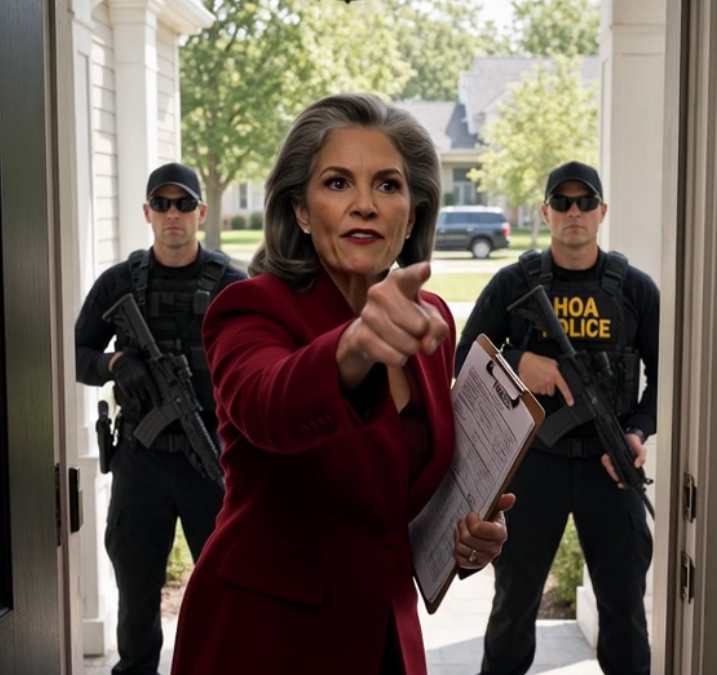
Karen stood at the threshold in a red wool coat, her hair sprayed into a shape that could survive a tornado, one hand gripping a clipboard, the other pointing directly at my chest.
“There he is,” she said.
“Take him.”
The four men straightened.
One stepped forward.
“Sir, you are trespassing on HOA property.”
His voice cracked on the word property.
I looked at him.
Then at Karen.
Then at the cheap laminated paper clipped to her board.
“Good morning,” I said.
Karen blinked.
That was not the response she wanted.
She wanted fear.
She wanted shouting.
She wanted me to say something she could record and turn into proof that I was unstable.
People like Karen do not start confrontations because they want answers.
They start them because they already wrote the ending.
“You were notified,” she snapped. “You ignored three compliance warnings. You parked an unauthorized county vehicle in the driveway. You installed a non-approved porch light. You failed to register your household. And you continue to occupy this structure without Stonebridge authorization.”
I glanced over her shoulder.
The “unauthorized county vehicle” sat in my driveway.
A black county-issued Chevrolet Tahoe.
Clean.
Unmarked from the front.
Marked on the sides if you knew where to look.
The one thing Karen had not done, apparently, was walk far enough down the driveway to read the gold lettering on the doors.
I looked back at her.
“Stonebridge authorization,” I repeated.
“Yes.” She lifted the clipboard higher. “You are in violation of Article Nine, Section Two of the Stonebridge Hills Community Occupancy and Aesthetic Harmony Code.”
“Aesthetic Harmony Code?”
Her nostrils flared.
“It is binding on all visible-adjacent properties.”
“No,” I said. “It isn’t.”
The man with the plastic badge stepped closer.
“Sir, you need to cooperate.”
I looked at him.
He was maybe thirty-five, thick through the middle, with a shaved head and a mustache that looked too deliberate. The badge on his belt had a gold eagle stamped on it and the words COMMUNITY PATROL.
Not sheriff.
Not police.
Not constable.
Not anything.
“And you are?” I asked.
He puffed up slightly.
“Lieutenant Bryce Nolan, Stonebridge Hills HOA Police.”
Behind him, the man with the baton nodded like that was supposed to impress me.
I stared at him for a full second.
Then said, “There is no such thing as HOA Police in this county.”
His face tightened.
Karen stepped forward, trying to retake control.
“Do not argue technicalities. You have been served.”
She shoved the laminated paper toward me.
I did not take it.
“Read it aloud,” I said.
Her mouth opened.
Closed.
“What?”
“If you’re evicting me, read the order.”
She looked at the men behind her.
The one with the gun shifted his weight.
That little movement told me plenty.
He was nervous.
Nervous men with long guns are more dangerous than angry men with long guns.
Karen cleared her throat.
“By authority of the Stonebridge Hills Homeowners Association and its duly elected board, occupant of 118 Oak Hollow Lane is hereby ordered to vacate the premises immediately due to unlawful occupancy, refusal to comply with community registration rules, exterior violations, unauthorized government vehicle storage, and hostile conduct toward the board president.”
I almost smiled at that last one.
“Hostile conduct?”
“You told me to leave your porch.”
“You were photographing my bedroom window.”
“I was documenting violations.”
“You were trespassing.”
She leaned forward.
Her perfume hit me before her words did. Expensive. Floral. Aggressive.
“This house is part of our community whether you admit it or not. It affects our standards. It affects our property values. And I am done letting you hide behind outdated county parcel lines.”
There it was.
Outdated county parcel lines.
That was Karen Whitcomb in one sentence.
The law itself was outdated because it did not hand her what she wanted.
I looked past her at the four men.
“Which one of you is the sheriff?”
The baton man frowned.
“What?”
“Mrs. Whitcomb told the sheriff to arrest me. I’m asking which one of you is the sheriff.”
The man with the plastic badge squared his shoulders again.
“We are acting under HOA enforcement authority.”
“That’s not what I asked.”
Karen snapped, “Stop playing games.”
I held her gaze.
“I’m not the one on a porch with four men pretending to be law enforcement.”
The man with the baton stepped forward.
“That’s enough.”
His hand tightened on the grip.
I saw it.
So did the man with the gun.
So did Karen, though she mistook tension for power.
“You have ten seconds to step outside,” she said. “If you refuse, we will remove you.”
“No,” I said. “You won’t.”
The porch went still.
Cold air moved between us.
A crow called from the oak tree near the ditch.
Somewhere down the lane, a garage door opened and stopped halfway, probably because one of the Stonebridge residents had heard the shouting and decided the morning needed witnesses.
Karen’s eyes narrowed.
“You think you’re above the rules.”
“No,” I said. “I know which rules apply.”
I looked at the man with the long gun.
“What’s your name?”
He blinked.
“Officer Dale Mercer.”
“No, it isn’t.”
His mouth tightened.
“You calling me a liar?”
“I’m calling you a man holding a firearm on a private porch while wearing a fake police shirt. So yes, we’re getting close.”
The plastic-badge lieutenant lifted his chin.
“Officer Mercer is licensed security.”
“Then he knows better.”
The gunman’s eyes flickered.
Good.
Somewhere under the costume, there was a man who understood this was going sideways.
Karen did not.
She lifted one hand and jabbed a finger toward my chest.
“Enough. Remove him.”
That was the moment everything changed.
Because the baton man reached for me.
He did not grab me.
He did not make contact.
But he crossed the threshold line, one boot landing inside my doorway as his hand came up toward my arm.
I stepped back exactly one pace.
Not out of fear.
To make the record clean.
Then I said, calm and loud, “Do not enter my home.”
He stepped in anyway.
One foot.
Then another.
Behind him, the plastic-badge lieutenant followed.
Karen smiled.
The kind of smile people wear when they think the law is just a prop and the ending belongs to them.
I raised my left hand slowly, palm out.
With my right, I reached to the hallway table and picked up the small black radio sitting beside my coffee mug.
I pressed the side button.
“Dispatch, this is Sheriff Mercer.”
The room froze.
Not the porch.
The room.
The man with the baton stopped halfway across my entry rug.
The fake lieutenant turned pale so fast it looked like someone had opened a drain under his skin.
Karen’s smile faltered.
I kept my eyes on the man with the gun.
“I have four armed and unauthorized individuals at my residence, 118 Oak Hollow Lane. Two have crossed the threshold after being ordered not to enter. One subject is carrying a long gun. Start units code three. Notify Captain Ruiz and County Attorney’s office. Body camera system is recording.”
The radio crackled instantly.
“Copy, Sheriff. Units en route. Confirm you are inside the residence?”
“Affirmative. I am inside. Subjects at front door and entry. No shots fired. No injuries. Advise responding units: one long gun, one baton, possible impersonation.”
Silence on the porch became something physical.
The baton man slowly lowered his hand.
The fake lieutenant stared at the radio.
Karen looked from the radio to me, then to the driveway, then back to me as if the world had betrayed her by developing facts.
“You’re not—” she started.
I looked at her.
“Not what?”
She swallowed.
“You’re not the sheriff.”
The radio crackled again.
“Sheriff, Deputy Lang and Deputy Morris two minutes out from Oak Hollow.”
“Copy.”
I set the radio back on the table but kept my hand near it.
Then I turned to the two men standing inside my house.
“Step back onto the porch. Slowly.”
The lieutenant’s voice had lost its authority.
“Look, we didn’t know—”
“That is not a defense. Step back.”
The baton man moved first.
He retreated as if the floor beneath him might become evidence.
Because it would.
The lieutenant followed, both hands visible now.
I looked at the gunman.
“Set the rifle on the porch.”
He blinked. “It’s not a rifle. It’s a—”
“Set the long gun down.”
His jaw worked.
For a second, I saw pride fight fear in his face.
Fear won.
He crouched slowly and placed the weapon on the boards, muzzle pointed away.
“Step away from it.”
He did.
Karen’s voice returned in a hiss.
“This is outrageous. This is intimidation. You deliberately concealed your position.”
That almost got a laugh out of me.
“From my own porch?”
“You let me believe—”
“I let you believe what you wanted to believe.”
Her face reddened.
“I demand your badge number.”
“It’s on the county website.”
“This is abuse of power.”
“No, Mrs. Whitcomb. Abuse of power is inventing a police department because your HOA bylaws don’t reach my porch.”
Her mouth opened again, but before she could speak, sirens came over the hill.
Real ones.
Sharp.
Fast.
Growing louder.
Karen turned toward the road.
For the first time since I had met her, she looked uncertain.
Not frightened yet.
That would come later.
Uncertain.
As if she had spent years climbing a ladder only to realize it had been leaning against the wrong building.
Two marked sheriff’s cruisers swung into the driveway hard enough to kick gravel against the flower bed. A third unit stopped at the lane, blocking exit. Deputy Lang stepped out first, one hand near his sidearm, eyes sweeping the porch. Deputy Morris came from the second cruiser, moving toward the gun on the porch.
Both men froze for half a second when they saw me in jeans, flannel, and socks in my own doorway.
Then training took over.
“Sheriff,” Lang called. “You okay?”
“I’m fine. Long gun on the porch. Four males in HOA Police shirts. Two unlawfully entered after warning. Mrs. Whitcomb appears to be directing them.”
Deputy Morris secured the gun.
Lang pointed at the men.
“Hands where I can see them. Now.”
This time, nobody argued.
The four HOA “officers” raised their hands.
Karen lifted her clipboard instead.
“Deputy, I need to explain—”
Lang cut her off.
“Ma’am, put the clipboard down.”
Her face hardened.
“I am the president of Stonebridge Hills HOA.”
“And I’m Deputy Lang with the county sheriff’s office. Put the clipboard down.”
She looked past him at me.
“You’re really going to do this?”
“You brought a fake eviction crew to my home.”
“You ignored notices.”
“I ignored illegal paper.”
She looked at the deputies again, as if expecting someone to suddenly recognize her importance.
No one did.
That was when fear finally touched her eyes.
Morris picked up the laminated eviction order with gloved fingers.
He read the top.
His eyebrows lifted.
“HOA Police?”
Deputy Lang glanced at it.
Then at me.
I said nothing.
Lang had been with the department twelve years. He had a face built for not laughing during traffic stops. It helped him now.
“Sheriff,” he said carefully, “do you want Captain Ruiz to respond?”
“She’s on the way.”
Karen’s head snapped toward me.
“Captain?”
I looked at her.
“You wanted official. We’re making it official.”
The next ten minutes felt slower than they were.
The four men were disarmed, separated, and questioned on the driveway. The baton turned out to be collapsible but real. The plastic badge was purchased online. The shirts had been printed at a local T-shirt shop two days earlier. The long gun belonged to the man who had called himself Officer Mercer, whose actual name was Dale Pritchard and whose security license had expired fourteen months ago.
None of them had arrest authority.
None of them had eviction authority.
None of them had any lawful reason to enter my home.
Karen stood near the porch railing, arms crossed, jaw locked, pretending she was annoyed instead of terrified.
Then Captain Elena Ruiz arrived.
If Deputy Lang had nearly laughed, Captain Ruiz did not.
She stepped out of her SUV with her hair pulled tight, uniform perfect, face calm in a way that made guilty people start volunteering information too soon. She had been my second-in-command for two years and had known me for twelve. She had also warned me about moving into Oak Hollow Lane.
“Stonebridge is a hornet nest,” she had said when I bought the house.
I had told her I liked old houses.
She had said, “That is not a personality. That is a symptom.”
Now she walked up my driveway, took in the scene, and gave me a look that said she hated being right.
“You okay, Sheriff?”
“Coffee got cold.”
“That’s tragic.”
Karen stepped forward.
“Captain, I am so glad someone in actual authority is here. This entire matter has been completely mishandled.”
Ruiz turned slowly.
“And you are?”
Karen looked offended by the question.
“Karen Whitcomb. President of Stonebridge Hills HOA.”
Ruiz’s expression did not change.
“Mrs. Whitcomb, did you bring these men here?”
Karen straightened.
“I requested assistance from our enforcement division.”
“Your what?”
“Our enforcement division.”
Ruiz looked at the green shirts.
Then back at Karen.
“Stonebridge Hills does not have a police department.”
“It is internal terminology.”
“Those shirts say HOA Police.”
Karen’s lips pressed together.
“That branding was meant to establish authority for compliance interactions.”
“Fake police shirts were meant to establish fake police authority.”
Karen flushed.
“I never represented them as county law enforcement.”
I looked at her.
“You shouted, ‘Sheriff, arrest him.’”
Ruiz turned toward me.
“Did she?”
“Yes.”
Karen snapped, “That was colloquial.”
Ruiz stared at her.
For three silent seconds, Karen experienced what it felt like to be a bug under glass.
Then Ruiz said, “Mrs. Whitcomb, we’re going to need a full statement.”
“I will provide one through HOA counsel.”
“That is your right.”
“Good.”
“But right now, based on what I see and what is recorded, you may be detained while we investigate unlawful entry, criminal trespass, impersonation-related conduct, attempted unlawful eviction, and conspiracy.”
Karen’s face went white.
“You cannot be serious.”
Ruiz’s voice stayed even.
“I’m extremely serious.”
Karen looked at me.
“This is because I challenged you.”
“No,” I said. “This is because you tried to have me dragged out of my own house.”
Her voice rose.
“You deceived me. You let me treat you like any other resident.”
“I am not your resident.”
“You moved into a visible-adjacent property without filing household registration.”
“That phrase does not mean anything.”
“It means something in Stonebridge.”
“Stonebridge ends at the survey line.”
She pointed toward my driveway.
“Then why park a county vehicle where our residents can see it?”
That sentence did more to incriminate her worldview than any confession could have.
Captain Ruiz slowly turned her head toward me.
I gave a small shrug.
Ruiz looked back at Karen.
“Mrs. Whitcomb, are you saying you attempted to remove the county sheriff from his private residence because his work vehicle was visible from HOA homes?”
Karen realized too late how it sounded.
“No. I’m saying this property is part of the Stonebridge community environment.”
Ruiz nodded once.
“Deputy Lang, detain Mrs. Whitcomb.”
Karen recoiled.
“What?”
Lang approached with the professional discomfort of a man about to handcuff a woman in a red wool coat who had spent her life believing handcuffs were for other kinds of people.
Karen backed up one step.
“Do not touch me.”
Lang stopped.
“Mrs. Whitcomb, turn around and place your hands behind your back.”
“You will regret this.”
“Turn around.”
“I know the county supervisor.”
“I know my job.”
For one second, I thought she might bolt.
She didn’t.
People like Karen don’t run.
They expect the ground to rearrange itself.
It did not.
Lang cuffed her.
The sound of the metal closing around her wrists was small but final.
Across the lane, a garage door was now fully open. Three neighbors stood in driveways. Someone inside Stonebridge had clearly sounded the gossip alarm because two golf carts had stopped near the boundary fence, their drivers staring from behind decorative shrubs.
Karen noticed them.
Humiliation hit her harder than the cuffs.
“This is unnecessary,” she said through clenched teeth.
“No,” Captain Ruiz replied. “This is overdue.”
They put Karen in the back of a cruiser.
The four men in green shirts went into separate vehicles.
The long gun went into evidence.
The fake eviction order went into evidence.
The body camera footage from my porch camera, hallway camera, and county radio log went into evidence.
And my coffee remained cold.
By noon, half the county knew.
By one, Stonebridge Hills had issued a statement.
The board is aware of an unfortunate misunderstanding involving a compliance visit to a visible-adjacent property. The board president acted in good faith to preserve community standards. We are cooperating fully with authorities.
By two, Captain Ruiz texted me a screenshot of the statement with only three words:
Good faith. Wow.
By three, our county attorney called.
“Please tell me,” he said, “that the HOA president did not send fake police to evict the sheriff.”
“She did.”
He sighed.
“I should have gone into tax law.”
The legal part moved quickly at first.
The four fake officers folded like wet cardboard.
Bryce Nolan, the self-proclaimed lieutenant, admitted Karen had hired them through a “community security consulting” group he had formed six weeks earlier after being fired from a mall security job. He said Karen wanted them to “create an official presence” and “physically remove the occupant if necessary.”
Dale Pritchard, the gunman, claimed he thought the long gun would “discourage resistance.”
The baton man said he had been told I was a dangerous squatter.
The fourth man, who had mostly stood behind everyone else looking like he regretted every life choice, provided text messages.
Lots of them.
Karen had sent photos of my house.
My driveway.
My county vehicle.
My porch light.
My mailbox.
Even one photo of me carrying groceries, taken from the Stonebridge walking path.
Under it, she had written:
He thinks because he is outside the gate, he can mock our authority. We need a strong response.
Another text:
Bring four men. Uniform appearance matters. He needs to believe removal is inevitable.
And the worst one:
If he refuses, step inside and take possession. Once he is out, we can change locks and force him to sue.
Force him to sue.
That sentence became famous.
Not in public at first.
In legal circles.
Then in Stonebridge.
Then everywhere.
Because Karen Whitcomb had accidentally written down the entire philosophy of every petty tyrant who ever confused money with law.
Do the wrong thing fast.
Make the victim fight uphill.
Call it procedure.
The search warrant for the HOA office came two days later.
Not because of me alone.
Because once investigators started looking at Karen’s emails, they found references to other “visible-adjacent enforcement actions.” Three homeowners outside Stonebridge had received fake compliance notices over the years. One elderly man had paid a $600 “appearance impact fee” because he thought fighting would cost more. A family had repainted a shed on non-HOA property after Karen threatened legal action. A widow removed a vegetable garden because Stonebridge claimed it created a “negative perimeter impression.”
Karen had been expanding her kingdom one intimidated neighbor at a time.
My house was just the first one she tried to seize with boots at the door.
Two weeks after her arrest, Stonebridge held an emergency board meeting.
I did not attend.
I had no desire to sit in a clubhouse full of people who had watched Karen rule for years and only discovered concern when her fake police made the news.
But three days later, an older man named Martin Hale came to my office.
He was seventy maybe, thin, neatly dressed, carrying a folder thick with papers and shame.
He introduced himself as Stonebridge’s interim board secretary.
I offered him a chair.
He remained standing.
“Sheriff Mercer,” he said, “I want to apologize on behalf of the residents who should have stopped her sooner.”
I leaned back.
“That’s a careful sentence.”
His face tightened.
“Yes. It is.”
“Why?”
“Because some residents didn’t know. Some suspected but didn’t ask questions. Some liked the results when she targeted other people’s messy yards, old trucks, sheds, or signs. Some told themselves it was harmless because it kept Stonebridge beautiful.”
He looked down at the folder.
“And some of us were cowards.”
That was the first honest thing anyone from Stonebridge had said to me.
“What’s in the folder?” I asked.
“Records. Complaints. Copies of letters she sent to properties outside the HOA. Payments collected. Board minutes where concerns were raised and dismissed.”
“Why bring it to me?”
“Because our attorney told us to preserve documents.”
“Good advice.”
“And because,” he said, swallowing, “I was the one who moved to table the discussion when a resident questioned her authority last year.”
I studied him.
His eyes were wet.
Not performative.
Not enough to absolve him.
Enough to prove it cost him something.
“There’s a widow on Farm Lane,” he said. “Her name is Alice Brenner. Karen threatened her over a vegetable garden. I knew that property was outside Stonebridge. I didn’t say anything because Karen was popular then and I didn’t want the fight.”
He placed the folder on my desk.
“I’m saying something now.”
I looked at the folder.
Then back at him.
“Mr. Hale, you understand this may implicate the board.”
“Yes.”
“You understand it may implicate you.”
“Yes.”
“Why not take it to your attorney?”
“I did.” He paused. “Then I made a copy for the county attorney.”
I nodded slowly.
That mattered.
Not enough to erase cowardice.
But enough to start repair.
“I’ll see that it gets logged,” I said.
He nodded.
At the door, he stopped.
“Sheriff?”
“Yes?”
“Did she really shout ‘Sheriff, arrest him’?”
I looked at him.
“She did.”
For the first time, he almost smiled.
“God has a sense of humor.”
“So does body camera footage.”
The county attorney eventually charged Karen with criminal trespass, attempted unlawful eviction, solicitation related to trespass, and impersonation-adjacent conduct under state law tied to falsely implying law enforcement authority. The four men faced their own charges. Dale Pritchard got the worst of it because of the long gun and expired license.
Karen’s lawyer tried to spin it as a misunderstanding.
An overzealous compliance visit.
A civil dispute.
A clash of personalities.
Then the video came out in discovery and somehow found its way into local news reporting after the first hearing.
There was Karen, red coat bright against my gray porch, pointing at me.
There he is. Take him.
There was Bryce Nolan saying I was trespassing on HOA property.
There was me asking which one was the sheriff.
There was Karen reading her fake order.
There was the baton man stepping inside.
There was my radio.
Dispatch, this is Sheriff Mercer.
I watched the clip only once.
I did not enjoy it as much as people thought I would.
The internet did.
People replayed Karen’s face when she realized who I was. They turned it into reaction GIFs. Somebody added dramatic music. A local T-shirt shop printed “Visible-Adjacent Sheriff” on coffee mugs until my office asked them politely to stop using the badge shape.
Karen became a joke.
That might sound satisfying.
It wasn’t, not entirely.
Because jokes flatten danger.
What happened on my porch was funny only because no one got shot.
Dale Pritchard had brought a gun he barely knew how to handle. Bryce Nolan had stepped inside my home believing a laminated paper gave him power. Karen had orchestrated a confrontation because she assumed the target was ordinary enough to be bullied.
If I had been an elderly man?
If my daughter had been home?
If I had grabbed my own weapon because four men in fake police shirts pounded on my door?
If Dale had panicked?
People laughed because the ending was clean.
I kept thinking about how easily it could have been blood.
My daughter, Emily, called me the night the video went viral.
She was twenty-four, living in Denver, studying pediatric nursing, and already better at telling when I was pretending to be okay than most deputies.
“Dad,” she said, “I saw the video.”
I closed my eyes.
“I figured.”
“You didn’t tell me it was that bad.”
“It looked worse than it was.”
“That is such a dad lie.”
I sat at the kitchen table.
The same hallway table still held the coffee mug from that morning. Washed now. Back in place. Ordinary again.
“It was under control.”
“Because you were there. Because you’re trained. Because you knew what to say.” Her voice tightened. “What if it had been Grandma’s house?”
That landed.
My mother had passed three years earlier, but the question knew exactly where to hit.
“I know.”
“No, Dad. Seriously. What if they had done that to someone who didn’t know they could say no?”
I looked toward the front door.
The porch light glowed through the narrow glass.
“I’ve been thinking about that.”
“Good.”
“You sound like your mother.”
“Thank you.”
That made me smile despite everything.
Emily softened.
“Are you okay?”
For a second, I considered giving the automatic answer.
Fine.
Men in my line of work are fluent in fine.
But the picture frame Karen’s knock had rattled hung across from me, the one of Emily at sixteen holding a fishing pole and laughing because she had hooked my sleeve instead of a trout. It had jumped against the wall that morning.
That detail stayed with me.
“I’m angry,” I said.
Emily was quiet.
Then, “Good.”
“That’s not what people usually say.”
“Maybe you need to be angry enough to do something bigger than arrest Karen.”
She had her mother’s gift for saying the one thing I did not want to hear because it was true.
The next week, my office created a public advisory.
It explained, in plain language, what HOAs could and could not do.
They could issue notices to members under valid covenants.
They could impose fines according to governing documents.
They could pursue civil remedies.
They could not arrest anyone.
They could not create police departments.
They could not enter homes.
They could not evict nonmembers.
They could not enforce rules outside their legal boundaries.
They could not use fake badges, uniforms, threats, or private security to imply government authority.
We held a town hall at the county auditorium.
I expected fifty people.
Three hundred showed up.
Not just from Stonebridge.
From across the county.
People brought letters, notices, fines, threats, boundary maps, and stories they had swallowed for years because they thought nobody would believe them or because fighting felt more expensive than surrendering.
A retired veteran stood up and said his HOA had threatened to tow his wheelchair van because it was “commercial-looking.”
A young couple said they were fined for a ramp built for their disabled son because it had not been approved in the correct shade.
A widow said she paid $1,200 in “view impact penalties” to an HOA she did not belong to because the letter looked official and she was afraid.
Alice Brenner from Farm Lane stood near the back holding a folder.
She was small, maybe seventy-eight, with white hair and a floral blouse buttoned to the neck. When she spoke, her voice shook.
“I took out my garden,” she said. “My husband built those raised beds before he died. I pulled them apart because Mrs. Whitcomb said I could lose my home.”
The room went dead silent.
There it was.
The real harm.
Not my porch.
Not my viral video.
A widow dismantling her dead husband’s garden because a woman with a letterhead wanted control over a view.
I stepped away from the podium and walked down the aisle to her.
“Mrs. Brenner,” I said, “did you keep the letter?”
She nodded.
Her hands trembled as she held it out.
I took it carefully.
Stonebridge Hills letterhead.
Karen’s signature.
Threatening escalation, property action, fines, and “occupancy review.”
Against a woman outside the HOA.
I looked at the audience.
“This is why we are here.”
The town hall changed the county.
Not overnight.
Government rarely does anything overnight except make coffee and excuses.
But within two months, the county commission passed an ordinance requiring any HOA notice sent to properties outside an association to include a clear legal disclaimer stating the HOA had no authority unless a recorded covenant or agreement applied. Private security operating in residential enforcement had to register with the county. Any uniformed private enforcement group using words like police, sheriff, marshal, deputy, or officer in a misleading context faced penalties.
The state legislature picked up the story later.
That part moved slower.
But it moved.
Stonebridge changed too.
Karen resigned before she could be removed.
Then she tried to withdraw her resignation when she realized resignation did not stop prosecution.
That did not work.
The board issued apologies to affected property owners. Some were stiff and lawyer-written. Some were personal. Martin Hale personally helped rebuild Alice Brenner’s raised garden beds and paid for the lumber himself.
Alice invited me to see it when it was done.
I went.
The garden sat behind her little yellow house, outside Stonebridge’s boundary by two hundred feet and a world of principle. The beds were cedar, waist-high, neat as a church pew. Tomatoes, basil, peppers, and marigolds grew in the late spring sun.
“My husband always overplanted tomatoes,” she said.
“Good problem.”
She smiled.
“Mrs. Whitcomb said vegetables looked disorderly from the walking trail.”
I looked toward the trail.
Two Stonebridge residents were walking a small white dog beyond the fence. One waved awkwardly.
I waved back.
Alice touched one tomato leaf with her fingers.
“I should have told her to go to hell.”
I smiled.
“You can still send a letter.”
She laughed.
It was soft but real.
Karen’s case ended in a plea.
That disappointed some people.
They wanted trial.
They wanted spectacle.
They wanted her dragged through every fact under bright lights.
But pleas are often how the system keeps from collapsing under its own weight. She pleaded guilty to criminal trespass-related charges and unlawful use of law-enforcement-style representation through the fake HOA Police operation. Other charges were reduced or dismissed as part of the agreement. She paid fines, restitution to affected property owners, completed community service, and was barred from serving on any HOA board or similar governing body for several years.
The four men received probation, fines, weapons restrictions where applicable, and permanent criminal records attached to the dumbest shirts ever printed in county history.
Dale Pritchard lost any chance of security licensing again.
Bryce Nolan’s “community security consulting” business vanished from the internet so fast people joked even Google filed a restraining order.
Was Karen’s sentence enough?
Ask Alice Brenner, and she might say no.
Ask me on a bad day, and I might agree.
But the public record mattered.
The guilty plea mattered.
The ordinance mattered.
The garden mattered.
And the next time some HOA board president thought about sending fake officers to a nonmember’s porch, the whole county knew exactly what that could cost.
As for my house, it became quieter after the storm passed.
The porch light Karen hated stayed.
I had installed it myself the second week after moving in, a warm brass fixture with a wide glass shade. My late wife, Hannah, would have loved it. She liked old houses and warm lights and impractical things that made a place feel human. The house on Oak Hollow had been hers before it was mine, technically. She grew up there, back when Stonebridge was still open scrubland and kids rode bikes where the gated entrance now stood.
After Hannah died, the house sat empty for almost two years.
I could not bring myself to live in it.
Too many echoes.
Too many memories stored in corners.
But Emily finally said what everyone else was too careful to say.
“Mom would hate that you turned her house into a museum of avoidance.”
So I moved in.
Six weeks later, Karen knocked.
Maybe that was why I took it so personally.
She had not just tried to control a parcel.
She had tried to invade the one place I was finally learning how to grieve without running.
One evening after the plea hearing, I sat on the porch with a fresh cup of coffee, watching the sun drop behind Stonebridge’s manicured roofs. Oak Hollow Lane was quiet. No fake police. No red coats. No laminated orders.
Just wind moving through the old trees.
Captain Ruiz pulled into the driveway around seven.
She stepped out carrying two paper bags.
“I brought dinner,” she said.
“You checking on me?”
“Obviously.”
“I’m fine.”
“Terrible opening lie.”
She sat in the chair beside mine and handed me a burger.
For a while, we ate in silence.
Ruiz looked at the porch light.
“That the non-approved one?”
“Apparently.”
“I like it.”
“Careful. That’s how rebellions start.”
She smiled.
Then her expression sobered.
“You did good with the town hall.”
“You sound surprised.”
“I’m not. Just don’t tell the deputies I complimented you. It undermines discipline.”
I nodded gravely.
“Your secret’s safe.”
She leaned back.
“You know, Lang still gets asked about the video.”
“I hate that video.”
“I know.”
“People think it’s funny.”
“It is funny.”
I gave her a look.
She shrugged.
“It’s also serious. Both can be true.”
I looked toward Stonebridge.
The gate lights glowed in the distance.
Ruiz followed my gaze.
“She picked the wrong house.”
“No,” I said after a moment. “She picked the kind of house she’d picked before. That’s the problem.”
Ruiz said nothing.
I continued, “She thought I’d fold because other people had folded. She thought the costume would work because it probably would have worked on someone else.”
Ruiz nodded.
“That’s why the ordinance matters.”
“Maybe.”
“No maybe,” she said. “It matters.”
I looked at her.
She was right.
I hate when my staff is right. It complicates leadership.
A week later, I received a letter.
No return address.
Inside was a handwritten note in careful cursive.
Sheriff Mercer,
You do not know me. I live in a neighborhood outside county limits, and our HOA once sent a man to my door claiming he had authority to inspect inside my garage. I let him because I was scared and alone. After seeing your story, I called my son, then an attorney. I learned they had no right. I just wanted you to know what happened on your porch helped someone you will never meet say no.
Thank you.
No name.
I read it three times.
Then I put it in my desk drawer beside the ordinance draft, the Stonebridge map, and a copy of Karen’s fake eviction order.
Not because I needed reminders of the confrontation.
Because I needed reminders of why it mattered.
Months passed.
The county moved on, as counties do.
New scandals arrived.
A budget fight.
A bridge repair nobody wanted to fund.
A deputy rescued a dog from a culvert and became briefly more popular than the entire sheriff’s office.
Stonebridge elected a new board. Their first official act was to send letters to every visible-adjacent property stating clearly that Stonebridge claimed no authority beyond its recorded boundary. Their second act was to remove the phrase “Aesthetic Harmony Code” from their handbook after residents laughed for five straight minutes during discussion.
My house remained outside their gate.
Outside their bylaws.
Outside their reach.
One Saturday morning in early summer, I was repainting the porch rail when a golf cart stopped at the end of the lane.
For a second, old irritation rose.
Then I saw Martin Hale step out, holding a small cardboard box.
He walked up slowly.
“Morning, Sheriff.”
“Mr. Hale.”
He looked at the freshly painted rail.
“Looks nice.”
“Don’t tell your architectural committee.”
He winced, then smiled. “Fair.”
He handed me the box.
Inside was a brass plaque.
Small.
Simple.
It read:
OAK HOLLOW HOUSE
BUILT 1948
OUTSIDE STONEBRIDGE HILLS HOA JURISDICTION
I stared at it.
Martin cleared his throat.
“The new board thought it might be a peace offering.”
I looked up.
“Or a warning label?”
“Both, perhaps.”
I laughed.
So did he.
Then he grew serious.
“We can’t undo what happened.”
“No.”
“But we can make sure nobody pretends not to know where the line is again.”
That was worth something.
I took the plaque.
“Thank you.”
He nodded.
As he turned to leave, I said, “Mr. Hale.”
He stopped.
“Alice’s garden looks good.”
His shoulders loosened.
“Yes,” he said. “It does.”
After he left, I mounted the plaque near the porch steps.
Not because I needed Stonebridge to remember.
Because I did.
Boundaries do not enforce themselves.
Not property boundaries.
Not legal ones.
Not personal ones.
People cross them first in small ways.
A notice in the mailbox.
A photo taken from a walking path.
A phrase like visible-adjacent.
A demand disguised as community concern.
A threat disguised as procedure.
And if nobody pushes back, the next knock gets louder.
Mine sounded like someone trying to break down a door.
It ended with sirens, arrests, ordinances, and a county full of people finally asking what authority really means.
But it began long before Karen Whitcomb reached my porch.
It began every time someone let her get away with a little more because fighting seemed inconvenient.
I think about that often now.
Especially when I leave for work in the morning.
The county Tahoe sits in the driveway, right where Karen first saw it. The porch light glows above the door. The brass plaque catches the sun. Emily’s picture hangs steady in the hallway.
And every time I lock the door, I remember Karen standing on my porch in that red coat, pointing at my chest and telling four fake officers to take me.
She thought authority was volume.
Costume.
Paper.
Confidence.
She thought if she said official loudly enough, the world would become what she wanted.
She was wrong.
Authority is not a shirt with crooked yellow letters.
It is not a plastic badge.
It is not a clipboard held by someone addicted to control.
Real authority has limits.
Real law has boundaries.
And sometimes the most powerful word a person can say to someone pretending otherwise is simple.
No.
No, you may not enter.
No, you may not threaten.
No, you may not invent power over my home.
No, your community does not erase my rights.
No, I will not step outside just because you brought an audience.
No.
Karen Whitcomb learned that at my door.
So did the four men she brought with her.
And by the time the last patrol car pulled away that morning, every person watching from behind the Stonebridge gate had learned it too.
Oak Hollow House was not theirs.
It had never been theirs.
And the man inside was not hiding from authority.
He was authority.
In socks, holding cold coffee, standing in the doorway of his own home.








