The HOA Burned My Cornfield and Sent Me a $12,700 Bill—Then I Asked Their President One Question About a Water Document Dated June 14, 1962.
PART3:
Pinnacle Group Development bought the surrounding parcels quickly.
So quickly that by the time most longtime residents understood the scale of the project, heavy equipment was already grading hills.
Within eighteen months, the landscape changed.
Fields became access roads.
Access roads became paved lanes.
The old tree line near the county road disappeared behind construction fencing.
Then came renderings.
Glossy boards.
Architect drawings.
Luxury living.
Resort amenities.
Active adult community.
Wellness.
Green space.
Lifestyle.
Developers are good at nouns.
Eventually, the nouns became concrete.
Three hundred eighty luxury condominium units.
A four-star hotel.
Two swimming pools.
A full-service spa.
Twelve acres of irrigated fairways.
Water features.
Landscaping designed to look effortlessly green in a part of the state where keeping anything effortlessly green requires irrigation.
The development cost was repeatedly reported around $120 million.
The grand opening became an event.
Three local papers covered it.
The Regional Business Journal ran a photograph of the general manager cutting a ribbon in front of the main fountain.
I remember seeing that photograph.
The fountain water climbed maybe eight feet into the air.
The resort tower stood behind it.
Everybody smiled.
The strange part was that I could see the same fountain from my field on a clear day.
Not every detail.
Just the movement.
Water rising and falling.
A new landmark across land my father would barely have recognized.
I did not resent the resort.
That is important.
People assume I must have hated it from the beginning.
I didn’t.
The area was changing.
People sold willingly.
Pinnacle paid well for some parcels.
Construction created jobs.
The resort hired locals.
Property values moved.
Change happens.
My eighty acres stayed mine.
That was enough.
At least I thought it was.
The Pinerest HOA formed as part of the development.
Nine-member board.
Management office.
Bylaws thick enough to stun livestock.
Color-coded compliance binders.
Architectural standards.
Landscaping standards.
Waste-bin standards.
Mailbox standards.
Signage standards.
Noise standards.
Parking standards.
Most of it had nothing to do with me.
My parcel predated Pinerest.
Separate deed.
Separate plat.
No HOA declaration.
No voluntary annexation.
No recorded covenant incorporating my land into the association.
That should have ended the issue before it began.
Karen Whitfield did not see it that way.
Karen had been HOA president four years by the time she burned my field.
Before that, she had worked as a real estate paralegal.
I mention that because it explained a lot.
She knew legal vocabulary.
Liens.
Notices.
Recorded interests.
Easements.
Board resolutions.
Procedural deadlines.
Governing documents.
She understood how official language sounded.
And Karen sounded official.
Always.
She did not say, “I think.”
She said, “Our counsel has confirmed.”
She did not say, “We want.”
She said, “The board requires.”
She did not say, “We disagree.”
She said, “This matter has been reviewed.”
People responded to that certainty.
Over four years, Karen issued more than two hundred fines.
Mailbox colors.
Satellite dishes.
Grass.
Garbage bins.
Decorations.
Driveway storage.
Landscaping.
She filed liens against six properties.
Two families sold after fines and lien pressure made refinancing difficult.
I knew both families.
One of them, the Hoffmeisters, had lived nearby longer than Pinerest existed.
The other, the Mercers, had bought their place before the resort towers rose above the ridge.
Karen’s system worked.
Official notice.
Fine.
Late charge.
Second notice.
Lien threat.
Legal letter.
People paid.
Not always because Karen was right.
Because fighting looked more expensive than surrendering.
That is a dangerous lesson for any authority figure.
If nobody makes you prove jurisdiction, eventually you forget jurisdiction is something you need.
Two years before the burn, I tried to settle my position quietly.
I sent the HOA a certified letter.
Simple.
Professional.
My parcel predated the HOA.
Separate recorded deed.
Recorded county plat.
Not subject to Pinerest HOA governance.
I included the plat number.
A copy of the deed.
Recording date highlighted.
Karen personally signed the return receipt.
I still have it.
A neighbor attended the board meeting after she received it. He told me Karen looked at the letter for maybe ninety seconds, set it down, and said, “His parcel falls within the Pinerest community plan area. Counsel has confirmed the boundary maps. This is not an actionable concern.”
That was it.
No response to me.
No explanation.
No legal opinion attached.
Nothing.
My letter disappeared into a file.
I let it go.
That was my mistake.
Not legally.
Practically.
I was farming.
I did not want a war.
I figured if the HOA realized I was not going to pay meaningless fines, they would focus on their actual members.
For a while, they did.
Then notices started.
First landscaping visibility.
Then equipment screening.
Then crop-height complaints.
That one almost made me laugh.
Corn being too tall.
Agricultural land.
Corn.
Too tall.
I responded when necessary.
Mostly ignored the rest.
Karen escalated through letters.
I kept copies.
Still, no one entered my property.
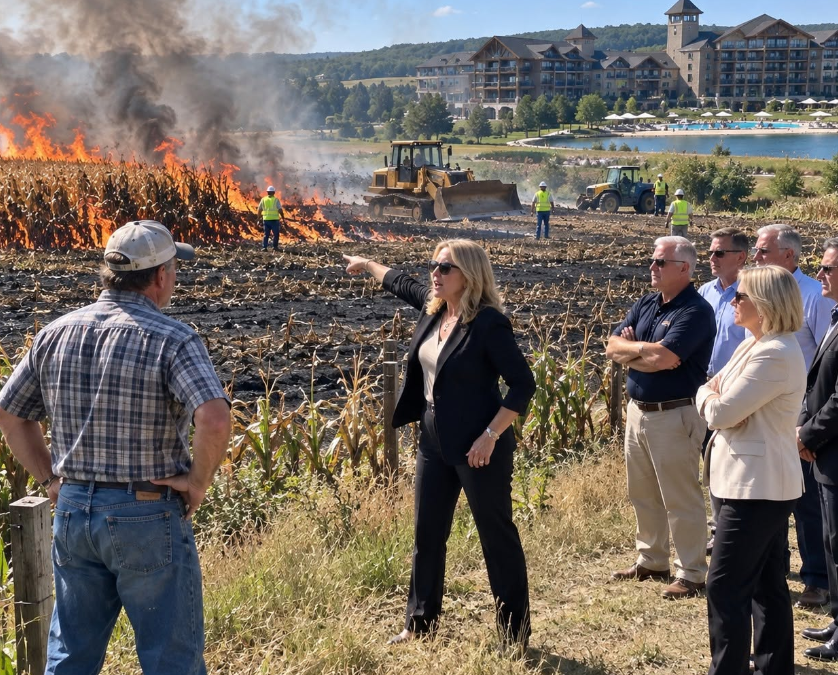
Until the morning they burned it.
It was a Tuesday.
Mid-July.
I remember the exact smell first.
Not smoke.
Burning green vegetation.
Wet plant matter burns differently from dry brush.
Heavy.
Bitter.
Almost sweet underneath.
I had been in the equipment shed when I heard engines.
More than one.
I walked out.
Two contractor trucks near the western field.
Utility trailer.
Workers.
Orange vests.
Portable burn unit and equipment.
Then I saw the flames.
Rows of corn.
My corn.
Eight feet high in places.
Green.
Healthy.
Three months from harvest.
Burning.
For several seconds, my brain did not make sense of what my eyes were seeing.
Fire belongs in a harvested field.
A controlled residue burn.
Dry stalks.
Winter cleanup.
Not living corn.
I ran toward the field.
One contractor saw me and raised both hands.
“Sir.”
“What are you doing?”
“We have authorization.”
“From who?”
“HOA.”
I stared at him.
“What HOA?”
“Pinerest.”
“They don’t own this land.”
He looked toward a woman standing near the road.
Karen.
White blouse.
Dark slacks.
Clipboard.
Two board members behind her.
She walked toward me calmly while fire moved down the rows behind her.
“Mr. Harlan.”
I pointed.
“Stop them.”
“The board authorized removal.”
“Stop them.”
“This agricultural obstruction has been under review for months.”
“Those are crops.”
“They are within the community visual corridor.”
“This is private agricultural land.”
“Our counsel disagrees.”
I stepped toward the contractor.
Karen moved between us.
“Do not interfere with contracted work.”
I could barely believe the sentence.
“You hired people to burn my field.”
“The board voted five to zero.”
“I don’t care if you voted fifty to zero.”
She held out an orange notice.
“Your continued noncompliance left us no alternative.”
Behind her, stalks folded into smoke.
Ash lifted.
Heat pressed across my face.
I wanted to grab the clipboard and throw it into the fire.
Instead, I asked, “Do you have a burn permit?”
“Contractor handled permitting.”
“Do you have written authority over this parcel?”
“Our community-plan designation is controlling.”
“No.”
She ignored me.
One board member looked uncomfortable.
Karen did not.
She had the expression of someone finally completing a delayed administrative task.
That angered me more than shouting would have.
The field was not a field to her.
It was an item on a compliance list.
I looked toward the resort.
Half a mile away.
Fountain.
Trees.
Pools hidden behind buildings.
Golf irrigation beyond the ridge.
Water everywhere.
And suddenly, for reasons I could not explain in that moment, I remembered my father’s safe.
The certificate.
Something in my mind connected.
Not fully.
Enough.
I looked at Karen.
“Do you know what a senior water appropriation is?”
She actually laughed.
One short sound.
“No, Mr. Harlan, I am not discussing unrelated agricultural regulations.”
“It isn’t unrelated.”
She looked toward the contractors.
“Continue.”
That laugh stayed with me.
Not because it was insulting.
Because it told me she had no idea.
I walked home.
Not because I surrendered.
Because I needed to think before I did anything stupid.
The field burned.
I watched smoke from my kitchen window.
Then I went to the back room.
Opened the fireproof safe.
The certificate sat where it had for decades.
Old folder.
Raised state seal.
Water Rights Certificate.
Milbrook Creek Watershed.
Senior appropriation.
Twelve acre-feet annually.
June 14, 1962.
I read it.
Then called Marcus Webb.
Marcus was seventy-one.
Water-rights attorney.
Practiced in the county for thirty-five years.
Had worked with my father in the early 1990s on a boundary issue.
He answered slowly.
“Marcus Webb.”
“It’s Daniel Harlan.”
Pause.
“Your father’s Daniel?”
“That’s me.”
“Haven’t heard your voice in years.”
“I need help.”
“What happened?”
“Pinerest HOA burned my cornfield.”
Silence.
“They what?”
“Burned it.”
“Why?”
“They say my land falls under their community plan.”
“Does it?”
“No.”
“Then why are you calling a water lawyer?”
I looked at the certificate.
“Because I found Dad’s 1962 Milbrook Creek appropriation.”
Long silence.
Then Marcus said, “Do not lose that document.”
“I’m holding it.”
“Get me a copy immediately.”
“What does it mean?”
“Depends whether it remained active.”
“How do we check?”
“I check.”
Another pause.
“And Daniel?”
“Yes?”
“Do not tell the HOA anything else about it.”
That was the first time I understood the document might matter more than I thought.
Three days after the burn, the certified letter arrived.
I stood at the mailbox and read it.
Pinerest HOA.
Compliance Enforcement Assessment.
Burning contractor: $4,200.
Beautification assessment: $8,500.
Total: $12,700.
They wanted me to pay for the destruction of my own crop.
Then landscape the site.
Native grasses.
Decorative stone.
Specified fencing.
Forty-five-day completion schedule.
I carried the letter inside.
Set it on the kitchen table.
Read it again.
Then I started laughing.
Not because it was funny.
Because anger sometimes has nowhere else to go.
I got my deed.
Community-plan maps.
Original plat.
The 2019 utility easement.
Put everything into a manila folder.
Then drove to the HOA office.
Pinerest clubhouse looked expensive in the understated way expensive buildings try to look inexpensive.
Stone.
Glass.
Quiet carpet.
Karen had a corner office.
She watched me come in.
“Mr. Harlan.”
I set the deed on her desk.
She did not touch it.
“My parcel is not in your association.”
“Our counsel has reviewed the boundary maps.”
“This deed predates your development.”
“The community plan area includes the parcel.”
“The recorded plat does not.”
She leaned back.
“You accepted HOA easement terms in 2019.”
“That was a utility corridor.”
“Which establishes a material governance relationship.”
“No.”
“The board’s legal position is otherwise.”
“Put that in writing.”
She opened a drawer.
For half a second, I thought she was reaching for a legal opinion.
Instead, she pulled out a stack of lien notices.
Bound.
Maybe twenty.
Different names.
Different properties.
She placed them on the desk.
“If the $12,700 is not paid within thirty days, we file a lien.”
I stared at the stack.
Karen continued.
“A lien prevents sale, transfer, or refinancing until cleared.”
“I know what a lien is.”
“We have used the process successfully before.”
There was no threat in her voice.
That made it worse.
Routine.
Everyone pays.
She believed the stack proved she was right.
What it proved was that people were afraid.
I knew some of the names.
Dale Hoffmeister.
The Mercer family.
Others.
People pressured into compliance by paperwork.
Then I noticed something behind Karen’s coffee mug.
Quarterly report.
Pinerest Resort letterhead.
WATER INFRASTRUCTURE UTILIZATION — Q2.
I did not reach for it.
Did not ask.
Just remembered.
Karen noticed where my eyes went.
She shifted the report slightly under another folder.
Interesting.
I picked up my deed.
“I’ll be in touch.”
“You have thirty days.”
I left.
Sat in my truck.
Called Marcus.
“I’m outside the HOA office.”
“How’d it go?”
“Karen has a Pinerest Resort quarterly water infrastructure report on her desk.”
Pause.
“Why?”
“I don’t know.”
“Operations coordination?”
“Maybe.”
“Developer relationship?”
“Probably.”
Marcus said, “Pull Pinnacle’s water permit.”
“Public?”
“State index.”
“Okay.”
“And Daniel?”
“Yes?”
“If they filed after 1962, the situation just changed.”
I went home.
Downloaded the public permit record.
Pinnacle Group Development LLC.
March 2017.
Milbrook Creek watershed.
Pools.
Spa.
Fairway irrigation.
Residential system.
Junior permit.
I stared at the date.
My father’s certificate was fifty-five years older.
The next morning, I drove to Marcus’s office.
Third floor.
Old building.
Wood paneling.
Brass handles.
Furniture older than some attorneys.
He placed my father’s certificate beneath a desk lamp.
Read every line.
Then checked the state registration.
“Active.”
I sat forward.
“You’re sure?”
“Never abandoned.”
Tap.
“Never transferred.”
Tap.
“Never modified.”
Tap.
“Senior appropriation, twelve acre-feet annually.”
He pointed to the date.
“June 14, 1962.”
“What does that actually mean?”
“In this watershed, priority matters during curtailment.”
“I know the phrase.”
“First in time, first in right.”
“Meaning?”
“When water availability triggers restriction, senior claims receive priority before junior claims.”
“And Pinnacle?”
He turned the screen.
“Filed March 2017.”
I read the applicant.
Scope.
Same resort.
Marcus continued.
“Your allocation gets satisfied first.”
“How much does that hurt them?”
“Depends on drought severity.”
“Worst case?”
“They could receive nothing until senior allocations are satisfied.”
I thought about the resort.
Two pools.
Spa.
Golf.
Landscaping.
Fountain.
Three hundred eighty units.
“Did they know?”
“They should have.”
“Could they have found this?”
Marcus almost looked offended.
“A basic adjacent-rights search would have found it.”
“How long?”
“An hour if the researcher was slow.”
I sat back.
“They never checked.”
“Apparently not.”
That evening Dale Hoffmeister came to my door.
Seventy-eight.
Retired schoolteacher.
Known him thirty years.
He carried a banker’s box.
Set it down carefully.
“I heard about your field.”
“News travels.”
“I’ve been keeping these.”
He opened the box.
HOA notices.
Four years.
Organized by year in rubber bands.
Teacher handwriting.
Mailbox fine.
$340.
Color inconsistent with standard PCS-7.
“Tobacco suede.”
Dale’s mailbox had been the same color since 2009.
Pinerest did not exist in 2009.
Satellite dish lien threat.
Dish installed 2011.
Grandfathered under HOA’s own rule.
Still fined.
Then landscaping.
$1,100.
Dead silver maple.
The reason the tree died?
Root dehydration during the same summer the HOA imposed irrigation restrictions.
Dale complied with the watering schedule.
Tree died.
HOA fined him for the dead tree.
He stood on my porch holding one of the notices.
His hands shook.
Not age.
Anger.
“They made us all feel like none of our paperwork mattered.”
I looked at him.
“Why didn’t you fight?”
“I tried.”
“What happened?”
“Attorney wanted a retainer.”
“How much?”
“More than the fine.”
There it was.
The business model.
Dale said, “Anything they put on paper felt like law.”
I nodded.
“I may need you to write down what happened.”
“I’ve been waiting for someone to ask.”
The next morning, I went to the county recorder.
The clerk spread the original plat across the counter.
My father’s parcel.
Separate.
Distinct.
Pinerest community-plan overlay came decades later.
Administrative planning map.
Not controlling title.
The HOA boundary claim did not match the recorded plat.
I photographed everything.
Certified copies.
Went home.
My kitchen table disappeared under documents.
1958 deed.
1962 water certificate.
2017 Pinnacle junior permit.
County plat.
2019 utility easement.
HOA burn notice.
$12,700 demand.
Dale’s notices.
Return receipt from my two-year-old certified letter.
I wrote EXHIBIT A on the folder containing the orange burn notice.
Then I built the file.
Dates.
Not emotions.
Karen had confidence.
I wanted chronology.
Chronology does not care who raises their voice.
The lien appeared online on a Thursday.
I had been checking the recorder database every morning.
There it was.
Pinerest HOA v. Daniel Harlan.
Noncompliant assessment.
$12,700.
My eighty acres reduced to an entry in a system.
Two days later, a letter came from Whitmore & Associates.
Pinerest legal counsel.
Pay within sixty days or foreclosure proceedings may begin.
Forced sale.
I read the letter three times.
Then looked up the law firm address.
1880 Commerce Drive.
Suite 204.
Pinnacle Group Development LLC was Suite 203.
One door apart.
Interesting again.
I called Marcus.
He had already filed the jurisdiction challenge.
A judge agreed to hear it.
The lien remained temporarily.
The foreclosure clock still moved.
“How long?”
“Long enough if we move carefully.”
“What do you need?”
“Everything.”
“You have it.”
“No.”
Marcus’s voice sharpened.
“I need certified copies. Recorder-stamped plat. Easement. Burn authorization. Board notice. Water permit. Every piece.”
“Fine.”
“And we do not threaten them with water.”
“Why not?”
“Because we don’t threaten.”
Pause.
“We file.”
That sentence became my rule.
Ten days after the lien filing, the HOA held its monthly meeting.
Eighty-three residents.
Karen had slides.
Before and after photographs.
My cornfield before burning.
Tall green rows.
Label:
NON-COMPLIANT AGRICULTURAL ZONE.
Then rough-graded dirt.
Label:
COMMUNITY GREEN SPACE INITIATIVE — PHASE 1.
Then a rendering.
Native grasses.
Walking path.
Decorative pond.
Bench.
Landscape lighting.
Community wellness corridor.
My field.
She spoke eleven minutes.
Used “community-first decision” four times.
Named me.
“Non-compliant agricultural holdout.”
Said resistance damaged community character.
New residents applauded.
Longtime residents did not.
Dale sat three rows ahead.
Jaw tight.
Karen opened public comment.
“Mr. Harlan, two minutes.”
I stood.
No notes.
No deed.
No pictures.
I looked at the board.
“Can anyone tell me who holds the senior water rights on Milbrook Creek?”
Silence.
Karen blinked.
Then smiled.
“Water rights are not before this board.”
“I asked whether anyone knows.”
“This meeting concerns community compliance.”
I nodded.
“Thank you.”
Then I sat.
That was all.
People looked confused.
Karen moved on.
But one man did not.
Third row.
Second seat.
Sixties.
Thin.
University hydrology department patch on his jacket.
Dr. Elliot Voss.
I did not know him then.
He stared at me.
Then Karen.
Then toward the resort visible through the clubhouse windows.
He understood.
Four days later, the state issued a drought notice.
Third issuance in four years.
Junior rights holders in the Milbrook Creek watershed required to demonstrate compliance or face curtailment.
Pinerest Resort was line seven.
Marcus called.
“They got the notice.”
“What are they doing?”
“Administrative review.”
“Does that stop priority enforcement?”
“No.”
“Do they know about me?”
“Not yet.”
I looked at the certificate.
“Give them two weeks.”
“Why?”
“Let them treat it like routine.”
Marcus was quiet.
Then he said, “You’re learning.”
I did not feel clever.
I felt tired.
That is the truth.
People later described the water right as my secret weapon.
It did not feel like a weapon.
It felt like a burden I never wanted.
I would have preferred my corn still standing.
I would have preferred the certificate remain in the safe.
I would have preferred Pinerest take its water and leave me alone.
Instead, someone burned eighty acres of trust down to smoke.
Now everything mattered.
The HOA scheduled a groundbreaking on my burned field.
Cream invitations.
Continental breakfast.
Guest remarks by Karen Whitfield.
Derek Sloan, Pinnacle regional director.
I received one.
I laughed.
Three days before the ceremony, Marcus called.
“Temporary stay granted.”
“On foreclosure?”
“Yes.”
“Lien?”
“Still recorded until hearing.”
“When?”
“Three weeks.”
“Enough?”
“If we file water enforcement before then.”
“Do it.”
“I need your signature Friday.”
“I’ll be there.”
Saturday morning, I went to the groundbreaking.
Clean shirt.
Work boots.
Maybe sixty people.
White tent.
Folding chairs.
Podium.
Pinerest banner.
Survey stakes across dirt that had been corn.
I stood near the back.
Karen saw me.
Whispered to Vice President Craig Fester.
Craig walked over.
“Mr. Harlan.”
“Craig.”
“Are you aware of the temporary order?”
“Yes.”
“You understand this is an association event?”
“On disputed private property.”
He frowned.
“You’re not to interfere.”
“I’m holding coffee.”
He looked at the cup.
Apparently decided coffee did not violate anything.
Walked away.
Karen spoke nine minutes.
“Long overdue reclamation.”
“Underused land.”
“Collective benefit.”
Applause.
Derek Sloan held a ceremonial shovel.
Photographers.
Resort PR team.
Breakfast.
Behind the podium, the resort water-intake tower rose above the trees.
I stared at it.
Funny how infrastructure becomes visible once you know what it depends on.
A reporter approached.
Pinerest Courier.
Mid-forties.
Notepad.
“You’re Daniel Harlan?”
“Yes.”
“Landowner?”
“Yes.”
“HOA says the burn was authorized.”
“They would.”
“Do you dispute jurisdiction?”
“Yes.”
“On what basis?”
“Recorded plat.”
He wrote.
“Anything else?”
I looked toward the resort.
“If you’re writing about expansion, check the state water board.”
He stopped writing.
“Why?”
“Milbrook Creek.”
“What am I looking for?”
“Curtailment notices.”
“Anything specific?”
“Senior appropriations.”
His eyes sharpened.
“Are you the senior claimant?”
I smiled.
“I did not say that.”
“Can I quote you?”
“You can quote that the records are public.”
He wrote faster.
I left.
The reporter filed records requests that afternoon.
Marcus learned later.
The state confirmed an active curtailment proceeding involving Pinerest.
No senior claimant publicly named yet.
But enough.
People started asking questions.
Friday morning, Marcus placed the enforcement paperwork in front of me.
Water Rights Certificate WR-1962-847.
Milbrook Creek Watershed.
Twelve acre-feet annually.
June 14, 1962.
I read every line.
Then signed.
Marcus notarized.
Filed that afternoon.
Seventy-two hours later, the state issued a mandatory compliance order to Pinerest Resort.
Their water intake dropped.
Thirty-two percent operational capacity remained under the curtailment conditions after senior allocations.
I was not there.
I did not watch.
But the effects were immediate.
Both pools began losing operating level.
Golf irrigation shut down under emergency protocols.
Spa service suspended.
Residential pressure fell to minimum operating levels.
The lobby fountain stopped.
That fountain.
The one from the grand-opening photo.
Eight feet of water.
Gone still.
Dr. Voss later told me he happened to be near the pool deck that morning. He watched the waterline fall several inches over a couple hours while maintenance staff checked equipment that was functioning exactly as designed.
The problem was not mechanical.
The problem was allocation.
That is what made the situation different.
Karen was used to paperwork threatening consequences.
My lien.
Dale’s notices.
Fines.
Deadlines.
This was not a letter threatening reduced water.
This was reduced water.
Physical.
Measurable.
Immediate.
Sunday morning, Rick Delano drove to my property.
General manager of Pinerest Resort.
Late fifties.
Personal pickup.
No company driver.
No lawyer.
No assistant.
7:30 a.m.
I met him at the gate.
He looked exhausted.
“I need to understand what I’m dealing with.”
I handed him two things.
A copy of the 1962 certificate.
Marcus Webb’s business card.
Rick read the date.
Long time.
“Nobody told me this existed.”
I believed him.
Not an excuse.
Observation.
“Your development team filed in 2017.”
He nodded slowly.
“This should have appeared in due diligence.”
“Yes.”
He looked at me.
“I did not authorize your field burn.”
“I know.”
“That was HOA compliance.”
“I know.”
“We have governance agreements with them, but individual enforcement is their side.”
“Then you need to talk to Karen.”
He looked toward the creek.
“What do you want?”
“That conversation goes through Marcus.”
“Money?”
“Marcus.”
“Access agreement?”
“Marcus.”
“Temporary accommodation?”
“Marcus.”
I gave him nothing else.
He nodded and left.
That afternoon, Rick went to Karen.
I was not there.
Later, a board member told me.
Written records confirmed pieces.
Rick put the state order on her desk.
The 1962 certificate.
Operations assessment.
Pool closures.
Spa loss.
Fairway irrigation impact.
Guest compensation exposure.
Then he asked, “Did you perform any water-right due diligence before authorizing the burn?”
Karen did not have an answer.
She talked about community boundaries.
2019 easement.
Counsel.
Governance.
Rick apparently asked again.
“Did you check?”
No.
That was the moment the machine stopped protecting her.
Until then, Karen’s method always worked because institutions moved in her direction.
HOA letters.
Lien systems.
Counsel.
County complaint mechanisms.
Once the resort’s operations began suffering, the most powerful institution in the relationship needed answers from her.
Not compliance.
Answers.
She had none.
Monday morning, the article ran.
PINEREST RESORT FACES WATER CRISIS AFTER HOA PROPERTY DISPUTE.
Regional pickup by noon.
Investors called Pinnacle.
Analysts asked about due diligence.
Tuesday, Dr. Elliot Voss spoke to local television.
He explained prior appropriation simply:
“First in time, first in right.”
Then:
“A valid senior agricultural claim from 1962 can legally outrank a resort permit issued decades later.”
The anchor summarized, “A document from 1962 is now affecting operations at a $120 million resort.”
That line traveled.
I hated headlines turning it into revenge.
But attention had one benefit.
Nobody could quietly erase the dates anymore.
The entire dispute was chronology.
Three weeks later, the judge ruled on the lien.
Invalid.
My parcel had never been subject to Pinerest HOA governance.
Recorded plat controlled.
Community-plan overlay did not create ownership or association jurisdiction.
The 2019 utility easement did not convert the entire parcel into HOA property.
Lien invalidated.
Foreclosure threat dead.
The orange notice from the day of the burn entered the record.
Exhibit A.
The document Karen thought proved her authority became evidence she acted without it.
Four days after the ruling, the county district attorney opened a preliminary inquiry.
Unauthorized destruction of private property.
Burn permit questions.
Lack of governing authority.
Karen.
Two board members who co-signed the burn authorization.
Named.
I did not celebrate.
By then, exhaustion had replaced anger.
Residents did move.
Forty-one of the eighty-three who had attended the earlier meeting signed a petition for an emergency board election.
Certified mail.
Hand delivery.
Email.
Apparently everybody had discovered documentation.
The civil case settled four months later.
I will not give the number.
I did not then.
I do not now.
More than the field would have earned in many years.
That is enough.
The HOA reserve fund took a heavy hit from defense costs.
State law and their own bylaws triggered a financial audit.
The audit found additional irregularities.
Those belonged to other proceedings.
I stayed with mine.
Burn.
Lien.
Jurisdiction.
Water.
Pinnacle moved faster.
Six weeks after the water compliance order, their general counsel contacted Marcus.
Formal negotiations.
They had choices.
Find alternative water source.
Reduce operation permanently.
Challenge priority.
Buy or lease lawful access.
We negotiated.
Not revenge pricing.
Not extortion.
A market-based arrangement recognizing the senior right and their operational need.
Three months.
Permanent easement and annual water access fee.
Documented.
Recorded.
Clear.
Pinnacle got legal certainty.
I got compensation.
The first quarterly payment arrived on a Tuesday in November.
I opened my bank account.
Pinnacle Group Development LLC.
Deposit.
I sat there looking at it.
Months earlier, Karen had handed me a $12,700 bill for burning my own field.
Now the company behind the resort was paying me to secure the water relationship they should have researched eight years earlier.
Irony can be satisfying.
But I would still have preferred the corn.
The emergency HOA board removed Karen.
Both co-signing board members went with her.
No dramatic screaming.
No handcuffs at a meeting.
No television cameras.
Vote.
Count.
Done.
The new interim board removed the Pinerest-branded sign from my burned field.
The sign that called it:
COMMUNITY WELLNESS CORRIDOR.
Survey stakes remained.
Nobody knew what to do with the dirt.
I did.
Wait.
Dale Hoffmeister organized a homeowner oversight committee.
Three longtime residents joined.
They reviewed four years of fines.
One by one.
Grandfather clauses.
Jurisdiction.
Notice procedures.
Lien history.
Some families retained attorneys.
Especially those who had sold under pressure.
I do not know how every case ended.
Not mine to tell.
I hope well.
The newspaper ran three articles.
First water crisis.
Second property jurisdiction.
Third HOA authority over preexisting parcels.
Fair reporting.
Documents.
Dates.
Interviews.
Karen declined comment.
Spring arrived.
I replanted.
Not exactly as before.
I left fifteen feet of native grasses along Milbrook Creek.
My father used to do that.
He said the creek needed room to breathe.
After I inherited the farm, I had narrowed the strip.
More rows.
More yield.
Efficient.
Standing there with seed in April, I changed my mind.
Some land does not need maximum productivity.
Some needs margin.
Corn went in.
Soil smelled right.
Irrigation line ran.
Clean.
Steady.
The resort towers were still visible.
I expected to resent them.
I did not.
The water agreement had changed the relationship.
Clear rights.
Clear obligations.
Clear payments.
No assumptions.
The resort had never been my real enemy.
Ignorance was.
Karen’s certainty was.
Institutional laziness was.
That spring morning, the resort fountain ran again.
I saw it from the field.
Water rising.
Falling.
For the first time, I did not see theft.
I saw a contractual relationship.
Their water.
After my allocation.
Under documented rights.
Order matters.
Records matter.
Consent matters.
One morning in May, I opened the fireproof safe.
Took out the original 1962 certificate.
Morning light across the page.
Raised seal.
Milbrook Creek watershed.
Twelve acre-feet.
My father’s name.
Date.
June 14, 1962.
I imagined him filing it.
Probably irritated about paperwork.
Maybe stopping at the state office in work clothes.
Maybe asking whether he really needed three copies.
He did not see the future.
No one does.
He did not know developers would build a $120 million resort downstream.
Did not know someone named Karen Whitfield would become HOA president.
Did not know his son would stand beside burning corn sixty years later.
He knew water mattered.
So he filed.
That was enough.
I put the certificate back.
Closed the safe.
Life moved on.
But the story did not end immediately.
People wanted explanations.
Residents approached me.
Some apologetic.
Some defensive.
Some angry.
A man named Thomas Reeve stopped me at the feed store.
He lived in one of the newer Pinerest condos.
“You shut our water off.”
“No.”
“That’s what everyone says.”
“The state curtailed a junior permit during drought.”
“Because you filed.”
“Yes.”
“So you shut it off.”
“No.”
He frowned.
“My wife couldn’t use the spa for a week.”
“I’m sorry.”
“You’re sorry?”
“Yes.”
He stared.
“You don’t sound sorry.”
“I didn’t burn anyone’s cornfield either.”
That landed badly.
I regretted it.
Thomas’s expression hardened.
I took a breath.
“Look.”
He waited.
“My right existed since 1962.”
“I know.”
“The resort filed in 2017.”
“I know.”
“State law determined priority.”
“But you chose to enforce.”
“Yes.”
“Why then?”
That was the real question.
“Because the HOA was threatening foreclosure on my land after destroying my crop.”
Thomas looked away.
“I didn’t know about foreclosure.”
“Most people didn’t.”
He rubbed his jaw.
“I bought because of the amenities.”
“I understand.”
“Water reliability was part of it.”
“Then Pinnacle should have disclosed the priority risk.”
He nodded slowly.
“That’s not your fault.”
“No.”
“Still sucks.”
“Yes.”
That conversation stayed with me.
People can be harmed by consequences without being responsible for the cause.
Residents lost amenities temporarily.
They were not all Karen.
Employees dealt with angry guests.
They were not Karen.
Maintenance crews drained systems.
They were not Karen.
The goal was never punishment.
The goal was stopping institutions from pretending my rights did not exist.
Marcus said something after settlement.
“The cleanest leverage is leverage you don’t need to exaggerate.”
I asked what he meant.
“Your certificate said enough.”
That was true.
We never demanded shutdown.
Never threatened the resort in public.
Never called reporters ourselves.
We filed.
Let the priority date operate.
Karen had relied on volume.
I relied on sequence.
Eventually, Pinerest residents learned the history.
Not all cared.
That was fine.
One community meeting after Karen left invited me.
I hesitated.
Then went.
Interim board chair Susan Bell introduced herself before the meeting.
“I want to apologize.”
“You didn’t burn the field.”
“I was on the board.”
“Did you vote?”
“No.”
“Then apologize for what you did.”
She looked surprised.
“That sounds harsh.”
“Maybe.”
She thought.
“I stayed quiet.”
I nodded.
“That matters.”
Susan swallowed.
“I knew the jurisdiction claim was disputed.”
“Did you read my certified letter?”
“No.”
“Why?”
“Karen said counsel handled it.”
There it was again.
Someone else checked.
Counsel.
President.
Management.
Title researcher.
Water manager.
Everybody assumes somebody else.
Susan said, “I should’ve asked.”
“Yes.”
“I’m sorry.”
“Thank you.”
That apology meant something.
Not because I needed guilt.
Because it was specific.
I stayed for the meeting.
Residents talked.
Dale presented the fine-history review.
Some notices invalid.
Some proper.
They did not simply cancel everything.
Good.
Accountability is not reversing every past decision because one leader was wrong.
It is reviewing accurately.
A woman asked, “Are we liable for your field?”
“Settlement handled that.”
“Through our reserves?”
“Insurance and settlement structure handled portions.”
She looked worried.
“Are dues going up?”
“Ask your board.”
She laughed nervously.
“We never asked questions before.”
“Start.”
That was the best thing I could tell them.
Ask.
Read.
Verify.
The financial audit became uncomfortable.
Not my case.
But people discovered procedural shortcuts.
Unapproved expenditures.
Inconsistent records.
Nothing I need to inflate.
Enough to reinforce the larger pattern.
When one leader controls information too long, systems get lazy.
The new board adopted changes.
Outside review of liens.
Independent title verification before claiming jurisdiction over nonstandard parcels.
Recorded-vote requirements.
Financial reporting.
Legal opinions distributed directly from counsel rather than summarized by the president.
Small things.
Boring things.
Strong things.
I watched Pinerest become less afraid of its own HOA.
That surprised me.
Meetings got louder.
People disagreed.
Good.
Democracy should sound messier than obedience.
Dale became almost annoying in retirement.
Every board meeting, front row.
Questions.
Documents.
Dates.
I teased him.
“You created a hobby.”
“They created it for me.”
Fair.
He showed me his old mailbox once after the fines were reviewed.
Still not tobacco suede.
He refused to repaint.
Good.
The resort changed too.
Pinnacle fired or reassigned people involved in due diligence failures.
I do not know details.
Rick Delano stayed.
We met twice during negotiation.
Professional.
Direct.
At the second meeting, he said, “I need to ask something off record.”
Marcus looked at him.
Rick continued, “Why didn’t you tell us about the certificate before filing?”
I answered, “I tried telling the HOA my property rights existed two years earlier.”
“That’s not the same.”
“No.”
“You could’ve called the resort.”
“Why would I?”
“Because our operations were exposed.”
“You built the system.”
Rick leaned back.
I continued.
“Your company filed a water permit.”
“Yes.”
“My certificate was public.”
“Yes.”
“You acquired surrounding parcels.”
“Yes.”
“Why is identifying senior rights my job?”
He exhaled.
“It isn’t.”
That was the right answer.
Then he said, “I wish someone had found it.”
“So do I.”
We moved on.
The permanent agreement gave everyone clarity.
Dry years still required management.
My allocation retained priority.
The resort had documented operational access under agreed terms.
No surprises.
The resort invested in conservation after that.
Better recirculation.
Reduced decorative irrigation.
Fairway changes.
Native landscaping.
I heard they cut water demand substantially.
Good.
A crisis sometimes improves infrastructure.
My farm changed too.
I became more careful about records.
Digitized everything.
Deed.
Water certificate.
Plat.
Easements.
Crop records.
Tax files.
Fire-safe originals.
Cloud copies.
Off-site backup.
My father would have hated the cloud.
He barely trusted banks.
But I learned something.
Rights nobody can find become harder to defend.
Records matter only if someone knows where they are.
I taught my daughter where the safe was.
She was an adult by then.
Lived two hours away.
I showed her the certificate.
She held it carefully.
“This is the famous paper?”
“Apparently.”
“Looks boring.”
“It is.”
“Worth a lot?”
“Depends what someone builds downstream.”
She laughed.
Then asked, “What happens when you die?”
“Cheerful question.”
“Serious.”
“The right follows the property under the applicable rules. Marcus has the estate file.”
She nodded.
“Good.”
Then:
“Grandpa really filed this?”
“Yes.”
“Did he know?”
“Know what?”
“That it would matter?”
“No.”
She looked toward the field.
“That’s kind of incredible.”
“It’s paperwork.”
“You say that like paperwork didn’t shut down a resort.”
“The state shut it down.”
“Because of paperwork.”
She had me.
The following July, one year after the burn, corn stood again.
Not exactly eight feet.
Season was drier.
Still healthy.
I walked the same rows where flames had moved.
No visible evidence.
Soil recovers faster than people sometimes.
Ash becomes nutrient.
That does not justify burning.
But land does not hold grudges.
It responds to what comes next.
Seed.
Water.
Time.
The burn area became productive again.
The community-wellness rendering disappeared.
The decorative pond never existed.
The native strip near the creek did.
Ironically, the land ended up greener near the water than before.
My choice.
That mattered.
Choice.
Karen’s central mistake was treating choice as inefficiency.
She saw a farmer refusing “community improvement.”
An underused field.
A stubborn holdout.
She believed the board’s plan was objectively better.
Walking paths.
Native grasses.
Aesthetic corridor.
Maybe some residents would prefer that.
Doesn’t matter.
Good ideas do not create ownership.
That seems obvious when stated plainly.
Authority makes obvious things complicated.
Karen could cite procedures.
She could produce maps.
She could hold votes.
Five to zero.
Still could not vote herself ownership of my field.
A board resolution cannot rewrite a deed.
A community plan cannot outrank a recorded plat merely because it is newer and prettier.
And a $120 million resort does not become senior water user because it costs more than a farm.
Priority does not care about glamour.
June 14, 1962 came before March 2017.
That was the whole thing.
At a later conference, Marcus used my case anonymously in a water-rights seminar.
He invited me.
I declined.
He later sent me his opening slide.
DATES BEAT DRAMA.
I laughed.
Then framed it.
Not because I wanted the memory.
Because he was right.
Karen had drama.
Burned field.
Board meeting.
Lien.
Groundbreaking.
PowerPoint.
I had dates.
The dates won.
Years after, people still called me sometimes.
Reporters.
Property owners.
HOA residents.
“Can you tell me how to fight my HOA?”
I always hated that question.
Every case different.
Different state.
Different documents.
Different law.
I am a farmer.
Not their lawyer.
So I told them:
“Read your deed.”
“Get the recorded documents.”
“Talk to qualified counsel.”
“Do not assume the HOA is right.”
“Do not assume it is wrong either.”
“Document.”
That last one always.
Document.
Emotion is memory.
Documents are evidence.
Dale understood that better than anyone.
He had saved every notice.
His banker’s box became useful during review.
He once told me, “I kept them because throwing them away felt like admitting they were right.”
I said, “You should scan them.”
He scowled.
“I’m seventy-eight.”
“You own a scanner.”
“My printer hates me.”
I scanned them for him.
Three hours.
He bought lunch.
Fair trade.
Some of his fines were refunded.
Others were not.
One landscaping violation actually had basis under a covenant that applied to his parcel.
He accepted that.
That is what credibility looks like.
You do not need every institution to be wrong.
You need them to be accurate.
The two families who sold under lien pressure pursued claims.
I only heard fragments.
I did not insert myself.
My ruling helped them challenge jurisdictional assumptions.
Good.
But their stories belonged to them.
Karen moved away eventually.
Not immediately.
I saw her car twice after removal.
Once at the old clubhouse.
Once near the management office.
We never spoke.
People asked whether she apologized.
No.
Would I have accepted?
Probably.
Would it change anything?
No.
Apologies matter for relationships.
We had none left.
I needed the lien gone.
It was.
I needed ownership confirmed.
It was.
I needed the water agreement documented.
It was.
I needed no one setting fire to crops again.
They didn’t.
That was enough.
One morning, maybe two years later, I found a Pinerest brochure in my mailbox.
Probably mass mailing.
New slogan.
ROOTED IN COMMUNITY.
I laughed so hard I had to sit down.
Marketing has no sense of irony.
The brochure advertised drought-conscious landscaping.
Efficient water systems.
Native plantings.
Sustainable luxury.
Maybe some of those changes came from what happened.
If so, good.
I threw the brochure into recycling.
The resort still exists.
Still expensive.
Still full most weekends.
People swim.
Golf.
Spa.
Attend weddings.
Nobody there thinks about my father when water comes from a faucet.
They shouldn’t.
Infrastructure works best when users do not need to think about it.
But somewhere behind the resort’s operational budget is a payment tied to a right filed by a farmer in 1962.
I like that.
Not because it gives me control over them.
Because it gives everyone clarity.
They know what they have.
I know what I have.
No fake assumptions.
No burned fields required.
My daughter once asked, “Would you ever sell the farm to Pinnacle?”
“No.”
“What if they offered twenty million?”
“No.”
“Thirty?”
“Stop.”
She laughed.
“I’m checking your principles.”
“My principles are not the only issue.”
“What is?”
“I like farming.”
She looked toward the resort.
“You could buy another farm.”
“Not this one.”
That answer sounded like my father.
The soil remembers.
Maybe people do too.
The back room still has his safe.
I could replace it.
Modern digital model.
Fire-rated.
Bigger.
I do not.
The old one works.
Heavy steel.
Dial.
Scratched paint.
Inside:
Water certificate.
Deed.
Family records.
My father’s handwriting on old envelopes.
Things worth keeping.
Sometimes leverage is not power you seek.
It is proof you preserved.
That distinction became important to me.
The water right did not make me powerful in 1962.
It made the farm secure.
That was what my father wanted.
Six decades later, security became leverage because someone threatened the farm.
Same document.
Different circumstance.
Power is often context applied to preparation.
Karen had preparation too.
Lien forms.
Counsel letters.
Board votes.
Templates.
She had built a system for people who would fold.
What she did not prepare for was a property outside her jurisdiction with records older than the HOA.
That gap destroyed her strategy.
I do not think Karen was stupid.
That is too easy.
She was overconfident.
More dangerous.
Stupid people make obvious mistakes.
Overconfident competent people build systems around assumptions.
Karen knew enough law to sound certain.
Enough process to make threats real.
Enough history of success to stop checking.
Every person she pressured before me trained her to believe pressure was proof.
They paid.
Therefore she was right.
They sold.
Therefore lien authority existed.
They complied.
Therefore governance extended.
Bad logic reinforced by good outcomes.
Until one day, it hit a wall.
The wall was not me.
It was the county plat.
Then the water certificate.
Then the priority date.
Systems.
Older than her.
Indifferent to her confidence.
That is why I never needed to out-shout Karen.
No voice can change 1962 into 2017.
One fall afternoon, Marcus visited the farm.
Rare.
He disliked leaving downtown.
I met him near the creek.
He walked slowly.
Seventy-something by then.
Cane.
We looked at the native grass strip.
“Your father would approve.”
“He’d complain I’m wasting fifteen feet.”
Marcus smiled.
“He would.”
Then he looked toward the resort.
“You know what bothers me?”
“What?”
“They almost got away with the jurisdiction claim.”
“Until the lien hearing.”
“No.”
“Then what?”
“If you’d paid.”
I thought about that.
“If you had written the check for $12,700, they would have called it consent by conduct someday.”
“Maybe.”
“If you had landscaped the burn site to their standard, same.”
I nodded.
Marcus continued.
“People underestimate the cost of peace.”
“What do you mean?”
“Sometimes paying for peace purchases the other side’s version of reality.”
That stayed with me.
I had wanted peace for two years.
Ignored letters.
Did not escalate.
Did not sue.
Did not demand declaratory judgment.
Peace felt cheaper.
Until they burned the field.
There is a difference between choosing your battles and teaching someone you will not fight.
I had accidentally done the second.
Would I change that?
Maybe.
If I could go back to my first certified letter, I would follow up.
Demand written legal basis.
Maybe file early declaratory action if necessary.
Force the jurisdiction issue before conflict grew.
Not because aggression is better.
Because clarity early is cheaper than catastrophe late.
The same lesson applied to Pinnacle.
If they had spent one hour checking water-right priority in 2017, everything changes.
Maybe negotiate then.
Maybe build conservation capacity.
Maybe choose alternative supply.
Maybe redesign fairways.
Maybe buy the right before spending millions.
Due diligence is boring.
So is insurance.
So are surveys.
So are water certificates.
Until they become the most important thing in the room.
I went to one Pinerest event years later.
Invited by Rick Delano.
Not HOA.
Resort anniversary.
He asked whether I would attend as a gesture.
I almost said no.
Then decided enough time had passed.
The lobby fountain was running.
I stood near it.
Rick approached.
“You made it.”
“Briefly.”
He laughed.
“Still hate resorts?”
“I never hated resorts.”
“Could’ve fooled our board.”
“Your board burned no corn.”
“Fair.”
We looked at the water.
Rick said, “That fountain uses less than half what it used to.”
“Good.”
“Closed-loop upgrade.”
“Good.”
“Golf irrigation down thirty percent.”
“Good.”
“You could sound impressed.”
“I am.”
He smiled.
Then said, “Water crisis was the best thing that happened to our infrastructure.”
“Bad way to learn.”
“Most lessons are.”
I stayed twenty minutes.
Ate one appetizer.
Left.
Driving home, I passed the field.
Dark.
Corn rustling.
I felt no conflict.
That was victory.
Not seeing the resort as an enemy.
Not seeing Karen in every light.
Not replaying the fire.
Just two neighboring properties with documented relationships.
The civil settlement money changed the farm.
I repaired equipment.
Improved irrigation controls.
Replaced an aging tractor.
Set aside college support for my granddaughter.
Nothing flashy.
People wanted revenge fantasy.
“Did you buy a bigger truck?”
No.
“Did you build a mansion?”
No.
“Did you make the HOA pay millions?”
Settlement confidential.
The real financial shift came from the long-term water agreement.
Steady.
Predictable.
Infrastructure value recognized.
That felt appropriate.
The right existed because my father wanted reliable water for crops.
Now it generated revenue helping another property use the same watershed lawfully.
Water can be shared.
Rights can be negotiated.
The problem was never sharing.
The problem was taking.
I watched another drought year arrive later.
State notices.
Priority system activated.
This time Pinerest was ready.
No panic.
Marcus had retired mostly by then.
His associate handled coordination.
Resort reduced nonessential use early.
Fairway schedule changed.
Pools managed capacity.
My allocation delivered.
No headlines.
No crisis.
That is what a functioning system looks like.
Boring.
I liked boring.
The HOA under new leadership became boring too.
Fewer fines.
Clearer notices.
Actual hearings.
Lien review.
Resident appeal process.
Dale said meetings became so dull he almost missed Karen.
Almost.
He died a few years later.
Eighty-one.
His daughter gave me the banker’s box.
“Dad said you’d know what to do.”
I did not.
The cases were done.
So I kept one folder.
His mailbox notice.
Tobacco suede.
I framed it and gave it back to his daughter.
She laughed through tears.
“He hated that color.”
“I know.”
The rest went to proper records where relevant.
Then shredding.
Not every document needs eternal life.
Only the ones that still tell something useful.
The orange burn notice stayed.
Exhibit A.
I keep it with the settlement file.
Sometimes I look at it.
Not often.
Bright paper.
Cheap zip tie hole.
HOA logo.
Words:
AUTHORIZED COMPLIANCE REMOVAL.
False.
But important.
It reminds me how confident bad authority can look.
The notice had formatting.
Signature.
Resolution number.
Contact information.
Deadline.
Everything except jurisdiction.
A document can look official and still be wrong.
That lesson applies everywhere.
I tell my granddaughter that now.
She rolls her eyes.
“Grandpa, I’m not going to fight an HOA.”
“You don’t know that.”
“I’m sixteen.”
“Start early.”
She laughs.
Then asks, “Can I see the famous certificate?”
I show her.
She touches the raised seal.
“This caused all that?”
“No.”
“Everyone says it did.”
“People caused all that.”
“The certificate recorded a right.”
“That sounds philosophical.”
“It’s accurate.”
She looks at the date.
“1962.”
“Your great-grandfather.”
She holds it carefully.
“Why didn’t he laminate it?”
I nearly choke.
“Do not laminate historical legal documents.”
“Okay.”
“Ever.”
“Got it.”
Some lessons matter more than others.
The next generation will inherit the land eventually.
Maybe they farm.
Maybe not.
That will be their decision.
If they sell, they will know what they are selling.
Deed.
Water.
History.
Boundaries.
No one will be able to tell them a community map erased it because the records are organized now.
That is part of inheritance too.
Not land.
Understanding.
The final time I saw Karen was at the county courthouse.
Different case.
I was leaving after filing something unrelated.
She was in the hallway.
Older.
No clipboard.
No HOA badge.
We recognized each other.
Stopped.
Neither spoke immediately.
Then she said, “Daniel.”
“Karen.”
Silence.
She looked down.
“I heard you replanted.”
“I did.”
“Corn?”
“Mostly.”
She nodded.
“I never intended for it to go that far.”
I did not know what she meant.
The burn?
Lien?
Water?
Everything?
I said, “You authorized the field removal.”
“The board did.”
“You led the board.”
She looked tired.
“We relied on counsel.”
“Counsel never changed the plat.”
“No.”
Another silence.
Then:
“I lost everything because of that field.”
I shook my head.
“No.”
Her eyes hardened slightly.
“You don’t think so?”
“You lost the presidency because the board acted outside its authority.”
“You enforced the water right.”
“Yes.”
“You knew what it would do.”
“Yes.”
“That destroyed my reputation.”
I looked at her.
“The certificate existed sixty years before I met you.”
She said nothing.
“I did not create the dates.”
That ended it.
She walked away.
I watched her go.
No satisfaction.
No anger.
Just closure.
People want villains to confess.
She did not.
Maybe she never will.
Does not matter.
Facts do not need emotional agreement.
The field was mine.
The lien invalid.
The water right senior.
The resort junior.
The agreement recorded.
Those facts stand whether Karen accepts them or not.
That freedom is powerful.
You stop needing the other person to understand.
The cornfield today looks ordinary.
That is the best ending.
Rows.
Creek.
Native grass strip.
Irrigation.
Birds.
Dust.
Some years good.
Some bad.
The resort still rises above trees.
Fountain still runs.
No one fights.
Quarterly payment arrives.
Boring.
One morning I stood where Karen had handed me the orange notice.
Same location.
No sign now.
No survey stakes.
No smoke.
I could remember flames moving through the rows.
Contractor engines.
Karen’s voice.
“The board voted five to zero.”
At the time, that sounded like power.
Five votes.
Now it sounds almost childish.
Five people can vote on anything.
They can vote that the moon belongs to the HOA.
Vote does not create jurisdiction.
The first question is not:
What did the board decide?
It is:
What does the board have authority to decide?
Everything follows from that.
Karen skipped the first question.
Pinnacle skipped a similar one.
Who has senior water rights?
Both failures came from institutions assuming scope.
HOA assumed a community-plan map gave authority.
Developer assumed a water permit gave sufficient supply.
Neither looked backward far enough.
Property law often punishes people who treat history as clutter.
Old deeds.
Old easements.
Old water claims.
Old plats.
History is not background.
It is infrastructure.
My father understood that without using those words.
Keep the paper.
File the claim.
Save the receipt.
Know the line.
He was not a lawyer.
He did not need to be.
He respected systems because he knew land outlives people.
I wish I had understood that sooner.
When he died, I saw the safe as a box of old documents.
Now I see a conversation across generations.
He filed.
I inherited.
Someone challenged.
The record answered.
Someday my daughter or granddaughter may need something I file.
Maybe not.
You do not preserve records because you know the future.
You preserve them because you do not.
The most expensive mistake Pinnacle made was not malicious.
It was omission.
They never ran the senior-rights cross-check.
Forty minutes.
Marcus said forty minutes.
A $120 million resort exposed because someone skipped forty minutes of research.
That still astonishes me.
The most expensive mistake Karen made was similar.
She never verified the recorded plat.
The newer map looked official.
The HOA’s overlay said community plan.
She believed what supported her authority.
Confirmation bias with letterhead.
If she had walked into the recorder’s office and asked for the controlling plat, the clerk would have shown her what I saw.
Separate parcel.
End.
No burn.
No lien.
No water enforcement.
No headlines.
No removal.
Maybe she remains president.
Maybe the HOA keeps functioning as before.
Forty minutes.
Sometimes disasters begin with the research somebody is too confident to do.
I tell that to younger farmers now.
Not the revenge part.
The diligence part.
Know your deed.
Know your water.
Know your easements.
Know access.
Know permits.
Do not assume because your family has farmed for sixty years that records are obvious to someone else.
Do not assume because something feels yours that the county database says what you think it says.
Check.
Farmers think paperwork is secondary.
I used to.
Crops are real.
Equipment is real.
Paper feels abstract.
Then someone burns the crop and the paper becomes the only thing that can prove who had no right to do it.
The farm association asked me to speak once.
I gave a short talk.
No dramatic title.
“Protecting Legacy Farm Records.”
Thirty minutes.
Old men fell asleep.
Young farmers took notes.
I brought a photocopy of the certificate.
Not original.
Never again leaves the safe unless necessary.
I said, “This paper was quiet for sixty years.”
People looked.
“Quiet is not useless.”
That was my point.
Rights do not have to shout.
They need to exist.
They need to be preserved.
And when challenged, they need to be used correctly.
Not recklessly.
Not as revenge.
Correctly.
That distinction mattered most to me after everything.
I could have tried to keep the resort dry permanently.
Maybe.
At least create prolonged conflict.
I did not.
We negotiated.
The law gave priority.
We converted conflict into agreement.
Some people online hated that ending.
They wanted the resort ruined.
Why?
Hundreds of residents.
Employees.
Vendors.
Guests.
Families.
They did not burn my field.
Karen did.
Two board members co-signed.
The HOA system enabled it.
Pinnacle failed due diligence.
Accountability should match responsibility.
Destroying the resort would not restore corn.
A lawful water agreement was better.
That is what adulthood often looks like.
Less satisfying in a headline.
Better in real life.
My father would have agreed.
He hated waste.
One morning, I imagined telling him everything.
He would listen.
Probably interrupt when I said $120 million.
“Who spends that on a resort?”
Then:
“You let them burn the corn?”
“I didn’t let them.”
“Where were you?”
“Dad.”
Then I would show him the agreement.
Quarterly payment.
He would stare.
Maybe say, “Should’ve charged more.”
That thought makes me laugh.
He was practical.
But the thing I think he would care about most is the field remained ours.
Not the money.
Land.
Water.
Continuity.
The soil remembers every season you put into it.
He was right.
The burned season exists in memory.
Then the replanted season.
Then the quiet ones after.
Land does not freeze around trauma.
Neither should people.
I still use the fireproof safe.
The certificate rests inside.
Folded along original creases.
I considered having it professionally flattened.
Decided against it.
Those creases came from my father.
Maybe the state clerk folded it.
Maybe he did.
They are part of the object.
The seal has faded slightly.
Still legible.
Date sharp.
June 14, 1962.
Sometimes all that separates a family farm from a $120 million institution is which date came first.
That sounds impossible until you understand water law.
Then it sounds obvious.
First in time.
First in right.
Karen thought money defined priority.
Development defined progress.
Board vote defined authority.
None did.
Dates did.
Recorded rights did.
When the state curtailment system activated, it did not ask which property had the nicer lobby.
It did not care that Pinerest had hundreds of units.
It did not care that my field was just corn.
It read priority.
That impartiality is why records matter.
Without it, power becomes aesthetics.
Biggest building wins.
Loudest board wins.
Most expensive lawyer wins.
Good systems exist to prevent that.
Imperfectly.
But sometimes spectacularly.
The last part of the original field I repaired was near the western edge.
The fire had damaged an old fence line.
I replaced posts.
Wire.
Gate.
Nothing fancy.
As I worked, I found a charred corn stalk embedded near one post.
Black.
Brittle.
I picked it up.
For a second, I thought about keeping it.
A souvenir.
Then I dropped it.
Ground it under my boot.
Let it become soil.
I did not need another artifact.
I had enough.
Orange notice.
Court order.
Water certificate.
Settlement.
Agreement.
Memory.
Sometimes healing is deciding not to archive everything.
That afternoon, my granddaughter brought lunch.
We sat on the tailgate.
She looked toward the resort.
“That’s the place?”
“Yes.”
“Doesn’t look evil.”
“It isn’t.”
She looked confused.
“But they burned the field.”
“The HOA did.”
“And the resort?”
“Failed to check water rights.”
“So who was the bad guy?”
I laughed.
“Life isn’t that clean.”
She frowned.
“That’s annoying.”
“Yes.”
Then I said, “Karen made bad decisions. The board followed. Pinnacle missed important due diligence. Residents trusted people they shouldn’t have. Lawyers used threats. I ignored the problem too long.”
She looked at me.
“You made mistakes?”
“Of course.”
“What?”
“I thought staying quiet would make them leave me alone.”
“Didn’t work.”
“No.”
She ate a chip.
“What should you have done?”
“Made them prove jurisdiction the first time.”
“Why didn’t you?”
“I had corn to grow.”
She nodded.
“That sounds like you.”
Fair.
The younger generation wants clear villains.
So does the internet.
Real stories are stronger when you resist making them cleaner than they were.
Karen was not a monster.
She was a person whose methods had worked too long.
Pinnacle was not an evil corporation secretly stealing water.
It was a developer that failed a critical records check.
The HOA residents were not an army.
Many were confused.
Some applauded Karen.
Later many signed the petition removing her.
People change when evidence changes.
That is a hopeful thing.
The reporter who broke the water story contacted me on the fifth anniversary.
Wanted a retrospective.
I agreed to one question.
He asked, “What was the turning point?”
He expected the water shutoff.
I said, “The burn notice.”
“Why?”
“Because they wrote down what they did.”
He laughed.
“Not the water certificate?”
“No.”
“The notice?”
“Yes.”
“Explain.”
“Before that, they could argue misunderstanding.”
“And after?”
“They documented authorization.”
He nodded.
“The paper trail.”
“Exactly.”
He asked a second question anyway.
“Do you feel vindicated?”
I hate that word.
“I feel done.”
He did not print that.
Maybe too boring.
The article used:
FARMER WHO OUTRANKED A RESORT STILL HOLDS HISTORIC WATER RIGHT.
Fine.
The resort’s public relations people eventually stopped referring to the crisis.
Understandable.
No one advertises due diligence failure.
The HOA stopped using the phrase community wellness corridor.
Also understandable.
The field returned to maps as agricultural land.
Correct.
That was the best correction.
Language returned to reality.
The county recorder entry for my lien showed released.
The foreclosure notice archived.
The water agreement recorded.
Clean.
Systems healed through records.
Not speeches.
If Karen had understood that earlier, maybe none of it happens.
But then I think about Dale’s box.
The families who sold.
The fines.
Maybe conflict was coming regardless.
Sometimes one case exposes a pattern the community needed to see.
I never wanted to be that case.
But once I was, I decided to make it complete.
That decision I do not regret.
Build a record so complete the facts do the arguing.
Marcus taught me that without saying it directly.
He died a few years later.
Seventy-six.
His associate called me.
Marcus had left an envelope.
Inside:
Copy of the 1962 certificate.
On a sticky note:
KEEP THE ORIGINAL DRY.
I laughed and cried at the same time.
Classic Marcus.
No sentiment.
Instruction.
I framed the sticky note.
The original remains dry.
One spring after his death, I stood by Milbrook Creek.
Water high from rain.
The resort fountain unnecessary compared to real moving water.
I thought about how strange ownership of water sounds.
Nobody owns the molecules in the way people own furniture.
Rights define use.
Priority.
Allocation.
Systems built around scarcity.
My father’s certificate was never about possessing the creek.
It was about predictable access.
That nuance got lost in headlines.
“Farmer owns resort water.”
Not exactly.
“Farmer shuts off resort.”
Not exactly.
The state enforced priority under drought conditions.
The law worked.
Then a private agreement created stability.
Real story less dramatic.
More important.
Because if the lesson is “find a secret weapon and destroy your enemy,” people learn nothing useful.
The lesson was:
Know what you have.
Know what others actually control.
Preserve records.
Challenge unsupported authority early.
Use lawful process.
Do not confuse restraint with surrender.
And when you gain leverage, solve the problem instead of feeding the conflict.
That is what I hope my granddaughter remembers.
Not the fountain stopping.
The field continuing.
By then, the corn was shoulder-high.
Wind moved through the rows.
Sound like paper brushing paper.
I walked to the creek.
Looked back toward Pinerest.
Glass towers in sunlight.
No smoke.
No contractors.
No orange notice.
Just distance.
I thought again about the day Karen laughed.
“Do you know what a senior water appropriation is?”
She did not.
Neither did most residents.
Neither did reporters at first.
That is fine.
Nobody knows everything.
The danger is laughing before checking.
I have done versions of that too.
Farmers can be arrogant about land.
Lawyers about law.
Developers about development.
HOA presidents about bylaws.
Expertise becomes dangerous when it makes you stop asking what exists outside your expertise.
Karen knew HOA procedure.
She did not know water law.
Pinnacle knew development.
They missed legacy agricultural claims.
I knew farming.
I underestimated institutional pressure.
Everybody had blind spots.
The difference is whether reality gets a chance to correct you before you double down.
Karen got many chances.
My certified letter.
Deed.
Plat number.
Utility easement language.
My question at the meeting.
She chose certainty.
That was the costly part.
One evening, I found the old $12,700 demand letter.
I had forgotten about it.
Original.
Folded.
The beautification specification attached.
Native grasses.
Decorative stone.
Fence requirements.
I read it.
Then looked outside.
Irony.
I had planted native grasses eventually.
But my way.
Along the creek.
For soil and water health.
Not because an HOA ordered decorative landscaping.
Same material.
Different authority.
Consent changes everything.
I kept the letter.
Maybe one day I will archive all of it with the local historical society.
Not yet.
It still feels like a family file.
The payment from Pinnacle arrives quarterly.
Automatic.
No ceremony.
I barely notice now.
That is how stable agreements should work.
No Sunday-morning general manager.
No lawyers every week.
No reporters.
Just contract performance.
Water flows.
Money flows.
Corn grows.
The resort operates.
Good.
The land is worth more now.
Not just because of the water agreement.
Development pressure.
Location.
Infrastructure.
People ask to buy.
I say no.
Maybe a future generation says yes.
Their decision.
But if they do, they will negotiate from knowledge.
That is my responsibility.
My father left me land and paper.
I leave both plus explanation.
Inheritance improves when context travels with assets.
That may be the final lesson.
A document can survive sixty years.
Understanding does not unless someone teaches it.
So I wrote everything down.
Not the internet version.
The full chronology.
1958 purchase.
1962 appropriation.
2017 resort permit.
2019 utility easement.
Certified letter.
Burn.
Lien.
Curtailment.
Court ruling.
Agreement.
Copies.
Contacts.
Stored with estate papers.
My daughter calls it the “if Grandpa disappears” binder.
Accurate.
The original certificate still has one job.
Exist.
Quietly.
Most of the best protections are like that.
You hope never to use them.
Insurance.
Fire extinguisher.
Survey.
Easement.
Water right.
Backup.
Until the day you need them.
Then yesterday’s boring paperwork becomes today’s survival.
Karen’s mistake was believing only active power mattered.
Board seat.
Lien threat.
Contractor.
Counsel.
She could see her tools.
Mine was sitting in a safe.
Invisible.
Still valid.
That difference changed everything.
The cornfield is not famous anymore.
Good.
Local people stopped driving by.
No more reporters.
No more television crews.
Sometimes a resort guest walks the nearby trail and looks across.
They see corn.
Maybe native grass.
Maybe creek.
They do not know the history.
They do not need to.
Places can recover anonymity.
That is another form of healing.
I walk the rows.
Feel soil.
Check irrigation.
Do work my father would recognize.
Modern equipment.
Same logic.
Seed.
Water.
Time.
One afternoon, I found my granddaughter standing at the creek.
She said, “Do you think Great-Grandpa would believe the story?”
“No.”
“Why?”
“He’d think I was exaggerating.”
She laughed.
“What part?”
“$120 million resort.”
“Not the HOA burning the corn?”
“He knew people.”
She laughed harder.
Then:
“What would he be proud of?”
I thought.
“Keeping the land.”
She nodded.
“That’s what I thought.”
Maybe.
I hope.
But pride is not why I tell the story.
I tell it because somebody somewhere will receive a letter that looks official.
A demand.
Fine.
Lien threat.
Compliance order.
Maybe valid.
Maybe not.
Fear makes people react before verifying.
I almost did.
Karen relied on that.
Her stack of lien notices was psychological as much as legal.
Everyone pays.
That was the message.
My advice is simple.
Do not ignore serious paperwork.
But do not worship it either.
Read.
Verify.
Ask who has authority.
Ask what document creates it.
Ask what date.
Ask what recording number.
Ask what right predates it.
Then get qualified help.
The question that changed my case was not:
“How do I beat Karen?”
It was:
“What is already recorded?”
That question found the plat.
The water certificate.
The junior permit.
Reality existed before strategy.
Strategy just uncovered it.
The final time I put the 1962 certificate back into the safe, I paused.
Ran my finger over the raised seal.
Old paper.
Slightly yellow.
My father’s name typed cleanly.
I imagined him folding it.
Closing the safe.
Walking outside.
Maybe corn that year.
Maybe alfalfa.
He had no idea.
No idea a woman with a clipboard would one day stand in smoke and laugh at the wrong question.
No idea a development company would build towers downstream.
No idea his filing would determine water priority six decades later.
He just did the responsible thing.
He filed the paperwork.
That is less cinematic than revenge.
More powerful.
Because systems only protect you when someone before you bothered to document what was theirs.
I closed the folder.
Set it inside.
Locked the safe.
Then walked outside.
Morning.
Creek moving.
Corn beginning to catch light.
The resort fountain barely visible through trees.
Everything operating.
Everything where it belonged.
Karen had once stood in that field and told me five votes gave her authority to destroy what my family had built.
She had been wrong.
Not because I was stronger.
Not because I shouted louder.
Not because a farmer somehow defeated a $120 million resort.
She was wrong because the deed was older than her map.
The plat was older than her community plan.
The water right was older than the resort.
And none of those documents cared who held the clipboard.
That was the whole story.
The HOA burned my cornfield.
Then billed me $12,700.
They threatened to lien and foreclose on land my father bought in 1958.
And in doing so, they forced me to open a fireproof safe and pull out a piece of paper no one at Pinerest had bothered to search for.
One date.
June 14, 1962.
A date older than the resort by more than half a century.
That date did not destroy Pinerest.
It forced Pinerest to finally operate within the rights that had existed before it arrived.
And that was better.
Because after all the smoke, court filings, empty pools, closed spa rooms, angry meetings, headlines, liens, and legal bills, the ending was not destruction.
It was order.
The farm kept its water.
The resort secured lawful access.
The HOA lost authority it never had.
The residents learned to read what they were being told to obey.
And the field grew corn again.
My father used to say the soil remembered every season you put into it.
For years, I thought that was just something an old farmer said.
Now I understand.
The field remembers drought.
It remembers fire.
It remembers harvest.
It remembers being replanted.








