The HOA Blocked My Private Mountain Road With Armed Guards and Ordered Me to Turn Around—They Never Checked Whose Land Was Under Their “Checkpoint.”
The HOA Blocked My Private Mountain Road With Armed Guards and Ordered Me to Turn Around—They Never Checked Whose Land Was Under Their “Checkpoint.”
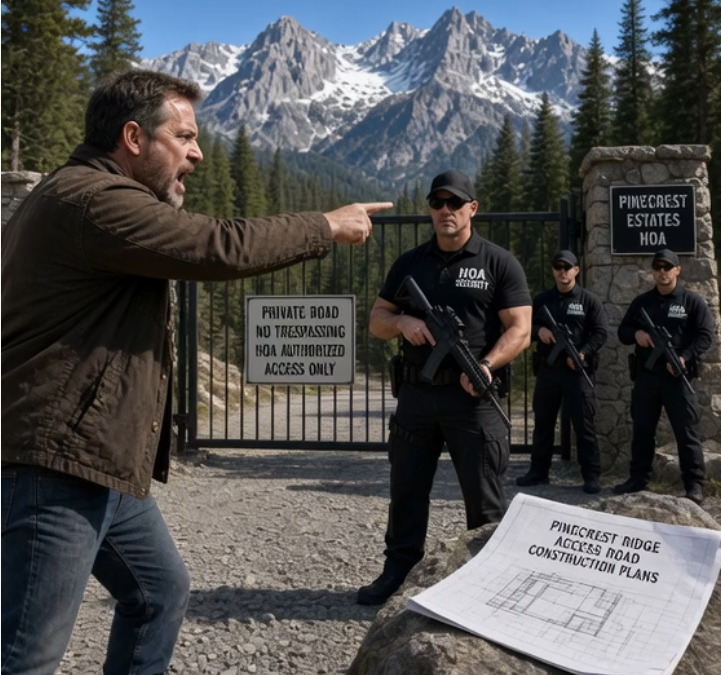
At the bottom of my mountain road, three armed guards stood beside two black SUVs like they owned the gravel beneath my tires.
The HOA president thought a printed sign and a rented security detail could erase twenty years of permits, survey markers, blasting invoices, fire-access agreements, and the scars on my hands from building that road myself.
But Hollow Ridge never checked who carved that road into the mountain, and by the time the sheriff arrived, their little checkpoint had become the most expensive mistake their gated neighborhood had ever made.
The first thing I saw at the bottom of my mountain road was a black SUV parked sideways across the gravel.
The second thing I saw was the armed guard standing beside it with one hand resting near his holster like he was protecting a federal checkpoint instead of blocking a road I had built with my own hands.
There were three guards in total.
Two black SUVs.
One temporary metal barrier.
A printed sign zip-tied to the middle of it.
ROAD CLOSED BY AUTHORITY OF THE HOLLOW RIDGE HOMEOWNERS ASSOCIATION.
I stopped my truck halfway down the slope and just stared.
For a few seconds, the whole scene looked so absurd that my mind refused to accept it. The morning sun was barely over the eastern ridge, still gold and thin between the pines. Mist clung in the hollows below. Gravel dust hung in the cold air behind my truck, drifting in slow pale ribbons through the headlights.
Behind me, Mercer Ridge Road curled up through granite cuts, drainage ditches, switchbacks, culverts, retaining walls, and pine woods that still carried burn scars from the Kingston Fire. It climbed almost three miles from the valley floor to my cabin, my machine shop, my timber ground, and the old fire lookout my father used to maintain before the county shut it down.
Every yard of that road sat on my land.
Every culvert had been installed under my permits.
Every retaining wall had been inspected by the county.
Every load of stone had been paid for from my account.
Every switchback existed because I had stood there with survey flags, blueprints, a laser level, and a stubbornness people mistook for madness until the road finally held through its first spring runoff.
And now three hired guards were standing at the entrance like they had been sent to protect the valley from me.
The youngest guard stepped forward when my truck rolled closer.
He wore a black tactical vest over a gray shirt. A radio sat clipped to his shoulder. A sidearm rested openly at his hip. His boots were too clean for mountain gravel. His face was serious in that way young men get when someone hands them authority before they understand responsibility.
He raised one hand.
“Sir, you need to stop right there.”
I put the truck in park.
The diesel idled low.
Dust drifted past the hood and settled near the barrier.
Through the windshield, I could see the sign bouncing slightly in the morning wind.
Road Closed.
By Authority.
Hollow Ridge HOA.
Those words would become very expensive for them.
I rolled down my window.
“This is my road.”
The guard looked at the clipboard in his left hand.
“This road is temporarily closed pending access review.”
“By who?”
“The association.”
“I am not in the association.”
He glanced toward the older guard near the second SUV.
Then back at me.
“Sir, I am going to need you to turn around.”
PART2:
I rested my left arm on the open window frame and looked past him toward the entrance where my road met Hollow Ridge Lane. The HOA had not just blocked the gravel. They had parked their SUVs on the strip I had deeded as a fire-lane apron, the one wide enough for two engines to stage if the mountain ever burned again.
That detail mattered.
It mattered more than they knew.
“What’s your name?” I asked.
The guard stiffened.
“Carter.”
“Carter, who told you this road belongs to Hollow Ridge?”
He looked at his clipboard again, though the answer was not going to appear there if it had not already.
“We were contracted by the Hollow Ridge Homeowners Association to secure this access point.”
“This access point is on my property.”
“The association says otherwise.”
“The association is wrong.”
He shifted his weight.
Behind him, the older guard muttered something into his radio.
The third guard stood by the barrier, arms crossed, trying to look bored and dangerous at the same time.
I looked at Carter’s sidearm.
Then at his clean boots.
Then at the sign.
I had spent enough years in construction to know when a mess was still small enough to fix and when someone had poured gasoline on it before striking the match.
This was already the second kind.
I turned off the engine.
Carter’s eyes widened a little.
“Sir, please remain in the vehicle.”
I opened the door.
“I’m stepping out of my truck on my road.”
His hand drifted closer to his holster.
Not drawing.
Not yet.
But enough.
My voice went colder.
“You touch that weapon over a property dispute, and every camera on this truck records it.”
His hand froze.
That was the first time he looked closely at the truck.
Dash camera.
Rear camera.
Side cameras mounted under both mirrors because mountain roads attract deer, falling rock, careless delivery drivers, and, apparently, armed idiots hired by an HOA.
I stepped down onto the gravel.
I am not a small man.
PART3:
At fifty-one, I am slower than I used to be, and my right knee aches when weather changes, but thirty years of building roads, cutting timber, pouring concrete, and lifting things smarter men would have used machines for had left me broad through the shoulders and hard through the hands. My beard had gone mostly gray. My left ear had a notch from a flying rock chip in 2006. My palms looked like old leather. I wore work boots, faded jeans, and a canvas jacket with Mercer Mountain Works stitched above the pocket.
The guards looked at the patch.
None of them understood it.
That almost made me smile.
Mercer Mountain Works was not a large company anymore. It was mostly me, two seasonal guys, a dump truck that should have retired before the pandemic, a backhoe older than Carter, and enough specialized mountain-road knowledge that county engineers still called when they needed to know why a slope was failing.
But twenty years ago, when I built Mercer Ridge Road, we were busy. My father was alive. My younger brother Nolan was still laughing too loudly at everything. My wife, Elise, was still planning where we would plant apple trees near the cabin.
Back then, I believed roads were simple.
You built them right.
They carried people home.
Then the mountain taught me roads were more than gravel and grade.
Sometimes a road is the line between rescue and regret.
The older guard approached.
He was maybe forty-five, heavier than the younger one, with a shaved head, a thick mustache, and a voice designed to close conversations.
“Sir, you need to leave the area.”
I looked at him.
“Are you a law enforcement officer?”
“No.”
“County deputy?”
“No.”
“State trooper?”
“No.”
“Federal marshal?”
His jaw tightened.
“Private security.”
“Then you do not have authority to order me off my land.”
“We have been authorized to secure this roadway.”
“By people who do not own it.”
He pulled a laminated document from a folder.
“Hollow Ridge HOA has determined that continued unauthorized use of this road presents safety and liability concerns pending access review.”
“Unauthorized use by who?”
His eyes flicked over me.
“Non-residents.”
I laughed once.
Not because it was funny.
Because the alternative was worse.
“Non-residents,” I repeated.
The road behind me led to my house.
My shop.
My timber.
My water tanks.
My emergency generator.
My wife’s ashes scattered under the three white pines at the second overlook.
And this rented guard with a laminated sheet was calling me a non-resident.
“What’s your name?” I asked him.
“Blake.”
“All right, Blake. You’re going to call whoever hired you and tell them Owen Mercer is at the gate.”
He did not move.
I watched his face carefully.
No recognition.
None.
That told me Hollow Ridge had not prepared their guards for the possibility that the man who built the road might show up in a dusty pickup before breakfast.
Blake said, “Mr. Mercer, we were instructed not to permit anyone through.”
“Then your instructions are bad.”
“Sir—”
“Call them.”
He stared at me for a beat.
Then he lifted the radio.
“Control, this is Unit Two. We have an Owen Mercer at the closure. Says he owns the road.”
The radio crackled.
A woman’s voice answered.
“Hold position. Mrs. Voss is en route.”
There she was.
Cynthia Voss.
President of Hollow Ridge HOA.
Retired real estate developer.
Current queen of the valley floor.
A woman who could turn a friendly wave into a zoning dispute if she believed it gave her leverage.
I had met her exactly twice before that morning, and both times she had mistaken patience for permission.
The first time was eight months earlier at the county planning office.
Hollow Ridge was a gated subdivision tucked below my mountain, built after the old Harlan ranch sold to developers. The homes were large, expensive, and angled carefully to look rustic from far away while costing more than anything truly rustic ever should. Stone pillars marked the entrance. The community had paved lanes, decorative lanterns, walking trails, a clubhouse with a fitness room, and a brochure that described “direct adjacency to preserved mountain wilderness.”
That preserved wilderness was mine.
Hollow Ridge liked my trees.
They liked my ridge line.
They liked the way my road disappeared into the pines and made their neighborhood feel exclusive, remote, important.
They did not like that I used it.
Especially not during the year I rebuilt the upper retaining wall and hauled rock through the entrance twice a day for six weeks.
Cynthia Voss cornered me at the planning office after a minor permit hearing.
She was sixty, maybe sixty-two, tall and thin, with silver hair cut in a perfect angled bob and a wardrobe made entirely of expensive neutrals. She had the calm, polished voice of someone who had spent decades making unreasonable demands sound like project management.
“Mr. Mercer,” she said, extending her hand. “Cynthia Voss. Hollow Ridge HOA.”
“I know who you are.”
Her smile paused for half a second.
“I wanted to introduce myself properly. We’ve had some concerns from homeowners about traffic on Ridge Access Road.”
“It’s Mercer Ridge Road.”
“Of course,” she said smoothly. “But it does serve as an access corridor adjacent to our community.”
“It existed before your community.”
“Yes, but conditions change. We have children now. Walkers. Cyclists. Delivery traffic. The gravel trucks are causing dust and safety concerns.”
“I haul rock on my road when my road needs rock.”
“Surely there is a way to coordinate usage.”
“There already is. I use my road. Your homeowners use their roads.”
Her smile thinned.
“I prefer collaboration to conflict.”
“Then stop trying to rename my property as a corridor.”
She did not like that.
People like Cynthia rarely do. They rely on soft words to blur hard lines.
The second time was at the county fire council meeting.
She stood in front of a room full of firefighters, road supervisors, county staff, and landowners, arguing that Hollow Ridge needed “greater control over private access points adjacent to the development” because of liability.
Fire Chief Alvarez asked one simple question.
“Are you talking about Mercer Ridge Road?”
Cynthia smiled.
“Yes, among others.”
Alvarez shook his head immediately.
“You can’t control that road. We use that road.”
“For what purpose?”
“Emergency access.”
“It is not a public road.”
“No,” Alvarez said. “It’s better maintained than half the public roads in this county.”
A few people laughed.
I did not.
Cynthia’s eyes found mine across the room.
I saw then that she did not like being told no in public.
That should have warned me.
Now, standing beside the SUVs at the bottom of my mountain road, I pulled out my phone and took pictures.
The barrier.
The sign.
The vehicles.
The guards.
Their weapons.
Their placement.
The fire-lane apron blocked by SUVs.
Blake noticed.
“Sir, you can’t photograph security personnel.”
“I can photograph trespassers on my land.”
“We are not trespassing.”
“You are.”
Carter looked nervous now.
The third guard, whose name I had not gotten yet, muttered, “Man, this is above our pay grade.”
He was the smartest one there.
I called the sheriff.
Dispatch answered.
“This is Owen Mercer at the entrance to Mercer Ridge Road, off Hollow Ridge Lane. The Hollow Ridge HOA has blocked my private road with armed security, two vehicles, and a barrier. They are preventing access to my residence and blocking the county fire-lane apron.”
There was a pause.
“Did you say armed security?”
“Yes.”
“Are weapons drawn?”
“No.”
“Is anyone injured?”
“Not yet.”
“We’ll send a deputy.”
“Send Sheriff Baines if he’s available.”
Another pause.
“I’ll note that request.”
I hung up.
Blake watched me.
“That was unnecessary.”
“No,” I said. “This whole thing is unnecessary. The call was documentation.”
Cynthia arrived twelve minutes later in a white Range Rover that had never met mud without complaint.
She stepped out wearing cream slacks, a quilted vest, leather gloves, and an expression of controlled irritation. Behind her came a younger man with a laptop bag, probably the HOA manager or attorney or professional email sender.
“Owen,” she called as if we were neighbors meeting at a mailbox.
“Cynthia.”
She glanced at the guards, then at my truck.
“I had hoped we could avoid escalation.”
I looked at the black SUVs parked across my road.
“You brought armed guards before six-thirty in the morning.”
“Because repeated unauthorized use created a liability issue.”
“Unauthorized by who?”
“The association is conducting an access review.”
“You do not have authority to review my access to my property.”
Her smile appeared.
There are smiles that warm a room.
Cynthia’s could freeze running water.
“That is one interpretation.”
“It is the recorded interpretation.”
The younger man stepped forward.
“Mr. Mercer, I’m Daniel Reed, community manager for Hollow Ridge. The association’s position is that this road intersects association-maintained frontage and creates shared liability exposure. Until the board determines appropriate access protocols, the closure is temporary.”
“You rehearsed that.”
His face reddened.
Cynthia’s eyes stayed on mine.
“We are not denying you eventual access.”
“Eventual access to my own house.”
“The road’s legal status is under review.”
“No, it isn’t.”
“We disagree.”
“Then you should have filed in court instead of hiring gunmen.”
Blake stiffened.
Cynthia looked offended.
“That is inflammatory.”
“That is descriptive.”
She stepped closer.
“Owen, I understand this road has sentimental value to you.”
I felt something in my chest go very still.
Sentimental.
People reached for that word whenever they wanted to make ownership sound emotional and therefore weak.
“This road has legal value,” I said. “Practical value. Emergency value. Economic value. Personal value too, but that’s none of your business.”
Her jaw tightened.
“Hollow Ridge residents have reported excessive noise, dust, unauthorized vehicles, and safety concerns. We have an obligation to protect our community.”
“From me driving home?”
“From uncontrolled access.”
I glanced toward the road behind me.
“You do know Hollow Ridge did not build that entrance, right?”
“We maintain the adjoining frontage.”
“No. You landscape beside it.”
She ignored that.
“The association has legal counsel reviewing the plats.”
“Good. Tell them to review Book 412, Page 88 at the county recorder’s office.”
The younger man looked up.
Cynthia did not.
“What is that supposed to mean?”
“It’s the recorded deed reservation for Mercer Ridge Road. Then they should review the 2004 grading permit, the 2005 slope stabilization approval, the 2006 culvert inspection, the 2007 fire-access memorandum, and the 2012 emergency-use agreement with the county.”
Daniel Reed opened his mouth.
Closed it.
Cynthia’s eyes narrowed.
“Those documents are old.”
“So is the mountain.”
Her face hardened.
“You may be used to informal arrangements up here, Owen, but Hollow Ridge has standards.”
That almost did it.
I thought of my father’s hands on a transit level.
My brother hanging survey tape from pine limbs.
Elise standing in orange mud with a thermos, laughing because I had fallen thigh-deep into a drainage trench.
The county inspector signing the final stabilization report after three years of sweat and debt.
Standards.
“You’re standing on my standard,” I said.
Before she could answer, the first sheriff’s cruiser rolled into view.
Then the second.
That surprised her.
Good.
Deputy Erin Malloy stepped out first, one hand on her belt but not near her weapon. She was calm, sharp-eyed, and had grown up on mountain roads worse than mine. Behind her came Sheriff Tom Baines himself, tall, gray-haired, hat low, expression already tired.
Tom had known my father.
He had also responded to the accident that made me build the road the way I did.
His eyes moved over the barrier, the guards, the SUVs, the sign, Cynthia, then me.
“Owen.”
“Sheriff.”
He looked at the sign again.
His mouth twitched, but not with humor.
“Hollow Ridge closed your road?”
“That’s what the sign says.”
Cynthia stepped forward with practiced confidence.
“Sheriff Baines, thank you for coming. The association has temporarily secured this access due to unresolved liability concerns.”
Tom looked at the armed guards.
“You always handle liability with sidearms?”
Blake said, “We are licensed private security.”
“Wasn’t asking you.”
Blake shut his mouth.
Tom turned to Cynthia.
“Do you have a court order?”
“No, but—”
“Do you have a recorded easement giving Hollow Ridge control over Mercer Ridge Road?”
“Our counsel is reviewing—”
“That means no.”
Cynthia’s smile faltered.
“The road intersects association frontage.”
Tom looked at me.
“Owen, where’s your lower boundary?”
I pointed to a bronze survey cap set in concrete near a boulder twenty feet beyond the barrier.
“There. Then it runs along the old fence line before cutting toward the creek.”
Tom walked to the cap.
He looked at it.
Then at the SUVs.
Then at Cynthia.
“These vehicles are on Mercer property.”
Cynthia’s voice sharpened.
“With respect, Sheriff, property boundaries in mountain developments are complex.”
Tom stared at her.
“Ma’am, I was standing here when that cap was set.”
That landed hard.
Even the guards looked at him.
Cynthia blinked.
“What?”
Tom pointed up the road.
“I was deputy then. County had to inspect this access after the Kingston Fire. Owen’s father was still alive. His brother was running a dozer. The county surveyor set that marker as part of the final access documentation.”
He looked at me.
“Your dad cussed about where they put it.”
“He said it was six inches ugly.”
Tom nodded.
“Sounds right.”
Cynthia looked from him to me.
For the first time, uncertainty crossed her face.
Not enough to stop.
Enough to warn her she had stepped into something older than her paperwork.
Sheriff Baines walked back to the barrier.
“Mrs. Voss, move the vehicles and remove the barrier.”
“We cannot do that without board authorization.”
“You can do it with mine.”
“I do not believe—”
“You are blocking a private road, trespassing on private property, and obstructing a designated emergency access route recognized by the county fire plan. Move the vehicles.”
The young guard Carter looked relieved.
Blake did not.
He turned to Cynthia.
“Ma’am?”
Cynthia’s lips pressed into a flat line.
“Not yet.”
Tom’s eyebrows lifted.
“Excuse me?”
She drew herself up.
“This is a civil access dispute. The association has retained counsel. Until we receive clarification, I am not authorizing removal of the closure.”
The air changed.
Even the mountain seemed to hold still.
I looked at Tom.
He looked at me.
Then he turned to Deputy Malloy.
“Start documenting obstruction.”
Cynthia’s face went pale.
“Sheriff—”
“No. You had your chance to correct this without paperwork.” He pointed to the SUVs. “Deputy Malloy, get plate numbers, VINs if visible, company information, weapon permits, security licenses. I want photos of the barrier, sign, and vehicles in relation to the survey cap.”
Malloy nodded.
Carter turned to Blake.
“Dude.”
Blake muttered something I did not catch.
Cynthia spoke quickly.
“Let’s not overreact.”
Tom’s voice hardened.
“Mrs. Voss, I am underreacting because I know Owen.”
That was true.
If Tom had not known me, if this had been any other armed blockade in a private mountain access easement, he might have emptied the place first and asked questions later.
I walked to my truck and pulled a binder from behind the seat.
It was old, thick, and ugly, with duct tape along the spine. My wife used to call it “the book of no fun.” Inside were copies of every permit, plat, inspection, agreement, invoice, map, survey, and county letter related to Mercer Ridge Road.
Elise had made me organize it.
That was her gift.
I could build anything, but I hated paperwork. She believed paper was how you made memory usable.
“If you build it and don’t document it,” she used to say, “some idiot in nicer shoes will eventually claim it never happened.”
Elise had been dead eleven years by then.
I wished she could have seen Cynthia’s face when I opened that binder on the hood of my truck.
I laid out the documents one by one.
Recorded deed.
Survey.
Road construction permit.
Slope disturbance permit.
Culvert inspections.
Retaining wall certifications.
Fire-access memorandum.
Emergency-use agreement.
Maintenance logs.
Invoices.
County approval letters.
A photo from 2005 showing me and Nolan standing beside a half-cut switchback, both of us covered in dust and grinning like fools.
Tom picked up the photo.
His face softened.
“Nolan,” he said.
I nodded.
Cynthia looked impatient.
“Sentiment does not establish current authority.”
I looked up from the binder.
“Nolan died on the old logging track before this road was finished.”
The words came out flat.
They always did when I said them in public.
Not because I did not feel them.
Because I felt them too much.
Cynthia went still.
Tom closed his eyes briefly.
Carter looked down.
I continued.
“April 17, 2003. He was bringing a load of cedar posts down the old ridge trail after a storm. The trail washed out under the rear axle. Truck rolled. He lived for forty-two minutes after the 911 call. Rescue couldn’t get up the mountain fast enough because there was no reliable access. That’s why I built this road. That’s why the county inspected every culvert. That’s why the fire department has an emergency-use agreement. That’s why your SUVs are not just trespassing. They are blocking the thing my family built so no one else dies waiting for help.”
Nobody spoke.
For once, not even Cynthia.
Then Daniel Reed, the HOA manager, whispered, “Cynthia…”
She shot him a look.
But something had shifted.
The guards no longer stood like men protecting a checkpoint.
They stood like employees realizing their paycheck had placed them on the wrong side of a dead man’s road.
Sheriff Baines picked up the emergency-use agreement and handed it to Cynthia.
“Read the highlighted section.”
She took it stiffly.
Her eyes moved over the page.
Her face changed.
The agreement stated that Mercer Ridge Road, while private, was designated as secondary emergency access for upper-slope fire response, rescue, and evacuation under county coordination. It also required that the entrance apron remain unobstructed and accessible to emergency vehicles at all times unless temporary closure was authorized by the landowner and county emergency management.
At all times.
Cynthia stopped reading.
Tom said, “That apron is currently obstructed.”
She handed the paper back.
“I was not aware of this document.”
“That is because you did not check.”
Her mouth tightened.
“We relied on our community manager and legal review.”
Daniel Reed looked like a man watching a bus come directly at him.
“No,” he said quietly.
Cynthia turned.
“What?”
“I sent the board a memo recommending title review before any closure action.”
Her eyes sharpened.
“Daniel.”
He swallowed.
“I did. Last week. I said we needed to confirm ownership and emergency status.”
The world became very quiet.
I looked at him with new interest.
Tom did too.
Cynthia’s face hardened into something ugly beneath the polish.
“This is not the place.”
Daniel’s voice shook, but he kept going.
“You told me security was only being hired to monitor traffic, not block access.”
Carter took one step back from the barrier.
Blake stared straight ahead.
I almost felt sorry for Daniel.
Almost.
Cynthia said through her teeth, “We will discuss this internally.”
“No,” Sheriff Baines said. “You’ll discuss it in reports.”
He turned to Blake.
“Move the SUVs.”
Blake looked at Cynthia.
Tom stepped closer.
“That was not a suggestion.”
Blake lifted both hands slightly.
“Yes, Sheriff.”
Cynthia snapped, “Wait.”
Nobody did.
The guards moved the barrier first. Carter cut the zip ties and removed the sign. He looked at it, then looked at me.
“I’m sorry, sir,” he said quietly.
I believed him.
Blake got into the first SUV and backed it off the apron. The third guard moved the second. Gravel crunched. Dust lifted. The road opened.
For the first time that morning, I could see the full width of the entrance again.
My entrance.
My road.
My way home.
But opening the road did not undo what they had done.
Not even close.
Deputy Malloy kept taking photos.
Tom told the security company to remain on scene for license verification.
I picked up the HOA sign after Carter set it on the gravel.
Road Closed by Authority of the Hollow Ridge Homeowners Association.
I held it for a moment.
Cynthia watched me.
“I’ll keep this,” I said.
“That is association property.”
I smiled for the first time that morning.
“It was abandoned on mine.”
Her nostrils flared.
Tom coughed into his fist.
Cynthia’s attorney arrived forty minutes later.
He came too late to stop the damage but just in time to witness the consequences beginning.
His name was Martin Bell, and to his credit, he looked horrified the moment he saw the documents on my hood. Unlike Cynthia, he understood paper. He understood recorded rights. He understood emergency access obligations. He understood that armed private security blocking a designated emergency route without court authority was not a strong position.
He pulled Cynthia aside.
They spoke behind the Range Rover in low voices.
She gestured sharply.
He shook his head.
She gestured again.
He shook his head harder.
Finally, he walked over to me and Sheriff Baines.
“Mr. Mercer,” he said, “on behalf of my client, I want to express that this appears to have resulted from a misunderstanding.”
“No,” I said.
He paused.
“No?”
“A misunderstanding is when someone turns into the wrong driveway. This was planned.”
His professional mask held, but only barely.
“We are prepared to work toward resolution.”
“You will work through my attorney.”
“Of course. May I have their contact information?”
I handed him a card.
“Also,” I added, “your client blocked my driveway, denied access to my residence, obstructed an emergency access route, placed armed personnel on my land, and attempted to exercise authority over property she never checked. I want preservation of all HOA communications, board minutes, legal memos, security contracts, invoices, emails, texts, and title review documents related to Mercer Ridge Road.”
Martin Bell’s face changed.
He glanced at Cynthia.
She looked away.
He understood then that I had done this before.
Not exactly this.
But enough.
Road disputes in mountain counties are rarely simple. I had watched families split over easements, developers misread plats, neighbors threaten one another over gates, and attorneys grow rich because someone assumed a gravel track had no memory.
Mercer Ridge Road had memory.
And files.
Lots of files.
By noon, the guards were gone.
The barrier was gone.
Cynthia was gone.
But the story was only beginning.
That afternoon, I drove up the road slowly, stopping at each switchback.
The road looked the same at first glance.
Pine needles along the shoulders.
Granite cuts catching sunlight.
Culverts running clear from last week’s rain.
Gravel packed firm.
But something had changed because someone had tried to take meaning from it.
At the second overlook, I pulled off beside the three white pines.
Elise’s pines.
We planted them the spring after the road opened fully. She wanted apple trees. I wanted pines because deer eat apple trees and I was more practical than romantic. She said practicality was a disease I refused to treat.
So we planted both.
The deer ate the apple trees in one winter.
The pines stayed.
When Elise died from an aneurysm so sudden I still sometimes wake up expecting her to be downstairs making coffee, I scattered part of her ashes there because she had loved that overlook. From it, you could see the valley spread below, Hollow Ridge now glittering where pasture used to be, and farther east, the river bending like dull silver through cottonwoods.
I stood under the pines with the HOA sign in my hand.
“Elise,” I said, “you were right about paperwork.”
The wind moved through the branches.
I decided that counted as agreement.
My attorney, Grace Kim, called me at four.
I had sent her photos, video, documents, and a summary.
She did not say hello.
“They hired armed guards?”
“Yes.”
“On your recorded private road?”
“Yes.”
“And blocked the emergency access apron?”
“Yes.”
“And the HOA president refused to move vehicles after the sheriff told her to?”
“Yes.”
There was a pause.
Then Grace said, “I need coffee before I answer professionally.”
Grace had represented me in two land disputes and one contractor claim. She was five feet two, terrifyingly organized, and capable of making grown men apologize to documents. Her father had been a surveyor, which meant she treated bad boundary assumptions as moral failures.
When she called back thirty minutes later, she had a plan.
Emergency demand letter.
Notice of trespass.
Preservation demand.
Request for HOA insurance information.
Open-records request for county emergency access filings.
A letter to the security company.
A letter to Hollow Ridge’s attorney.
A claim for damages related to obstruction, emotional distress was unlikely but not impossible, interference with property access, and violation of the emergency access agreement.
She also wanted one more thing.
“Do you have footage showing the guard’s hand near his firearm?”
“Yes.”
“Good.”
“I don’t want to ruin some young guard’s life.”
“We are not ruining his life. We are establishing that the HOA created a dangerous confrontation by placing armed personnel where they had no authority.”
That was fair.
“Grace,” I said.
“Yes?”
“I want this handled hard.”
She was quiet for a moment.
Grace knew me well enough to hear what that meant.
Not reckless.
Not emotional.
Hard.
“They touched the road,” she said.
“They did.”
“I’ll handle it.”
The first demand letter went out the next morning.
By afternoon, Hollow Ridge’s board knew more than Cynthia wanted them to know.
By evening, half the subdivision knew too.
That part was not my doing.
It was Daniel Reed.
Apparently, after being thrown under Cynthia’s Range Rover in front of the sheriff, Daniel decided transparency had become a survival strategy. He sent the full board his prior memo, the photos Deputy Malloy had taken, the emergency-use agreement, and a written statement that said he had advised against closure until title and legal authority were confirmed.
Someone on the board forwarded it to someone else.
By dinner, Hollow Ridge’s private resident forum exploded.
I know because three different people sent me screenshots.
One homeowner wrote:
Did we really hire ARMED GUARDS to block a private emergency road??
Another:
Cynthia told us Mercer refused to cooperate with safety review. She never mentioned we may not own/access/control the road.
Another:
Are we liable if there had been a fire or medical emergency while the road was blocked?
That question was the one that mattered.
Because there almost was.
Two days after the blockade, while Hollow Ridge was still arguing online, an elderly homeowner named Mr. Haskell fell from a ladder while cleaning pine needles out of his gutters. He broke his hip and hit his head. Hollow Ridge Lane was open, so the ambulance came through the main subdivision gate.
But Fire Chief Alvarez called me that evening.
“You hear about Haskell?”
“Yes. Is he okay?”
“Stable.”
“Good.”
A pause.
Then Alvarez said, “If that had happened Monday morning during their blockade and Hollow Ridge Lane had been blocked by the resurfacing crew like it was scheduled to be, we would’ve used your road apron to stage.”
I looked out my kitchen window toward the dark ridge.
“I know.”
“They don’t.”
“They’re learning.”
“I’m writing a report,” he said.
“Please do.”
He did.
That report landed like a second avalanche.
It stated plainly that Mercer Ridge Road was included in county emergency planning for alternative access and staging and that obstruction by unauthorized private parties could increase response times during fire, medical rescue, or evacuation events.
The county emergency management director added a formal letter.
The county attorney opened a review.
The sheriff’s report classified the incident as unlawful obstruction and trespass, though criminal charges were left pending while the county attorney reviewed intent and authority.
Cynthia’s authority evaporated quickly after that.
Hollow Ridge held an emergency board meeting one week after the blockade.
I did not attend.
Grace did, representing me.
Sheriff Baines attended.
Fire Chief Alvarez attended.
So did nearly eighty homeowners, which was impressive for a Tuesday night and a meeting room designed for thirty.
Cynthia tried to open with a statement.
According to Grace, she stood at the front of the clubhouse beneath a framed watercolor of the ridge she had tried to control and said, “This has been blown out of proportion by misinformation and emotional overreaction.”
That was when Mr. Haskell’s wife stood up.
Mrs. Haskell was seventy-four, had white hair, a cane, and no patience left in her body.
“My husband was on the ground for eighteen minutes waiting for an ambulance,” she said. “If your guards had delayed them by one second, I would have sued you myself.”
The room went silent.
Cynthia tried to respond.
Mrs. Haskell kept going.
“You told us that road was an association liability. You did not tell us it was someone else’s private property. You did not tell us it was emergency access. You did not tell us the manager warned you. You did not tell us anything except what made you sound in charge.”
That was the first public crack.
Then Daniel Reed spoke.
He read his memo aloud.
Title review needed.
Emergency status unknown.
Legal review advised.
Do not physically restrict access pending confirmation.
Cynthia stared at him like she could set him on fire with her eyes.
Then Grace stood.
Grace is polite when she is most dangerous.
She introduced herself, laid out the recorded documents, showed survey maps, explained the emergency access agreement, displayed photos of the armed guards, the barrier, and the SUVs parked across my entrance apron, then read the text of the sign out loud.
Road Closed by Authority of the Hollow Ridge Homeowners Association.
Then she looked at the board.
“Authority is not a decorative word. It must exist before it is exercised.”
Several homeowners clapped.
Grace waited until they stopped.
“My client built Mercer Ridge Road at his own expense after a family tragedy caused by lack of reliable mountain access. The road is private property. It is also recognized in county emergency planning. Hollow Ridge had no ownership, no easement, no court order, no emergency authorization, and no legal right to place armed personnel at its entrance.”
Cynthia interrupted.
“This is one side of the story.”
Grace looked at her.
“Yes. The documented side.”
I wish I had been there for that.
The board voted that night to remove Cynthia as president pending investigation.
She refused to resign.
They removed her anyway.
Three days later, she resigned from the board entirely.
Not with apology.
People like Cynthia rarely apologize when consequences finally reach them. They issue statements.
Hers said:
I acted in good faith to protect the safety and quality of life of Hollow Ridge residents amid unresolved access concerns.
Grace read it aloud over the phone and said, “That sentence was written by an attorney trying to keep a window from becoming a doorway.”
The security company settled first.
Their owner drove up personally to meet me at the road entrance. His name was Luis Ramirez, former military police, direct, visibly embarrassed.
“We were told the HOA controlled the access point,” he said.
“You didn’t verify?”
“We should have.”
“Yes.”
He nodded.
“My guys should not have been positioned armed on unverified property. That’s on us. The young one, Carter, said you handled yourself professionally.”
“I was angry enough to see through time.”
Luis almost smiled.
“We’ve changed our intake procedure. No armed site post on access disputes without proof of ownership or court order.”
“Good.”
Their insurer paid a modest settlement and covered legal fees tied to their portion. Luis also sent Carter’s written apology. I kept it. Not because I needed it, but because he was young enough to learn and I hoped he did.
Hollow Ridge’s settlement took longer.
Cynthia’s personal liability took longer still.
Emails came out in discovery.
The most damaging one was from Cynthia to two friendly board members:
Mercer has used that road unchecked for years because prior boards were too timid to address it. If we establish physical control now, the legal details can be sorted afterward from a stronger position.
Grace highlighted that sentence and called me.
“Owen,” she said, “you are going to enjoy this email.”
I did not enjoy it exactly.
Enjoyment is too simple.
But I felt a grim satisfaction reading the words.
If we establish physical control now.
That was the whole thing.
That was the sickness beneath so many HOA disasters, development fights, and private-property conflicts.
Establish control first.
Justify later.
Cynthia had not misunderstood.
She had gambled.
On my age.
My patience.
My privacy.
My reluctance to escalate.
My supposed sentimentality.
She had gambled that if she put men with guns at the bottom of my road, I would negotiate from behind their barrier.
She had never imagined the road itself would testify against her.
In the end, Hollow Ridge agreed to a settlement that included legal fees, damages, a permanent recorded acknowledgment that Mercer Ridge Road was private property with no HOA control rights, a non-obstruction covenant tied to the emergency access agreement, reimbursement for county administrative costs, and mandatory board training on property rights and emergency access.
They also had to install, at their expense, two signs approved by me and the county.
PRIVATE ROAD
MERCER RIDGE ROAD
NO HOA ACCESS OR CONTROL
EMERGENCY ACCESS MUST REMAIN CLEAR
The signs were simple.
Plain.
Beautiful.
Cynthia’s personal settlement came through her insurance and a separate agreement with Hollow Ridge. I was not party to all of it, but Daniel told me enough. She sold her house six months later and moved to a golf community two counties away.
I felt sorry for the golf community.
Not enough to warn them.
Life on the mountain returned to normal slowly.
Normal meant gravel maintenance, culvert clearing, snowplowing, diesel invoices, elk tracks in mud, and the sound of wind moving through high pines at night. Normal meant driving past the new signs and feeling both relief and grief. Relief because the road was secure. Grief because nobody should have to prove ownership of what grief already paid for.
One afternoon in October, I drove down to the entrance and found a boy standing by the sign.
He was maybe twelve, wearing a Hollow Ridge hoodie and carrying a skateboard. He jumped when he saw my truck and looked guilty enough to be innocent.
I rolled down the window.
“You lost?”
“No, sir.”
“You planning to skate up my road?”
His eyes widened.
“No, sir. My mom would kill me. Also it’s steep.”
“Smart.”
He looked at the sign.
“You’re Mr. Mercer?”
“Yes.”
“My grandpa is Mr. Haskell. He fell off the ladder.”
“How’s he doing?”
“Complaining a lot.”
“That means he’s recovering.”
The boy nodded.
Then he said, “My mom says the old HOA lady tried to steal your road.”
I considered correcting the phrasing.
Then decided not to.
“That’s close enough.”
“Did you really build it?”
“Yes.”
“All by yourself?”
“No. My dad helped. My brother. My wife. A lot of good crews. County inspectors. Engineers. Roads take more than one person.”
He studied the gravel climbing into the trees.
“Why’d you build it?”
I looked up the road.
Morning sun touched the first switchback. Pines threw long shadows over the ditch line. Somewhere above, hidden by distance, were the three white pines where Elise rested and the curve where Nolan’s accident had taught us what bad access could cost.
“Because the old way wasn’t safe,” I said.
He absorbed that.
Then he looked embarrassed.
“I’m sorry they blocked it.”
“You didn’t.”
“No, but… we live there.”
That was a heavy thing for a kid to carry.
I rested my arm on the window.
“Living somewhere doesn’t make you responsible for every foolish thing adults do there.”
He nodded.
Then he asked, “Can a road belong to somebody and still help other people?”
That one stayed with me.
I looked at the emergency access sign.
“Yes,” I said. “But only if people respect who it belongs to.”
He nodded again, like that made perfect sense.
Children often understand consent better than boards do.
Winter came hard that year.
Heavy snow.
Ice.
Wind that rattled the cabin windows and knocked branches across the upper road.
In January, a storm dropped twenty inches in one night. Hollow Ridge lost power. Their main gate froze half-open. A transformer blew near the valley road. Emergency management called at 4:12 a.m.
“Owen,” the dispatcher said, “Chief Alvarez wants to know if Mercer Ridge is passable for access to the upper hydrant tanks.”
“I plowed at midnight. I’ll make another pass.”
“Thank you.”
I hung up, pulled on insulated coveralls, and went outside.
The world was blue-black and silent except for wind in the trees. Snow sat heavy on pine limbs. The truck started reluctantly, engine growling awake like an old bear. I mounted the plow and headed down.
At the entrance, Hollow Ridge lay dark except for a few generator lights.
The new sign stood clear beside the road.
Private.
No HOA access or control.
Emergency access must remain clear.
No SUVs blocked the apron.
No guards.
No barrier.
Just open gravel beneath fresh snow.
I plowed through.
By dawn, county fire trucks used the apron to stage while crews checked hydrant pressure and assisted several elderly residents with generator issues. Nobody asked who owned the road. Nobody tried to rename it. They simply used it the way the agreement intended: with permission, purpose, and respect.
Chief Alvarez found me near the lower switchback as the sky turned pale.
“Road held good,” he said.
“It usually does.”
He smiled.
“Your dad would be proud.”
I looked up the ridge.
“Of the road or the lawsuit?”
“Both.”
I laughed then.
The sound surprised me.
It had been a long time since I laughed about any part of it.
That spring, I repaired a drainage ditch on the second switchback and replaced two culvert grates. Daniel Reed, no longer Hollow Ridge’s manager because he had taken a job with a county planning firm, stopped by with coffee.
“I thought you’d like to know,” he said. “Hollow Ridge’s new board passed an emergency access policy.”
“Did it include not hiring armed guards?”
He smiled.
“Explicitly.”
“Progress.”
He leaned against his truck.
“I should have pushed harder before they blocked you.”
“Yes.”
He winced.
I took the coffee.
“But you told the truth when it mattered.”
“I wish I’d done it sooner.”
“Sooner is best. Later is still better than never.”
He looked up the road.
“You ever think about selling?”
“Every developer in three counties has asked me that question.”
“I’m not asking as a developer.”
“No.”
He smiled faintly.
“Fair.”
I looked at the ridgeline.
The mountain was greening again. The road cut through it in curves so familiar I could have driven them blind, though I never would. Every switchback held a problem we had solved. Every culvert remembered a storm. Every retaining wall had a story. Nolan’s laugh still lived somewhere in the upper grade. Elise’s practicality lived in the binder. My father’s stubbornness lived in the alignment.
“No,” I said. “I don’t think about selling.”
Daniel nodded.
“I figured.”
Years will pass, and Hollow Ridge will probably change again.
New homeowners will arrive.
Old ones will leave.
Boards will rotate.
People will forget the details and remember only a simplified version.
The HOA tried to block Mercer’s road.
Mercer sued them.
They lost.
That is fine.
Simple stories travel farther.
But the truth is deeper than that.
They did not just block a road.
They tried to control something they had not built, had not paid for, had not maintained, had not understood, and had not bothered to research because arrogance told them possession could be staged with SUVs and a printed sign.
They saw gravel and thought access.
They saw a mountain road and thought liability.
They saw a man in an old truck and thought resistance.
They did not see my brother dying on a washed-out logging track.
They did not see my father standing with a survey rod in sleet because he refused to let another ambulance lose time on that mountain.
They did not see Elise at the kitchen table organizing permits into binders while teasing me that paperwork would save my hide someday.
They did not see the culverts sized for hundred-year runoff, the county stamps, the slope reports, the emergency agreement, the inspection notes, the invoices, the sweat, the grief, the love packed under every inch of gravel.
They did not see that a road can be private and still serve the public when people honor the terms that make trust possible.
They did not see any of that.
Because they never checked who built it.
Now, every time I drive past the lower sign, I slow down.
Not because I need to read it.
I know what it says.
I slow down because the road deserves that small moment of respect.
The tires crunch over gravel. Pines lean overhead. Water moves through ditches I cut years ago. The first switchback rises toward the ridge, steady and familiar.
Sometimes I hear Nolan’s voice in memory, laughing from the dozer.
Sometimes I hear my father cussing about a survey cap six inches ugly.
Sometimes I hear Elise saying, “Keep the receipts, Owen.”
I kept them.
I kept all of it.
That is why, when three armed guards stood at the bottom of my mountain road with a sign claiming authority they did not have, I did not panic.
I did not beg.
I did not turn around.
I simply opened the binder.
And let the road speak for itself.








