The HOA Blocked an 80-Year-Old Irrigation Canal to “Improve the View”—Then 600 Young Trees Began Dying and the County Asked Who Had Touched the Water.
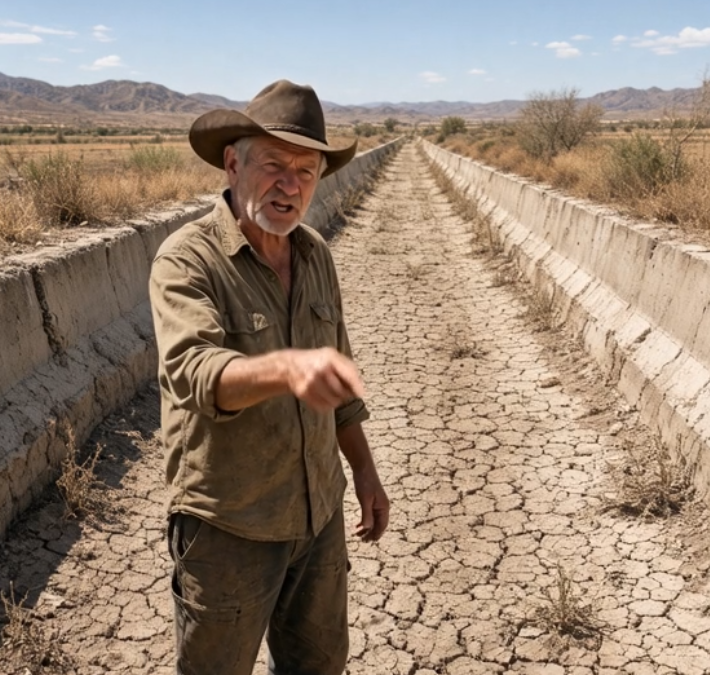
The HOA Blocked an 80-Year-Old Irrigation Canal to “Improve the View”—Then 600 Young Trees Began Dying and the County Asked Who Had Touched the Water.
The morning my irrigation canal went dry, I knew somebody had not just touched my land—they had touched the only thing keeping forty acres alive.
They blocked it for a cleaner view, buried the channel under decorative boulders and mulch, and called it beautification.
By the time Willow Creek Estates learned what that water had been protecting, their perfect backyards were already cracking apart in the heat.
The morning I opened the irrigation gate and nothing came out, I knew somebody had crossed a line they were never going to uncross.
Not a fence line.
Not a property line.
Something older than both.
A water line.
For almost eighty years, a narrow concrete canal had carried water along the edge of my family’s land outside Cedar Ridge.
It was not pretty.
It was not modern.
It was not the kind of thing a luxury neighborhood wanted behind its polished fences and outdoor kitchens.
But that canal had kept soil alive through drought years, fed pasture when rain failed, and carried just enough water to make impossible work possible.
That spring, it was the only reason six hundred young trees were still standing.
Then, one Monday morning, the canal went silent.
No trickle.
No current.
No muddy pulse under the gate.
Just a dry, hollow channel and a smell like hot concrete.
I stood there with my boots in the dust, listening to nothing.
Behind me, rows of saplings stretched across forty acres of land I had spent three years bringing back from neglect.
Cottonwoods.
Willows.
Oaks.
Native plum.
Hackberry.
Sycamore.
Small, fragile, stubborn trees planted in soil my father once told me was too tired to forgive us.
I had promised him I would try anyway.
Now their leaves were curling in the heat.
Their roots were reaching for water that had always been there.
And somewhere upstream, someone had decided the canal was ugly.
I walked the line myself.
A mile of sunburned weeds.
A mile of cracked service path.
A mile of getting angrier with every dry bend.
Then I found it.
Two hundred yards before the canal reached my property, a brand-new landscape barrier blocked the entire waterway.
Decorative boulders had been stacked behind wire mesh panels.
Fresh mulch covered the banks.
Young ornamental grasses had been planted in neat little rows.
A painted wooden sign stood beside the obstruction.
Willow Creek Estates Greenbelt Beautification Project.
I stared at that sign for a long time.
Then I looked at the dead-still canal behind it.
This was not an accident.
This was not debris.
This was not a misunderstanding.
Somebody had built a wall across my water and decorated it.
By the time I heard Denise Holloway had stood in front of the HOA board and bragged that she had finally “cleaned up that abandoned ditch,” the first trees were already showing stress.
By the time the county inspectors arrived, hundreds were turning brown.
By the time Denise realized the canal was not abandoned, not optional, and not hers to touch, the damage had already become impossible to hide.
My name is Ethan Mercer.
I do not come from people who quit on land.
That does not mean we always win.
PART2:
It means we stay longer than common sense recommends.
The Mercer property sat outside Cedar Ridge, where the old agricultural valley met a new world of stucco walls, security gates, golf carts, and HOA newsletters printed on glossy paper.
My grandfather bought the first acreage in 1948.
Back then, the land was rough and dry, but it had canal rights, and in that part of the county, water rights were more valuable than charm.
The canal was dug long before Cedar Ridge had luxury subdivisions.
It ran from the North Fork irrigation system, crossed several old farm parcels, then bent along what became the western boundary of Willow Creek Estates before reaching our land.
Every deed mentioned it.
Every county map marked it.
Every easement document protected it.
The canal was not a suggestion.
It was infrastructure.
My father understood that better than anyone.
He raised hay on that land for thirty years, then watched drought, fuel costs, and bad markets turn a proud operation into something that barely survived.
By the time he passed, the fields were tired.
The soil had lost structure.
The old sheds leaned.
The pasture looked gray in summer and washed-out in winter.
Most people told me to sell.
Developers wanted it.
Investors wanted it.
Willow Creek residents wanted the view.
I could have taken the money and walked away with clean hands.
But every time I considered it, I heard my father’s voice.
Land remembers what you do to it.
That was what he used to say.
When he was angry, he said it like a warning.
When he was tired, he said it like a prayer.
So I stayed.
I sold my house in town, moved back into the old farmhouse, and started restoring the property one hard season at a time.
I did not have enough money to do everything at once.
Nobody restoring land ever does.
I fixed the roof first because rain inside a house makes all other plans theoretical.
Then the well pump.
Then the south fence.
PART3:
Then the collapsed equipment shed.
Then the irrigation gate, because without water the rest was just hope standing in dust.
The canal had been neglected, but it still worked.
Old concrete does not care about fashion.
It only cares about grade.
I cleared tumbleweed, patched cracks, scraped silt, replaced the headgate wheel, and rehung the turnout my father had welded sometime in the late seventies.
The first time water slid through that gate again, I stood there until sunset.
Not because I needed to.
Because it sounded like my childhood.
My father used to walk that canal every morning during irrigation season with a shovel over one shoulder and a coffee can full of nails in one hand. He could tell from twenty feet away if a gate was leaking wrong. He could hear a muskrat hole under bank grass. He could look at a hayfield and know which corner was thirsty.
When I was ten, I asked him why we had to work so hard to move water when rain fell for free.
He laughed and said, “Rain belongs to weather. Canal water belongs to whoever respects the ditch.”
I did not understand then.
I did by the time Willow Creek Estates arrived.
The subdivision was approved six years after my father died.
One hundred and eighteen homes.
Luxury rural living.
Gated privacy.
Mountain-view lots.
Community walking paths.
Native-inspired landscaping.
Outdoor gathering spaces.
That was what the brochure said.
I kept a copy because sometimes stupidity becomes evidence later.
Their western edge ran along the old canal easement before the canal turned south toward my fields. The developer dressed everything up with split-rail fencing, crushed granite trails, low-voltage lighting, and little signs explaining how the greenbelt “celebrated the valley’s agricultural heritage.”
Agricultural heritage.
They put those words beside a canal they would later call abandoned.
At first, I tried to be neighborly.
I attended the public hearing.
I told the planning commission the canal was active, legally protected, and necessary for downstream agricultural use.
The developer’s engineer nodded through his beard and said all easements would be respected.
The county planner said the canal was shown on the final plat.
The developer’s attorney said the HOA would maintain clear access and not obstruct water delivery.
I asked for that in writing.
They gave it to me.
That piece of paper would later become very expensive for them.
For the first year after Willow Creek opened, things stayed mostly quiet.
The residents jogged their trails, walked little dogs, complained online about coyotes, and took sunset photos over my restoration fields as if I had planted them for background texture.
I did not mind.
Not much.
People enjoy views.
That does not mean they own them.
Then Denise Holloway became HOA president.
Every HOA has a person like Denise eventually.
Not always named Denise.
Sometimes Carl.
Sometimes Marlene.
Sometimes Victor with a visor and a rule binder.
They arrive with good posture, organized folders, and a deep belief that because they are willing to attend meetings, the world should obey them.
Denise Holloway had silver-blonde hair cut into a sharp bob, a white SUV, a voice trained by years of fundraising luncheons, and the patience of a woman who mistook disagreement for disrespect.
The first time she came to my property, she parked outside my gate and called the number painted on my irrigation shed.
“Mr. Mercer,” she said when I answered, “this is Denise Holloway from Willow Creek Estates.”
“I know who you are.”
A pause.
“I’m calling regarding the canal corridor adjacent to our greenbelt.”
“What about it?”
“We’ve had homeowner concerns.”
“That sounds unfortunate.”
“It is visually inconsistent with the standards of our community.”
I looked out the kitchen window toward the fields.
“You called me to say my canal is ugly?”
“I called to discuss improvement opportunities.”
“No.”
“You haven’t heard the proposal.”
“You started with visual inconsistency. I heard enough.”
Her voice cooled.
“We are trying to be constructive.”
“The canal carries water. That’s its construction.”
“Surely it can be modernized.”
“It can be maintained.”
“We were thinking of naturalizing the area.”
“Water canals are already natural to farms.”
“That’s not what I mean.”
“I know.”
She exhaled.
“Mr. Mercer, Willow Creek homeowners paid a premium for open views.”
“They should ask the developer for a refund.”
That ended the first conversation.
It did not end Denise.
Nothing ended Denise until consequences arrived wearing mud.
Over the next year, I received six letters.
Each one more polished than the last.
The first asked whether I would consider “screening improvements.”
The second requested “collaborative corridor redesign.”
The third suggested the canal was “underutilized historical infrastructure.”
The fourth called it a “potential safety hazard.”
The fifth claimed children might fall in, despite the canal being behind a fence with warning signs.
The sixth used the phrase abandoned agricultural ditch.
That was when I stopped being polite.
I sent Denise a packet.
Deed references.
Canal easement.
Water rights.
County plat.
The developer’s written commitment.
Photos of flowing water from the previous season.
A letter from the North Fork Irrigation District confirming active delivery to the Mercer property.
My final paragraph was short.
The canal is not abandoned. Do not obstruct it, modify it, landscape it, fill it, cover it, divert it, or interfere with access.
I copied the county.
Denise did not respond.
For two months, I thought she had finally learned.
That was my mistake.
People like Denise do not learn in silence.
They plan in it.
That spring was dry.
Not drought-of-record dry.
Not the kind the news loved.
Worse in some ways.
The quiet kind.
Warm March.
Low snowpack.
Wind that stripped moisture from soil before roots had time to chase it.
By April, my restoration field needed every drop I could legally deliver.
The six hundred trees were part of a conservation project I had designed with the county soil district. Not a government handout, despite what some people liked to say when they saw someone trying to heal land instead of sell it.
I paid for most of it myself.
The district helped with planning, seedlings, and technical support. In exchange, I agreed to maintain the trees, keep invasive weeds down, protect the riparian strip, and document survival rates for five years.
Those trees had a job.
Cottonwoods and willows near the low swale to shade soil and hold moisture.
Oaks on the higher ground to build long-term canopy.
Hackberry and native plum for birds and pollinators.
Sycamores near the old wash because their roots knew how to hold a bank.
It was not landscaping.
It was repair.
My father had watched that soil lose life slowly.
I wanted to watch it come back.
The first year nearly broke me.
Half the seedlings looked like sticks with labels.
Rabbits chewed tubes.
Wind knocked stakes loose.
A late frost burned new growth.
The irrigation timing had to be perfect. Too much water too fast and the shallow soil sealed. Too little and the root zones dried. Canal water fed the temporary lateral lines I had run through the rows, not fancy but effective.
By the third year, the field had changed.
You could feel it before you saw it.
Birds returned.
The air cooled slightly near the low rows.
Dust settled faster.
Native grass came in between tree lines.
The land was not healed.
But it was listening again.
Then Denise’s beautification project shut off the water.
I stood beside that decorative obstruction, reading the painted sign, while wind pushed dry grass against my jeans.
Willow Creek Estates Greenbelt Beautification Project.
It had little painted leaves in the corners.
Someone had spent time making the words cheerful.
Behind the barrier, the canal upstream was already backing into a shallow stagnant pool. Downstream, toward my property, the channel was bone dry.
The wire mesh panels were anchored into both banks.
Boulders had been stacked tight.
Mulch had been spread over the disturbed soil to make it look intentional.
Ornamental grasses had been planted where my father once cleared tumbleweed with a shovel.
I took photos.
A lot of them.
Then I called the North Fork ditch rider.
His name was Miguel Ortega, and he had inherited the job from his uncle the way some men inherit land. Miguel knew every headgate, culvert, user, turnout, illegal pump, and questionable repair in twenty miles of canal.
He answered on the second ring.
“Mercer?”
“Somebody blocked my delivery.”
He did not ask if I was sure.
Good ditch riders know the difference between a complaint and a problem.
“Where?”
“Willow Creek greenbelt. Two hundred yards above my turnout.”
Silence.
Then, “Blocked how?”
“Boulders. Wire mesh. Landscaping. Sign.”
Miguel said something in Spanish that I did not fully understand but appreciated.
“I’ll be there in thirty.”
He arrived in twenty-two.
Miguel was fifty, broad, sun-darkened, and usually cheerful in the way of people who spend more time with water than with committees. That morning, he took one look at the barrier and lost all cheer.
“Oh, hell no.”
“That’s what I thought.”
He walked the obstruction, photographed it, checked the upstream pool, then called his supervisor and the county water commissioner.
Within an hour, we had three trucks, five angry men, one county inspector named Anita Reese, and a Willow Creek security guard who had no idea what kind of morning he had been sent into.
The security guard was young, nervous, and overdressed in black tactical pants for a canal dispute.
“This is HOA property,” he said.
Anita looked at him.
“No, it isn’t.”
He blinked.
“This is the greenbelt.”
“This is a recorded irrigation easement.”
“I was told—”
“You were told wrong.”
Miguel pointed at the barrier.
“Who authorized this?”
The guard swallowed.
“I think the landscape committee.”
“Call them.”
He did.
Twenty minutes later, Denise Holloway arrived in her white SUV.
She stepped out wearing a navy vest, sunglasses, and the expression of a woman prepared to manage an inconvenience.
Then she saw the county truck.
Her expression changed.
Not enough.
But a little.
“Good morning,” she said. “I assume there’s been some confusion.”
“No confusion,” I said. “You blocked my canal.”
She looked at me as if I had spoken too loudly in a restaurant.
“Mr. Mercer, the board approved a greenbelt improvement project to remove an abandoned ditch.”
Miguel laughed once.
It was not a friendly sound.
Anita held up a folder.
“This canal is active and protected by recorded easement and water delivery rights.”
Denise’s smile stayed, but it stiffened.
“Our documents show this section as common landscape corridor.”
“Your documents are wrong,” Anita said.
“That’s not possible.”
That sentence told me everything I needed to know about Denise Holloway.
Not unlikely.
Not surprising.
Not we should check.
Not possible.
Some people build their entire lives around that phrase.
Anita pointed to the barrier.
“This has to be removed immediately.”
Denise took off her sunglasses.
“Immediately is not realistic. The HOA board would need to convene. We have contracts, landscape warranties, resident notifications—”
“You obstructed active irrigation delivery.”
“We improved an eyesore.”
Miguel stepped closer.
“You blocked water during delivery season.”
Denise looked at him like he had tracked mud onto marble.
“Who are you?”
“North Fork Irrigation District.”
She looked back at Anita.
“I think we need to slow down. This is a community design matter.”
“No,” Anita said. “This is a water rights matter.”
Denise did not like that.
People who live by boards and subcommittees hate matters that do not ask for their vote.
“You can’t expect us to tear out completed landscape work because Mr. Mercer suddenly claims he needs water.”
I looked toward my fields.
“Suddenly?”
She followed my gaze.
From where we stood, the tops of my tree tubes were visible beyond the fence.
Rows and rows of young trees under a white hot sky.
For one moment, something almost like uncertainty crossed her face.
Then it vanished.
“You chose to plant those,” she said.
“Yes.”
“And we chose to improve our greenbelt.”
Anita closed her folder.
“Mrs. Holloway, you have twenty-four hours to remove this obstruction voluntarily. After that, the county and irrigation district will take enforcement action and bill responsible parties.”
Denise’s face flushed.
“I’ll be contacting counsel.”
“Good,” Miguel said. “Tell them to bring shovels.”
Denise left angry.
The barrier stayed.
Twenty-four hours mattered.
To Denise, it was time to call lawyers, gather board members, send emails, and find a way to turn a physical obstruction into a procedural discussion.
To my trees, it was heat.
Stress.
Curling leaves.
Dry root zones.
I went back to my property and tried to stretch what water I had left in the storage tank.
It was not enough.
By evening, the willows nearest the west row had begun to fold.
Willows are honest plants.
They show thirst fast.
The cottonwoods followed.
By the next morning, the field looked wrong.
Not dead.
Not yet.
But quiet in a way living trees should not be quiet.
I spent that day hauling emergency water in an old tanker trailer from the house well.
It was a joke.
A painful one.
You cannot replace a canal with a farm trailer and stubbornness.
I watered the most vulnerable rows first.
Then the newest plantings.
Then the sycamores near the wash.
By the end of the day, my shoulders felt full of gravel and my hands shook from heat.
At sunset, I stood among the rows and counted stressed trees.
Two hundred and thirteen obvious.
More coming.
I called Denise.
She answered with the briskness of someone who believed she was winning.
“Mr. Mercer.”
“Remove the barrier.”
“The matter is under legal review.”
“My trees are dying.”
“I’m sorry to hear that, but the HOA cannot be expected to accept liability for your agricultural choices.”
“This isn’t agriculture. It’s a restoration project tied to county conservation work.”
“That may be your interpretation.”
I closed my eyes.
Some people are not ignorant because they lack information.
They are ignorant because information threatens their convenience.
“Denise,” I said, “that canal does not just bring water to me.”
“I’m aware of your position.”
“No, you’re not. That canal keeps water in a controlled path. When the district opens full flow, it needs somewhere to go.”
“The water is currently contained.”
“For now.”
“I’m not interested in scare tactics.”
“You should be interested in gravity.”
She hung up.
The North Fork Irrigation District opened the next scheduled delivery on Thursday morning.
My allotment was not the only one in the line. Water moved through the system according to schedule, headgates, rotations, downstream calls, and old agreements written when the valley still understood that water had to be shared carefully or fought over honestly.
At first, nothing dramatic happened.
The canal upstream of Willow Creek filled.
The water reached Denise’s beautification barrier and stopped.
Then it began backing up.
Canals are not storage ponds.
They are built to carry flow.
When water loses its route, it looks for another.
By noon, the upstream pool had risen to the edge of the bank.
Miguel called me.
“You better come see this.”
I drove there with a shovel, camera, and a very old anger.
Anita was already on-site.
So was Denise.
So were three board members, two landscapers, a man in a suit, and half a dozen Willow Creek residents standing behind the split-rail fence with their phones out.
The water behind the barrier had turned brown and restless.
It pressed against the boulders, seeped through mulch, and began licking at the ornamental grasses planted on the bank.
Denise pointed at Miguel.
“Shut it off.”
Miguel stared at her.
“Shut what off?”
“The water.”
He laughed.
Not loudly.
Just enough.
“This isn’t a patio hose.”
“You’re flooding our greenbelt.”
“No, ma’am,” he said. “Your greenbelt is blocking the canal.”
The man in the suit stepped forward.
“I’m counsel for Willow Creek Estates. We request immediate suspension of flow until jurisdiction is determined.”
Miguel looked at Anita.
Anita looked at me.
I looked at the barrier.
The water pushed harder.
A thin stream slipped around the right side where mulch met the bank.
That was the beginning.
People expected the boulder wall to fail dramatically.
It did not.
That would have been too generous.
Instead, the water found the weakest edge.
It seeped.
Then trickled.
Then cut.
A brown line began moving through the fresh mulch, carrying little chips of bark with it.
One of the landscapers said, “Uh.”
Denise turned.
The trickle became a stream.
The stream became a narrow channel.
The channel sliced behind the wire mesh and began eating the newly disturbed bank.
That was what Denise had not understood.
The old concrete canal looked ugly because it was honest about what it did.
Her beautification project made the banks look clean by disturbing them, softening them, and covering the damage with mulch.
Water loves that kind of vanity.
Within twenty minutes, the right bank slumped.
Not the whole thing.
Just enough.
One boulder shifted.
Then another.
Water shoved through the gap and poured sideways into Willow Creek’s greenbelt.
Residents gasped.
Denise shouted at the landscapers.
The landscapers backed away because they knew better than to stand in front of moving water and a collapsing bank.
The flow cut across the landscaped corridor, tore a fresh trench through the mulch, uprooted ornamental grasses, and rushed toward the rear fences of the first three Willow Creek homes.
A woman in yoga clothes screamed, “My yard!”
I almost said, “That was the canal’s yard first.”
I did not.
Maturity is sometimes just exhaustion wearing boots.
By one o’clock, the water had reached the back lawn of Lot 14.
By one-thirty, the homeowners were stacking patio cushions on tables.
By two, the decorative walking path buckled where water undermined the gravel base.
By three, Willow Creek Estates’ greenbelt beautification project had become a muddy, braided mess of boulders, mulch, wire mesh, torn plants, and brown water trying to rejoin the path it had been blocked from.
My canal below the obstruction remained mostly dry.
My trees kept suffering.
That was the part no one from Willow Creek wanted to look at.
They cared now because water had reached them.
It had already been killing my field for days.
Emergency crews did not come because nobody was in danger yet. The county did.
With authority.
By late afternoon, Anita issued a written emergency order.
The obstruction was to be removed immediately.
Access was granted to the irrigation district.
Willow Creek Estates was cited for unauthorized interference with a protected water conveyance.
The HOA attorney objected.
Anita told him he could object in writing from somewhere not actively eroding.
Miguel brought in an excavator.
Denise stood behind the fence, watching with a face like curdled milk as the boulders came out one by one.
The sign came last.
Willow Creek Estates Greenbelt Beautification Project.
It was muddy now.
Crooked.
The painted leaves smeared brown.
Miguel held it up and looked at me.
“Want it?”
“No.”
He tossed it into the debris pile.
By sunset, the canal was open enough to flow again.
Water finally moved toward my property.
When it reached my turnout, I opened the gate with both hands on the wheel and felt the old vibration come through the metal.
The canal gave a muddy pulse.
Then a current.
Then flow.
I stood there while water filled the lateral ditch and ran toward the first row of trees.
It should have felt like relief.
It did not.
Not fully.
Relief is for things saved in time.
I already knew some had not been.
The next morning, I walked the field with Rachel Kim from the county soil district.
Rachel had helped design the restoration plan. She was small, direct, and had the kind of quiet anger that made careless people uncomfortable.
She did not say much as we moved row by row.
She touched leaves.
Scraped bark.
Checked moisture.
Marked trees with colored tape.
Yellow for stressed.
Red for unlikely.
Black for gone.
At the end, she stood near the wash and looked back across the forty acres.
“How many?” I asked.
She took off her hat.
“Too early for final count.”
“Rachel.”
She sighed.
“Two hundred dead or nearly. Maybe another hundred recover with care. The willows were hit hardest.”
The words entered me slowly.
Two hundred.
Not numbers on a spreadsheet.
Not landscaping.
Living things I had carried in bundles, planted by hand, staked, tubed, watered, weeded, and argued into the world.
I looked toward Willow Creek.
Their backyards were muddy.
Mine was dying.
Rachel followed my gaze.
“They’ll pay for this.”
“Money won’t make three years grow faster.”
“No,” she said. “But it can plant again. And it can make sure they never touch the canal.”
That afternoon, I found my father’s old notebook in the shop.
I had not opened it in years.
It still smelled faintly of dust and pipe tobacco.
Inside were irrigation notes from the 1980s.
Dates.
Weather.
Gate settings.
Hay yield.
Canal repairs.
On one page, in his blocky handwriting, he had written:
Never let anyone call water wasted just because they don’t understand what it feeds.
I sat on an overturned bucket and read that sentence until the light changed.
Then I added it to my evidence folder.
The legal fight began properly the next week.
Not with one lawsuit.
With several letters sharp enough to cut wire.
My attorney, Clara Venn, was a water rights lawyer who had spent twenty years making developers regret being vague near ditches. She had a dry voice, a small office, and no patience for people who used the word abandoned without checking a deed.
She read the file at her desk while I sat across from her.
The easement.
The county plat.
The developer’s commitment.
Denise’s letters.
My warning.
Photos of the obstruction.
Miguel’s report.
Anita’s citation.
Rachel’s preliminary damage assessment.
The flood damage in Willow Creek.
The dead and dying trees.
Clara turned the final page and removed her glasses.
“Well,” she said. “They stepped on a rake and sued the rake.”
“Do we sue?”
“Oh, yes.”
“For the trees?”
“For the trees. For the interference. For the emergency work. For restoration delay. For attorney’s fees if we can get them. And we seek injunctive relief so they never put so much as a decorative pebble near that canal again.”
“What about their yards?”
“What about them?”
“They’ll say the water damaged them.”
She smiled without warmth.
“Good. Then they can explain why water escaped only after they blocked the legal channel designed to carry it.”
Clara’s demand letter was a thing of beauty.
It did not shout.
It did not threaten beyond what it could prove.
It simply lined up facts and let them become a wall.
Willow Creek Estates HOA had knowingly altered an active irrigation canal after receiving notice of its status.
The canal was protected by recorded easement.
The HOA’s obstruction interrupted lawful water delivery.
The interruption caused documented damage to a county-supported restoration project.
The obstruction also caused water to back up, overtop, and damage Willow Creek’s own landscaped common areas and adjoining lots.
The HOA was responsible for immediate restoration, replacement plantings, professional monitoring, repairs to the canal, and all related damages.
Denise responded with a community email.
That was a mistake.
Dear Willow Creek Residents,
Recent events involving the old irrigation ditch adjacent to our greenbelt have been mischaracterized by outside parties. The Board acted in good faith to improve the appearance and safety of common areas. Unfortunately, unexpected water activity caused temporary disruption…
Unexpected water activity.
Miguel printed that phrase and taped it above the desk in the irrigation office.
Unexpected water activity.
In a canal.
The residents were not amused.
Not all of them, at least.
At first, many supported Denise.
They had liked the beautification project.
They had complained for years that the canal made the greenbelt feel unfinished.
They had wanted the view clean, the paths tidy, the fence line pretty.
Then they saw the repair estimate.
Then the county fine.
Then the legal demand.
Then the photos of my dead trees.
Then the part of the developer’s old approval package showing the canal clearly marked, labeled active, and protected.
That was when the Willow Creek message board turned.
I did not see it myself.
A resident named Nora Phelps printed screenshots and brought them to my gate.
Nora lived on Lot 16, one of the backyards that had taken muddy water during the overtopping. She was in her sixties, had short gray hair, and wore gardening gloves like other people wore jewelry.
“I wanted you to know not all of us are on Denise’s side,” she said.
I looked at the folder she held.
“What is that?”
“Proof that she knew.”
I took it.
Inside were message board posts from months before the obstruction.
Residents asking whether the canal was active.
Someone linking to the county map.
A retired surveyor in the neighborhood warning the board not to alter easements.
Denise replying:
The Board has reviewed the matter and is confident the ditch is obsolete.
Nora watched my face.
“She lied to us too.”
“That tends to be efficient.”
Nora looked past me toward the restoration field.
“I saw the trees.”
I said nothing.
“I’m sorry.”
That was the first apology I received from anyone in Willow Creek.
It was not enough.
But it was something.
The county hearing happened in June.
Denise wore a cream blazer.
Clara wore black.
I wore a clean work shirt because Clara told me not to show up looking like I had slept in a tractor tire.
The hearing officer was an older man named Thomas Greer, former ditch company counsel, which meant he understood water and disliked nonsense.
Anita testified first.
Miguel next.
Rachel after him.
Then me.
Clara asked simple questions.
How long had my family used the canal?
Was the canal active?
Had I notified Willow Creek?
What happened when the obstruction was installed?
How many trees were damaged?
What did the canal water supply?
I answered calmly.
Mostly.
Then the HOA attorney asked whether I had considered using well water, trucked water, temporary hoses, or private storage to protect my plantings.
“Yes,” I said.
“Yet you did not prevent the loss.”
I looked at him.
“You want to blame me for not replacing an eighty-year-old canal with a garden hose in four days?”
He blinked.
Clara did not object.
She did not need to.
The hearing officer wrote something down.
Denise testified last.
She said the board believed the canal was abandoned.
She said the project was meant to improve safety.
She said residents had expressed concerns.
She said no harm was intended.
Then Clara stood.
“Mrs. Holloway, did Mr. Mercer send the HOA documentation showing the canal was active?”
Denise’s lips tightened.
“We received materials, yes.”
“Did those materials include the canal easement?”
“I would have to review.”
Clara handed her a copy.
“Please review now.”
The room was silent as Denise looked at the page.
“Yes.”
“Did those materials include confirmation from North Fork Irrigation District?”
“Yes.”
“Did you share those materials with the full board before approving the beautification project?”
Denise hesitated.
“No.”
“Why not?”
“They were lengthy.”
Someone in the back made a sound.
Maybe a laugh.
Maybe a cough.
Clara’s voice stayed flat.
“Did you tell residents the canal was confirmed active?”
“No.”
“Did you obtain written permission from the irrigation district?”
“No.”
“From Mr. Mercer?”
“No.”
“From the county?”
“No.”
“From anyone with legal authority over the canal?”
Denise said nothing.
The hearing officer looked up.
“Mrs. Holloway, answer the question.”
“No.”
That was the sound of a case breaking.
The county order came two weeks later.
Willow Creek Estates was found in violation of water conveyance protection requirements.
The HOA was fined.
The obstruction was declared unauthorized.
The HOA was ordered to restore the canal bank under professional supervision.
They were prohibited from modifying the corridor without written approval from the county, irrigation district, and affected water rights holders.
That last part was mine.
I framed it.
Not because I am petty.
Because I am exactly petty enough.
The civil case settled before trial.
They always seem to when the documents get ugly enough.
The settlement paid for replacement trees.
Not six hundred.
Nine hundred.
Because Rachel argued the dead trees had delayed the restoration plan and increased erosion risk, and Clara argued that delay had value.
The HOA paid for three years of professional monitoring.
They paid for emergency watering infrastructure so the new plantings could survive future disruptions.
They paid for canal repairs, bank stabilization, and a locked service gate that only the irrigation district, county, and I could access.
They paid my legal fees.
They paid the county fines.
They paid to remove every inch of their beautification project from the canal easement.
No decorative boulders.
No mulch beds.
No ornamental grasses.
No painted signs.
Just the canal.
Concrete.
Practical.
Honest.
Denise resigned the day before the settlement became public.
Her resignation email blamed “hostile outside interests.”
Nora Phelps forwarded it to me with one handwritten note:
That means water.
The new HOA president was a man named Andrew Sloan, a retired fire captain who had moved to Willow Creek because his knees hated stairs but his wife loved views.
He came to see me after the settlement.
He parked at the gate and waited.
That alone put him ahead of Denise.
I walked out with my hat low against the sun.
“Mr. Mercer,” he said. “I’m Andrew Sloan.”
“I know.”
“I’m here to apologize.”
“On behalf of the board or yourself?”
“Both, but mostly myself. I voted for the project.”
I looked at him.
“Did you read the documents I sent?”
“No.”
“Why?”
He looked toward the canal.
“Because Denise said it was handled.”
At least he was honest.
“That answer is why this happened.”
“I know.”
“No, you know after. That’s not the same.”
He nodded slowly.
“No, sir. It isn’t.”
He handed me a folder.
“What’s that?”
“New board policy. Easements, water, drainage, utilities, property boundaries, anything like that—no action without independent verification and notice to affected parties. We also removed all language calling the canal abandoned from community documents.”
I took the folder.
“Good.”
He shifted.
“One more thing. The board wants to fund a privacy buffer along our side of the canal. Native trees. Not blocking access. Not interfering with flow. Designed by the soil district.”
I almost laughed.
“You want to plant trees now?”
His face reddened.
“Yes.”
“That view must not look so clean anymore.”
“No,” he said. “It looks expensive.”
I appreciated that answer.
We planted in November.
Not just my field.
Both sides.
The new trees arrived bundled and dormant, roots wrapped, labels tied in colored plastic.
Volunteers from Willow Creek came because Andrew made it a community workday instead of a ribbon-cutting.
That mattered.
People understand land differently when they put a shovel in it.
Some residents worked hard.
Some took photos.
Some complained about blisters.
Nora Phelps planted twenty willows and named each one after an HOA rule she hated.
One was called Approved Mailbox Beige.
Another was Decorative Boulder Misconduct.
Miguel came by at lunch and checked the canal because he trusted trees more than people.
Rachel walked the rows with a clipboard, calm as ever, giving instructions and correcting depth.
I planted the first cottonwood myself.
Not because ceremonies matter.
Because that one stood where the worst damage had been.
The soil there had cracked wide during the water shutoff. The original seedling had died with its leaves curled tight like fists.
I dug the hole deeper than required, set the roots carefully, backfilled with soil, pressed it firm with both hands, then opened the temporary line.
Water pooled dark around the base.
For a second, I saw my father standing at the edge of the field, shovel over one shoulder, saying nothing because he never used words when work could speak.
Then the image was gone.
Just wind.
Trees.
Water.
Mud under my nails.
Andrew stood nearby.
He took off his work gloves.
“Mr. Mercer?”
“Ethan.”
He nodded.
“Ethan. What did the water protect?”
I looked at him.
He was not being poetic.
He was asking because he finally understood he had never known the answer.
I pointed across the field.
“The obvious answer is the trees.”
He nodded.
“But not just them. It protected the soil from turning to powder. Protected the wash from cutting deeper. Protected pollinators, shade, grass, birds, roots, everything we’re trying to bring back.”
I turned toward Willow Creek.
“And it protected your side too. The canal carried water where water was supposed to go. You blocked the path, and the water made another one.”
Andrew looked down.
“Seems simple now.”
“Most expensive lessons do.”
Years passed.
Not many.
Enough for the new trees to take hold.
Enough for some of the original survivors to surprise us.
The willows came back fastest, because willows are stubborn little miracles when water returns. The cottonwoods took longer. The oaks were slow, but that is their nature. Oaks do not rush to prove anything.
By the third spring after the settlement, the restoration field sounded alive again.
Birds in the morning.
Bees in the plum blossoms.
Wind moving through leaves that had not existed when Denise Holloway decided the canal was ugly.
The soil changed too.
Not dramatically.
Land heals in increments too small for impatient people.
But I saw it.
More earthworms.
Better infiltration.
Less crusting after rain.
Native grass thickening between rows.
The wash holding shape.
Dust settling where it used to lift.
Willow Creek residents walked their side of the canal now, behind the fence, on a path set far enough back to respect the easement. The HOA installed signs too.
Not cheerful ones.
Useful ones.
ACTIVE IRRIGATION CANAL
NO MODIFICATION OR OBSTRUCTION
PROTECTED WATER CONVEYANCE
I liked those signs.
No painted leaves.
No nonsense.
Just truth.
Once, I saw a child from Willow Creek reading one aloud to her mother.
“What’s conveyance?” the girl asked.
Her mother answered, “It means it carries water.”
The girl looked through the fence at the canal.
“Where?”
“To Mr. Mercer’s trees.”
The girl thought about that.
“Then we shouldn’t block it.”
“No,” the mother said. “We shouldn’t.”
That may have been the first Willow Creek HOA meeting I ever approved of.
Denise Holloway moved away two years later.
Nora told me.
“She listed her house as having ‘views of restored native open space,’” Nora said.
I nearly choked on my coffee.
“Restored native open space?”
“That’s you.”
“She tried to kill it.”
“And now it improves resale value.”
Land remembers what you do to it.
So do people with screenshots.
Nora left a review under the listing.
Beautiful area thanks to neighboring restoration work and legally protected irrigation infrastructure.
She showed it to me later.
I told her she was trouble.
She said, “At my age, I prefer the word accurate.”
One summer evening, after the worst of the heat had broken, I walked the canal with Miguel.
The water ran clear and steady, low enough to show the concrete bottom in places. Dragonflies skimmed the surface. On the Willow Creek side, young trees cast thin shadows across the fence. On my side, the restoration rows moved in the wind.
Miguel stopped near the spot where the barrier had been.
You could still see the repair if you knew where to look. The concrete patch was slightly different. The bank reinforcement was newer. The service path curved around a rebuilt section where water had cut through Denise’s mulch trench.
He looked at it and shook his head.
“Beautification.”
I smiled.
“That word still bothers you?”
“It was a canal.”
“It still is.”
He nodded.
“Thanks to you.”
“No,” I said. “Thanks to paperwork.”
“And stubbornness.”
“That too.”
We stood there listening to the water.
After a while, he said, “Your father would like this.”
I looked over the field.
The trees were still young.
Some would not make it.
Some already had not.
Restoration is not a straight line.
It is an argument you keep having with damage until life starts answering back.
“Yeah,” I said quietly. “I think he would.”
The hardest part to explain to people is that I did not hate Willow Creek.
Not all of it.
I hated what Denise did.
I hated the arrogance of a board that believed an old canal became meaningless because it did not match their fence stain.
I hated watching young trees die while people debated whether water rights were “a matter for legal review.”
But Willow Creek was not just Denise.
It was also Nora showing up with screenshots.
Andrew admitting he had been wrong.
Residents planting willows in November wind.
Children learning the word conveyance.
People can be foolish in groups and decent one by one.
That is the only reason communities survive themselves.
Still, I never trusted them with the canal again.
Trust is not required when the order is recorded.
The locked service gate remains.
The county retains inspection authority.
The irrigation district has access.
The HOA has none.
Every spring, before the first delivery, Miguel and I walk the easement.
We check banks.
Clear tumbleweed.
Inspect gates.
Photograph everything.
I send a short notice to Andrew, now just a regular resident after wisely declining another term as president.
Canal delivery begins Monday. Easement must remain clear.
He always replies:
Understood.
That word, from an HOA, is a small miracle.
This morning, I opened the irrigation gate and water came out.
Not a trickle.
Not a weak apology.
A proper muddy pulse.
It slid through the turnout, filled the lateral, and moved into the field the way it was supposed to.
Rows of young trees stood in the dawn light.
Some taller than me now.
Cottonwood leaves flashing silver-green.
Willows bending slightly.
Oaks taking their time.
Native plum thick with white bloom.
Sycamores near the wash spreading broad leaves like open hands.
I walked barefoot into the wet edge of the field because some mornings deserve less distance between a man and the land.
The mud was cool.
The water moved around my ankles.
Birds made a racket in the rows.
Somewhere beyond the fence, a lawn mower started in Willow Creek Estates, then stopped quickly, as if someone remembered quiet was allowed too.
I stood there and thought about the day the canal went silent.
The dry concrete.
The curling leaves.
The decorative boulders.
Denise’s sign.
Her phrase: abandoned ditch.
That was the deepest insult, I think.
Not ugly.
Not unsafe.
Abandoned.
Because nothing about that canal had been abandoned.
Not by my grandfather.
Not by my father.
Not by me.
Not by the trees whose roots knew exactly what it meant when water returned.
People like Denise look at old infrastructure and see inconvenience.
People like my father looked at it and saw memory made useful.
That canal carried more than water.
It carried agreements.
Labor.
Survival.
Mistakes corrected over generations.
The difference between a field dying and a field trying again.
Willow Creek wanted a cleaner view.
They got one for four days.
Then the water reminded them that hidden things are not always unimportant.
Sometimes the thing you want to cover is the thing protecting you.
Sometimes the ugly concrete ditch behind your perfect fence is the reason your backyard does not become a washout.
Sometimes the old waterline is holding together more than soil.
By the time they understood that, two hundred trees were gone, their greenbelt was a trench, their HOA president had signed herself into legal history, and the word beautification had become a neighborhood joke no one said too loudly around me.
But the canal flows now.
The trees are growing.
The soil is softer than it was.
The field is louder with life every spring.
And when I walk the service path, I still hear my father’s voice.
Land remembers what you do to it.
He was right.
It remembered the neglect.
It remembered the damage.
It remembered the day the water stopped.
But it also remembers the repair.
The replanting.
The hands that came back.
The roots that held.
The canal that kept carrying what people were foolish enough to call abandoned.
That is the thing about water.
It does not care about polished fences, board votes, property brochures, or painted signs with little leaves in the corners.
It knows grade.
It knows gravity.
It knows the path it has earned.
And if you block it for a better view, you may learn too late that the view was never the valuable thing.
The valuable thing was what the water kept alive.








