The Funeral Director Put My Father’s Casket Beside a Mop Bucket Because I Couldn’t Afford a Viewing Room—Then One Phone Call Made the Entire Parking Lot Begin to Rumble.
PART3:
If an elderly woman had a tire going bald, Dad somehow discovered that a “customer had left behind” two perfectly usable tires in her exact size.
I stopped believing that story by the time I was sixteen.
But I thought that was the whole of him.
A generous neighborhood mechanic.
A man who never learned to charge enough.
A father who kept food in the refrigerator by writing IOUs to himself.
I did not know about the motorcycles.
Not really.
I had seen the vest.
Of course I had.
Old black leather.
Faded patch.
IRON HORSES MOTORCYCLE CLUB.
Bakersfield chapter.
The lettering was cracked.
The leather around the shoulders had gone soft enough to fold like heavy cloth.
Dad kept it hanging behind the workshop door.
Once in a while, when he was younger, he rode.
I remembered him taking a black Harley out on Sunday mornings.
I remembered other motorcycles showing up at the garage.
Men with beards.
Women in denim.
Laughter.
Beer in paper bags after closing.
But by the time I was a teenager, Dad rode less.
By the time I had my son, Leo, the Harley mostly sat beneath a cover.
I thought the club had faded with age.
I thought the vest was nostalgia.
I thought I knew.
Then Dad died on a Tuesday.
There was no warning.
That sounds merciful when somebody else says it.
“It was peaceful.”
“He didn’t suffer.”
“He went in his sleep.”
All true.
None helpful.
I had come home from the diner around eleven-thirty Monday night.
Dad was in his recliner watching an old western with the volume too high.
Leo had fallen asleep on the couch beside him with a science workbook on his stomach.
Dad pointed toward Leo.
“That boy studies like you did.”
“I studied.”
“You slept near books.”
“Same thing.”
Dad smiled.
I kissed his forehead.
“Good night.”
“Night, Sarah.”
Those were our last words.
Tuesday morning, I woke because the coffee maker had not started.
Dad woke before everybody.
Always.
Even retired.
Even sick.
Even on Sundays.
If the house was quiet at six-thirty, something was wrong.
I went into his room.
He looked asleep.
I knew before I touched him.
People tell you they knew.
I never understood how.
You do.
Something leaves the body that isn’t breath.
Some small tension disappears.
Some presence.
I said:
“Dad?”
Then louder.
Then I touched his shoulder.
Cold.
Not freezing.
Just wrong.
Leo heard me.
I turned fast.
“Go to your room.”
“Mom?”
“Go.”
He saw my face.
He went.
I called 911.
The paramedics came.
Then the coroner’s transport.
Then paperwork.
Then phone calls.
Grief is surprisingly administrative.
People imagine collapsing into someone’s arms.
Mostly you answer questions.
Full legal name.
Date of birth.
Social Security number.
Primary physician.
Funeral home.
Funeral home.
I had not thought about a funeral home.
Dad and I had talked about death in the way families often do.
Badly.
He said he wanted cremation.
“Don’t put me in some fancy box.”
“Okay.”
“And don’t spend money.”
“Okay.”
“If you buy flowers, I’ll haunt you.”
“You don’t believe in ghosts.”
“I’ll make an exception.”
That was our plan.
Not enough of one.
I called three funeral homes.
The first quoted a number that made my throat close.
The second required payment before they would transfer Dad.
The third was Gable & Sons.
Family owned.
Local.
Polished website.
Photographs of soft lighting and peaceful rooms.
Mr. Gable himself answered.
His first name was Harold, though nobody called him that.
He told me they could work with a limited budget.
I had five hundred dollars in checking that I could spare without missing rent, utilities, or groceries.
Dad owned the house free and clear, but he had maybe twelve hundred dollars in savings.
There was a small life insurance policy through an old union plan.
Ten thousand dollars.
I did not know how long it would take.
Mr. Gable said they could begin with a deposit.
So I went.
I wore my diner uniform because I had left work early and did not own enough clothes to pretend my financial situation was different from what it was.
Black pants.
White blouse.
Cheap nonslip shoes.
There was still a coffee stain on one cuff.
Mr. Gable wore a charcoal suit.
His son Trent stood behind him.
Maybe thirty.
Perfect hair.
Perfect teeth.
The kind of tie that looked selected specifically to reassure grieving families that nothing messy would happen while he was in charge.
Mr. Gable slid a glossy brochure across the desk.
Packages.
Bronze.
Silver.
Heritage.
Legacy.
I hated the names.
Death does not need branding.
The first package included two visitation days.
Catering.
Memorial video.
Premium casket.
I said no.
Next.
One-day visitation.
Flowers.
Guest book.
No.
Next.
Simple viewing.
Basic casket for viewing before cremation.
One hour.
Minimal preparation.
That was enough.
“I just want people to see him one last time.”
Mr. Gable nodded solemnly.
“Of course.”
“Somewhere clean.”
“Yes.”
“Private.”
“Yes.”
“And peaceful.”
“We’ll take care of him.”
I pointed at the line.
PRIVATE FAMILY VIEWING — UP TO ONE HOUR.
“This is included?”
“Yes.”
“An actual viewing room?”
Trent smiled.
“We have several spaces.”
I asked again before signing.
I wish that did not matter so much.
It shouldn’t.
A family should not need courtroom instincts while arranging cremation.
But I asked.
Twice.
“Will he be in one of those rooms?”
Mr. Gable nodded.
“Yes, Ms. Mercer.”
So I signed.
The next morning I brought Dad’s clothes.
Charcoal suit.
White shirt.
No tie.
He hated ties.
And the vest.
I had taken it down from the workshop hook.
Held it longer than I expected.
It smelled faintly of dust, leather, and garage.
I wrapped it in one of Dad’s pillowcases.
At Gable & Sons, Trent met me near the arrangement room.
“This is what you’d like him wearing?”
“Yes.”
I handed the suit.
Then the vest.
“Don’t put the vest on him.”
“Okay.”
“Lay it beside him.”
“Sure.”
“It mattered to him.”
Trent held the old leather between two fingers.
Not dramatically.
Not disgusted.
Just the way somebody handles an object they don’t understand and doesn’t particularly respect.
“Sure.”
I took it back.
“What?”
“I’ll bring it Friday.”
He shrugged.
“Whatever works.”
Friday morning, Leo wore the only dark slacks he owned.
They were too short.
He had grown two inches that year.
Dad would have noticed immediately and said:
“Flood coming?”
Leo would have rolled his eyes.
He was twelve.
Old enough to understand death.
Young enough to expect adults to arrange it with dignity.
Tommy Miller met us outside Gable & Sons.
Tommy was seventy-one.
Thin.
White hair.
Hands almost as scarred as Dad’s.
He had worked beside Dad longer than I had been alive.
He wore a navy suit that fit badly and a red tie.
“Your father would hate this.”
He pulled at collar.
“The tie?”
“Everything.”
“He’d hate the tie most.”
Tommy smiled.
That was the last time I smiled that morning.
Trent came into the lobby.
“Ms. Mercer.”
“Hi.”
“You’re early.”
“About forty minutes.”
“No problem.”
He looked at Leo.
“Family only?”
“For now. A few people may come at ten.”
He glanced toward reception desk.
“Okay. Follow me.”
There were two viewing rooms along the main hallway.
One had double doors and tall flower arrangements outside.
The other was smaller.
I could see soft chairs inside.
Trent walked past both.
I thought perhaps there was another chapel.
We passed offices.
A coffee station.
Then a swinging door.
STAFF ONLY.
I stopped.
“Where are we going?”
“Just around back.”
The smell changed.
The front of funeral home smelled like flowers and furniture polish.
Back hallway smelled like bleach.
Industrial cleaner.
A little cold.
Trent opened a narrow door.
Dad was inside.
I will never forget it.
Not because he looked terrible.
Because he looked ordinary in the wrong place.
The pine casket sat on a metal transport cart.
No stand.
No skirt.
No flowers.
No lamp.
The overhead fluorescent tube made his skin look gray.
His charcoal suit was on, but wrinkled near shoulders.
His collar had folded under one side.
His white hair stuck up near right temple.
Against one wall were six folding chairs.
Against another:
Mop bucket.
Broom.
Plastic bin of paper towels.
Cleaning bottles.
A folded yellow caution sign.
Dad’s casket had been placed between a shelf of toilet paper and a vacuum cleaner.
Leo stopped in doorway.
His hand found mine.
Then he saw the vest.
I had dropped it off that morning after all.
Someone had hung it over the handle of the mop bucket.
Not beside Dad.
Not on a chair.
Over a mop bucket.
“Mom?”
I couldn’t answer.
“Why is Grandpa in a closet?”
I walked in.
Took the vest down.
Held it against my chest.
Then Leo asked:
“Did Grandpa do something wrong?”
That was the question.
Not:
Why are they mean?
Not:
Why don’t we have the nice room?
A twelve-year-old looked at how adults had arranged his grandfather’s body and assumed the dead man must have done something to deserve it.
I turned to him.
“No.”
My voice barely worked.
“Then why is he back here?”
I did not know how to explain money to him without making poverty sound like shame.
So I said:
“They made a mistake.”
Trent leaned against door.
“This is the private space available under the basic arrangement.”
I turned.
“You told me viewing room.”
“This is private.”
“This is a storage closet.”
“It’s a service room that can accommodate family viewings.”
“Beside a mop bucket?”
He exhaled.
“Ms. Mercer—”
“Where’s your father?”
His expression changed.
“He’s with another family.”
“Get him.”
I smoothed Dad’s hair while we waited.
That broke me more than anything.
He had combed his hair the same way every morning.
Left side part.
A little water.
Plastic comb he’d owned since I was a child.
He would stop by hallway mirror and say:
“Still handsome.”
Mom used to say:
“Debatable.”
I dampened my fingers in sink down hall.
Smoothed it.
Fixed his collar.
Leo stood beside me.
“Can Grandpa hear?”
“No.”
“You sure?”
“I don’t know.”
He nodded.
Then:
“I’m gonna talk anyway.”
“Okay.”
He stepped closer.
“Grandpa, this place sucks.”
A laugh escaped me.
Then a sob.
Dad would have loved that.
Mr. Gable arrived.
He looked first at me.
Then the vest.
Then his son.
“Is there a problem?”
“You promised me a viewing room.”
“This is a designated private viewing area for direct-service families.”
“Direct-service families?”
“Families choosing simplified arrangements.”
“You mean poor people.”
“I did not say that.”
“You put my father beside cleaning supplies.”
“The larger chapel is reserved for a full-service family.”
“I am not asking for their chapel.”
“The smaller room is being prepared for another service.”
“You promised a room.”
“You have a room.”
“This is a closet.”
He straightened.
“Ms. Mercer, I understand emotions are high.”
Nothing enrages a grieving person faster than being told their grief is making them unreasonable.
I opened my purse.
Pulled out agreement.
“Show me.”
“What?”
“Show me where I agreed to this.”
He glanced at document.
“The contract allows management to assign viewing space according to availability.”
“Where?”
He didn’t reach for it.
“It’s incorporated into general terms.”
“Show me.”
“Please lower your voice.”
That was when Tommy appeared at end of hallway.
He had gone to get coffee.
He saw us.
Then casket.
Then mop bucket.
Then Dad’s vest in my arms.
His face changed.
“What happened?”
I told him.
Or tried.
I got through first sentence and my voice shook so badly I had to start again.
Tommy listened.
He did not interrupt.
When I finished, he looked at Mr. Gable.
“She’s got viewing listed?”
Mr. Gable sighed.
“This is a viewing space.”
Tommy stared into closet.
“No.”
Then he looked at Trent.
Trent folded arms.
“Look, the family in the main chapel paid in full.”
Tommy said:
“Nobody asked for their room.”
Trent glanced at Dad’s vest.
Then at Dad.
Then he made the mistake.
“Honestly, this setup may be more his style anyway.”
Silence.
Even Mr. Gable looked at him.
I knew exactly what Trent meant.
Dad the mechanic.
Old vest.
No flowers.
Cheap casket.
Maybe this was fitting.
Maybe people like us did not need soft lighting because we wouldn’t know difference.
I had spent thirty-four years hearing versions of that.
Waitresses don’t understand wine.
Mechanics don’t understand investments.
Poor families don’t understand contracts.
People in old houses don’t care about appearances.
My father had taught me not to confuse price with worth.
Leo knew it too.
His face flushed.
“Don’t talk about Grandpa like that.”
Trent looked surprised.
Tommy placed a hand on Leo’s shoulder.
“Easy.”
Then he turned and walked outside.
I thought he was leaving because he was angry.
He wasn’t.
He made a phone call.
Ten minutes passed.
Nothing changed.
Mr. Gable disappeared to “see what could be arranged.”
Trent stayed near lobby.
I stood beside Dad.
Leo stood beside me.
I touched Dad’s hand.
Cold.
Formaldehyde had changed texture slightly.
Still his hand.
“I’m sorry.”
I whispered it.
For the room.
For money.
For not planning better.
For every time he gave somebody else fifty dollars when maybe he should have saved it.
Then I got angry at myself for apologizing.
Dad had done nothing wrong.
I had done nothing wrong.
We had purchased one hour in a room.
That should have been enough.
Leo said:
“Can we take him home?”
My throat closed.
“No, honey.”
“Why?”
“Because we can’t.”
“I don’t want him here.”
“Neither do I.”
Then a low sound came through wall.
At first I thought truck.
Deep.
Distant.
Then another.
Then several.
Engines.
Motorcycles.
The rumble grew.
Trent walked toward front window.
Mr. Gable joined.
Neither said anything.
I moved toward lobby with Leo.
The parking lot was filling.
Motorcycles entered in pairs.
Harleys.
Indian.
Honda Gold Wings.
Old touring bikes.
A couple newer machines.
Men.
Women.
Gray hair.
Black hair.
Leather.
Denim.
Some wearing patches.
Some not.
Nobody revved unnecessarily.
They parked.
Shut engines off.
Removed helmets.
Waited.
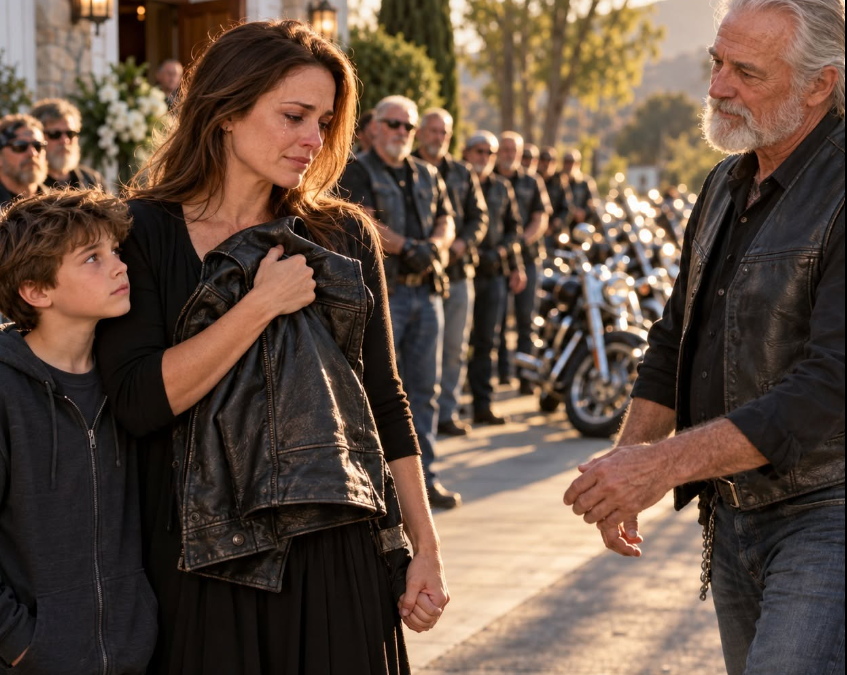
Then an older man stepped through front doors.
Tall.
Silver hair pulled behind ears.
Weathered face.
Leather vest.
Same faded patch as Dad’s.
IRON HORSES.
Tommy walked beside him.
The man’s eyes found Dad’s vest in my hands.
He stopped.
For a second, he could not speak.
Then:
“Sarah?”
“Yes?”
“My name’s Joe Alvarez.”
He looked older than my father somehow.
Or maybe grief did that.
“Your dad asked me years ago to keep an eye on you.”
I stared.
“What?”
Joe smiled sadly.
“He worried.”
“Dad never said.”
“Frank didn’t say much.”
True.
Joe’s eyes moved toward staff hallway.
“Tommy told us where they put him.”
Then quieter:
“When I was eighteen, your father saved my life.”
I looked at Tommy.
He nodded.
Joe did not walk toward Dad until I did.
That mattered.
He wasn’t storming a funeral home.
Nobody was.
We went down hallway.
Joe saw the room.
Stopped in doorway.
His hand gripped frame.
For a long moment, he simply stared.
Then he approached casket.
Put one hand on edge.
“Hey, Frank.”
His voice broke.
“We made it.”
Outside, more engines stopped.
People entered a few at a time.
They did not block halls.
Did not shout.
Did not threaten.
That might have disappointed anyone hoping for a biker showdown.
Dad would have hated that anyway.
He had spent his life fixing what other people broke.
Not breaking more.
Mr. Gable appeared.
“I need to ask that everyone keep noise down. We have another family service.”
Joe turned.
“Of course.”
The calm answer visibly surprised him.
Joe continued:
“Sarah has an agreement for a viewing.”
“Yes.”
“Can we find a room where her father isn’t beside cleaning supplies?”
Mr. Gable began explaining packages.
Joe didn’t argue.
He looked at me.
“Do you have contract?”
I pulled it out.
My hands shook.
I pointed to line.
“This.”
Joe read.
Then held it toward Mr. Gable.
“Looks like she paid for a private viewing.”
“We are providing one.”
“In a janitorial room?”
“It is a multipurpose service area.”
Leo said:
“There’s a mop bucket.”
Nobody corrected him.
Mr. Gable’s face reddened.
“The small chapel may be available in approximately thirty minutes.”
“Then we’ll wait.”
Joe looked at me.
“Is that okay?”
I nodded.
Mr. Gable said:
“We can move Mr. Mercer once room is reset.”
“I want to stay while you move him.”
“That’s not usually—”
“I want to stay.”
He saw something in my face.
“Okay.”
That was first time all morning somebody from Gable & Sons simply said okay.
While staff prepared the chapel, Joe took Leo and me into lobby.
People stood when we entered.
That startled me.
Forty? Maybe fifty riders by then.
More arriving.
Some carried flowers.
Gas-station bouquets.
Grocery-store roses.
One man held a potted plant because apparently that was all he found.
A woman brought a pie.
I don’t know why.
Maybe grief made her think food.
Leo whispered:
“Mom, who are these people?”
“I don’t know.”
That was true.
Joe heard.
He crouched in front of Leo.
“Your grandpa did.”
Then he began.
“When I was eighteen, I ran away from home.”
Joe had grown up outside Fresno.
His father drank.
Fought.
Broke things.
Joe took a motorcycle that barely ran and came south.
The bike died outside Bakersfield.
He slept behind Dad’s repair shop.
Three nights.
Dad found him there on the fourth morning.
“Frank kicked my shoe and said, ‘If you’re gonna sleep on my property, you can sweep it.’”
A few riders laughed softly.
Joe smiled.
“He gave me breakfast. Then lunch. Then work.”
“What kind of work?” Leo asked.
“Mostly bad work.”
“Like what?”
“Cleaning oil pans. Scraping gaskets. Sweeping. Your grandpa said I wasn’t allowed near customer engines until I learned how not to lose bolts.”
That sounded exactly like Dad.
Joe worked there almost a year.
Saved money.
Went home eventually?
“No,” Joe said.
“My home became Bakersfield.”
At nineteen, he wrecked his motorcycle outside Tehachapi.
Bad.
Hospital.
No family contact.
“The nurse asked who to call. I gave Frank’s number.”
Joe looked toward hallway.
“He drove through the night.”
“Why?” Leo asked.
Joe stared at him.
“Because I asked.”
That was Dad.
No complicated answer.
Because somebody asked.
Joe was only the first story.
A woman named Denise Coleman came forward.
Early sixties.
Gray braid.
She hugged me only after asking permission.
“Your father taught me to work on my bike.”
“When?”
“1989.”
I was a toddler.
She laughed.
“I was twenty-six. Took my Honda into a shop that kept charging me for things they weren’t fixing. Frank showed me how to check my own work.”
“He charged you?”
“Coffee.”
Another man named Raymond Price had lost his wife eleven years earlier.
He stopped leaving house.
Dad began coming over every Sunday.
“Sometimes groceries,” Raymond said. “Sometimes tools. Sometimes he sat on my porch and didn’t talk.”
“How long?” I asked.
Raymond shrugged.
“A year.”
Dad had never mentioned Raymond.
Another woman said Dad had repaired her daughter’s car for free after she left an abusive boyfriend and needed transportation to a new job.
A man named Victor told us Dad co-signed? Better not, too big. He lent him $600 for tools when he started as apprentice.
“He made me pay back fifty dollars a month.”
“That sounds like Dad.”
Victor smiled.
“Then when I brought last payment, he put all six hundred in an envelope and gave it back.”
I stared.
“What?”
“He said, ‘Now you know you can save.’”
I sat down.
Every story rearranged my father.
Not changing who he was.
Expanding him.
I had known his quietness.
I hadn’t known what he did inside it.
For Dad, generosity apparently did not count as news.
He came home.
Washed hands.
Asked about homework.
That was all.
More riders arrived.
Some had ridden from Fresno.
Visalia.
Taft.
Delano.
One woman came in a minivan because she’d stopped riding after hip replacement.
Tommy’s one phone call had gone to Joe.
Joe called three people.
Those people called others.
Dad’s death traveled through a network I hadn’t known still existed.
Leo looked at vest.
“Was Grandpa in their club?”
Joe nodded.
“Helped start the Bakersfield chapter.”
Leo’s mouth opened.
“He told me he used to ride.”
“He did.”
“I thought, like, sometimes.”
The riders laughed.
Joe smiled.
“Your mom came along.”
He glanced at me.
“Frank cut back.”
“Because of me?”
“He said he had somebody more important waiting at home.”
That sentence nearly ended me.
I turned away.
Leo leaned against me.
The chapel was ready forty minutes later.
I insisted on going back before anyone else.
Dad had been moved.
The difference hurt.
Same man.
Same casket.
But now:
Soft lighting.
Cream walls.
Windows overlooking narrow garden.
Thirty upholstered chairs.
A small table for photographs.
Dad’s hair combed.
Suit smoothed.
Collar fixed.
Someone had replaced his wrinkled shirt with a clean one from funeral-home stock because Trent said first had been creased during preparation.
I appreciated it and hated that it had taken humiliation to receive basic care.
I placed the vest myself.
Along the inside edge of casket.
Dad’s hand beside it.
Joe stood behind me.
“Looks right.”
“Should he wear it?”
Joe thought.
“No.”
“Why?”
“He stopped wearing it when he stopped riding. Beside him is right.”
That felt right.
People came in a few at a time.
Not all riders could fit.
They waited outside.
Rotated.
No one complained.
Each person stopped at casket.
Some touched edge.
Some touched Dad’s hand.
Some just stood.
A man named Curtis left a ten-millimeter socket.
“Frank stole every one I owned.”
Tommy immediately said:
“Other way around.”
For the first time that day, the room laughed.
That laugh mattered.
Funerals should contain laughter if the person did.
Dad had.
Quietly.
Often at exactly the wrong moment.
Tommy told a story about Dad giving away an entire Saturday’s profit.
A young father brought in a car with tires worn to threads.
His wife had just had a baby.
They needed drive home from hospital.
Dad replaced all four tires with decent used ones.
The man had sixty dollars.
The tires cost more.
Dad took sixty.
Then gave twenty back.
“For gas.”
Tommy told him he was an idiot.
Dad said:
“Baby can’t ride receipts.”
I put hand over mouth.
I had heard that line.
Not story.
Dad said it once when I complained about him not saving enough.
I had thought he made it up.
Denise left an old photograph beside vest.
Seven motorcycles lined beside Lake Isabella.
Dad in middle.
Young.
Black beard.
Arms crossed.
Smiling.
I had never seen that photograph.
Then Leo stepped forward.
He was holding something.
A bicycle bell.
Chrome.
Dented.
I recognized it.
Dad’s coffee can of spare parts.
“Where’d you get that?”
“Garage.”
“Why?”
He looked at his grandfather.
“Grandpa put one like this on my first bike.”
I remembered.
Leo was five.
Blue bicycle.
Training wheels removed.
Terrified.
Dad ran behind him halfway down street with one hand hovering over seat.
Never touching.
Leo thought he was holding on.
He wasn’t.
“You remember?”
Leo nodded.
“I rang it so he would know where I was.”
He placed bell near Dad’s hand.
“Now he’ll know where we are.”
I held my son until he pulled away.
I had not planned to speak.
I hate speaking in front of people.
I serve pie and coffee to strangers twelve hours at a time, but put me in front of forty silent people and language disappears.
Still, after last rider found a seat or stood along wall, I rose.
I looked at Dad.
Then at faces.
“I don’t know most of you.”
Several smiled.
“Apparently my father did.”
A little laugh.
I took breath.
“I thought I knew him.”
My voice shook immediately.
“I knew the man who left porch light on when I worked late.”
I looked at Leo.
“The man who let my son take apart a perfectly good lawn mower because Leo wanted to know how it worked.”
Leo sniffed.
“I knew the man who burned pancakes every Mother’s Day because he thought if he did it long enough he would eventually become good at pancakes.”
More laughter.
“He did not.”
I looked down.
“I knew he didn’t have much money because he gave too much away.”
Then toward casket.
“But I didn’t know who all of you were.”
That hurt.
“I didn’t know there were this many people carrying pieces of him.”
Silence.
“I am angry about that.”
I laughed through tears.
“Which is probably unfair because Dad would say it wasn’t my business.”
Tommy nodded.
Exactly.
“I wish I’d asked more questions.”
Joe handed me water.
I drank.
Then finished.
“He loved Leo and me so well that I thought maybe that was everything he had to give.”
My voice failed.
I tried again.
“Apparently it wasn’t.”
I looked at Dad.
“I hope he knew we saw it.”
That was all.
No perfect ending.
Just:
“I hope he knew.”
Afterward, Mr. Gable asked to speak privately.
I almost refused.
Joe said:
“Your choice.”
That mattered too.
I went.
Mr. Gable closed office door halfway, not fully.
Good.
He looked older than that morning.
“I owe you an apology.”
“Yes.”
He seemed surprised I didn’t say it’s okay.
It wasn’t.
He continued.
“The space you were assigned should not have been used for a family viewing in its condition.”
“No.”
“Trent’s comment was inappropriate.”
“Yes.”
“I understand how this appeared.”
I looked at him.
“How it appeared?”
He corrected.
“How it was.”
Better.
“I would like to refund your viewing fee.”
“That’s not the point.”
“I understand.”
“No, I don’t think you do.”
He waited.
“I asked twice.”
“Yes.”
“You knew what I could afford.”
“Yes.”
“And once you knew, you decided my father could be placed wherever was easiest.”
He lowered eyes.
“That should not have happened.”
“No.”
He nodded.
I wasn’t interested in humiliating him.
Humiliation had already taken enough space.
“I want what I paid for.”
“You have the chapel through the afternoon.”
“I paid for one hour.”
“Use it as long as needed.”
“That is not a gift.”
He looked up.
“No.”
“If another family needs their room, don’t take it.”
“We have arranged another space.”
Good.
“And I want my father’s preparation corrected before cremation.”
“It has been.”
“I want documentation.”
“Of course.”
“And I want the complaint process.”
He handed card.
“State funeral bureau information is online.”
“Write it down.”
He did.
Why?
Because grief taught me suddenly not to trust polished answers.
The riders formed a procession afterward.
Joe asked first.
No assumptions.
“We’d like to ride behind Frank to the crematory.”
I pictured Dad hearing engines.
Recognizing them one by one.
“Yes.”
The hearse left slowly.
Then motorcycles.
Dozens.
Not roaring.
Steady.
Leo and I rode with Tommy in his pickup.
I watched riders through rear window.
At intersections, people stopped.
Some stared.
Some put phones up.
I did not care.
Dad’s last trip through Bakersfield carried the sound of machines he had loved.
That felt right.
That evening the house was full.
People brought food.
Too much.
Enchiladas.
Fried chicken.
Potato salad.
A sheet cake with no writing because someone had realized words would be strange.
Joe stood in Dad’s garage for almost twenty minutes without touching anything.
Then he pointed at old red toolbox.
“He still had it.”
“What?”
“That belonged to me.”
I looked.
“You gave Dad a toolbox?”
“No.”
“He took it when I owed him shop rent.”
I stared.
Joe laughed.
“Kidding.”
Dad bought it for him when he was eighteen.
Joe left it years later after buying a better box.
Dad kept it.
Everything had a story.
The next morning, Tommy came over with an envelope.
I assumed paperwork.
He put it on kitchen table.
“What?”
“Club collection.”
“No.”
“Sarah.”
“No.”
“I mean it.”
He pushed it back.
I opened.
Cash.
Checks.
Too much.
I didn’t count all immediately.
“Tommy.”
“Funeral bill first.”
“I can’t.”
“Yes.”
“I don’t want people thinking—”
“Thinking what?”
“That we needed charity.”
Tommy leaned back.
“Your father spent forty years pretending everything he did for other people wasn’t charity.”
“That was different.”
“How?”
I had no answer.
He continued.
“Frank chipped in every time somebody else was hurting.”
“I know.”
“No. You don’t.”
Not cruel.
Fact.
“He paid part of Denise’s hospital deductible after crash.”
I stared.
“Joe’s first apartment deposit.”
I looked down.
“Bought Victor’s tools.”
I knew that one now.
“Covered two months of my shop payroll when Linda had surgery and I missed work.”
“You never told me.”
“Neither did he.”
Tommy tapped envelope.
“Let us be Frank for one day.”
That was the sentence.
I accepted.
Not easily.
The collection paid the remaining cremation and funeral bill.
There was enough left that Joe and Tommy insisted part go into savings for Leo.
I kept records of every dollar.
Dad would have mocked me.
Claire? No, Sarah. I made spreadsheet.
Maybe grief inherited from nobody.
I sent Gable & Sons a written complaint.
Dates.
Contract copy.
Photographs Tommy had quietly taken.
Storage room.
Mop bucket.
Vest.
Dad’s wrinkled suit.
I also filed complaint with state funeral bureau.
Not because I wanted business destroyed.
Because I needed somebody outside grief to decide whether this was acceptable practice.
Mr. Gable called the following week.
He apologized again.
Refunded viewing charge.
Then cremation-services administrative fee too.
I accepted refund.
I did not withdraw complaint.
He asked if I would consider meeting.
I said not yet.
Months later, I did.
By then the state investigation had found no evidence of mishandling of remains in a way rising to criminal conduct, but it cited the funeral home for inadequate separation and presentation standards for viewings and for unclear disclosures regarding room assignments.
They were required to revise policies.
The multipurpose room could no longer be used for family viewing while cleaning equipment was stored there.
Basic.
Painfully basic.
Trent received disciplinary action internally.
He called me once.
I almost didn’t answer.
“Ms. Mercer?”
“Yes.”
“This is Trent Gable.”
I waited.
“I wanted to apologize.”
“You did.”
“No, my father did.”
Fair.
He breathed.
“What I said about your father’s vest was cruel.”
“Yes.”
“I was trying to be funny.”
“It wasn’t.”
“I know.”
Pause.
“My grandfather was a mechanic.”
That surprised me.
“Then you should’ve known better.”
“I should have.”
No excuse.
He said:
“I’ve thought about your son.”
That tightened something in me.
“What about him?”
“The way he looked at me.”
Leo had looked at Trent like an adult had revealed something ugly.
“I don’t want anyone’s kid looking at me that way again.”
That was more useful than “I’m sorry.”
I said:
“Then don’t give them a reason.”
He thanked me.
We ended.
I did not forgive instantly.
I did not need to.
Consequences and forgiveness are separate.
Dad’s ashes came home in a plain walnut box because I refused every decorative urn in brochure.
Dad had said no fancy box.
I put him on shelf temporarily.
Then couldn’t stand him being on shelf.
Then moved him to workshop.
Then that felt worse.
Grief turns furniture into moral dilemma.
Finally Joe told me Dad had once said he wanted ashes scattered along Kern River where Iron Horses used to ride.
“Did he tell you?”
“No.”
“Did he write it?”
“No.”
“Then we’re not doing it yet.”
Joe nodded.
“Fair.”
A year later, after I found one of Dad’s notebooks with the words:
If anybody makes a fuss, dump me by the river and go eat breakfast
I decided that qualified.
We held small gathering.
No funeral director.
No glossy brochure.
Leo.
Me.
Tommy.
Joe.
Denise.
Maybe twenty riders.
We went early.
Sun low.
Water moving fast.
Joe asked:
“Ready?”
“No.”
We did it anyway.
The thing nobody tells you about ashes is they are heavier than they look.
Leo held part of box with me.
We released them.
Wind cooperated, thankfully.
Dad would’ve appreciated practical detail.
Then we ate breakfast.
Exactly like notebook said.
The stories continued afterward.
That was the strangest gift.
People Dad had helped became people who knew us.
Not replacements.
No one sat in Dad’s chair.
No one became Leo’s grandfather.
But Joe came by when water heater broke.
Denise brought tamales every Christmas.
Tommy showed Leo how to rebuild carburetor.
Raymond came to sit on porch sometimes without talking.
Apparently Dad’s method transferred.
Leo changed too.
The question from funeral home stayed with him longer than I realized.
“Did Grandpa do something wrong?”
A few months after Dad died, he asked me:
“Why did they put him back there?”
I had avoided giving the full answer.
This time I didn’t.
“Because they treated people differently based on what they paid.”
“Because we didn’t have money?”
“Partly.”
He thought.
“Is that legal?”
“Sometimes different services cost different money.”
“That’s not what I asked.”
Twelve-year-olds are brutal.
“No. What they promised us mattered.”
“Did they think Grandpa was trash?”
My stomach turned.
“I don’t know what they thought.”
“Trent did.”
“Maybe.”
Leo’s eyes filled.
“He wasn’t.”
“No.”
That was easy.
“He was not.”
Then I told him something Dad had taught me without words.
“Money tells you what somebody can buy. It doesn’t tell you what somebody is worth.”
Leo rolled eyes.
“That sounds like a poster.”
“Your grandfather said it better.”
“What’d he say?”
“Don’t judge a man’s engine by the paint.”
Leo laughed.
“I don’t think he said that.”
“He would’ve.”
Close enough.
That spring, Leo found a blue bicycle on curb.
Dented frame.
Missing chain.
Bent rear wheel.
He dragged it home.
“Can I fix it?”
“I don’t know.”
“Grandpa would.”
Cheap shot.
“Fine.”
He worked at Dad’s bench for three weekends.
Tommy helped with wheel.
Leo replaced brake cable.
Cleaned bearings.
Found used chain.
Spray-painted nothing because Dad hated spray paint over good original finish.
When finished, he rode once around block.
Then wheeled bike next door.
A boy named Mateo had had his bike stolen two months earlier.
Leo knocked.
Mateo came out.
“This is for you.”
Mateo looked at me.
I shrugged.
“His decision.”
The boy got on.
Wobbled.
Leo jogged beside.
One hand hovering near seat.
Exactly the way Dad had done.
I stood on porch and covered my mouth.
Not because I wanted life to become metaphor.
It just did.
That night I went into workshop.
The empty hook where Dad’s vest had hung remained.
The vest itself was in my closet now.
I took it out.
Turned it over.
The big faded Iron Horses patch.
Small pins.
Stitched names.
One tiny patch I had never noticed:
F.M. — ROAD CAPTAIN
I called Joe.
“Dad was road captain?”
“Years.”
“What does that mean?”
“He planned routes. Watched riders. Made sure nobody got left.”
Nobody got left.
Of course.
I laughed and cried at once.
Joe said:
“Sarah?”
“Yeah?”
“Frank hated anybody getting stranded.”
I knew.
Cars.
Motorcycles.
People.
He fixed what was stranded.
That was his whole life.
I started working fewer diner shifts eventually because Dad’s house had no mortgage and life insurance arrived.
Not wealth.
Breathing room.
I used some to repair roof.
Some into savings.
I refused to touch money Iron Horses set aside for Leo except agreed expenses.
Leo started high school.
Then driver’s license.
He wanted motorcycle.
Absolutely not.
Joe betrayed me.
“He’s Frank’s grandson.”
“He can be Frank’s grandson in a Honda Civic.”
Dad would’ve sided with Leo.
Fortunately dead people don’t vote.
At sixteen, Leo got an old Toyota pickup.
He and Tommy rebuilt front suspension.
The first time it started after a major repair, Leo yelled loud enough for neighbors.
He came inside smelling like oil.
For one second I saw Dad at twenty.
I had never known Dad at twenty.
Memory can invent resemblances anyway.
Leo graduated.
Dad’s vest was on empty chair at ceremony.
Not worn.
Just there.
Joe cried more than me and denied.
Years moved.
Gable & Sons changed too.
Mr. Gable eventually retired.
Trent took over.
This surprised me because I had assumed one bad morning revealed his entire character.
It didn’t.
People can learn.
Not always.
Sometimes.
Three years after Dad died, Trent wrote me a letter.
Not marketing.
He told me the funeral home had renovated.
Every family, regardless of package, received a dedicated viewing room if a viewing was purchased.
No service spaces.
No cleaning equipment.
No difference in basic preparation standards.
They created a hardship fund funded partly by profits and donations so families awaiting insurance could access rooms without upfront payment.
I wondered if letter was public relations.
Maybe partly.
Motives can mix.
The changes still mattered.
Then he wrote:
Your father should not have needed fifty motorcycles in the parking lot before we treated his goodbye as important.
That sentence made me sit down.
I wrote back.
You’re right.
Nothing else.
Enough.
Years later, when Tommy died, his family used Gable & Sons.
I almost objected.
Joe said:
“His daughters chose.”
I went.
Trent met them.
Not me.
He treated Tommy’s faded shop jacket like ceremonial garment.
Not because bikers stood outside.
Only twelve bikes by then.
Age had taken many.
The viewing room was small.
Clean.
Warm.
No flowers beyond what family brought.
No hierarchy.
I watched Trent smooth Tommy’s collar before daughters entered.
Maybe people change.
Dad would’ve liked that more than revenge.
Dad was terrible at grudges.
He could be angry.
Loud.
Sharp.
Then fifteen minutes later hand you wrench.
When I was seventeen, I dented his truck.
Badly.
He stared at door for full minute.
Then:
“You hurt?”
“No.”
“Other driver?”
“No.”
“Good.”
“Are you mad?”
“Yes.”
“What now?”
“We fix door.”
That was Dad.
Problem.
Repair.
Move forward.
But do not pretend dent didn’t happen.
Maybe that is forgiveness at its best.
Repair without pretending.
At age twenty-one, Leo found Dad’s vest.
He asked if he could wear it.
I hesitated.
“Why?”
“Joe’s memorial ride.”
Joe had died that spring.
Stroke.
Sudden.
Another loss.
The Iron Horses chapter had shrunk.
Some younger riders kept name.
Leo had bought motorcycle despite me.
Of course.
A small used Triumph.
Not Harley.
Dad probably spinning.
He held vest.
“It’s too big.”
“You’ll survive.”
“Can I?”
I touched shoulders.
Leather soft.
Dad’s smell long gone.
Time does that.
“Yes.”
Leo wore it.
At memorial ride, old and young riders gathered.
One young man asked:
“Who was Frank Mercer?”
Leo looked at me.
Then at vest.
“He was my grandfather.”
The man waited.
Leo added:
“He fixed people.”
I nearly laughed.
Joe would’ve liked.
So would Dad.
The story of the funeral home had become one of those family stories everybody knew.
Leo told it differently than me.
In his version, hundreds of bikers arrived.
It was not hundreds.
Maybe fifty-three at peak.
Joe was seven feet tall.
He wasn’t.
Mr. Gable begged forgiveness on knees.
Absolutely not.
I correct.
“Don’t ruin facts.”
Leo says:
“Mom, stories need shape.”
“The truth has shape.”
He rolls eyes.
Dad would’ve enjoyed.
The truth is enough.
My father was placed in a storage room because the funeral home had prioritized more expensive services and treated our basic viewing as something that could be accommodated wherever convenient.
His vest was hung over a mop bucket.
My son saw.
It hurt us.
A friend made a phone call.
People arrived.
Not to threaten.
To witness.
To remind everyone—including me—that the old mechanic in a cheap pine casket had a life larger than the price printed on his funeral contract.
The funeral home corrected the viewing.
Later refunded charges.
Regulators required changes.
The riders helped pay the bill.
No business burned.
No one went bankrupt.
No dramatic revenge.
Just accountability.
That is enough.
I think people often want the powerful person humiliated because humiliation feels symmetrical.
They humiliated you.
Now humiliate them.
Dad would have hated that math.
He did not spend his life helping embarrassed people by embarrassing someone else.
He fixed what he could.
That doesn’t mean silence.
File complaint.
Ask questions.
Demand contract honored.
Tell truth.
Then decide whether repair is possible.
I still work at diner, though fewer shifts.
People still come in wearing clothes other customers judge.
Work boots.
Leather.
Hospital scrubs.
Oil-stained uniforms.
I’ve noticed myself doing it too.
Everyone does.
You see shoes.
Watch.
Car.
Accent.
You build story.
Dad taught me that story is usually incomplete.
A man in torn vest may have spent forty years making sure teenagers weren’t homeless.
A woman counting quarters may have given her last twenty dollars to daughter.
A quiet mechanic may be center of network his own family never knew existed.
A polished funeral director can make a cruel decision and later become better.
A twelve-year-old can ask a question that exposes an entire adult system.
People are always more than room you assign them.
That is the line I keep coming back to.
More than room you assign them.
Dad knew that instinctively.
When Joe slept behind garage, everybody else saw runaway kid.
Dad saw somebody hungry.
When Denise was overcharged, others saw woman who didn’t know engines.
Dad saw somebody willing to learn.
When Raymond stopped leaving house after wife died, people saw grieving widower.
Dad saw somebody who should not sit alone every Sunday.
When I moved home after my marriage ended, I thought I was failure.
Thirty-two.
Single mother.
Waitress.
Back in childhood bedroom.
I apologized the first night.
Dad carried Leo’s box into spare room.
“For what?”
“For being back.”
He looked genuinely confused.
“This is your house.”
“I know, but—”
“No but.”
“I should have my own place.”
“You do.”
“What?”
He pointed down.
“Here.”
That was all.
No speech.
No judgment.
No deadline.
That is the kind of dignity I wanted for him when he died.
Not chandeliers.
Not expensive flowers.
A room that said:
You belong here.
That’s what the storage closet denied.
Not luxury.
Belonging.
I wish I had understood that in Mr. Gable’s office.
I could have said it better.
Instead I shook.
Sometimes shaking is enough.
I found Dad’s old ledger years after.
Not business ledger.
Personal notebook.
Names.
Amounts.
Dates.
I thought debts.
Some were.
But notes:
JOE — $200 deposit. Don’t ask back unless he offers.
DENISE — parts only.
RAYMOND — Sundays. Bring coffee.
MARIA’S KID — tire money.
TOMMY — cover payroll, no interest, idiot will argue.
I sat on garage floor reading.
Dad had documented kindness like repairs.
Maybe because that was how his mind worked.
Problem.
Parts.
Time.
Done.
No bragging.
No score.
At bottom of one page:
Sarah — brakes. Don’t tell her pads were bad or she’ll worry.
I yelled at an urn that wasn’t there anymore.
“DAD.”
Even dead, still hiding maintenance from me.
Then another page.
Leo bike. Bell too loud. Perfect.
I kept ledger.
Not to collect anything.
To remember.
One name I didn’t recognize:
Aaron P. — bus ticket north, $87.
I asked Tommy before he died.
He didn’t know.
Maybe someone passing through.
A life touched once.
Enough.
That’s the thing about goodness that frustrates recordkeeping.
You never get complete list.
Dad died thinking most of what he did disappeared into ordinary days.
Maybe that’s right.
Kindness doesn’t need monument to count.
But when funeral home put him beside mop bucket, the people he had helped became the monument.
Not because he planned it.
Because help leaves traces inside people.
Tommy made one call.
Joe called another.
Then another.
They came because Dad had come for them.
Simple.
Years after, when Leo had first child—a little girl named June—he brought her to Dad’s old garage.
By then the building belonged fully to Tommy’s son, but one corner still looked same.
Old workbench.
Red toolbox.
Pegboard.
Leo held baby.
“Great-Grandpa worked here.”
June was six months old.
Unimpressed.
He showed her bicycle bell he had taken back after cremation.
I didn’t know he had.
“You kept that?”
“Of course.”
He rang it.
Tiny bright sound.
For one second, Dad’s whole life folded together.
Leo at five riding blue bike.
Dad running behind.
Storage closet.
Chapel.
Motorcycles.
Blue curbside bicycle.
Leo jogging beside neighbor kid.
Now his daughter.
Life doesn’t heal by replacing people.
It carries patterns forward.
Sometimes good ones.
Sometimes bad.
We get a choice.
At June’s first birthday, Leo gave every kid small bicycle bell as party favor.
Terrible idea.
Twelve toddlers ringing bells.
Dad’s revenge from beyond grave.
I laughed until I cried.
That happens less now.
Crying.
But still.
Grief becomes seasonal.
Not gone.
Less tyrannical.
Dad has been dead long enough that sometimes an entire week passes without me thinking of him.
The first time that happened, guilt hit.
Then I realized forgetting for a while is not betrayal.
It is life doing what living things do.
Move.
Then something returns him.
Motorcycle outside diner.
Smell of motor oil.
Somebody setting a broken toaster on counter and saying, “Think this can be fixed?”
A porch light.
A kid on bicycle.
An old man in work shirt.
I don’t think of storage room first anymore.
That matters.
For a while, that morning threatened to become Dad’s final image.
Fluorescent light.
Mop bucket.
Wrinkled suit.
I hated that.
But memory has choices too.
Now when I think of funeral, I remember engines going quiet one after another.
Joe saying:
“Hey, Frank. We made it.”
Leo placing bicycle bell beside his hand.
A room too small for everyone who wanted to come in.
I remember Dad’s vest along casket.
Not over mop bucket.
I remember stories.
That is the goodbye he got.
Not because we could afford it.
Because people showed up.
There is an important difference.
Money can buy space.
Flowers.
Catering.
Polished wood.
Music.
None of those are wrong.
People should buy whatever comforts them.
But dignity should not be an upgrade.
That lesson stayed with me.
Every funeral home should know.
Every hospital.
Every nursing home.
Every school.
Every workplace.
Every person behind a desk who decides which customer gets eye contact and which gets pointed toward back hallway.
Dignity is not premium service.
Dad would make fun of me for sounding dramatic.
Probably say:
“Sarah, people screw up. Fix it.”
Fine.
We did.
They did.
Mostly.
That’s enough.
I still have his vest.
It hangs in my closet now, inside garment bag because leather is old.
Leo will get it.
Then June, if she wants.
Or maybe it goes to Iron Horses clubhouse someday.
I don’t know.
Objects choose their own lives through people.
Sometimes I take it out.
Not often.
The patch is almost unreadable.
One pocket contains an old receipt I never noticed until years later.
A diner.
Coffee.
Two eggs.
Toast.
$4.85.
On back Dad wrote phone number.
No name.
I called once.
Disconnected.
Another mystery.
I finally accepted I’ll never know every life he touched.
Children want full biographies of parents after they die.
We rarely get them.
Parents belonged to world before us.
During us.
Outside us.
That’s not betrayal.
It’s evidence they were whole people.
Dad was my father.
Leo’s grandfather.
Tommy’s partner.
Joe’s rescuer.
Denise’s teacher.
Raymond’s Sunday visitor.
A man who once drove two hours to pick up a stranger’s daughter because she was scared.
An Iron Horse.
A terrible cook.
A stubborn mechanic.
A person who did not have enough savings because other people’s emergencies kept reaching his wallet.
And, for one humiliating hour, a body in a storage closet.
That hour did not define him.
It defined the failure of people who put him there.
There is a difference.
Leo understood eventually.
Years later, he asked:
“Did Grandpa know all those people would come?”
“No.”
“You sure?”
“I don’t think he would’ve believed it.”
Leo smiled.
“He would’ve hated it.”
“Oh, absolutely.”
“All those motorcycles?”
“Too loud.”
“He loved motorcycles.”
“He loved complaining more.”
Leo laughed.
Then:
“Do you think he knew people loved him?”
That question was harder.
I thought about Dad waiting beside hospital bed for Joe.
Dropping groceries at Raymond’s.
Teaching Denise.
Leaving porch light on for me.
People like Dad are often better at giving than receiving evidence.
“I think he knew enough.”
“Enough?”
“I hope.”
Leo nodded.
That was same thing I had said at funeral.
I hope he knew we saw it.
Maybe all love contains that uncertainty.
Did they know?
Did I say enough?
Did I show enough?
Death removes chance to clarify.
So say it before.
That is one lesson I don’t romanticize.
Tell people.
Thank them.
Ask stories.
Take photographs.
Make them sit still while you ask:
Who were you before me?
Who helped you?
Who did you help?
What do you want when you die?
Where are the papers?
And for God’s sake, how much life insurance is there?
Dad would’ve rolled eyes but yes.
Love includes paperwork.
Claire? no.
I made Leo promise.
“Write down what you want.”
“Mom, I’m thirty.”
“People die at thirty.”
“Comforting.”
“Do it.”
He did.
Basic cremation.
No fancy box.
Apparently genetic.
Then he wrote:
If you put me beside a mop bucket, I will haunt you.
I laughed.
Dad would approve.
I keep that paper too.
The last time I drove past Gable & Sons, I almost didn’t recognize it.
New sign.
Landscaping.
Different paint.
Still same building.
I thought about stopping.
Didn’t.
No need.
We had already said everything.
Some wounds close because someone apologizes.
Some because policy changes.
Some because enough years pass.
Some because your son gives a repaired bicycle to a child next door and you suddenly understand that the most important part of your father’s life survived the room where strangers failed to recognize it.
That is what happened to me.
For a while, I wanted people to remember how Gable & Sons treated Dad.
Now I mostly want people to remember Dad.
There is a difference.
He was not the man in closet.
He was man everyone came for.
That is the story.
Tommy’s phone call mattered.
Joe’s arrival mattered.
The motorcycles mattered.
But not because numbers frightened a funeral director.
They mattered because each engine represented a debt of love Dad had never collected.
A teenager fed.
A widow taught.
A widower visited.
A family helped.
A stranded daughter brought home.
A young mechanic given tools.
A friend whose payroll got covered.
A grandson taught to ride a bicycle.
A daughter given a home twice—once as a child and once when her marriage ended.
Those were the people in parking lot.
Not a mob.
A receipt.
The only receipt Dad ever deserved.
Proof that what he had spent on other people came back when we needed it most.
Not all money.
Presence.
Witness.
Respect.
That morning, Leo asked why Grandpa was in a closet.
I told him they made a mistake.
Years later, I realized that answer was incomplete.
The mistake wasn’t simply the room.
It was measuring a person’s dignity by the package his daughter could afford.
It was seeing old leather and assuming small life.
It was confusing poverty with insignificance.
It was forgetting that every body carried through a funeral-home door once belonged to a person whose story extends far beyond the invoice.
Dad’s story certainly did.
And if he had been exactly what Trent thought he was—just a poor old mechanic with no motorcycle club, no parking lot full of people, no secret history of generosity—he would still have deserved a clean room.
That’s the part I refuse to lose beneath the satisfying ending.
Dad didn’t become worthy when engines arrived.
The motorcycles did not create his dignity.
They revealed what the funeral home had failed to see.
But even if nobody had come, that mop bucket still would have been wrong.
A person’s worth does not become visible only when enough witnesses show up.
Dad taught me that long before I understood it.
A broken-down teenager behind a garage was worthy before Frank gave him breakfast.
A scared young woman at a dishonest repair shop was worthy before Frank showed her an engine.
A grieving widower was worthy before Frank brought coffee.
I was worthy when I came home embarrassed with a child and a failed marriage.
Leo was worthy before he ever learned to hold a wrench.
Dignity comes first.
Help should follow because it already exists.
Not create it.
If I could go back to that hallway now, I would still be angry.
I would still take Dad’s vest off the mop bucket.
I would still demand the contract.
I would still file complaint.
But I would answer Leo differently.
“Did Grandpa do something wrong?”
No.
I would kneel.
Look at him.
And say:
“No, sweetheart. They forgot who he was.”
Then I would correct myself.
Because even that gives the funeral home too much excuse.
“They forgot who they were supposed to be.”
That is closer.
Dad never forgot.
That was his gift.
He looked at people in embarrassing circumstances and somehow did not make them smaller.
Broke.
Stranded.
Grieving.
Scared.
Young.
Old.
He made room.
A cot behind shop.
A job.
A ride.
A Sunday chair.
A spare bedroom.
A repaired bike.
Dad made room.
So on the morning strangers put him where they stored mops because I could not afford a better funeral package, the people whose lives he had made room for came back.
They filled the parking lot.
They filled the lobby.
They filled the chapel.
And when there were no chairs left, they stood.
Not because Frank Mercer had been famous.
He wasn’t.
Not because he was rich.
He wasn’t.
Not because he had power.
He didn’t.
They came because at one point in their lives, when somebody else might have looked at what they could afford, what they wore, where they came from, or what trouble they were carrying, my father had looked at them and decided none of those things changed what they deserved.
A little dignity.
A little patience.
A chance.
A place to stand.
That morning, when Dad needed the same thing one last time, they gave it back.
And that is how my father left this world.
Not beside a mop bucket.
Not as a basic service.
Not as a poor old mechanic in a cheap pine casket.
He left with his vest beside him, his grandson’s bicycle bell near his hand, and a line of motorcycles stretching from the funeral-home parking lot toward the road.
One engine after another.
One life after another.
People he had once helped get home.
Coming back to make sure he did too.








