The Frozen Kitten Wouldn’t Drink—Until the Shelter’s Oldest Cat Walked Over and Curled Around Her
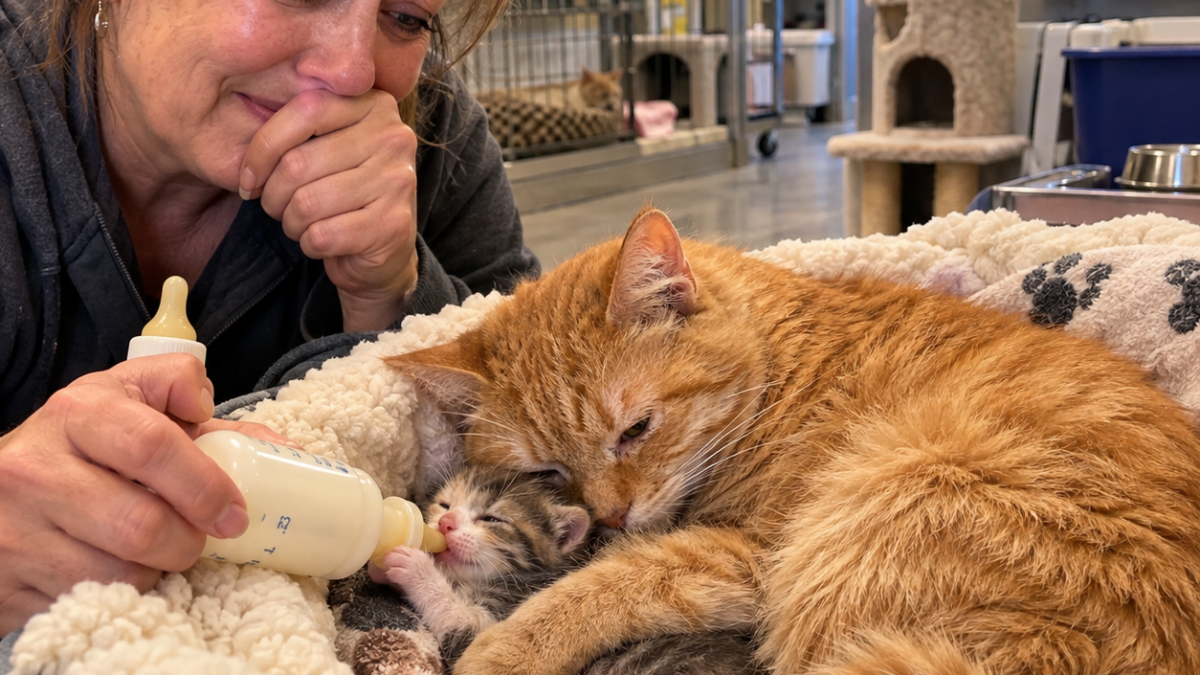
PART3:
Because the name should have sounded ridiculous.
This was the same cat who acted irritated if another animal breathed in her direction. The same cat who looked at adopters like they were tax auditors. The same cat people walked past again and again because she did not perform sweetness on command.
And yet there she was, curled around a newborn kitten, purring life back into a body that had almost stopped asking.
From that moment on, Peaches took the job seriously.
If Minnie cried, Peaches got up.
If Minnie crawled away from the blanket, Peaches nudged her back.
If Minnie’s tiny paw slipped over the side of the padded bed, Peaches used one orange foot to pull her in closer.
She cleaned Minnie’s face.
Her ears.
Her paws.
Her belly.
When I picked Minnie up to weigh her, Peaches followed me with a look that made me feel like I was being audited by a very disappointed grandmother.
“I’m bringing her back,” I told Peaches more than once.
Peaches did not appear convinced.
For the first week, we lived in small numbers.
Drops of formula.
Ounces on the scale.
Temperature.
Minutes between feedings.
One bowel movement could make us cheer.
One missed feeding could make the room go quiet.
That is how fragile Minnie was.
People like dramatic turning points.
A kitten drinks once, a cat curls around her, music swells, everything is saved.
Real rescue is not like that.
Real rescue is alarms set through the night.
Laundry.
Sticky formula on your sleeves.
Fear every time the baby sleeps too deeply.
Hope measured in grams.
Peaches stayed through all of it.
A week passed.
Then another.
Minnie got stronger.
Her eyes opened.
Blue at first, cloudy and unfocused, blinking up at the world as if she could not believe how much of it there was.
Her legs stopped wobbling so badly.
Her cry got louder.
Her appetite grew.
Soon she was climbing on Peaches, biting her tail, and trying to tackle her ears with the confidence of a creature who had no memory of almost leaving.
Peaches tolerated all of it.
Mostly.
Every once in a while, she would get up and walk away with an expression that seemed to say motherhood had been badly advertised.
Then Minnie would cry.
Peaches would turn around.
Every single time.
One afternoon, Minnie suddenly stopped eating again.
My stomach dropped so fast I had to sit down.
She had been doing so well. Running. Pouncing. Attacking shoelaces. Sleeping with her face buried in Peaches’ fur.
Now she was weak and sleepy, and all the fear from that first day came rushing back at once.
That is the cruelest thing about saving something fragile.
Even after progress, terror remembers the first version.
We had her checked immediately. The doctor adjusted what needed adjusting, gave instructions, told us what to watch, and reminded me in the careful voice doctors use that tiny kittens can dip quickly but sometimes recover just as quickly.
I nodded like a reasonable adult.
Inside, I was already back under that porch, holding a cold kitten and begging her to swallow.
After we brought Minnie back to rest, I sat beside her bed for hours.
Peaches stayed curled around her.
I put another blanket nearby so Peaches could stretch out.
She ignored it.
She stayed pressed against Minnie.
Purring.
Cleaning her.
Waiting.
At some point, I must have fallen asleep in the chair.
My neck hurt when I woke. My hand had gone numb. The room was dim, and for half a second, I could not remember where I was.
Then I heard a sound from Minnie’s bed.
The tiniest squeak.
I bolted upright.
Minnie had her face buried against Peaches and was yelling for breakfast.
Not crying weakly.
Yelling.
Full complaint.
Tiny outrage.
I cried right there.
Not quietly, either.
Peaches gave me one of her annoyed looks, as if emotional displays were making feeding time less efficient.
Over the next few weeks, Minnie turned into a completely different kitten.
She ran.
She played.
She attacked shoelaces.
She discovered that cardboard boxes were apparently more valuable than anything we could buy.
She climbed onto Peaches’ back like she was scaling a mountain.
She practiced pouncing from behind blankets, though her tail always gave away her position.
She once tried to jump from a low stool to the floor and somehow looked surprised when gravity remained consistent.
And something changed in Peaches too.
She started greeting me when I came in.
Not enthusiastically.
Let’s not get carried away.
But she stood.
She walked toward me.
She allowed exactly two scratches behind the ear before moving away six inches for professional reasons.
Once, I even caught her chasing Minnie across the room like she was five years old again.
That was when I realized something.
Maybe Peaches had never been cold.
Maybe she had simply stopped expecting anyone to need her.
There is a difference.
Cold is no feeling.
Peaches had feeling.
She had too much, maybe.
Maybe after months of being passed by, she learned not to offer what nobody seemed to want.
Then Minnie arrived small enough, cold enough, and lonely enough to need the exact thing everyone had stopped asking Peaches to give.
Love.
Not cute love.
Not easy love.
Not the kind that jumps into laps when visitors arrive.
The kind that gets up when somebody cries.
The kind that stays close all night.
The kind that turns around every single time.
Eventually, the day came that I had been avoiding.
Minnie was healthy enough to be adopted.
A family came to meet her on a Saturday morning.
Melissa, her husband Ryan, and their eleven-year-old daughter, Emma.
I knew immediately they were good people.
Not perfect.
Nobody is.
But good.
Melissa knelt before picking Minnie up, letting the kitten come to her instead of grabbing. Ryan stood back with his hands in his pockets, smiling like he did not want to admit he was already in trouble. Emma sat cross-legged on the floor and waited.
Minnie did exactly what Minnie did best.
She made herself impossible not to love.
She climbed into Emma’s lap, attacked the drawstring on her hoodie, and then fell asleep against her knee like she had been planning this family all along.
I should have been happy.
Instead, I looked at Peaches.
She was lying beside Minnie’s carrier.
Minnie kept climbing out to rub against her.
For almost two months, those two had slept together every night.
Minnie had never known a world where Peaches was not beside her.
I suddenly felt sick thinking about separating them.
So I told the family everything.
How Minnie had arrived cold and barely moving.
How she had refused the bottle.
How Peaches had walked over when no one expected her to.
How she curled around that tiny body and purred until Minnie relaxed enough to drink.
How she cleaned her, guarded her, answered every cry.
How Peaches had been at the shelter for almost a year.
How people kept passing her by because she was older and not eager and not easy.
How she had become the only mother Minnie had ever known.
The room got quiet.
Melissa looked at Ryan.
Ryan looked at Emma.
Emma looked at Peaches.
Finally, Melissa asked the question I still remember word for word.
“Can they go home together?”
I thought I had misheard.
“What?”
“Peaches and Minnie,” she said. “We don’t want to split them up.”
I started crying before I could answer.
Again.
Apparently that had become my main contribution to the story.
A few weeks later, Melissa sent me a picture.
Minnie was asleep across Peaches’ stomach near a sunny window.
Peaches had one paw wrapped around her.
She also looked deeply annoyed about having her picture taken.
Perfectly Peaches.
For a long time, I told people Peaches saved Minnie.
And she did.
But I do not think that was the whole story.
Minnie saved Peaches too.
She gave an old cat who had been overlooked again and again a reason to open her heart.
Sometimes the ones everyone passes by still have the most love left to give.
They are just waiting for someone small enough, scared enough, or lonely enough to need it.
I thought that was the ending.
I should have known better.
Animal rescue teaches you that happy endings are often only the end of one chapter.
Three months after Peaches and Minnie went home together, I got a phone call that made me wonder if their happy ending had only been temporary.
The woman on the other end was crying.
Before she even finished her first sentence, I knew something was wrong.
“Brenda,” she said, “I need to ask you something awful.”
It was Melissa.
For months, she had sent pictures.
Minnie sleeping upside down on the couch.
Peaches sitting in a cardboard box three sizes too small.
Minnie stealing Peaches’ food.
Peaches grooming her afterward like she had already forgiven the crime.
They had become exactly what I hoped they would become.
Family.
So when Melissa said she had to ask me something awful, my stomach tightened.
“What happened?”
She was quiet for several seconds.
Then she said it.
“We may have to bring one of them back.”
I actually pulled the phone away from my ear.
“One?”
She started talking fast.
Their situation had changed.
Ryan had lost his job unexpectedly. He had found another position, but it paid less, and the family was trying to make everything work.
They had cut expenses.
Canceled things.
Delayed things.
Stopped buying anything they did not really need.
Still, their rent had become too much.
When their lease ended, they planned to move into a smaller apartment. The new place was clean, safe, closer to Ryan’s new job, and still allowed Emma to stay in the same school.
There was only one problem.
The apartment allowed one cat.
Not two.
Melissa started crying harder.
“I know what you’re going to say.”
I did not know what I was going to say.
Actually, that was not true.
I knew exactly what I wanted to say.
Don’t split them up.
The thought was so immediate I almost said it without thinking.
But Melissa kept talking.
They had called other places. Anything that allowed two pets was either too far away or more than they could afford right then.
I sat down.
On the other side of the shelter office, someone was washing food bowls. A dog barked once from the hallway. Water ran in the sink.
Normal sounds.
But suddenly I was back on the day Peaches had curled herself around a dying kitten.
I could see Minnie fitting into my hand.
I could hear that deep purr.
I could remember Peaches following me when I weighed Minnie, making sure I gave her baby back.
“You can’t separate them,” I said.
The words came out harder than I meant them to.
Melissa stopped talking.
For a second, neither of us said anything.
Then she said very quietly, “I know.”
I immediately felt bad.
Not because I thought I was wrong.
Because I could hear what those two words cost her.
I asked what they were thinking.
She told me they had gone back and forth for almost a week.
At first, Ryan thought they should return Peaches.
That probably sounds cruel when you hear it that way.
It sounded cruel to me too.
But his reasoning was simple.
Minnie was young.
Minnie was healthy.
Minnie was Emma’s cat in a way Peaches was not.
Minnie slept in Emma’s bed almost every night. She followed that little girl everywhere. When Emma did homework, Minnie sat on the papers. When Emma cried, Minnie climbed into her lap.
Peaches loved the family too, but she still had her independent streak.
She slept with Minnie.
Groomed Minnie.
Followed Minnie.
But she did not crawl into people’s laps much. She did not beg for attention. She did not perform affection just because humans wanted reassurance.
Ryan thought Peaches would adjust better.
Melissa disagreed.
“She waited almost a year for someone to choose her,” she said.
I closed my eyes.
“I know.”
“And then she finally gets a home, and we’re going to send her back because she’s old?”
There it was.
The part that hurt.
The part nobody wanted to say out loud.
Peaches was twelve when she was adopted.
Now she was thirteen.
Minnie was still practically a baby.
If one of them came back to the shelter, which one had the better chance?
We both knew.
People loved Minnie.
Minnie was cute.
Minnie was playful.
Minnie ran toward strangers like she had known them for years.
Peaches was Peaches.
Older.
Quiet.
Suspicious.
Orange.
Opinionated.
She had already spent nearly a year being passed over once.
Melissa whispered, “I feel like we promised her.”
I did not answer.
Because that was exactly how I felt.
But promises get easier when life stays easy.
The real test comes when keeping them costs something.
I asked Melissa what Emma thought.
She hesitated.
“That’s the worst part.”
Emma was eleven.
Old enough to understand what was happening.
Young enough to believe there had to be a fair answer.
There was not.
Melissa and Ryan had tried explaining the apartment rule. Emma immediately said they should live somewhere else. They explained why that was not simple. Emma offered to give up dance classes. Melissa told her it was not about dance classes. Emma offered to stop buying lunch at school.
Finally, Ryan asked Emma the question no parent wants to ask a child.
If they could only keep one cat, which one?
Emma started crying.
Then she ran upstairs.
She did not speak to him for the rest of the night.
The next morning, there was a note on the kitchen table.
Melissa read it to me over the phone.
It said:
Peaches stayed with Minnie when Minnie needed her. We should stay with Peaches when Peaches needs us.
I did not say anything for a long time.
Neither did Melissa.
Finally, she said, “So tell me what to do.”
That is a dangerous sentence.
People say it when they do not actually want someone to make the decision.
They want somebody to make the pain disappear.
I could not do that.
“I can’t tell you what to do with your family,” I said.
“But?”
There was definitely a but.
I took a breath.
“But I don’t think returning Peaches alone is fair to either cat.”
Melissa cried again.
“I knew you’d say that.”
“They’re bonded.”
“I know.”
“Minnie has never really known life without her.”
“I know.”
“And Peaches…”
I stopped.
Because suddenly I was angry.
Not really at Melissa.
Not really at Ryan.
Maybe at the whole situation.
We spend so much time telling people that pets are family.
We put it on signs.
We say it at adoption events.
We post pictures about it.
We cry over it.
But when life gets complicated, that sentence becomes uncomfortable.
What does family actually mean when keeping someone becomes inconvenient?
What does it mean when money gets tight?
When housing gets smaller?
When someone gets old?
Those questions are easy until the answer affects your own kitchen table.
I told Melissa that if the family truly could not keep both cats, the shelter would take them back.
Both of them.
Together.
She went silent.
“Both?”
“Yes.”
“But Emma—”
“I know.”
“She would be devastated.”
“I know.”
“So you think she should lose both cats?”
“No.”
“That’s what you’re saying.”
I felt my face get hot.
“I’m saying I don’t think Minnie should get to keep her family while Peaches loses hers.”
The second the words left my mouth, I knew how harsh they sounded.
Melissa heard it too.
Her voice changed.
“So my daughter should lose Minnie because my husband lost his job?”
“That’s not what I meant.”
“It kind of is.”
“No, Melissa.”
She was crying, but now she was angry too.
And I understood why.
I was protecting the cats.
She was protecting her child.
Neither of us felt like the villain.
That was what made it so hard.
Then she said something I still think about.
“People always say don’t adopt unless you’re ready for fifteen years. But nobody knows what their life will look like fifteen years from now.”
I had no answer.
Because she was right.
People get sick.
People lose jobs.
People divorce.
Parents get older.
Children need things.
Families move.
Life does not ask whether the timing is convenient.
Melissa apologized for snapping at me.
I apologized too.
Then I told her not to make a decision that day.
“Give me forty-eight hours.”
“For what?”
“I don’t know yet.”
That was the truth.
I had no plan.
I only knew I could not stand the thought of Peaches being carried back through our shelter door alone.
The next morning, I talked to our shelter manager, Linda.
Linda had been doing this work longer than I had. Nothing shocked her anymore.
At least, that was what she liked people to think.
I explained everything.
Linda listened without interrupting.
When I finished, she sighed.
“You told them we would only take both cats?”
“Yes.”
“That was bold.”
“You mean stupid?”
“I didn’t say stupid.”
“You were thinking it.”
“A little.”
I crossed my arms.
“They shouldn’t be separated.”
“I agree.”
“So what’s the problem?”
Linda leaned back in her chair.
“The problem is people don’t live inside perfect little adoption stories.”
I did not like hearing that.
She kept going.
“Suppose they return both cats. What happens?”
“We find them another home together.”
“Maybe.”
“We would.”
“Maybe.”
I hated when Linda said maybe.
She usually said it when she was right.
Linda reminded me that bonded pairs were harder to place. Older cats were harder to place. Two cats together meant more food, more litter, more vet care, more everything.
And while Minnie was still young and easy to adopt, Peaches was now thirteen.
“If they come back here,” Linda said, “there is no guarantee they leave together quickly.”
“I know.”
“They could sit here six months.”
“I know.”
“A year.”
“I know.”
“And you told a family that’s trying to keep at least one of them that you’d rather take both?”
I stared at her.
“When you say it that way, it sounds terrible.”
“It’s not terrible.”
“Then what is it?”
“Complicated.”
I hated that word.
Complicated is what people say when there is not a clean good guy and bad guy.
Nobody wants complicated.
People want a villain.
A hero.
A lesson.
A sentence they can type in capital letters.
Real life usually does not cooperate.
Linda asked me what I actually wanted.
I said I wanted the apartment manager to suddenly change the rule.
She laughed.
Then I said I wanted the family to find a place they could afford that allowed two cats.
She nodded.
Then she asked what I wanted if neither of those things happened.
That answer was harder.
“I want Peaches not to be abandoned again.”
Linda looked at me.
“She wouldn’t be abandoned.”
“You know what I mean.”
“Yes.”
“No, I mean emotionally.”
“I know.”
Peaches would not understand rent.
She would not understand job changes.
She would not understand lease rules.
She would not understand spreadsheets on the kitchen table.
She would understand one thing.
One day she lived in a home beside Minnie.
The next day she did not.
Animals do not know our reasons.
They only know what changes.
Linda finally said, “Find a foster.”
“For Peaches?”
“For both.”
That idea had crossed my mind.
I had not liked it.
Temporary foster situations sound good until you ask one important question.
Temporary until when?
Melissa’s family had no idea how long they would need the smaller apartment.
Six months?
A year?
Two?
Still, it was something.
I made calls.
A lot of calls.
Every experienced foster I knew already had animals.
One woman had a nursing mother cat with five kittens.
Another had two senior cats receiving daily medication.
Another could take one cat but not two.
By the end of the first day, I had nothing.
The second day was worse.
One person said yes.
Then talked to her husband.
Then said no.
Another offered a spare room for three weeks.
Three weeks did not solve anything.
At four that afternoon, Melissa called.
“I have to tell the apartment office by tomorrow.”
I rubbed my forehead.
“I’m still trying.”
“I know.”
There was something in her voice.
“What?”
“We made a decision.”
My heart sank.
“What decision?”
“We’re keeping Minnie.”
I closed my eyes.
Melissa started explaining immediately.
Emma had been crying constantly. She could not sleep. She had started carrying Minnie around the house like someone was coming to take her.
Ryan felt terrible.
Melissa felt terrible.
Everyone felt terrible.
But they had decided Peaches would come back to the shelter.
“Please don’t think we don’t love her,” Melissa said.
I did not answer quickly enough.
She noticed.
“Brenda?”
“I’m here.”
“She matters to us.”
“I know.”
“No, I need you to understand that.”
“I do.”
“We’re not throwing her away.”
“I know.”
“We’re trying to survive a bad year.”
That sentence stopped me.
Not because it changed how I felt about Peaches.
Because I suddenly heard the exhaustion underneath everything else.
Sometimes when people talk about responsibility, they talk like responsible people never get cornered.
That is not true.
Sometimes responsible people get three bad choices.
Then everybody watches which bad choice they make.
I told Melissa I would meet them at the shelter Saturday morning.
After we hung up, I went into the bathroom and cried.
I was embarrassed about it.
I do not know why.
Nobody was there.
Still, I washed my face before I came back out.
Saturday arrived too fast.
I got to the shelter early.
I put fresh blankets in a large enclosure.
Added a cardboard box because Peaches loved boxes.
Found one of those little cloth mice she used to bat around when she thought nobody was looking.
Then I hated myself for doing all of it.
It felt like preparing a guest room for someone who did not want to visit.
At 9:17, I saw Melissa’s car pull into the parking lot.
Emma was in the back seat.
Minnie was beside her in a carrier.
I froze.
Then I saw Peaches in another carrier.
Both cats.
I walked outside.
Melissa got out first. Her eyes were swollen. Ryan came around the other side of the car looking exhausted. Emma did not move at first.
I stared at the carriers.
“You brought Minnie too.”
Melissa nodded.
“We changed our minds.”
I should have been relieved.
Instead, I felt sick.
Emma opened the back door with Minnie’s carrier pressed against her chest.
She would not look at me.
Ryan carried Peaches.
Nobody spoke as we walked inside.
Once we were in the little adoption room, Emma set Minnie’s carrier on the floor. Peaches’ carrier went beside it.
The cats started making worried little sounds immediately.
Minnie scratched at the carrier door.
Peaches pushed her nose against the bars closest to Minnie.
Emma started crying.
I knelt beside her.
“Hey.”
She wiped her face hard.
“This is stupid.”
I knew she did not mean the cats.
“What is?”
“All of it.”
That was fair.
She looked at me.
“My dad said we should keep Minnie.”
Ryan lowered his head.
Emma continued.
“I told him no.”
Melissa put a hand on her shoulder.
Emma pulled away.
Not angrily.
She was just eleven and heartbroken.
“I told them Peaches took care of Minnie, so if Minnie had to leave, Peaches should go too.”
I swallowed.
That sounded like something I would have said.
For one second, I felt proud of her.
Then I looked at Ryan.
He looked crushed.
And I realized this little girl had been asked to carry a decision adults barely knew how to hold.
I did not feel proud anymore.
I felt sad.
Ryan spoke quietly.
“I don’t think kids should have to make choices like that.”
Emma snapped, “Then you shouldn’t have asked me.”
Nobody said anything.
Because she was right.
Ryan nodded.
“You’re right.”
That surprised her.
He crouched so they were eye level.
“I’m sorry.”
Emma looked away.
Ryan continued.
“I was scared. I wanted to fix it. I thought keeping one cat was better than losing both.”
Emma said nothing.
“I still think that would have been better than this.”
That was the moment the room changed.
Melissa looked at him.
I looked at him.
Emma looked at him.
Ryan shook his head.
“I know everybody thinks I’m awful.”
“I don’t,” I said.
He gave me a look that told me he did not believe that for a second.
“I’m the guy who wanted to keep the kitten and return the old cat.”
When you say it like that, it sounds terrible.
He knew it too.
“But Minnie is attached to Emma,” he said. “And Emma is attached to Minnie.”
He looked at Peaches’ carrier.
“I love Peaches. I do.”
His voice cracked.
“But I have a kid who already lost her house.”
Melissa corrected him gently.
“We’re moving.”
Ryan nodded.
“To her, that means losing her house.”
He looked at Emma.
“She’s changing bedrooms. Changing neighborhoods. I’m driving her to the same school because I promised she wouldn’t have to lose that too.”
Then he looked at me.
“And I thought maybe she shouldn’t have to lose the cat that sleeps on her pillow.”
I had spent two days thinking about what Peaches deserved.
Ryan had spent two days thinking about what his daughter could handle.
Both mattered.
That was the problem.
The shelter door opened.
Linda walked in.
She took one look at us.
Then at the carriers.
Then at Emma.
“What happened?”
“They brought both,” I said.
Linda frowned.
“Why?”
Ryan laughed once.
Not happily.
“Because apparently there’s no choice we can make that doesn’t hurt somebody.”
Linda stared at him for a second.
Then she said something I was not expecting.
“Maybe you don’t need a permanent choice.”
Melissa looked up.
“What?”
Linda turned to me.
“You didn’t check the volunteer list from yesterday, did you?”
“No.”
“You should have.”
That annoyed me.
“Linda.”
She raised a hand.
“I talked to Martha.”
I knew Martha.
Everybody did.
She was sixty-seven, retired, widowed, and lived alone in a small house about fifteen minutes from the shelter. She had fostered cats years earlier but stopped after her own cat died.
“What about her?”
“She’ll take both.”
My heart jumped.
“For how long?”
“Six months.”
Melissa stared at Linda.
“Six months?”
Linda nodded.
“And possibly longer if things are going well.”
Nobody moved.
Ryan spoke first.
“What does that mean?”
“It means the cats stay together,” Linda said. “You remain their family. You cover what you can. We help coordinate the rest. Martha keeps them until your housing situation changes.”
Melissa started crying again.
Emma looked at her mother.
Then at Linda.
Then at me.
“Can we visit them?”
Linda smiled.
“That would be up to Martha, but knowing Martha, you may get tired of visiting before she gets tired of feeding you cookies.”
Emma laughed.
Just a little.
It was the first good sound in that room all morning.
Ryan did not look relieved.
That caught my attention.
“What?”
He rubbed both hands over his face.
“What happens after six months?”
There it was.
The question nobody wanted to ask.
Linda did not pretend.
“We see where things are.”
“And if we’re still in the apartment?”
“We figure it out then.”
“So we’re delaying the same decision.”
“Maybe.”
Ryan shook his head.
“I don’t want Emma spending six months thinking everything is fixed when it might not be.”
Melissa looked at him.
“What do you want to do?”
“I don’t know.”
Emma whispered, “I do.”
Everybody looked at her.
She put her hand on Minnie’s carrier.
“Let them stay together.”
Ryan closed his eyes.
Emma went on.
“If we can get them back, we get them back.”
Her voice shook.
“If we can’t…”
She stopped.
I watched an eleven-year-old girl try to say something no eleven-year-old should have to practice saying.
“If we can’t, then find them a home together.”
Melissa started crying.
Ryan looked like someone had punched him.
I had to look away.
Emma wiped her face.
“But nobody gets to pick one.”
There are people who would disagree with that.
I know because I have told this story before.
Some people hear it and say Emma was right.
A bonded pair is a bonded pair.
You do not separate them because life gets inconvenient.
Others say Ryan was right.
A child should not lose a beloved pet just because adults want a cleaner moral answer.
Some people say Melissa and Ryan should never have adopted two cats if they could not guarantee they would always afford two cats.
That one bothers me.
Not because responsibility does not matter.
It does.
Because nobody can guarantee a life without disaster.
I have seen people who planned everything perfectly lose jobs.
I have seen careful people get sick.
I have seen marriages end.
I have seen houses sold.
I have seen people take in elderly parents.
I have seen people choose between things they never imagined would compete with each other.
Life can turn anyone’s certainty into a question mark.
The easy thing is judging the answer.
The harder thing is admitting you might not know what you would do until it is your family sitting in that little room.
That afternoon, Peaches and Minnie went home with Martha.
Not back with Melissa.
Not into the shelter.
Somewhere in between.
Martha sent me a picture that night.
Minnie was under the sofa.
Peaches was sitting three feet away, staring at Martha like she was conducting a security clearance.
I laughed.
Perfectly Peaches.
The first week was hard.
Minnie hid.
Peaches barely ate.
Martha called me twice because she was worried.
On the third day, Emma visited.
The second she walked into the room, Minnie came flying out from under the couch.
She ran to her.
Actually ran.
Emma dropped to the floor.
Minnie climbed into her lap.
Peaches walked over more slowly.
Emma started crying before Peaches even reached her.
She rubbed Peaches’ head.
“I’m sorry.”
That nearly destroyed me.
Peaches head-butted her hand.
Then sat beside Minnie.
No drama.
No punishment.
Cats do not make speeches.
Sometimes I think that is why they forgive better than people.
For the next several months, that became their routine.
Emma visited every Saturday.
Melissa usually came too.
Ryan came when his work schedule allowed.
They brought food.
Litter.
Toys.
Martha kept saying they brought too much.
Melissa kept bringing it anyway.
Minnie adjusted quickly.
Of course she did.
She was Minnie.
She once made friends with a dust mop.
Peaches took longer.
But eventually she started sitting beside Martha in the evenings.
Not on her lap.
Let’s not get ridiculous.
Beside her.
For Peaches, that was practically a marriage proposal.
One night, Martha called me laughing.
“You’re not going to believe this.”
“What?”
“She brought me a sock.”
“A sock?”
“A dirty one.”
“Congratulations.”
“Is that good?”
“For Peaches? That might be an engagement ring.”
Martha laughed for a full minute.
Something else happened during those months.
Something I did not expect.
Martha changed.
At first, she was supposed to be the solution.
The safe house.
The temporary person.
I was not thinking about what Peaches and Minnie might do for her.
Martha had lost her husband four years earlier.
Then her cat the year after that.
Her children lived in other states. They called. They visited. They loved her.
But most days, her house was quiet.
She had gotten used to it.
Or at least she said she had.
After Peaches and Minnie moved in, she started coming by the shelter more often. Sometimes she brought supplies. Sometimes muffins. Sometimes she just stood in the doorway and told me something Minnie had destroyed.
A roll of paper towels.
A houseplant.
A basket of clean laundry.
Nothing important.
Everything funny.
Once she told me Peaches had begun sleeping at the foot of her bed.
“She acts like she owns the place,” Martha said.
“She probably thinks she does.”
“She didn’t even pay the mortgage.”
“Peaches has never respected financial systems.”
Martha laughed.
Then her face got quiet.
“I forgot what it was like to come home and have somebody waiting.”
I knew that feeling mattered more than she wanted to admit.
Loneliness does not always look dramatic.
Sometimes it looks like eating dinner in front of the television because setting the table feels silly for one person.
Sometimes it looks like leaving the radio on in another room.
Sometimes it looks like pretending you enjoy all the quiet.
Martha was not miserable.
She had friends.
Family.
Volunteer work.
A full life.
But Peaches and Minnie filled a space she had stopped noticing.
Three months into the foster arrangement, Melissa called me.
For once, she sounded excited.
They had found another rental.
Small.
Farther from Ryan’s job.
Older.
Not as nice as the apartment they were in.
But it allowed two cats.
“When can we bring them home?” she asked.
I should have been thrilled.
I was.
Mostly.
Then I thought about Martha.
That afternoon, I drove to her house.
Peaches was sleeping on the back of the couch.
Minnie was chasing something invisible across the floor.
I told Martha the news.
She smiled immediately.
“Oh.”
Just one word.
But I heard it.
“That’s good,” she added.
“Yes.”
“Really good.”
“Yes.”
She stood and began collecting Minnie’s toys.
I put my hand on her arm.
“Martha.”
“I’m fine.”
“You don’t have to pack today.”
“I should wash their blankets.”
“Martha.”
“I’ll send the little tunnel thing. Minnie likes that.”
“Martha.”
She stopped.
Then she sat down.
“I knew this was temporary.”
“I know.”
“That was the deal.”
“I know.”
“I’m happy for them.”
“I know.”
She looked toward Peaches.
Peaches opened one eye.
Martha laughed softly.
“That old cat fooled me.”
“How?”
“I thought she needed me.”
I did not answer.
Martha wiped one eye.
“Turns out I needed her.”
There it was again.
The same thing I had said months earlier.
Peaches saved Minnie.
Minnie saved Peaches.
Now maybe both of them had saved Martha.
I was starting to think animals were very bad at staying inside the roles we gave them.
The reunion happened the next Saturday.
Emma came running through Martha’s front door.
Minnie ran straight toward her.
No hesitation.
She climbed up Emma’s jeans like a tiny criminal.
Emma screamed.
Then laughed.
Then cried.
Melissa cried too.
Ryan hugged Martha.
I cried because apparently that remained my official assignment.
Peaches stayed on the couch.
Emma went to her.
“Hi, Mama Peaches.”
Peaches blinked.
Emma scratched her chin.
Peaches stood up.
For one second, I thought she was going to climb into Emma’s lap.
She did not.
She walked past her.
Straight to Martha.
Then she sat beside Martha’s leg.
The room went very quiet.
Martha looked horrified.
“Oh no.”
Nobody moved.
Emma stared at Peaches.
Melissa stared at me.
Ryan looked down.
Martha reached toward Peaches, then stopped.
“Peaches.”
Peaches leaned against her ankle.
I remember thinking:
Of course.
Of course this story could not be easy.
Minnie had never forgotten Emma.
Peaches had built a new bond.
Now we had a different problem.
Should Peaches go back with Minnie because they had always been a pair?
Or should Peaches stay with the person she had chosen during the months apart?
Emma was the first to say it.
“She wants to stay here.”
Melissa immediately said, “Honey, we don’t know that.”
Emma looked at her mother.
“Yes, we do.”
Ryan sighed.
“She loves Martha.”
Martha shook her head.
“She loves all of you.”
Peaches had absolutely no interest in helping us.
She started washing one paw.
Perfectly Peaches.
Melissa sat down.
“This is unbelievable.”
Nobody disagreed.
Four months earlier, we had fought to keep Peaches and Minnie together.
Now Peaches had formed a bond that made staying together more complicated.
Martha looked at Emma.
“You should take her.”
Emma looked surprised.
“She’s yours.”
“No,” Martha said. “She’s yours.”
Emma shook her head.
“She likes you.”
“She likes you too.”
“She picked you.”
That sentence landed hard.
Martha’s face changed.
I looked at Peaches.
Then at Minnie.
Minnie was currently inside an empty paper bag.
Clearly one of our deepest thinkers.
I asked Emma to sit with Peaches.
She did.
Peaches stayed beside Martha.
Emma called Minnie.
Minnie came immediately.
Then something happened.
Minnie climbed onto the couch.
She walked to Peaches.
Rubbed her face against Peaches’ neck.
Peaches licked the top of Minnie’s head.
Once.
Twice.
Then Peaches stood up.
She walked over to Emma.
And sat beside her.
Martha started crying.
“So that settles it,” she said.
I was not sure it did.
Maybe Peaches had chosen.
Maybe she had just moved three feet.
Humans are very good at assigning meaning to animals when we need them to solve our problems.
Still, Melissa asked Martha a question.
“Do you want her to stay?”
Martha looked at Peaches.
Then Minnie.
Then Emma.
“Yes.”
She said it quietly.
Nobody breathed.
Then she added, “And no.”
That answer made more sense than anything else said that day.
Martha loved Peaches enough to want her.
And loved her enough not to claim her.
Emma started crying.
She hugged Martha.
I looked away because there are limits to how much public crying one woman should do.
Peaches and Minnie went home with Melissa’s family that afternoon.
Together.
Just like we had planned months earlier.
I followed their car partway down the street.
Then I turned back.
Martha was still standing in her driveway.
That picture stayed with me.
So did the guilt.
Happy endings usually have somebody standing in the driveway after the happy people leave.
We just do not take pictures of that part.
Two weeks later, I stopped by Martha’s house.
The place felt too quiet.
I noticed it immediately.
So did she.
She tried to joke.
“I’ve used the same roll of paper towels for twelve days.”
“That must be a record.”
“My laundry is staying folded.”
“Terrible.”
“My socks are safe.”
“Unacceptable.”
She smiled.
Then her eyes watered.
I asked whether she wanted to foster again.
“No.”
The answer came too fast.
I nodded.
“Okay.”
She looked embarrassed.
“I’m sorry.”
“For what?”
“I know you need people.”
“We do.”
“I just can’t do it again.”
I understood.
Fostering is strange.
You open your home because an animal needs somewhere temporary.
Then you spend weeks teaching them they are safe.
And if you do the job right, sometimes you hand them to someone else.
People call that beautiful.
It is.
It can also hurt like crazy.
Martha said, “I don’t know how you people do this.”
I laughed.
“We complain a lot.”
She smiled.
Then we changed the subject.
A month passed.
Then another.
Peaches and Minnie settled back into Melissa’s family.
Their new place was smaller. Emma’s bedroom barely fit her bed and desk. Ryan’s commute was longer. Melissa said the kitchen cabinets were probably installed sometime around the invention of electricity.
But the cats were there.
Minnie resumed sleeping on Emma’s pillow.
Peaches claimed a chair near the living-room window.
Everything seemed okay.
Then Peaches got sick.
Melissa called me on a Tuesday night.
“Something’s wrong.”
My chest tightened.
Peaches had stopped eating.
Different cat.
Same fear.
She was drinking more water.
Sleeping more.
Seeming uncomfortable.
The family took her to their veterinarian.
The next afternoon, Melissa called again.
Peaches had kidney disease.
It was not an immediate emergency. She was not dying that day. But she was old. She would need more care, more appointments, more monitoring, possibly medication, possibly special food.
Nothing about it was shocking for a thirteen-year-old cat.
But the timing felt cruel.
The family had barely climbed out of one problem.
Now another had arrived.
Melissa sounded tired.
“So what are you thinking?” I asked.
She laughed bitterly.
“I’m thinking Peaches has terrible timing.”
That actually sounded like Peaches.
Then Melissa got quiet.
“Ryan is worried.”
“About her?”
“About everything.”
I knew what everything meant.
Money.
Time.
Stress.
Their smaller house.
His longer commute.
Emma.
The bills they had delayed.
The things they were still trying to catch up on.
Melissa whispered, “He asked how far we’re supposed to go.”
I understood the question.
I also hated it.
How much should someone spend on an old pet?
Everything they have?
Only what feels comfortable?
Should age matter?
Should quality of life matter more than length?
Is it wrong to set a limit?
Is it wrong not to?
There is no answer I can put here that will satisfy everybody.
I have watched people spend money they absolutely did not have trying to buy another month.
I have watched others choose comfort earlier because they were afraid of putting an animal through too much.
I have seen both choices made out of love.
I have seen both judged by strangers.
I told Melissa the only thing I could honestly say.
“Peaches needs you to make decisions based on her life, not your guilt.”
Melissa was quiet.
Then she said, “Emma thinks if we love her enough, we can fix it.”
“That sounds like Emma.”
“She’s eleven.”
“I know.”
“How do you explain to a kid that love doesn’t fix everything?”
I looked across my kitchen. My own cat was sleeping on a chair.
I said, “Maybe you don’t.”
Melissa waited.
“Maybe you tell her love is what makes you stay while you figure out what can be fixed and what can’t.”
Melissa cried.
I nearly did too.
Again.
A few days later, I visited.
Peaches had lost a little weight.
She still looked offended by my existence.
That was comforting.
Minnie followed her everywhere.
If Peaches drank water, Minnie watched.
If Peaches changed chairs, Minnie changed chairs.
If Peaches slept, Minnie slept nearby.
Emma had made a little bed beside her own bed for Peaches.
Peaches refused to use it.
Of course.
She preferred an old folded sweatshirt on the floor.
Ryan was in the kitchen.
He looked tired.
I joined him.
“You can say it,” he told me.
“Say what?”
“That I’m the bad guy again.”
“I don’t think you’re the bad guy.”
He raised an eyebrow.
“I mean it.”
He leaned against the counter.
“I keep being the one who asks the ugly questions.”
“Somebody has to.”
“Does that make me awful?”
“No.”
“I asked whether we should keep Minnie.”
“I remember.”
“I asked what we could realistically afford for Peaches.”
“I know.”
“Emma looks at me like I’m trying to get rid of her.”
That hurt to hear.
Ryan stared at the floor.
“I love that cat.”
Peaches was ten feet away, chewing on a houseplant.
Ryan pointed.
“She is literally destroying something while I defend her.”
I laughed.
He did too.
Then he got serious.
“My job is to think about everybody in this house.”
That sentence mattered.
Not just the cats.
Not just Emma.
Everybody.
He continued.
“If I spend every dollar because I’m afraid someone online would call me heartless otherwise, that doesn’t make me a better father.”
He looked toward Emma’s room.
“And if I quit too soon because things are hard, that doesn’t make me a better person.”
There it was.
The middle.
Nobody likes the middle.
It does not fit on a bumper sticker.
It does not make a satisfying argument.
But most decent people live there.
Trying.
Adjusting.
Getting some things wrong.
Trying again.
Peaches did well for several months.
Not perfectly.
But well.
She ate.
She slept.
She still groomed Minnie.
She still sat near the window.
She still moved six inches away if anyone became too affectionate.
Then something else happened.
Martha started visiting.
At first, I think Melissa invited her because she felt guilty.
Then it became natural.
Every other Sunday, Martha came over.
Sometimes she brought cookies.
Sometimes nothing.
Peaches always went to her.
Always.
She would sit beside Martha on the couch.
Minnie would climb over both of them.
Emma loved it.
Ryan called it Peaches’ shared custody arrangement.
That joke probably saved everybody from explaining how emotional it actually was.
One Sunday, Martha called me after she got home.
“I think I’m ready.”
“For what?”
“To foster again.”
I smiled.
“Are you sure?”
“No.”
“Perfect.”
She laughed.
The next week, Martha came to the shelter.
I showed her three cats.
A young tabby.
A shy two-year-old.
Then Earl.
Remember Earl?
The older black cat who had been sitting in the corner the day Melissa called me months earlier?
He was still there.
Eleven months.
Almost a full year.
Martha stood in front of his enclosure.
“He doesn’t seem very interested.”
I laughed.
“You have a type.”
“What does that mean?”
“Nothing.”
Earl stared at her.
Martha opened the enclosure.
She held out her hand.
Earl sniffed it.
Then moved farther away.
Martha smiled.
“Oh.”
I knew that smile.
“What?”
She looked at me.
“He’s rude.”
“Very.”
“I like him.”
Of course she did.
Martha took Earl home as a foster that afternoon.
Two weeks later, she adopted him.
Nobody was surprised.
Especially Earl.
He walked through her house like he had finally received property he had been waiting to inherit.
Martha sent pictures.
Earl on the couch.
Earl on the bed.
Earl sitting in front of the television.
Earl ignoring a very expensive cat bed.
Then one picture stopped me.
Earl was sitting beside the same window where Peaches used to sit.
For a second, I felt sad.
Then I did not.
Nothing had replaced Peaches.
That was not the point.
Love is not a parking space.
Someone new does not have to erase who was there before.
That idea stayed with me.
A year after Peaches and Minnie were adopted, Melissa invited me over for Emma’s birthday.
I almost did not go.
I’m not great at children’s parties.
Too much noise.
Too much frosting.
Too many people asking whether I can help them convince their spouse to get another cat.
But I went.
Peaches was thinner.
Older.
Slower.
Still Peaches.
Minnie had grown into a beautiful cat. Longer body. Bright eyes. Completely convinced the house existed for her entertainment.
At one point, Emma sat on the floor with both cats.
Minnie climbed into her lap.
Peaches settled beside her leg.
Martha was sitting across the room.
Ryan was carrying paper plates.
Melissa was arguing with someone about where she had put the candles.
It was ordinary.
That was what made it beautiful.
Nothing dramatic was happening.
Nobody was being saved.
Nobody was crying.
Nobody was making a terrible decision.
They were just together.
I remember thinking maybe this was what we had been fighting for all along.
Not a perfect ending.
Just more ordinary days.
A few months later, Peaches took a turn.
She stopped climbing onto the chair.
Then she stopped caring much about food.
The veterinarian adjusted what could be adjusted.
The family kept her comfortable.
They spent more time on the floor with her because she no longer wanted to jump.
Minnie stopped playing as much.
She stayed close.
One evening, Melissa called.
“We think it’s time.”
I knew what she meant.
I drove over.
Martha was already there.
Peaches was lying on Emma’s folded sweatshirt.
The same old sweatshirt she had preferred over the nice bed months earlier.
Emma was beside her.
Minnie was curled against Peaches’ back.
Nobody was talking.
Ryan sat on the floor.
Melissa cried quietly.
Martha had one hand resting beside Peaches.
Peaches looked tired.
But calm.
I sat down.
No speeches.
No big moment.
Just people on a floor around an old orange cat.
Emma finally whispered, “She saved Minnie.”
I nodded.
Then she said, “Minnie saved her.”
“Yes.”
Martha wiped her face.
Ryan looked at Peaches.
“She saved us some too.”
Nobody laughed.
Because we knew what he meant.
She had forced them to decide what kind of family they wanted to be.
Not a perfect family.
Not a family with unlimited money.
Not a family that never got scared.
A family that stayed in the room when decisions got hard.
Martha whispered, “She saved me.”
That was true too.
Then Emma looked at me.
“Who did we save?”
I did not answer right away.
Maybe I was supposed to say Peaches.
That would have been the easy answer.
But it did not feel completely true.
So I said, “Each other.”
Peaches died peacefully with Minnie beside her.
I will not turn that moment into something dramatic.
It was not dramatic.
It was quiet.
Sad.
Gentle.
Human.
Emma cried into her mother’s shoulder.
Ryan cried too.
So did Martha.
So did I.
Minnie stayed close to Peaches for a while afterward.
Then she got up.
She walked to Emma.
And climbed into her lap.
That broke all of us.
For weeks afterward, Minnie searched for Peaches.
She checked the chair.
The window.
The little bed Peaches never used.
She cried more at night.
Emma slept with her bedroom door open.
Eventually, Minnie adjusted.
Not because she forgot.
Because living things do that strange thing we all have to learn.
They continue.
Martha kept visiting.
Earl continued being rude.
Ryan’s work situation eventually improved.
The family stayed in the smaller place longer than they expected.
They never regretted moving there.
At least, that is what they told me.
But here is the part I still think about.
If you ask ten people what that family should have done when the apartment allowed only one cat, you will probably get ten different answers.
Some will say Ryan was right from the beginning.
Keep Minnie.
Return Peaches.
Protect the child.
Do what the family can realistically manage.
Some will say Emma was right.
Peaches and Minnie were family.
You do not separate family because circumstances get inconvenient.
Some will say the parents should have found different housing immediately, no matter the commute, cost, or sacrifice.
Others will say animals matter deeply, but parents still have obligations to their children that must come first.
Some people will think my refusal to take Peaches alone was compassionate.
Others will think it was unfair.
I understand both.
I really do.
Because I learned something from Peaches that I did not understand when she first curled around Minnie.
Love is easy when all it asks for is affection.
The hard part comes when love asks for inconvenience.
Money.
Time.
Patience.
Humility.
Compromise.
Sometimes even letting go.
We live in a world where almost everybody I know feels stretched in one way or another.
People are helping children.
Helping parents.
Working longer.
Living smaller.
Trying to save.
Trying to recover.
Trying to be responsible to five different people at the same time.
Under that pressure, it becomes very tempting to sort everyone by usefulness.
Young before old.
Easy before difficult.
Healthy before sick.
Productive before dependent.
Convenient before complicated.
Peaches spent almost a year in a shelter because people kept choosing easier.
Then one tiny kitten needed exactly the thing everyone assumed Peaches no longer had.
Love.
Not cute love.
Not easy love.
The kind that gets up when somebody cries.
The kind that stays close through the night.
The kind that comes back every single time.
Minnie gave Peaches purpose.
Peaches gave Minnie a beginning.
Melissa’s family gave them a home.
Martha gave them somewhere safe when that home became uncertain.
And Peaches gave all of us something I still carry.
A reminder that getting older does not mean having less to give.
Being difficult does not mean being unlovable.
Needing help does not make somebody a burden.
And sometimes the one everyone is ready to count out is still holding the thing somebody else desperately needs.
A few months after Peaches died, Emma came to the shelter with Melissa.
She had gotten taller.
Minnie was doing well.
They brought donated blankets and cat food.
Emma walked through the cat room slowly.
Then she stopped.
Inside one of the lower enclosures was a twelve-year-old gray cat.
He was not doing anything special.
He was sleeping.
Emma crouched down.
“What’s his name?”
I told her.
She looked at the card.
Then at me.
“How long has he been here?”
“Seven months.”
She frowned.
“Why?”
I shrugged.
“Older cats sometimes wait longer.”
Emma opened the enclosure.
The gray cat looked at her.
Then moved six inches farther away.
I started laughing.
Emma looked at me.
“What?”
“Nothing.”
She reached inside.
The cat stared at her like she had personally offended him.
Emma smiled.
And for one second, I could almost see Peaches sitting there again.
Not because the cats looked alike.
They did not.
Because I recognized the moment.
Someone being overlooked.
Someone else deciding to look closer.
Emma stayed with that cat for almost twenty minutes.
Before she left, she turned to me.
“Somebody will take him, right?”
I looked at the gray cat.
Then at her.
“I hope so.”
She nodded.
Then she said something that sounded older than eleven.
“If people knew what Peaches did, they wouldn’t skip the old ones.”
Maybe.
But people forget.
We all do.
That is why I keep telling her story.
Not because Peaches was some magical cat.
She was not.
She was grumpy.
She stole food.
She disliked being held.
She hated strangers touching her stomach.
She once slapped a volunteer because he sneezed too close to her.
She was not a saint.
She was an old orange cat with opinions.
That was exactly why she mattered.
You do not have to be perfect to change someone’s life.
You do not have to be young.
You do not have to be easy.
You do not even have to know you are doing it.
Sometimes all you have to do is walk toward somebody who is cold and scared when everyone expected you to walk away.
That is what Peaches did.
And somehow, one tiny step toward Minnie ended up changing more lives than any of us could have imagined.








