The Freezing Newborn Kitten Refused to Eat—Then Our 12-Year-Old Shelter Cat Curled Around Her and Became the Mother She Never Had.**
PART3:
Linda was already setting up towels and a heating pad.
We wrapped Minnie.
That name came later.
At the time she was just Baby Female, because shelters become strangely clinical when everybody is scared.
We warmed her slowly.
I held her against a towel-covered heat source.
Rubbed tiny circles along her back.
She gave one weak squeak.
I remember being relieved just to hear it.
After a while, Linda mixed formula.
I touched the nipple to the kitten’s mouth.
Nothing.
“Come on.”
I tried again.
Her head turned weakly.
“No.”
I hated how frightened my own voice sounded.
“Come on, sweetheart.”
A drop touched her lip.
No response.
Linda looked at the clock.
“We give her another few minutes.”
I nodded.
Newborn kittens don’t have large reserves.
When they stop eating, time becomes very small.
Five minutes matters.
Ten matters.
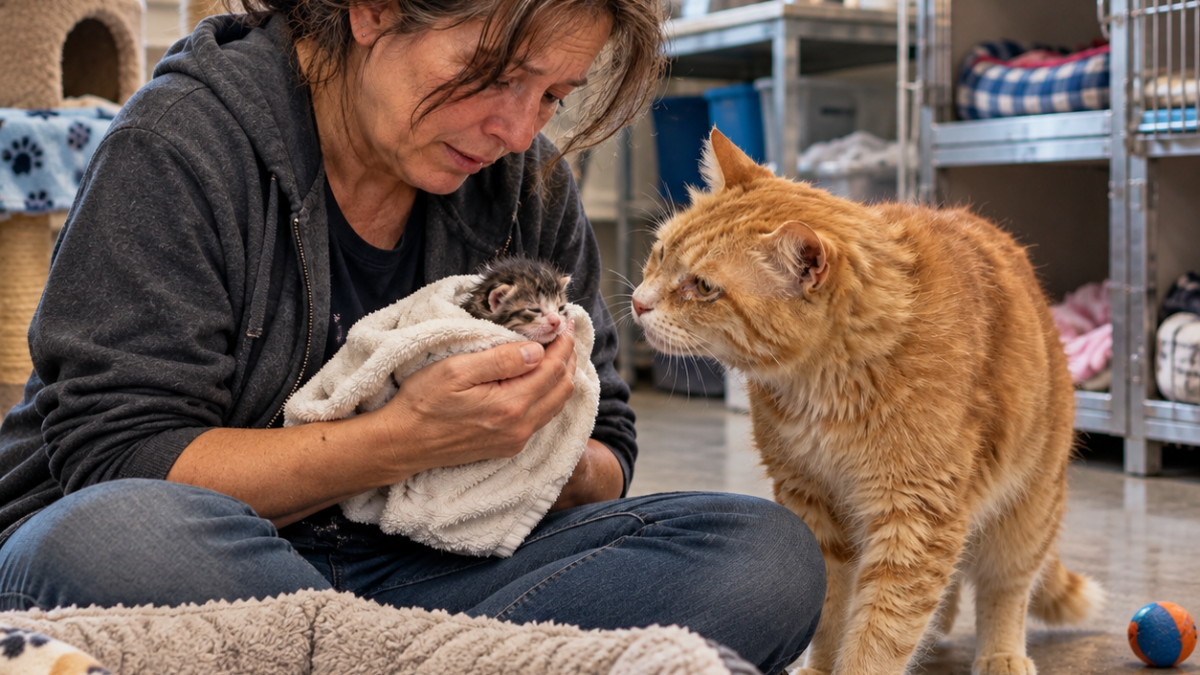
I sat in a chair with her wrapped against my chest.
Please.
That was all I could think.
Please.
Take one swallow.
Then something orange appeared beside my shoe.
Peaches.
I looked down.
“What are you doing?”
Peaches was twelve years old.
Maybe thirteen.
Records were uncertain.
She had come to us after her owner moved into assisted living and family members could not take her.
For almost a year, Peaches had remained at the shelter.
Not because anything was particularly wrong with her.
That was almost the problem.
She was old.
Independent.
Not interested in selling herself.
When visitors reached into her enclosure, she usually moved exactly six inches farther away.
If people used baby voices, she stared at them as though they had personally lowered the standards of civilization.
Children wanted kittens.
Adults often wanted cats under five.
People looking for affectionate seniors usually found another cat who actually acted pleased to meet them.
Peaches did not campaign.
She sat.
She watched.
She ate.
She slept.
Occasionally she swatted another cat for standing too close.
I loved her.
From a respectful distance.
I used to call her Principal Peaches.
She had the energy of a retired school administrator who had spent thirty-eight years dealing with nonsense and was now disappointed to discover nonsense had followed her into retirement.
That afternoon, she did not look annoyed.
She looked curious.
She walked toward me.
Then toward the towel.
I moved Minnie instinctively.
“Careful.”
Peaches sniffed.
Once.
Twice.
Then she stepped into the padded bed beside the kitten.
I nearly stopped her.
Linda raised one hand.
“Wait.”
Peaches circled once.
Then lowered herself.
Slowly.
And curled around Minnie.
Her body formed a warm orange wall around that little black-and-white scrap of life.
Then she began to purr.
Not a faint purr.
A deep, continuous vibration.
Minnie stopped squirming.
Her tiny body pressed into Peaches.
I stared.
“So we’re doing this?”
Peaches opened one eye.
I swear there was judgment in it.
Linda whispered:
“Try the bottle.”
I did.
The nipple touched Minnie’s mouth.
Nothing.
Then one tiny movement.
A lick.
Another.
Then a weak suck.
I froze.
Linda said:
“Don’t stop.”
I didn’t.
Minnie drank maybe a few drops.
That was all.
But she drank.
When you work around animals long enough, you stop calling every improvement a miracle.
Most things have explanations.
Warmth.
Smell.
Contact.
Instinct.
Stress reduction.
Biology is allowed to be beautiful without becoming magic.
But sitting there, watching Peaches curl around a kitten she had never seen before, I did not care what word anybody used.
Something had changed.
Peaches took the assignment seriously.
Very seriously.
If Minnie squeaked, Peaches stood.
If Minnie crawled toward the edge of the bedding, Peaches nudged her back.
If I picked Minnie up, Peaches watched me with an expression that suggested documentation would be filed.
During weigh-ins she followed.
During feeding she sat beside me.
If I took too long returning the kitten, Peaches walked over and stared until I corrected my behavior.
“She thinks you’re incompetent,” Linda told me.
“She may be right.”
We started calling her Mama Peaches.
The name should have been ridiculous.
This was the same cat who once slapped another adult cat because he sneezed near her tail.
Now she cleaned Minnie’s ears.
Her paws.
Her face.
She slept wrapped around her.
Minnie got stronger.
Slowly.
A week.
Then another.
Her eyes opened.
Her legs became less like noodles.
She learned that Peaches had ears.
This was unfortunate for Peaches.
Minnie bit them.
She climbed her.
Chewed her tail.
Attacked her paws.
Used her belly as a trampoline.
Peaches endured motherhood with the expression of someone who had not read the terms carefully enough.
Every few hours she would get up.
Walk three feet away.
Sit.
Minnie would cry.
Peaches would close her eyes.
Wait.
Minnie would cry again.
Peaches would turn around.
Every single time.
Then, one afternoon, Minnie stopped eating.
Again.
No warning.
The day before she had been energetic.
That morning she had played.
By afternoon she was weak.
Sleepy.
Not interested in food.
That familiar cold fear ran through me.
Linda arranged veterinary evaluation.
We did what the vet instructed.
Fluids.
Monitoring.
Warmth.
Rest.
Nothing dramatic.
Nothing guaranteed.
That night I sat beside the little bed.
Peaches was already there.
I put an extra blanket nearby so she could stretch out.
She ignored it.
She remained pressed against Minnie.
Purring.
Cleaning her.
Waiting.
Sometime after midnight, I fell asleep in the chair.
When I woke, my neck hurt and one arm was numb.
For a moment I didn’t know where I was.
Then I heard a squeak.
Sharp.
Demanding.
I looked down.
Minnie had pushed her face into Peaches and was yelling.
Not dying.
Demanding breakfast.
I started crying.
Loudly.
Peaches lifted her head.
Looked at me.
Her expression clearly said:
Control yourself.
From there, Minnie transformed.
She ran.
Played.
Destroyed paper.
Attacked shoelaces.
Discovered cardboard.
Learned that any object purchased specifically for cats was less interesting than the box it arrived in.
And Peaches changed too.
That part surprised me more.
She began coming to the front of her enclosure when I arrived.
She played.
Actually played.
One afternoon, I saw her chase Minnie across the cat room.
Twelve-year-old Peaches.
Running.
Minnie launched herself behind a chair.
Peaches followed.
For perhaps fifteen seconds, she looked five years old.
I stood there smiling like an idiot.
Then I realized something.
Maybe Peaches had never been cold.
Maybe she had simply stopped expecting anyone to need her.
Shelters do strange things to animals.
Even good shelters.
We can feed them.
Clean them.
Love them.
Give them enrichment.
But a shelter is still a place where people come, look, and sometimes walk away.
Peaches had been watched and passed over for nearly a year.
Every adoption day, people stopped.
“Oh, she’s pretty.”
“How old?”
“Twelve.”
Then the face changed.
Not cruelly.
Usually sadly.
“Oh.”
Then they moved.
Kittens went home.
Young adults went home.
Peaches stayed.
Maybe after enough months she stopped asking.
Minnie did not ask permission to need her.
She simply did.
Two months after Minnie arrived, the question we had been avoiding became unavoidable.
Minnie was healthy enough for adoption.
A family came to meet her.
Melissa and Ryan Parker.
Their daughter Emma.
Emma was eleven.
Quiet at first.
Then Minnie climbed into her lap and the child became completely incapable of pretending she didn’t want her.
The family felt right.
I hate saying that because “feels right” is not a professional screening tool.
We checked the normal things.
Housing.
Pets.
Veterinary history.
Expectations.
Finances.
But beyond that, they listened.
They didn’t just play with Minnie.
They asked what frightened her.
What food she ate.
What she was like at night.
Whether she scratched furniture.
Then Melissa noticed Peaches.
“Who’s that?”
I explained.
Emma walked toward Peaches.
Peaches moved six inches away.
Emma smiled.
“She doesn’t like me.”
“She doesn’t know you.”
Peaches stared.
“That’s probably the same thing.”
Emma sat on the floor.
Did not touch her.
Minnie climbed out of her lap and ran to Peaches.
Rubbed against her.
Peaches licked her head.
Melissa watched.
“What is that?”
I told them.
Everything.
The freezing kitten.
The bottle.
The purring.
Peaches cleaning her.
The second illness.
Every night together.
When I finished, the room was quiet.
Ryan looked at Peaches.
“How long has she been here?”
“Almost a year.”
“And no one wants her?”
“People have liked her.”
“That wasn’t my question.”
I looked at him.
“No.”
Emma was already sitting beside both cats.
Melissa asked:
“Would Minnie be okay without her?”
I should have given a simple shelter answer.
Young kittens adjust.
Cats adapt.
Not all close shelter relationships remain lifelong bonds.
But I looked at Minnie pressed against Peaches.
Then at Peaches grooming her.
“I don’t know.”
Melissa nodded.
A long silence.
Then she asked the question I still remember exactly.
“Can they go home together?”
I thought I had misheard.
“What?”
“Peaches and Minnie.”
She looked at Ryan.
He nodded.
“We don’t want to split them.”
I started crying.
Again.
Apparently that was going to be my role in this story.
Emma laughed.
“Are you okay?”
“No.”
I wiped my face.
“Yes.”
“No.”
“I don’t know.”
Peaches watched all of us with disgust.
They went home together.
For the first few weeks, Melissa sent pictures constantly.
Minnie asleep upside down.
Peaches sitting in a box much too small.
Minnie stealing food from Peaches.
Peaches grooming her afterward.
Emma doing homework with Minnie sitting directly on the worksheet.
Peaches sleeping near Emma’s feet.
One picture became my favorite.
Sunny window.
Peaches asleep.
Minnie stretched across her stomach.
Peaches had one paw over Minnie.
Her face looked deeply irritated that photography existed.
Perfect.
For months, I told everyone Peaches had saved Minnie.
That was true.
But incomplete.
Minnie saved Peaches too.
She gave an old cat who had been passed over again and again a reason to become necessary.
Then three months after their adoption, Melissa called me.
She was crying.
“Brenda.”
I knew immediately.
“What happened?”
“I need to ask you something awful.”
My whole body tightened.
“Are the cats okay?”
“Yes.”
“Emma?”
“Yes.”
“Then what?”
“We may have to bring one back.”
I pulled the phone away from my ear.
“One?”
Ryan had lost his job.
Not because he had done anything wrong.
Company downsizing.
He found another position.
Lower pay.
Longer commute.
The family cut expenses.
Subscriptions.
Restaurants.
Trips.
Anything optional.
Still, their rent renewal increased.
They needed a cheaper place.
They found one.
Clean.
Safe.
Closer to Ryan’s new job.
Emma could stay in her school.
One problem.
One-cat limit.
Not two.
Melissa cried harder.
“I know what you’re thinking.”
She was right.
Don’t split them.
The thought came so fast it almost became accusation.
Instead, I asked:
“Have you talked to the landlord?”
“Yes.”
“Deposit?”
“Doesn’t matter.”
“Pet rent?”
“No.”
“Another apartment?”
“Everything that takes two is either more expensive or too far.”
I sat down.
The shelter was loud behind me.
Bowls being washed.
Dog barking.
Phones.
Normal life.
But I could only see Peaches curling around Minnie.
“You can’t separate them.”
The words came harder than I meant.
Melissa stopped.
Then quietly:
“I know.”
I immediately felt ashamed.
Not because I thought separation was good.
Because Melissa sounded like somebody who had already lost every argument inside her own head.
“What are you considering?”
They had talked for almost a week.
Ryan thought Peaches should come back.
That sounds terrible if you say it quickly.
Old cat returned.
Young cat stays.
But his reasoning was not cruelty.
Minnie was young.
Healthy.
Emma’s cat in a way Peaches wasn’t.
Minnie slept on Emma’s bed.
Followed her.
Sat in her lap.
Cried outside the bathroom door.
When Emma was upset, Minnie appeared.
Peaches loved everyone too.
But differently.
She loved Minnie most.
She was still independent with people.
Rarely climbed into laps.
Did not demand affection.
Ryan thought she might adjust more easily.
Melissa disagreed.
“She waited almost a year.”
I closed my eyes.
“I know.”
“And now she’s finally in a home.”
“I know.”
“We’re going to send her back because she’s old?”
There it was.
The thing underneath everything.
Peaches was thirteen now.
Minnie was still young.
If one came back to the shelter, we knew which would get adopted quickly.
Minnie could walk into an adoption room, climb into someone’s lap, and be gone by Saturday.
Peaches might wait.
Again.
Melissa whispered:
“I feel like we promised her.”
I did too.
Then I remembered something shelters sometimes forget when we’re judging people from the outside.
Promises are easiest when life cooperates.
What happens when keeping them costs something you did not expect?
I asked what Emma thought.
“That is the worst part.”
Emma understood enough to know the apartment meant one cat.
Her first answer:
Live somewhere else.
They explained money.
She offered to quit dance.
Not enough.
She offered to stop buying school lunch.
Not enough.
Ryan, desperate, made the mistake of asking which cat she would keep.
Emma ran upstairs.
Did not speak to him that night.
The next morning, she left a note.
Melissa read it to me.
“Peaches stayed with Minnie when Minnie needed her. We should stay with Peaches when Peaches needs us.”
I sat there with my eyes closed.
Eleven years old.
No understanding of rent negotiations.
Perfect understanding of loyalty.
“Tell me what to do,” Melissa said.
Nobody really means that sentence.
What they mean is:
Tell me how to make this stop hurting.
I could not.
“I can’t decide for your family.”
“But?”
“But I don’t think returning Peaches alone is fair.”
Melissa cried.
“I knew.”
“They’re bonded.”
“I know.”
“Minnie has never lived without her.”
“I know.”
“And Peaches…”
I stopped.
Anger rose in me.
Not at Melissa.
Not exactly at Ryan.
At the situation.
We tell people animals are family.
Adopt for life.
Forever home.
Then life becomes expensive.
Housing changes.
Someone gets sick.
A job disappears.
Suddenly those slogans are tested.
I said:
“If you truly cannot keep them, we’ll take both back together.”
Silence.
“Both?”
“Yes.”
“But Emma would lose Minnie.”
“I know.”
“That can’t be what you’re saying.”
“I don’t want her to lose Minnie.”
“Then what are you saying?”
My voice sharpened.
“I don’t think Minnie should keep her family while Peaches loses hers.”
The moment I heard myself, I knew.
Harsh.
Melissa heard it too.
“So my daughter should lose both cats because my husband lost his job?”
“No.”
“That is what it sounds like.”
“Melissa—”
“She didn’t do anything.”
“I know.”
“Ryan didn’t choose to lose his job.”
“I know.”
“We aren’t dumping them because we’re tired of them.”
“I know.”
Her anger was deserved.
I was protecting Peaches.
She was protecting her child.
Neither of us was evil.
That was what made the situation unbearable.
Then Melissa said something I have never forgotten.
“People say don’t adopt unless you’re ready for fifteen years.”
She sniffed.
“But nobody knows what their life looks like fifteen years from now.”
She was right.
People get sick.
Jobs disappear.
Parents age.
Marriages end.
Rents rise.
Children develop needs.
Housing changes.
Life does not check your adoption contract before becoming difficult.
We both apologized.
Then I said:
“Give me forty-eight hours.”
“For what?”
“I don’t know.”
That was true.
I simply could not picture Peaches entering that shelter alone.
I spoke to Linda the next morning.
She listened.
Then:
“You told them we would only take both?”
“Yes.”
“That was bold.”
“Meaning stupid?”
“I didn’t say stupid.”
“You thought it.”
“A little.”
I crossed my arms.
“They shouldn’t be separated.”
“I agree.”
“Then what’s wrong?”
Linda leaned back.
“We don’t live in perfect rescue stories.”
I hated that sentence.
She continued.
“If they return both, what happens?”
“We adopt them together.”
“Maybe.”
“We will.”
“Maybe.”
She reminded me:
Bonded pairs take longer.
Two animals cost more.
Senior cats take longer.
Peaches was thirteen.
“If they come back, they might sit here six months.”
“I know.”
“A year.”
“I know.”
“And you’re telling a family trying desperately to keep one that both are better here?”
I stared.
“When you say it like that, I sound horrible.”
“You don’t sound horrible.”
“Then what?”
“Complicated.”
I hated that word.
Complicated means no villain.
No hero.
No simple sentence for social media.
Real life loves complicated.
“What do you actually want?” Linda asked.
“The apartment manager changes the rule.”
“Next.”
“They find affordable housing that allows both.”
“Next.”
I hated her.
“I want Peaches not to be abandoned again.”
Linda softened.
“She isn’t being abandoned.”
“She won’t understand the difference.”
That was the part people forget.
Peaches did not understand rent.
Downsizing.
Employment.
Pet limits.
She understood:
Yesterday I lived beside Minnie.
Today I don’t.
Animals do not understand our reasons.
Only the change.
Linda said:
“Find a foster.”
Both cats.
Temporary.
I made calls.
Everyone was full.
Nursing mothers.
Seniors on medication.
Cats recovering from surgery.
One could take Minnie.
Not Peaches.
Useless.
Another could take both for three weeks.
Also useless.
At the end of the second day, Melissa called.
“I have to tell the apartment office tomorrow.”
“I know.”
Pause.
“We decided.”
My heart sank.
“What?”
“We’re keeping Minnie.”
I closed my eyes.
She explained.
Emma was barely sleeping.
Carrying Minnie everywhere.
Ryan was devastated.
Melissa was exhausted.
They believed returning Peaches was the least damaging option.
“Please don’t think we don’t love her.”
I hesitated too long.
“Brenda?”
“I know you love her.”
“We’re not throwing her away.”
“I know.”
“We’re trying to survive a bad year.”
That stopped me.
Sometimes responsible people do not get good options.
They get three painful options and then strangers judge which one they choose.
“Saturday,” I said.
“We’ll be ready.”
After hanging up, I went into the shelter bathroom and cried.
Saturday came.
I prepared an enclosure for Peaches.
Blankets.
Cardboard box.
Toy mouse.
Everything she used to like.
It felt like preparing a hotel room for someone who did not want to travel.
At 9:17, Melissa’s car pulled into the lot.
I saw Emma in back.
Then two carriers.
Two.
I went outside.
Melissa looked exhausted.
Ryan worse.
Emma stayed in the car.
“You brought Minnie?”
Melissa nodded.
“We changed our minds.”
I thought I would feel relief.
Instead, I felt sick.
Emma carried Minnie.
Ryan carried Peaches.
Inside the adoption room, the carriers sat side by side.
Immediately:
Minnie cried.
Peaches answered.
Minnie scratched at the door.
Peaches pushed her nose against the bars nearest Minnie.
Emma started crying.
“This is stupid.”
“What is?”
“All of it.”
Fair.
She looked at Ryan.
“Dad wanted to keep Minnie.”
Ryan lowered his head.
“I told him no.”
Melissa reached for her daughter.
Emma pulled away.
Not cruelly.
Just overwhelmed.
“Peaches took care of Minnie. If Minnie has to leave, Peaches goes too.”
For one second I felt proud.
Then I looked at Ryan.
He looked broken.
And I realized we had made an eleven-year-old carry a moral problem adults could barely hold.
Ryan crouched.
“You’re right.”
Emma looked at him.
“I shouldn’t have asked you.”
Her face softened slightly.
“I was scared.”
He continued.
“I thought keeping one cat was better than losing both.”
Nobody spoke.
Then Ryan said:
“I still think that.”
The room changed.
“I know that makes me sound awful.”
“I don’t think you’re awful,” I said.
He looked at me as if I was lying.
“I’m the guy who wanted to keep the kitten and send back the old cat.”
“When you say it like that…”
“Exactly.”
He looked at Emma.
“She already lost her house.”
Melissa corrected gently.
“We’re moving.”
“To her, that’s losing home.”
He looked at me.
“New bedroom. New neighborhood. Longer drive. I’m keeping her in the same school because I promised she wouldn’t lose that.”
Then:
“And I thought maybe she shouldn’t lose the cat that sleeps beside her.”
I had spent two days thinking what Peaches deserved.
Ryan had spent two days thinking what his daughter could survive.
Both mattered.
Minnie cried.
Peaches answered.
Again.
Again.
Emma covered her face.
Then the door opened.
Linda.
She looked at us.
The carriers.
Emma.
“What happened?”
“They brought both.”
Linda frowned.
Then:
“Maybe you don’t need a permanent decision.”
Melissa looked up.
“What?”
Linda looked at me.
“You didn’t check yesterday’s volunteer list?”
“No.”
“You should.”
“Linda.”
She raised one hand.
“Martha called.”
I knew Martha.
Sixty-seven.
Widowed.
Former foster volunteer.
Stopped after her own cat died.
“She’ll take both.”
My heart jumped.
“How long?”
“Six months.”
Nobody moved.
“Maybe longer.”
Melissa started crying immediately.
Emma looked at Linda.
“Can we see them?”
“I think Martha would be offended if you didn’t.”
Emma laughed.
Tiny.
First good sound all morning.
Ryan did not smile.
“What happens after six months?”
There it was.
Linda did not lie.
“We see.”
“If we’re still in the apartment?”
“We decide then.”
“So we’re postponing this.”
“Maybe.”
Ryan rubbed his face.
“I don’t want Emma thinking everything is fixed if it isn’t.”
Emma whispered:
“I do.”
Everyone looked.
“Let them stay together.”
Ryan closed his eyes.
“If we can get them back, we get them back.”
Her voice shook.
“If we can’t…”
She swallowed.
“Find them a home together.”
Then, firmer:
“Nobody gets to pick one.”
That afternoon, Peaches and Minnie went to Martha.
Not home.
Not shelter.
Something in between.
First photo Martha sent:
Minnie under sofa.
Peaches sitting three feet away, watching Martha like she was evaluating a background check.
I laughed.
Perfectly Peaches.
The first week was hard.
Minnie hid.
Peaches ate poorly.
Then Emma visited.
The moment she entered, Minnie shot from under the sofa.
Straight into her lap.
Emma sat on the floor crying.
Peaches approached more slowly.
Emma whispered:
“I’m sorry.”
Peaches rubbed her head against Emma’s hand.
That nearly destroyed me.
Cats do not understand apologies.
Or maybe they understand the part that matters.
Presence.
Touch.
Voice.
For months, Emma visited every Saturday.
Melissa often came.
Ryan when work allowed.
They brought food.
Litter.
Toys.
Martha complained.
They ignored her.
Minnie adjusted.
Peaches took longer.
Eventually Peaches started sitting beside Martha in the evening.
Not on her lap.
Let’s remain realistic.
Beside her.
For Peaches, that was practically marriage.
One night Martha called.
“You won’t believe this.”
“What?”
“She brought me a sock.”
“A sock?”
“Dirty.”
“Congratulations.”
“Is that good?”
“For Peaches, that’s probably an engagement ring.”
Martha laughed.
Something else happened.
Martha changed.
We had seen her as the solution.
Temporary safe place.
We did not ask what two cats might do to her.
Her husband had died four years earlier.
Then her cat.
Children lived in other states.
They loved her.
Called.
Visited.
But most days her house was quiet.
She said she liked quiet.
Then Peaches and Minnie arrived.
Suddenly there were food bowls.
Destroyed paper towels.
Cat hair.
Things falling at night.
Someone waiting when she opened the door.
One afternoon Martha said:
“I forgot what it’s like to come home and have someone there.”
Loneliness is not always tragedy.
Sometimes it is dinner in front of the television because setting a table for one feels ridiculous.
A radio left on.
A room that never gets messy.
Martha had a good life.
Friends.
Family.
Volunteering.
But Peaches and Minnie filled a space she had stopped measuring.
Three months later, Melissa called.
Excited.
They had found another rental.
Older.
Smaller.
Longer commute.
Not ideal.
Allowed two cats.
“When can we bring them home?”
I was happy.
Mostly.
Then I thought about Martha.
I drove over.
Peaches was sleeping on the couch.
Minnie was attacking nothing visible.
I told her.
Martha smiled immediately.
“Oh.”
One word.
I heard everything in it.
“That’s good.”
“Yes.”
“Really good.”
“Yes.”
She stood.
Started collecting toys.
“Martha.”
“I should wash the blankets.”
“Not today.”
“The tunnel thing should go. Minnie loves it.”
“Martha.”
She stopped.
Sat.
“I knew it was temporary.”
“I know.”
“That was the deal.”
“I know.”
“I’m happy.”
“I know.”
She looked toward Peaches.
“That old cat fooled me.”
“How?”
“I thought she needed me.”
I waited.
Martha wiped her face.
“Turns out I needed her.”
Again.
Peaches saved Minnie.
Minnie saved Peaches.
Now both had saved Martha in some small way.
The reunion happened Saturday.
Emma ran through the door.
Minnie ran to her.
Immediately.
Climbed Emma’s jeans like a criminal.
Emma screamed.
Laughed.
Cried.
Melissa cried.
Ryan hugged Martha.
I cried because apparently I was committed to consistency.
Peaches stayed on the couch.
Emma walked over.
“Hi, Mama Peaches.”
Peaches blinked.
Emma scratched under her chin.
Peaches stood.
Walked past Emma.
Straight to Martha.
Then sat beside Martha’s leg.
The room became silent.
Martha looked horrified.
“Oh no.”
Peaches leaned against her ankle.
Emma stared.
“She wants to stay.”
Melissa said:
“We don’t know that.”
Emma looked at her.
“Yes, we do.”
Ryan sighed.
“She loves Martha.”
Martha shook her head.
“She loves you too.”
Peaches began washing a paw.
Completely unwilling to clarify her legal position.
“Perfect,” Melissa muttered.
Months earlier, we had insisted the cats could not be separated.
Now Peaches had built another bond.
Love had complicated the simple answer.
Martha said:
“You should take her.”
Emma:
“She’s yours.”
“No.”
“She picked you.”
That sentence hit everyone.
Martha’s face changed.
I looked at Minnie.
Minnie was inside a paper bag.
Our leading philosopher.
I asked Emma to sit beside Peaches.
Peaches stayed with Martha.
Then Emma called Minnie.
Minnie came.
Climbed onto the couch.
Rubbed against Peaches.
Peaches licked her head.
Once.
Twice.
Then Peaches stood.
Walked to Emma.
Sat beside her.
Martha cried.
“So that’s settled.”
I wasn’t sure.
Maybe Peaches chose.
Maybe she moved three feet.
Humans are very good at making animal behavior solve human problems.
Melissa asked Martha:
“Do you want her to stay?”
Martha looked at Peaches.
Minnie.
Emma.
“Yes.”
Nobody breathed.
Then Martha added:
“And no.”
That was probably the truest answer.
She loved Peaches enough to want her.
And enough not to claim her.
Peaches and Minnie went home together.
As their car left, I turned around.
Martha stood alone in her driveway.
That image stayed with me.
Happy endings usually leave somebody standing in the driveway after the happy people leave.
We just do not photograph that part.
Two weeks later, Martha’s house felt too quiet.
She joked:
“My socks are safe.”
“Terrible.”
“My laundry stays folded.”
“Awful.”
Then her eyes filled.
“Want to foster again?” I asked.
“No.”
Too fast.
I understood.
To foster means opening your home to something temporary.
Then teaching it safety.
Then, if you do everything right, sometimes handing it away.
People call that beautiful.
It is.
It can also hurt terribly.
A few months passed.
Peaches and Minnie settled back with Melissa’s family.
The new place was small.
Old cabinets.
Long commute.
Emma’s bedroom barely held a bed and desk.
But both cats were there.
Then Peaches became sick.
Kidney disease.
Not dying immediately.
Not a crisis.
But thirteen years old.
Special food.
Monitoring.
Appointments.
Medication possibly.
Extra cost.
The family’s finances were still recovering.
Melissa called me.
“Ryan asked how far we’re supposed to go.”
I knew what she meant.
Treatment.
Money.
Time.
Quality of life.
There are questions people love answering for other people.
How much should someone spend on an elderly pet?
Everything?
Nothing beyond comfort?
Does age matter?
Prognosis?
Quality?
Is setting a financial limit heartless?
Is refusing to set one irresponsible?
I’ve seen people spend money they did not have for another month.
I’ve seen others choose comfort earlier because treatment itself had become suffering.
Both choices can come from love.
Both can be judged by strangers.
I told Melissa:
“Make decisions based on Peaches’ life, not your guilt.”
She cried.
“Emma thinks if we love her enough we can fix it.”
“That sounds like Emma.”
“How do you explain love doesn’t fix everything?”
I looked across my kitchen.
My own cat asleep in a chair.
“Maybe you don’t.”
“What do I say?”
“Tell her love is why you stay while you figure out what can be fixed and what can’t.”
A few days later, I visited.
Peaches had lost weight.
Still looked annoyed with me.
That reassured me.
Minnie followed her everywhere.
Peaches drank.
Minnie watched.
Peaches moved chairs.
Minnie moved.
Peaches slept.
Minnie nearby.
Ryan was in the kitchen.
He looked tired.
“You can say it.”
“What?”
“That I’m the bad guy again.”
“I don’t think you are.”
He raised an eyebrow.
“I mean it.”
“I keep asking the ugly questions.”
“Someone has to.”
“Does that make me awful?”
“No.”
“I wanted to keep Minnie.”
“I remember.”
“Now I’m asking what we can afford for Peaches.”
“I know.”
“Emma thinks I’m trying to get rid of her.”
His face hurt when he said it.
Peaches, ten feet away, started chewing a plant.
Ryan pointed.
“She is destroying something while I defend her.”
I laughed.
So did he.
Then:
“My job is to think about everybody in this house.”
That mattered.
Not just Peaches.
Not just Minnie.
Not just Emma.
Everybody.
“If I spend every dollar because I’m afraid strangers would call me heartless, that doesn’t make me a better father.”
He looked down the hall.
“And if I give up because it’s hard, that doesn’t make me better either.”
There it was.
The middle.
Nobody likes the middle.
It does not fit into a slogan.
Most decent people live there.
Trying.
Adjusting.
Making imperfect decisions.
Trying again.
Peaches did well for months.
Ate.
Slept.
Groomed Minnie.
Sat near the window.
Moved six inches away whenever affection became excessive.
Then Martha began visiting.
At first Melissa probably invited her out of guilt.
Soon it became normal.
Every other Sunday.
Martha sat on the couch.
Peaches always went to her.
Always.
Minnie climbed across both.
Emma loved it.
Ryan called it “shared custody.”
They laughed because laughing was easier than explaining what it meant.
One Sunday, Martha called me afterward.
“I think I’m ready.”
“To foster?”
“Yes.”
“You sure?”
“No.”
“Excellent.”
At the shelter I showed her several cats.
Young tabby.
Shy two-year-old.
Then Earl.
Remember Earl?
Old black cat in the top corner the day Melissa first called me?
Still there.
Almost a year.
Martha stood before his enclosure.
“He doesn’t seem interested.”
I laughed.
“What?”
“You have a type.”
“I do not.”
She opened the door.
Held out a hand.
Earl sniffed.
Then moved away.
Martha smiled.
“Oh.”
I knew.
“What?”
“He’s rude.”
“Extremely.”
“I like him.”
Of course.
She fostered Earl.
Two weeks later, adopted him.
He entered her house like someone finally handing him property he’d been waiting to inherit.
She sent pictures.
Earl on couch.
Bed.
Window.
Ignoring expensive cat bed.
Then one image stopped me.
Earl sat beside the same window where Peaches used to sit.
For a moment, sadness.
Then something better.
Nothing had replaced Peaches.
That was never the purpose.
Love is not a parking space.
Someone new does not erase whoever sat there before.
A year after Peaches and Minnie first went home, Melissa invited me to Emma’s birthday.
I dislike children’s parties.
Noise.
Frosting.
People discovering I volunteer at a shelter and immediately asking me to help convince their spouse to adopt four kittens.
I went anyway.
Peaches was thinner.
Slower.
Older.
Still Peaches.
Minnie had grown beautiful.
Long.
Bright-eyed.
Completely certain every object belonged to her.
At one point, Emma sat on the floor.
Minnie climbed into her lap.
Peaches rested beside her leg.
Across the room, Martha sat talking with Melissa.
Ryan carried paper plates.
Someone searched for candles.
Nothing dramatic.
Nobody being saved.
Nobody making impossible decisions.
Just ordinary people.
Ordinary cats.
Ordinary afternoon.
I remember thinking:
This is what all that pain bought.
Not a perfect ending.
More ordinary days.
A few months later, Peaches worsened.
She stopped climbing into her chair.
Then lost interest in food.
Veterinarian adjusted treatment.
Eventually, one evening, Melissa called.
“We think it’s time.”
I knew.
I drove over.
Martha was there.
Peaches lay on Emma’s old folded sweatshirt.
The same one she had preferred over every expensive bed.
Emma beside her.
Minnie curled against Peaches’ back.
Ryan on the floor.
Melissa crying quietly.
Martha’s hand near Peaches.
Peaches looked tired.
Calm.
I sat.
No speeches.
For a while, nobody talked.
Just people on a floor around an old orange cat.
Emma whispered:
“She saved Minnie.”
“Yes.”
“Minnie saved her.”
“Yes.”
Ryan looked down.
“She saved us some too.”
Nobody laughed.
We understood.
Peaches had forced them to decide what family meant when family became inconvenient.
Not perfect.
Not unlimited money.
Not endless patience.
A family willing to remain in the room when decisions became hard.
Martha whispered:
“She saved me.”
Emma looked at me.
“Who did we save?”
I almost said Peaches.
Easy answer.
Instead:
“Each other.”
Peaches died peacefully with Minnie beside her.
I will not turn it into something cinematic.
Death rarely needs help being emotional.
It was quiet.
Sad.
Gentle.
Emma cried against Melissa.
Ryan cried.
Martha cried.
I cried.
Minnie stayed beside Peaches for a while.
Then she stood.
Walked to Emma.
Climbed into her lap.
That broke everybody.
For weeks, Minnie searched.
Chair.
Window.
Little bed Peaches never used.
She cried at night.
Emma kept the bedroom door open.
Eventually Minnie adjusted.
Not because she forgot.
Because living things continue.
That is one of the cruelest and most beautiful things about them.
Martha kept visiting.
Earl remained rude.
Ryan’s work improved.
The family stayed in the smaller rental longer than expected.
They never regretted taking it.
At least that’s what they told me.
People still ask what the family should have done when the apartment allowed one cat.
Everyone has an answer.
Some say Ryan was right.
Keep Minnie.
Protect Emma.
Return Peaches.
Others say Emma was right.
Family stays together.
Some say Melissa and Ryan never should have adopted two animals without being able to guarantee fifteen years.
I understand the instinct.
I no longer agree with the certainty.
Nobody guarantees fifteen years.
You can plan.
Save.
Buy insurance.
Choose carefully.
Then life arrives.
Someone gets sick.
Somebody dies.
A company closes.
A landlord sells.
A marriage changes.
Parents need care.
Children need something you never budgeted for.
Responsibility is not predicting every disaster.
Sometimes it is how you behave after the prediction fails.
I also had to admit something uncomfortable.
My first reaction to Melissa had been morally clean and emotionally easy.
Don’t separate them.
Simple.
Except I was not paying their rent.
I was not Emma’s mother.
I wasn’t commuting.
I wasn’t deciding which bills waited.
Compassion from outside can become arrogance very quickly.
Ryan’s first solution hurt Peaches.
Mine could have hurt Emma.
Both of us were trying to protect someone.
Linda had been right.
Real rescue stories are complicated.
That does not mean standards disappear.
Animals are not disposable.
Promises matter.
But so does mercy toward imperfect people making hard choices.
Peaches taught me that too.
An old cat who seemed unwilling to love anyone turned out to have an enormous amount left.
Maybe people are like that.
Maybe somebody can make a bad decision and still be trying.
Maybe someone can be scared and responsible at the same time.
Maybe family is not proven by never having a crisis.
Maybe it is proven by how honestly you face the crisis when it comes.
Months after Peaches died, Emma visited the shelter with Melissa.
They brought blankets.
Food.
Donations.
Emma had grown taller.
Minnie was doing well.
Emma walked through the cat room.
Then stopped at a lower enclosure.
Inside slept a twelve-year-old gray cat.
Nothing special.
No dramatic story on the card.
No missing leg.
No viral eyes.
Just old.
Emma crouched.
“What’s his name?”
I told her.
“How long?”
“Seven months.”
“Why?”
“Older cats wait.”
She frowned.
Opened the enclosure.
The gray cat looked at her.
Then moved exactly six inches farther away.
I started laughing.
Emma looked at me.
“What?”
“Nothing.”
She reached in.
The cat stared at her like she had personally offended him.
Emma smiled.
And for one second, I saw Peaches.
Not visually.
The moment.
Someone overlooked.
Somebody else deciding to look again.
Emma stayed twenty minutes.
Before leaving, she asked:
“Someone will take him, right?”
“I hope.”
She looked at the gray cat.
Then at me.
“If people knew what Peaches did, they wouldn’t skip the old ones.”
Maybe.
People forget.
We all do.
That’s why I keep telling her story.
Not because Peaches was magical.
She wasn’t.
She was grumpy.
Stole food.
Hated being held.
Disliked strangers touching her stomach.
Once slapped a volunteer because he sneezed too close to her.
She was not a saint.
She was an elderly orange cat with opinions.
That was exactly why she mattered.
You do not have to be perfect to change someone’s life.
You do not have to be young.
Easy.
Friendly.
Beautiful.
Chosen first.
Sometimes the thing everyone assumes you no longer have is exactly what somebody else desperately needs.
Peaches spent almost a year in a shelter because people kept choosing easier.
Then one tiny kitten needed something Peaches had not been asked to give in a very long time.
Warmth.
Patience.
Presence.
Love.
Not cute love.
Not convenient love.
The kind that gets up when somebody cries.
The kind that sits beside sickness.
The kind that returns every time.
Minnie gave Peaches purpose.
Peaches gave Minnie a beginning.
Melissa’s family gave them a home.
Martha gave them somewhere safe when that home became uncertain.
Peaches gave Martha a reason to open her house again.
Then Martha opened it for Earl.
Emma learned that loving someone sometimes means refusing the easiest choice.
Ryan learned that asking painful questions does not mean you love less.
Melissa learned that promises can bend without becoming meaningless.
And I learned that rescuing an animal is rarely a straight line from danger to happiness.
Sometimes it loops.
Breaks.
Changes hands.
Asks more than anyone expected.
Years after I first held Minnie in one cold hand, I still remember the moment Peaches walked toward her.
I nearly stopped her.
I thought I knew who Peaches was.
Old.
Distant.
Done with everybody.
I was wrong.
She sniffed that tiny kitten.
Climbed into the bed.
Curled around her.
Started purring.
One step.
That was all.
One old cat walking toward somebody everyone else feared we were going to lose.
And somehow, that small decision kept moving outward for years.
Into Emma.
Melissa.
Ryan.
Martha.
Earl.
Me.
Maybe that’s the part worth remembering.
We spend a lot of time wondering whether we are still useful after disappointment.
Age.
Loss.
Being passed over.
Failure.
Grief.
Peaches never asked any of those questions.
A kitten was cold.
So she moved closer.
Sometimes that’s enough.
Sometimes changing a life does not begin with being extraordinary.
Sometimes it begins with refusing to walk away.








