The Doorbell Camera Caught a Scarred Stray Cat Carrying a Newborn at 2 A.M.—Then She Realized Why He Had Chosen Her Door
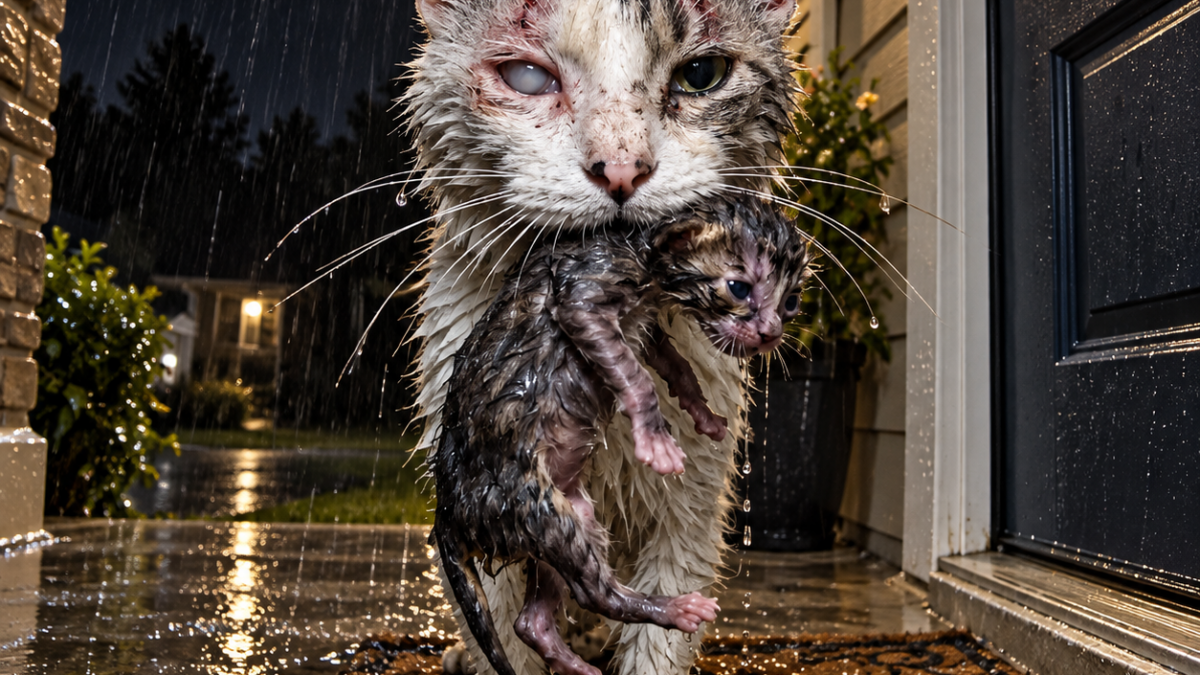
The Doorbell Camera Caught a Scarred Stray Cat Carrying a Newborn at 2 A.M.—Then She Realized Why He Had Chosen Her Door.
At 2:04 in the morning, a retired nurse opened her doorbell camera and saw the most feared stray cat in the neighborhood staring directly into the lens with a newborn kitten hanging from his jaws.
Her first scream woke her husband because she thought she was watching a tomcat kill a litter—but then she noticed he was holding the tiny body gently by the loose skin of its neck, exactly the way a mother cat would carry her young.
Eleven minutes later he came back with another kitten, and by 3:26 a.m. the scarred animal nobody had been able to touch for years had crossed a violent storm four times to deliver an entire orphaned litter to the only human on the street he had decided was safe.
At 2:04 in the morning, Elaine Mercer’s phone lit up on the nightstand.
MOTION DETECTED — FRONT DOOR.
She did not wake immediately.
The storm had been hammering the house for almost thirty-six hours, and every few minutes some branch, leaf, trash can lid, or piece of blown debris triggered one of the cameras around the property.
Her husband, Tom, had already threatened to throw the doorbell camera into the creek if it woke them one more time.
Elaine had laughed.
At 11:30.
At 12:40, she had been less amused.
At 2:04, she opened one eye, saw the glow, and almost ignored it.
Then something scraped against the porch.
Not wind.
Not a branch.
A soft dragging sound.
Then silence.
Elaine reached for the phone.
She was sixty-eight years old, retired after thirty-six years as a registered nurse, and had spent most of her adult life learning the difference between emergencies and things that only looked like emergencies.
That night she was wrong twice in less than ten seconds.
She opened the live camera feed.
And screamed.
Tom bolted upright beside her.
“What?”
Elaine could not answer.
The screen was filled with a face.
White and gray fur.
Torn left ear.
A thick scar running diagonally across the forehead.
One eye pale and cloudy.
Rainwater dripping from long whiskers.
The animal was so close to the camera that his nose looked enormous.
Ghost.
The neighborhood tomcat.
And hanging from Ghost’s mouth was a newborn kitten.
Tom leaned over.
“What the hell?”
Elaine’s stomach dropped.
“No.”
Ghost stood under the porch light with the kitten dangling from his jaws.
Elaine had fed stray and feral cats for years.
Not as some grand rescue operation.
She did not run a shelter.
Did not have thirty cats living in the house.
She simply could not stand watching hungry animals pass through the yard when food cost so little compared with what hunger cost them.
A ceramic bowl sat on the back steps.
Dry kibble in the morning.
Fresh water.
Wet food on the coldest nights.
Most of the neighborhood strays eventually learned the schedule.
Orange cats.
Black cats.
A calico with half a tail.
PART2:
A tiny gray female who would scream through the screen door if Elaine was late.
Ghost was different.
He had appeared maybe four years earlier.
Already adult.
Already scarred.
Nobody knew where he came from.
He was huge.
Not overweight.
Just built like a small wild animal.
Broad head.
Thick shoulders.
Heavy paws.
One ear looked as though something had chewed half of it away.
The cloudy eye gave him a permanent sideways stare.
Children called him Monster at first.
Elaine hated that.
Someone eventually started calling him Ghost because he appeared silently, ate, and vanished.
That name stayed.
Ghost trusted nobody.
Animal control had attempted to trap him twice.
Failed.
A neighbor tried grabbing him with welding gloves.
Required antibiotics afterward.
PART3:
One teenager threw a rock near him once.
Ghost disappeared for nearly a month.
After that, Elaine stopped letting people bother him when he came near her property.
“He doesn’t owe us affection.”
She told Tom.
“He just needs somewhere he can eat without somebody chasing him.”
It took almost a year before Ghost would approach the food while Elaine stood behind the closed kitchen window.
Another six months before he would eat with the back door cracked open.
At two years, Elaine could sit inside the screened porch while Ghost ate ten feet away.
Ten feet.
Never nine.
If she shifted toward him, he left.
If she reached a hand, he vanished.
There had never been touching.
No petting.
No purring.
No rubbing against her ankle.
Their entire relationship was permission.
Ghost allowed Elaine to exist nearby while he ate.
Elaine considered that trust.
Tom called it “a very one-sided friendship.”
Elaine didn’t care.
Then, at 2:04 on an October morning, the most untouchable animal she had ever known stood inches from her doorbell camera with a newborn kitten in his mouth.
And every ugly story she had ever heard about male cats flashed through her head.
“Oh God.”
Elaine whispered.
Tom squinted at the screen.
“What is he doing?”
“I don’t know.”
But she thought she knew.
Tomcats could be dangerous around newborn litters.
Elaine had heard enough rescue workers warn about separating unknown males from kittens.
Her mind immediately filled in the worst version.
Dead mother somewhere.
Unprotected babies.
Ghost had found one.
Maybe he was carrying it off.
Maybe she was watching the end of something terrible.
She swung her legs off the bed.
Then stopped.
“Wait.”
“What?”
“Look.”
She enlarged the image.
The kitten hung from the loose skin behind the neck.
Ghost’s teeth were not clamped around its body.
No shaking.
No biting.
No blood.
The kitten’s legs dangled.
Its eyes were barely open.
And Ghost was not trying to leave.
That was the part Elaine suddenly understood.
He was standing at her door.
Not the back steps where the food was.
The front door.
Beneath the porch light.
Directly in front of the only camera on the street.
He had positioned himself where she could see him.
“He’s showing us.”
Tom looked at her.
“What?”
“He’s showing me the kitten.”
Elaine was already moving.
“Elaine, wait.”
She grabbed robe.
Slippers.
Opened bedroom door.
Tom followed.
The storm sounded louder downstairs.
Rain battered windows.
Wind pushed through the old maples.
The porch light glowed through curtains.
Elaine unlocked front door.
Her hands were shaking.
She opened it maybe twelve inches.
Ghost stood four feet away.
The kitten still in his mouth.
For two years, four feet would have been impossible.
Ghost did not run.
Elaine opened the door farther.
“Hey.”
Her voice came out barely above breath.
“Ghost.”
The big tom watched her.
His cloudy eye made it difficult to read his gaze, but the clear one never left her face.
Elaine crouched.
Not too close.
The kitten made a tiny sound.
A squeak more than a cry.
“Oh, baby.”
Ghost stepped forward.
One step.
Elaine froze.
Two.
He came closer than he ever had in four years.
Then he lowered his head.
Very carefully.
And placed the kitten on the welcome mat.
At Elaine’s bare toes.
He released.
Stepped backward.
Three full paces.
Sat down in the rain beyond the porch overhang.
Elaine stared.
The kitten wriggled.
Alive.
Cold.
So cold that Elaine could feel it through the towel when she scooped it up.
“Oh my God.”
She whispered.
Tom stood behind.
“Is it alive?”
“Yes.”
“Barely warm.”
Elaine’s nursing instincts took over.
Warm first.
Not food.
Not water.
Warmth.
She carried the kitten inside.
Tom grabbed towels.
Heating pad.
A cardboard box.
Elaine rubbed gently.
The tiny body was wet through.
Umbilical stump still present.
Maybe only a few days old.
Its belly felt empty.
It cried weakly.
Ghost remained outside.
Elaine looked through sidelight.
He sat in rain.
Not leaving.
“Bring him in.”
Tom said.
“I’ll try.”
Elaine opened door again.
“Ghost.”
The tom did not move.
“Come on.”
She stepped back.
“Inside.”
Nothing.
He looked past her toward sound of kitten.
Then turned.
Walked off porch.
Into rain.
“Damn it.”
Elaine reached for boots.
Tom grabbed shoulder.
“Where are you going?”
“To see where he—”
The darkness had already swallowed him.
Elaine stood at doorway, rain blowing against robe.
Gone.
She closed door.
The kitten cried.
There was no formula in house.
Of course not.
Elaine began calling.
Emergency vet first.
No answer immediately.
Then 24-hour clinic forty minutes away.
They told her what to do until she could bring kitten.
Warm.
Do not feed while hypothermic.
Check airway.
Keep dry.
Then at 2:15 a.m., the doorbell camera chimed again.
Elaine and Tom looked at each other.
She grabbed phone.
Ghost.
Another kitten.
“Oh my God.”
She opened door before he reached mat.
Ghost climbed steps.
The second kitten was gray.
Smaller.
Still alive.
He placed it beside first towel pile.
Backed away.
Elaine picked it up.
“You found more.”
Ghost stared.
Then walked into storm again.
Tom said:
“Elaine.”
“I know.”
“There could be a whole litter.”
“I know.”
They converted dining table into emergency nursery.
Towels.
Heating pad on low beneath half the box.
Rice sock warmed in microwave.
Thermometer.
Elaine’s hands moved with competence she had not used in years.
She had retired from nursing four years earlier.
Most of career had been adults.
Cardiac.
Step-down.
Hospice during final years.
But patients were patients.
Cold was cold.
Breathing was breathing.
Life was life.
She checked gums.
Respiration.
Tiny heartbeats.
Tom called emergency vet again.
“Two now.”
He said.
Then corrected:
“Possibly more coming.”
The person on other end probably thought they were insane.
At 2:37, Ghost returned.
Third kitten.
This one crying louder.
Orange and white.
Ghost’s steps were slower.
His fur clung to body.
Tail low.
He paused at porch step longer before climbing.
Elaine watched through glass.
Something about his movement worried her.
“Open.”
Tom said.
She did.
Ghost came in under overhang.
Dropped kitten.
Elaine picked it up.
“Come inside.”
She moved farther back.
“Please.”
Ghost stared at warm light behind her.
At kittens crying.
At Elaine.
One paw lifted.
For one second she thought he might cross.
Then he backed away.
“No.”
Elaine whispered.
“Don’t.”
But Ghost turned again.
Into blackness.
By then they understood what was happening.
“He’s bringing them one at a time.”
Tom said.
Elaine nodded.
“From where?”
They both knew likely answer.
Two properties over stood old detached shed behind abandoned rental house.
Storm had ripped half roof off first night.
A maple branch collapsed part of wall.
Neighbors had mentioned stray female cat hanging around there.
Young tortoiseshell.
Elaine had seen her twice.
Thin.
Pregnant.
Could that be mother?
If she had delivered under shed—
Elaine’s stomach tightened.
“What if she’s still there?”
Tom said.
“What if she needs help?”
Elaine grabbed raincoat.
“No.”
Tom stood in front door.
“No?”
“You’re not going into collapsed shed in wind at two forty in morning.”
“There might be cat.”
“There might also be roof coming down.”
Elaine glared.
Tom did not move.
Thirty-nine years married.
He knew when to choose a hill.
Apparently this was it.
“Wait for Ghost.”
He said.
“If he brings another, we know.”
Elaine hated that he was right.
They waited.
2:50.
Nothing.
3:00.
Nothing.
The three kittens were slowly warming.
First began crying stronger.
Good sign.
Elaine contacted local rescue volunteer named Marcy and woke her.
Marcy did not complain.
“Newborns?”
“Yes.”
“How many?”
“Three so far.”
“So far?”
“A tomcat is bringing them.”
Silence.
“A what?”
Elaine explained.
Marcy said:
“Video.”
“What?”
“Save every second.”
“I’m not going to believe you tomorrow.”
Elaine almost laughed.
Then doorbell chimed.
3:18.
Ghost again.
Fourth kitten.
This trip was different.
He struggled.
The kitten was mostly white.
Ghost stopped at bottom step.
Placed it down.
Picked it back up.
Tried first step.
His back legs slipped on wet concrete.
Elaine opened door.
“Ghost.”
He froze.
She stepped onto porch.
Closer than she had ever dared.
Six feet.
Five.
He did not run.
“Give me the baby.”
She crouched.
Four feet.
Ghost’s body trembled.
Rain dripped from beard-like fur along chest.
He took two more steps.
Then lowered kitten.
Not on welcome mat this time.
On porch boards halfway between them.
Elaine reached.
Ghost flinched.
She stopped.
“Okay.”
“Okay.”
He backed one step.
Elaine stretched.
Picked kitten up.
Its body colder than others.
Weak.
Too quiet.
She pressed against robe.
Then looked at Ghost.
He swayed.
Not dramatically.
Just a tiny movement.
Exhaustion.
Elaine’s heart broke.
“Please come inside.”
She opened door wide.
Warm light spilled.
The other kittens cried from dining room.
Ghost heard.
His ears turned.
Elaine waited.
He approached threshold.
One paw onto mat.
Then stopped.
Tom stepped back out of sight.
Elaine whispered:
“You did it.”
“I have them.”
“You can come in.”
Ghost looked inside.
For a moment the savage old tomcat of Maple Lane seemed impossibly small.
Not physically.
But uncertain.
He had trusted one human exactly enough to deliver lives to her door.
Not enough to surrender himself.
He stepped backward.
Sat under porch roof this time instead of rain.
Elaine did not push.
That mattered.
Trust had taken two years.
A storm did not erase who he was.
She carried fourth kitten inside.
At 3:26 a.m., the doorbell recording showed Ghost still sitting.
Head low.
Eyes half closed.
Watching front door.
The fourth kitten was alive.
Barely.
Elaine warmed it gradually.
After ten minutes, tiny squeak.
She began crying.
Tom put arm around.
“They’re all here.”
“We don’t know.”
Elaine looked outside.
“What if more?”
Ghost remained.
Marcy arrived at 3:47 wearing pajama pants under raincoat, carrying kitten formula, syringes, scale, warming supplies.
She stepped in.
“Where’s hero?”
Elaine pointed.
Ghost sat on porch.
Marcy stared through glass.
“That cat?”
“Yes.”
“Holy…”
She stopped.
“Don’t open fast.”
“He won’t come inside.”
“Don’t make him.”
Exactly.
They assessed kittens.
Four.
All neonatal.
Eyes partly sealed.
Severely chilled.
Dehydrated.
But responsive.
The fourth weakest.
Marcy fed after body temperature improved.
Drop by drop.
Elaine helped.
At 4:20, rain eased slightly.
Ghost stood.
Walked away.
No ceremony.
No last look.
Just disappeared.
“Should we follow?”
Elaine asked.
Marcy looked at storm.
“Daylight.”
At first light, Tom, Elaine, Marcy, and animal control officer went to collapsed shed.
They found nest beneath a section of roofing and wet insulation.
Mud.
Debris.
No kittens.
Ghost had emptied it.
Fifteen feet away, near a drainage ditch, they found mother.
Dead.
Elaine turned away.
Young tortoiseshell.
Small.
Maybe hit by debris.
Maybe exposure.
No one could tell.
She had not survived second night.
Elaine stood in rain.
Thought of Ghost finding nest.
Four crying newborns.
No mother.
What made him act?
No one knew.
That uncertainty bothered reporters later.
People wanted answer.
Maybe he had known mother.
Maybe they shared territory.
Maybe kittens triggered some instinct.
Maybe he heard them and responded.
Maybe cats are more complicated than labels humans assign.
Elaine did not need explanation.
She knew what he had done.
He had carried them.
One by one.
Across two properties.
Through storm.
To her door.
Not nearest door.
Not random porch.
Hers.
That part mattered most.
Ghost knew food came from Elaine.
He knew she did not chase.
Did not grab.
Did not trap.
For two years, she had respected ten-foot rule.
And somewhere inside his suspicious scarred mind, that had become:
If something helpless needs human, take it there.
Elaine cried harder over that than mother cat.
Because trust had been built in tiny invisible payments she had never known she was making.
Every time she sat still.
Every time she did not reach.
Every time she placed food then backed away.
Every time she defended him from neighbor who wanted chase him.
All of it had accumulated.
Ghost spent that trust at 2:04 a.m.
On kittens.
The four survived first night.
Then second.
That sounds simple.
It was not.
Newborn kittens are work.
Every few hours.
Warmth.
Feeding.
Stimulation.
Weight checks.
Cleaning.
Watching for aspiration.
Watching for fading.
Elaine and Tom were sixty-eight and seventy-one.
They had believed night feedings were decades behind them.
Apparently not.
Marcy arranged foster support.
But Elaine refused to send all four away.
“I’m retired.”
She said.
“You’re also seventy hours from sleep.”
Tom said.
“I slept forty minutes.”
“That is not defense.”
They compromised.
Marcy took two overnight for first week.
Elaine kept two, switching as needed so all received care.
The smallest, fourth kitten, they named Storm.
The first became Button because it arrived on welcome mat directly beneath doorbell.
The gray one, Rain.
The orange, Sunny, because Tom insisted something in story needed optimism.
Elaine hated Sunny.
The name.
Not kitten.
It stayed.
Ghost disappeared for three days.
Elaine worried constantly.
Food untouched.
Shelter behind house empty.
Then on fourth evening, he appeared.
Dry.
Mud on paws.
He stopped at edge of backyard.
Ten feet.
Same as always.
Elaine was sitting on porch holding bottle.
Storm in towel against chest.
Ghost stared.
Elaine froze.
Storm squeaked.
Ghost’s ears turned.
Elaine lowered kitten onto towel in box near doorway.
Then she stepped back.
Ghost came to food bowl.
Ate.
Glanced at kitten.
Ate more.
No grand reunion.
No nose touching.
No purring.
Then left.
Perfectly Ghost.
Over following weeks, he appeared more often.
Never entered.
Never allowed touch.
But distance changed.
Ten feet became eight.
Then six on some days.
Elaine refused to rush.
Marcy said:
“He brought you four newborn kittens and you’re still pretending he doesn’t like you?”
Elaine replied:
“He trusts me.”
“Different.”
Ghost deserved distinction.
Neighborhood learned story because doorbell footage spread.
At first Elaine sent only to Marcy.
Marcy asked permission to show rescue group.
Then local shelter.
Then one neighbor.
Within days half street knew.
People who once crossed road when Ghost appeared now stood on porches hoping to see him.
Elaine hated that.
“Do not turn him into attraction.”
She told everyone.
“He does not know he’s famous.”
Kids wanted pet.
No.
People wanted treats.
Fine, placed at distance.
Someone suggested trapping for adoption.
Elaine refused initially.
“He is intact maybe? Needs vet.”
Marcy pointed out.
That created harder question.
Ghost needed medical care.
Cloudy eye.
Scarred ear.
Parasites likely.
Neutering could reduce risks.
But trapping could destroy trust.
They planned carefully.
Humane trap.
Veterinary partner experienced feral cats.
No chasing.
No cornering.
After months, Ghost was trapped safely.
Elaine cried more than he did.
He hated every second.
Vet treated parasites.
Dental infection.
Old eye injury with limited vision.
Ear scars.
No microchip.
Estimated age maybe seven or eight.
He was neutered.
Vaccinated.
Released back to Elaine’s property.
When trap door opened, Ghost shot into bushes.
Did not return for nine days.
Elaine thought she had ruined everything.
On tenth morning, bowl was empty.
On eleventh, he appeared.
Twelve feet.
Angry.
Elaine sat.
Did nothing.
After half hour he moved closer.
Trust damaged.
Not destroyed.
Rebuilt.
That was another lesson.
Trust is not glass exactly.
Sometimes it bends.
Needs repair.
By December, kittens were thriving.
Eyes open.
Legs too long for bodies.
Learning to climb everything.
Storm, once weakest, became most aggressive eater.
Sunny discovered curtains.
Rain preferred sleeping on Tom’s chest.
Button followed Elaine everywhere.
Adoption time came.
Elaine cried.
Again.
She was doing a lot of that lately.
Two kittens went to carefully vetted homes.
Together.
Rain and Sunny.
Elaine kept Button and Storm.
Tom claimed he objected.
Nobody believed.
He bought cat tree before adoption decision final.
Ghost observed from outside.
When Button and Storm played near screen door, he sometimes sat several feet away.
Watching.
Did he recognize them?
Elaine believed yes.
Could not prove.
Did not matter.
One January evening, Storm slipped onto screened porch when Elaine opened door.
Ghost was outside eating.
Storm rushed screen.
Tiny tail up.
Ghost froze.
Storm chirped.
Ghost approached.
They touched noses through mesh.
Elaine cried so loudly Tom came running thinking something happened.
“It did.”
She whispered.
“What?”
“They remember.”
Maybe.
Maybe not.
Humans interpret.
Still beautiful.
Ghost’s wooden shelter came that winter.
Tom built.
Insulated.
Two exits.
Straw inside.
Roof overhang.
Elaine put it on front porch first.
Ghost ignored for week.
Then camera caught him entering at 1:13 a.m.
He slept there four hours.
From then on most cold nights.
Still untouchable.
The three-meter rule became less exact.
Sometimes he passed within six feet.
Once, years later, Elaine sat very still and Ghost’s tail brushed her slipper accidentally.
She did not move for five minutes afterward.
Tom teased:
“Congratulations, marriage consummated.”
Elaine threw cushion.
Ghost never became lap cat.
Good.
Not every rescue story ends with formerly feral animal curled on pillow.
Some animals choose parallel lives.
Shelter.
Food.
Safety.
Distance.
That can be enough.
Elaine saved every doorbell clip.
2:04.
2:15.
2:37.
3:18.
Then 3:26, Ghost sitting.
She backed them up three places.
Tom said:
“If house burns, cats more important than video.”
“Both.”
Years later she showed clips when someone said:
“It’s just a stray.”
That phrase bothered.
Just.
Just stray.
Just feral.
Just scared.
Humans love reducing things they do not know.
Ghost looked terrifying.
That was true.
His face told history.
Fights.
Cold.
Hunger.
Injury.
Distrust.
People assumed his appearance told character.
It did not.
Elaine thought about first scream.
She had looked at Ghost carrying newborn and immediately imagined violence.
Because she knew enough to be afraid and not enough to understand moment.
Then she looked closer.
Grip gentle.
Body deliberate.
Door chosen.
Everything changed.
That became story’s heart for her.
Look closer.
Not all frightening things are doing frightening things.
Sometimes the scarred animal at your door is carrying someone smaller to safety.
Two years after storm, local elementary school invited Elaine to speak about animal care.
She brought no cats.
Just pictures.
She told children:
“If a scared animal does not want you to touch it, kindness can mean not touching.”
A boy asked:
“But how do they know you like them?”
“Food.”
Elaine said.
“Space.”
“Same time every day.”
“Not chasing.”
“Being predictable.”
A girl:
“Did Ghost love you?”
Elaine paused.
“I don’t know if Ghost would use that word.”
Children laughed.
“But he trusted me with something important.”
“That’s enough.”
Another:
“Why did he save kittens if boy cats are mean?”
Elaine corrected carefully.
“Animals aren’t rules in a book.”
“Individuals surprise you.”
That answer mattered.
The rescue group later used Ghost’s story to teach about community cats.
Again, Elaine insisted:
“No hero costume.”
“What?”
Marcy wanted poster:
GHOST THE HERO CAT.
Elaine shook head.
“He does not need cape.”
“He carried four babies.”
“He is still animal.”
She wanted people to help strays without turning them into saints.
Ghost could rescue kittens and still hiss at veterinarian.
Could choose Elaine’s door and still swat Tom when he moved too close to food once.
Compassion did not make him domesticated.
Good deeds did not erase trauma.
Elaine understood.
She had spent decades nursing people.
Humans same.
A difficult patient could still be terrified.
A rude family member could be grieving.
A hardened veteran could cry.
A frightened cat could act tenderly.
Complexity is normal.
One autumn, three years after storm, another severe weather system approached.
Elaine prepared.
Food.
Water.
Shelter.
Generators.
Ghost appeared before rain.
Ate.
Then went into wooden house by himself.
Tom looked through window.
“He finally figured out indoor-adjacent living.”
Elaine smiled.
Storm and Button sat inside.
Watching him.
Rain started.
For first time, Elaine did not worry where Ghost slept.
That felt like progress.
The original shed two properties down was demolished.
New owners built fence.
Elaine asked permission to retrieve stones from area where mother cat found.
They looked confused.
She took one flat stone.
Placed near wooden shelter.
No plaque.
No name.
Mother had no name.
That bothered Elaine.
So she called her October.
Not because anyone knew what cat called herself.
Humans name to remember.
October had given birth.
Died.
Ghost found kittens.
Elaine believed story should include her.
Without mother there were no four lives to carry.
Rescue stories often center visible savior.
The dead are easy to erase.
Elaine refused.
When people said:
“Ghost saved four kittens.”
She said:
“October kept them alive long enough for him to find.”
Both mattered.
Button grew into enormous white-and-gray cat, though nowhere near Ghost’s size.
Storm remained petite and bossy.
At five years old, Button would sit inside window while Ghost slept in shelter.
Sometimes their silhouettes mirrored.
Elaine wondered if Ghost could be father.
No way to know.
Maybe.
Maybe not.
She did not romanticize.
But possibility lingered.
If he was father, story took different shape.
If he wasn’t, perhaps even more remarkable.
Either way, he acted.
That is all evidence supports.
Ghost aged.
His jumps became slower.
The scarred head grayer.
One winter his cloudy eye worsened.
Elaine and Marcy trapped him again.
This time Ghost entered trap with less drama.
At vet, kidney values beginning to change.
Arthritis.
Dental problems.
Age.
Elaine knew what that meant.
Not imminent death.
But narrowing.
She adjusted shelter.
Lower entrance.
Heated pad designed for outdoor animals.
Raised food.
Ghost accepted upgrades as though he had requested renovation.
Still no touching.
Until one February night.
Seven years after first appearing in neighborhood.
Almost four after storm.
Elaine stepped outside with food.
Ghost lay inside shelter.
He did not come out.
She crouched six feet away.
“Hey.”
He opened clear eye.
Didn’t move.
Elaine waited.
Something felt wrong.
Nurse brain.
Respiration slower.
Posture.
She called Marcy.
Then emergency vet.
Ghost needed care.
How to get him without terrifying?
Elaine approached.
Five feet.
Four.
Ghost watched.
Three.
Two.
The old boundary.
Elaine stopped.
“You have to let me.”
She whispered.
Ghost’s ears moved.
No hiss.
She extended towel.
Not hand.
Placed it near him.
He sniffed.
Elaine touched his shoulder through towel.
First deliberate contact in seven years.
Ghost did not run.
Her throat closed.
She lifted carefully into carrier.
He was lighter than he looked.
That hurt most.
Kidney failure had progressed.
Treatment bought time.
Months.
Ghost came home.
For first week he slept mostly shelter.
Elaine administered medication in food.
Hydration visits difficult.
He tolerated more touch out of necessity.
But she never turned it into sentiment.
If he pulled away, she stopped.
One evening Ghost stepped onto screened porch voluntarily.
First time.
Tom froze.
Button and Storm froze.
Elaine froze.
Ghost walked three feet inside.
Sat.
Looked around.
Then left.
Five minutes.
Seven years of negotiation.
Tom said:
“We should frame floorboard.”
Elaine laughed and cried.
Ghost died the following spring.
Not at clinic.
At home.
Or as close to home as he allowed.
His final week, he stopped leaving porch shelter.
Elaine sat beside him for hours.
Two feet away.
Sometimes one.
On last morning, she reached slowly.
Ghost lifted head.
She scratched behind torn ear.
Once.
He leaned—not much.
Maybe half inch.
Enough.
Elaine whispered:
“You brought them to me.”
Ghost closed eye.
Later that afternoon, he was gone.
Elaine and Tom buried him beneath maple beside porch.
Not because she believed animals need graves.
Because she did.
They placed no elaborate marker.
Only flat stone with one word:
GHOST
Underneath, smaller:
HE KNEW WHERE TO GO.
Elaine kept camera footage.
Of course.
Button and Storm would sit by shelter sometimes after.
The shelter stayed another year.
Eventually another feral cat used it.
Elaine did not remove.
That felt right.
People continued saying:
“Wasn’t Ghost that hero cat?”
Elaine always answered:
“He was a stray.”
Then after pause:
“And he did one heroic thing.”
Actually four.
Trip one.
Trip two.
Trip three.
Trip four.
Through wind.
Rain.
Cold.
With no expectation of reward.
Maybe instinct.
Maybe attachment.
Maybe something humans do not have language for.
That was part Elaine loved most.
Nobody was watching except camera.
Ghost did not know story would spread.
Did not know humans praised rescue.
Did not know words hero, empathy, sacrifice.
He found helpless creatures.
He knew one safe door.
He carried them.
That is all.
Sometimes the purest actions are the ones performed without audience.
The first time Elaine showed footage publicly after Ghost died, she almost couldn’t.
At local rescue fundraiser, projector displayed frozen image.
Ghost’s battered face.
Rain.
Newborn kitten hanging gently.
Audience gasped.
Elaine stood microphone.
“This is where I screamed.”
People laughed softly.
“I thought I knew what I was seeing.”
She paused.
“I was wrong.”
Video played.
Ghost approached.
Placed kitten.
Backed away.
People became quiet.
Then second trip.
Third.
Fourth.
At final clip, Ghost sat beneath porch light after last delivery.
Exhausted.
Watching door.
Elaine stopped video.
“You can tell a lot about somebody by what they do when no one is supposed to be watching.”
She immediately corrected herself.
“Something.”
“He was not a person.”
“He was a cat.”
“But I spent thirty-six years nursing humans, and I can tell you humans make same mistake I made that night.”
“We see scars and decide danger.”
“We see fear and decide aggression.”
“We see distance and decide indifference.”
“We see an animal no one owns and call it just a stray.”
She looked at Ghost on screen.
“Then sometimes they show us how little we understood.”
After fundraiser, a teenage boy approached.
“My dad hates stray cats.”
“What does he do?”
“Shoos them.”
“Tell him not to feed if he doesn’t want.”
She said.
“But don’t hurt them.”
Boy nodded.
Then:
“Do you think Ghost knew you’d help?”
Elaine thought longer than expected.
“Yes.”
She finally said.
“I think that’s exactly why he came.”
“How?”
“Two years.”
“What?”
“It took two years before he’d eat while I sat on porch.”
“Two years of him watching what I did.”
“He learned me.”
The phrase surprised even her.
“He learned me.”
Not trained.
Not tamed.
Learned.
Which human moved slowly.
Which door stayed safe.
Which place had food.
Which voice never shouted.
Which hands never grabbed.
When crisis came, Ghost used information.
There is intelligence in trust.
Not sentimental magic.
Observation.
Memory.
Choice.
That was what Elaine meant when she said he chose her.
Not mystical.
Earned.
That choice cost him strength.
Four trips.
By final one he could barely climb step.
Yet he finished.
Button and Storm lived fourteen and thirteen years respectively.
Elaine outlived Ghost and eventually Tom.
Tom died peacefully after short illness.
During his final week, Storm slept at foot of bed.
Elaine remembered Ghost outside rain refusing to enter.
Different animals.
Different forms of trust.
She never stopped feeding neighborhood cats.
Even into eighties.
Someone younger from rescue began helping.
The old doorbell camera was replaced twice.
Elaine transferred original clips each time.
“Do not lose Ghost.”
She told technician.
Technician thought Ghost was deceased relative.
In a way, maybe.
At eighty-three, Elaine moved to smaller house near daughter.
Leaving porch was hardest part.
She took wooden shelter.
Her daughter said:
“Mom, that thing is falling apart.”
“I know.”
“Why bring?”
“Because.”
No argument.
It sat on new porch.
No Ghost.
But one winter, a skinny black cat began sleeping there.
Elaine laughed.
“Vacancy filled.”
Life does that.
The story remained.
People online reshaped.
Some versions claimed Ghost fought coyotes.
No.
Some said he broke through window.
No.
Some said mother cat deliberately asked him.
Nobody knew.
Some claimed all four kittens were his.
Unknown.
Elaine hated exaggeration.
“What happened is enough.”
She would say.
Exactly.
What happened was enough.
A scarred male stray everybody feared.
A dead mother.
Four newborns invisible under wreckage.
A storm.
A woman who had spent two years feeding without touching.
A camera.
2:04 a.m.
And one decision after another.
Find kitten.
Pick up.
Cross rain.
Go to door.
Put down.
Return.
Again.
Again.
Again.
There is power in ordinary verbs.
No miracle required.
Just persistence.
The line Elaine repeated most in later years was not “Ghost was a hero.”
It was:
“Look closer.”
Because first glance had lied.
His jaw looked dangerous.
His teeth looked dangerous.
His face looked dangerous.
The kitten looked doomed.
Then Elaine looked closer.
The mouth was gentle.
The grip careful.
The destination intentional.
Everything changed.
Look closer.
At animals.
At people.
At frightened children.
At difficult patients.
At the person who sits farther away.
At the neighbor who never speaks.
At behavior that seems strange.
Sometimes what looks like rejection is caution.
Sometimes what looks like aggression is terror.
Sometimes what looks like a predator carrying prey is a scarred old tomcat doing the gentlest thing anybody on the street did that night.
At 2:04 a.m., Elaine Mercer believed Ghost had brought death to her door.
By 3:26, she understood he had brought four lives.
And he had brought them to her for one reason.
Not because she had ever touched him.
Not because she had tamed him.
Not because he belonged to her.
Because for two years, every time he came hungry and afraid, she had shown him that her door was a place where nothing chased him away.
That was enough.
When the storm took the kittens’ mother and left four tiny bodies crying beneath broken boards, Ghost chose the one human he knew well enough to trust.
He carried one.
Then went back.
Carried another.
Went back.
Again.
And again.
Until the last newborn lay on Elaine’s mat and the most feared cat in the neighborhood sat exhausted beneath her porch light, refusing shelter for himself until he knew every smaller life had gone inside.
Years later, whenever somebody pointed at an old feral cat and said, “It’s just a stray,” Elaine would take out her phone.
She would open the saved clip.
Pause on Ghost’s battered white-and-gray face.
The torn ear.
Cloudy eye.
Rain running from whiskers.
A newborn held gently between his teeth.
Then she would say:
“Look at the scariest face on our street.”
And after a moment:
“Now look at what he chose to become at two in the morning when he thought nobody was watching.”
Ghost never became tame.
He never became anybody’s pet.
He never stopped insisting on distance.
But he became something more important than the neighborhood had ever allowed him to be.
Known.
And on the worst night of that October storm, being known gave four kittens somewhere to live.








