The deaf cat outside my door knew something I didn’t, and he refused to stop staring until I followed him.
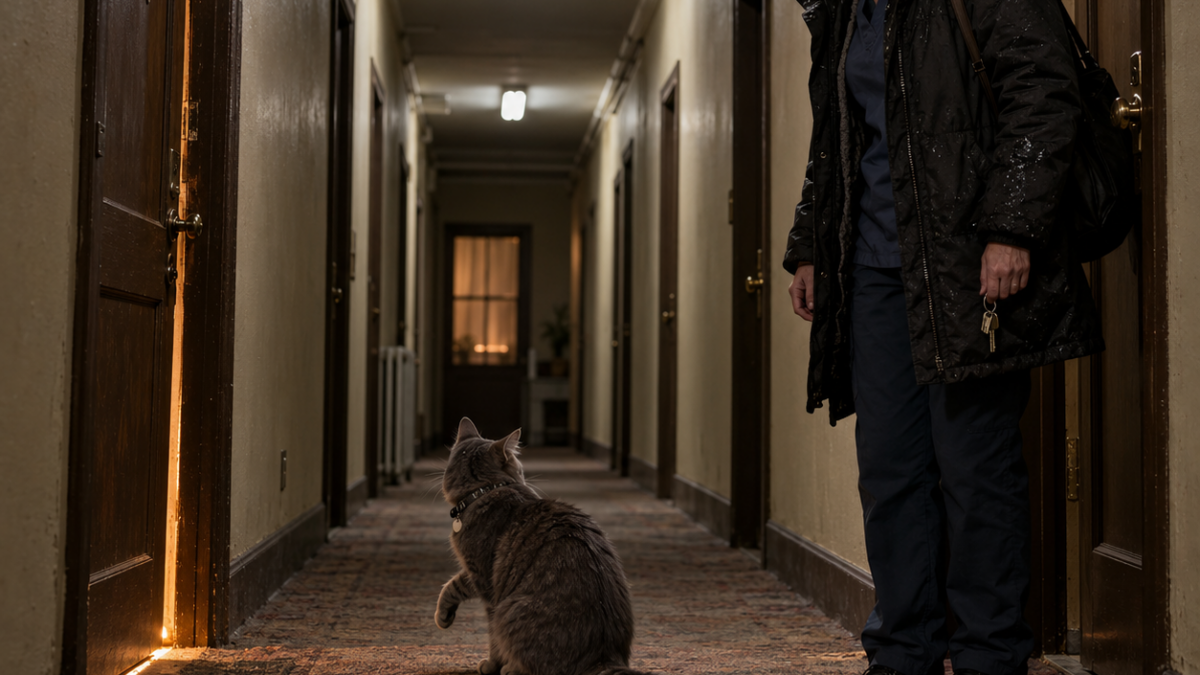
PART3:
“Alright,” I whispered, then immediately felt stupid.
Whispering did not matter.
He watched my mouth, not my voice.
I tried the usual nonsense people try with cats.
A soft clicking noise.
A quiet “pspsps.”
Nothing.
No ear flick.
No head tilt.
Then, by accident, I shifted my weight.
My heel thudded against the floor.
The cat’s ears did not move.
But his whole body did.
He stood.
Alert.
Focused.
Not frightened.
He had felt the vibration.
He took three steps down the hallway, then turned and looked back at me.
Come on.
That was what his face said.
I should have gone inside.
That would have been the normal thing.
The sensible thing.
The safe thing.
I was exhausted.
It was after two in the morning.
I had no business following strange animals down hallways in a building where half the residents seemed one bad notice away from eviction.
I should have unlocked my door, washed my hands, heated my dinner, and gone to sleep.
Instead, I picked up my keys and followed a deaf cat down a hallway that smelled faintly of bleach, old carpet, and burnt toast.
He moved with purpose.
Not wandering.
Not exploring.
Not asking for food.
He passed two doors, then three, then stopped outside the last door on the left.
The door was a little crooked in its frame.
I had noticed that before.
Some doors look shut.
This one always looked like it was holding itself together.
The cat sat down in front of it.
Looked at the door.
Looked at me.
Then lifted one paw and tapped the wood.
Gentle as a knock.
A chill moved through me.
I knocked properly.
“Hello?”
Nothing.
I knocked again, harder.
The cat stayed perfectly still beside me, a small gray statue made of patience.
For a second, I wondered if I was about to become part of someone else’s problem in a way I did not know how to handle.
Then the door cracked open.
An elderly woman peered out.
Small.
Wrapped in a cardigan that looked too big for her now.
Silver hair flattened by sleep.
One hand gripping the edge of the door.
She did not look angry.
She looked embarrassed.
That kind of embarrassed people get when they have been caught needing something.
Her eyes dropped to the cat.
Her face softened so suddenly it made me want to look away.
“There you are,” she said.
But she did not say it to him exactly.
She said it for him.
Like she knew he could not hear the words but hoped he could still receive the feeling.
Then she looked at me.
“I’m sorry,” she said. “He wanders when he gets spooked. He can’t hear himself being loud, if that makes sense.”
“It does,” I said.
It did not, not fully.
But I understood enough.
“He led me here.”
The woman opened the door wider.
The cat slipped inside and rubbed his cheek against her ankle like he had been holding his breath all night.
“I’m Marlene,” she said. “Down the hall. If he bothered you—”
“He didn’t,” I said quickly. “He just sat there.”
Marlene gave a tired little smile.
“He likes to sit where he thinks people will come back.”
That sentence should not have hurt.
It did.
I noticed then that she was watching my face carefully.
Her head tipped slightly.
Her eyes stayed on my mouth.
She was not simply listening.
She was reading.
“You’re hard of hearing too,” I said softly.
She nodded.
“Not completely. But enough. The world turns into a guessing game. You learn to pretend you understood.”
That hit me harder than it should have.
Not because it was dramatic.
Because it was ordinary.
Because I had spent years pretending I understood life.
Pretending I understood why people left.
Why marriages failed quietly.
Why adult children stopped calling parents who still waited.
Why coworkers joked together but never invited me.
Why a man could work six nights a week and still feel one paycheck away from being erased.
Marlene’s room behind her was neat in a careful way.
Every object had been placed with intention, like clutter might become dangerous if it moved too freely.
A small lamp beside a worn chair.
A folded blanket.
A pill organizer on a side table.
A walking cane leaned against the wall.
On the dresser sat an old photograph turned face-down.
I noticed it because face-down photographs always mean something.
People do not turn memories over unless looking at them has become too heavy.
Then I saw the paper taped to the inside of her door.
NO PETS.
Same words as the lobby.
Same warning.
Same quiet threat.
Marlene saw me looking.
Her shoulders rose in a reflex of fear.
“I keep him quiet,” she said quickly. “I do. I don’t want trouble.”
“I’m not trouble,” I said.
But I did not know who I was trying to convince.
She hesitated.
“People don’t always understand. They think he’s ignoring them. They get angry.”
The cat pressed his forehead into her shin.
He did not meow.
Not once.
He only leaned into her like he was anchoring himself.
A thought slipped in, sharp and unwelcome.
What happens to her if someone takes him?
Another followed.
What happens to her if no one comes back?
I said goodnight.
I walked away.
I told myself I had done the polite thing.
The reasonable thing.
The not-my-problem thing.
Back in my room, I did not take off my coat.
I sat on the edge of the bed, then lay back with my shoes still on.
The heater rattled under the window like it was trying to remember how to work.
Through the wall, the television laugh track rose and fell, bright and false.
I stared at the ceiling.
“I’m fine,” I whispered to no one.
That had become my favorite lie.
Fine.
A word people use when the real answer requires too much paperwork.
I closed my eyes.
Then I felt something through the mattress.
Not a sound.
A vibration.
Thump.
I opened my eyes.
Thump-thump.
I sat up.
The gray cat was on my bed.
I do not know how he got in.
Maybe I had not latched the door properly.
Maybe old buildings breathe open when they should not.
Maybe Mercury—though I did not know his name yet—had decided doors were suggestions.
He stood near my knee, stamping one front paw into the mattress.
Urgent little hits.
Eyes wide.
Body tense.
He was not crying.
He could not call out for help.
He did not hear panic.
He carried it.
I swung my legs off the bed.
The cat jumped down, trotted to my door, and looked back once.
Impatient now.
Almost angry.
Then he took off down the hallway.
“Marlene,” I muttered.
I followed.
The hallway felt longer this time.
Brighter.
Colder.
The cat stopped at her door and pressed his body against it.
I knocked firmly.
“Marlene?”
From inside came a thin voice.
“Here.”
Not fine.
Not okay.
Just here.
That word went through me.
I hovered at the threshold.
“Do you want me to come in?”
A pause.
Then, very quietly:
“Please.”
I opened the door.
The room smelled like lavender lotion and something metallic underneath.
Fear, maybe.
Marlene was on the floor beside her chair, one hand pressed awkwardly to her side, face pale, gray hair loose around her cheeks.
She looked more furious with herself than frightened.
“I’m alright,” she said immediately.
Because pride does not disappear with age.
“I just—my foot caught the rug.”
The cat pressed against her shoulder, purring so softly I felt it more than heard it.
He turned his head and looked at me.
Bright-eyed.
Demanding.
I moved.
Not gracefully.
Not like a hero.
Like a tired man suddenly handed a crisis bigger than himself.
I grabbed the folded blanket from the chair and placed it beneath Marlene’s head the way I had seen people do on television. My hands shook. I asked if she could move her legs. I asked if she felt dizzy. I asked if anything hurt. I asked too many questions because questions felt like action.
She squeezed her eyes shut.
“I hate being a nuisance.”
“You’re not,” I said, sharper than I meant.
Her eyes opened.
I softened my voice.
“You’re not.”
I asked if I should call an ambulance.
She resisted at first.
Of course she did.
Older people in buildings like ours learn that every call, every form, every ride, every bill, every official intervention might begin as help and end as loss of control.
“I just need a minute,” she said.
So I gave her a minute.
Then another.
I did not leave.
Eventually, her breathing steadied.
Some color returned to her face.
She let me help her sit up against the chair.
Then, after a longer rest, she allowed me to help her back into it.
I did not fix her.
I did not become a hero in a hallway.
I just stayed.
I held her hand when she let me.
I kept my voice steady even when my insides were not.
And the whole time, that deaf cat never left her side.
At dawn, Marlene was wrapped in the blanket like someone had finally remembered she deserved to be warm.
The first weak blue of morning slipped around the edges of her curtains.
The building began making its ordinary waking sounds.
Pipes.
Doors.
Footsteps.
Somebody’s alarm going off too long.
Marlene looked at the cat resting against her leg.
“He can’t hear me fall,” she said.
Her voice was soft.
“But he can feel it. He feels everything.”
I swallowed.
“So do you.”
Her eyes flicked to the face-down photograph on the dresser.
“Sometimes,” she said, “I feel like the world is loud and I’m not in it.”
I understood that too well.
Before I left, I tore a page from my notebook.
My handwriting was ugly, but the letters were big.
I wrote:
IF YOU KNOCK, KNOCK FIRMLY.
HE’S DEAF.
SHE’S HARD OF HEARING.
BE KIND.
I taped it to Marlene’s door where anyone could see.
I expected it to be ripped down.
It was not.
That night, when I came home from work, the hallway felt different.
Not warmer.
Not brighter.
Just aware.
A man from two doors down walked past Marlene’s door, hesitated, then stomped once, hard, before continuing.
Like he was saying, I’m here. I’m not sneaking up.
Like he was learning a new language with his feet.
Someone left a bowl of water outside Marlene’s door.
No note.
No announcement.
Just a gesture.
The gray cat was not in the hallway that night.
But I could feel him anyway.
That sounds ridiculous unless you have lived alone long enough to know the difference between quiet and empty.
The next time I saw Marlene was in the laundry room.
She was not doing laundry.
She stood there with a basket in her arms like a prop, watching the machines spin as if they were hypnotizing her into staying upright.
I recognized that look.
It is the look of someone pretending to be fine in public because they do not trust their own body not to betray them.
I walked over slowly.
Made sure my steps carried.
She turned her head, eyes scanning until they found my face.
Relief flickered across her mouth before she could hide it.
“Hi,” she said.
It came out thin, like she had used the word too many times without anyone answering back.
“You okay?” I asked.
She nodded too fast.
“Yes. Just dizzy sometimes.”
Then, quieter, “He gets nervous when I’m not in the room.”
“He,” I said, like I did not already know.
“What’s his name?”
Marlene’s face softened in a way that made her look younger and older at the same time.
“Mercury.”
“Mercury?”
“My husband named him. Said he moved like something you couldn’t hold onto.”
Her eyes dropped.
“He was wrong. He’s the only thing that stayed.”
That was the first time she mentioned her husband without her shoulders locking up.
That was also when I understood the face-down photograph.
Grief is not always dramatic.
Sometimes it is the daily habit of not touching what hurts.
After that, I started checking on her.
Not in a grand way.
Not in a look-at-me-being-good way.
Just in the way you check a thermostat you do not trust.
A firm knock.
A solid step.
A “You good?” through the crack of the door.
She would answer, “Here.”
Sometimes she added, “Come in.”
Sometimes she only smiled while Mercury rubbed his cheek against my shoe like he was confirming I was real.
The building did not turn into a fairy tale.
It turned into something messier.
Something more honest.
Because for every bowl of water, there was a side-eye.
For every deliberate stomp outside Marlene’s door, there was a whispered complaint.
It started with a notice.
Not on Marlene’s door.
On the lobby bulletin board, taped under the original “NO PETS” sign like someone wanted the message to have backup.
REMINDER: PETS ARE NOT PERMITTED.
REPORT VIOLATIONS TO MANAGEMENT.
No name.
No signature.
Just a clean printed sheet that smelled like someone’s fear of losing control.
I stared at it for a long time.
My fingers were still cold from outside.
My tired brain tried to make everything simple.
Good people versus bad people.
Kindness versus cruelty.
Compassion versus rules.
But life does not like clean categories.
Life likes gray hallways and complicated motives.
That same night, I heard voices outside my door.
Not loud exactly.
Sharp.
The kind of talking meant to be overheard.
“He’s not even supposed to be here,” a woman said.
“I don’t care if it’s cute,” a man replied. “Rules are rules.”
Then another voice, lower.
“It’s not about cute. She’s old.”
A pause.
Then the first voice again, tighter now.
“And I have allergies.”
Allergies are real.
Rules are real.
So is loneliness.
So is the way a person can fall in their own room and lie there wondering if anyone would notice before morning.
I opened my door.
Not dramatically.
Not confrontationally.
Just enough to be a presence.
Three neighbors stood in the hall.
The woman was in her late thirties, hair pulled tight, face tired in that specific way that says overworked and underappreciated.
A man beside her looked less angry than frightened, like he had seen management punish tenants before and did not want trouble spreading.
The third person disappeared the moment my door opened.
“Hey,” I said.
My voice came out calmer than I felt.
“What’s going on?”
The woman tilted her head.
“We’re going on because there’s a cat in a no-pet building.”
“Mercury,” I corrected before thinking.
Her eyes narrowed.
“I don’t care what his name is.”
Then, like she had been saving the line:
“I pay rent too.”
That phrase.
I pay rent too.
The adult version of that’s not fair.
And sometimes it is true.
Sometimes it is the only power people feel they have.
I nodded once.
“You do.”
I kept my hands visible.
Kept my voice level.
“But he’s deaf. And she’s hard of hearing. He’s not tearing up carpets. He’s not barking at three in the morning. He’s…”
I stopped.
Because the words were getting slippery.
He was her.
He was the reason she had not stayed on the floor.
The man beside her shifted.
“They’ll fine everyone,” he said quietly. “They do that sometimes. They say ‘building-wide issue,’ and then we all get punished.”
There it was.
Not hatred.
Fear.
Fear dressed up like righteousness.
Fear wearing a badge that said rules so it could feel respectable.
The woman crossed her arms.
“It’s not my job to take risks for her.”
I could have snapped.
I could have said something sharp enough to make me feel righteous for ten seconds and useless afterward.
Instead, I remembered Marlene saying, “People don’t always understand.”
So I asked, “Have you met her?”
The woman blinked.
“No.”
Then, defensively, “I don’t need to. It’s a policy.”
That is how this country works sometimes.
We do not have to know the people affected by our choices.
We can cite the rule and walk away feeling clean.
The next day, Marlene got a notice.
Not a conversation.
Not a knock.
A notice slid under her door like a knife.
She showed it to me with trembling hands.
Her pride fought her so hard her jaw quivered.
“I keep him quiet,” she said again. “I do. I do.”
The paper did not say Mercury.
It said UNAUTHORIZED ANIMAL in bold letters.
Like he was a weapon.
Like companionship was contraband.
FINAL WARNING.
FUTURE VIOLATIONS MAY RESULT IN EVICTION.
Those words do not only threaten housing.
They threaten the nervous system.
They crawl into sleep.
They turn every footstep outside the door into a possible ending.
Marlene lowered herself into her chair like her bones had become suddenly older.
Mercury pressed against her shin.
Silent.
Steady.
She looked at me, and for the first time, her voice broke.
“I can’t go.”
Not I do not want to.
Not I will not.
Just:
“I can’t.”
I wanted to fix it.
I wanted to storm down to management like some righteous movie character, slap the notice on a desk, and force decency into policy with my bare hands.
But real life rarely rewards tantrums.
Real life rewards paperwork.
And I am not good at paperwork.
So I did the only thing I could think to do.
I sat on the floor in front of Marlene’s chair like I belonged there.
I looked at Mercury.
Then at her.
“Tell me what you need.”
She hesitated.
Because needing things is humiliating in a world that worships independence.
Then she reached over and turned the face-down photograph upright.
Like she had been holding it down with sheer willpower.
It was a picture of Marlene and a man standing in front of a little house I did not recognize.
Her husband had one arm around her shoulders.
In his other hand, he held a tiny gray kitten against his chest.
Mercury.
Marlene traced the edge of the frame with one shaking finger.
“He found him behind the shed,” she said. “In the snow. He was so small I thought he’d freeze.”
Her throat tightened.
“He couldn’t hear then either. We didn’t know. We just thought he was dreamy.”
She breathed out slowly.
“My husband used to stomp when he came in. Said it was polite. Said it was cruel to startle something that couldn’t hear you.”
Her eyes shone.
Angry at themselves for it.
“When he died, Mercury stopped sleeping.”
The air in the room changed.
Not heavier.
Clearer.
Grief does not always look like crying.
Sometimes it looks like a person quietly trying to survive without the one who taught them how.
“He keeps you safe,” I said.
Marlene gave a bitter little laugh.
“He tries.”
Then, softer:
“He keeps me from disappearing.”
That word again.
Disappearing.
I understood it in my bones.
I had been disappearing for years.
Slowly.
The kind of disappearing nobody calls an emergency.
That night, I wrote another sign.
Not a threat.
Not an attack.
Just big block letters again, because sometimes simple words are the strongest ones left.
PLEASE DON’T REPORT MERCURY.
HE SAVED A LIFE IN THIS HALLWAY.
IF YOU’RE WORRIED, COME TALK TO US FIRST.
I did not tape it to the lobby board.
I taped it to my own door.
Because if people wanted to argue, they could start with me.
And argue they did.
The woman with the tight hair knocked on my door the next day.
Hard.
Firm.
I respected that, even as my stomach sank.
When I opened it, she did not smile.
She did not yell.
She looked exhausted.
“I read your sign,” she said.
I nodded.
“Okay.”
She took a breath like she had been holding it for days.
“My kid has asthma,” she said. “Severe. Cats can trigger it.”
Her eyes held mine like she was daring me to call her a villain.
“So what am I supposed to do?”
There it was.
The real conversation.
Not rules.
Not rent.
A mother scared her child might stop breathing.
That is not petty.
That is human.
“What’s your name?” I asked.
She frowned, thrown off.
“Jenna.”
“Jenna,” I said, “I don’t want your kid hurt.”
She blinked, as if she had expected a fight.
“I also don’t want Marlene hurt. Because she will be.”
“You don’t know that.”
“I do,” I said.
My voice shook.
I hated that it shook.
“I found her on the floor at two in the morning. Mercury came to get me because he felt her fall. He couldn’t call for help. He couldn’t make noise anyone understood. He just came.”
Jenna’s eyes flickered toward the hallway.
Then back.
“And what if my kid ends up on the floor?” she asked.
Sharp with fear.
That question sat between us like a live wire.
Two realities.
Two kinds of danger.
Both true.
Both deserving care.
“I don’t have an easy answer,” I admitted.
Her shoulders dropped a fraction.
Maybe honesty was the first non-performance she had seen all week.
“But maybe we can find a way that doesn’t end with someone getting punished for needing to exist.”
She did not answer right away.
Then she said, quieter:
“People always pick the sad story over the practical one.”
She looked at me like she hated herself for saying it.
“And my kid doesn’t get a sad story. He just gets an ambulance.”
I did not argue.
Because she was not wrong.
Sympathy can be loud.
Chronic conditions are constant.
They do not go viral.
They grind people down.
So I asked, “Would you talk to Marlene?”
Her eyes widened.
“No.”
“Not to apologize. Not to become best friends. Just to make it real. So we’re not fighting a concept.”
She hesitated like the idea offended her pride.
Then she nodded once.
“Fine. But I’m not promising anything.”
That evening, Jenna stood in Marlene’s doorway with her arms crossed and her jaw clenched like armor.
Marlene looked terrified.
Not of Jenna exactly.
Of being judged.
I introduced them like this was normal.
“This is Marlene. This is—”
“Jenna,” she cut in.
Like she did not want her name softened by my tone.
Marlene smiled small.
“Hello.”
Jenna’s eyes dropped to Mercury.
Mercury did not move.
He sat beside Marlene’s chair, calm as a stone, watching this new person who smelled like tension and laundry detergent.
“My son has asthma,” Jenna said.
Marlene’s face pinched with worry.
“Oh.”
Jenna continued faster, like courage had an expiration date.
“So I can’t have cat dander in the hall. I can’t. I’m not trying to be cruel. I’m trying to keep my kid breathing.”
Marlene’s hand flew to her chest.
“I don’t let him out,” she said quickly. “He doesn’t roam. He only—”
Her voice faltered.
Because the truth was, he did roam.
He had roamed to save her.
I stepped in gently.
“He left when she fell.”
Jenna’s eyes snapped to me.
“So you admit it.”
Marlene flinched.
The room sharpened.
Then Mercury did something none of us expected.
He stood.
Walked slowly toward Jenna.
Stopped at her shoe.
And pressed his cheek against it.
Careful.
Slow.
Like he was introducing himself in the only language he trusted.
Jenna froze.
Her eyes filled so quickly it almost looked like anger.
“I can’t,” she whispered.
Then, furious at herself, she wiped her face.
“I can’t get attached to this.”
That is the thing nobody says out loud.
Attachment is dangerous when you cannot afford to change your mind.
Marlene swallowed hard.
“I’m sorry,” she said.
Jenna looked at her.
Really looked.
And for the first time, she saw what I had seen.
A woman who was not trying to break rules.
A woman trying not to be erased.
Jenna exhaled.
“I don’t want you evicted.”
Marlene’s eyes widened.
Jenna added quickly, “I just need safety too.”
Marlene nodded, tears running quietly down her cheeks.
“I understand. I do.”
That, right there, was the moment the building could have become something better.
If fear had not shown up again.
Two days later, management posted another notice.
This one was not a reminder.
It was a demand.
INSPECTIONS WILL OCCUR THIS WEEK.
UNAUTHORIZED ANIMALS WILL RESULT IN ACTION.
No hearts.
No nuance.
Just pressure.
You could feel the mood shift.
People started looking at one another like suspects.
Hallway friendliness evaporated.
Footsteps got faster.
Doors shut harder.
Fear spreads like mold.
It does not need light.
It only needs silence.
Marlene stopped opening her door.
Even when I knocked.
I would hear her voice from inside, thin and distant.
“I’m here.”
But she would not let me in.
Because shame makes people isolate.
And isolation makes them easier to break.
On the third day of that tense week, I came home to find Mercury sitting outside my door again.
Dead center.
Tail wrapped neatly.
Staring.
My stomach dropped.
Because that posture had become a signal.
A warning.
A message.
I took one solid step so the floor would carry my presence.
Mercury turned toward the vibration.
His eyes locked on mine.
Then he stood.
And walked.
I followed him down the hallway past doors that suddenly felt like closed mouths.
He stopped at Marlene’s door.
Pressed his body against it.
Not scratching.
Not crying.
Just insisting.
I knocked.
Firm.
“Marlene?”
No answer.
I knocked again, harder.
“Marlene. It’s me.”
Nothing.
My skin went cold beneath my clothes.
I remembered how she had answered last time.
Here.
Not okay.
Not fine.
Just here.
I tried the handle.
Unlocked.
The door opened a crack like the room itself was afraid.
“Marlene,” I said, stepping inside.
The air smelled wrong.
Not lavender.
Not lotion.
Something sharp.
Metallic.
Panic had a scent, and my body recognized it before my brain did.
Marlene was on the floor.
Again.
This time farther from her chair.
This time her face was waxy, and her breath came in little broken pieces.
Mercury was pressed to her shoulder, vibrating with his purr.
I dropped to my knees.
My hands shook so hard I almost could not use them.
“Marlene,” I said, loud enough for her eyes. “Look at me.”
Her gaze flickered.
Unfocused.
“Here,” she whispered.
I am not going to turn this into a tutorial.
I am not going to pretend I knew everything.
I did what scared people do when a human life suddenly feels bigger than their ability.
I called for help.
Then I shouted into the hallway.
Not polite.
Not quiet.
“Someone, please help!”
Doors cracked open like cautious eyelids.
Faces appeared.
Fear.
Curiosity.
Annoyance.
Then, when they saw Marlene, something shifted.
Reality does not care about policy.
Reality does not ask permission to be urgent.
Jenna ran out barefoot.
Her hair was loose.
Her face bare.
Her eyes wild.
She took one look at Marlene and went pale.
“Oh my God.”
Then she snapped into motion like a switch.
“Call,” she barked at someone behind her. “Call now.”
A tall, quiet man from the other end of the hall dropped to the floor beside us.
I had seen him before, always invisible the way I was invisible.
He did not ask permission.
He did not hesitate.
He offered his jacket to cushion Marlene’s head.
Another neighbor brought water.
Someone else brought a blanket.
Someone stood in the doorway shaking and repeating, “It’s okay, it’s okay,” like saying it could make it true.
Mercury never moved.
Not an inch.
He pressed into Marlene like an anchor.
Like if he let go, she might float away.
When the responders arrived, the hallway became a different kind of loud.
Not sound.
Movement.
Boots.
Instructions.
Hands.
Marlene’s eyes tracked faces like she was trying to keep up with a world that kept slipping out of sync.
One responder looked down at Mercury.
Then at me.
“Is that cat—?”
“He’s deaf,” I said.
Like it mattered right then.
Like I needed them to understand he was not ignoring anyone.
He was just doing his best.
They took Marlene out on a stretcher.
Her hand reached blindly.
Mercury tried to follow.
His whole body tensed like a pulled wire.
That was when the hallway held its breath.
Because we all realized the same thing at once.
They were about to separate her from the one creature that made her feel safe.
Jenna stepped forward.
She raised her chin.
Looked at the responders and said, fierce, “He goes with her.”
Someone behind her hissed, “Jenna—”
She did not look back.
“He goes with her.”
The responder hesitated.
Not because he was cruel.
Because systems do not like exceptions.
Rules have a way of turning people into paperwork.
I heard myself speak.
My voice came out rough.
“He’s all she has.”
The sentence shocked me with its simplicity.
The responder looked at Mercury.
Then at Marlene’s face.
Then he sighed like a man choosing humanity over convenience.
“Okay. But keep him close.”
Jenna’s shoulders sagged with relief.
Then she flinched.
Like she remembered her son.
Like she remembered the reason she had started this fight in the first place.
“I’ll clean,” she blurted, almost angry with herself. “I’ll figure it out. I don’t know. I’ll figure it out.”
I looked at her.
She looked back.
In her eyes, I saw it.
She had not stopped being scared.
She had just stopped letting fear make her cruel.
After they left, the hallway did not return to normal.
It could not.
Because normal had been the problem.
Normal was people falling in private.
Normal was everyone pretending silence meant fine.
Normal was a deaf cat doing the job nobody else had agreed to do.
The next day, management knocked on doors.
Not softly.
Firm.
Official.
A man in a stiff jacket stood outside my apartment with a clipboard and a tired face.
He looked like someone who had been forced to play the villain in too many stories.
He introduced himself as Mr. Grady.
He did not smile.
But he did not sneer either.
He looked conflicted.
“I’m here about the animal issue,” he said, like he hated the word issue.
I let him talk.
Let him do his script.
Then I asked, “Did you hear what happened last night?”
His eyes flickered.
“I was informed there was an incident.”
“An incident,” I repeated.
Because language is a way of hiding from truth.
He cleared his throat.
“We have policies for a reason.”
Behind him, one door cracked open.
Then another.
A neighbor hovered.
Then Jenna stepped into the hall.
Then the tall quiet man.
Then a woman I had never seen before appeared with a toddler on her hip.
The hallway was becoming a courtroom without anyone admitting it.
“She could have died,” I said.
Mr. Grady’s jaw tightened.
He looked down at his clipboard like it could protect him.
Then he said quietly, “I’m not heartless.”
I believed him.
That was the annoying part.
It would have been easier if he had been obviously bad.
But he looked like a man trapped between compassion and a job that punished it.
“What do you want?” he asked.
It came out sharper than he intended.
And I realized he was not only asking me.
He was asking the hallway.
The building.
Life.
Before I could answer, Jenna stepped forward.
She stood beside me like she could not believe she was doing it.
“My son has asthma,” she said immediately.
Mr. Grady blinked.
Jenna continued.
“And I still think you can make an exception.”
Someone behind her whispered, shocked, “Jenna?”
She did not turn around.
Mr. Grady looked at her.
“Ma’am, it’s not that simple.”
Jenna’s eyes flashed.
“It never is.”
The tall quiet man stepped forward too.
“I pay rent,” he said.
The words hit differently this time.
Not as a weapon.
As a reminder.
“I pay rent, and I don’t want to live in a building where people get punished for needing help.”
A door opened across the hall.
The woman with the toddler said softly, “My grandma fell last year. No one found her until morning.”
She swallowed.
“I keep thinking about that.”
The hallway grew crowded with truths people usually kept behind doors.
Someone admitted they were scared of getting sick alone.
Someone admitted they had not spoken to another human in three days.
Someone admitted they had complained because they were terrified of rent going up, of being targeted, of being powerless.
Mr. Grady stood there holding his clipboard like it weighed a hundred pounds.
He rubbed his forehead.
Then he said something I did not expect.
“My mother can’t hear well.”
He paused like he regretted speaking.
“She fell two months ago. She didn’t have anyone there.”
His throat tightened.
“I got the call at work.”
Silence.
Not empty.
Human.
Mr. Grady exhaled.
“Look,” he said, voice rougher now. “I can’t promise anything on the spot.”
Nobody asked him to.
We were not looking for magic.
We were looking for willingness.
He looked around at us, half in pajamas, half in pride, and nodded once.
“I will talk to my supervisor.”
He raised a hand before anyone could speak.
“And I need you to understand. There are health concerns. There are liability concerns.”
He hesitated.
“And there are people concerns.”
People concerns.
The phrase landed in my chest.
As if people were something policy sometimes forgot to include until someone fell on the floor.
Marlene came back two days later.
Not in a dramatic ambulance way.
Quiet.
Tired.
With a bruise blooming along her ribs and a walker she hated.
Mercury walked beside her, close as a shadow.
When she saw the sign on her door still there—my first sign, retaped with fresh tape like someone had repaired it—she pressed a hand to her mouth.
Her eyes filled.
She looked at me.
Then at Jenna.
Then at the others peeking from their doors.
“I didn’t want trouble,” she whispered.
Jenna stepped forward.
Awkward.
Stubborn.
There.
“I don’t want trouble either,” she said.
Then she held out a sealed plastic container.
“A lint roller,” she said.
Like it was a peace offering and she hated that it mattered.
“For the hall. For… you know.”
Marlene blinked.
Then she laughed.
Quiet.
Shocked.
Relieved.
Someone else left a little mat outside Marlene’s door.
Another neighbor offered to carry groceries.
Not in a savior way.
In a we-live-here-too way.
Two weeks later, management replaced the lobby notice.
Not with a miracle.
With a compromise.
Something that looked like it had been fought over in emails.
PLEASE BE MINDFUL OF NEIGHBORS.
SOME RESIDENTS HAVE HEARING AND HEALTH NEEDS.
CONTACT MANAGEMENT WITH CONCERNS.
No mention of Mercury.
No public shaming.
Just a subtle shift from threat to human.
It was not perfect.
It was not a Hollywood ending.
People still argued.
They just argued out loud now, with faces attached.
That matters.
Because the most dangerous version of fear is the anonymous kind.
The kind taped to bulletin boards.
The kind whispered through doors.
The kind that never has to look at the person it hurts.
Mercury stayed.
Jenna’s son stayed safe.
Not by accident.
By effort.
Marlene began keeping Mercury’s bedding washed more often.
Jenna bought better air filters.
Management fixed the hallway ventilation they had ignored for years because suddenly people concerns came with signatures.
Neighbors agreed Mercury would not roam freely unless there was an emergency, though everyone understood Mercury had his own interpretation of policy.
Jenna still did not pet him.
Not for months.
But every time she passed Marlene’s door, she stepped firmly.
Not sneaking.
Not punishing.
Just present.
One evening, I saw her son, a thin boy with serious eyes, standing near their doorway watching Mercury sit in the hall.
He wore a little medical mask.
Jenna stood behind him, tense.
Mercury looked at the boy.
The boy looked at Mercury.
Neither moved closer.
Finally, the boy lifted one hand and waved.
Mercury blinked slowly.
The boy smiled like he had received a royal blessing.
After that, he started calling Mercury “the silent alarm.”
Marlene liked that.
Mercury did not care.
Months passed.
The building did not become paradise.
The laundry machines still stole quarters.
The lobby radiator still clanked.
The elevator still smelled wrong after rain.
People still got tired, petty, frightened, and strange.
But the hallway changed.
Not loudly.
No posters about community.
No management newsletter.
Just habits.
People knocked more firmly.
People left notes in bigger letters.
People learned not to approach Mercury from behind.
People checked if Marlene’s newspaper stayed outside too long.
Jenna started a group text for emergency building issues and pretended it was only for practical reasons.
The tall quiet man, whose name was Omar, began helping carry groceries for residents on the third floor when the elevator broke.
The woman with the toddler brought Marlene soup once, then apologized three times for the container being old.
Marlene wrote thank-you notes in handwriting so careful it looked like lace.
And me?
I stopped being quite so invisible.
Not dramatically.
I did not become the mayor of the hallway.
But people learned my name.
Evan.
That is my name.
For months, I had existed as “the night-shift guy in 2B.”
Then one deaf cat sat outside my door and stared until I followed him, and somehow I became Evan again.
That should not have required an emergency.
But sometimes it does.
One night, near the end of winter, I came home after another shift.
My shoes were damp.
My fingers numb.
The hallway lights were too bright and too tired.
Mercury sat outside my door again.
Dead center.
Tail wrapped neatly.
Staring.
For one second, my stomach dropped the way it always did now when I saw him waiting.
But this time, his stare did not feel like a warning.
It felt like a question.
Like:
Are you still the kind of person who shows up?
I took one solid step.
The floor carried the vibration to him.
He turned toward it.
His eyes found mine.
I bent down slowly.
Not sneaking.
Not rushing.
I held out my hand where he could see it.
Mercury leaned forward and pressed his forehead into my knuckles.
Silent.
Steady.
A small creature saying, You are here.
Down the hall, Marlene’s door opened.
She stood there with one hand on her walker.
“He likes you,” she said.
“I think he likes that I’m trainable.”
She smiled.
Mercury stepped away from me and returned to her side.
Where he belonged.
I looked down the hallway.
At the doors.
At the gaps beneath them where light leaked out.
At the place where people came to stop being cold.
We live in a country that worships independence.
We romanticize minding your own business like it is always a virtue.
We call asking for help weak until it is our own mother on the floor.
We defend rules because rules feel safer than judgment.
And sometimes they are.
But sometimes rules become walls.
Sometimes privacy becomes abandonment.
Sometimes silence becomes danger.
And sometimes a deaf cat has to cross a hallway in the middle of the night to remind a building full of people that being alive near one another should mean something.
Mercury could not hear a thing.
Not Marlene’s fall.
Not my voice.
Not the arguments.
Not the notices.
Not the words people used to make fear sound reasonable.
But he noticed anyway.
He felt what others ignored.
He showed up when no one else knew to.
And because he did, Marlene was not alone on the floor.
Jenna learned that fear does not have to become cruelty.
Mr. Grady remembered his own mother before policy turned him into paper.
Omar stopped disappearing.
I stopped pretending I was fine.
A whole hallway learned to knock firmly.
That cat could not hear a thing.
But he taught us all how to listen.








