The Crowd Laughed When a 24-Year-Old Woman Bid on the Combat Dog Nobody Could Touch—Then She Whispered His Handler’s Secret Name
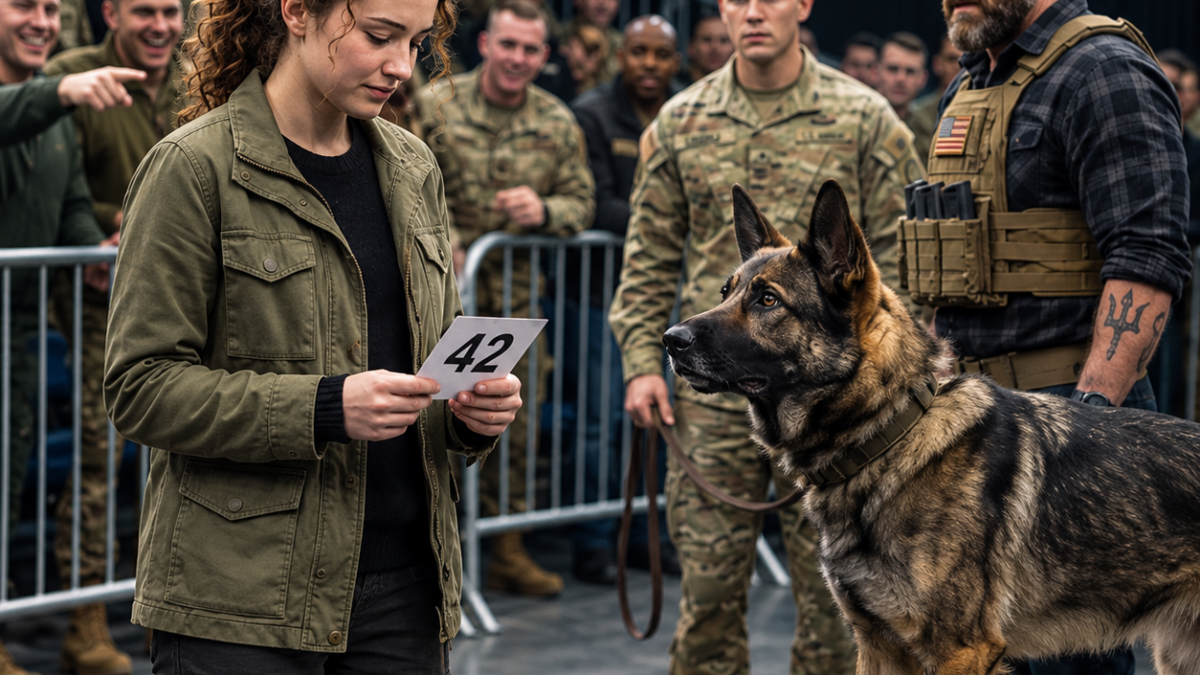
PART2:
“Ghost has not permitted a leash attachment in eight months.”
Next.
Titan.
German Shepherd.
Seven.
Massive chest.
“One handler deceased. Four subsequent bite incidents involving experienced personnel.”
Next.
Empress.
Dutch Shepherd.
Thin.
Alert.
“She has not bitten anyone.”
Someone in back muttered:
“Yet.”
A few people laughed.
Robert ignored it.
“She also has not reliably responded to a human command since separation from her original trainer.”
Next.
Ranger.
Labrador.
“He destroys kennels at night.”
A contractor smiled.
“A Lab?”
Robert looked at him.
“Three kennels.”
The smile disappeared.
Next.
Vega.
Malinois.
Five years old.
She looked small in photograph.
“Former handler deceased six months after returning stateside.”
Robert did not say suicide.
Everyone approved to be in room already knew.
Next.
Atlas.
Ten-year-old Rottweiler.
Thick neck.
Gray muzzle.
“He has lost fourteen pounds since arriving.”
“Medical?”
One veterinarian asked.
“No physical cause identified.”
“Food refusal?”
“Only eats when no human is visible.”
Last.
Seven.
Three-year-old German Shepherd mix.
Young.
Too young for eyes like that.
Robert clicked again.
The screen showed a photograph taken at intake.
Seven stood pressed against rear wall of kennel.
His body said retreat.
His teeth said do not follow.
“He has one serious federal apprehension incident in his final operational report, one handler surrender, and no successful reassignment.”
Robert paused.
“The note submitted by his handler said…”
He read from screen.
“He needs someone who understands what he saw. I can’t be that person anymore. I’m sorry.”
Nobody laughed at that.
Robert faced room.
“The current disposition window closes in seventeen days.”
Everyone understood the bureaucratic language.
Robert did not say euthanasia.
He did not have to.
Federal working dogs were not automatically killed because they were difficult.
There were evaluations.
Placement networks.
Handlers.
Veterans.
Specialized rescues.
Medical decisions.
Years of policy.
But there was also reality.
A dangerous animal nobody could safely manage could not be warehoused indefinitely.
A dog who was continuously suffering could not simply be preserved because humans were uncomfortable making final decisions.
Resources were finite.
Staff injuries mattered.
Quality of life mattered.
The seven high-restriction dogs had reached the point where every option had narrowed.
That was why the people in the room had been invited.
The official term was placement review.
Informally, staff sometimes called it bidding.
Not because anybody was buying the animals.
There was no auctioneer.
No money changed hands for ownership.
Approved organizations and qualified handlers submitted placement bids—detailed proposals identifying which dog they wanted responsibility for, where the dog would live, behavioral plans, liability safeguards, veterinary resources, and why they believed their environment matched that animal.
Most bids came from professionals.
Police trainers.
Military handlers.
Search-and-rescue specialists.
Experienced sanctuaries.
Marisol Vega had submitted one too.
For Seven.
Robert read her application twice because he initially assumed some section was missing.
Age: twenty-four.
Military service: none.
Law enforcement service: none.
Professional K9 handling certification: none.
Graduate student, behavioral psychology.
Part-time county animal shelter employee.
No operational dog experience.
No bite-work experience.
No military dog certification.
Housing:
Small rental home in San Antonio with fenced yard pending approval.
Proposed dog:
Seven.
Robert had almost thrown it out.
Then he saw the supporting letter.
Colonel Patricia Reyes, United States Army, retired.
Thirty years.
Four continents.
The kind of officer who did not attach her name to sentimental nonsense.
Her letter began:
Please read this entirely.
So Robert had.
Three days later Marisol was on a plane to Arizona.
Now she sat at the end of the briefing table while the placement proposals were discussed.
Ghost received two.
Titan one.
Ranger three.
Atlas none.
Vega one conditional.
Empress none.
Seven—
One.
Marisol.
A former military handler named Briggs leaned back in his chair.
He had a shaved head and forearms like concrete posts.
“I’m sorry.”
He looked toward Marisol.
“No disrespect.”
That phrase usually means disrespect is about to arrive.
“But what exactly are you going to do when Seven comes up the leash at you?”
Marisol answered calmly.
“I don’t know yet.”
A few people laughed.
Briggs looked around as if she had proven his point.
“You don’t know.”
“No.”
“You submitted for a three-year-old apprehension dog with a serious aggression record.”
“Yes.”
“And you don’t know what you’ll do if he comes at you?”
“I haven’t met him.”
That produced more laughter.
Not cruel exactly.
Disbelieving.
Marisol waited.
When it ended, she said:
“If I told you I knew exactly what an animal I have never met would do, wouldn’t that worry you more?”
The room quieted slightly.
Briggs folded arms.
“What makes you think you’re qualified?”
“I don’t.”
“Then why are you here?”
“Because qualification and relevance are different things.”
One of the veterinarians looked up.
Robert did too.
Marisol opened the Manila folder in front of her.
“I am not a military dog trainer.”
“Obviously.”
Briggs said.
Colonel Reyes turned her head toward him.
He stopped smiling.
Marisol continued.
“I study trauma-linked behavioral dysregulation after bonded loss.”
Someone asked:
“In people?”
“And animals.”
“Dogs don’t experience trauma like people.”
“No.”
Marisol agreed immediately.
That surprised them.
“They experience it like dogs.”
Silence.
“I’m not here to anthropomorphize them.”
She pointed toward screen.
“I’m here because six of those seven files describe behavioral change following death, disappearance, or permanent separation from a bonded handler.”
Robert corrected:
“Some details are classified.”
“I know.”
“How?”
“Patterns.”
She opened a chart.
“Titan’s bite history begins after his handler’s death.”
Another page.
“Ranger’s destructive behavior escalates only after lights-out and after reassignment.”
Another.
“Empress responds to environmental cues but ignores replacement command structures.”
Another.
“Atlas stopped eating after removal from one long-term handler.”
Marisol looked around.
“Those aren’t explanations.”
She emphasized that.
“They are correlations.”
Robert liked that she said it.
She did not pretend.
“But the facility keeps asking one question.”
“What?”
Briggs said.
“How do we make the dog accept a new handler?”
No one answered.
Marisol looked toward the photographs.
“I think some of them may still be waiting for the old one.”
A contractor snorted.
“You think they’re sitting around hoping dead people come back?”
“I think routines can persist after the person attached to them is gone.”
“That’s grief.”
“Maybe.”
“Dogs don’t—”
“Call it attachment disruption if that makes you more comfortable.”
The contractor went quiet.
Marisol said:
“I don’t need the word grief.”
She tapped Seven’s photograph.
“I need to understand what behavior is doing.”
Robert studied her.
“What do you think Seven’s behavior is doing?”
“I don’t know.”
Briggs laughed again.
Marisol looked at him.
“But neither do you.”
That ended it.
After the briefing, Robert walked Marisol toward high-restriction block.
Colonel Reyes remained behind.
Robert had asked why she believed in the young woman.
Patricia had said:
“I didn’t say I believe she’s right.”
“What did you say?”
“That you should listen.”
“Why?”
Colonel Reyes considered.
“Because she has spent three years trying to disprove herself.”
That had stayed with him.
People who wanted to be right gathered evidence.
People who wanted truth tried to destroy their own theory.
Marisol had apparently done both.
Outside the kennel block, the October desert looked almost pleasant.
Morning temperature still low.
Pale sky.
Dry wind.
The facility sat twenty-two miles from nearest town.
No public signage.
Steel buildings.
Exercise yards.
Reinforced fencing.
It was intentionally forgettable.
Dogs arrived there from military and federal pipelines after working careers ended badly.
Some eventually left with former handlers.
Some transitioned into specialized homes.
Some were redirected into lower-intensity work.
Others never made it.
Marisol stopped before entrance.
“Can we walk outside first?”
Robert frowned.
“Why?”
“I want to hear the building.”
“You can hear it from inside.”
“I know.”
He almost said no.
Instead:
“Fine.”
They walked perimeter.
At east wall, Marisol stopped.
A ventilation panel ran low along steel siding.
From inside came sounds.
Pacing claws.
Whining.
Metal.
One sharp bark.
Another.
Then the deep repetitive thump of a body striking something.
Marisol closed eyes.
Robert watched her.
“What are you doing?”
“Listening.”
“To what?”
“Timing.”
He waited.
Two minutes.
She opened eyes.
“They’re exhausted.”
Robert felt irritation.
Not because statement was absurd.
Because it landed too close.
“They’re dangerous.”
“Yes.”
“You say that like separate issue.”
“It might be.”
He stared.
She added:
“Fear, frustration, learned aggression, pain, guarding, arousal, grief, predatory behavior—they can all be dangerous.”
“Agreed.”
“But dangerous isn’t cause.”
That sentence followed Robert through the door.
Inside, two staff members joined.
Miller.
Jenkins.
Both trained.
Both wearing protective equipment.
Marisol wore none.
She would not have contact.
The high-restriction corridor was concrete and fluorescent.
Seven kennels.
Reinforced barriers.
Double containment.
Ghost reacted first.
He hit front of kennel so hard the mesh rattled.
Jenkins instinctively shifted backward.
Marisol stopped.
Titan remained at rear.
Body stiff.
Ranger circled.
Round.
Round.
Round.
Empress sat motionless.
Vega retreated.
Atlas watched.
Seven pressed himself against wall and made a low sound that turned Robert’s stomach.
Marisol did nothing.
Four minutes.
Robert timed it without meaning to.
She stood in center.
Hands loose.
No staring.
No speaking.
Ranger stopped circling first.
He looked at her.
Marisol breathed slowly.
Then said:
“I know what you’re waiting for.”
Robert almost interrupted.
She continued.
“And I know it isn’t coming.”
Ghost stopped hitting mesh.
Not completely calm.
Just stopped.
Marisol spoke as though she were not performing for humans.
“I’m not here to replace anybody.”
Her eyes moved down corridor.
“I’m not asking you to forget.”
Atlas shifted.
One paw.
Then another.
“I just want to know if there’s anything left you can put down.”
Atlas came to front.
Robert’s pulse changed.
The Rottweiler had not voluntarily approached a person at barrier in months.
Marisol stepped toward his kennel.
Stopped several feet away.
Atlas pressed nose against mesh.
Marisol looked at him.
Then whispered one word.
“Bishop.”
Robert frowned.
Atlas froze.
Every muscle.
Marisol whispered again.
“Bishop.”
The Rottweiler pushed his entire head against wire.
Hard.
Then made a sound.
Robert would fail to describe it later.
Not bark.
Not whine.
Something between exhale and cry.
The kind of sound an animal makes when body reacts before training can stop it.
Ranger stopped.
Vega lifted her head.
Ghost went silent.
Empress stood.
Titan moved one step forward.
Seven stopped vocalizing.
Within seconds, every kennel was quiet.
Jenkins whispered:
“What the hell?”
Robert looked at Marisol.
“What did you call him?”
She did not answer immediately.
Her eyes remained on Atlas.
“Bishop.”
“That name isn’t in his file.”
“I know.”
“How do you know it?”
“Later.”
“Miss Vega—”
“Please.”
She looked at him.
“Let him have this minute.”
Robert almost objected.
Then Atlas slid down against kennel door.
Not collapsed.
Settled.
His broad head remained touching metal near Marisol’s knees.
She sat on floor outside barrier.
No touching.
No reaching.
Just proximity.
Robert looked at the other dogs.
All watching.
The building felt different.
Not healed.
Not safe.
Different.
That afternoon Robert called Colonel Reyes.
“What did she say to Atlas?”
Patricia answered:
“You heard her.”
“What is Bishop?”
“Ask Marisol.”
“She won’t tell me yet.”
“Then wait.”
“I hate when people say that.”
“I know.”
“Is it the handler’s name?”
“No.”
“Call sign?”
“No.”
“Command?”
“Not exactly.”
“Patricia.”
“Robert.”
He cursed.
She laughed.
Three weeks later, after separate confirmation through four agencies and contact with Atlas’s former handler’s surviving sister, Robert learned the truth.
Atlas was his operational kennel name.
The dog’s original handler had called him Bishop privately.
Never in briefings.
Never on mission.
Never in reports.
Bishop was the name used in barracks, hotel rooms, late-night transport, and quiet moments after equipment came off.
The sister had a letter.
One line:
Bishop finally slept last night. He only does that when I sit on the floor with him.
Marisol had found it after six months of research.
Six months.
One name.
Robert confronted her in his office.
“You spent half a year tracking a nickname?”
“Yes.”
“Why?”
“Because I needed to know whether the dog had two contexts.”
“What?”
“Atlas was working identity.”
She sat across desk.
“Bishop may have been off-duty identity.”
Robert stared.
“You thought saying a nickname would cure him?”
“No.”
She almost looked offended.
“I thought it might tell me whether the association was still there.”
“And?”
“It was.”
He leaned back.
“Six months.”
“For one name.”
“And the dog took four minutes.”
A small smile escaped him.
Marisol smiled too.
The story could have ended there if stories cared about applause.
It did not.
Atlas was still underweight.
Ghost was still dangerous.
Titan still had a bite history.
Seven remained untouchable.
One extraordinary reaction did not erase behavioral risk.
Marisol stayed eleven days.
The first morning Robert expected something dramatic.
She gave him a feeding schedule spreadsheet.
“What is this?”
“Changes.”
“We have feeding protocols.”
“I know.”
“Then why—”
“Because Ranger begins pacing before staff rotation at 0600.”
Robert looked.
“How do you know?”
“I watched.”
“For one day.”
“And your logs show the same thing.”
He checked.
She was right.
Marisol did not treat the seven dogs the same.
That, more than Atlas, began winning Robert over.
People who arrived claiming they could save all dogs usually had one method.
More affection.
More discipline.
More exercise.
More structure.
More medication.
More whatever their worldview preferred.
Marisol kept saying:
“Different dog.”
Ghost required predictability.
He reacted hardest to departure.
Someone approached.
Someone left.
He exploded.
Marisol hypothesized that disappearing humans had become the trigger itself.
She started appearing at same times.
Never entered.
Never forced contact.
Five minutes.
Leave.
Return two hours later.
Same posture.
Same location.
Day two.
Same.
Day three.
Same.
Ghost lunged less.
Day four he watched.
Day seven, under controlled barrier conditions, he accepted food from her.
Robert said:
“That’s progress.”
Marisol answered:
“It’s data.”
“You ever enjoy anything?”
“Sometimes.”
Titan was harder.
Nobody approached him casually.
His handler had died during an ambush.
Titan reportedly stayed beside body for eleven hours before extraction.
Afterward, replacement handlers tried bonding.
Four were bitten.
Not during attacks.
During attempts at affection.
Petting.
Leashing.
Physical proximity.
Marisol sat outside his run.
Two hours.
No talking.
No eye contact.
Robert checked twice.
“You doing anything?”
“Yes.”
“What?”
“Nothing.”
“That isn’t something.”
“For him it might be.”
Third day Titan sat.
Fifth day he approached mesh.
Marisol left her knee near barrier.
Titan pressed his head against chain-link.
No touching.
He stayed there thirteen minutes.
She did not move.
Empress was different.
Everyone had tried commands.
Food.
Toys.
Engagement.
She ignored them.
Marisol did not ask anything.
She brought laptop.
Sat twenty feet away.
Worked on thesis.
No calls.
No cues.
No praise.
After forty minutes, Empress stood.
Walked to kennel front.
Sat.
Marisol looked once.
Then returned to typing.
Robert said afterward:
“You ignored her.”
“Yes.”
“Why?”
“Everyone else wanted a response.”
“And?”
“Maybe response itself became pressure.”
Ranger needed movement.
Stillness was his problem.
At night he paced and destroyed.
Marisol requested controlled exercise-yard access.
Robert initially refused.
“Three destroyed kennels.”
“Because he moves.”
“Exactly.”
“So why are you locking him into smaller movement?”
Robert disliked question.
They used two handlers and safety lines.
Marisol walked.
Not training heel.
Not asking obedience.
Just walking.
Ranger moved beside her.
One lap.
Ten.
Twenty.
Nearly an hour.
Then sat.
Looked toward sun.
Closed eyes.
Robert watched an explosive-detection Labrador do absolutely nothing.
It felt monumental.
Vega affected Marisol differently.
Maybe because name.
Maybe because handler’s death.
The dog’s person had died by suicide after returning from overseas.
Vega had been present.
After that, she sat in corners.
Watched doors.
Rarely engaged.
Marisol went alone into corridor one evening after staff shift.
Robert observed remotely.
She sat outside Vega’s kennel.
Twenty minutes passed.
Nothing.
Then Marisol said:
“I know what happened to your person.”
Vega’s ears moved.
Marisol swallowed.
“It wasn’t your job to stop it.”
Robert looked away from monitor, then back.
“You couldn’t fix it.”
Vega stood.
One step.
Marisol’s voice shook for first time.
“Some things are too broken for the ones closest to them to hold together.”
The dog approached.
“That’s not yours to carry.”
Vega pressed forehead against mesh.
Marisol put palm flat on opposite side.
They stayed.
Twenty minutes.
When Marisol finally came out, Robert was waiting.
“You okay?”
“Yes.”
“No, you’re not.”
She looked at him.
“My father died when I was seven.”
Robert knew.
Colonel Reyes had told him minimal background.
“Combat?”
“Yes.”
“Dog handler?”
“Yes.”
Robert looked toward kennel block.
“How many?”
“Four partners over his career.”
“You remember him?”
“Not enough.”
That was answer.
Her father, Sergeant First Class Daniel Vega, had deployed when Marisol was a toddler.
Home briefly.
Gone again.
Her memories were photographs and stories.
Letters.
A cardboard box.
He died during nighttime operation.
His working dog survived.
Marisol grew up knowing an animal had been beside her father when she could not.
That knowledge became an axis around which the rest of her life quietly formed.
Psychology.
Animal behavior.
Attachment.
Trauma.
Loss.
Not because she had planned a mission.
Because unanswered grief can become a field of study if a child grows old enough.
Seven remained last.
Always last.
Youngest.
Most reactive.
The dog Marisol had submitted a placement bid for.
Robert asked her on day eight:
“Still want him?”
She corrected:
“Want isn’t useful.”
“Still think you’re right placement?”
“I don’t know.”
“You flew here because you thought you were.”
“I flew here because I thought his file was incomplete.”
“And now?”
“It is incomplete.”
“Meaning?”
“He’s not only aggressive.”
Robert sighed.
“We covered this.”
“No.”
She looked toward Seven.
“He’s expecting something.”
“What?”
“I don’t know.”
Robert nearly laughed.
Again.
That phrase.
I don’t know.
At beginning it sounded like weakness.
Now he trusted it more than certainty.
On tenth night, Marisol took Seven’s surrender note from pocket.
She had been carrying photocopy since arrival.
He needs someone who understands what he saw.
I can’t be that person anymore.
I’m sorry.
She read it five times.
Then asked Robert:
“Do you know what happened on final apprehension?”
“Redacted.”
“What is visible?”
“Suspect fled into commercial building. Seven deployed. Handler followed. Shots fired.”
“Who was shot?”
“Unclear.”
“Dog?”
“No.”
“Handler?”
“No.”
“Suspect?”
Robert paused.
“The report confirms fatality.”
Marisol sat quietly.
“Anything else?”
“An uninvolved civilian was inside.”
Her face changed.
“Child?”
“Details sealed.”
That was enough.
Seven had been trained to locate threats.
Maybe he had done exactly what trained.
Maybe something went wrong afterward.
Maybe there was blood.
Screaming.
Handler distress.
Maybe the person he trusted became afraid of him.
Maybe none of that.
Marisol refused to invent what files did not say.
She returned to the only line she had.
He needs someone who understands what he saw.
On eleventh morning, before sunrise, she sat outside Seven’s kennel.
Robert watched from twenty feet away.
No protective spectacle.
Barrier remained secured.
Seven pressed back wall.
Marisol crossed legs on concrete.
Made herself low.
She said nothing for a long time.
Then:
“I don’t know what you saw.”
Seven stared.
“I’m not going to pretend I do.”
His ears shifted.
“I know something changed.”
No movement.
“And somebody you trusted couldn’t stay.”
Seven’s head lowered slightly.
Marisol continued:
“That doesn’t make him bad.”
Pause.
“It doesn’t make you bad either.”
Robert felt uncomfortable with how human sentence sounded.
Then watched dog.
Still.
“You’re still here.”
Marisol said.
“That matters.”
Seven moved one step.
Robert held breath.
Another.
He stopped far from gate.
Marisol did not reach.
“You don’t have to do anything.”
Seven sat.
Robert looked toward Jenkins.
Jenkins’ mouth opened.
No words.
The dog had not voluntarily sat in a human’s presence since intake.
Marisol stayed.
Eventually she extended one hand toward barrier.
Not through.
Palm up.
Loose.
Seven approached.
Sniffed through mesh.
Backed away.
Came again.
Sniffed.
Then lay down.
Nose touching steel.
Eyes closed.
Marisol stayed until sunlight cleared fence.
That afternoon Robert put seven disposition folders on desk.
He had delayed signatures twice.
Now he reopened every recommendation.
Not canceled.
Reopened.
That distinction mattered.
Marisol had not proved every dog safe.
She had proved the available picture was incomplete.
That was enough to justify time.
Time became evaluations.
Evaluations became plans.
Marisol opened her folder.
She had already built possible placement network over three years.
Robert stared.
“You came prepared to take all seven?”
“No.”
“You have names for all of them.”
“Potential matches.”
“Same thing.”
“Not remotely.”
She started with Titan.
Retired combat medic.
Eastern Tennessee.
Forty acres.
No children.
No other dogs.
Prior experience with working Shepherds.
Willing to make no demand for affection.
Robert read.
“Why him?”
“His application says, ‘I don’t need him to like me. I need him to have a place where nobody leaves unexpectedly.’”
Robert read sentence twice.
Ranger.
Former military family with acreage and an adult son who ran five miles every morning.
Empress.
Experienced working-dog trainer who had specifically requested a low-pressure placement and accepted she might never get traditional obedience.
Ghost.
Search-and-rescue professional in Oregon.
Robert objected.
“He has bite history.”
“Yes.”
“He’s nine.”
“Yes.”
“You think he should work?”
“I think he still wants structured work.”
“And if wrong?”
“Then they retire him fully.”
Vega.
A woman named Elena Morales in New Mexico.
Her son had died overseas.
She had no interest in training.
No children at home.
Quiet property.
Application included one line:
I do not need a dog to make my grief smaller. I know how to sit beside something that does not get smaller.
Robert cleared his throat.
Then Atlas.
“No.”
He said.
Marisol looked up.
“Hospice?”
“He’s a Rottweiler with food refusal and classified protection background.”
“Old.”
“Exactly.”
“You think putting him around hospice patients is appropriate?”
“After evaluation.”
“No.”
“Read proposal.”
He did.
Veteran-run hospice residence.
Controlled access.
No unsupervised interaction.
Behaviorist onsite.
Atlas had spent career sitting still for hours beside one person.
Waiting.
Watching.
Marisol said:
“Some dogs who have learned how to remain present in hard rooms are very good at simply staying.”
Robert looked at Atlas’s photo.
“You’re guessing.”
“Yes.”
She smiled slightly.
“So we’ll test it.”
Then Seven.
Robert already knew.
“You.”
“Yes.”
“No.”
Marisol blinked.
“That sounds final.”
“It isn’t.”
“Good.”
“I said no because I want to hear why.”
She looked through office window toward kennel block.
“His former handler wrote that he needs somebody who understands what he saw.”
“You don’t know what he saw.”
“No.”
“So?”
“I know what it’s like when the person carrying a story cannot tell you whole story.”
Robert went still.
“My father left me letters.”
She looked down.
“Pages and pages describing dogs, missions he could discuss, people he missed, things he loved.”
Then:
“But there were pieces he could never tell us.”
She folded hands.
“I spent years trying to fill blanks.”
“And?”
“I learned not to.”
Robert waited.
“I think Seven needs someone who won’t force a meaning onto him because silence makes them uncomfortable.”
That was the best answer she could have given.
Three months later, San Antonio hosted finalization event.
Not a victory parade.
Marisol refused that language.
Placement celebration.
Seven dogs.
Seven new environments.
Federal officials.
Former handlers where appropriate.
Veterans.
Facility staff.
Families.
Robert attended.
Colonel Reyes too.
Briggs—the man who laughed at Marisol’s original placement bid—showed up.
He stood near wall.
Ghost entered first.
Loose leash.
Alert.
Still intense.
But not frantic.
His Oregon handler carried no bite sleeve.
Kept distance from crowd.
Ghost checked exits.
Then looked back at handler.
Moved on.
Titan arrived with medic from Tennessee.
They did not touch much.
Titan walked beside him.
That was enough.
Empress followed.
The trainer gave no unnecessary commands.
The Dutch Shepherd selected a quiet corner herself and lay down.
Ranger arrived with young boy.
The boy talked continuously.
Ranger listened with eyes closed.
Vega entered beside Elena.
Elena did not lead her tightly.
The Malinois leaned against her leg.
Two grieving beings not fixing each other.
Just not alone.
Atlas came late.
The room changed when people saw him.
Broad gray head.
Slow walk.
He was heavier now.
Eating again.
His hospice evaluation was proceeding better than Robert expected.
Atlas settled near chairs.
Within minutes, an elderly veteran who had come with oxygen tank sat beside him.
Atlas put chin on man’s shoe.
Robert looked at Marisol.
She did not say I told you so.
He appreciated that.
Then Seven entered.
Marisol held leash loosely.
The young Shepherd scanned room.
Crowds still difficult.
He looked at exits.
Then at her.
She looked back.
He continued.
Briggs approached carefully.
“Miss Vega.”
“Marisol.”
He nodded.
“Marisol.”
Seven watched him.
Briggs kept distance.
“I owe you apology.”
“For laughing?”
“Yes.”
“You weren’t entirely wrong.”
He frowned.
“I wasn’t?”
“My application was ridiculous on paper.”
Briggs laughed.
“That’s generous.”
“I had no operational qualifications.”
“But you were right.”
Marisol looked toward seven dogs.
“About some things.”
“Still doing that?”
“What?”
“Refusing to take win.”
“I’m a researcher.”
“Sounds exhausting.”
“It is.”
Briggs looked at Seven.
“You think he recognizes you now?”
Marisol considered.
“He knows my routines.”
“That wasn’t question.”
“It’s answer I can prove.”
Robert overheard.
“Ask her about Atlas.”
Briggs looked.
“What about him?”
Robert told story of Bishop.
The secret name.
Briggs stared at Marisol.
“How the hell did you find that?”
“Six months.”
“For a nickname?”
“Yes.”
“Why?”
Marisol looked toward Atlas.
Because now, months later, everyone wanted magic version.
Girl whispers secret word.
Combat dog remembers.
Impossible bond.
But truth had been research.
Letters.
Phone calls.
Memorial databases.
Rejected records requests.
A dead handler’s sister opening a box.
Patience.
“Because everybody kept asking what was wrong with him.”
Marisol said.
“I wanted to know what he had lost.”
Robert felt the sentence settle.
Colonel Reyes joined them.
“That.”
She said.
“Is why I wrote the letter.”
Robert nodded.
Later, event host invited Robert to speak.
He hated podiums.
He went anyway.
“I run a facility people misunderstand.”
He began.
“Some think we warehouse dangerous dogs.”
Pause.
“Some think we save heroes.”
He looked at seven animals around room.
“Both descriptions are too simple.”
He told them about paperwork.
Risk.
Staff injuries.
Limited resources.
Hard decisions.
Then:
“The biggest mistake I made with these seven dogs was not believing they were dangerous.”
He looked at Ghost.
“They were.”
At Titan.
“Some still require careful management.”
Then Marisol.
“My mistake was believing danger explained them.”
The room became still.
“It described what they could do.”
He said.
“It did not always explain why they were doing it.”
Marisol lowered eyes.
Robert continued:
“This woman did not walk into my facility and tame seven combat dogs.”
Good.
She appreciated that.
“She asked seven different questions.”
Robert lifted hand.
“Ghost: What happens when people leave?”
Another finger.
“Titan: What happens when someone tries replacing the person you lost?”
“Empress: What happens when every human asks you to perform?”
“Ranger: What happens when the only thing that quiets your mind disappears?”
“Vega: What happens when you stay beside someone you love and cannot save them?”
His voice slowed.
“Atlas: Who were you when the uniform came off?”
Then Seven.
“What happens when everybody demands you explain something you cannot?”
Nobody moved.
Robert looked toward Marisol.
“I spent nineteen years in military police.”
A few smiled.
“I believed good decisions came from having enough information.”
He paused.
“She taught me sometimes a good decision begins by admitting what information you’re missing.”
When he finished, no standing ovation.
Marisol was glad.
People simply remained quiet.
That felt more appropriate.
Afterward Robert brought Marisol coffee.
Real coffee.
Not facility coffee.
They stood near window.
Seven leaned against her leg.
“You know there are forty-three more dogs in programs connected to ours with complex placement holds.”
Marisol looked at him.
“I know.”
“You have how much research funding left?”
“Three years.”
Robert sipped.
“Good.”
She smiled.
“You asking me to work?”
“I’m asking if your ridiculous placement bid was a one-time event.”
She looked around.
Ghost sleeping.
Titan watching his new person.
Ranger beside child.
Vega pressed gently against Elena.
Atlas resting.
Empress choosing her own quiet.
Seven breathing against her calf.
“No.”
She said.
“It wasn’t.”
Robert nodded.
“Good.”
That evening, after everyone left, Marisol drove Seven home.
Her mother was waiting in driveway.
Lucia Vega had spent seventeen years watching her daughter build a relationship with a father mostly through paper.
She worried Marisol had taken grief and turned it into career because she did not know what else to do with it.
Maybe she had.
But when Seven stepped from vehicle, Lucia did not approach.
Marisol had warned her.
Let him choose.
Seven stood in driveway.
New street.
New smells.
Distant dog barking.
Cars.
A lawn mower.
He looked at Marisol.
She waited.
He stepped closer.
Then followed her toward house.
Inside was small.
Living room.
Kitchen.
Two bedrooms.
No kennel.
A crate remained open in corner.
Seven checked every room.
Then stopped beside hallway shelf.
There was a cardboard box there.
Marisol’s father’s letters.
Lucia had brought it.
Marisol stared.
“Mom.”
“I thought it belongs here now.”
Seven sniffed box.
Nothing magical.
No recognition.
No supernatural connection to man he had never met.
Just paper.
Old ink.
Family history.
Marisol knelt.
Opened lid.
On top was a photograph of Daniel Vega at twenty-eight.
Desert uniform.
Kneeling beside military dog.
His hand on animal’s head.
The dog looking up at him instead of camera.
Marisol had studied that expression for years.
Not obedience.
Not fear.
Attention.
The kind of complete orientation living creatures sometimes give the person who has become their reference point.
Lucia touched photograph.
“Your father always said dogs know who is actually present.”
Marisol looked at mother.
“You never told me that.”
“I forgot.”
Seven moved closer.
Lay beside Marisol.
His shoulder against her leg.
Lucia smiled.
“You’ve got his habit.”
“What?”
“Your father sat on floors.”
Marisol laughed.
“That’s not hereditary.”
“No.”
Lucia sat too.
“Maybe not.”
For first weeks, Seven was difficult.
The viral version of story ended at recognition.
Real life began afterward.
He woke at every sound.
Refused one hallway.
Barked at men in hats.
Once destroyed a pillow during thunderstorm.
He did not like doors closing behind him.
Marisol worked with professionals.
She did not become his trainer because she had one breakthrough.
A veterinary behaviorist helped.
A working-dog consultant built protocols.
Marisol kept logs.
Sleep.
Eating.
Triggers.
Recovery times.
No punishment for fear.
No romanticizing aggression.
No treating him as broken child in fur.
He was a dog.
Powerful one.
With history.
Month two, he slept through garbage truck.
Month three, he allowed Lucia to clip leash.
Month four, he played.
That shocked Marisol more than anything at facility.
A yellow rubber ball.
Seven looked at it.
Pawed.
Chased once.
Then again.
The third time he returned it to her.
Marisol laughed so hard her mother came from kitchen.
“What happened?”
“He brought it back.”
Lucia looked.
“He’s a dog.”
“I know.”
“Apparently you forgot.”
She had.
For years Marisol had studied working dogs as trauma cases.
Military assets.
Behavioral systems.
Attachments.
Seven reminded her he also liked cheese.
Hated baths.
Stole socks.
Slept upside down.
Barked at vacuum.
He was more than what happened.
That became the next chapter of her research.
Trauma-informed care could become its own cage if every behavior was interpreted through trauma.
Sometimes a dog chewed shoe because shoe was fun.
Sometimes Ranger needed movement because Labrador.
Sometimes Ghost wanted work because Malinois.
Sometimes Seven stole sandwich because he was opportunistic criminal.
Healing meant allowing ordinary explanations back in.
Six months after placement, Robert called.
“Atlas died.”
Marisol sat down.
“What happened?”
“Age.”
“Was he sick?”
“Short.”
He had spent final months at veterans’ hospice residence.
Not as formal therapy dog at first.
Simply present.
One terminal Marine had become attached.
Atlas slept outside his room.
The Marine died.
Atlas stayed at doorway for an hour afterward.
Then returned to his own bed.
Robert’s voice broke.
“He ate dinner.”
Marisol closed eyes.
Good.
Not trapped.
He stayed.
Then moved.
Robert said:
“They called him Bishop.”
Marisol swallowed.
“Who did?”
“Staff.”
“Why?”
“I told them.”
Silence.
“Was that okay?”
“Yes.”
She whispered.
“Yes.”
Atlas died in sleep three weeks later.
No crisis.
No disposition paperwork.
No steel kennel.
Old dog on thick bed.
Someone’s hand on him.
The private name had followed him home.
A year after Marisol first entered Maricopa, her research group published a paper.
Clinical.
Careful.
Nothing about miracles.
No claim dogs grieve identically to humans.
No claim secret names cure aggression.
No guarantee.
The conclusions were narrower.
Behavior following bonded handler loss should be assessed in context of attachment history.
Placement protocols should consider continuity, routine, sensory triggers, handler-specific cues, and loss-related environmental changes.
Risk remains risk.
Aggression requires management.
But a behavior label is not an explanation.
The paper did not go viral.
A photograph did.
Marisol at adoption event.
Twenty-four.
Plain gray shirt.
Seven leaning against her leg.
Behind them Robert Mack speaking.
Caption somebody wrote:
THEY LAUGHED WHEN SHE BID ON THE DOG NO ONE COULD HANDLE.
THEY STOPPED WHEN HE CHOSE HER.
Marisol hated it.
“That’s not what happened.”
Lucia said:
“I know.”
“He didn’t choose me in some magical moment.”
“I know.”
“There were eleven days, months of prep, three years research—”
“I know.”
“Atlas reacted to name, not Seven.”
“I know.”
Marisol stared at phone.
“Why does everything become fake when people retell it?”
Lucia smiled.
“Because truth takes longer.”
That sentence became another axis.
Truth takes longer.
Longer than a headline.
Longer than four-minute corridor.
Longer than eleven days.
Longer than a dog pressing head to steel.
Two years later Marisol returned to Maricopa as consultant.
Not savior.
Not miracle worker.
Consultant.
Robert met her at gate.
Older.
Same damaged knee.
Seven remained home with Lucia that trip.
Robert looked behind her.
“No dog?”
“He has a dentist appointment tomorrow.”
Robert stared.
“You flew here while your combat dog goes to dentist?”
“My mother is taking him.”
“He lets her?”
“He likes her more than me.”
“Good.”
“You’re enjoying this.”
“Very.”
They entered high-restriction block.
Different dogs now.
Different stories.
One barked.
One paced.
One hid.
Marisol stopped.
Not afraid.
Not assuming.
Robert asked:
“What do you think?”
She listened.
Then gave same answer that once made room full of experts laugh.
“I don’t know yet.”
Robert smiled.
This time nobody laughed.
That was the real ending.
Not that a young woman proved everybody wrong.
Not that seven impossible dogs were magically fixed.
Not that love conquered training or science.
Marisol believed in science too much for that.
The ending was that people changed question.
From:
How do we control this animal?
To:
What is this behavior telling us?
From:
Why won’t he accept a replacement?
To:
What relationship was lost?
From:
How do we stop pacing?
To:
When does pacing begin?
From:
Why won’t she respond?
To:
What happens when we stop demanding a response?
And sometimes:
What name did somebody use when mission was over?
Years later, Marisol still kept Bishop’s photograph in her office.
Not because Atlas was most dramatic.
Because he reminded her what a file could not hold.
Official records listed:
Atlas.
Male.
Rottweiler.
Ten years.
Diplomatic protection assignment.
Behavioral withdrawal.
Food refusal.
Placement risk.
No file contained:
Bishop.
No file contained quiet nights with one handler sitting on floor.
No file contained the name that meant work was finished.
Safe now.
Rest.
Those details lived somewhere bureaucracies rarely knew to search.
Inside letters.
Inside families.
Inside habits.
Inside dogs.
That was Marisol’s work.
Not pretending she could read minds.
Searching for missing context.
Seven grew gray around muzzle eventually.
The frightening young federal dog became an older animal who preferred one side of couch.
He never became easy with strangers.
That was fine.
Marisol stopped measuring success by sociability.
He had a stable home.
Predictable routines.
Veterinary care.
Boundaries.
Choice.
Lucia.
Marisol.
A yard.
A stupid yellow ball.
Rest.
One evening, years after the crowd laughed at her application, Marisol sat on floor beside him.
Her father’s cardboard box open nearby.
She was preparing a lecture for graduate students.
Seven slept with nose against her ankle.
On screen:
TRAUMA IS CONTEXT, NOT IDENTITY.
She stared at sentence.
Deleted it.
Typed:
START WITH WHAT YOU KNOW.
MAKE ROOM FOR WHAT YOU DON’T.
She liked that better.
Seven opened one eye.
Marisol scratched behind his ear.
Her father had once written about his own working dog:
The hardest thing isn’t teaching him when to go.
It’s teaching him that when I say we’re done, I mean we’re done.
She understood line differently now.
Some dogs spend lives waiting for release.
From command.
From job.
From vigilance.
From grief.
Sometimes no one knows the word.
Sometimes word was lost when handler died.
Sometimes it was hidden in letter.
Sometimes there was no word at all.
Only years of consistent proof.
You can sleep.
Food will come.
The door opens again.
Nobody is asking you to perform.
The person beside you is not disappearing.
Marisol looked down at Seven.
He was asleep now.
Deep enough that paws twitched.
Dreaming.
The dog once described as arguably the most dangerous animal in Maricopa high-restriction block was chasing something in his sleep.
Probably not memories.
Maybe ball.
Maybe rabbit.
Maybe nothing humans had right to interpret.
She let him have privacy.
Outside, San Antonio evening settled warm and amber.
Cars passed.
Neighbors talked.
A lawn mower started.
Seven did not wake.
Marisol returned to lecture.
The crowd had laughed because they thought she believed she could save a combat dog with kindness.
They had misunderstood her.
She never thought love was enough.
She thought information mattered.
History mattered.
Attachment mattered.
Risk mattered.
Environment mattered.
Professional skill mattered.
And sometimes one forgotten name mattered.
Most of all, she believed animals declared unreachable deserved one final question before humans decided the story was over:
What are we missing?
Atlas had answered with his whole body when she whispered Bishop.
Seven answered more slowly.
One step.
Another.
A sit.
A sniff.
Then years.
Robert Mack once told her the facility was built for endings.
She disagreed now.
Buildings were not endings.
Paperwork was not endings.
Behavior reports were not endings.
Even loss was not always the final thing.
Sometimes an animal could carry loyalty until it became pain.
Sometimes another person could not replace what was gone.
They could only acknowledge it.
Respect it.
Build something beside it.
That was what happened at Maricopa.
Seven dogs did not forget.
They did not become who they had been before.
They became what came next.
And so did Marisol.
The daughter who grew up with a photograph instead of a father became the woman who learned how much a photograph could reveal if you looked long enough.
The girl who spent years trying to understand what happened inside a mind after unbearable loss became someone willing to say:
I don’t know.
Then stay long enough to find out.
That was why the laughter stopped.
Not because she controlled the dog.
Not because she possessed some secret gift.
Because in a room full of people prepared to prove what they already knew, Marisol Vega was the only one willing to begin with what nobody knew yet.
And sometimes that is where a life gets another chance.








