The Biker Who Put My 12-Year-Old Son in a Coma Came Back to His Hospital Room Every Morning for 47 Days—Then I Finally Learned Why He Refused to Leave
PART2:
Melissa making a sound I had never heard from another human being.
Machines.
Tubes.
My boy’s face pale against white sheets.
The first night, I stood beside his bed and told him to wake up until my voice disappeared.
The second night, I prayed though I had not prayed with any honesty in years.
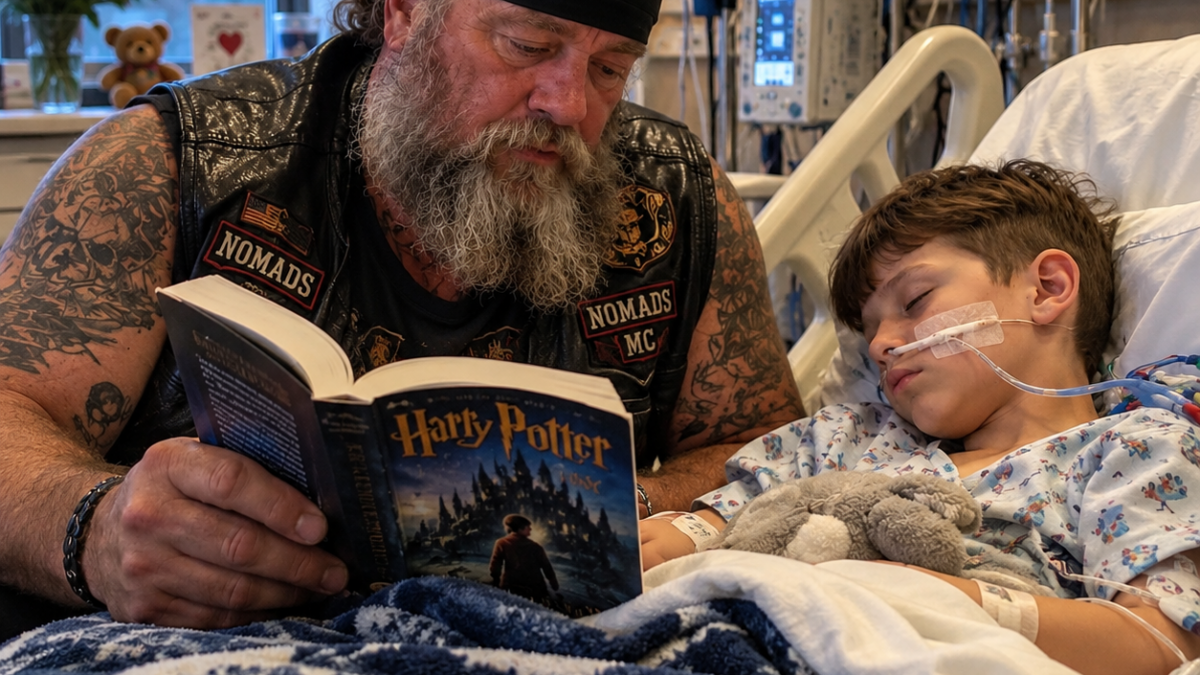
The third day, I walked into his room and found the biker sitting beside my son’s bed.
He was huge.
Gray beard.
Broad shoulders.
Black leather vest covered in patches.
One eye bruised from the crash.
A scab on his cheek.
He was holding a copy of Harry Potter and reading aloud in a low, steady voice.
I froze in the doorway.
For one second, I did not understand what I was seeing.
Then he turned the page.
Something inside me snapped.
“Who the hell are you?” I demanded.
The man closed the book carefully and stood.
Slowly.
Like sudden movement might disturb Ethan.
“My name is Ray,” he said quietly. “I’m the one who hit your son.”
I crossed the room before anyone could stop me.
My fist hit his jaw so hard pain shot up my arm.
Ray’s head turned with the impact.
Blood appeared at the corner of his mouth.
He did not fight back.
He did not raise his hands.
He did not even step away.
He just stood there and looked at me.
Hospital security grabbed me before I could hit him again.
Melissa screamed my name.
A nurse rushed in and told Ray he needed to leave.
I thought that would be the end of him.
It was not.
The next morning, Ray came back.
Then the day after that.
And the day after that.
Every day, he sat beside Ethan and read.
Harry Potter first.
Then Percy Jackson.
Then The Hobbit.
When the books ran out, he started telling stories.
Motorcycle trips through mountain roads.
Rainstorms in Tennessee.
A dog he once rescued from a gas station parking lot.
A baseball game he saw in St. Louis where a foul ball landed in a stranger’s nachos.
Anything he thought a twelve-year-old boy might enjoy hearing.
I hated him for it.
Not because he was cruel.
Because he was not.
Cruel would have been easier.
If Ray had been drunk, speeding, reckless, careless, or arrogant, my hatred would have had somewhere clean to stand.
But the police report did not give me that.
They told us Ray was not intoxicated.
He was not speeding.
He was not using his phone.
Ethan had chased a basketball into the street without looking.
Ray had tried to avoid him.
The skid marks proved it.
The witnesses confirmed it.
Ray stayed at the scene.
Ray called 911.
Ray performed CPR until paramedics arrived.
Ray kept Ethan’s heart going until help took over.
None of that mattered to me.
My son was unconscious because Ray’s motorcycle hit him.
That was all I had room to understand.
Melissa saw it differently.
That made me angry too.
On the eighth day, I found her standing outside Ethan’s room, watching Ray read through the glass.
“He has to stop coming,” I said.
Melissa did not look at me.
“He’s not hurting anything.”
“He put Ethan in that bed.”
Her face crumpled, but her voice stayed calm.
“It was an accident.”
I laughed once.
A bitter, ugly sound.
“Do not say that to me.”
“It was,” she whispered. “He stayed. He called for help. He kept Ethan alive until the ambulance came.”
“I do not care.”
“I know.”
She turned then, tears shining in her eyes.
“But maybe you should.”
I walked away before I said something I could not take back.
For the next two weeks, Ray kept showing up.
Every morning.
Same chair.
Same quiet voice.
Same leather vest.
Sometimes he brought books.
Sometimes he brought baseball cards.
Once he brought a small Bluetooth speaker and played classic rock at a volume so low the nurses pretended not to notice.
I told myself I ignored him.
I did not.
I watched everything.
The way he washed his hands before touching Ethan’s blanket.
The way he never sat in my chair.
The way he stepped into the hallway whenever doctors came in, giving us space he had not been asked to give.
The way he spoke to Ethan as if my son were awake.
As if Ethan was not a body connected to tubes, but a boy who might be listening from somewhere just out of reach.
On the fifteenth day, I walked into the room and found Ray crying.
Not loudly.
Not dramatically.
He sat beside Ethan’s bed with his phone in one hand, staring at a picture.
I should have left.
Instead, I asked, “What is that?”
Ray wiped his face quickly.
“This is my son,” he said.
He turned the screen toward me.
The photo showed a boy around Ethan’s age standing beside a baseball field, cap crooked, glove tucked under one arm, grin too big for his face.
“Caleb,” Ray said.
I looked from the photo to Ray.
“Where is he now?”
Ray stared at the picture a long time.
“He died twenty years ago.”
For a moment, my anger stepped back.
Not gone.
Just far enough that I could hear him.
“Car accident,” Ray said. “I was working that night. By the time I got there, he was gone.”
His voice broke on the last word.
He looked toward Ethan.
“That’s why I keep coming.”
I sat down across from him without meaning to.
“Why?”
Ray took a slow breath.
“When Caleb died, I didn’t get to say goodbye. I wasn’t there when he needed me.”
His hand tightened around the phone.
“I can’t bring him back. But Ethan is somebody’s son. He’s hurt because of me, whether the accident was my fault or not. So I’m going to sit here.”
He looked at Ethan.
“I’m going to make sure he knows somebody is still fighting for him.”
I did not know what to say.
The police had already told us Ray was not legally responsible.
Ray did not seem interested in being excused.
“Fault doesn’t matter to me,” he said, as if reading my thoughts. “My bike hit him. That’s enough.”
We sat quietly.
Machines breathed and beeped around us.
Then Ray looked at me.
“If you want me to leave, I’ll leave.”
I looked at my son.
At the stillness of his face.
At the tubes and wires and blankets.
At the boy I had taught to ride a bike, throw a curveball badly, and apologize when he slammed doors.
I thought of Ray’s son.
Caleb.
A boy in a baseball cap who never got one more story.
“No,” I whispered. “Stay.”
So he stayed.
And slowly, I started staying too.
Until then, I had been present in the room but not really with Ethan.
I hovered.
I paced.
I demanded updates.
I argued with doctors.
I stared at monitors like I could threaten them into changing.
But sitting beside Ethan?
Talking to him?
Reading to him?
That required hope.
And hope was dangerous.
Hope made promises grief could destroy.
Ray seemed to understand that without explaining it.
He never told me to be strong.
He never told me everything would be okay.
He never said God had a plan.
He just pulled up a chair and kept showing up.
Melissa, Ray, and I began taking turns beside Ethan’s bed.
We played his favorite songs.
Read his favorite books.
Talked about baseball.
Told him his dog, Cooper, kept sleeping outside his bedroom door.
Melissa described dinner recipes Ethan would have complained about.
I told him his team had won two games without him but looked terrible doing it.
Ray told him motorcycle stories.
Not dangerous ones.
Funny ones.
Human ones.
Once he spent twenty minutes explaining how he accidentally rode six miles with a raccoon in his saddlebag.
I did not believe him.
Ethan would have.
On the twenty-third day, Ray showed up with his motorcycle club.
Sixteen riders gathered in the hospital parking lot.
They could not all come upstairs, so they stood outside beneath Ethan’s window.
One by one, they started their engines.
The sound rolled through the parking lot like thunder.
Deep.
Steady.
Alive.
Melissa stood at the hospital window crying.
“Ethan loves motorcycles,” she whispered. “If he can hear anything, he’ll hear that.”
Ray stood beside us, looking down at the men in the parking lot.
“They’re praying,” he said.
I looked at him.
“With engines?”
He smiled faintly.
“Some men only know one way to speak.”
On day thirty, the doctors sat us down.
That is never good.
Doctors do not ask you to sit unless the words coming next are heavy.
They told us Ethan might not wake up.
They were careful.
Gentle.
Professional.
They talked about brain activity, swelling, recovery windows, long-term care, and preparing ourselves for the possibility that this could become permanent.
Permanent.
A word that sounded too large for my twelve-year-old son.
I made it into the hallway before I broke.
Then my knees gave out.
I slid down the wall and sat on the floor with my head in my hands.
“I can’t lose him,” I said. “He’s everything.”
Ray found me there.
He did not try to pull me up.
He did not say be positive.
He did not tell me not to think that way.
He sat beside me on the hallway floor, a man in a leather vest under fluorescent lights, and stayed quiet.
After several minutes, he said, “I know.”
Two words.
That was all.
But somehow they meant everything.
Because he did know.
Not in the way people say they understand when they cannot.
Ray knew the shape of a world after a son was gone.
He had lived in it for twenty years.
After that, I stopped seeing only the motorcycle.
I started seeing the man.
The man who sat with guilt because guilt was easier than absence.
The man who read to my son because nobody had read to his.
The man who let me punch him because maybe he thought he deserved it, even when the facts said otherwise.
The man who stayed.
On the forty-fifth day, Ray walked into Ethan’s room carrying a small box.
“What is that?” I asked.
“A project.”
“For who?”
“For when he wakes up.”
Inside was a model motorcycle kit.
Chrome pieces.
Tiny wheels.
A blue fuel tank.
Instructions so detailed they made my eyes hurt.
Ray set it on the windowsill.
“We’re going to build it together,” he said.
I stared at the box.
Then I started crying.
Not the violent crying from the first week.
Not the angry crying.
This was something else.
This was the sound a person makes when hope touches a place he has been guarding too hard.
Ray looked uncomfortable.
“I can take it back if—”
“No,” I said quickly.
I wiped my face.
“Leave it.”
So he did.
The box sat on the windowsill beside Ethan’s bed.
A promise made by a man who had no right to make promises and somehow gave us one we needed.
Then came day forty-seven.
I arrived at the hospital at six in the morning.
The halls were quiet.
A nurse at the station lifted one hand in greeting.
I carried two coffees, one for Melissa when she arrived and one I did not intend to offer Ray but probably would.
Ray was already there.
Of course he was.
He sat beside Ethan’s bed, reading softly.
The Hobbit that morning.
His voice was low and rough.
“In a hole in the ground there lived a hobbit…”
I walked toward them.
Then I saw Ethan’s finger move.
I stopped so suddenly coffee spilled over my hand.
“Ray…”
He looked up.
Ethan’s finger moved again.
The cup hit the floor.
I rushed to the bed.
“Ethan? Buddy? Can you hear me?”
His eyelids fluttered.
The machines began beeping faster.
A nurse ran in.
Then another.
Someone called for a doctor.
I grabbed Ethan’s hand.
“Come on, buddy. Come on. I’m here.”
His eyes opened.
Just a little at first.
Then wider.
Confused.
Frightened.
His gaze moved from the ceiling to the machines, then finally to me.
I cried his name.
“I’m here. Dad’s here.”
His eyes moved past me.
Toward Ray.
Ray stood frozen beside the chair.
Ethan stared at him.
His lips barely moved.
“You…”
The room went silent.
Ethan swallowed.
“You’re the man.”
Ray’s face crumpled.
I leaned closer.
“What, buddy? What do you mean?”
Ethan’s eyes filled with tears.
“The man who saved me.”
Ray shook his head.
“No, kid. I hit you.”
Ethan’s voice was weak, barely more than air.
“You stopped.”
“I hit you.”
“You stayed.”
The room went silent in a way I had never heard before.
Ethan blinked slowly.
“You saved me.”
I looked at my son.
At the man beside his bed.
At the book still open in Ray’s hand.
And every simple version of the story I had been telling myself fell apart.
Ethan remembered.
Not everything.
Not clearly.
But enough.
He remembered running after the ball.
He remembered the street.
The sudden shape of the motorcycle.
The impact.
Then Ray kneeling beside him.
Ray holding his hand.
Ray telling him not to close his eyes.
Ray saying, “Stay with me, kid. Help is coming. I’m right here.”
Then sirens.
Then darkness.
The doctors later told us Ethan’s cognitive function looked better than they had dared hope. He would need months of therapy. There would be hard days, pain, confusion, setbacks, and work none of us could yet understand.
But he was awake.
My son was awake.
Then Ethan said something that broke Ray completely.
“I heard you.”
Ray looked at him.
“Who?”
“You.”
Ethan’s voice shook.
“I heard you reading.”
Ray covered his face with one hand.
“I heard you talking about Caleb too.”
The room seemed to stop breathing.
Ethan looked toward him.
“I wanted to wake up and tell you I was okay.”
Ray made a sound I will never forget.
Not a sob exactly.
A wound opening and closing at the same time.
He walked to Ethan’s bed and placed one huge, trembling hand gently on my son’s shoulder.
“You scared the hell out of us, kid.”
Ethan managed the smallest smile.
“You stayed.”
Ray nodded.
“I wasn’t leaving.”
Ethan spent sixty-two days in the hospital before he was strong enough to go home.
Sixty-two days of therapy, tests, headaches, balance exercises, memory checks, medication schedules, and small victories that felt enormous.
The first time he sat up without help, Melissa cried.
The first time he took three steps with a walker, I cried.
The first time he complained about hospital food, all three of us cried, including Ray, though he denied it.
Ray was there for most of it.
Not every hour.
Not every day after Ethan woke.
He had a life, a job, a club, and a grief that still belonged to him.
But he came often.
He brought books, then puzzles, then the model motorcycle kit.
He and Ethan built it slowly on a tray table.
Some days Ethan could only manage one piece.
Some days he got frustrated and shoved the instructions away.
Ray never rushed him.
“Roads are built one mile at a time,” he would say.
Ethan rolled his eyes every time.
He secretly loved it.
The day Ethan was discharged, Ray waited outside the hospital entrance.
His motorcycle was parked at the curb, polished until the chrome caught the morning sun.
Sixteen riders stood behind him.
The same men from the parking lot.
Melissa pushed Ethan’s wheelchair through the sliding doors.
My son looked thinner than before.
Paler.
But alive.
Ray stepped forward holding a small black leather vest.
Across the back, stitched in white letters, were the words:
HONORARY ROAD BROTHER
Ray cleared his throat.
“You’re family now, kid. You fought your way back.”
Ethan stared at the vest.
Then reached for Ray.
Ray bent down, and my son hugged him.
I stood there watching my child embrace the man whose motorcycle had put him in the hospital.
For the first time, I finally understood something that had taken me almost two months to accept.
Ray was not the villain of our story.
He was a man caught in a terrible accident who chose to run toward the aftermath instead of away from it.
Two years have passed.
Ethan is fourteen now.
He is back to playing baseball, though his swing is different and his balance still needs work when he is tired. He argues about homework. He leaves socks in the hallway. He complains about chores. He eats everything in the refrigerator and then asks what is for dinner.
All the ordinary things I once feared I would never get to complain about again.
Every Sunday, Ray comes over for dinner.
Ethan calls him Uncle Ray.
The model motorcycle sits on a shelf in Ethan’s bedroom. They eventually finished it, although Ray insists Ethan did most of the work.
Sometimes they work on Ray’s real motorcycle in our garage.
I pretend not to hover.
Melissa does not bother pretending.
People ask me how I forgave him.
The truth is, I eventually realized there was nothing to forgive.
Ray did not leave my son in the street.
He did not run.
He did not hide.
He stayed.
Then he stayed for forty-seven more days.
He sat beside a boy he had never met before that terrible morning and read him his favorite books because twenty years earlier, Ray had not been there when his own son needed him.
He could not save Caleb.
But he helped save Ethan.
And somewhere along the way, he saved me too.
Because I almost let grief turn me into someone who could only blame.
Someone who could only see the moment of impact and nothing after it.
Someone who believed anger was the same thing as love because both burned hot enough to keep me standing.
Ray taught me something I did not want to learn.
Sometimes a person can be connected to the worst day of your life and still not be your enemy.
Sometimes guilt is not proof of evil.
Sometimes responsibility looks like a man in a leather vest sitting beside a hospital bed, turning pages for a child who may never answer.
And sometimes the person you blame for the wound is the person who refuses to leave you alone while it heals.
I still remember the first time I saw him in Ethan’s hospital room.
That black vest.
That gray beard.
That book in his hands.
I remember hitting him.
I remember the blood on his lip.
I remember how badly I wanted him gone.
Now, on Sundays, I watch him sit at my kitchen table while Ethan talks too fast about school, baseball, engines, and everything else a fourteen-year-old boy thinks adults need to know.
Ray listens to all of it.
Every word.
As if listening is sacred.
Maybe to him, it is.
After dinner, Ethan usually follows him into the garage.
Melissa clears plates.
I stand at the sink and watch through the window as Ray shows my son how to hold a wrench, how to check oil, how to be patient when something does not fit the first time.
Sometimes, in the fading light, Ray turns his head a certain way, and I see the father he never got to finish being.
Then Ethan says something that makes him laugh.
And for one brief second, the past loosens its grip on both of them.
I do not believe everything happens for a reason.
I hate that phrase.
No reason would ever be good enough for what happened to Ethan, or Caleb, or any parent who has stood beside a hospital bed begging a child to come back.
But I do believe people can choose what they do after the terrible thing.
Ray chose to stay.
Ethan chose to fight.
Melissa chose compassion before I was strong enough to understand it.
And eventually, I chose to open the door to the man I once wanted thrown out of my son’s room.
That does not erase the accident.
Nothing does.
But it changed what came after.
And sometimes, what comes after is where the saving happens.








