Teller Ripped Up a Black Mom’s Check—Then Looked Up and Saw Her Son on the Bank’s Billboard
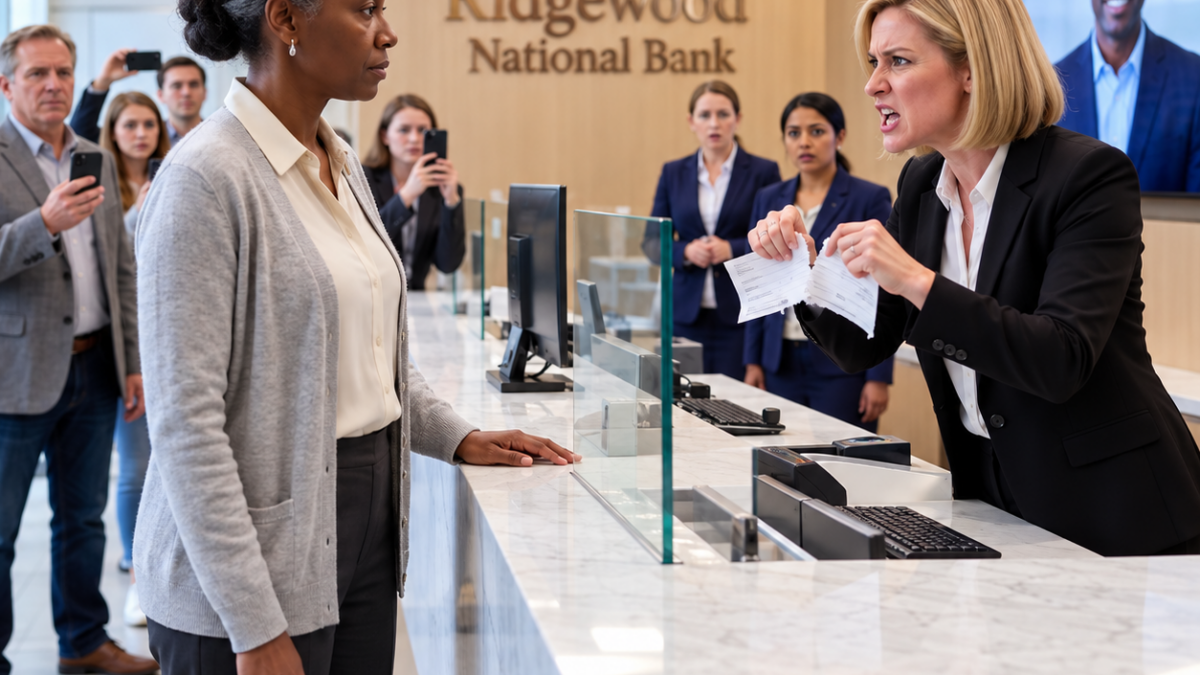
Teller Ripped Up a Black Mom’s Check—Then Looked Up and Saw Her Son on the Bank’s Billboard
The teller tore my son’s check in half and let the pieces fall beside my groceries like I was trash she had finally decided to throw away.
She called me a money launderer in front of the entire bank, froze my account, and had security drag me outside with one shoe still lying on the marble floor.
Then my son walked through the glass doors, and the teller finally looked up at the billboard behind her—the one with his face on it.
My name is Monica Taylor.
I was seventy-three years old the day Ridgewood National Bank decided I did not look like a woman who deserved eight thousand dollars.
Not earned.
Not given.
Not loved enough to receive.
Deserved.
That was the word under everything they did to me.
They never said it that way, of course. People rarely say the cruelest part out loud. They dress it in policy. They hide it behind procedure. They write it down on yellow forms and call it compliance.
But I felt the truth in the way the teller held my check with two fingers, like it smelled bad.
I felt it in the way the branch manager looked down at me on the floor, kneeling beside my spilled collard greens, and said, “People like you.”
I felt it in the silence of everyone who watched.
That morning had started like an ordinary Tuesday.
My back hurt, but my back always hurt. Degenerative disc disease had been working on me for years, bending my spine little by little, taking inches from my height and patience from my days. Some mornings, I woke up already tired from the simple effort of being inside my own body.
But that day was a good day.
My son was coming for dinner.
Jaylen always told me I did too much when he visited.
“Mama, just order something,” he would say. “I can pick it up.”
And I would say, “Boy, I did not raise you on takeout.”
He liked my collard greens with extra hot sauce, sweet potatoes with cinnamon, and cornbread with just enough sugar to make him argue.
“Cornbread is not cake,” he would say.
“And yet you eat three pieces.”
That morning, I went to SaveMart on Ridgewood Avenue and bought collard greens, bell peppers, onions, sweet potatoes, and a small bottle of the hot sauce Jaylen had loved since he was nine years old. I carried two plastic bags, one in each hand, and moved slowly across the parking lot because every step sent a dull ache through my lower back.
The check was folded inside my purse.
Eight thousand dollars.
Jaylen mailed one every month.
He had been trying for years to get me to use mobile banking.
“Mama, I can just transfer it,” he said at least a hundred times.
“I like going to the bank,” I always told him. “It gets me out the house.”
That was true.
Mostly.
The bank had been part of my routine for eleven years. Same branch. Same lobby. Same marble floors. Same little table with pens chained to it. Same waiting chairs, including the one near the window with the wobbly leg.
I knew the place well enough to feel comfortable.
That was my mistake.
PART2:
Comfort can make you forget that a place recognizing your account number is not the same as recognizing your humanity.
The line was short when I walked in.
Four people ahead of me.
I set my grocery bags on the floor beside my feet and waited.
The air conditioning was too cold, like always. The bank smelled faintly of paper, perfume, and floor polish. Behind the teller windows, there was a framed poster on the wall. I had seen it before, but I never stared long.
A young Black man in a sharp navy suit smiled from the poster.
BUILDING YOUR FUTURE.
That was the tagline.
The man was my son.
Jaylen Taylor.
Vice president of marketing at Hallmark Financial Group, the parent company of Ridgewood National Bank.
I knew his face was on the poster.
Of course I knew.
He had called me the day they took the photo.
“Mama, they’re putting me on campaign materials.”
“That means what?”
“It means my face might be in branches.”
“Then smile right. I paid for those braces.”
He laughed for a full minute.
Still, when I saw the poster, I usually looked away.
Not because I was not proud.
I was too proud.
Sometimes love swells so big inside your chest that looking straight at it hurts.
PART3:
When my turn came, I picked up my grocery bags, stepped to the counter, and smiled at a teller I did not recognize.
Her name tag said Karen Alrech.
Young.
Blonde.
Smooth hair.
Pale pink nails.
A face arranged into customer service before she looked at me, then rearranged into something colder.
“Good afternoon,” I said. “Can you help me deposit this check, please?”
She did not smile back.
Her eyes dropped to my grocery bags.
Then to my shoes.
Old sneakers. One lace loose. Not untied completely, just tired, like the rest of me.
I slid the check across the counter.
Karen picked it up with two fingertips and held it away from herself.
“What is this?”
“A check from my son. I deposit one every month.”
She turned it over.
Read the amount.
Her eyebrows rose.
“This is for eight thousand dollars.”
“Yes, ma’am.”
“You’re telling me someone wrote you a check for eight thousand dollars?”
“My son. He sends it every—”
“Hold on.”
She set the check down and turned to a coworker at the next window. Her name tag said Lisa.
Karen whispered something.
Lisa looked at me.
Then at the check.
Then away.
I stood still with my hands folded on the counter.
The name on the check was clear.
Jaylen Taylor.
The same name printed beneath the man in the framed poster six feet behind Karen’s head.
Nobody noticed.
Karen turned back with a different expression.
Not confusion.
Decision.
“Ma’am, I’m going to need you to step aside.”
“I’ve been waiting in line.”
“I need to verify this check. It’s going to take a while.”
She was already waving the next customer forward.
A white man in a navy blazer stepped past me without a glance.
“Sir,” Karen said warmly, “how can I help you today?”
Her voice had changed completely.
Bright.
Sweet.
Easy.
A voice she had not used once with me.
I moved to the side with my grocery bags. One tipped slightly, and a bell pepper rolled against the base of the velvet rope. I bent to pick it up.
Halfway down, my spine locked.
Pain shot from my lower back down my left leg so sharply that I grabbed the edge of the counter to keep from falling.
My eyes watered.
Nobody noticed.
The man in the blazer deposited a check in under two minutes.
No extra ID.
No questions.
Karen smiled and told him to have a wonderful afternoon.
Then came a blonde woman in sunglasses.
Another check.
Another deposit.
Ninety seconds.
Karen complimented her bracelet.
Then a man in a polo shirt who did not even know his account number. Karen looked it up for him and laughed at something he said about the weather.
Then a woman with a stroller. Karen leaned over the counter and cooed at the baby.
“Oh, aren’t you precious?”
She processed the deposit without asking for a single piece of identification.
I stood by the wall.
Twenty-five minutes.
The pain in my back moved from aching into something deeper. Grinding. Radiating down both legs. I shifted my weight from left foot to right foot, then back again. The floor felt like it was tilting.
I pressed my palms against the marble ledge near the window.
An elderly white woman in the waiting area looked at me.
Then looked away.
Five customers.
Five customers served while I stood three feet from the counter, waiting for a check that had been deposited into that same account every month for eleven years.
Finally, Karen turned back.
“All right,” she said, as if doing me a favor. “Let me look at this again.”
She picked up the check, held it under the desk lamp, tilted it back and forth.
Then she pulled up my account on her screen.
Her expression sharpened.
“Ma’am, your account shows a pattern of large monthly deposits, all from the same source.”
“Yes. My son sends me—”
“Who is your son?”
“His name is on the check.”
“I’m asking you. Who is he? What does he do?”
I hesitated.
Jaylen had always told me to be careful talking about his work with strangers.
“He works in business,” I said.
Karen laughed.
Not a polite laugh.
A loud, sharp sound that made two people in the waiting area look up.
“Business,” she repeated.
She turned toward Lisa.
“You hearing this? A woman dragging grocery bags into my bank has a son in business, writing her eight-thousand-dollar checks every month.”
Lisa leaned over, looked at the screen, then at me.
She tried not to smile.
She failed.
My jaw tightened.
“I don’t see why that’s funny.”
“It’s my job to see why, ma’am,” Karen said, leaning forward. “Because where I’m sitting, this looks like a textbook case of structured deposits.”
I did not answer.
“You know what that means?”
I still did not answer.
“It means money laundering.”
She said it loudly enough for the entire lobby to hear.
Money laundering.
The words landed like a brick through glass.
Every head turned.
A woman in pearls pulled her purse closer.
A man in a gray suit stepped backward.
The security guard near the door unclipped his radio.
A teenager in the corner raised his phone. A red light blinked.
Live.
“I am not laundering money,” I said.
My voice cracked, and I hated that it did.
“My son sends me that check every month. I’ve deposited it here for eleven years.”
“Eleven years of suspicious activity that nobody caught until today,” Karen said.
Then she started typing.
Fast.
Click.
Click.
Click.
“I’m flagging this account for a suspicious activity report.”
“What does that mean?”
“It means your account is frozen.”
I blinked.
“Frozen?”
“You can’t deposit. You can’t withdraw. You can’t transfer. Nothing. Not until compliance reviews the full history.”
“How long does that take?”
“Could be thirty days. Could be ninety.”
The floor tilted beneath me.
Every dollar I had.
My savings.
My Social Security deposits.
Money for medication.
Money for the electric bill.
The account that had carried me through eleven years of quiet survival.
Locked by a young woman who had looked at my jacket, my shoes, my groceries, my Black face, and decided I belonged in a criminal file.
“You can’t do this,” I whispered.
Karen folded her arms.
“I just did.”
A murmur moved through the lobby.
People had phones out now.
One woman in a red coat recorded with her phone held sideways.
No one stepped forward.
No one said, “That isn’t right.”
No one asked Karen to slow down.
I looked around the room, searching for one face willing to meet mine.
I found screens.
Downcast eyes.
Pursed lips.
Distance.
“Please,” I said. “I just came in to deposit a check. I bought groceries. I was going to cook dinner for my son tonight. Collard greens. His favorite. That’s all I was doing.”
Karen glanced down at the grocery bags.
The bell pepper had rolled farther and stopped near a woman’s designer heel. The woman shifted her foot and kicked it away without looking down.
“Ma’am,” Karen said, “this is a bank. Not a farmers market. I don’t know why you thought it was appropriate to drag your shopping in here like this is some kind of bus stop. You’re making a mess on my floor.”
Someone snorted.
A woman covered her mouth.
The teenager’s phone stayed aimed at my face.
My eyes burned.
I would not cry.
Not there.
Not in front of them.
I reached into my purse for my phone. Jaylen would know what to do. He always did.
My fingers shook too badly to unlock it.
Once.
Twice.
Three times.
The phone locked me out.
Thirty seconds.
I stared at the screen.
Jaylen’s college graduation photo smiled back at me.
I held the phone against my chest.
Karen kept talking.
“I told compliance to pull the whole history,” she said to Lisa, loud enough for the lobby. “Eleven years of this. Can you imagine? We’ll probably get a commendation for catching this one.”
“Good eye, Karen,” Lisa said.
Good eye.
A young teller at the far window looked up.
He was maybe twenty-three.
His name tag said Devon Harris.
His eyes moved from Karen to me.
Then to the framed poster behind her.
The young Black man in the navy suit.
Jaylen.
Devon’s lips parted slightly.
He looked at my check.
Then at my face.
Same cheekbones.
Same eyes.
Same last name.
“Karen,” Devon said carefully. “Maybe we should let a manager—”
“Maybe you should mind your station, Devon,” Karen snapped without turning around. “I’ve been doing this job since before you could spell deposit.”
Devon closed his mouth.
He looked at the poster one more time.
Then he looked down.
That almost hurt more than the laughter.
Because he saw it.
He almost spoke.
Almost.
Karen pulled a yellow form from under the counter.
Suspicious Activity Report.
She began filling it out slowly, making sure I could see every stroke.
“Full legal name.”
“You have my account right there.”
“I need you to say it for the record.”
“Monica Taylor.”
She wrote it down and underlined it twice.
“And your son’s name?”
“Jaylen Taylor.”
She wrote that down too.
She did not look up.
She did not notice that the answer she needed was on the wall behind her head, printed in gold letters.
She was too busy feeling important.
The pain in my back had become unbearable now. My legs trembled from standing nearly forty minutes. My groceries sat at my feet like evidence against me.
Karen closed the yellow folder with a snap.
“We’ll be in touch,” she said. “In the meantime, I suggest you find a good lawyer. Because if this turns out to be what I think it is, you’re looking at federal charges. Money laundering. Wire fraud. Conspiracy.”
She counted them on her fingers.
“That’s twenty-five years minimum.”
Twenty-five years.
I was seventy-three.
The math did not need explaining.
My hands went to the counter to steady myself.
“I want my check back,” I said.
Karen looked at me like I had asked for the vault code.
“Excuse me?”
“My check. My son’s check. Give it back to me.”
“That check is evidence now. It’s part of an active suspicious activity file.”
“It is not evidence. It is my money. My son wrote it for me.”
Karen picked up the check.
Held it between two fingers.
Dangled it just out of reach.
“This piece of paper is what started all of this,” she said. “Honestly, you should have thought twice before walking in here with something like this.”
I reached for it.
My arm moved slowly.
My back seized.
Karen pulled it away.
Then she looked at it one more time.
Eight thousand dollars.
Signed by Jaylen Taylor.
And tore it in half.
The sound cut through the lobby like a slap.
She dropped both pieces onto the counter.
“There,” she said. “Now nobody has to worry about it.”
For a second, I could not breathe.
My son’s handwriting.
His signature.
Torn down the middle.
I reached for the pieces with trembling fingers.
Karen swept them off the counter.
They fell to the floor.
Then she pushed my grocery bags off the ledge with the back of her hand.
The bags hit the tile.
Onions rolled under the rope.
A container of collard greens split open.
Dark leaves scattered across the white marble.
“This is not a storage facility,” Karen said.
My knees gave out.
Not from emotion.
From pain.
My body finally refused to stand.
I dropped to the floor and tried to gather the torn check pieces and scattered vegetables with hands that would not stop shaking.
My spine screamed.
Tears ran down my face.
I did not make a sound.
A door opened behind the teller windows.
A man in a charcoal suit walked out.
Name tag: Preston Holloway.
Branch Manager.
Mid-fifties.
Silver hair.
Tight jaw.
“What’s going on here?”
Karen straightened like a child proud of a school project.
“I flagged a suspicious account. Structured deposits. Possible money laundering. I already filed the SAR and froze the account.”
Preston looked down at me.
Seventy-three years old.
On my knees.
Picking collard greens off his marble floor.
He did not ask if I was okay.
He did not ask what happened.
He looked at Karen and nodded.
“Good work.”
Then he stepped closer to me.
“Ma’am,” he said, “I don’t know where you came from or what you were trying to pull in my branch, but we take financial crimes very seriously here. People like you think you can walk into a place like this and nobody will notice.”
People like you.
There it was.
Plain.
Cold.
Final.
He turned toward the security guard.
“Ray, get her out of here.”
Ray was thick-necked and broad-shouldered. He did not offer me a hand.
He gripped my upper arm and pulled.
Pain flashed white behind my eyes.
My shoe slipped off.
“Sir, please,” I said. “My groceries. My shoe.”
“Leave them,” Preston said. “I’m issuing a trespass order effective immediately. You are permanently banned from this branch. If you return, we will contact law enforcement.”
Ray dragged me toward the door.
One shoe on.
One shoe off.
My foot dragged on the marble.
I looked back once.
My groceries were still on the floor.
My shoe sat alone near the velvet rope.
The torn check pieces lay among the collard greens like confetti after a celebration I had not been invited to.
A woman in the third row stood up.
“Hey. Wait a minute. She didn’t do anything wrong. I’ve been watching this whole time and she didn’t—”
Preston turned to her.
“Ma’am, would you like to continue banking with us?”
Her mouth opened.
Then closed.
“I didn’t think so,” Preston said.
She sat down.
Nobody else moved.
Nobody else spoke.
The lobby was silent except for the hum of air conditioning and the sound of my one shoe dragging.
Ray pushed the glass door open and pulled me into the afternoon light.
“Don’t come back,” he said.
Then he released me.
I stumbled and caught myself on the metal railing.
My purse hung from one shoulder.
One foot bare on the hot concrete.
My groceries were inside.
My check was in pieces.
My account was frozen.
My name was in a suspicious activity report.
I stood alone on the sidewalk outside the bank I had trusted for eleven years.
Inside, Karen wiped down her counter with a disinfectant cloth.
She scrubbed the spot where my hands had been.
Like I had left something dirty behind.
My phone buzzed in my purse.
I pulled it out.
Three missed calls.
Baby Jay.
I tried to call back.
It rang.
Once.
Twice.
Three times.
Voicemail.
“Hey, you’ve reached Jaylen Taylor. Leave a message and I’ll get back to you.”
I opened my mouth.
Nothing came out.
I ended the call and held the phone against my chest.
Then, for the first time that day, I looked up.
The billboard on the building next door was three stories tall.
A young Black man in a tailored navy suit smiled down with quiet confidence.
Ridgewood National Bank.
Building Your Future.
My son’s face.
The same face I had washed with a warm cloth when he was a baby.
The same face that looked up at me from homework pages and hospital beds and graduation stages.
The same face that had smiled across my dinner table every Sunday.
The same face belonging to the man whose check had just been torn in half inside a bank using him to sell trust.
I looked through the glass door.
Karen was laughing at something Lisa said.
Preston’s office door was closed.
My collard greens were still on the floor.
My shoe was still on the marble.
Then my phone buzzed again.
A text.
Mama, I’m 10 minutes away. Don’t leave the bank. I have a surprise.
I read it twice.
I pressed the phone to my chest.
I did not go back inside.
I couldn’t.
So I waited.
Seven minutes passed.
A couple walked into the bank.
A man walked out counting twenties.
Nobody asked why an old Black woman stood barefoot outside the entrance on a Tuesday afternoon.
Then a black Escalade turned the corner and pulled into the reserved spot near the door.
The engine cut.
Two men stepped out.
The first was tall, early forties, wearing a charcoal suit with no tie. He moved like someone who owned the air around him.
Reginald Cole.
CEO of Hallmark Financial Group.
The second man was younger, early thirties, navy suit, white shirt, silver watch.
Jaylen.
My son saw me before both feet hit the curb.
“Mama?”
He crossed the sidewalk in three steps.
His hands went to my shoulders.
“Mama, what happened? Where are your shoes? Where are your groceries?”
I tried to speak.
Then I broke.
Not loud.
Not dramatic.
My chin dropped to my chest. Tears ran down both cheeks. My body shook under his hands.
“They took my check,” I whispered. “They tore it up. They froze my account. They said I was laundering money. They dragged me out.”
Jaylen’s hands went still.
“Who?”
His voice was low.
Too controlled.
“The teller. The manager. Security.”
My voice cracked.
“They threw my groceries on the floor, Jaylen. The collard greens. I was making them for you tonight.”
He looked through the glass doors.
From outside, we could see everything.
The counter.
The teller windows.
The white marble floor.
Dark green leaves scattered near Karen’s station.
Collard greens.
Next to them, one black shoe.
My shoe.
Reginald Cole stood behind Jaylen.
He looked from me, to my son, to the billboard above us.
“Is that your mother, Jaylen?”
“Yes, sir,” Jaylen said. “That’s my mother.”
Reginald buttoned his jacket.
“Let’s go inside.”
Jaylen took off his suit jacket and draped it over my shoulders.
“Stay here, Mama. I’ll be right back.”
“Jaylen—”
“I’ll be right back.”
Then he walked through the glass doors.
Reginald followed.
The lobby went quiet immediately.
Not gradual quiet.
Instant quiet.
The kind of silence that arrives when people recognize power walking toward the place where they misused it.
Jaylen passed the velvet ropes.
Passed the onions.
Passed my shoe.
He stopped in front of Karen’s window.
Karen looked up.
Her customer-service smile appeared automatically.
Then froze.
Her eyes moved from Jaylen’s face to the poster behind her.
Then back to Jaylen.
Then the poster.
Same jawline.
Same eyes.
Same last name.
Her mouth opened.
No sound came out.
“Good afternoon,” Jaylen said. His voice was calm, almost pleasant. “I’m Jaylen Taylor, vice president of marketing at Hallmark Financial Group.”
He paused.
“This is Reginald Cole, our CEO. We’re here for a branch inspection.”
Karen’s fingers gripped the edge of her keyboard.
“I—yes. Welcome. We weren’t expecting—”
“No,” Jaylen said. “You weren’t.”
The back office door opened.
Preston Holloway stepped out, adjusting his tie.
When he saw Reginald Cole, he straightened so fast I thought his spine might crack.
“Mr. Cole, sir. We had no idea you were coming today. I’m Preston Holloway, branch manager. Please, let me show you to the conference—”
“There’s a shoe on your floor,” Reginald said.
Preston blinked.
He looked down.
My shoe sat on the marble three feet from the pile of collard greens and torn check pieces.
“And vegetables,” Reginald continued. “And what appears to be a torn check on the floor of my bank.”
He looked at Preston.
“Would you like to explain that?”
Preston glanced at Karen.
Karen stared at the billboard like she was seeing it for the first time.
“We had a situation,” Preston said. His authority was gone, replaced by something thin and weak. “A customer presented a suspicious check. Large amount. Monthly pattern. My teller identified potential money laundering, followed protocol, filed a SAR, froze the account, and removed the individual from the premises.”
“Removed,” Jaylen repeated.
Preston swallowed.
“Escorted.”
“The woman you escorted out,” Jaylen said, “is standing on the sidewalk right now with one shoe, no groceries, and a bruise on her arm from your security guard.”
He paused.
“That woman is my mother.”
The sentence detonated in the lobby without making a sound.
Karen made a noise.
Not a word.
A small broken sound somewhere between a gasp and a whimper.
Preston’s face drained of color.
“Your mother?”
“Monica Taylor,” Jaylen said. “Seventy-three years old. Customer at this branch for eleven years. She deposits a check from me every month. The same check she has deposited one hundred thirty-two times before.”
He looked down at the floor.
“The check your teller just tore in half.”
Preston turned toward Karen.
Karen looked at the floor.
Lisa had disappeared from her window.
“I had no idea,” Preston said.
Jaylen’s voice stayed level.
“You had no idea that an elderly woman with a curved spine and a bag of groceries was not a federal criminal? You needed to tear up her check, freeze her account, file a federal report, drag her across the lobby, take her shoe, and throw her onto the sidewalk to figure that out?”
Nobody spoke.
The woman in the red coat had her phone pointed directly at Jaylen.
The teenager’s livestream was still running.
Devon stood from his station.
“Sir,” he said quietly. “I tried to say something. I noticed the poster. I noticed the name. Karen told me to mind my station.”
Jaylen looked at him.
Nodded once.
Then turned back to Preston.
Reginald stepped forward.
He looked through the glass door at me, standing outside in Jaylen’s jacket, one foot bare, phone pressed to my chest.
Then he looked at Preston.
“I met Monica Taylor last December at our annual gala,” Reginald said. “She sat at my table. She told me she was proud of her son. She said she still cooked him collard greens every Sunday.”
He looked down.
“Those are her collard greens on your floor, Mr. Holloway.”
Preston did not answer.
Jaylen looked around the lobby.
The phones.
The silent witnesses.
The vegetables.
The single shoe.
The torn check.
Then he looked at Karen and Preston with something worse than anger.
Certainty.
“Here’s what’s going to happen,” he said. “You’re going to pull up the security footage from the last hour. Every camera in this lobby. And we’re going to watch it together.”
Preston opened his mouth.
“Mr. Taylor, I’m sure we can discuss this in my office.”
“We’re not going to your office,” Jaylen said.
He looked at the lobby.
“At the people who watched my mother get dragged across this floor. We’re doing this right here.”
Reginald nodded once.
The kind of nod that leaves no room for negotiation.
Preston brought a laptop from the back office with shaking hands.
The footage started.
Everyone watched.
Me walking into the bank with grocery bags.
Me waiting in line.
Karen holding the check with two fingers.
Karen whispering to Lisa.
Me standing aside while white customers were served quickly, warmly, easily.
Me bending for the bell pepper, my spine locking.
Nobody helping.
Karen laughing at the word business.
Lisa leaning over to smile.
The money laundering accusation.
The account freeze.
The farmers market comment.
The bell pepper kicked away.
The teenager’s phone aimed at my face.
Karen filling out the yellow form.
Underlining my name.
Threatening federal charges.
The check.
Karen tearing it in half.
Sweeping the pieces to the floor.
Pushing my grocery bags over.
Collard greens scattering across the marble.
Me on my knees, seventy-three years old, trying to pick vegetables and check pieces off a bank floor with shaking hands.
Preston walking out.
Good work.
Not one question.
Ray gripping my arm.
My shoe falling off.
One shoe on.
One shoe off.
The woman standing to protest.
Preston silencing her.
Would you like to continue banking with us?
Me pushed through the glass doors.
Barefoot on hot concrete.
Karen wiping the counter where my hands had been.
The footage ended.
The lobby stayed silent.
Karen’s face had gone gray.
Preston stood perfectly still, his mouth slightly open.
Reginald closed the laptop.
“In thirty-two years of banking,” he said quietly, “I have never seen anything like what I just watched.”
He looked at Karen.
Then Preston.
“You filed a fraudulent suspicious activity report on a loyal customer. You froze her account without cause. You destroyed her property. You physically removed a seventy-three-year-old disabled woman from this building.”
He paused.
“And you did it because she was Black, because she was old, because she carried grocery bags, because she did not look like your idea of someone who deserves eight thousand dollars.”
Karen started crying.
“Mr. Cole, I didn’t know. I was just following—”
“You were not following anything,” Reginald said. “There is no protocol that instructs a teller to tear up a customer’s check. There is no procedure for pushing a woman’s groceries onto the floor. There is no policy that says drag an elderly customer out by her arm. You made every one of those choices yourself.”
Karen sobbed into the silent lobby.
Reginald turned.
“Preston Holloway, you are terminated, effective immediately. Surrender your badge and keys before you leave this building.”
Preston fumbled with his name tag. It took three tries to remove it.
He placed it on the counter.
“Karen Alrech, you are terminated, effective immediately.”
Karen sat down hard in her chair.
Her name tag remained pinned to her blouse.
She did not reach for it.
Jaylen turned to Devon.
“Pull up my mother’s account.”
Devon sat quickly.
His fingers moved across the keyboard.
“The freeze—I can reverse it from here, sir. The SAR filing will need formal withdrawal through compliance, but I can flag it for immediate review.”
“Do it.”
A few seconds.
Then Devon looked up.
“Account active. Freeze removed. Balance restored.”
Jaylen nodded.
Then he walked to the glass door and opened it.
I was still outside.
“Mama,” he said softly. “Come inside.”
I did not move.
“It’s okay, Mama. Come inside.”
I stepped through the door with one shoe on and one foot bare on the cold marble.
The room watched.
Every phone still recording.
Jaylen knelt in front of me.
He picked up my shoe from the floor, slid it onto my foot, and tied the lace.
My son.
The man on the billboard.
The vice president in the navy suit.
Kneeling on a bank floor to put his mother’s shoe back on.
That was when the woman in the red coat began to cry.
The man with the reading glasses wiped his face.
The woman who had tried to defend me stood again.
This time, nobody threatened her.
She started clapping.
Slowly.
Then someone joined.
Then another.
Soon the whole lobby was clapping.
I stood in the middle of the room holding my son’s hand, tears running down my face.
Not tears of pain this time.
Something else.
The collard greens were still on the floor.
Jaylen looked down at them.
A small, sad smile touched his face.
“I’ll buy you new ones, Mama.”
“You better,” I said. “And don’t forget the hot sauce.”
The video hit the internet before Karen and Preston reached the parking lot.
By the time Reginald said, “You are terminated,” the teenager’s livestream had four thousand viewers.
By the time Jaylen knelt to put my shoe back on, it had twelve thousand.
Within an hour, clips were everywhere.
The check tearing.
The groceries falling.
Me on my knees.
Ray dragging me out.
Jaylen walking in under his own billboard.
And then the shot that broke people open.
My son kneeling on the marble floor of the bank that had humiliated me.
By sundown, the hashtag Justice for Monica was trending.
I did not understand all of it.
I did not want to.
The next morning, Hallmark Financial Group released a statement.
Reginald did not call it an incident.
He called it a failure.
“What happened to Monica Taylor was not a mistake,” he said. “It was a choice. Multiple choices made by multiple people, and every one of them was wrong.”
The company announced mandatory in-person training on racial bias, customer dignity, and ethical use of compliance tools across all two hundred fourteen branches.
Not a webinar.
Not a checkbox.
Three days.
Every employee.
They also launched the Taylor Dignity Initiative, a fund proposed by Jaylen and approved by the board within forty-eight hours. It would provide free legal support and advocacy for customers facing discrimination at financial institutions.
They named it after me with my permission.
Devon Harris, the young teller who almost spoke, was promoted to assistant branch manager at the Ridgewood location.
He called me later.
His voice shook.
“Mrs. Taylor, I’m sorry I didn’t do more.”
“You tried, baby.”
“I stopped.”
“You start again next time.”
He was quiet for a long moment.
“Yes, ma’am.”
Karen’s name appeared in local news for three days.
Then her profiles disappeared.
Lisa resigned before the internal investigation reached her desk.
Preston released an apology through his attorney.
Six sentences.
He used the phrase regrettable situation twice.
I did not read it twice.
The following Sunday, Jaylen came to my house with groceries.
Collard greens.
Bell peppers.
Sweet potatoes.
Hot sauce.
He carried too much, as usual.
“You didn’t have to bring all that,” I said.
“Yeah, I did.”
We cooked together.
I seasoned the greens.
He washed them wrong, so I made him do it again.
We did not talk about the bank.
Not at first.
We talked about the weather, his new apartment, whether cornbread needs sugar, and why he still could not chop onions without making a mess.
After dinner, I sat in my recliner.
Jaylen sat on the floor beside me like he used to when he was little.
I rested my hand on his head.
“I did not raise you to be cruel,” I said quietly.
He looked up.
“I know, Mama.”
“Even to people who were cruel to me.”
His jaw tightened.
“I know.”
“Good.”
I patted his head.
“Now go wash those dishes.”
He did.
Three months later, I walked back into Ridgewood National Bank.
Same worn jacket.
Same bent spine.
Same grocery bags in my hands.
Devon met me at the door.
“Good morning, Mrs. Taylor. Let me carry those for you.”
I smiled.
“Thank you, baby.”
He walked me to the counter.
A new teller processed my check in under a minute.
No accusation.
No laughter.
No extra performance.
Just a smile and, “Have a wonderful day, ma’am.”
When I walked out, I passed the billboard.
Jaylen’s face still looked down from three stories above the parking lot.
I did not look up.
I did not need to.
I already knew he was there.
Not just on the building.
In every lesson I had taught him.
In every Sunday dinner.
In every check he sent because he wanted his mother to be comfortable.
In every choice he made not to become cruel in a world that had given him reason.
The hardest part of that day was not Karen tearing the check.
It was not even Preston saying people like you.
It was the room full of people who watched an old woman humiliated and decided silence was safer.
But I learned something too.
Silence can be broken.
Sometimes by one young teller trying to speak.
Sometimes by one woman standing up from a chair.
Sometimes by a son walking through a glass door and refusing to take the conversation into a private office.
And sometimes by an old mother returning to the same bank with her groceries in hand, not because she forgot what happened, but because she refused to let that place keep the last word.
Karen ripped up my son’s check.
But she did not rip up my dignity.
She did not rip up the life I built.
She did not rip up the boy I raised into a man who knelt on a marble floor and tied his mother’s shoe in front of everyone who had watched her lose it.
Money can be frozen.
Accounts can be reopened.
Checks can be replaced.
But dignity is different.
My father taught me that.
I taught Jaylen.
And on that Tuesday afternoon, inside a bank that had forgotten the difference between policy and prejudice, my son reminded everybody else.








