Someone Tied a Heavy Rock to a Helpless Cat and Threw Her Into a Freezing River—But She Chewed Through the Rope for Hours to Stay Alive. What Her Rescuer Discovered Left Him Heartbroken.
PART3:
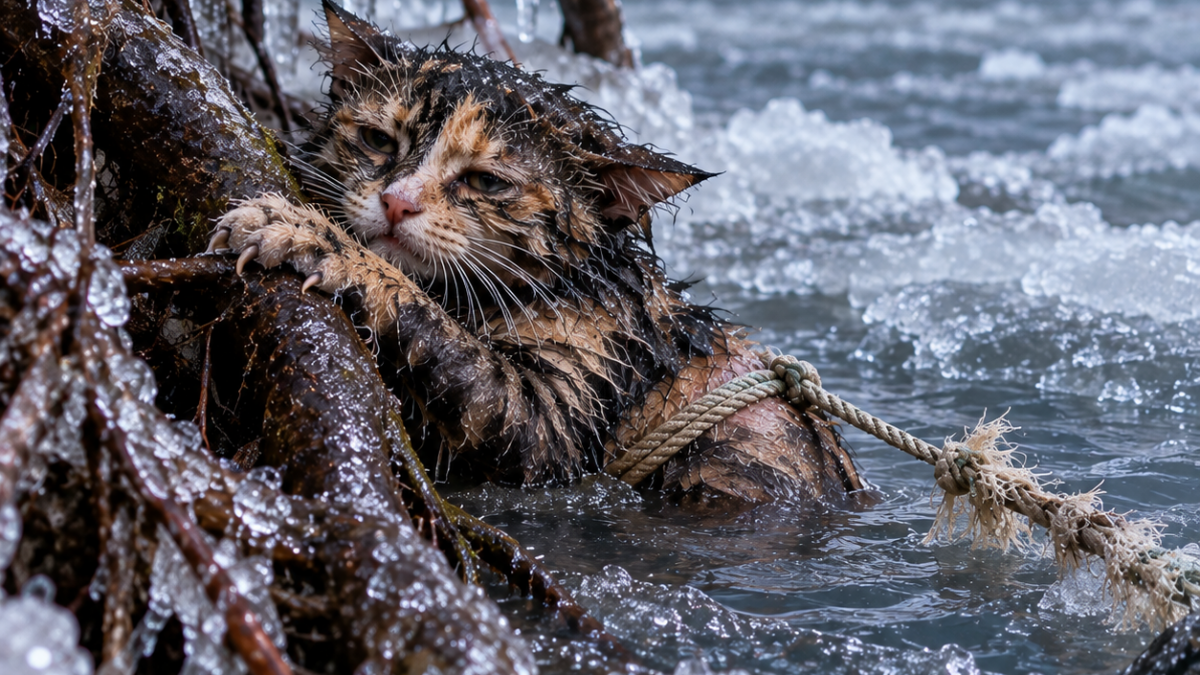
Her colors—black, orange, cream—were almost invisible beneath mud and river water.
Daniel dropped Cooper’s leash and slid down the bank.
Mud gave beneath his boots.
He grabbed a branch.
“Easy. Easy, sweetheart.”
The cat didn’t hiss.
Didn’t fight.
Didn’t even turn her head.
That frightened him more than anything.
A healthy terrified cat would have clawed his face apart.
This one only held the root.
Daniel reached the water.
The cold went through his gloves instantly.
He put one hand beneath her chest.
Then stopped.
Something was around her body.
A rope.
Bright blue nylon.
It had been wrapped behind her front legs and knotted tightly beneath her belly.
Daniel stared.
“What the hell?”
The loose end trailed into the water.
Except it wasn’t loose.
It was ragged.
Frayed.
Shredded into dozens of tiny fibers.
Daniel pulled the cat toward him.
Her claws did not release the root.
He had to gently pry them away one at a time.
Her paws were bleeding.
“It’s okay. I’ve got you.”
The words came automatically.
They were the same words he had said to Elaine near the end, when medicine could no longer help and there was nothing left to offer except presence.
I’ve got you.
The cat collapsed against his arm.
Daniel climbed back toward the trail.
Cooper circled them, whining.
When Daniel reached level ground, he knelt and looked at the rope again.
There were marks along it.
Tiny indentations.
Chewed fibers.
The realization arrived slowly.
“No.”
Daniel touched the frayed end.
“No, no, no.”
He looked toward the river.
Whatever had once been attached to that rope was gone.
But Daniel understood.
He had worked construction for thirty-seven years.
He knew knots.
He knew nylon rope.
He knew exactly what kind of knot had been pulled tight around the cat’s body.
And he knew rope did not fray like that by rubbing against a rock for a few hours.
It had been bitten.
Again.
And again.
And again.
Daniel wrapped the animal in Cooper’s red emergency blanket from his backpack.
The cat’s eyes were half closed.
Her breathing was so faint he had to put his face near her nose.
“Stay with me.”
Cooper stood beside him, trembling.
Daniel ran.
At sixty-one, with a bad right knee and forty pounds more around his waist than his doctor recommended, Daniel ran almost half a mile through mud carrying an animal he had not known existed ten minutes earlier.
He reached the truck gasping.
Turned the heater all the way up.
Wrapped the cat tighter.
Then called the nearest emergency veterinary hospital.
A woman answered.
Daniel spoke too quickly.
“I found a cat in the river. She’s freezing. There’s rope around her. I think somebody—”
“Sir, slow down. Is she breathing?”
“Yes.”
“Responsive?”
“Barely.”
“Bring her in immediately. Keep her warm but don’t apply direct heat.”
“I’m forty minutes away.”
“Drive safely. We’ll be ready.”
Daniel looked at the cat.
Forty minutes.
He had never hated a number so much.
He placed her on the passenger seat inside Cooper’s blanket.
Cooper jumped into the back.
Daniel drove.
The cat did not move.
Twice he reached over at red lights to make sure she was breathing.
“Come on, sweetheart.”
Nothing.
“You didn’t fight that hard just to quit in my truck.”
Cooper pushed his nose between the seats and sniffed the blanket.
Daniel swallowed.
“You hear him? He’s annoying as hell. You need to stay alive long enough to tell him.”
The cat’s ear twitched.
Daniel laughed once.
It came out sounding like a sob.
“That’s right.”
At the animal hospital, two veterinary technicians met him at the door.
They took her from his arms and disappeared through swinging doors.
Daniel stood in the lobby holding Cooper’s wet blanket.
Blue nylon fibers were still stuck to his gloves.
A receptionist asked if he owned the cat.
“No.”
“Do you know who does?”
“No.”
“Do you want us to contact animal control?”
Daniel looked through the doors.
“Yes.”
Then he added, “And the police.”
The receptionist studied him.
Daniel opened his hand.
A short piece of blue rope lay across his palm.
“Someone tied this around her.”
Twenty minutes later, Dr. Hannah Levin came into the waiting room.
She was perhaps forty, dark-haired, exhausted-looking, still wearing gloves.
“Mr. Mercer?”
Daniel stood.
“How is she?”
“Alive.”
His shoulders dropped.
“But she’s critical.”
Dr. Levin explained carefully.
The cat’s body temperature was 89 degrees Fahrenheit—about 31.7 Celsius.
Normal feline body temperature was roughly 100.5 to 102.5.
Her heart rate was dangerously low.
She was severely hypothermic.
She had aspirated some water.
Her blood glucose was abnormal.
There were abrasions on all four paws.
A section of her tail had lost circulation.
And then there were the teeth.
Dr. Levin held up a clear plastic evidence bag containing the rope.
“Did you cut this off?”
“No. The end was like that when I found her.”
The veterinarian nodded slowly.
“We took radiographs of her mouth.”
Daniel already knew.
He didn’t want to hear it.
He did anyway.
“Her upper incisors are fractured,” Dr. Levin said. “Two badly enough that the pulp is exposed. There are fresh nylon fibers caught between several teeth.”
Daniel stared at the bag.
“So she chewed through it.”
“Yes.”
“What was on the other end?”
“We don’t know.”
“I know.”
Dr. Levin was quiet.
Daniel’s jaw tightened.
“Somebody tied something to her and threw her in.”
“That is consistent with what we’re seeing.”
“How long was she in there?”
“There’s no precise way to determine it. Based on her core temperature, exposure injuries, water temperature, and condition when she arrived, my best estimate would be several hours.”
“How many?”
“Possibly three to four.”
Daniel sat down.
Four hours.
He pictured the river.
The freezing darkness.
A five-pound animal pulled toward the bottom by a weight she could not understand.
He pictured her mouth closing around wet nylon.
Biting.
Slipping.
Biting again.
He looked at Dr. Levin.
“Would she have known what she was doing?”
The veterinarian considered the question.
“She would have known the rope was restricting her. Animals don’t need to understand knots to understand what’s hurting them.”
Daniel nodded.
Dr. Levin added softly, “She fought very hard.”
That sentence stayed with him.
Animal Control Officer Maria Santos arrived that afternoon.
So did Deputy Aaron Blake from the county sheriff’s department.
Daniel told the story three times.
Where he parked.
Where Cooper stopped.
Where the cat was found.
What the current looked like.
What he touched.
What he moved.
Officer Santos photographed Daniel’s muddy clothes and collected the rope from the hospital.
They returned to the river before dark.
Daniel showed them the location.
Santos climbed carefully down the bank.
The water had dropped slightly.
She found scrape marks on the root where the cat’s claws had dug into the bark.
She photographed those too.
Deputy Blake stood near Daniel.
“Any houses nearby?”
“About a quarter mile up there.”
Daniel pointed through the trees.
“Old mill property farther north. Road crosses the river maybe half a mile down.”
Blake nodded.
“Anybody could’ve accessed this place?”
“There’s a parking lot.”
“So yes.”
Daniel looked at him.
“You’re going to investigate, right?”
The deputy’s expression changed slightly.
“We’ll document it.”
“That wasn’t my question.”
Blake exhaled.
“Mr. Mercer, I understand you’re upset.”
Daniel hated that sentence immediately.
“I’m not upset.”
Blake raised an eyebrow.
“I’m angry.”
“I understand.”
“No, I don’t think you do.”
Cooper leaned against Daniel’s leg.
Daniel pointed toward the river.
“Something was tied to that cat. Somebody stood somewhere near here holding her in their hands. She was alive. They tied a weight to her and threw her in the water. That’s not somebody losing their temper for five seconds. That’s a decision.”
Officer Santos looked up from the bank.
“I agree.”
Blake glanced toward her.
Santos climbed up.
“We’ll open an animal cruelty case.”
Daniel nodded.
“Good.”
“Don’t expect miracles,” she added. “No collar. No microchip so far. The rope is common hardware-store stock. If there are no witnesses or cameras, this can be difficult.”
Daniel looked back at the river.
“Then find something.”
For the next forty-eight hours, the cat existed between life and death.
Daniel visited the hospital twice the first day.
Three times the second.
Nobody asked him to.
He simply came.
He sat beside the oxygen kennel and talked.
At first he didn’t know what to say.
So he told her about Cooper.
About the weather.
About Elaine.
About the terrible coffee in the veterinary lobby.
“You’d hate it,” he said. “Actually, you’re a cat. You’d probably knock it off the table.”
One of the technicians smiled from the doorway.
The cat still had no name.
On intake paperwork she was listed as:
FEMALE TORTOISESHELL—FOUND MILLSTONE RIVER.
Daniel hated that too.
It sounded like evidence.
Not a life.
On the third morning, Dr. Levin called.
“She ate.”
Daniel stood in his kitchen holding the phone.
“What?”
“She ate about a tablespoon of food by herself.”
He smiled.
Then covered his eyes with his hand.
“That’s good?”
“That’s very good.”
He heard Elaine’s voice in his memory.
Don’t ask stupid questions when you’re emotional, Dan.
He laughed.
Dr. Levin laughed too.
“She isn’t out of danger yet.”
“But she’s fighting.”
“Yes.”
“When can I see her?”
“You can come this afternoon.”
Daniel was there at noon.
The cat was upright.
Barely.
But upright.
Her fur had dried into a chaotic patchwork of black, orange, and brown.
One front leg was shaved for the IV.
A warming blanket surrounded her body.
The blue rope was gone, but a deep red groove remained around her abdomen.
She watched Daniel approach.
He sat beside the kennel.
“Hey.”
Her eyes narrowed.
“You look better.”
She stared.
“Still terrible. But better.”
Her ears shifted.
Daniel put one finger through the kennel bars.
He didn’t expect anything.
The cat leaned forward.
Sniffed.
Then pressed her forehead against his knuckle.
Daniel stopped breathing.
Behind him, one technician whispered, “Well, I guess she remembers you.”
Daniel swallowed.
“Yeah.”
The cat stayed there.
Forehead against his hand.
“Yeah, maybe she does.”
Animal control posted her photograph online.
FOUND IN MILLSTONE RIVER.
POSSIBLE ANIMAL CRUELTY.
INFORMATION REQUESTED.
Within six hours, the post had been shared more than four thousand times.
People were furious.
Then came rumors.
Someone claimed teenagers had been seen near the river.
Someone blamed a fisherman.
Someone insisted it was an occult ritual.
Someone posted the name of a mentally disabled man who lived near the trail despite having no evidence whatsoever.
Officer Santos removed comments and issued a statement asking the public not to identify suspects without verified information.
Daniel learned quickly that public anger could become its own kind of cruelty.
He wanted justice.
He did not want a mob.
Three days after the rescue, a woman named Linda Keene called animal control.
She said the cat looked familiar.
She had seen a tortoiseshell cat around a rental property on Willow Lane, approximately two miles from the river.
Officer Santos visited.
The property belonged to a man named Curtis Vale.
Forty-eight years old.
Divorced.
Worked irregular construction jobs.
Two prior citations for allowing dogs to run loose.
One dismissed animal-neglect complaint from years earlier.
Vale told Santos he did not own a cat.
He claimed strays passed through his yard all the time.
“Can I look around?” she asked.
“Got a warrant?”
“No.”
“Then no.”
That was the end of the conversation.
For the moment.
A week passed.
The cat improved.
Her tail did not.
The last two inches turned black.
Dead tissue.
Dr. Levin showed Daniel.
“We need to amputate the damaged portion.”
Daniel nodded.
“Do it.”
“The shelter technically has custody right now.”
“I’ll pay.”
“That’s not what I meant.”
“I know. I’m still paying.”
Dr. Levin looked at him.
“Daniel.”
It was the first time she had used his first name.
“You’ve already covered a significant portion of her emergency care.”
“So?”
“The rescue fund can handle the surgery.”
Daniel crossed his arms.
“My wife spent eleven months dying of pancreatic cancer.”
Dr. Levin said nothing.
Daniel looked through the observation window at the cat.
“I spent those eleven months watching people help us. Nurses. Neighbors. People from church who barely knew us. A guy I worked with twenty years ago came over and cleaned my gutters because he said I had enough to worry about.”
His voice tightened.
“After Elaine died, I kept thinking I owed something. I just didn’t know who.”
Dr. Levin looked at the cat.
“Maybe now you do.”
The surgery happened that afternoon.
Two damaged teeth were extracted.
The dead portion of her tail was removed.
The rope injury was cleaned again.
The veterinarian warned Daniel that the hair around the abdomen might never fully return.
“The pressure damaged follicles and skin.”
Daniel touched the scar gently days later.
A pale ring around her middle.
“You’re going to have a belt forever,” he whispered.
The cat purred.
That was when he named her.
Dr. Levin had asked twice.
The technicians had suggested Ember, Autumn, Pumpkin, Hope, Lucky.
Daniel rejected them all.
He looked at the cat sitting inside the kennel with her shortened tail curled awkwardly around her feet.
“River.”
The technician beside him smiled.
“After where you found her?”
Daniel shook his head.
“After what didn’t get to keep her.”
River came home with Daniel on November 12.
He told himself it was temporary.
The shelter had approved him as a medical foster.
He had signed papers.
Received medication instructions.
Bought a litter box.
Bought food.
Bought a cat bed.
Bought three toys.
Bought a scratching post.
Bought a second scratching post because he wasn’t sure the first one looked comfortable.
Temporary.
Cooper was waiting behind a baby gate when River arrived.
Daniel carried the cat carrier inside.
Cooper whined.
River froze.
Daniel immediately covered the carrier with a towel.
“Easy.”
He took her into the spare bedroom.
Elaine’s sewing room.
He had barely entered it since her death.
Fabric still sat in transparent bins.
Thread lined the wall.
A half-finished quilt remained folded over a chair.
Daniel placed River’s carrier on the floor.
For ten minutes, she would not come out.
Then one paw appeared.
Then her face.
She stepped into the room.
Sniffed.
Walked beneath Elaine’s old sewing table.
And disappeared behind a box.
Daniel sat on the floor.
“Fair enough.”
He remained there forty minutes.
Eventually River came out.
She approached slowly.
Daniel extended his hand.
She sniffed his fingers.
Then climbed into his lap.
No hesitation.
She curled against his stomach, pushed her face into his flannel shirt, and began to purr.
It was astonishingly loud.
Daniel laughed.
“Oh, you’ve got to be kidding.”
The purring intensified.
He scratched behind her ear.
“Cooper’s going to be jealous.”
River kneaded his leg.
Daniel looked around the room.
Elaine’s room.
For more than a year, every object in there had felt like a monument to something finished.
That afternoon, for the first time, the room felt inhabited again.
Not healed.
Not replaced.
Simply alive.
Daniel cried quietly.
River kept purring.
The investigation stalled.
The rope was available at at least six stores within twenty miles.
No usable fingerprints survived the water.
No cameras covered the section of river where River had been found.
The veterinary examination confirmed intentional cruelty but could not identify a perpetrator.
Then Officer Santos received another call.
This one came from a sixteen-year-old girl.
Her name was Kayla Vale.
Curtis Vale’s daughter.
She lived with her mother in another county and visited her father every other weekend.
Kayla had seen the online photograph.
She recognized River.
Her name had not been River then.
Kayla had called her Patches.
She told Officer Santos the cat appeared at her father’s property sometime the previous summer.
Curtis hated her.
“He said she got into the trash,” Kayla explained.
“Was she your father’s cat?”
“No. But I fed her.”
“Did she live inside the house?”
“Sometimes when Dad wasn’t home.”
“Did he know?”
“He found out.”
Kayla began crying.
“He got really mad.”
Officer Santos recorded the interview.
“What did he say?”
Kayla stared at her hands.
“He said if I kept feeding strays, they’d never leave.”
“Anything else?”
“He said he’d take care of it.”
“When?”
“The last weekend I was there before Halloween.”
Santos leaned forward.
“What exactly did he say?”
Kayla hesitated.
“He said, ‘You’ll stop wasting food on that thing when it doesn’t come back.’”
A warrant followed.
At Curtis Vale’s property, investigators found a roll of blue braided nylon rope in the garage.
Common.
Not enough.
They found several chunks of broken concrete near a shed.
Also common.
Not enough.
Then they found River’s hair.
Tortoiseshell fur caught on a wooden crate near the garage.
Still not enough.
Curtis said the cat had wandered inside.
Then Officer Santos noticed something on the workbench.
A utility knife.
Beside it, a small length of rope.
One end had been cut cleanly.
The rope diameter, braid pattern, and color matched the section recovered from River.
Still circumstantial.
Then Deputy Blake found a receipt in a kitchen drawer.
Dated October 28.
A hardware store.
Blue nylon rope.
Concrete eye bolt.
Plastic bucket.
Again, suspicious.
Not proof.
Curtis laughed when confronted.
“You people are tearing apart my house over a stray cat?”
Officer Santos watched him carefully.
“A cat that someone tried to drown.”
“Not my problem.”
“Your daughter says you threatened to make the cat disappear.”
“My daughter is dramatic.”
“She identified the cat.”
“So what?”
“You bought rope the day before she was found.”
“I buy rope all the time.”
“And an eye bolt.”
“I work construction.”
“Did you tie the cat to a weight?”
Curtis smiled.
“No.”
Santos would later tell Daniel that it was the smile she remembered.
Not nervous.
Not frightened.
Annoyed.
As though the real injustice was that anyone had forced him to spend his afternoon answering questions about an animal he considered worthless.
Without stronger evidence, prosecutors hesitated.
Daniel was furious.
“His daughter identified River.”
“That’s evidence,” Santos said. “It isn’t enough by itself.”
“He threatened her.”
“Still circumstantial.”
“He bought the rope.”
“Common product.”
“You found the same rope in his garage.”
“Yes.”
Daniel paced his kitchen.
River watched from the counter.
Her surgical incision had healed.
Her abdomen still carried the pale band where the rope had cut circulation.
“What do you need, a video of him doing it?”
Santos remained calm.
“I need enough evidence that a defense attorney can’t explain every individual fact away.”
Daniel stopped.
“So he gets away with it?”
“I didn’t say that.”
“Sounds like it.”
Santos looked at River.
“I’ve been doing this twelve years. Cruelty cases are difficult because the victim can’t testify.”
River jumped down from the counter.
Santos crouched.
The cat approached her cautiously.
“She already testified,” Daniel said.
Santos looked up.
“She just did it with her body.”
Winter arrived early.
River hated rain.
The first storm after she came home began just after midnight.
Daniel woke to crashing.
He ran downstairs.
A glass had fallen from the kitchen counter.
River was beneath the dining table.
Pressed flat against the floor.
Eyes enormous.
Rain struck the windows.
River trembled.
Daniel knelt six feet away.
“Hey.”
She retreated farther.
“It’s okay.”
Thunder was not the problem.
The rain was.
Each time water hit the glass harder, River flinched.
Daniel understood.
He sat on the floor.
For almost an hour.
He didn’t touch her.
Didn’t force her out.
Eventually she crawled toward him.
When she reached his knee, Daniel opened his robe.
River climbed against his chest.
He held her.
“You’re not there anymore.”
She shook.
“You’re here.”
Rain ran down the windows.
“You’re not in the river.”
Her claws sank into his shirt.
Daniel closed his eyes.
“I promise.”
For months, River would not enter the bathroom if the faucet was running.
She panicked when Daniel filled the kitchen sink.
She refused to drink from pet fountains even though every cat website claimed cats loved moving water.
Her water bowl required its own ritual.
River would approach.
Stop six inches away.
Stare at the surface.
Circle once.
Tap the edge with one paw.
Then drink.
Every time.
Daniel never rushed her.
Cooper learned the rules too.
Within three weeks, the German shepherd and the cat were sleeping within two feet of each other.
Within two months, River was sleeping against Cooper’s back.
Daniel took a photograph and sent it to Dr. Levin.
She replied:
I think your temporary foster arrangement may be failing.
Daniel answered:
Tragic.
He formally adopted River the next day.
Kayla Vale visited in January.
Officer Santos called first.
“She’s asking if she can see the cat.”
Daniel hesitated.
“Why?”
“She feels guilty.”
“For what?”
“Feeding her.”
Daniel closed his eyes.
“Oh.”
“She thinks if she hadn’t brought the cat inside, her father wouldn’t have gotten angry.”
“She’s sixteen.”
“I told her.”
Daniel looked at River sleeping beside Cooper.
“Bring her.”
Kayla arrived with her mother.
She was small for sixteen, with brown hair pulled into a loose ponytail and the careful posture of someone accustomed to measuring adults’ moods before speaking.
River was on the windowsill.
The moment Kayla entered, the cat stood.
Kayla covered her mouth.
“Patches.”
River jumped down.
Kayla knelt.
The cat walked directly to her.
No hesitation.
Kayla burst into tears.
River pushed against her legs.
“Oh my God.”
Kayla picked her up carefully.
River began purring.
Daniel stood near the doorway.
Kayla buried her face in the cat’s fur.
“I’m sorry.”
Daniel looked away.
“I am so sorry.”
Her mother put a hand on her shoulder.
Kayla looked at Daniel.
“I didn’t know he would do that.”
“I know.”
“I should’ve taken her.”
“You were a kid.”
“I knew he hated her.”
“That doesn’t mean you knew he’d hurt her.”
Kayla’s face crumpled.
“He always did stuff when he got mad.”
Her mother stiffened.
Daniel noticed.
“What kind of stuff?”
Kayla looked at her mother.
“Kayla,” the woman said quietly.
The girl looked down at River.
“Dad had a dog before.”
Daniel felt something cold move through him.
Officer Santos, who had remained outside to give the family privacy, was called back in.
Kayla told them about Duke.
A mixed-breed dog Curtis owned when she was eleven.
Curtis claimed Duke had run away.
Kayla never believed him.
“Why?” Santos asked.
“Because Dad said the same thing.”
“What same thing?”
“That he’d take care of it.”
The room went silent.
Kayla’s mother, Jennifer, sat down.
“I didn’t know this.”
Kayla looked at her.
“I heard them fighting. Dad kicked Duke because he chewed a work glove. The next morning Duke was gone.”
“Did your father tell you where he went?”
“He said he left the gate open.”
Officer Santos wrote everything down.
Daniel watched River knead Kayla’s jacket.
A pattern was forming.
Not proof of what happened to River.
But a pattern.
Then Jennifer Vale spoke.
“There was another animal.”
Everyone looked at her.
She appeared sick.
“When we were married. A kitten.”
Curtis had disliked cats.
Jennifer knew that.
But Kayla had been six when a gray kitten appeared behind their house.
They fed it.
One evening Curtis found scratches on his leather recliner.
He exploded.
The kitten disappeared two days later.
Curtis said he had taken it to a shelter.
Jennifer never checked.
“I wanted to believe him,” she whispered.
Officer Santos asked, “Which shelter?”
“I don’t know.”
“Did he say?”
“No.”
“When was this?”
Jennifer gave the approximate year.
Santos searched intake records at every nearby shelter.
No matching cat had been surrendered by Curtis Vale.
Still not proof.
But now investigators widened their search.
Former neighbors were interviewed.
An ex-girlfriend.
Coworkers.
A former landlord.
Stories emerged.
A rabbit that disappeared after digging up a garden.
A neighbor’s dog allegedly threatened with antifreeze.
A raccoon caught in a live trap and left in the sun.
Some stories were hearsay.
Some too old.
Some impossible to verify.
But one mattered.
A former neighbor named Glenn Porter remembered seeing Curtis near Millstone River on the night of October 28.
Not at the exact rescue location.
At the road crossing upstream.
Glenn had been driving home from second shift around 11:20 p.m.
He saw Curtis’s pickup parked on the shoulder.
“Why did you remember it?” Deputy Blake asked.
“Because it was pouring rain.”
“Could you identify the truck?”
“I worked with Curtis three years. Rusted white Ford with a black replacement tailgate. Hard to miss.”
“Did you see Curtis?”
“Yes.”
“What was he doing?”
“Standing behind the truck.”
“Anything in his hands?”
Glenn paused.
“A bucket.”
The receipt.
Plastic bucket.
Concrete eye bolt.
Blue rope.
Daniel received the update two days later.
“Is that enough?” he asked.
“Closer,” Santos said.
“What does that mean?”
“It means we keep going.”
They searched the river.
A dive team could not safely enter during the first weeks because of current conditions.
By February, water levels dropped enough for investigators to inspect the area downstream from the road crossing.
They found nothing the first day.
Nothing the second.
On the third morning, a diver found a five-gallon plastic bucket lodged beneath submerged debris approximately two hundred yards from where River had been rescued.
The bucket was half filled with hardened concrete.
An eye bolt protruded from the center.
A short segment of blue nylon rope remained tied to it.
Daniel learned about it when Officer Santos called.
He sat down before she finished talking.
“Same rope?”
“Visually consistent. Lab is testing it.”
“And the knot?”
“Same type.”
Daniel gripped the phone.
“Can you prove it was attached to River?”
“The rope ends may match.”
“What does that mean?”
“When rope is torn or cut, individual fibers can sometimes be compared. Think of it like pieces of a broken object fitting together.”
Daniel didn’t speak.
“Daniel?”
“Yeah.”
“We may have it.”
The forensic report came eleven days later.
The frayed section recovered with River and the rope attached to the concrete bucket shared matching fiber characteristics.
More importantly, portions of the damaged ends physically corresponded under microscopic comparison.
The prosecution filed charges.
Aggravated cruelty to animals.
Possession of an instrument of crime related to the act.
Evidence tampering was later added after investigators determined Curtis had attempted to dispose of related materials.
Curtis Vale was arrested at 6:42 on a Tuesday morning.
He told deputies they were insane.
Over a cat.
Those three words appeared in the arrest report.
Over a cat.
Daniel read them twice.
Then printed the page.
He folded it.
Put it in a drawer.
Not because he wanted revenge.
Because he wanted to remember something.
Cruelty almost always depended on reducing a life to the word just.
Just a stray.
Just an animal.
Just a cat.
The preliminary hearing drew reporters.
River’s story had spread far beyond the county by then.
Local television crews waited outside the courthouse.
Daniel hated cameras.
He hated microphones even more.
But he attended.
Curtis entered wearing a clean blue shirt and an expression of disgust.
When he saw Daniel, he smirked.
Daniel did not react.
Kayla sat behind the prosecutor with her mother.
Curtis looked at his daughter.
Whatever passed between them made Kayla lower her eyes.
Daniel moved seats.
He sat beside her.
Curtis’s smile disappeared.
The prosecution presented evidence.
The rope.
The receipt.
The bucket.
The eyewitness.
Veterinary records.
Kayla’s testimony.
When photographs of River’s injuries appeared on the courtroom monitor, several people looked away.
Daniel did not.
He forced himself to look.
The raw ring around her abdomen.
The damaged tail.
The blood around her mouth.
The cracked teeth.
She had lived it.
He could look at it.
Curtis’s attorney argued there was no direct witness to the act.
That River was a stray.
That the rope could have become attached elsewhere.
That the bucket could have been dumped by anyone.
That the witness saw Curtis upstream, not committing a crime.
Then Curtis testified.
His lawyer had advised against it.
Curtis insisted.
He said Kayla lied because her mother had poisoned her against him.
He said Glenn Porter held a grudge.
He said animal control targeted him.
He said the rope was common.
The prosecutor asked one question.
“Mr. Vale, did you know this cat?”
Curtis leaned back.
“I’d seen it.”
“Had your daughter fed it?”
“Probably.”
“Did it enter your home?”
“Maybe.”
“Did you dislike that?”
“I don’t like animals destroying my property.”
“What did this five-pound cat destroy?”
Curtis hesitated.
“My daughter was wasting money feeding it.”
“That wasn’t my question.”
“It scratched things.”
“What things?”
“I don’t remember.”
The prosecutor walked closer.
“You told investigators she was just a stray.”
“She was.”
“You told them this prosecution was, quote, ‘insane over a cat.’”
Curtis’s attorney objected.
Overruled.
Curtis looked annoyed.
The prosecutor waited.
“Did you say that?”
“Probably.”
“Why?”
“Because it is.”
The courtroom became still.
The prosecutor tilted her head.
“Trying to drown an animal is not serious to you?”
“I didn’t say I did that.”
“That wasn’t my question.”
Curtis looked toward the judge.
The prosecutor repeated it.
“Is tying a living animal to a concrete weight and throwing it into a flooded river serious?”
Curtis’s face hardened.
“If somebody did it, sure.”
“If somebody did it?”
“Yes.”
The prosecutor picked up the evidence photograph.
“What do you think happened to her?”
Curtis shrugged.
Daniel felt Kayla flinch beside him.
The prosecutor stopped.
“You find this amusing?”
“No.”
“You shrugged.”
“So?”
The prosecutor looked at the judge.
“No further questions.”
Outside the courtroom, Kayla broke down.
Daniel found her sitting on a bench near the stairwell.
“He didn’t even care,” she whispered.
Daniel sat beside her.
“No.”
“I kept thinking maybe there was some explanation.”
Daniel nodded.
“That’s normal.”
“He’s my dad.”
“I know.”
“How can somebody be your dad and still be like that?”
Daniel looked toward the courthouse windows.
“I don’t know.”
Kayla wiped her face.
“I feel like I’m supposed to hate him.”
“You don’t have to feel anything you’re not ready to feel.”
She looked at him.
“Do you hate him?”
Daniel thought about it.
Then shook his head.
“No.”
Kayla seemed surprised.
“I hate what he did.”
“What’s the difference?”
“Hating him would mean he gets to live in my head.”
Daniel nodded toward the parking lot.
“I’ve already got one damaged cat living in my house for free. I’m not taking in your father too.”
Kayla laughed through tears.
It was the first time Daniel had heard her laugh.
The case did not go quickly.
Cases never did.
Hearings became continuances.
Continuances became motions.
Months passed.
River healed.
Her fear did not disappear.
But it changed.
The first spring thunderstorm sent her beneath Daniel’s bed.
The second sent her beneath a chair.
By the third, she remained on the couch as long as Daniel sat beside her.
Rain still bothered her.
Running water still made her cautious.
But she adapted.
She learned Daniel’s routines.
5:45 a.m.—alarm.
5:47—River walked across his chest.
5:50—coffee.
5:55—River’s breakfast.
6:00—Cooper’s breakfast, supervised by River despite the fact that she had no authority whatsoever.
Daniel began working part-time again, helping a friend inspect residential construction sites.
Every afternoon, River waited in the front window.
Every evening, she climbed into his lap.
Her purr could be heard across the room.
Visitors always noticed the scar.
A one-inch band of bare skin encircled her body.
Some people looked uncomfortable.
Some asked.
Daniel always told the truth.
“She survived somebody.”
Not something.
Somebody.
Because calling it an accident would have been easier.
And false.
The trial began fourteen months after River was pulled from the water.
By then, the story had become familiar to reporters.
Daniel worried that familiarity would soften it.
That people would stop seeing River as an animal who had suffered and begin seeing her as content.
A headline.
A photograph.
A sad story shared online between advertisements.
So when the prosecutor asked whether he would testify, Daniel agreed.
He described the morning.
Cooper stopping.
The sound.
The roots.
The rope.
The drive.
The moment Dr. Levin told him River’s teeth were broken from chewing nylon.
The prosecutor asked, “What did you observe about the rope when you first found her?”
Daniel looked toward the jury.
“The end wasn’t cut.”
“What did it look like?”
“Like somebody had taken a hundred tiny bites out of it.”
Curtis stared at him.
The prosecutor showed the evidence photo.
Daniel’s voice tightened.
“She did that.”
“Objection.”
The judge looked over.
“Basis?”
“Speculation.”
“Sustained.”
The prosecutor rephrased.
“What did the veterinary examination later establish?”
“That nylon fibers were embedded between her damaged teeth.”
The prosecutor nodded.
“What did you understand from that?”
Curtis’s attorney rose again.
The judge sighed.
“Counsel, move on.”
Daniel sat back.
He didn’t need to say it.
Everyone understood.
Dr. Levin testified the next day.
She was clinical.
Precise.
She explained hypothermia.
Aspiration.
Dental fractures.
Pressure injuries.
Necrosis.
The estimated duration of immersion.
Then the prosecutor asked a simple question.
“Doctor, how painful would chewing braided nylon with fractured incisors have been?”
The courtroom went silent.
Dr. Levin looked at River’s dental images on the screen.
“Extremely.”
“Would the pain have increased as the fractures reached the pulp?”
“Yes.”
“Would the animal have stopped because of that pain?”
Dr. Levin paused.
“Most animals stop behaviors that cause severe dental pain.”
“But this animal continued?”
“The condition of the rope suggests repeated biting.”
“For how long?”
“I can’t say.”
“Long enough to sever it?”
“Yes.”
The prosecutor turned toward the jury.
“No further questions.”
Kayla testified last.
Daniel worried about her more than anyone.
She was seventeen now.
Older.
Still young.
She entered the witness box and looked once at her father.
Curtis did not smile.
The prosecutor asked about River.
Kayla described feeding her.
Sneaking her inside.
Naming her Patches.
“She used to sleep on my hoodie.”
“Why your hoodie?”
“I don’t know. She liked it.”
“Did your father approve of the cat being inside?”
“No.”
“What happened when he discovered her?”
“He yelled.”
“What did he say?”
Kayla swallowed.
“He said I cared more about stupid animals than about respecting him.”
“Did he threaten the cat?”
“Yes.”
“What did he say?”
“He said she’d stop coming around.”
“Anything else?”
“He said he’d make sure.”
Curtis shifted at the defense table.
The prosecutor showed Kayla a photo of River taken before the incident.
A picture recovered from Kayla’s phone.
“Is this the cat?”
“Yes.”
Then a photograph from the veterinary hospital.
Kayla’s face tightened.
“Is that the same cat?”
“Yes.”
“How do you know?”
“The face. The markings. She has orange on the left side of her nose.”
The prosecutor nodded.
“When did you last see her before she was found in the river?”
“October twenty-eighth.”
“What happened that day?”
Kayla looked down.
“I fed her.”
“Where?”
“In Dad’s garage.”
“Did he see you?”
“Yes.”
“What did he do?”
“He grabbed the food bowl.”
“Then what?”
“He threw it across the garage.”
A juror frowned.
“What did he say?”
Kayla’s voice dropped.
“He said, ‘I’m done with this.’”
“Did you see the cat again?”
“No.”
The defense attorney approached gently during cross-examination.
He tried to establish that Kayla was angry with her father.
She admitted she was.
That her parents had an unpleasant divorce.
She admitted that too.
That she had not actually seen Curtis take River to the river.
“No.”
“Then you don’t know what happened after you left?”
Kayla stared at him.
“No.”
“So it’s possible someone else harmed the cat?”
“I guess.”
Curtis leaned back slightly.
Then the attorney made a mistake.
“Miss Vale, isn’t it true that your father simply wanted this stray animal off his property?”
Kayla looked toward Curtis.
Her face changed.
Not anger.
Recognition.
“Yes.”
“And isn’t that understandable?”
The prosecutor objected.
Sustained.
The defense attorney moved on.
But the question had already done damage.
Because the jury had heard what cruelty often sounded like before it became an act.
Not hatred.
Entitlement.
My property.
My rules.
My inconvenience.
My right to decide whether another living thing mattered.
The forensic analyst connected the rope from River to the rope on the concrete bucket.
Not with absolute certainty like a DNA match.
But with strong physical consistency.
Fibers from one torn region corresponded to fibers from the other.
The knot attached to the eye bolt matched the type investigators believed had been used.
The bucket brand matched the receipt.
The eye bolt dimensions matched the receipt.
A partial mixture of DNA recovered beneath River’s claw had degraded too far for definitive identification, but it contained a male component.
The prosecution did not overstate it.
They didn’t need to.
The evidence was no longer one fact.
It was a chain.
Curtis bought rope, a bucket, and an eye bolt.
His daughter heard him threaten to make the cat disappear.
The cat vanished that night.
A witness saw Curtis near the river in heavy rain holding a bucket.
River was found downstream hours later with matching rope around her body.
The concrete-filled bucket was recovered from the river with the corresponding rope attached.
River’s teeth contained nylon fibers.
She had chewed through the connection.
The defense called it coincidence.
The prosecutor called it what it was.
An attempt to kill an animal and remove the evidence at the same time.
The jury deliberated four hours.
Daniel spent those hours walking courthouse hallways.
Kayla sat with Jennifer.
Officer Santos drank terrible vending-machine coffee.
Dr. Levin answered emails on her phone.
At 4:17 p.m., the bailiff opened the door.
“We have a verdict.”
Curtis Vale stood.
Guilty.
Aggravated animal cruelty.
Guilty.
Evidence-related offense.
Guilty.
Daniel closed his eyes.
Kayla cried.
Curtis looked stunned.
Then angry.
The judge warned him to remain quiet after he muttered something toward the prosecutor.
Sentencing occurred six weeks later.
Daniel almost did not attend.
He had already heard the word he needed.
Guilty.
But the prosecutor asked him to provide a victim-impact statement.
Daniel thought the phrase was strange.
River was the victim.
She couldn’t stand at a podium.
So Daniel did.
He brought no photographs.
No dramatic props.
Just a piece of paper.
He looked at the judge.
Then at Curtis.
“My wife died in 2019.”
Curtis looked confused.
Daniel continued.
“She loved animals. She used to stop traffic to move turtles. I made fun of her for it. Said she’d get herself killed saving something that didn’t know her name.”
A few people smiled faintly.
“After she died, I got angry at a lot of things. Cancer. Doctors. God. Empty rooms. People who still had wives and complained about them.”
Daniel swallowed.
“Then one morning my dog stopped beside a river.”
He looked toward Curtis.
“I found a cat there.”
Curtis looked away.
“She weighed about five pounds. You apparently thought that made her powerless.”
The defense attorney shifted.
Daniel continued.
“You tied a rope around her body. You tied the other end to a concrete weight. You threw her into freezing water during a flood.”
The courtroom remained absolutely quiet.
“I want you to understand what happened after that.”
Curtis glanced back.
“You left.”
Daniel paused.
“She didn’t.”
He unfolded the paper, but did not look at it.
“She stayed alive.”
His voice broke slightly.
“She chewed through the rope until she broke her own teeth.”
Someone behind him sniffed.
“She found a root.”
Daniel breathed.
“She held on.”
He looked directly at Curtis.
“For hours.”
Curtis’s jaw tightened.
“You thought you had decided how her story ended.”
Daniel shook his head.
“You didn’t.”
He glanced toward Kayla.
“You didn’t get to decide whether your daughter kept loving animals either.”
Kayla cried silently.
“You didn’t get to decide whether people cared.”
Daniel folded the paper.
“And you don’t get to decide that something is worthless just because it’s smaller than you.”
The judge sentenced Curtis to incarceration followed by probation, mandatory psychological evaluation, and a prohibition on owning or residing with animals during the probationary period.
For some people, it was not enough.
Online comments demanded harsher punishment.
Others complained that taxpayer money was being spent “over a cat.”
Daniel stopped reading comments.
Justice, he learned, rarely felt as dramatic as people imagined.
No music played.
Nobody applauded.
Curtis did not suddenly understand what he had done.
There was no magical transformation.
Justice was smaller.
A guilty verdict.
A record.
A prohibition.
A frightened teenage girl learning that her father’s cruelty was not her responsibility.
An animal sleeping safely on a warm couch.
That was enough.
Not perfect.
Enough.
Years passed.
Cooper grew gray around his muzzle.
River became rounder.
Daniel joked that she had gone from five pounds of fury to nine pounds of management.
She supervised everything.
Laundry.
Cooking.
Home repairs.
Television.
Guests.
She developed an irrational hatred of one particular mail carrier despite liking every other human who approached the house.
She stole chicken when given the opportunity.
She learned that knocking pens from Daniel’s desk caused immediate attention.
She never learned to tolerate baths.
Daniel never tried.
Rain remained complicated.
During heavy storms, River still searched for him.
But she no longer hid.
She would jump onto his lap.
Press herself against his chest.
Wait.
Daniel would place one hand over the scar around her body.
The scar never disappeared.
The hair never fully returned.
A pale ring remained around her abdomen.
From above, it looked almost like a belt.
Visitors sometimes stared.
Children asked what happened.
Daniel answered honestly without frightening them.
“Someone hurt her.”
Then he always added:
“But she got away.”
Kayla went to college.
Veterinary nursing.
Daniel was not surprised.
She visited during holidays.
River remembered her every time.
At twenty-one, Kayla brought her boyfriend to meet Daniel.
“This is the famous River?” he asked.
Kayla picked up the cat.
“No.”
Daniel raised an eyebrow.
Kayla smiled.
“This is the cat who got me through college.”
Later that evening, Kayla sat with Daniel on the porch.
“Do you ever think about what would’ve happened if Cooper hadn’t stopped?”
Daniel looked through the window.
River was asleep in Cooper’s old bed.
Cooper had died the previous spring at fourteen.
That grief had nearly broken Daniel.
River had spent three nights sleeping outside his bedroom door.
“Yeah,” Daniel said.
“I do.”
Kayla looked down.
“Do you think things happen for a reason?”
Daniel took his time.
“No.”
She looked surprised.
“No?”
“I think sometimes terrible things happen for no reason at all.”
Rain clouds gathered far away over the trees.
Daniel continued.
“But I think what we do afterward can have a reason.”
Kayla considered that.
“I like that better.”
“Me too.”
River lived seven years after the river.
Seven.
Dr. Levin had not predicted that.
Nobody had.
River developed kidney disease near the end.
At first it was manageable.
Medication.
Special food.
More veterinary visits.
Then came weight loss.
Fatigue.
Longer sleep.
Daniel recognized the signs before anyone had to explain them.
He had seen decline before.
He refused to pretend.
One November morning, River walked toward her water bowl.
Stopped.
Stared at it.
Circled once.
Tapped the edge.
Then looked at Daniel.
The ritual.
Still there.
Daniel crouched beside her.
“You’re okay.”
She drank.
Slowly.
That afternoon, she climbed onto his lap.
Her body was lighter now.
Too light.
Daniel ran his fingers across the bare ring around her abdomen.
River purred.
Still loud.
Still ridiculous.
Still somehow bigger than her body.
“You know,” he whispered, “you’re the toughest thing I’ve ever met.”
River pushed her face against his chest.
Daniel closed his eyes.
Seven years earlier, he had carried her from a river believing she might die before he reached the truck.
Now she was old.
Safe.
Warm.
Loved.
There were worse endings.
The final appointment happened at the same veterinary hospital where she had first arrived.
Dr. Levin was still there.
Older.
A little more gray in her hair.
When she entered the room and saw River in Daniel’s arms, she stopped.
“Oh, sweetheart.”
River opened her eyes.
Dr. Levin stroked her head.
“You really made us work for this one, didn’t you?”
Daniel smiled.
“She always does.”
Dr. Levin examined her.
Then looked at Daniel.
He already knew.
“Is she hurting?”
“She’s uncomfortable. And she’s tired.”
Daniel nodded.
“Can I hold her?”
“Yes.”
He sat in the same type of plastic chair he had occupied seven years earlier when he had no idea whether she would survive the night.
River rested against his chest.
Her bare scar was visible beneath his hand.
Dr. Levin gave the first medication.
River relaxed.
Her breathing slowed.
Daniel whispered into her ear.
“You’re not in the river.”
Her purr vibrated faintly.
“You’re home.”
Dr. Levin looked away.
“You’re safe.”
River’s paw rested against Daniel’s wrist.
“I’ve got you.”
The same words.
The first day.
The last day.
River died with her face pressed against his shirt.
No cold water.
No rope.
No darkness.
No fear.
Just hands she trusted.
Daniel sat there long after.
Dr. Levin did not rush him.
Eventually she touched the scar.
“It never grew back.”
“No.”
Daniel looked down.
“Used to bother me.”
“The scar?”
“Yeah.”
“Why?”
“Because every time I saw it, I thought about him.”
Dr. Levin nodded.
Daniel stroked River’s head.
“Then one day I realized that was stupid.”
“How so?”
“He doesn’t own the scar.”
Dr. Levin’s eyes filled.
Daniel smiled through tears.
“She does.”
River was cremated with the red blanket Cooper had been carrying the morning they found her.
Daniel kept the ashes in a small wooden box Elaine had made years before in a woodworking class.
For a while it sat on the mantel.
Then Daniel moved it.
He put it beside a framed photograph.
Not one from the hospital.
Not one showing the rope injury.
Not the viral photograph thousands of strangers had shared.
His favorite picture had been taken on an ordinary Tuesday.
River sat on his lap.
Cooper lay beside the chair.
Morning sunlight filled the living room.
Nothing dramatic was happening.
That was why Daniel loved it.
Survival stories often focused on the worst moment.
The rope.
The water.
The broken teeth.
The cold.
But surviving was not only the moment River escaped death.
Surviving was everything after.
It was learning to drink without fear.
Sleeping beside a dog.
Stealing chicken.
Watching birds.
Waiting in windows.
Purring against a lonely man’s chest.
Making a frightened girl believe kindness was still worth choosing.
Growing old.
Being loved long enough to become ordinary.
A year after River died, Daniel returned to Millstone River.
He had avoided the exact spot for years.
The bank had changed.
Floods had reshaped the trail.
The root River had held was partly rotted now.
Daniel stood there for a long time.
The water was calm.
He carried something in his pocket.
The short piece of rope he had kept from the evidence after the case ended.
He had debated throwing it into the river.
Instead, he cut it into pieces.
Then he dropped them into a trash bag.
The river had held enough of that story.
He sat beneath the sycamore tree.
A woman walking a Labrador passed behind him.
The dog stopped.
Sniffed.
For one absurd second, Daniel expected another cry from the water.
There was none.
Only leaves.
Current.
Wind.
He smiled.
“Good.”
The Labrador’s owner looked confused.
Daniel shook his head.
“Nothing.”
He walked back toward the parking lot.
Rain began lightly.
Years earlier, rain had meant terror to River.
That memory hurt.
But it also reminded him of something else.
During River’s final year, there had been a summer storm.
A heavy one.
Rain hammered the windows.
Thunder shook the house.
Daniel had been in the kitchen when he realized River was not beside him.
He searched.
Living room.
Bedroom.
Hallway.
Then he found her.
She was sitting on the covered porch.
Not hiding.
Not trembling.
Watching the rain.
The screen protected her from most of it, but a few droplets blew through.
One landed on her paw.
River looked down.
Licked it away.
Then continued watching.
Daniel had stood in the doorway afraid to move.
He didn’t want to frighten her.
Didn’t want to interrupt whatever small miracle was happening.
After several minutes, River turned.
She walked inside.
Passed him.
Jumped onto the couch.
As if nothing had happened.
Daniel had laughed until tears came.
Not because her fear had vanished.
It hadn’t.
Some things leave marks.
Some sounds stay inside the body.
Some memories never become harmless.
River still paused before drinking.
She still disliked faucets.
She still sought Daniel during storms.
Healing had never meant forgetting.
Healing meant fear was no longer making every decision.
That was the lesson Daniel carried home from the river.
Not that suffering makes anyone stronger.
Sometimes suffering only hurts.
Not that everything happens for a reason.
Some things should never happen at all.
River’s strength belonged to River.
Not to the man who hurt her.
Curtis Vale had not made her brave.
The river had not made her brave.
Pain had not given her courage.
She had courage already.
That was why, in freezing black water, with a concrete weight dragging beneath her and nylon cutting into her body, she kept biting.
One fiber.
Then another.
Her teeth cracked.
She kept biting.
The current pulled.
She kept biting.
Her body cooled.
She kept biting.
Until the rope failed before she did.
Until she surfaced.
Until she found a root.
Until one tired man walking a dog stopped when he could have kept going.
For the rest of River’s life, the scar remained.
A perfect ring of bare skin.
Visible from every side.
At first people saw cruelty when they looked at it.
Daniel eventually saw something else.
He saw the place where one person’s decision ended.
And River’s began.
Someone had tied that rope believing they had written the final sentence of her life.
They were wrong.
The scar was not proof that River had been defeated.
It was proof that death had once wrapped itself completely around her body—
and still couldn’t hold on.








