Someone Threw a Tiny Cat From a Car at 70 MPH—Then a Motorcyclist Saw Her Bounce Across the Highway and Risked His Life to Save Her. What He Did Next Will Break Your Heart.
PART3:
His right foot already moving toward the rear brake.
“No.”
He said it aloud inside his helmet.
“No, no, no.”
He checked the mirror.
Truck behind him.
He couldn’t simply stop.
He signaled.
Moved right.
The shoulder came up fast.
Gravel rattled beneath his tires as he decelerated.
Fifty.
Forty.
Thirty.
He pulled as far from traffic as possible and stopped.
By the time he kicked down the stand, the silver sedan was disappearing between two tractor-trailers.
Marcus turned.
The thing that had landed on the road was almost two hundred yards behind him.
He ripped off his helmet.
Traffic screamed past.
The wind from a semi nearly pushed him sideways.
He started running.
He did not lock the motorcycle.
Did not take his phone.
Did not think about the bike sitting unattended on an interstate shoulder.
He ran.
Work boots weren’t built for sprinting.
Neither were motorcycle pants.
After thirty yards, his lungs burned.
After seventy, his knees hurt.
He kept going.
Cars passed.
A horn sounded.
Maybe someone thought he was insane.
At that point, Marcus didn’t know whether he was running toward a living animal or a body.
He just knew what he had seen.
Bounce.
Roll.
Grass.
Please.
He didn’t know whether he said the word aloud.
Please.
He reached the place where he thought she’d disappeared.
Nothing.
Tall roadside grass moved in the wind.
Pieces of shredded tire.
A crushed soda bottle.
White wildflowers.
Marcus stepped farther from the pavement.
“Hey.”
No response.
He scanned.
“Come on.”
His heart hammered.
Then he heard it.
A sound so weak he almost confused it with traffic.
A tiny cry.
Marcus froze.
There.
Ten feet down the embankment.
Gray fur.
White belly.
A cat lay on her side in the grass.
Alive.
Marcus slid down the slope.
“Oh, God.”
She was young.
Maybe seven or eight months.
Small enough that he could have carried her under one arm.
Gray along the back and head, with a white chest and white front paws.
Her eyes were open.
Huge.
Her mouth moved rapidly as she breathed.
The right side of her body was scraped raw in patches.
Fur missing.
Pink skin exposed.
Blood along the chin.
And her rear leg—
Marcus looked away for one second.
The lower part bent at an angle that did not belong on any living body.
“Oh, sweetheart.”
The cat tried to move.
She made a sharp sound and collapsed.
“No.”
Marcus dropped to his knees.
“Don’t move.”
Ridiculous thing to tell an animal.
Still, he kept saying it.
“Don’t move. I’ve got you.”
He took off his motorcycle jacket.
Heavy black textile with armored shoulders and elbows.
He spread it beside her.
The cat watched him.
No hissing.
No attempt to bite.
That scared him.
A healthy frightened cat would have fought.
This one simply breathed.
Fast.
Too fast.
Marcus slid one hand beneath her chest.
The other under her hips, careful not to touch the leg.
When he lifted, her body stiffened.
She cried.
Marcus nearly put her back down.
“I know.”
He swallowed.
“I know, baby.”
He wrapped the jacket around her like a sling.
The cat’s head rested against the black fabric.
Marcus sat down in the grass.
For the first time since he stopped, he looked back toward the highway.
The silver sedan was gone.
Dozens of cars had passed since.
Maybe hundreds.
Nobody else had stopped.
He reached for his phone.
Nothing.
Still beside the bike.
“Perfect.”
He looked at the cat.
“You and me are making excellent decisions.”
Her eyes closed halfway.
“No.”
Marcus touched her head gently.
“Stay with me.”
He stood carefully.
The walk back felt three times longer.
He moved along the grass instead of the shoulder whenever possible.
Every few steps he checked her breathing.
Still there.
Thin.
Rapid.
But there.
When he finally reached the motorcycle, he realized the obvious problem.
He could not ride.
There was no safe way to put a badly injured cat on a motorcycle and merge back into interstate traffic.
He lowered himself onto the grass beside the guardrail.
Placed the cat in his lap.
Then reached into his tank bag and grabbed his phone.
Three missed texts from Erin.
Don’t forget milk.
Also eggs.
Actually just call me when you leave work.
Marcus called.
She answered immediately.
“You finally remembered I exist?”
“Erin.”
Something in his voice changed hers.
“What happened?”
“I need you.”
“Are you hurt?”
“No.”
“Did you crash?”
“No.”
“What happened?”
Marcus looked at the bundle in his lap.
“I found a cat.”
Silence.
“You found a cat.”
“On the interstate.”
“What do you mean on the interstate?”
“Someone threw her out of a car.”
Another silence.
This one longer.
“What?”
“I saw them do it.”
Erin’s voice changed again.
“Oh my God.”
“Her leg’s broken. I think bad.”
“Where are you?”
He sent his location.
“How far?”
“Thirty minutes.”
“Stay there.”
“Obviously.”
“Marcus.”
“Yeah?”
“Don’t let her die.”
He looked down.
The cat’s eyes were open again.
“I won’t.”
After Erin hung up, Marcus called highway patrol.
Then animal control.
Then the nearest veterinary clinic he could find.
The clinic receptionist asked if the cat belonged to him.
“No.”
“Do you know the owner?”
“No.”
“Do you have any information on the vehicle?”
“Silver sedan.”
“License plate?”
Marcus closed his eyes.
He had looked directly at that car for several seconds.
Had he seen the plate?
Letters.
Numbers.
A blue strip.
Maybe.
His attention had shifted instantly to the animal hitting the road.
“I don’t know.”
The receptionist said they could stabilize her if he brought her in.
Payment would need to be arranged.
“Fine.”
“Sir, depending on injuries—”
“Fine.”
He ended the call.
A state trooper arrived thirteen minutes later.
Trooper Daniel Ruiz.
Early forties.
Buzzed hair.
Serious face.
He parked behind Marcus’s motorcycle with lights flashing and approached cautiously.
“You call?”
Marcus nodded.
“She’s right here.”
Ruiz crouched.
His expression tightened when he saw the leg.
“You witnessed someone throw her?”
“Yes.”
“From a vehicle?”
“Yes.”
“You sure she didn’t fall?”
Marcus looked at him.
“I saw an arm.”
Ruiz’s eyebrows lifted.
“They threw her.”
Marcus pointed toward the highway.
“Passenger window opened. Hand came out. Cat came out.”
“Vehicle description?”
“Silver sedan. Older. Maybe Honda Accord. Toyota. Something that size.”
“Passengers?”
“Driver and at least one passenger.”
“Plate?”
“Didn’t get it.”
Ruiz nodded.
Not judgmental.
Just recording.
“Direction?”
“Northbound.”
“What mile marker?”
Marcus gave it.
Ruiz looked down at the cat.
She trembled inside the jacket.
“She’s lucky you saw her.”
Marcus stared toward traffic.
“Lucky isn’t the word I’d use.”
Ruiz didn’t argue.
He returned to his cruiser to radio ahead.
Marcus sat.
The cat remained against his stomach.
He could feel every breath.
After a while she moved one front paw and placed it against his wrist.
Barely.
Probably accidental.
Marcus did not move.
“You can hold on.”
Traffic continued.
Cars.
Trucks.
SUVs.
Thousands of pounds of steel passing seventy feet away.
Marcus watched them differently now.
Somewhere ahead, a silver car contained somebody capable of opening a window and throwing a living animal into traffic.
Maybe they were laughing.
Maybe arguing.
Maybe pretending it hadn’t happened.
The thought made his stomach turn.
The cat suddenly jerked.
Marcus leaned down.
“Easy.”
Her breathing became faster.
“Come on.”
He didn’t know her name.
That bothered him irrationally.
Everything living should have a name when it’s frightened.
“Hey, girl.”
Her ear moved.
“Stay.”
Again, ridiculous.
But he had nothing better.
Twenty-eight minutes after the call, a dark green Subaru pulled onto the shoulder behind the patrol car.
Erin got out before fully shutting the door.
She was thirty-four, dark-haired, small, normally calm to the point that Marcus sometimes accused her of having “the emotional range of a responsible accountant.”
She saw the cat.
Her hand covered her mouth.
“Oh, no.”
Marcus stood carefully.
“Don’t touch the leg.”
“What did they do?”
“I don’t know.”
Erin looked at him.
“No. I mean who does that?”
Marcus shook his head.
“I don’t know.”
They transferred the jacket-wrapped cat into the back seat.
Erin had brought a laundry basket lined with towels.
Marcus stared.
“You thought of a basket?”
“You called and said injured cat.”
“I married up.”
“Get in.”
Ruiz approached the car.
“I’ll need your contact information.”
Marcus provided it.
“Traffic cameras?” Marcus asked.
“We’re checking.”
“You’ll find them?”
Ruiz hesitated.
That hesitation answered too much.
“We’ll do what we can.”
Marcus stared.
The trooper added, “You did the right thing stopping.”
“I didn’t do anything.”
“You stopped.”
Marcus looked toward the highway.
“Apparently that’s something.”
The veterinary clinic was twenty-one minutes away.
Erin drove.
Marcus sat in back.
The cat lay in the basket, still wrapped in his jacket.
Every bump made her tense.
Marcus kept one hand beside her head.
“You’re okay.”
Erin looked at him through the mirror.
“Don’t promise things you can’t control.”
He nodded.
Then whispered anyway.
“You’re okay.”
At the clinic, a technician rushed out with a small stretcher.
The cat was taken immediately.
Marcus and Erin stood in the lobby looking ridiculous.
Marcus was still wearing motorcycle pants but no jacket.
His work shirt was stained with grass.
Erin had left home wearing house slippers.
“You’re wearing slippers.”
She looked down.
“I noticed.”
“You drove thirty miles on the interstate in slippers.”
“You called me and said somebody threw a cat out of a car.”
“Fair.”
They checked in.
“Name?” the receptionist asked.
Marcus gave his.
“No. Animal.”
He blinked.
“Oh.”
He looked at Erin.
She looked back.
“We don’t know.”
Receptionist waited.
Marcus said, “Just put Jane Doe.”
Erin frowned.
“For a cat?”
“You have a better idea?”
The receptionist smiled despite herself.
“Unknown female is fine.”
Then came the question.
“Who is financially responsible?”
Marcus said, “Me.”
Erin turned.
“Marcus.”
He looked at her.
“What?”
“You don’t even know what this costs.”
“Doesn’t matter.”
“It matters a little.”
“Not right now.”
Erin knew that tone.
She folded her arms.
“How much is in checking?”
“Enough.”
“That wasn’t the question.”
“Erin.”
She stared at him for three seconds.
Then sighed.
“Fine.”
The veterinarian came out forty minutes later.
Dr. Leah Benton.
She was probably around forty-five, with reading glasses hanging from the collar of her scrubs.
“She’s stable.”
Marcus realized he had been holding his breath.
“What happened?”
“Right tibial fracture.”
He nodded despite understanding only half.
“Broken lower hind leg.”
“Okay.”
“Extensive road rash on the right side. Chin too.”
“Internal?”
“We did a FAST ultrasound. I don’t see evidence of internal bleeding.”
Erin closed her eyes briefly.
“Spine?”
“Neurologically, she looks good.”
Marcus exhaled.
“Can she walk again?”
“If the fracture heals properly, yes.”
“What does properly mean?”
“Surgery.”
Of course.
Pins.
Possibly external fixation depending on imaging.
Wound cleaning.
Antibiotics.
Pain medication.
Sedation.
Dental evaluation because one canine appeared chipped.
Dr. Benton went through everything slowly.
Then gave them an estimate.
$1,050 to $1,300.
Marcus nodded.
“Do it.”
Erin looked at him.
“Marcus.”
“What?”
“Can I talk to you?”
The veterinarian tactfully stepped away.
Erin pulled Marcus toward the side of the lobby.
“We have a furnace inspection next week.”
“Yes.”
“Your back tire is almost done.”
“I know.”
“You said you were replacing it.”
“I will.”
“With what money?”
Marcus rubbed his forehead.
“I’ll figure it out.”
“We have six hundred in emergency savings.”
“Then this is an emergency.”
“It isn’t our cat.”
The sentence landed badly.
Erin heard it too.
She softened immediately.
“I don’t mean that the way it sounds.”
Marcus looked through the treatment-room door.
“She was breathing in my jacket.”
“I know.”
“She looked at me.”
“I know.”
“She got thrown out of a car, Erin.”
His voice cracked.
He hated that.
“She didn’t choose us.”
“No.”
“We’re just the people who were there.”
Erin looked down.
Then back at him.
“Which card?”
Marcus blinked.
“What?”
“Use the Visa.”
He almost laughed.
She added, “And you’re not buying motorcycle accessories for a year.”
“I don’t buy accessories.”
“You bought a $180 phone mount.”
“That was safety equipment.”
“It rotates.”
“Useful feature.”
“Pay the vet.”
He did.
The final bill the next day came to $1,107.63.
Marcus’s motorcycle had cost $4,300 used.
He would later do the math and realize he’d spent more than a quarter of its value on an animal he had known for less than one hour.
At the time, the number meant almost nothing.
He just wanted the cat alive.
The surgery took place that evening.
Two pins.
A small external stabilizer.
The wounds were shaved, cleaned, treated, and covered.
One canine was chipped but did not need extraction.
No spinal injury.
No internal bleeding.
Young animal.
Strong heart.
Lucky landing.
“Lucky,” Dr. Benton repeated the next morning.
Marcus looked through the kennel window.
The cat lay sedated with a bright blue wrap around the injured leg.
“Everybody keeps calling her lucky.”
Dr. Benton glanced at him.
“She is.”
“Someone threw her at seventy miles an hour.”
“I know.”
Marcus crossed his arms.
“Feels like we’re using the word wrong.”
The veterinarian thought about that.
“Surviving bad luck still counts.”
That Marcus accepted.
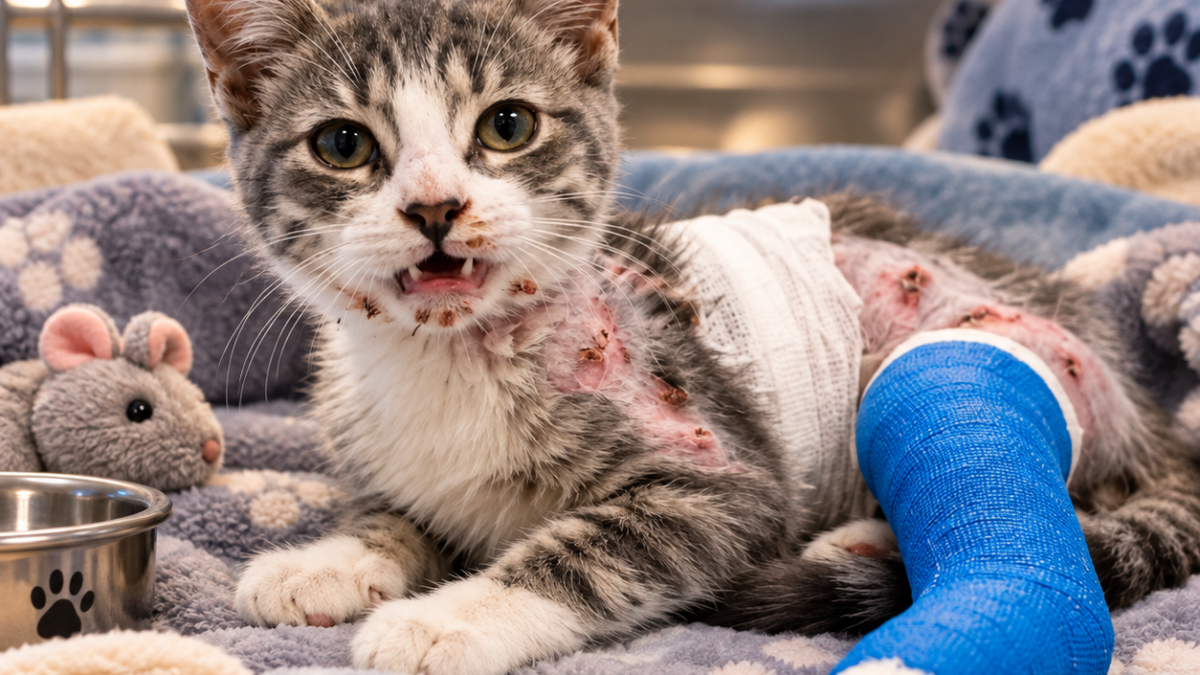
The clinic took a photograph after surgery.
The cat sitting awkwardly on a folded blanket.
Blue cast.
Road rash visible along the shaved right flank.
Pink healing skin.
Tiny scabs along the chin.
One slightly chipped canine showing because her mouth rested partly open.
Green-gray eyes staring straight at the camera.
Alive.
When Marcus saw the image, he thought:
She looks angry.
Good.
Anger meant life.
The state police called later that afternoon.
Traffic cameras had captured a possible vehicle.
Silver Nissan Altima.
2009 to 2012 body style.
One camera showed it near the approximate mile marker.
Another showed it taking Exit 42 several minutes later.
The rear plate was obscured by dirt or a cover.
“Can you enhance it?” Marcus asked.
“We’re working on it.”
“Passenger?”
“Possibly two occupants.”
“Can you see them?”
“No useful facial image.”
Marcus gripped his phone.
“So they get away with it.”
“I didn’t say that.”
“What are the chances?”
Trooper Ruiz was quiet.
“Better if somebody recognizes the car.”
That was how the story went public.
The police department posted a short appeal.
Witness sought.
Silver Nissan.
Animal cruelty investigation.
Approximate time.
Approximate location.
The veterinary clinic asked Marcus if they could share the photograph of the cat.
“To help identify the people?”
“Yes.”
“Do it.”
Within hours, the photograph traveled farther than anyone expected.
Local Facebook groups.
Motorcycle pages.
Animal rescue pages.
The caption was simple.
A young female cat had allegedly been thrown from a moving vehicle on Interstate 81.
A motorcyclist witnessed the incident, stopped, and recovered her alive.
Police were requesting information.
People reacted exactly the way people do online.
Most were horrified.
Some were furious.
Many wanted to donate.
A few insisted the story must be fake.
Someone wrote:
“No motorcycle rider is stopping from 70 mph and running back for a cat.”
Marcus read that twice.
Then handed his phone to Erin.
She read it.
“Well.”
“What?”
“You apparently don’t exist.”
“Good. Bills disappear too?”
“No.”
Another comment said:
“Why would someone spend $1,100 on a random cat? Sounds like a publicity stunt.”
That one bothered him more.
Erin saw his face.
“Stop reading comments.”
“They think I did this for attention.”
“Did you?”
“No.”
“Then who cares?”
“I care.”
“Why?”
Marcus didn’t know.
Maybe because he had spent his life assuming people could distinguish decency from performance.
Maybe because he had never been publicly discussed before.
Maybe because the person who wrote it had reduced forty-five terrifying minutes to a cynical theory from a couch.
Erin took the phone.
“Go make coffee.”
“I don’t want coffee.”
“Then go pretend to make coffee.”
He did.
The cruelest comment came from an account with no profile picture.
“Should’ve left it. It’s just a cat.”
Marcus stared at those words a long time.
Just a cat.
He thought about the small paw against his wrist.
The rapid breathing.
The fractured leg.
Then he thought about the silver car.
Someone in that car had probably thought the same thing.
Just a cat.
That sentence became the difference between two kinds of people in Marcus’s mind.
Not cat people and non-cat people.
Something more fundamental.
People who believed vulnerability reduced value.
And people who believed vulnerability increased responsibility.
Two days after surgery, the cat ate on her own.
Dr. Benton called Marcus.
“She demolished half a can.”
Marcus smiled at work.
His coworker Nate noticed.
“You look happy.”
“Cat ate.”
Nate stared.
“What?”
“The highway cat.”
“Oh.”
Marcus had told everyone.
Repeatedly.
Nate shook his head.
“Dude, you spent a grand on a cat.”
“Eleven hundred.”
“That’s worse.”
Marcus went back to repairing a condenser.
Nate followed.
“You keeping it?”
“Her.”
“Whatever.”
Marcus stopped.
Nate immediately raised both hands.
“Okay. Her.”
“I don’t know.”
“Your wife gonna let you?”
“She’s currently pretending she doesn’t want the cat.”
Nate laughed.
“That’s dangerous.”
Marcus knew.
Erin had already purchased three cat toys.
She claimed the clinic needed them.
The clinic did not.
On day four, Marcus visited.
The cat recognized his jacket before she recognized him.
He knew because Dr. Benton had washed the blood out but the jacket still smelled like leather, road, oil, and him.
Marcus placed it inside the recovery pen.
The cat limped over.
Sniffed.
Then carefully lay on top of it.
Marcus sat on the floor.
“Oh, come on.”
Dr. Benton smiled.
“What?”
“She’s manipulating me.”
“Severely.”
“I have a motorcycle.”
“Yes.”
“I can’t carry a cat.”
“Cars exist.”
“My wife has a car.”
“Problem solved.”
“Don’t encourage this.”
The cat closed her eyes on his jacket.
Marcus stared.
Then quietly:
“You’ve already cost me more than the bike’s worth.”
Dr. Benton corrected him.
“Quarter.”
“Still offensive.”
“Then stop coming.”
Marcus looked at her.
She smiled.
“Exactly.”
Nobody came forward claiming ownership.
The clinic scanned again for a chip.
Nothing.
Animal control checked missing pet reports.
Nothing matching.
The photograph circulated.
No family saying that’s ours.
That made Marcus think about what the cat’s life had looked like before the highway.
Had she been loved?
Had she been a stray someone caught?
Had she belonged to the people who threw her?
That possibility made him sick.
Three days later, the police got their first serious lead.
A woman named Sophia Grant called after seeing the vehicle description.
Her nineteen-year-old cousin, Cody, drove a silver 2011 Altima.
Dirty license plate.
Broken passenger taillight.
He lived twelve miles from Exit 42.
More importantly, Sophia had seen a gray-and-white cat in his apartment the previous week.
“She belonged to his girlfriend,” Sophia told investigators.
Marcus didn’t know that yet.
What he knew was that Trooper Ruiz called and asked whether Marcus would be willing to view photographs of vehicles.
Not people.
Cars.
He went to the station.
Five images.
Similar silver sedans.
Marcus studied them.
Car one: wrong wheels.
Car two: darker tint.
Car three—
He stopped.
There was a dark patch of missing paint near the right side of the rear bumper.
He remembered seeing something similar.
Maybe.
Memory under stress is dangerous.
Ruiz warned him about that.
Marcus said, “This one feels right.”
“Feels?”
“I won’t tell you I’m sure.”
“Good.”
Marcus pointed.
“But I think that’s it.”
It was Cody Grant’s Altima.
Police questioned him.
He denied owning a cat.
Denied being on the interstate.
Denied everything.
Then investigators showed him toll-camera footage from earlier that day.
The car was his.
Cody changed the story.
He had been driving.
His friend had been passenger.
There was no cat.
Then there had been a cat, but it escaped inside the car.
Then it jumped through the open window.
Marcus heard that version and laughed in disbelief.
“Jumped.”
Ruiz nodded.
“At seventy.”
“Yes.”
“With a broken leg after landing.”
“Yes.”
“And he expects people to believe that?”
Ruiz looked tired.
“People expect us to believe a lot.”
The passenger turned out to be Cody’s friend, Brandon Lee.
Twenty.
Not the girlfriend.
Police separated them.
Brandon’s story lasted forty minutes.
Then broke.
The cat belonged to Cody’s girlfriend, Jenna Price.
Jenna had been trying to move out.
She and Cody had been fighting for weeks.
The cat’s original name was Willow.
Jenna had raised her from a kitten.
The day before the highway incident, Jenna told Cody she was leaving.
She went to her sister’s house overnight.
She planned to return with her father and collect the rest of her belongings, including Willow.
Cody texted saying he would “take care of the cat.”
Jenna interpreted that as feeding her.
The next afternoon, Cody and Brandon drove north.
According to Brandon, Cody was angry.
Talking about Jenna.
Saying she cared more about “that stupid cat” than him.
Willow was in a soft carrier on the back seat.
At some point, Cody pulled her out.
Brandon claimed he told him to stop.
Maybe he did.
Maybe he didn’t.
Marcus would never know.
Cody lowered the passenger window.
Brandon was driving.
Cody threw Willow.
Then they kept going.
Brandon did not stop.
That detail mattered to Marcus almost as much as the throw.
They kept going.
Brandon later told police he was shocked.
Scared.
Didn’t know what to do.
Marcus understood fear.
He understood bad decisions.
He understood freezing in terrible moments.
But they drove for another twenty-seven miles.
No call to police.
No stopping.
No turning around.
No anonymous tip.
Nothing.
Marcus had stopped.
Brandon hadn’t.
That became the quiet center of the story.
The difference between seeing and acting.
Jenna learned what happened when police called.
She arrived at the veterinary clinic crying so hard Erin had to help her sit down.
Marcus and Erin had gone there because Willow was being discharged that afternoon.
They had expected to take her home temporarily.
Instead they met the person who actually loved her.
Jenna was twenty-three.
Nursing assistant.
Dark circles beneath her eyes.
Hair pulled into a messy bun.
She carried an old photograph.
Willow as a kitten asleep inside a hoodie.
Same white chin.
Same gray mask.
Same eyes.
“Oh my God.”
Jenna covered her mouth when she saw the cat.
Willow was inside a recovery crate.
Blue cast.
Shaved side.
Healing wounds.
Jenna crouched.
“Willow.”
The cat’s ears moved.
Marcus watched.
Jenna said it again.
“Willow, baby.”
The cat struggled upright.
Her broken leg dragged slightly.
Then she made a low, desperate sound.
Jenna started sobbing.
Dr. Benton opened the crate.
Willow crawled into Jenna’s lap.
No hesitation.
She pressed her face against Jenna’s stomach.
Jenna curled around her.
“I thought you were dead.”
Marcus looked away.
Erin slipped her hand into his.
“I thought he took you to the shelter.”
Jenna cried into the cat’s fur.
“I believed him.”
Willow purred.
Even injured.
Even shaking.
Purring.
Marcus felt relieved.
And strangely disappointed.
That embarrassed him.
This was what they wanted.
A real owner.
Someone Willow knew.
Someone who loved her.
That should have solved everything.
Jenna looked up at Marcus.
“You’re the guy.”
He nodded.
She stood carefully, still holding Willow.
Then hugged him.
Hard.
Marcus froze.
He was not built for surprise hugs.
“Thank you.”
“You don’t have to—”
“No.”
She cried harder.
“You don’t understand.”
Marcus did.
Maybe too well.
“If you weren’t there…”
He shook his head.
“But I was.”
Erin began crying too.
Marcus looked at the ceiling.
“Great. Everybody’s crying.”
Jenna laughed through tears.
Dr. Benton handed her tissues.
Then the practical problem emerged.
Jenna couldn’t take Willow.
Not yet.
She had left Cody’s apartment with almost nothing.
She was sleeping on her sister’s couch.
Her sister had two large dogs that were not cat-safe.
Jenna’s new apartment would not be available for six weeks.
“What about your parents?” Erin asked.
“No pets.”
“Friend?”
“Everyone I know either has animals or leases.”
Silence.
Marcus knew what was coming before anyone looked at him.
“No.”
Erin’s mouth twitched.
“No what?”
“Don’t.”
“I didn’t say anything.”
“You’re all thinking it.”
Jenna looked embarrassed.
“I could call rescues.”
Willow had settled against Marcus’s jacket again.
Traitor.
Erin folded her arms.
“Six weeks.”
Marcus stared.
“Erin.”
“She’s already paid for.”
“That is not how animals work.”
“Temporary.”
“Nothing good follows that word.”
Dr. Benton turned away to hide a smile.
Marcus looked at Jenna.
She looked terrified he would feel pressured.
That decided it.
“Six weeks.”
Jenna’s face changed.
“Really?”
“Six.”
“I’ll pay for food.”
“No.”
“Marcus,” Erin said.
“She needs to save for the apartment.”
Erin raised an eyebrow.
“You just argued with me for the privilege of spending more money.”
“I know.”
“Just checking.”
They drove home with Willow that evening.
Erin drove.
Marcus sat in the back.
Again.
Willow was inside a hard carrier this time, packed with towels.
She hated it.
Her complaints were weak but persistent.
Marcus leaned toward the door.
“You survived seventy miles an hour and now you’re mad about air conditioning?”
Meow.
“Ungrateful.”
Meow.
Erin smiled in the mirror.
“You love her.”
“No.”
“You spent eleven hundred dollars.”
“Financial decisions don’t equal love.”
“You ran two hundred yards on an interstate.”
“Adrenaline.”
“You sleep with the jacket she bled on beside the bed because she likes the smell.”
“That was one night.”
“Three.”
Marcus stared out the window.
“Drive.”
At home, they set Willow up in the guest bedroom.
Low litter box.
Food.
Water.
Blankets.
No furniture she could jump onto.
The first night Marcus slept on the floor beside her.
He told Erin it was because the cat might interfere with the pins.
Erin did not argue.
She didn’t need to.
At 2:00 a.m., Marcus woke with Willow’s head resting against his forearm.
He did not move.
The next six weeks changed all of them.
Willow learned the sound of Marcus’s motorcycle.
The first time he started it in the driveway after bringing her home, she panicked.
Scrambled backward despite the cast.
Marcus killed the engine instantly.
He came inside.
Sat beside her.
“Sorry.”
She stared.
The motorcycle smell was on him.
Helmet.
Gloves.
Road.
Maybe highway.
Maybe memory.
He put the helmet on the floor.
Willow approached slowly.
Sniffed it.
Then stepped away.
For several days, Marcus rolled the bike to the end of the driveway before starting it.
He knew that was absurd.
He did it anyway.
Erin noticed.
“She’s training you.”
“She has trauma.”
“So do you.”
Marcus looked at her.
“What?”
“You haven’t ridden the interstate since.”
He almost denied it.
Then realized.
She was right.
Every commute.
Back roads.
County routes.
Longer.
Slower.
He hadn’t consciously decided.
“You saw her hit.”
Erin softened.
“You’re allowed to be bothered.”
“I didn’t get hurt.”
“That isn’t the rule.”
Marcus looked toward the guest room.
Willow slept.
“I keep seeing the bounce.”
Erin sat beside him.
“What part?”
“All of it.”
He rubbed his hands together.
“I keep thinking if I’d been closer, she might’ve hit me.”
Erin said nothing.
“If I’d been farther back, I wouldn’t have known she was alive.”
Still nothing.
“If there’d been a truck beside me, I couldn’t have stopped.”
His voice became quieter.
“If I had looked at my mirror two seconds earlier…”
“You didn’t.”
“I know.”
“You saw her.”
“I know.”
“You stopped.”
Marcus stared down.
“Everybody else kept going.”
“You don’t know what they saw.”
“No.”
“But you saw.”
That was the part he couldn’t shake.
He saw.
So now he was responsible for what came next.
Maybe not legally.
Morally.
The idea frightened him.
Because how many things did he fail to see every day?
Willow’s physical recovery moved faster than Marcus’s thoughts.
The road rash scabbed.
Pink skin toughened.
Gray fur began returning.
The chipped canine gave her a permanently crooked expression when she yawned.
The cast changed from blue to purple.
Jenna visited every other day.
At first Willow abandoned everyone as soon as Jenna arrived.
Marcus pretended not to be offended.
Then something changed around week three.
Jenna entered.
Willow purred and limped toward her.
After ten minutes she turned.
Looked for Marcus.
Walked back.
Sat on his boot.
Jenna noticed.
“He’s stealing you.”
Marcus said, “I’m not.”
Willow rubbed against his leg.
“She’s confused.”
Jenna smiled.
“She likes you.”
“She tolerates me.”
Erin yelled from the kitchen.
“He sleeps on the floor with her.”
Marcus closed his eyes.
“Marriage is betrayal.”
The criminal case became public after Cody was charged.
Aggravated animal cruelty.
Conspiracy-related charges.
Brandon faced charges too, though lesser because he had not physically thrown Willow and eventually cooperated.
Local news arrived.
Reporters called Marcus.
At first he refused.
Then one television station aired a segment centered almost entirely on Cody’s mug shot and graphic descriptions of Willow’s injuries.
Marcus hated it.
“She becomes a thing that got hurt.”
Erin looked at him.
“What do you want?”
“I want people to know she survived.”
So Marcus agreed to one interview.
The reporter came to their house.
Willow was four weeks into recovery.
Purple cast.
Fur growing back.
She sat beside Marcus on the couch.
The reporter asked:
“What went through your mind when you saw her thrown?”
“Nothing.”
“Nothing?”
“Not really.”
Marcus shrugged.
“I saw something hit the road wrong.”
“What do you mean wrong?”
“Trash tumbles.”
“Bodies bounce.”
The reporter became quiet.
Marcus immediately regretted saying it that way.
But it was true.
“What made you stop?”
“I didn’t decide.”
“Your bike was moving at highway speed.”
“Yes.”
“That could be dangerous.”
“Yes.”
“You could’ve caused an accident.”
Marcus looked uncomfortable.
“I checked traffic.”
“Still.”
“Yes.”
The reporter waited.
Marcus finally said:
“My body had already moved before my brain had an opinion.”
That sentence became the headline.
HE SAW THE BOUNCE AND STOPPED.
It spread everywhere.
Motorcycle groups shared it.
Animal rescues.
Local shelters.
People began sending donations for the vet bill.
Marcus refused initially.
Then Dr. Benton suggested something better.
“Let them donate to the clinic’s emergency animal fund.”
Marcus liked that.
Within a week, nearly $18,000 came in.
Enough to cover surgeries for other injured strays.
That changed the story again.
Willow’s broken leg became vaccines for neglected puppies.
Treatment for a dog hit by a car.
Emergency oxygen for a cat rescued from a house fire.
Marcus liked that much more than being called a hero.
Cody did not.
His family began posting online.
That was where things got ugly.
An aunt claimed the entire incident had been exaggerated.
A cousin said Marcus was “milking the situation for attention.”
Someone using a fake account accused Jenna of inventing abuse because she wanted revenge after the breakup.
Then came a message directly to Marcus.
You should’ve minded your business.
No name.
No photo.
Marcus showed Erin.
She went pale.
“You tell police.”
“Probably troll.”
“Tell them.”
He did.
Two days later another arrived.
Cats die every day.
Then:
You don’t know what happened.
Marcus’s anger frightened him.
He imagined finding the person.
He imagined conversations that didn’t end peacefully.
Erin saw the change.
“Do not become stupid now.”
“I won’t.”
“You’re doing the jaw thing.”
“What jaw thing?”
“The thing where your jaw decides we’re going to prison.”
Despite himself, he laughed.
She touched his arm.
“Let the police handle it.”
Marcus looked toward Willow.
“I hate that guy.”
“I know.”
“I don’t know him.”
“You know enough.”
“No.”
Erin waited.
Marcus continued.
“I know one thing he did.”
“That’s enough to hate what he did.”
“Maybe.”
“But don’t build him bigger than that.”
Marcus looked at her.
“What?”
“He gets the criminal case.”
“He doesn’t get your house.”
“Your sleep.”
“Your marriage.”
“Your whole brain.”
She pointed toward Willow.
“She survived him.”
“Don’t make him the biggest person in her story.”
That sentence changed Marcus’s approach.
He stopped reading Cody’s family posts.
Blocked anonymous accounts.
Stopped searching the case at midnight.
Focused on Willow.
The cast came off after six weeks.
The leg looked thin.
Shaved.
Weak.
She took three steps.
Stopped.
Looked offended by gravity.
Marcus sat across the room with a treat.
“Come on.”
Willow stared.
Jenna sat nearby.
“She’ll do it.”
Marcus moved the treat.
“Worth it.”
Willow limped forward.
One step.
Another.
Another.
Reached him.
Took the treat.
Then bit his finger lightly.
Marcus smiled.
“There’s gratitude.”
Physical therapy began.
Short sessions.
Weight shifting.
Controlled walking.
Willow hated all of it.
But she improved.
Soon she chased a string toy.
Then jumped onto the couch despite being specifically told not to.
Marcus cheered before remembering he should be discouraging jumping.
Jenna laughed.
The problem arrived at the end of week six.
Jenna’s apartment was ready.
Her boxes were moved.
Cat tree assembled.
Food bought.
Windows secured.
Everything prepared.
Marcus knew the date.
He had known for weeks.
Still, when Jenna arrived with the carrier, he felt blindsided.
Willow saw the carrier and disappeared beneath the dining table.
Jenna crouched.
“Come on, baby.”
Nothing.
Marcus sat on the floor.
“You’re going home.”
Willow looked at him.
“With Jenna.”
Her tail moved.
“Your actual person.”
Jenna’s eyes became wet.
Marcus pretended not to notice.
Willow eventually came out.
Jenna picked her up.
The cat accepted it.
Then twisted her head toward Marcus.
He reached over.
Scratched her chin.
“Be normal.”
She rubbed against his fingers.
“Don’t destroy her furniture.”
Jenna laughed.
“Too late. She has a cat tree.”
“That’s not furniture.”
“It cost more than my coffee table.”
Marcus nodded.
“Then definitely destroy it.”
Jenna hugged him.
“Thank you.”
“Stop doing that.”
“Doing what?”
“Making things emotional.”
“You spent six weeks calling her ‘criminal.’”
“She steals.”
“Chicken.”
“Still theft.”
Willow went into the carrier.
The door clicked.
Marcus’s stomach dropped.
Erin walked Jenna to the car.
Marcus didn’t.
He stood in the living room.
Listened to the front door close.
Then to the car pull away.
The house became quiet.
Too quiet.
Marcus looked at the empty water bowl.
The small bed.
The toy mouse under the couch.
“I hate this.”
Erin walked back in.
“You want me to call her?”
“No.”
“You’re lying.”
“Yes.”
Erin sat beside him.
“She belongs with Jenna.”
“I know.”
“Jenna loves her.”
“I know.”
“She’ll visit.”
“I know.”
“You want another cat?”
“No.”
“Didn’t think so.”
Marcus stood.
Went into the garage.
His motorcycle sat there.
For the first time since the accident, he decided to take the interstate.
Maybe to prove something.
Maybe to stop avoiding it.
Erin saw the helmet.
“You sure?”
“Yeah.”
He rode alone.
Traffic moved normally.
Same sound.
Same wind.
Same vulnerability.
At the entrance ramp, his heart rate increased.
He merged.
Sixty-five.
Seventy.
Everything sharpened.
Cars.
Windows.
Shoulders.
Grass.
He reached the approximate mile marker.
He knew it before seeing the sign.
His throat tightened.
There.
Somewhere along that stretch.
He saw Willow hit again in his mind.
Bounce.
Roll.
Grass.
Marcus slowed.
Then continued.
He did not stop.
There was nothing to rescue now.
That realization mattered.
Not every place of trauma required an altar.
Sometimes you passed it.
Sometimes you kept moving because the thing you once feared losing was already safe somewhere else.
Three weeks later, Jenna called.
Not texted.
Called.
Marcus answered.
“What happened?”
“Nothing.”
“You don’t call.”
“I need to ask you something.”
His stomach tightened.
“What?”
“Willow is miserable.”
Marcus sat down.
“What do you mean?”
“She eats.”
“She uses the litter box.”
“Vet says she’s healthy.”
“But she sits by the apartment door.”
Marcus didn’t speak.
“She does it around five every afternoon.”
“When I used to come home?”
Jenna said softly, “Yeah.”
His chest tightened.
“She hears motorcycles and runs to the window.”
“Probably doesn’t mean anything.”
“Marcus.”
He rubbed his face.
“What are you asking?”
“I don’t know.”
Jenna was quiet.
“I love her.”
“I know.”
“But maybe loving something doesn’t mean insisting it belongs only to you.”
Marcus frowned.
“She does belong to you.”
“She lived with me eight months before Cody.”
“Then three months with him.”
“Then…”
She hesitated.
“You stopped.”
Marcus said nothing.
Jenna continued.
“She almost died and woke up with your jacket around her.”
“That doesn’t mean—”
“No.”
“I know.”
“But she chose you too.”
Marcus hated how much he wanted the sentence to be true.
“What do you want to do?”
“Would you take her on weekends?”
He laughed once.
“What?”
“Shared custody.”
“For a cat.”
“My sister says we’re insane.”
“Your sister’s right.”
“So?”
Marcus looked toward the garage.
His motorcycle helmet sat on a shelf.
“Motorcycle.”
“I know.”
“I can’t transport her.”
“I can bring her.”
“That seems ridiculous.”
“Probably.”
“When?”
“Friday.”
Willow arrived Friday.
The moment Jenna opened the carrier, Willow ran into Marcus’s house.
Not cautiously.
Straight through the kitchen.
Around the couch.
Into the hallway.
Then returned.
Marcus crouched.
She jumped into his chest.
He nearly fell backward.
“Okay.”
Willow rubbed her face against his beard.
“Calm down.”
Erin cried from the kitchen.
Marcus looked over.
“You are embarrassing.”
“You’re crying too.”
“I have allergies.”
“To cats?”
“Apparently.”
Weekends became routine.
Then long weekends.
Then every other week.
Willow had two homes.
Two sets of bowls.
Two cat trees.
Two people she waited for.
Jenna eventually joked, “She’s the most divorced cat in Virginia.”
But something more important was happening.
Jenna was rebuilding too.
She started trauma counseling.
Changed phone numbers.
Changed jobs.
Moved again after Cody’s relatives learned her address.
Testified at preliminary hearings.
Stopped apologizing every time she expressed fear.
Marcus saw the difference slowly.
The first time they met, Jenna looked like someone expecting to be blamed.
Months later, she looked people directly in the eye.
When asked why she hadn’t left Cody sooner, she stopped explaining.
“I left when I was able to.”
Period.
No apology.
No defense.
Marcus respected that.
The case took nine months.
Cody’s attorney argued there was no direct video of the actual throw.
The highway cameras did not show the event clearly.
Marcus’s eyewitness testimony became critical.
He hated court.
Hated the suit.
Hated sitting under fluorescent lights.
Hated seeing Cody ten yards away.
Cody looked ordinary.
That bothered Marcus more than if he’d looked monstrous.
Twenty-four years old.
Clean haircut.
Button-down shirt.
Could have been a coworker.
Neighbor.
Guy standing behind you at a grocery store.
Cruelty did not mark the face.
Marcus knew that, intellectually.
Seeing it still disturbed him.
When called to testify, Marcus described everything.
Silver sedan.
Passenger window.
Arm.
Gray object.
Bounce.
Legs.
His stop.
His run.
The grass.
The injured cat.
Defense counsel tried to make uncertainty matter.
“You were operating a motorcycle at approximately seventy miles per hour?”
“Yes.”
“Your attention was divided.”
“My attention was on the road.”
“You saw this event for how long?”
“Seconds.”
“So you cannot say with absolute certainty that Mr. Grant intentionally threw an animal.”
Marcus looked toward Cody.
Then back.
“I watched his arm move outside the window.”
“You cannot know his intention.”
“I know the cat didn’t roll the window down.”
A few people reacted.
The judge called for quiet.
The attorney continued.
“Could the cat have jumped?”
Marcus paused.
He knew anger would hurt his credibility.
So he answered slowly.
“I’ve owned cats now.”
A faint smile touched the prosecutor’s face.
“Cats jump.”
Marcus nodded.
“But they don’t normally jump from somebody’s hand.”
The defense attorney changed subjects.
Marcus stepped down.
In the hallway afterward, Cody’s mother approached him.
She was crying.
Marcus immediately felt uncomfortable.
“My son isn’t a monster.”
He didn’t answer.
“He made a mistake.”
Still nothing.
“He was angry.”
Marcus looked at her.
“I don’t know what you want me to say.”
“You’ve helped ruin his life.”
There it was.
Marcus felt Erin’s hand on his arm.
He kept his voice calm.
“No.”
“Your testimony—”
“He opened the window.”
Her mouth tightened.
“You don’t know him.”
Marcus nodded.
“That’s true.”
“He’s been depressed.”
“I’m sorry.”
“He and Jenna were toxic together.”
Marcus’s expression changed.
“She didn’t throw the cat.”
Cody’s mother flinched.
“I’m not defending it.”
“You are.”
“No.”
“You’re explaining it until it becomes smaller.”
Her face reddened.
Marcus continued.
“Willow’s leg doesn’t care why he was angry.”
Erin squeezed his arm.
Enough.
Marcus stepped back.
“I hope your son gets help.”
He meant it.
“But help comes after responsibility.”
Then he walked away.
The case eventually ended in a plea.
Cody admitted intentionally throwing Willow from the moving car during an argument related to Jenna.
He received a custodial sentence, probation afterward, restitution for veterinary costs, mandatory psychological counseling, and a prohibition on owning animals during probation.
Brandon received probation, community service, and animal welfare education for his role and failure to report the incident.
Some people online said the punishment was too harsh.
Others said it was nowhere near enough.
Marcus stopped reading.
What mattered was the court record.
Willow had been thrown.
Marcus had seen correctly.
Jenna had not imagined Cody’s capacity for cruelty.
And Cody could no longer rewrite what happened.
The restitution check for $1,107.63 arrived months later.
Marcus stared at it.
Erin asked, “What are you going to do?”
“Buy tires.”
She smiled.
“Practical.”
He looked at the check again.
Then shook his head.
The emergency fund at Dr. Benton’s clinic had helped seven animals since the news story.
One was a dog named Frank whose owner had lost his job.
One was a kitten with a bowel obstruction.
One was an elderly cat whose owner couldn’t afford emergency treatment.
Marcus signed the restitution check over to the fund.
Erin discovered it when Dr. Benton mailed a thank-you card.
“You donated it.”
Marcus shrugged.
“You needed tires.”
“Bought tires.”
“With what?”
“Overtime.”
She stared at him.
“What?”
“I married an idiot.”
“Known issue.”
She hugged him anyway.
A year after the highway incident, Marcus and Erin attended a fundraiser at the clinic.
They did not bring Willow.
Technically the invitation said well-behaved pets were welcome.
Willow did not qualify.
A photograph from the first night hung near the entrance.
Gray-and-white kitten.
Blue cast.
Raw pink skin.
Broken canine visible.
Marcus stopped.
He had not looked closely at that image in months.
“She was tiny.”
Erin stood beside him.
“She still is.”
“No.”
He pointed.
“Look.”
Willow’s eyes in that photograph bothered him.
Not pain exactly.
Shock.
An animal who had experienced something impossible and hadn’t yet learned what came next.
Beside it was a newer photograph.
Willow sitting on Marcus’s motorcycle seat in the garage.
Harness on.
Healthy leg.
Full fur.
Still crooked little tooth.
Jenna had taken the picture.
Dr. Benton had captioned it:
ASPHALT — ONE YEAR LATER.
Marcus frowned.
“I told you I hate that name.”
Erin laughed.
The Asphalt issue had begun months earlier.
Jenna called her Willow.
Always.
Marcus had tried.
He really had.
But one evening during recovery, Willow knocked over a plant, dragged dirt across the kitchen, stole chicken from his plate, and then hissed at the vacuum.
Marcus had looked at her and said:
“You survived highway asphalt and now you’re afraid of a vacuum?”
Erin said, “Asphalt.”
Marcus looked over.
“No.”
“That’s her biker name.”
“She has a name.”
“Willow.”
“Yes.”
“Willow at Jenna’s.”
“No.”
“Asphalt here.”
“Absolutely not.”
Then Erin called:
“Asphalt.”
The cat turned.
Marcus stared.
Traitor.
The name stuck.
At Jenna’s apartment, Willow.
At Marcus and Erin’s house, Asphalt.
The cat responded to both because food was involved.
Marcus eventually had a small identification tag made.
WILLOW “ASPHALT” PRICE-HALE
Three phone numbers barely fit.
Jenna cried when she saw it.
Marcus pretended to have something in his eye.
The fundraiser raised nearly $40,000.
Marcus spoke for two minutes.
He was terrible at speeches.
He said so first.
People laughed.
Then he looked toward the original photograph.
“I’ve been called a hero a lot because of that picture.”
He shook his head.
“I don’t like it.”
The room quieted.
“I pulled over.”
“That mattered.”
“But that cat did the hard part.”
“She hit pavement at highway speed.”
“She survived.”
“The veterinarian put her back together.”
“Police investigated.”
“People donated.”
“Her owner had the courage to testify against someone she was afraid of.”
“My wife drove thirty miles in slippers.”
People laughed.
Erin covered her face.
Marcus smiled.
“Lots of people did something.”
He paused.
“That matters to me because cruelty makes us think one terrible person gets to control the whole story.”
He looked toward Jenna.
“He doesn’t.”
“Not unless everybody else chooses to do nothing.”
The room became very quiet.
Marcus finished:
“I don’t think the lesson is that everybody needs to stop on an interstate.”
“Please don’t.”
Another laugh.
“The lesson is simpler.”
“If something living is hurting and you can safely help…”
He shrugged.
“Look.”
“Actually look.”
“That’s where everything starts.”
Then he sat down.
Jenna hugged him afterward.
Again.
He still disliked surprise hugs.
Less than before.
The second anniversary passed quietly.
Willow’s repaired leg developed mild arthritis in cold weather.
Dr. Benton said that might happen.
Marcus bought heated pet stairs for the couch.
Erin caught him assembling them.
“You spent ninety dollars.”
“They have orthopedic foam.”
“For a cat.”
“Asphalt is an athlete.”
“She walks eleven feet to her food bowl.”
“Retired athlete.”
Jenna eventually moved into a townhouse close enough that Willow’s arrangement became easier.
Weekdays with Jenna.
Most weekends with Marcus and Erin.
There was no legal document.
No argument.
Just people doing what made the animal happiest.
Willow learned the sound of Jenna’s Honda.
And Marcus’s Yamaha.
The motorcycle fear faded slowly.
Marcus never forced it.
First she tolerated the engine from inside.
Then from the screened porch.
Then from Erin’s arms in the driveway.
Eventually she walked toward the parked motorcycle on her own.
Sniffed the tire.
Sniffed the exhaust.
Jumped onto the seat.
Marcus froze.
Erin took the photograph that ended up at the fundraiser.
“Don’t start the engine.”
“I am not suicidal.”
Willow sat there like she owned it.
Marcus scratched her chin.
“You have terrible associations with transportation.”
Her crooked canine showed.
He smiled.
“You’re weird.”
The biggest change happened in Marcus himself.
He began volunteering with a local motorcycle group that transported emergency supplies for animal rescues.
Not animals on motorcycles.
Despite repeated jokes.
Food.
Blankets.
Medication.
Donations.
The group eventually organized an annual ride called Look Twice.
Originally it was about motorcycle safety.
Then the phrase took on another meaning.
Look twice.
For riders.
For animals.
For people stranded on shoulders.
For anything easy to ignore at speed.
Marcus liked the name.
He hated the attention.
Erin handled social media because she said Marcus’s online communication style “resembled an irritated park ranger.”
Three years after the incident, a teenage boy approached Marcus at one of the charity rides.
Sixteen.
Nervous.
“My mom says I should tell you something.”
Marcus waited.
The boy rubbed his hands.
“Last winter, I saw a dog near the highway.”
Marcus listened.
“I was riding with my friend.”
“We almost kept going.”
“But I remembered the cat story.”
“So we turned around.”
The dog had escaped through a broken fence.
Collar.
Phone number.
Family found within an hour.
The boy smiled.
“Nothing dramatic.”
Marcus shook his head.
“No.”
“Still counts.”
The kid nodded.
That moment meant more to Marcus than every article ever written about him.
Years passed.
Willow turned eight.
Then ten.
Gray appeared around her muzzle.
The repaired leg remained slightly stiff.
She couldn’t jump as high.
Marcus built ramps.
Erin accused him of creating “cat infrastructure.”
He did not deny it.
Jenna married a man named Aaron.
Good man.
Quiet.
Willow approved after stealing turkey from his sandwich.
Jenna’s wedding reception included a framed photograph near the guestbook.
Not the injury photo.
The one from after recovery.
Willow on Marcus’s motorcycle.
Beneath it Jenna had written:
THE GIRL WHO GOT US HERE.
Marcus stared at the caption.
Jenna appeared beside him.
“You’re crying.”
“No.”
“You absolutely are.”
“Wedding lighting.”
“Sure.”
She smiled.
“Thank you.”
“Don’t start.”
“For stopping.”
Marcus looked at her.
After all those years, she still meant that exact moment.
The shoulder.
The bike.
The run.
He nodded.
“You’re welcome.”
He finally allowed himself to say it.
At twelve, Willow developed kidney disease.
Manageable at first.
Special food.
Fluids.
Medication.
Jenna handled most daily care.
Marcus drove to appointments when possible.
The veterinarian was still Dr. Benton.
More gray hair now.
Same glasses.
During one checkup, she examined Willow’s old leg.
“You know, this repair held beautifully.”
Marcus looked at the faint scar.
“Good work.”
“Good patient.”
Willow immediately tried to bite the thermometer technician.
Dr. Benton laughed.
“Relatively.”
One cold January evening, Jenna called.
Marcus knew from the first breath.
“She isn’t eating.”
He drove over.
No motorcycle.
Truck.
Snow threatened.
Willow lay in her bed beside the radiator.
Smaller than he remembered.
Too light.
Jenna sat on the floor.
Aaron beside her.
Erin arrived ten minutes later.
Four adults around one cat.
Willow opened her eyes when Marcus touched her.
He said the name he used.
“Hey, Asphalt.”
One ear moved.
Jenna smiled through tears.
Willow lifted her head.
Marcus put his hand beside her.
She rested one paw across his fingers.
That gesture transported him thirteen years backward.
Interstate shoulder.
Black motorcycle jacket.
Tiny paw against his wrist.
“You can hold on.”
He had told her then.
Now the words felt wrong.
Marcus lowered his face near hers.
“You don’t have to.”
Jenna cried harder.
Marcus stroked Willow’s head.
“You hear me?”
Her eyes half closed.
“You don’t have to hold on for us.”
The house was silent.
No highway.
No engines.
No wind.
No pavement.
Just warmth.
People she knew.
Hands she trusted.
Willow died the next morning at the veterinary clinic, with Jenna holding her and Marcus’s old motorcycle jacket folded underneath her body.
The same jacket.
Repaired twice.
Faded.
No blood left.
But Marcus had never thrown it away.
Dr. Benton gave them time.
Jenna pressed her face against Willow’s head.
Erin held Jenna.
Aaron stood behind them.
Marcus remained near the table.
One hand against the jacket.
For years, people had turned Willow’s survival into a story about holding on.
Marcus finally understood there was another half.
Sometimes survival means refusing to let go.
Sometimes peace means realizing you no longer need to grip anything at all.
They cremated her.
Jenna kept half the ashes.
Marcus kept half.
He thought dividing ashes sounded strange.
Then realized Willow had spent most of her life belonging fully to more than one place.
Why stop now?
Marcus placed his portion in a small wooden box.
No dramatic inscription.
Just:
WILLOW
“ASPHALT”
SHE WAS SEEN.
That last line mattered.
Not because no one else on the highway had cared.
Marcus never knew what the other drivers saw.
Some probably saw nothing.
Some maybe noticed too late.
He stopped blaming imaginary strangers years earlier.
The words meant something simpler.
Her attacker treated her like an object.
Marcus saw an animal.
Jenna saw family.
Erin saw responsibility.
Dr. Benton saw a patient.
Police saw evidence.
Donors saw a chance to help.
Thousands of strangers saw a life worth saving.
Cruelty had tried to turn her into trash.
Attention turned her back into somebody.
Marcus kept riding into his sixties.
Slower.
Less often.
He sold the Yamaha eventually.
That hurt.
His knees made the decision.
The buyer was a young man named Daniel.
Twenty-seven.
Marcus gave him maintenance records.
Spare key.
Tools.
Then pointed toward a tiny scratch near the rear seat.
“Leave that.”
Daniel frowned.
“Why?”
Marcus smiled.
“A cat did it.”
Daniel stared.
“The highway cat?”
Marcus hated that people still recognized the story.
But this time he nodded.
“Yeah.”
“Asphalt?”
“Willow.”
“Right.”
“Both.”
Daniel looked at the scratch.
“I’ll leave it.”
“Good.”
Before Daniel rode away, Marcus gave him advice.
Not about speed.
Not about cornering.
Not even about helmets.
“You ride long enough, you’ll see things.”
Daniel nodded.
“Accidents.”
“Animals.”
“People broken down.”
“Sometimes you’ll be able to help.”
“Sometimes you won’t.”
Marcus looked him straight in the eye.
“Don’t be stupid.”
“Don’t get yourself killed.”
“But don’t become so focused on getting where you’re going that you stop seeing what you’re passing.”
Daniel nodded more seriously.
Marcus stepped back.
The motorcycle engine started.
For a second, the sound made him expect Willow to appear at a window.
Old habit.
She didn’t.
The bike pulled away.
Marcus watched until it disappeared.
Then went inside.
Erin sat at the kitchen table.
“You okay?”
“Yeah.”
“You sold your girlfriend.”
“Motorcycle.”
“Same thing.”
Marcus smiled.
On the shelf behind her sat the wooden box.
Below it, one photograph.
Not the veterinary photo.
Not the cast.
Not wounds.
Not even the motorcycle.
It showed Willow asleep on Marcus’s chest during one of her weekends at their house.
Older.
Healthy.
All four paws loose.
No fear.
Marcus looked at it often.
That was the photograph he wished had gone viral.
Not broken.
Not bleeding.
Not proof of cruelty.
Proof of what came afterward.
Because the highway was only a few seconds of Willow’s life.
Terrible seconds.
Seconds that nearly ended everything.
But they did not own the remaining years.
That was important.
We have a strange habit of defining survivors by the worst thing that happened to them.
The abandoned dog.
The abused child.
The battered wife.
The veteran with trauma.
The cat thrown from a car.
The description becomes the identity.
Marcus learned from Willow how incomplete that was.
She was not the cat who got thrown out of a car.
She was the cat who stole Marcus’s chicken.
The cat who hated the vacuum.
The cat with two names and three phone numbers on her tag.
The cat who slept on Jenna’s chest when nightmares returned.
The cat who knew the exact sound of Marcus’s motorcycle.
The cat who scratched Aaron because he attempted to trim her nails.
The cat who lived in two homes.
The cat who cost $1,107.63 and inspired eighteen thousand dollars in emergency veterinary donations.
The cat who made a frightened young woman testify.
The cat who made one stubborn motorcycle rider learn that stopping could be just as important as moving.
The highway was something that happened to her.
It was not who she was.
Years later, Marcus still remembered the original moment perfectly.
Window lowers.
Arm appears.
Gray body flies.
Impact.
Bounce.
He never managed to forget.
But memory changed shape.
At first, whenever he remembered the bounce, rage came first.
Then guilt.
Then fear.
Eventually something else replaced them.
The shoulder.
He remembered the shoulder.
His tires crossing the white line.
The bike slowing.
His boot touching gravel.
The stand going down.
Running.
That was the part Marcus chose to keep.
Because he couldn’t control the arm.
Couldn’t control the throw.
Couldn’t change the impact.
He controlled the stop.
Maybe that’s all any of us really controls.
Not every cruel thing that happens in front of us.
Not every person who chooses badly.
Not every injury.
Not every loss.
Just whether we notice.
Whether we look away.
Whether we keep moving because stopping is inconvenient.
Or whether, when it is safe and possible, we put our foot down.
Years after Willow was gone, Marcus was driving home with Erin when they passed a stalled minivan on a rural road.
Hazard lights.
Woman standing beside it.
Two kids inside.
Marcus drove past.
Erin looked at him.
He looked at her.
They said nothing.
At the next driveway, Marcus turned around.
Erin smiled.
“What?”
“Nothing.”
He pulled behind the minivan.
The alternator had failed.
No cell service.
Marcus drove the family to a gas station.
Took twenty minutes.
Nothing dramatic.
Nobody took a photo.
Nobody posted it.
No article.
No viral headline.
When Marcus returned to the truck, Erin asked:
“You always gonna do that now?”
“Do what?”
“Stop.”
He thought.
“Probably.”
“Because of Willow?”
Marcus looked through the windshield.
Maybe.
Maybe not.
Then he said:
“I guess I learned I don’t like wondering what would’ve happened if I had.”
Erin nodded.
They drove home.
That was the real legacy of the cat people called Asphalt.
Not the cast.
Not the cruelty case.
Not the money.
Not even survival.
It was the interruption.
The second where one person’s destination stopped being the most important thing in the world because something helpless needed him more.
Marcus had been going home.
Someone else was hurting.
So he stopped.
That’s it.
That’s the story.
Someone threw a young cat out of a moving car at nearly seventy miles an hour.
She struck the pavement.
Her tibia snapped.
Skin tore from her side.
A tooth chipped.
Her body rolled into the grass.
A silver sedan continued north.
The people who caused it kept driving.
Behind them came a motorcycle.
The rider saw something hit the road.
For half a second, he thought it was garbage.
Then it bounced.
And garbage doesn’t bounce like that.
Marcus moved toward the shoulder before he had time to think.
Brakes.
Gravel.
Kickstand.
Running boots.
Traffic roaring beside him.
Two hundred yards back.
A sound in the grass.
A tiny gray-and-white cat breathing too fast.
Alive.
He wrapped her inside the most protective thing he had.
His own jacket.
Then he sat beside an interstate holding an animal he’d never seen before and waited thirty minutes for his wife because there was no safe way to carry her on a motorcycle.
He paid the hospital bill.
Helped police.
Opened his home.
Helped her owner rebuild a life.
Loved the cat when she wasn’t technically his.
Let her go home.
Took her back when she needed two homes.
And years later, when she no longer had the strength to hold on, he was there for that too.
People sometimes asked Marcus why he stopped.
He never developed a sophisticated answer.
He didn’t weigh the cost.
He didn’t calculate the risk to his evening.
He didn’t decide whether a stray cat was worth $1,100.
He didn’t consider whether somebody else might handle it.
He saw the bounce.
His hands moved.
His bike slowed.
He stopped.
Sometimes that’s the distance between cruelty and mercy.
Not a heroic person.
Not a perfect person.
Just one person paying attention.
One person refusing to treat a living thing like debris on the side of the road.
One person who sees something everyone else might mistake for garbage and says:
No.
That’s alive.
And that is enough reason to stop.








